
Introduction
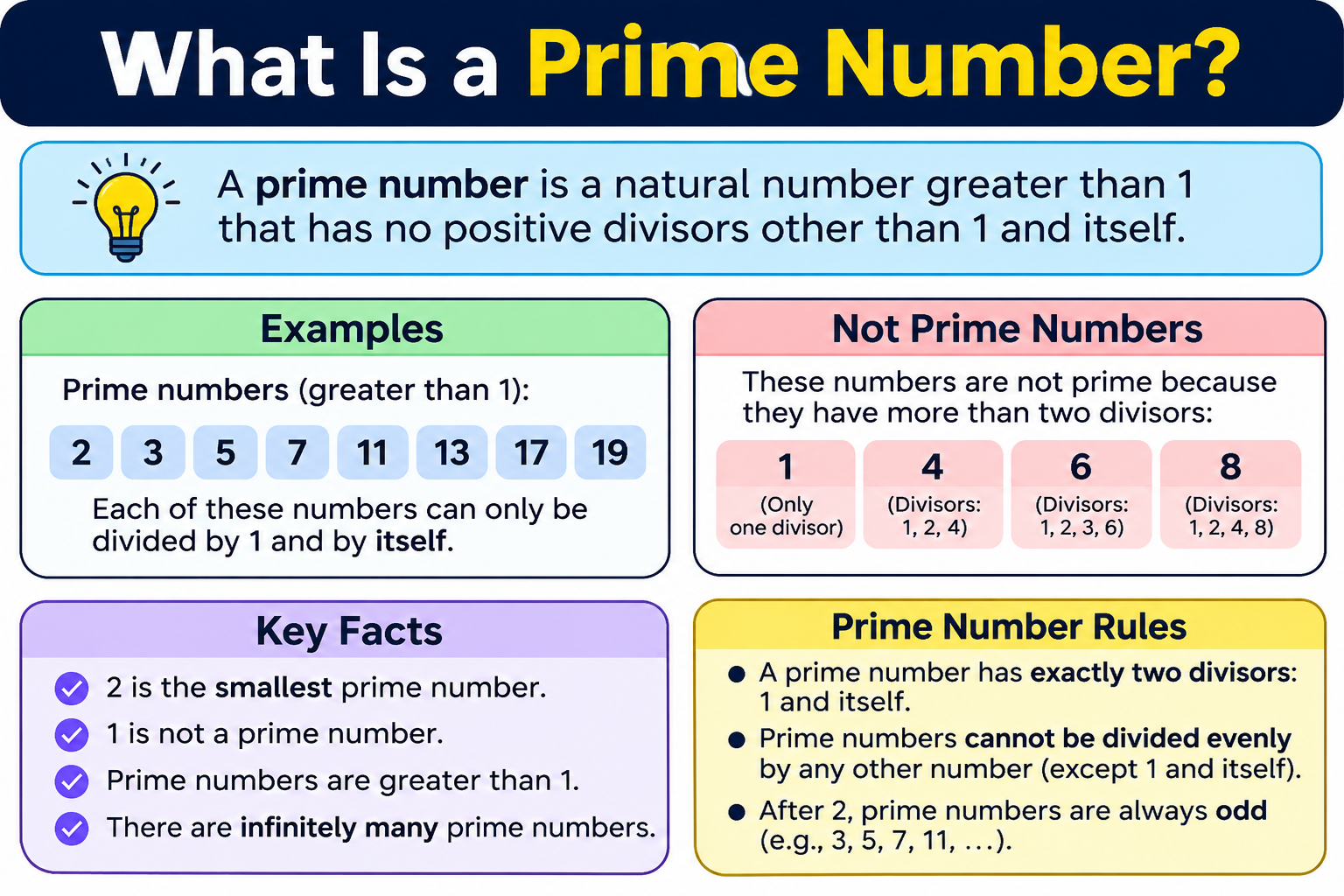
Take a moment to look at these numbers: 2, 3, 5, 7, and 11. What do they all have in common? Each one can only be divided evenly by two numbers — 1 and the number itself. That shared characteristic is exactly what makes them prime numbers.
A prime number is a whole number greater than 1 that has exactly two positive factors: 1 and itself.
That definition is short, but it carries a lot of meaning. To fully understand prime numbers, you need to understand what factors are, what divisibility means, and how prime numbers differ from the numbers around them.
Prime numbers are one of the oldest and most important ideas in mathematics. From simplifying fractions to powering internet security systems, they appear in far more places than most students expect. This article explains everything you need to know about prime numbers — from the basic definition to factorization, patterns, common mistakes, and real-world applications.
Key Takeaways
-
A prime number is a whole number greater than 1 with exactly two positive factors: 1 and itself.
-
The number 1 is not prime because it has only one positive factor.
-
The number 2 is the only even prime number.
-
All prime numbers greater than 2 are odd, but not all odd numbers are prime.
-
Composite numbers have more than two positive factors.
-
Prime factorization breaks any composite number into a product of prime numbers.
-
Prime numbers are infinite — there is no largest prime number.
What Is a Prime Number?
A prime number is a whole number greater than 1 that has exactly two positive factors: 1 and the number itself.
Let us break that definition into parts so nothing is unclear.
Whole numbers are the counting numbers: 1, 2, 3, 4, 5, and so on. They do not include fractions, decimals, or negative numbers.
Greater than 1 is an essential condition. The number 1 is excluded from the definition for a specific mathematical reason that is explained later in this article.
Factors are numbers that divide evenly into another number without leaving a remainder. Every number has at least two factors: 1 and itself. A prime number has exactly those two — no more.
For example:
- 7 can be divided evenly by 1 and by 7, and nothing else. So 7 is prime.
- 9 can be divided evenly by 1, 3, and 9. That is three factors. So 9 is not prime.
The key phrase is exactly two positive factors. Not one. Not three. Exactly two.
Prime Number Examples
Here are the first several prime numbers and a short explanation of why each qualifies.
2 — Factors: 1 and 2. Only two factors, so 2 is prime.
3 — Factors: 1 and 3. Only two factors, so 3 is prime.
5 — Factors: 1 and 5. No other number divides evenly into 5, so it is prime.
7 — Factors: 1 and 7. Dividing 7 by 2, 3, 4, 5, or 6 all leave remainders. So 7 is prime.
11 — Factors: 1 and 11. Not divisible by any number between 2 and 10. So 11 is prime.
13 — Factors: 1 and 13. Prime.
17 — Factors: 1 and 17. Prime.
19 — Factors: 1 and 19. Prime.
23 — Factors: 1 and 23. Prime.
29 — Factors: 1 and 29. Prime.
These ten numbers — 2, 3, 5, 7, 11, 13, 17, 19, 23, 29 — are the first ten prime numbers. Memorising them is genuinely useful for exams.
Why Is 2 the Only Even Prime Number?
This is one of the most commonly asked questions about prime numbers, and the answer is straightforward once you think about it carefully.
An even number is any number divisible by 2. So every even number has 2 as one of its factors. That means every even number greater than 2 has at least three factors: 1, 2, and itself. Having three or more factors means it cannot be prime.
For example:
- 4 has factors 1, 2, and 4. Not prime.
- 6 has factors 1, 2, 3, and 6. Not prime.
- 8 has factors 1, 2, 4, and 8. Not prime.
Now consider 2 itself. Its only factors are 1 and 2. That is exactly two positive factors. So 2 is prime.
The number 2 is special because it is the only even number that does not have another even number as a factor — other than itself. It is the smallest prime and the only even one. Every prime number after 2 must be odd.
Is 1 a Prime Number?
No. The number 1 is not a prime number.
This is a very common exam question. The reason 1 is excluded is simple: a prime number must have exactly two positive factors. The number 1 has only one positive factor, which is itself.
Factors of 1: just 1.
Since 1 does not meet the condition of having exactly two positive factors, it does not qualify as prime.
It is also not a composite number, because composite numbers must be greater than 1 and have more than two factors. The number 1 is in its own category — it is called a unit.
This distinction matters in mathematics because including 1 as a prime would break an important theorem called the Fundamental Theorem of Arithmetic, which states that every whole number greater than 1 can be expressed as a unique product of prime numbers. If 1 were prime, that uniqueness would collapse.
Prime Numbers vs Composite Numbers
A composite number is a whole number greater than 1 that has more than two positive factors. In other words, it can be divided evenly by at least one number other than 1 and itself.
| Feature | Prime Number | Composite Number |
|---|---|---|
| Number of factors | Exactly 2 | More than 2 |
| Smallest example | 2 | 4 |
| Examples | 2, 3, 5, 7, 11, 13 | 4, 6, 8, 9, 10, 12 |
| Divisible by other numbers? | No | Yes |
| Factor pairs | Only 1 × itself | Multiple pairs |
| Can be broken into smaller factors? | No | Yes |
For example, 12 is composite because it can be divided by 1, 2, 3, 4, 6, and 12. That is six factors — far more than two.
A number must be one or the other (prime or composite), with the single exception of the number 1, which is neither.
What Are Factors?
A factor of a number is any whole number that divides into it evenly, leaving no remainder.
For example:
Factors of 12: 1, 2, 3, 4, 6, 12
- 12 ÷ 1 = 12 (no remainder)
- 12 ÷ 2 = 6 (no remainder)
- 12 ÷ 3 = 4 (no remainder)
- 12 ÷ 4 = 3 (no remainder)
- 12 ÷ 6 = 2 (no remainder)
- 12 ÷ 12 = 1 (no remainder)
Factors of 13: 1, 13
- 13 ÷ 1 = 13 (no remainder)
- 13 ÷ 13 = 1 (no remainder)
- No other number divides evenly into 13.
This is how factors help you identify prime numbers. When a number has exactly two factors — 1 and itself — it is prime. When it has more, it is composite.
Finding all the factors of a number is a practical skill that sits at the heart of working with prime numbers, simplifying fractions, and solving problems involving highest common factors and lowest common multiples.
What Is Divisibility?
Divisibility simply means whether one number divides evenly into another without leaving a remainder.
For example, 15 is divisible by 3 because 15 ÷ 3 = 5 exactly. But 15 is not divisible by 4 because 15 ÷ 4 = 3 remainder 3.
Knowing divisibility rules helps you test whether a number is prime much more quickly.
Basic divisibility rules:
| Divisor | Rule | Example |
|---|---|---|
| 2 | The number ends in 0, 2, 4, 6, or 8 | 38 is divisible by 2 |
| 3 | The sum of the digits is divisible by 3 | 123: 1+2+3=6, divisible by 3 |
| 5 | The number ends in 0 or 5 | 45 is divisible by 5 |
| 10 | The number ends in 0 | 70 is divisible by 10 |
These rules let you quickly rule out many numbers when checking whether something is prime. If a number ends in an even digit, for instance, it is divisible by 2 and therefore not prime (unless it is 2 itself).
How to Find Prime Numbers
Finding prime numbers follows a logical process. Here is a straightforward step-by-step method suitable for beginners.
Step 1: Choose a whole number greater than 1.
Step 2: Check whether the number is divisible by any whole number other than 1 and itself.
Step 3: Start with small numbers: try dividing by 2, then 3, then 5, and continue upwards.
Step 4: If you find even one number that divides evenly into it, the number is composite — not prime.
Step 5: If no number between 2 and one less than the number divides evenly into it, then it is prime.
Example — is 19 prime?
- Is 19 divisible by 2? No.
- Is 19 divisible by 3? No (1+9=10, not divisible by 3).
- Is 19 divisible by 4? No.
- Is 19 divisible by 5? No (does not end in 0 or 5).
- Is 19 divisible by 6, 7, 8, or 9? No.
- Conclusion: 19 is prime.
Example — is 21 prime?
- Is 21 divisible by 2? No.
- Is 21 divisible by 3? Yes — 2+1=3, which is divisible by 3. So 21 ÷ 3 = 7.
- Conclusion: 21 is not prime. It is composite (factors: 1, 3, 7, 21).
How to Check if a Number Is Prime
For a more efficient method, mathematicians use a simple principle: you only need to test divisibility up to the square root of the number. If no number up to the square root divides evenly into it, the number is prime.
For most students at GCSE or beginner level, however, simply testing small divisors (2, 3, 5, 7, 11, and 13) will cover the vast majority of cases you will encounter.
Examples:
17 — Test divisibility by 2, 3, 5, 7. None divide evenly. Prime.
25 — 25 ÷ 5 = 5. Divisible by 5. Composite. (Factors: 1, 5, 25)
31 — Test 2, 3, 5. None divide evenly. Prime.
37 — Test 2, 3, 5. None divide evenly. Prime.
49 — 49 ÷ 7 = 7. Divisible by 7. Composite. (Factors: 1, 7, 49)
53 — Test 2, 3, 5, 7. None divide evenly. Prime.
Notice that 49 looks prime at a glance — it is odd and not divisible by 2, 3, or 5 — but 7 × 7 = 49, so it is composite. This is why checking carefully matters.
Prime Numbers Up to 100
There are exactly 25 prime numbers between 1 and 100. The number 1 is not included.
| 2 | 3 | 5 | 7 | 11 |
| 13 | 17 | 19 | 23 | 29 |
| 31 | 37 | 41 | 43 | 47 |
| 53 | 59 | 61 | 67 | 71 |
| 73 | 79 | 83 | 89 | 97 |
These 25 numbers are worth becoming familiar with. Many exam questions involve identifying whether a number in this range is prime.
Prime Number Chart
| Range | Prime Numbers |
|---|---|
| 1–10 | 2, 3, 5, 7 |
| 11–20 | 11, 13, 17, 19 |
| 21–30 | 23, 29 |
| 31–40 | 31, 37 |
| 41–50 | 41, 43, 47 |
| 51–60 | 53, 59 |
| 61–70 | 61, 67 |
| 71–80 | 71, 73, 79 |
| 81–90 | 83, 89 |
| 91–100 | 97 |
You can see from this chart that prime numbers become less frequent as numbers grow larger. In the range 1–10 there are four primes, but in the range 91–100 there is only one.
Sieve of Eratosthenes
The Sieve of Eratosthenes is a method developed by the ancient Greek mathematician Eratosthenes for finding all prime numbers up to a given limit. It remains one of the most elegant approaches to the problem.
Here is how it works for numbers from 1 to 100:
Step 1: Write out all whole numbers from 1 to 100.
Step 2: Cross out 1, because 1 is not prime.
Step 3: Circle 2 (it is prime). Then cross out every multiple of 2 after it: 4, 6, 8, 10, and so on.
Step 4: Circle 3 (it is prime). Then cross out every multiple of 3 that has not already been crossed out: 9, 15, 21, 27, and so on.
Step 5: Circle 5 (it is prime). Cross out every multiple of 5 not already crossed out: 25, 35, 55, and so on.
Step 6: Circle 7 (it is prime). Cross out every multiple of 7 not already crossed out: 49, 77, 91, and so on.
Step 7: Every number that remains — all the circled ones — is prime.
The logic is simple. When you eliminate all multiples of a prime, everything left over cannot have any factor other than 1 and itself. The method is systematic, reliable, and easy to apply on paper.
What Is a Prime Factor?
A prime factor is a factor of a number that is also a prime number.
To understand the difference:
- A factor of 12 is any number that divides evenly into 12: 1, 2, 3, 4, 6, 12.
- A prime factor of 12 is any factor that is also prime: 2 and 3.
- A composite factor of 12 is any factor that is not prime (and not 1): 4, 6, 12.
So when someone asks for the prime factors of 12, the answer is 2 and 3.
Another example: the prime factors of 30 are 2, 3, and 5, because 30 = 2 × 3 × 5.
Prime Factorization
Prime factorization means expressing a composite number as a product of its prime factors. Every composite number can be written this way, and the result is always unique.
Examples:
12 = 2 × 2 × 3 = 2² × 3
18 = 2 × 3 × 3 = 2 × 3²
24 = 2 × 2 × 2 × 3 = 2³ × 3
36 = 2 × 2 × 3 × 3 = 2² × 3²
60 = 2 × 2 × 3 × 5 = 2² × 3 × 5
100 = 2 × 2 × 5 × 5 = 2² × 5²
Prime factorization is useful for finding the Highest Common Factor (HCF), the Lowest Common Multiple (LCM), simplifying fractions, and working with exponents. It is a foundational skill in number theory and general mathematics.
Prime Numbers and Factor Trees
A factor tree is a visual method of breaking a number into its prime factors step by step.
Example 1: Factor tree for 36
- 36 = 4 × 9
- 4 = 2 × 2
- 9 = 3 × 3
- So 36 = 2 × 2 × 3 × 3 = 2² × 3²
Example 2: Factor tree for 60
- 60 = 6 × 10
- 6 = 2 × 3
- 10 = 2 × 5
- So 60 = 2 × 2 × 3 × 5 = 2² × 3 × 5
Example 3: Factor tree for 84
- 84 = 4 × 21
- 4 = 2 × 2
- 21 = 3 × 7
- So 84 = 2 × 2 × 3 × 7 = 2² × 3 × 7
In each case, you keep splitting branches until every branch ends in a prime number. Collect all the prime numbers at the ends of the branches — that is your prime factorization.
Prime Numbers and Greatest Common Factor
The Greatest Common Factor (GCF) — also called the Highest Common Factor — is the largest number that divides evenly into two or more numbers.
Prime factorization gives you a reliable way to find it.
Example: Find the GCF of 24 and 36.
- 24 = 2³ × 3
- 36 = 2² × 3²
- Common prime factors: 2² and 3
- GCF = 2² × 3 = 4 × 3 = 12
The GCF of 24 and 36 is 12.
This method is especially useful when dealing with larger numbers where simply listing factors would take too long.
Prime Numbers and Least Common Multiple
The Least Common Multiple (LCM) is the smallest number that two or more numbers divide into evenly.
Example: Find the LCM of 12 and 18.
- 12 = 2² × 3
- 18 = 2 × 3²
- Take the highest power of each prime: 2² and 3²
- LCM = 2² × 3² = 4 × 9 = 36
The LCM of 12 and 18 is 36.
Prime factorization makes finding the LCM systematic and straightforward, even for large numbers.
Prime Numbers in Fractions
Prime factorization is an excellent tool for simplifying fractions.
Example: Simplify 36/60.
- 36 = 2² × 3²
- 60 = 2² × 3 × 5
- Common factors: 2² × 3 = 12
- 36 ÷ 12 = 3
- 60 ÷ 12 = 5
- Simplified fraction: 3/5
By identifying the prime factors of both numbers, you can find the GCF quickly and reduce the fraction to its simplest form in a few steps. This is much faster than trial and error.
Prime Numbers and Exponents
When a prime factor appears more than once in a prime factorization, it is written using exponents.
Example:
72 = 2 × 2 × 2 × 3 × 3 = 2³ × 3²
Here, 2³ means 2 multiplied by itself 3 times (2 × 2 × 2 = 8), and 3² means 3 multiplied by itself twice (3 × 3 = 9). So 8 × 9 = 72.
Exponent notation appears throughout mathematics and science. In physics, for example, many formulas involve squared or cubed quantities. If you have studied [What Is Kinetic Energy?](What Is Kinetic Energy?), you will have seen that kinetic energy is calculated using the formula KE = ½mv², where velocity is squared — a direct use of exponent notation in a scientific context.
Understanding how repeated factors are expressed as exponents in prime factorization prepares you for working with these kinds of formulas confidently.
Prime Numbers in Science and Physics
Mathematics and physics are deeply connected. Many physical calculations involve division, ratios, factors, and numerical relationships where a solid understanding of number structure — including prime factorization — is genuinely useful.
When working with quantities like [What Is Speed in Physics?], students learn that speed is calculated as distance divided by time. This division relationship mirrors the concept of factors: you are finding how many times one quantity fits into another.
Similarly, understanding [What Is Acceleration?] requires comfort with dividing changes in velocity by time — a numerical operation that benefits from strong number sense, including knowledge of factors and divisibility.
In problems involving [What Is Force in Physics?], quantities are often broken down, multiplied, or divided in ways that mirror factorization. When a physicist or engineer simplifies an equation, they use many of the same logical steps as simplifying a number into its prime factors.
The connection is not always obvious at first, but a strong foundation in number theory — including prime numbers — supports clearer mathematical thinking across all scientific subjects.
Real-Life Uses of Prime Numbers
Prime numbers are not just an abstract school topic. They have genuine applications in various fields.
Mathematics and number theory: Prime numbers are the building blocks of all whole numbers. The Fundamental Theorem of Arithmetic guarantees that every whole number greater than 1 can be written as a unique product of primes.
Computer science: Algorithms that involve factorization, hashing, and data structures frequently rely on properties of prime numbers.
Cryptography and data security: Large prime numbers are used to protect digital information — from online banking to private messages. This is discussed in more detail in the next section.
Coding and programming: Many programming tasks involve modular arithmetic and hashing functions that use prime numbers to distribute data efficiently.
Number theory research: Prime numbers remain an active area of mathematical research. Questions about their distribution and patterns continue to attract some of the world’s best mathematicians.
Prime Numbers and Cryptography
Modern encryption — the process of securing digital data so that only authorised people can read it — relies heavily on the mathematical properties of large prime numbers.
The basic idea works like this. Multiplying two large prime numbers together is computationally simple, even for enormous primes. But reversing the process — taking the resulting large number and figuring out which two primes were multiplied — is extraordinarily difficult, even for powerful computers.
This asymmetry is the foundation of widely used encryption systems, including RSA encryption, which protects online banking, secure websites, and private communications.
Students do not need to understand the full mathematics of RSA to appreciate the point: prime numbers are not just a school exercise. They are actively used to keep digital information safe around the world.
Are All Prime Numbers Odd?
Almost — but not quite. The only exception is 2.
Every prime number greater than 2 is odd. This is because any even number greater than 2 is divisible by 2, which gives it at least three factors (1, 2, and itself), so it cannot be prime.
However, it would be incorrect to say that all odd numbers are prime. Many odd numbers are composite:
- 9 = 3 × 3 (composite)
- 15 = 3 × 5 (composite)
- 21 = 3 × 7 (composite)
- 25 = 5 × 5 (composite)
- 35 = 5 × 7 (composite)
So the correct statement is: all prime numbers except 2 are odd, but not all odd numbers are prime.
Are Prime Numbers Infinite?
Yes. There are infinitely many prime numbers. They never stop, no matter how far along the number line you travel.
This was proven more than 2,000 years ago by the Greek mathematician Euclid. His proof is elegant and can be explained in student-friendly terms.
Simplified version of Euclid’s proof:
Suppose you claim that there is a finite list of all prime numbers. Call them p₁, p₂, p₃, and so on up to pₙ.
Now multiply them all together and add 1:
N = (p₁ × p₂ × p₃ × … × pₙ) + 1
This new number N is not divisible by any prime on your list, because dividing by any of them leaves a remainder of 1. So either N itself is a prime not on your list, or it has a prime factor not on your list.
Either way, your list was incomplete. This contradiction proves that no finite list can contain all prime numbers. Therefore, there must be infinitely many of them.
This proof is one of the most celebrated in all of mathematics — not because it is complicated, but because it is so beautifully simple.
What Is the Largest Prime Number?
Because there are infinitely many prime numbers, there is no largest prime number. The search simply never ends.
However, mathematicians use powerful computers to search for large prime numbers, mainly for the challenge and for applications in cryptography. These record-setting primes are typically Mersenne primes — numbers of the form 2ⁿ − 1, where n is itself prime.
The largest known prime numbers have millions of digits. Records are broken periodically, so any specific number cited here could soon be outdated. For the current record, refer to the Great Internet Mersenne Prime Search (GIMPS) project at www.mersenne.org.
Prime Numbers and Number Patterns
Students often wonder whether there is a simple pattern or formula that generates every prime number. The honest answer is no — no such formula is known.
A few observations can be made:
- All primes greater than 2 are odd.
- All primes greater than 3 have a remainder of 1 or 5 when divided by 6 (although not all numbers with these remainders are prime).
- Prime numbers become increasingly sparse as numbers grow larger, but they never stop entirely.
Twin primes are pairs of primes that differ by 2, such as (11, 13), (17, 19), and (29, 31). Whether there are infinitely many twin primes is still an open question in mathematics.
The distribution of prime numbers is studied using tools like the Prime Number Theorem, but at beginner level, the key point is this: prime numbers do not follow a simple, repeating pattern, and that is part of what makes them mathematically fascinating.
Common Mistakes About Prime Numbers
These misconceptions appear regularly in exams. Learning to avoid them will improve your marks.
Mistake 1: “1 is a prime number.”
It is not. A prime number must have exactly two positive factors. The number 1 has only one positive factor. The number 1 is neither prime nor composite.
Mistake 2: “2 is not prime because it is even.”
Being even does not disqualify a number from being prime. The number 2 has exactly two positive factors (1 and 2), so it is prime. It is the only even prime.
Mistake 3: “Every odd number is prime.”
This is false. 9, 15, 21, 25, 35, and 49 are all odd but composite.
Mistake 4: “Prime numbers have only one factor.”
Prime numbers have exactly two positive factors. A number with only one factor would be the number 1, which is not prime.
Mistake 5: “0 is a prime number.”
Zero is not prime. Zero is divisible by every non-zero number, so it has infinitely many factors — not two.
Mistake 6: “Negative numbers can be prime.”
In standard elementary mathematics, prime numbers are defined as positive whole numbers greater than 1. Negative numbers are not included in the basic definition.
Mistake 7: “A number is prime simply because it is odd.”
As explained above, being odd is a necessary condition for all primes greater than 2, but it is not sufficient. Many odd numbers are composite.
Prime Number Rules to Remember
- Prime numbers are whole numbers greater than 1.
- A prime number has exactly two positive factors: 1 and itself.
- The number 1 is not prime.
- The number 2 is the only even prime number.
- Every prime number greater than 2 is odd.
- Not every odd number is prime.
- Numbers with more than two positive factors are composite.
- Every composite number can be written as a unique product of prime numbers (prime factorization).
- There are infinitely many prime numbers.
Prime Number Examples With Solutions
1. Is 2 prime?
Factors of 2: 1 and 2. Exactly two factors. Yes, 2 is prime.
2. Is 7 prime?
Factors of 7: 1 and 7. Not divisible by 2, 3, 4, 5, or 6. Yes, 7 is prime.
3. Is 9 prime?
Factors of 9: 1, 3, 9. Three factors. No, 9 is composite. (9 = 3 × 3)
4. Is 11 prime?
Factors of 11: 1 and 11. Not divisible by 2, 3, 4, 5, 6, 7, 8, 9, or 10. Yes, 11 is prime.
5. Is 15 prime?
Factors of 15: 1, 3, 5, 15. More than two factors. No, 15 is composite. (15 = 3 × 5)
6. Is 17 prime?
Factors of 17: 1 and 17. Not divisible by 2, 3, 5, 7, 11, or 13. Yes, 17 is prime.
7. Is 21 prime?
Factors of 21: 1, 3, 7, 21. More than two factors. No, 21 is composite. (21 = 3 × 7)
8. Is 29 prime?
Factors of 29: 1 and 29. Not divisible by 2, 3, 5, or 7. Yes, 29 is prime.
9. Is 35 prime?
Factors of 35: 1, 5, 7, 35. More than two factors. No, 35 is composite. (35 = 5 × 7)
10. Is 41 prime?
Factors of 41: 1 and 41. Not divisible by 2, 3, 5, or 7. Yes, 41 is prime.
Prime Number Practice Questions
20 Multiple Choice Questions
Question 1: Which of the following is a prime number?
- A) 1
- B) 9
- C) 13
- D) 15
Correct Answer: C
Explanation: 13 has exactly two factors: 1 and 13. The number 1 is not prime, 9 = 3 × 3, and 15 = 3 × 5.
Question 2: How many positive factors does a prime number have?
- A) 1
- B) 2
- C) 3
- D) More than 3
Correct Answer: B
Explanation: By definition, a prime number has exactly two positive factors: 1 and itself.
Question 3: Which is the only even prime number?
- A) 4
- B) 6
- C) 2
- D) 8
Correct Answer: C
Explanation: 2 is the only even prime. Every even number greater than 2 is divisible by 2 and therefore has more than two factors.
Question 4: Is 1 a prime number?
- A) Yes, because it is odd
- B) Yes, because it has no composite factors
- C) No, because it has only one positive factor
- D) No, because it is less than 2
Correct Answer: C
Explanation: A prime number must have exactly two positive factors. The number 1 has only one — itself.
Question 5: Which of the following is composite?
- A) 17
- B) 19
- C) 23
- D) 27
Correct Answer: D
Explanation: 27 = 3 × 3 × 3. It has factors 1, 3, 9, and 27. The others are prime.
Question 6: What are the prime factors of 30?
- A) 2, 3, 5
- B) 1, 2, 3, 5
- C) 5, 6
- D) 3, 10
Correct Answer: A
Explanation: 30 = 2 × 3 × 5. All three are prime.
Question 7: Which statement is correct?
- A) All odd numbers are prime
- B) All prime numbers are odd
- C) All prime numbers greater than 2 are odd
- D) No even numbers are prime
Correct Answer: C
Explanation: 2 is even and prime. All other primes are odd, but not all odd numbers are prime.
Question 8: What is the prime factorization of 36?
- A) 6 × 6
- B) 2² × 3²
- C) 4 × 9
- D) 2 × 18
Correct Answer: B
Explanation: 36 = 4 × 9 = 2 × 2 × 3 × 3 = 2² × 3².
Question 9: How many prime numbers are there between 1 and 100?
- A) 20
- B) 22
- C) 25
- D) 30
Correct Answer: C
Explanation: There are exactly 25 prime numbers between 1 and 100.
Question 10: Which of the following is NOT a prime number?
- A) 41
- B) 43
- C) 45
- D) 47
Correct Answer: C
Explanation: 45 = 3 × 3 × 5. It has more than two factors.
Question 11: Which is the smallest prime number?
- A) 0
- B) 1
- C) 2
- D) 3
Correct Answer: C
Explanation: 2 is the smallest prime number. 0 and 1 are not prime.
Question 12: What is the prime factorization of 48?
- A) 2⁴ × 3
- B) 6 × 8
- C) 2³ × 6
- D) 4 × 12
Correct Answer: A
Explanation: 48 = 2 × 2 × 2 × 2 × 3 = 2⁴ × 3.
Question 13: Is 97 a prime number?
- A) Yes
- B) No, it is divisible by 3
- C) No, it is divisible by 7
- D) No, it is divisible by 11
Correct Answer: A
Explanation: 97 is not divisible by 2, 3, 5, 7. It is prime.
Question 14: What is the GCF of 18 and 24 using prime factorization?
- A) 4
- B) 6
- C) 8
- D) 12
Correct Answer: B
Explanation: 18 = 2 × 3², 24 = 2³ × 3. Common factors: 2 × 3 = 6.
Question 15: Which number is a prime factor of 100?
- A) 4
- B) 10
- C) 25
- D) 5
Correct Answer: D
Explanation: 100 = 2² × 5². The prime factors are 2 and 5. All others in the list are composite.
Question 16: A number has factors 1, 2, 4, 7, 14, and 28. What type of number is it?
- A) Prime
- B) Composite
- C) Unit
- D) Cannot be determined
Correct Answer: B
Explanation: It has more than two factors, so it is composite.
Question 17: Which pair of numbers are both prime?
- A) 9 and 15
- B) 11 and 13
- C) 14 and 17
- D) 21 and 23
Correct Answer: B
Explanation: 11 and 13 are both prime. The others include at least one composite number.
Question 18: What is 2³ × 3 as a regular number?
- A) 18
- B) 24
- C) 12
- D) 36
Correct Answer: B
Explanation: 2³ = 8, and 8 × 3 = 24.
Question 19: Using the Sieve of Eratosthenes, which step eliminates the number 49?
- A) Eliminating multiples of 2
- B) Eliminating multiples of 3
- C) Eliminating multiples of 5
- D) Eliminating multiples of 7
Correct Answer: D
Explanation: 49 = 7 × 7. It is eliminated when multiples of 7 are crossed out.
Question 20: Which of the following describes a composite number?
- A) A number with exactly two factors
- B) A number with only one factor
- C) A number with more than two factors
- D) A number that is always even
Correct Answer: C
Explanation: Composite numbers have more than two positive factors.
10 Short Answer Questions
Q1: List the first five prime numbers.
Answer: 2, 3, 5, 7, 11.
Q2: Explain why 1 is not a prime number.
Answer: A prime number must have exactly two positive factors. The number 1 has only one positive factor (itself), so it does not meet the definition.
Q3: What is the prime factorization of 72?
Answer: 72 = 2³ × 3²
Q4: Is 51 prime or composite? Explain.
Answer: Composite. 51 = 3 × 17. It has more than two factors.
Q5: Write 60 as a product of its prime factors using exponents.
Answer: 60 = 2² × 3 × 5
Q6: Why is 2 the only even prime number?
Answer: Every even number greater than 2 is divisible by 2 and therefore has at least three factors (1, 2, and itself). The number 2 has only two factors (1 and 2), making it the only even prime.
Q7: Find the GCF of 12 and 30 using prime factorization.
Answer: 12 = 2² × 3, 30 = 2 × 3 × 5. GCF = 2 × 3 = 6.
Q8: How many prime numbers are between 10 and 30?
Answer: Six — 11, 13, 17, 19, 23, 29.
Q9: Is every prime number greater than 2 an odd number?
Answer: Yes. Every prime greater than 2 is odd because any even number is divisible by 2 and therefore has more than two factors.
Q10: What does the Fundamental Theorem of Arithmetic state?
Answer: Every whole number greater than 1 can be expressed as a unique product of prime numbers.
10 Prime Number Identification Questions
1. Is 4 prime or composite?
Composite. Factors: 1, 2, 4.
2. Is 7 prime or composite?
Prime. Factors: 1 and 7 only.
3. Is 16 prime or composite?
Composite. Factors: 1, 2, 4, 8, 16.
4. Is 29 prime or composite?
Prime. Factors: 1 and 29 only.
5. Is 33 prime or composite?
Composite. 33 = 3 × 11.
6. Is 37 prime or composite?
Prime. Factors: 1 and 37 only.
7. Is 49 prime or composite?
Composite. 49 = 7 × 7.
8. Is 53 prime or composite?
Prime. Factors: 1 and 53 only.
9. Is 81 prime or composite?
Composite. 81 = 3⁴. Factors: 1, 3, 9, 27, 81.
10. Is 97 prime or composite?
Prime. Not divisible by 2, 3, 5, or 7. Factors: 1 and 97 only.
5 Prime Factorization Problems
Problem 1: Find the prime factorization of 84.
Step 1: 84 ÷ 2 = 42
Step 2: 42 ÷ 2 = 21
Step 3: 21 ÷ 3 = 7
Step 4: 7 is prime.
Answer: 84 = 2² × 3 × 7
Problem 2: Find the prime factorization of 120.
Step 1: 120 ÷ 2 = 60
Step 2: 60 ÷ 2 = 30
Step 3: 30 ÷ 2 = 15
Step 4: 15 ÷ 3 = 5
Step 5: 5 is prime.
Answer: 120 = 2³ × 3 × 5
Problem 3: Find the prime factorization of 180.
Step 1: 180 ÷ 2 = 90
Step 2: 90 ÷ 2 = 45
Step 3: 45 ÷ 3 = 15
Step 4: 15 ÷ 3 = 5
Step 5: 5 is prime.
Answer: 180 = 2² × 3² × 5
Problem 4: Find the LCM of 12 and 20 using prime factorization.
- 12 = 2² × 3
- 20 = 2² × 5
- Take highest powers: 2², 3, 5
- LCM = 4 × 3 × 5 = 60
Answer: LCM = 60
Problem 5: Simplify the fraction 48/72 using prime factorization.
- 48 = 2⁴ × 3
- 72 = 2³ × 3²
- GCF = 2³ × 3 = 24
- 48 ÷ 24 = 2, 72 ÷ 24 = 3
Answer: 48/72 = 2/3
Exam Tips
Memorise the first 10 primes. Knowing 2, 3, 5, 7, 11, 13, 17, 19, 23, 29 by heart saves time in exams.
Remember that 1 is not prime. This comes up in almost every exam on number theory. Write it at the top of your working paper if it helps.
Remember that 2 is the only even prime. If a question asks for the even prime number, the answer is always 2.
Use divisibility rules. Before attempting long division, quickly check: does the number end in 0, 2, 4, 6, or 8 (divisible by 2)? Does the digit sum divide by 3? Does it end in 0 or 5 (divisible by 5)?
Do not assume odd means prime. Always test odd numbers before declaring them prime. Numbers like 9, 15, 21, 25, 35, and 49 are common traps.
Test divisors systematically. For larger numbers, test 2, 3, 5, 7, 11, and 13 in order. At GCSE level, if none of those divide the number, it is almost certainly prime.
Use square roots at higher levels. To check if a number n is prime, you only need to test divisors up to the square root of n. This makes the process much more efficient.
Quick Revision Notes
Definition: A prime number is a whole number greater than 1 with exactly two positive factors: 1 and itself.
Factors: Numbers that divide evenly into a given number. Prime numbers have exactly two.
Prime vs composite: Prime numbers have two factors; composite numbers have more than two.
The number 1: Not prime. It has only one positive factor. It is neither prime nor composite.
The number 2: The only even prime number. Every other prime is odd.
Prime factorization: Expressing a number as a product of prime numbers. For example, 60 = 2² × 3 × 5.
Sieve of Eratosthenes: A systematic method for finding all primes up to a given limit by eliminating multiples.
Infinite primes: There is no largest prime number. Euclid proved that primes are infinite over 2,000 years ago.
Real-world applications: Prime numbers are used in cryptography, computer science, data security, and mathematical research.
Prime Numbers Cheat Sheet
| Concept | Definition | Example |
|---|---|---|
| Prime number | A whole number greater than 1 with exactly two positive factors | 7 (factors: 1 and 7) |
| Composite number | A whole number greater than 1 with more than two positive factors | 12 (factors: 1, 2, 3, 4, 6, 12) |
| Factor | A number that divides evenly into another number | Factors of 20: 1, 2, 4, 5, 10, 20 |
| Prime factor | A factor that is also a prime number | Prime factors of 12: 2 and 3 |
| Prime factorization | Expressing a number as a product of its prime factors | 36 = 2² × 3² |
| Divisibility | Whether one number divides evenly into another | 15 is divisible by 3 and 5 |
Frequently Asked Questions
1. What is a prime number?
A prime number is a whole number greater than 1 that has exactly two positive factors: 1 and the number itself. Examples include 2, 3, 5, 7, 11, and 13.
2. Is 1 a prime number?
No. A prime number must have exactly two positive factors. The number 1 has only one positive factor, so it is not prime.
3. Why is 2 the only even prime number?
Because every even number greater than 2 is divisible by 2, giving it at least three factors. The number 2 itself has only two factors: 1 and 2.
4. What are the first 10 prime numbers?
2, 3, 5, 7, 11, 13, 17, 19, 23, 29.
5. How do you identify a prime number?
Check whether the number is divisible by any whole number other than 1 and itself. If it is not, the number is prime.
6. What is the difference between prime and composite numbers?
Prime numbers have exactly two positive factors. Composite numbers have more than two positive factors.
7. What is a prime factor?
A prime factor is a factor of a number that is itself a prime number. The prime factors of 18 are 2 and 3.
8. What is prime factorization?
Prime factorization means expressing a composite number as a product of its prime factors. For example, 24 = 2³ × 3.
9. Are all odd numbers prime?
No. Many odd numbers are composite, such as 9, 15, 21, 25, and 35.
10. Are there infinitely many prime numbers?
Yes. Euclid proved over 2,000 years ago that prime numbers are infinite and there is no largest prime.
11. What are the prime numbers from 1 to 100?
There are 25 prime numbers from 1 to 100: 2, 3, 5, 7, 11, 13, 17, 19, 23, 29, 31, 37, 41, 43, 47, 53, 59, 61, 67, 71, 73, 79, 83, 89, 97.
12. What is the smallest prime number?
The smallest prime number is 2.
13. What is the largest prime number?
There is no largest prime number because primes are infinite. The largest known prime is periodically updated by mathematical research projects.
14. How is the Sieve of Eratosthenes used?
Write out numbers from 1 to a given limit. Cross out 1. Circle 2 and eliminate all its multiples. Circle the next remaining number and eliminate its multiples. Continue until all primes are identified.
15. Why are prime numbers important?
Prime numbers are the building blocks of all whole numbers. They are used in mathematics, cryptography, computer science, and data security. Understanding them is essential for number theory and higher mathematics.
Summary
Prime numbers are fundamental to mathematics. A prime number is a whole number greater than 1 with exactly two positive factors: 1 and itself. The first ten prime numbers are 2, 3, 5, 7, 11, 13, 17, 19, 23, and 29. There are exactly 25 prime numbers between 1 and 100.
The number 1 is not prime, and the number 2 is the only even prime. Every prime greater than 2 is odd, but not every odd number is prime.
Prime factorization — breaking numbers into products of primes — is a core skill used in simplifying fractions, finding common factors, working with exponents, and understanding the structure of numbers. Tools like factor trees and the Sieve of Eratosthenes make the process systematic and accessible.
Understanding [What Is Velocity?](What Is Velocity?) or any other science topic benefits from the kind of precise, logical numerical thinking that studying prime numbers helps develop. Whether you are preparing for GCSE mathematics, A-Level examinations, or simply building a stronger foundation in number theory, prime numbers are one of the most important topics to master.
Final Thoughts
The question “What is a prime number?” has a deceptively simple answer: a prime number is a whole number greater than 1 with exactly two positive factors — 1 and itself. But that simplicity belies the enormous importance of prime numbers across mathematics and beyond.
From the Sieve of Eratosthenes to prime factorization, from simplifying fractions to securing online communications, prime numbers appear throughout mathematics, science, and technology in ways that students often do not initially appreciate.
Take the time to learn the first twenty or thirty prime numbers, practise prime factorization with factor trees, and understand why 1 is excluded and why 2 is uniquely special. These are not just exam points — they are the foundations upon which much of higher mathematics is built.
Prime numbers are infinite, they never lose their properties, and they have fascinated mathematicians for over two thousand years. That, perhaps, is the most remarkable thing about them.
References
- Khan Academy — Prime Numbers: https://www.khanacademy.org/math/cc-fourth-grade-math/imp-factors-multiples-and-patterns/imp-prime-and-composite-numbers/a/prime-numbers
- Wolfram MathWorld — Prime Number: https://mathworld.wolfram.com/PrimeNumber.html
- Encyclopaedia Britannica — Prime: https://www.britannica.com/science/prime
- OpenStax — Primes, Factors, and Multiples (Prealgebra): https://openstax.org/books/prealgebra-2e/pages/2-4-prime-factorization-and-the-least-common-multiple
- NIST Digital Library of Mathematical Functions — Number Theory: https://dlmf.nist.gov/
- Great Internet Mersenne Prime Search (GIMPS) — Largest Known Prime Numbers: https://www.mersenne.org/
Disclaimer:
This article is intended for educational and informational purposes only. While LearnMinto strives to provide accurate and up-to-date mathematics information, readers should verify important academic concepts through official textbooks, educational institutions, examination boards, or trusted educational resources before using this content for exams or academic purposes. LearnMinto is not affiliated with any specific school, university, research institution, or examination board.