
Introduction
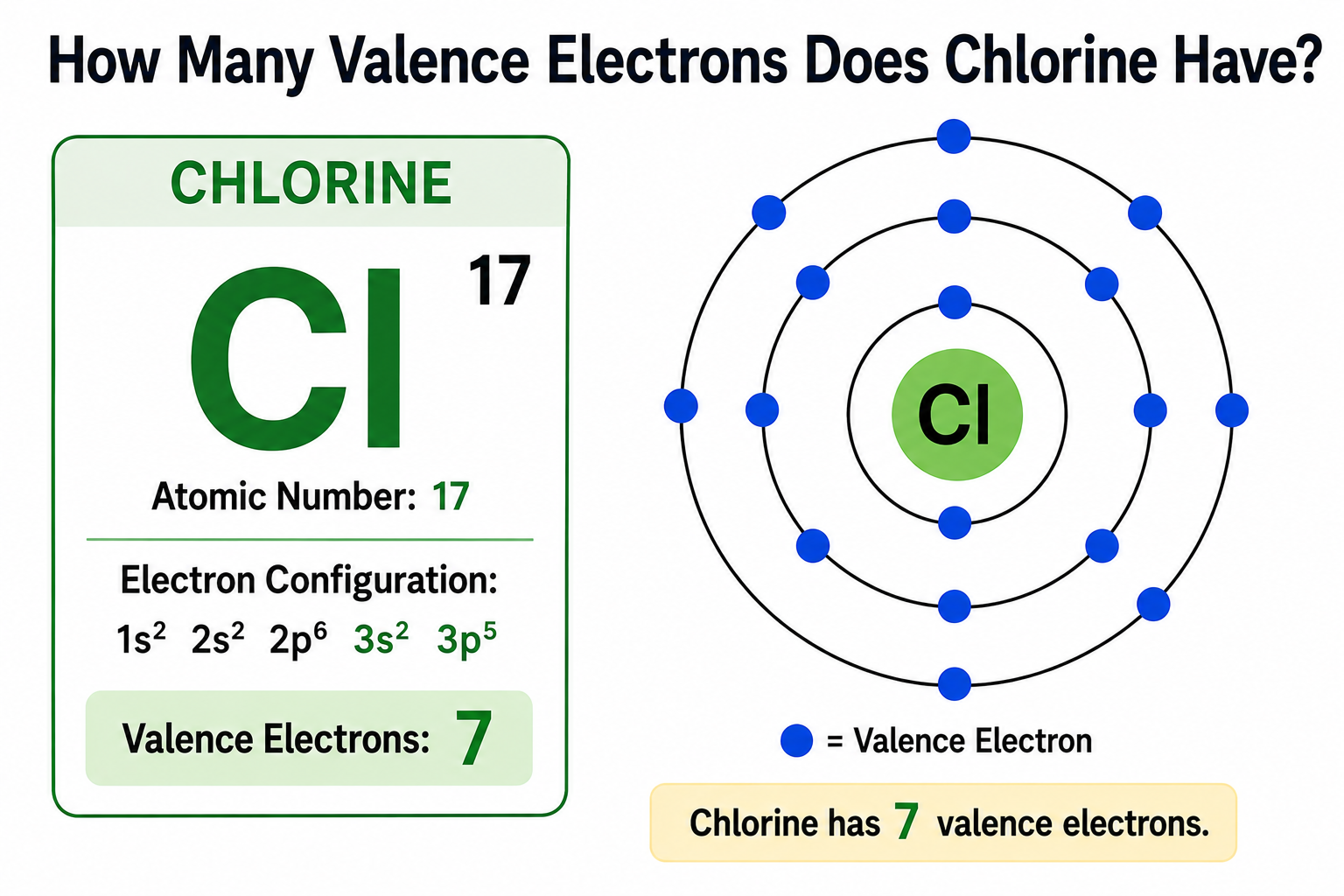
If you have been searching for how many valence electrons does chlorine have, here is your direct answer: a neutral chlorine atom has 7 valence electrons. These seven electrons occupy chlorine’s outermost shell — the third energy level — and they are responsible for chlorine’s remarkable reactivity, its tendency to form one bond in most compounds, and its ability to gain a single electron to become the stable chloride ion.
Chlorine has an atomic number of 17, meaning a neutral chlorine atom contains 17 electrons in total. Its electron configuration is 1s² 2s² 2p⁶ 3s² 3p⁵. The first shell holds 2 electrons, the second shell holds 8 electrons, and the third shell holds the remaining 7. Since the third shell is the outermost occupied shell, those 7 electrons are the valence electrons.
Seven valence electrons make chlorine one of the most electronegative and reactive nonmetals in the periodic table. Being just one electron away from a complete outer shell of 8 drives chlorine to react readily with metals, hydrogen, and a wide range of other substances. The result is a rich chemistry that includes table salt, water purification, household bleach, and countless industrial processes.
This guide covers everything you need to understand chlorine’s valence electrons thoroughly — from electron configuration and the Bohr model to Lewis dot structures, bonding behavior, the chloride ion, practice questions, and exam tips.
Key Takeaways
- A neutral chlorine atom has 7 valence electrons, located in its third (outermost) shell.
- Chlorine’s atomic number is 17, and its electron configuration is 1s² 2s² 2p⁶ 3s² 3p⁵.
- Chlorine belongs to Group 17 (the halogens) and Period 3 of the periodic table. All Group 17 elements have 7 valence electrons.
- Chlorine needs just 1 more electron to complete its octet of 8, making it highly reactive and a strong oxidizing agent.
- The chloride ion Cl⁻ forms when chlorine gains 1 electron, giving it 8 outer-shell electrons and a stable, noble-gas-like configuration.
- Chlorine’s valency is commonly 1 in most compounds, despite having 7 valence electrons — these two concepts are not the same.
- Chlorine’s 7 valence electrons underpin its chemistry in table salt, water treatment, bleach, and an enormous range of organic and inorganic compounds.
What Are Valence Electrons?
Valence electrons are the electrons found in an atom’s outermost energy shell. The outermost shell is called the valence shell, and the electrons in it are the ones that directly participate in chemical bonding and reactions.
Every atom has electrons arranged in layers, or shells, around the nucleus. The electrons closest to the nucleus occupy the inner shells and are known as core electrons. Core electrons are held tightly by the strong positive charge of the nucleus and generally play no role in forming bonds or reacting with other atoms.
The electrons in the outermost shell are another matter. They sit farther from the nucleus, experience a weaker pull from the nuclear charge, and are the first to interact when two atoms encounter each other. Whether an atom forms a covalent bond, transfers an electron to form an ion, or resists bonding altogether — all of this is determined by its valence electrons.
Comparing valence electrons and core electrons:
| Feature | Valence Electrons | Core Electrons |
|---|---|---|
| Location | Outermost shell | Inner shells |
| Role in chemical bonding | Directly involved | Not involved |
| Energy level | Higher | Lower |
| Held by nucleus | Less tightly | More tightly |
| Influence on reactivity | Yes — fundamentally | Minimal |
For main-group elements, the number of valence electrons can be read directly from the group number on the periodic table, making identification straightforward. Chlorine’s position in Group 17 immediately tells you it has 7 valence electrons.
How Many Valence Electrons Does Chlorine Have?
Chlorine has 7 valence electrons.
This is a consistent, well-established fact across all chemistry curricula worldwide — from GCSE and A-Level through NEET and university-level courses.
Here is the complete reasoning behind this answer:
- Chlorine’s atomic number is 17, which tells us a neutral chlorine atom has 17 electrons in total.
- Those 17 electrons distribute across three shells: 2 in the first shell, 8 in the second shell, and 7 in the third shell.
- The third shell is the outermost occupied shell — the valence shell.
- The 7 electrons in the third shell are therefore chlorine’s valence electrons.
Chlorine sits in Group 17 of the periodic table, the halogen group. For main-group elements in Groups 13 through 18, the group number minus 10 gives the valence electron count. Group 17 minus 10 equals 7. Every halogen has 7 valence electrons, and chlorine is no exception.
Why Does Chlorine Have 7 Valence Electrons?
Understanding why requires a step-by-step look at chlorine’s atomic structure.
- Atomic number = 17 — Chlorine has 17 protons in its nucleus. This number defines chlorine as an element.
- Number of protons = 17 — Fixed and permanent for all chlorine atoms.
- Number of electrons in a neutral chlorine atom = 17 — In a neutral atom, electrons equal protons. No charge means no gain or loss.
- Electron configuration = 1s² 2s² 2p⁶ 3s² 3p⁵ — Electrons fill orbitals from the lowest energy level upward (Aufbau principle).
- First shell (n=1): 2 electrons in the 1s orbital. This shell is completely full.
- Second shell (n=2): 8 electrons — 2 in the 2s orbital and 6 in the 2p orbitals. This shell is also completely full.
- Third shell (n=3): 7 electrons — 2 in the 3s orbital and 5 in the 3p orbitals.
- The third shell is the outermost occupied shell — the valence shell.
- Conclusion: Chlorine has 7 valence electrons, all located in the third shell.
The logic is clean and directly traceable to the electron configuration. Every time you see chlorine in any chemistry context, the neutral atom always has 7 valence electrons.
Chlorine Electron Configuration Explained
Full Electron Configuration
The full electron configuration of a neutral chlorine atom is:
1s² 2s² 2p⁶ 3s² 3p⁵
Breaking this notation down:
- 1s² — 2 electrons fill the first s orbital. The first shell is now complete.
- 2s² — 2 electrons fill the second s orbital.
- 2p⁶ — 6 electrons fill all three 2p orbitals (two per orbital). The second shell is now complete with 8 electrons.
- 3s² — 2 electrons fill the third s orbital.
- 3p⁵ — 5 electrons occupy the three 3p orbitals. Since there are 3 available 3p orbitals and 5 electrons, two orbitals hold 2 electrons each (paired) and one orbital holds 1 unpaired electron.
That single unpaired electron in the 3p subshell is the one chlorine most commonly uses to form a covalent bond or the electron-accepting position in ionic bonding.
Shell Distribution
| Shell | Subshells | Electrons | Total in Shell |
|---|---|---|---|
| First shell (n=1) | 1s | 2 | 2 |
| Second shell (n=2) | 2s, 2p | 2 + 6 | 8 |
| Third shell (n=3) | 3s, 3p | 2 + 5 | 7 |
| Total | 17 |
Valence Shell of Chlorine
The third shell is chlorine’s valence shell because it is the highest principal energy level that contains electrons in a neutral chlorine atom. Both the 3s and 3p electrons count as valence electrons because they are in the outermost occupied shell. The 7 electrons across 3s² and 3p⁵ together make up chlorine’s 7 valence electrons.
Chlorine Bohr Model
The Bohr model represents electrons as orbiting the nucleus in fixed circular paths, each path corresponding to an energy shell. It is a simplified model, but it remains one of the clearest ways to visualize electron distribution for introductory students.
For chlorine, the Bohr model is arranged as follows:
- Nucleus: Contains 17 protons and typically 18 neutrons (for the most abundant isotope, chlorine-35, which actually contains 18 neutrons, while the atomic mass averages to approximately 35.45 reflecting the natural mixture of isotopes).
- First shell: 2 electrons orbit very close to the nucleus. This shell is completely filled.
- Second shell: 8 electrons orbit in the next ring. The second shell is also completely filled — holding the maximum of 8.
- Third shell: 7 electrons orbit in the outermost ring. The third shell can hold a maximum of 18 electrons, so chlorine’s outer ring has 7 electrons and 1 empty space — the space that chlorine seeks to fill through bonding.
When drawing the Bohr model for an exam, place Cl in the center, draw three concentric rings, and mark 2, 8, and 7 electrons on the first, second, and third rings respectively. That single gap on the outer ring immediately communicates chlorine’s tendency to gain one electron.
Chlorine Lewis Dot Structure
The Lewis dot structure uses dots around an element’s chemical symbol to represent its valence electrons. For chlorine, you place 7 dots around the symbol Cl.
Step-by-step method:
- Write the chemical symbol: Cl
- Count the valence electrons: 7
- Place one dot on each of the four sides of the symbol (top, bottom, left, right) — that accounts for 4 dots.
- Return to the beginning and add a second dot alongside three of the existing single dots, creating three lone pairs.
The result: the symbol Cl surrounded by 3 lone pairs (6 electrons) and 1 unpaired dot (1 electron). The single unpaired dot represents the one electron chlorine uses to form a covalent bond. The three lone pairs are electrons that typically remain unbonded in simple chlorine compounds.
This structure communicates immediately that chlorine usually forms exactly 1 bond — consistent with its valency of 1 in most familiar compounds.
Chlorine and the Periodic Table
Chlorine’s identity and chemistry are anchored to its position on the periodic table.
| Property | Value |
|---|---|
| Symbol | Cl |
| Atomic number | 17 |
| Group | 17 |
| Period | 3 |
| Block | p-block |
| Classification | Halogen, nonmetal |
| Standard state | Gas (as Cl₂) |
Chlorine sits in Group 17, the halogen group. The halogens are distinguished by having 7 valence electrons — one fewer than the noble gases directly to their right. This single missing electron is what drives their characteristic high reactivity.
The shortcut for main-group elements: Group 17 – 10 = 7 valence electrons. This works for all p-block main-group elements in Groups 13 through 18.
Being in Period 3 means chlorine’s valence electrons are in the third energy level. The p-block designation reflects that the highest-energy electrons being added are placed in p orbitals (the 3p subshell specifically).
Chlorine is classified as both a halogen and a nonmetal. In its elemental form, it exists as a diatomic molecule Cl₂ — a pale greenish-yellow gas with a sharp, distinctive odor.
Chlorine and the Octet Rule
The octet rule states that atoms are most stable when they have 8 electrons in their outer shell, matching the configuration of a noble gas.
Chlorine starts with 7 valence electrons. The calculation is straightforward: 8 – 7 = 1. Chlorine needs just one more electron to achieve a full octet.
This single-electron deficit has profound consequences:
- In ionic bonding, chlorine gains 1 electron from a metal atom to form Cl⁻, which has 8 outer-shell electrons and the same electron configuration as argon.
- In covalent bonding, chlorine shares 1 pair of electrons with another atom, effectively gaining access to 1 additional electron through sharing — again completing the octet.
Being just one step away from stability is a major reason for chlorine’s high reactivity. Elements farther from a complete octet generally need to undergo more complex bonding processes; chlorine only needs to do it once.
How Does Chlorine Form Chemical Bonds?
Chlorine and Ionic Bonding
Ionic bonding occurs when one atom transfers electrons to another, creating oppositely charged ions that attract each other.
Sodium chloride (NaCl) is the most familiar example. Sodium (Group 1) has 1 valence electron that it readily gives away. Chlorine has 7 valence electrons and needs 1 more. The transfer is mutually beneficial:
- Sodium loses 1 electron, becoming Na⁺ (with 10 electrons and a stable neon configuration).
- Chlorine gains 1 electron, becoming Cl⁻ (with 18 electrons and a stable argon configuration).
- The strong electrostatic attraction between Na⁺ and Cl⁻ forms the ionic lattice of sodium chloride — common table salt.
Similar ionic compounds form with other metals: potassium chloride (KCl), calcium chloride (CaCl₂), and magnesium chloride (MgCl₂) all arise from the same principle of chlorine accepting electrons from metal atoms.
Chlorine and Covalent Bonding
When chlorine bonds with nonmetals, electron sharing rather than transfer is the mechanism.
Hydrogen chloride (HCl): Chlorine shares 1 electron with hydrogen. The shared pair counts toward both atoms’ outer shells, giving chlorine 8 electrons around it and giving hydrogen a full duet.
Chlorine gas (Cl₂): Two chlorine atoms each share 1 electron with each other, forming a single covalent bond. Both atoms achieve an octet. Each chlorine retains 3 lone pairs and 1 bonding pair.
Carbon tetrachloride (CCl₄): Carbon forms 4 single covalent bonds with 4 chlorine atoms. Each chlorine contributes 1 electron to the bond, retains 3 lone pairs, and achieves an octet.
In all of these covalent examples, chlorine forms exactly 1 covalent bond using its 1 unpaired valence electron.
How Many Valence Electrons Does Cl⁻ Have?
This is a question that trips up many students, so it is worth addressing carefully.
A neutral chlorine atom has 7 valence electrons. When chlorine gains 1 electron to form the chloride ion (Cl⁻), that extra electron enters the outermost shell — the third shell — bringing its outer-shell electron count to 8.
| Species | Total Electrons | Outer-Shell Electrons |
|---|---|---|
| Neutral chlorine (Cl) | 17 | 7 |
| Chloride ion (Cl⁻) | 18 | 8 |
The chloride ion has 8 outer-shell electrons — a complete and stable octet. Its electron configuration becomes 1s² 2s² 2p⁶ 3s² 3p⁶, which is identical to the configuration of argon (a noble gas). This isoelectronic relationship with argon explains why Cl⁻ is so stable.
In exam questions, when asked about the valence electrons of Cl⁻, the correct answer is 8 outer-shell electrons (complete octet), not 7. The gain of 1 electron changes the count from 7 to 8.
Chlorine Valence Electrons vs Chlorine Valency
Valence electrons and valency are related but meaningfully different concepts, and students who confuse them often lose marks unnecessarily.
| Feature | Valence Electrons | Valency |
|---|---|---|
| Definition | Electrons in the outermost shell | Combining capacity — number of bonds formed |
| For chlorine | 7 | 1 (most common) |
| Fixed or variable? | Fixed for the neutral atom | Can vary by compound |
| Determined by | Electron configuration | Actual bonding in a specific compound |
| Example | Cl has 7 valence electrons | Cl forms 1 bond in HCl and NaCl |
In most common compounds — HCl, NaCl, Cl₂, CCl₄ — chlorine forms exactly 1 bond, giving it a valency of 1. This makes sense: chlorine has 1 unpaired electron available for bonding.
The oxidation state of chlorine adds another layer. In NaCl, chlorine’s oxidation state is -1. In ClF₃, it is +3. In perchlorate (ClO₄⁻), it is +7. Oxidation states vary by compound and do not equal the number of valence electrons. Chlorine is one of those elements where expanded octet behavior is possible (unlike the Period 2 elements), and in some higher oxidation state compounds it uses d-orbital involvement to form more bonds. For introductory chemistry, however, chlorine’s valency of 1 is the most important value to know.
Chlorine vs Other Halogens
All members of Group 17 — the halogens — share the defining feature of having 7 valence electrons. The table below places chlorine in context.
| Element | Atomic Number | Period | Group | Valence Electrons | Classification |
|---|---|---|---|---|---|
| Fluorine (F) | 9 | 2 | 17 | 7 | Nonmetal, halogen |
| Chlorine (Cl) | 17 | 3 | 17 | 7 | Nonmetal, halogen |
| Bromine (Br) | 35 | 4 | 17 | 7 | Nonmetal, halogen |
| Iodine (I) | 53 | 5 | 17 | 7 | Nonmetal, halogen |
| Astatine (At) | 85 | 6 | 17 | 7 | Metalloid/halogen |
Despite sharing 7 valence electrons, the halogens differ considerably in reactivity. Fluorine, with the smallest atomic radius and highest electronegativity, is the most reactive halogen. Reactivity decreases as you move down the group because the outer electrons are farther from the nucleus, held less tightly, and the atom is less effective at attracting additional electrons. Chlorine is the second most reactive halogen and one of the most reactive elements in the periodic table under ordinary conditions.
Chlorine vs Other Period 3 Elements
Moving across Period 3 from sodium to argon, valence electrons increase from 1 to 8, revealing the repeating pattern of the periodic table.
| Element | Atomic Number | Electron Configuration | Valence Electrons | Group |
|---|---|---|---|---|
| Sodium (Na) | 11 | [Ne] 3s¹ | 1 | 1 |
| Magnesium (Mg) | 12 | [Ne] 3s² | 2 | 2 |
| Aluminum (Al) | 13 | [Ne] 3s² 3p¹ | 3 | 13 |
| Silicon (Si) | 14 | [Ne] 3s² 3p² | 4 | 14 |
| Phosphorus (P) | 15 | [Ne] 3s² 3p³ | 5 | 15 |
| Sulfur (S) | 16 | [Ne] 3s² 3p⁴ | 6 | 16 |
| Chlorine (Cl) | 17 | [Ne] 3s² 3p⁵ | 7 | 17 |
| Argon (Ar) | 18 | [Ne] 3s² 3p⁶ | 8 | 18 |
The trend is clear: as atomic number increases across Period 3, each element has one more valence electron than the previous one. Chlorine, with 7 valence electrons, sits just before argon (8 valence electrons and a complete, stable outer shell). This proximity to argon’s configuration is what makes chlorine so strongly driven to gain 1 electron.
Chlorine vs Other Common Elements
| Element | Atomic Number | Valence Electrons | Group | Period |
|---|---|---|---|---|
| Carbon (C) | 6 | 4 | 14 | 2 |
| Nitrogen (N) | 7 | 5 | 15 | 2 |
| Oxygen (O) | 8 | 6 | 16 | 2 |
| Fluorine (F) | 9 | 7 | 17 | 2 |
| Sodium (Na) | 11 | 1 | 1 | 3 |
| Magnesium (Mg) | 12 | 2 | 2 | 3 |
| Chlorine (Cl) | 17 | 7 | 17 | 3 |
This table highlights that chlorine and fluorine share the same number of valence electrons (7) despite being in different periods — both are halogens in Group 17. It also shows how chlorine’s high valence electron count (7) contrasts sharply with sodium’s single valence electron (1), explaining why these two elements react so readily with each other: sodium is eager to give away its 1 electron, and chlorine is eager to accept exactly 1.
How to Find Chlorine’s Valence Electrons From the Periodic Table
This method is fast and reliable for all main-group elements.
Step-by-step:
- Locate chlorine on the periodic table.
- Identify its group number: Group 17.
- For Groups 13 through 18, subtract 10 from the group number.
- 17 – 10 = 7
- Chlorine has 7 valence electrons.
For Groups 1 and 2, the group number equals the valence electrons directly (no subtraction needed). For all p-block main-group elements (Groups 13–18), the subtraction method applies. Once you know chlorine is in Group 17, the valence electron count takes a single calculation and a few seconds.
How to Find Chlorine’s Valence Electrons From Electron Configuration
Step-by-step using chlorine:
- Write the full electron configuration: 1s² 2s² 2p⁶ 3s² 3p⁵
- Identify the highest principal quantum number (n) present. For chlorine, the highest n is 3.
- Collect all electrons with n = 3:
- 3s² = 2 electrons
- 3p⁵ = 5 electrons
- Total = 7 electrons
- These 7 electrons are chlorine’s valence electrons.
The method works universally for main-group elements. Write the full configuration, find the outermost shell number, sum up all electrons in that shell, and you have your valence electron count.
Chlorine Lewis Structure Examples
Cl₂ (Chlorine Gas)
Each chlorine atom has 7 valence electrons and 1 unpaired electron. Two chlorine atoms share 1 pair of electrons, forming a single covalent bond. Each chlorine retains 3 lone pairs. Both atoms achieve an octet: 2 electrons from the bond plus 6 from 3 lone pairs = 8. The Lewis structure shows Cl–Cl with 3 lone pairs on each chlorine atom.
HCl (Hydrogen Chloride)
Chlorine shares 1 electron with hydrogen, forming a single H–Cl covalent bond. Chlorine retains 3 lone pairs and achieves an octet (2 bonding + 6 lone pair electrons = 8). Hydrogen achieves a duet (2 electrons from the shared pair). The bond is polar because chlorine is significantly more electronegative than hydrogen, pulling the shared electron density strongly toward itself.
NaCl (Sodium Chloride)
Sodium chloride is an ionic compound, so it does not have a molecular Lewis structure in the same way. Instead, the representation shows Na⁺ and Cl⁻ ions. The Cl⁻ ion is shown with the Cl symbol surrounded by 4 lone pairs (8 dots total), enclosed in brackets with a negative charge. This represents the complete octet achieved after chlorine gains 1 electron.
CCl₄ (Carbon Tetrachloride)
Carbon forms 4 single bonds with 4 chlorine atoms. Each chlorine contributes 1 electron to its bond with carbon, retains 3 lone pairs, and achieves an octet. Carbon achieves an octet through its 4 bonding pairs. The Lewis structure shows C in the center, 4 Cl atoms arranged around it, each connected by a single bond line, each Cl surrounded by 3 lone pairs.
Why Are Chlorine’s Valence Electrons Important?
Chlorine’s 7 valence electrons are the chemical origin of everything that makes chlorine useful and reactive.
Chemical bonding: Chlorine’s 1 unpaired valence electron allows it to form exactly 1 covalent bond or accept 1 electron in ionic bonding. This predictability makes chlorine a reliable reactant in both organic and inorganic chemistry.
Reactivity: The near-complete outer shell makes chlorine strongly electronegative and reactive. Chlorine attracts electrons in bonds more strongly than most nonmetals, which influences the polarity and properties of every compound it forms.
Formation of chloride ions: In reactions with metals, chlorine gains 1 electron to form Cl⁻. The chloride ion is present in biological fluids, minerals, and industrial chemicals. Its stability (isoelectronic with argon) makes it one of the most common anions in chemistry.
Salt formation: When chlorine reacts with metals, it forms salts — compounds containing Cl⁻ ions paired with metal cations. Table salt (NaCl), potassium chloride (KCl), and calcium chloride (CaCl₂) are all products of this behavior.
Chemical reactions: Chlorine participates in substitution reactions, addition reactions, and redox reactions. In each case, the 7 valence electrons — and in particular the 1 unpaired electron and 3 lone pairs — determine how the reaction proceeds.
Halogen chemistry: As part of the halogen group, chlorine’s chemistry is defined by its 7 valence electrons. Understanding chlorine helps students understand fluorine, bromine, and iodine as well, since they share the same fundamental electron arrangement.
Why Is Chlorine Highly Reactive?
Chlorine’s high reactivity stems directly from its electron arrangement.
With 7 valence electrons, chlorine is just 1 electron short of achieving the stable configuration of argon, the noble gas immediately to its right on the periodic table. Noble gases are notable for their extreme stability and chemical inertness — they have complete outer shells and no driving force to react. Chlorine, by contrast, has an almost-complete outer shell and a strong chemical incentive to fill that final vacancy.
This creates a powerful tendency in chlorine to attract electrons from other atoms. Chlorine’s electronegativity value of approximately 3.16 on the Pauling scale reflects this tendency — only fluorine exceeds it among the halogens.
In practice, this means chlorine reacts vigorously with most metals (often producing spectacular reactions) and reacts readily with hydrogen and many nonmetals as well. Elements with already-full outer shells (noble gases) do not react with chlorine because they have no electron to offer and no need to accept one.
It is worth noting that reactivity depends on more than just valence electron count. Bond strengths, activation energies, and the specific conditions of a reaction all matter. But as a general principle, chlorine’s single-electron deficit relative to a noble gas configuration is the primary driving force behind its well-known reactivity.
Chlorine in Everyday Life
Chlorine’s chemistry is not confined to the laboratory — it appears in many aspects of daily life.
Table salt: Sodium chloride (NaCl) is the most familiar chlorine compound in the world. Produced by the reaction of sodium metal and chlorine gas, it exists as a stable ionic lattice of Na⁺ and Cl⁻ ions. Table salt is used for food preservation, cooking, and as a source of sodium and chloride in biological systems.
Water treatment: Chlorine has been used to disinfect drinking water for over a century. When added to water, chlorine or chlorine-containing compounds (such as sodium hypochlorite) kill bacteria, viruses, and other pathogens, making water safe to drink. The chemistry involves chlorine’s oxidizing power — again, a direct consequence of its need to gain electrons.
Household bleach: Common household bleach is a solution of sodium hypochlorite (NaOCl) in water. It works as a disinfectant and whitening agent because hypochlorite ions are powerful oxidizing agents. Safe handling of bleach requires care because it is chemically reactive, and it should never be mixed with acids or ammonia-based cleaners, as this can generate toxic gases.
PVC and chlorine-containing materials: Polyvinyl chloride (PVC) is one of the most widely produced synthetic polymers in the world. It is used in pipes, electrical cable insulation, flooring, and window frames. PVC is built on a carbon backbone where alternating carbon atoms carry chlorine substituents — a direct application of carbon-chlorine covalent bonding.
Common Mistakes Students Make
Being aware of these errors helps you avoid them in exams and class work.
- Thinking chlorine has 17 valence electrons: 17 is the atomic number — the total electron count. Valence electrons are only those in the outermost shell, which for chlorine is 7.
- Confusing atomic number with valence electrons: Atomic number = total electrons = 17. Valence electrons = outermost shell = 7. These are different numbers.
- Thinking chlorine has 8 valence electrons: 8 is the number chlorine is trying to reach through bonding, not the number it starts with. Chlorine begins with 7.
- Confusing total electrons with valence electrons: Count only the third-shell electrons (7), not all 17.
- Confusing valence electrons with valency: Chlorine has 7 valence electrons but a common valency of 1. These do not have to match.
- Forgetting chlorine belongs to Group 17: Knowing the group is the fastest shortcut to the valence electron count.
- Incorrectly drawing chlorine’s Lewis dot structure: A common error is drawing all dots as pairs. The correct structure has 3 lone pairs (6 electrons) and 1 unpaired dot.
- Forgetting that Cl⁻ has a complete octet: After gaining 1 electron, Cl⁻ has 8 outer-shell electrons, not 7. Always add the gained electrons to the count.
Important Facts About Chlorine
| Property | Detail |
|---|---|
| Symbol | Cl |
| Atomic number | 17 |
| Atomic mass | 35.45 u |
| Group | 17 |
| Period | 3 |
| Block | p-block |
| Electron configuration | 1s² 2s² 2p⁶ 3s² 3p⁵ |
| Valence electrons | 7 |
| Valence shell | Third shell (n=3) |
| Classification | Halogen, nonmetal |
| Common ion | Cl⁻ (chloride ion) |
| Common bonding behavior | Forms 1 covalent or ionic bond |
| Standard state | Gas (as Cl₂) |
| Electronegativity | 3.16 (Pauling scale) |
Chlorine Valence Electrons Practice Questions
20 Multiple Choice Questions
1. How many valence electrons does a neutral chlorine atom have?
a) 3 b) 5 c) 7 d) 17
Answer: c) 7 — Chlorine has 7 electrons in its outermost (third) shell.
2. What is chlorine’s atomic number?
a) 7 b) 17 c) 35 d) 11
Answer: b) 17 — Chlorine has 17 protons in its nucleus.
3. What is the correct electron configuration of chlorine?
a) 1s² 2s² 2p⁵ b) 1s² 2s² 2p⁶ 3s² c) 1s² 2s² 2p⁶ 3s² 3p⁵ d) 1s² 2s² 2p⁶ 3s² 3p⁶
Answer: c) 1s² 2s² 2p⁶ 3s² 3p⁵ — This is the correct ground-state configuration.
4. Which group does chlorine belong to?
a) Group 7 b) Group 15 c) Group 16 d) Group 17
Answer: d) Group 17 — Chlorine is in the halogen group (Group 17).
5. How many electrons does chlorine need to complete its octet?
a) 1 b) 2 c) 3 d) 7
Answer: a) 1 — Chlorine has 7 valence electrons and needs only 1 more to reach 8.
6. What is the most common ion formed by chlorine?
a) Cl⁺ b) Cl²⁻ c) Cl⁻ d) Cl²⁺
Answer: c) Cl⁻ — Chlorine gains 1 electron to form the chloride ion.
7. How many outer-shell electrons does Cl⁻ have?
a) 7 b) 8 c) 9 d) 17
Answer: b) 8 — After gaining 1 electron, Cl⁻ has a complete octet of 8 outer-shell electrons.
8. Which period is chlorine in?
a) Period 1 b) Period 2 c) Period 3 d) Period 4
Answer: c) Period 3 — Chlorine’s valence electrons are in the third energy level.
9. How many covalent bonds does chlorine typically form?
a) 1 b) 2 c) 3 d) 4
Answer: a) 1 — Chlorine has 1 unpaired electron and typically forms 1 covalent bond.
10. What type of bond is found in HCl?
a) Ionic b) Metallic c) Polar covalent d) Nonpolar covalent
Answer: c) Polar covalent — Chlorine is much more electronegative than hydrogen, making the bond polar.
11. What is chlorine’s valence shell?
a) First shell b) Second shell c) Third shell d) Fourth shell
Answer: c) Third shell — The third shell is chlorine’s outermost occupied shell.
12. Which element has the same number of valence electrons as chlorine?
a) Oxygen b) Bromine c) Sulfur d) Carbon
Answer: b) Bromine — Bromine is also in Group 17 with 7 valence electrons.
13. How many lone pairs does chlorine have in a Cl₂ molecule?
a) 1 b) 2 c) 3 d) 4
Answer: c) 3 — Each chlorine in Cl₂ retains 3 lone pairs after forming 1 bond.
14. Chlorine is classified as which type of element?
a) Metal b) Metalloid c) Noble gas d) Halogen
Answer: d) Halogen — Chlorine is a halogen — a reactive nonmetal in Group 17.
15. How many total electrons does a neutral chlorine atom have?
a) 7 b) 8 c) 17 d) 18
Answer: c) 17 — Matching its atomic number.
16. In CCl₄, how many bonds does each chlorine atom form?
a) 4 b) 3 c) 2 d) 1
Answer: d) 1 — Each chlorine forms 1 single bond with the central carbon atom.
17. What noble gas has the same electron configuration as Cl⁻?
a) Neon b) Krypton c) Argon d) Helium
Answer: c) Argon — Cl⁻ has 18 electrons with configuration 1s² 2s² 2p⁶ 3s² 3p⁶, identical to argon.
18. What is the bond type in Cl₂?
a) Ionic b) Polar covalent c) Nonpolar covalent d) Metallic
Answer: c) Nonpolar covalent — Both atoms are identical, so the shared electrons are distributed equally.
19. Which block of the periodic table does chlorine belong to?
a) s-block b) p-block c) d-block d) f-block
Answer: b) p-block — Chlorine’s outermost electrons fill p orbitals.
20. In sodium chloride (NaCl), what happens to chlorine’s electrons?
a) Chlorine loses 1 electron b) Chlorine shares 2 electrons c) Chlorine gains 1 electron d) Chlorine loses 7 electrons
Answer: c) Chlorine gains 1 electron — Chlorine accepts 1 electron from sodium to form Cl⁻.
10 Short Answer Questions
Q1. State the number of valence electrons in chlorine and explain how you determine this.
Chlorine has 7 valence electrons. Its electron configuration is 1s² 2s² 2p⁶ 3s² 3p⁵. The highest occupied shell is n=3, which contains 3s² (2 electrons) + 3p⁵ (5 electrons) = 7 valence electrons.
Q2. Write the full electron configuration of chlorine.
1s² 2s² 2p⁶ 3s² 3p⁵
Q3. Explain the difference between chlorine’s valence electrons and its valency.
Chlorine has 7 valence electrons (all electrons in the outermost shell). Its valency is 1, reflecting the 1 covalent bond it typically forms. Valency describes bonding capacity; valence electrons describe outer-shell electron count. They are related but not equivalent.
Q4. How many outer-shell electrons does Cl⁻ have, and why?
Cl⁻ has 8 outer-shell electrons. Neutral chlorine has 7 valence electrons. After gaining 1 additional electron, the outer shell contains 7 + 1 = 8 electrons — a complete octet, giving Cl⁻ the same electron configuration as argon.
Q5. Explain why chlorine forms an ionic bond with sodium but a covalent bond with hydrogen.
Sodium is a metal with 1 loosely held valence electron; the energy required to transfer that electron to chlorine is low, making ionic bonding favorable. Hydrogen is a nonmetal; neither atom has the energy advantage of electron transfer, so they share electrons to form a polar covalent bond instead.
Q6. In which shell are chlorine’s valence electrons?
Chlorine’s valence electrons are in the third shell (n=3), specifically in the 3s and 3p subshells.
Q7. How does chlorine satisfy the octet rule in HCl?
Chlorine shares 1 electron with hydrogen, forming 1 bonding pair. That shared pair counts as 2 electrons toward chlorine’s outer shell. Adding the 6 electrons from its 3 lone pairs gives chlorine 8 electrons around it — a complete octet.
Q8. What is the standard physical state of chlorine, and what is its molecular formula?
Chlorine is a gas at room temperature and pressure. Its molecular formula is Cl₂ — chlorine exists as a diatomic molecule where two chlorine atoms are joined by a single covalent bond.
Q9. What is the electron configuration of the chloride ion (Cl⁻)?
1s² 2s² 2p⁶ 3s² 3p⁶ — identical to the noble gas argon.
Q10. State one reason why chlorine is more reactive than iodine despite both having 7 valence electrons.
Chlorine has a smaller atomic radius than iodine. Its outer electrons are in the third shell, closer to the nucleus and experiencing a stronger effective nuclear charge than iodine’s outer electrons in the fifth shell. This makes chlorine better at attracting electrons from other atoms, giving it higher electronegativity and greater reactivity.
5 Exam-Style Questions
Q1. (a) State the number of valence electrons in chlorine. (b) Write its full electron configuration. (c) Explain how the configuration confirms the valence electron count.
Answer:
(a) Chlorine has 7 valence electrons.
(b) 1s² 2s² 2p⁶ 3s² 3p⁵
(c) The highest principal quantum number present in the configuration is n=3. The electrons at n=3 are: 3s² (2 electrons) + 3p⁵ (5 electrons) = 7 electrons. Since these are in the outermost shell, they are the 7 valence electrons.
Q2. Explain why chlorine typically gains 1 electron in chemical reactions rather than losing 7. Use the octet rule in your answer.
Answer: Chlorine has 7 valence electrons and needs only 1 more to achieve a complete outer shell of 8 electrons (an octet), matching the stable configuration of argon. Gaining 1 electron requires relatively little energy — just one electron transfer — and produces the highly stable Cl⁻ ion. Losing 7 electrons, by contrast, would require an enormous amount of energy to remove electrons from a highly electronegative atom, and the resulting Cl⁷⁺ ion would be extremely unstable. Gaining 1 electron is therefore overwhelmingly energetically preferred.
Q3. Compare the bonding in Cl₂ and NaCl. Explain why different types of bonds form in each case.
Answer: In Cl₂, two identical chlorine atoms bond. Since neither atom has a greater pull on electrons than the other (both have the same electronegativity), they share electrons equally, forming a nonpolar covalent bond. Each chlorine contributes 1 electron to the shared pair and retains 3 lone pairs, giving both atoms a complete octet.
In NaCl, sodium (a metal, electronegativity 0.93) and chlorine (a nonmetal, electronegativity 3.16) have a very large electronegativity difference. Sodium’s single valence electron is transferred entirely to chlorine. Sodium becomes Na⁺ (stable, neon configuration) and chlorine becomes Cl⁻ (stable, argon configuration). The strong electrostatic attraction between these ions forms the ionic bond in NaCl.
Q4. A student draws chlorine’s Lewis dot structure with 4 lone pairs and 0 unpaired electrons. Identify the error and draw the correct structure.
Answer: The error is in placing all 7 valence electrons as pairs. Seven electrons cannot form 4 complete pairs — that would require 8 electrons. The correct Lewis dot structure of chlorine has 3 lone pairs (6 electrons) and 1 unpaired dot (1 electron) = 7 electrons total. The unpaired dot represents the single electron available for covalent bonding, which is why chlorine forms 1 bond.
Q5. Chlorine and fluorine are both Group 17 elements with 7 valence electrons. Explain one similarity and two differences in their chemistry.
Answer:
Similarity — Both chlorine and fluorine have 7 valence electrons and form 1 bond in most compounds (valency of 1). Both form X⁻ ions by gaining 1 electron and achieve the electron configuration of the nearest noble gas (neon for F⁻, argon for Cl⁻).
Difference 1 — Fluorine is the more reactive of the two. Its smaller atomic radius means its outer electrons are closer to the nucleus, and the effective nuclear charge experienced by an incoming electron is higher, making fluorine better at attracting electrons from other atoms.
Difference 2 — Fluorine is strictly limited to an octet in all compounds because it is in Period 2 and has no available d orbitals. Chlorine, in Period 3, can sometimes expand beyond an octet using its 3d orbitals, forming compounds like PCl₅-type structures in specific conditions, though for introductory chemistry chlorine’s valency of 1 is the standard.
Exam Tips
These focused strategies will help you answer questions about chlorine’s valence electrons quickly and accurately.
- Memorize the Group 17 rule: Chlorine is in Group 17. Group 17 – 10 = 7 valence electrons. Practice this calculation until it is instant.
- Write 1s² 2s² 2p⁶ 3s² 3p⁵ from memory: Configuration questions are common. Count up: 2+2+6+2+5 = 17 electrons total. Confirm the third shell has 7.
- Keep 17 and 7 separate: Atomic number = 17 (total electrons). Valence electrons = 7 (third shell only). These two numbers appear in many questions and are frequently confused.
- Know the Bohr model layout: 2, 8, 7 across the three shells. This mental image is fast and reliable in exam conditions.
- Know Cl⁻ has 8 outer-shell electrons: If asked about the chloride ion, add 1 to the valence electron count: 7 + 1 = 8 outer-shell electrons.
- Draw the Lewis dot structure correctly: 3 lone pairs + 1 unpaired dot = 7 valence electrons. Practice until it is effortless.
- Remember the isoelectronic relationship: Cl⁻ is isoelectronic with argon. Both have 18 electrons. This fact appears in questions about isoelectronic species.
Revision Checklist
Work through this checklist before your exam to make sure you are fully prepared on this topic.
- I know that chlorine has 7 valence electrons.
- I can write chlorine’s full electron configuration: 1s² 2s² 2p⁶ 3s² 3p⁵.
- I know chlorine’s atomic number is 17 and it has 17 total electrons.
- I understand that the 2 electrons in the first shell and 8 in the second shell are core electrons for chlorine.
- I can draw the Bohr model of chlorine: 2 electrons in the first shell, 8 in the second, 7 in the third.
- I can draw the Lewis dot structure of chlorine: 3 lone pairs and 1 unpaired dot.
- I know chlorine is in Group 17, Period 3, and the p-block.
- I know chlorine needs 1 electron to complete its octet.
- I understand that Cl⁻ has 8 outer-shell electrons and is isoelectronic with argon.
- I can explain the bonding in NaCl (ionic) and HCl (polar covalent).
- I can distinguish between valence electrons (7) and valency (1) for chlorine.
- I know all Group 17 elements have 7 valence electrons.
- I can explain why chlorine is reactive in terms of its electron configuration.
- I can avoid common mistakes such as writing 17 instead of 7 for valence electrons.
Frequently Asked Questions
1. How many valence electrons does chlorine have?
A neutral chlorine atom has 7 valence electrons — the 7 electrons in its outermost (third) shell.
2. Why does chlorine have 7 valence electrons?
Chlorine has atomic number 17 and electron configuration 1s² 2s² 2p⁶ 3s² 3p⁵. Its third shell contains 3s² (2 electrons) + 3p⁵ (5 electrons) = 7 electrons, which are the valence electrons.
3. What is chlorine’s electron configuration?
The electron configuration of chlorine is 1s² 2s² 2p⁶ 3s² 3p⁵.
4. What is chlorine’s valence shell?
Chlorine’s valence shell is the third shell (principal quantum number n=3), containing the 3s and 3p subshells.
5. What group is chlorine in?
Chlorine is in Group 17 of the periodic table — the halogen group.
6. What is chlorine’s valency?
Chlorine’s most common valency is 1. It forms 1 bond in most compounds using its 1 unpaired valence electron.
7. How many electrons does chlorine need to complete its octet?
Chlorine needs 1 more electron to complete its octet. It has 7 valence electrons and needs 8 for a full outer shell.
8. How many valence electrons does Cl⁻ have?
The chloride ion Cl⁻ has 8 outer-shell electrons — the original 7 plus 1 gained electron, completing the octet.
9. What is chlorine’s Lewis dot structure?
The Lewis dot structure of chlorine shows the symbol Cl surrounded by 7 dots — 3 lone pairs (6 electrons) and 1 unpaired dot, representing the single electron available for bonding.
10. Is chlorine a metal or nonmetal?
Chlorine is a nonmetal and a halogen. It is a pale greenish-yellow gas at room temperature.
11. How many total electrons does neutral chlorine have?
A neutral chlorine atom has 17 electrons in total, matching its atomic number of 17.
12. Why does chlorine gain one electron?
Chlorine has 7 valence electrons and needs 1 more to complete its outer shell of 8 (an octet), achieving the stable electron configuration of argon. Gaining 1 electron is energetically favorable and produces the stable Cl⁻ ion.
Summary
Chlorine is element number 17, located in Group 17 (the halogens) and Period 3 of the periodic table. A neutral chlorine atom has 17 electrons in total, distributed across three shells: 2 in the first, 8 in the second, and 7 in the third. Since the third shell is the outermost occupied shell, those 7 electrons are chlorine’s valence electrons.
The electron configuration 1s² 2s² 2p⁶ 3s² 3p⁵ confirms this exactly. Chlorine’s 3p⁵ arrangement leaves 1 unpaired electron, which is the electron most commonly used in covalent bonding — giving chlorine a valency of 1. In ionic compounds, chlorine gains that 1 missing electron to form Cl⁻, which has 8 outer-shell electrons and the same stable configuration as argon.
Valence electrons (7) and valency (1) are not the same concept, though they are related. All Group 17 elements share 7 valence electrons, though their reactivity and physical properties differ across the group. Chlorine’s 7 valence electrons make it highly electronegative, strongly reactive, and capable of forming both ionic and covalent compounds with a wide range of elements.
Final Thoughts
Understanding how many valence electrons does chlorine have is one of those foundational chemistry facts that opens the door to a much deeper understanding of reactivity, bonding, and chemical behavior. The answer — 7 valence electrons — explains why chlorine reacts with sodium to form table salt, why it bonds with hydrogen to form HCl, why it purifies water, and why it is one of the most industrially important elements in the world.
Those 7 electrons, sitting in the third shell with one position unfilled, represent an atom perpetually reaching toward stability. Every bond chlorine forms and every reaction it undergoes is, at its root, an expression of that single missing electron and the drive to complete the outer shell.
Master the electron configuration, practice drawing the Lewis dot structure, and always connect the chemistry back to those 7 outer electrons. That connection is what makes chemistry genuinely make sense.
For further study, explore these related LearnMinto guides:
- Valence Electrons Explained — Learn the fundamentals of valence electrons and why they are important in chemical bonding.
- How Many Valence Electrons Does Nitrogen Have? — Compare chlorine with nitrogen and understand how valence electrons vary between elements.
- How Many Valence Electrons Does Oxygen Have? — Explore another Period 2 element and compare its valence-electron arrangement with chlorine.
- How Many Valence Electrons Does Carbon Have? — Learn how carbon’s four valence electrons influence its chemical bonding.
- Electron Shells Explained — Understand electron shells, energy levels, and how electrons are distributed around the nucleus.
- Atomic Structure Study Guide — Review protons, neutrons, electrons, and the basic structure of an atom.
References
- OpenStax Chemistry — Atomic structure, electron configurations, periodic trends, and chemical bonding.
- Chemistry LibreTexts — Detailed chemistry resources covering electron configurations, periodic properties, and bonding.
- Khan Academy Chemistry — Beginner-friendly lessons on atomic structure, electron configuration, and the periodic table.
- Royal Society of Chemistry Education — Chemistry education resources and periodic-table information.
- American Chemical Society Education — Trusted chemistry education resources for students and teachers.
Disclaimer
This article is intended for educational and informational purposes only. While LearnMinto strives to provide accurate and up-to-date information, readers should verify important academic concepts through official textbooks, educational institutions, examination boards, or trusted scientific resources before relying on this content for exams or academic purposes. LearnMinto is not affiliated with any specific school, university, research institution, or examination board.