
Introduction
If you have spent any time studying atomic structure, you have probably come across terms like isotopes, isotones, and isobars. Most students find isotopes easy enough to understand, but when isobars come into the picture, things can get a little confusing. And honestly, that confusion is completely normal.
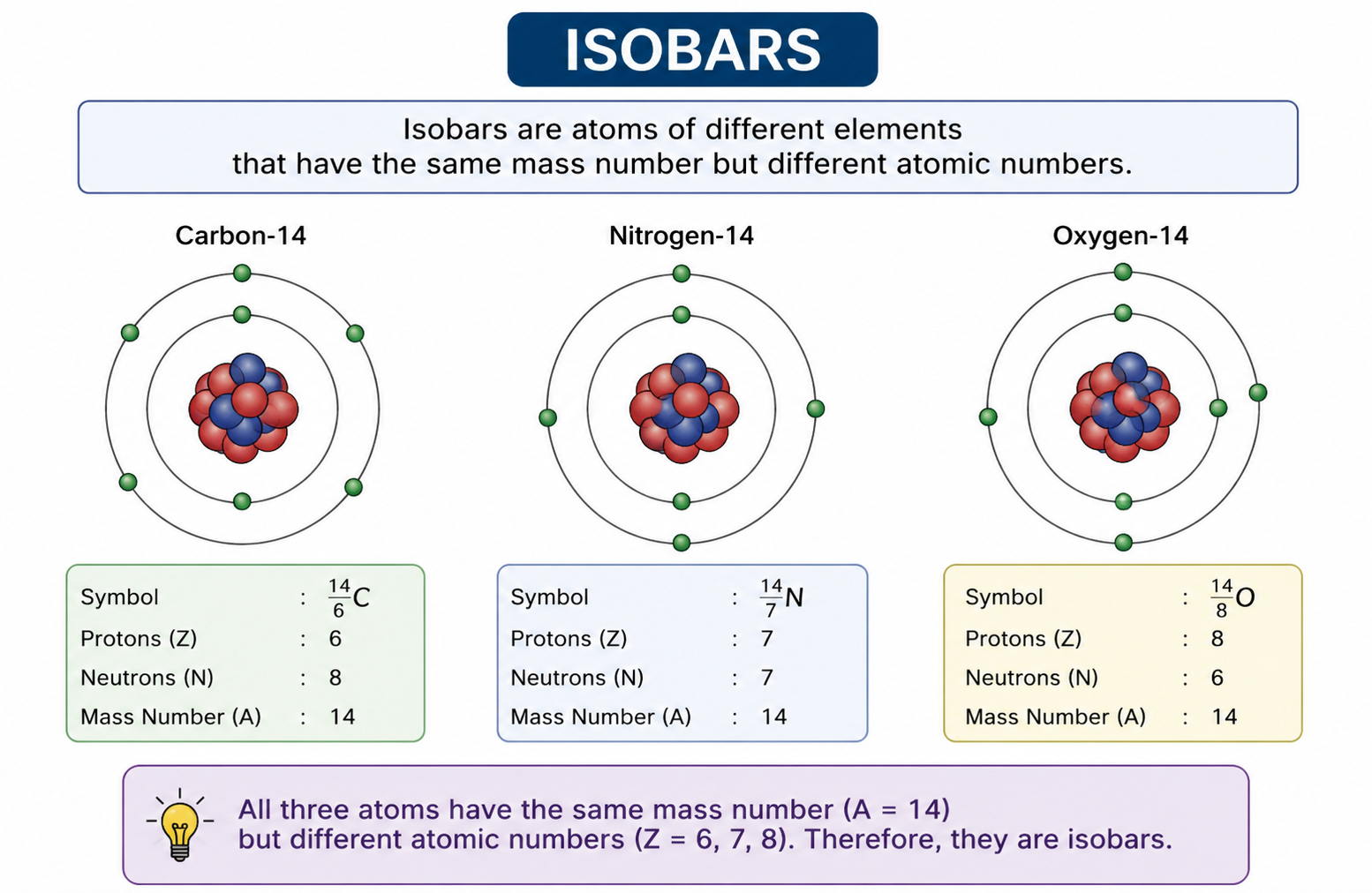
So, what are isobars? In the simplest possible terms, isobars are atoms of different elements that share the same mass number but have different atomic numbers. That one sentence might not feel like much right now, but by the time you finish reading this guide, you will have a thorough understanding of what isobars are, why they matter, how to identify them, and how they appear in real exam questions.
This article was written with students in mind — whether you are preparing for NEET, MDCAT, ECAT, GCSE, A-Level chemistry, or simply trying to get a solid grip on atomic structure concepts. We will walk through definitions, worked examples, comparison tables, practice questions, and common exam mistakes. There are no shortcuts here, just clear and honest explanations written the way a good chemistry teacher would explain things across a desk.
Understanding isobars also lays the foundation for more advanced topics like nuclear chemistry, radioactive decay, and nuclear medicine. So even if you are reading this purely for exam preparation, the knowledge you gain here connects directly to bigger ideas you will encounter later in your chemistry or physics journey.
Let us start from the beginning and build this up properly.
Key Takeaways
Before we dive deep, here is a quick summary of the most important points this article will cover:
- Isobars are atoms of different elements with the same mass number but different atomic numbers.
- They have different numbers of protons and neutrons, but the total of protons plus neutrons remains equal.
- Isobars are not the same element — they belong to completely different positions on the periodic table.
- Common isobar pairs include Argon-40 and Calcium-40, Carbon-14 and Nitrogen-14, and Potassium-40 and Argon-40.
- Isobars have different chemical properties because chemical behavior is determined by the number of electrons, which depends on the number of protons.
- Understanding isobars helps in nuclear chemistry, radioactive decay studies, and nuclear medicine applications.
- Isobars are commonly tested in NEET, MDCAT, ECAT, GCSE, and A-Level examinations.
What Are Isobars?
Definition
Isobars are defined as atoms of two or more different elements that have the same mass number but different atomic numbers. The word “isobar” comes from the Greek word isos, meaning equal, and baros, meaning weight. So the name itself gives you the key idea: equal weight, or more precisely, equal mass numbers.
In nuclear notation, the mass number is represented by the symbol A, and the atomic number is represented by the symbol Z. For two atoms to be isobars, their value of A must be identical while their value of Z must be different.
Formally written:
For two atoms X and Y to be isobars: Mass number of X = Mass number of Y, but Atomic number of X is not equal to Atomic number of Y.
Simple Explanation
Think of it this way. Imagine two people who weigh exactly the same — say, 70 kilograms each. Even though they weigh the same, they are clearly different people. Isobars work on a similar idea. Two atoms can have the same total count of protons plus neutrons (which gives us the mass number), but still be entirely different elements because they have different numbers of protons.
The number of protons is what defines which element an atom belongs to. Change the number of protons, and you have a completely different element. So even though isobars share the same mass number, they are chemically and elementally distinct from each other.
Why Are Isobars Important?
You might wonder why anyone would care about two atoms having the same mass number. The answer is that isobars come up constantly in nuclear physics and nuclear chemistry, two fields that deal with some of the most important topics in modern science.
When scientists study radioactive decay, they often observe one element transforming into another. In many cases, the parent and daughter nuclides are isobars — they have the same mass number but different atomic numbers. This happens in a process called beta decay, where a neutron converts into a proton (or vice versa), changing the atomic number while keeping the mass number constant. Understanding isobars helps scientists track these transformations accurately.
In nuclear medicine, isobars are relevant when selecting radioactive isotopes for imaging and treatment. Researchers need to understand how different nuclides with the same mass number behave, both in terms of their radioactive properties and their biological effects.
For students, understanding isobars sharpens your understanding of atomic structure. It forces you to clearly distinguish between mass number, atomic number, protons, and neutrons — concepts that appear across almost every chapter of advanced chemistry and physics.
History of Isobars
The concept of isobars in nuclear science has an interesting history. Before the development of modern atomic theory, scientists were puzzled by the fact that certain elements seemed to have atoms with the same atomic weight but completely different chemical properties.
In the early 20th century, after Ernest Rutherford’s nuclear model and Niels Bohr’s atomic model began reshaping how scientists thought about atoms, researchers realized that atoms of different elements could share the same total nuclear mass while differing in their nuclear composition. The discovery of the neutron by James Chadwick in 1932 was the turning point. Once scientists understood that the nucleus contains both protons and neutrons, the idea of isobars became straightforward: same total of protons and neutrons, different split between the two.
Frederick Soddy, the Nobel Prize-winning chemist who also coined the term “isotope,” contributed significantly to our understanding of nuclear species. The broader classification of nuclides into isotopes, isobars, and isotones developed gradually through the work of multiple researchers throughout the 1920s and 1930s.
Characteristics of Isobars
Understanding the characteristics of isobars is essential for answering exam questions correctly. Here are the key properties you need to know:
- Same mass number (A): The defining feature. Both atoms have an identical total count of protons plus neutrons.
- Different atomic numbers (Z): Each isobar belongs to a different element. They occupy different positions on the periodic table.
- Different numbers of protons: Since atomic number equals the number of protons, different atomic numbers mean different proton counts.
- Different numbers of neutrons: While the total (protons + neutrons) is the same, the individual counts differ.
- Different chemical properties: Chemical behavior is determined by electrons, and the number of electrons in a neutral atom equals the number of protons. Since isobars have different proton numbers, they have different electron configurations and therefore different chemistry.
- Different physical properties: Isobars have different melting points, boiling points, densities, and other physical characteristics.
- May have similar nuclear binding energies: In some cases, isobars with similar mass numbers have comparable nuclear binding energies, which is studied in nuclear physics.
- Can undergo beta decay to transform into each other: A radioactive isobar can transform into another isobar through beta decay, changing Z by 1 while keeping A constant.
How to Identify Isobars
Identifying isobars is straightforward once you know what to look for. The process comes down to comparing atomic numbers and mass numbers of different atoms.
Atomic Number
The atomic number (Z) tells you how many protons are in the nucleus. It also identifies which element you are dealing with. For two atoms to be isobars, their atomic numbers must be different. If the atomic numbers are the same, you are looking at isotopes of the same element, not isobars.
Mass Number
The mass number (A) is the sum of protons and neutrons in the nucleus. For isobars, this value must be identical across the atoms you are comparing. This is the one thing isobars always share.
Number of Protons
Since atomic number equals the number of protons, isobars always have a different number of protons. This is what makes them different elements entirely.
Number of Neutrons
The number of neutrons is calculated as:
Number of Neutrons = Mass Number (A) – Atomic Number (Z)
For isobars, since A is the same but Z is different, the number of neutrons will always be different between two isobars. As the atomic number increases, the number of neutrons decreases (when comparing two isobars with the same mass number).
Number of Electrons
In a neutral atom, the number of electrons equals the number of protons. Since isobars have different numbers of protons, they also have different numbers of electrons. This is why their chemical properties differ.
Formula Related to Isobars
The key mathematical relationship for isobars is built around two fundamental equations in atomic structure:
Mass Number (A) = Number of Protons (Z) + Number of Neutrons (N)
For two isobars, let us call them element X with atomic number Z1 and element Y with atomic number Z2:
- A(X) = A(Y) — Mass numbers are equal
- Z1 is not equal to Z2 — Atomic numbers are different
- N(X) = A – Z1 and N(Y) = A – Z2 — Neutron counts differ
If Z1 is less than Z2, then N(X) is greater than N(Y). This inverse relationship between proton count and neutron count (within the same mass number) is important for understanding why certain isobaric nuclides are more stable than others.
Common Examples of Isobars
Let us look at some of the most frequently cited and most important isobar pairs. These examples come up repeatedly in exam questions.
Argon-40 and Calcium-40
This is perhaps the most classic example of isobars in chemistry textbooks.
- Argon-40 (Ar-40): Atomic number = 18, Mass number = 40, Neutrons = 40 – 18 = 22
- Calcium-40 (Ca-40): Atomic number = 20, Mass number = 40, Neutrons = 40 – 20 = 20
Both have a mass number of 40. But argon has 18 protons while calcium has 20. Argon is a noble gas — it does not react under normal conditions. Calcium is a reactive alkaline earth metal. Their chemistry could not be more different, yet their mass numbers are identical. This example beautifully illustrates what isobars are all about.
Carbon-14 and Nitrogen-14
Another well-known isobar pair, particularly relevant in discussions of radioactive decay:
- Carbon-14 (C-14): Atomic number = 6, Mass number = 14, Neutrons = 14 – 6 = 8
- Nitrogen-14 (N-14): Atomic number = 7, Mass number = 14, Neutrons = 14 – 7 = 7
Carbon-14 is radioactive and undergoes beta-minus decay, transforming into Nitrogen-14. This is the basis of radiocarbon dating, one of the most widely used techniques in archaeology and geology. During the decay, the mass number stays at 14 while the atomic number increases from 6 to 7 — turning carbon into nitrogen. The parent and daughter nuclides are isobars.
Potassium-40 and Argon-40
- Potassium-40 (K-40): Atomic number = 19, Mass number = 40, Neutrons = 40 – 19 = 21
- Argon-40 (Ar-40): Atomic number = 18, Mass number = 40, Neutrons = 40 – 18 = 22
Potassium-40 can decay into Argon-40 through a process called electron capture. This isobaric pair is central to potassium-argon dating, a technique geologists use to determine the age of rocks and minerals. Again, the mass number stays at 40 while the atomic number changes — a hallmark of isobaric relationships in radioactive decay.
Summary Table of Common Isobar Examples:
| Isobar Pair | Element 1 | Atomic No. (Z1) | Element 2 | Atomic No. (Z2) | Mass Number (A) |
|---|---|---|---|---|---|
| Ar-40 and Ca-40 | Argon | 18 | Calcium | 20 | 40 |
| C-14 and N-14 | Carbon | 6 | Nitrogen | 7 | 14 |
| K-40 and Ar-40 | Potassium | 19 | Argon | 18 | 40 |
| S-40 and Ca-40 | Sulfur | 16 | Calcium | 20 | 40 |
| Co-58 and Ni-58 | Cobalt | 27 | Nickel | 28 | 58 |
| Zr-90 and Mo-90 | Zirconium | 40 | Molybdenum | 42 | 90 |
Isobars vs Isotopes (Comparison Table)
Students very commonly mix up isobars and isotopes. This comparison table should make the differences crystal clear.
| Property | Isobars | Isotopes |
|---|---|---|
| Definition | Same mass number, different atomic number | Same atomic number, different mass number |
| Same Element? | No — different elements | Yes — same element |
| Mass Number (A) | Same | Different |
| Atomic Number (Z) | Different | Same |
| Number of Protons | Different | Same |
| Number of Neutrons | Different | Different |
| Number of Electrons (neutral) | Different | Same |
| Chemical Properties | Different | Nearly identical |
| Physical Properties | Different | Slightly different |
| Example | C-14 and N-14 | C-12, C-13, and C-14 |
The key thing to remember: isotopes are the same element with different neutron counts. Isobars are different elements with the same total nuclear count.
Isobars vs Isotones (Comparison Table)
Isotones are atoms that have the same number of neutrons but different atomic numbers and mass numbers. Here is how they compare with isobars:
| Property | Isobars | Isotones |
|---|---|---|
| Definition | Same mass number, different atomic number | Same number of neutrons, different atomic and mass numbers |
| Mass Number (A) | Same | Different |
| Atomic Number (Z) | Different | Different |
| Number of Neutrons (N) | Different | Same |
| Number of Protons | Different | Different |
| Same Element? | No | No |
| Example | Ar-40 and Ca-40 | C-14 (N=8) and N-15 (N=8) |
You can think of it like this: isobars share the same total, isotones share the same neutron count, and isotopes share the same proton count.
Isobars vs Isoelectronic Species (Comparison Table)
Isoelectronic species are atoms or ions that have the same number of electrons. This concept comes up more in physical chemistry and bonding, but it is worth comparing with isobars here.
| Property | Isobars | Isoelectronic Species |
|---|---|---|
| Definition | Same mass number, different atomic number | Same number of electrons |
| Basis of Similarity | Mass number | Electron count |
| Same Element? | No | Not necessarily |
| Can Include Ions? | Generally refers to neutral atoms | Yes, includes ions |
| Chemical Properties | Different | Similar in some ways |
| Example | C-14 and N-14 | Na+ and Ne (both have 10 electrons) |
Isoelectronic species can sometimes be ions of different elements, while isobars are typically discussed in the context of neutral atoms and nuclear properties.
Isobars vs Isotopes vs Isotones (Detailed Comparison Table)
| Feature | Isobars | Isotopes | Isotones |
|---|---|---|---|
| Same Mass Number (A) | Yes | No | No |
| Same Atomic Number (Z) | No | Yes | No |
| Same Neutron Number (N) | No | No | Yes |
| Same Element | No | Yes | No |
| Same Proton Count | No | Yes | No |
| Same Electron Count (neutral) | No | Yes | No |
| Same Chemical Properties | No | Nearly yes | No |
| Defined By | Equal A, different Z | Equal Z, different A | Equal N, different Z and A |
| Classic Example | Ar-40 and Ca-40 | C-12, C-13, C-14 | C-14 and N-15 |
Memorizing this table alone will take you a long way in any exam that asks you to differentiate between these three types of nuclear species.
Relationship Between Atomic Number, Mass Number, and Isobars
The relationship between atomic number, mass number, and isobars is essentially the heart of the concept. Let us unpack it clearly.
The mass number (A) represents the total number of nuclear particles — protons and neutrons combined. The atomic number (Z) represents the number of protons alone. The number of neutrons (N) is simply A minus Z.
When two atoms are isobars, their mass numbers are equal. This means:
Z1 + N1 = Z2 + N2 = A (constant)
If Z1 is greater than Z2, then N1 must be less than N2. In other words, the atom with more protons has fewer neutrons, and the atom with fewer protons has more neutrons — but both still add up to the same total mass number.
This mathematical balance is what nuclear physicists analyze when studying nuclear stability. Among isobaric nuclides, only one (sometimes two) will be completely stable. The others will typically be radioactive and will decay — often through beta decay — until they reach the most stable isobar in that mass number chain.
How to Solve Isobar Questions
Step-by-Step Example 1
Question: Are the following two atoms isobars? Atom X has atomic number 15 and mass number 31. Atom Y has atomic number 16 and mass number 32.
Solution:
Step 1: Identify the mass numbers.
- Mass number of X = 31
- Mass number of Y = 32
Step 2: Compare the mass numbers.
- 31 is not equal to 32
Step 3: Conclusion.
- Since the mass numbers are different, X and Y are not isobars.
Answer: No, they are not isobars.
Step-by-Step Example 2
Question: Silicon-30 has atomic number 14. Phosphorus-30 has atomic number 15. Are they isobars?
Solution:
Step 1: Identify the mass numbers.
- Si-30: Mass number = 30
- P-30: Mass number = 30
Step 2: Compare the mass numbers.
- Both have A = 30. Mass numbers are equal.
Step 3: Compare the atomic numbers.
- Si has Z = 14, P has Z = 15. Atomic numbers are different.
Step 4: Verify neutron counts.
- Neutrons in Si-30 = 30 – 14 = 16
- Neutrons in P-30 = 30 – 15 = 15
- Neutron counts are different.
Step 5: Conclusion.
- Same mass number, different atomic numbers, different elements. These are isobars.
Answer: Yes, Si-30 and P-30 are isobars.
Step-by-Step Example 3
Question: An atom has 20 protons and 20 neutrons. Another atom has 18 protons and 22 neutrons. Are these two atoms isobars? What are they?
Solution:
Step 1: Calculate mass numbers.
- Atom 1: A = 20 + 20 = 40 (This is Calcium-40, Ca-40)
- Atom 2: A = 18 + 22 = 40 (This is Argon-40, Ar-40)
Step 2: Compare mass numbers.
- Both have A = 40. Mass numbers are equal.
Step 3: Compare atomic numbers.
- Atom 1 has Z = 20, Atom 2 has Z = 18. Atomic numbers differ.
Step 4: Conclusion.
- These are isobars. Specifically, they are Calcium-40 and Argon-40.
Answer: Yes, Ca-40 and Ar-40 are isobars.
Uses of Isobars in Science
Nuclear Chemistry
In nuclear chemistry, isobars appear naturally in the study of nuclear reactions and decay chains. When a nucleus undergoes beta decay, the mass number does not change — only the atomic number shifts by one unit. The parent and product nuclei are therefore isobars. Understanding this helps chemists and physicists map out nuclear decay chains and predict what products will form when specific radioactive materials decay.
Nuclear Medicine
Nuclear medicine uses radioactive nuclides to diagnose and treat medical conditions. When selecting a radioactive tracer for a medical scan, doctors and researchers must consider the nuclide’s behavior inside the body, its decay mode, and its half-life. Comparing isobaric nuclides helps researchers choose the most appropriate one for a given medical application. For example, certain isobaric pairs involving isotopes of technetium and iodine are relevant in thyroid imaging and cancer diagnosis.
Physics Research
In particle physics and nuclear physics research, isobaric nuclides are studied to understand nuclear forces, binding energies, and nuclear shell structures. The fact that isobars have the same mass number but different compositions lets physicists isolate variables and study how changing the proton-to-neutron ratio affects nuclear stability and decay.
Radioactive Decay Studies
The study of radioactive decay series often involves tracking isobaric transformations. Beta decay, in particular, produces isobars. When researchers study the stability of nuclides, they examine isobaric chains — sequences of isobars connected by beta decay — to determine which nuclide in a given mass number chain is the most stable (lowest binding energy). This is fundamental work in understanding nuclear stability.
Real-Life Applications of Isobars
The practical applications of isobar research extend into everyday life more than most people realize:
- Radiocarbon Dating: The decay of Carbon-14 into Nitrogen-14 (an isobaric transformation) is the basis of radiocarbon dating. Archaeologists use this to date organic materials up to about 50,000 years old. Without understanding isobars, radiocarbon dating would be impossible to explain correctly.
- Geological Age Determination: Potassium-40 decays to Argon-40, another isobaric pair. Geologists use the potassium-argon dating method to determine the age of rocks, volcanic ash, and ancient geological formations. This has helped scientists piece together Earth’s geological history.
- Medical Imaging: In positron emission tomography (PET scans), radioactive nuclides undergo beta-plus decay, producing isobaric daughter nuclides. Understanding isobaric relationships helps in designing better imaging agents.
- Nuclear Power: In nuclear reactors, understanding the isobaric chains of uranium and plutonium fission products helps engineers manage nuclear waste and assess the long-term radioactivity of spent fuel.
- Environmental Monitoring: Scientists studying radioactive contamination in the environment track isobaric nuclides to understand how radioactive materials move through soil, water, and air.
Common Mistakes Students Make
After teaching atomic structure for many years, certain errors come up again and again when students tackle isobar questions. Here are the most frequent ones:
- Confusing isobars with isotopes: The most common mistake. Remember — isotopes share the same atomic number (same element), while isobars share the same mass number (different elements).
- Thinking isobars have the same number of neutrons: They do not. Since the atomic numbers differ but the mass numbers are equal, the neutron counts must be different.
- Assuming isobars have similar chemical properties: They do not. Chemical properties depend on electron configuration, which depends on the number of protons. Different atomic numbers mean completely different chemistry.
- Forgetting that isobars belong to different elements: Some students write that isobars are different “versions” of the same element. That is isotopes. Isobars are always different elements.
- Mixing up the formula: Students sometimes subtract incorrectly when calculating neutron numbers. Always use N = A – Z, and make sure you are using the correct A and Z for each atom.
- Confusing isobars with isoelectronic species: Isoelectronic species share the same number of electrons (often ions), while isobars share the same mass number (usually neutral atoms discussed in terms of nuclear composition).
Best Tips to Study Isobars
Here are some practical strategies that genuinely help students master this topic:
- Create a comparison flashcard with isobars, isotopes, and isotones side by side. Review it every day until the differences are automatic.
- Practice with element symbols and mass numbers. Get comfortable reading nuclear notation like Carbon-14 written as C with superscript 14 and subscript 6.
- Work through examples from periodic table data. Pick two elements at random, choose a specific mass number, calculate neutron counts, and check if a valid isobar pair exists.
- Connect isobars to beta decay. Every time you study beta decay, remind yourself that the parent and daughter are isobars. This real-world connection makes the concept stick.
- Use the neutron number as a cross-check. After identifying a potential isobar pair, always verify that the neutron numbers are different. If neutron numbers are the same AND the mass numbers are the same, then the atomic numbers must also be the same — which means they are the same element, not isobars.
- Write out the full nuclear composition of each atom when practicing: number of protons, number of neutrons, number of electrons, atomic number, and mass number. This habit eliminates careless errors.
Common Terms Every Student Should Know
Having a firm vocabulary makes atomic structure topics much easier to handle. Here are the essential terms:
| Term | Definition |
|---|---|
| Atom | The smallest unit of an element that retains chemical properties |
| Nucleus | The central part of an atom containing protons and neutrons |
| Proton | Positively charged particle in the nucleus; determines element identity |
| Neutron | Neutral particle in the nucleus; contributes to mass number |
| Electron | Negatively charged particle outside the nucleus |
| Atomic Number (Z) | Number of protons in the nucleus |
| Mass Number (A) | Total number of protons and neutrons in the nucleus |
| Nuclide | A specific type of nucleus defined by its proton and neutron numbers |
| Isobar | Atoms with the same mass number but different atomic numbers |
| Isotope | Atoms of the same element with different mass numbers |
| Isotone | Atoms with the same number of neutrons but different atomic numbers |
| Isoelectronic | Atoms or ions with the same number of electrons |
| Radioactive Decay | Spontaneous transformation of an unstable nucleus into a more stable one |
| Beta Decay | Radioactive decay in which an electron or positron is emitted, changing the atomic number by 1 |
| Nuclear Binding Energy | Energy required to disassemble a nucleus into its component protons and neutrons |
Isobars Practice Questions
30 Multiple Choice Questions (MCQs) with Answers
1. Which of the following is the defining characteristic of isobars?
- A) Same number of neutrons
- B) Same mass number
- C) Same atomic number
- D) Same number of electrons
Answer: B
2. Argon-40 and Calcium-40 are isobars. What do they share?
- A) Same number of protons
- B) Same chemical properties
- C) Same mass number
- D) Same number of neutrons
Answer: C
3. Carbon-14 has atomic number 6. Nitrogen-14 has atomic number 7. Are they isobars?
- A) Yes
- B) No
- C) They are isotopes
- D) They are isotones
Answer: A
4. How many neutrons does Argon-40 have? (Atomic number of Ar = 18)
- A) 18
- B) 20
- C) 22
- D) 40
Answer: C
5. If two atoms have the same mass number and the same atomic number, they are:
- A) Isobars
- B) Isotones
- C) The same nuclide
- D) Isoelectronic
Answer: C
6. Isobars always have:
- A) The same chemical properties
- B) Different elements
- C) The same number of neutrons
- D) The same number of electrons
Answer: B
7. Which pair represents isobars?
- A) C-12 and C-14
- B) C-14 and N-14
- C) C-12 and N-13
- D) O-16 and O-18
Answer: B
8. In beta-minus decay, the mass number of the resulting atom compared to the parent atom is:
- A) Greater
- B) Smaller
- C) The same
- D) Doubled
Answer: C
9. The relationship between isobars and beta decay is that:
- A) Beta decay produces atoms with different mass numbers
- B) Parent and daughter nuclides in beta decay are isobars
- C) Beta decay does not change the atomic number
- D) Beta decay produces isotopes
Answer: B
10. Which of the following statements about isobars is FALSE?
- A) They have the same mass number
- B) They belong to different elements
- C) They have the same number of protons
- D) They have different neutron counts
Answer: C
11. An atom has 17 protons and 20 neutrons. Which atom would be its isobar?
- A) An atom with 17 protons and 21 neutrons
- B) An atom with 18 protons and 19 neutrons
- C) An atom with 16 protons and 20 neutrons
- D) An atom with 17 protons and 20 neutrons
Answer: B
12. Potassium-40 and Argon-40 are isobars. Which application uses this isobaric pair?
- A) Radiocarbon dating
- B) Potassium-argon dating
- C) PET scanning
- D) Nuclear power generation
Answer: B
13. Isobars differ from isotones in that:
- A) Isobars have the same mass number; isotones have the same neutron number
- B) Isobars have the same neutron number; isotones have the same mass number
- C) Both isobars and isotones have the same mass number
- D) Isobars and isotones both refer to the same element
Answer: A
14. The mass number of an atom is calculated as:
- A) Protons minus neutrons
- B) Protons plus electrons
- C) Protons plus neutrons
- D) Neutrons minus protons
Answer: C
15. Two isobars with mass number 58 are Cobalt-58 and Nickel-58. How many neutrons does Cobalt-58 have? (Atomic number of Co = 27)
- A) 27
- B) 28
- C) 31
- D) 30
Answer: C
16. How many neutrons does Nickel-58 have? (Atomic number of Ni = 28)
- A) 28
- B) 30
- C) 31
- D) 58
Answer: B
17. In the isobar pair Cobalt-58 and Nickel-58, which element has more neutrons?
- A) Nickel
- B) Cobalt
- C) Both have equal neutrons
- D) Cannot be determined
Answer: B
18. Which of the following is true about the chemical properties of isobars?
- A) Isobars have identical chemical properties
- B) Isobars have similar but slightly different chemical properties
- C) Isobars have completely different chemical properties
- D) Isobars have no chemical properties
Answer: C
19. An element has atomic number 19 and mass number 39. Which of the following is its isobar?
- A) An element with atomic number 19 and mass number 40
- B) An element with atomic number 20 and mass number 39
- C) An element with atomic number 18 and mass number 40
- D) An element with atomic number 20 and mass number 40
Answer: B
20. Which scientist’s discovery of the neutron in 1932 helped clarify the concept of isobars?
- A) Niels Bohr
- B) Ernest Rutherford
- C) James Chadwick
- D) Frederick Soddy
Answer: C
21. Radiocarbon dating is based on the decay of:
- A) Nitrogen-14 into Carbon-14
- B) Carbon-14 into Nitrogen-14
- C) Carbon-12 into Carbon-14
- D) Nitrogen-14 into Nitrogen-15
Answer: B
22. If Atom A has 8 protons and 8 neutrons, and Atom B has 6 protons and 10 neutrons, are they isobars?
- A) Yes — both have mass number 16
- B) No — they have different neutron counts
- C) Yes — they have different atomic numbers
- D) No — they are isotopes
Answer: A
23. Which of the following pairs are NOT isobars?
- A) Ar-40 and Ca-40
- B) C-14 and N-14
- C) O-16 and O-18
- D) K-40 and Ar-40
Answer: C
24. The term “isobar” is derived from Greek words meaning:
- A) Equal number and atom
- B) Equal weight and mass
- C) Equal and weight
- D) Same element and nucleus
Answer: C
25. In a neutral isobar atom, the number of electrons equals:
- A) The mass number
- B) The number of neutrons
- C) The number of protons
- D) Half the mass number
Answer: C
26. If two atoms are isobars with mass number 30, and one has atomic number 14, what is the neutron count of the other atom if it has atomic number 15?
- A) 15
- B) 16
- C) 14
- D) 30
Answer: A
27. Why do isobars have different chemical properties?
- A) They have different mass numbers
- B) They have different numbers of electrons
- C) They have the same number of neutrons
- D) They are in the same period of the periodic table
Answer: B
28. Which process in nuclear physics always produces isobars?
- A) Alpha decay
- B) Gamma decay
- C) Beta decay
- D) Nuclear fission
Answer: C
29. How many protons does Calcium-40 have? (Ca has atomic number 20)
- A) 40
- B) 18
- C) 22
- D) 20
Answer: D
30. Which statement correctly distinguishes isobars from isotopes?
- A) Isobars have the same atomic number; isotopes have the same mass number
- B) Isobars have the same mass number; isotopes have the same atomic number
- C) Both isobars and isotopes have the same atomic number
- D) Both isobars and isotopes have different elements
Answer: B
15 Short Answer Questions
1. Define isobars in your own words.
Sample Answer: Isobars are atoms of different elements that have the same mass number but different atomic numbers. They contain different numbers of protons and neutrons, but the total count of protons plus neutrons is the same.
2. Give two examples of isobar pairs.
Sample Answer: Argon-40 and Calcium-40; Carbon-14 and Nitrogen-14.
3. Why do isobars belong to different elements?
Sample Answer: Because they have different atomic numbers, and the atomic number determines the element identity by defining the number of protons in the nucleus.
4. How does the neutron count differ between two isobars?
Sample Answer: Since the mass number is the same but the atomic numbers are different, the neutron counts must be different. The isobar with a higher atomic number has fewer neutrons.
5. What happens to the mass number during beta decay?
Sample Answer: The mass number remains unchanged during beta decay. Only the atomic number changes by one unit, producing an isobar.
6. Distinguish between isobars and isotones.
Sample Answer: Isobars have the same mass number but different atomic numbers. Isotones have the same number of neutrons but different atomic numbers and different mass numbers.
7. Can two isobars have the same chemical properties? Explain.
Sample Answer: No. Chemical properties depend on the number and arrangement of electrons, which is determined by the number of protons. Since isobars have different atomic numbers, they have different electron configurations and therefore different chemical properties.
8. What is the formula for calculating the number of neutrons in an atom?
Sample Answer: Number of Neutrons = Mass Number (A) – Atomic Number (Z)
9. Name the type of radioactive decay that produces isobars.
Sample Answer: Beta decay. During beta decay, the mass number stays the same while the atomic number changes by one, making the parent and daughter nuclides isobars.
10. Why is the concept of isobars important in radiocarbon dating?
Sample Answer: Radiocarbon dating involves the decay of Carbon-14 into Nitrogen-14. These two atoms are isobars — they share the same mass number of 14 but have different atomic numbers (6 and 7). Understanding this isobaric relationship is central to explaining how carbon-14 transforms into nitrogen-14 over time.
11. Are isobars and isoelectronic species the same? Explain briefly.
Sample Answer: No. Isobars share the same mass number but differ in atomic number. Isoelectronic species share the same number of electrons and can include ions of different elements. The basis of comparison is completely different.
12. What does the mass number represent physically?
Sample Answer: The mass number represents the total number of nuclear particles — specifically, the combined count of protons and neutrons in the nucleus.
13. An atom has 16 protons and 16 neutrons. Is this atom an isobar with an atom that has 14 protons and 18 neutrons?
Sample Answer: First atom: A = 16 + 16 = 32. Second atom: A = 14 + 18 = 32. Both have mass number 32, but different atomic numbers (16 and 14). Yes, they are isobars.
14. How can you quickly check whether two atoms are isobars?
Sample Answer: Calculate the mass number (A = protons + neutrons) for each atom. If the mass numbers are equal and the atomic numbers are different, the atoms are isobars.
15. What is the significance of isobars in nuclear medicine?
Sample Answer: In nuclear medicine, isobaric nuclides help researchers compare radioactive species with the same mass number to choose the most effective and safest tracer for diagnostic imaging or treatment. Understanding isobaric decay also helps predict what products form after a radioactive tracer decays inside the body.
10 Numerical Problems with Step-by-Step Solutions
Problem 1: An atom has atomic number 11 and mass number 23. Find the number of neutrons and identify if it is an isobar with an atom that has 12 protons and 11 neutrons.
Solution:
- Atom 1: Z = 11, A = 23, N = 23 – 11 = 12 (This is Sodium-23)
- Atom 2: Z = 12, N = 11, A = 12 + 11 = 23 (This is Magnesium-23)
- Both have A = 23 and different Z values (11 and 12)
- Answer: Yes, Na-23 and Mg-23 are isobars.
Problem 2: Calculate the number of neutrons in Phosphorus-31 (Z = 15) and Silicon-31 (Z = 14). Are they isobars?
Solution:
- P-31: N = 31 – 15 = 16
- Si-31: N = 31 – 14 = 17
- Both have A = 31, Z values are 15 and 14 (different)
- Answer: Yes, P-31 and Si-31 are isobars. P-31 has 16 neutrons; Si-31 has 17 neutrons.
Problem 3: An unknown atom X has 20 neutrons and 20 protons. An atom Y has 22 neutrons and 18 protons. Are X and Y isobars?
Solution:
- Atom X: A = 20 + 20 = 40
- Atom Y: A = 22 + 18 = 40
- Both have A = 40. Atomic numbers are 20 and 18 (different)
- Answer: Yes, X (Calcium-40) and Y (Argon-40) are isobars.
Problem 4: Chlorine-37 has atomic number 17. Argon-37 has atomic number 18. Find the number of neutrons in each and confirm they are isobars.
Solution:
- Cl-37: N = 37 – 17 = 20
- Ar-37: N = 37 – 18 = 19
- Mass numbers are both 37. Atomic numbers differ (17 and 18)
- Answer: Yes, Cl-37 and Ar-37 are isobars. Cl has 20 neutrons; Ar has 19 neutrons.
Problem 5: Atom P has 26 protons and 30 neutrons. Atom Q has 28 protons and 28 neutrons. Are P and Q isobars?
Solution:
- Atom P: A = 26 + 30 = 56
- Atom Q: A = 28 + 28 = 56
- Both have A = 56. Atomic numbers are 26 and 28 (different)
- Answer: Yes, Atom P (Iron-56) and Atom Q (Nickel-56) are isobars.
Problem 6: An atom has A = 40 and Z = 19. Another atom has A = 40 and Z = 20. Find the neutron counts and identify the elements.
Solution:
- Atom 1 (K-40): N = 40 – 19 = 21 (Potassium)
- Atom 2 (Ca-40): N = 40 – 20 = 20 (Calcium)
- Same A = 40, different Z values
- Answer: K-40 and Ca-40 are isobars. K has 21 neutrons; Ca has 20 neutrons.
Problem 7: Sulfur has atomic number 16. Can Sulfur-40 be an isobar with Calcium-40 (Z = 20)?
Solution:
- S-40: A = 40, Z = 16, N = 40 – 16 = 24
- Ca-40: A = 40, Z = 20, N = 40 – 20 = 20
- Both have A = 40. Atomic numbers differ (16 and 20)
- Answer: Yes, S-40 and Ca-40 are isobars.
Problem 8: Find the mass number of an atom with 18 protons and 22 neutrons. Is this atom an isobar with an atom that has 20 protons and 20 neutrons?
Solution:
- Atom 1 (Ar): A = 18 + 22 = 40
- Atom 2 (Ca): A = 20 + 20 = 40
- Both have A = 40, different Z values (18 and 20)
- Answer: Yes, Ar-40 and Ca-40 are isobars.
Problem 9: Cobalt-58 (Z = 27) and Nickel-58 (Z = 28) — find the neutron counts for each and confirm they are isobars.
Solution:
- Co-58: N = 58 – 27 = 31
- Ni-58: N = 58 – 28 = 30
- Both have A = 58, different Z values (27 and 28)
- Answer: Yes, Co-58 and Ni-58 are isobars. Co has 31 neutrons; Ni has 30 neutrons.
Problem 10: An atom M has mass number 14 and atomic number 7. An atom N has mass number 14 and atomic number 6. Find the neutron counts. Are they isobars? Name them.
Solution:
- Atom M (Z = 7): N = 14 – 7 = 7 (This is Nitrogen-14)
- Atom N (Z = 6): N = 14 – 6 = 8 (This is Carbon-14)
- Both have A = 14, different Z values (7 and 6)
- Answer: Yes, N-14 and C-14 are isobars. Nitrogen has 7 neutrons; Carbon has 8 neutrons.
Revision Checklist
Use this checklist before your exam to make sure you have covered everything:
- I can define isobars clearly and explain what makes two atoms isobars.
- I know that isobars have the same mass number but different atomic numbers.
- I understand that isobars belong to different elements.
- I can calculate the number of neutrons in any atom using N = A – Z.
- I can identify isobar pairs from a given list of atoms.
- I know why isobars have different chemical properties.
- I can distinguish between isobars, isotopes, and isotones.
- I understand the connection between beta decay and isobars.
- I know the classic isobar examples: Ar-40/Ca-40, C-14/N-14, K-40/Ar-40.
- I can explain why the neutron counts of isobars are always different.
- I have practiced at least 10 numerical problems involving isobars.
- I know the real-life applications of isobars including radiocarbon dating and potassium-argon dating.
- I have reviewed the comparison tables for isobars vs isotopes vs isotones.
- I understand the significance of isobars in nuclear medicine.
- I am comfortable with nuclear notation and reading atomic symbols.
Best Books for Learning Atomic Structure
If you want to go deeper into atomic structure, isobars, and related nuclear chemistry topics, these books are excellent starting points:
- Chemistry: The Central Science by Brown, LeMay, Bursten, and Murphy — One of the most widely used university-level chemistry textbooks. The chapters on atomic structure and nuclear chemistry are particularly detailed.
- Atkins’ Physical Chemistry by Peter Atkins and Julio de Paula — For advanced students interested in the physical chemistry perspective on atomic and nuclear structure.
- Concise Inorganic Chemistry by J.D. Lee — A classic reference for understanding atomic structure at the A-Level and undergraduate level.
- NCERT Chemistry Textbooks (Class 11 and 12) — Widely used for NEET and other competitive examinations. The atomic structure chapters clearly explain isobars, isotopes, and isotones.
- Chemistry for IGCSE and A-Level by Roger Norris — A solid resource for GCSE and A-Level students covering fundamental atomic structure concepts including isobars.
Free Online Chemistry Resources
These trusted platforms offer free, reliable chemistry content to supplement your studies:
- OpenStax Chemistry (openstax.org) — Free, peer-reviewed university-level chemistry textbooks available online, covering atomic structure and nuclear chemistry in depth.
- Khan Academy (khanacademy.org) — Offers video lessons, articles, and practice exercises on atomic structure, nuclear chemistry, and related topics. Great for visual learners.
- Chemistry LibreTexts (chem.libretexts.org) — A comprehensive open-access chemistry library with detailed articles on atomic structure, nuclides, isobars, isotopes, and nuclear chemistry.
- American Chemical Society (ACS) (acs.org) — Provides educational resources, chemistry news, and access to journal articles relevant to nuclear and physical chemistry.
- Royal Society of Chemistry (RSC) (rsc.org) — Offers educational materials, chemistry databases, and resources for students at all levels, including atomic structure and nuclear topics.
Related LearnMinto Articles Worth Reading:
- Chemistry Study Guide
- Atomic Structure Study Guide
- What Are Isotopes?
- What Are Isotones?
- What Are Isoelectronic Species?
- Difference Between Atomic Mass and Mass Number
- Bohr Model vs Modern Atomic Model
Frequently Asked Questions
1. What are isobars in chemistry?
Isobars are atoms of two or more different elements that have the same mass number (total number of protons and neutrons) but different atomic numbers (number of protons). Because they have different atomic numbers, they are entirely different elements with different chemical properties.
2. What is the best example of isobars?
The most commonly cited example is Argon-40 (Z = 18, A = 40) and Calcium-40 (Z = 20, A = 40). Both have a mass number of 40 but are completely different elements with very different physical and chemical properties. Another frequently mentioned pair is Carbon-14 and Nitrogen-14.
3. Do isobars have the same number of neutrons?
No. Isobars always have different numbers of neutrons. Since the mass number (protons + neutrons) is the same but the number of protons differs, the neutron counts must be different.
4. What is the difference between isobars and isotopes?
Isotopes are atoms of the same element with the same atomic number but different mass numbers. Isobars are atoms of different elements with different atomic numbers but the same mass number. Put simply: isotopes share the same atomic number; isobars share the same mass number.
5. What is the difference between isobars and isotones?
Isotones are atoms with the same number of neutrons but different atomic numbers and mass numbers. Isobars have the same mass number but different atomic numbers. The key distinguishing factor is what they share: neutron count for isotones, mass number for isobars.
6. How are isobars related to beta decay?
During beta decay, the mass number of a nucleus stays constant while the atomic number changes by one unit (either increases in beta-minus decay or decreases in beta-plus decay). This means the parent nucleus and the daughter nucleus produced after beta decay are isobars — they share the same mass number but have different atomic numbers.
7. Are isobars chemically similar?
No. The chemical properties of an atom depend on its electron configuration, which is determined by the number of protons (atomic number). Since isobars have different atomic numbers, they have different numbers of electrons and completely different chemical behaviors.
8. How do I identify isobars in an exam question?
First, calculate the mass number (A = Z + N) for each atom given in the question. If two atoms have the same mass number but different atomic numbers, they are isobars. Always double-check by confirming that the atomic numbers are genuinely different.
9. Can three or more atoms be isobars of each other?
Yes. Multiple nuclides can share the same mass number. For example, in the A = 40 series, Sulfur-40, Argon-40, Potassium-40, and Calcium-40 are all isobars with mass number 40. Sets of three or more isobaric nuclides are common, especially at higher mass numbers.
10. What is the significance of isobars in real life?
Isobars are central to radiocarbon dating (Carbon-14 decaying to Nitrogen-14), potassium-argon dating (Potassium-40 decaying to Argon-40), nuclear medicine (design of radioactive tracers), nuclear power (management of fission products), and fundamental nuclear physics research.
11. Do isobars occupy the same position on the periodic table?
No. Since isobars have different atomic numbers, they are located at different positions on the periodic table. Each element has its own unique atomic number and occupies a distinct position.
12. Why is it important to distinguish between isobars, isotopes, and isotones in exams?
These three terms are frequently confused in exam settings, and the distinction between them is a common test question at GCSE, A-Level, NEET, MDCAT, and ECAT levels. Confusing them can cost marks on straightforward questions. Mastering the differences — and using the comparison tables in this guide — will help you answer these questions confidently every time.
Summary
Let us bring everything together. Isobars are atoms of different chemical elements that share the same mass number but have different atomic numbers. Because the atomic number differs, they contain different numbers of protons, and consequently, different numbers of neutrons and electrons as well. The one thing they genuinely have in common is the total count of nuclear particles — protons plus neutrons — which defines their mass number.
Some of the most important isobar pairs to remember include Argon-40 and Calcium-40, Carbon-14 and Nitrogen-14, and Potassium-40 and Argon-40. These pairs come up repeatedly in academic examinations and in real scientific applications like radiocarbon dating and geological age determination.
Isobars are fundamentally different from isotopes (which share the same element and atomic number but differ in mass number) and from isotones (which share the same neutron count but differ in both atomic number and mass number). Memorizing these distinctions will make your exam preparation significantly more efficient.
The connection between isobars and beta decay is particularly important. Any time a nucleus undergoes beta decay, the mass number stays the same while the atomic number changes — and the parent and product nuclei are isobars. This concept bridges atomic structure with nuclear chemistry in a very direct way.
Finally, do not overlook the real-world relevance of this topic. From determining the age of ancient organic material to helping doctors diagnose diseases using radioactive tracers, the concept of isobars touches practical science in meaningful ways.
Final Thoughts
Understanding what isobars are is one of those foundational chemistry concepts that keeps paying off. You will encounter it in atomic structure chapters, in nuclear chemistry, in exam questions at every level, and in real-world scientific applications. The good news is that the concept itself is not complicated. Same mass number, different atomic number, different element — that is the core of it.
What students tend to struggle with is not the definition itself but the confusion with isotopes and isotones. If you take one thing from this article, let it be the comparison table that lays all three side by side. Review it regularly, practice the numerical problems, and quiz yourself with the MCQs. With consistent practice, isobars will become one of the easier topics in your atomic structure repertoire.
If you are preparing for NEET, MDCAT, ECAT, A-Level, or GCSE, the practice questions and worked examples in this guide are designed specifically to match the types of questions those examinations use. Work through them carefully, understand each step, and do not just memorize answers — understand the reasoning behind them.
Good luck with your studies. Chemistry rewards curiosity and patience, and topics like isobars — as technical as they might seem at first — are genuinely fascinating once they click into place.
Disclaimer
This article is intended for educational and informational purposes only. While LearnMinto strives to provide accurate and up-to-date information, readers should verify important academic concepts through official textbooks, educational institutions, examination boards, or trusted scientific resources before relying on this content for exams or academic purposes. LearnMinto is not affiliated with any specific school, university, research institution, or examination board.