
Introduction
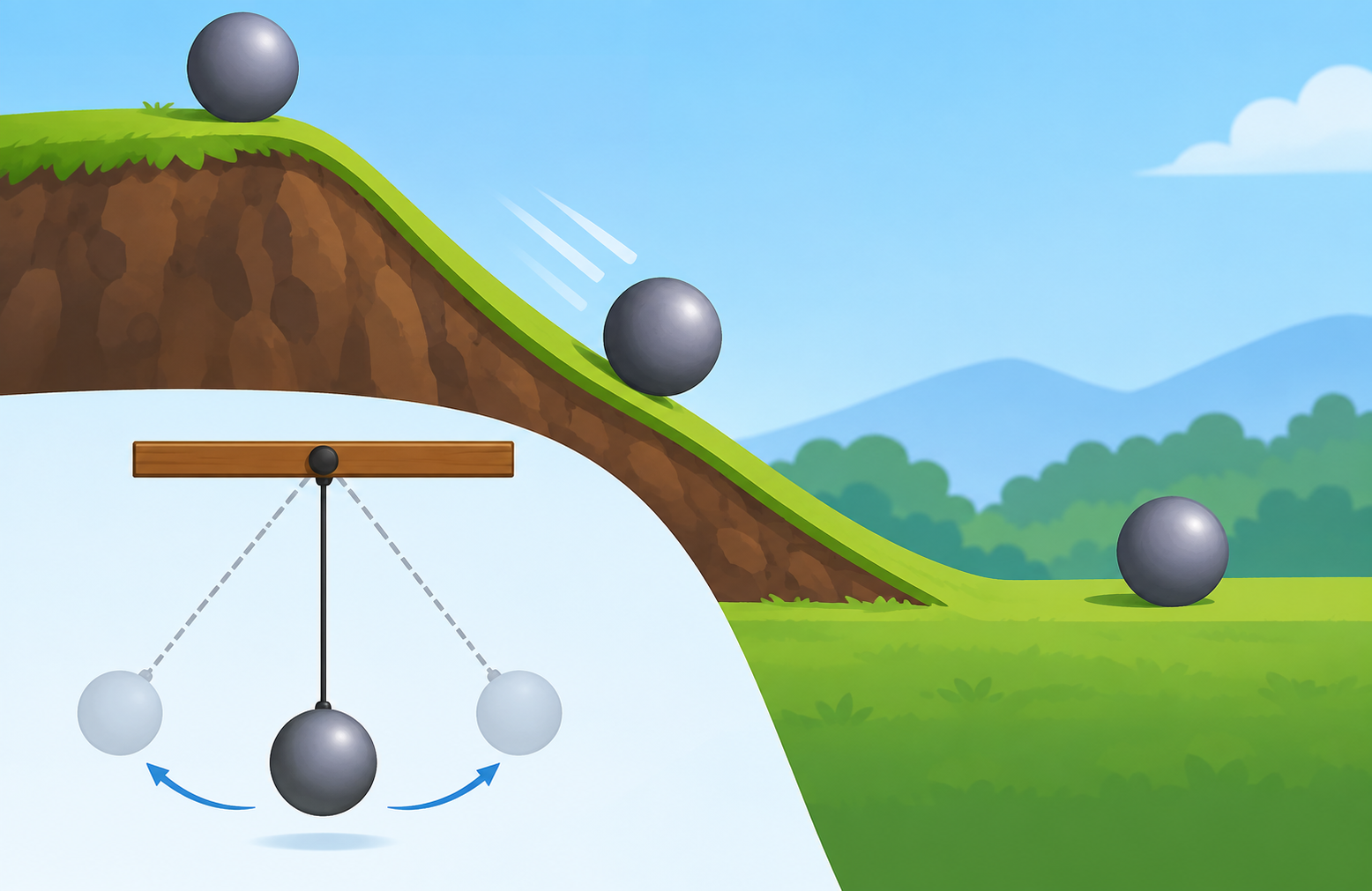
Picture a roller coaster sitting at the very top of its tallest hill. It is not moving fast — but it has something valuable stored up: height. The moment it begins to roll downward, that stored energy starts converting into the energy of motion. By the time it reaches the bottom, the car is travelling at its highest speed of the entire ride.
That exchange — stored energy becoming motion — is the heart of mechanical energy.
Mechanical energy is the energy an object possesses because of its motion, its position, or its configuration. It is one of the most fundamental concepts in physics, and once you understand it, you start seeing it everywhere — in swinging pendulums, falling objects, bouncing balls, and moving vehicles.
Key Takeaways
-
Mechanical energy is the sum of kinetic energy and potential energy: ME = KE + PE.
-
Kinetic energy is the energy of motion — the faster an object moves and the more massive it is, the more kinetic energy it has.
-
Potential energy is stored energy — associated with an object’s position, height, or configuration.
-
Mechanical energy is measured in joules (J).
-
Kinetic and potential energy continuously transform into each other in moving systems.
-
In an ideal frictionless system, total mechanical energy remains constant.
-
In real situations, friction and air resistance can convert some mechanical energy into thermal energy — though total energy is always conserved.
What Is Mechanical Energy?
Mechanical energy is the total energy an object has because of its motion, its position, or its physical configuration.
It is calculated using a straightforward equation:
ME = KE + PE
Where:
- ME = mechanical energy (joules, J)
- KE = kinetic energy (joules, J)
- PE = potential energy (joules, J)
Consider a simple example. A ball is held at rest, 3 metres above the ground. At that instant, it has gravitational potential energy because of its height. The moment you release it, it starts moving — gaining kinetic energy as it loses height. The total mechanical energy at any point during the fall is the sum of whatever kinetic and potential energy the ball has at that moment.
Mechanical energy is measured in joules (J), the standard SI unit of energy.
The Two Main Types of Mechanical Energy
| Feature | Kinetic Energy | Potential Energy |
|---|---|---|
| Definition | Energy due to motion | Energy stored due to position or configuration |
| Depends on | Mass and speed | Mass, height, and gravitational acceleration |
| Formula | KE = ½mv² | PE = mgh |
| SI Unit | Joule (J) | Joule (J) |
| Everyday example | A moving car | A rock held at the edge of a cliff |
| Can change into the other form? | Yes — when an object slows and rises | Yes — when an object falls and speeds up |
These two forms are not independent. They continuously exchange with each other as objects move through gravitational fields or interact with springs and other physical systems.
What Is Kinetic Energy?
Kinetic energy is the energy an object has because it is moving. Any object that has mass and is in motion has kinetic energy — a bicycle, a falling apple, a moving planet.
Formula:
KE = ½mv²
Where:
- KE = kinetic energy (J)
- m = mass (kg)
- v = speed (m/s)
Notice that speed is squared. This means doubling an object’s speed quadruples its kinetic energy — which is why high-speed collisions are so much more damaging than low-speed ones.
For a thorough explanation of kinetic energy and how it is calculated, see What Is Kinetic Energy?
Worked Examples:
Example 1: A 2 kg ball moves at 5 m/s.
KE = ½ × 2 × 5² = ½ × 2 × 25 = 25 J
Example 2: A 1,000 kg car travels at 20 m/s.
KE = ½ × 1,000 × 20² = ½ × 1,000 × 400 = 200,000 J (200 kJ)
Example 3: A 0.15 kg cricket ball is bowled at 30 m/s.
KE = ½ × 0.15 × 30² = ½ × 0.15 × 900 = 67.5 J
What Is Potential Energy?
Potential energy is stored energy. An object has potential energy because of where it is or how it is arranged — not because of how fast it is moving.
The most common form in mechanical energy problems is gravitational potential energy — the energy stored in an object because of its height above a reference level.
Formula:
PE = mgh
Where:
- m = mass (kg)
- g = gravitational acceleration (9.8 m/s² on Earth)
- h = height above the chosen reference point (m)
The choice of reference point (where h = 0) is up to you — it is usually the lowest point in the problem, such as the ground.
For a complete explanation of potential energy and its different forms, see What Is Potential Energy?
Worked Examples:
Example 1: A 3 kg book rests on a shelf 2 m above the floor.
PE = 3 × 9.8 × 2 = 58.8 J
Example 2: A 60 kg person stands at the top of a 10 m staircase.
PE = 60 × 9.8 × 10 = 5,880 J
Example 3: A 0.5 kg apple hangs 1.5 m above the ground.
PE = 0.5 × 9.8 × 1.5 = 7.35 J
The Mechanical Energy Formula
The complete formula for mechanical energy in a gravitational situation is:
ME = KE + PE
ME = ½mv² + mgh
Both kinetic and potential energy depend on mass, which means a more massive object has more mechanical energy for the same speed and height.
Worked Example:
A 4 kg object moves at 3 m/s while positioned 2 m above the ground (g = 9.8 m/s²).
KE = ½ × 4 × 3² = ½ × 4 × 9 = 18 J
PE = 4 × 9.8 × 2 = 78.4 J
ME = 18 + 78.4 = 96.4 J
How Kinetic and Potential Energy Work Together
A roller coaster is the classic illustration of this relationship.
At the top of the first hill:
The coaster moves slowly (low KE) but sits at maximum height (high PE). Most of its mechanical energy is stored as potential energy.
During the descent:
As the coaster loses height, PE decreases. That energy does not disappear — it converts into kinetic energy. The coaster accelerates.
At the bottom:
Height is at its minimum (low PE) and speed is at its maximum (high KE). The same total mechanical energy is present — just in a different form.
Going up again:
Speed decreases (KE drops) as height increases (PE rises).
The total — ME = KE + PE — remains the same throughout (in an ideal frictionless system). Energy is simply shifting between forms.
Conservation of Mechanical Energy
When only conservative forces (such as gravity) do work on an object, mechanical energy is conserved:
KE₁ + PE₁ = KE₂ + PE₂
The subscripts 1 and 2 represent two different points in time or position.
Worked Example — Falling Object:
A 2 kg object is released from rest at a height of 5 m. Use g = 9.8 m/s². Ignore air resistance.
At the starting point (h = 5 m):
PE = mgh = 2 × 9.8 × 5 = 98 J
KE = 0 J (starts from rest)
ME = 98 + 0 = 98 J
Just before hitting the ground (h ≈ 0):
PE ≈ 0 J
KE = 98 J (all PE has converted to KE)
ME = 0 + 98 = 98 J
The mechanical energy remained exactly 98 J throughout. The energy changed form — from potential to kinetic — but the total stayed constant.
What was the object’s speed just before impact?
KE = ½mv²
98 = ½ × 2 × v²
98 = v²
v = √98 ≈ 9.9 m/s
Mechanical Energy and Friction
In real-world situations, friction and air resistance are always present to some degree. These are called non-conservative forces, and they do something important: they convert mechanical energy into thermal energy (heat).
A key distinction to understand clearly:
- Total energy is always conserved. Energy cannot be created or destroyed.
- Mechanical energy can decrease when friction converts some of it into thermal energy.
For example, when a ball rolls down a ramp and friction acts between the ball and the surface, the ball arrives at the bottom moving slightly slower than predicted by the ideal conservation equation. Some mechanical energy has been transferred to the ramp and ball as thermal energy — you might notice the surface feels slightly warmer after repeated use.
This does not mean energy was lost — it was transformed into a form that is no longer useful for driving the ball’s motion.
Mechanical Energy Without Friction vs With Friction
| Condition | What Happens to Mechanical Energy |
|---|---|
| Ideal frictionless system | ME remains constant: KE + PE = constant |
| System with friction | ME decreases — some converts to thermal energy |
| Falling object (no air resistance) | All PE converts to KE — ME is conserved |
| Roller coaster (real) | ME decreases slightly due to air resistance and track friction |
| Sliding object on rough surface | ME decreases — friction produces heat |
In all cases, total energy is always conserved. Only the distribution across different energy forms changes.
Mechanical Energy in a Falling Object
This is the clearest example of mechanical energy in action.
At the top (height h, at rest):
- PE = mgh (maximum)
- KE = 0
- ME = mgh
During the fall (intermediate height):
- PE decreasing
- KE increasing
- ME = same total value
Just before impact (h ≈ 0):
- PE ≈ 0
- KE ≈ mgh (maximum)
- ME = same total value
Worked Example:
A 1.5 kg rock falls from a height of 8 m. Use g = 9.8 m/s².
Initial ME = PE = 1.5 × 9.8 × 8 = 117.6 J
Speed just before impact:
KE = ½mv² = 117.6
½ × 1.5 × v² = 117.6
v² = 156.8
v = √156.8 ≈ 12.5 m/s
Mechanical Energy in a Roller Coaster
Top of the hill: Maximum PE, minimum KE.
Descending: PE decreases, KE increases, speed rises.
Bottom of the valley: Minimum PE, maximum KE, highest speed.
Climbing again: KE converts back to PE, speed falls.
In a real roller coaster, friction between the wheels and track, and air resistance, gradually reduce the total mechanical energy available. This is why real roller coasters cannot return to exactly the same height after each valley — each successive hill must be slightly lower than the previous one (or motors must add energy to compensate).
Mechanical Energy in a Pendulum
A swinging pendulum provides a beautiful, repeating demonstration of energy transformation.
At the highest point of the swing:
- PE is maximum (greatest height above the lowest point).
- KE is zero (the pendulum momentarily stops before swinging back).
At the lowest point of the swing:
- KE is maximum (fastest speed).
- PE is minimum (reference level, h = 0).
At the other extreme:
- PE is maximum again.
- KE is zero again.
In an ideal pendulum (no friction, no air resistance), this continues indefinitely with total ME unchanged. In reality, each swing is slightly smaller than the last as friction at the pivot and air resistance convert mechanical energy to thermal energy — which is why real pendulums eventually come to rest.
Mechanical Energy in a Spring
A compressed or stretched spring stores elastic potential energy. This is another form of potential energy that contributes to mechanical energy.
When you compress a spring and release an object from it:
- The stored elastic potential energy converts to kinetic energy.
- The object accelerates as the spring returns to its natural length.
Similarly, when a bouncing ball deforms on impact, it stores elastic potential energy momentarily — then releases it as kinetic energy on the rebound.
While the full treatment of spring energy involves Hooke’s Law and the formula PE = ½kx², the key principle is the same: potential energy converts to kinetic energy, and vice versa.
Mechanical Energy vs Kinetic Energy
| Feature | Mechanical Energy | Kinetic Energy |
|---|---|---|
| Definition | Total energy from motion and position | Energy from motion only |
| Formula | ME = KE + PE | KE = ½mv² |
| Includes potential energy? | Yes | No |
| Can be zero for a moving object? | Only if PE is negative | No — if moving, KE > 0 |
| Unit | Joule (J) | Joule (J) |
Kinetic energy is one component of mechanical energy — not the same thing. An object resting at height has mechanical energy (all PE) but zero kinetic energy.
Mechanical Energy vs Potential Energy
Similarly, potential energy is one component of mechanical energy.
Using ME = KE + PE:
- A stationary object at height h has ME = PE = mgh (since KE = 0).
- A moving object at the same height has ME = ½mv² + mgh.
Potential energy alone does not represent the full mechanical energy picture — you need to add any kinetic energy present.
Mechanical Energy vs Total Energy
This distinction matters in real-world problems.
Mechanical energy refers specifically to the sum of kinetic and gravitational (or elastic) potential energy. It describes the energy associated with macroscopic motion and position.
Total energy is a broader concept that includes:
- Mechanical energy (KE + PE)
- Thermal energy (internal energy of particles)
- Chemical energy
- Electrical energy
- Nuclear energy
- Other forms
When friction acts, it converts mechanical energy into thermal energy. Mechanical energy decreases — but total energy remains constant. This is the correct way to describe what happens: not “energy is lost” but “mechanical energy is converted into thermal energy.”
Units of Mechanical Energy
The SI unit of mechanical energy — like all forms of energy — is the joule (J).
1 J = 1 kg·m²/s²
This unit is consistent across both kinetic and potential energy formulas:
- KE = ½mv² → kg × (m/s)² = kg·m²/s² = J
- PE = mgh → kg × m/s² × m = kg·m²/s² = J
For a complete reference to SI units and how they work, see What Are SI Units in Physics?
Mechanical Energy and Work
Work and mechanical energy are closely connected. When a net force does work on an object, it changes the object’s mechanical energy.
Work-energy theorem:
The net work done on an object equals the change in its kinetic energy.
When you lift an object from the ground to a shelf, you do work against gravity. That work is stored as gravitational potential energy in the object. The amount of work done equals the gain in PE.
W = Fd (when force and displacement are in the same direction)
For a full exploration of work and how it relates to energy, see What Is Work in Physics?
Example:
A person lifts a 5 kg box by 1.2 m.
Work done = mgh = 5 × 9.8 × 1.2 = 58.8 J
The box gains 58.8 J of gravitational potential energy.
Mechanical Energy and Force
Forces cause changes in motion and therefore in kinetic energy. When gravity pulls an object downward, it does work on the object — converting potential energy to kinetic energy.
Conservative forces (like gravity and spring forces) can transfer energy reversibly between kinetic and potential forms without any net loss of mechanical energy.
Non-conservative forces (like friction) do work that converts mechanical energy into thermal energy — a one-way transfer.
For a thorough understanding of force and how it acts on objects, see What Is Force in Physics?
Mechanical Energy and Mass
Mass appears in both fundamental mechanical energy formulas:
KE = ½mv²
PE = mgh
This means that for two objects at the same height and speed, the heavier one has more mechanical energy. Double the mass → double the mechanical energy (all else equal).
This relationship is why large trucks travelling at highway speeds have enormous kinetic energy and require much greater braking distances than small cars at the same speed.
For a clear explanation of what mass means and how it differs from weight, see What Is Mass in Physics?
Mechanical Energy as a Scalar Quantity
Mechanical energy is a scalar quantity — it has magnitude (a numerical value with a unit) but no direction.
A ball moving to the right at 5 m/s and a ball moving to the left at 5 m/s have exactly the same kinetic energy — and therefore the same mechanical energy at the same height. The direction of motion does not affect the energy value.
This makes energy calculations simpler in many respects — you add and subtract energy values as ordinary numbers, without needing to account for direction.
For a full explanation of what scalar quantities are and how they differ from vectors, see What Is Scalar Quantity in Physics?
Worked Examples
Example 1 — Calculate mechanical energy from KE and PE:
KE = 40 J, PE = 60 J.
ME = 40 + 60 = 100 J
Example 2 — Calculate kinetic energy:
m = 5 kg, v = 6 m/s.
KE = ½ × 5 × 36 = 90 J
Example 3 — Calculate gravitational PE:
m = 8 kg, h = 3 m, g = 9.8 m/s².
PE = 8 × 9.8 × 3 = 235.2 J
Example 4 — Falling object (find speed at bottom):
A 4 kg object falls from rest at h = 6 m. Ignore air resistance.
Initial ME = PE = 4 × 9.8 × 6 = 235.2 J
At bottom: KE = 235.2 J
½ × 4 × v² = 235.2
v² = 117.6
v = √117.6 ≈ 10.8 m/s
Example 5 — Roller coaster:
A 500 kg roller coaster car sits at rest at h = 20 m.
PE = 500 × 9.8 × 20 = 98,000 J
At h = 5 m: PE = 500 × 9.8 × 5 = 24,500 J
KE at h = 5 m = 98,000 − 24,500 = 73,500 J
v² = (2 × 73,500) ÷ 500 = 294
v = √294 ≈ 17.1 m/s
Example 6 — Object moving at height:
A 3 kg ball moves at 4 m/s at a height of 5 m.
KE = ½ × 3 × 16 = 24 J
PE = 3 × 9.8 × 5 = 147 J
ME = 24 + 147 = 171 J
Example 7 — Find speed using conservation of ME:
A 2 kg ball starts at rest at h = 10 m. What is its speed at h = 3 m?
Initial ME = 2 × 9.8 × 10 = 196 J
At h = 3 m: PE = 2 × 9.8 × 3 = 58.8 J
KE = 196 − 58.8 = 137.2 J
½ × 2 × v² = 137.2
v² = 137.2
v = √137.2 ≈ 11.7 m/s
Example 8 — Find height using conservation of ME:
A 1 kg ball is launched upward at 14 m/s from ground level. How high does it reach?
Initial KE = ½ × 1 × 196 = 98 J
At maximum height, KE = 0, all energy is PE.
PE = mgh → 98 = 1 × 9.8 × h → h = 98 ÷ 9.8 = 10 m
Example 9 — Compare ME at two positions:
A 5 kg object at h = 4 m moves at 3 m/s.
ME = ½ × 5 × 9 + 5 × 9.8 × 4 = 22.5 + 196 = 218.5 J
At h = 1 m (ideal): PE = 5 × 9.8 × 1 = 49 J. KE = 218.5 − 49 = 169.5 J.
v = √(2 × 169.5 ÷ 5) = √67.8 ≈ 8.2 m/s
Example 10 — Mechanical energy with friction (conceptual):
A 3 kg box slides down a 5 m ramp. Without friction, ME at the bottom would be all KE = 3 × 9.8 × 5 = 147 J. With friction doing 20 J of work against the box, actual KE at the bottom = 147 − 20 = 127 J. The 20 J has been converted to thermal energy.
Example 11 — Pendulum:
A 0.5 kg pendulum bob is raised 0.8 m above its lowest point.
PE at top = 0.5 × 9.8 × 0.8 = 3.92 J
At the lowest point: KE = 3.92 J
v = √(2 × 3.92 ÷ 0.5) = √15.68 ≈ 3.96 m/s
Example 12 — Spring (elastic PE to KE):
A spring stores 50 J of elastic potential energy and releases a 0.4 kg object. Find the object’s speed after release (assuming no friction and horizontal launch):
KE = 50 J
½ × 0.4 × v² = 50
v² = 250
v = √250 ≈ 15.8 m/s
Example 13 — Mixed KE + PE:
A 10 kg object is at h = 3 m and moving at 6 m/s.
KE = ½ × 10 × 36 = 180 J
PE = 10 × 9.8 × 3 = 294 J
ME = 180 + 294 = 474 J
Example 14 — Word problem:
A 70 kg cyclist coasts downhill from a height of 15 m to ground level. If we ignore friction, what is the cyclist’s speed at the bottom?
Initial ME = PE = 70 × 9.8 × 15 = 10,290 J
At bottom: KE = 10,290 J
½ × 70 × v² = 10,290
v² = 294
v = √294 ≈ 17.1 m/s
Example 15 — Challenge problem:
A 2 kg ball is thrown horizontally from a cliff 20 m high at 10 m/s. What is its total mechanical energy at the moment of launch? (Take g = 9.8 m/s², reference level = ground.)
KE = ½ × 2 × 100 = 100 J
PE = 2 × 9.8 × 20 = 392 J
ME = 100 + 392 = 492 J
In the absence of air resistance, this value remains 492 J throughout the ball’s flight — the ratio of KE to PE changes with height, but their sum stays constant.
How to Solve Mechanical Energy Problems
- Identify the system — what object(s) are involved?
- List known values — mass, height, speed, g.
- Check for non-conservative forces — is there friction or air resistance?
- Identify KE and PE at each relevant position.
- Choose the correct formula — ME = KE + PE, or the conservation equation KE₁ + PE₁ = KE₂ + PE₂.
- Convert units — grams to kilograms, centimetres to metres.
- Calculate initial mechanical energy.
- Apply conservation if the system is frictionless.
- Solve for the unknown by rearranging the equation.
- Check your answer — does the speed seem physically reasonable? Is the unit joules?
Common Mistakes Students Make
| Mistake | How to Avoid It |
|---|---|
| Confusing mechanical energy with total energy | ME = KE + PE only. Total energy also includes thermal, chemical, electrical, etc. |
| Forgetting that KE depends on v² | Doubling speed quadruples KE. Always square the speed first. |
| Using the wrong PE formula | For gravity: PE = mgh. For springs: PE = ½kx². Know which applies. |
| Forgetting units | Always include J in energy answers. |
| Saying friction “destroys” energy | Friction converts mechanical energy to thermal energy — energy is not destroyed. |
| Assuming ME is conserved even with friction | ME is only conserved when no non-conservative forces do work. |
| Forgetting to define the reference level for h | Always state where h = 0. This determines your PE values. |
| Confusing mass and weight | Mass is in kg; weight is in N (= mg). Use mass in energy formulas. |
| Assuming KE = 0 just because an object will stop | At the exact top of a vertical throw or swing, KE = 0. At other points, KE > 0. |
| Using g = 10 without stating it | Always state whether you are using g = 9.8 m/s² or an approximation. |
Real-Life Examples of Mechanical Energy
| Example | Energy Transformation |
|---|---|
| Roller coaster | PE at top → KE at bottom → PE at next hill |
| Falling apple | Gravitational PE → KE as it falls |
| Swinging pendulum | PE at extremes ↔ KE at centre |
| Bicycle going downhill | PE → KE (speed increases) |
| Ball thrown upward | KE → PE (slows and rises) → KE again (falls) |
| Hydroelectric dam | PE of water stored at height → KE as it falls → electrical energy via turbines |
| Compressed spring | Elastic PE → KE of released object |
| Playground swing | PE at highest points ↔ KE at lowest point |
| Ramp | PE at top converts to KE on the way down |
| Moving vehicle | Chemical energy (fuel) → KE; brakes convert KE → thermal energy |
Practice Questions
- Define mechanical energy in your own words.
- Write the formula for mechanical energy.
- What is the SI unit of mechanical energy?
- A 3 kg object moves at 4 m/s. Calculate its kinetic energy.
- A 5 kg object rests on a shelf 3 m above the ground (g = 9.8 m/s²). Calculate its gravitational potential energy.
- A 2 kg ball is at a height of 4 m and moving at 3 m/s. Calculate its total mechanical energy.
- An object falls from rest at a height of 12 m (g = 9.8 m/s², ignore air resistance). What is its speed just before impact?
- A roller coaster car (mass 600 kg) starts at rest at h = 25 m. Calculate its speed at h = 5 m (ignore friction).
- Explain what happens to mechanical energy when friction acts on a sliding object.
- A 4 kg pendulum bob is raised 1.2 m above its lowest point. What is its speed at the lowest point?
- Is mechanical energy always conserved? Explain.
- A 1 kg ball is thrown upward at 8 m/s from ground level. What maximum height does it reach?
- Explain, using energy terms, why a real roller coaster cannot return to the same height as its starting point without motor assistance.
- A spring stores 80 J of elastic potential energy. It launches a 0.5 kg ball horizontally. Calculate the ball’s speed after launch (ignore friction).
- A 10 kg object has 490 J of gravitational PE and 200 J of kinetic energy. What is its mechanical energy, speed, and height? (g = 9.8 m/s²)
Practice Question Answers
- Mechanical energy is the total energy an object has due to its motion and position — the sum of kinetic and potential energy (ME = KE + PE).
- ME = KE + PE, or ME = ½mv² + mgh.
- Joule (J).
- KE = ½ × 3 × 16 = 24 J
- PE = 5 × 9.8 × 3 = 147 J
- KE = ½ × 2 × 9 = 9 J. PE = 2 × 9.8 × 4 = 78.4 J. ME = 87.4 J
- KE = mgh = 2 × 9.8 × 12 = 235.2 J (using 2 kg? — using the given setup: for any mass, v = √(2gh) = √(2 × 9.8 × 12) = √235.2 ≈ 15.3 m/s
- ME = 600 × 9.8 × 25 = 147,000 J. At h = 5: PE = 600 × 9.8 × 5 = 29,400 J. KE = 117,600 J. v = √(2 × 117,600 ÷ 600) = √392 ≈ 19.8 m/s
- Friction converts some mechanical energy into thermal energy — the object arrives with less KE than predicted by the ideal frictionless calculation.
- PE = 4 × 9.8 × 1.2 = 47.04 J. KE at bottom = 47.04 J. v = √(2 × 47.04 ÷ 4) = √23.52 ≈ 4.85 m/s
- No — only in ideal systems with no non-conservative forces. In real life, friction and air resistance convert some ME to thermal energy.
- KE = ½ × 1 × 64 = 32 J. At max height: PE = 32 J. h = 32 ÷ (1 × 9.8) ≈ 3.27 m
- Friction and air resistance convert some mechanical energy to thermal energy on each descent. The car has less ME to convert back to PE on the next climb — so it cannot reach the same height.
- KE = 80 J. ½ × 0.5 × v² = 80. v² = 320. v = √320 ≈ 17.9 m/s
- ME = 490 + 200 = 690 J. Speed: ½ × 10 × v² = 200 → v² = 40 → v ≈ 6.32 m/s. Height: 10 × 9.8 × h = 490 → h = 5 m
Multiple-Choice Questions
Question 1
What is the formula for mechanical energy?
A. ME = ½mv²
B. ME = mgh
C. ME = KE + PE
D. ME = Work ÷ Time
Correct Answer: C
Mechanical energy is the sum of kinetic and potential energy. Options A and B are formulas for individual components, not total ME.
Question 2
A 4 kg object moves at 3 m/s. What is its kinetic energy?
A. 12 J
B. 18 J
C. 36 J
D. 6 J
Correct Answer: B
KE = ½ × 4 × 9 = 18 J. Remember to square the speed before multiplying.
Question 3
What happens to potential energy as a falling object descends (ignoring air resistance)?
A. It increases.
B. It stays the same.
C. It decreases.
D. It first increases, then decreases.
Correct Answer: C
As height decreases, PE = mgh decreases. The lost PE converts to KE.
Question 4
In an ideal frictionless system, what happens to total mechanical energy?
A. It increases as the object speeds up.
B. It decreases as the object loses height.
C. It remains constant.
D. It equals zero.
Correct Answer: C
In an ideal system, KE + PE = constant. Energy shifts between forms but the total stays the same.
Question 5
What does friction do to the mechanical energy of a sliding object?
A. Increases it.
B. Keeps it constant.
C. Converts some of it into thermal energy.
D. Destroys it.
Correct Answer: C
Friction is a non-conservative force that converts mechanical energy to thermal energy. Total energy is conserved, but ME decreases.
Question 6
A 5 kg object rests on a ledge 4 m above the ground (g = 9.8 m/s²). It is not moving. What is its mechanical energy?
A. 20 J
B. 196 J
C. 98 J
D. 0 J
Correct Answer: B
PE = 5 × 9.8 × 4 = 196 J. KE = 0 (at rest). ME = 196 J.
Question 7
A ball is thrown vertically upward. At its highest point, which of the following is true?
A. KE is maximum, PE is minimum.
B. Both KE and PE are zero.
C. KE is zero, PE is maximum.
D. KE equals PE.
Correct Answer: C
At the highest point, the ball momentarily stops (KE = 0) and is at maximum height (PE is maximum).
Question 8
Which of the following is NOT a form of mechanical energy?
A. Kinetic energy of a moving car
B. Gravitational PE of a lifted rock
C. Chemical energy stored in a battery
D. Elastic PE in a compressed spring
Correct Answer: C
Chemical energy is not a form of mechanical energy. ME includes kinetic and potential (gravitational and elastic) energy only.
Question 9
Doubling the speed of an object will do what to its kinetic energy?
A. Double it.
B. Triple it.
C. Quadruple it.
D. Halve it.
Correct Answer: C
KE = ½mv². If v doubles, v² quadruples — so KE quadruples.
Question 10
Mechanical energy is which type of quantity?
A. Vector
B. Scalar
C. Dimensionless
D. Complex
Correct Answer: B
Mechanical energy is a scalar — it has magnitude (in joules) but no direction.
Challenge Questions
Challenge 1:
A 3 kg ball is released from rest at a height of 15 m. Using g = 9.8 m/s², find its speed at heights of 10 m, 5 m, and 0 m (ignore air resistance). Explain what the pattern shows.
Solution:
Initial ME = 3 × 9.8 × 15 = 441 J
At h = 10 m:
PE = 3 × 9.8 × 10 = 294 J. KE = 441 − 294 = 147 J.
v = √(2 × 147 ÷ 3) = √98 ≈ 9.9 m/s
At h = 5 m:
PE = 3 × 9.8 × 5 = 147 J. KE = 441 − 147 = 294 J.
v = √(2 × 294 ÷ 3) = √196 = 14.0 m/s
At h = 0 m:
PE = 0. KE = 441 J.
v = √(2 × 441 ÷ 3) = √294 ≈ 17.1 m/s
Pattern: Speed increases steadily as height decreases. At each point, ME = 441 J. The ball gains KE at exactly the rate it loses PE.
Challenge 2:
A 60 kg skier starts at rest at the top of a slope 30 m high. At the bottom, the skier is moving at 20 m/s. (g = 9.8 m/s²) (a) Calculate the initial ME. (b) Calculate the KE at the bottom. (c) How much mechanical energy was lost to friction? (d) What happened to that energy?
Solution:
(a) Initial ME = PE = 60 × 9.8 × 30 = 17,640 J
(b) KE at bottom = ½ × 60 × 400 = 12,000 J
(c) ME lost = 17,640 − 12,000 = 5,640 J
(d) The 5,640 J was converted to thermal energy by friction between the skis and snow, and by air resistance. The snow and skis became very slightly warmer. Total energy was conserved — it simply shifted from mechanical to thermal form.
Challenge 3:
A pendulum of length 2 m is released from an angle where the bob is 0.5 m above the lowest point. The bob has mass 0.8 kg. (g = 9.8 m/s²) (a) What is the ME of the system? (b) What is the speed at the lowest point? (c) What is the height reached on the other side, assuming no energy loss?
Solution:
(a) ME = PE at top = 0.8 × 9.8 × 0.5 = 3.92 J
(b) At lowest point: KE = 3.92 J.
½ × 0.8 × v² = 3.92 → v² = 9.8 → v = √9.8 ≈ 3.13 m/s
(c) On the other side, all KE converts back to PE.
mgh = 3.92 → 0.8 × 9.8 × h = 3.92 → h = 0.5 m
The pendulum rises to exactly the same height on the other side — as expected from conservation of mechanical energy.
Challenge 4:
A 1,200 kg car travels along a level road at 25 m/s, then approaches a hill. Ignoring friction and air resistance, what maximum height can the car reach if the engine is switched off at the base of the hill?
Solution:
At the base: KE = ½ × 1,200 × 625 = 375,000 J. PE = 0.
At maximum height: KE = 0. All ME is PE.
PE = 375,000 J
mgh = 375,000 → 1,200 × 9.8 × h = 375,000
h = 375,000 ÷ 11,760 ≈ 31.9 m
The car could coast up to approximately 31.9 m before stopping — if no friction or air resistance were present.
Challenge 5:
Two identical 2 kg balls are at height h = 8 m. Ball A is stationary. Ball B is moving horizontally at 6 m/s. (g = 9.8 m/s²) (a) Calculate ME for each ball. (b) Both are released (Ball A from rest, Ball B continuing its horizontal motion). Which reaches the ground first? (c) Which has greater speed just before impact?
Solution:
(a) Ball A: PE = 2 × 9.8 × 8 = 156.8 J. KE = 0. ME = 156.8 J
Ball B: PE = 156.8 J. KE = ½ × 2 × 36 = 36 J. ME = 192.8 J
(b) Both balls experience the same vertical acceleration due to gravity (g = 9.8 m/s² downward). Both start at the same height. Both fall to the ground in the same time — they reach the ground simultaneously.
(c) Ball B has greater speed at impact because it has more total mechanical energy.
Ball A at ground: KE = 156.8 J → v = √(2 × 156.8 ÷ 2) = √156.8 ≈ 12.5 m/s
Ball B at ground: KE = 192.8 J → v = √(2 × 192.8 ÷ 2) = √192.8 ≈ 13.9 m/s
Ball B’s additional mechanical energy (from its initial horizontal motion) means it strikes the ground faster — though both take the same time to fall.
Mechanical Energy Cheat Sheet
| Concept | Formula | Meaning | SI Unit |
|---|---|---|---|
| Mechanical energy | ME = KE + PE | Total energy from motion and position | Joule (J) |
| Kinetic energy | KE = ½mv² | Energy due to motion | Joule (J) |
| Gravitational PE | PE = mgh | Energy stored due to height | Joule (J) |
| Conservation of ME | KE₁ + PE₁ = KE₂ + PE₂ | ME is constant in ideal (frictionless) systems | Joule (J) |
| Work | W = Fd | Force applied over a distance | Joule (J) |
| Power | P = W/t | Rate of energy transfer | Watt (W) |
Quick Revision Notes
- ME = KE + PE
- KE = ½mv² — kinetic energy depends on mass and the square of speed.
- PE = mgh — gravitational potential energy depends on mass, g, and height.
- The SI unit of mechanical energy is the joule (J).
- Mechanical energy is a scalar quantity — no direction.
- KE and PE continuously transform into each other in moving systems.
- In an ideal frictionless system: KE + PE = constant.
- Friction converts mechanical energy into thermal energy — total energy is still conserved.
- Mechanical energy can decrease; total energy cannot.
- Always define the reference level (h = 0) before calculating PE.
Frequently Asked Questions
1. What is mechanical energy?
Mechanical energy is the total energy an object has because of its motion and its position or configuration. It equals the sum of kinetic energy and potential energy: ME = KE + PE. It is measured in joules.
2. What is the formula for mechanical energy?
ME = KE + PE. For a gravitational situation, this expands to ME = ½mv² + mgh, where m is mass, v is speed, g is gravitational acceleration, and h is height above the reference level.
3. What are the two types of mechanical energy?
Kinetic energy (energy of motion, KE = ½mv²) and potential energy (stored energy due to position or configuration, PE = mgh for gravitational PE). Both are measured in joules.
4. Is kinetic energy mechanical energy?
Yes — kinetic energy is one of the two components of mechanical energy. An object’s total mechanical energy includes its kinetic energy plus any potential energy it has.
5. Is potential energy mechanical energy?
Yes — potential energy is the other main component of mechanical energy. Gravitational PE, elastic PE in springs, and similar stored mechanical energies all contribute to an object’s total ME.
6. What is the SI unit of mechanical energy?
The joule (J). This is the same unit used for all forms of energy and for work. 1 J = 1 kg·m²/s².
7. Is mechanical energy conserved?
In an ideal system where only conservative forces (like gravity) do work, yes — KE + PE remains constant. In real systems where friction or air resistance act, mechanical energy decreases because some is converted to thermal energy. Total energy is always conserved.
8. What happens to mechanical energy when friction acts?
Friction converts some mechanical energy into thermal energy (heat). The object loses mechanical energy, but that energy is not destroyed — it appears as an increase in the thermal energy of the object and surface. Total energy remains constant.
9. What is the difference between mechanical energy and total energy?
Mechanical energy is specifically KE + PE. Total energy includes all forms — mechanical, thermal, chemical, electrical, nuclear, and others. When friction converts mechanical energy to thermal energy, ME decreases but total energy is unchanged.
10. Can mechanical energy be negative?
Kinetic energy is always zero or positive (since KE = ½mv² and v² ≥ 0). Gravitational PE can be negative if the reference level is chosen above the object’s position. So technically ME can be negative — but this depends entirely on where you set h = 0. The choice is arbitrary and does not affect any physically measurable outcomes.
11. How does mechanical energy change during a fall?
As an object falls, gravitational PE decreases and kinetic energy increases. In the absence of air resistance, their sum (ME) remains constant. The object speeds up at the same rate as it loses height.
12. How does a roller coaster demonstrate mechanical energy?
At the top of the first hill, the car has maximum PE and minimum KE. As it descends, PE converts to KE and the car accelerates. At the bottom, KE is maximum. Going up the next hill, KE converts back to PE. In a real coaster, friction reduces ME slightly with each cycle.
13. Is mechanical energy a scalar or vector?
Mechanical energy is a scalar — it has magnitude in joules but no direction. The velocity of an object has direction, but when you calculate KE = ½mv², the result is a positive scalar number.
14. How is mechanical energy related to work?
Work done on an object by a net force changes the object’s mechanical energy. Lifting an object does work equal to mgh, storing that amount as gravitational PE. A braking force does negative work on a moving vehicle, reducing its KE.
15. What is an example of mechanical energy in everyday life?
A swinging playground swing is a perfect example. At the highest point of the swing, the child has maximum PE and minimum KE. At the lowest point, KE is maximum and PE is minimum. Energy continuously transforms between the two forms with each swing.
Summary
Mechanical energy is the total energy associated with an object’s motion and its position or configuration:
ME = KE + PE
ME = ½mv² + mgh
Kinetic energy — the energy of motion — depends on mass and the square of speed. Potential energy — stored energy — depends on mass, gravitational acceleration, and height. Both are measured in joules. Both are scalar quantities.
In an ideal frictionless system, mechanical energy is conserved: the total KE + PE at any point equals the total KE + PE at any other point. Energy does not disappear — it transforms between kinetic and potential forms continuously.
In real situations, friction and air resistance convert some mechanical energy into thermal energy. Mechanical energy decreases in these cases — but total energy is always conserved. It is critical to distinguish between mechanical energy (which can change) and total energy (which cannot).
Understanding mechanical energy — how it is calculated, how it transforms, and how friction affects it — is fundamental to analysing the motion of objects in almost every context in physics.
Helpful Resources
OpenStax — Mechanical Energy and Conservation of Energy
A peer-reviewed, free university-level physics text with detailed coverage of kinetic energy, potential energy, conservation of mechanical energy, and work-energy relationships.
https://openstax.org/books/physics/pages/9-2-mechanical-energy-and-conservation-of-energy
OpenStax — Conservation of Energy (College Physics)
Covers mechanical energy conservation with worked examples, the effect of non-conservative forces, and real-world applications.
https://openstax.org/books/college-physics-2e/pages/7-6-conservation-of-energy
Khan Academy — Kinetic and Potential Energy
Video lessons and interactive exercises on kinetic energy, gravitational potential energy, and conservation of mechanical energy — suitable for beginners through intermediate physics students.
https://www.khanacademy.org/science/highschool-physics/x6679aa2c65c01e53%3Aenergy/x6679aa2c65c01e53%3Akinetic-and-potential-energy/v/potential_energy
Disclaimer:
This article is intended for educational and informational purposes only. While LearnMinto strives to provide accurate and up-to-date mathematics information, readers should verify important academic concepts through official textbooks, educational institutions, examination boards, or trusted educational resources before using this content for exams or academic purposes. LearnMinto is not affiliated with any specific school, university, research institution, or examination board.