
Introduction
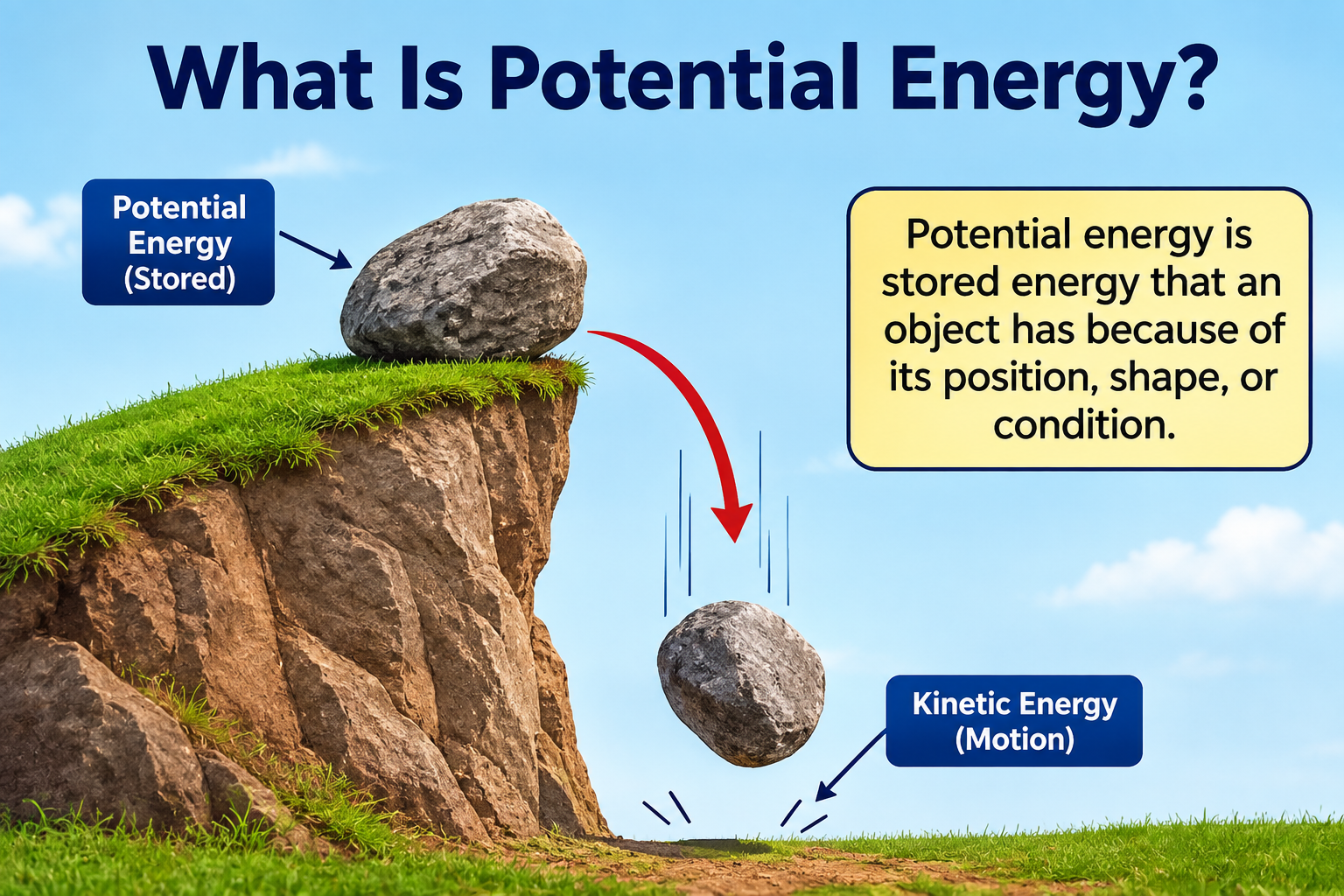
Picture a heavy rock balanced on the edge of a cliff. It is completely still, yet it possesses an enormous capacity to do damage if it falls. Or think about a stretched rubber band held back in your fingers, a drawn bow and arrow ready to be released, or millions of litres of water held behind a dam wall. None of these objects are moving, yet each one stores energy that is ready to be released at any moment. That stored energy is called potential energy. So what exactly is potential energy? Potential energy is the energy stored in an object due to its position, condition, or configuration.
Unlike kinetic energy, which is the energy of motion, potential energy is waiting energy. It has the potential to do work. When the conditions change, such as when the rock falls, the rubber band snaps back, or the water rushes through a dam, that stored potential energy converts into kinetic energy and other forms.
The SI unit of potential energy is the joule (J), the same unit used for all forms of energy. In this article, you will find a thorough, beginner-friendly guide covering the definition, types, formulas, real-life examples, worked calculations, practice questions, and much more.
Key Takeaways
- Potential energy is stored energy that depends on an object’s position, condition, or configuration.
- The SI unit of potential energy is the joule (J).
- Potential energy is a scalar quantity. It has magnitude only and no direction.
- The main types of potential energy are gravitational, elastic, chemical, electric, nuclear, and magnetic.
- Gravitational PE is calculated using PE = mgh (mass × gravitational acceleration × height).
- Elastic PE is calculated using PE = ½kx² (spring constant × extension squared ÷ 2).
- Potential energy can convert to kinetic energy and vice versa. In ideal conditions (no friction), the total mechanical energy (KE + PE) is conserved.
- Gravitational PE depends on a chosen reference point. Below the reference point, PE can be negative.
What Is Potential Energy?
Potential energy is defined as the energy stored in an object or system due to its position, condition, or configuration. The word “potential” captures this idea well: the energy is not actively doing anything at the moment, but it has the potential to be released and do work.
Here are the key characteristics of potential energy:
- Stored energy: Potential energy is not the energy of motion. It is energy held in reserve, waiting to be converted into a more active form such as kinetic energy.
- Position or condition determines it: Gravitational PE depends on height. Elastic PE depends on how much a spring or elastic material is stretched or compressed. Chemical PE depends on the arrangement of atoms in molecules.
- Can convert to kinetic energy: When the conditions change (an object falls, a spring releases, fuel burns), potential energy converts to kinetic energy, thermal energy, light, or other forms.
- Scalar quantity: Potential energy has magnitude only and no direction. A 5 J increase in potential energy is simply 5 J, regardless of the direction of movement.
- Depends on a reference point: For gravitational PE, you must choose a reference level. The potential energy is measured relative to that level. This choice is flexible and does not affect the final physics answer as long as it is used consistently.
What Is the SI Unit of Potential Energy?
The SI unit of potential energy is the joule (J).
In base SI units:
1 J = 1 kg·m²/s²
This unit is consistent with the gravitational PE formula PE = mgh, where:
kg × (m/s²) × m = kg·m²/s² = J
Every form of energy in physics, whether kinetic energy, potential energy, work, or heat, shares the same SI unit of joules. This makes energy calculations consistent and directly comparable across different situations.
For larger energy values, the kilojoule (kJ) is used:
1 kJ = 1,000 J
For example, the gravitational PE of a large reservoir of water might be expressed in megajoules (MJ) or even gigajoules (GJ).
Types of Potential Energy
Potential energy takes several distinct forms depending on the nature of the stored energy.
| Type | Definition | Formula | Example |
|---|---|---|---|
| Gravitational PE | Energy due to height above a reference point | PE = mgh | Water stored in a dam |
| Elastic PE | Energy stored in a stretched or compressed elastic material | PE = ½kx² | Compressed spring |
| Chemical PE | Energy stored in chemical bonds between atoms | No simple single formula | Food, fuel, batteries |
| Electric PE | Energy stored in a system of charges due to their positions | Depends on charge and field | Charged capacitor |
| Nuclear PE | Energy stored in the nucleus of an atom | Mass-energy equivalence | Nuclear power plant |
| Magnetic PE | Energy stored in a magnetic field or magnetic configuration | Depends on field and position | Two magnets held apart |
Gravitational Potential Energy
Gravitational potential energy (GPE) is the energy stored in an object because of its height above a reference point in a gravitational field. The higher an object is, the more gravitational PE it has, and the more energy it can release when it falls.
Gravitational PE depends on three quantities:
- Mass (m): A heavier object at the same height has more gravitational PE.
- Gravitational acceleration (g): A stronger gravitational field means more PE for the same mass and height. On Earth, g ≈ 9.8 m/s².
- Height (h): Greater height above the reference point means more PE.
The formula is:
PE = mgh
Where:
- PE = gravitational potential energy (joules, J)
- m = mass of the object (kilograms, kg)
- g = gravitational acceleration (m/s²)
- h = height above the chosen reference point (metres, m)
Reference point: The reference point is the level at which you define PE = 0. This is often the ground, the floor, or the lowest point of the system. The choice is flexible, but once chosen, it must be used consistently throughout a problem.
Example 1:
A 4 kg book is placed on a shelf 2 m above the floor. g = 9.8 m/s². Calculate its gravitational PE.
PE = mgh
PE = 4 × 9.8 × 2
PE = 78.4 J
Example 2:
A 60 kg person stands at the top of a 50 m cliff. g = 9.8 m/s². Calculate their gravitational PE relative to the base of the cliff.
PE = mgh
PE = 60 × 9.8 × 50
PE = 29,400 J (or 29.4 kJ)
How gravitational PE changes with height:
- When an object rises, work is done against gravity and gravitational PE increases.
- When an object falls, gravity does work on it and gravitational PE decreases, converting to kinetic energy.
Real-life examples:
- A book resting on a high shelf has more gravitational PE than the same book on a low shelf.
- A ball thrown upward gains gravitational PE as it rises and loses it as it falls.
- Water stored in a reservoir at height has enormous gravitational PE used in hydroelectric power generation.
- A roller coaster at the top of its first and highest hill has maximum gravitational PE.
- A skydiver on a plane before jumping has significant gravitational PE relative to the ground.
Elastic Potential Energy
Elastic potential energy is the energy stored in a material that has been stretched, compressed, or deformed elastically. When the force is removed, the material returns to its original shape and releases this stored energy as kinetic energy.
Elastic PE arises from Hooke’s Law, which states that the force needed to stretch or compress a spring is directly proportional to the extension or compression, as long as the elastic limit is not exceeded:
F = kx
Where:
- F = force applied (newtons, N)
- k = spring constant (N/m), a measure of the stiffness of the spring
- x = extension or compression from the natural length (metres, m)
The elastic potential energy stored is:
PE_elastic = ½kx²
Where:
- PE_elastic = elastic potential energy (joules, J)
- k = spring constant (N/m)
- x = extension or compression (metres, m)
Example:
A spring with spring constant k = 200 N/m is compressed by 0.1 m. Calculate the elastic PE stored.
PE_elastic = ½ × 200 × (0.1)²
PE_elastic = ½ × 200 × 0.01
PE_elastic = ½ × 2
PE_elastic = 1 J
Real-life examples:
- A compressed spring in a child’s toy stores elastic PE, which launches a projectile when released.
- A stretched rubber band stores elastic PE that converts to kinetic energy when released.
- A drawn bow stores elastic PE in the bent limbs, converting to kinetic energy of the arrow when released.
- A trampoline surface stores elastic PE when a person lands, then converts it back to kinetic energy to launch the person upward.
- A bungee cord stores elastic PE at maximum stretch, decelerating the jumper before pulling them back upward.
When the spring or elastic material is released, the stored elastic PE converts to kinetic energy of the released object.
Chemical Potential Energy
Chemical potential energy is energy stored in the chemical bonds between atoms and molecules. When a chemical reaction occurs, these bonds break and form in new arrangements, releasing energy as heat, light, or kinetic energy.
Chemical PE is present in:
- Food: The chemical bonds in carbohydrates, fats, and proteins store energy that the body releases through metabolic processes to power movement and vital functions.
- Fuels: Petrol, diesel, natural gas, and wood store chemical PE. Burning (combustion) releases this energy as heat and light.
- Batteries: A battery stores chemical PE in its electrochemical reactions. As it discharges, chemical PE converts to electrical energy.
- Explosives: Materials such as gunpowder or TNT store large amounts of chemical PE in unstable molecular bonds. When triggered, this energy releases very rapidly.
Chemical PE is fundamental to life, transportation, and electricity generation. You do not need to know the detailed chemistry to understand that it is simply energy stored in molecular bonds, ready to be released under the right conditions.
Electric Potential Energy
Electric potential energy is the energy stored in a system of electric charges due to their positions relative to each other.
When charged objects are held apart against the electric force acting between them, energy is stored in the system. This is similar in concept to gravitational PE, where mass is replaced by electric charge and gravity is replaced by the electric force.
Examples of electric PE:
- Capacitor: A capacitor stores electric PE by separating positive and negative charges on two conducting plates. When the capacitor discharges, this PE converts to electrical energy.
- Electric field: A charged particle placed in an electric field has electric PE due to its position in the field.
At school level, the key concept is simply that separated electric charges store energy, just as a raised mass stores gravitational energy.
Nuclear Potential Energy
Nuclear potential energy is the energy stored within the nucleus of an atom. It arises from the forces that hold protons and neutrons together inside the nucleus.
When nuclear reactions occur, a tiny amount of nuclear mass is converted into an enormous amount of energy, as described by Einstein’s equation E = mc². This energy is released as:
- Nuclear fission: The splitting of heavy nuclei (such as uranium) releases nuclear PE as heat and radiation, which is used in nuclear power stations.
- Nuclear fusion: The joining of light nuclei (such as hydrogen isotopes) releases even more nuclear PE. This is the process that powers the Sun.
Nuclear PE represents the most concentrated form of stored energy known in physics. A small amount of nuclear material can release millions of times more energy than the same mass of chemical fuel.
Magnetic Potential Energy
Magnetic potential energy is the energy stored in a magnetic field or in the spatial arrangement of magnets relative to each other.
When two magnets are held apart in a configuration where they attract each other, the system stores magnetic PE. If released, this PE converts to kinetic energy as the magnets accelerate toward each other.
Similarly, when two magnets are pushed together with like poles facing (repulsion), work must be done against the repulsive magnetic force. This work is stored as magnetic PE in the system.
Magnetic PE is important in electric motors, generators, magnetic storage devices, and magnetic levitation systems.
Gravitational PE vs Elastic PE
| Feature | Gravitational PE | Elastic PE |
|---|---|---|
| Definition | Energy stored due to height in a gravitational field | Energy stored in a stretched or compressed elastic material |
| Formula | PE = mgh | PE = ½kx² |
| Depends on | Mass, gravitational acceleration, height | Spring constant, extension or compression |
| SI unit | Joule (J) | Joule (J) |
| Example | Ball on a shelf, water in a reservoir | Compressed spring, stretched rubber band |
| Can it be negative? | Yes, if object is below the reference point | No, because x² is always positive |
| Reference point | Yes, must be chosen | Not applicable in the same way |
Potential Energy and Kinetic Energy
Potential energy and kinetic energy are the two main forms of mechanical energy. They are constantly interconverting in many physical situations.
Examples of PE and KE conversion:
- Falling object: As an object falls from height h to the ground, gravitational PE (mgh) decreases while kinetic energy (½mv²) increases. At the moment of impact, virtually all PE has become KE (ignoring air resistance).
- Ball thrown upward: At the moment of release, the ball has maximum KE. As it rises, KE converts to gravitational PE. At the peak, KE = 0 and PE is maximum.
- Spring released: A compressed spring releases its elastic PE, which converts to kinetic energy of the object attached to it or launched by it.
- Roller coaster: At the top of each hill, the coaster has high gravitational PE and low KE. At the bottom of each descent, PE has converted to KE and the coaster reaches maximum speed.
In the absence of friction and air resistance, the total mechanical energy is conserved:
KE + PE = constant
Worked example using conservation of energy:
A 2 kg ball is dropped from a height of 5 m. g = 10 m/s². Find its speed just before it hits the ground.
At the top: PE = mgh = 2 × 10 × 5 = 100 J, KE = 0 J. Total energy = 100 J.
At the bottom: PE = 0 J, KE = 100 J.
KE = ½mv²
100 = ½ × 2 × v²
100 = v²
v = √100
v = 10 m/s
For a full treatment of kinetic energy including the work-energy theorem and collision types, the LearnMinto article on What Is Kinetic Energy? provides detailed explanations and worked examples.
Conservation of Energy and Potential Energy
The law of conservation of energy states that energy cannot be created or destroyed. It can only be transformed from one form to another. The total energy of an isolated system remains constant.
Potential energy plays a central role in this conservation:
- Hydroelectric dam: Water stored at height has gravitational PE. When released, it flows downward, converting PE to KE. The moving water drives turbines, converting KE to electrical energy.
- Pendulum: At the extreme points of the swing, the pendulum has maximum gravitational PE and minimum KE. At the lowest point, PE is minimum and KE is maximum. In practice, air resistance and friction at the pivot gradually convert mechanical energy to thermal energy, causing the pendulum to slow.
- Stretched spring released: When a compressed or stretched spring is released, elastic PE converts to kinetic energy of the object it propels.
When friction is present, some mechanical energy converts to thermal energy. The total mechanical energy (KE + PE) is no longer constant, but the total energy of the system (including thermal energy) is still conserved. Energy is never created or destroyed, regardless of the situation.
Potential Energy and Work
Work and potential energy are closely related. In fact, the change in potential energy equals the work done against the relevant force:
W = ΔPE
Specific relationships:
- Work done against gravity increases gravitational PE. When you lift a box from the floor to a shelf, the work you do (force × distance) equals the increase in gravitational PE.
- Work done by gravity decreases gravitational PE. When a ball falls, gravity does work on it and the gravitational PE decreases (converting to KE).
- Work done to stretch a spring increases elastic PE. The work done by your hands in pulling a spring equals the elastic PE stored.
This relationship between work and potential energy is a direct consequence of the work-energy theorem. When a conservative force does negative work on an object (for example, lifting against gravity), potential energy increases by the same amount.
For a complete explanation of work, including the formula W = Fd cos θ and its applications, the LearnMinto article on What Is Work in Physics? is highly recommended.
Potential Energy and Force
Potential energy and force are connected through a fundamental relationship. For a conservative force (a force where the work done is path-independent, such as gravity or spring force), the force is related to the change in potential energy:
In one dimension:
F = −ΔPE / Δx
This means that a conservative force acts in the direction that decreases potential energy. Gravity pulls objects downward because that is the direction of decreasing gravitational PE. A spring pulls a stretched end back to its natural length because that is the direction of decreasing elastic PE.
This relationship is why potential energy is such a powerful concept in physics. Instead of calculating forces at every point, you can use potential energy to describe the behaviour of a system.
Gravity is a conservative force, which is why gravitational PE is well defined and path-independent. For a thorough grounding in force and how it relates to motion and energy, the LearnMinto article on What Is Force in Physics? covers all the essential concepts.
Potential Energy and Height
Gravitational PE is directly proportional to height above the reference point:
PE ∝ h (at constant mass and g)
This means doubling the height doubles the gravitational PE. The relationship is linear.
Numerical example:
A 3 kg object is at different heights. g = 10 m/s². Reference point = ground.
At h = 0 m: PE = 3 × 10 × 0 = 0 J (reference point)
At h = 2 m: PE = 3 × 10 × 2 = 60 J
At h = 4 m: PE = 3 × 10 × 4 = 120 J
Moving from 2 m to 4 m (doubling the height above the ground) doubled the PE from 60 J to 120 J. This direct proportionality makes it straightforward to predict how PE changes with height.
Potential Energy and Mass
Gravitational PE is directly proportional to mass at constant height and gravitational acceleration:
PE ∝ m (at constant h and g)
Doubling the mass doubles the gravitational PE at the same height.
Numerical example:
Two objects are both at 3 m height. g = 10 m/s².
Object A (mass = 2 kg): PE = 2 × 10 × 3 = 60 J
Object B (mass = 4 kg): PE = 4 × 10 × 3 = 120 J
Doubling the mass doubled the PE. This is why heavy objects store far more gravitational PE than light objects at the same height, and why heavy objects can do much more work when they fall.
Potential Energy and Gravity
The value of gravitational acceleration (g) directly affects gravitational PE. Where g is larger, the same mass at the same height has more PE. Where g is smaller, the PE is reduced proportionally.
Example:
A 5 kg object is held at a height of 2 m.
On Earth (g = 9.8 m/s²):
PE = 5 × 9.8 × 2 = 98 J
On the Moon (g ≈ 1.62 m/s²):
PE = 5 × 1.62 × 2 = 16.2 J
The object has the same mass and is at the same height, but its gravitational PE on the Moon is only about one-sixth of its PE on Earth. This is because the Moon’s gravitational acceleration is approximately one-sixth of Earth’s.
Potential Energy on Different Planets
The table below shows the gravitational PE of a 10 kg object held at 5 m above the surface on different celestial bodies.
| Location | Gravitational Acceleration (m/s²) | PE = mgh (J) |
|---|---|---|
| Earth | 9.8 | 10 × 9.8 × 5 = 490 J |
| Moon | 1.62 | 10 × 1.62 × 5 = 81 J |
| Mars | 3.72 | 10 × 3.72 × 5 = 186 J |
| Jupiter | 24.8 | 10 × 24.8 × 5 = 1,240 J |
In every case, the mass (10 kg) and height (5 m) are identical. The only variable is the local gravitational acceleration. Jupiter’s powerful gravity gives the object more than twice the PE it would have on Earth. The Moon’s weak gravity results in far less PE.
Reference Point and Potential Energy
One of the most important concepts in gravitational PE is the reference point, also called the reference level or datum.
Key facts about the reference point:
- The reference point is the level at which you define gravitational PE = 0.
- It can be chosen freely depending on what is most convenient for the problem. Common choices include the ground, the floor of a room, the lowest point of the system, or sea level.
- PE above the reference point is positive.
- PE below the reference point is negative.
- The choice of reference point does not affect the final physics answer, because only changes in PE matter in most calculations.
Example:
A ball is at 3 m above the ground. You choose the ground as the reference point.
PE = mgh = m × g × 3 (positive)
Now suppose you choose a table at 1 m above the ground as the reference point. The ball is 2 m above the table.
PE = mgh = m × g × 2 (still positive, but a different value)
If the ball were at 0.5 m above the ground (below the 1 m table reference point):
PE = m × g × (−0.5) (negative, below the reference)
The key is consistency. Always use the same reference point throughout any given problem.
Can Potential Energy Be Negative?
Yes, potential energy can be negative. This might seem counterintuitive, but it simply means the object is below the chosen reference point.
Example:
A 2 kg object is 3 m below the chosen reference point. g = 10 m/s².
PE = mgh = 2 × 10 × (−3) = −60 J
The negative value does not mean the object has no energy or that something has gone wrong. It simply means the object is located below the level where PE was defined as zero.
Negative PE is also important in orbital mechanics and gravitational physics, where a bound system (such as a satellite in orbit) is described as having negative gravitational PE relative to a reference point at infinity.
At school level, the main takeaway is: if your object is below your chosen reference level, its gravitational PE is negative, and that is perfectly correct physics.
Potential Energy in Real Life
Potential energy is present in countless everyday situations:
- Water stored in a dam: The enormous mass of water held at height stores vast gravitational PE. When released through turbines, this converts to kinetic energy and then to electrical energy.
- A ball on a shelf: A football resting on a high shelf has gravitational PE. Knock it off and it falls, converting PE to KE.
- A compressed car spring (suspension): Car suspension springs store elastic PE when compressed by bumps in the road, then release it to absorb shock.
- A drawn bow and arrow: Drawing the bow stores elastic PE in the bent limbs. Releasing the arrow converts this to kinetic energy.
- A battery: A battery stores chemical PE in its electrochemical reactions, releasing it as electrical energy when connected to a circuit.
- Food: The chemical PE in food is released through digestion and metabolism, providing energy for movement, growth, and maintaining body temperature.
- A wound clock spring: A tightly wound spring stores elastic PE that gradually releases to keep the clock mechanism running.
- A stretched elastic band: Stretching a rubber band stores elastic PE. Release it and it snaps back, converting the stored energy to kinetic energy.
Potential Energy in Engineering and Technology
Potential energy is harnessed in many important engineering applications:
- Hydroelectric power stations: These exploit gravitational PE. Water at height flows down through penstocks, converting PE to KE of flowing water, which drives turbines to generate electricity. Hydroelectric power is one of the cleanest and most reliable energy sources available.
- Springs in mechanical devices: From clock mechanisms to valve systems, springs store elastic PE that is released in a controlled way to perform work.
- Elastic components in engineering: Elastic PE is used in vehicle suspension, recoil systems in firearms, and energy storage in elastic materials.
- Chemical energy in fuel and batteries: Almost all transportation relies on chemical PE stored in fuels or batteries. Internal combustion engines release chemical PE from petrol or diesel as thermal energy and kinetic energy.
- Nuclear power: Nuclear PE stored in uranium fuel is released through fission, producing heat that generates steam to drive turbines. Nuclear power stations provide large amounts of electricity with very low carbon emissions.
Potential Energy vs Kinetic Energy
| Feature | Potential Energy | Kinetic Energy |
|---|---|---|
| Definition | Energy stored due to position or condition | Energy due to motion |
| Depends on | Position, height, spring extension, charge arrangement | Mass and speed |
| Formula | PE = mgh (gravitational); PE = ½kx² (elastic) | KE = ½mv² |
| SI unit | Joule (J) | Joule (J) |
| Example | Book on a shelf | Moving car |
| Can it be zero? | Yes (at reference point) | Yes (object at rest) |
| Can it be negative? | Yes (gravitational, below reference) | No |
Both are forms of mechanical energy and can convert into each other. Their sum (KE + PE) is conserved in the absence of friction and air resistance.
For a complete guide to kinetic energy, the LearnMinto article on What Is Kinetic Energy? covers everything from the formula and types to collisions and the work-energy theorem.
Potential Energy vs Work
| Feature | Potential Energy | Work |
|---|---|---|
| Definition | Stored energy due to position or condition | Energy transferred by a force over a displacement |
| Formula | PE = mgh or PE = ½kx² | W = Fd cos θ |
| SI unit | Joule (J) | Joule (J) |
| Scalar or vector | Scalar | Scalar |
| Can it be negative? | Yes (gravitational) | Yes (opposing force) |
| Relationship | Work done against a force stores PE | W = ΔPE when work changes PE |
Work done against gravity is stored as gravitational PE. Work done by gravity releases gravitational PE. These two concepts are two sides of the same physical coin.
How to Calculate Gravitational Potential Energy
Example 1: Basic gravitational PE
A 5 kg object rests on a shelf 3 m above the floor. g = 9.8 m/s². Calculate its gravitational PE.
PE = mgh
PE = 5 × 9.8 × 3
PE = 147 J
Example 2: Finding mass from PE and height
A object at 4 m height has gravitational PE of 240 J. g = 10 m/s². Find the mass.
PE = mgh
240 = m × 10 × 4
240 = 40m
m = 240/40
m = 6 kg
Example 3: Finding height from PE and mass
A 3 kg object has gravitational PE of 90 J. g = 10 m/s². Find the height.
PE = mgh
90 = 3 × 10 × h
90 = 30h
h = 90/30
h = 3 m
Example 4: PE on the Moon
A 10 kg object is at a height of 5 m on the Moon. g_Moon = 1.62 m/s². Calculate its gravitational PE.
PE = mgh
PE = 10 × 1.62 × 5
PE = 81 J
Compare with Earth: PE = 10 × 9.8 × 5 = 490 J. The Moon’s weaker gravity results in much less PE.
Example 5: Change in PE when height changes
A 4 kg object is moved from a height of 2 m to a height of 7 m. g = 10 m/s². Calculate the change in gravitational PE.
PE_initial = mgh_1 = 4 × 10 × 2 = 80 J
PE_final = mgh_2 = 4 × 10 × 7 = 280 J
ΔPE = PE_final − PE_initial = 280 − 80
ΔPE = 200 J
How to Calculate Elastic Potential Energy
Example 1: Basic elastic PE
A spring with spring constant k = 500 N/m is stretched by 0.04 m. Calculate the elastic PE stored.
PE_elastic = ½kx²
PE_elastic = ½ × 500 × (0.04)²
PE_elastic = ½ × 500 × 0.0016
PE_elastic = ½ × 0.8
PE_elastic = 0.4 J
Example 2: Finding extension from elastic PE and spring constant
A spring with k = 400 N/m stores 50 J of elastic PE. Find the extension.
PE_elastic = ½kx²
50 = ½ × 400 × x²
50 = 200x²
x² = 50/200
x² = 0.25
x = √0.25
x = 0.5 m
Common Misconceptions About Potential Energy
Clearing up common errors helps you avoid losing marks in examinations:
- Thinking potential energy is only gravitational. Potential energy exists in many forms: gravitational, elastic, chemical, electric, nuclear, and magnetic. Gravitational PE is simply the most commonly discussed at school level.
- Thinking potential energy is a force. Potential energy is a scalar quantity of energy. It is not a force. Forces cause changes in PE, but PE and force are different quantities.
- Thinking negative PE means no energy. Negative PE simply means the object is below the chosen reference point. The object still has energy and can still do work.
- Confusing PE with kinetic energy. Potential energy is stored energy of position or condition. Kinetic energy is energy of motion. They can convert into each other but are fundamentally different.
- Thinking PE is destroyed when converted. Energy is never destroyed. When PE converts to KE or heat, the total energy of the system is conserved. Nothing is lost.
- Forgetting that the reference point is arbitrary. The choice of reference point affects the numerical value of PE but not the physics. Changes in PE (ΔPE) are the quantities that matter most in calculations.
- Confusing height with displacement. In PE = mgh, h is the vertical height above the reference point, not the distance traveled along a slope. If an object moves along a slope, only the vertical component of displacement matters for gravitational PE.
How to Solve Potential Energy Problems
Use this structured approach to solve potential energy problems accurately:
- Identify the type of potential energy. Is the problem about gravitational PE, elastic PE, or another type?
- Identify the relevant quantities. For gravitational PE: mass, g, and height. For elastic PE: spring constant and extension.
- Choose the reference point for gravitational PE. Clearly state what level corresponds to PE = 0.
- Select the correct formula. PE = mgh for gravitational; PE = ½kx² for elastic.
- Convert units if necessary. Mass in kg, height in m, spring constant in N/m, extension in m.
- Substitute the values. Place each number carefully into the formula.
- Calculate the result. Work through the arithmetic step by step.
- Include the correct unit. Always state joules (J) or kilojoules (kJ).
- Check whether the answer is reasonable. A book on a table should have PE in the range of tens of joules, not millions.
Important Potential Energy Formulas
| Formula | Meaning | Variables | SI Unit | When to Use |
|---|---|---|---|---|
| PE = mgh | Gravitational potential energy | m = mass (kg), g = gravitational acceleration (m/s²), h = height (m) | J | Object at height in a gravitational field |
| PE = ½kx² | Elastic potential energy | k = spring constant (N/m), x = extension or compression (m) | J | Stretched or compressed elastic material |
| KE + PE = constant | Conservation of mechanical energy | KE = kinetic energy (J), PE = potential energy (J) | J | When no friction or non-conservative forces act |
| W = ΔPE | Work equals change in potential energy | W = work done (J), ΔPE = change in PE (J) | J | Work done against or by a conservative force |
Potential Energy Practice Questions
20 Multiple Choice Questions
Question 1: What is potential energy?
- A) Energy due to motion
- B) Energy stored due to position or condition
- C) The force acting on an object
- D) The work done by a moving object
Correct Answer: B) Energy stored due to position or condition
Explanation: Potential energy is stored energy that depends on position, condition, or configuration.
Question 2: What is the SI unit of potential energy?
- A) Newton
- B) Watt
- C) Joule
- D) Pascal
Correct Answer: C) Joule
Explanation: All forms of energy, including potential energy, are measured in joules (J).
Question 3: A 5 kg object is at 4 m height. g = 10 m/s². What is its gravitational PE?
- A) 50 J
- B) 20 J
- C) 200 J
- D) 400 J
Correct Answer: C) 200 J
Explanation: PE = mgh = 5 × 10 × 4 = 200 J.
Question 4: Is potential energy a scalar or vector quantity?
- A) Vector
- B) Scalar
- C) Both
- D) Neither
Correct Answer: B) Scalar
Explanation: Potential energy has magnitude only and no direction. It is a scalar.
Question 5: Which formula gives gravitational potential energy?
- A) PE = ½mv²
- B) PE = mgh
- C) PE = ½kx²
- D) PE = Fd
Correct Answer: B) PE = mgh
Explanation: Gravitational PE = mass × gravitational acceleration × height.
Question 6: Which formula gives elastic potential energy stored in a spring?
- A) PE = mgh
- B) PE = mv
- C) PE = ½kx²
- D) PE = Fx
Correct Answer: C) PE = ½kx²
Explanation: Elastic PE = half × spring constant × extension squared.
Question 7: A spring with k = 300 N/m is compressed by 0.2 m. What is the elastic PE?
- A) 60 J
- B) 6 J
- C) 30 J
- D) 3 J
Correct Answer: B) 6 J
Explanation: PE = ½ × 300 × (0.2)² = ½ × 300 × 0.04 = ½ × 12 = 6 J.
Question 8: A ball is thrown upward. As it rises, what happens to its gravitational PE?
- A) It decreases
- B) It stays the same
- C) It increases
- D) It becomes zero
Correct Answer: C) It increases
Explanation: As the ball gains height, its gravitational PE increases. KE converts to PE.
Question 9: At which point does a falling object have maximum gravitational PE?
- A) Just before hitting the ground
- B) Halfway through its fall
- C) At the highest point before falling
- D) After hitting the ground
Correct Answer: C) At the highest point before falling
Explanation: Maximum height corresponds to maximum gravitational PE.
Question 10: Which of the following is an example of elastic potential energy?
- A) A book on a shelf
- B) Water in a dam
- C) A stretched rubber band
- D) A moving car
Correct Answer: C) A stretched rubber band
Explanation: A stretched rubber band stores elastic PE due to its deformation.
Question 11: Can gravitational potential energy be negative?
- A) No, never
- B) Yes, when the object is below the reference point
- C) Yes, when the object is at rest
- D) Yes, always
Correct Answer: B) Yes, when the object is below the reference point
Explanation: Gravitational PE is negative when the object is below the chosen reference level.
Question 12: Which type of potential energy is stored in food?
- A) Gravitational PE
- B) Elastic PE
- C) Nuclear PE
- D) Chemical PE
Correct Answer: D) Chemical PE
Explanation: Food stores energy in chemical bonds between atoms and molecules.
Question 13: An object has PE = 360 J at a height of 6 m. g = 10 m/s². What is its mass?
- A) 6 kg
- B) 60 kg
- C) 3.6 kg
- D) 36 kg
Correct Answer: A) 6 kg
Explanation: m = PE/(gh) = 360/(10 × 6) = 360/60 = 6 kg.
Question 14: In the absence of friction, what is conserved in a mechanical system?
- A) Kinetic energy only
- B) Potential energy only
- C) Total mechanical energy (KE + PE)
- D) Neither KE nor PE
Correct Answer: C) Total mechanical energy (KE + PE)
Explanation: KE + PE = constant when no non-conservative forces (such as friction) act.
Question 15: As a pendulum swings from its highest point to its lowest point, what energy conversion occurs?
- A) KE to PE
- B) PE to KE
- C) PE to thermal energy
- D) No energy conversion
Correct Answer: B) PE to KE
Explanation: At the highest points, the pendulum has maximum PE. As it descends to the lowest point, PE converts to KE.
Question 16: What happens to the gravitational PE of an object when it falls to the ground?
- A) It is destroyed
- B) It converts to kinetic energy
- C) It converts to elastic PE
- D) It remains unchanged
Correct Answer: B) It converts to kinetic energy
Explanation: As a falling object descends, gravitational PE decreases and kinetic energy increases.
Question 17: A 10 kg object is at 8 m height. g = 9.8 m/s². What is its gravitational PE?
- A) 784 J
- B) 80 J
- C) 98 J
- D) 480 J
Correct Answer: A) 784 J
Explanation: PE = mgh = 10 × 9.8 × 8 = 784 J.
Question 18: What does the variable k represent in the elastic PE formula?
- A) Kinetic energy
- B) Height
- C) Spring constant
- D) Mass
Correct Answer: C) Spring constant
Explanation: In PE = ½kx², k is the spring constant, measured in N/m.
Question 19: Which of the following correctly states the reference point for gravitational PE?
- A) It must always be the ground
- B) It must always be sea level
- C) It can be chosen freely and is where PE = 0
- D) It is always the highest point
Correct Answer: C) It can be chosen freely and is where PE = 0
Explanation: The reference point is arbitrary. It is simply the level where PE is defined as zero.
Question 20: In a hydroelectric power station, gravitational PE is ultimately converted to:
- A) Chemical energy
- B) Nuclear energy
- C) Electrical energy
- D) Magnetic energy
Correct Answer: C) Electrical energy
Explanation: Water at height has gravitational PE, which converts to kinetic energy of flowing water, then to rotational kinetic energy in turbines, and finally to electrical energy via generators.
10 Short Answer Questions
Q1: Define potential energy in physics.
Potential energy is the energy stored in an object or system due to its position, condition, or configuration. It has the capacity to do work when conditions change.
Q2: What is the formula for gravitational potential energy? Define all variables.
PE = mgh, where PE is gravitational potential energy in joules, m is mass in kilograms, g is gravitational acceleration in m/s², and h is height above the reference point in metres.
Q3: A 10 kg object is at a height of 3 m. g = 9.8 m/s². Calculate its gravitational PE.
PE = mgh = 10 × 9.8 × 3 = 294 J
Q4: What is elastic potential energy?
Elastic potential energy is energy stored in a material that has been stretched or compressed, calculated using PE = ½kx², where k is the spring constant and x is the extension or compression.
Q5: Explain the conservation of mechanical energy in a falling object.
A falling object converts gravitational PE to kinetic energy as it descends. In the absence of air resistance, the total mechanical energy (KE + PE) remains constant throughout the fall.
Q6: A spring with k = 250 N/m is extended by 0.08 m. Calculate the elastic PE stored.
PE = ½kx² = ½ × 250 × (0.08)² = ½ × 250 × 0.0064 = ½ × 1.6 = 0.8 J
Q7: Explain why gravitational PE can be negative.
Gravitational PE is measured relative to a chosen reference point. If an object is below the reference point, its height h is negative, making PE = mgh negative. This does not mean the object has no energy; it simply means it is below the reference level.
Q8: How does height affect gravitational PE?
Gravitational PE is directly proportional to height (PE ∝ h at constant m and g). Doubling the height doubles the PE. Halving the height halves the PE.
Q9: A 2 kg object is dropped from rest at 10 m height. g = 10 m/s². Find its speed just before impact.
PE at top = mgh = 2 × 10 × 10 = 200 J
At ground: KE = 200 J
½mv² = 200 → ½ × 2 × v² = 200 → v² = 200 → v = √200 ≈ 14.1 m/s
Q10: Name three real-life applications of potential energy.
Three real-life applications: (1) Hydroelectric power stations use gravitational PE of water to generate electricity. (2) Springs in vehicle suspension systems store elastic PE to absorb road vibrations. (3) Batteries store chemical PE that converts to electrical energy when connected to a circuit.
5 Numerical Problems
Problem 1:
A 15 kg boulder rests on a cliff 40 m above a valley. g = 9.8 m/s². Calculate its gravitational PE relative to the valley floor.
Solution:
PE = mgh
PE = 15 × 9.8 × 40
PE = 5,880 J (5.88 kJ)
Problem 2:
A spring with k = 1,200 N/m is compressed by 0.05 m. Calculate the elastic PE stored. If this PE is fully converted to kinetic energy of a 0.3 kg ball, find the ball’s speed.
Solution:
PE = ½kx² = ½ × 1,200 × (0.05)²
PE = ½ × 1,200 × 0.0025
PE = 1.5 J
KE = 1.5 J
½mv² = 1.5
½ × 0.3 × v² = 1.5
0.15v² = 1.5
v² = 10
v = √10 ≈ 3.16 m/s
Problem 3:
An object is dropped from 20 m height. g = 10 m/s². Find the speed at 12 m and at ground level using conservation of energy. Mass = 4 kg.
Solution:
Total energy at top = PE = 4 × 10 × 20 = 800 J (KE = 0)
At h = 12 m:
PE = 4 × 10 × 12 = 480 J
KE = 800 − 480 = 320 J
320 = ½ × 4 × v² → v² = 160 → v = √160 ≈ 12.6 m/s
At ground (h = 0):
PE = 0, KE = 800 J
800 = ½ × 4 × v² → v² = 400 → v = 20 m/s
Problem 4:
A person of mass 70 kg climbs a staircase 8 m high. g = 9.8 m/s². Calculate the increase in their gravitational PE.
Solution:
ΔPE = mgh = 70 × 9.8 × 8
ΔPE = 5,488 J (5.488 kJ)
Problem 5:
A spring stores 18 J of elastic PE. The spring constant is 800 N/m. Find the extension.
Solution:
PE = ½kx²
18 = ½ × 800 × x²
18 = 400x²
x² = 18/400
x² = 0.045
x = √0.045
x ≈ 0.212 m
5 Exam-Style Questions
Question 1:
A roller coaster car of mass 800 kg starts from rest at a height of 30 m. Using conservation of energy and ignoring friction, calculate the speed of the car at the bottom of the descent. g = 10 m/s².
Answer:
At the top: PE = mgh = 800 × 10 × 30 = 240,000 J, KE = 0.
Total mechanical energy = 240,000 J.
At the bottom: PE = 0, KE = 240,000 J.
½mv² = 240,000
½ × 800 × v² = 240,000
400v² = 240,000
v² = 600
v = √600
v ≈ 24.5 m/s
Question 2:
Explain the energy transformations that occur in a hydroelectric power station, starting from water stored at height.
Answer: Water stored in a reservoir at height possesses gravitational potential energy (PE = mgh). When the dam gates open, water flows downward through penstocks. As the water descends, gravitational PE converts to kinetic energy of the moving water. The fast-moving water strikes the blades of a turbine, converting kinetic energy to rotational kinetic energy of the turbine. The spinning turbine drives a generator, which converts rotational kinetic energy to electrical energy. At each stage, energy changes form but total energy is conserved.
Question 3:
A student argues that the reference point for gravitational PE must always be the ground. Explain why this argument is incorrect and give an example to support your explanation.
Answer: The reference point can be chosen freely and is defined by the physicist or engineer to suit the problem. The ground is a common and convenient choice, but it is not the only valid one. For example, if analysing the motion of a lift (elevator) in a building, it might be more convenient to define PE = 0 at the first floor level rather than at ground level. An object on the third floor would then have positive PE. If the lift were to go to a basement level below the first floor, the object would have negative PE. The physics of the situation is unchanged regardless of the reference chosen, because only changes in PE (ΔPE) determine the energy exchanged.
Question 4:
A 0.5 kg ball is thrown upward with an initial speed of 12 m/s. Using conservation of energy (ignoring air resistance), calculate the maximum height reached by the ball. g = 10 m/s².
Answer:
At launch: KE = ½mv² = ½ × 0.5 × 144 = 36 J, PE = 0 (reference = launch point).
At maximum height: KE = 0, PE = mgh.
Conservation of energy:
36 = mgh = 0.5 × 10 × h = 5h
h = 36/5
h = 7.2 m
Question 5:
Explain what happens to the mechanical energy of a pendulum over time in a real-world situation, and where the energy goes.
Answer: In an ideal frictionless environment, the total mechanical energy (KE + PE) of a pendulum would remain constant indefinitely. In the real world, however, two main factors reduce mechanical energy over time. First, air resistance acts on the swinging pendulum, doing negative work and converting kinetic energy to thermal energy in the surrounding air. Second, friction at the pivot point also converts mechanical energy to thermal energy. As a result, the pendulum’s amplitude gradually decreases and it eventually comes to rest at its lowest point. The mechanical energy is not destroyed; it has been converted to thermal energy in the air and pivot. Total energy (mechanical + thermal) remains conserved throughout the process.
Exam Tips
- Define potential energy clearly: It is stored energy due to position, condition, or configuration. Avoid vague definitions like “energy at rest.”
- Know both formulas: PE = mgh for gravitational PE and PE = ½kx² for elastic PE. Be able to rearrange each to find m, g, h, k, or x.
- SI unit is joules (J). Never give potential energy in newtons or kilograms.
- Potential energy is scalar. No direction is needed or correct in your answer.
- Reference point matters. Always state or identify the reference point in gravitational PE problems. Marks are often awarded for this.
- Negative PE is valid. If an object is below the reference point, PE is negative. Do not be alarmed by this.
- Conservation of mechanical energy: KE + PE = constant (no friction). This is one of the most frequently examined relationships. Know how to apply it to find unknown speeds or heights.
- Work and PE: Work done against gravity = increase in gravitational PE. This directly connects the force, displacement, and energy topics.
Quick Revision Notes
- Potential energy = stored energy due to position or condition.
- SI unit: joule (J). 1 J = 1 kg·m²/s².
- Scalar quantity: no direction.
- Types: gravitational, elastic, chemical, electric, nuclear, magnetic.
- Gravitational PE: PE = mgh (m = mass, g = gravitational acceleration, h = height above reference).
- Elastic PE: PE = ½kx² (k = spring constant, x = extension or compression).
- Reference point: level where PE = 0. Freely chosen. PE below reference is negative.
- PE ∝ h (direct proportionality at constant m and g).
- PE ∝ m (direct proportionality at constant h and g).
- PE converts to KE when object falls or spring releases.
- KE converts to PE when object rises or spring is compressed.
- Conservation of mechanical energy: KE + PE = constant (no friction).
- When friction acts, some mechanical energy converts to thermal energy.
Potential Energy Cheat Sheet
| Concept | Definition | Formula | Unit | Example |
|---|---|---|---|---|
| Potential Energy | Stored energy due to position or condition | PE = mgh or PE = ½kx² | J | Book on a shelf |
| Gravitational PE | PE due to height in a gravitational field | PE = mgh | J | Water in a dam |
| Elastic PE | PE stored in a stretched or compressed material | PE = ½kx² | J | Compressed spring |
| Chemical PE | PE stored in chemical bonds | No simple formula | J | Food, fuel, battery |
| Conservation (no friction) | Total mechanical energy constant | KE + PE = constant | J | Ball falling freely |
| Work and PE | Work done against force = change in PE | W = ΔPE | J | Lifting an object |
| Reference Point | Level where PE = 0; freely chosen | PE = 0 at reference | J | Ground level |
| Negative PE | Object below reference point | PE = mgh (h negative) | J | Object in a well |
Frequently Asked Questions
1. What is potential energy?
Potential energy is the energy stored in an object or system due to its position, condition, or configuration. It can convert to kinetic energy or other forms when conditions change.
2. What is the SI unit of potential energy?
The SI unit of potential energy is the joule (J). In base units, 1 J = 1 kg·m²/s².
3. What are the types of potential energy?
The main types are gravitational, elastic, chemical, electric, nuclear, and magnetic potential energy.
4. What is gravitational potential energy?
Gravitational PE is the energy stored in an object because of its height above a reference point in a gravitational field. It is calculated using PE = mgh.
5. What is elastic potential energy?
Elastic PE is the energy stored in a stretched or compressed elastic material, such as a spring. It is calculated using PE = ½kx².
6. What is the formula for gravitational potential energy?
PE = mgh, where m is mass (kg), g is gravitational acceleration (m/s²), and h is height above the reference point (m).
7. What is the formula for elastic potential energy?
PE = ½kx², where k is the spring constant (N/m) and x is the extension or compression from the natural length (m).
8. Is potential energy a scalar or vector?
Potential energy is a scalar quantity. It has magnitude only and no direction.
9. Can potential energy be negative?
Yes. Gravitational PE can be negative when the object is below the chosen reference point. This is physically meaningful and correct.
10. What is the reference point in potential energy?
The reference point is the level chosen where gravitational PE is defined as zero. It can be chosen freely. PE above the reference is positive; PE below is negative.
11. How does potential energy convert to kinetic energy?
When a raised object falls, gravitational PE converts to kinetic energy. When a stretched spring is released, elastic PE converts to kinetic energy of the released object.
12. What is the difference between potential energy and kinetic energy?
Potential energy is stored energy of position or condition. Kinetic energy is energy of motion. They can convert into each other; their sum (KE + PE) is conserved in the absence of friction.
13. What is the difference between potential energy and work?
Work is the energy transferred by a force over a displacement. Work done against a conservative force (such as gravity) is stored as potential energy. W = ΔPE.
14. How does height affect gravitational potential energy?
Gravitational PE is directly proportional to height. Doubling the height doubles the PE. Halving the height halves the PE.
15. How does mass affect gravitational potential energy?
Gravitational PE is directly proportional to mass at constant height and g. Doubling the mass doubles the PE.
Summary
Potential energy is stored energy that depends on an object’s position, condition, or configuration. Unlike kinetic energy, which is the energy of motion, potential energy is waiting energy that can be released and converted into other forms.
The SI unit of potential energy is the joule (J). The main types include gravitational PE (PE = mgh), elastic PE (PE = ½kx²), chemical PE, electric PE, nuclear PE, and magnetic PE. Each type arises from a different physical situation.
Gravitational PE depends on mass, gravitational acceleration, and height above a chosen reference point. Elastic PE depends on the spring constant and the amount of extension or compression. Both are scalar quantities and can be negative (gravitational) or only zero/positive (elastic).
Potential energy converts to kinetic energy and back in countless everyday situations. In the absence of friction, the total mechanical energy (KE + PE) is conserved. When friction acts, some mechanical energy converts to thermal energy, but the total energy of the system remains conserved.
Final Thoughts
Potential energy is one of the most elegant ideas in physics because it captures the idea that position and configuration carry physical significance. A book sitting on a high shelf is not just sitting there doing nothing. It holds real, measurable energy relative to the floor below it. That energy can do work. It can lift other objects, generate electricity, or accelerate a mass, depending on how it is released.
Understanding what potential energy is means understanding that energy is not only found in fast-moving objects or burning fuel. It is present in every raised object, every stretched spring, every charged particle, and every chemical bond. Physics helps us see and measure the energy that surrounds us even when nothing appears to be happening.
Work through the practice problems, practise converting between PE and KE using conservation of energy, and make sure you can confidently apply both PE = mgh and PE = ½kx² in exam situations. Mastering potential energy gives you a powerful tool for understanding the physical world.
References
- OpenStax. University Physics Volume 1 – Chapter 8: Potential Energy and Conservation of Energy. OpenStax, Rice University. Available at: https://openstax.org/books/university-physics-volume-1/pages/8-introduction
- Physics LibreTexts. Potential Energy. LibreTexts Physics. Available at: https://phys.libretexts.org/Bookshelves/University_Physics/Book%3A_University_Physics_(OpenStax)/Book%3A_University_Physics_I_-Mechanics_Sound_Oscillations_and_Waves(OpenStax)/08%3A_Potential_Energy_and_Conservation_of_Energy
- Khan Academy. Potential Energy. Khan Academy Physics. Available at: https://www.khanacademy.org/science/physics/work-and-energy/potential-energy-tutorial/a/what-is-gravitational-potential-energy
- Encyclopaedia Britannica. Potential Energy. Britannica. Available at: https://www.britannica.com/science/potential-energy
- The Physics Classroom. Potential Energy. The Physics Classroom. Available at: https://www.physicsclassroom.com/class/energy/Lesson-1/Potential-Energy
- National Institute of Standards and Technology (NIST). SI Units – Joule. NIST. Available at: https://www.nist.gov/pml/owm/metric-si/si-units
Disclaimer
This article is intended for educational and informational purposes only. While LearnMinto strives to provide accurate and up-to-date information, readers should verify important academic concepts through official textbooks, educational institutions, examination boards, or trusted scientific resources before relying on this content for exams or academic purposes. LearnMinto is not affiliated with any specific school, university, research institution, or examination board.