
Introduction
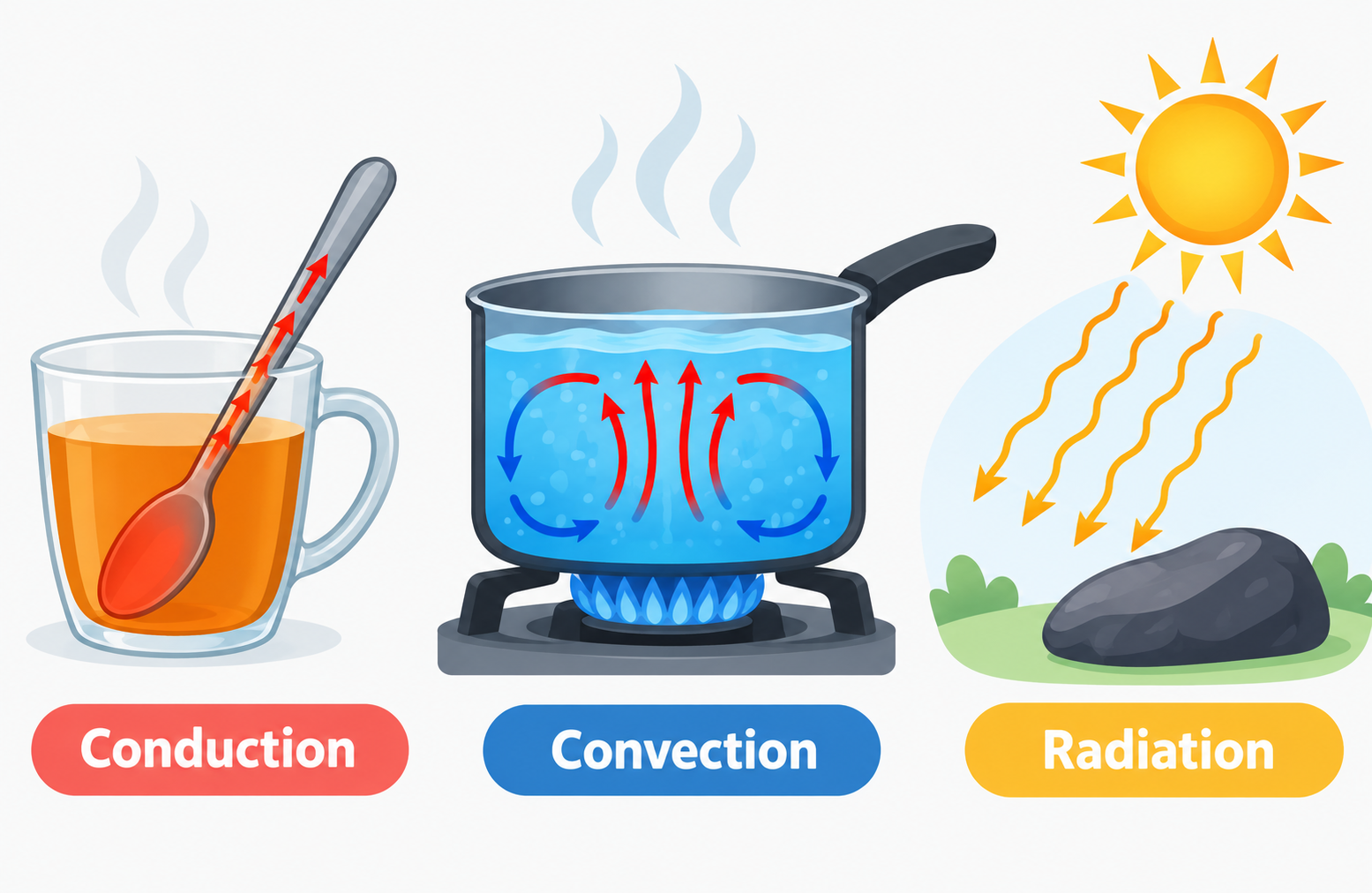
Hold a metal spoon in a cup of hot tea for a few seconds. The handle starts to feel warm — even though only the tip is in contact with the liquid. Heat is travelling through the metal toward your hand. That is just one of the three ways heat moves.
What is heat transfer? Heat transfer is the movement of thermal energy from a region of higher temperature to a region of lower temperature. It happens constantly — in cooking, in weather systems, in building design, and in the human body.
Understanding how heat moves is one of the most practical topics in physics, with applications ranging from home insulation to spacecraft thermal management.
Key Takeaways
-
Heat transfer is the movement of thermal energy from a hotter region to a cooler region — always in that direction.
-
There are three mechanisms: conduction (through solids by particle vibration), convection (through fluids by fluid movement), and radiation (by infrared electromagnetic waves).
-
Conduction and convection require a material medium — radiation does not and can travel through a vacuum.
-
Dark, matt surfaces are better emitters and absorbers of thermal radiation than light, shiny surfaces.
-
The heat transfer equation is Q = mcΔT, where Q is heat energy (J), m is mass (kg), c is specific heat capacity (J/kg·K), and ΔT is the temperature change.
-
A vacuum flask minimises all three types of heat transfer simultaneously.
-
Heat and temperature are not the same thing — heat is energy (joules); temperature measures average particle kinetic energy (kelvin or Celsius).
What Is Heat Transfer?
Heat transfer is the process by which thermal energy moves from a region of higher temperature to a region of lower temperature.
This direction is not a choice — it is a law of nature. Heat always flows from hot to cold. It never spontaneously flows from cold to hot. This continues until the two regions reach the same temperature, at which point thermal equilibrium is achieved and no further net heat transfer takes place.
Before going further, it is worth clarifying a distinction that trips up many students: heat and temperature are not the same thing.
- Temperature is a measure of the average kinetic energy of the particles in a substance. It is measured in kelvin (K) or degrees Celsius (°C). For a full explanation, see What Is Temperature in Physics?
- Heat is the total thermal energy transferred between objects because of a temperature difference. It is measured in joules (J).
A large bathtub of warm water at 40 °C contains far more thermal energy than a small cup of boiling water at 100 °C — because the bathtub has enormously more mass, even though its temperature is lower. Heat depends on both temperature and mass.
Heat is a form of energy — and like all forms of energy, it is measured in joules. For a broader understanding of energy and its forms, see What Is Energy in Physics?
Heat, temperature, and mass are all examples of physical quantities — measurable properties that can be expressed with a numerical value and a unit. To understand what that means more fully, see What Is a Physical Quantity?
There are three distinct mechanisms by which heat transfer occurs: conduction, convection, and radiation.
The Three Methods of Heat Transfer — Overview
| Method | Medium Required | How It Works | Example |
|---|---|---|---|
| Conduction | Yes — solid or fluid | Particle-to-particle vibration transfer; free electrons in metals | Metal spoon heating up in hot tea |
| Convection | Yes — fluid only (liquid or gas) | Heated fluid rises, cooler fluid sinks, creating a circulation current | Warm air rising from a radiator |
| Radiation | No — works in vacuum | Infrared electromagnetic waves emitted from all objects | Sun heating the Earth through space |
The most important distinction to remember: conduction and convection both require matter — particles must be present to carry or pass the energy. Radiation requires no medium at all — it is carried by electromagnetic waves and travels freely through the vacuum of space.
Conduction
What Is Conduction?
Conduction is the transfer of heat through a material by direct particle-to-particle interaction — without the material itself moving from place to place.
Here is what happens at the particle level:
- In solids, particles are held tightly together and vibrate about fixed positions.
- When one end of a solid is heated, those particles gain energy and vibrate more vigorously.
- These more energetic particles collide with and transfer energy to neighbouring particles.
- This chain of vibration passes energy progressively through the material.
- The particles themselves do not move along the material — only the energy does.
In metals, there is an additional and highly effective mechanism: free electrons. Metals contain electrons that are not bound to any single atom and can move freely throughout the material. When heated, these free electrons gain kinetic energy and carry it rapidly through the metal — far faster than vibration alone can achieve. This is why metals are dramatically better thermal conductors than non-metals such as wood or plastic.
Good and Poor Conductors
| Material | Conductor or Insulator | Approximate Thermal Conductivity (W/m·K) | Common Use |
|---|---|---|---|
| Copper | Conductor | ~400 | Cooking pans, heat sinks, electrical wiring |
| Aluminium | Conductor | ~237 | Baking trays, radiators, aircraft panels |
| Steel | Conductor | ~50 | Cooking equipment, building structures |
| Glass | Poor conductor (insulator) | ~1.0 | Windows, laboratory equipment |
| Wood | Insulator | ~0.1–0.2 | Furniture, building frames, tool handles |
| Air | Insulator | ~0.025 | Trapped in insulation materials |
| Wool / Fibreglass | Insulator | ~0.04 | Clothing, loft insulation |
| Rubber | Insulator | ~0.15 | Electrical insulation, handles |
The lower the thermal conductivity, the better the material acts as an insulator. Air is an exceptionally poor conductor — which is why trapping air inside a material (wool, foam, double glazing) is such an effective insulation strategy.
Real-World Examples of Conduction
1. Metal spoon in hot liquid
The tip of the spoon sits in hot tea. Heat conducts from the liquid through the metal, along the spoon’s handle toward your hand. Metals are excellent conductors — heat travels quickly.
2. Cooking pan on a stove
The stove heats the base of the pan by conduction. Heat then conducts through the metal pan base to the food. The metal’s high thermal conductivity ensures efficient cooking.
3. Walking barefoot on tiles vs carpet
Both tiles and carpet may be at exactly the same room temperature. Tiles feel colder because they conduct heat away from your feet rapidly. Carpet is a poor conductor — it does not draw heat away quickly, so it feels warmer.
4. Burns from touching a hot metal surface
Metal conducts heat so efficiently that touching a hot metal surface transfers a large amount of energy to your skin in a very short time — causing burns. A wooden surface at the same temperature would feel far less intense.
5. Ice melting in your hand
Your body heat conducts into the ice through direct contact. The ice absorbs this heat and melts. The cold sensation you feel is heat leaving your hand — conducting into the ice.
6. Soldering in electronics
A soldering iron conducts heat from its tip into the solder and the metal components being joined. Controlled conduction ensures the joint forms correctly without damaging surrounding components.
7. Double-glazed windows reducing conduction
A single pane of glass conducts heat between the warm interior and cold exterior efficiently. Double glazing places two panes of glass with a layer of air (or inert gas) between them. Air conducts heat poorly — this gap dramatically reduces heat loss by conduction.
8. Insulating handles on cooking utensils
Wooden or plastic handles are attached to metal pans precisely because they are poor conductors. Heat conducts along the metal but stops (or slows dramatically) when it reaches the insulating handle — protecting the cook’s hand.
Factors Affecting the Rate of Conduction
| Factor | Effect on Rate of Conduction | Example |
|---|---|---|
| Temperature difference | Greater difference → faster rate | A pan on a high flame heats faster than one on low |
| Material | Better conductors → faster rate | Copper conducts faster than glass |
| Thickness (of material) | Thicker → slower rate | Thick walls reduce heat loss more than thin walls |
| Cross-sectional area | Larger area → faster rate | A wide metal bar conducts more heat than a thin wire |
| Length | Longer → slower rate | Heat takes longer to reach the far end of a long rod |
Convection
What Is Convection?
Convection is the transfer of heat through a fluid — either a liquid or a gas — by the bulk movement of the fluid itself.
Unlike conduction, where particles pass energy between neighbours without moving, in convection the particles themselves physically move, carrying thermal energy with them from one region to another.
Here is the particle-level mechanism:
- A fluid near a heat source is warmed. Its particles gain kinetic energy and move more rapidly, spreading further apart.
- The fluid expands and its density decreases — it becomes less dense than the surrounding cooler fluid.
- The less dense, warmer fluid rises (buoyancy — just as a cork rises in water).
- Cooler, denser fluid moves in from the sides and below to replace the rising warm fluid.
- This cooler fluid is then heated and rises in turn.
- A continuous circular flow develops — called a convection current.
Convection does not occur in solids. In a solid, particles are locked in fixed positions and cannot flow or migrate. The bulk movement of material that convection requires is impossible in a solid — conduction is the only mechanism available.
Convection Currents
A convection current is the continuous circular circulation pattern created when a fluid is heated from below (or cooled from above).
The complete cycle:
- Fluid near heat source warms → particles spread out → density decreases.
- Less dense warm fluid rises.
- Cooler, denser fluid sinks to replace it.
- Cooler fluid reaches the heat source → is warmed → rises.
- Cycle repeats continuously, circulating the fluid.
Examples:
- Heating water in a pan: Water at the bottom of the pan heats first, becomes less dense, and rises. Cooler water from the surface sinks to the bottom. This creates a circulation that eventually brings all the water to boiling point.
- Room heated by a radiator: Warm air near the radiator rises toward the ceiling. Cooler air from the far side of the room flows along the floor toward the radiator. A convection current circulates air around the entire room.
- Atmospheric convection: Solar radiation warms Earth’s surface. The air immediately above it warms, becomes less dense, and rises — forming the basis of weather systems, clouds, winds, and storms.
Real-World Examples of Convection
1. Central heating radiators
Despite the name “radiator,” most of the heat from a domestic radiator is transferred by convection. Warm air rises from the surface of the radiator; cool air replaces it from below; a convection current distributes heat around the room.
2. Boiling water in a kettle
The heating element at the base heats water directly above it. This warm water rises; cooler water sinks to the element. The convection current mixes the water and eventually brings it all to boiling point.
3. Sea breeze and land breeze
During the day, land heats up faster than the sea. Warm air over the land rises; cooler air from the sea flows inland to replace it — creating a sea breeze. At night, the process reverses.
4. Hot air balloons
A burner heats the air inside the balloon. The warm air is less dense than the cooler air outside and provides buoyancy — lifting the balloon. Convection within the balloon keeps the air circulating and maintaining lift.
5. Thunderstorms and atmospheric convection
Strong solar heating of the ground causes warm, moist air to rise rapidly. As it rises, it cools and water vapour condenses, releasing latent heat — which further drives the air upward. This creates towering cumulonimbus clouds and severe weather.
6. Oceanic circulation (thermohaline circulation)
Cold, dense, salty water sinks in polar regions. Warmer, less dense water flows in to replace it, forming slow but massive convection currents that circulate water around the entire planet — influencing climate on a global scale.
7. Lava lamps
The wax at the bottom is heated by a light bulb, becomes less dense, and rises. At the top, it cools, becomes more dense, and sinks — repeating in a visually satisfying convection cycle.
8. Ventilation systems in buildings
Warm, stale air (which is less dense) naturally rises and exits through vents near the ceiling. Fresh, cooler air enters through vents near the floor. This passive convection ventilation can maintain air quality without fans.
Factors Affecting the Rate of Convection
1. Temperature difference
A greater temperature difference between the fluid and its surroundings produces a stronger density gradient — and stronger, faster convection currents. A more powerful heater creates more vigorous circulation.
2. Fluid properties
Viscosity (the fluid’s resistance to flow) affects how easily convection currents form. Less viscous fluids (like air or water) convect more readily than thick, viscous fluids. Density also matters — larger density differences between warm and cool regions create stronger currents.
3. Surface area of the heat source
A larger heating surface area transfers energy to a greater volume of fluid simultaneously, accelerating convection. This is why radiators have fins — increasing their surface area.
Radiation
What Is Radiation (Thermal Radiation)?
Thermal radiation is the transfer of heat energy by electromagnetic waves — specifically infrared radiation.
This is fundamentally different from conduction and convection in one critical way: radiation requires no medium. It can travel through the complete vacuum of empty space. This is how the Sun’s heat reaches Earth — travelling approximately 150 million kilometres through the vacuum of space, with no material of any kind in between.
Every object with a temperature above absolute zero (0 K = −273.15 °C) continuously emits thermal radiation. The hotter the object:
- The more radiation it emits per second.
- The shorter the peak wavelength of that radiation.
At everyday temperatures, objects emit infrared radiation (which we cannot see but can feel as warmth). At very high temperatures — such as in a fire or the Sun — objects also emit visible light (red, orange, yellow) in addition to infrared.
Emitters and Absorbers of Radiation
Not all surfaces interact with thermal radiation equally. The colour and texture of a surface determine how well it emits and absorbs radiation.
| Surface Type | Emitter | Absorber | Reflector | Example |
|---|---|---|---|---|
| Dark, matt (dull) | Good | Good | Poor | Solar panels, dark tarmac |
| Light, shiny | Poor | Poor | Good | Emergency blankets, thermos flask walls |
| White, matt | Poor emitter | Poor absorber | Moderate reflector | White-painted buildings in hot climates |
| Black, matt | Best emitter | Best absorber | Poorest reflector | Black radiator fins, black car body |
This explains several practical observations:
- Dark surfaces heat up faster in sunlight because they absorb radiation more effectively.
- Solar panels are dark to maximise absorption of solar radiation.
- Buildings in hot countries are often painted white to reflect solar radiation and remain cooler inside.
- Emergency blankets are silvered (shiny) to reflect radiation back toward the body — minimising heat loss.
Real-World Examples of Radiation
1. The Sun heating the Earth
Solar radiation (mainly visible light and infrared) travels through the vacuum of space and is absorbed by Earth’s surface and atmosphere, providing almost all of Earth’s thermal energy.
2. Sitting near a campfire
You feel warmth from a campfire even at some distance, and even from the side — not just from above the flames. The fire emits infrared radiation in all directions; your skin absorbs it and you feel warm.
3. Thermal imaging cameras
All objects emit infrared radiation. Thermal cameras detect this radiation and display it as a colour-coded image — warmer areas appear brighter. Used in medicine, building inspection, firefighting, and security.
4. Emergency (survival) blankets
These thin, silvered plastic sheets are designed to reflect the body’s infrared radiation back toward the person wearing them. The shiny surface is a poor emitter and poor absorber — it keeps the body’s heat in.
5. Solar panels (photovoltaic and thermal)
Dark surfaces absorb solar radiation effectively. Solar thermal panels use this heat to warm water. Photovoltaic panels convert light directly to electricity — but the dark surface is essential for maximum energy collection.
6. Infrared heaters
Electric infrared heaters emit infrared radiation that travels through the air and is absorbed directly by people and objects — warming them without needing to heat the air first. More efficient than convection heaters in draughty spaces.
7. Greenhouse effect
Sunlight (short-wavelength radiation) passes through the atmosphere and is absorbed by Earth’s surface. The surface re-emits this energy as long-wavelength infrared radiation. Greenhouse gases (CO₂, water vapour, methane) absorb this infrared and re-emit it in all directions — including back toward Earth — warming the surface.
8. Thermos (vacuum) flask
The silvered inner surfaces of the flask’s walls reduce radiation emission. Even at rest in a warm room, the flask reflects infrared back inward — reducing heat loss from a hot drink, or heat gain into a cold drink.
Factors Affecting the Rate of Radiation
| Factor | Effect on Rate of Radiation | Example |
|---|---|---|
| Temperature of the object | Higher temperature → more radiation emitted | A white-hot metal emits far more radiation than a warm metal |
| Surface colour and texture | Dark, matt → more emission and absorption | Black body vs polished mirror |
| Surface area | Larger area → more total radiation emitted | Radiator fins increase surface area |
| Distance from source | Greater distance → less intensity (inverse square relationship) | Standing 2 m from a fire feels less warm than 1 m |
Comparing Conduction, Convection, and Radiation
| Feature | Conduction | Convection | Radiation |
|---|---|---|---|
| Definition | Heat transfer by particle vibration through a material | Heat transfer by bulk movement of a fluid | Heat transfer by infrared electromagnetic waves |
| Medium required | Yes — solid or fluid | Yes — fluid only (liquid or gas) | No — works in vacuum |
| How energy is transferred | Particle-to-particle vibration and free electrons | Bulk movement of heated fluid creating currents | Electromagnetic waves (infrared) |
| Occurs in solids | Yes — primary mechanism | No — particles cannot flow | Yes |
| Occurs in liquids | Yes — slowly | Yes — primary mechanism | Yes |
| Occurs in gases | Yes — very slowly | Yes | Yes |
| Occurs in vacuum | No | No | Yes — only method |
| Speed of transfer | Slower — depends on material | Moderate — depends on fluid flow | Fastest — speed of light |
| Good conductors/emitters | Metals (copper, aluminium) | Low-viscosity fluids (air, water) | Dark, matt surfaces |
| Poor conductors/emitters | Wood, plastic, air, wool | Thick, viscous fluids; solids | Light, shiny surfaces |
| Application | Cooking pans, heat sinks | Radiators, weather systems | Solar heating, infrared heaters |
| Everyday example | Spoon heating in hot tea | Warm air rising from a radiator | Sun warming your skin outdoors |
Heat Transfer in Everyday Applications
Vacuum (thermos) flask
Minimises all three types simultaneously — see the dedicated section below.
Home insulation
- Loft insulation (mineral wool or fibreglass): Reduces conduction through the roof — the fibres trap air, which is an excellent insulator.
- Cavity wall insulation: Fills the gap between inner and outer walls with foam or mineral wool, eliminating convection currents in the air gap and reducing conduction.
- Double-glazed windows: Two panes of glass with an air or argon gap. The gap dramatically reduces conduction; the sealed unit prevents convection currents.
Car engine cooling systems
Car engines produce enormous heat by combustion. A coolant fluid (water/antifreeze mixture) circulates through channels in the engine block, carrying heat away by convection. The hot coolant flows to the radiator, where it is cooled by air flowing over the fins (also convection and some conduction), then returns to the engine.
Greenhouse effect and climate science
Sunlight penetrates the atmosphere and warms Earth’s surface (radiation). The surface re-emits infrared radiation, which greenhouse gases absorb and re-radiate — trapping heat in the lower atmosphere. This natural process keeps Earth habitable; enhanced greenhouse warming from human emissions is driving climate change.
Human body temperature regulation
- Blood circulation: Blood carries heat by convection from the body’s core to the skin surface, where it can be lost.
- Sweating: Sweat evaporates from the skin — each gram of water that evaporates carries away approximately 2,260 J of latent heat, cooling the skin.
- Radiation: The body continuously emits infrared radiation — accounting for roughly 60% of resting heat loss in a cool environment.
Cooking — all three mechanisms at work
- Conduction: Heat transfers from the stove through the pan base into the food.
- Convection: In an oven, hot air circulates around the food, cooking it from all sides.
- Radiation: A grill (broiler) uses intense infrared radiation to brown and cook the surface of food directly.
The Vacuum Flask — A Perfect Case Study
The vacuum flask (thermos) is the single best example in physics of all three heat transfer mechanisms being deliberately minimised in one device.
How it works:
Conduction:
The flask has a double-walled construction. Between the two walls is a vacuum — a region with no air or other matter. Without particles, heat cannot be conducted between the inner and outer walls. The walls themselves are typically made of glass or stainless steel, and the contact between inner and outer walls is minimised to tiny support points.
Convection:
Convection requires a fluid medium. The vacuum between the walls contains no fluid — so convection is completely eliminated. No air or liquid can circulate between the walls.
Radiation:
The inner surfaces of both walls are coated with a silvery, reflective material. A shiny surface is a poor emitter of infrared radiation — it reflects most radiation back rather than absorbing or emitting it. This minimises heat transfer by radiation in either direction.
The stopper/lid:
The opening of the flask is sealed with a cork or plastic stopper, which reduces conduction and prevents convection through the top opening.
The result: a vacuum flask can keep a hot drink at near-boiling temperature for many hours, and equally can keep a cold drink cold for many hours — because it minimises heat flow in both directions.
Heat Transfer and Insulation
Insulation works by reducing unwanted heat transfer — keeping heat where you want it and preventing it from going where you do not.
The key principle behind most insulation materials is that air is an excellent insulator. Still air has a thermal conductivity of approximately 0.025 W/m·K — far lower than most solid materials. Insulation works by trapping air in tiny pockets where it cannot form convection currents.
Loft insulation (mineral wool):
Fibres of mineral wool trap millions of tiny pockets of air. The air cannot flow freely enough to form convection currents, and conduction through both the fibres and the trapped air is very slow. Heat loss through the roof is dramatically reduced.
Cavity wall insulation:
Without insulation, the air gap between the inner and outer walls can develop convection currents — continuously circulating air and transferring heat. Filling the cavity with foam or mineral wool eliminates this convection and reduces conduction.
Double-glazed windows:
The sealed gap between two panes contains still air or argon gas (which has even lower thermal conductivity than air). Conduction is slow and convection is suppressed. Heat loss through windows is significantly reduced compared to single glazing.
Layers of clothing:
Each layer traps a thin layer of air against the body. Air cannot convect freely in these thin layers, and it conducts poorly. Multiple layers multiply the insulating effect.
For a reference to the standard units used in heat transfer calculations — joules (J), watts (W), and kelvin (K) — see What Are SI Units in Physics?
Heat Transfer Calculations
The fundamental equation for calculating the heat energy transferred when the temperature of a substance changes is:
Q = mcΔT
Where:
- Q = heat energy transferred (joules, J)
- m = mass of the substance (kilograms, kg)
- c = specific heat capacity of the substance (J/kg·K)
- ΔT = change in temperature (kelvin, K, or degrees Celsius, °C — the difference is the same)
Specific heat capacity (c) is the amount of energy required to raise the temperature of 1 kg of a substance by 1 K (or 1 °C). Different materials require different amounts of energy for the same temperature rise — which is why water takes much longer to heat than metal.
| Substance | Specific Heat Capacity (J/kg·K) |
|---|---|
| Water | 4,200 |
| Aluminium | 900 |
| Iron | 450 |
| Copper | 385 |
| Air (at constant pressure) | approximately 1,005 |
Water has an unusually high specific heat capacity — this is why it is used as a coolant in car engines and why coastal areas have milder climates than inland regions.
Worked Calculation Examples:
1. Calculate the heat needed to raise 2 kg of water by 50 °C.
Q = mcΔT = 2 × 4,200 × 50 = 420,000 J (420 kJ)
2. Calculate the heat needed to raise 500 g of aluminium by 20 °C.
Convert: 500 g = 0.5 kg
Q = mcΔT = 0.5 × 900 × 20 = 9,000 J (9 kJ)
3. Calculate the temperature change when 10,000 J is applied to 2 kg of copper.
ΔT = Q/(mc) = 10,000 ÷ (2 × 385) = 10,000 ÷ 770 = 13.0 °C
4. Calculate the mass of iron heated by 1,000 J with a temperature rise of 10 °C.
m = Q/(cΔT) = 1,000 ÷ (450 × 10) = 1,000 ÷ 4,500 = 0.222 kg (222 g)
5. A material of mass 0.8 kg absorbs 12,000 J and its temperature rises by 30 °C. Calculate its specific heat capacity.
c = Q/(mΔT) = 12,000 ÷ (0.8 × 30) = 12,000 ÷ 24 = 500 J/kg·K
Newton’s Law of Cooling
Newton’s Law of Cooling states that the rate of heat loss from a body is approximately proportional to the temperature difference between the body and its surroundings — provided that difference is not too large.
In simple terms: the bigger the temperature gap, the faster heat is lost. As the object cools and approaches the temperature of its surroundings, the rate of cooling slows down.
This is why:
- A very hot cup of coffee at 90 °C cools rapidly in a 20 °C room initially — the difference is 70 °C.
- As it cools to 40 °C (a difference of only 20 °C), it cools far more slowly.
- Near room temperature, it cools almost imperceptibly slowly.
Newton’s Law of Cooling applies to all three heat transfer mechanisms — the driving force for heat loss in each case depends on the temperature difference. This is also why refrigerators work more efficiently when their contents are not much warmer than the target temperature, and why industrial furnaces lose heat most rapidly when first opened.
Common Misconceptions About Heat Transfer
| Misconception | Correct Explanation |
|---|---|
| “Cold travels from cold objects to warm ones.” | Cold is not a thing that travels — it is simply the absence of thermal energy. Heat (energy) always flows from hot to cold, not the other way around. |
| “Radiation requires a medium like air.” | Thermal radiation is infrared electromagnetic radiation. It requires no medium and travels freely through a vacuum — this is how the Sun heats Earth across 150 million km of empty space. |
| “Metals feel colder than wood because they are at a lower temperature.” | At room temperature, a metal surface and a wooden surface are both at exactly the same temperature. Metal feels colder because it conducts heat away from your hand much more rapidly — the sensation of cold is actually heat leaving your skin quickly. |
| “Convection can happen in solids.” | Convection requires particles to flow and move in bulk. In a solid, particles are held in fixed positions by strong bonding forces and cannot flow — convection is impossible. Only conduction occurs in solids. |
| “A thermos flask only works for hot drinks.” | A vacuum flask minimises heat transfer in both directions. It keeps hot drinks hot (reducing heat loss from the warm liquid) and cold drinks cold (reducing heat gain into the cold liquid) equally effectively. |
Worked Examples
Example 1
Question: A student holds a metal rod with one end in a flame. After a short time, the far end gets warm. Which type of heat transfer is this?
Solution: Conduction.
Explanation: Heat is transferred through the solid metal rod by particle vibration and free electron movement — without the rod itself moving. This is conduction through a solid.
Example 2
Question: Why does warm air rise above a radiator and cool air sink to the floor?
Solution: Convection — driven by density differences.
Explanation: Air heated by the radiator gains kinetic energy and expands — its density decreases. Less dense warm air rises (buoyancy). Cooler, denser air sinks to the floor and moves toward the radiator. This creates a convection current that circulates air around the room.
Example 3
Question: How does the Sun’s heat reach Earth?
Solution: Radiation (infrared and visible electromagnetic radiation).
Explanation: There is no material between the Sun and Earth — only vacuum. Conduction and convection cannot occur in vacuum. Only radiation can travel through empty space. Solar radiation (primarily infrared and visible light) travels 150 million km and is absorbed by Earth’s surface and atmosphere.
Example 4
Question: Two surfaces — one black and matt, one white and shiny — are placed in sunlight for 30 minutes. Which becomes hotter? Explain.
Solution: The black, matt surface becomes hotter.
Explanation: Dark, matt surfaces are good absorbers of radiation. They absorb a large proportion of the incoming infrared and visible radiation, converting it to thermal energy. White, shiny surfaces reflect most incoming radiation and absorb very little — they remain cooler.
Example 5
Question: Calculate the energy needed to heat 3 kg of water from 20 °C to 100 °C. (c_water = 4,200 J/kg·K)
Solution: ΔT = 100 − 20 = 80 °C. Q = mcΔT = 3 × 4,200 × 80 = 1,008,000 J (1,008 kJ)
Explanation: Substituting into Q = mcΔT gives the total heat energy required. Water’s high specific heat capacity means a large amount of energy is needed even for this common everyday heating task.
Example 6
Question: Explain why the handle of a wooden spoon does not get hot when the spoon is used to stir hot soup.
Solution: Wood is a thermal insulator.
Explanation: Wood has very low thermal conductivity (approximately 0.1–0.2 W/m·K). It has no free electrons to carry thermal energy, and its particles are poor at transferring vibrations. Heat conducts through the wooden handle so slowly that the far end remains comfortable to hold.
Example 7
Question: Why does a vacuum flask have silvered (shiny) inner walls?
Solution: To reduce heat transfer by radiation.
Explanation: Shiny, reflective surfaces are poor emitters and poor absorbers of infrared radiation. The silvered walls reflect radiation back toward its source rather than absorbing it. This minimises the heat transferred by radiation between the inner liquid and the outer environment.
Example 8
Question: A block of copper with mass 0.5 kg absorbs 5,000 J of heat. Calculate the temperature rise. (c_copper = 385 J/kg·K)
Solution: ΔT = Q/(mc) = 5,000 ÷ (0.5 × 385) = 5,000 ÷ 192.5 = 26.0 °C
Explanation: Rearranging Q = mcΔT gives ΔT = Q/(mc). Copper has a relatively low specific heat capacity, so a modest amount of energy produces a significant temperature rise.
Example 9
Question: In a hot air balloon, which type of heat transfer is primarily responsible for the balloon rising?
Solution: Convection.
Explanation: The burner heats the air inside the balloon envelope. The warm air is less dense than the cooler air outside. The density difference creates a buoyancy force — the warm air inside is effectively “floating” in the denser surrounding air. The balloon rises due to this convective buoyancy.
Example 10
Question: A student says “cold air from the window is making the room cold.” Explain what is actually happening physically.
Solution: Warm air near the cold window is cooled, becomes denser, and sinks. This cold, dense air flows along the floor — creating a convection current that circulates cool air throughout the room.
Explanation: Cold does not move — heat does. The window conducts heat from the warm room air to the cold outside, cooling the air near the glass. This cool, dense air sinks and flows across the floor, and warmer room air replaces it near the window — creating a convection current that makes the room feel cold near the floor.
Example 11
Question: Explain why cavity wall insulation reduces heat loss from a house.
Solution: It eliminates convection in the air gap and reduces conduction.
Explanation: An uninsulated cavity contains air that can form convection currents — continuously transferring heat from the warm inner wall to the cold outer wall. Filling the cavity with foam or mineral wool prevents convection currents from forming. The insulating material itself conducts heat very poorly — further reducing heat loss.
Example 12
Question: A 1.5 kg iron pan is heated from 25 °C to 200 °C. How much energy was required? (c_iron = 450 J/kg·K)
Solution: ΔT = 200 − 25 = 175 °C. Q = mcΔT = 1.5 × 450 × 175 = 118,125 J (118.1 kJ)
Explanation: Despite iron’s relatively low specific heat capacity, the large temperature change (175 °C) means a substantial amount of energy is still required to heat the pan.
Practice Questions
12 Short Answer Questions
1. Define heat transfer in physics.
Answer: Heat transfer is the movement of thermal energy from a region of higher temperature to a region of lower temperature, continuing until thermal equilibrium is reached.
2. What is the difference between heat and temperature?
Answer: Temperature measures the average kinetic energy of particles in a substance (measured in K or °C). Heat is the total thermal energy transferred between objects due to a temperature difference (measured in joules, J).
3. Name the three types of heat transfer and state which requires no medium.
Answer: Conduction, convection, and radiation. Radiation requires no medium — it travels through a vacuum.
4. Explain why metals are better thermal conductors than wood.
Answer: Metals contain free electrons that can move throughout the material and carry thermal energy rapidly. Wood has no free electrons and its particles transfer vibrations slowly — making it a poor conductor.
5. Describe the convection current that forms in a room heated by a wall radiator.
Answer: Air near the radiator warms, becomes less dense, and rises. It cools near the ceiling, becomes denser, and sinks. Cooler air flows along the floor toward the radiator. The cycle repeats — circulating warm air around the room.
6. Why are the inner walls of a vacuum flask silvered?
Answer: Silvered (shiny) surfaces are poor emitters and poor absorbers of infrared radiation. They reflect radiation back toward its source — minimising heat transfer by radiation between the flask contents and the surroundings.
7. Calculate the heat needed to warm 1 kg of water from 15 °C to 65 °C. (c = 4,200 J/kg·K)
Answer: Q = mcΔT = 1 × 4,200 × 50 = 210,000 J (210 kJ)
8. Why does convection not occur in solids?
Answer: Convection requires bulk movement of particles carrying thermal energy. In solids, particles are held in fixed positions by strong bonding forces and cannot flow — convection is impossible.
9. Why do buildings in hot countries tend to be painted white?
Answer: White, reflective surfaces are poor absorbers of radiation. They reflect most incoming solar radiation rather than absorbing it — keeping the interior of the building cooler.
10. State Newton’s Law of Cooling in simple terms.
Answer: The rate at which a hot object loses heat is proportional to the temperature difference between the object and its surroundings. A larger temperature difference causes faster cooling.
11. A 2 kg block of aluminium absorbs 36,000 J of heat. Calculate the temperature rise. (c = 900 J/kg·K)
Answer: ΔT = Q/(mc) = 36,000 ÷ (2 × 900) = 36,000 ÷ 1,800 = 20 °C
12. Explain why wearing multiple layers of thin clothing is warmer than one thick layer.
Answer: Each layer traps a thin film of air. Air is an excellent insulator. Multiple layers multiply the number of trapped air pockets, providing better insulation than a single thick layer of the same total thickness.
10 Multiple Choice Questions
Question 1
Which type of heat transfer does not require a medium?
A. Conduction
B. Convection
C. Radiation
D. All three require a medium
Correct Answer: C
Short Explanation: Radiation is carried by infrared electromagnetic waves, which travel through the vacuum of space. Conduction and convection both require particles (a material medium) to transfer energy.
Question 2
Why do metals feel colder than wood at the same room temperature?
A. Metal has a lower temperature than wood.
B. Metal conducts heat away from your hand more quickly.
C. Wood emits more radiation than metal.
D. Metal has a lower specific heat capacity.
Correct Answer: B
Short Explanation: At room temperature, both metal and wood are at exactly the same temperature. Metal conducts heat away from your skin much faster than wood — the rapid heat loss from your hand creates the sensation of coldness.
Question 3
Which surface type is the best absorber of thermal radiation?
A. White and shiny
B. White and matt
C. Black and shiny
D. Black and matt
Correct Answer: D
Short Explanation: Dark, matt surfaces absorb the greatest proportion of incoming thermal radiation. Shiny surfaces reflect radiation; white surfaces also absorb poorly. A black, matt surface is closest to a perfect absorber.
Question 4
What is the specific heat capacity of water?
A. 385 J/kg·K
B. 900 J/kg·K
C. 4,200 J/kg·K
D. 1,005 J/kg·K
Correct Answer: C
Short Explanation: Water has a specific heat capacity of 4,200 J/kg·K — one of the highest of any common substance. This means water requires a large amount of energy for each degree of temperature rise.
Question 5
A student places a copper rod with one end in a flame. After a few minutes, the other end becomes hot. Which process is responsible?
A. Convection
B. Radiation
C. Conduction
D. Evaporation
Correct Answer: C
Short Explanation: Heat transfers through the solid copper rod by conduction — particle vibrations and free electron movement carry energy from the hot end to the cool end, without the rod itself moving.
Question 6
How does a vacuum flask minimise heat loss by radiation?
A. The vacuum prevents radiation from forming.
B. The silvered walls reflect infrared radiation.
C. The thick glass absorbs all radiation.
D. The stopper blocks infrared waves.
Correct Answer: B
Short Explanation: The inner walls of a vacuum flask are coated with a silvery, reflective material. Shiny surfaces are poor emitters and poor absorbers of radiation — they reflect infrared back toward its source, minimising radiative heat transfer.
Question 7
Which of the following is NOT a factor affecting the rate of conduction?
A. Temperature difference across the material
B. Colour of the material’s surface
C. Thickness of the material
D. Thermal conductivity of the material
Correct Answer: B
Short Explanation: Surface colour affects the rate of radiation — specifically the emission and absorption of infrared. It does not affect conduction, which depends on temperature difference, material type, thickness, area, and length.
Question 8
Calculate the heat energy needed to raise 0.5 kg of copper by 40 °C. (c = 385 J/kg·K)
A. 3,850 J
B. 7,700 J
C. 15,400 J
D. 770 J
Correct Answer: B
Short Explanation: Q = mcΔT = 0.5 × 385 × 40 = 7,700 J. Substituting directly into the formula gives the correct answer.
Question 9
In which state(s) of matter does convection occur?
A. Solids only
B. Liquids only
C. Gases only
D. Liquids and gases
Correct Answer: D
Short Explanation: Convection requires bulk movement of particles — which is only possible in fluids (liquids and gases). In solids, particles are fixed in position and cannot flow, so convection cannot occur.
Question 10
A very hot object cools rapidly at first, then more slowly as it approaches room temperature. This behaviour is explained by:
A. The specific heat capacity increasing as temperature drops.
B. Newton’s Law of Cooling — cooling rate is proportional to temperature difference.
C. Convection stopping once the temperature difference is small.
D. Radiation becoming the only active transfer method at low temperatures.
Correct Answer: B
Short Explanation: Newton’s Law of Cooling states that the rate of heat loss is proportional to the temperature difference between the object and its surroundings. As the difference decreases, cooling slows — explaining why objects cool quickly at first and then more gradually.
5 Challenge Questions
Challenge 1:
A house loses heat through its roof at a rate that depends on the temperature difference between inside and outside. On a winter day, the inside is 21 °C and the outside is −3 °C. On a mild autumn day, the inside is 19 °C and the outside is 12 °C. (a) Calculate the temperature difference in each case. (b) On which day is heat loss through the roof greater, and why? (c) Suggest two ways to reduce heat loss through the roof.
Answer:
(a) Winter: ΔT = 21 − (−3) = 24 °C. Autumn: ΔT = 19 − 12 = 7 °C
(b) Heat loss is greater on the winter day. By Newton’s Law of Cooling, the rate of heat loss is proportional to the temperature difference. A difference of 24 °C drives heat loss more than three times faster than a difference of 7 °C.
(c) Two methods:
- Loft insulation (mineral wool or fibreglass): Traps air in tiny pockets, reducing conduction and eliminating convection currents — substantially slowing heat transfer through the roof.
- Increasing insulation thickness: A thicker insulation layer increases resistance to conduction — further reducing heat loss.
Challenge 2:
A student fills a vacuum flask with 0.5 kg of hot coffee at 95 °C. After several hours, the coffee has cooled to 70 °C. (a) Calculate the heat energy lost by the coffee. (c_water ≈ 4,200 J/kg·K) (b) Explain, using all three heat transfer mechanisms, why a perfect vacuum flask would lose no heat at all. (c) Explain why real vacuum flasks are not perfectly insulating.
Answer:
(a) ΔT = 95 − 70 = 25 °C. Q = mcΔT = 0.5 × 4,200 × 25 = 52,500 J (52.5 kJ)
(b) A perfect vacuum flask would prevent:
- Conduction: A perfect vacuum between the walls contains no particles — conduction requires particles, so zero conduction would occur.
- Convection: No fluid in the vacuum means no convection currents can form — zero convection.
- Radiation: A perfect reflector would reflect 100% of infrared radiation — zero radiation loss.
(c) Real vacuum flasks are imperfect because:
- The vacuum is never perfect — traces of gas remain, allowing some conduction and convection.
- The silvered surface reflects most but not all radiation — some infrared is still absorbed and emitted.
- The walls must be physically connected at some point (support points) — allowing a small amount of conduction.
- The stopper/lid is an imperfect seal and conducts some heat.
Challenge 3:
On a summer day, a black car and a white car of identical size and construction are parked in direct sunlight. After two hours: (a) Which car’s interior is hotter, and why? (b) Which type of heat transfer is primarily responsible for the initial heating of the car body? (c) Once the car interior is hot, which types of heat transfer warm the driver sitting inside?
Answer:
(a) The black car’s interior is significantly hotter. The black exterior absorbs a much greater proportion of incoming solar radiation. The white car reflects most solar radiation and absorbs far less, so its surface and interior reach a lower temperature.
(b) Radiation (thermal/solar) is primarily responsible for heating the car body initially. Solar radiation (infrared and visible light) strikes the car’s surface and is absorbed — converting electromagnetic energy to thermal energy in the metal body.
(c) Once the interior is hot, the driver is warmed by:
- Radiation: The hot interior surfaces (dashboard, seats, metal frame) emit infrared radiation in all directions — directly heating the driver’s skin.
- Convection: Hot air inside the car circulates, carrying thermal energy from hot surfaces to the driver’s body.
- Conduction: If the driver touches the hot steering wheel or seat, heat conducts directly from the hot surface into their skin.
Challenge 4:
A student claims: “The vacuum between the walls of a thermos flask eliminates all heat transfer — the drink inside will stay at its original temperature forever.” Identify two errors in this claim and explain the correct physics.
Answer:
Error 1 — “The vacuum eliminates all heat transfer”:
The vacuum eliminates conduction and convection (which require a material medium). However, radiation does not require a medium and can travel through a vacuum. Even with silvered walls, the flask is not a perfect reflector — a small amount of infrared radiation is still emitted and absorbed through the walls. Some heat transfer by radiation always occurs.
Error 2 — “The drink will stay at its original temperature forever”:
This is incorrect for two reasons:
- The stopper/lid is not a perfect insulator. Some heat conducts through the stopper material and some convection can occur through the opening.
- As noted above, radiation transfer through the walls is never completely zero.
- Over time, all three mechanisms (though greatly reduced) gradually transfer heat until thermal equilibrium is eventually reached.
The correct statement is: a vacuum flask greatly reduces heat transfer by all three mechanisms, dramatically slowing the rate of temperature change — but it does not prevent heat transfer entirely.
Challenge 5:
Explain fully, using particle theory, why: (a) a metal spoon heats up faster in hot soup than a wooden spoon of the same dimensions, and (b) the air in a thermos flask’s vacuum gap does not transfer heat even though air normally transfers heat by conduction.
Answer:
(a) Metal vs wooden spoon:
Metal spoon:
Metal contains a lattice of positive ions surrounded by free (delocalised) electrons. When the metal end is in hot soup:
- The free electrons gain kinetic energy and move rapidly throughout the metal, carrying thermal energy from hot to cool regions far faster than vibration alone.
- Metal ions also vibrate and pass vibrational energy to neighbours by conduction.
- Both mechanisms operate simultaneously — the result is extremely rapid heat conduction. Thermal conductivity of steel: ~50 W/m·K.
Wooden spoon:
Wood has no free electrons. Its particles are bound in a polymer/cellulose structure with poor vibrational coupling. Energy is transferred only by slow particle-to-particle vibration — and the complex, irregular structure of wood makes this transfer inefficient. Thermal conductivity of wood: ~0.1–0.2 W/m·K.
The metal spoon has thermal conductivity approximately 250–500 times greater than wood — hence it heats up dramatically faster.
(b) Air in the vacuum gap:
Normal air conducts heat by particle collisions — air molecules collide with each other and with surfaces, passing kinetic energy from hotter to cooler regions. The rate of conduction depends on how frequently molecules collide with the walls.
In the vacuum gap of a thermos flask, air pressure is reduced to an extremely low level — far fewer gas molecules are present. With very few molecules, collisions between molecules and between molecules and the walls are extremely rare. The thermal conductivity of air drops dramatically as pressure decreases — approaching zero in a near-perfect vacuum. With almost no molecules to conduct energy, heat transfer by conduction (and convection) through the gap is negligible.
Heat Transfer Across Physics Topics
Thermodynamics
Heat transfer is central to thermodynamics. The First Law of Thermodynamics describes how energy is conserved — heat added to a system increases its internal energy or does work. The Second Law states that heat spontaneously flows from hot to cold — establishing the direction of all natural heat transfer processes. Entropy increases whenever heat flows irreversibly.
Energy
Heat is one of the primary ways energy is transferred between objects and systems. Conservation of energy applies to all heat transfer — energy lost by a hot object equals energy gained by the cooler object (in an isolated system). The equation Q = mcΔT quantifies this energy exchange.
Waves
Thermal radiation is part of the electromagnetic spectrum — specifically infrared radiation, with wavelengths between approximately 700 nm and 1 mm. It travels as transverse electromagnetic waves at the speed of light. Understanding radiation requires understanding the wave nature of electromagnetic radiation.
Material Science
Thermal conductivity is a fundamental material property that determines how materials are selected for engineering applications. Metals with high conductivity are chosen for heat exchangers and cooking equipment; materials with low conductivity are chosen for insulation.
Environmental Science
The greenhouse effect is a heat transfer phenomenon at a planetary scale. Solar radiation passes through the atmosphere (radiation). Earth’s surface absorbs it and re-emits infrared (radiation). Greenhouse gases absorb and re-radiate this infrared — trapping heat in the lower atmosphere. Understanding the physics of radiation is essential for understanding climate science.
Exam Tips
- Always identify the type(s) of heat transfer in a scenario before explaining the mechanism. Many exam questions require you to name the process first.
- Radiation is the only method that works in a vacuum. If a question involves space or a vacuum, radiation is the answer for heat transfer across that gap.
- Conduction in solids; convection in fluids. This boundary is important — convection does not occur in solids, regardless of how much you heat them.
- Dark, matt surfaces are better emitters and absorbers. Shiny, light surfaces reflect radiation. Memorise this pair — it appears frequently in exam questions about solar panels, emergency blankets, and thermos flasks.
- Know Q = mcΔT and what each symbol means. Also know how to rearrange it to find m, c, or ΔT.
- Convert units before calculating: grams to kilograms (÷ 1,000); the temperature difference ΔT in Celsius and kelvin is numerically identical — no conversion needed for ΔT.
- Explain convection step by step: (1) fluid heats and expands; (2) becomes less dense; (3) rises; (4) cooler fluid sinks to replace it; (5) cycle repeats. This structured explanation scores full marks.
- For vacuum flask questions: explain all three mechanisms and exactly how each is minimised — vacuum for conduction and convection, silvered walls for radiation, stopper for the opening.
Quick Revision Notes
Definition: Heat transfer is the movement of thermal energy from higher temperature to lower temperature until thermal equilibrium is reached.
Three mechanisms:
| Method | Medium | Mechanism | Example |
|---|---|---|---|
| Conduction | Required | Particle vibration + free electrons in metals | Spoon in hot tea |
| Convection | Required (fluid only) | Bulk fluid movement — convection currents | Warm air from radiator |
| Radiation | Not required | Infrared electromagnetic waves | Sun warming Earth |
Key equation: Q = mcΔT
- Q in joules (J), m in kg, c in J/kg·K, ΔT in K or °C
Specific heat capacities: Water: 4,200 | Aluminium: 900 | Iron: 450 | Copper: 385 (all J/kg·K)
Radiation surfaces: Dark, matt = good absorber and emitter. Shiny, light = poor absorber and emitter (good reflector).
Newton’s Law of Cooling: Rate of cooling ∝ temperature difference between object and surroundings.
Common mistakes: Saying convection happens in solids — it does not. Saying radiation needs a medium — it does not. Confusing heat (J) with temperature (°C or K).
Heat Transfer Cheat Sheet
| Concept | Key Point | Example |
|---|---|---|
| Heat transfer definition | Thermal energy moves from hot to cold | Spoon warming in hot soup |
| Thermal equilibrium | No further net heat transfer when temperatures equalise | Cup of tea reaching room temperature |
| Conduction | Particle vibration + free electrons; no bulk movement | Metal rod heating up in a flame |
| Convection | Heated fluid rises; cool fluid sinks; creates current | Warm air circulating from a radiator |
| Radiation | Infrared electromagnetic waves; no medium needed | Sun’s heat reaching Earth through space |
| Conduction in metals | Free electrons carry heat — metals conduct well | Copper pan base heating quickly |
| Radiation — dark surface | Good absorber and emitter | Solar panels are black |
| Radiation — shiny surface | Poor absorber, good reflector | Emergency blanket reflects body heat |
| Vacuum flask | Vacuum (no conduction/convection) + silvered walls (less radiation) | Hot drinks stay hot for hours |
| Q = mcΔT | Heat = mass × specific heat capacity × temp change | 2 kg water, 50 °C rise: Q = 420,000 J |
| Water’s specific heat | 4,200 J/kg·K — unusually high | Water used as coolant in car engines |
| Newton’s Law of Cooling | Faster cooling when temperature difference is larger | Coffee cools quickly at first, then slowly |
| Insulation principle | Trap still air — air is a poor conductor | Loft insulation, double glazing |
Frequently Asked Questions
1. What is heat transfer in physics?
Heat transfer is the movement of thermal energy from a region of higher temperature to a region of lower temperature. It continues until both regions reach the same temperature — thermal equilibrium.
2. What are the three types of heat transfer?
Conduction (through solids by particle vibration and free electrons), convection (through fluids by bulk fluid movement creating convection currents), and radiation (by infrared electromagnetic waves — requires no medium).
3. What is conduction in physics?
Conduction is the transfer of heat through a material by direct particle-to-particle interaction, without the material itself flowing. In metals, free electrons also carry thermal energy, making metals much better conductors than non-metals.
4. What is convection in physics?
Convection is the transfer of heat through a fluid (liquid or gas) by the bulk movement of the fluid itself. Heated fluid becomes less dense, rises, and is replaced by cooler, denser fluid — creating a convection current.
5. What is thermal radiation?
Thermal radiation is the transfer of heat energy by infrared electromagnetic waves. All objects above absolute zero emit thermal radiation. It requires no medium and can travel through a vacuum.
6. Which type of heat transfer does not require a medium?
Radiation. It is carried by infrared electromagnetic waves, which travel at the speed of light through a vacuum. This is how the Sun’s heat reaches Earth across 150 million km of empty space.
7. Why do metals feel colder than wood at the same temperature?
They are at the same temperature — but metals conduct heat away from your skin much faster than wood. The rapid heat loss from your hand creates the sensation of coldness. Wood conducts heat away slowly, so it feels warmer to the touch.
8. What is a convection current?
A convection current is the continuous circular flow of fluid created when a fluid is heated from below. Warm fluid rises (less dense), cool fluid sinks (more dense), and the cycle repeats — distributing heat throughout the fluid.
9. What is the difference between heat and temperature?
Temperature measures the average kinetic energy of particles (°C or K). Heat is the total thermal energy transferred between objects due to a temperature difference (joules). A large cold object can contain more thermal energy than a small hot object.
10. What is specific heat capacity?
Specific heat capacity (c) is the amount of energy required to raise the temperature of 1 kg of a substance by 1 K (or 1 °C). Water’s specific heat capacity is 4,200 J/kg·K — one of the highest of any common material.
11. What is the heat transfer equation?
Q = mcΔT, where Q is heat energy (J), m is mass (kg), c is specific heat capacity (J/kg·K), and ΔT is the temperature change (K or °C).
12. How does a vacuum flask work?
It minimises all three heat transfer types: (1) The vacuum between walls eliminates conduction and convection. (2) Silvered (shiny) walls reflect radiation, minimising radiative transfer. (3) The stopper reduces heat loss through the opening.
13. Why are solar panels dark coloured?
Dark, matt surfaces are good absorbers of radiation. Solar panels are designed to absorb as much incoming solar radiation as possible — dark surfaces maximise this absorption, converting solar energy into heat or electricity efficiently.
14. What is Newton’s Law of Cooling?
It states that the rate of heat loss of a body is approximately proportional to the temperature difference between the body and its surroundings. Objects cool rapidly when the temperature difference is large, then more slowly as they approach the surrounding temperature.
15. Which surfaces are the best emitters of radiation?
Dark, matt (dull) surfaces are the best emitters of thermal radiation. They radiate more infrared per unit area and per unit time than light or shiny surfaces of the same temperature. A perfectly black surface (a “black body”) is the theoretical ideal emitter.
Summary
Heat transfer is the flow of thermal energy from regions of higher temperature to regions of lower temperature — always in that direction, until thermal equilibrium is reached.
There are three mechanisms, each with distinct physical principles:
Conduction transfers heat through solids (and fluids) by particle vibration and — in metals — by free electron movement. No bulk flow of material occurs. Good conductors (metals) transfer heat quickly; insulators (wood, air, wool) transfer it slowly.
Convection transfers heat through fluids by the bulk movement of the fluid itself. Heated fluid becomes less dense and rises; cooler, denser fluid sinks to replace it. This creates convection currents. Convection cannot occur in solids.
Radiation transfers heat by infrared electromagnetic waves. It requires no material medium and travels through the vacuum of space. Dark, matt surfaces are the best emitters and absorbers; light, shiny surfaces reflect radiation effectively.
Heat transfer is quantified by the equation Q = mcΔT — where the energy transferred depends on the mass, the material’s specific heat capacity, and the temperature change.
All three mechanisms are minimised simultaneously in a vacuum flask — the most elegant practical demonstration of heat transfer physics.
Heat and temperature are related but distinct: temperature measures average particle kinetic energy; heat measures the total energy transferred between objects. Both are scalar quantities — for more on scalars and how they are measured, see What Is Scalar Quantity in Physics?
Final Thoughts
Heat transfer is far more than an exam topic. It is one of the most practically consequential areas of physics — shaping the design of every building, every engine, every refrigerator, every piece of spacecraft equipment, and every item of clothing manufactured worldwide.
Engineers use heat transfer principles to design efficient cooling systems, architects use them to reduce energy consumption in buildings, climate scientists use them to model the Earth’s energy balance, and medical professionals use them to understand how the human body regulates its temperature.
Every time you open a window on a warm day, insulate your home for winter, use a thermos flask, or simply feel the warmth of the sun on your face — you are experiencing the physics of heat transfer firsthand.
Understanding how heat moves is the foundation for understanding how to manage, conserve, and use thermal energy effectively — in everyday life and in the larger challenge of building a more energy-efficient world.
References
- Khan Academy — Thermodynamics and Heat Transfer: https://www.khanacademy.org
- OpenStax University Physics — Temperature and Heat: https://openstax.org
- Physics LibreTexts — Heat Transfer: https://phys.libretexts.org
- Encyclopaedia Britannica — Heat Transfer: https://www.britannica.com
- NASA — Heat Transfer in Space Exploration: https://www.nasa.gov
Helpful Resources
Khan Academy — Thermodynamics
Students can watch video lessons and complete interactive exercises on heat, temperature, conduction, convection, radiation, and the heat transfer equation — with worked examples throughout.
https://www.khanacademy.org
OpenStax University Physics — Temperature, Heat, and Thermal Expansion
A free, peer-reviewed textbook with comprehensive chapters on heat transfer, specific heat capacity, thermal conductivity, and real-world thermal applications — suitable for GCSE through early university level.
https://openstax.org
Physics LibreTexts — Heat and Thermodynamics
Provides detailed, structured explanations of conduction, convection, and radiation — with worked examples, diagrams, and practice problems for students at all levels.
https://phys.libretexts.org
NASA Education — Thermal Control in Spacecraft
NASA’s education resources explain how heat transfer principles are applied in real space missions — an engaging context that shows why understanding radiation, conduction, and insulation matters beyond everyday life.
https://www.nasa.gov
Disclaimer:
This article is intended for educational and informational purposes only. While LearnMinto strives to provide accurate and up-to-date physics information, readers should verify important academic concepts through official textbooks, educational institutions, examination boards, or trusted educational resources before using this content for exams or academic purposes. LearnMinto is not affiliated with any specific school, university, research institution, or examination board.