
Introduction
When you step on a weighing scale, it shows a number — say, 65 kg. That number tells you everything you need to know about your mass. You do not need to ask “in which direction?” The number alone, paired with a unit, gives a complete description.
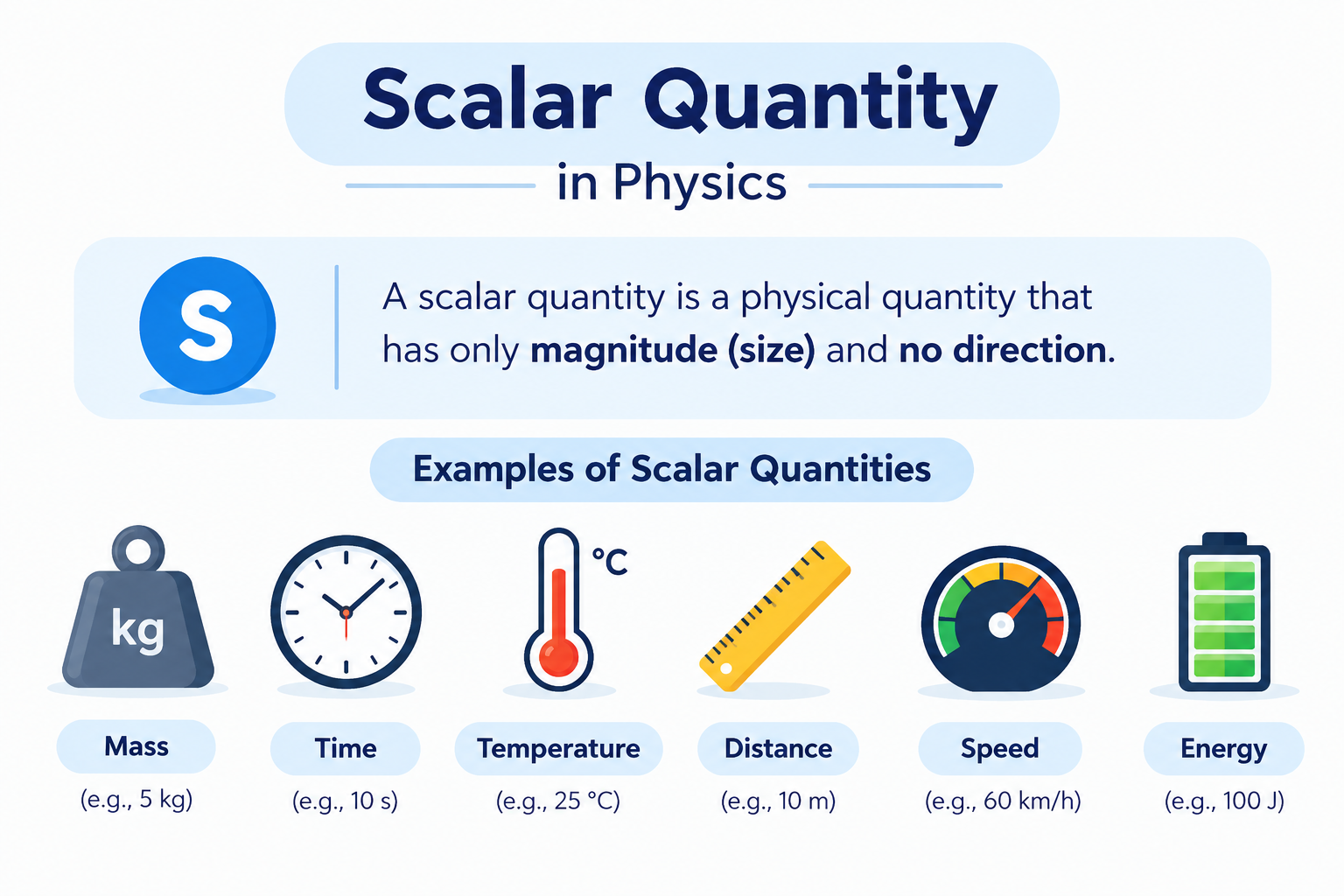
That is exactly what a scalar quantity is. A scalar quantity in physics is any physical quantity that is fully described by its magnitude (a numerical value) and a unit alone — with no direction required.
Mass, temperature, time, speed, distance, and energy are all scalar quantities. Understanding what makes a quantity scalar — and how scalars differ from vectors — is one of the first and most important steps in learning physics.
Key Takeaways
-
A scalar quantity is completely described by its magnitude and unit — no direction is needed.
-
Common scalar quantities include mass, distance, speed, time, temperature, energy, and pressure.
-
The key difference between a scalar and a vector is that vectors require direction; scalars do not.
-
Scalar quantities follow simple arithmetic rules — they can be added, subtracted, multiplied, and divided directly.
-
A negative value does not make a quantity a vector — negative scalars simply represent values below a reference point.
-
Speed is scalar; velocity is vector. Distance is scalar; displacement is vector. Mass is scalar; weight is vector.
-
Scalar quantities appear in almost every area of physics — from mechanics and thermodynamics to electricity and waves.
What Is Scalar Quantity in Physics?
A scalar quantity is a physical quantity that is completely described by two things only:
- Magnitude — the numerical value of the measurement.
- Unit — the standard used to express that measurement.
No direction is needed. No additional information is required. If you know the magnitude and the unit, you know everything there is to know about a scalar quantity.
Here are four straightforward examples:
- Mass = 5 kg (how much matter — no direction required)
- Temperature = 30 °C (how hot — no direction required)
- Time = 45 s (duration — no direction required)
- Distance = 100 m (path length — no direction required)
This is what separates scalar quantities from vector quantities. A vector requires both a magnitude and a direction to be fully described. A scalar does not.
Think of it this way: if you ask someone “how far did you walk?” and they say “3 km,” that is a scalar answer — complete and sufficient. If you ask “where did you walk to?” you need a direction — “3 km north” — and that becomes a vector (displacement).
The absence of direction is the defining characteristic of a scalar quantity. Every scalar quantity in physics follows this rule without exception.
Scalar Quantity vs Vector Quantity
Both scalar and vector quantities are types of physical quantities. To understand what makes a quantity scalar, it helps to see how it compares to a vector quantity directly. For a full introduction to the broader concept, see What Is a Physical Quantity?
| Feature | Scalar Quantity | Vector Quantity |
|---|---|---|
| Described by | Magnitude and unit only | Magnitude, unit, and direction |
| Direction required | No | Yes |
| Representation | Single number with unit | Number with unit and direction (or arrow in diagrams) |
| Addition rule | Simple arithmetic | Must account for direction (vector addition) |
| Example quantity | Speed: 20 m/s | Velocity: 20 m/s north |
| Another example | Mass: 10 kg | Weight: 98 N downward |
| Can be negative | Yes — indicates below reference, not direction | Yes — negative indicates opposite direction |
| Everyday analogy | “The temperature is 25 °C” | “Drive 5 km east, then turn north” |
The single most important point in this table is the third row: direction. If a quantity needs direction to be fully described, it is a vector. If magnitude and unit alone are sufficient, it is a scalar. Everything else follows from this distinction.
Examples of Scalar Quantities
Here is a comprehensive reference table of scalar quantities you will encounter across physics:
| Scalar Quantity | Symbol | SI Unit | What It Measures | Real-World Example |
|---|---|---|---|---|
| Mass | m | kilogram (kg) | Amount of matter in an object | A person’s mass: 70 kg |
| Distance | d | metre (m) | Total path length travelled | Walking 500 m to school |
| Speed | v | metre per second (m/s) | Rate of change of distance | Car travelling at 30 m/s |
| Time | t | second (s) | Duration of an event | Race time: 9.58 s |
| Temperature | T | kelvin (K) / °C | Degree of hotness or coldness | Body temperature: 37 °C |
| Energy | E | joule (J) | Capacity to do work | Energy in a meal: 2,000 kJ |
| Work | W | joule (J) | Energy transferred by a force | Lifting a box: 200 J |
| Power | P | watt (W) | Rate of energy transfer | Light bulb: 60 W |
| Pressure | p | pascal (Pa) | Force per unit area | Tyre pressure: 200,000 Pa |
| Volume | V | cubic metre (m³) | Amount of space occupied | Water in a bottle: 0.5 L |
| Density | ρ | kg/m³ | Mass per unit volume | Density of water: 1,000 kg/m³ |
| Frequency | f | hertz (Hz) | Number of cycles per second | Mains electricity: 50 Hz |
| Electric charge | Q | coulomb (C) | Amount of electric charge | Charge on a capacitor: 0.01 C |
| Electric potential (Voltage) | V | volt (V) | Electric potential energy per unit charge | Battery voltage: 1.5 V |
| Resistance | R | ohm (Ω) | Opposition to electric current | Resistor: 100 Ω |
| Wavelength | λ | metre (m) | Distance between successive wave crests | Green light: 530 nm |
| Refractive index | n | dimensionless | Ratio of speed of light in media | Glass: n ≈ 1.5 |
| Entropy | S | joule per kelvin (J/K) | Measure of disorder in a system | Entropy change in a reaction |
| Heat | Q | joule (J) | Thermal energy transferred | Heat from a heater: 5,000 J |
| Area | A | square metre (m²) | Two-dimensional extent of a surface | Floor area: 20 m² |
Each of these quantities is fully described by its numerical value and unit. None of them requires a direction.
Scalar Quantities in Everyday Life
Scalar quantities are not confined to physics laboratories — they appear throughout daily life, often without you noticing.
| Situation | Scalar Quantity | Base or Derived | Typical Value | Why No Direction Is Needed |
|---|---|---|---|---|
| Checking body temperature | Temperature | Base (K) | 37 °C (310.15 K) | Temperature describes a state of hotness — not a direction |
| Weighing food for cooking | Mass | Base | 250 g (0.25 kg) | Mass measures amount of matter — independent of location or direction |
| Timing a boiling egg | Time | Base | 360 s | Duration has no direction — it simply passes |
| Checking a car’s fuel level | Volume | Derived | 40 L (0.04 m³) | Volume occupies space — it does not point anywhere |
| Reading an electricity meter | Energy | Derived | 15 kWh (54,000,000 J) | Energy is a capacity to do work — directionless |
| Checking your internet speed | Speed (data rate) | Derived | 100 Mbps | Rate of data transfer needs no direction |
| Inflating a tyre | Pressure | Derived | 200,000 Pa | Pressure acts in all directions equally — not one specific direction |
| Listening to music | Frequency | Derived | 440 Hz (note A) | Frequency counts cycles per second — no direction involved |
| Measuring a room | Distance | Derived | 5 m | Path length — no directional information needed |
| Paying for electricity | Power | Derived | 2,000 W | Rate of energy use — scalar |
| Checking the weather forecast | Temperature | Base | −5 °C | Negative value = below zero reference, not a direction |
| Charging a phone | Electric charge | Derived | 3,000 mAh | Amount of charge — no direction required |
In every case above, knowing the number and the unit is all you need. No compass, no arrow, no directional information required.
Scalar Quantities — Base and Derived
Scalar quantities belong to two categories: base (fundamental) and derived.
Scalar base quantities are among the seven fundamental SI quantities — defined independently, not built from other quantities.
Scalar derived quantities are formed by combining base quantities mathematically.
| Scalar Quantity | Base or Derived | SI Unit | Formula (if derived) |
|---|---|---|---|
| Mass | Base | kg | — |
| Time | Base | s | — |
| Temperature | Base | K | — |
| Amount of substance | Base | mol | — |
| Luminous intensity | Base | cd | — |
| Speed | Derived | m/s | d ÷ t |
| Energy | Derived | J (kg·m²·s⁻²) | Various (e.g., ½mv²) |
| Pressure | Derived | Pa (kg·m⁻¹·s⁻²) | F ÷ A |
| Density | Derived | kg/m³ | m ÷ V |
| Frequency | Derived | Hz (s⁻¹) | 1 ÷ T |
| Power | Derived | W (kg·m²·s⁻³) | W ÷ t |
| Electric charge | Derived | C (A·s) | I × t |
| Voltage | Derived | V (kg·m²·A⁻¹·s⁻³) | W ÷ Q |
| Area | Derived | m² | l × w |
| Volume | Derived | m³ | l × w × h |
For a full explanation of how base and derived SI units work together, see What Are SI Units in Physics?
How Scalar Quantities Are Added
One of the great practical advantages of scalar quantities is that they obey ordinary arithmetic. You simply add, subtract, multiply, or divide the numbers — no direction, no trigonometry, no vector components.
Example 1 — Total distance walked:
A student walks 400 m to the library, then 250 m to a café, then 150 m home.
Total distance = 400 + 250 + 150 = 800 m
Simple addition — direction of travel is irrelevant for distance.
Example 2 — Total energy consumed in a day:
Breakfast provides 1,800 kJ, lunch provides 2,500 kJ, dinner provides 2,200 kJ.
Total energy = 1,800 + 2,500 + 2,200 = 6,500 kJ
Energy values add directly — no direction needed.
Example 3 — Combined mass of two objects:
A bag has mass 3.5 kg. A textbook has mass 1.2 kg.
Total mass = 3.5 + 1.2 = 4.7 kg
Mass is scalar — add the values directly.
Example 4 — Total time for two events:
Event 1 takes 35 s. Event 2 takes 48 s.
Total time = 35 + 48 = 83 s
Time values add arithmetically.
Example 5 — Change in temperature:
Water starts at 20 °C and is heated to 75 °C.
Change in temperature = 75 − 20 = 55 °C
Temperature change is scalar — simple subtraction gives the answer.
Compare this to adding two forces (vectors): if one force acts to the right and another to the left, you cannot simply add the numbers — you must account for direction. Scalars require no such complication.
Speed as a Scalar Quantity
Speed is one of the most commonly encountered scalar quantities in physics — and also one of the most frequently confused with velocity.
Speed is defined as the rate of change of distance with time:
Speed = distance ÷ time (v = d/t)
Speed tells you how fast an object is moving. It does not tell you in which direction. A car travelling at 25 m/s has a speed of 25 m/s — whether it is heading north, south, east, or in a circle makes no difference to the speed value.
Velocity, by contrast, is the rate of change of displacement with time. It is a vector — it requires both magnitude and direction. “25 m/s north” is a velocity. “25 m/s” alone is a speed.
This is a critical distinction in physics. Two cars can have the same speed but completely different velocities if they are moving in different directions.
For a thorough explanation of speed and how it is calculated, see What Is Speed in Physics?
Distance as a Scalar Quantity
Distance is the total length of the path an object has travelled, regardless of direction.
Key facts about distance:
- Distance is always zero or positive — it can never be negative (you cannot travel a negative length of path).
- Direction plays no role in determining distance.
- It is measured in metres (m) in SI units.
Worked example:
A student walks 300 m north, then 400 m south.
- Total distance = 300 + 400 = 700 m (scalar — total path length, direction irrelevant)
- Displacement = 400 − 300 = 100 m south (vector — shortest straight-line path from start to finish, with direction)
The student walked 700 m in total, but ended up only 100 m from where they started — and in the southward direction. Distance and displacement give very different information about the same journey.
Mass as a Scalar Quantity
Mass measures the amount of matter contained in an object. It is a fundamental scalar quantity — described entirely by a value and a unit.
Key facts about mass:
- Mass has no direction — it simply tells you how much matter is present.
- Mass is constant regardless of location — your mass is the same on Earth, on the Moon, and in deep space.
- Mass is measured in kilograms (kg).
Weight is not the same as mass. Weight is the gravitational force acting on a mass — it is a vector, directed toward the centre of the gravitating body (downward on Earth). Weight = mass × gravitational field strength (W = mg), measured in newtons (N).
A person with a mass of 70 kg has a weight of approximately 686 N on Earth (downward) — but only about 115 N on the Moon. The mass remains 70 kg in both cases.
For a complete explanation of mass and how it differs from weight, see What Is Mass in Physics?
Temperature as a Scalar Quantity
Temperature measures the degree of hotness or coldness of an object — specifically, the average kinetic energy of the particles within it.
Temperature is a scalar quantity:
- It has a magnitude (a number) and a unit (°C or K).
- It has no direction — heat does not travel “northward” or “downward” because of temperature alone.
- The SI unit of temperature is the kelvin (K). Degrees Celsius (°C) is also widely used.
The relationship between kelvin and Celsius:
K = °C + 273.15
So 0 °C = 273.15 K, and absolute zero = 0 K = −273.15 °C. Absolute zero is the lowest physically possible temperature.
Important correction to a common misconception:
Some students think that because temperature can be negative (e.g., −15 °C), it must be a vector. This is incorrect. A negative temperature simply means the temperature is below the zero point of the chosen scale — it says nothing about direction. Vectors use negative signs to indicate opposite directions; scalars use negative signs to indicate values below a reference level. These are entirely different uses of the negative sign.
Energy as a Scalar Quantity
Energy is the capacity to do work. It is one of the most important scalar quantities in all of physics.
Energy is scalar because:
- It has magnitude (a numerical value) and a unit (joules, J).
- It has no direction — you cannot say energy is “pointing north.”
- Whether energy is being stored, transferred, or transformed, it remains a scalar at every stage.
The main forms of energy are all scalar:
- Kinetic energy (energy of motion)
- Gravitational potential energy (stored due to height)
- Thermal energy (heat)
- Chemical energy (stored in bonds)
- Nuclear energy (stored in atomic nuclei)
- Electrical energy (energy of electric charge)
A useful way to remember this: when work is done by a force (a vector) through a displacement (a vector), the result — the work done — is a scalar. The directions of force and displacement combine mathematically to produce a single number with a unit (joules), with no direction attached.
To explore the different forms of energy and how they are calculated, see What Is Energy in Physics?
Common Scalar Quantities in Physics Equations
Scalar quantities appear throughout physics equations. Here are eight key equations, with the scalar/vector nature of each quantity identified:
1. Speed: v = d/t
- d (distance): scalar | t (time): scalar | v (speed): scalar
- SI unit: m/s
- Result is scalar because both distance and time are scalar — simple division gives a scalar.
2. Density: ρ = m/V
- m (mass): scalar | V (volume): scalar | ρ (density): scalar
- SI unit: kg/m³
- Both quantities are scalar; their ratio is scalar.
3. Pressure: P = F/A
- F (magnitude of force): scalar value used here | A (area): scalar | P (pressure): scalar
- SI unit: Pa
- Pressure is defined as the magnitude of force per unit area — the result is scalar (no specific direction).
4. Work done: W = Fd cos θ
- F (force): vector | d (displacement): vector | θ: angle between them | W (work): scalar
- SI unit: J
- Even though force and displacement are both vectors, their combination via cos θ produces a scalar result. Work has no direction.
5. Kinetic energy: E_k = ½mv²
- m (mass): scalar | v (speed): scalar | E_k: scalar
- SI unit: J
- Both quantities are scalar; their combination is scalar.
6. Power: P = W/t
- W (work/energy): scalar | t (time): scalar | P (power): scalar
- SI unit: W
- Energy divided by time gives a scalar.
7. Frequency: f = 1/T
- T (period): scalar | f (frequency): scalar
- SI unit: Hz (s⁻¹)
- The reciprocal of a scalar time period gives a scalar frequency.
8. Electric charge: Q = It
- I (current): scalar | t (time): scalar | Q (charge): scalar
- SI unit: C
- Current multiplied by time gives a scalar charge value.
Scalar Quantities and Negative Values
This is one of the most important clarifications in introductory physics: a negative value does not make a quantity a vector.
| Situation | Scalar or Vector | What the Negative Sign Means |
|---|---|---|
| Temperature: −10 °C | Scalar | 10 degrees below the 0 °C reference point — not a direction |
| Change in energy: −50 J | Scalar | Energy was lost (decreased) — not a direction |
| Change in temperature: −5 K | Scalar | Temperature decreased by 5 K — not a direction |
| Displacement: −3 m | Vector | 3 m in the opposite direction to the chosen positive direction |
| Velocity: −10 m/s | Vector | 10 m/s in the opposite direction to the chosen positive direction |
| Force: −20 N | Vector | 20 N in the opposite direction to the chosen positive direction |
The rule is straightforward:
- In a scalar, a negative value means the quantity is below a chosen reference level.
- In a vector, a negative value means the quantity acts in the opposite direction to a defined positive direction.
The defining feature of a vector is always direction — not the sign of its value. Temperature can be negative and remain entirely scalar. Displacement is always a vector regardless of whether its value is positive, negative, or zero.
Scalar Quantities That Students Often Confuse with Vectors
| Quantity | Scalar or Vector | Key Distinction |
|---|---|---|
| Speed | Scalar | Tells you how fast — no direction. “60 km/h” is complete. |
| Velocity | Vector | Tells you how fast and in which direction. “60 km/h north” is required. |
| Distance | Scalar | Total path length — always positive, no direction. |
| Displacement | Vector | Straight-line distance from start to finish, with direction. |
| Mass | Scalar | Amount of matter — same everywhere, no direction. |
| Weight | Vector | Gravitational force on a mass — directed downward (toward centre of gravity). |
| Temperature | Scalar | Degree of hotness — no direction. Negative values indicate below reference. |
| Pressure | Scalar | Force per unit area — acts in all directions equally; the quantity itself is scalar. |
| Energy | Scalar | Capacity to do work — no direction. Work done = F·d·cos θ gives a scalar. |
| Force | Vector | A push or pull — must state magnitude and direction to fully describe it. |
Common Misconceptions About Scalar Quantities
| Misconception | Correct Explanation |
|---|---|
| “A negative value means the quantity is a vector.” | Negative scalar values represent below a reference point. Vectors use negatives to indicate opposite direction. The defining criterion for a vector is direction — not the sign of the value. |
| “Speed and velocity are the same thing.” | Speed is scalar — magnitude only. Velocity is vector — magnitude and direction. A car moving at 60 km/h has a speed of 60 km/h, but its velocity includes direction (e.g., 60 km/h east). |
| “Mass and weight are the same.” | Mass (kg) is scalar — amount of matter, constant everywhere. Weight (N) is a vector force — depends on gravitational field strength and acts downward. |
| “Pressure is a vector because force is a vector.” | Pressure is defined as force ÷ area — specifically the magnitude of force applied perpendicularly to a surface. The result is a scalar with no directional assignment. |
| “Energy must be a vector because forces (vectors) produce it.” | Work done = F × d × cos θ. The cos θ factor combines the directional information of force and displacement into a single scalar number. The result — energy — has no direction. |
Worked Examples
Example 1
Question: Is “the temperature today is 22 °C” a scalar or vector quantity?
Solution: Scalar.
Explanation: Temperature has a magnitude (22) and a unit (°C). No direction is stated or needed. Temperature is always a scalar quantity.
Example 2
Question: Classify each of the following as scalar or vector: (a) 500 J of energy, (b) 15 m/s northward, (c) 8 kg, (d) 9.8 m/s² downward.
Solution: (a) Scalar — energy has magnitude and unit only. (b) Vector — velocity has magnitude, unit, and direction. (c) Scalar — mass has magnitude and unit only. (d) Vector — acceleration has magnitude, unit, and direction.
Explanation: The presence of a stated direction identifies (b) and (d) as vectors. The absence of direction in (a) and (c) confirms they are scalars.
Example 3
Question: A student walks 200 m east, 150 m west, and 100 m east. What is the total distance?
Solution: Total distance = 200 + 150 + 100 = 450 m
Explanation: Distance is scalar — directions are irrelevant. Simply add all path lengths arithmetically.
Example 4
Question: A student walks 200 m east, 150 m west, and 100 m east. What is the displacement?
Solution: Net eastward movement = 200 − 150 + 100 = 150 m east
Explanation: Displacement is vector — direction matters. East is positive, west is negative. The student ends 150 m east of the starting point.
Example 5
Question: Calculate the speed of a car that travels 360 m in 12 s.
Solution: v = d/t = 360 ÷ 12 = 30 m/s
Explanation: Speed = distance ÷ time. Both distance and time are scalar, so speed is scalar. No direction is required or given.
Example 6
Question: Is −15 °C a vector quantity? Explain.
Solution: No — it is a scalar.
Explanation: Temperature is always scalar. The negative sign indicates the temperature is 15 degrees below the 0 °C reference point. It does not indicate a direction. Vectors use negative signs to show opposite direction; scalars use them to show values below a reference level.
Example 7
Question: A box of mass 4 kg and a bag of mass 2.5 kg are placed on a shelf. What is the total mass?
Solution: Total mass = 4 + 2.5 = 6.5 kg
Explanation: Mass is scalar — add the values directly using arithmetic.
Example 8
Question: An athlete runs 100 m in 10 s. What is their speed?
Solution: v = d/t = 100 ÷ 10 = 10 m/s
Explanation: Speed is distance divided by time — both scalar quantities. The result is a scalar speed of 10 m/s.
Example 9
Question: A heater transfers 12,000 J of thermal energy in 5 minutes. Calculate the power output.
Solution: Convert time: 5 min = 300 s. P = W/t = 12,000 ÷ 300 = 40 W
Explanation: Both energy (J) and time (s) are scalar quantities. Power (W) is their ratio — also scalar.
Example 10
Question: Explain why work done (W = Fd cos θ) is a scalar even though force and displacement are vectors.
Solution: Work is scalar.
Explanation: When a force F acts at angle θ to displacement d, the cos θ factor extracts the component of force in the direction of displacement. The result is a single number with a unit (joules) — no directional information remains. Multiplying two vectors in this way (dot product) always produces a scalar result.
Example 11
Question: A car has a speed of 20 m/s going north and another car has a speed of 20 m/s going south. Are their speeds the same? Are their velocities the same?
Solution: Their speeds are the same (20 m/s each). Their velocities are different (20 m/s north vs 20 m/s south).
Explanation: Speed is scalar — direction does not affect the speed value. Velocity is vector — opposite directions make the velocities completely different.
Example 12
Question: Calculate the kinetic energy of a 1,200 kg car travelling at 25 m/s.
Solution: E_k = ½mv² = ½ × 1,200 × 25² = ½ × 1,200 × 625 = 375,000 J (375 kJ)
Explanation: Kinetic energy is scalar. Mass (kg) and speed (m/s) are both scalar — their combination gives a scalar energy in joules.
Example 13
Question: A student says “force is 30 N — that is a scalar.” Is the student correct?
Solution: No — the student is incorrect.
Explanation: Force is a vector quantity. It requires both magnitude (30 N) and direction to be fully described. A complete description would be “30 N downward” or “30 N to the right.” Without direction, the description is incomplete.
Example 14
Question: Identify the scalar quantities in this list: velocity, pressure, displacement, frequency, weight, temperature, momentum.
Solution: Scalar quantities: pressure, frequency, temperature.
Explanation: Velocity (vector — has direction), displacement (vector — has direction), weight (vector — gravitational force downward), and momentum (vector — has direction) all require direction. Pressure, frequency, and temperature are fully described by magnitude and unit alone — they are scalar.
Example 15
Question: The density of aluminium is 2,700 kg/m³. Is density a scalar or vector? What does this value mean?
Solution: Density is a scalar quantity.
Explanation: Density = mass ÷ volume = 2,700 kg/m³. It tells you that every cubic metre of aluminium contains 2,700 kg of mass. No direction is involved — density is the same in all directions within the material.
Practice Questions
12 Short Answer Questions
1. Define scalar quantity in physics.
Answer: A scalar quantity is a physical quantity that is completely described by its magnitude (numerical value) and unit alone. No direction is needed.
2. Give five examples of scalar quantities with their SI units.
Answer: Mass (kg), speed (m/s), temperature (K), energy (J), time (s). Many other correct answers are possible.
3. What is the key difference between a scalar and a vector quantity?
Answer: A scalar has magnitude and unit only. A vector has magnitude, unit, and direction. Direction is the defining difference.
4. Is speed a scalar or vector? Explain.
Answer: Speed is scalar. It measures how fast an object moves (magnitude only) — no direction is required. Velocity is the vector equivalent — it includes direction.
5. A student walks 500 m, rests, then walks another 300 m. What is the total distance?
Answer: Total distance = 500 + 300 = 800 m (scalar — add directly, direction irrelevant).
6. Why is pressure a scalar quantity even though force is a vector?
Answer: Pressure is defined as the magnitude of force per unit area (P = F/A). It uses only the magnitude of the force, applied perpendicularly, distributed over an area. The result is a scalar — it has no directional assignment.
7. Can a scalar quantity have a negative value? Give an example.
Answer: Yes. A scalar can be negative — it means the value is below the reference point. For example, −5 °C means 5 degrees below 0 °C. This is not a direction.
8. What is the SI unit of energy, and why is energy a scalar?
Answer: The SI unit of energy is the joule (J). Energy is scalar because it has magnitude and unit only — no direction can be assigned to energy.
9. State the scalar quantity in each pair: (a) speed/velocity, (b) distance/displacement, (c) mass/weight.
Answer: (a) Speed — scalar. (b) Distance — scalar. (c) Mass — scalar.
10. A kettle uses 150,000 J of energy in 5 minutes. Calculate the power.
Answer: P = W/t = 150,000 ÷ 300 = 500 W (power is scalar).
11. Is temperature a vector because it can be negative? Explain.
Answer: No. Temperature is always scalar. A negative temperature (e.g., −20 °C) means the temperature is below the 0 °C reference — it does not indicate a direction. The criterion for a vector is direction, not the sign of the value.
12. Name two scalar base quantities and two scalar derived quantities.
Answer: Base: mass (kg), time (s). Derived: speed (m/s), energy (J).
10 Multiple Choice Questions
Question 1
Which of the following is a scalar quantity?
A. Force
B. Velocity
C. Displacement
D. Speed
Correct Answer: D
Short Explanation: Speed has magnitude and unit only (e.g., 30 m/s) — no direction is needed. Force, velocity, and displacement are all vectors that require direction to be fully described.
Question 2
A student records a temperature of −8 °C. This quantity is:
A. A vector, because it has a negative value
B. A scalar, because it has magnitude and unit only
C. A vector, because temperature can act in a direction
D. Neither scalar nor vector
Correct Answer: B
Short Explanation: Temperature is always a scalar. The negative sign means the temperature is 8 degrees below the 0 °C reference — not a direction. Negative values do not make a quantity a vector.
Question 3
Which pair correctly identifies one scalar and one vector?
A. Speed and velocity
B. Mass and weight
C. Distance and displacement
D. All of the above
Correct Answer: D
Short Explanation: In each pair, the first quantity is scalar and the second is vector: speed (scalar) / velocity (vector); mass (scalar) / weight (vector); distance (scalar) / displacement (vector).
Question 4
What is the total distance if a student runs 400 m, walks 200 m, then runs 150 m?
A. 250 m
B. 400 m
C. 750 m
D. 550 m
Correct Answer: C
Short Explanation: Distance is scalar — add all path lengths directly: 400 + 200 + 150 = 750 m. Direction of travel is irrelevant for distance.
Question 5
Which of the following quantities is a vector?
A. Temperature
B. Pressure
C. Frequency
D. Weight
Correct Answer: D
Short Explanation: Weight is the gravitational force on a mass — it acts downward and requires direction (a vector). Temperature, pressure, and frequency are all scalar quantities.
Question 6
Why is work done (W = Fd cos θ) considered a scalar quantity?
A. Because force is a scalar
B. Because the cos θ factor removes directional information, producing a scalar result
C. Because displacement is a scalar
D. Because energy has units of newtons
Correct Answer: B
Short Explanation: Work done is the dot product of force and displacement. The cos θ factor combines their directional relationship into a single numerical value. The result — joules of energy — has no direction.
Question 7
A car travels at 60 km/h. Which description correctly identifies this as a scalar quantity?
A. 60 km/h north
B. 60 km/h at 45° to the horizontal
C. 60 km/h
D. 60 km/h southward
Correct Answer: C
Short Explanation: Speed is scalar — “60 km/h” is a complete description. Options A, B, and D include direction, making them descriptions of velocity (a vector).
Question 8
Which of the following is a scalar derived quantity?
A. Mass
B. Time
C. Pressure
D. Temperature
Correct Answer: C
Short Explanation: Pressure (P = F/A) is derived from force and area — both built from base quantities. It is scalar. Mass, time, and temperature are base quantities, not derived.
Question 9
A car has a kinetic energy of 360,000 J travelling at 30 m/s. What is its mass?
A. 400 kg
B. 600 kg
C. 800 kg
D. 1,200 kg
Correct Answer: C
Short Explanation: E_k = ½mv² → 360,000 = ½ × m × 900 → m = 360,000 ÷ 450 = 800 kg.
Question 10
Which of the following statements about scalar quantities is correct?
A. Scalar quantities always have positive values.
B. Scalar quantities require direction to be fully described.
C. Scalar quantities are fully described by magnitude and unit alone.
D. Scalar quantities cannot appear in physics equations alongside vectors.
Correct Answer: C
Short Explanation: By definition, scalar quantities are fully described by magnitude and unit — no direction required. Scalars can be negative (e.g., −10 °C) and do appear in equations alongside vectors.
5 Challenge Questions
Challenge 1:
A cyclist completes a circular track of circumference 800 m, returning exactly to the starting point. (a) What is the total distance? (b) What is the displacement? (c) If the journey takes 200 s, calculate the speed and the magnitude of velocity.
Answer:
(a) Distance = 800 m (total path length — scalar)
(b) Displacement = 0 m (returned to start — vector quantity, net change in position = zero)
(c) Speed = distance ÷ time = 800 ÷ 200 = 4 m/s (scalar)
Magnitude of velocity = displacement ÷ time = 0 ÷ 200 = 0 m/s
This demonstrates a key insight: a moving object can have non-zero speed but zero velocity magnitude — when it returns to its starting position.
Challenge 2:
A student argues: “Pressure cannot be a scalar because it is caused by force, which is a vector.” Write a complete explanation of why this argument is incorrect.
Answer:
The student’s argument confuses the cause of a quantity with the nature of the quantity itself.
Force is indeed a vector — it has magnitude and direction. However, pressure is defined as the magnitude of force applied perpendicularly per unit area (P = F/A). In this definition, only the magnitude of the perpendicular component of force is used — the directional information is not preserved in the pressure value.
Furthermore, pressure in a fluid acts equally in all directions at a given point (Pascal’s principle). It does not favour one direction over another — which is fundamentally incompatible with being a vector quantity.
Pressure has a numerical value and a unit (pascals) — that is all. It is a scalar quantity, regardless of the vector nature of the forces that produce it.
Challenge 3:
Two students calculate the work done by a force. Student A says work is a vector because “force is a vector and displacement is a vector, so work must also be a vector.” Student B says work is a scalar. Who is correct, and why?
Answer:
Student B is correct. Work is a scalar.
When a force F acts on an object and causes a displacement d at angle θ between them, the work done is:
W = F × d × cos θ
The cos θ factor accounts for the relative directions of force and displacement. By multiplying the magnitudes and the cosine of the angle between them, all directional information is collapsed into a single number. The result — work in joules — carries no directional information.
This operation is called the scalar (dot) product of two vectors. Whenever two vectors are combined using the dot product, the result is always a scalar. This is precisely why work, despite being produced by two vectors, is itself a scalar quantity.
Challenge 4:
A ball is thrown vertically upward. Its speed at the top of the flight is 0 m/s. (a) Is this speed value (0 m/s) scalar? (b) At the same instant, what is the ball’s velocity? (c) Is the ball’s acceleration zero at the top? Explain using scalar/vector reasoning.
Answer:
(a) Yes — speed is always scalar. At the top, speed = 0 m/s (scalar — no direction stated or needed).
(b) Velocity at the top = 0 m/s in any direction (also zero, since speed = 0). Velocity is vector, but its magnitude is zero at this instant.
(c) No — the acceleration is not zero at the top. Acceleration due to gravity = 9.8 m/s² downward. Acceleration is a vector. Even when the ball momentarily stops (speed = 0), gravity continues to act on it, pulling it downward. The ball’s speed is zero for only an instant before it begins to fall.
This is a crucial distinction: zero speed does not imply zero acceleration. Confusing these is a very common error. Speed (scalar) and acceleration (vector) are independent quantities.
Challenge 5:
A physics student lists the following as “scalar quantities”: energy, velocity, mass, frequency, force, pressure, displacement. Identify which are incorrectly classified as scalar, explain why, and correct the classification.
Answer:
Two quantities are incorrectly classified as scalar:
Velocity — Vector, not scalar. Velocity is the rate of change of displacement with time. It requires both magnitude and direction (e.g., 15 m/s east). Correct classification: vector.
Force — Vector, not scalar. Force is a push or pull — it requires magnitude, unit, and direction to be fully described (e.g., 50 N downward). Correct classification: vector.
Displacement — Vector, not scalar. Displacement is the straight-line distance from start to finish with direction (e.g., 200 m north). Correct classification: vector.
Correctly classified as scalar: energy (J), mass (kg), frequency (Hz), pressure (Pa).
Scalar Quantities Across Physics Topics
Mechanics
The most-used scalar quantities in mechanics are distance (m), speed (m/s), mass (kg), energy (J), work (J), and power (W). These appear in equations for kinetic energy, gravitational potential energy, and work done. Understanding which are scalar and which are vector (e.g., velocity, force, acceleration) is essential for solving mechanics problems correctly.
Thermodynamics
Temperature (K), heat energy (J), internal energy (J), and entropy (J/K) are all scalar quantities. Thermodynamic equations use kelvin rather than Celsius — always convert before substituting into gas law or thermal equations.
Electricity
Electric charge (C), voltage (V), resistance (Ω), and power (W) are all scalar. Electric current (A) is treated as scalar in most GCSE and A-level contexts. These quantities appear in Ohm’s law (V = IR) and power equations (P = IV).
Waves
Frequency (Hz), wavelength (m), amplitude (m), and wave speed (m/s) are all scalar quantities. They appear in the wave equation v = fλ. All are fully described by magnitude and unit — no direction needed.
Optics
Refractive index (dimensionless), focal length (m), and optical path length (m) are scalar quantities used in lens and refraction calculations. Refractive index (n = c/v) is a ratio of two speeds — both scalar — giving a scalar result.
Exam Tips
- Check whether direction is needed. If a complete description of the quantity requires a direction, it is a vector. If magnitude and unit alone are sufficient, it is scalar. Apply this test to every quantity you encounter.
- Never state a direction for a scalar. Writing “the temperature is 25 °C northward” is physically meaningless and will cost marks.
- Know the commonly confused pairs: speed (scalar) / velocity (vector); distance (scalar) / displacement (vector); mass (scalar) / weight (vector).
- Negative values do not mean vector. A negative scalar (e.g., −10 °C, −50 J) is still a scalar — the negative sign indicates below a reference level, not a direction.
- In calculations, scalars add simply. Total distance = sum of all path lengths. Total energy = sum of all energy values. No trigonometry or vector components needed.
- Use correct SI units in every answer. An answer of “30” with no unit is incomplete and incorrect in physics.
- In work done (W = Fd cos θ): the answer is scalar (joules), even though F and d are vectors. State the unit and value — no direction.
Quick Revision Notes
Scalar quantity: Fully described by magnitude and unit only. No direction needed.
Key scalar quantities:
| Quantity | SI Unit |
|---|---|
| Mass | kg |
| Distance | m |
| Speed | m/s |
| Time | s |
| Temperature | K (or °C) |
| Energy / Work | J |
| Power | W |
| Pressure | Pa |
| Frequency | Hz |
| Electric charge | C |
Scalar vs vector: Scalar = magnitude + unit. Vector = magnitude + unit + direction.
Adding scalars: Simple arithmetic — add, subtract, multiply, divide directly.
Negative scalars: A negative value does NOT make a quantity a vector. It means below a reference level.
Common confusions: Speed (scalar) ≠ velocity (vector). Distance (scalar) ≠ displacement (vector). Mass (scalar) ≠ weight (vector).
Scalar in equations: Speed = d/t. KE = ½mv². P = W/t. All produce scalar results.
Scalar Quantity Cheat Sheet
| Concept | Key Point | Example |
|---|---|---|
| Definition | Magnitude + unit only — no direction | Mass: 70 kg |
| Key test | “Does it need direction?” → No = scalar | Temperature: 37 °C — no direction needed |
| Speed (scalar) vs velocity (vector) | Speed: how fast / Velocity: how fast + which way | 60 km/h vs 60 km/h north |
| Distance (scalar) vs displacement (vector) | Distance: path length / Displacement: start to finish + direction | 700 m vs 100 m south |
| Mass (scalar) vs weight (vector) | Mass: amount of matter / Weight: gravitational force downward | 70 kg vs 686 N downward |
| Negative scalars | Below reference point — not direction | −10 °C = 10 below zero, not a direction |
| Adding scalars | Simple arithmetic — no direction needed | 200 J + 300 J = 500 J |
| Work done | Scalar — even though F and d are vectors | W = Fd cos θ → result in joules (J) |
| Scalar base quantities | Mass, time, temperature, mol, cd | Time: 60 s |
| Scalar derived quantities | Speed, energy, pressure, density, frequency | Pressure: 101,325 Pa |
Frequently Asked Questions
1. What is a scalar quantity in physics?
A scalar quantity is a physical quantity that is completely described by its magnitude (numerical value) and unit alone. No direction is needed. Examples include mass, temperature, speed, time, and energy.
2. What are examples of scalar quantities?
Common examples include: mass (kg), distance (m), speed (m/s), time (s), temperature (°C or K), energy (J), work (J), power (W), pressure (Pa), frequency (Hz), electric charge (C), and voltage (V).
3. What is the difference between scalar and vector quantities?
A scalar quantity has magnitude and unit only. A vector quantity has magnitude, unit, and direction. Speed is scalar; velocity is vector. Distance is scalar; displacement is vector.
4. Is speed a scalar or vector?
Speed is scalar. It tells you how fast an object is moving — magnitude only. Velocity is the vector equivalent — it includes direction (e.g., 20 m/s north).
5. Is mass a scalar or vector?
Mass is scalar. It measures the amount of matter in an object — a single value in kilograms. Weight is the corresponding vector — the gravitational force on the mass, directed downward.
6. Is temperature a scalar or vector?
Temperature is scalar. It has magnitude and a unit (°C or K) but no direction. A negative temperature (e.g., −15 °C) simply means the temperature is below the reference point — not a direction.
7. Is energy a scalar or vector?
Energy is scalar. All forms of energy — kinetic, potential, thermal, chemical, nuclear — have magnitude and unit (joules) but no direction.
8. Is distance a scalar or vector?
Distance is scalar. It is the total length of the path travelled — always positive, no direction. Displacement is the vector equivalent — straight-line distance from start to finish, with direction.
9. Can scalar quantities be negative?
Yes. A negative scalar value means the quantity is below a chosen reference point. For example, −10 °C is 10 degrees below 0 °C. This is not a direction — negative scalars are still scalar.
10. What is the difference between distance and displacement?
Distance is the total path length (scalar — no direction). Displacement is the straight-line distance from start to finish, with direction (vector). A person walking in a complete circle has non-zero distance but zero displacement.
11. What is the difference between speed and velocity?
Speed is the rate of change of distance with time (scalar — magnitude only). Velocity is the rate of change of displacement with time (vector — magnitude and direction). Same numerical value can describe both, but velocity also requires a direction.
12. What is the difference between mass and weight?
Mass (kg) is scalar — the amount of matter in an object, constant everywhere. Weight (N) is a vector force — the gravitational pull on the mass, directed downward. Weight = mass × g, and changes with gravitational field strength.
13. Is pressure a scalar or vector?
Pressure is scalar. It is defined as the magnitude of force per unit area — the result has no specific direction. In a fluid, pressure acts equally in all directions at a given point.
14. How are scalar quantities added?
Scalar quantities are added using simple arithmetic — just add the numbers directly. For example, total distance = 300 m + 200 m = 500 m. No consideration of direction is needed.
15. Why is work done considered a scalar quantity?
Work done (W = Fd cos θ) uses the magnitudes of force and displacement and the cosine of the angle between them. The cos θ factor removes directional information, producing a single numerical result in joules. Work is the scalar (dot) product of two vectors — the result is always scalar.
Summary
A scalar quantity in physics is any physical quantity that is fully described by its magnitude and unit alone — with no direction required.
Mass, distance, speed, time, temperature, energy, pressure, frequency, and dozens of other quantities are all scalar. Each is completely described by a number and a unit. None of them requires a direction to make physical sense.
The key distinction that separates scalars from vectors is always direction. If a quantity needs a direction to be complete, it is a vector. If magnitude and unit are enough, it is a scalar.
Scalar quantities follow simple arithmetic rules — they can be added, subtracted, multiplied, and divided directly. Negative scalar values indicate below a reference level — they do not indicate direction, and they do not make a quantity a vector.
The most commonly confused pairs in physics — speed/velocity, distance/displacement, and mass/weight — always follow the same pattern: the scalar version describes size alone; the vector version adds direction.
Final Thoughts
Understanding scalar quantities is the essential first step in building a solid foundation in physics. Once you are confident about what makes a quantity scalar — that a number and a unit are all that is needed — the concept of vector quantities becomes much easier to grasp by contrast.
Almost every calculation in introductory physics involves scalar quantities. Getting comfortable with them, knowing their SI units, and understanding how they are added and used in equations will give you a genuine advantage across every physics topic you study — from mechanics and thermodynamics to electricity, waves, and optics.
Start here. Build the habit of always checking: does this quantity need a direction? If the answer is no, you are working with a scalar — and that means straightforward arithmetic is all you need.
References
- Khan Academy — Scalars and Vectors: https://www.khanacademy.org
- OpenStax University Physics — Vectors and Scalars: https://openstax.org
- Physics LibreTexts — Scalar and Vector Quantities: https://phys.libretexts.org
- Encyclopaedia Britannica — Scalar (Mathematics and Physics): https://www.britannica.com
- NIST — Physical Quantities and Units: https://www.nist.gov
Helpful Resources
Khan Academy — Scalars and Vectors
Students can watch clear video lessons and complete interactive practice exercises covering scalar quantities, vector quantities, distance vs displacement, and speed vs velocity.
https://www.khanacademy.org
OpenStax University Physics
A free, peer-reviewed textbook with structured chapters on scalars, vectors, physical quantities, and their applications in mechanics and beyond — suitable for GCSE through early university level.
https://openstax.org
Physics LibreTexts — Classical Mechanics
Offers detailed, accessible explanations of scalar and vector quantities, how they are used in physics equations, and why the distinction matters in problem-solving.
https://phys.libretexts.org
Disclaimer:
This article is intended for educational and informational purposes only. While LearnMinto strives to provide accurate and up-to-date physics information, readers should verify important academic concepts through official textbooks, educational institutions, examination boards, or trusted educational resources before using this content for exams or academic purposes. LearnMinto is not affiliated with any specific school, university, research institution, or examination board.