
Introduction
Multiplying fractions is one of those topics that trips up a surprising number of students — not because it is complicated, but because it looks more intimidating than it actually is. Once you see the pattern, you will realise it is one of the more straightforward operations you can perform with fractions.
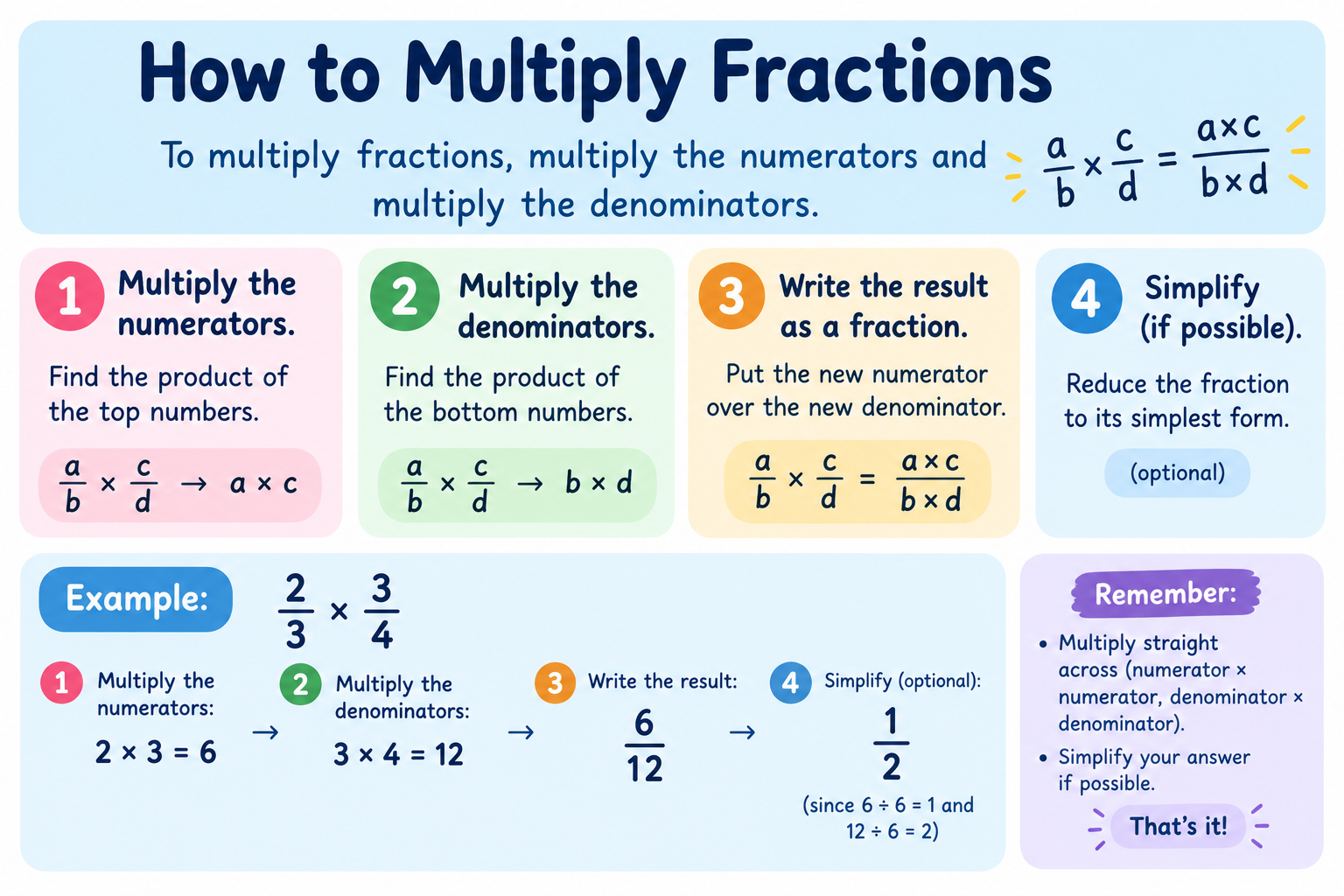
Here is the essential idea: to multiply two fractions, you multiply the numerators together and the denominators together. That is genuinely all there is to the basic method. No common denominators required, no borrowing, no complex conversions — just two straightforward multiplications.
Of course, there are a few important variations to understand. What happens when you multiply a fraction by a whole number? What about multiplying mixed numbers? What does it mean to simplify before multiplying? This guide covers every variation clearly and step by step, so by the end you will be able to handle any fraction multiplication problem with confidence.
Key Takeaways
-
To multiply fractions, multiply the numerators together and the denominators together.
-
You do not need a common denominator to multiply fractions.
-
Always simplify the result to its lowest terms.
-
You can simplify before multiplying (cross-cancelling) to make calculations easier.
-
To multiply a fraction by a whole number, write the whole number as a fraction over 1.
-
To multiply mixed numbers, convert them to improper fractions first.
-
Multiplying a fraction by another fraction always produces a result smaller than either original fraction (for proper fractions).
What Does It Mean to Multiply Fractions?
Before jumping into the mechanics, it helps to understand what fraction multiplication actually represents.
When you multiply two whole numbers — say, 3 × 4 — you are asking: what is 3 groups of 4?
When you multiply fractions, the same idea applies but with parts of a whole. For example:
1/2 × 3/4 asks: what is one half of three quarters?
Imagine a rectangle divided into four equal columns, with three of them shaded (representing 3/4). Now take half of that shaded area. The result — 3/8 — is what you get when you calculate 1/2 × 3/4.
This “of” interpretation is important. In mathematics, “of” and “×” mean the same thing when working with fractions. So:
- 1/2 of 3/4 = 1/2 × 3/4 = 3/8
- 2/3 of 1/2 = 2/3 × 1/2 = 2/6 = 1/3
Understanding this concept prevents fraction multiplication from feeling like an abstract rule and connects it to real meaning.
The Basic Rule for Multiplying Fractions
The rule is memorably simple:
Numerator × Numerator / Denominator × Denominator
For two fractions a/b and c/d:
(a/b) × (c/d) = (a × c) / (b × d)
Example:
2/3 × 4/5 = (2 × 4) / (3 × 5) = 8/15
That is the complete method for multiplying two proper fractions. Unlike addition and subtraction, you do not need to find a common denominator. You simply multiply across.
How to Multiply Fractions Step by Step
Step 1: Write both fractions side by side with a multiplication sign
Make sure both values are written as fractions. If one is a whole number or a mixed number, convert it first (explained in later sections).
Step 2: Multiply the numerators
Multiply the top numbers together. The result becomes the numerator of your answer.
Step 3: Multiply the denominators
Multiply the bottom numbers together. The result becomes the denominator of your answer.
Step 4: Write the resulting fraction
Place the product of the numerators over the product of the denominators.
Step 5: Simplify if possible
Reduce the resulting fraction to its lowest terms by dividing both the numerator and denominator by their greatest common factor (GCF).
Step 6: Convert to a mixed number if required
If the resulting fraction is improper (numerator ≥ denominator) and the question asks for a mixed number, convert it.
Simplifying the Result
After multiplying, always check whether the result can be simplified.
A fraction is in its simplest (or lowest) form when the numerator and denominator share no common factor other than 1.
Example 1: Simplify 4/6
GCF of 4 and 6 = 2
4 ÷ 2 = 2; 6 ÷ 2 = 3
Simplified: 2/3
Example 2: Simplify 6/8
GCF of 6 and 8 = 2
6 ÷ 2 = 3; 8 ÷ 2 = 4
Simplified: 3/4
Example 3: Simplify 10/15
GCF of 10 and 15 = 5
10 ÷ 5 = 2; 15 ÷ 5 = 3
Simplified: 2/3
Example 4: Simplify 12/36
GCF of 12 and 36 = 12
12 ÷ 12 = 1; 36 ÷ 12 = 3
Simplified: 1/3
If you are unsure how to find the greatest common factor, the article What Is a Factor? on LearnMinto explains the concept clearly with examples.
Simplifying Before Multiplying — Cross-Cancelling
Cross-cancelling (also called cross-reducing) is a technique that simplifies fractions before you multiply, rather than after. This keeps the numbers smaller and makes the arithmetic easier.
How it works:
Before multiplying, look for common factors between any numerator and any denominator — including across the two fractions, not just within one fraction.
If a numerator and a denominator share a common factor, divide both by that factor before proceeding.
Example 1: Multiply 2/3 × 3/4
Without cross-cancelling:
(2 × 3) / (3 × 4) = 6/12 = 1/2
With cross-cancelling:
The numerator 2 and denominator 4 share a factor of 2: divide both by 2 → 1 and 2.
The numerator 3 and denominator 3 share a factor of 3: divide both by 3 → 1 and 1.
Now multiply: (1 × 1) / (1 × 2) = 1/2
Answer: 1/2 — same result, but with smaller numbers throughout.
Example 2: Multiply 4/9 × 3/8
Numerator 4 and denominator 8 share factor 4: → 1 and 2.
Numerator 3 and denominator 9 share factor 3: → 1 and 3.
(1 × 1) / (3 × 2) = 1/6
Answer: 1/6
Example 3: Multiply 5/6 × 3/10
Numerator 5 and denominator 10 share factor 5: → 1 and 2.
Numerator 3 and denominator 6 share factor 3: → 1 and 2.
(1 × 1) / (2 × 2) = 1/4
Answer: 1/4
Cross-cancelling is not compulsory — you will always reach the same answer either way — but it is strongly recommended because it reduces errors and speeds up calculation.
Multiplying Fractions by Whole Numbers
To multiply a fraction by a whole number, write the whole number as a fraction with a denominator of 1, and then multiply as normal.
Why? Every whole number can be expressed as itself over 1: 5 = 5/1, 8 = 8/1. This does not change its value but puts it in a form that follows the same multiplication rule.
Example 1: Calculate 3/4 × 6
Write 6 as 6/1:
3/4 × 6/1 = (3 × 6) / (4 × 1) = 18/4
Simplify: 18/4 = 9/2 = 4 1/2
Example 2: Calculate 2/5 × 10
2/5 × 10/1 = 20/5 = 4
Answer: 4
Example 3: Calculate 3/8 × 4
3/8 × 4/1 = 12/8 = 3/2 = 1 1/2
Example 4: Calculate 5/6 × 3
5/6 × 3/1 = 15/6 = 5/2 = 2 1/2
Example 5: Calculate 7/10 × 5
7/10 × 5/1 = 35/10 = 7/2 = 3 1/2
Notice that in Example 2, multiplying 2/5 by 10 gives exactly 4 — a whole number. This happens when the whole number is a multiple of the denominator.
Understanding multiples is useful here — the article What Is a Multiple? explains this concept if you need a refresher.
Multiplying Three or More Fractions
The same rule extends naturally to three or more fractions. Multiply all the numerators together and all the denominators together, then simplify.
Example 1: Multiply 1/2 × 2/3 × 3/4
Numerators: 1 × 2 × 3 = 6
Denominators: 2 × 3 × 4 = 24
6/24 = 1/4
Answer: 1/4
Example 2: Multiply 2/3 × 3/5 × 5/6
Numerators: 2 × 3 × 5 = 30
Denominators: 3 × 5 × 6 = 90
30/90 = 1/3
Answer: 1/3
Example 3: Multiply 4/5 × 1/2 × 5/8
Numerators: 4 × 1 × 5 = 20
Denominators: 5 × 2 × 8 = 80
20/80 = 1/4
Answer: 1/4
Cross-cancelling becomes especially valuable with three or more fractions, as it dramatically reduces the size of the intermediate numbers.
Multiplying Mixed Numbers
You cannot multiply mixed numbers directly by treating the whole and fractional parts separately. You must convert them to improper fractions first.
Steps:
- Convert each mixed number to an improper fraction.
- Multiply the numerators together.
- Multiply the denominators together.
- Simplify and convert back to a mixed number if needed.
Why convert first? A mixed number like 2 1/3 actually means 2 + 1/3 = 7/3. If you tried to multiply 2 1/3 × 1 1/2 by separately multiplying 2 × 1 and 1/3 × 1/2, you would get 2 + 1/6 = 2 1/6, which is wrong. The correct answer is 3 1/2. Converting to improper fractions avoids this entirely.
Example 1: Calculate 2 1/2 × 1 1/3
Convert: 2 1/2 = 5/2; 1 1/3 = 4/3
Multiply: (5 × 4) / (2 × 3) = 20/6
Simplify: 20/6 = 10/3
Convert: 10 ÷ 3 = 3 remainder 1 → 3 1/3
Example 2: Calculate 1 3/4 × 2 2/5
Convert: 1 3/4 = 7/4; 2 2/5 = 12/5
Multiply: (7 × 12) / (4 × 5) = 84/20
Simplify: 84/20 = 21/5
Convert: 21 ÷ 5 = 4 remainder 1 → 4 1/5
Example 3: Calculate 3 1/3 × 1 1/2
Convert: 3 1/3 = 10/3; 1 1/2 = 3/2
Multiply: (10 × 3) / (3 × 2) = 30/6 = 5
Answer: 5
Example 4: Calculate 2 2/3 × 2 1/4
Convert: 2 2/3 = 8/3; 2 1/4 = 9/4
Multiply: (8 × 9) / (3 × 4) = 72/12 = 6
Answer: 6
Example 5: Calculate 1 1/2 × 2 2/3 × 1 1/4
Convert: 3/2; 8/3; 5/4
Multiply numerators: 3 × 8 × 5 = 120
Multiply denominators: 2 × 3 × 4 = 24
120/24 = 5
Answer: 5
For a full guide to converting mixed numbers before calculation, the article How to Convert a Mixed Number to an Improper Fraction walks through every step in detail.
Multiplying Fractions by 1 and by 0
Multiplying by 1:
Any fraction multiplied by 1 equals itself.
3/5 × 1 = 3/5
3/5 × 1/1 = 3/5
This works because 1 means one whole — multiplying by 1 does not change the value.
Multiplying by 0:
Any fraction multiplied by 0 equals 0.
3/5 × 0 = 0
3/5 × 0/1 = 0/5 = 0
These two special cases are worth remembering, as they can save time in certain problems.
Multiplying Negative Fractions
Negative fractions follow the same sign rules as any multiplication:
- Positive × Positive = Positive
- Negative × Negative = Positive
- Positive × Negative = Negative
- Negative × Positive = Negative
Example 1: (−2/3) × (1/4)
Multiply magnitudes: 2/3 × 1/4 = 2/12 = 1/6
Signs: negative × positive = negative
Answer: −1/6
Example 2: (−3/5) × (−2/3)
Multiply magnitudes: 3/5 × 2/3 = 6/15 = 2/5
Signs: negative × negative = positive
Answer: 2/5
Example 3: (−1/2) × (4/7)
Multiply magnitudes: 1/2 × 4/7 = 4/14 = 2/7
Signs: negative × positive = negative
Answer: −2/7
Visual Models for Fraction Multiplication
A visual model helps make fraction multiplication concrete, especially for beginners.
Area model for 2/3 × 3/4:
Draw a rectangle. Divide it into 3 equal rows (representing thirds) and shade 2 of them. Now divide the same rectangle into 4 equal columns (representing quarters) and shade 3 of them. The area where both shading patterns overlap represents the product.
The total rectangle has 3 × 4 = 12 equal cells. The overlapping area has 2 × 3 = 6 cells. So the product is 6/12 = 1/2.
This matches the calculation: 2/3 × 3/4 = 6/12 = 1/2.
Number line model for 1/2 × 1/3:
Take a number line from 0 to 1. Divide it into thirds and mark 1/3. Now take half of that distance from 0. That half sits at 1/6 — which is exactly 1/2 × 1/3.
Visual models are particularly helpful when the numerical answer feels counterintuitive — for example, when the product is smaller than both original fractions.
Why Multiplying Fractions Makes the Answer Smaller
When you multiply two proper fractions, the result is always smaller than either of the original fractions. This surprises many students because multiplying whole numbers always makes the result bigger.
The reason comes back to the meaning of multiplication. When you calculate 1/2 × 3/4, you are finding one half of three quarters. A part of something is always smaller than the thing itself.
Think of it physically: if you take half of a piece of cake that is already only three quarters of the original cake, your piece is smaller than three quarters.
Mathematically:
1/2 × 3/4 = 3/8
And 3/8 < 1/2, and 3/8 < 3/4.
This relationship only holds for proper fractions (values between 0 and 1). When you multiply by a number greater than 1 (such as an improper fraction or a whole number), the result can be larger.
Common Mistakes When Multiplying Fractions
1. Adding denominators instead of multiplying
A student who has just learned to add fractions sometimes carries that habit into multiplication, writing 1/2 × 1/3 = 1/5 (adding denominators). The correct answer is 1/6 — multiply, do not add.
2. Trying to find a common denominator
You do not need a common denominator for multiplication. This is required only for addition and subtraction. Students who look for a common denominator before multiplying are doing unnecessary work and often introduce errors.
3. Forgetting to simplify
Leaving an answer as 6/12 instead of 1/2 is incomplete. Always check whether the result can be reduced.
4. Multiplying mixed numbers directly without converting
Attempting to multiply 2 1/3 × 1 1/2 by multiplying 2 × 1 and 1/3 × 1/2 separately gives the wrong answer. Always convert to improper fractions first.
5. Incorrect cross-cancelling
Cross-cancelling only works between a numerator and a denominator — not between two numerators or two denominators. For example, in 2/3 × 4/5, you cannot cancel the 2 and 4 because they are both numerators.
6. Forgetting to convert the final answer
If the result is an improper fraction and the question asks for a mixed number (or vice versa), the answer is incomplete. Always read what format is required.
7. Applying the wrong sign to the answer
When multiplying negative fractions, students sometimes apply the sign rule incorrectly. Two negatives multiply to a positive; one negative multiplied by one positive gives a negative.
8. Not multiplying the whole number correctly
When multiplying a fraction by a whole number, some students only multiply the numerator and ignore the denominator, writing 3/4 × 2 = 6/4 — which is actually correct in this case, but the reasoning must be clear: you write 2 as 2/1 and multiply normally.
Real-Life Applications of Multiplying Fractions
Cooking: A recipe that serves 4 people requires 3/4 cup of butter. To make half the recipe (for 2 people), you calculate 1/2 × 3/4 = 3/8 cup.
Area calculations: A room measures 4 1/2 metres by 3 2/3 metres. To find the floor area, multiply: 4 1/2 × 3 2/3 = 9/2 × 11/3 = 99/6 = 16 1/2 square metres.
Discounts: A jacket costs £80 and is discounted by 1/4. The discount amount is 1/4 × 80 = £20.
Scale models: An architect works at a scale of 1/50. A wall that is 3/4 of a metre on the plan represents 3/4 × 50 = 37.5 metres in reality.
Probability: In probability, the chance of two independent events both occurring is found by multiplying their individual probabilities. If the chance of rain is 2/5 and the chance of a particular bus being late is 1/3, both happening simultaneously has probability 2/5 × 1/3 = 2/15.
Time and rates: Working at 3/4 of normal speed for 2/3 of an hour completes 3/4 × 2/3 = 1/2 of a normal hour of work.
How This Skill Connects to Other Topics
Multiplying fractions is not a standalone skill — it feeds into many other areas of mathematics.
Dividing fractions: Division of fractions is performed by multiplying by the reciprocal. You cannot divide fractions without first understanding how to multiply them.
Mixed numbers: Multiplying mixed numbers requires converting to improper fractions first, then applying fraction multiplication. Understanding the article What Is a Mixed Number? provides useful context.
Equivalent fractions: Simplifying after multiplication relies on understanding equivalent fractions. The article What Are Equivalent Fractions? explains this concept in depth.
Ratios and proportions: Scaling a ratio up or down often involves multiplying by a fraction.
Algebra: Algebraic fractions are multiplied using exactly the same rule — multiply numerators together and denominators together — making this an essential foundation for algebra.
Percentages: Finding a percentage of an amount is fraction multiplication. 25% of 80 = 25/100 × 80 = 1/4 × 80 = 20.
Comparing fractions: Multiplying fractions connects to comparing fractions with different denominators, a skill covered in detail at How to Compare Fractions With Different Denominators.
Worked Examples
Example 1: Multiply 1/2 × 1/4
(1 × 1) / (2 × 4) = 1/8
Answer: 1/8
Example 2: Multiply 2/3 × 3/5
(2 × 3) / (3 × 5) = 6/15 = 2/5
Answer: 2/5
Example 3: Multiply 3/4 × 2/9
Cross-cancel: 3 and 9 → divide by 3 → 1 and 3; 2 and 4 → divide by 2 → 1 and 2.
(1 × 1) / (2 × 3) = 1/6
Answer: 1/6
Example 4: Multiply 5/8 × 4/15
Cross-cancel: 5 and 15 → divide by 5 → 1 and 3; 4 and 8 → divide by 4 → 1 and 2.
(1 × 1) / (2 × 3) = 1/6
Answer: 1/6
Example 5: Multiply 7/10 × 5/14
Cross-cancel: 7 and 14 → divide by 7 → 1 and 2; 5 and 10 → divide by 5 → 1 and 2.
(1 × 1) / (2 × 2) = 1/4
Answer: 1/4
Example 6: Multiply 3/4 × 8 (fraction × whole number)
3/4 × 8/1 = 24/4 = 6
Answer: 6
Example 7: Multiply 5/6 × 3 (fraction × whole number)
5/6 × 3/1 = 15/6 = 5/2 = 2 1/2
Answer: 2 1/2
Example 8: Multiply 2 1/2 × 3/4 (mixed number × fraction)
Convert: 2 1/2 = 5/2
5/2 × 3/4 = 15/8 = 1 7/8
Answer: 1 7/8
Example 9: Multiply 1 2/3 × 1 4/5 (mixed number × mixed number)
Convert: 1 2/3 = 5/3; 1 4/5 = 9/5
5/3 × 9/5: cross-cancel 5 and 5 → 1 and 1
(1 × 9) / (3 × 1) = 9/3 = 3
Answer: 3
Example 10: Multiply 2 3/4 × 1 1/3
Convert: 2 3/4 = 11/4; 1 1/3 = 4/3
Cross-cancel: 4 and 4 → 1 and 1
(11 × 1) / (1 × 3) = 11/3 = 3 2/3
Answer: 3 2/3
Example 11: Multiply (−1/3) × (3/5)
Magnitude: 1/3 × 3/5 = 3/15 = 1/5
Sign: negative × positive = negative
Answer: −1/5
Example 12: Multiply (−2/5) × (−5/6)
Magnitude: 2/5 × 5/6 → cross-cancel 5 and 5 → 1 and 1; 2 and 6 → 1 and 3
(1 × 1) / (1 × 3) = 1/3
Sign: negative × negative = positive
Answer: 1/3
Example 13: Multiply 1/3 × 1/4 × 3/5
Numerators: 1 × 1 × 3 = 3
Denominators: 3 × 4 × 5 = 60
3/60 = 1/20
Answer: 1/20
Example 14: Word problem — A recipe uses 3/4 cup of sugar. If you make 2/3 of the recipe, how much sugar do you need?
2/3 × 3/4: cross-cancel 3 and 3 → 1 and 1; 2 and 4 → 1 and 2
(1 × 1) / (1 × 2) = 1/2
Answer: 1/2 cup of sugar
Example 15: Word problem — A garden is 3 1/2 metres long and 2 2/3 metres wide. What is its area?
Convert: 3 1/2 = 7/2; 2 2/3 = 8/3
7/2 × 8/3: cross-cancel 8 and 2 → 4 and 1
(7 × 4) / (1 × 3) = 28/3 = 9 1/3
Answer: 9 1/3 square metres
Practice Questions
Work through each question independently. Answers are in the section below.
Multiply the following fractions. Simplify your answer.
- 1/2 × 1/3
- 2/5 × 3/4
- 3/7 × 7/9
- 4/5 × 5/8
- 5/6 × 3/10
Multiply fractions by whole numbers.
- 3/4 × 8
- 2/3 × 9
- 5/6 × 12
- 7/8 × 4
- 1/5 × 15
Multiply mixed numbers.
- 1 1/2 × 2
- 2 1/3 × 1 1/2
- 3 1/4 × 2 2/3
- 1 3/4 × 2 2/7
- 4 1/2 × 1 1/3
Multiply three fractions.
- 1/2 × 2/3 × 3/4
- 2/5 × 5/6 × 3/4
- 1/3 × 3/4 × 4/5
Negative fraction multiplication.
- (−1/4) × (2/3)
- (−3/5) × (−5/9)
Word problems.
- A rectangular plot of land is 5/6 km long and 3/4 km wide. What is its area?
- A car uses 2/5 of a tank of fuel per hour. How much fuel does it use in 1 1/2 hours?
- A factory produces 4/5 of its target each day. In 3 1/2 days, what fraction of the weekly target does it produce?
- A baker uses 2 1/4 cups of flour per loaf. How much flour is needed for 3 loaves?
- If 2/3 of a class passed an exam, and 3/4 of those who passed also completed the bonus question, what fraction of the whole class completed the bonus question?
Answers:
- 1/6
- 6/20 = 3/10
- 21/63 = 1/3
- 20/40 = 1/2
- 15/60 = 1/4
- 24/4 = 6
- 18/3 = 6
- 60/6 = 10
- 28/8 = 7/2 = 3 1/2
- 15/5 = 3
- 3/2 × 2/1 = 6/2 = 3
- 7/3 × 3/2 = 21/6 = 7/2 = 3 1/2
- 13/4 × 8/3 = 104/12 = 26/3 = 8 2/3
- 7/4 × 16/7 = 112/28 = 4
- 9/2 × 4/3 = 36/6 = 6
- 6/24 = 1/4
- 30/120 = 1/4
- 12/60 = 1/5
- −2/12 = −1/6
- 15/45 = 1/3
- 5/6 × 3/4 = 15/24 = 5/8 km²
- 2/5 × 3/2 = 6/10 = 3/5 of a tank
- 4/5 × 7/2 = 28/10 = 14/5 = 2 4/5 of the daily target (over 3.5 days)
- 9/4 × 3 = 27/4 = 6 3/4 cups
- 2/3 × 3/4 = 6/12 = 1/2
Multiple-Choice Questions
Question 1: What is 2/3 × 3/4?
A) 5/7
B) 6/12
C) 1/2
D) 2/4
Correct Answer: C — 1/2
(2 × 3) / (3 × 4) = 6/12 = 1/2. Options B and C are equivalent, but the fully simplified answer is 1/2.
Question 2: Which of the following is the first step in multiplying fractions?
A) Find a common denominator
B) Multiply the numerators together
C) Add the numerators together
D) Simplify each fraction separately
Correct Answer: B — Multiply the numerators together
Fraction multiplication requires multiplying numerators and denominators — no common denominator is needed.
Question 3: What is 3/4 × 8?
A) 3/32
B) 24
C) 6
D) 3/8
Correct Answer: C — 6
3/4 × 8/1 = 24/4 = 6.
Question 4: A student calculates 1/2 × 1/3 = 1/5 by adding the denominators. What is the correct answer?
A) 1/5
B) 1/6
C) 2/6
D) 1/3
Correct Answer: B — 1/6
Multiply denominators: 2 × 3 = 6. Multiply numerators: 1 × 1 = 1. Answer: 1/6.
Question 5: What is 1 1/2 × 2 1/3?
A) 2 1/6
B) 3 1/2
C) 3 1/6
D) 2 5/6
Correct Answer: B — 3 1/2
Convert: 3/2 × 7/3 = 21/6 = 7/2 = 3 1/2.
Question 6: Which method allows you to simplify fractions before multiplying?
A) Finding a common denominator
B) Cross-cancelling
C) Converting to decimals
D) Finding the LCM
Correct Answer: B — Cross-cancelling
Cross-cancelling divides a numerator and a denominator by a shared factor before multiplication, keeping numbers smaller.
Question 7: What is (−2/3) × (−3/4)?
A) −1/2
B) 6/12
C) 1/2
D) −6/12
Correct Answer: C — 1/2
Magnitude: 2/3 × 3/4 = 6/12 = 1/2. Sign: negative × negative = positive.
Question 8: What is 1/3 × 1/3 × 1/3?
A) 3/9
B) 1/9
C) 1/27
D) 3/27
Correct Answer: C — 1/27
1 × 1 × 1 = 1; 3 × 3 × 3 = 27. Answer: 1/27.
Question 9: A piece of ribbon is 4 1/2 metres long. You use 2/3 of it. How much do you use?
A) 2 1/2 metres
B) 3 metres
C) 2 2/3 metres
D) 4 metres
Correct Answer: B — 3 metres
4 1/2 = 9/2. 9/2 × 2/3 = 18/6 = 3.
Question 10: Which of the following statements about multiplying proper fractions is always true?
A) The result is always greater than both fractions.
B) The result is always equal to 1.
C) The result is always smaller than both original fractions.
D) The result is always a whole number.
Correct Answer: C — The result is always smaller than both original fractions.
Multiplying two positive proper fractions (values between 0 and 1) always produces a result smaller than either original.
Challenge Questions
Challenge 1: Simplify and calculate: (3/4 × 8/9) × (5/6 × 3/10)
Part 1: 3/4 × 8/9
Cross-cancel: 3 and 9 → 1 and 3; 8 and 4 → 2 and 1
(1 × 2) / (1 × 3) = 2/3
Part 2: 5/6 × 3/10
Cross-cancel: 5 and 10 → 1 and 2; 3 and 6 → 1 and 2
(1 × 1) / (2 × 2) = 1/4
Combine: 2/3 × 1/4 = 2/12 = 1/6
Answer: 1/6
Challenge 2: A rectangular field is 3 3/5 km long and 1 2/3 km wide. What is the area of the field? Express your answer as a mixed number.
Convert: 3 3/5 = 18/5; 1 2/3 = 5/3
Multiply: 18/5 × 5/3
Cross-cancel: 5 and 5 → 1 and 1; 18 and 3 → 6 and 1
(6 × 1) / (1 × 1) = 6
Answer: 6 km²
Challenge 3: A factory runs at 3/4 of full capacity for 2/5 of a day, then at 4/5 of full capacity for the remaining 3/5 of the day. What is the total fraction of a full day’s output produced?
Output in first portion: 3/4 × 2/5 = 6/20 = 3/10
Output in second portion: 4/5 × 3/5 = 12/25
Total: 3/10 + 12/25
LCM of 10 and 25 = 50
3/10 = 15/50; 12/25 = 24/50
15/50 + 24/50 = 39/50
Answer: 39/50 of a full day’s output
Challenge 4: If x = 2/3 and y = 3/4, calculate x × y, x × x, y × y, and then (x × y) × (x × y). What pattern do you notice?
x × y = 2/3 × 3/4 = 6/12 = 1/2
x × x = 2/3 × 2/3 = 4/9
y × y = 3/4 × 3/4 = 9/16
(x × y) × (x × y) = 1/2 × 1/2 = 1/4
Notice: (x × y)² = x² × y² — the square of the product equals the product of the squares. This is a fundamental property of multiplication that applies to fractions just as it does to whole numbers.
Challenge 5: A water tank is 4/5 full. Each day, 1/6 of the current water is used. After two days, what fraction of the original full tank remains?
After Day 1: Water remaining = 4/5 × (1 − 1/6) = 4/5 × 5/6 = 20/30 = 2/3
After Day 2: Water remaining = 2/3 × (1 − 1/6) = 2/3 × 5/6 = 10/18 = 5/9
Answer: 5/9 of the full tank remains after two days.
Quick Revision Notes
- Basic rule: Multiply numerators together; multiply denominators together.
- No common denominator needed — this is only required for addition and subtraction.
- Simplify the result by dividing numerator and denominator by their GCF.
- Cross-cancel before multiplying to keep numbers manageable.
- Whole numbers: Write as a fraction over 1 (e.g., 6 = 6/1) before multiplying.
- Mixed numbers: Convert to improper fractions first — always.
- Three or more fractions: Multiply all numerators together, then all denominators.
- Negative × Negative = Positive; Positive × Negative = Negative.
- Proper fraction × Proper fraction always gives a result smaller than both.
- Any fraction × 0 = 0; Any fraction × 1 = the fraction itself.
Fraction Multiplication Cheat Sheet
| Situation | Method | Example |
|---|---|---|
| Fraction × Fraction | Multiply numerators; multiply denominators; simplify | 2/3 × 3/4 = 6/12 = 1/2 |
| Fraction × Whole number | Write whole number as n/1; multiply normally | 3/4 × 8 = 24/4 = 6 |
| Mixed number × Fraction | Convert mixed number to improper fraction; multiply | 2 1/2 × 2/3 = 5/2 × 2/3 = 10/6 = 5/3 |
| Mixed number × Mixed number | Convert both to improper fractions; multiply | 1 1/2 × 1 1/3 = 3/2 × 4/3 = 12/6 = 2 |
| Three fractions | Multiply all numerators; multiply all denominators | 1/2 × 2/3 × 3/4 = 6/24 = 1/4 |
| Negative fractions | Multiply magnitudes; apply sign rules | (−2/3) × (1/4) = −2/12 = −1/6 |
| Cross-cancelling | Divide numerator and denominator by shared factor before multiplying | 3/4 × 8/9 → cancel → 1/1 × 2/3 = 2/3 |
Exam Tips
- Always check whether your final answer can be simplified before writing it down. Examiners expect fully reduced fractions.
- Do not look for a common denominator when multiplying — that habit belongs to addition and subtraction only.
- When multiplying mixed numbers, write out the conversion to improper fractions as a separate step before multiplying. Rushing this step is a common source of error.
- Use cross-cancelling in exams to keep numbers small and reduce the risk of arithmetic mistakes.
- When the question involves a whole number, write it as n/1 explicitly — this makes the multiplication step clear and avoids confusion.
- Read the question carefully to see whether the answer should be a mixed number, improper fraction, or simplified proper fraction. Providing the wrong format loses marks.
- For word problems, identify the operation before calculating. If the problem says “of” between two fractions, it means multiply.
- After calculating, check that your answer makes sense. If you multiply two proper fractions, the result should always be smaller than either original.
- If you spot a cross-cancelling opportunity, always use it — it dramatically reduces the chance of a multiplication error with large numbers.
Frequently Asked Questions
1. How do you multiply fractions step by step?
Multiply the numerators together to get the new numerator, then multiply the denominators together to get the new denominator. Simplify the result to its lowest terms. If the answer is an improper fraction and a mixed number is required, convert it.
2. Do you need a common denominator to multiply fractions?
No. A common denominator is only required for addition and subtraction. When multiplying fractions, you simply multiply across — numerator by numerator and denominator by denominator.
3. What is cross-cancelling and why is it useful?
Cross-cancelling means simplifying before multiplying by dividing a numerator and a denominator (from different fractions) by their common factor. It keeps the numbers smaller and reduces simplification work after multiplication.
4. How do you multiply a fraction by a whole number?
Write the whole number as a fraction with denominator 1, then multiply normally. For example, 3/4 × 5 = 3/4 × 5/1 = 15/4 = 3 3/4.
5. How do you multiply mixed numbers?
Convert both mixed numbers to improper fractions first, then multiply numerators and denominators. Simplify and convert back to a mixed number if required.
6. Why does multiplying two proper fractions give a smaller result?
Multiplying by a fraction less than 1 is the same as taking a part of something. A part is always smaller than the whole, so the result is smaller than the original fractions.
7. What is 1/2 × 1/2?
1/2 × 1/2 = 1/4. This represents one half of one half, which is one quarter.
8. What is 2/3 × 3/4?
(2 × 3) / (3 × 4) = 6/12 = 1/2. Using cross-cancelling: cancel 3 and 3, cancel 2 and 4 — gives 1/2 directly.
9. Can you multiply more than two fractions at once?
Yes. Multiply all the numerators together and all the denominators together. Then simplify. Cross-cancelling works across all the fractions in the group.
10. How do you handle negative fractions when multiplying?
Multiply the magnitudes as normal, then apply the sign rules: two negatives give a positive; one negative and one positive give a negative.
11. What is 3/4 × 4/3?
(3 × 4) / (4 × 3) = 12/12 = 1. When a fraction is multiplied by its reciprocal, the result is always 1.
12. What happens when you multiply a fraction by 0?
Any number multiplied by 0 equals 0. So 5/8 × 0 = 0.
13. What happens when you multiply a fraction by 1?
Any number multiplied by 1 equals itself. So 5/8 × 1 = 5/8.
14. How do you know when to cross-cancel?
Look for any numerator and any denominator (including from different fractions) that share a common factor. When you find one, divide both by that factor before multiplying. This is optional but always reduces the complexity of the calculation.
15. What is the difference between multiplying fractions and adding fractions?
When multiplying fractions, you multiply straight across — numerators together, denominators together — and no common denominator is needed. When adding fractions, you must first find a common denominator, then add only the numerators. The two operations follow completely different rules.
Summary
Multiplying fractions is built on one clean, consistent rule: multiply the numerators together and the denominators together. Unlike addition and subtraction, no common denominator is required.
The key steps to remember are:
- Proper fractions: Multiply numerators, multiply denominators, simplify.
- Fractions and whole numbers: Express the whole number as n/1, then multiply.
- Mixed numbers: Convert to improper fractions first — always — then multiply.
- Three or more fractions: The same rule applies; multiply all numerators together and all denominators together.
- Cross-cancelling: Simplify before multiplying to keep arithmetic manageable.
- Negative fractions: Apply standard sign rules after multiplying the magnitudes.
Fraction multiplication connects directly to dividing fractions, working with mixed numbers, understanding ratios, and algebraic fractions. Each of these topics becomes easier once you are comfortable with the fundamental multiplication rule covered in this guide.
Final Thoughts
Once the basic rule clicks, fraction multiplication genuinely becomes one of the simpler operations in mathematics. The challenge for most students is not the method itself but the habits around it — remembering to convert mixed numbers, checking for cross-cancelling opportunities, and always simplifying the final answer.
Build those habits deliberately. Every time you multiply fractions, ask yourself three questions before writing down the answer: Have I converted any mixed numbers? Can I cross-cancel? Is my answer fully simplified?
With consistent practice, those three questions will become automatic, and fraction multiplication will feel completely straightforward — whether you are working with simple proper fractions, large mixed numbers, or multi-step word problems.
Helpful Resources
- Khan Academy — Multiplying Fractions
Clear video lessons and interactive exercises covering fraction multiplication, including fractions by whole numbers, mixed numbers, and multi-step problems.
https://www.khanacademy.org/math/arithmetic/fraction-arithmetic - OpenStax Prealgebra — Multiplying and Dividing Fractions
A free, peer-reviewed prealgebra textbook with detailed sections on fraction multiplication, simplification, and mixed number operations.
https://openstax.org/books/prealgebra-2e/pages/1-introduction - Mathematics LibreTexts — Fraction Multiplication
A thorough open-access resource explaining the rules and reasoning behind fraction multiplication, with worked examples and practice sets.
https://math.libretexts.org - National Council of Teachers of Mathematics (NCTM)
The leading professional organisation for mathematics education, offering research-based resources and standards for teaching fractions and operations.
https://www.nctm.org - BBC Bitesize — Multiplying Fractions
A student-friendly UK resource with clear explanations, examples, and practice questions on multiplying fractions, aligned with school curricula.
https://www.bbc.co.uk/bitesize
Disclaimer:
This article is intended for educational and informational purposes only. While LearnMinto strives to provide accurate and up-to-date mathematics information, readers should verify important academic concepts through official textbooks, educational institutions, examination boards, or trusted educational resources before using this content for exams or academic purposes. LearnMinto is not affiliated with any specific school, university, research institution, or examination board.