
Introduction
Look at this simple expression: 3x + 5y
Can you combine 3x and 5y into a single term? The answer is no. Even though both are algebraic terms, they contain different variables. One has x and the other has y. Because their variable parts are different, they are called unlike terms.
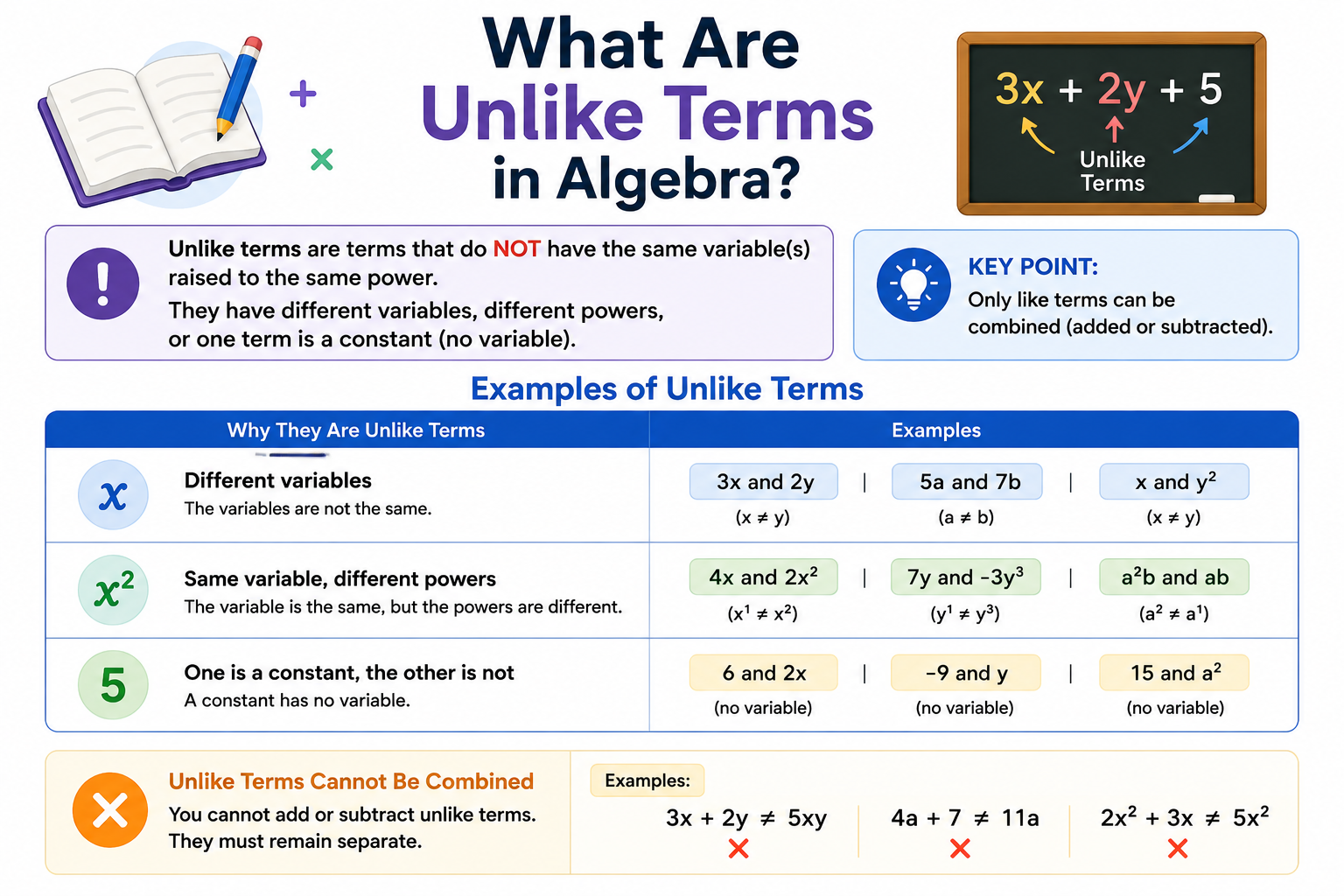
So, what are unlike terms in algebra? Unlike terms are algebraic terms that do not share the same variable part. This means they have different variables, different exponents on their variables, or a different combination of variables altogether. Unlike terms cannot be combined into a single term through addition or subtraction.
Understanding unlike terms is essential for correctly simplifying algebraic expressions. Knowing which terms can and cannot be combined saves you from one of the most frequent errors in algebra: merging terms that should stay separate.
Key Takeaways
-
Unlike terms are algebraic terms whose variable parts are not identical.
-
Terms can be unlike because of different variables, different exponents, or different variable combinations.
-
Unlike terms cannot be added or subtracted to form a single simplified term.
-
The coefficients of terms do not determine whether terms are like or unlike. Only the variable part matters.
-
Constants can be combined with other constants, but a constant and a variable term are unlike.
-
Negative signs and fractional coefficients do not affect whether terms are unlike.
-
Within an expression, like terms can be combined while unlike terms must remain separate.
What Are Unlike Terms in Algebra?
Unlike terms are algebraic terms that have different variable parts. Two terms are unlike when at least one of the following is true:
- They contain different variables (for example, x and y).
- They contain the same variable but with different exponents (for example, x and x²).
- They contain different combinations of variables (for example, xy and x²y).
The key principle is simple: if the complete variable part of one term does not match the complete variable part of the other term exactly, those two terms are unlike.
Here are three clear examples:
- 3x and 5y — different variables. Unlike terms.
- 4x and 7x² — same variable but different exponents. Unlike terms.
- 2xy and 3x²y — same variables but the exponent on x differs. Unlike terms.
It is very important to understand that the numerical coefficient, the number in front of the variable, plays no role in determining whether terms are like or unlike. Only the variable structure matters.
Simple Examples of Unlike Terms
The following table provides fifteen examples of unlike terms, with an explanation of why each pair does not qualify as like terms.
| Pair | Reason They Are Unlike |
|---|---|
| 2x and 3y | Different variables (x versus y) |
| 5a and 7b | Different variables (a versus b) |
| x and x² | Same variable but different exponents (1 versus 2) |
| 4m² and 4m³ | Same variable but different exponents (2 versus 3) |
| 3xy and 5x²y | Exponent on x differs (1 versus 2) |
| 6ab and 2ac | Different variable combinations (ab versus ac) |
| -3p and 4q | Different variables (p versus q) |
| 7a³ and 7a² | Same variable but different exponents (3 versus 2) |
| 5xyz and 5xy | Second term is missing z |
| 2x and 2 | One has a variable; the other is a constant |
| 4mn and 4m²n | Exponent on m differs (1 versus 2) |
| 1/2x and 1/2y | Different variables despite equal coefficients |
| 8k² and 8k³ | Different exponents on k |
| 3ab² and 3a²b | Exponent positions on a and b are swapped |
| 0.5t and 0.5s | Different variables despite equal decimal coefficients |
In every case, something in the variable structure differs. That single difference is enough to make the terms unlike.
What Are Like Terms?
Before going further, it is helpful to be clear on what like terms are, so the contrast with unlike terms is sharp.
Like terms are algebraic terms that have exactly the same variable parts. Every variable in both terms must be identical, and each variable must be raised to exactly the same exponent. The coefficients can be any numbers at all.
Examples of like terms:
- 3x and 5x (both have x to the power of 1)
- 4x² and 7x² (both have x to the power of 2)
- 2ab and 9ab (both have a and b, each to the power of 1)
Like terms can be combined by adding or subtracting their coefficients. Unlike terms cannot.
The article [What Are Like Terms in Algebra?] covers this topic in full detail, including how to identify like terms, combine them with positive and negative coefficients, and simplify complex expressions. Reading it alongside this article will give you a complete picture of how terms work in algebra.
Like Terms vs Unlike Terms
| Feature | Like Terms | Unlike Terms |
|---|---|---|
| Variables | Identical variables | Different variables, or same variable with different exponent |
| Exponents | Identical exponents on each variable | At least one exponent differs |
| Coefficients | Can be different | Can be different (irrelevant to classification) |
| Can they be combined? | Yes, by adding/subtracting coefficients | No, they must remain as separate terms |
| Result of combining | One simplified term | Cannot be written as a single term |
| Example (like) | 5x and -3x → 2x | — |
| Example (unlike) | — | 5x and -3y → 5x – 3y (unchanged) |
How to Identify Unlike Terms
Follow these five steps every time you need to decide whether two terms are unlike:
- Identify the variables in the first term. Write them down along with their exponents.
- Identify the variables in the second term. Write them down along with their exponents.
- Compare the variables. Do both terms have the same letter or letters?
- Compare the exponents on each variable. Even if the variables match, the exponents must also match.
- Check the complete variable part. If there is any difference at all in the variable structure, the terms are unlike.
Example 1: Are 6x² and 9x unlike terms?
Variable part of 6x² = x²
Variable part of 9x = x
Exponents differ (2 versus 1). Yes, they are unlike terms.
Example 2: Are 4mn and -7mn unlike terms?
Variable part of 4mn = mn
Variable part of -7mn = mn
Both contain m and n to the power of 1. They are identical. No, these are like terms.
Example 3: Are 3xy² and 5x²y unlike terms?
Variable part of 3xy² = xy²
Variable part of 5x²y = x²y
The exponents on x and y are in different positions. Yes, they are unlike terms.
Example 4: Are 8a and 8b unlike terms?
Variable part of 8a = a
Variable part of 8b = b
Different variables. Yes, they are unlike terms.
Why Are Unlike Terms Different?
Think of variables as labels for different quantities. If x represents the number of books and y represents the number of pens, then 3x means three books and 5y means five pens. You can count books, and you can count pens, but you cannot add them together into a single quantity of one type of item.
This is exactly why:
3x + 5y
cannot be simplified into a single term. x and y represent entirely different things in algebra, just as books and pens are different physical objects.
By contrast:
3x + 5x = 8x
Both terms refer to the same type of quantity, so they can be combined.
The mathematics of combining terms requires that they represent the same underlying algebraic unit. When variable parts differ, that condition fails, and the terms must remain separate.
Different Variables Make Terms Unlike
When two terms contain different variables, they are automatically unlike terms, regardless of how similar their coefficients are.
Examples:
- 3x and 3y — identical coefficients, but x ≠ y. Unlike terms.
- 5a and 5b — identical coefficients, but a ≠ b. Unlike terms.
- 7m and 2n — different coefficients and different variables. Unlike terms.
The coefficient is simply a multiplier. The variable is the identity of the term. Different variables mean entirely different quantities in algebra. No amount of coefficient similarity can make two terms like if their variables differ.
Different Exponents Make Terms Unlike
Two terms can share the same variable and still be unlike if their exponents are different.
Examples:
- 3x and 3x² — same variable x, but exponents 1 and 2 differ. Unlike terms.
- 5a² and 5a³ — same variable a, but exponents 2 and 3 differ. Unlike terms.
- 8p and 8p⁴ — same variable p, but exponents 1 and 4 differ. Unlike terms.
The reason for this is mathematical. x and x² represent completely different expressions. x means x, while x² means x times x. Adding them produces x + x², which has no simpler form. It is not possible to combine them into a single meaningful term.
Always check both the variable and its exponent. Matching one without the other is not enough.
Different Combinations of Variables
In expressions that contain more than one variable per term, the entire variable combination must match exactly.
Examples:
- 3xy and 4x²y — x has exponent 1 in the first and exponent 2 in the second. Unlike terms.
- 2ab and 5ac — first term has ab, second term has ac. Unlike terms (b and c differ).
- 6xyz and 3xy — first term contains three variables; second contains only two. Unlike terms.
Even if two terms share some of the same variables, they are still unlike if any part of their variable structure differs. Every letter and every exponent must match for terms to be like.
Can Coefficients Be Different?
Yes, absolutely. Coefficients have no bearing on whether terms are like or unlike. Only the variable part matters.
Compare these two situations:
- 3x and 8x — different coefficients (3 and 8), same variable (x to the power of 1). These are like terms.
- 3x and 8y — different coefficients (3 and 8), different variables (x and y). These are unlike terms.
In the first case, the different coefficients do not make the terms unlike. In the second case, it is the different variables that make the terms unlike, not the different coefficients.
Students sometimes assume that terms with the same coefficient must be like. That is not true. 3x and 3y have identical coefficients but are unlike terms. 3x and 7x have different coefficients but are like terms.
Can Constants Be Unlike Terms?
Constants are numbers with no variable part. Examples include 5, -3, 12, and 0.7.
Because constants have no variable, they all share the same “empty” variable part. This means all constants are like terms with each other and can be combined freely.
Examples:
- 5 + 7 = 12
- -3 + 9 = 6
- 4 – 10 + 1 = -5
However, a constant and a variable term are unlike. The number 5 and the term 3x cannot be combined because 5 has no variable and 3x does. They must remain separate:
5 + 3x stays as 5 + 3x
Can Negative Terms Be Unlike Terms?
Yes. A negative sign in front of a term is part of the coefficient. It does not affect whether the variable part is different or the same.
Examples:
- -3x and 5y — negative coefficient in the first term, but the variable parts (x and y) are still different. Unlike terms.
- -4x² and 7x³ — exponents differ (2 versus 3). Unlike terms.
- -2ab and 3ac — variable combinations differ (ab versus ac). Unlike terms.
The presence of a negative sign neither creates nor removes an unlike relationship. The variable structure alone decides whether terms are like or unlike.
Can Fractional Terms Be Unlike Terms?
Yes. A fraction used as a coefficient does not change the classification of a term. The variable part still determines whether terms are like or unlike.
Examples:
- 1/2x and 3/4y — different variables despite fractional coefficients. Unlike terms.
- 1/3x² and 2/5x³ — same variable but different exponents. Unlike terms.
Of course, if the variable parts are the same, even terms with fractional coefficients are like terms and can be combined. The rule remains the same regardless of whether the coefficient is a whole number, a fraction, or a decimal.
To understand how fraction arithmetic works in algebraic contexts, the article [What Is a Fraction?] provides a complete and clear explanation that is directly relevant to working with fractional coefficients in algebra.
Can Decimal Terms Be Unlike Terms?
Yes. Decimal coefficients follow exactly the same rules as any other coefficients.
Examples:
- 0.5x and 1.5y — different variables (x versus y). Unlike terms.
- 2.5a² and 3.5a³ — same variable but different exponents (2 versus 3). Unlike terms.
- 0.3xy and 0.7x²y — exponent on x differs. Unlike terms.
In each case, the decimal coefficient is simply the number multiplying the variable. It has no effect on whether the terms are like or unlike.
Unlike Terms in Algebraic Expressions
An algebraic expression can contain a mixture of like terms and unlike terms all in the same expression. Your job when simplifying is to identify which terms are like and combine only those, leaving all unlike terms exactly as they are.
Consider the expression:
3x + 5y + 2x – 4y + 7
Identify the groups:
- x terms: 3x and 2x — these are like terms.
- y terms: 5y and -4y — these are like terms.
- Constants: 7 — stands alone.
- 3x and 5y are unlike terms (different variables).
- 3x and 7 are unlike terms (variable term versus constant).
Combine the like terms:
3x + 2x = 5x
5y – 4y = y
The constant 7 remains as it is.
Simplified result: 5x + y + 7
The article [What Is an Algebraic Expression?] explains the complete structure of algebraic expressions, including how terms, variables, coefficients, and constants all fit together. Understanding the full anatomy of an expression makes it easier to identify which terms are unlike.
Unlike Terms and Linear Equations
In a linear equation, unlike terms can appear on the same side of the equals sign. They cannot be combined, but they still play individual roles in the equation.
Consider:
2x + 3y = 12
Here, 2x and 3y are unlike terms. They cannot be combined into a single term. Each variable (x and y) remains independent and must be treated as its own unknown.
When unlike terms appear on the same side of a linear equation with some like terms mixed in, you combine the like terms first and leave the unlike terms separate.
Example: 3x + 2x + 4y = 20
Combine like terms: 5x + 4y = 20
The 5x and 4y are unlike terms. They remain separate. The equation now has its left side in its simplest form.
The article [What Is a Linear Equation?] provides a complete step-by-step guide to understanding and solving linear equations, including how simplification using like and unlike terms fits into the solving process.
Unlike Terms and Quadratic Equations
Quadratic expressions and equations frequently contain terms with different exponents. This is a classic source of unlike terms.
Consider:
x² + 3x + 5
The three terms are:
- x² (quadratic term, exponent 2)
- 3x (linear term, exponent 1)
- 5 (constant term, no variable)
All three terms are unlike because each has a different variable structure. None of them can be combined with the others. The expression x² + 3x + 5 is already fully simplified even though it has three terms.
Now consider: 3x² + 5x + 2x²
Here, 3x² and 2x² are like terms (same variable and exponent). However, 5x is unlike both of them. You can combine 3x² and 2x² to get 5x², but 5x must remain separate.
Result: 5x² + 5x
The article [What Is a Quadratic Equation?] covers quadratic expressions and equations in full detail, including how to identify and handle different types of terms within quadratic expressions.
Unlike Terms and Factors
It is easy to confuse terms and factors, but they are completely different concepts.
A term is a single component of an algebraic expression, separated from other components by addition or subtraction.
A factor is one of the quantities multiplied together to form a term.
In the term 4x²:
- 4x² is one single term.
- 4 and x² are the factors of that term. Alternatively, 4, x, and x are three factors.
Unlike terms are about the relationship between separate terms in an expression, not the relationship between the parts within a single term.
The article [What Is a Factor?] explains factors clearly and distinguishes them from terms and other algebraic concepts, which is helpful for avoiding confusion when working with expressions.
Unlike Terms and Rational Numbers
Rational numbers are numbers that can be expressed as a fraction p/q, where q is not zero. They frequently appear as the coefficients of algebraic terms.
For example:
- 2/3 x and 5/7 y — both have rational coefficients, but the variables differ. Unlike terms.
- 3/4 a² and 1/2 a³ — both have rational coefficients, but the exponents differ. Unlike terms.
As always, the rational coefficient does not affect whether the terms are like or unlike. Only the variable part determines that.
The article [What Is a Rational Number?] provides a full explanation of rational numbers and how they are used in mathematics, which is useful background when working with algebraic terms that have fractional or rational coefficients.
Unlike Terms and Real Numbers
Coefficients in algebraic terms can be any real numbers, including positive integers, negative integers, fractions, decimals, and irrational numbers such as √2 or π, though these last two are less common at introductory levels.
Regardless of what type of real number the coefficient is, the rule remains unchanged: the variable part determines whether terms are like or unlike. A coefficient of √3 and a coefficient of 5 do not make terms unlike or like. Only the variable structure does.
The article [What Is a Real Number?] explains the complete real number system and helps you understand the full range of values that coefficients in algebra can take.
Unlike Terms in Physics Formulas
Physics formulas often combine several algebraic terms that represent different physical quantities. These terms are frequently unlike because they involve different variables.
For example, in kinematic equations, displacement, velocity, time, and acceleration are all represented by different variables. When an equation involves multiple such terms, those terms are unlike terms in the algebraic sense and must each be treated independently.
Understanding how algebraic structure relates to physical relationships is made clearer by reading the article [What Is Force in Physics?], which explains how force, mass, and acceleration are expressed as algebraic quantities and why the terms in such formulas retain their individual identities.
How to Simplify Expressions Containing Unlike Terms
When an expression contains both like and unlike terms, follow this process:
- Identify every term in the expression.
- Group the like terms together.
- Combine each group of like terms.
- Leave all unlike terms as they are.
- Write the final simplified expression.
Example 1: Simplify 3x + 5y + 2x – y
Group x terms: 3x + 2x = 5x
Group y terms: 5y – y = 4y
Final answer: 5x + 4y
Example 2: Simplify 7a + 3b – 2a + 6b – 4
Group a terms: 7a – 2a = 5a
Group b terms: 3b + 6b = 9b
Constant: -4 remains
Final answer: 5a + 9b – 4
Example 3: Simplify 4x² + 3x – x² + 2 + 5x
Group x² terms: 4x² – x² = 3x²
Group x terms: 3x + 5x = 8x
Constant: 2 remains
Final answer: 3x² + 8x + 2
Example 4: Simplify 6mn – 2m + 3mn + m
Group mn terms: 6mn + 3mn = 9mn
Group m terms: -2m + m = -m
Final answer: 9mn – m
Example 5: Simplify 5p² + 2q – p² + 3p – q
Group p² terms: 5p² – p² = 4p²
Group q terms: 2q – q = q
Group p terms: 3p remains (no match)
Final answer: 4p² + 3p + q
Example 6: Simplify 2x + 3y – x + y + 4
Group x terms: 2x – x = x
Group y terms: 3y + y = 4y
Constant: 4 remains
Final answer: x + 4y + 4
Example 7: Simplify 8ab + 4a – 3ab – a + 2b
Group ab terms: 8ab – 3ab = 5ab
Group a terms: 4a – a = 3a
Group b terms: 2b remains (no match)
Final answer: 5ab + 3a + 2b
Example 8: Simplify 9x³ – 4x² + x³ + 2x²
Group x³ terms: 9x³ + x³ = 10x³
Group x² terms: -4x² + 2x² = -2x²
Final answer: 10x³ – 2x²
Worked Examples
Example 1: Different Variables
Given: 5x + 3y
Identify terms: 5x and 3y
Unlike: Different variables (x and y). Neither can be combined with the other.
Final Answer: 5x + 3y (already simplified)
Example 2: Different Exponents
Given: 4a² + 7a
Identify terms: 4a² and 7a
Unlike: Same variable a but different exponents (2 and 1).
Final Answer: 4a² + 7a (already simplified)
Example 3: Multiple Variables With Exponent Difference
Given: 3x²y + 5xy²
Identify terms: 3x²y and 5xy²
Unlike: The exponents on x and y are swapped. These are unlike terms.
Final Answer: 3x²y + 5xy² (already simplified)
Example 4: Negative Terms
Given: -6m + 9n
Identify terms: -6m and 9n
Unlike: Different variables (m and n).
Final Answer: -6m + 9n (already simplified)
Example 5: Fractions
Given: 2/3x and 5/4y
Identify terms: 2/3x and 5/4y
Unlike: Different variables despite fractional coefficients.
Final Answer: 2/3x + 5/4y (already simplified; these terms cannot be combined)
Example 6: Decimals
Given: 0.6a² + 1.2a³
Identify terms: 0.6a² and 1.2a³
Unlike: Same variable but different exponents (2 and 3).
Final Answer: 0.6a² + 1.2a³ (already simplified)
Example 7: Constants Mixed With Variables
Given: 5 + 3x + 7y
Identify terms: 5 (constant), 3x (x term), 7y (y term)
Unlike: All three terms are unlike each other. 5 is a constant; 3x and 7y have different variables.
Final Answer: 5 + 3x + 7y (already simplified)
Example 8: Quadratic Expression
Given: 2x² + 4x + 1
Identify terms: 2x² (exponent 2), 4x (exponent 1), 1 (constant)
Unlike: All three terms are unlike each other.
Final Answer: 2x² + 4x + 1 (already simplified)
Example 9: Identify Like and Unlike Terms
Given: 4x + 7y + 3x² + 5x – 2y
Grouping:
- x terms: 4x and 5x (like terms) → 9x
- y terms: 7y and -2y (like terms) → 5y
- x² term: 3x² (no match; unlike all others)
Final Answer: 9x + 5y + 3x²
Example 10: Simplifying a Mixed Expression
Given: 5x + 3y – 2x + 7 – y
Grouping:
- x terms: 5x – 2x = 3x
- y terms: 3y – y = 2y
- Constant: 7 remains
Final Answer: 3x + 2y + 7
Example 11: Exponents
Given: 3x² + 5x + 2x²
- x² terms: 3x² and 2x² are like terms → 5x²
- x term: 5x is unlike both x² terms
Final Answer: 5x² + 5x
Example 12: Multiple Variables
Given: 2xy + 5x²y + 3xy
- xy terms: 2xy and 3xy are like → 5xy
- x²y term: 5x²y is unlike xy terms (exponent on x differs)
Final Answer: 5xy + 5x²y
Example 13: Three Groups
Given: 6a + 4b – 3a + b + 2c
- a terms: 6a – 3a = 3a
- b terms: 4b + b = 5b
- c term: 2c stands alone (unlike a and b terms)
Final Answer: 3a + 5b + 2c
Example 14: Unlike With Same Coefficient
Given: 7x and 7y
Both have coefficient 7. Variable parts differ.
These are unlike terms. They cannot be combined.
Final Answer: 7x + 7y (unchanged)
Example 15: Full Simplification
Given: 3p² + 2p – p² + 4q – q + 1
- p² terms: 3p² – p² = 2p²
- p term: 2p (stands alone, unlike p²)
- q terms: 4q – q = 3q
- Constant: 1
Final Answer: 2p² + 2p + 3q + 1
Common Mistakes Students Make
| Mistake | Incorrect | Correct |
|---|---|---|
| Combining different variables | 3x + 4y = 7xy | 3x + 4y stays as 3x + 4y |
| Combining different exponents | 5x + 3x² = 8x³ | 5x + 3x² stays as 5x + 3x² |
| Adding exponents when combining | 4x² + 4x² = 4x⁴ | 4x² + 4x² = 8x² |
| Thinking equal coefficients mean like terms | 5x and 5y are like because both have 5 | 5x and 5y are unlike (different variables) |
| Combining constant and variable term | 3x + 4 = 7x | 3x + 4 stays as 3x + 4 |
| Ignoring the negative sign | 5x + (-3y) = 2xy | 5x + (-3y) stays as 5x – 3y |
| Thinking fractions change the type | 1/2x and 1/2y are like | 1/2x and 1/2y are unlike (different variables) |
| Confusing factors with terms | In 6xy, 6 and x are separate terms | 6xy is one term; 6, x, and y are its factors |
| Combining all terms in one step | 3x + 4y – x = 6xy | 3x – x = 2x, leaving 2x + 4y |
| Assuming negative terms are always unlike | -3x and 5y are unlike because of the negative | They are unlike because of different variables, not the sign |
Unlike Terms Rules Cheat Sheet
| Rule | Example | Result |
|---|---|---|
| Different variables → unlike | 3x and 5y | Cannot be combined |
| Different exponents → unlike | 4x² and 4x³ | Cannot be combined |
| Different variable combinations → unlike | 2xy and 2x²y | Cannot be combined |
| Same variable and same exponent → like | 3a and 7a | 10a |
| Coefficients do not determine type | 5x and 5y | Unlike (different variables) |
| Constants can always be combined | 6 and -4 | 2 |
| Unlike terms stay separate in expressions | 3x + 5y | Remains 3x + 5y |
| Negative sign is part of the coefficient | -3x and 7x | Like terms, combine: 4x |
| Fraction coefficient doesn’t change type | 1/3x and 2/5y | Unlike (different variables) |
| Multi-variable: entire variable part must match | 4ab and 4a | Unlike (second term missing b) |
Unlike Terms vs Factors
Understanding the difference between factors and unlike terms prevents a great deal of confusion.
Take the term 4x².
This is one single algebraic term. Its factors are 4 and x² (or equivalently, 4, x, and x). Factors are the quantities multiplied together inside a single term.
Now take the expression 4x² + 3x.
Here there are two terms: 4x² and 3x. These two terms are unlike because their exponents differ. The relationship between these terms (unlike) is entirely different from the relationship between the parts inside each term (factors).
Like and unlike terms are about what is being added or subtracted across separate terms. Factors are about what is being multiplied within a single term. These are two completely separate ideas.
Unlike Terms vs Expressions
An algebraic expression is a collection of one or more terms joined by addition or subtraction.
An expression can contain:
- All like terms: 3x + 5x + x (all have variable x)
- All unlike terms: 2x + 4y + 7 (all different)
- A mixture: 3x + 5y + 2x (two like x terms and one unlike y term)
The unlike terms in an expression must stay separate. They cannot be simplified further relative to each other. However, any like terms within the same expression can and should be combined.
This means the job of simplifying an expression involves two separate tasks: identifying which terms are like and combining them, and recognising which terms are unlike and leaving them alone.
Practice Questions
20 Multiple Choice Questions
Question 1: Which pair of terms is unlike?
A) 4x and 9x
B) -3a and 7a
C) 2y and 5z
D) 8m² and -3m²
Correct Answer: C
Explanation: 2y and 5z contain different variables (y and z), making them unlike terms.
Question 2: Why are x and x² unlike terms?
A) Their coefficients differ
B) They have different exponents
C) One is positive and one is negative
D) They have different variable names
Correct Answer: B
Explanation: x has exponent 1 and x² has exponent 2. Different exponents on the same variable make terms unlike.
Question 3: Which of the following are like terms?
A) 3ab and 3a
B) 5x² and 5x
C) 7mn and -2mn
D) 4p and 4q
Correct Answer: C
Explanation: 7mn and -2mn both contain mn with the same exponents. They are like terms.
Question 4: Simplify 4x + 3y + 2x – y.
A) 9xy
B) 6x + 2y
C) 6x – 2y
D) 6x² + 2y
Correct Answer: B
Explanation: 4x + 2x = 6x. 3y – y = 2y. Result: 6x + 2y.
Question 5: Are 5x and 5y like or unlike terms?
A) Like, because the coefficients are the same
B) Unlike, because the variables are different
C) Like, because both have only one variable
D) Unlike, because both have coefficient 5
Correct Answer: B
Explanation: The variable parts (x and y) are different, making these unlike terms regardless of the equal coefficients.
Question 6: Which expression is fully simplified?
A) 4x + 4x + 2y
B) 8x + 2y
C) 4x + 7y – 3y + 3x
D) None of the above
Correct Answer: B
Explanation: 4x + 4x = 8x. With 2y remaining, the expression becomes 8x + 2y, which is fully simplified since 8x and 2y are unlike.
Question 7: Which of the following cannot be simplified into one term?
A) 3x + 7x
B) 5a – 2a
C) 4m + 6n
D) 9y – y
Correct Answer: C
Explanation: 4m and 6n have different variables and are unlike terms. They cannot be combined.
Question 8: Are 3xy and 3x²y like or unlike terms?
A) Like, because they both contain x and y
B) Unlike, because the exponent on x differs
C) Like, because they have the same coefficient
D) Unlike, because one is positive and one is not stated
Correct Answer: B
Explanation: The first term has x to the power of 1; the second has x to the power of 2. The exponent difference makes them unlike.
Question 9: Simplify 6a² + 4a – 2a² + a.
A) 8a³ + 5a
B) 4a² + 5a
C) 4a² – 5a
D) 8a² + 3a
Correct Answer: B
Explanation: 6a² – 2a² = 4a². 4a + a = 5a. Result: 4a² + 5a.
Question 10: Can -4x and 9x be combined?
A) No, because one is negative
B) Yes, they are like terms
C) No, because the exponents differ
D) Yes, but only by multiplication
Correct Answer: B
Explanation: Both terms contain x to the power of 1. They are like terms. -4x + 9x = 5x.
Question 11: Which pair contains unlike terms due to different exponents?
A) 3x and 5x
B) 4a and 7b
C) 6y² and -2y³
D) 2mn and 8mn
Correct Answer: C
Explanation: 6y² has exponent 2 and -2y³ has exponent 3. Different exponents make them unlike.
Question 12: Simplify 5p + 3q – 2p + q.
A) 7p + 2q
B) 3p + 4q
C) 3p – 4q
D) 7pq
Correct Answer: B
Explanation: 5p – 2p = 3p. 3q + q = 4q. Result: 3p + 4q.
Question 13: What happens to unlike terms in an expression when simplifying?
A) They are multiplied together
B) They are cancelled out
C) They remain separate in the simplified expression
D) They are added to zero
Correct Answer: C
Explanation: Unlike terms cannot be combined. They remain as separate terms in the final simplified expression.
Question 14: Which of the following is true about unlike terms?
A) They must have different coefficients
B) They can never appear in the same expression
C) Their variable parts are not identical
D) They must all be negative
Correct Answer: C
Explanation: Unlike terms are defined by having non-identical variable parts. Coefficients and signs are irrelevant to this classification.
Question 15: Are 1/2x² and 3/4x² like or unlike terms?
A) Unlike, because the fractions are different
B) Like, because both have x²
C) Unlike, because fractions cannot be like terms
D) Like, because both contain x
Correct Answer: B
Explanation: Both terms contain x to the power of 2. Fractional coefficients do not affect the classification. These are like terms.
Question 16: Simplify 2x²y + 4xy² – x²y.
A) 5xy³
B) x²y + 4xy²
C) x²y – 4xy²
D) 5x²y²
Correct Answer: B
Explanation: 2x²y – x²y = x²y. The term 4xy² is unlike (different exponent arrangement) and stays separate. Result: x²y + 4xy².
Question 17: Which of these expressions has no like terms?
A) 3x + 5x – 2x
B) 4a + 7b + 2c
C) 8y² + 3y² – y²
D) 6m – 3m + m
Correct Answer: B
Explanation: 4a, 7b, and 2c all have different variables. There are no like terms. The expression is already fully simplified.
Question 18: Can 0.5a and 0.5b be combined?
A) Yes, because the decimal coefficients are equal
B) No, because the variables are different
C) Yes, because both are decimal terms
D) No, because decimals cannot appear in algebraic terms
Correct Answer: B
Explanation: The different variables (a and b) make these unlike terms. Equal decimal coefficients have no effect on this.
Question 19: Simplify 7k + 3 – 2k + 5.
A) 5k + 8
B) 5k – 8
C) 9k + 8
D) 5k + 2
Correct Answer: A
Explanation: 7k – 2k = 5k. 3 + 5 = 8. Constants and variable terms are unlike, so 5k and 8 stay separate. Result: 5k + 8.
Question 20: In 4x² + 3x + 2, which terms are unlike each other?
A) 4x² and 3x only
B) 3x and 2 only
C) All three terms are unlike each other
D) None are unlike
Correct Answer: C
Explanation: 4x² (exponent 2), 3x (exponent 1), and 2 (constant) all have different variable structures. All three are unlike.
10 Identify-the-Term Questions
Q1: In 3x + 4y + 2x – y, which terms are unlike all others?
Answer: 3x and 2x are like. 4y and -y are like. 3x and 4y are unlike. 3x and -y are unlike. 2x and 4y are unlike. 2x and -y are unlike.
Q2: In 5a² + 3a – 2b + a², which terms are unlike the others?
Answer: 5a² and a² are like. 3a is unlike a² terms (different exponent). -2b is unlike all others (different variable).
Q3: In 6mn + 4m – mn + 2n, which terms are unlike?
Answer: 6mn and -mn are like. 4m is unlike mn terms. 2n is unlike all mn and m terms.
Q4: In x³ + x² + x + 1, are any terms like each other?
Answer: No. All four terms have different variable structures (x³, x², x, and constant). All are unlike each other.
Q5: In 3xy + 2x²y + 5xy – x²y, identify like and unlike groups.
Answer: {3xy, 5xy} are like. {2x²y, -x²y} are like. The two groups are unlike each other.
Q6: In 4a + 3b + 2a – b + 5c, which terms cannot be combined with any others?
Answer: 5c cannot be combined with any other term. It is unlike all other terms in the expression.
Q7: In 7p³ + 4p² – 3p + 2, which terms are unlike the p² term?
Answer: 7p³ (different exponent: 3 versus 2), -3p (different exponent: 1 versus 2), and 2 (constant, no variable) are all unlike the p² term.
Q8: In 8x + 7y – 3x + y – 4, which groups of unlike terms remain after simplification?
Answer: After combining: 5x + 8y – 4. The terms 5x, 8y, and -4 are all unlike each other.
Q9: In 2ab + 3a²b – ab + 4a²b, identify unlike groups.
Answer: {2ab, -ab} are like. {3a²b, 4a²b} are like. The two groups are unlike each other.
Q10: In 9m² + 4n + 3m – n + 2m², which terms are unlike the 9m² term?
Answer: 4n (different variable), 3m (different exponent), and -n (different variable) are all unlike the 9m² term. 2m² is like the 9m² term.
10 Simplification Problems
Problem 1: 4x + 3y + 2x + y
Solution: (4x + 2x) + (3y + y) = 6x + 4y
Problem 2: 7a² + 5a – 3a² + 2a
Solution: (7a² – 3a²) + (5a + 2a) = 4a² + 7a
Problem 3: 9mn – 3m + 4mn + m
Solution: (9mn + 4mn) + (-3m + m) = 13mn – 2m
Problem 4: 5x³ + 2x² – x³ + 4x
Solution: (5x³ – x³) + 2x² + 4x = 4x³ + 2x² + 4x
Problem 5: 6a + 3b – 4c + 2a – b + c
Solution: (6a + 2a) + (3b – b) + (-4c + c) = 8a + 2b – 3c
Problem 6: 1/2x + 3/4x + 2y – y
Solution: (2/4x + 3/4x) + (2y – y) = 5/4x + y
Problem 7: 4p²q + 3pq – 2p²q + pq
Solution: (4p²q – 2p²q) + (3pq + pq) = 2p²q + 4pq
Problem 8: 3x + 4 – x + 7 – 5y
Solution: (3x – x) + (4 + 7) – 5y = 2x + 11 – 5y
Problem 9: 8k³ – 4k² + k³ – 3k + 2k²
Solution: (8k³ + k³) + (-4k² + 2k²) – 3k = 9k³ – 2k² – 3k
Problem 10: 0.5a + 1.5b – 0.2a + 0.5b
Solution: (0.5a – 0.2a) + (1.5b + 0.5b) = 0.3a + 2b
5 Challenge Questions
Challenge 1: Simplify 3(2x + y) – 2(x – 3y) + 4y
Solution: 6x + 3y – 2x + 6y + 4y = (6x – 2x) + (3y + 6y + 4y) = 4x + 13y
Challenge 2: Simplify 4x²y + 3xy² – x²y + 2xy² – 5x²y
Solution: (4x²y – x²y – 5x²y) + (3xy² + 2xy²) = -2x²y + 5xy² → -2x²y + 5xy²
Challenge 3: Simplify 2(a² + 3a) – (a² – a) + 4a² – 5a
Solution: 2a² + 6a – a² + a + 4a² – 5a = (2a² – a² + 4a²) + (6a + a – 5a) = 5a² + 2a
Challenge 4: Simplify 5/6x² + 1/3x² – 1/2x + 3/4x
Solution: (5/6x² + 2/6x²) + (-3/6x + 4.5/6x) → better as: (5/6 + 1/3)x² + (-1/2 + 3/4)x = (5/6 + 2/6)x² + (-2/4 + 3/4)x = 7/6x² + 1/4x
Challenge 5: Simplify 3(m²n + 2mn²) – 2(m²n – mn²) + mn²
Solution: 3m²n + 6mn² – 2m²n + 2mn² + mn² = (3m²n – 2m²n) + (6mn² + 2mn² + mn²) = m²n + 9mn²
Exam Tips
- Look at the variable first. Before doing anything else, identify what variable or variables each term contains.
- Check the exponent next. Even if two terms share the same variable, a difference in exponent makes them unlike.
- Check the entire variable combination. In multi-variable terms, every single variable and every exponent must match.
- Ignore the coefficient when classifying. Never use the coefficient to decide whether terms are like or unlike. It plays no role in that decision.
- Group like terms before simplifying. Physically rearrange the expression on your working paper to place like terms next to each other. This reduces errors.
- Never combine unlike terms. If you cannot confirm that the variable parts match exactly, leave the terms separate.
- Keep negative signs attached. A term like -3x has a coefficient of -3. Never detach the sign from its coefficient.
- Check the final simplified expression. After simplifying, scan the result one more time for any remaining like terms you may have missed.
Quick Revision Notes
Unlike terms defined: Terms with different variable parts. They cannot be combined by addition or subtraction.
Unlike because of different variables: 3x and 5y (x ≠ y).
Unlike because of different exponents: 4a and 4a² (exponents 1 ≠ 2).
Unlike because of different variable combinations: 2xy and 2x²y (exponent on x differs).
Coefficients: Do not determine whether terms are like or unlike. Only the variable part matters.
Constants: All constants are like terms with each other. A constant is unlike any variable term.
Simplifying: Combine like terms. Leave unlike terms separate. Write the final expression cleanly.
Common mistakes: Adding exponents, combining different variables, confusing coefficients with variable parts, treating negative terms as automatically unlike.
Unlike Terms Cheat Sheet
| Concept | Definition | Example |
|---|---|---|
| Unlike terms | Terms with different variable parts | 3x and 5y |
| Unlike due to variables | Different letters in variable part | 4a and 4b |
| Unlike due to exponents | Same variable but different powers | 3x and 3x² |
| Unlike due to combination | Different multi-variable structure | 2xy and 2x²y |
| Like terms (contrast) | Identical variable parts | 5x and -2x |
| Combining unlike terms | Not possible by addition/subtraction | 3x + 5y stays as 3x + 5y |
| Constants | No variable; always like each other | 4 and -7 combine to -3 |
| Coefficient role | Does not determine type | 5x and 5y are unlike despite equal coefficients |
| Negative unlike terms | Negative sign is part of coefficient | -3x and 4y are unlike (different variables) |
| Fractional unlike terms | Fractions are coefficients | 1/2x and 3/4y are unlike (different variables) |
Frequently Asked Questions
1. What are unlike terms in algebra?
Unlike terms are algebraic terms that do not have identical variable parts. They differ because of different variables, different exponents, or a different combination of variables. Unlike terms cannot be combined by addition or subtraction.
2. What is an example of unlike terms?
3x and 5y are unlike terms because they contain different variables. Also, x and x² are unlike terms because they have the same variable but different exponents.
3. How do you identify unlike terms?
Compare the variable parts of each term, ignoring the coefficients. If the variables differ, the exponents differ, or the variable combination differs, the terms are unlike.
4. What is the difference between like and unlike terms?
Like terms have identical variable parts and can be combined. Unlike terms have different variable parts and cannot be combined into a single term.
5. Can x and x² be unlike terms?
Yes. Although both contain the variable x, the exponents are different (1 and 2). This difference in exponent makes them unlike terms.
6. Can x and y be unlike terms?
Yes. x and y are different variables, so any terms containing only x or only y (such as 3x and 5y) are unlike terms.
7. Can unlike terms be added?
Unlike terms can be written side by side with an addition sign, but they cannot be simplified into a single term. 3x + 5y stays as 3x + 5y.
8. Can unlike terms be subtracted?
The same applies. You can write 7a – 4b, but it cannot be simplified further because a and b are different variables.
9. Do different coefficients make terms unlike?
No. Coefficients play no role in determining whether terms are like or unlike. Only the variable parts matter.
10. Are fractions allowed in unlike terms?
Yes. A fractional coefficient does not change whether terms are like or unlike. The variable part still makes the determination.
11. Can terms with multiple variables be unlike?
Yes. 3xy and 4x²y are unlike because the exponent on x differs. The entire variable combination must match for terms to be like.
12. Are negative terms unlike terms?
A negative sign forms part of the coefficient. It does not automatically make terms unlike. -3x and 5x are like terms. -3x and 5y are unlike terms because of different variables, not because of the sign.
13. Can constants be combined?
Yes. All constants are like terms with each other. However, a constant and a variable term are unlike and cannot be combined.
14. Why can unlike terms not be combined?
Unlike terms represent different algebraic quantities. Just as you cannot add hours and kilometres to get a single unit, you cannot add x and y into a single term because they represent different unknowns.
15. How do unlike terms appear in algebraic expressions?
Most algebraic expressions contain a mix of like and unlike terms. Like terms can be combined to simplify the expression. Unlike terms remain separate. The final simplified expression may still contain several unlike terms.
Summary
Unlike terms in algebra are terms that do not share identical variable parts. They are unlike because of different variables, different exponents on those variables, or a different combination of variables across the term.
Unlike terms cannot be combined through addition or subtraction. When simplifying an algebraic expression, you identify all groups of like terms, combine each group separately, and leave all unlike terms exactly as they are.
Coefficients, whether they are whole numbers, fractions, decimals, or negative values, play no role in deciding whether terms are like or unlike. It is the variable part alone that makes the determination.
Constants are like terms with other constants but unlike any variable term. Multi-variable terms are unlike if even one variable or one exponent in the variable structure differs from the other term.
Final Thoughts
Understanding what are unlike terms in algebra is a skill that pays off throughout every level of mathematics. Every time you simplify an expression, solve an equation, or work with a polynomial, you are making decisions about which terms are like and which are unlike.
The rule is consistent and straightforward: if the variable parts of two terms do not match exactly, the terms are unlike. They must stay separate. No amount of similarity in coefficients, signs, or structure can override that.
Building a strong instinct for identifying unlike terms prevents a wide range of common algebra errors and makes the rest of your algebra work significantly more reliable. Practise with the examples and questions in this article until the recognition becomes immediate and confident.
References
- OpenStax – Elementary Algebra and Prealgebra textbooks covering algebraic terms, like and unlike terms, and expression simplification.
https://openstax.org - Khan Academy – Free lessons on identifying and combining like terms, simplifying expressions, and understanding algebraic structure.
https://www.khanacademy.org - Mathematics LibreTexts – Open-access library with detailed coverage of algebraic terms, coefficients, variables, and simplification methods.
https://math.libretexts.org - Encyclopaedia Britannica – Reference articles on algebra, algebraic expressions, and the structure of mathematical terms.
https://www.britannica.com - Wolfram MathWorld – Comprehensive mathematical reference covering algebraic terms, polynomials, and expression simplification.
https://mathworld.wolfram.com
Disclaimer:
This article is intended for educational and informational purposes only. While LearnMinto strives to provide accurate and up-to-date mathematics information, readers should verify important academic concepts through official textbooks, educational institutions, examination boards, or trusted educational resources before using this content for exams or academic purposes. LearnMinto is not affiliated with any specific school, university, research institution, or examination board.