
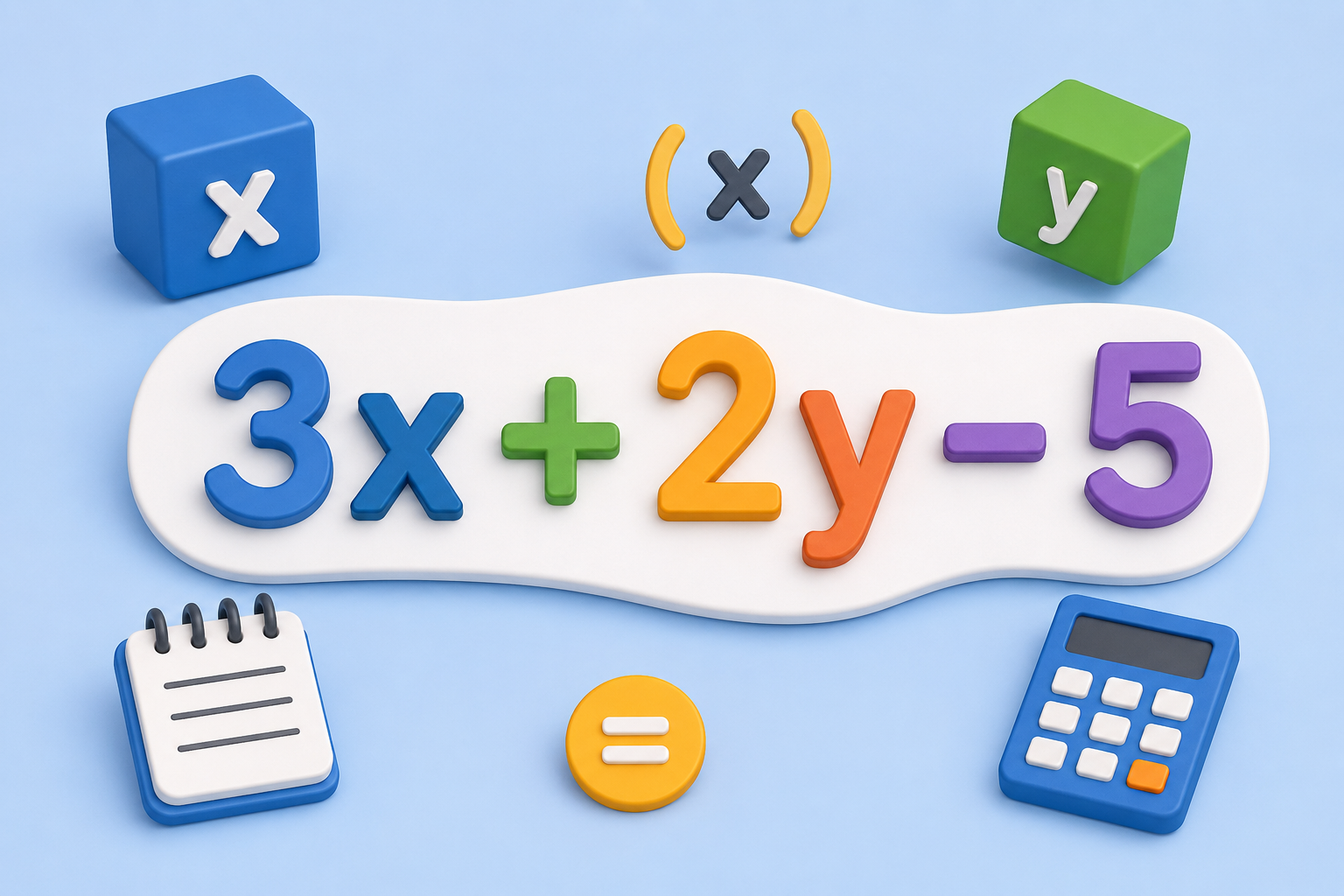
Introduction
Look at this simple expression: 3x + 5
What does it mean? Where did the letter come from? And why does it matter?
An algebraic expression is a mathematical phrase that combines numbers, variables, and mathematical operations such as addition, subtraction, multiplication, or division. It is one of the most fundamental ideas in algebra, and once you understand it, a huge part of mathematics becomes much clearer.
So, what is an algebraic expression? In simple terms, it is any combination of numbers and letters that represents a mathematical value or relationship, without using an equals sign.
That last part is important. Unlike an equation, an algebraic expression does not have an equals sign. It does not claim that two things are equal. It simply represents a quantity.
To put it in everyday terms: imagine you are buying apples. You do not know how many you will buy, so you call that unknown number x. If each apple costs 3 units of currency and you also pick up a fixed bag for 5 units, your total cost can be written as 3x + 5. That is an algebraic expression in real life.
Key Takeaways
-
An algebraic expression is a combination of numbers, variables, and operations without an equals sign.
-
The main parts of an algebraic expression are variables, constants, coefficients, terms, operators, and exponents.
-
Algebraic expressions are classified as monomials, binomials, trinomials, or polynomials based on the number of terms.
-
Like terms share the same variable and exponent and can be combined during simplification.
-
Unlike terms cannot be combined because they have different variables or different exponents.
-
Evaluating an expression means substituting a number for each variable and calculating the result.
-
An algebraic expression is different from an equation because it does not contain an equals sign.
What Is an Algebraic Expression?
An algebraic expression is a mathematical phrase made up of one or more terms that can include numbers, variables, and mathematical operations such as addition, subtraction, multiplication, division, and exponentiation. It does not contain an equals sign.
Here are some straightforward examples:
- x + 5
- 2x + 3
- 4x² – 7x + 2
- 3a + 2b – 5
Each of these is an algebraic expression because each one contains at least one variable and represents a mathematical value depending on what value the variable takes.
An algebraic expression can contain any or all of the following components:
- Numbers such as 2, 7, or 15
- Variables such as x, y, a, or b
- Constants such as 5 or 12 (fixed values that do not change)
- Coefficients such as the 4 in 4x
- Mathematical operations such as +, -, ×, or ÷
- Exponents such as the 2 in x²
The key point that students often forget is this: an algebraic expression is not an equation. The moment you add an equals sign, you turn an expression into an equation. The expression 2x + 3 simply represents a value. The equation 2x + 3 = 9 makes a statement that can be solved.
Parts of an Algebraic Expression
To work with algebraic expressions confidently, you need to understand each of their parts clearly. Let us take the expression 3x² as our main example and identify what each part means.
Variables
A variable is a letter that represents an unknown or changing value. In the expression 3x², the variable is x.
Variables can take different values depending on the situation. Common variables used in algebra include x, y, z, a, b, and n. There is no rule about which letter you use, but x is the most commonly chosen.
More examples of variables:
- In 5y + 3, the variable is y.
- In 2a – 7b, the variables are a and b.
Constants
A constant is a fixed number that does not change. It stands alone in an expression without any variable attached to it.
In the expression 2x + 9, the constant is 9. No matter what value x takes, the 9 always stays as 9.
More examples of constants:
- In 4x – 3, the constant is -3.
- In x² + 5x + 6, the constant is 6.
Coefficients
A coefficient is the number placed directly in front of a variable. It tells you how many times the variable is being multiplied.
In 3x², the coefficient is 3. This means x² is being multiplied by 3.
More examples of coefficients:
- In 7y, the coefficient is 7.
- In -4a, the coefficient is -4.
- In x, the coefficient is 1 (it is just not written, but it is always there).
Terms
A term is a single part of an algebraic expression. Terms are separated by addition or subtraction signs.
In the expression 4x² – 7x + 2, there are three terms:
- First term: 4x²
- Second term: -7x
- Third term: 2
Each term is a distinct piece of the expression.
Operators
Operators are the mathematical symbols that connect the terms in an expression. The four basic operators used in algebraic expressions are:
- Addition (+)
- Subtraction (-)
- Multiplication (×, or written without a symbol as in 3x)
- Division (÷, or written as a fraction such as x/2)
Exponents
An exponent tells you how many times a variable or number is multiplied by itself.
In 3x², the exponent is 2. This means x is multiplied by itself: x × x.
More examples:
- In 5a³, the exponent is 3, meaning a × a × a.
- In x, the exponent is 1 (usually not written).
How to Identify the Terms in an Expression
The simplest rule is this: terms are separated by plus (+) and minus (-) signs. Every time you see a + or -, it marks the boundary between terms.
Example 1: 4x + 7
- Term 1: 4x
- Term 2: 7
- This expression has 2 terms.
Example 2: 3x² – 5x + 2
- Term 1: 3x²
- Term 2: -5x
- Term 3: 2
- This expression has 3 terms.
Example 3: a + b – 10
- Term 1: a
- Term 2: b
- Term 3: -10
- This expression has 3 terms.
One important detail: when a minus sign appears in front of a term, the minus sign belongs to that term. So in 3x² – 5x + 2, the second term is -5x, not just 5x.
Examples of Algebraic Expressions
Here are fifteen examples ranging from very simple to moderately advanced:
| Expression | Description |
|---|---|
| x + 2 | A variable plus a constant |
| 2x | A coefficient multiplied by a variable |
| 5x + 3 | Two terms: one with a variable, one constant |
| 7a – 4 | Subtraction of a constant from a variable term |
| x² | A variable raised to the power of 2 |
| 3x² | A coefficient multiplied by a squared variable |
| x² + 3x + 2 | Three terms including a squared variable |
| 2a² – 5a + 6 | Quadratic expression with three terms |
| 4x – 9 | Binomial with subtraction |
| 3x + 2y | Two variables with coefficients |
| 5a³ – 2a | Variable raised to the third power |
| x/2 + 4 | Expression containing a fraction |
| 2(x + 3) | Expression using parentheses |
| -3x + 7 | Expression beginning with a negative term |
| 4a² + 3b – 7 | Expression with two variables and three terms |
Each of these is a valid algebraic expression. None of them contains an equals sign, which is what keeps them as expressions rather than equations.
Types of Algebraic Expressions
Algebraic expressions are classified based on the number of terms they contain.
Monomial
A monomial is an algebraic expression that contains exactly one term.
Examples:
- 5x
- -3a²
- 7
- 4xy
A single number or a single variable or a single product of numbers and variables all count as monomials.
Binomial
A binomial is an algebraic expression that contains exactly two terms.
Examples:
- x + 5
- 3a – 2
- 4x² + 7
The two terms are connected by a plus or minus sign.
Trinomial
A trinomial is an algebraic expression that contains exactly three terms.
Examples:
- x² + 3x + 2
- 2a² – 5a + 6
- 4x² – x + 9
Trinomials appear very frequently in algebra, especially when factoring and solving quadratic expressions.
Polynomial
A polynomial is an algebraic expression that contains one or more terms with non-negative integer exponents. This means that monomials, binomials, and trinomials are all technically polynomials. However, in everyday use, when teachers say “polynomial,” they often mean an expression with four or more terms.
Examples:
- x³ + 4x² – 2x + 7
- 5a⁴ – 3a³ + 2a² – a + 1
The important rule for polynomials is that variables cannot appear in the denominator and exponents must be whole numbers (0, 1, 2, 3, …).
Monomial vs Binomial vs Trinomial vs Polynomial
| Type | Number of Terms | Example | Description |
|---|---|---|---|
| Monomial | 1 | 5x | A single term |
| Binomial | 2 | 3x + 7 | Two terms separated by + or – |
| Trinomial | 3 | x² + 2x + 1 | Three terms |
| Polynomial | 1 or more | x³ – 4x² + x – 6 | General term including all of the above |
Note: Every monomial, binomial, and trinomial is a type of polynomial. The word “polynomial” is the umbrella term.
Algebraic Expression vs Equation
This is one of the most common points of confusion for students. Let us settle it clearly.
An algebraic expression is a phrase. It represents a value but does not make a statement about equality.
An algebraic equation is a sentence. It states that two expressions are equal to each other.
| Feature | Algebraic Expression | Algebraic Equation |
|---|---|---|
| Equals sign | No | Yes |
| Purpose | Represents a value | States a relationship |
| Example | 3x + 5 | 3x + 5 = 14 |
| Can it be solved? | No (only evaluated) | Yes |
| What it represents | A quantity | A mathematical statement |
Expression: 3x + 5
This says “three times x, plus five.” It does not tell you what x equals.
Equation: 3x + 5 = 14
This says “three times x, plus five, equals fourteen.” You can now solve for x.
The difference matters. An expression can be simplified or evaluated, but it cannot be “solved” the way an equation can. Always check for the equals sign.
Algebraic Expression vs Numerical Expression
A numerical expression contains only numbers and operations. No variables are involved.
A algebraic expression contains at least one variable in addition to numbers and operations.
| Feature | Numerical Expression | Algebraic Expression |
|---|---|---|
| Contains numbers | Yes | Yes |
| Contains variables | No | Yes |
| Example | 5 + 3 × 2 | 5x + 3 |
| Result | Always a fixed number | Depends on the value of the variable |
Numerical expression: 5 + 3 × 2 = 11 (fixed answer)
Algebraic expression: 5x + 3 (answer changes depending on what x equals)
Like Terms and Unlike Terms
Like Terms
Like terms are terms that have exactly the same variable raised to exactly the same power. Only the coefficients are allowed to differ.
Examples of like terms:
- 3x and 5x (both have x to the power of 1)
- 2x² and 5x² (both have x to the power of 2)
- 4a and -7a (both have the variable a)
Unlike Terms
Unlike terms are terms that have different variables or the same variable raised to different powers. They cannot be combined.
Examples of unlike terms:
- 3x and 5y (different variables)
- 2x and 2x² (same variable but different exponents)
- 4a and 3b (different variables)
The distinction matters when you try to simplify. You can only add or subtract like terms. You cannot combine 3x and 5y into a single term, no matter how much you want to.
Combining Like Terms
Combining like terms means adding or subtracting the coefficients of terms that share the same variable and exponent.
Example 1: 3x + 5x
Both terms have x, so they are like terms.
3x + 5x = (3 + 5)x = 8x
Example 2: 7a – 2a + 4
7a and -2a are like terms. The constant 4 stands alone.
7a – 2a + 4 = 5a + 4
Example 3: 4x² + 3x + 2x² – x
Group like terms: (4x² + 2x²) + (3x – x)
= 6x² + 2x
Example 4: 5a + 3b – 2a + b
Group like terms: (5a – 2a) + (3b + b)
= 3a + 4b
Always look for terms with identical variable parts. Those are the ones you can combine.
How to Simplify an Algebraic Expression
Simplifying an algebraic expression means writing it in its most compact and clean form. Follow these steps:
- Remove parentheses by using the distributive property where needed.
- Identify like terms by looking for matching variables and exponents.
- Combine like terms by adding or subtracting their coefficients.
- Simplify any numerical terms that appear on their own.
- Write the final expression clearly, usually from highest to lowest power.
Worked Example 1: Simplify 2x + 3x – 5
Like terms: 2x and 3x
2x + 3x = 5x
Final answer: 5x – 5
Worked Example 2: Simplify 4a + 7 – 2a + 1
Like terms: 4a and -2a; 7 and 1
(4a – 2a) + (7 + 1) = 2a + 8
Final answer: 2a + 8
Worked Example 3: Simplify 3(x + 4) + 2x
Remove parentheses: 3x + 12 + 2x
Combine like terms: 5x + 12
Final answer: 5x + 12
Worked Example 4: Simplify 5x² – 3x + 2x² + 7x – 4
Group like terms: (5x² + 2x²) + (-3x + 7x) – 4
= 7x² + 4x – 4
Final answer: 7x² + 4x – 4
Worked Example 5: Simplify 6a – 2b + a + 5b – 3
Group like terms: (6a + a) + (-2b + 5b) – 3
= 7a + 3b – 3
Final answer: 7a + 3b – 3
Evaluating an Algebraic Expression
To evaluate an algebraic expression, you substitute a specific number for each variable and then calculate the result using the correct order of operations.
Example 1: Evaluate 2x + 5 when x = 3
Replace x with 3:
2(3) + 5 = 6 + 5 = 11
Example 2: Evaluate 3x² – 4x + 2 when x = 2
3(2²) – 4(2) + 2
= 3(4) – 8 + 2
= 12 – 8 + 2
= 6
Example 3: Evaluate 4a – 3b when a = 5 and b = 2
4(5) – 3(2)
= 20 – 6
= 14
Always use brackets when substituting a value to avoid sign errors.
Algebraic Expressions With Multiple Variables
Some expressions contain more than one variable. Each variable can take its own independent value.
Examples:
- 3x + 2y
- 4a² + 3b – 7
- 5p – 2q + r
Worked Example: Evaluate 3x + 2y when x = 4 and y = 3
3(4) + 2(3)
= 12 + 6
= 18
Worked Example: Evaluate 4a² + 3b – 7 when a = 2 and b = 5
4(2²) + 3(5) – 7
= 4(4) + 15 – 7
= 16 + 15 – 7
= 24
Writing Algebraic Expressions From Words
One of the most important skills in algebra is translating word problems into algebraic expressions. Here are ten examples:
| Word Statement | Algebraic Expression |
|---|---|
| A number plus 5 | x + 5 |
| Three times a number | 3x |
| Seven less than a number | x – 7 |
| Twice a number plus 4 | 2x + 4 |
| A number divided by 6 | x/6 |
| The sum of a number and 9 | x + 9 |
| Four more than a number | x + 4 |
| Half of a number | x/2 |
| A number decreased by 12 | x – 12 |
| Five times a number minus 3 | 5x – 3 |
The key is to identify the unknown quantity (the variable), then translate the operation words into mathematical symbols.
Common Mathematical Words Used in Algebra
| Word or Phrase | Algebraic Operation | Example |
|---|---|---|
| Sum | Addition (+) | Sum of x and 3: x + 3 |
| Difference | Subtraction (-) | Difference of x and 4: x – 4 |
| Product | Multiplication (×) | Product of 5 and x: 5x |
| Quotient | Division (÷) | Quotient of x and 2: x/2 |
| Twice | Multiply by 2 | Twice a number: 2x |
| Half | Divide by 2 | Half of x: x/2 |
| More than | Addition (+) | 6 more than x: x + 6 |
| Less than | Subtraction (-) | 3 less than x: x – 3 |
| Increased by | Addition (+) | x increased by 7: x + 7 |
| Decreased by | Subtraction (-) | x decreased by 5: x – 5 |
Using the Distributive Property
The distributive property states:
a(b + c) = ab + ac
In other words, when a number or term is placed outside a bracket, it multiplies every term inside the bracket.
Example 1: 3(x + 4)
= 3 × x + 3 × 4
= 3x + 12
Example 2: 5(2x – 3)
= 5 × 2x – 5 × 3
= 10x – 15
Example 3: 2x(x + 6)
= 2x × x + 2x × 6
= 2x² + 12x
The distributive property is used constantly in algebra, especially when expanding brackets and simplifying expressions.
Factoring Algebraic Expressions
Factoring is the reverse of expanding. Instead of multiplying out brackets, you find common factors and put the expression back into bracket form.
Example 1: 6x + 12
Both 6x and 12 are divisible by 6.
6x + 12 = 6(x + 2)
Example 2: 10a – 15
Both 10a and 15 are divisible by 5.
10a – 15 = 5(2a – 3)
Example 3: 4x² + 8x
Both terms are divisible by 4x.
4x² + 8x = 4x(x + 2)
Factoring makes expressions easier to work with and is a key skill for solving equations. To understand the concept of factors more deeply, read the article [What Is a Factor?].
Algebraic Expressions and Factors
A factor is any number or expression that divides another exactly without leaving a remainder. In algebraic expressions, factors can be numbers, variables, or entire bracketed expressions.
For example, in 6(x + 2):
- 6 is a numerical factor.
- (x + 2) is an algebraic factor.
Both multiply together to give 6x + 12. It is important not to confuse factors with terms. Terms are added or subtracted. Factors are multiplied.
Algebraic Expressions and Fractions
Algebraic expressions can include fractions. This is completely normal and nothing to be alarmed about.
Examples:
- x/2
- 3x/4
- (x + 2)/5
In x/2, the variable x is being divided by 2. In (x + 2)/5, the entire expression (x + 2) is divided by 5.
If you need to refresh your understanding of fractions before working with algebraic fractions, the article [What Is a Fraction?] provides a clear and thorough explanation.
The rules for fractions in algebra follow the same principles as fractions with numbers: you cannot have a zero in the denominator, and you can simplify by cancelling common factors.
Algebraic Expressions and Rational Numbers
A rational number is any number that can be written as a fraction p/q where p and q are integers and q is not zero.
In algebraic expressions, the coefficients and constants can be rational numbers. For example:
- (1/2)x + 3
- (3/4)a – (2/5)
These are perfectly valid algebraic expressions. The fraction (1/2) is a rational coefficient. For a full explanation of rational numbers, visit the article [What Is a Rational Number?].
Working with rational coefficients follows the same rules as working with integer coefficients. The only extra care needed is with fraction arithmetic when combining like terms.
Algebraic Expressions and Real Numbers
In most school-level algebra, variables are assumed to take real-number values. This means they can be whole numbers, fractions, decimals, or even irrational numbers like the square root of 2.
For example, in the expression 3x + 7, x could be:
- 4 (a whole number)
- 1.5 (a decimal)
- -3 (a negative number)
- (any value from the real number system)
For a thorough understanding of what real numbers include, read the article [What Is a Real Number?]. Understanding the number system helps you make sense of what kinds of values variables can take in different problems.
Algebraic Expressions in Everyday Life
Algebra is not just a classroom topic. Algebraic expressions appear in many everyday situations, even when people do not realise it.
Shopping: If each item costs £x and you buy 4 of them, your total is 4x. If there is a £5 delivery charge, the total becomes 4x + 5.
Budgeting: If you earn £a per hour and work h hours, your wages are ah.
Distance: If you drive at a speed of v kilometres per hour for t hours, the distance is vt.
Age problems: If someone is currently x years old, in 7 years they will be x + 7 years old.
Perimeter: The perimeter of a square with side length s is 4s.
Area: The area of a rectangle with length l and width w is lw.
Whenever a quantity is unknown or can change, a variable is used, and the relationship becomes an algebraic expression.
Algebraic Expressions in Physics
Physics formulas are often algebraic expressions or equations involving multiple variables that represent physical quantities.
One of the most famous examples is Newton’s Second Law of Motion:
F = ma
Here, F represents force, m represents mass, and a represents acceleration. The right-hand side, ma, is an algebraic expression. To understand more about how force works and how this formula is used, read the article [What Is Force in Physics?].
Other physics expressions include:
- Kinetic energy: (1/2)mv²
- Speed: d/t
- Momentum: mv
Each of these is built from variables representing measurable physical quantities, multiplied together using the principles of algebra.
Algebraic Expressions in Geometry
Geometry is full of algebraic expressions. Whenever a shape has an unknown dimension, algebra steps in.
Perimeter of a rectangle:
If the length is l and the width is w, the perimeter is:
2l + 2w
Area of a rectangle:
Area = lw
Area of a triangle:
Area = (1/2) × b × h, which can be written as bh/2
Perimeter of a square:
If the side length is s, the perimeter is 4s.
These expressions allow you to calculate dimensions even when you only know some of the measurements. Geometry and algebra work closely together, especially at GCSE and IGCSE level.
Algebraic Expressions in Exponents
Expressions involving exponents (also called powers) appear frequently in algebra, especially in quadratic and cubic expressions.
Examples:
- x² means x squared, or x × x
- 3x² means 3 multiplied by x squared
- 5a³ means 5 multiplied by a × a × a
The key distinction to remember:
- x² means the variable is squared.
- 2x means the variable is multiplied by 2.
These are very different. x² grows much faster than 2x as x increases.
When working with exponents in expressions, make sure you only combine like terms (same variable, same exponent).
Positive and Negative Terms
Every term in an algebraic expression carries a sign. Terms can be positive or negative.
In 3x – 5:
- 3x is a positive term.
- -5 is a negative term (the minus sign belongs to the 5).
In -2x + 7:
- -2x is a negative term.
- 7 is a positive term.
When simplifying, always track the sign of each term carefully. A common mistake is to accidentally drop or reverse a negative sign, which changes the entire meaning of the expression.
Algebraic Expression Rules
Here is a concise set of rules to keep in mind:
- Like terms can be combined by adding or subtracting their coefficients.
- Unlike terms cannot be combined, even if you want to.
- Multiplication between a coefficient and a variable can be written without a multiplication symbol (3 × x = 3x).
- A coefficient multiplies the variable directly next to it.
- An algebraic expression does not require an equals sign.
- The correct order of operations must always be followed.
- The denominator of a fraction can never be zero.
- Exponents apply only to the variable or bracket they are directly attached to, unless otherwise indicated.
- A variable with no written coefficient has a coefficient of 1.
- A variable with no written exponent has an exponent of 1.
Order of Operations in Algebraic Expressions
When calculating the value of an expression, always follow the correct order of operations. This is remembered using the acronyms BODMAS or PEMDAS.
BODMAS: Brackets, Orders (powers/roots), Division, Multiplication, Addition, Subtraction.
PEMDAS: Parentheses, Exponents, Multiplication, Division, Addition, Subtraction.
Example 1: Evaluate 2 + 3 × 4
Multiplication first: 3 × 4 = 12
Then addition: 2 + 12 = 14
(Not 5 × 4 = 20)
Example 2: Evaluate 2(x + 3) when x = 4
Brackets first: x + 3 = 4 + 3 = 7
Then multiplication: 2 × 7 = 14
The order of operations matters enormously in algebra. Doing operations in the wrong order leads to wrong answers.
Understanding how multiples of a number are used in expressions and calculations can be explored further in the article [What Is a Multiple?], which covers patterns and number relationships relevant to algebraic thinking.
Worked Examples
Example 1: Identifying Variables
Given: 5x – 3
Method: Look for letters in the expression.
Steps: The letter x represents the unknown quantity.
Final Answer: Variable = x
Example 2: Identifying Constants
Given: 7a + 4
Method: Look for a standalone number with no variable.
Steps: The number 4 has no variable attached.
Final Answer: Constant = 4
Example 3: Identifying Coefficients
Given: -6y + 2
Method: Look for the number directly in front of the variable.
Steps: -6 is directly in front of y.
Final Answer: Coefficient = -6
Example 4: Counting Terms
Given: 3x² – 5x + 8
Method: Count the terms separated by + and – signs.
Steps: Term 1: 3x², Term 2: -5x, Term 3: 8
Final Answer: 3 terms
Example 5: Identifying Expression Type
Given: 4x + 9
Method: Count the terms.
Steps: Two terms separated by a plus sign.
Final Answer: Binomial
Example 6: Combining Like Terms
Given: 6x + 2x – 3
Method: Identify and combine like terms.
Steps: 6x + 2x = 8x. The constant -3 stands alone.
Final Answer: 8x – 3
Example 7: Simplifying an Expression
Given: 4(2x – 1) + 3x
Method: Expand brackets, then combine like terms.
Steps: 8x – 4 + 3x = 11x – 4
Final Answer: 11x – 4
Example 8: Evaluating an Expression
Given: 3x + 7 when x = 5
Method: Substitute x = 5.
Steps: 3(5) + 7 = 15 + 7 = 22
Final Answer: 22
Example 9: Translating Words Into Expressions
Given: “Eight less than three times a number”
Method: Identify the variable, then translate.
Steps: Three times a number = 3x. Eight less than that = 3x – 8.
Final Answer: 3x – 8
Example 10: Using the Distributive Property
Given: 4(x + 5)
Method: Multiply 4 by each term inside the bracket.
Steps: 4 × x + 4 × 5 = 4x + 20
Final Answer: 4x + 20
Example 11: Factoring a Simple Expression
Given: 9x + 18
Method: Find the highest common factor of 9x and 18.
Steps: HCF = 9. Divide both terms: 9(x + 2)
Final Answer: 9(x + 2)
Example 12: Working With Fractions
Given: Evaluate x/4 + 3 when x = 8
Method: Substitute x = 8.
Steps: 8/4 + 3 = 2 + 3 = 5
Final Answer: 5
Example 13: Working With Exponents
Given: Evaluate 2x² when x = 3
Method: Substitute x = 3 and respect the exponent.
Steps: 2(3²) = 2(9) = 18
Final Answer: 18
Example 14: Working With Two Variables
Given: Evaluate 5x – 2y when x = 3 and y = 4
Method: Substitute both values.
Steps: 5(3) – 2(4) = 15 – 8 = 7
Final Answer: 7
Example 15: Applying Algebra to a Real-World Problem
Given: A shopkeeper sells notebooks for £x each and pens for £y each. Write an expression for the total cost of 3 notebooks and 5 pens.
Method: Multiply quantity by price for each item and add.
Steps: Cost of notebooks = 3x. Cost of pens = 5y. Total = 3x + 5y.
Final Answer: 3x + 5y
Common Mistakes Students Make
1. Confusing an expression with an equation
An expression has no equals sign. If you see an equals sign, it is an equation. Do not try to “solve” an expression.
2. Combining unlike terms
You cannot add 3x and 4y together. They are unlike terms. The answer is not 7xy.
3. Forgetting negative signs
In 5x – 3x², the second term is -3x², not 3x². Dropping the negative sign changes everything.
4. Misidentifying coefficients
In the term x, the coefficient is 1, not 0. In -x, the coefficient is -1.
5. Treating exponents incorrectly
2x² means 2 × (x²), not (2x)². Always apply the exponent to the variable first.
6. Ignoring the order of operations
In 3 + 2x when x = 4, the answer is 3 + 8 = 11, not 5 × 4 = 20. Multiply before adding.
7. Assuming every expression can be simplified
3x + 4y cannot be simplified further because x and y are unlike terms.
8. Confusing factors with terms
In 6(x + 2), the factors are 6 and (x + 2). The terms of the expanded form are 6x and 12.
9. Forgetting brackets during substitution
When substituting a negative number, always use brackets. If x = -3, then 2x = 2(-3) = -6, not 2 – 3 = -1.
10. Dividing by zero
In an expression like 5/x, the value x = 0 is never allowed. The denominator cannot be zero.
Algebraic Expression Cheat Sheet
| Concept | Definition | Example |
|---|---|---|
| Variable | A letter representing an unknown value | x, y, a |
| Constant | A fixed number with no variable | 5, -3, 12 |
| Coefficient | The number multiplied by a variable | 4 in 4x |
| Term | A single part of an expression | 3x, 7, -2a² |
| Monomial | An expression with one term | 5x² |
| Binomial | An expression with two terms | x + 4 |
| Trinomial | An expression with three terms | x² – 3x + 2 |
| Polynomial | An expression with one or more terms | x³ + 2x – 1 |
| Expression | A mathematical phrase without an equals sign | 4x + 7 |
| Like Terms | Terms with the same variable and exponent | 3x and 5x |
| Unlike Terms | Terms with different variables or exponents | 3x and 3x² |
Algebraic Expression Practice Questions
20 Multiple Choice Questions
Question 1: Which of the following is an algebraic expression?
A) 5 + 3 = 8
B) 4x + 7
C) 12 ÷ 4
D) 9 – 2 = 7
Correct Answer: B
Explanation: 4x + 7 contains a variable, making it an algebraic expression. The others are numerical expressions or equations.
Question 2: What is the coefficient of x in the expression 9x – 4?
A) -4
B) 9
C) x
D) 4
Correct Answer: B
Explanation: The coefficient is the number directly in front of the variable. It is 9.
Question 3: How many terms does 3x² – 5x + 2 have?
A) 2
B) 4
C) 3
D) 1
Correct Answer: C
Explanation: The three terms are 3x², -5x, and 2.
Question 4: Which expression is a monomial?
A) x + 2
B) 4x – 1
C) 7x²
D) a + b + c
Correct Answer: C
Explanation: 7x² has only one term, so it is a monomial.
Question 5: What is the constant in 6x + 11?
A) 6
B) x
C) 6x
D) 11
Correct Answer: D
Explanation: The constant is the standalone number with no variable. It is 11.
Question 6: Simplify 4x + 3x.
A) 7x²
B) 12x
C) 7x
D) 43x
Correct Answer: C
Explanation: 4x and 3x are like terms. 4 + 3 = 7, so the result is 7x.
Question 7: Which of the following is a binomial?
A) 5x
B) 3x + 2
C) x² + 3x + 1
D) 7
Correct Answer: B
Explanation: 3x + 2 has exactly two terms.
Question 8: Evaluate 2x + 3 when x = 4.
A) 9
B) 11
C) 14
D) 8
Correct Answer: B
Explanation: 2(4) + 3 = 8 + 3 = 11.
Question 9: What is the variable in 5a – 9?
A) 5
B) 9
C) a
D) -9
Correct Answer: C
Explanation: The letter a is the variable.
Question 10: Which pair of terms are like terms?
A) 3x and 3x²
B) 4a and 4b
C) 5x and 7x
D) 2y and 2y³
Correct Answer: C
Explanation: 5x and 7x both have the variable x to the power of 1. They are like terms.
Question 11: Which expression represents “five less than twice a number”?
A) 2x + 5
B) 5 – 2x
C) 2x – 5
D) 5x – 2
Correct Answer: C
Explanation: Twice a number = 2x. Five less than that = 2x – 5.
Question 12: Simplify 8a – 3a + 2.
A) 5a + 2
B) 11a + 2
C) 5a – 2
D) 8a – 1
Correct Answer: A
Explanation: 8a – 3a = 5a. The constant 2 remains. Answer: 5a + 2.
Question 13: Which of the following is NOT an algebraic expression?
A) x + 7
B) 3y – 2
C) 5a = 10
D) 2x²
Correct Answer: C
Explanation: 5a = 10 contains an equals sign. It is an equation, not an expression.
Question 14: What is the degree of the term 4x³?
A) 4
B) 1
C) 3
D) 12
Correct Answer: C
Explanation: The degree of a term is the exponent of its variable. The exponent of x in 4x³ is 3.
Question 15: Expand 2(3x + 5).
A) 6x + 5
B) 6x + 10
C) 5x + 10
D) 3x + 10
Correct Answer: B
Explanation: 2 × 3x = 6x and 2 × 5 = 10. Result: 6x + 10.
Question 16: Evaluate 3a² – 2 when a = 3.
A) 21
B) 25
C) 27
D) 16
Correct Answer: B
Explanation: 3(3²) – 2 = 3(9) – 2 = 27 – 2 = 25.
Question 17: Which expression is a trinomial?
A) 4x
B) x – 6
C) 2x² + x – 3
D) a + b + c + d
Correct Answer: C
Explanation: 2x² + x – 3 has exactly three terms.
Question 18: Simplify 3x + 2y – x + 5y.
A) 4x + 3y
B) 2x + 7y
C) 4xy
D) 2x + 3y
Correct Answer: B
Explanation: (3x – x) + (2y + 5y) = 2x + 7y.
Question 19: What does factoring an expression mean?
A) Adding all terms together
B) Rewriting the expression as a product of factors
C) Substituting values for variables
D) Removing all variables
Correct Answer: B
Explanation: Factoring means expressing the algebraic expression as a multiplication of its factors.
Question 20: Evaluate x/2 + 4 when x = 6.
A) 5
B) 7
C) 9
D) 10
Correct Answer: B
Explanation: 6/2 + 4 = 3 + 4 = 7.
10 Short Answer Questions
Q1: Write an algebraic expression for “four more than six times a number.”
Answer: 6x + 4
Q2: Identify the coefficient and constant in 9x – 7.
Answer: Coefficient = 9, Constant = -7
Q3: How many terms are in 5a²b – 3ab + 7b – 2?
Answer: 4 terms
Q4: Are 4x² and 4x like terms? Explain.
Answer: No. They have the same variable but different exponents (2 and 1), so they are unlike terms.
Q5: Simplify 2(x – 3) + 4x.
Answer: 2x – 6 + 4x = 6x – 6
Q6: Evaluate 5x – 2y when x = 2 and y = 3.
Answer: 5(2) – 2(3) = 10 – 6 = 4
Q7: Write “the product of 7 and a number, decreased by 4” as an algebraic expression.
Answer: 7x – 4
Q8: What type of expression is 6x + 9?
Answer: Binomial
Q9: Factor 15x + 20.
Answer: 5(3x + 4)
Q10: What is the value of 4x² + x when x = 2?
Answer: 4(4) + 2 = 16 + 2 = 18
10 Simplification Problems
Problem 1: Simplify 7x + 3x – 4
Solution: 7x + 3x = 10x. Final answer: 10x – 4
Problem 2: Simplify 5a – 2b + 3a + 4b
Solution: (5a + 3a) + (-2b + 4b) = 8a + 2b. Final answer: 8a + 2b
Problem 3: Simplify 4(x + 3) – 2x
Solution: 4x + 12 – 2x = 2x + 12. Final answer: 2x + 12
Problem 4: Simplify 9x² – 4x + 3x² + 2x
Solution: (9x² + 3x²) + (-4x + 2x) = 12x² – 2x. Final answer: 12x² – 2x
Problem 5: Simplify 3(2a – 1) + 4(a + 2)
Solution: 6a – 3 + 4a + 8 = 10a + 5. Final answer: 10a + 5
Problem 6: Simplify 2x + 5 – 3x + 1
Solution: (2x – 3x) + (5 + 1) = -x + 6. Final answer: -x + 6
Problem 7: Simplify 6y – 2(y – 4)
Solution: 6y – 2y + 8 = 4y + 8. Final answer: 4y + 8
Problem 8: Simplify 5x + 2(3x – 7) – x
Solution: 5x + 6x – 14 – x = 10x – 14. Final answer: 10x – 14
Problem 9: Simplify 4a + a – 3a
Solution: (4 + 1 – 3)a = 2a. Final answer: 2a
Problem 10: Simplify 3(x + y) + 2(x – y)
Solution: 3x + 3y + 2x – 2y = 5x + y. Final answer: 5x + y
10 Evaluation Problems
Problem 1: Evaluate 4x + 7 when x = 3
Answer: 4(3) + 7 = 12 + 7 = 19
Problem 2: Evaluate 2a² – 5 when a = 4
Answer: 2(16) – 5 = 32 – 5 = 27
Problem 3: Evaluate 3x – 2y when x = 5 and y = 3
Answer: 15 – 6 = 9
Problem 4: Evaluate x² + 2x + 1 when x = 3
Answer: 9 + 6 + 1 = 16
Problem 5: Evaluate (x + 4)/2 when x = 6
Answer: 10/2 = 5
Problem 6: Evaluate 5x² – 3x when x = 2
Answer: 5(4) – 3(2) = 20 – 6 = 14
Problem 7: Evaluate 2a + 3b – 1 when a = 2 and b = 3
Answer: 4 + 9 – 1 = 12
Problem 8: Evaluate 6 – 2x when x = 1
Answer: 6 – 2 = 4
Problem 9: Evaluate 3x³ when x = 2
Answer: 3(8) = 24
Problem 10: Evaluate (2x – y)² when x = 3 and y = 2
Answer: (6 – 2)² = 4² = 16
5 Word-to-Algebra Problems
Problem 1: “The sum of a number and fourteen.”
Answer: x + 14
Problem 2: “Three times a number, reduced by nine.”
Answer: 3x – 9
Problem 3: “Twice the sum of a number and six.”
Answer: 2(x + 6)
Problem 4: “A number divided by four, plus three.”
Answer: x/4 + 3
Problem 5: “Five less than the product of eight and a number.”
Answer: 8x – 5
Exam Tips
- Identify variables first. Before doing anything else, note which letters are in the expression and what they represent.
- Count the terms carefully. Look for each plus or minus sign to divide the expression into its parts.
- Look for like terms. Underline or circle terms with the same variable and exponent before combining.
- Watch positive and negative signs. A missing negative sign is one of the most common causes of wrong answers. Take your time.
- Use the correct order of operations. Always handle brackets first, then exponents, then multiplication and division, then addition and subtraction.
- Substitute values carefully. Use brackets when substituting, especially with negative numbers or fractions.
- Simplify the final answer where possible. After combining like terms, check whether the expression can be simplified further.
- Do not combine unlike terms. If two terms have different variables or different exponents, leave them as they are.
- Check your answer by re-substituting. If you evaluate an expression, double-check by working through the substitution again.
- Read word problems slowly. Translate one phrase at a time. Do not rush the translation from words into algebra.
Quick Revision Notes
Definition: An algebraic expression is a combination of numbers, variables, and operations, written without an equals sign.
Variables: Letters that represent unknown or changing values (x, y, a, b).
Constants: Fixed numbers in an expression with no variable attached (5, -3, 12).
Coefficients: Numbers multiplied directly by a variable (the 4 in 4x).
Terms: Individual parts of an expression, separated by + or – signs.
Types:
- Monomial = 1 term
- Binomial = 2 terms
- Trinomial = 3 terms
- Polynomial = 1 or more terms
Like terms: Same variable, same exponent. Can be combined.
Unlike terms: Different variables or different exponents. Cannot be combined.
Simplification: Use the distributive property, identify like terms, combine them, and write the result clearly.
Evaluation: Substitute a value for each variable and calculate using the correct order of operations.
Factoring: Rewrite an expression as a product of its factors (e.g., 6x + 12 = 6(x + 2)).
Expressions vs Equations: An expression has no equals sign. An equation has one and can be solved.
Distributive property: a(b + c) = ab + ac. Multiply the outside term by every term inside.
Order of operations (BODMAS/PEMDAS): Brackets, Orders, Division/Multiplication, Addition/Subtraction.
Frequently Asked Questions
1. What is an algebraic expression?
An algebraic expression is a mathematical phrase that contains numbers, variables, and operations such as addition, subtraction, multiplication, or division. It does not contain an equals sign.
2. What are the parts of an algebraic expression?
The main parts are variables, constants, coefficients, terms, operators, and exponents.
3. What is a variable?
A variable is a letter (such as x, y, or a) that represents an unknown or changing value in an expression.
4. What is a coefficient?
A coefficient is the number placed directly in front of a variable. In 7x, the coefficient is 7.
5. What is a constant?
A constant is a fixed number in an expression that does not change. In 4x + 9, the constant is 9.
6. What is a term in algebra?
A term is a single part of an algebraic expression. Terms are separated by plus or minus signs.
7. What are the types of algebraic expressions?
The main types are monomials (one term), binomials (two terms), trinomials (three terms), and polynomials (one or more terms).
8. What is a monomial?
A monomial is an algebraic expression with exactly one term, such as 5x or 3a².
9. What is a binomial?
A binomial is an algebraic expression with exactly two terms, such as x + 4 or 3x – 7.
10. What is a trinomial?
A trinomial is an algebraic expression with exactly three terms, such as x² + 2x + 1.
11. What is the difference between an expression and an equation?
An expression does not have an equals sign and cannot be solved. An equation has an equals sign and can be solved to find the value of a variable.
12. How do you simplify an algebraic expression?
Remove any brackets using the distributive property, identify like terms, combine them by adding or subtracting their coefficients, and write the result in its simplest form.
13. What are like terms?
Like terms are terms that have the same variable raised to the same power. For example, 3x and 7x are like terms.
14. How do you evaluate an algebraic expression?
Substitute the given numerical values for each variable into the expression and calculate the result using the correct order of operations.
15. Can an algebraic expression contain fractions?
Yes. Expressions such as x/2, 3x/4, and (x + 5)/3 are all valid algebraic expressions that include fractions.
Summary
An algebraic expression is a fundamental concept in mathematics. It is a combination of numbers, variables, and operations that represents a mathematical value. Understanding its parts, including variables, constants, coefficients, terms, and exponents, gives you the tools to work confidently with algebra at any level.
There are different types of algebraic expressions: monomials, binomials, trinomials, and polynomials. Each type is defined by the number of terms it contains.
Simplifying expressions involves combining like terms. Evaluating expressions involves substituting values for variables. Translating word problems into algebraic expressions is an essential skill for solving real-world problems.
The difference between an expression and an equation is simple but important: an expression has no equals sign, and an equation does.
With practice, working with algebraic expressions becomes second nature. The worked examples, practice questions, and revision notes in this article provide everything you need to build a strong foundation.
Final Thoughts
Algebraic expressions are not just an abstract classroom topic. They are the language that mathematics uses to describe unknown quantities, patterns, relationships, and real-world situations. Every time you write a formula, build a model, or describe a changing quantity, you are using an algebraic expression.
Understanding what is an algebraic expression is the first and most important step in algebra. From here, everything else builds on this foundation: equations, functions, graphs, geometry, physics formulas, and much more. The students who take the time to understand expressions properly will find the rest of algebra significantly easier and more logical.
Whether you are preparing for a school test, a GCSE or IGCSE exam, or simply learning algebra for the first time, mastering algebraic expressions will serve you well in every area of mathematics.
References
- OpenStax – Introductory Algebra and Prealgebra textbooks covering algebraic expressions, terms, and simplification.
https://openstax.org - Khan Academy – Free online lessons on algebraic expressions, combining like terms, and evaluating expressions.
https://www.khanacademy.org - Mathematics LibreTexts – Open-access mathematics library covering algebraic expressions and polynomial types.
https://math.libretexts.org - Encyclopaedia Britannica – Reference articles on algebra and algebraic structures.
https://www.britannica.com - Wolfram MathWorld – Comprehensive mathematical reference covering algebraic expressions, monomials, binomials, trinomials, and polynomials.
https://mathworld.wolfram.com
Disclaimer:
This article is intended for educational and informational purposes only. While LearnMinto strives to provide accurate and up-to-date mathematics information, readers should verify important academic concepts through official textbooks, educational institutions, examination boards, or trusted educational resources before using this content for exams or academic purposes. LearnMinto is not affiliated with any specific school, university, research institution, or examination board.