
Introduction
Think about the numbers you use every single day. The price of a coffee at £2.50, the temperature outside at -3 degrees, the distance to school at 1.7 kilometres, or the length of a diagonal measured as √2 centimetres. Every one of those numbers — positive, negative, fractional, or irrational — belongs to the same family.
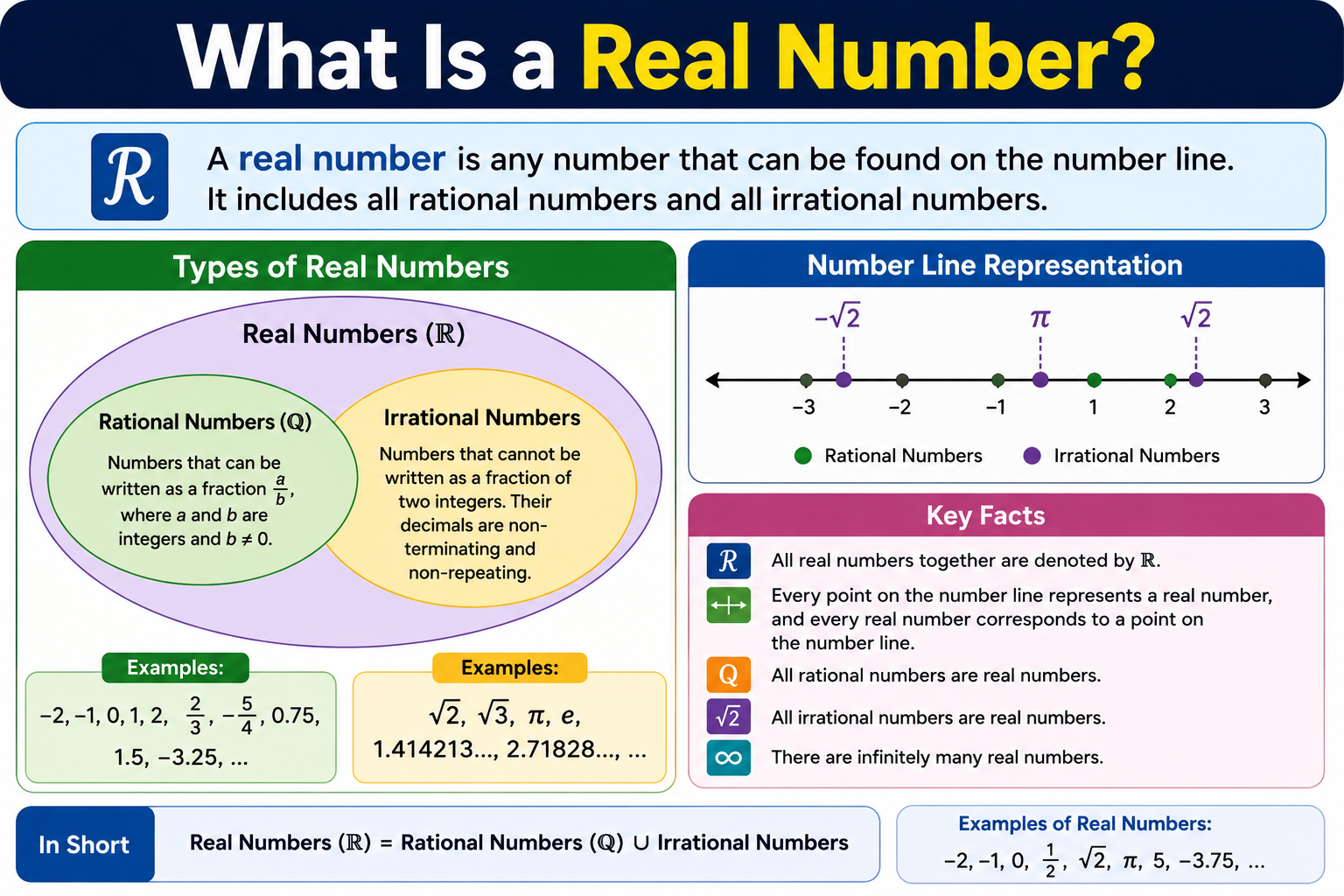
A real number is any number that can be represented on the real number line. Real numbers include all positive numbers, negative numbers, zero, fractions, terminating decimals, repeating decimals, and irrational numbers such as √2 and π.
The real number system is built from two major categories: rational numbers and irrational numbers. Rational numbers can be expressed as a fraction of two integers. Irrational numbers cannot. Together, they cover every point on the continuous number line and form the foundation of most mathematics you will study at school and beyond.
Key Takeaways
-
A real number is any number that can be placed on the real number line.
-
Real numbers include both rational numbers (fractions, integers, terminating and repeating decimals) and irrational numbers (√2, π, e).
-
Zero is a real number. Negative numbers are real numbers.
-
The real number system contains natural numbers, whole numbers, integers, and rational numbers as nested subsets.
-
Irrational numbers are real but cannot be expressed as a fraction of two integers.
-
Imaginary numbers such as √(-1) are not real numbers.
-
Real numbers follow properties including closure, commutativity, associativity, distributivity, and the identity and inverse properties.
What Is a Real Number?
A real number is any number that can be represented as a point on the real number line — the continuous, infinite line that extends from negative infinity on the left to positive infinity on the right.
Real numbers include:
- Positive numbers: 1, 2, 5, 100, 3.14
- Negative numbers: -1, -7, -0.5, -√3
- Zero: 0
- Fractions: 1/2, 3/4, -5/3
- Terminating decimals: 0.25, 1.75, 3.5
- Repeating decimals: 0.333…, 0.272727…
- Irrational numbers: √2, √5, π, e
The key idea is the number line. If a number can be placed at a precise location on that infinite line, it is a real number. If it cannot — as is the case with the square root of a negative number — then it is not a real number in the standard sense.
Real numbers are often denoted by the symbol ℝ in formal mathematics.
Real Number Examples
Here are common examples with a brief explanation of why each qualifies as a real number.
| Number | Type | Why It Is Real |
|---|---|---|
| 5 | Natural number | Positive integer; sits on the number line |
| -7 | Integer | Negative whole number; sits on the number line |
| 0 | Whole number | Sits at the origin of the number line |
| 1/2 | Rational number | Fraction of two integers; equals 0.5, a point on the line |
| 0.75 | Rational number | Terminating decimal; equal to 3/4 |
| 0.333… | Rational number | Repeating decimal; equal to 1/3 |
| √2 | Irrational number | Non-repeating decimal; precise point between 1 and 2 |
| π | Irrational number | Non-repeating decimal; precise point near 3.14159 |
| -√5 | Irrational number | Negative irrational; sits left of -2 on the line |
Every one of these numbers has a definite, fixed position on the real number line. That is what makes each of them real.
What Is the Real Number System?
The real number system is the complete, organized collection of all real numbers, built from nested sets of number types. Each set in the hierarchy is contained within the one above it.
Irrational numbers do not fit neatly into this chain of inclusions because they are not rational. Instead, they are added alongside rational numbers at the final level to complete the real number system.
| Number Set | Contains |
|---|---|
| Natural numbers | Positive counting numbers (and possibly 0, depending on textbook) |
| Whole numbers | Natural numbers plus 0 |
| Integers | Whole numbers plus negative numbers |
| Rational numbers | Integers plus fractions and repeating/terminating decimals |
| Real numbers | Rational numbers plus irrational numbers |
Every natural number is a whole number. Every whole number is an integer. Every integer is rational. Every rational number is real. And every irrational number is also real. The real numbers contain all of these.
Types of Real Numbers
Natural Numbers
Natural numbers are the positive counting numbers: 1, 2, 3, 4, 5, and so on. These are the numbers children learn to count with.
Some textbooks begin natural numbers at 0, while others begin at 1. The difference depends on the curriculum or convention being used. For most school purposes, natural numbers start at 1.
Examples: 1, 7, 42, 100.
Whole Numbers
Whole numbers are natural numbers with the addition of zero: 0, 1, 2, 3, 4, …
The only difference between natural numbers and whole numbers is the inclusion of 0.
Examples: 0, 1, 5, 23, 200.
Integers
Integers extend the whole numbers in the negative direction: …, -4, -3, -2, -1, 0, 1, 2, 3, 4, …
Integers include all positive whole numbers, all negative whole numbers, and zero. They do not include fractions or decimals.
Examples: -10, -3, 0, 4, 17.
Rational Numbers
A rational number is any number that can be written in the form a/b, where a and b are integers and b ≠ 0. This includes all integers, fractions, terminating decimals, and repeating decimals.
For a full explanation of rational numbers including their types, properties, and how to work with them, see the LearnMinto article [What Is a Rational Number?]
Examples: 1/2, -3/4, 5, 0, 0.25, 0.666…
Irrational Numbers
An irrational number is a real number that cannot be expressed as a ratio of two integers. Its decimal expansion is non-terminating and non-repeating.
For a complete explanation of irrational numbers including proofs, examples, and properties, see the LearnMinto article [What Are Irrational Numbers?]
Examples: √2, √3, √5, π, e, the golden ratio φ.
Rational Numbers vs Irrational Numbers
| Feature | Rational Numbers | Irrational Numbers |
|---|---|---|
| Definition | Expressible as a/b (b ≠ 0) with integer a, b | Cannot be expressed as a/b |
| Fraction form | Always possible | Never possible |
| Decimal representation | Terminates or repeats | Non-terminating, non-repeating |
| Examples | 1/2, -3, 0, 0.75, 0.333… | √2, √5, π, e, φ |
| Relationship to real numbers | Subset of real numbers | Subset of real numbers |
| Together they form | Real numbers | Real numbers |
Both rational and irrational numbers are real numbers. They are complementary subsets — every real number is either rational or irrational, and these two categories do not overlap.
Are All Rational Numbers Real Numbers?
Yes. Every rational number is a real number.
A rational number can be expressed as a fraction a/b, and every such fraction corresponds to a specific, definite point on the real number line.
For example:
- 1/2 = 0.5 sits exactly halfway between 0 and 1.
- -3/4 = -0.75 sits three-quarters of the way between -1 and 0.
- 5 = 5/1 sits at the position 5 on the number line.
Since every rational number has a precise position on the number line, every rational number is real.
Are All Irrational Numbers Real Numbers?
Yes. Every irrational number is also a real number.
Although irrational numbers cannot be expressed as exact fractions, they still have precise, definite locations on the real number line.
For example:
- √2 ≈ 1.41421… sits between 1 and 2, closer to 1.4.
- π ≈ 3.14159… sits between 3 and 4, very close to 3.14.
- e ≈ 2.71828… sits between 2 and 3.
Each of these numbers occupies a fixed point on the line. The fact that their decimal expansions never end does not make them any less precise or any less real.
Is Zero a Real Number?
Yes. Zero is a real number.
Zero sits at the exact centre of the real number line, serving as the boundary between positive numbers on the right and negative numbers on the left.
Zero is also:
- A whole number
- An integer
- A rational number (0 = 0/1)
- A real number
Zero is not a natural number in most standard definitions, and it is not irrational. But it is unquestionably real.
Are Negative Numbers Real Numbers?
Yes. Negative numbers are real numbers.
The real number line extends infinitely in both directions. The right side contains positive real numbers, and the left side contains negative real numbers. Every negative number — whether an integer, fraction, or irrational — has a precise position on the line.
Examples of negative real numbers:
- -5 (negative integer)
- -1/3 (negative rational fraction)
- -0.75 (negative terminating decimal)
- -√3 (negative irrational number)
- -π (negative irrational constant)
All of these are real numbers. Negativity does not remove a number from the real number system.
Real Numbers on the Number Line
The real number line is a straight, horizontal line that stretches infinitely in both directions. Every real number corresponds to exactly one point on this line, and every point on the line corresponds to exactly one real number.
Key features of the number line:
- Zero is at the centre.
- Positive numbers extend to the right of zero.
- Negative numbers extend to the left of zero.
- Numbers increase in value as you move right.
- Numbers decrease in value as you move left.
- Fractions and decimals sit between the integers.
- Irrational numbers such as √2 and π occupy specific fixed points between rational numbers.
The number line is continuous — there are no gaps. Between any two real numbers, there is always another real number. This is called the density property of real numbers.
How to Locate Real Numbers on a Number Line
Follow these steps to place any real number on a number line.
Step 1: Identify the value of the number. If necessary, convert it to a decimal.
Step 2: Determine whether it is positive or negative. Positive numbers go to the right of 0, negative numbers to the left.
Step 3: Identify which two integers the number falls between.
Step 4: Place the number proportionally between those integers.
Examples:
- 2: Count two units to the right of zero. Exact position.
- -3: Count three units to the left of zero. Exact position.
- 1/2 = 0.5: Halfway between 0 and 1.
- -1.5: Halfway between -1 and -2.
- √2 ≈ 1.414: Between 1 and 2, slightly less than 1.5.
For irrational numbers, decimal approximations guide the approximate placement. The position is still precise and exact even though the decimal never ends.
Real Numbers vs Imaginary Numbers
Imaginary numbers arise when you try to take the square root of a negative number, something that no real number can equal.
For example, there is no real number x such that x² = -1. Mathematicians introduced the imaginary unit i, defined as i = √(-1), to handle these cases.
| Feature | Real Numbers | Imaginary Numbers |
|---|---|---|
| Definition | Numbers on the real number line | Multiples of i = √(-1) |
| Can be placed on number line? | Yes | No |
| Examples | 5, -3, 1/2, √2, π | 2i, -3i, 5i |
| Includes zero? | Yes | Only as 0i = 0, which is real |
| Used in everyday measurement? | Yes | In advanced physics and engineering |
Imaginary numbers are not real numbers. They require a separate mathematical dimension — the imaginary axis — which, when combined with the real number line, forms the complex number plane.
Real Numbers vs Complex Numbers
A complex number is any number of the form a + bi, where a and b are real numbers and i = √(-1).
When b = 0, the complex number reduces to a, which is a pure real number. This means every real number is also a complex number — specifically, a complex number with no imaginary part.
| Type | Form | Example | Is It Real? |
|---|---|---|---|
| Real number | a + 0i | 5, -3, √2 | Yes |
| Imaginary number | 0 + bi | 3i, -2i | No |
| Complex number | a + bi | 2 + 3i, -1 + i | Only if b = 0 |
Real numbers are a subset of complex numbers. The complex number system is the larger system that contains the real numbers within it.
Properties of Real Numbers
Real numbers follow a set of fundamental algebraic properties. These properties hold for all real numbers and govern how arithmetic operations work.
| Property | Addition | Multiplication |
|---|---|---|
| Closure | a + b is real | a × b is real |
| Commutative | a + b = b + a | a × b = b × a |
| Associative | (a+b)+c = a+(b+c) | (a×b)×c = a×(b×c) |
| Identity | a + 0 = a | a × 1 = a |
| Inverse | a + (-a) = 0 | a × (1/a) = 1 (a ≠ 0) |
| Distributive | a(b + c) = ab + ac | — |
Closure Property of Real Numbers
The closure property states that performing an operation on two real numbers always produces another real number.
- Addition: 3 + √2 is a real number.
- Subtraction: 7 − 1/2 = 6.5 is a real number.
- Multiplication: (-3) × (1/4) = -3/4 is a real number.
- Division: 5 ÷ 2 = 2.5 is a real number.
Exception — division by zero: Real numbers are not closed under division by zero. The expression 5 ÷ 0 is undefined. Division by zero produces no real number result and is not permitted.
Commutative Property
The commutative property states that the order of two numbers does not affect the result of addition or multiplication.
Addition:
3 + 7 = 7 + 3 = 10
Multiplication:
4 × 5 = 5 × 4 = 20
Important: Subtraction and division are not commutative.
- 8 − 3 = 5, but 3 − 8 = -5. These are different.
- 12 ÷ 4 = 3, but 4 ÷ 12 = 1/3. These are different.
Associative Property
The associative property states that the grouping of numbers does not affect the result of addition or multiplication.
Addition:
(2 + 3) + 4 = 2 + (3 + 4) = 9
Multiplication:
(2 × 3) × 4 = 2 × (3 × 4) = 24
Important: Subtraction and division are not generally associative.
- (10 − 4) − 2 = 4, but 10 − (4 − 2) = 8. Different results.
Distributive Property
The distributive property connects multiplication and addition.
a(b + c) = ab + ac
Example 1:
3(4 + 5) = 3 × 4 + 3 × 5 = 12 + 15 = 27
Example 2:
2(x + 7) = 2x + 14
Example 3:
-4(3 − 1) = (-4)(3) + (-4)(-1) = -12 + 4 = -8
The distributive property is used constantly in algebra when expanding brackets and simplifying expressions.
Identity and Inverse Properties
Additive identity: Adding 0 to any real number leaves it unchanged.
a + 0 = a
Example: 7 + 0 = 7
Multiplicative identity: Multiplying any real number by 1 leaves it unchanged.
a × 1 = a
Example: -5 × 1 = -5
Additive inverse: Every real number a has an additive inverse −a such that their sum is 0.
a + (−a) = 0
Example: 3 + (−3) = 0
Multiplicative inverse: Every nonzero real number a has a multiplicative inverse 1/a such that their product is 1.
a × (1/a) = 1
Example: 4 × (1/4) = 1
Important exception: Zero has no multiplicative inverse because 1/0 is undefined.
Real Numbers and Decimals
Decimal numbers fall into three categories, and each belongs to a specific part of the real number system.
Terminating decimals end after a finite number of decimal places. They are rational real numbers.
Examples: 0.5, 0.25, 3.75, -1.2
Repeating decimals have one or more digits that repeat in a fixed pattern forever. They are rational real numbers.
Examples: 0.333… = 1/3, 0.181818… = 2/11
Non-terminating, non-repeating decimals continue forever without any fixed repeating pattern. They are irrational real numbers.
Examples: √2 = 1.41421356…, π = 3.14159265…
All three types are real numbers. The distinction is whether they are rational or irrational — not whether they are real.
Real Numbers and Fractions
Any fraction with an integer numerator and a nonzero integer denominator is a rational number, and therefore a real number.
Examples:
- 3/4 = 0.75 (positive rational real number)
- -5/8 = -0.625 (negative rational real number)
- 7/3 = 2.333… (positive rational real number)
- -11/4 = -2.75 (negative rational real number)
Fractions are fully at home in the real number system. They sit at precise positions between integers on the real number line.
Real Numbers and Square Roots
Square roots can be either rational or irrational, depending on whether the number under the root sign is a perfect square.
Square roots of perfect squares are rational:
- √1 = 1
- √4 = 2
- √9 = 3
- √16 = 4
- √25 = 5
All of these are integers, which are rational real numbers.
Square roots of non-perfect-square integers are irrational:
- √2 ≈ 1.414… (irrational)
- √3 ≈ 1.732… (irrational)
- √5 ≈ 2.236… (irrational)
- √7 ≈ 2.646… (irrational)
These are irrational, but they are still real numbers. They have precise positions on the number line.
Square roots of negative numbers are not real:
- √(-1) = i (imaginary, not real)
- √(-4) = 2i (imaginary, not real)
Understanding this distinction — between rational square roots, irrational square roots, and imaginary square roots — is important in algebra and number theory. For a deeper understanding of how prime factors relate to classifying integers, see the LearnMinto article [What Is a Prime Number?], which covers how prime factorization helps explain why certain square roots simplify to integers.
Real Numbers and Pi
π (pi) is the ratio of the circumference of any circle to its diameter. It is one of the most important constants in mathematics.
π ≈ 3.14159265358979…
Its decimal expansion continues forever without repeating any fixed pattern, which confirms that π is irrational. However, π is absolutely a real number — it has a precise, definite location on the real number line just past 3.14.
One important clarification: 22/7 ≈ 3.142857… is a common approximation of π, but it is not equal to π. The approximation 22/7 is a rational number; π is irrational. They are not the same value.
In calculations, π is used in its exact symbolic form wherever possible. Using 3.14 or 22/7 introduces rounding error.
Real Numbers in Algebra
Real numbers form the foundation of algebra. They appear in every aspect of algebraic work.
As constants: In the expression 2x + 5, the numbers 2 and 5 are real-number constants.
As variables: Variables like x and y represent real numbers unless specified otherwise. When you solve for x, you are typically looking for a real number solution.
As coefficients: In 3x² − 7x + 1, the coefficients 3, -7, and 1 are all real numbers.
As solutions: The solutions to quadratic equations may be rational or irrational real numbers. For example, the solutions to x² = 2 are x = √2 and x = -√2 — both irrational but both real.
When solutions to an equation involve √(-1) or similar imaginary values, those solutions are not real numbers.
Real Numbers in Geometry
Geometry is filled with real numbers. Every measurement, every coordinate, and every calculated length or area is a real number.
Length: The side of a square with area 7 has length √7 — an irrational real number.
Area: The area of a circle of radius 3 is 9π — an irrational real number.
Perimeter: The perimeter of a rectangle with sides 5 and 2.5 is 15 — a rational real number.
Angles: An angle of 45.5 degrees uses a real number.
Coordinates: In coordinate geometry, every point on a plane is described by two real numbers (x, y).
Distance: The distance between two points on a plane, calculated using the Pythagorean theorem, is often an irrational real number.
Real numbers allow geometry to describe continuous shapes and exact measurements with full precision.
Real Numbers in Physics
Physics depends on real numbers at every level. Every physical measurement — whether of mass, time, distance, temperature, or energy — is a real number.
When studying [What Is Speed in Physics?], students learn that speed equals distance divided by time. Both distance and time are real-number quantities, and dividing one by the other produces a real-number result. A speed of 13.5 m/s is a real number. A speed of √50 m/s, derived from an energy calculation, is an irrational real number — still a perfectly valid physical quantity.
Similarly, [What Is Acceleration?] is defined as the change in velocity divided by time. Every value involved — initial velocity, final velocity, time — is a real number. The resulting acceleration is a real number, whether it turns out to be a neat integer like 3 m/s² or a more complex decimal like 2.67 m/s².
Real numbers also appear in formulas involving square roots and π in areas such as wave mechanics, circular motion, and energy calculations — all of which involve real-valued measurements that may be rational or irrational.
Real Numbers in Science and Everyday Life
Real numbers are not abstract classroom concepts. They are the numbers people use to navigate daily life.
Money: A price of £4.75 is a real number. A debt of -£12.50 is also a real number.
Temperature: 37.5°C (body temperature) and -10°C (winter temperature) are real numbers. Temperature scales extend in both positive and negative directions.
Distance: 1.6 km, 250 m, 0.5 miles — all real numbers.
Time: 2.5 hours, 45 minutes (= 0.75 hours) — real numbers.
Weight: 63.4 kg, 0.25 kg — real numbers.
Scientific measurements: The charge of an electron, the mass of an atom, the speed of sound — all expressed as real numbers (often with scientific notation for very large or very small values).
Both positive and negative real numbers are essential. Negative real numbers represent quantities such as debt, temperature below zero, and positions to the left or below a reference point.
How to Identify a Real Number
A number is real if it can be represented as a point on the real number line.
Step-by-step method:
Step 1: Ask whether the number can be expressed as an integer, fraction, terminating decimal, or repeating decimal. If yes, it is a rational real number.
Step 2: Ask whether the number is a non-terminating, non-repeating decimal (such as √2 or π). If yes, it is an irrational real number.
Step 3: Ask whether the number involves √(-1) or any square root of a negative number. If yes, it is imaginary — not a real number.
Step 4: If none of the above apply, consider whether the number has a defined position on the number line.
Examples:
- 7: Integer. Real.
- -1/3: Fraction. Real.
- 0.25: Terminating decimal. Real.
- 0.121212…: Repeating decimal. Real.
- √11: Non-repeating decimal. Irrational. Real.
- √(-9) = 3i: Imaginary. Not real.
- 3 + 2i: Complex with imaginary part. Not purely real.
Real Number Examples With Explanations
| Number | Classification | Why It Is Real |
|---|---|---|
| 1 | Natural, whole, integer, rational | Positive counting number; clear position on number line |
| 7 | Natural, whole, integer, rational | Positive integer |
| -4 | Integer, rational | Negative whole number; sits left of zero |
| 0 | Whole, integer, rational | Centre of the number line |
| 1/2 | Rational | Fraction equal to 0.5; sits between 0 and 1 |
| -3/4 | Rational | Negative fraction; sits between -1 and 0 |
| 0.6 | Rational | Terminating decimal equal to 3/5 |
| 0.333… | Rational | Repeating decimal equal to 1/3 |
| √2 | Irrational | Non-repeating decimal; sits between 1 and 2 |
| √9 = 3 | Rational | Perfect square; equals an integer |
| -√5 | Irrational | Negative irrational; sits near -2.236 |
| π | Irrational | Non-repeating; sits near 3.14159 |
| -π | Irrational | Negative π; sits near -3.14159 |
| e | Irrational | Euler’s number; approximately 2.71828 |
| 100 | Natural, whole, integer, rational | Large positive integer |
Real Number Operations
All four basic arithmetic operations apply to real numbers, with one important exception.
Addition: The sum of any two real numbers is a real number.
3.5 + √2 ≈ 4.914 (real)
Subtraction: The difference of any two real numbers is a real number.
7 − π ≈ 3.858 (real)
Multiplication: The product of any two real numbers is a real number.
3 × √5 = 3√5 ≈ 6.708 (real)
Division: The quotient of two real numbers is a real number, except when the divisor is zero.
10 ÷ 4 = 2.5 (real)
10 ÷ 0 = undefined (not permitted)
Division by zero is undefined in the real number system. No real number multiplied by zero equals a nonzero result.
Comparing Real Numbers
To compare two real numbers, determine which is larger using these approaches.
Method 1: Number line
The number further to the right on the number line is always the greater value.
Method 2: Decimal conversion
Convert both numbers to decimals and compare.
Compare 3/4 and √0.5:
3/4 = 0.75 and √0.5 ≈ 0.7071
Since 0.75 > 0.7071, we have 3/4 > √0.5.
Method 3: Squaring positive values
To compare √5 and 2.2:
(√5)² = 5 and (2.2)² = 4.84
Since 5 > 4.84, √5 > 2.2.
Method 4: Common denominator (for fractions)
Compare 3/5 and 5/8:
Common denominator 40: 24/40 vs 25/40.
Since 25 > 24, 5/8 > 3/5.
Ordering Real Numbers
Ordering real numbers from smallest to largest requires comparing their values, using decimal approximations when necessary.
Example 1: Order -2, 1/2, √3, -1.5, 0 from smallest to largest.
Decimal values: -2, -1.5, 0, 0.5, 1.732
Order: -2 < -1.5 < 0 < 1/2 < √3
Example 2: Order π, 3, √10, 3.1, √8 from smallest to largest.
Decimal values: π ≈ 3.1416, 3 = 3, √10 ≈ 3.1623, 3.1, √8 ≈ 2.8284
Order: √8 < 3 < 3.1 < π < √10
Example 3: Order -√5, -2, -√3, -3 from smallest to largest.
Decimal values: -√5 ≈ -2.236, -2 = -2, -√3 ≈ -1.732, -3 = -3
Order: -3 < -√5 < -2 < -√3
Example 4: Order 1/3, 0.3, 0.31, √0.1 from smallest to largest.
Decimal values: 1/3 ≈ 0.333, 0.3, 0.31, √0.1 ≈ 0.316
Order: 0.3 < 0.31 < √0.1 < 1/3
Example 5: Order 5/2, √6, 2.5, √7, 3 from smallest to largest.
Decimal values: 5/2 = 2.5, √6 ≈ 2.449, 2.5, √7 ≈ 2.646, 3
Order: √6 < 5/2 = 2.5 < √7 < 3
(Note: 5/2 and 2.5 are equal.)
Real Number Worked Problems
Problem 1: Classify the number -7.
Given: -7
Method: Check the number type.
Analysis: -7 is a negative whole number without a fractional part.
Final Answer: -7 is an integer, rational number, and real number.
Problem 2: Is √25 rational or irrational?
Given: √25
Method: Check whether 25 is a perfect square.
Calculation: 5² = 25, so √25 = 5.
Final Answer: √25 = 5. Rational and real.
Problem 3: Is √13 a real number?
Given: √13
Method: 13 is positive, so √13 exists as a real number.
Calculation: √13 ≈ 3.6055… Non-terminating, non-repeating.
Final Answer: √13 is an irrational real number.
Problem 4: Order √2, 1.5, 1, and π/2 from smallest to largest.
Given: √2, 1.5, 1, π/2
Decimal values: √2 ≈ 1.414, 1.5 = 1.5, 1 = 1, π/2 ≈ 1.5708
Order: 1 < √2 < 1.5 < π/2
Final Answer: 1 < √2 < 1.5 < π/2
Problem 5: Evaluate 3 × √4 + 2.
Given: 3 × √4 + 2
Method: Simplify √4 first.
Calculation: √4 = 2. So 3 × 2 + 2 = 6 + 2 = 8.
Final Answer: 8 (rational real number)
Problem 6: Is -√7 a real number?
Given: -√7
Method: √7 is a positive irrational real number. Its negative is also real.
Final Answer: -√7 is an irrational real number, approximately -2.646.
Problem 7: Classify 0.454545…
Given: 0.454545…
Method: This is a repeating decimal. It equals 5/11.
Final Answer: Rational and real.
Problem 8: Compare -1/3 and -0.4.
Given: -1/3 and -0.4
Method: Convert -1/3 to decimal: -1/3 ≈ -0.333…
Comparison: -0.333 > -0.4 (less negative)
Final Answer: -1/3 > -0.4
Problem 9: Identify which is not a real number: 5, -3/4, √(-2), 0.75.
Given: 5, -3/4, √(-2), 0.75
Method: Check for imaginary values.
Analysis: √(-2) requires the square root of a negative number, giving an imaginary result.
Final Answer: √(-2) is not a real number. The others are all real.
Problem 10: Calculate (-3) × (-1/2) and state whether the result is real.
Given: (-3) × (-1/2)
Method: Multiply the values.
Calculation: (-3) × (-1/2) = 3/2 = 1.5
Final Answer: 1.5 is a rational real number. (Negative × negative = positive.)
Common Misconceptions About Real Numbers
Misconception 1: Real numbers are only positive.
False. Real numbers include all negative numbers, zero, and positive numbers.
Misconception 2: Fractions are not real numbers.
False. Fractions with integer numerator and nonzero denominator are rational real numbers.
Misconception 3: Irrational numbers are not real.
False. Every irrational number is a real number with a precise location on the number line.
Misconception 4: Negative numbers are not real.
False. Negative integers, negative fractions, and negative irrationals are all real.
Misconception 5: π is not a real number.
False. π is an irrational real number approximately equal to 3.14159…
Misconception 6: Every decimal is irrational.
False. Terminating decimals (0.5, 0.25) and repeating decimals (0.333…) are rational.
Misconception 7: Every square root is irrational.
False. Square roots of perfect squares are rational. √9 = 3, √16 = 4.
Misconception 8: Zero is not a real number.
False. Zero is a real number sitting at the centre of the number line.
Misconception 9: Real numbers and rational numbers are the same.
False. Real numbers include both rational and irrational numbers. Rational numbers are only a subset.
Misconception 10: Imaginary numbers are real numbers.
False. Imaginary numbers involve √(-1) and cannot be placed on the real number line.
Real Number System
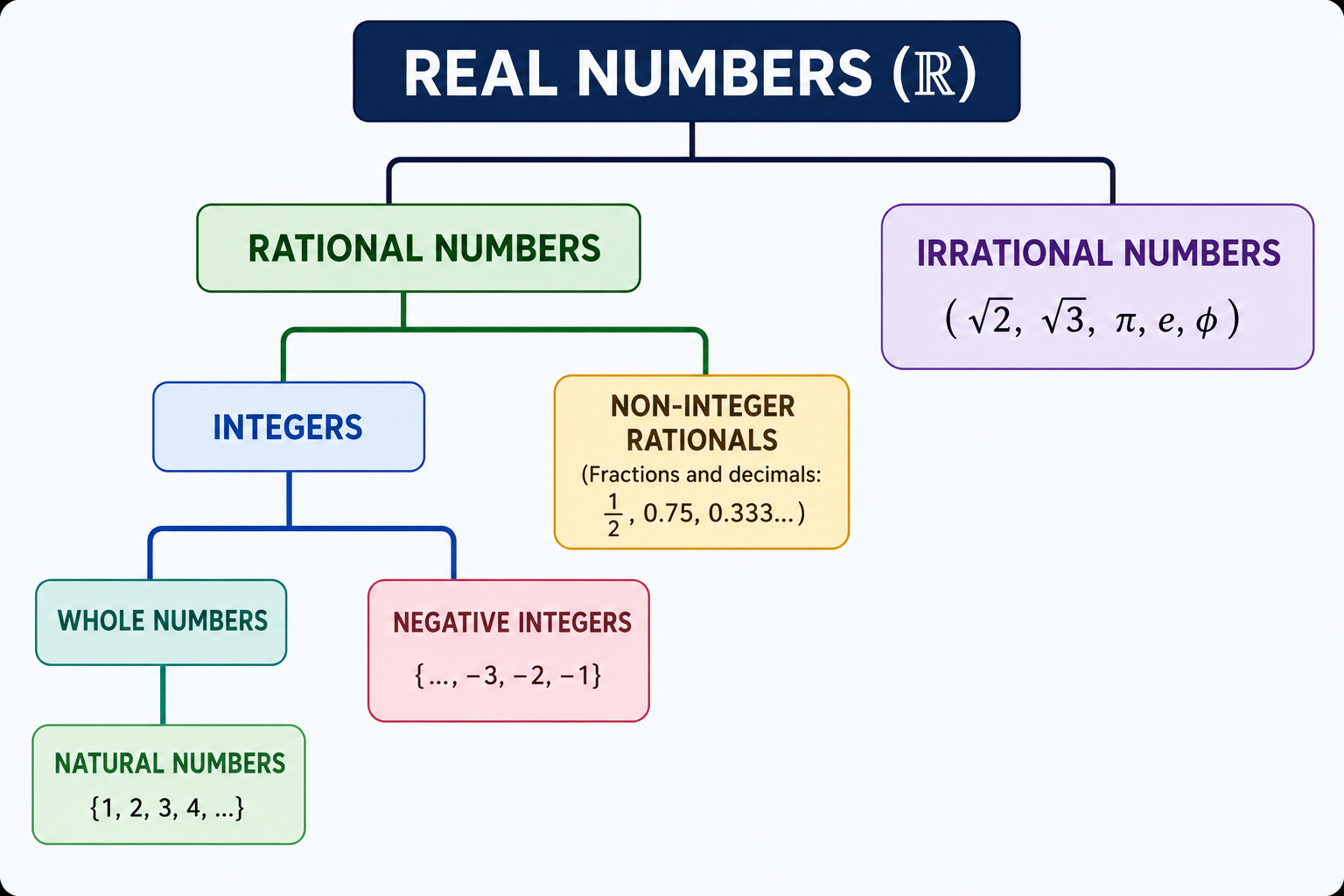
Key relationships:
- Every natural number is a whole number.
- Every whole number is an integer.
- Every integer is a rational number.
- Every rational number is a real number.
- Every irrational number is a real number.
- Rational and irrational numbers together make up all real numbers.
Why Are Real Numbers Important?
Real numbers form the backbone of virtually all mathematics.
Mathematics: Real numbers underpin arithmetic, number theory, algebra, and calculus. The completeness of the real number system — the fact that it has no gaps — is what makes calculus and continuous mathematics possible.
Algebra: Variables and constants in algebraic expressions are real numbers. Solving equations typically means finding real-number solutions.
Geometry: Every measurement — length, area, perimeter, angle, and coordinate — is a real number.
Calculus: Limits, derivatives, and integrals are defined using the properties of real numbers. The real number line is the domain and range of most calculus functions.
Physics: Every physical quantity is expressed as a real number with appropriate units. Real numbers allow physics to model the continuous, measurable world.
Engineering: Structural calculations, electrical circuit analysis, and fluid dynamics all rely on real-number arithmetic.
Statistics: Data values, means, standard deviations, and probabilities are all real numbers.
Everyday measurements: Temperature, distance, time, money, and weight are real numbers that people use constantly in daily life.
Real Number Practice Questions
20 Multiple Choice Questions
Question 1: Which of the following is a real number?
- A) √(-4)
- B) 3 + 2i
- C) √7
- D) i²
Correct Answer: C
Explanation: √7 is an irrational real number. The others involve imaginary components or are imaginary.
Question 2: Which set of numbers is a subset of the real numbers?
- A) Imaginary numbers
- B) Complex numbers with nonzero imaginary part
- C) Integers
- D) Numbers of the form a + bi where b ≠ 0
Correct Answer: C
Explanation: Integers are a subset of rational numbers, which are a subset of real numbers.
Question 3: Which of the following is NOT a real number?
- A) -√3
- B) 0
- C) √(-9)
- D) 5/7
Correct Answer: C
Explanation: √(-9) = 3i, an imaginary number. All others are real.
Question 4: What type of decimal does an irrational number have?
- A) Terminating
- B) Repeating
- C) Non-terminating and non-repeating
- D) Terminating or repeating
Correct Answer: C
Explanation: Irrational numbers have decimal expansions that never end and never settle into a repeating pattern.
Question 5: Which statement is correct?
- A) Every real number is rational.
- B) Every rational number is real.
- C) No irrational number is real.
- D) Real numbers do not include negative numbers.
Correct Answer: B
Explanation: Every rational number is a real number. Irrational numbers are also real. The real number system includes negatives.
Question 6: Where is -1.5 located on the number line?
- A) Between 1 and 2
- B) Between -1 and 0
- C) Between -2 and -1
- D) At -2
Correct Answer: C
Explanation: -1.5 is halfway between -1 and -2, to the left of -1.
Question 7: Which of the following is an irrational real number?
- A) 4/5
- B) √36
- C) 0.25
- D) √11
Correct Answer: D
Explanation: √11 ≈ 3.3166… — non-terminating and non-repeating. √36 = 6, which is rational.
Question 8: Which property is illustrated by: 3 + (5 + 7) = (3 + 5) + 7?
- A) Commutative
- B) Distributive
- C) Associative
- D) Identity
Correct Answer: C
Explanation: Changing the grouping without changing the order is the associative property.
Question 9: What is the multiplicative identity for real numbers?
- A) 0
- B) -1
- C) 1
- D) 1/2
Correct Answer: C
Explanation: Any real number multiplied by 1 remains unchanged. 1 is the multiplicative identity.
Question 10: Is 0.666… a rational real number?
- A) No, because it does not terminate
- B) Yes, because it equals 2/3
- C) No, because it is irrational
- D) Yes, because it is positive
Correct Answer: B
Explanation: 0.666… is a repeating decimal equal to 2/3, which is rational and real.
Question 11: What is the additive inverse of -√5?
- A) √5
- B) 1/√5
- C) -1/√5
- D) -√5
Correct Answer: A
Explanation: The additive inverse of -√5 is √5, because -√5 + √5 = 0.
Question 12: Which set of numbers is described as “rational and irrational numbers combined”?
- A) Integers
- B) Complex numbers
- C) Real numbers
- D) Natural numbers
Correct Answer: C
Explanation: Real numbers = rational numbers + irrational numbers.
Question 13: Order √3, 1.7, 2, √5 from smallest to largest.
- A) 1.7 < √3 < 2 < √5
- B) √3 < 1.7 < 2 < √5
- C) √3 < 1.7 < √5 < 2
- D) 1.7 < √3 < √5 < 2
Correct Answer: A
Explanation: √3 ≈ 1.732, 1.7, 2.0, √5 ≈ 2.236. So 1.7 < √3 < 2 < √5.
Question 14: Which of the following properties states that a + 0 = a?
- A) Associative identity
- B) Commutative property
- C) Additive identity
- D) Multiplicative inverse
Correct Answer: C
Explanation: Adding 0 to any number leaves it unchanged. This is the additive identity property.
Question 15: Is √(-16) a real number?
- A) Yes, because 16 is a perfect square
- B) Yes, because it equals 4
- C) No, because the square root of a negative number is imaginary
- D) No, because 16 is too large
Correct Answer: C
Explanation: √(-16) = 4i, an imaginary number. It is not a real number.
Question 16: Which of the following correctly describes real numbers?
- A) Only positive rational numbers
- B) All numbers that can be placed on the number line
- C) Only integers and fractions
- D) All complex numbers
Correct Answer: B
Explanation: A real number is any number that has a position on the real number line.
Question 17: Which pair are both real numbers?
- A) √(-3) and 2i
- B) π and 0
- C) i and 5i
- D) 3i and -3i
Correct Answer: B
Explanation: π is an irrational real number. 0 is a rational real number. All others are imaginary.
Question 18: What is 5 × (2 + 3) using the distributive property?
- A) 25
- B) 5 × 2 + 5 × 3 = 25
- C) 5 + 10 = 15
- D) 5 × 5 = 25
Correct Answer: B
Explanation: 5(2 + 3) = 5 × 2 + 5 × 3 = 10 + 15 = 25. Both A and B give 25, but B correctly shows the distributive process.
Question 19: Which of the following is NOT a property that applies to all real numbers under multiplication?
- A) Closure
- B) Commutativity
- C) Division by zero
- D) Associativity
Correct Answer: C
Explanation: Division by zero is undefined and is not a valid operation with real numbers.
Question 20: A number is real if:
- A) It is positive
- B) It can be represented on the number line
- C) It is rational
- D) It has no decimal part
Correct Answer: B
Explanation: A real number is defined as any number that can be represented as a point on the real number line, including negative, irrational, and decimal values.
10 Short Answer Questions
Q1: Name the two major categories of real numbers.
Answer: Rational numbers and irrational numbers.
Q2: Is every integer a real number?
Answer: Yes. Every integer is rational, and every rational number is real.
Q3: Give two examples of irrational real numbers.
Answer: Any two from: √2, √3, √5, π, e, -√7, φ.
Q4: Explain in one sentence why √(-4) is not a real number.
Answer: √(-4) = 2i, an imaginary number, which has no position on the real number line.
Q5: Classify 0.272727… as rational or irrational, and explain.
Answer: Rational. It is a repeating decimal equal to 3/11, which is a fraction of two integers.
Q6: What is the additive inverse of 7/3?
Answer: -7/3, because 7/3 + (-7/3) = 0.
Q7: Is -π a real number?
Answer: Yes. Negative irrational numbers are real. -π ≈ -3.14159…
Q8: Which is greater: √5 or 2.3?
Answer: √5 ≈ 2.236 and 2.3 = 2.3. So 2.3 > √5.
Q9: Give an example of a real number that is neither rational nor an integer.
Answer: √3 (or any other irrational number such as π).
Q10: Explain why division by zero is excluded from real number arithmetic.
Answer: Division by zero is undefined because no real number multiplied by zero can produce a nonzero result.
10 Number Classification Questions
1. Classify: 8
Real, rational, integer, whole number, natural number.
Explanation: 8 is a positive whole number belonging to all subsets of real numbers.
2. Classify: -5
Real, rational, integer.
Explanation: -5 is a negative integer, which is rational and real, but not a whole or natural number.
3. Classify: 3/7
Real, rational.
Explanation: 3/7 is a fraction of two integers; rational and real, but not an integer.
4. Classify: √25
Real, rational, integer, whole number, natural number.
Explanation: √25 = 5, which is a natural number.
5. Classify: √13
Real, irrational.
Explanation: 13 is not a perfect square. √13 ≈ 3.6055… — non-repeating, non-terminating.
6. Classify: 0
Real, rational, integer, whole number.
Explanation: 0 is a whole number and integer. Not a natural number in most definitions.
7. Classify: -2/3
Real, rational.
Explanation: -2/3 is a negative fraction with integer numerator and denominator.
8. Classify: π
Real, irrational.
Explanation: π ≈ 3.14159… — non-terminating and non-repeating; cannot be written as a/b.
9. Classify: 0.8
Real, rational.
Explanation: 0.8 = 4/5, a terminating decimal; rational and real.
10. Classify: -√11
Real, irrational.
Explanation: √11 is irrational; its negative is also irrational and real.
5 Calculation Problems
Problem 1: Apply the distributive property to expand 4(3 + √2).
Step 1: 4 × 3 = 12
Step 2: 4 × √2 = 4√2
Result: 12 + 4√2
Answer: 12 + 4√2 (irrational real number)
Problem 2: Order these real numbers from smallest to largest: -√2, -1, 0, 0.5, √3.
Decimal values:
-√2 ≈ -1.414, -1, 0, 0.5, √3 ≈ 1.732
Answer: -√2 < -1 < 0 < 0.5 < √3
Problem 3: Find the additive inverse and multiplicative inverse of 3/4.
Additive inverse: -(3/4) = -3/4
Verification: 3/4 + (-3/4) = 0
Multiplicative inverse: 4/3
Verification: (3/4) × (4/3) = 12/12 = 1
Answer: Additive inverse = -3/4. Multiplicative inverse = 4/3.
Problem 4: Is the product of √3 × √3 rational or irrational?
Step 1: √3 × √3 = √(3 × 3) = √9 = 3.
Step 2: 3 is an integer, which is rational.
Answer: 3. Rational real number. (Irrational × irrational can produce a rational result.)
Problem 5: A right triangle has legs of length 4 and 6. Find the hypotenuse.
Step 1: c² = 4² + 6² = 16 + 36 = 52
Step 2: c = √52 = √(4 × 13) = 2√13
Step 3: √13 ≈ 3.606, so c ≈ 7.211
Answer: Exact form: 2√13. Approximate: 7.21 units. Irrational real number.
Exam Tips
Memorise the definition. A real number is any number that can be represented on the real number line. Use this as your first check.
Know the hierarchy. Natural ⊂ Whole ⊂ Integer ⊂ Rational ⊂ Real. Irrational numbers are real but not in this chain.
Distinguish rational from irrational. Terminating and repeating decimals are rational. Non-terminating, non-repeating decimals are irrational. Both are real.
Check square roots carefully. √4 = 2 (rational). √5 ≈ 2.236… (irrational). Always check whether the number under the root is a perfect square.
Remember the imaginary rule. √(-1) and any square root of a negative number is imaginary — not real. This is a common exam trap.
Zero is real. Do not let questions about zero trip you up. 0 is a real number.
Negative numbers are real. Negativity has nothing to do with whether a number is real. All negative numbers that appear on the number line are real.
Use approximations carefully. When ordering or comparing irrational numbers, convert to decimals to the same number of places before deciding the order.
Keep exact forms when asked. If a question says “leave your answer in exact form,” write √7, not 2.646.
Quick Revision Notes
Definition: A real number is any number representable on the real number line.
Number system: Natural ⊂ Whole ⊂ Integer ⊂ Rational ⊂ Real. Irrational numbers are real but not rational.
Types: Natural (1, 2, 3…), Whole (0, 1, 2…), Integer (…-1, 0, 1…), Rational (fractions, terminating/repeating decimals), Irrational (√2, π, e).
Rational numbers: Expressible as a/b with integer a, b and b ≠ 0.
Irrational numbers: Non-terminating, non-repeating decimals. Cannot be expressed as a/b.
Number line: Every real number has a precise position. Positive right, negative left, zero at centre.
Properties: Closure, commutative, associative, distributive, identity, inverse. Division by zero is undefined.
Operations: Addition, subtraction, multiplication, and division all produce real numbers (except ÷ 0).
Applications: Used in algebra, geometry, physics, engineering, statistics, and everyday life.
Real Number Cheat Sheet
| Number Type | Definition | Examples | Relationship to Real Numbers |
|---|---|---|---|
| Natural numbers | Positive counting numbers (from 1) | 1, 2, 3, 50, 100 | Subset of real numbers |
| Whole numbers | Natural numbers plus 0 | 0, 1, 2, 3, 10 | Subset of real numbers |
| Integers | Positive and negative whole numbers and zero | -5, -1, 0, 3, 7 | Subset of real numbers |
| Rational numbers | Numbers expressible as a/b (b ≠ 0) | 1/2, -3/4, 0.75, 0.333… | Subset of real numbers |
| Irrational numbers | Real numbers not expressible as a/b | √2, √5, π, e | Subset of real numbers |
| Real numbers | All rational and irrational numbers | 5, -3, 0, √2, π | The complete set described |
Frequently Asked Questions
1. What is a real number?
A real number is any number that can be represented on the real number line. It includes positive numbers, negative numbers, zero, fractions, decimals, and irrational numbers.
2. What are examples of real numbers?
Examples include 5, -3, 0, 1/2, 0.75, 0.333…, √2, π, -√5, and e.
3. Are all integers real numbers?
Yes. Every integer is rational, and every rational number is real. Integers are a subset of real numbers.
4. Are all rational numbers real numbers?
Yes. Every rational number has a precise position on the real number line and is therefore real.
5. Are irrational numbers real numbers?
Yes. Irrational numbers such as √2 and π have exact positions on the real number line. They are real, just not rational.
6. Is zero a real number?
Yes. Zero is a real number sitting at the exact centre of the real number line. It is also a whole number, integer, and rational number.
7. Are negative numbers real numbers?
Yes. Negative numbers sit on the left side of the real number line. Negative integers, fractions, and irrationals are all real.
8. Is π a real number?
Yes. π is an irrational real number approximately equal to 3.14159… It has a fixed, precise location on the real number line.
9. Is √2 a real number?
Yes. √2 is an irrational real number approximately equal to 1.41421… It sits between 1 and 2 on the number line.
10. What is the difference between rational and irrational numbers?
Rational numbers can be expressed as a fraction a/b. Irrational numbers cannot. Both are real numbers.
11. What is the difference between real and imaginary numbers?
Real numbers have positions on the real number line. Imaginary numbers involve √(-1) and do not exist on the real number line.
12. Can fractions be real numbers?
Yes. Fractions with integer numerator and nonzero denominator are rational real numbers.
13. Are all decimals real numbers?
Yes. Terminating decimals and repeating decimals are rational real numbers. Non-terminating, non-repeating decimals are irrational real numbers. All decimals are real.
14. What numbers are not real?
Imaginary numbers such as √(-1), √(-4), and complex numbers with a nonzero imaginary part (e.g., 2 + 3i) are not real numbers.
15. Why are real numbers important?
Real numbers form the foundation of arithmetic, algebra, geometry, calculus, physics, and statistics. They allow us to measure, calculate, and model the continuous world.
Summary
A real number is any number that can be represented on the real number line. This includes natural numbers, whole numbers, integers, rational numbers such as fractions and terminating or repeating decimals, and irrational numbers such as √2 and π.
The real number system is structured as a hierarchy, with natural numbers at the centre and each broader set containing the one before it. Irrational numbers stand alongside rational numbers at the outermost level, together completing the entire real number system.
Real numbers follow important properties — closure, commutativity, associativity, distributivity, identity, and inverse — that govern how arithmetic operations work. Division by zero remains the one important exception that is undefined in the real number system.
From algebra and geometry to physics, engineering, and daily measurements, real numbers are the numerical language of the continuous, measurable world.
Final Thoughts
Real numbers form the foundation of mathematics as most students encounter it. Every measurement you make, every equation you solve, every graph you draw — all of it rests on the real number system. Whether a number is as simple as 3, as elegant as π, or as unexpected as √7, if it has a place on the number line, it is a real number.
Understanding what a real number is — and how rational numbers, irrational numbers, integers, and natural numbers all fit together within it — gives you a clear map of the numerical world. That clarity will serve you in every mathematical topic that follows, from algebra and geometry through to calculus and beyond.
Take time to understand the distinctions: rational versus irrational, real versus imaginary, terminating versus repeating versus non-repeating. These are not just exam topics — they are the precise vocabulary of mathematical thinking.
References
- Khan Academy — The Real Number System: https://www.khanacademy.org/math/algebra/x2f8bb11595b61c86:foundation-algebra/x2f8bb11595b61c86:real-numbers/a/real-numbers-review
- Wolfram MathWorld — Real Number: https://mathworld.wolfram.com/RealNumber.html
- Encyclopaedia Britannica — Real Number: https://www.britannica.com/science/real-number
- OpenStax — Prealgebra 2e: The Real Numbers: https://openstax.org/books/prealgebra-2e/pages/7-1-rational-and-irrational-numbers
- Mathematics LibreTexts — Real Numbers and the Number Line: https://math.libretexts.org/
Disclaimer:
This article is intended for educational and informational purposes only. While LearnMinto strives to provide accurate and up-to-date mathematics information, readers should verify important academic concepts through official textbooks, educational institutions, examination boards, or trusted educational resources before using this content for exams or academic purposes. LearnMinto is not affiliated with any specific school, university, research institution, or examination board.