
Introduction
Walk through any forest, dive beneath any ocean, or peer through a microscope at a drop of pond water, and you’ll encounter an almost incomprehensible diversity of living things. Scientists estimate there are somewhere between 8 and 10 million species on Earth—with only about 2 million formally described and named. Without some system for organizing all of this life, biology would be an impossibly chaotic field.
That organizing system is the classification of living organisms—the scientific framework that groups organisms based on their shared characteristics, evolutionary relationships, and fundamental biology. This guide is designed to give you a complete, clear, and genuinely useful understanding of how that system works—from its ancient philosophical roots through the modern molecular methods that are reshaping our understanding of the tree of life.
Whether you’re a high school student wrestling with the six kingdoms for the first time, a college student diving into phylogenetics, a competitive exam candidate who needs to know every taxonomic rank cold, or someone who simply wants to understand why a mushroom is more closely related to you than it is to a plant—this guide covers everything you need in one place.
We’ll trace the history of biological classification from Aristotle to Carl Woese, explore the three domains and six kingdoms in detail, explain binomial nomenclature and how scientific names work, compare the five and six kingdom systems, walk through modern molecular classification methods, and give you practice questions, memory tricks, and a revision checklist for exam preparation.
Life is astonishing in its diversity. Let’s figure out how to make sense of it.
Key Takeaways
By the end of this guide, you’ll be able to:
- Define taxonomy and explain why classifying living organisms is essential for biology
- List all eight levels of the taxonomic hierarchy from domain to species
- Explain binomial nomenclature and write scientific names correctly
- Describe the three domains of life and the defining features of each
- Compare the six kingdoms across cell type, nutrition, reproduction, and examples
- Distinguish the five-kingdom and six-kingdom classification systems
- Explain how modern molecular methods like DNA analysis have changed classification
- Write the complete taxonomic classification of humans
- Use mnemonics to remember taxonomic ranks reliably under exam pressure
What Is Classification of Living Organisms?
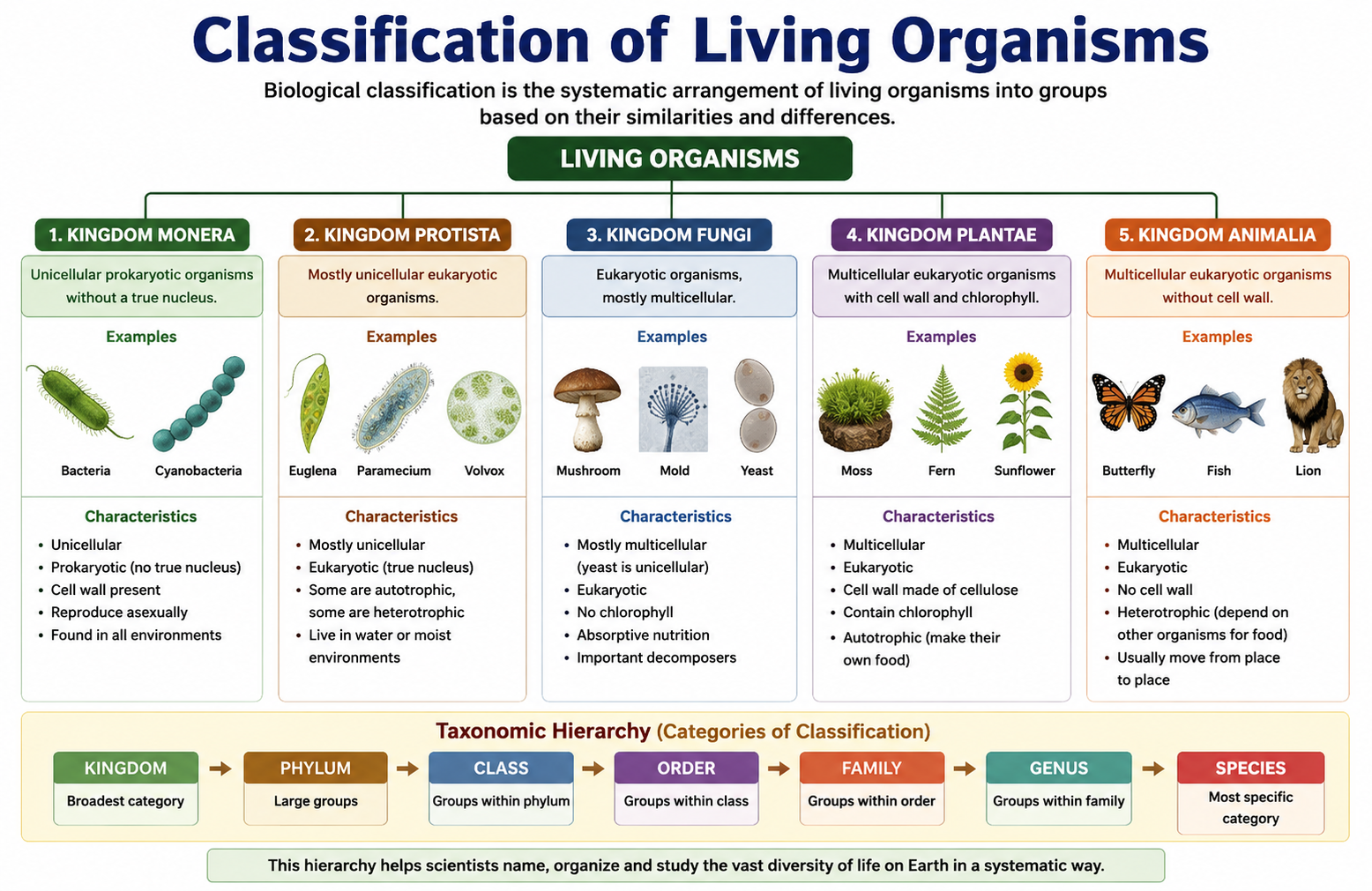
Classification of living organisms is the systematic arrangement of all known life forms into organized groups based on their shared characteristics, structural similarities, evolutionary relationships, and biological properties. In science, this process is called taxonomy or biological classification.
Think of it like a filing system for life. A library without a cataloging system would be chaos—you’d never find anything. Biology without classification would be the same. With approximately 2 million described species (and millions more yet to be named), scientists need a reliable, universal framework for organizing, identifying, communicating about, and studying organisms.
Classification serves several fundamental purposes:
- Identification – It allows scientists anywhere in the world to identify an organism using its scientific name, regardless of what local or common name it goes by
- Organization – It groups related organisms together, making it easier to study their biology, ecology, and evolution
- Communication – A universal naming system means a researcher in Brazil and a researcher in Japan can communicate precisely about the same organism without confusion
- Prediction – When an organism is classified into a group, we can predict its likely characteristics based on what we know about related species
Classification isn’t static—it evolves as new organisms are discovered and as new technologies (particularly DNA analysis) provide more accurate information about evolutionary relationships. What was accepted taxonomy a generation ago has been significantly revised in some areas, and that process continues today.
Why Classification Is Important
The importance of classification extends far beyond academic organization. It has real, practical consequences in medicine, agriculture, conservation, and almost every field that touches biology.
In medicine: Knowing that a pathogen is a bacterium rather than a virus tells a doctor immediately that antibiotics might work—and which class of antibiotics to consider. Misidentifying the kingdom of a pathogen can be literally life-threatening. Taxonomic knowledge is clinical knowledge.
In ecology: Understanding which organisms are related helps ecologists predict how ecosystem changes will cascade. If you lose a keystone species, knowing its relatives helps predict which might fill its ecological role.
In conservation: Classification helps identify which species are truly distinct and therefore deserve legal protection as separate entities. Two populations that look similar might be genetically distinct enough to merit separate conservation strategies.
In agriculture: Taxonomy reveals which plants are closely related to important crops—identifying wild relatives that might carry genes for drought resistance, pest resistance, or higher yield that could be bred into cultivated varieties.
In evolutionary biology: Classification reflects evolutionary relationships—the more closely two organisms are classified together, the more recently they shared a common ancestor. Understanding taxonomy is understanding the history of life.
History of Biological Classification
Aristotle’s Classification
The systematic classification of living things began with the ancient Greek philosopher Aristotle (384–322 BCE). He organized animals into groups based on their observable characteristics: whether they had red blood or not (roughly equivalent to our distinction between vertebrates and invertebrates), where they lived (land, water, or air), and how they reproduced.
Aristotle divided all living things into two major groups: plants and animals—a distinction that persisted as the dominant view for nearly 2,000 years. His student Theophrastus applied similar thinking to plants, earning the title “Father of Botany.”
While remarkably observant by ancient standards, Aristotle’s system had obvious limitations—it was based entirely on visible characteristics and had no mechanism for accommodating the microscopic world that no one yet knew existed.
Carolus Linnaeus and Modern Taxonomy
The true founder of modern taxonomy is the Swedish botanist and physician Carolus Linnaeus (1707–1778). His contributions transformed biological classification from a loose collection of observations into a rigorous scientific system.
Linnaeus made two revolutionary contributions:
1. Hierarchical classification – He organized organisms into nested groups of increasing inclusivity: class → order → genus → species (modern taxonomy has since expanded this to eight levels).
2. Binomial nomenclature – He established the system of giving each species a unique two-part Latin name: genus + specific epithet. His monumental work Systema Naturae (first edition 1735, tenth edition 1758—still the formal starting point for zoological nomenclature) classified thousands of plants, animals, and minerals.
Linnaeus’s two-kingdom system (Plantae and Animalia) persisted until the discovery and study of microorganisms demanded something more comprehensive.
Development of the Three-Domain System
As microscopy advanced through the 19th and 20th centuries, it became clear that the living world was far more diverse than two or even five kingdoms could capture.
- Ernst Haeckel (1866) proposed a third kingdom—Protista—to accommodate single-celled organisms
- Herbert Copeland (1956) proposed a four-kingdom system separating bacteria into their own kingdom (Monera)
- Robert Whittaker (1969) proposed the five-kingdom system: Monera, Protista, Fungi, Plantae, Animalia
- Carl Woese and George Fox (1977–1990) made the most revolutionary revision: using ribosomal RNA (rRNA) analysis, they demonstrated that what was called “bacteria” actually represented two completely distinct evolutionary lineages—Bacteria and Archaea—giving rise to the three-domain system: Archaea, Bacteria, and Eukarya
The Woese-Fox discovery fundamentally rewrote the tree of life. It showed that Archaea are actually more closely related to Eukarya (including humans) than to Bacteria—a finding that would have been impossible to detect by looking at physical characteristics alone.
What Is Taxonomy?
Definition of Taxonomy
Taxonomy (from Greek taxis = arrangement; nomos = law) is the scientific discipline of naming, describing, and classifying organisms into hierarchical groups based on shared characteristics. A taxon (plural: taxa) is any group at any level of the hierarchy—a species, genus, family, or kingdom are all taxa.
Branches of Taxonomy
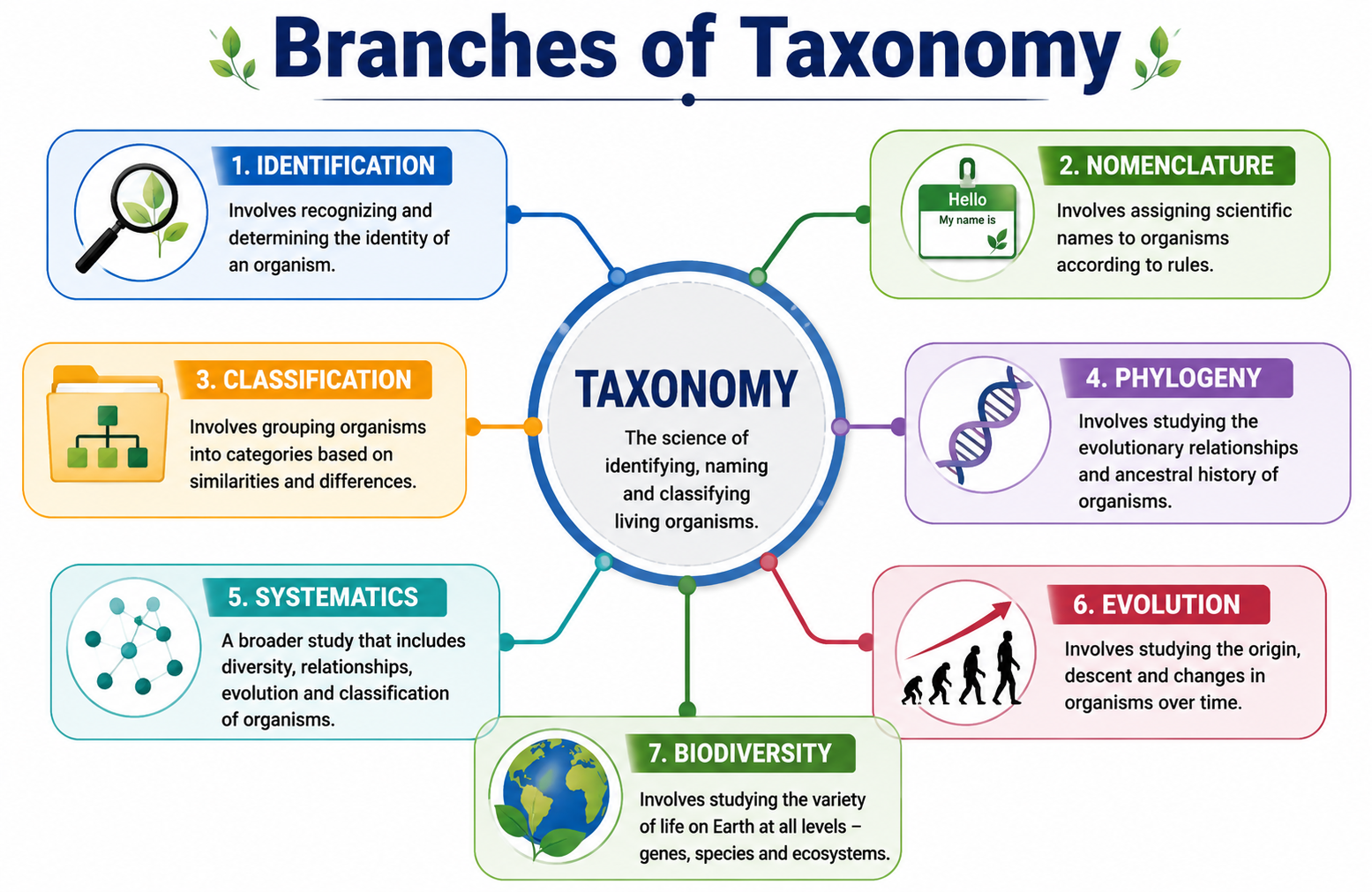
- Alpha taxonomy – The practical work of describing and naming new species
- Beta taxonomy – Arranging species into higher taxa (genera, families, orders)
- Gamma taxonomy – The evolutionary and phylogenetic study of taxonomic relationships
- Microtaxonomy – Focused on variation within and between closely related species
- Macrotaxonomy – Focused on higher-level classifications and relationships between major groups
Importance of Taxonomy
- Provides a universal language for biology
- Allows discovery and documentation of biodiversity
- Supports identification of invasive species and pathogens
- Enables cross-disciplinary communication among scientists worldwide
- Serves as the framework for databases like GenBank, which contains millions of DNA sequences organized taxonomically
Levels of Biological Classification
The modern taxonomic hierarchy has eight major levels. Think of them as nested categories—each level contains all the levels below it. As you move from domain down to species, the groups become progressively smaller and more specific, and the organisms within each group become more closely related.
Domain
The broadest and most inclusive level. All life is divided into three domains: Bacteria, Archaea, and Eukarya. This level was added after Woese and Fox’s rRNA work revealed that the differences between Bacteria and Archaea are as profound as the differences between either and Eukarya.
Kingdom
The second level. Within Eukarya, there are four kingdoms (Animalia, Plantae, Fungi, Protista). Bacteria and Archaea each form their own kingdom within their respective domains in the six-kingdom system.
Phylum
The third level. Groups organisms with fundamental shared body plans or structural organization. Animals are divided into phyla including Chordata (with a notochord at some stage), Arthropoda (jointed limbs, exoskeleton), Mollusca, Echinodermata, and about 30 others.
Class
The fourth level. Within Phylum Chordata, for example, Classes include Mammalia (mammals), Aves (birds), Reptilia (reptiles), Amphibia, and Actinopterygii (ray-finned fish).
Order
The fifth level. Within Class Mammalia, Orders include Primates, Carnivora, Rodentia, Chiroptera (bats), and many others.
Family
The sixth level. Within Order Primates, Families include Hominidae (great apes and humans), Cercopithecidae (Old World monkeys), and Hylobatidae (gibbons).
Genus
The seventh level. The first word of the binomial name. Organisms within the same genus are closely related and often similar in appearance. Humans belong to genus Homo; domestic dogs belong to genus Canis.
Species
The most specific level. The second word of the binomial name. Members of the same species can interbreed and produce fertile offspring (under the biological species concept). Humans are Homo sapiens; domestic dogs are Canis lupus familiaris (a subspecies of the wolf Canis lupus).
Taxonomic Hierarchy Explained
Here’s the complete hierarchy as a reference table:
| Level | Meaning | Human Example | Common Dog Example |
|---|---|---|---|
| Domain | Broadest group | Eukarya | Eukarya |
| Kingdom | Second tier | Animalia | Animalia |
| Phylum | Body plan | Chordata | Chordata |
| Class | Major body type | Mammalia | Mammalia |
| Order | Ecological/functional group | Primates | Carnivora |
| Family | Close relatives | Hominidae | Canidae |
| Genus | Immediate relatives | Homo | Canis |
| Species | Breeding group | Homo sapiens | Canis lupus familiaris |
Scientific Naming (Binomial Nomenclature)
Binomial nomenclature is the formal system of giving each species a two-part scientific name, consisting of the genus name and the specific epithet. It was standardized by Linnaeus and remains the universal standard in biology.
Rules of Scientific Names
- Two-part name – Always consists of genus + specific epithet
- Latin or Latinized – Names are Latin or Greek in origin, or Latinized versions of other words (including person names)
- Italicized in print – Scientific names are always italicized when typed (e.g., Homo sapiens)
- Underlined when handwritten – When writing by hand, underline instead of italicizing
- Genus capitalized; specific epithet lowercase – Homo sapiens, not Homo Sapiens or homo sapiens
- Author citation – The name of the scientist who first described the species may follow (abbreviated): Homo sapiens Linnaeus, 1758
- Abbreviation – After first use, the genus can be abbreviated: H. sapiens
- Universal – The same name is used worldwide regardless of local language
Examples of Scientific Names
| Common Name | Scientific Name | Meaning |
|---|---|---|
| Human | Homo sapiens | “Wise man” |
| House cat | Felis catus | “Cat cat” |
| Gray wolf | Canis lupus | “Dog wolf” |
| Common honeybee | Apis mellifera | “Honey-bearing bee” |
| Rice | Oryza sativa | “Cultivated rice” |
| E. coli | Escherichia coli | Named after Theodor Escherich; “of the colon” |
| Common chimpanzee | Pan troglodytes | “Cave-dwelling Pan” |
| Great white shark | Carcharodon carcharias | “Jagged tooth” |
Important Fact: Scientific names are often descriptive (referring to appearance, habitat, or behavior) or honorific (named after a scientist, place, or person). Linnaeus named many plants after their characteristics: Mimosa pudica (the “shy mimosa”—the sensitive plant that folds its leaves when touched) is a perfect example of a descriptive scientific name.
The Three Domains of Life
Domain Archaea
Archaea are prokaryotes—they lack a membrane-bound nucleus—but they are biochemically and genetically more similar to eukaryotes than to bacteria. This surprising discovery by Woese and Fox revolutionized our understanding of life.
Key features:
- Prokaryotic (no nucleus)
- Cell walls lack peptidoglycan (unlike bacteria)
- Cell membranes contain unique lipids with ether bonds (vs ester bonds in bacteria and eukaryotes)
- Unique ribosomes (though still 70S)
- Often found in extreme environments (extremophiles)
- Many are methanogens (produce methane)
- Not known to cause human disease
Examples: Methanobacterium, Halobacterium (extreme halophile), Sulfolobus (thermophile in volcanic springs)
Domain Bacteria
Bacteria are the most abundant and metabolically diverse organisms on Earth. They inhabit every environment, perform critical ecological functions, cause many infectious diseases, and also confer enormous benefits to humans and ecosystems.
Key features:
- Prokaryotic (no nucleus, no membrane-bound organelles)
- Cell walls typically made of peptidoglycan
- 70S ribosomes
- Circular chromosome; may have plasmids
- Enormously diverse metabolism: autotrophs and heterotrophs; aerobic and anaerobic
- Reproduce by binary fission
Examples: Escherichia coli, Streptococcus pneumoniae, Mycobacterium tuberculosis, Lactobacillus acidophilus
Domain Eukarya
Eukarya contains all organisms with cells that have a true membrane-bound nucleus. This domain encompasses extraordinary diversity—from single-celled amoebae to blue whales to giant sequoia trees.
Key features:
- Eukaryotic cells (true nucleus)
- Membrane-bound organelles (mitochondria, etc.)
- 80S ribosomes
- Linear chromosomes with histones
- Larger and more complex than prokaryotes
- Four kingdoms: Protista, Fungi, Plantae, Animalia
Three Domains Comparison Table:
| Feature | Bacteria | Archaea | Eukarya |
|---|---|---|---|
| Cell type | Prokaryotic | Prokaryotic | Eukaryotic |
| Nucleus | Absent | Absent | Present |
| Ribosome size | 70S | 70S | 80S |
| Cell wall | Peptidoglycan (usually) | No peptidoglycan | Varies (or absent) |
| Membrane lipids | Ester-linked | Ether-linked | Ester-linked |
| DNA | Circular, no histones | Circular, with histone-like proteins | Linear, with histones |
| Extremophiles? | Some | Many | Some (fungi, algae) |
| Examples | E. coli, Salmonella | Methanogens, Halobacterium | Plants, animals, fungi |
The Six Kingdom Classification System
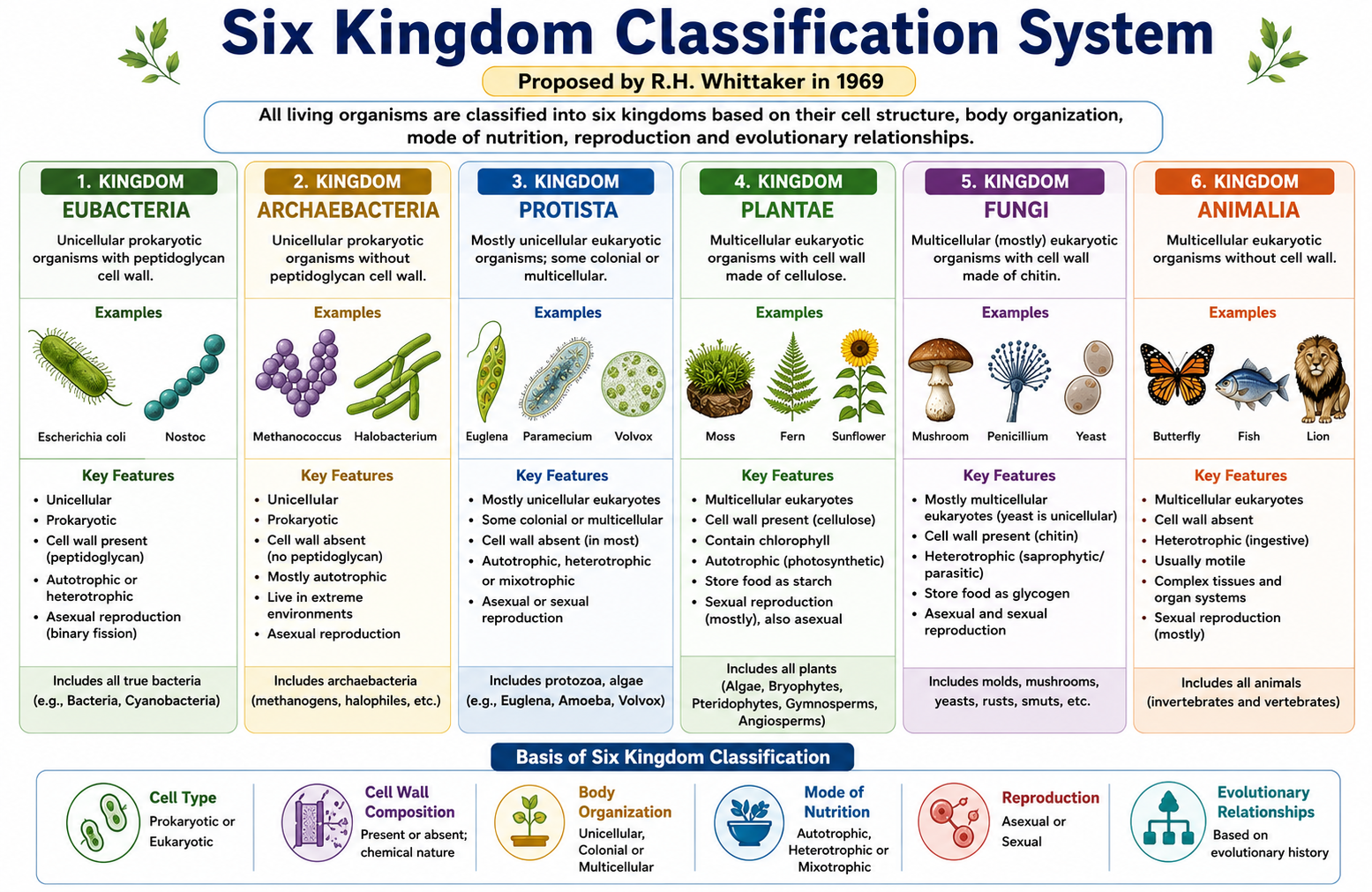
The six kingdom system is the most widely used classification framework in contemporary biology education. It divides all life into six kingdoms across three domains.
Kingdom Animalia
Animals are multicellular, eukaryotic, heterotrophic organisms. They obtain energy by consuming other organisms and typically have the ability to move at some stage of their life cycle.
Key characteristics:
- Multicellular eukaryotes
- No cell walls
- Heterotrophic (ingestive nutrition)
- Most reproduce sexually
- Most are motile at some life stage
- Embryonic development through blastula stage
Major groups: Porifera (sponges), Cnidaria (jellyfish, corals), Platyhelminthes (flatworms), Annelida (earthworms), Mollusca (snails, octopus), Arthropoda (insects, spiders, crustaceans), Echinodermata (starfish, sea urchins), Chordata (fish, amphibians, reptiles, birds, mammals)
Kingdom Plantae
Plants are multicellular, eukaryotic, autotrophic organisms that conduct photosynthesis using chlorophyll.
Key characteristics:
- Multicellular eukaryotes
- Cell walls of cellulose
- Autotrophic (photosynthetic)
- Contain chloroplasts with chlorophyll a and b
- Alternation of generations life cycle
- Generally non-motile
Major groups: Bryophytes (mosses, liverworts), Pteridophytes (ferns), Gymnosperms (conifers, cycads), Angiosperms (flowering plants)
Kingdom Fungi
Fungi are eukaryotic organisms that absorb nutrients from their environment through extracellular digestion. They are neither plants nor animals—they’re their own distinctive kingdom.
Key characteristics:
- Eukaryotic (unicellular or multicellular)
- Cell walls of chitin
- Heterotrophic (absorptive nutrition)
- Body typically made of thread-like hyphae forming a mycelium
- Reproduce by spores
- Most are decomposers
Examples: Agaricus (mushrooms), Saccharomyces cerevisiae (baker’s yeast), Penicillium (source of penicillin), Candida albicans
Kingdom Protista
Protists are a diverse, largely artificial grouping of eukaryotes that don’t fit neatly into the animal, plant, or fungi kingdoms. They’re mostly unicellular but some form multicellular structures.
Key characteristics:
- Eukaryotic (mostly unicellular)
- Enormous diversity—the “wastebasket” kingdom
- Can be autotrophic (algae), heterotrophic (protozoa), or mixotrophic
- Can be motile (using flagella, cilia, or pseudopods) or non-motile
- Reproduce both sexually and asexually
Examples: Amoeba, Paramecium, Euglena, Plasmodium (causes malaria), kelp, diatoms
Kingdom Eubacteria
Eubacteria (true bacteria) are prokaryotic organisms forming the domain Bacteria. They’re the “classic” bacteria most students think of when they hear the word.
Key characteristics:
- Prokaryotic (no membrane-bound nucleus)
- Cell walls typically containing peptidoglycan
- Metabolically diverse: aerobic, anaerobic, autotrophic, heterotrophic
- Reproduce rapidly by binary fission
- Some form endospores for survival
Examples: Escherichia coli, Staphylococcus aureus, Streptococcus, Cyanobacteria
Kingdom Archaebacteria
Archaebacteria (now more precisely called Archaea) are prokaryotes that inhabit extreme environments and are biochemically distinct from true bacteria.
Key characteristics:
- Prokaryotic
- No peptidoglycan in cell walls
- Unique membrane lipids (ether-linked)
- Found in extreme environments: hot springs, salt lakes, deep-sea vents, anaerobic environments
- Include methanogens, halophiles, and thermophiles
Examples: Methanobacterium, Halobacterium halobium, Sulfolobus acidocaldarius
Characteristics of Each Kingdom
| Kingdom | Cell Type | Cell Wall | Cells | Nutrition | Reproduction | Examples |
|---|---|---|---|---|---|---|
| Animalia | Eukaryotic | Absent | Multicellular | Heterotrophic (ingestive) | Mostly sexual | Dogs, humans, insects |
| Plantae | Eukaryotic | Cellulose | Multicellular | Autotrophic (photosynthetic) | Sexual + asexual | Roses, ferns, trees |
| Fungi | Eukaryotic | Chitin | Uni/Multicellular | Heterotrophic (absorptive) | Spores | Mushrooms, yeast, mold |
| Protista | Eukaryotic | Varies | Mostly unicellular | Auto/Heterotrophic | Sexual + asexual | Amoeba, algae, Plasmodium |
| Eubacteria | Prokaryotic | Peptidoglycan | Unicellular | Auto/Heterotrophic | Asexual (binary fission) | E. coli, Streptococcus |
| Archaebacteria | Prokaryotic | No peptidoglycan | Unicellular | Auto/Heterotrophic | Asexual | Methanogens, halophiles |
Five Kingdom Classification System
Before the six-kingdom system became widely adopted, Robert Whittaker’s five-kingdom system (1969) was the standard framework. Many curricula still teach it, and it’s worth understanding alongside the six-kingdom system.
Monera
Monera combined all prokaryotic organisms into one kingdom—both what we now call Eubacteria and Archaebacteria. This grouping was later abandoned when molecular evidence showed that “bacteria” actually represented two deeply divergent lineages.
Features: Prokaryotic, unicellular, no nuclear membrane, reproduce by binary fission
Protista
Same as in the six-kingdom system—a diverse grouping of unicellular (and some multicellular) eukaryotes.
Fungi
Same as in the six-kingdom system.
Plantae
Same as in the six-kingdom system.
Animalia
Same as in the six-kingdom system.
Five Kingdom vs Six Kingdom Classification
| Feature | Five Kingdom | Six Kingdom |
|---|---|---|
| Proposed by | Robert Whittaker (1969) | Carl Woese et al. (based on rRNA work, 1977–1990s) |
| Number of kingdoms | 5 | 6 |
| Prokaryotes | One kingdom (Monera) | Two kingdoms (Eubacteria + Archaebacteria) |
| Basis | Cell structure, nutrition, reproduction | Molecular/genetic evidence + cell structure |
| Archaea | Included in Monera | Separate kingdom (Archaebacteria) |
| Accuracy | Less accurate (ignores Archaea distinctiveness) | More accurate (reflects evolutionary relationships) |
| Still used? | Yes, in some curricula | Yes, increasingly standard |
The fundamental reason for the shift from five to six kingdoms is the molecular evidence that Archaea are not just “odd bacteria”—they’re a completely separate evolutionary lineage with fundamental differences in biochemistry and genetic machinery.
Classification of Humans
The full taxonomic classification of humans is one of the most commonly required facts in biology education—and a perfect example for understanding what each taxonomic level actually means.
Human Taxonomic Classification
| Taxonomic Level | Human Classification | Meaning/Significance |
|---|---|---|
| Domain | Eukarya | Cells have a true nucleus |
| Kingdom | Animalia | Multicellular; heterotrophic; no cell wall |
| Phylum | Chordata | Notochord, dorsal nerve cord, pharyngeal slits at some stage |
| Class | Mammalia | Hair/fur; mammary glands; warm-blooded; live birth (mostly) |
| Order | Primates | Forward-facing eyes; grasping hands; large brain relative to body |
| Family | Hominidae | Great apes; large brain; no tail; upright posture |
| Genus | Homo | Upright walking; very large brain; tool use |
| Species | Homo sapiens | Modern humans; language; complex culture |
Scientific Name of Humans
Homo sapiens (Linnaeus, 1758) — from Latin: homo = human being, sapiens = wise, knowing
Important Fact: We are the only surviving species in genus Homo. Other species in our genus—Homo erectus, Homo habilis, Homo neanderthalensis—are all extinct. The Homo sapiens lineage branched from shared ancestors with chimpanzees approximately 6–7 million years ago.
Classification of Plants
The plant kingdom (Plantae) is divided based primarily on the presence or absence of vascular tissue and whether they reproduce by seeds:
| Group | Vascular Tissue | Seeds | Flowers/Fruit | Examples |
|---|---|---|---|---|
| Bryophytes | Absent | Absent | Absent | Mosses, liverworts, hornworts |
| Pteridophytes | Present | Absent | Absent | Ferns, horsetails, club mosses |
| Gymnosperms | Present | Present (naked) | Absent (cones) | Pines, spruces, cycads, ginkgo |
| Angiosperms | Present | Present (enclosed) | Present | Roses, oaks, grasses, orchids |
Angiosperms are further divided into:
- Monocots – One seed leaf; parallel veins; flower parts in 3s (grasses, lilies, corn)
- Dicots – Two seed leaves; net veins; flower parts in 4s or 5s (roses, oaks, beans)
Classification of Animals
Animals (Kingdom Animalia) are divided into about 35 phyla, of which these are the most significant:
| Phylum | Key Features | Examples |
|---|---|---|
| Porifera | No tissues; filter feeding; sessile | Sponges |
| Cnidaria | Radial symmetry; stinging cells (nematocysts) | Jellyfish, coral, sea anemones |
| Platyhelminthes | Flatworms; bilateral symmetry; acoelomate | Tapeworms, planarians |
| Annelida | Segmented worms; true coelom | Earthworms, leeches |
| Mollusca | Soft body; often shell; mantle | Snails, clams, octopus, squid |
| Arthropoda | Jointed legs; exoskeleton; segmented | Insects, spiders, crabs, lobsters |
| Echinodermata | Spiny skin; water vascular system; radial symmetry as adults | Starfish, sea urchins, sea cucumbers |
| Chordata | Notochord; dorsal nerve cord; pharyngeal slits | Fish, amphibians, reptiles, birds, mammals |
Within Phylum Chordata, the vertebrate classes are:
- Agnatha – Jawless fish (lampreys, hagfish)
- Chondrichthyes – Cartilaginous fish (sharks, rays)
- Osteichthyes – Bony fish (salmon, tuna)
- Amphibia – Frogs, salamanders, caecilians
- Reptilia – Lizards, snakes, turtles, crocodilians
- Aves – Birds
- Mammalia – Mammals
Characteristics Used for Classification
Cell Structure
The most fundamental classification criterion. Prokaryotic vs eukaryotic divides all life at the highest level. The presence of a nucleus, membrane-bound organelles, and chromosome structure are all considered.
Body Organization
- Unicellular vs multicellular
- Level of tissue organization: No tissues → tissues → organs → organ systems
- Body symmetry: Asymmetrical, radial, or bilateral
- Presence of coelom: Acoelomate, pseudocoelomate, or coelomate
Mode of Nutrition
- Autotrophic: Photosynthesis (plants, algae, cyanobacteria) or chemosynthesis (some bacteria)
- Heterotrophic: Ingestive (animals), absorptive (fungi), parasitic, mixotrophic
Reproduction
- Sexual vs asexual reproduction
- Type of gametes produced
- Life cycle patterns (alternation of generations in plants)
- Internal vs external fertilization
Evolutionary Relationships
Modern classification increasingly prioritizes phylogenetic relationships—grouping organisms based on shared evolutionary history rather than just shared physical characteristics. This is called cladistics, and it produces cladograms (branching diagrams showing evolutionary relationships).
Phylogenetic Classification
Phylogenetics is the study of evolutionary relationships among organisms. Phylogenetic trees (or cladograms) are branching diagrams that show which organisms share common ancestors and how recently.
Key concepts:
- Clade (monophyletic group) – A group consisting of a common ancestor and ALL its descendants
- Homologous characters – Features inherited from a common ancestor (used to establish relationships)
- Analogous characters – Features that look similar but evolved independently in separate lineages (convergent evolution—should NOT be used to establish relationships)
- Synapomorphy – A shared derived character that defines a clade
- Outgroup – A distantly related species used as a reference point in phylogenetic analysis
The shift from phenetic classification (grouping by overall similarity) to phylogenetic/cladistic classification (grouping by evolutionary history) was one of the major paradigm shifts in 20th-century biology, championed by Willi Hennig in the 1950s–60s.
Evolution and Classification
Classification and evolution are inseparable. Modern taxonomy reflects evolutionary history—closely related organisms are classified together because they share a more recent common ancestor, not just because they look similar.
This means:
- Sharks and dolphins look similar (both streamlined, aquatic) but are classified in completely different classes (fish vs mammals) because their similarity results from convergent evolution, not common ancestry
- Birds and crocodilians are classified as more closely related to each other than either is to lizards and snakes—even though crocodilians “look” more reptile-like—because molecular and fossil evidence shows birds evolved from within the archosaur lineage
- Humans and mushrooms are more closely related to each other (both in Domain Eukarya) than either is to any bacterium—a relationship that would be invisible from appearance alone
This evolutionary framework means that classification is both a description of the current state of life AND a hypothesis about evolutionary history—one that can and should be revised as new evidence emerges.
Modern Classification Methods
DNA Analysis
The most powerful modern tool for classification is comparing DNA sequences between organisms. The more similar two organisms’ DNA sequences, the more recently they shared a common ancestor.
- DNA hybridization – Measures how well single-stranded DNA from two species bind together; more binding = greater similarity
- Cytochrome c sequences – Comparing this highly conserved protein’s gene across species reveals deep evolutionary relationships
- Whole genome comparisons – Now routine with next-generation sequencing; provides the most comprehensive evolutionary information
Molecular Taxonomy
Molecular taxonomy uses specific molecular markers to classify organisms:
- rRNA gene sequences (16S for prokaryotes, 18S for eukaryotes) – The approach Woese used to distinguish Archaea from Bacteria; still the gold standard for prokaryote identification
- Barcoding regions – Short, standardized DNA sequences used to quickly identify species (e.g., COI gene for animals, rbcL and matK for plants)
- Phylogenomics – Using entire genome sequences to construct evolutionary trees; provides the most accurate picture of relationships
Genetic Sequencing
Next-generation sequencing (NGS) has made it possible to sequence entire genomes quickly and cheaply, enabling:
- Discovery of cryptic species (organisms that look identical but are genetically distinct)
- Reclassification of organisms that were grouped together based on superficial similarity but are genetically distinct
- Environmental DNA (eDNA) analysis—identifying species from environmental samples like water or soil without ever seeing the organism
Biodiversity and Classification
Biodiversity refers to the variety of life at all levels—genetic diversity within species, species diversity within communities, and ecosystem diversity across the planet.
Classification is both a tool for measuring biodiversity and a product of it:
- You cannot count species without first defining them (taxonomy defines species)
- Approximately 2.1 million species have been formally described and named
- Estimates suggest 8–10 million eukaryotic species total exist on Earth
- Prokaryotic diversity is staggering—some estimates suggest there may be 10^12 (one trillion) bacterial species
- Only through classification can scientists track which species are being lost to extinction, assess the rate of biodiversity loss, and prioritize conservation efforts
Important Fact: Approximately 15,000–20,000 new species are formally described every year. Despite this pace, scientists fear we are losing species to extinction faster than we can discover and classify them—making taxonomy not just academically important but urgently necessary for conservation.
Importance of Classification in Biology
- Facilitates scientific communication worldwide through universal nomenclature
- Helps understand biodiversity and track species loss
- Reveals evolutionary relationships that would otherwise be invisible
- Supports disease understanding—knowing a pathogen’s classification predicts its biology and informs treatment
- Enables cross-disciplinary research—taxonomic databases connect ecology, genetics, physiology, and medicine
- Assists drug discovery—related species often share biochemical pathways and compounds of pharmaceutical interest
Applications of Taxonomy
Medicine
Taxonomy is directly clinically relevant. Correctly identifying a pathogen—to genus and species level—determines treatment. Staphylococcus aureus and Streptococcus pyogenes are both gram-positive cocci that cause skin infections, but their antibiotic sensitivities differ significantly. Misidentification leads to incorrect treatment.
Agriculture
Taxonomy identifies plant relatives that may carry useful traits—pest resistance, drought tolerance, higher yield—that can be bred into crop plants. The wild relatives of wheat, rice, and corn are taxonomically cataloged, and their genomes are being sequenced precisely for this reason.
Environmental Science
Environmental monitoring uses taxonomic identification of indicator species—organisms whose presence or absence signals ecosystem health. Macroinvertebrate surveys of stream quality, for example, depend entirely on accurate species identification.
Wildlife Conservation
Conservation legislation protects specific species—so species boundaries must be defined taxonomically. The discovery that what appeared to be one widespread species is actually multiple distinct species (often using molecular taxonomy) can dramatically change conservation priorities.
Biotechnology
Industrial biotechnology exploits the biochemical diversity of microorganisms—and taxonomy is the framework for finding organisms with useful properties. Extremophilic archaea from deep-sea vents have yielded heat-stable enzymes (including Taq polymerase, essential for PCR). Finding new enzyme variants means searching in taxonomically specific environments.
Common Biology Terms Every Student Should Know
| Term | Definition |
|---|---|
| Taxonomy | Science of naming, describing, and classifying organisms |
| Taxon | Any group at any level of the taxonomic hierarchy |
| Species | A group of organisms that can interbreed and produce fertile offspring |
| Genus | A group of closely related species; first word of binomial name |
| Binomial nomenclature | System of two-part Latin scientific names |
| Phylogeny | Evolutionary history and relationships of organisms |
| Clade | A monophyletic group: ancestor + all its descendants |
| Prokaryote | Organism lacking a membrane-bound nucleus (Bacteria, Archaea) |
| Eukaryote | Organism with a membrane-bound nucleus |
| Domain | The highest level of the taxonomic hierarchy |
| Homologous | Features derived from a common ancestor |
| Analogous | Features that evolved independently in different lineages |
| Morphology | The form and structure of an organism |
| Molecular taxonomy | Classification based on DNA/RNA sequences |
| Convergent evolution | Unrelated organisms evolving similar features independently |
| Endosymbiosis | Theory explaining the origin of mitochondria and chloroplasts from ancient prokaryotes |
| Barcoding | Using a standard short DNA sequence to identify species |
| Cryptic species | Morphologically identical but genetically distinct species |
| Extremophile | Organism that thrives in extreme conditions |
| Phylogenetic tree | Branching diagram showing evolutionary relationships |
Common Mistakes Students Make
1. Confusing the order of taxonomic levels
The most common error: getting the hierarchy wrong. Many students put Family before Order, or confuse Phylum with Class. The correct order (broadest to most specific) is: Domain → Kingdom → Phylum → Class → Order → Family → Genus → Species. Use a mnemonic and practice it until it’s automatic.
2. Incorrect capitalization and formatting of scientific names
Homo sapiens—not Homo Sapiens, not homo sapiens, not Homo sapiens (when typed). Genus is capitalized; specific epithet is lowercase; the entire name is italicized. Losing marks to formatting errors is entirely avoidable.
3. Saying all bacteria are in Domain Bacteria
Archaea are also prokaryotes but belong to a completely separate domain—Domain Archaea. Writing “bacteria are in Domain Bacteria” when you mean “all prokaryotes” is incorrect and will cost marks.
4. Confusing homologous and analogous structures in classification
Homologous structures (shared ancestry) support classification together. Analogous structures (convergent evolution) do NOT indicate close relationship. A dolphin’s flipper and a fish’s fin look similar but evolved independently—dolphins and fish are NOT closely related.
5. Thinking classification is fixed and permanent
Classification is a hypothesis about evolutionary relationships. It changes as new evidence emerges. The reclassification of Archaea is the most dramatic recent example. Students who treat taxonomy as a fixed set of facts miss the point that it’s an actively developing scientific framework.
6. Describing Protista as a natural group
Protista is explicitly a polyphyletic or paraphyletic grouping—a collection of organisms that don’t all share a single common ancestor (exclusive of other kingdoms). Modern biology recognizes this and is actively working to replace the kingdom Protista with multiple more natural groups, though this hasn’t yet made it into most introductory curricula.
Memory Tricks to Remember Taxonomic Ranks
The eight levels of the taxonomic hierarchy in order from broadest to most specific:
Domain, Kingdom, Phylum, Class, Order, Family, Genus, Species
Popular mnemonics:
“Dumb King Philip Came Over For Good Soup”
- Dumb = Domain
- King = Kingdom
- Philip = Phylum
- Came = Class
- Over = Order
- For = Family
- Good = Genus
- Soup = Species
“Do Kings Play Chess On Fine Green Silk?”
- Another popular version that many students find easier to visualize
“Dear King Philip, Could Order From Genus Species?”
- A more formal-sounding version
For remembering which is broader:
Think of it like Russian nesting dolls—Domain contains everything, and each level nests inside the one above it. Species is the smallest, innermost doll.
Easy Mnemonics for Classification
For the Three Domains:
“Big Ants Eat” = Bacteria, Archaea, Eukarya
For the Six Kingdoms:
“All People Find Perfect Evening Activities” = Animalia, Plantae, Fungi, Protista, Eubacteria, Archaebacteria
For remembering Genus and Species in a scientific name:
“General Soldier” — General (Genus) comes first, Soldier (Species) second; the General outranks the Soldier (Genus is broader than Species)
For remembering that Genus is capitalized, species is not:
“Generals are important (capital G); soldiers aren’t (lowercase s)”
For the base characteristics of each kingdom:
- Animalia = Ate food (heterotrophic, ingestive)
- Plantae = Photosynthesis (autotrophic)
- Fungi = Feeds by absorption
- Protista = Patchwork (diverse—anything goes)
- Eubacteria = Everywhere, peptidoglycan walls
- Archaebacteria = Ancient, extreme environments
Classification Practice Questions
20 Multiple Choice Questions with Answers
- Which of the following is the correct order of taxonomic ranks from broadest to most specific?
- A) Kingdom, Domain, Phylum, Class
- B) Domain, Kingdom, Phylum, Class ✓
- C) Domain, Phylum, Kingdom, Class
- D) Kingdom, Phylum, Domain, Order
- Who developed the modern system of binomial nomenclature?
- A) Charles Darwin
- B) Aristotle
- C) Carl Woese
- D) Carolus Linnaeus ✓
- The scientific name for humans is correctly written as:
- A) homo sapiens
- B) Homo Sapiens
- C) Homo sapiens ✓
- D) homo Sapiens
- Which domain contains organisms with both ether-linked membrane lipids and no peptidoglycan in cell walls?
- A) Bacteria
- B) Eukarya
- C) Archaea ✓
- D) Protista
- In the six-kingdom system, fungi are placed in their own kingdom because they:
- A) Are prokaryotic
- B) Photosynthesize
- C) Absorb nutrients and have chitin cell walls ✓
- D) Are unicellular only
- Which scientist’s work with ribosomal RNA led to the three-domain system?
- A) Robert Whittaker
- B) Ernst Haeckel
- C) Carl Woese ✓
- D) Carolus Linnaeus
- Crossing over and recombination during meiosis—wait, which characteristic is NOT used for classification?
- A) Cell structure
- B) Mode of nutrition
- C) Favorite color ✓
- D) Evolutionary relationships
- Which kingdom includes organisms with no cell wall, heterotrophic nutrition, and multicellular organization?
- A) Fungi
- B) Plantae
- C) Animalia ✓
- D) Protista
- Binomial nomenclature gives every species:
- A) A number code
- B) A common name
- C) A two-part Latin name ✓
- D) A three-part classification
- The most specific level of biological classification is:
- A) Genus
- B) Family
- C) Species ✓
- D) Order
- Archaea and Bacteria are both:
- A) Eukaryotic
- B) Prokaryotic ✓
- C) Members of Kingdom Monera only
- D) Found only in extreme environments
- What is the phylum of humans?
- A) Mammalia
- B) Primates
- C) Animalia
- D) Chordata ✓
- Which kingdom was split into two separate kingdoms when moving from five to six kingdoms?
- A) Protista
- B) Fungi
- C) Monera ✓
- D) Plantae
- A phylogenetic tree shows:
- A) The physical appearance of organisms
- B) The geographic distribution of organisms
- C) Evolutionary relationships and common ancestors ✓
- D) The chromosome number of organisms
- Which of these is an example of an analogous (not homologous) structure?
- A) Human arm and bat wing
- B) Dog leg and whale flipper
- C) Bird wing and insect wing ✓
- D) Human hand and cat paw
- Kingdom Plantae is defined by which combination of features?
- A) Heterotrophic; chitin cell wall; spore reproduction
- B) Multicellular; cellulose cell wall; photosynthetic ✓
- C) Unicellular; no cell wall; autotrophic
- D) Prokaryotic; peptidoglycan cell wall; binary fission
- Which level of the taxonomic hierarchy do two organisms share if they have the same first word in their scientific name?
- A) Family
- B) Order
- C) Species
- D) Genus ✓
- DNA barcoding is a technique used to:
- A) Clone organisms
- B) Quickly identify species using short, standardized DNA sequences ✓
- C) Map genomes
- D) Sequence entire chromosomes
- Which kingdom is described as a “wastebasket” grouping of diverse eukaryotes?
- A) Fungi
- B) Animalia
- C) Protista ✓
- D) Monera
- Dolphins and sharks have similar streamlined body shapes. This is an example of:
- A) Homology
- B) Common ancestry
- C) Convergent evolution ✓
- D) Phylogenetic relationship
10 Short Answer Questions
- Explain the difference between homologous and analogous structures. Why is only homology used to establish evolutionary relationships in classification?
- Describe three key differences between Domain Bacteria and Domain Archaea. Why were they originally placed in the same kingdom?
- Write the complete taxonomic classification of the domestic cat (Felis catus) from domain to species.
- Explain why Kingdom Protista is considered an artificial (paraphyletic or polyphyletic) grouping. What challenges does this create for classification?
- Describe two advantages of molecular taxonomy (DNA-based classification) over traditional morphological classification. Give one specific example where molecular evidence changed the classification of an organism.
- Explain the rules of binomial nomenclature. Why is a standardized universal naming system essential for biology?
- What is the difference between the five-kingdom and six-kingdom classification systems? What discovery drove the change, and who made it?
- Explain what a phylogenetic tree represents. What information can be read from the branching pattern?
- Why is it scientifically incorrect to say “humans evolved from chimpanzees,” and how does proper taxonomic classification help explain this? (Hint: consider shared ancestry and classification levels)
- Describe three real-world applications of taxonomy outside of pure academic classification.
5 Long Answer Questions
- Describe the historical development of biological classification from Aristotle to the modern three-domain system. For each major milestone, name the scientist involved, describe their contribution, and explain what limitation their system addressed or what new discovery they made. Explain why the three-domain system, proposed by Carl Woese, was considered revolutionary.
- Compare and contrast all six kingdoms using at least six criteria: cell type, cell wall composition, number of cells, mode of nutrition, reproduction method, and examples. Explain the evolutionary reasoning behind the current arrangement and why Archaea were separated from Eubacteria into their own kingdom.
- Explain binomial nomenclature in detail: its history, rules, and importance. Then write the complete taxonomic classification of three organisms of your choice (one animal, one plant, one microorganism), explaining what each taxonomic level tells us about the organism’s biology and relationships.
- Discuss how modern molecular methods have transformed biological classification. Describe at least three specific techniques (DNA barcoding, rRNA analysis, phylogenomics) and explain how each works, what information it provides, and give a specific example where molecular evidence led to reclassification of organisms. Discuss both the benefits and limitations of molecular approaches.
- Explain the relationship between classification and evolution. What does it mean for taxonomy to reflect phylogeny? Describe cladistics and explain how it differs from earlier classification approaches. Give three examples where organisms that look similar are actually distantly related (convergent evolution) and three examples where organisms that look different are actually closely related—explaining in each case what evidence establishes the true relationship.
Revision Notes
Key facts to know cold:
- Taxonomic ranks in order: Domain → Kingdom → Phylum → Class → Order → Family → Genus → Species
- Mnemonic: “Dumb King Philip Came Over For Good Soup”
- Three domains: Bacteria, Archaea, Eukarya
- Six kingdoms: Animalia, Plantae, Fungi, Protista, Eubacteria, Archaebacteria
- Binomial nomenclature: Genus species (italicized; Genus capitalized)
- Human scientific name: Homo sapiens (Linnaeus, 1758)
- Archaea are prokaryotes but more closely related to Eukarya than to Bacteria
- Cell wall composition: Animals = none; Plants = cellulose; Fungi = chitin; Bacteria = peptidoglycan; Archaea = no peptidoglycan
- Woese discovered the three-domain system using 16S ribosomal RNA analysis
- Homologous structures = common ancestry (use in classification); Analogous structures = convergent evolution (do NOT use for establishing relationships)
- Modern classification uses cladistics—grouping by shared derived characters (synapomorphies)
- The species is the only level with a clear biological definition (biological species concept: can interbreed and produce fertile offspring)
Revision Checklist
Check these off genuinely before any exam—if you can’t, that section needs review.
- I can recite all eight taxonomic levels from Domain to Species in order
- I can explain what each taxonomic level means using specific examples
- I can write a scientific name correctly (format, capitalization, italics)
- I can name and describe the three domains and their defining features
- I can describe all six kingdoms across cell type, wall, nutrition, and reproduction
- I can distinguish the five-kingdom and six-kingdom systems and explain why the change was made
- I can write the complete taxonomic classification of humans from domain to species
- I can explain binomial nomenclature and its rules
- I can distinguish homologous from analogous structures and explain the classification relevance
- I can explain how rRNA analysis led to the three-domain system
- I can describe at least three modern molecular classification methods
- I can name applications of taxonomy in medicine, agriculture, and conservation
- I can recall at least two reliable mnemonics for the taxonomic hierarchy
- I know what phylogenetics is and what a phylogenetic tree shows
- I have completed at least 20 MCQs and 3 long answer questions from this guide
Best Books for Learning Taxonomy
- Campbell Biology (any recent edition) – The gold standard AP Biology and introductory college text. Its chapters on taxonomy, phylogenetics, and the survey of life are comprehensive, beautifully illustrated, and up-to-date with current molecular approaches.
- “Biological Science” by Scott Freeman et al. – Excellent treatment of phylogenetics and classification from an evolutionary perspective. Strong on the modern cladistic approach and molecular methods.
- “The Tangled Tree” by David Quammen – A gripping popular science narrative about Carl Woese’s discovery of Archaea and how it changed our understanding of the tree of life. Not a textbook, but an essential read for anyone who wants to understand why the three-domain system was so revolutionary.
- “Life: The Science of Biology” by Sadava, Hillis, Heller, and Hacker – Comprehensive coverage of all life forms with strong taxonomy and phylogenetics chapters. Excellent diversity surveys of each major group.
- “Systematics and the Origin of Species” by Ernst Mayr – A classic that established the biological species concept and modern systematics. More advanced, but essential background for anyone going deep into taxonomy.
Free Online Biology Resources
- OpenStax Biology 2e – Biological Diversity Chapters – Free, peer-reviewed coverage of phylogenetics, taxonomy, and the diversity of life across bacteria, archaea, protists, plants, fungi, and animals.
- Khan Academy – Classification – Clear video explanations and practice exercises on taxonomy, phylogenetic trees, and the major groups of life.
- Biology LibreTexts – Taxonomy and Classification – Open-access academic content on taxonomy, phylogenetics, and biological diversity at introductory and advanced levels.
- HHMI BioInteractive – Tree of Life Resources – Stunning interactive resources on the diversity of life and evolutionary relationships, including interactive tree-of-life tools and animations.
- NCBI Taxonomy Browser – The National Center for Biotechnology Information hosts the world’s most comprehensive taxonomic database. You can look up the complete taxonomic classification of any named organism—invaluable for checking facts and exploring taxonomic relationships.
Frequently Asked Questions
1. What is the classification of living organisms?
Classification of living organisms is the scientific process of grouping all known life forms into hierarchical categories based on shared characteristics, evolutionary relationships, and biological properties. The system used is called taxonomy, and the hierarchy runs from Domain (broadest) to Species (most specific).
2. What are the eight levels of taxonomic classification?
Domain, Kingdom, Phylum, Class, Order, Family, Genus, Species—from broadest to most specific. A popular mnemonic: “Dumb King Philip Came Over For Good Soup.”
3. Why are organisms classified?
Classification provides a universal system for naming and organizing the enormous diversity of life. It enables precise communication between scientists worldwide, reveals evolutionary relationships, facilitates research, supports medical identification of pathogens, and assists conservation by defining which organisms are distinct species.
4. What is the difference between the five-kingdom and six-kingdom systems?
The five-kingdom system (Whittaker, 1969) combined all prokaryotes into one kingdom (Monera). The six-kingdom system separates prokaryotes into two kingdoms—Eubacteria and Archaebacteria—based on molecular evidence showing they are as different from each other as either is from eukaryotes.
5. Who invented the three-domain system?
Carl Woese (with George Fox and others) proposed the three-domain system in the late 1970s–1990s based on analysis of 16S ribosomal RNA sequences. This revealed that Archaea and Bacteria, while both prokaryotic, are as evolutionarily distinct from each other as either is from Eukarya.
6. What is binomial nomenclature and why is it important?
Binomial nomenclature is the system—standardized by Linnaeus—of giving each species a unique two-part Latin name: Genus species. It’s important because it provides a universal, language-independent naming system that allows scientists worldwide to communicate precisely about the same organism regardless of local common names.
7. What is the scientific name for humans?
Homo sapiens (Linnaeus, 1758). Homo is the genus (meaning “human being”), and sapiens is the specific epithet (meaning “wise” or “knowing”).
8. What are the six kingdoms of life?
Animalia, Plantae, Fungi, Protista, Eubacteria, and Archaebacteria. All six belong to three domains: Bacteria (Eubacteria), Archaea (Archaebacteria), and Eukarya (Animalia, Plantae, Fungi, Protista).
9. How is modern classification different from traditional classification?
Traditional classification relied on observable physical characteristics (morphology). Modern classification uses molecular evidence—particularly DNA sequences, rRNA analysis, and whole genome comparisons—to establish evolutionary relationships more accurately. This has led to several significant reclassifications, including the separation of Archaea from Bacteria.
10. Why is Protista called an artificial kingdom?
Kingdom Protista is called artificial (paraphyletic or even polyphyletic) because its members don’t all share a single common ancestor exclusive of organisms in other kingdoms. It’s a “wastebasket” group for diverse eukaryotes that aren’t animals, plants, or fungi. Modern biology is working to replace it with multiple more natural groupings.
11. What is phylogenetics and how does it relate to taxonomy?
Phylogenetics is the study of evolutionary relationships among organisms. Modern taxonomy aims to reflect phylogeny—organisms are classified together if and only if they share a common ancestor. A phylogenetic tree (cladogram) diagrams these relationships, with branching points representing common ancestors.
12. How does DNA barcoding work?
DNA barcoding uses a short, standardized DNA region—different for different organism groups (e.g., COI gene for animals)—as a “barcode” to identify species. The sequence from an unknown specimen is compared to a reference database of known species sequences. It enables rapid, accurate species identification even from tiny fragments of tissue, without needing a whole organism or an expert taxonomist.
Summary
This complete guide to the classification of living organisms has covered the full scope of biological taxonomy—from Aristotle’s first attempts to organize life through Linnaeus’s revolutionary naming system to Carl Woese’s molecular discovery that rewrote the tree of life.
The essential framework: all life is organized into three domains (Bacteria, Archaea, Eukarya) and six kingdoms (Eubacteria, Archaebacteria, Protista, Fungi, Plantae, Animalia). Each organism is assigned a unique two-part scientific name through binomial nomenclature—Genus species—that is recognized universally. Classification proceeds through eight hierarchical levels from Domain to Species, with each level becoming progressively more specific.
Modern classification has moved beyond appearances—molecular taxonomy using DNA sequences, rRNA analysis, and genomic comparisons now drives major classification decisions. The result is a system that more accurately reflects evolutionary history.
For your exam: know the eight taxonomic ranks in order, know the three domains and six kingdoms and their defining features, be able to write scientific names correctly, and understand why Archaea were separated from Bacteria. Use your mnemonics, practice with the questions in this guide, and check off every item on the revision checklist.
Final Thoughts
There’s something genuinely humbling about biological taxonomy. The moment you learn that fungi are more closely related to you than to plants, or that the “bacteria” domain is actually two completely different domains that just happen to look similar under a microscope, the familiar world becomes suddenly more complex and more interesting.
Classification isn’t just organization for its own sake—it’s humanity’s attempt to find order in the extraordinary, almost unimaginable diversity of life on Earth. Every time a new species is discovered and named, it takes its place in this vast system, connected to everything else by threads of evolutionary history that stretch back billions of years.
For exam purposes: memorize the ranks, know the kingdoms, practice the naming rules, and understand why molecular evidence matters. But beyond the exam, let taxonomy do what it does best—give you a framework for understanding that every living thing you encounter is part of a story that goes back to the very beginning of life on Earth.
Good luck with your studies.
References
- OpenStax Biology 2e – Biological Diversity – openstax.org/books/biology-2e
- Khan Academy – Classification and Phylogeny – khanacademy.org
- Biology LibreTexts – Taxonomy – bio.libretexts.org
- HHMI BioInteractive – Tree of Life – biointeractive.org
- NCBI Taxonomy Browser – ncbi.nlm.nih.gov/taxonomy
Disclaimer
This article is intended for educational and informational purposes only. While LearnMinto strives to provide accurate, reliable, and up-to-date information about the classification of living organisms, taxonomy, and biological concepts, readers should verify important academic information through official textbooks, educational institutions, examination boards, or trusted scientific resources before relying on this content for exams or academic purposes. LearnMinto is not affiliated with any specific school, university, research institution, or examination board. The information provided should be used as a learning resource and not as a replacement for professional academic guidance or formal education.