
Introduction
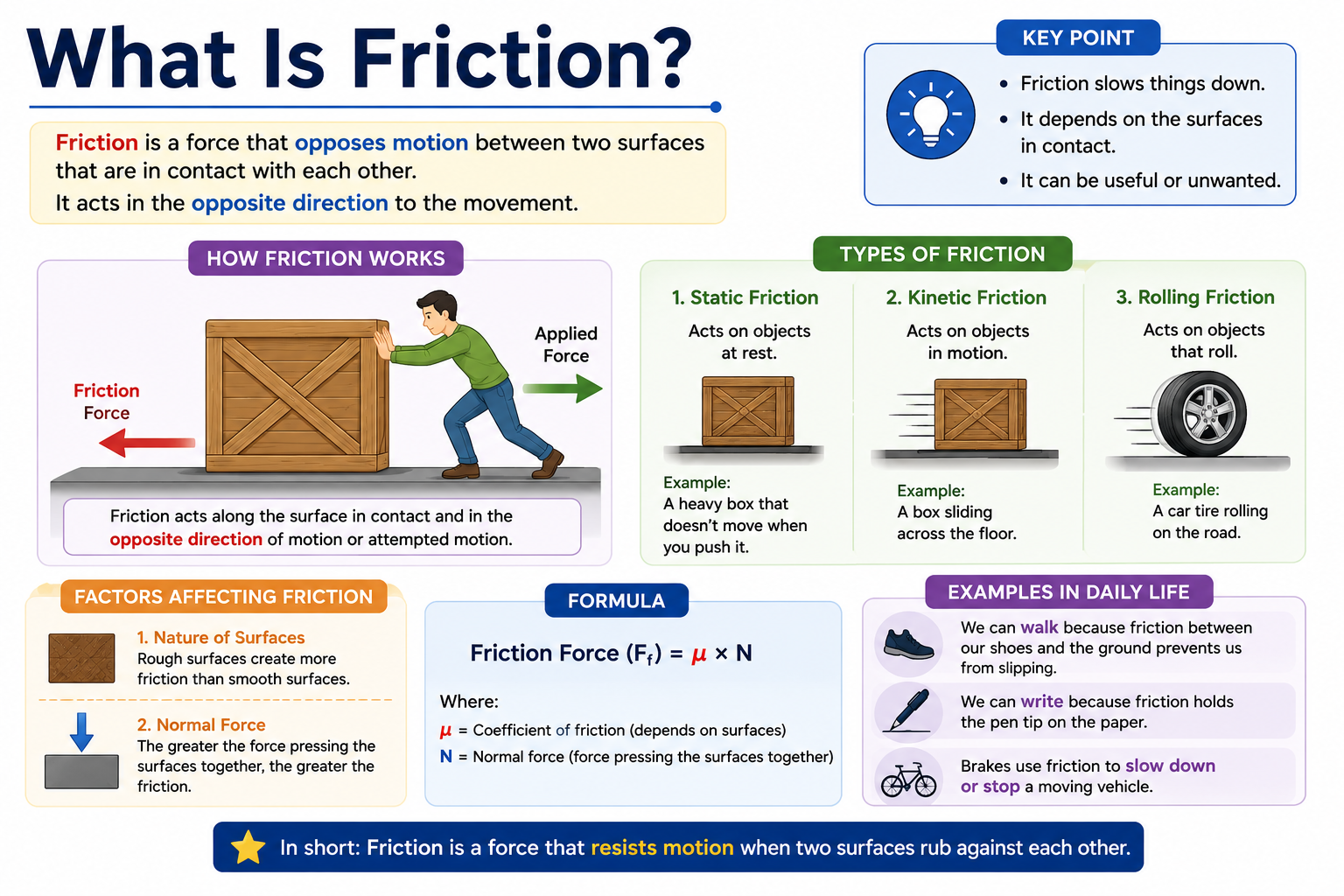
Every time you take a step, your shoe grips the ground and pushes you forward. Every time you squeeze your bicycle brakes, you slow to a stop. Every time you slide a book across a table, it gradually loses speed and stops. All of these everyday experiences have one thing in common: friction. So what is friction exactly? Friction is a force that opposes relative motion, or the tendency of relative motion, between surfaces that are in contact.
Friction is a contact force, which means it only acts when two surfaces are physically touching. Its behaviour depends on the nature of the surfaces involved and the forces pressing them together. Friction can be enormously useful, allowing you to walk, drive, and grip objects, but it can also be unwanted, causing energy loss and wear in machines.
In this article, you will find a complete guide to friction in physics, including its definition, types, formula, advantages, disadvantages, real-life examples, worked calculations, and practice questions.
Key Takeaways
-
Friction is a contact force that opposes relative motion or the tendency of relative motion between surfaces.
-
There are four main types of friction: static, kinetic, rolling, and fluid friction.
-
The standard formula for dry friction is f = μN, where μ is the coefficient of friction and N is the normal force.
-
Static friction prevents motion and adjusts up to a maximum value. Kinetic friction acts during sliding and is approximately constant.
-
The coefficient of friction (μ) depends on the pair of materials in contact and has no SI unit.
-
Friction converts mechanical energy into thermal energy, which is why rubbing surfaces become warm.
-
Friction is both beneficial (enabling walking, braking, writing) and problematic (causing energy loss, wear, and heat in machines)
What Is Friction?
Friction is a contact force that opposes relative motion or the tendency of relative motion between two surfaces that are in contact. Whenever two objects touch and one of them is moving or trying to move relative to the other, friction acts to resist that motion.
Key points about friction:
- Friction is a contact force, meaning it requires physical contact between two surfaces.
- It opposes relative motion, not all motion. Friction acts against the direction of sliding or attempted sliding.
- Friction depends on the nature of the surfaces (what materials they are made from) and on the normal force (how hard the surfaces are pressed together).
- Friction does not always prevent motion entirely. It simply resists it.
A very important clarification for beginners: friction is not simply “the force that stops everything.” An object can be moving at constant velocity while friction acts on it, if another force balances the friction exactly. Friction changes what happens next, not what is already happening in isolation.
Friction is one of the most important forces in everyday physics. Without friction, walking, driving, braking, writing, and gripping objects would all be impossible.
Why Does Friction Occur?
At first glance, a polished table or a smooth floor might appear perfectly flat. At the microscopic level, however, every surface has tiny bumps, ridges, and irregularities, no matter how smooth it looks. When two surfaces come into contact, these microscopic features interlock and interact.
Several mechanisms contribute to friction:
- Microscopic interlocking: The tiny surface irregularities of one surface catch on those of the other, creating mechanical resistance to relative motion.
- Adhesive interactions: At the microscopic contact points where surfaces actually touch, molecular forces of attraction act between the materials. These adhesive interactions resist the separation of the surfaces during sliding.
- Deformation: During contact and sliding, small-scale deformation of the surface material can absorb energy and resist motion.
- Normal force dependence: The greater the force pressing the two surfaces together (the normal force), the more contact points are engaged and the stronger the overall friction.
It is worth knowing that modern physics understands friction as a complex phenomenon that depends on the specific materials, their surface conditions, temperature, and speed of sliding. The simple formula f = μN is a very useful model for everyday problem-solving, but it is an idealization of a physically complex interaction.
Is Friction a Contact or Non-Contact Force?
Friction is a contact force. It can only act when two surfaces are physically touching. The moment the surfaces separate, friction ceases immediately.
This is in contrast to non-contact forces, which can act across empty space without any physical contact. Examples of non-contact forces include:
- Gravity, which pulls objects toward each other across any distance.
- Magnetic force, which attracts or repels magnetic materials across space.
- Electric force, which acts between charged objects without requiring contact.
Friction belongs to the same category as normal force, tension, and applied force. All of these require direct physical contact between objects.
For a comprehensive overview of the different types of forces and how they are classified, the LearnMinto article on What Is Force in Physics? provides detailed explanations of both contact and non-contact forces.
What Is the Formula for Friction?
The most commonly used formula for dry friction between solid surfaces is:
f = μN
Where:
- f = frictional force (measured in newtons, N)
- μ = coefficient of friction (dimensionless, no unit)
- N = normal force (measured in newtons, N)
This formula gives the magnitude of the frictional force. The direction of friction is always opposite to the direction of relative motion (or attempted relative motion) between the surfaces.
There are two important variants of this formula depending on the situation:
- For static friction (when the object is not moving): f_s ≤ μ_s N
- For kinetic friction (when the object is sliding): f_k = μ_k N
Simple Example:
A box rests on a horizontal floor. The normal force on the box is 50 N. The kinetic coefficient of friction between the box and the floor is 0.3. What is the kinetic frictional force?
f_k = μ_k × N
f_k = 0.3 × 50
f_k = 15 N
The frictional force acting on the sliding box is 15 N, directed opposite to the direction of sliding.
What Is the Coefficient of Friction?
The coefficient of friction (μ) is a dimensionless number that describes how much friction exists between a specific pair of surfaces under given conditions. It does not have any SI unit.
There are two types of coefficient of friction:
- Static coefficient of friction (μ_s): Used when the object is not moving relative to the surface. It describes the maximum resistance to the onset of sliding.
- Kinetic coefficient of friction (μ_k): Used when the object is already sliding. It describes the resistance to continued sliding.
In the common idealised dry-friction model, μ_k is typically less than or equal to μ_s. This means it usually takes more force to start an object sliding than to keep it sliding.
Some key points about the coefficient of friction:
- It depends on the pair of materials in contact, not just one material alone.
- It depends on surface conditions such as temperature, lubrication, and cleanliness.
- It does not depend on the area of contact in the simple model.
- It has no units because it is a ratio of forces (frictional force divided by normal force).
Since coefficients vary significantly with conditions, values found in textbooks should be treated as approximate typical values rather than exact universal constants.
What Is Normal Force?
The normal force is the force exerted by a surface on an object in contact with it, acting perpendicular (at right angles) to the contact surface.
Consider a book resting on a horizontal table:
- Gravity pulls the book downward with a force equal to its weight (W = mg).
- The table pushes back upward with the normal force (N).
- On a flat, horizontal surface with no other vertical forces, N = mg.
The normal force is not always vertical. On an inclined surface, the normal force acts perpendicular to the slope. This distinction becomes important in friction problems involving ramps.
The normal force matters enormously for friction because friction is proportional to normal force. Press two surfaces together more firmly, and the frictional force increases. This is why it is harder to slide a heavy box than a light one across the same floor.
For a deeper understanding of forces including normal force, the LearnMinto article on What Is Force in Physics? covers all major types of forces with worked examples.
Types of Friction
Friction is not a single uniform phenomenon. Different situations give rise to different types of friction, each with distinct characteristics.
| Type | Definition | When It Occurs | Example | Typical Behaviour |
|---|---|---|---|---|
| Static Friction | Resists the onset of sliding between stationary surfaces | When an object is at rest but a force tries to move it | Box that doesn’t move when pushed gently | Adjustable up to a maximum value |
| Kinetic Friction | Opposes sliding between surfaces in relative motion | When two surfaces are sliding past each other | Sliding a box across the floor | Approximately constant during sliding |
| Rolling Friction | Resistance to rolling motion | When an object rolls on a surface | Car tyre on a road | Generally much smaller than sliding friction |
| Fluid Friction | Resistance from a fluid (liquid or gas) | When an object moves through a fluid | Swimmer in water, car in air | Increases with speed |
Static Friction
Static friction is the friction that acts between two surfaces that are at rest relative to each other when an external force tries to make them slide.
Static friction is not a fixed value. It is self-adjusting. When you apply a small force to a box on the floor, static friction matches that force exactly, keeping the box stationary. As you push harder, static friction increases to continue opposing the applied force, up to a maximum limit.
The relationship is expressed as:
f_s ≤ μ_s N
Where:
- f_s = static frictional force (N)
- μ_s = static coefficient of friction
- N = normal force (N)
The inequality (≤) is important. It means static friction takes whatever value is needed to prevent motion, right up to its maximum value. Below the maximum, the object remains still. At the maximum, the object is on the verge of sliding.
Examples of static friction:
- A heavy wardrobe that does not move when you push it gently.
- The grip between your shoes and the ground that stops your feet from slipping.
- A parked car on a hill held in place by the static friction between the tyres and the road.
Maximum Static Friction
The maximum static friction (also called limiting friction) is the highest value that static friction can reach before the object begins to slide:
f_s,max = μ_s N
At this point, the applied force equals the maximum resistive capacity of static friction. If the applied force exceeds this value, the surfaces begin to slide relative to each other and static friction is replaced by kinetic friction.
This transition is something you can feel in everyday life. When you push a heavy box, at first it does not move. As you push harder, there comes a moment when the box suddenly starts to slide. That moment is when the applied force has just exceeded the maximum static friction.
Kinetic Friction
Kinetic friction (also called sliding friction) acts when two surfaces are already sliding relative to each other. Unlike static friction, kinetic friction does not adjust: once sliding begins, kinetic friction has an approximately constant value given by:
f_k = μ_k N
Where:
- f_k = kinetic frictional force (N)
- μ_k = kinetic coefficient of friction
- N = normal force (N)
Kinetic friction always opposes the direction of relative sliding. If a box slides to the right across a floor, kinetic friction acts to the left on the box.
Examples of kinetic friction:
- A book sliding across a desk gradually slows down due to kinetic friction.
- A car’s wheels skidding on a wet road, where the locked wheels slide against the tarmac.
- Rubbing two pieces of sandpaper together.
Static Friction vs Kinetic Friction
| Feature | Static Friction | Kinetic Friction |
|---|---|---|
| Relative motion | No sliding between surfaces | Surfaces are sliding relative to each other |
| Formula | f_s ≤ μ_s N | f_k = μ_k N |
| Value | Variable, up to maximum | Approximately constant during sliding |
| Coefficient | μ_s (static) | μ_k (kinetic) |
| Typical comparison | μ_s ≥ μ_k in the simple model | μ_k ≤ μ_s in the simple model |
| Example | Pushing a box that does not move | Sliding a box that is already moving |
| What triggers change | Applied force exceeds maximum static friction | Motion has already begun |
In the standard dry-friction model commonly used at school level, kinetic friction is treated as less than or equal to maximum static friction. This means more force is needed to start sliding than to maintain it, which matches everyday experience.
Rolling Friction
Rolling friction (also called rolling resistance) is the resistance experienced by an object that rolls across a surface. It arises from the deformation of the rolling object, the deformation of the surface, or both, as the object rolls over the contact area.
Rolling friction is generally much smaller than kinetic friction for the same object and normal force, which is why wheels and rollers are so widely used to move heavy objects.
Examples of rolling friction:
- A car tyre rolling along a road experiences rolling resistance that the engine must overcome.
- A bicycle wheel continues rolling for a long time after the cyclist stops pedalling, but gradually slows due to rolling resistance.
- Ball bearings in a machine allow heavy rotating parts to turn with far less resistance than sliding contact would produce.
Rolling friction is why a ball rolled across a floor eventually stops, even though a perfectly rigid ball on a perfectly rigid surface would experience no rolling resistance. In practice, all real materials deform to some degree.
Fluid Friction and Drag
When an object moves through a fluid (a liquid or gas), it experiences a resistive force called fluid friction or drag. This is different in nature from dry surface friction, though both oppose motion.
Drag depends on factors including:
- The speed of the object through the fluid (drag increases with speed).
- The shape of the object (streamlined shapes experience less drag).
- The size of the object (larger objects generally experience more drag).
- The density and viscosity of the fluid.
Examples of fluid friction:
- Air resistance slows a moving car or cyclist. Aerodynamic design reduces this.
- Water resistance slows swimmers and boats moving through water.
- A parachute uses very high drag deliberately to slow a person’s descent.
- A falling raindrop reaches a constant terminal velocity when air resistance equals its weight.
Streamlining in vehicle and aircraft design is all about reducing fluid friction to improve fuel efficiency and speed.
Friction in Solids, Liquids, and Gases
| Environment | Type of Resistive Force | Key Characteristics | Example |
|---|---|---|---|
| Solid surfaces | Static and kinetic friction | Depends on normal force and surface materials | Box on a floor |
| Rolling on a surface | Rolling friction | Much smaller than kinetic friction | Car tyre on road |
| Moving through a liquid | Viscous drag | Depends on speed, size, shape, and fluid viscosity | Swimmer in water |
| Moving through a gas | Aerodynamic drag | Increases with speed, depends on shape and size | Car driving in air |
Friction and Motion
Friction plays a central role in the physics of motion. It can:
- Prevent motion from starting: Static friction keeps objects at rest when forces are applied below the threshold for sliding.
- Stop moving objects: Kinetic friction decelerates sliding objects, eventually bringing them to rest if no driving force maintains the motion.
- Maintain motion at constant speed: If an applied force exactly balances kinetic friction, the object moves at constant velocity.
- Convert energy: Friction converts kinetic energy into thermal energy (heat), which is why surfaces warm up during rubbing and why brakes get hot during heavy use.
Friction is one reason why real-world motion is so much more complex than the idealised frictionless scenarios used in introductory physics problems.
For students exploring how friction relates to changes in speed, the LearnMinto article on What Is Speed in Physics? provides helpful context on how speed changes under various forces.
Friction and Acceleration
Friction directly affects the net force on an object and therefore its acceleration. By Newton’s Second Law:
F_net = ma
When friction acts on a moving object in the opposite direction to the applied force:
F_net = Applied Force − Friction
Example:
A 10 kg box is pushed with a force of 40 N. Kinetic friction acting on the box is 15 N. What is the acceleration?
F_net = 40 − 15 = 25 N
a = F_net / m = 25 / 10
a = 2.5 m/s²
If the applied force equalled the friction force, the net force would be zero and the box would move at constant velocity. If the applied force were removed entirely, friction alone would decelerate the box.
For a thorough treatment of acceleration and net force, the LearnMinto guide on What Is Acceleration? covers these concepts in detail with worked examples.
Friction and Newton’s Laws
Newton’s First Law
Newton’s First Law states that an object at rest or moving at constant velocity remains in that state unless acted upon by a net external force. Friction is often the net external force that changes this state.
When you slide a book across a table and release it, the only horizontal force remaining is kinetic friction. This net force decelerates the book until it stops. Without friction, the book would continue sliding indefinitely at the same speed.
Newton’s Second Law
Newton’s Second Law (F = ma) applies directly to friction problems. The frictional force contributes to the net force calculation. The net force, divided by mass, gives the acceleration.
If friction equals the applied force, net force is zero and acceleration is zero. The object moves at constant speed. If friction is less than the applied force, there is net forward acceleration.
Newton’s Third Law
Newton’s Third Law states that for every action force, there is an equal and opposite reaction force acting on a different object. When a book slides on a table, the book exerts a friction force on the table (in the direction of the book’s motion), and the table exerts an equal and opposite friction force on the book (opposing the book’s motion). These are a Newton’s Third Law pair, both friction forces on different objects.
An important clarification: the normal force and the friction force acting on the same object are not a Newton’s Third Law pair. They are different types of forces acting on the same object in different directions. Newton’s Third Law pairs always involve the same type of force acting between two different objects.
Friction on an Inclined Plane
When an object rests on a slope, friction acts parallel to the slope and opposes the tendency of the object to slide down.
On an incline at angle θ to the horizontal:
- The normal force acts perpendicular to the slope: N = mg cos θ
- The component of gravity parallel to the slope: mg sin θ (pulling the object down the slope)
- Static friction acts up the slope if the object is stationary: f_s ≤ μ_s N
If the angle of the slope is increased, the component of gravity parallel to the slope increases while the normal force decreases. At a certain critical angle (the angle of friction), gravity overcomes maximum static friction and the object begins to slide.
Once sliding begins, kinetic friction acts up the slope:
f_k = μ_k × mg cos θ
Net force down the slope = mg sin θ − f_k
This net force causes the object to accelerate down the incline.
Advantages of Friction
Friction is absolutely essential for many aspects of daily life:
- Walking and running: Friction between your shoes and the ground propels you forward. Without it, your feet would slip.
- Writing: Friction between a pencil or pen and paper allows marks to be made.
- Braking: Friction between brake pads and a disc, or between tyres and road, stops vehicles safely.
- Climbing: Friction between hands, feet, and the climbing surface provides grip.
- Using tools: Screwdrivers, spanners, and hammers all rely on friction to transmit force to the object being worked on.
- Holding objects: Friction between your fingers and an object allows you to grip and carry it.
- Driving: Tyre friction with the road allows vehicles to accelerate, steer, and stop.
In every case, friction is the force making useful physical interaction possible.
Disadvantages of Friction
Despite its many uses, friction is often unwanted in mechanical systems:
- Energy loss: In engines and machines, friction converts useful mechanical energy into heat, reducing efficiency.
- Heat generation: Excessive friction can cause overheating of components, which may damage them or create safety hazards.
- Wear and tear: Friction gradually wears away surfaces in contact, shortening the lifespan of machine parts.
- Reduced efficiency: Any machine with moving parts loses some of its input energy to friction.
- Noise: Friction between poorly lubricated surfaces can cause squeaking, grinding, and vibration.
Engineers constantly work to balance the benefits of friction in some situations against its costs in others.
How to Reduce Friction
Reducing friction is important in many mechanical and engineering applications:
- Lubrication: Applying oil, grease, or other lubricants between surfaces reduces direct contact and lowers friction significantly.
- Ball and roller bearings: Replacing sliding contact with rolling contact dramatically reduces friction in rotating machinery.
- Smoother surfaces: Polishing or machining surfaces to reduce roughness can lower friction in controlled situations.
- Streamlining: In fluid friction, aerodynamic and hydrodynamic designs reduce drag by allowing fluid to flow more smoothly around the object.
- Wheels and rollers: Converting sliding motion to rolling motion, as wheels do, reduces the magnitude of the resistive force significantly.
The best method depends heavily on the specific application and which type of friction is dominant.
How to Increase Friction
Sometimes more friction is exactly what is needed:
- Using rougher or high-grip surfaces: Rougher material pairs tend to have higher coefficients of friction. Rubber-soled shoes on a tiled floor provide more grip than leather soles.
- Increasing normal force: Pressing surfaces together more firmly increases the frictional force proportionally (f = μN).
- Treaded tyres: Deep tread patterns on vehicle tyres channel water away and increase contact grip, especially on wet roads.
- Chalk or grip aids: Rock climbers use chalk on their hands to increase friction and improve grip on rock surfaces.
- Textured surfaces: Sand, gravel, or textured paint applied to surfaces such as steps or ramps increases friction and reduces the risk of slipping.
Friction in Everyday Life
Friction shows up in virtually every physical activity:
- Walking: Friction between shoe and floor allows you to push backward and move forward.
- Running: Greater friction allows faster acceleration from push-off.
- Driving: Tyre friction with road allows acceleration, steering, and braking.
- Cycling: Tyre friction drives forward motion; brake friction provides stopping.
- Writing: Pen or pencil friction against paper deposits ink or graphite marks.
- Erasing: Friction from an eraser physically removes pencil marks from paper.
- Opening containers: Friction between hand and lid allows torque to be applied to twist the cap off.
- Braking: Every braking system, from bicycle to heavy goods vehicle, relies on friction to convert kinetic energy into heat and slow the vehicle.
- Sports: Cricket players shine the ball on one side to control air friction. Bowlers use friction to grip the ball. Gymnasts use chalk to grip apparatus.
- Machines: Every machine with moving parts has friction to manage.
Friction in Machines and Engineering
Friction plays a central role in the design and operation of machines:
- Engines: Internal combustion engines have many sliding and rotating parts. Lubrication minimises unwanted friction, while the piston-cylinder design uses friction to maintain seals.
- Brakes: Disc brakes, drum brakes, and friction brakes in industrial machinery all rely on high-friction materials pressed against rotating surfaces to convert kinetic energy to heat and slow the machine.
- Gears: Gear teeth transmit force through contact. Lubrication reduces friction at gear contact points to prevent excessive wear.
- Bearings: Ball bearings and roller bearings in motors, wheels, and turbines replace high-friction sliding contact with low-friction rolling contact.
- Conveyor systems: Friction between belt and product, or between belt and driven roller, moves goods along conveyor lines.
- Clutches: A clutch operates by controlled friction between two discs, allowing smooth engagement and disengagement of engine power.
Engineers must carefully specify materials, lubrication, and surface finishes to achieve the right balance of friction for each application.
Friction and Energy
When friction acts on a moving object, it does work against the motion. This work is converted into thermal energy (heat) in the contacting surfaces. Energy is not destroyed. It is transformed from mechanical energy into a less useful form.
This energy transformation is what makes brakes work: the kinetic energy of a moving vehicle is converted into heat in the brake discs and pads. It is also why your hands warm up when you rub them together on a cold day.
In any system where friction acts over a distance, the energy dissipated is:
W = f × d
Where W is work done against friction (joules), f is the frictional force (newtons), and d is the distance over which friction acts (metres).
This energy goes into heating the surfaces and the surrounding environment. In engineering, this energy loss must be accounted for in any efficiency calculation.
Common Misconceptions About Friction
Clearing up misconceptions about friction is just as important as learning the correct facts:
- “Friction always prevents motion.” False. Friction opposes relative motion but does not always prevent it. If the applied force exceeds maximum static friction, the object slides.
- “Friction always acts opposite to velocity.” Not always. Static friction acts opposite to the tendency of motion, which may not be in the direction of the object’s velocity. In some situations, such as a wheel rolling forward, the friction on the wheel from the ground acts forward.
- “Rougher surfaces always have more friction.” Generally true in the simple model, but not universally. Some very rough surface pairs also cause very high wear. Surface material and condition both matter significantly.
- “Static friction has a single fixed value.” No. Static friction adjusts to match the applied force up to its maximum value. It does not suddenly jump to its maximum whenever any force is applied.
- “Kinetic friction is always greater than static friction.” The opposite is true in the simple model. Maximum static friction is typically greater than or equal to kinetic friction for the same surfaces.
- “The normal force and friction force are a Newton’s Third Law pair.” They are not. Normal force acts perpendicular to the surface; friction acts parallel. Newton’s Third Law pairs involve the same type of force between two different objects.
- “Friction only occurs when objects are moving.” False. Static friction acts even when objects are stationary, preventing motion from starting.
- “Friction always has the same magnitude.” The magnitude of friction depends on the normal force, which can change if the situation changes.
How to Solve Friction Problems
Follow this step-by-step method to solve friction problems confidently:
- Identify the object you are analysing.
- Draw a free-body diagram showing all forces acting on the object.
- Identify the normal force. For a flat horizontal surface, N = mg. For other situations, calculate N from the geometry.
- Determine whether the situation involves static or kinetic friction. Is the object moving or stationary? Is it on the verge of sliding?
- Identify the coefficient of friction if provided (μ_s or μ_k as appropriate).
- Calculate the frictional force using the appropriate formula.
- Determine the net force by combining all forces in each direction.
- Calculate acceleration if required using F_net = ma.
- Check units and direction. Friction is in newtons and acts opposite to the direction of motion or attempted motion.
Example 1: Box at rest on a horizontal surface
Forces:
- Weight (W = mg) acting downward.
- Normal force (N) acting upward.
- No horizontal forces if nothing is pushing.
The box is in equilibrium: N = W.
Example 2: Box being pushed but remaining stationary
Forces:
- Weight downward.
- Normal force upward.
- Applied force to the right.
- Static friction to the left (opposing the tendency to slide).
Since the box does not move: static friction = applied force (as long as the applied force is below the maximum).
Example 3: Box sliding across a floor
Forces:
- Weight downward.
- Normal force upward.
- Kinetic friction to the left (opposing sliding direction).
Net horizontal force = −f_k (decelerating the box).
Example 4: Object on a slope
Forces:
- Weight (mg) straight downward.
- Normal force perpendicular to the slope.
- Component of weight parallel to the slope (mg sin θ) pulling down the slope.
- Friction parallel to the slope, acting upward if the object is stationary or sliding down.
How to Calculate Friction
Example 1: Kinetic friction on a horizontal surface
A 15 kg box slides across a floor. The kinetic coefficient of friction is 0.4. Calculate the frictional force. (g = 10 m/s²)
Normal force: N = mg = 15 × 10 = 150 N
f_k = μ_k × N = 0.4 × 150
f_k = 60 N
Example 2: Maximum static friction
A 20 kg crate rests on a floor. The static coefficient of friction is 0.5. What is the maximum static friction? (g = 10 m/s²)
N = mg = 20 × 10 = 200 N
f_s,max = μ_s × N = 0.5 × 200
f_s,max = 100 N
The crate will not move unless the applied force exceeds 100 N.
Example 3: Net force and acceleration with friction
A 10 kg box is pushed with 50 N. Kinetic friction is 20 N. What is the acceleration?
F_net = 50 − 20 = 30 N
a = F_net / m = 30 / 10
a = 3 m/s²
Example 4: Finding the coefficient of friction
A 5 kg object slides at constant velocity under an applied force of 15 N. What is the kinetic coefficient of friction? (g = 10 m/s²)
Constant velocity means F_net = 0, so friction = applied force = 15 N.
N = mg = 5 × 10 = 50 N
μ_k = f_k / N = 15 / 50
μ_k = 0.3
Example 5: Normal force changed by additional load
A 30 kg box sits on top of another box on a floor. The combined system has a total mass of 50 kg. The kinetic coefficient of friction between the bottom box and the floor is 0.25. What is the frictional force? (g = 10 m/s²)
Total normal force: N = 50 × 10 = 500 N
f_k = μ_k × N = 0.25 × 500
f_k = 125 N
Friction Formula Examples
Using f = μN:
A box has a normal force of 80 N on it. The kinetic coefficient of friction is 0.35.
f = μ × N = 0.35 × 80 = 28 N
The box experiences 28 N of kinetic friction opposing its motion.
Another example: A 12 kg object on a flat surface, g = 10 m/s², μ_k = 0.2.
N = mg = 12 × 10 = 120 N
f_k = 0.2 × 120 = 24 N
Friction vs Other Forces
| Force | Contact or Non-Contact | Direction | Example | Role in Motion |
|---|---|---|---|---|
| Friction | Contact | Opposes relative motion | Box sliding on floor | Slows or prevents sliding |
| Gravity | Non-contact | Toward Earth’s centre | Falling apple | Pulls objects downward |
| Normal force | Contact | Perpendicular to surface | Book on table | Prevents objects passing through surface |
| Tension | Contact | Along the rope/cable | Hanging object | Transmits pulling force |
| Applied force | Contact | In chosen direction | Pushing a door | Initiates or changes motion |
| Air resistance | Contact (fluid) | Opposite to motion direction | Parachute | Opposes motion through air |
Friction vs Air Resistance
While both friction and air resistance oppose motion, they are different in important ways:
- Dry surface friction acts between two solid surfaces in contact. It depends on the normal force and the coefficient of friction. It is approximately constant for a given normal force in the kinetic case.
- Air resistance acts when an object moves through air. It is a form of fluid friction. Unlike dry friction, air resistance increases with the speed of the object, which is why faster-moving objects experience much greater air resistance.
A sliding box on a floor experiences kinetic friction from the surface beneath it. If the box also moves through air, it simultaneously experiences air resistance. Both forces act against motion, but they arise from different physical mechanisms and have different dependencies.
Friction vs Drag
Drag is the term most commonly used for the resistive force experienced by an object moving through a fluid (liquid or gas). It is related to but distinct from dry surface friction:
- Dry friction (static and kinetic) is largely independent of speed in the simple model and depends on the normal force.
- Drag depends strongly on the speed of the object through the fluid, its shape, size, and the properties of the fluid.
At low speeds in certain fluids, drag may be approximately proportional to speed (viscous drag). At higher speeds, drag often varies with speed squared (aerodynamic drag). This is why the relationship between drag and speed is more complex than the simple f = μN model used for dry friction.
Why Is Friction Important in Physics?
Friction is important in physics for several reasons:
- Motion analysis: You cannot accurately predict the motion of real objects without including friction. Ignoring it gives idealised results that do not match reality.
- Force calculations: Friction is often one of the largest forces in everyday mechanical systems.
- Energy understanding: Friction illustrates how mechanical energy can be converted to thermal energy, which is fundamental to understanding energy conservation.
- Mechanical systems: Brakes, clutches, drives, and bearings all use friction. Understanding it is essential for any mechanical engineering application.
- Transportation: Vehicle performance, stopping distances, and road safety all depend critically on friction.
- Engineering design: Engineers designing everything from sports equipment to aircraft must account for friction accurately.
Important Friction Formulas
| Formula | Meaning | Variables | SI Unit | When to Use |
|---|---|---|---|---|
| f_s ≤ μ_s N | Static friction does not exceed μ_s N | f_s = static friction, μ_s = static coefficient, N = normal force | N | When the object is stationary and a force is applied |
| f_s,max = μ_s N | Maximum (limiting) static friction | Same variables as above | N | Finding the force needed to just start sliding |
| f_k = μ_k N | Kinetic (sliding) friction | f_k = kinetic friction, μ_k = kinetic coefficient, N = normal force | N | When the object is already sliding |
Friction Practice Questions
20 Multiple Choice Questions
Question 1: What is friction?
- A) A force that accelerates objects
- B) A force that opposes relative motion between surfaces in contact
- C) A non-contact force acting between charged objects
- D) A force that only acts on moving objects
Correct Answer: B) A force that opposes relative motion between surfaces in contact
Explanation: Friction is defined as a contact force that opposes relative motion or the tendency of relative motion between surfaces.
Question 2: Which of the following is the correct formula for kinetic friction?
- A) f_k = μ_s N
- B) f_k = μ_k / N
- C) f_k = μ_k N
- D) f_k = μ_k × m
Correct Answer: C) f_k = μ_k N
Explanation: Kinetic friction equals the kinetic coefficient of friction multiplied by the normal force.
Question 3: What is the SI unit of the coefficient of friction?
- A) Newton
- B) kg/m²
- C) m/s²
- D) It has no unit
Correct Answer: D) It has no unit
Explanation: The coefficient of friction is a dimensionless ratio and has no SI unit.
Question 4: A box of mass 10 kg rests on a surface. μ_k = 0.3 and g = 10 m/s². What is the kinetic friction force?
- A) 3 N
- B) 10 N
- C) 30 N
- D) 300 N
Correct Answer: C) 30 N
Explanation: N = mg = 100 N. f_k = 0.3 × 100 = 30 N.
Question 5: Which type of friction prevents an object from starting to slide?
- A) Kinetic friction
- B) Rolling friction
- C) Static friction
- D) Fluid friction
Correct Answer: C) Static friction
Explanation: Static friction resists the onset of relative sliding between surfaces.
Question 6: When is kinetic friction acting instead of static friction?
- A) When the object is at rest
- B) When the object is about to start moving
- C) When the two surfaces are sliding relative to each other
- D) When no force is applied to the object
Correct Answer: C) When the two surfaces are sliding relative to each other
Explanation: Kinetic friction acts during sliding. Static friction acts before sliding begins.
Question 7: In the simple dry-friction model, how does kinetic friction change as the object slides faster?
- A) It increases with speed
- B) It decreases with speed
- C) It remains approximately constant
- D) It becomes zero at high speeds
Correct Answer: C) It remains approximately constant
Explanation: In the simple dry-friction model, kinetic friction depends on the normal force and coefficient, not on sliding speed.
Question 8: A box is pushed with 20 N but does not move. The static coefficient of friction is 0.5 and the normal force is 50 N. What is the static friction force acting on the box?
- A) 25 N
- B) 20 N
- C) 50 N
- D) 10 N
Correct Answer: B) 20 N
Explanation: The box is not moving, so static friction exactly matches the applied force = 20 N. (The maximum would be 0.5 × 50 = 25 N, which the applied force has not yet reached.)
Question 9: What happens when the applied force exceeds maximum static friction?
- A) The object remains stationary
- B) Kinetic friction increases to match the applied force
- C) The object begins to slide and kinetic friction acts
- D) The normal force increases
Correct Answer: C) The object begins to slide and kinetic friction acts
Explanation: Once the applied force exceeds maximum static friction, sliding begins and kinetic friction replaces static friction.
Question 10: Which type of friction is typically smallest in magnitude?
- A) Static friction
- B) Kinetic friction
- C) Rolling friction
- D) Fluid friction at high speed
Correct Answer: C) Rolling friction
Explanation: Rolling friction is generally much smaller than kinetic friction for the same object and normal force.
Question 11: What does the normal force represent in a friction problem?
- A) The weight of the object
- B) The friction force
- C) The force perpendicular to the contact surface exerted by the surface on the object
- D) The applied force
Correct Answer: C) The force perpendicular to the contact surface exerted by the surface on the object
Explanation: The normal force acts perpendicular to the contact surface. On a flat horizontal surface, it equals the weight, but this is not always the case.
Question 12: Friction between a moving object and air or water is called:
- A) Static friction
- B) Rolling friction
- C) Fluid friction or drag
- D) Kinetic friction
Correct Answer: C) Fluid friction or drag
Explanation: Resistance experienced when moving through a fluid (liquid or gas) is called fluid friction or drag.
Question 13: A 5 kg object slides at constant velocity across a floor under a 10 N applied force. What is the kinetic friction force?
- A) 50 N
- B) 5 N
- C) 10 N
- D) 0 N
Correct Answer: C) 10 N
Explanation: Constant velocity means zero net force, so friction must equal the applied force = 10 N.
Question 14: Which of the following increases friction between two surfaces?
- A) Lubrication
- B) Reducing the normal force
- C) Increasing the normal force
- D) Using ball bearings
Correct Answer: C) Increasing the normal force
Explanation: f = μN. Increasing N increases the frictional force directly.
Question 15: In the simple dry-friction model, what is the relationship between μ_s and μ_k?
- A) μ_s < μ_k always
- B) μ_s ≥ μ_k typically
- C) They are always equal
- D) μ_k is always zero
Correct Answer: B) μ_s ≥ μ_k typically
Explanation: In the simple model, the static coefficient is typically greater than or equal to the kinetic coefficient for the same surfaces.
Question 16: Which of the following is an advantage of friction?
- A) Energy loss in engines
- B) Wear of machine parts
- C) Heat generated in brakes
- D) Ability to walk without slipping
Correct Answer: D) Ability to walk without slipping
Explanation: Friction between shoe and ground allows you to push backward and propel yourself forward.
Question 17: A 20 kg box has a kinetic coefficient of friction of 0.4 with the floor. g = 10 m/s². An applied force of 100 N pushes it. What is the net force?
- A) 100 N
- B) 80 N
- C) 20 N
- D) 180 N
Correct Answer: C) 20 N
Explanation: N = 200 N, f_k = 0.4 × 200 = 80 N. Net force = 100 − 80 = 20 N.
Question 18: Which method is most effective for reducing friction in a rotating machine shaft?
- A) Applying a rough surface
- B) Increasing the normal force
- C) Using ball bearings and lubrication
- D) Removing the shaft
Correct Answer: C) Using ball bearings and lubrication
Explanation: Ball bearings replace sliding contact with rolling contact, and lubrication further reduces friction.
Question 19: What energy conversion does friction typically cause?
- A) Chemical energy to electrical energy
- B) Kinetic energy to thermal energy
- C) Potential energy to kinetic energy
- D) Electrical energy to mechanical energy
Correct Answer: B) Kinetic energy to thermal energy
Explanation: Friction converts mechanical (kinetic) energy into thermal energy (heat).
Question 20: Friction is best described as:
- A) A non-contact force between all objects
- B) A contact force that opposes relative motion between surfaces
- C) A force that only acts on fluids
- D) A force that always prevents motion
Correct Answer: B) A contact force that opposes relative motion between surfaces
Explanation: This is the standard definition of friction in physics.
10 Short Answer Questions
Q1: Define friction in physics.
Friction is a contact force that opposes relative motion, or the tendency of relative motion, between two surfaces that are in contact with each other.
Q2: What is the difference between static and kinetic friction?
Static friction acts between surfaces at rest relative to each other and adjusts up to a maximum value to prevent sliding. Kinetic friction acts when surfaces are already sliding and is approximately constant in the simple model.
Q3: What is the formula for kinetic friction? Define each variable.
f_k = μ_k N, where f_k is kinetic friction in newtons, μ_k is the kinetic coefficient of friction (dimensionless), and N is the normal force in newtons.
Q4: A 10 kg object rests on a surface with μ_s = 0.6. g = 10 m/s². What is the maximum static friction?
N = mg = 100 N. f_s,max = 0.6 × 100 = 60 N.
Q5: Why does friction convert energy into heat?
When surfaces slide against each other, the microscopic interactions between contact points require work to be done. This work is dissipated as thermal energy (heat) in the surfaces.
Q6: Give two advantages and two disadvantages of friction.
Advantages: Enables walking (shoe-ground grip); allows vehicles to brake safely.
Disadvantages: Causes energy loss in engines; causes wear of machine components.
Q7: A box slides across a floor at constant velocity under a 25 N applied force. What can you conclude about the kinetic friction?
Since velocity is constant, net force = 0. Therefore kinetic friction = 25 N (equal and opposite to the applied force).
Q8: Why is rolling friction usually smaller than kinetic friction?
Rolling friction arises from deformation at the contact point rather than full sliding contact. Less energy is dissipated per unit distance compared to kinetic (sliding) friction.
Q9: What is fluid friction and give two examples?
Fluid friction (drag) is the resistive force on an object moving through a fluid (liquid or gas). Examples: air resistance on a car, water resistance on a swimmer.
Q10: Why does friction depend on the normal force?
Greater normal force presses the surfaces together more firmly, increasing the number and strength of microscopic contact interactions, which increases the overall frictional force.
5 Numerical Problems
Problem 1:
A 25 kg box is pulled across a horizontal floor at constant velocity. The kinetic coefficient of friction is 0.35. Calculate the applied force needed. (g = 10 m/s²)
Solution:
N = mg = 25 × 10 = 250 N
f_k = μ_k N = 0.35 × 250 = 87.5 N
Since velocity is constant, net force = 0, so applied force = friction force.
Applied force = 87.5 N
Problem 2:
A 12 kg box is pushed with 80 N. The kinetic coefficient of friction is 0.4. g = 10 m/s². Calculate the acceleration.
Solution:
N = mg = 12 × 10 = 120 N
f_k = 0.4 × 120 = 48 N
F_net = 80 − 48 = 32 N
a = F_net / m = 32 / 12
a ≈ 2.67 m/s²
Problem 3:
A 50 kg crate rests on a floor with μ_s = 0.45. g = 10 m/s². What minimum force is required to start the crate sliding?
Solution:
N = mg = 50 × 10 = 500 N
f_s,max = μ_s N = 0.45 × 500
Minimum force = 225 N
Problem 4:
An object slides with kinetic friction of 36 N. The normal force is 120 N. What is the kinetic coefficient of friction?
Solution:
μ_k = f_k / N = 36 / 120
μ_k = 0.3
Problem 5:
A 15 kg box is pushed with 90 N on a rough surface. It accelerates at 2 m/s². g = 10 m/s². Calculate the kinetic coefficient of friction.
Solution:
F_net = ma = 15 × 2 = 30 N
f_k = Applied force − F_net = 90 − 30 = 60 N
N = mg = 15 × 10 = 150 N
μ_k = f_k / N = 60 / 150
μ_k = 0.4
5 Exam-Style Questions
Question 1:
A student states: “Once I stop pushing a box, friction immediately disappears.” Evaluate this statement.
Answer: This statement is partially correct but misleading. While kinetic friction does disappear when the box stops sliding (since there is no more relative motion), static friction immediately takes over if any tendency to slide remains, such as on an incline. When a sliding box comes to rest on a flat surface, kinetic friction ceases. However, if the box were on a slope, static friction would immediately begin acting to prevent the box from sliding down. Friction does not simply disappear the moment pushing stops; it adapts to the situation.
Question 2:
A 20 kg box is on a floor with μ_s = 0.5 and μ_k = 0.35. A student applies a force of 80 N horizontally. g = 10 m/s². Will the box slide? If it does, what is the acceleration?
Answer:
N = mg = 20 × 10 = 200 N
Maximum static friction = μ_s N = 0.5 × 200 = 100 N
Applied force = 80 N < 100 N, so the box does not slide.
Static friction matches the applied force = 80 N opposing the push.
The box remains stationary. Acceleration = 0.
(If the force were 110 N, for example, the box would slide, and then:
f_k = 0.35 × 200 = 70 N, F_net = 110 − 70 = 40 N, a = 40/20 = 2 m/s².)
Question 3:
Explain why it is harder to start a heavy box sliding than to keep it sliding, using the concept of static and kinetic friction.
Answer: Starting the box sliding requires overcoming the maximum static friction, given by f_s,max = μ_s N. Keeping the box sliding only requires overcoming kinetic friction, f_k = μ_k N. In the standard dry-friction model, μ_s ≥ μ_k, which means maximum static friction is greater than or equal to kinetic friction for the same normal force. Therefore, more force is needed to initiate sliding than to maintain it. This is why heavy boxes feel harder to get moving than to keep moving once they are already sliding.
Question 4:
A cyclist on a bicycle and rider with a combined mass of 80 kg descends a slope at constant speed. The angle of the slope is such that the component of gravity along the slope is 240 N. What is the total resistive force (friction plus air resistance) acting on the cyclist? Explain your reasoning.
Answer:
Since the cyclist descends at constant speed, the net force is zero. This means the driving force (gravity component along the slope) exactly equals the total resistive force.
Total resistive force = 240 N opposing the motion.
The resistive forces include both surface friction between tyres and road, and air resistance from moving through the air. Because velocity is constant, their combined effect exactly balances the gravitational component pulling the cyclist down the slope.
Question 5:
Explain the difference between static friction and the maximum (limiting) static friction, and describe what happens physically as an increasing force is applied to a stationary object.
Answer: Static friction is the actual friction force acting on a stationary object when an external force is applied. It is not a fixed value: it adjusts to exactly match the applied force, keeping the object stationary. This continues until the applied force reaches the maximum (limiting) static friction, given by f_s,max = μ_s N.
At this threshold, static friction is at its greatest possible value. If the applied force is increased any further beyond this threshold, the object begins to slide. Once sliding starts, static friction no longer applies, and kinetic friction (which is typically smaller than maximum static friction) takes over. The transition feels noticeable in practice because less force is needed to keep the object moving than was needed to start it sliding.
Exam Tips
- Know the definition precisely: Friction opposes relative motion or the tendency of relative motion between surfaces in contact. Memorise this wording.
- Distinguish static from kinetic friction: Static friction adjusts up to a maximum; kinetic friction is approximately constant during sliding. Know when to use each.
- Remember the formula: f = μN. Know that μ has no unit, N is the normal force (not the weight in all cases), and the result is in newtons.
- Normal force is not always mg: On inclined planes or when additional forces act vertically, calculate N separately. N = mg only on horizontal surfaces with no other vertical forces.
- Direction of friction: Always opposite to the direction of relative motion (or tendency of motion). State this clearly in exam answers.
- Advantages vs disadvantages: Be ready to give specific examples for both. Examiners value examples over vague statements.
- Coefficient of friction: μ_s ≥ μ_k in the simple model. Static coefficient is typically larger. Do not confuse them.
- Free-body diagrams: Always draw one before solving a friction problem. It clarifies the direction of friction and the other forces.
Quick Revision Notes
- Friction is a contact force opposing relative motion between surfaces.
- Types: static (prevents sliding), kinetic (during sliding), rolling (rolling objects), fluid (through liquids and gases).
- Formula: f = μN (μ = coefficient of friction, N = normal force, both dimensionless and newtons respectively).
- Static friction: f_s ≤ μ_s N. Self-adjusting up to maximum.
- Maximum static friction: f_s,max = μ_s N (the threshold for sliding).
- Kinetic friction: f_k = μ_k N. Approximately constant during sliding.
- μ_s ≥ μ_k typically. More force needed to start sliding than to maintain it.
- Normal force is perpendicular to the contact surface.
- Friction direction: always opposite to relative motion or tendency of motion.
- Friction converts kinetic energy to thermal energy.
- Advantages: walking, braking, grip. Disadvantages: energy loss, heat, wear.
- Reduce friction: lubrication, ball bearings, streamlining.
- Increase friction: rougher surfaces, greater normal force, treaded tyres.
Friction Cheat Sheet
| Concept | Definition | Formula | Unit | Example |
|---|---|---|---|---|
| Friction | Contact force opposing relative motion | f = μN | N | Box sliding on floor |
| Static Friction | Friction preventing sliding onset | f_s ≤ μ_s N | N | Heavy wardrobe not moving |
| Max Static Friction | Highest value before sliding begins | f_s,max = μ_s N | N | Force needed to start sliding box |
| Kinetic Friction | Friction during sliding | f_k = μ_k N | N | Book sliding across table |
| Rolling Friction | Resistance during rolling | Much smaller than f_k | N | Car tyre on road |
| Fluid Friction | Resistance in fluids | Depends on speed, shape, size | N | Air resistance on car |
| Normal Force | Perpendicular surface force | N = mg (on flat surface) | N | Table supporting book |
| Coefficient of Friction | Ratio describing surface pair friction | μ = f / N | None (dimensionless) | Rubber on concrete |
Frequently Asked Questions
1. What is friction?
Friction is a contact force that opposes relative motion, or the tendency of relative motion, between two surfaces that are in contact with each other.
2. What causes friction?
Friction is caused by microscopic interactions between surfaces in contact, including surface irregularities interlocking and molecular adhesive forces at contact points.
3. Is friction a contact force?
Yes. Friction only acts when two surfaces are physically touching. It ceases immediately when surfaces separate.
4. What are the four types of friction?
The four main types are static friction, kinetic friction, rolling friction, and fluid friction (drag).
5. What is static friction?
Static friction is the friction that acts between stationary surfaces when a force tries to cause sliding. It adjusts up to a maximum value to prevent motion from starting.
6. What is kinetic friction?
Kinetic friction is the friction that acts when two surfaces are sliding relative to each other. It opposes the direction of sliding and is approximately constant in the simple model.
7. What is rolling friction?
Rolling friction is the resistance experienced by an object rolling on a surface. It arises from deformation at the contact area and is much smaller than kinetic friction.
8. What is fluid friction?
Fluid friction, or drag, is the resistive force experienced by an object moving through a fluid (liquid or gas). It depends on speed, shape, size, and fluid properties.
9. What is the formula for friction?
The standard formula is f = μN, where μ is the coefficient of friction and N is the normal force. For static friction: f_s ≤ μ_s N. For kinetic friction: f_k = μ_k N.
10. What is the coefficient of friction?
The coefficient of friction (μ) is a dimensionless number that characterises the friction between a specific pair of surfaces. It depends on the materials and surface conditions.
11. How does friction affect motion?
Friction opposes relative motion, decelerating moving objects and preventing stationary objects from sliding. It converts kinetic energy into thermal energy.
12. How can friction be reduced?
Friction can be reduced using lubrication, ball bearings, smoother surfaces where appropriate, streamlining, and wheels or rollers.
13. How can friction be increased?
Friction can be increased using rougher or higher-grip surface materials, increasing the normal force, using treaded tyres, and applying chalk or grip aids.
14. What is the difference between static and kinetic friction?
Static friction acts before sliding begins and is variable up to a maximum. Kinetic friction acts during sliding and is approximately constant. Maximum static friction is typically greater than kinetic friction in the simple model.
15. Why is friction important?
Friction enables walking, braking, writing, and gripping. It is also essential for understanding energy conversion, motion analysis, and the design of mechanical systems.
Summary
Friction is a contact force that opposes relative motion or the tendency of relative motion between surfaces. It is fundamental to understanding motion in the real world. Without friction, walking, driving, braking, and gripping would all be impossible.
The four main types of friction are static (preventing sliding onset), kinetic (during sliding), rolling (during rolling), and fluid (in liquids and gases). The standard formula for dry friction is f = μN, where μ is the coefficient of friction and N is the normal force.
Static friction is self-adjusting up to its maximum value (f_s,max = μ_s N). Kinetic friction is approximately constant during sliding (f_k = μ_k N). In the simple model, μ_s ≥ μ_k, which is why it takes more force to start sliding than to maintain it.
Friction has important advantages, enabling movement and control, but also disadvantages, including energy loss and wear. Engineers manage friction through lubrication, bearings, and design choices appropriate to each application.
Final Thoughts
Friction is one of those forces that most people experience without ever thinking about it, yet it shapes almost everything in the physical world. Understanding what friction is in physics means understanding why you can walk without slipping, why cars can brake safely, and why machines need oil to run efficiently.
The most important thing is to understand friction as a self-adjusting, directional contact force, not simply a fixed obstacle to motion. It can prevent motion, maintain motion, assist motion in some directions, and convert energy into heat. Its behaviour depends on the surfaces involved, the forces pressing them together, and whether sliding has begun.
Master the distinction between static and kinetic friction, learn to draw accurate free-body diagrams, and practise calculating net force with friction included. With these tools, friction problems become manageable and the physics of real-world motion becomes much more accessible.
References
- OpenStax. University Physics Volume 1 – Chapter 6: Applications of Newton’s Laws. OpenStax, Rice University. Available at: https://openstax.org/books/university-physics-volume-1/pages/6-introduction
- Physics LibreTexts. Friction. LibreTexts Physics. Available at: https://phys.libretexts.org/Bookshelves/University_Physics/Book%3A_University_Physics_(OpenStax)/Book%3A_University_Physics_I_-Mechanics_Sound_Oscillations_and_Waves(OpenStax)/06%3A_Applications_of_Newton’s_Laws/6.02%3A_Friction
- Khan Academy. Friction. Khan Academy Physics. Available at: https://www.khanacademy.org/science/physics/forces-newtons-laws/friction-tutorial/a/what-is-friction
- Encyclopaedia Britannica. Friction – Physics. Britannica. Available at: https://www.britannica.com/science/friction
- The Physics Classroom. Friction. The Physics Classroom. Available at: https://www.physicsclassroom.com/class/newtlaws/Lesson-2/Friction
- National Institute of Standards and Technology (NIST). SI Units. NIST. Available at: https://www.nist.gov/pml/owm/metric-si/si-units
Disclaimer
This article is intended for educational and informational purposes only. While LearnMinto strives to provide accurate and up-to-date information, readers should verify important academic concepts through official textbooks, educational institutions, examination boards, or trusted scientific resources before relying on this content for exams or academic purposes. LearnMinto is not affiliated with any specific school, university, research institution, or examination board.