
Introduction
Imagine telling a friend to walk 5 km. They could end up anywhere — north, south, east, west, or somewhere in between. But if you say “walk 5 km north,” they know exactly where to go. That single extra piece of information — direction — changes everything.
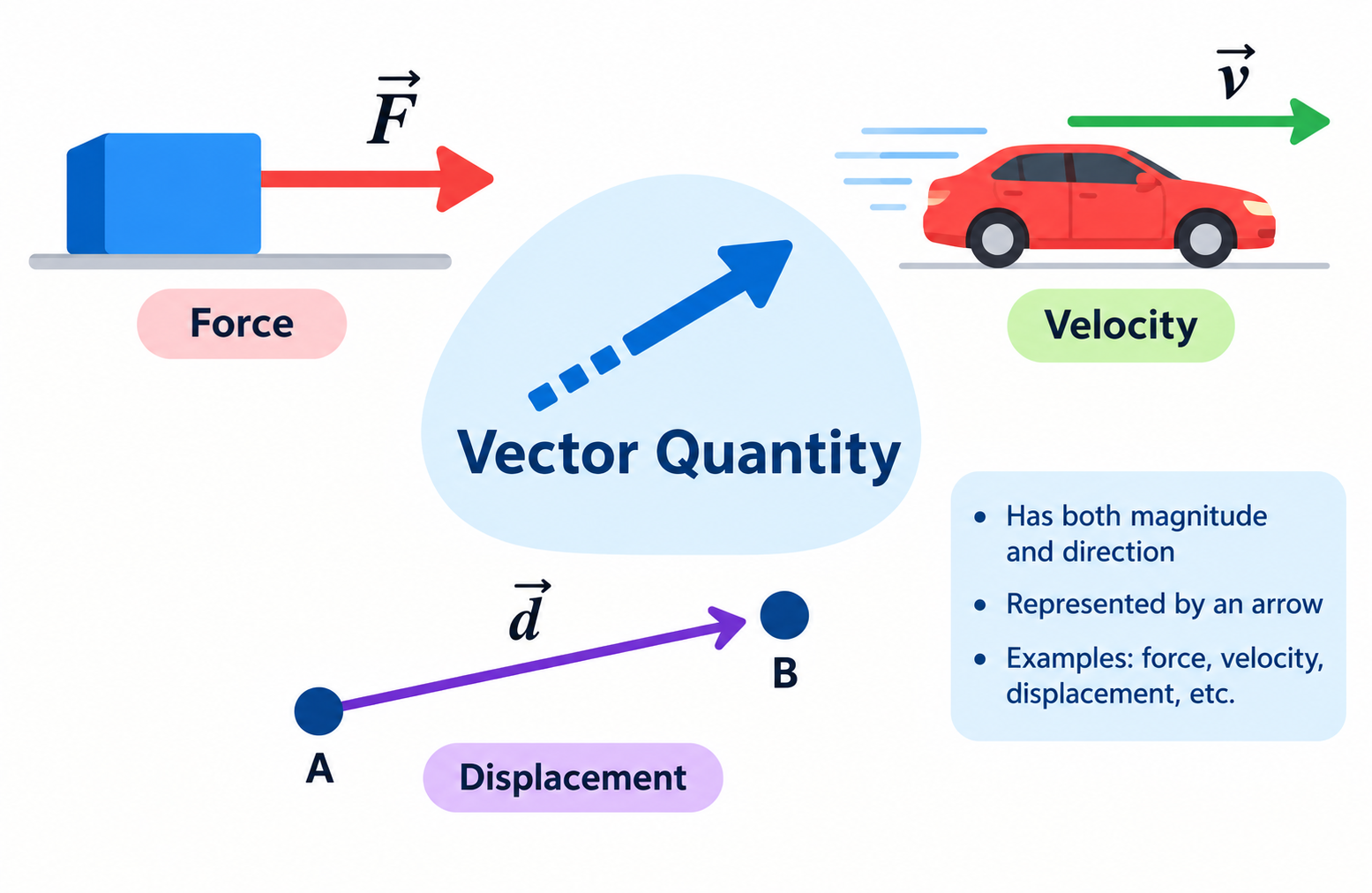
That is precisely what makes a quantity a vector. A vector quantity in physics is a physical quantity that requires both a magnitude (a numerical value with a unit) and a direction to be completely and correctly described. Without the direction, the description is physically incomplete.
Force, velocity, displacement, acceleration, and momentum are all vector quantities. Understanding them is essential for making sense of how objects move, interact, and behave in the physical world.
Key Takeaways
-
A vector quantity has three essential components: magnitude, unit, and direction.
-
Without stating a direction, any description of a vector quantity is incomplete.
-
Common vector quantities include displacement, velocity, acceleration, force, weight, and momentum.
-
Vectors are represented by arrows in diagrams — arrow length shows magnitude; arrow direction shows the vector’s direction.
-
Vectors cannot be added using simple arithmetic — direction must always be accounted for.
-
A negative value in a vector calculation means the vector acts in the opposite direction to the defined positive direction — not below a reference level.
-
Resolving a vector into horizontal and vertical components makes complex problems far easier to solve.
What Is Vector Quantity in Physics?
A vector quantity is a physical quantity that is completely described only when three things are known:
- Magnitude — the numerical size of the quantity.
- Unit — the standard measurement unit.
- Direction — which way the quantity acts or points.
Remove any one of these three components, and the description of a vector is no longer physically complete.
Here are four clear examples:
- Force: 50 N downward — magnitude (50), unit (N), direction (downward).
- Velocity: 30 m/s north — magnitude (30), unit (m/s), direction (north).
- Displacement: 200 m east — magnitude (200), unit (m), direction (east).
- Acceleration: 9.8 m/s² downward — magnitude (9.8), unit (m/s²), direction (downward).
If someone tells you a force is “50 N” without specifying direction, you cannot determine what that force will do to an object. Is it pushing the object upward, sideways, or at an angle? Direction is not optional — it is essential.
In physics diagrams, vectors are drawn as arrows. The length of the arrow represents the magnitude — a longer arrow means a larger magnitude. The direction the arrow points represents the direction of the vector. This visual representation makes it much easier to see how multiple vectors interact.
Vector Quantity vs Scalar Quantity
To fully understand what makes a quantity a vector, it helps to compare it directly with its counterpart. For a complete explanation of quantities that need magnitude and unit alone, see What Is Scalar Quantity in Physics?
| Feature | Vector Quantity | Scalar Quantity |
|---|---|---|
| Components needed | Magnitude, unit, and direction | Magnitude and unit only |
| Direction required | Yes — always | No |
| Representation | Arrow (length = magnitude, direction shown) | Single number with unit |
| Addition rule | Vector addition (direction must be considered) | Simple arithmetic |
| Example quantity | Velocity: 20 m/s north | Speed: 20 m/s |
| Another example | Force: 30 N downward | Mass: 30 kg |
| Negative value meaning | Opposite direction to defined positive | Below a reference level |
| Everyday analogy | “Drive 10 km east, then 5 km north” | “Drive 15 km total” |
The fundamental difference is always direction. If a complete physical description of a quantity requires a direction, it is a vector. If magnitude and unit alone are sufficient, it is a scalar.
Examples of Vector Quantities
Here is a comprehensive reference table of vector quantities you will encounter throughout physics:
| Vector Quantity | Symbol | SI Unit | What It Measures | Real-World Example with Direction |
|---|---|---|---|---|
| Displacement | s | metre (m) | Straight-line distance from start to finish | 500 m north of starting point |
| Velocity | v | metre per second (m/s) | Rate of change of displacement | 25 m/s eastward |
| Acceleration | a | metre per second squared (m/s²) | Rate of change of velocity | 9.8 m/s² downward (free fall) |
| Force | F | newton (N) | Push or pull on an object | 200 N forward (engine thrust) |
| Weight | W | newton (N) | Gravitational force on a mass | 686 N downward (70 kg person on Earth) |
| Momentum | p | kilogram metre per second (kg·m/s) | Product of mass and velocity | 1,500 kg·m/s eastward |
| Impulse | J | newton second (N·s) | Change in momentum | 50 N·s upward |
| Gravitational field strength | g | newton per kilogram (N/kg) | Gravitational force per unit mass | 9.8 N/kg toward Earth’s centre |
| Electric field strength | E | newton per coulomb (N/C) | Force per unit positive charge | 500 N/C to the right |
| Magnetic field | B | tesla (T) | Magnetic force per unit current per unit length | 0.5 T into the page |
| Torque | τ | newton metre (N·m) | Rotational effect of a force | 10 N·m clockwise |
| Angular velocity | ω | radian per second (rad/s) | Rate of angular rotation | 5 rad/s anticlockwise |
| Thrust | F | newton (N) | Forward force from engine or propulsion | 30,000 N forward (jet engine) |
| Lift force | F_L | newton (N) | Upward aerodynamic force | 80,000 N upward (aircraft wing) |
| Normal force | N | newton (N) | Contact force perpendicular to surface | 700 N upward (floor on person) |
| Tension | T | newton (N) | Pulling force transmitted through rope or string | 150 N upward (rope holding mass) |
| Friction force | f | newton (N) | Force opposing relative motion | 20 N backward (opposing forward motion) |
| Centripetal acceleration | a_c | metre per second squared (m/s²) | Acceleration directed toward centre of circular path | 5 m/s² toward centre of circle |
| Electric current density | J | ampere per square metre (A/m²) | Electric current per unit cross-sectional area | 10⁶ A/m² in direction of current flow |
| Linear momentum | p | kilogram metre per second (kg·m/s) | Mass times velocity of a particle | 0.2 kg·m/s to the left |
In every case, stating the direction is not optional — it is what makes the description physically complete and useful.
Vector Quantities in Everyday Life
Vector quantities are not abstract concepts confined to textbooks. They appear constantly in daily life — and in many cases, ignoring direction would lead to serious errors.
1. A car travelling on a motorway
Vector quantity: Velocity
Value with direction: 30 m/s south
Why direction matters: Two cars travelling at 30 m/s toward each other have very different velocities — and a head-on collision has very different consequences than two cars travelling side by side.
2. Pushing a shopping trolley
Vector quantity: Force
Value with direction: 40 N forward
Why direction matters: Pushing the trolley sideways instead of forward moves it in the wrong direction entirely, even with the same force magnitude.
3. A skydiver falling
Vector quantity: Weight
Value with direction: 800 N downward
Why direction matters: Weight always acts downward. If it acted upward, the skydiver would accelerate away from Earth rather than toward it.
4. A ball thrown upward
Vector quantity: Velocity (initial)
Value with direction: 15 m/s upward
Why direction matters: Throwing at 15 m/s upward produces very different motion from throwing at 15 m/s sideways — direction determines the entire trajectory.
5. A GPS navigation instruction
Vector quantity: Displacement
Value with direction: 3.2 km northeast
Why direction matters: “3.2 km” without direction tells you nothing useful about where to go.
6. A footballer kicking a ball
Vector quantity: Force
Value with direction: 500 N at 30° above horizontal
Why direction matters: The angle determines whether the ball travels along the ground, curves upward, or rises into the air.
7. A plane landing
Vector quantity: Acceleration (deceleration)
Value with direction: 3 m/s² backward (opposing direction of motion)
Why direction matters: Deceleration acts opposite to velocity — the direction is critical to understanding how the plane slows down safely.
8. A boat crossing a river
Vector quantity: Velocity
Value with direction: 4 m/s east (boat) + 3 m/s north (river current) = resultant 5 m/s at an angle
Why direction matters: Without accounting for the river current’s direction, the boat would miss its intended landing point entirely.
9. A climber on a rope
Vector quantity: Tension
Value with direction: 750 N upward along the rope
Why direction matters: Tension acts along the rope — its direction determines whether it supports or pulls the climber.
10. Earth’s gravitational field
Vector quantity: Gravitational field strength
Value with direction: 9.8 N/kg toward Earth’s centre
Why direction matters: Gravity always pulls toward the centre — understanding this direction is fundamental to orbital mechanics, tides, and projectile motion.
11. A swimming race
Vector quantity: Displacement
Value with direction: 50 m along the pool, in the swimmer’s lane direction
Why direction matters: Swimming 50 m in the wrong direction does not complete the race — direction determines the result.
12. A crane lifting a load
Vector quantity: Tension in the cable
Value with direction: 5,000 N vertically upward
Why direction matters: The cable must pull directly upward to lift the load efficiently. A cable pulling at an angle would not lift the load as effectively.
How Vectors Are Represented
Physicists use several consistent methods to represent vector quantities.
In written text:
Vectors are often written in bold type — for example, F for force or v for velocity. Alternatively, an arrow is written above the symbol: →F or →v. Scalar quantities use ordinary (non-bold, non-arrowed) symbols.
In diagrams:
Vectors are drawn as arrows. The length of the arrow is drawn to scale — proportional to the magnitude of the vector. The direction the arrow points shows the direction of the vector. When multiple forces act on an object, all arrows are drawn from (or to) the same point.
In calculations:
A positive direction is defined (for example, rightward = positive, leftward = negative; upward = positive, downward = negative). Vectors in the positive direction are given positive values. Vectors in the negative direction are given negative values. This allows vector arithmetic to be performed algebraically.
Resultant vector:
When two or more vectors act simultaneously, their combined effect is represented by a single vector called the resultant. The resultant has the same overall effect as all the individual vectors acting together.
Simple examples:
- Two forces of 10 N in the same direction → resultant = 20 N in that direction.
- Two forces of 10 N in exactly opposite directions → resultant = 0 N (the object is in equilibrium).
- A force of 3 N east and a force of 4 N north → resultant = 5 N at an angle northeast (using Pythagoras: √(3² + 4²) = √25 = 5 N).
Adding Vector Quantities
Unlike scalar quantities — which you simply add arithmetically — vectors require careful treatment of direction at every step.
Case 1: Vectors in the same direction
Add the magnitudes. Direction remains the same.
Case 2: Vectors in opposite directions
Subtract the smaller magnitude from the larger. The direction of the resultant is the direction of the larger vector.
Case 3: Vectors at right angles
Use Pythagoras’ theorem to find the magnitude of the resultant:
Resultant = √(v₁² + v₂²)
Getting vector addition wrong produces physically incorrect answers — a bridge designed without accounting for force directions, or a flight path calculated without accounting for wind direction, would fail in the real world.
Five fully worked vector addition examples:
Example 1 — Two forces in the same direction:
Force A = 25 N east. Force B = 15 N east.
Resultant = 25 + 15 = 40 N east
Same direction: add magnitudes directly.
Example 2 — Two forces in opposite directions:
Force A = 30 N right. Force B = 18 N left.
Resultant = 30 − 18 = 12 N to the right
Opposite directions: subtract; resultant acts in the direction of the larger force.
Example 3 — Two perpendicular forces:
Force A = 6 N east. Force B = 8 N north.
Resultant magnitude = √(6² + 8²) = √(36 + 64) = √100 = 10 N
Direction: northeast at angle θ where tan θ = 8/6 = 53.1° north of east.
Use Pythagoras for perpendicular vectors.
Example 4 — Boat crossing a river:
Boat velocity = 3 m/s east (across river). River current = 4 m/s south (downstream).
Resultant velocity = √(3² + 4²) = √(9 + 16) = √25 = 5 m/s at an angle south of east.
Direction: tan θ = 4/3 → θ ≈ 53.1° south of east.
The boat does not travel straight across — it is carried downstream by the current.
Example 5 — Resolving a vector into components:
A force of 100 N acts at 40° above the horizontal.
Horizontal component = 100 × cos 40° = 100 × 0.766 = 76.6 N (horizontal)
Vertical component = 100 × sin 40° = 100 × 0.643 = 64.3 N (vertical)
Resolving splits the vector into two perpendicular components — useful for analysing inclined planes and projectile motion.
Displacement as a Vector Quantity
Displacement is the straight-line distance from a starting point to an ending point, measured in a specific direction.
Key facts:
- Displacement is always measured in a straight line — regardless of the actual path taken.
- Displacement can be positive, negative, or zero.
- It is measured in metres (m).
Contrast with distance:
Distance is the total length of the path travelled — it is always positive and has no direction (scalar). Displacement captures where you ended up relative to where you started, with direction.
Worked example:
A student walks 300 m north, then 400 m south.
- Total distance = 300 + 400 = 700 m (scalar — total path length)
- Displacement: 400 − 300 = 100 m in the net southward direction = 100 m south (vector)
The student walked 700 m in total but is only 100 m from where they started — and in the southward direction.
An important special case: if an object completes a full circle and returns to its starting point, the displacement is zero — even though the distance is the full circumference of the circle.
Velocity as a Vector Quantity
Velocity is the rate of change of displacement with respect to time.
Velocity = displacement ÷ time (v = s/t)
Velocity is a vector because displacement is a vector. The direction of velocity is the same as the direction of displacement.
Contrast with speed:
Speed = distance ÷ time — it is a scalar with no direction. Two objects can have the same speed but completely different velocities if they are moving in different directions.
Example:
Car A travels at 20 m/s north. Car B travels at 20 m/s south. Both have a speed of 20 m/s. Their velocities are 20 m/s north and 20 m/s south respectively — entirely different vectors. If they collide head-on, the consequences are dramatically different from two cars travelling side by side at the same speed.
For a thorough explanation of velocity and how it differs from speed, see What Is Velocity in Physics?
Acceleration as a Vector Quantity
Acceleration is the rate of change of velocity with time. Since velocity is a vector, acceleration is also a vector — it has both magnitude and direction.
Key facts:
- Acceleration = change in velocity ÷ time (a = Δv/t)
- Acceleration can involve a change in speed, a change in direction, or both.
- An object moving in a circle at constant speed is still accelerating — because its direction changes continuously. This is called centripetal acceleration, and it always points toward the centre of the circle.
- Free fall: g = 9.8 m/s² downward (toward Earth’s centre).
A common misconception is that acceleration only means “speeding up.” In physics, acceleration means any change in velocity — slowing down, changing direction, or both. A car turning a corner at constant speed is accelerating because its direction (and therefore velocity) is changing.
For a complete explanation of acceleration and its direction, see What Is Acceleration in Physics?
Force as a Vector Quantity
Force is a push or pull exerted on an object. It is one of the most important vector quantities in all of physics.
Key facts:
- Force requires both magnitude and direction — “50 N” is incomplete; “50 N downward” is correct.
- Multiple forces can act on the same object simultaneously.
- The net force (resultant force) is the vector sum of all forces acting on an object.
- If the net force is zero, the object is in equilibrium — it either remains stationary or continues moving at constant velocity.
- Equal and opposite forces cancel — their vector sum is zero.
Example: A book resting on a table has its weight (686 N downward) balanced by the normal force from the table (686 N upward). Net force = 0 N. The book does not accelerate.
For a full explanation of force and how it is applied in physics, see What Is Force in Physics?
Weight as a Vector Quantity
Weight is the gravitational force acting on a mass. It is always a vector — it always acts downward, toward the centre of the gravitating body.
Key facts:
- Weight = mass × gravitational field strength (W = mg)
- On Earth: g ≈ 9.8 N/kg → a 70 kg person has weight = 70 × 9.8 = 686 N downward
- On the Moon: g ≈ 1.6 N/kg → same 70 kg person has weight = 70 × 1.6 = 112 N downward
- In deep space (away from any large mass): weight ≈ 0 N
Mass is scalar (70 kg — same everywhere). Weight is a vector force (686 N downward on Earth — changes with location).
This distinction is critical and is one of the most commonly confused concepts in introductory physics.
Momentum as a Vector Quantity
Momentum is the product of an object’s mass and its velocity.
p = mv
Since mass is a scalar and velocity is a vector, momentum is a vector — it has the same direction as the velocity of the object.
Key facts:
- SI unit: kg·m/s
- Direction of momentum = direction of velocity
- In collisions, the direction of each object’s momentum must be accounted for
- Total momentum of a system is conserved — but direction is part of the conservation calculation
Example:
Two cars each have mass 1,000 kg. Car A travels at 20 m/s east. Car B travels at 20 m/s west.
- Momentum of Car A = 1,000 × 20 = 20,000 kg·m/s east
- Momentum of Car B = 1,000 × 20 = 20,000 kg·m/s west
- Total momentum of system = 20,000 − 20,000 = 0 kg·m/s
Equal speeds in opposite directions give zero total momentum — a fact that has direct consequences in collision analysis.
For a detailed explanation of momentum and conservation, see What Is Momentum?
Resolving Vectors into Components
Any vector can be split into two perpendicular components — typically horizontal and vertical. This process is called resolving a vector.
Resolving is enormously useful. Instead of dealing with a vector at an awkward angle, you work with two simpler vectors — one horizontal, one vertical — which can be treated independently.
The formulas:
- Horizontal component = magnitude × cos θ
- Vertical component = magnitude × sin θ
Where θ is the angle the vector makes with the horizontal.
Fully worked example:
A force of 50 N acts at 30° above the horizontal.
- Horizontal component = 50 × cos 30° = 50 × 0.866 = 43.3 N (horizontal)
- Vertical component = 50 × sin 30° = 50 × 0.5 = 25 N (vertical)
The original 50 N force at 30° has exactly the same effect as a 43.3 N horizontal force and a 25 N vertical force acting simultaneously.
Why this matters:
- On an inclined plane: resolve weight into a component along the slope and a component perpendicular to the slope.
- In projectile motion: resolve initial velocity into horizontal (constant) and vertical (affected by gravity) components.
- In structural engineering: resolve forces in cables or beams into horizontal and vertical components.
Vector Quantities and Negative Values
In vector problems, a positive direction is always defined first — usually stated explicitly at the start of a problem or diagram.
Once positive direction is defined:
- A vector in the positive direction has a positive value.
- A vector in the opposite direction has a negative value.
This is fundamentally different from negative scalar values. A negative scalar (e.g., −10 °C) means below a reference point. A negative vector value means acting in the opposite direction to the defined positive.
| Vector Negative Value Example | What It Means | Direction |
|---|---|---|
| Velocity = −15 m/s (right is positive) | 15 m/s to the left | Leftward |
| Force = −30 N (upward is positive) | 30 N downward | Downward |
| Acceleration = −9.8 m/s² (upward is positive) | 9.8 m/s² downward (gravity) | Downward |
| Displacement = −200 m (north is positive) | 200 m south | Southward |
| Momentum = −500 kg·m/s (east is positive) | 500 kg·m/s westward | Westward |
Always define your positive direction clearly at the start of any vector calculation.
Common Misconceptions About Vector Quantities
| Misconception | Correct Explanation |
|---|---|
| “Velocity and speed are the same.” | Speed is scalar — magnitude only. Velocity is vector — magnitude and direction. Two cars at the same speed in opposite directions have different velocities. |
| “A larger force always produces more motion.” | Direction matters. Two equal and opposite forces produce zero net force — no motion at all. Net force (not individual force) determines acceleration. |
| “Acceleration only means speeding up.” | Acceleration is any change in velocity — including slowing down (negative acceleration) or changing direction at constant speed (centripetal acceleration). |
| “Displacement and distance are the same.” | Distance is scalar — total path length, always positive. Displacement is vector — straight-line change in position with direction. They are equal only when motion is in a straight line without reversing. |
| “Weight and mass are the same.” | Mass (kg) is scalar — the amount of matter, constant everywhere. Weight (N) is a vector force — gravitational pull on the mass, directed downward, varying with location. |
Scalar Quantities That Students Confuse with Vectors
| Quantity | Scalar or Vector | Reason |
|---|---|---|
| Speed | Scalar | Tells you how fast — no direction. “30 m/s” is a complete description. |
| Velocity | Vector | Tells you how fast and which way. “30 m/s north” is required. |
| Distance | Scalar | Total path length — always positive, no direction. |
| Displacement | Vector | Straight-line change in position, with direction. Can be zero or negative. |
| Mass | Scalar | Amount of matter — same everywhere, no direction. |
| Weight | Vector | Gravitational force on a mass — directed downward. Changes with g. |
| Temperature | Scalar | Degree of hotness — no direction. Negative values indicate below reference, not direction. |
| Pressure | Scalar | Force per unit area — the quantity itself has no direction (acts equally in all directions in a fluid). |
| Force | Vector | Push or pull — must state magnitude and direction to describe fully. |
| Energy | Scalar | Capacity to do work — no direction. Always a scalar, even when produced by vector forces. |
Worked Examples
Example 1
Question: Is “a velocity of 40 m/s” a complete description of a vector quantity?
Solution: No — it is incomplete.
Explanation: Velocity is a vector. “40 m/s” gives magnitude and unit but no direction. A complete description would be “40 m/s northward” or “40 m/s at 30° above the horizontal.” Without direction, the velocity is not fully described.
Example 2
Question: Classify each quantity: (a) 9.8 m/s² downward, (b) 500 J, (c) 200 N to the right, (d) 60 km/h.
Solution: (a) Vector — acceleration with direction. (b) Scalar — energy, no direction. (c) Vector — force with direction. (d) Scalar — speed, no direction stated or needed.
Explanation: The presence of direction in (a) and (c) identifies them as vectors. (b) and (d) have magnitude and unit only — scalars.
Example 3
Question: Two forces act on a box: 40 N to the right and 25 N to the right. Find the net force.
Solution: Net force = 40 + 25 = 65 N to the right
Explanation: Both forces act in the same direction — add magnitudes directly. Direction of resultant is the same as both forces.
Example 4
Question: Two forces act on an object: 50 N upward and 30 N downward. Find the net force.
Solution: Net force = 50 − 30 = 20 N upward
Explanation: Opposite directions — subtract magnitudes. Net force acts in the direction of the larger force (upward).
Example 5
Question: Two perpendicular forces act on an object: 5 N east and 12 N north. Find the resultant.
Solution: Resultant = √(5² + 12²) = √(25 + 144) = √169 = 13 N
Direction: tan θ = 12/5 → θ = 67.4° north of east.
Explanation: Perpendicular vectors — use Pythagoras for magnitude, trigonometry for direction.
Example 6
Question: A force of 80 N acts at 45° above the horizontal. Find its horizontal and vertical components.
Solution:
Horizontal = 80 × cos 45° = 80 × 0.707 = 56.6 N
Vertical = 80 × sin 45° = 80 × 0.707 = 56.6 N
Explanation: At 45°, both components are equal. cos 45° = sin 45° = √2/2 ≈ 0.707.
Example 7
Question: A student walks 400 m north, then 300 m south. Find (a) total distance, (b) displacement.
Solution: (a) Distance = 400 + 300 = 700 m (b) Displacement = 400 − 300 = 100 m north
Explanation: Distance (scalar) adds path lengths. Displacement (vector) finds the net change in position with direction.
Example 8
Question: An object has displacement of 150 m east in 30 s. Calculate its velocity.
Solution: v = s/t = 150/30 = 5 m/s east
Explanation: Velocity = displacement ÷ time. Since displacement is east, velocity is also east. Both magnitude and direction are given.
Example 9
Question: A 0.5 kg ball travels at 12 m/s westward. Calculate its momentum.
Solution: p = mv = 0.5 × 12 = 6 kg·m/s westward
Explanation: Momentum = mass × velocity. Mass is scalar; velocity is vector (westward). Momentum has the same direction as velocity.
Example 10
Question: Three forces act on an object: 20 N right, 35 N right, 15 N left. Find the net force.
Solution: Forces right = 20 + 35 = 55 N right. Forces left = 15 N left. Net = 55 − 15 = 40 N to the right
Explanation: Combine forces in same direction first, then subtract opposing forces. Net force is rightward.
Example 11
Question: A velocity is given as −8 m/s, with rightward defined as positive. What does this mean?
Solution: The object is moving at 8 m/s to the left (leftward).
Explanation: In vector problems, a negative value indicates the vector acts opposite to the defined positive direction. Here, positive = right, so negative = left. Magnitude is 8 m/s; direction is leftward.
Example 12
Question: Is weight a scalar or vector? Calculate the weight of a 50 kg object on Earth (g = 9.8 N/kg).
Solution: Weight is a vector. W = mg = 50 × 9.8 = 490 N downward
Explanation: Weight is the gravitational force on a mass — it always acts downward. Both the magnitude (490 N) and direction (downward) must be stated.
Example 13
Question: A car initially travels at 20 m/s north. It slows to 8 m/s north in 6 s. Calculate the acceleration.
Solution: a = Δv/t = (8 − 20)/6 = −12/6 = −2 m/s²
With north as positive: acceleration = 2 m/s² southward (opposing motion)
Explanation: The negative sign shows the acceleration acts opposite to motion — the car is decelerating. Acceleration is a vector — stating direction is essential.
Example 14
Question: An aircraft engine produces 120,000 N of thrust eastward. Air resistance is 45,000 N westward. Find the net force.
Solution: Net force = 120,000 − 45,000 = 75,000 N eastward
Explanation: Opposite direction forces — subtract. The net force acts in the direction of the larger force (thrust, eastward).
Example 15
Question: A boat’s engine drives it at 6 m/s north. A river current flows at 8 m/s east. Find the resultant velocity.
Solution: Resultant = √(6² + 8²) = √(36 + 64) = √100 = 10 m/s
Direction: tan θ = 8/6 → θ = 53.1° east of north.
Explanation: Two perpendicular velocity vectors — use Pythagoras for magnitude. The boat actually travels at 10 m/s in a direction 53.1° east of north, not straight north as intended.
Practice Questions
12 Short Answer Questions
1. Define vector quantity in physics.
Answer: A vector quantity is a physical quantity that requires magnitude, unit, and direction to be completely described. Without direction, the description is physically incomplete.
2. Give five examples of vector quantities with their SI units.
Answer: Displacement (m), velocity (m/s), acceleration (m/s²), force (N), momentum (kg·m/s). Many other correct answers are possible.
3. What is the key difference between a vector and a scalar quantity?
Answer: A vector requires magnitude, unit, and direction. A scalar requires only magnitude and unit. Direction is the defining difference.
4. Two forces act on an object: 60 N north and 60 N south. What is the net force?
Answer: Net force = 60 − 60 = 0 N. Equal and opposite forces cancel — the object is in equilibrium.
5. An object has a velocity of −20 m/s, with eastward defined as positive. Describe its motion.
Answer: The object is moving at 20 m/s westward — opposite to the defined positive direction.
6. Why is weight a vector quantity but mass is not?
Answer: Mass (kg) is a scalar — it measures the amount of matter and has no direction. Weight is the gravitational force on a mass — it acts downward (toward the centre of the gravitating body) and must include direction to be fully described.
7. A force of 60 N acts at 60° above the horizontal. Calculate its vertical component.
Answer: Vertical component = 60 × sin 60° = 60 × 0.866 = 52.0 N upward
8. Can an object moving at constant speed be accelerating? Explain.
Answer: Yes. If the object is changing direction (e.g., moving in a circle), its velocity changes even if speed remains constant. Acceleration = rate of change of velocity — any change in direction constitutes acceleration.
9. What is a resultant vector?
Answer: A resultant vector is the single vector that represents the combined effect of two or more vectors. It has the same overall effect as all the individual vectors acting together.
10. A person has mass 80 kg. Calculate their weight on Earth (g = 9.8 N/kg) and state the direction.
Answer: W = mg = 80 × 9.8 = 784 N downward
11. Two perpendicular forces act on an object: 8 N east and 6 N north. Calculate the resultant.
Answer: Resultant = √(8² + 6²) = √(64 + 36) = √100 = 10 N at angle θ = arctan(6/8) = 36.9° north of east.
12. State the direction of momentum of a 2 kg ball moving at 5 m/s southward.
Answer: p = mv = 2 × 5 = 10 kg·m/s. Direction: southward (same direction as velocity).
10 Multiple Choice Questions
Question 1
Which of the following is a vector quantity?
A. Mass
B. Speed
C. Temperature
D. Acceleration
Correct Answer: D
Short Explanation: Acceleration is a vector — it has magnitude, unit (m/s²), and direction (e.g., 9.8 m/s² downward). Mass, speed, and temperature are all scalar quantities.
Question 2
A force of 30 N acts to the right and a force of 50 N acts to the left. What is the net force?
A. 80 N to the right
B. 80 N to the left
C. 20 N to the right
D. 20 N to the left
Correct Answer: D
Short Explanation: Opposite directions — subtract: 50 − 30 = 20 N. The larger force (50 N left) determines the direction. Net force = 20 N to the left.
Question 3
Two perpendicular forces of 3 N and 4 N act on an object. What is the magnitude of the resultant?
A. 1 N
B. 5 N
C. 7 N
D. 12 N
Correct Answer: B
Short Explanation: Pythagoras: √(3² + 4²) = √(9 + 16) = √25 = 5 N. This is the classic 3-4-5 right triangle.
Question 4
Which statement correctly describes the difference between velocity and speed?
A. Velocity is always greater than speed.
B. Velocity is scalar; speed is vector.
C. Velocity has direction; speed does not.
D. Speed has direction; velocity does not.
Correct Answer: C
Short Explanation: Velocity is a vector — it has magnitude and direction. Speed is a scalar — magnitude only. An object moving in a circle has constant speed but continuously changing velocity.
Question 5
A vector quantity is given as −25 m/s, with upward defined as positive. This means:
A. The object is at rest.
B. The object moves at 25 m/s upward.
C. The object moves at 25 m/s downward.
D. The value is below the reference temperature.
Correct Answer: C
Short Explanation: A negative vector value means opposite to the defined positive direction. Upward is positive, so −25 m/s means 25 m/s downward.
Question 6
A force of 100 N acts at 30° above the horizontal. What is its horizontal component?
A. 50 N
B. 86.6 N
C. 100 N
D. 57.7 N
Correct Answer: B
Short Explanation: Horizontal component = 100 × cos 30° = 100 × 0.866 = 86.6 N. Always use cos θ for the horizontal component when θ is measured from the horizontal.
Question 7
Which of the following pairs correctly identifies one scalar and one vector?
A. Force and weight
B. Velocity and acceleration
C. Speed and distance
D. Mass and weight
Correct Answer: D
Short Explanation: Mass is scalar (kg — amount of matter, no direction). Weight is a vector (N — gravitational force, always acts downward). Options A and B are both vector pairs. Option C is both scalar.
Question 8
An object completes one full lap of a circular track and returns to the starting point. Which statement is correct?
A. Distance = 0 m; displacement = circumference
B. Distance = circumference; displacement = 0 m
C. Distance = displacement = circumference
D. Distance = displacement = 0 m
Correct Answer: B
Short Explanation: Distance = total path length = circumference of the circle (scalar, always positive). Displacement = straight-line distance from start to finish = 0 m (the object returned to start). This is a key distinction between scalar distance and vector displacement.
Question 9
A 1,500 kg car travels at 20 m/s eastward. What is its momentum?
A. 30,000 kg·m/s eastward
B. 30,000 kg·m/s (no direction)
C. 75 kg·m/s eastward
D. 20 m/s eastward
Correct Answer: A
Short Explanation: p = mv = 1,500 × 20 = 30,000 kg·m/s. Momentum is a vector — direction must be stated. Direction = direction of velocity = eastward.
Question 10
Which of the following is NOT a vector quantity?
A. Displacement
B. Momentum
C. Kinetic energy
D. Weight
Correct Answer: C
Short Explanation: Kinetic energy (E_k = ½mv²) is a scalar — it has magnitude and unit (joules) but no direction. Displacement, momentum, and weight are all vector quantities.
5 Challenge Questions
Challenge 1:
A ship’s engine drives it at 8 m/s due north. A current flows at 6 m/s due east. (a) Calculate the resultant velocity. (b) Calculate the angle of the resultant from north. (c) If the ship needs to travel due north, in which direction should it aim?
Answer:
(a) Resultant = √(8² + 6²) = √(64 + 36) = √100 = 10 m/s
(b) tan θ = 6/8 = 0.75 → θ = arctan(0.75) = 36.9° east of north
(c) To travel due north, the ship must aim west of north to counteract the eastward current. Specifically, it must aim at an angle west of north such that the westward component of its engine velocity exactly cancels the 6 m/s eastward current. This is why ships and aircraft must account for currents and wind when plotting courses.
Challenge 2:
A 2,000 kg car travelling at 30 m/s east collides with a 1,500 kg car travelling at 20 m/s west. (a) Calculate the momentum of each car. (b) Calculate the total momentum of the system before the collision. (c) After the collision, the cars stick together. Calculate their combined velocity.
Answer:
(a) Car A (east): p = 2,000 × 30 = 60,000 kg·m/s east
Car B (west): p = 1,500 × 20 = 30,000 kg·m/s west = −30,000 kg·m/s (eastward positive)
(b) Total momentum = 60,000 + (−30,000) = 30,000 kg·m/s east
(c) Combined mass = 2,000 + 1,500 = 3,500 kg
v = total momentum ÷ combined mass = 30,000 ÷ 3,500 = 8.57 m/s east
The combined wreckage moves eastward at approximately 8.57 m/s — momentum is conserved, and direction is preserved.
Challenge 3:
A box of mass 20 kg sits on a ramp inclined at 25° to the horizontal. (a) Calculate the component of the box’s weight acting along (parallel to) the ramp. (b) Calculate the component acting perpendicular to the ramp. (c) Explain why these components are useful. (g = 9.8 N/kg)
Answer:
Weight = mg = 20 × 9.8 = 196 N downward.
(a) Component along ramp (parallel) = W × sin 25° = 196 × 0.423 = 82.9 N (down the slope)
(b) Component perpendicular to ramp = W × cos 25° = 196 × 0.906 = 177.6 N (into the ramp surface)
(c) Resolving weight into components makes the problem tractable:
- The parallel component (82.9 N down the slope) is what causes the box to slide — it must be balanced by friction or a holding force.
- The perpendicular component (177.6 N) determines the normal force from the ramp, which in turn determines the maximum friction force.
Without resolving, you cannot separately analyse the forces causing sliding and the forces maintaining contact with the surface.
Challenge 4:
A student claims: “Acceleration is zero at the top of a ball’s flight when thrown vertically upward, because the ball momentarily stops.” Explain fully why this claim is incorrect, using vector reasoning.
Answer:
The student is incorrect. The ball’s speed is zero at the top of its flight — but its acceleration is not zero.
Acceleration is the rate of change of velocity, and it is determined by the net force acting on the object. At the top of the flight, the only force acting on the ball (ignoring air resistance) is gravity — pulling the ball downward with force mg.
By Newton’s Second Law: a = F/m = mg/m = g = 9.8 m/s² downward
This is constant throughout the entire flight — on the way up, at the top, and on the way down. The acceleration never changes magnitude or direction during the flight.
The confusion arises from conflating speed (scalar — zero at the top) with acceleration (vector — 9.8 m/s² downward at all times). These are completely different physical quantities. Zero speed does not imply zero acceleration — this is a fundamental principle of kinematics.
Challenge 5:
Three forces act on an object at the same point: 40 N east, 30 N north, and 20 N at 45° south of west. Find the magnitude and direction of the resultant force.
Answer:
First, resolve all forces into east-west (x) and north-south (y) components.
Force 1: 40 N east
x = +40 N, y = 0 N
Force 2: 30 N north
x = 0 N, y = +30 N
Force 3: 20 N at 45° south of west
This force points into the third quadrant (west and south).
x = −20 × cos 45° = −20 × 0.707 = −14.14 N
y = −20 × sin 45° = −20 × 0.707 = −14.14 N
Total x-component: 40 + 0 + (−14.14) = +25.86 N (east)
Total y-component: 0 + 30 + (−14.14) = +15.86 N (north)
Resultant magnitude:
R = √(25.86² + 15.86²) = √(668.74 + 251.54) = √920.28 = 30.3 N
Direction:
tan θ = 15.86/25.86 = 0.613 → θ = arctan(0.613) = 31.5° north of east
The resultant force is approximately 30.3 N at 31.5° north of east.
Vector Quantities Across Physics Topics
Mechanics
Vector quantities dominate mechanics. Displacement, velocity, and acceleration describe motion. Force and weight determine how objects respond to interactions. Momentum is central to collision analysis and Newton’s Laws. Understanding how forces combine as vectors is essential for every mechanics problem involving equilibrium, inclined planes, or circular motion.
Electricity and Magnetism
Electric field strength (N/C) and magnetic field (T) are both vectors — their directions determine how charged particles and current-carrying conductors experience forces. Current density (A/m²) is a vector. The force on a moving charge in a magnetic field (the Lorentz force) is a vector whose direction depends on both the velocity of the charge and the magnetic field direction.
Waves
The direction of wave propagation is a vector concept. Wave intensity — the power per unit area — has a direction (the direction the wave travels). In electromagnetic waves, the electric field and magnetic field vectors are perpendicular to each other and to the direction of propagation.
Thermodynamics
Heat flux — the rate of heat transfer per unit area — is a vector quantity. It points in the direction of heat flow (from higher to lower temperature). While many thermodynamic quantities are scalar (temperature, internal energy, entropy), heat flow direction is genuinely vectorial.
Astrophysics and Space
Gravitational field strength (N/kg) is a vector always directed toward the centre of the mass producing it. Orbital velocity is a vector — continuously changing direction as an object orbits. Thrust from a rocket engine is a vector — its direction determines the spacecraft’s trajectory. Understanding vectors is absolutely essential for orbital mechanics, spacecraft navigation, and gravitational analysis.
Exam Tips
- Always state the direction when describing a vector quantity in an exam answer. “30 N” will lose marks if the question expects a vector answer — “30 N downward” is complete.
- Define your positive direction clearly at the start of any vector calculation, especially when using signs to represent direction.
- Opposite directions: subtract magnitudes. The direction of the resultant is that of the larger vector.
- Perpendicular vectors: use Pythagoras for the magnitude of the resultant. Use tan θ = opposite/adjacent for the direction angle.
- Never confuse velocity (vector) with speed (scalar). If a question asks for velocity, state the direction. If it asks for speed, no direction is needed.
- Never confuse displacement (vector) with distance (scalar). Distance is always positive; displacement can be zero, positive, or negative.
- Never confuse weight (vector, N) with mass (scalar, kg). Weight = mg and always acts downward.
- Acceleration is always a vector. Even at the top of a ball’s flight (where speed = 0), acceleration = 9.8 m/s² downward.
- A negative vector value = opposite direction to the defined positive. It does not mean below a reference level (that is the meaning in scalars).
- Resolving vectors: use cos θ for the component along the reference direction; use sin θ for the component perpendicular to it.
Quick Revision Notes
Vector quantity: Requires magnitude, unit, and direction. All three are essential — missing any one makes the description incomplete.
Key vector quantities:
| Quantity | SI Unit | Example |
|---|---|---|
| Displacement | m | 200 m north |
| Velocity | m/s | 15 m/s east |
| Acceleration | m/s² | 9.8 m/s² downward |
| Force | N | 50 N upward |
| Weight | N | 686 N downward |
| Momentum | kg·m/s | 300 kg·m/s westward |
| Impulse | N·s | 25 N·s upward |
Vector vs scalar: Vector = magnitude + unit + direction. Scalar = magnitude + unit only.
Adding vectors:
- Same direction: add magnitudes.
- Opposite directions: subtract magnitudes; direction = larger vector’s direction.
- Perpendicular: R = √(v₁² + v₂²); use tan θ for direction.
Resolving vectors:
- Horizontal = magnitude × cos θ
- Vertical = magnitude × sin θ
Negative vector values: Opposite to defined positive direction — not below a reference level.
Common confusions: Speed (scalar) ≠ velocity (vector). Distance (scalar) ≠ displacement (vector). Mass (scalar) ≠ weight (vector).
Vector Quantity Cheat Sheet
| Concept | Key Point | Example |
|---|---|---|
| Definition | Magnitude + unit + direction | Force: 30 N downward |
| Key test | “Does it need direction?” → Yes = vector | “50 N” — incomplete. “50 N east” — complete. |
| Velocity (vector) vs speed (scalar) | Velocity: how fast + which way | 20 m/s north vs 20 m/s |
| Displacement (vector) vs distance (scalar) | Displacement: start-to-finish with direction | 100 m south vs 700 m |
| Weight (vector) vs mass (scalar) | Weight: gravitational force downward | 686 N downward vs 70 kg |
| Same direction: add | Add magnitudes, keep direction | 20 N + 15 N east = 35 N east |
| Opposite directions: subtract | Subtract; direction = larger vector | 30 N right − 10 N left = 20 N right |
| Perpendicular: Pythagoras | R = √(a² + b²) | 3 N + 4 N = 5 N resultant |
| Resolving: horizontal | magnitude × cos θ | 50 N at 30° → 43.3 N horizontal |
| Resolving: vertical | magnitude × sin θ | 50 N at 30° → 25 N vertical |
| Negative vector value | Opposite to positive direction | −15 m/s = 15 m/s leftward (if right is positive) |
| Momentum direction | Same as velocity direction | 600 kg·m/s northward |
| Centripetal acceleration | Always toward centre of circle | 5 m/s² inward |
Frequently Asked Questions
1. What is a vector quantity in physics?
A vector quantity is a physical quantity that requires magnitude, unit, and direction to be completely described. Without all three components, the description is physically incomplete. Examples include force, velocity, displacement, acceleration, and momentum.
2. What are examples of vector quantities?
Common examples include: displacement (m), velocity (m/s), acceleration (m/s²), force (N), weight (N), momentum (kg·m/s), impulse (N·s), gravitational field strength (N/kg), and electric field strength (N/C).
3. What is the difference between vector and scalar quantities?
A vector requires magnitude, unit, and direction. A scalar requires only magnitude and unit. Speed is scalar (20 m/s); velocity is vector (20 m/s north). Distance is scalar (500 m); displacement is vector (500 m east).
4. Is velocity a vector or scalar?
Velocity is a vector. It is the rate of change of displacement with time and requires both magnitude (how fast) and direction (which way). Speed is the scalar equivalent — magnitude only.
5. Is force a vector or scalar?
Force is a vector. A force of “50 N” is incomplete — “50 N downward” or “50 N to the right” is correct. The direction of a force determines its effect on an object’s motion.
6. Is acceleration a vector or scalar?
Acceleration is a vector. It is the rate of change of velocity — which itself is a vector. Acceleration has both magnitude (m/s²) and direction. Free fall acceleration is 9.8 m/s² downward.
7. Is weight a vector or scalar?
Weight is a vector. It is the gravitational force on a mass — W = mg — and always acts downward toward the centre of the gravitating body. Mass (kg) is scalar; weight (N) is vector.
8. Is momentum a vector or scalar?
Momentum is a vector. Since p = mv, and velocity is a vector, momentum inherits the direction of the velocity. Momentum has the same direction as the object’s velocity.
9. What is displacement in physics?
Displacement is the straight-line distance from a starting point to an ending point, with direction. It is a vector. It differs from distance (scalar) — which is the total path length, always positive, with no direction.
10. How do you add vector quantities?
Adding vectors depends on their directions. Same direction: add magnitudes. Opposite directions: subtract magnitudes (direction = larger vector’s direction). Perpendicular: use Pythagoras for resultant magnitude, and trigonometry for direction.
11. What is a resultant vector?
A resultant vector is the single vector that represents the combined effect of two or more vectors. It has the same overall effect as all the individual vectors acting together. The resultant of two equal and opposite forces is zero — the object is in equilibrium.
12. How do you resolve a vector into components?
Choose a reference direction (usually horizontal). The component along that direction = magnitude × cos θ. The perpendicular component = magnitude × sin θ. Where θ is the angle the vector makes with the reference direction.
13. Can vector quantities be negative?
Yes. A negative vector value means the vector acts in the opposite direction to the defined positive direction. For example, if rightward is positive, then −20 m/s means 20 m/s leftward. This is different from a negative scalar, which means below a reference level.
14. What is the difference between velocity and speed?
Speed (scalar) = distance ÷ time — magnitude only. Velocity (vector) = displacement ÷ time — magnitude and direction. An object moving in a circle has constant speed but continuously changing velocity.
15. What is the difference between displacement and distance?
Distance (scalar) is the total length of the path travelled — always positive, no direction. Displacement (vector) is the straight-line change in position from start to finish, with direction — can be zero, positive, or negative.
Summary
A vector quantity in physics is any physical quantity that requires all three of the following to be completely described: magnitude, unit, and direction. Without direction, a vector description is incomplete and physically meaningless.
Displacement, velocity, acceleration, force, weight, and momentum are among the most important vector quantities in physics. Each one tells you not just how much — but also which way. That directional information determines everything: how objects move, how forces combine, whether an object accelerates or stays in equilibrium.
Vectors cannot be added using simple arithmetic. Direction must be accounted for at every step — whether you are combining parallel forces, subtracting opposing velocities, or finding the resultant of two perpendicular vectors using Pythagoras.
Resolving vectors into perpendicular components — horizontal and vertical — is one of the most powerful tools in physics problem-solving. And understanding that a negative vector value means opposite direction (not below a reference level) is essential for avoiding one of the most common errors in introductory physics.
Final Thoughts
Once you understand vector quantities properly — not just as a definition to memorise, but as a genuine way of describing how physical quantities behave in the real world — a significant portion of physics becomes considerably clearer.
Newton’s Laws, projectile motion, circular motion, momentum and collisions, electric and magnetic fields — all of these topics depend on vector thinking. Getting comfortable with the idea that direction is not optional, that forces combine according to their angles, and that equal forces in opposite directions cancel completely, gives you the foundation to tackle every one of these topics with confidence.
Vectors are not a complication introduced to make physics harder. They are the honest, accurate description of how forces, motions, and fields actually behave in three-dimensional space. Master them here, and the rest of physics becomes considerably more accessible.
References
- Khan Academy — Vectors and Scalars: https://www.khanacademy.org
- OpenStax University Physics — Vectors: https://openstax.org
- Physics LibreTexts — Vector Addition and Subtraction: https://phys.libretexts.org
- Encyclopaedia Britannica — Vector (Mathematics and Physics): https://www.britannica.com
- NIST — Physical Quantities and SI Units: https://www.nist.gov
Helpful Resources
Khan Academy — Vectors and Scalars
Students can watch video lessons and complete interactive exercises on vector quantities, scalar quantities, vector addition, and resolving vectors into components — with worked examples throughout.
https://www.khanacademy.org
OpenStax University Physics — Vectors
A free, peer-reviewed textbook with detailed chapters on vectors, vector addition, unit vectors, and vector components — suitable for GCSE through early university study.
https://openstax.org
Physics LibreTexts — Classical Mechanics
Provides structured, clear explanations of vectors, scalar quantities, adding and resolving vectors, and their application in mechanics, with worked examples and practice problems.
https://phys.libretexts.org
Disclaimer:
This article is intended for educational and informational purposes only. While LearnMinto strives to provide accurate and up-to-date physics information, readers should verify important academic concepts through official textbooks, educational institutions, examination boards, or trusted educational resources before using this content for exams or academic purposes. LearnMinto is not affiliated with any specific school, university, research institution, or examination board.