
Introduction
Think about your morning routine. You check the time — that is a measurement. You step on a scale — another measurement. You drive to school at a certain speed — yet another. Every single one of these involves a physical quantity.
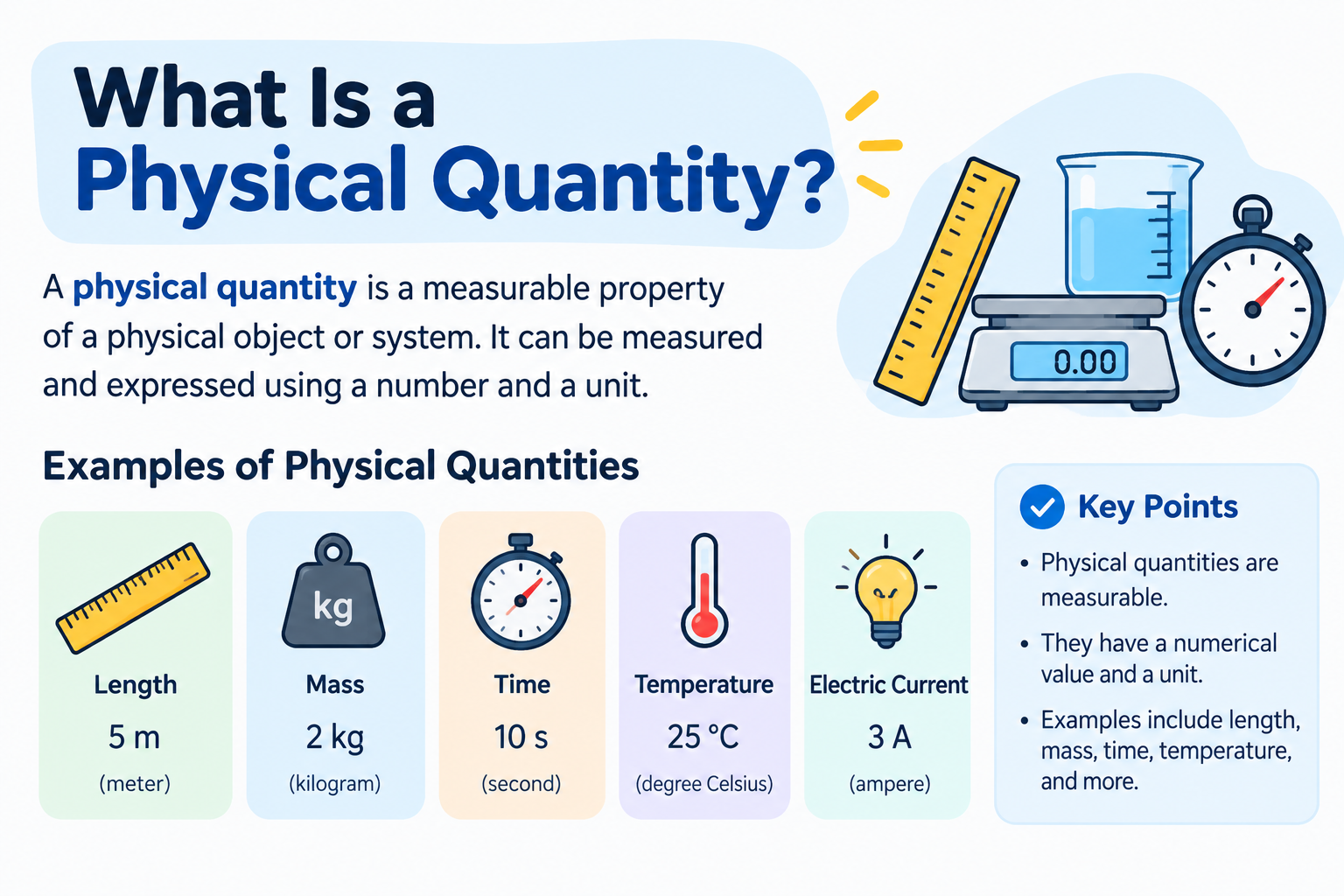
So, what is a physical quantity? A physical quantity is any property of matter or a physical phenomenon that can be measured and expressed as a number paired with a unit. Height, mass, temperature, speed, force — these are all physical quantities because they can all be measured with instruments and recorded with a value and a unit.
Understanding physical quantities is not just an academic exercise. It is the foundation of all physics — and of any science that involves measurement.
Key Takeaways
-
A physical quantity consists of two parts: a numerical value and a unit of measurement.
-
Physical quantities are classified into scalar quantities (magnitude only) and vector quantities (magnitude and direction).
-
There are seven SI base quantities — all other quantities are derived from these.
-
Derived quantities are formed by combining base quantities through multiplication or division.
-
The SI system (International System of Units) provides a globally agreed set of units for all physical quantities.
-
Common scalar quantities include mass, speed, and temperature; common vector quantities include force, velocity, and acceleration.
-
Without a unit, a number alone has no meaning in physics.
What Is a Physical Quantity?
A physical quantity is any property of a physical object, phenomenon, or system that can be measured and expressed as a number combined with a unit.
Every physical quantity has exactly two essential parts:
- A numerical value — the number obtained from measurement.
- A unit of measurement — the standard reference that gives the number its meaning.
For example:
- Height = 1.75 m (value: 1.75 / unit: metres)
- Body temperature = 37 °C (value: 37 / unit: degrees Celsius)
- Car speed = 60 km/h (value: 60 / unit: kilometres per hour)
Remove the unit, and the number becomes meaningless. If someone says “the room is 5 long,” you have no idea whether that means 5 centimetres, 5 metres, or 5 kilometres. The unit is not optional — it is essential.
Physical quantities are distinct from purely mathematical numbers (like the number of sides on a triangle) because they describe measurable properties of the physical world. You need an instrument — a ruler, a thermometer, a stopwatch — to measure them.
Types of Physical Quantities
All physical quantities fall into one of two broad categories:
- Scalar Quantities — described completely by a magnitude (size) and a unit alone.
- Vector Quantities — described completely by a magnitude, a unit, and a direction.
The single most important distinction between them is direction. A scalar does not have direction; a vector does.
| Feature | Scalar Quantity | Vector Quantity |
|---|---|---|
| Requires magnitude | Yes | Yes |
| Requires unit | Yes | Yes |
| Requires direction | No | Yes |
| Example | Mass: 5 kg | Force: 20 N downward |
This difference has real consequences in physics calculations, as you will see shortly.
Scalar Quantities — Explained
A scalar quantity is fully described by its magnitude and unit alone. You do not need to state a direction to completely describe a scalar.
If someone says the temperature outside is 28 °C, that is a complete description. You do not need to ask “in which direction?” Temperature simply does not have a direction.
Here are twelve common scalar quantities with their symbols and SI units:
| Scalar Quantity | Symbol | SI Unit | Example Value |
|---|---|---|---|
| Mass | m | kilogram (kg) | 70 kg |
| Distance | d | metre (m) | 150 m |
| Speed | v | metre per second (m/s) | 12 m/s |
| Time | t | second (s) | 45 s |
| Temperature | T | kelvin (K) | 300 K |
| Energy | E | joule (J) | 500 J |
| Power | P | watt (W) | 60 W |
| Pressure | p | pascal (Pa) | 101,325 Pa |
| Frequency | f | hertz (Hz) | 50 Hz |
| Volume | V | cubic metre (m³) | 2 m³ |
| Density | ρ | kilogram per cubic metre (kg/m³) | 1,000 kg/m³ |
| Electric charge | Q | coulomb (C) | 3 C |
For a detailed explanation of speed as a scalar quantity, see What Is Speed in Physics?
Vector Quantities — Explained
A vector quantity requires both a magnitude and a direction to be fully and correctly described.
Consider force. If you say “a force of 50 N acts on a box,” that is incomplete. Is the force pushing the box upward? To the right? Downward? The direction completely changes what happens to the box. Without stating the direction, the description of a vector is physically incomplete.
Here are twelve common vector quantities:
| Vector Quantity | Symbol | SI Unit | Example Value with Direction |
|---|---|---|---|
| Displacement | s | metre (m) | 200 m north |
| Velocity | v | metre per second (m/s) | 15 m/s east |
| Acceleration | a | metre per second squared (m/s²) | 9.8 m/s² downward |
| Force | F | newton (N) | 30 N upward |
| Weight | W | newton (N) | 700 N downward |
| Momentum | p | kilogram metre per second (kg·m/s) | 40 kg·m/s forward |
| Gravitational field strength | g | newton per kilogram (N/kg) | 9.8 N/kg downward |
| Electric field strength | E | newton per coulomb (N/C) | 500 N/C to the right |
| Magnetic field | B | tesla (T) | 0.5 T into the page |
| Torque | τ | newton metre (N·m) | 10 N·m clockwise |
| Impulse | J | newton second (N·s) | 25 N·s forward |
| Lift force | F_L | newton (N) | 5,000 N upward |
For a full explanation of velocity as a vector quantity, see What Is Velocity in Physics?
Scalar vs Vector — Key Differences
| Feature | Scalar Quantity | Vector Quantity |
|---|---|---|
| Definition | Has magnitude and unit only | Has magnitude, unit, and direction |
| Direction required | No | Yes |
| Representation | Single number with unit | Number with unit and stated direction (or arrow in diagrams) |
| Addition rule | Simple arithmetic | Must account for direction (vector addition) |
| Example | Speed: 20 m/s | Velocity: 20 m/s north |
| Can be negative in vector sense | No (scalars are non-directional) | Yes — negative sign indicates opposite direction |
| Everyday analogy | “I walked 5 km” (distance) | “I walked 5 km north” (displacement) |
| Physics equation treatment | Simple algebraic equations | Require vector algebra or trigonometry |
A useful way to remember the distinction: if you need a compass to fully describe the quantity, it is a vector. If a number and unit are enough, it is a scalar.
Base Quantities and Derived Quantities
Beyond scalar and vector, physical quantities are also classified as either base quantities or derived quantities.
Base (Fundamental) Quantities
Base quantities are the seven fundamental quantities from which all other physical quantities are built. They are defined independently of each other — none of them can be derived from the others.
| Base Quantity | SI Unit | Unit Symbol |
|---|---|---|
| Length | metre | m |
| Mass | kilogram | kg |
| Time | second | s |
| Electric current | ampere | A |
| Thermodynamic temperature | kelvin | K |
| Amount of substance | mole | mol |
| Luminous intensity | candela | cd |
These seven quantities are the building blocks of all measurement in physics.
Derived Quantities
Derived quantities are formed by mathematically combining two or more base quantities through multiplication, division, or both. They do not have their own independent definitions — they arise naturally from the base quantities.
| Derived Quantity | Formula in Terms of Base Quantities | SI Unit | Unit Symbol |
|---|---|---|---|
| Speed / Velocity | length ÷ time | metre per second | m/s |
| Acceleration | length ÷ time² | metre per second squared | m/s² |
| Force | mass × length ÷ time² | newton | N (= kg·m/s²) |
| Energy / Work | mass × length² ÷ time² | joule | J (= kg·m²/s²) |
| Power | mass × length² ÷ time³ | watt | W (= kg·m²/s³) |
| Pressure | mass ÷ (length × time²) | pascal | Pa (= kg/(m·s²)) |
| Density | mass ÷ length³ | kilogram per cubic metre | kg/m³ |
| Electric charge | current × time | coulomb | C (= A·s) |
| Voltage | mass × length² ÷ (current × time³) | volt | V (= kg·m²/(A·s³)) |
| Frequency | 1 ÷ time | hertz | Hz (= s⁻¹) |
For example, acceleration — a key derived vector quantity — is defined as the rate of change of velocity, which itself combines length and time. Learn more in What Is Acceleration in Physics?
SI Units — The International System of Units
The SI system (from the French Système International d’Unités) is the internationally agreed standard system of measurement used in science, engineering, medicine, and trade worldwide.
Before SI was adopted, different countries used different units for the same quantities — creating confusion and errors. The SI system was formally established in 1960 to give the world a single, coherent system.
The seven SI base units are: metre (m), kilogram (kg), second (s), ampere (A), kelvin (K), mole (mol), and candela (cd).
SI Prefixes
When dealing with very large or very small values, SI prefixes are used to scale units conveniently.
| Prefix | Symbol | Multiplier | Example |
|---|---|---|---|
| Giga | G | 10⁹ | 1 GHz = 1,000,000,000 Hz |
| Mega | M | 10⁶ | 1 MHz = 1,000,000 Hz |
| Kilo | k | 10³ | 1 km = 1,000 m |
| Centi | c | 10⁻² | 1 cm = 0.01 m |
| Milli | m | 10⁻³ | 1 mm = 0.001 m |
| Micro | μ | 10⁻⁶ | 1 μm = 0.000001 m |
| Nano | n | 10⁻⁹ | 1 nm = 0.000000001 m |
Using prefixes prevents the need to write out long strings of zeros and makes values much easier to read and compare.
Measuring Physical Quantities
Every physical quantity must be measured using an appropriate instrument. Using the wrong instrument — or recording results without units — introduces errors and makes results meaningless.
| Physical Quantity | Measuring Instrument | SI Unit |
|---|---|---|
| Length (large) | Metre rule / tape measure | metre (m) |
| Length (small, precise) | Vernier calliper | metre (m) |
| Length (very small, e.g. wire diameter) | Micrometer screw gauge | metre (m) |
| Temperature | Thermometer | kelvin (K) / °C |
| Mass | Balance / digital scale | kilogram (kg) |
| Time | Stopwatch | second (s) |
| Electric current | Ammeter | ampere (A) |
| Voltage (potential difference) | Voltmeter | volt (V) |
| Weight / Force | Spring balance (newton meter) | newton (N) |
| Angles | Protractor | degrees (°) |
Accuracy refers to how close a measurement is to the true value. Precision refers to how consistent repeated measurements are with each other. A good measurement is both accurate and precise.
Always record every measurement with its correct unit. A number without a unit — such as writing “the length is 35” instead of “35 cm” — is incomplete and scientifically invalid.
Scalars and Vectors in Equations
Physics equations treat scalars and vectors differently, and this matters enormously when solving problems.
Scalar equations involve straightforward arithmetic. You add, subtract, multiply, or divide the numbers directly.
For example: total distance = 300 m + 150 m = 450 m
Vector equations require you to account for direction. Two vectors pointing in the same direction add up normally. Two vectors pointing in opposite directions partially or fully cancel.
- Two forces of 10 N both pushing to the right: net force = 20 N to the right
- One force of 10 N to the right, one force of 10 N to the left: net force = 0 N
This is not just a mathematical rule — it has direct physical consequences. A tug-of-war team pulling with 500 N to the left against a team pulling 500 N to the right results in zero net force and no movement. The two vector forces cancel completely.
This is why correctly identifying whether a quantity is scalar or vector is one of the first skills you need to develop in physics.
Force is one of the most important vector quantities in physics — explore it in depth in What Is Force in Physics?
Physical Quantities in Everyday Life
Physical quantities are not confined to laboratories. They appear constantly in everyday situations.
| Situation | Physical Quantity | Scalar or Vector | Typical Value with Unit |
|---|---|---|---|
| Checking your height | Length | Scalar | 1.70 m |
| Weighing ingredients for cooking | Mass | Scalar | 250 g (0.25 kg) |
| Checking body temperature | Temperature | Scalar | 37 °C (310 K) |
| Timing a race | Time | Scalar | 9.58 s |
| Filling a water bottle | Volume | Scalar | 0.5 L (0.0005 m³) |
| Driving a car | Speed | Scalar | 80 km/h |
| Navigating with GPS | Displacement | Vector | 5 km north |
| Pushing a shopping trolley | Force | Vector | 30 N forward |
| A ball falling | Acceleration | Vector | 9.8 m/s² downward |
| A train moving | Velocity | Vector | 120 km/h eastward |
In every case, the physical quantity is measurable, expressed with a numerical value and a unit, and — for vector quantities — associated with a direction.
Common Misconceptions About Physical Quantities
| Misconception | Correct Explanation |
|---|---|
| “A number alone is enough to describe a physical quantity.” | A unit is always required. Without a unit, the number has no physical meaning. 5 kg and 5 g are completely different quantities. |
| “Speed and velocity are the same thing.” | Speed is a scalar — it has magnitude only. Velocity is a vector — it has magnitude and direction. A car travelling at 60 km/h has a speed of 60 km/h, but its velocity is 60 km/h north (or whatever direction it is moving). |
| “Mass and weight are the same.” | Mass is a scalar quantity measured in kilograms (kg) — it measures the amount of matter. Weight is a vector force measured in newtons (N) — it is the gravitational pull on the mass. They are related by W = mg, but they are not the same thing. |
| “All physical quantities can simply be added together.” | Scalar quantities can be added arithmetically. Vector quantities must be added using vector rules — direction matters. Two 10 N forces in opposite directions give zero net force, not 20 N. |
| “Temperature is a vector because it can have a negative value.” | A negative value does not make a quantity a vector. Vectors are defined by having direction — temperature has no direction. −10 °C simply means a temperature below the defined zero point of the scale. |
Understanding mass correctly is essential — for a full explanation see What Is Mass in Physics?
Physical Quantities vs Non-Physical Quantities
Not everything in the world is a physical quantity.
A physical quantity is measurable with an instrument and expressible as a number with a unit. Length, temperature, force, and time all qualify.
A non-physical quantity is real and meaningful but cannot be measured with a scientific instrument or expressed with a numerical unit. Examples include beauty, happiness, love, fairness, and courage. These are genuine human experiences — but they fall outside the scope of scientific measurement.
This distinction is important in physics: we deal exclusively with quantities that can be objectively measured, recorded, and compared using agreed-upon standards and instruments.
Worked Examples
Example 1
Question: Is “the temperature of the oven is 200” a complete description of a physical quantity?
Solution: No.
Explanation: The number 200 is present, but there is no unit. It could mean 200 °C, 200 K, or 200 °F — three very different temperatures. A physical quantity requires both a numerical value and a unit. The correct statement is “200 °C.”
Example 2
Question: Classify the following as scalar or vector: (a) 50 kg, (b) 30 m/s westward, (c) 100 J, (d) 9.8 m/s² downward.
Solution: (a) Scalar — mass has magnitude only. (b) Vector — velocity has magnitude and direction. (c) Scalar — energy has magnitude only. (d) Vector — acceleration has magnitude and direction.
Explanation: The presence or absence of a direction is the key test.
Example 3
Question: Is force a base or derived quantity?
Solution: Derived.
Explanation: Force = mass × acceleration = kg × m/s² = kg·m/s². It is built from the base quantities mass (kg), length (m), and time (s). It is not one of the seven independent base quantities.
Example 4
Question: Convert 5.2 km into metres.
Solution: 5.2 km = 5.2 × 1,000 m = 5,200 m
Explanation: The prefix “kilo” means 10³ (one thousand). Multiplying by 1,000 converts kilometres to metres.
Example 5
Question: Convert 450 nm into metres.
Solution: 450 nm = 450 × 10⁻⁹ m = 4.5 × 10⁻⁷ m
Explanation: The prefix “nano” means 10⁻⁹. This is a typical wavelength of visible light (violet/blue range).
Example 6
Question: A student walks 200 m east, then 200 m west. What is their total distance? What is their displacement?
Solution: Distance = 200 + 200 = 400 m (scalar — direction does not matter). Displacement = 200 m east − 200 m west = 0 m (vector — directions cancel).
Explanation: Distance is a scalar and adds arithmetically. Displacement is a vector and accounts for direction — the student ends up at the starting point.
Example 7
Question: Two people push a box in the same direction — one with 15 N and one with 25 N. What is the net force?
Solution: Net force = 15 N + 25 N = 40 N in the direction of pushing.
Explanation: Forces are vectors, but when they point in the same direction, they add directly.
Example 8
Question: Two people push a box in opposite directions — one with 20 N to the right, one with 20 N to the left. What is the net force?
Solution: Net force = 20 N − 20 N = 0 N
Explanation: Equal and opposite vector forces cancel. The box does not accelerate.
Example 9
Question: What is the SI unit of pressure, and express it in terms of base units?
Solution: The SI unit of pressure is the pascal (Pa). 1 Pa = 1 N/m² = 1 kg/(m·s²).
Explanation: Pressure = force ÷ area. Force is in newtons (kg·m/s²) and area is in m². Dividing gives kg·m⁻¹·s⁻².
Example 10
Question: A student records a mass measurement as “5.” Is this acceptable in physics?
Solution: No — it is incomplete.
Explanation: The unit is missing. Is it 5 grams, 5 kilograms, or 5 milligrams? In physics, every measurement must include both the numerical value and the unit. The correct record is “5 kg” (or whichever unit applies).
Example 11
Question: Classify the following as base or derived: (a) length, (b) density, (c) electric current, (d) energy.
Solution: (a) Base. (b) Derived (mass/volume = kg/m³). (c) Base. (d) Derived (kg·m²/s²).
Explanation: Base quantities are the seven fundamental ones. Density and energy are combinations of base quantities and are therefore derived.
Example 12
Question: A car travels at 90 km/h. Convert this speed to m/s.
Solution: 90 km/h = 90 × (1,000 m) ÷ (3,600 s) = 90,000 ÷ 3,600 = 25 m/s
Explanation: Convert km to m (multiply by 1,000) and hours to seconds (multiply by 3,600). The standard SI unit of speed is m/s.
Practice Questions
12 Short Answer Questions
1. Define a physical quantity.
Answer: A physical quantity is any property of matter or a physical phenomenon that can be measured and expressed as a numerical value paired with a unit of measurement.
2. What are the two essential parts of every physical quantity?
Answer: A numerical value and a unit of measurement.
3. What is the difference between a scalar and a vector quantity?
Answer: A scalar quantity has magnitude and unit only. A vector quantity has magnitude, unit, and direction.
4. Give three examples of scalar quantities and three examples of vector quantities.
Answer: Scalars — mass, speed, temperature. Vectors — force, velocity, displacement.
5. What are the seven SI base quantities?
Answer: Length (m), mass (kg), time (s), electric current (A), thermodynamic temperature (K), amount of substance (mol), luminous intensity (cd).
6. What is a derived quantity? Give two examples.
Answer: A derived quantity is formed by combining base quantities. Examples: speed (m/s = length/time) and force (N = kg·m/s²).
7. What is the SI unit of force, and what base units does it consist of?
Answer: Newton (N) = kg·m/s² (mass × length ÷ time²).
8. Why is it incorrect to say “the mass is 5”?
Answer: Because a physical quantity requires a unit. The correct statement must include a unit, e.g., “5 kg.”
9. Convert 3.5 km to metres.
Answer: 3,500 m (multiply by 1,000).
10. Is weight a scalar or a vector? Explain.
Answer: Weight is a vector. It is a force — the gravitational pull on a mass — and it acts in a specific direction (toward the centre of the Earth, i.e., downward).
11. What instrument is used to measure electric current, and what is its SI unit?
Answer: An ammeter measures electric current. The SI unit is the ampere (A).
12. Explain why two equal forces can produce a net force of zero.
Answer: If two equal forces act in exactly opposite directions, they cancel each other out because they are vectors. The net (resultant) force = 0 N.
10 Multiple Choice Questions
Question 1
Which of the following is a vector quantity?
A. Mass
B. Temperature
C. Speed
D. Displacement
Correct Answer: D
Short Explanation: Displacement has magnitude and direction (e.g., 50 m north). The others — mass, temperature, and speed — are scalar quantities.
Question 2
What are the two essential components of a physical quantity?
A. Mass and volume
B. Numerical value and unit
C. Direction and magnitude
D. Base quantity and derived quantity
Correct Answer: B
Short Explanation: Every physical quantity must have a numerical value (the measurement) and a unit (what it is measured in). Without both, the quantity is incomplete.
Question 3
Which of the following is a base SI quantity?
A. Force
B. Speed
C. Electric current
D. Pressure
Correct Answer: C
Short Explanation: Electric current (measured in amperes, A) is one of the seven SI base quantities. Force, speed, and pressure are all derived quantities.
Question 4
A student records a speed as “25.” What is wrong with this record?
A. The number is incorrect.
B. The unit is missing.
C. Speed is not a physical quantity.
D. The direction is missing.
Correct Answer: B
Short Explanation: Speed is a scalar physical quantity — it requires a numerical value and a unit. “25 m/s” would be correct. Speed does not require direction (it is scalar), but it does require a unit.
Question 5
What is the SI unit of energy?
A. Newton (N)
B. Watt (W)
C. Joule (J)
D. Pascal (Pa)
Correct Answer: C
Short Explanation: The joule (J) is the SI unit of energy. 1 J = 1 kg·m²/s². The newton is force; the watt is power; the pascal is pressure.
Question 6
Which prefix represents 10⁻³?
A. Micro
B. Nano
C. Milli
D. Centi
Correct Answer: C
Short Explanation: Milli (m) = 10⁻³. Micro = 10⁻⁶, Nano = 10⁻⁹, Centi = 10⁻².
Question 7
Two forces act on an object: 15 N to the right and 10 N to the left. What is the net force?
A. 25 N to the right
B. 5 N to the right
C. 25 N to the left
D. 5 N to the left
Correct Answer: B
Short Explanation: Forces are vectors. 15 N right − 10 N left = 5 N to the right. The greater force determines the direction of the net force.
Question 8
Which of the following correctly distinguishes mass from weight?
A. Mass is in newtons; weight is in kilograms.
B. Mass is a vector; weight is a scalar.
C. Mass is a scalar measured in kg; weight is a vector force measured in N.
D. Mass and weight are the same quantity.
Correct Answer: C
Short Explanation: Mass measures the amount of matter (scalar, kg). Weight is the gravitational force acting on that mass (vector, N). W = mg.
Question 9
Which instrument is used to measure small lengths accurately, such as the diameter of a wire?
A. Metre rule
B. Protractor
C. Spring balance
D. Micrometer screw gauge
Correct Answer: D
Short Explanation: A micrometer screw gauge is designed to measure very small lengths (typically 0–25 mm) with high precision, such as the diameter of a wire or the thickness of a sheet.
Question 10
Which of the following is a derived quantity?
A. Mass
B. Time
C. Length
D. Density
Correct Answer: D
Short Explanation: Density = mass ÷ volume = kg/m³. It is derived from the base quantities mass and length. Mass, time, and length are all base quantities.
5 Challenge Questions
Challenge 1:
A student says: “Velocity and speed are the same — they both describe how fast something is moving.” Explain precisely why this statement is incorrect, using an example to illustrate.
Answer:
The student is incorrect. Speed is a scalar quantity — it tells you the rate at which an object covers distance, with no direction involved. Velocity is a vector quantity — it tells you both the rate of motion and the direction.
Example: A car driving around a circular track at a constant 60 km/h has constant speed but changing velocity, because its direction is continuously changing. Since velocity is a vector, any change in direction constitutes a change in velocity — even if the speed remains the same. This is why a car moving in a circle is actually accelerating (centripetal acceleration), even though its speed is unchanged.
Challenge 2:
A box experiences three forces: 30 N to the right, 20 N to the right, and 15 N to the left. Calculate the net force and state its direction. Then state whether the box will accelerate and in which direction.
Answer:
Forces to the right: 30 N + 20 N = 50 N to the right.
Force to the left: 15 N to the left.
Net force = 50 N − 15 N = 35 N to the right.
Since the net force is 35 N to the right and is not zero, the box will accelerate to the right (by Newton’s Second Law, F = ma).
Challenge 3:
Express the SI unit of pressure (pascal) entirely in terms of SI base units. Show your working clearly.
Answer:
Pressure = Force ÷ Area
Force is measured in newtons.
1 N = 1 kg·m·s⁻² (from F = ma: kg × m/s²)
Area is measured in m².
Therefore: Pressure = N/m² = (kg·m·s⁻²) / m² = kg·m⁻¹·s⁻²
So 1 Pa = 1 kg·m⁻¹·s⁻².
Challenge 4:
A scientist measures the wavelength of green light as 530 nm. (a) Convert this to metres. (b) Convert this to micrometres. (c) State whether wavelength is a scalar or vector quantity.
Answer:
(a) 530 nm = 530 × 10⁻⁹ m = 5.30 × 10⁻⁷ m
(b) 5.30 × 10⁻⁷ m ÷ 10⁻⁶ m/μm = 0.530 μm (or 5.30 × 10⁻¹ μm)
(c) Wavelength is a scalar quantity. It is a length measurement — the distance between two consecutive wave crests or troughs. It has magnitude and a unit, but no direction.
Challenge 5:
Explain why it is physically incorrect to add a force of 40 N and a distance of 40 m and claim the result is “80.” Address two separate errors in this statement.
Answer:
There are two distinct errors:
Error 1 — Adding unlike quantities: In physics, you can only add quantities that measure the same physical property and share the same unit. Force (measured in newtons) and distance (measured in metres) are entirely different physical quantities. Adding them together is physically meaningless — just as you cannot add 3 kg + 4 seconds.
Error 2 — Missing units in the “result”: Even if someone mistakenly added the numbers, stating “80” without a unit is wrong. A physical quantity always requires a unit. What would “80” even mean here? It has no physical interpretation.
The correct approach: use force and distance together appropriately in a physics equation — for example, work done = force × distance = 40 N × 40 m = 1,600 J (joules of energy). Each step produces a result with a physically meaningful unit.
Physical Quantities in Physics Topics
Physical quantities appear across every branch of physics. Here is a brief overview:
Mechanics
Length, mass, time, speed, velocity, acceleration, force, displacement, momentum, and energy are all central to mechanics. Most involve both scalar and vector quantities, and understanding the distinction is essential for solving problems correctly.
Thermodynamics
Temperature (scalar, kelvin), heat energy (scalar, joules), and pressure (scalar, pascals) are the key quantities. Thermodynamics deals with how energy transfers between systems.
Electricity
Electric current (scalar, amperes), voltage or potential difference (scalar, volts), resistance (scalar, ohms), and electric charge (scalar, coulombs) are the core electrical quantities. Electric and magnetic field strengths are vectors.
Waves
Frequency (scalar, hertz), wavelength (scalar, metres), amplitude (scalar, metres), and wave speed (scalar, m/s) describe wave behaviour. Wave propagation direction is a vector property used in more advanced contexts.
Optics
Refractive index (scalar, dimensionless) describes how much light bends when passing between media. Focal length (scalar, metres) describes lens properties. Light ray direction is treated as a vector in ray diagram work.
Exam Tips
- Always write the unit alongside every numerical answer. A correct number with no unit will typically lose marks.
- State direction when describing a vector quantity. “30 N” is incomplete for a force answer — “30 N downward” is correct.
- Learn the seven SI base quantities and their units — they are frequently tested and underpin all derived quantities.
- Know which common quantities are scalar and which are vector. Build a mental list: force, velocity, acceleration, displacement, and momentum are vectors; mass, speed, time, temperature, energy, and distance are scalars.
- Derived units can be expressed in terms of base units. Practise converting: 1 N = kg·m/s², 1 J = kg·m²/s², 1 Pa = kg/(m·s²).
- Do not confuse mass (kg) with weight (N). They are different quantities. Mass is scalar; weight is a vector force.
- Do not confuse speed (scalar) with velocity (vector). If a question asks for velocity, state the direction.
- When adding vectors, direction matters. Two equal forces in opposite directions produce zero net force — not double the force.
- SI prefixes are regularly tested — know at minimum: nano (10⁻⁹), micro (10⁻⁶), milli (10⁻³), centi (10⁻²), kilo (10³), mega (10⁶), giga (10⁹).
Quick Revision Notes
Physical Quantity: Any measurable property expressed as a number with a unit. Two essential parts — numerical value + unit.
Scalar vs Vector:
- Scalar: magnitude and unit only (mass, speed, temperature, distance, energy, time).
- Vector: magnitude, unit, and direction (force, velocity, acceleration, displacement, weight, momentum).
Base Quantities (7): Length (m), Mass (kg), Time (s), Electric Current (A), Temperature (K), Amount of Substance (mol), Luminous Intensity (cd).
Derived Quantities: Built from base quantities. Examples: speed (m/s), force (N = kg·m/s²), energy (J = kg·m²/s²), pressure (Pa = kg/(m·s²)).
SI Prefixes: Giga (G, 10⁹), Mega (M, 10⁶), Kilo (k, 10³), Centi (c, 10⁻²), Milli (m, 10⁻³), Micro (μ, 10⁻⁶), Nano (n, 10⁻⁹).
Common Instruments: Ruler (length), Vernier calliper (precise length), Micrometer (very small length), Thermometer (temperature), Balance (mass), Stopwatch (time), Ammeter (current), Voltmeter (voltage), Spring balance (force), Protractor (angle).
Common Mistakes:
- Forgetting units.
- Confusing speed (scalar) with velocity (vector).
- Confusing mass (kg) with weight (N).
- Treating vectors like scalars when adding (ignoring direction).
- Thinking a negative value makes a quantity a vector.
Physical Quantities Cheat Sheet
| Concept | Key Point | Example |
|---|---|---|
| Physical quantity | Number + unit | 9.8 m/s² |
| Scalar | Magnitude and unit only | Mass: 70 kg |
| Vector | Magnitude, unit, and direction | Weight: 686 N downward |
| Base quantity | One of 7 fundamental quantities | Length (metre, m) |
| Derived quantity | Built from base quantities | Force: kg·m/s² = N |
| SI prefix: kilo | × 10³ | 1 km = 1,000 m |
| SI prefix: milli | × 10⁻³ | 1 mm = 0.001 m |
| SI prefix: micro | × 10⁻⁶ | 1 μm = 0.000001 m |
| SI prefix: nano | × 10⁻⁹ | 1 nm = 0.000000001 m |
| Speed vs velocity | Speed = scalar / Velocity = vector | 60 km/h vs 60 km/h north |
| Mass vs weight | Mass = kg (scalar) / Weight = N (vector) | 10 kg vs 98 N downward |
| Vector addition | Direction matters | 10 N + (−10 N) = 0 N |
Frequently Asked Questions
1. What is a physical quantity?
A physical quantity is any property of matter or a physical phenomenon that can be measured and expressed as a number with a unit. Examples include length, mass, temperature, force, and speed.
2. What are the two types of physical quantities?
Scalar quantities (magnitude and unit only) and vector quantities (magnitude, unit, and direction).
3. What is a scalar quantity?
A scalar quantity is fully described by its magnitude (size) and unit alone. Direction is not needed. Examples: mass, temperature, speed, distance, energy, time.
4. What is a vector quantity?
A vector quantity requires magnitude, a unit, and a direction to be fully described. Examples: force, velocity, acceleration, displacement, weight, momentum.
5. What is the difference between scalar and vector quantities?
The key difference is direction. Scalars have no direction; vectors do. This affects how they are added, subtracted, and used in equations.
6. What are the seven base quantities in physics?
Length (m), mass (kg), time (s), electric current (A), thermodynamic temperature (K), amount of substance (mol), and luminous intensity (cd).
7. What is a derived quantity?
A derived quantity is formed by mathematically combining two or more base quantities. Examples: speed (m/s), force (N = kg·m/s²), energy (J = kg·m²/s²).
8. What is the SI system?
The SI system (International System of Units) is the globally agreed standard for measurement in science and engineering. It defines seven base units from which all other units are derived.
9. Is temperature a scalar or vector?
Temperature is a scalar quantity. It has magnitude and a unit (kelvin or degrees Celsius) but no direction. A negative temperature does not make it a vector — negative simply means below the chosen zero point of the scale.
10. Is mass a scalar or vector?
Mass is a scalar quantity. It measures the amount of matter in an object and has magnitude (in kilograms) but no direction.
11. What is the difference between mass and weight?
Mass is a scalar — it measures the amount of matter (kg) and does not change with location. Weight is a vector — it is the gravitational force on a mass (N = kg × g), acts downward, and varies with gravitational field strength.
12. What is the difference between speed and velocity?
Speed is a scalar — it measures how fast an object is moving (m/s) with no direction. Velocity is a vector — it measures how fast an object is moving in a specific direction (e.g., 20 m/s north).
13. Why do physical quantities need units?
Without a unit, a number has no physical meaning. Saying “the length is 5” tells you nothing — is it 5 mm or 5 km? Units provide the context that makes measurements meaningful and comparable.
14. What are SI prefixes?
SI prefixes are multipliers attached to unit names to represent very large or very small values conveniently. For example, kilo (10³), milli (10⁻³), and nano (10⁻⁹) scale metres into kilometres, millimetres, and nanometres respectively.
15. How do you identify whether a quantity is base or derived?
Check whether it is one of the seven SI base quantities (length, mass, time, current, temperature, amount of substance, luminous intensity). If not, it is derived — you can express it in terms of base units. For example, energy is not a base quantity; it equals kg·m²·s⁻², which is derived from mass, length, and time.
Summary
Every measurement in physics is a physical quantity — a number paired with a unit. Without both parts, the measurement is incomplete and meaningless.
Physical quantities are classified in two important ways:
First, as scalars (magnitude and unit only — such as mass, speed, and temperature) or vectors (magnitude, unit, and direction — such as force, velocity, and acceleration). This distinction matters because vectors must be combined using direction, not just arithmetic.
Second, as base quantities (the seven fundamental quantities from which everything else is built) or derived quantities (combinations of base quantities that describe more complex phenomena like energy, pressure, and force).
The SI system provides the internationally agreed units for all of these quantities, ensuring that measurements made anywhere in the world can be clearly communicated, compared, and verified.
Final Thoughts
Every equation you will ever encounter in physics involves physical quantities. Every experiment you perform measures them. Every result you record must state them correctly — with a value and a unit.
Understanding what a physical quantity is, how to classify it, and how to measure and express it correctly is not just the first topic in physics — it is the foundation on which every other topic is built. Get this right, and everything that follows becomes considerably clearer.
Whether you are calculating the speed of a falling object, the force on a moving charge, or the energy stored in a spring, you are working with physical quantities every step of the way. The better you understand them, the more confidently you can approach any physics problem.
References
- Khan Academy — Units and Measurement: https://www.khanacademy.org
- OpenStax University Physics — Units and Measurement: https://openstax.org
- Physics LibreTexts — Physical Quantities and Units: https://phys.libretexts.org
- Encyclopaedia Britannica — Physical Quantity: https://www.britannica.com
- NIST — SI Units and the International System of Units: https://www.nist.gov
Helpful Resources
Khan Academy — Physics: Units and Measurement
Students can watch video lessons and complete exercises on physical quantities, SI units, unit conversion, and scientific notation.
https://www.khanacademy.org
OpenStax University Physics
A free, peer-reviewed university-level physics textbook with detailed chapters on physical quantities, SI units, scalars, vectors, and measurement — suitable for GCSE through early university.
https://openstax.org
NIST — National Institute of Standards and Technology
The official source for SI unit definitions, SI prefixes, and the international standards that underpin all physical measurement worldwide.
https://www.nist.gov
Physics LibreTexts
Provides structured, accessible chapters on scalars, vectors, base and derived quantities, and SI units — useful for both classroom learning and independent study.
https://phys.libretexts.org
Disclaimer:
This article is intended for educational and informational purposes only. While LearnMinto strives to provide accurate and up-to-date physics information, readers should verify important academic concepts through official textbooks, educational institutions, examination boards, or trusted educational resources before using this content for exams or academic purposes. LearnMinto is not affiliated with any specific school, university, research institution, or examination board.
About the Author
Saad Qureshi is a Senior Education & Technology Editor at LearnMinto. He focuses on creating and reviewing clear, accessible educational content across mathematics, physics, chemistry, biology, computer science, technology, AI tools, and personal finance.