
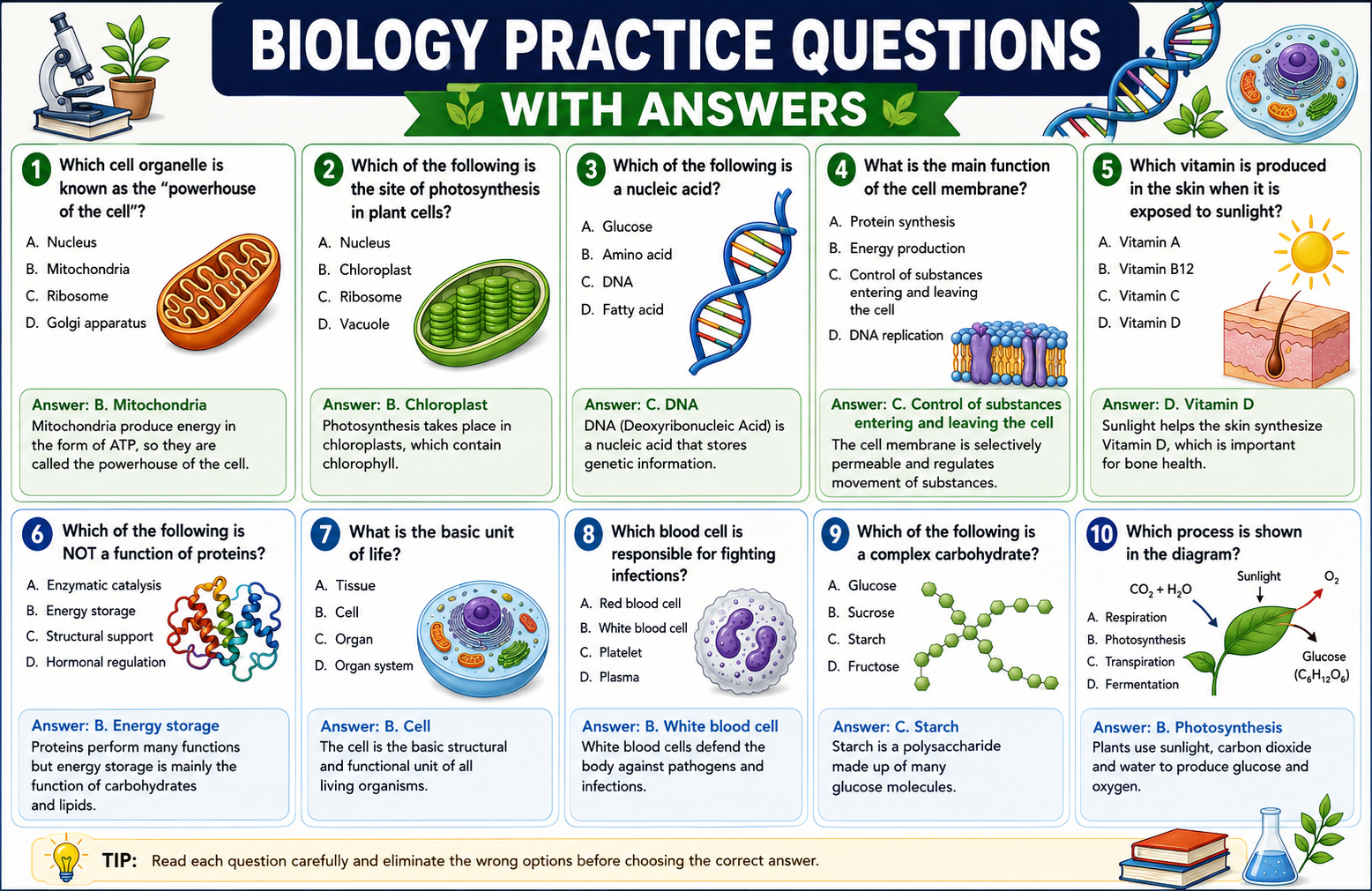
If you have been looking for one solid, all-in-one collection of biology practice questions with answers, you have come to the right place. Whether you are preparing for NEET, MCAT, MDCAT, A-Level, GCSE, SAT Biology, or a university entrance exam, practicing multiple-choice questions is honestly one of the most effective ways to lock in what you have studied.
Here is the thing about biology — it is a subject that rewards consistency. You can read your notes a dozen times, but until you actually test yourself, you never really know which concepts are sitting firmly in your memory and which ones are still a bit shaky. That is exactly what this guide is designed to do. It gives you 200+ original, exam-style MCQs across 15 major biology topics, each with the correct answer clearly marked and a short explanation so you understand the reasoning, not just the result.
This collection covers everything from cell biology and biomolecules to genetics, photosynthesis, human anatomy, and plant biology. Every question has been written with real exams in mind, including the kind of tricky, application-based questions that distinguish a good score from a great one.
Whether you are a high school student working through your biology revision checklist, a medical school applicant doing a final push, or a self-learner who just wants to sharpen their knowledge, this guide has something genuinely useful for you. Let us get into it.
Key Takeaways
- This article contains 200+ original biology MCQs organized by topic for structured exam preparation.
- Each question includes four answer options (A–D), the correct answer, and a brief explanation.
- Topics covered include cell biology, genetics, DNA and RNA, photosynthesis, cellular respiration, enzymes, biomolecules, human anatomy, and more.
- Suitable for NEET, MCAT, MDCAT, GCSE, A-Level, SAT Biology, and university entrance exam candidates.
- Practical exam tips, a revision checklist, and recommended resources are also included.
How to Use This Biology MCQ Guide
This guide is designed to be flexible, so use it in whatever way fits your study style. Here are a few approaches that work well.
Topic-by-topic practice: If you are working through your syllabus unit by unit, stick to one section at a time. Finish the questions, check your answers, read the explanations, and only then move to the next topic.
Timed practice: Set a timer and try to answer 20 questions in 15 minutes. This builds exam speed and helps reduce anxiety when you sit the actual test.
Weakness targeting: Already strong in genetics but struggling with photosynthesis? Go straight to those sections. Targeted practice saves time and delivers better results per study hour.
Full mock test mode: Answer all 200+ questions in one sitting to simulate a full exam experience. Review every wrong answer carefully afterward.
One golden rule — do not look at the answers before attempting the question. The struggle of trying to recall the answer is what actually strengthens memory.
Why Practice Biology MCQs?
There is solid science behind why multiple-choice practice works so well for biology revision. It comes down to something called the testing effect, which is the well-documented finding that retrieving information from memory actually strengthens that memory more than simply re-reading does.
Here are the main reasons biology MCQ practice is worth your time:
- Active recall beats passive reading. When you try to remember an answer, you are doing real cognitive work. That work makes the memory stick.
- It reveals gaps instantly. You might think you understand enzyme kinetics until a question trips you up. MCQs surface those gaps fast.
- It builds pattern recognition. Biology exams tend to test the same core ideas in slightly different ways. Practice helps you recognize those patterns.
- Explanations deepen understanding. Reading why an answer is correct — especially for the ones you got wrong — reinforces conceptual understanding rather than rote memorization.
- Confidence grows with repetition. Sitting an exam is partly a psychological challenge. Regular practice reduces the fear factor significantly.
Biology Exam Preparation Tips
Before diving into the questions, a few preparation strategies worth knowing:
- Start with the syllabus. Know exactly what your exam board covers. Do not waste time studying content that will not appear.
- Use active recall daily. Instead of rereading notes, close your book and try to write down what you remember. Then check.
- Draw diagrams from memory. For topics like cell structure, the heart, and the neuron, drawing without looking forces deeper processing.
- Understand, do not memorize blindly. Biology has a lot of vocabulary, but almost everything makes logical sense once you understand the underlying mechanism.
- Use spaced repetition. Revisit topics at increasing intervals — after one day, then three days, then a week. Apps like Anki can automate this.
- Prioritize high-yield topics. Cell biology, genetics, photosynthesis, and cellular respiration appear heavily across most exams.
- Practice past papers. After using this guide, source official past papers from your exam board for the closest possible simulation.
Biology Practice Questions by Topic
Cell Biology MCQs (20 Questions)
Related Resource: For a deeper conceptual foundation, explore the LearnMinto Cell Biology Study Guide before or after attempting these questions.
Q1. Which of the following is the basic structural and functional unit of life?
- A) Tissue
- B) Organ
- C) Cell
- D) Molecule
Correct Answer: C) Cell
Explanation: The cell is universally recognized as the basic structural and functional unit of all living organisms. This is one of the central principles of the cell theory, first formally proposed by Schleiden and Schwann.
Q2. Cell theory was NOT proposed by which of the following scientists?
- A) Matthias Schleiden
- B) Theodor Schwann
- C) Rudolf Virchow
- D) Gregor Mendel
Correct Answer: D) Gregor Mendel
Explanation: Gregor Mendel is the father of genetics, not cell theory. Schleiden, Schwann, and Virchow are the three scientists most closely associated with the development of modern cell theory.
Q3. Which type of cell does NOT contain a membrane-bound nucleus?
- A) Plant cell
- B) Animal cell
- C) Prokaryotic cell
- D) Eukaryotic cell
Correct Answer: C) Prokaryotic cell
Explanation: Prokaryotic cells, such as bacteria, lack a membrane-bound nucleus. Their genetic material is found in a region called the nucleoid, which is not enclosed by a nuclear envelope.
Q4. The fluid mosaic model describes the structure of which cellular component?
- A) Cell wall
- B) Cytoplasm
- C) Cell membrane
- D) Ribosome
Correct Answer: C) Cell membrane
Explanation: The fluid mosaic model, proposed by Singer and Nicolson in 1972, describes the cell membrane as a fluid phospholipid bilayer embedded with proteins that can move laterally — hence the term “mosaic.”
Q5. Which organelle is responsible for producing energy in the form of ATP?
- A) Ribosome
- B) Golgi apparatus
- C) Mitochondria
- D) Lysosome
Correct Answer: C) Mitochondria
Explanation: Mitochondria are the sites of cellular respiration, where glucose and oxygen are used to produce ATP. This is why mitochondria are often called the powerhouse of the cell.
Q6. Lysosomes are primarily responsible for:
- A) Protein synthesis
- B) Digestion of cellular waste and foreign material
- C) Lipid synthesis
- D) DNA replication
Correct Answer: B) Digestion of cellular waste and foreign material
Explanation: Lysosomes contain hydrolytic enzymes that break down old organelles, cellular debris, and pathogens. This process is called autophagy when the material is internal.
Q7. Which of the following is a feature of eukaryotic cells but NOT prokaryotic cells?
- A) Ribosomes
- B) Cell membrane
- C) Membrane-bound organelles
- D) DNA
Correct Answer: C) Membrane-bound organelles
Explanation: Eukaryotic cells have membrane-bound organelles such as the nucleus, mitochondria, and endoplasmic reticulum. Prokaryotic cells lack these structures, though they do have ribosomes, a cell membrane, and DNA.
Q8. The process by which cells engulf large particles or other cells is called:
- A) Pinocytosis
- B) Phagocytosis
- C) Exocytosis
- D) Osmosis
Correct Answer: B) Phagocytosis
Explanation: Phagocytosis is a form of endocytosis where the cell membrane wraps around a large particle to engulf it. White blood cells use phagocytosis to destroy pathogens.
Q9. Which structure controls what enters and exits the cell?
- A) Cell wall
- B) Cytoplasm
- C) Nucleus
- D) Cell membrane
Correct Answer: D) Cell membrane
Explanation: The selectively permeable cell membrane regulates the movement of substances into and out of the cell, maintaining the internal environment.
Q10. Cytoplasm is best described as:
- A) The fluid inside the nucleus
- B) The gel-like fluid that fills the cell and suspends the organelles
- C) The outer covering of the cell
- D) The fluid inside mitochondria
Correct Answer: B) The gel-like fluid that fills the cell and suspends the organelles
Explanation: Cytoplasm is the semi-fluid substance found between the nucleus and the cell membrane. It provides a medium in which organelles are suspended and biochemical reactions take place.
Q11. Which of the following best describes the term “cell differentiation”?
- A) Cells dividing to produce identical copies
- B) Cells changing into specialized types with specific functions
- C) Cells increasing in size
- D) Cells undergoing apoptosis
Correct Answer: B) Cells changing into specialized types with specific functions
Explanation: Cell differentiation is the process by which cells develop specific structures and functions during an organism’s development. It is driven by differential gene expression.
Q12. What is the approximate size range of a typical animal cell?
- A) 1–10 nanometers
- B) 10–100 micrometers
- C) 1–10 millimeters
- D) 100–500 micrometers
Correct Answer: B) 10–100 micrometers
Explanation: Most animal cells range from about 10 to 100 micrometers in diameter, making them visible only under a light microscope.
Q13. Which of the following organelles contains its own DNA?
- A) Golgi apparatus
- B) Ribosome
- C) Mitochondria
- D) Vacuole
Correct Answer: C) Mitochondria
Explanation: Mitochondria have their own circular DNA and ribosomes, supporting the endosymbiotic theory, which suggests that mitochondria were once free-living prokaryotes.
Q14. The concept of “omnis cellula e cellula” means:
- A) All cells have a nucleus
- B) All cells arise from pre-existing cells
- C) Cells are the smallest unit of life
- D) All cells contain DNA
Correct Answer: B) All cells arise from pre-existing cells
Explanation: This Latin phrase, attributed to Rudolf Virchow, means “every cell from a cell” and is one of the foundational principles of modern cell theory.
Q15. Which of the following is a function of the smooth endoplasmic reticulum (SER)?
- A) Ribosome synthesis
- B) Protein synthesis
- C) Lipid synthesis and detoxification
- D) ATP production
Correct Answer: C) Lipid synthesis and detoxification
Explanation: Unlike the rough ER, the smooth ER lacks ribosomes. It plays a key role in lipid and steroid hormone synthesis, as well as detoxification of drugs and metabolic byproducts.
Q16. What type of microscope would you use to see the three-dimensional surface of a cell?
- A) Light microscope
- B) Transmission electron microscope
- C) Scanning electron microscope
- D) Fluorescence microscope
Correct Answer: C) Scanning electron microscope
Explanation: Scanning electron microscopes (SEM) produce high-resolution, three-dimensional images of cell surfaces, making them ideal for studying external structures.
Q17. The nucleolus is responsible for:
- A) DNA replication
- B) RNA transcription of all genes
- C) Ribosomal RNA synthesis and ribosome assembly
- D) Protein packaging
Correct Answer: C) Ribosomal RNA synthesis and ribosome assembly
Explanation: The nucleolus is a dense region within the nucleus where rRNA is produced and ribosomal subunits are assembled before being exported to the cytoplasm.
Q18. Which of the following cellular processes requires energy (ATP)?
- A) Facilitated diffusion
- B) Osmosis
- C) Active transport
- D) Simple diffusion
Correct Answer: C) Active transport
Explanation: Active transport moves substances against their concentration gradient, which requires energy in the form of ATP. Diffusion and osmosis are passive processes that do not require energy.
Q19. A cell that lacks a cell wall would most likely be:
- A) A plant cell
- B) A fungal cell
- C) A bacterial cell
- D) An animal cell
Correct Answer: D) An animal cell
Explanation: Animal cells are unique among common cell types in that they do not have a cell wall. Plant cells, fungal cells, and most bacteria possess cell walls made of different materials.
Q20. What happens to a cell placed in a hypertonic solution?
- A) It swells and may burst
- B) It remains unchanged
- C) It shrinks due to water loss by osmosis
- D) It undergoes mitosis
Correct Answer: C) It shrinks due to water loss by osmosis
Explanation: In a hypertonic solution, the solute concentration outside the cell is higher than inside. Water moves out of the cell by osmosis, causing it to shrink — a process called crenation in animal cells.
Cell Structure and Function MCQs (20 Questions)
Q21. Which organelle modifies, sorts, and packages proteins for secretion?
- A) Mitochondria
- B) Golgi apparatus
- C) Ribosome
- D) Smooth ER
Correct Answer: B) Golgi apparatus
Explanation: The Golgi apparatus, sometimes called the “post office” of the cell, receives proteins from the rough ER, modifies them, and packages them into vesicles for secretion or intracellular use.
Q22. Cilia and flagella are primarily made of:
- A) Actin and myosin
- B) Microtubules arranged in a 9+2 pattern
- C) Intermediate filaments
- D) Microfilaments only
Correct Answer: B) Microtubules arranged in a 9+2 pattern
Explanation: Both cilia and flagella are composed of microtubules arranged in the characteristic 9+2 array — nine pairs of outer microtubules surrounding a central pair — which enables their movement.
Q23. The primary function of ribosomes is:
- A) DNA replication
- B) Lipid synthesis
- C) Protein synthesis
- D) Energy production
Correct Answer: C) Protein synthesis
Explanation: Ribosomes translate messenger RNA (mRNA) into polypeptide chains, making them the sites of protein synthesis. They can be free in the cytoplasm or attached to the rough endoplasmic reticulum.
Q24. Plant cells have a large central vacuole that functions mainly to:
- A) Produce energy
- B) Synthesize chlorophyll
- C) Maintain turgor pressure and store substances
- D) Carry out photosynthesis
Correct Answer: C) Maintain turgor pressure and store substances
Explanation: The large central vacuole in plant cells fills with water to create turgor pressure, which keeps the plant firm. It also stores ions, waste products, and pigments.
Q25. Which component of the cell membrane is primarily responsible for its fluid nature?
- A) Cholesterol
- B) Glycoproteins
- C) Phospholipid bilayer
- D) Peripheral proteins
Correct Answer: C) Phospholipid bilayer
Explanation: The phospholipid bilayer gives the membrane its fluid character because the fatty acid tails are unsaturated, allowing phospholipids to move laterally. Cholesterol helps regulate this fluidity.
Q26. What is the role of the nuclear envelope?
- A) Synthesizing proteins
- B) Separating nuclear contents from the cytoplasm and regulating transport
- C) Producing energy
- D) Synthesizing lipids
Correct Answer: B) Separating nuclear contents from the cytoplasm and regulating transport
Explanation: The nuclear envelope is a double-membrane structure with nuclear pores that regulate the passage of molecules, such as mRNA and proteins, between the nucleus and the cytoplasm.
Q27. Which type of protein in the cell membrane spans the entire lipid bilayer?
- A) Peripheral protein
- B) Glycoprotein only
- C) Integral (transmembrane) protein
- D) Carrier lipid
Correct Answer: C) Integral (transmembrane) protein
Explanation: Integral or transmembrane proteins are embedded within the phospholipid bilayer and span its entire width. They serve as channels, carriers, receptors, and enzymes.
Q28. The cytoskeleton is responsible for:
- A) Digesting waste
- B) Providing structural support and enabling cell movement
- C) Synthesizing ATP
- D) Storing genetic information
Correct Answer: B) Providing structural support and enabling cell movement
Explanation: The cytoskeleton is a network of protein filaments — microfilaments, intermediate filaments, and microtubules — that give the cell shape, provide mechanical support, and assist in cell movement and division.
Q29. Which of the following is found in plant cells but NOT in animal cells?
- A) Mitochondria
- B) Ribosome
- C) Chloroplast
- D) Cell membrane
Correct Answer: C) Chloroplast
Explanation: Chloroplasts are unique to plant cells and some algae. They contain chlorophyll and are the sites of photosynthesis. Animal cells do not possess chloroplasts.
Q30. Peroxisomes primarily function to:
- A) Produce ATP
- B) Break down fatty acids and detoxify hydrogen peroxide
- C) Package proteins
- D) Synthesize carbohydrates
Correct Answer: B) Break down fatty acids and detoxify hydrogen peroxide
Explanation: Peroxisomes contain enzymes that oxidize fatty acids and break down harmful substances like hydrogen peroxide into water and oxygen using catalase.
Q31. Which part of the mitochondria is the site of the electron transport chain?
- A) Outer membrane
- B) Matrix
- C) Inner membrane
- D) Intermembrane space
Correct Answer: C) Inner membrane
Explanation: The inner mitochondrial membrane houses the protein complexes of the electron transport chain, which is where the majority of ATP is generated through oxidative phosphorylation.
Q32. The cell wall of plants is primarily composed of:
- A) Chitin
- B) Peptidoglycan
- C) Cellulose
- D) Lignin only
Correct Answer: C) Cellulose
Explanation: Plant cell walls are mainly made of cellulose, a polysaccharide composed of long chains of glucose units. Lignin may also be present in woody tissues for added strength.
Q33. Plasmodesmata in plant cells function to:
- A) Provide mechanical support
- B) Allow communication and transport between adjacent plant cells
- C) Carry out photosynthesis
- D) Store water
Correct Answer: B) Allow communication and transport between adjacent plant cells
Explanation: Plasmodesmata are channels that pass through the cell walls of neighboring plant cells, enabling the direct exchange of water, nutrients, and signaling molecules.
Q34. Which organelle is most abundant in cells that secrete large amounts of proteins?
- A) Mitochondria
- B) Rough endoplasmic reticulum
- C) Smooth endoplasmic reticulum
- D) Lysosome
Correct Answer: B) Rough endoplasmic reticulum
Explanation: The rough ER is studded with ribosomes and is the primary site for synthesizing proteins destined for secretion. Cells like pancreatic acinar cells and antibody-producing B cells are rich in rough ER.
Q35. What is the role of the centrosome in animal cells?
- A) Energy production
- B) Protein degradation
- C) Organization of the mitotic spindle during cell division
- D) Lipid storage
Correct Answer: C) Organization of the mitotic spindle during cell division
Explanation: The centrosome, containing a pair of centrioles, organizes the spindle fibers during mitosis and meiosis, ensuring that chromosomes are separated accurately.
Q36. Tight junctions between cells are particularly important in:
- A) Allowing free passage of molecules between cells
- B) Preventing leakage of substances between cells in epithelial tissues
- C) Providing mechanical strength through intermediate filaments
- D) Enabling gap junction communication
Correct Answer: B) Preventing leakage of substances between cells in epithelial tissues
Explanation: Tight junctions seal adjacent epithelial cells together, preventing molecules from leaking through the spaces between cells. They are critical in the gut lining and blood-brain barrier.
Q37. In which part of the chloroplast does the light-dependent reaction of photosynthesis occur?
- A) Stroma
- B) Outer membrane
- C) Thylakoid membrane
- D) Matrix
Correct Answer: C) Thylakoid membrane
Explanation: Light-dependent reactions occur in the thylakoid membranes, where light energy is captured by chlorophyll and used to produce ATP and NADPH.
Q38. Which cellular structure is responsible for protein degradation in eukaryotic cells?
- A) Ribosome
- B) Proteasome
- C) Nucleolus
- D) Golgi apparatus
Correct Answer: B) Proteasome
Explanation: The proteasome is a large protein complex that degrades unneeded, damaged, or misfolded proteins tagged with ubiquitin. This is distinct from lysosomal degradation.
Q39. Which of the following best describes a stem cell?
- A) A fully differentiated cell with a permanent function
- B) A cell that can self-renew and differentiate into multiple cell types
- C) A cell found only in plants
- D) A cell with no nucleus
Correct Answer: B) A cell that can self-renew and differentiate into multiple cell types
Explanation: Stem cells are undifferentiated cells with the capacity for self-renewal and differentiation. They are the foundation of tissue repair and embryonic development.
Q40. The inner compartment of the mitochondria, called the matrix, is the site of which metabolic process?
- A) Glycolysis
- B) Electron transport chain
- C) Krebs cycle
- D) Fermentation
Correct Answer: C) Krebs cycle
Explanation: The Krebs cycle, also known as the citric acid cycle, takes place in the mitochondrial matrix. It oxidizes acetyl-CoA to produce CO2, NADH, FADH2, and ATP.
Biomolecules MCQs (20 Questions)
Related Resource: The LearnMinto Biomolecules Study Guide provides excellent complementary reading for these questions.
Q41. Which of the following is NOT a macromolecule?
- A) Protein
- B) Glucose
- C) DNA
- D) Starch
Correct Answer: B) Glucose
Explanation: Glucose is a monosaccharide — a simple sugar and a monomer of carbohydrates. The four major biological macromolecules are carbohydrates, lipids, proteins, and nucleic acids.
Q42. The monomer of proteins is:
- A) Glucose
- B) Fatty acid
- C) Amino acid
- D) Nucleotide
Correct Answer: C) Amino acid
Explanation: Proteins are polymers built from amino acid monomers linked by peptide bonds. There are 20 standard amino acids used in protein synthesis.
Q43. Which bond links two amino acids together?
- A) Glycosidic bond
- B) Phosphodiester bond
- C) Hydrogen bond
- D) Peptide bond
Correct Answer: D) Peptide bond
Explanation: A peptide bond is a covalent bond formed between the carboxyl group of one amino acid and the amino group of another during dehydration synthesis.
Q44. Cellulose, starch, and glycogen are all examples of:
- A) Lipids
- B) Polysaccharides
- C) Proteins
- D) Nucleic acids
Correct Answer: B) Polysaccharides
Explanation: All three are polysaccharides made of glucose monomers but differ in their glycosidic linkages and branching patterns, which give them different properties and functions.
Q45. Which type of lipid forms the structural basis of cell membranes?
- A) Triglycerides
- B) Steroids
- C) Waxes
- D) Phospholipids
Correct Answer: D) Phospholipids
Explanation: Phospholipids are amphipathic molecules with a hydrophilic phosphate head and hydrophobic fatty acid tails. They spontaneously form the bilayer structure of cell membranes.
Q46. Which of the following is the energy storage polysaccharide in animals?
- A) Cellulose
- B) Starch
- C) Glycogen
- D) Chitin
Correct Answer: C) Glycogen
Explanation: Glycogen is stored primarily in the liver and muscle cells of animals. It is a highly branched polymer of glucose that can be quickly mobilized for energy.
Q47. The primary structure of a protein refers to:
- A) The overall three-dimensional shape
- B) The sequence of amino acids
- C) The coiling of the polypeptide chain
- D) The combination of multiple polypeptide chains
Correct Answer: B) The sequence of amino acids
Explanation: Primary structure is simply the linear sequence of amino acids in a polypeptide chain. This sequence determines everything about the protein’s higher-level structure and function.
Q48. Which of the following describes a saturated fatty acid?
- A) Contains one or more double bonds between carbon atoms
- B) Contains only single bonds between carbon atoms and is solid at room temperature
- C) Has a bent shape due to double bonds
- D) Is liquid at room temperature
Correct Answer: B) Contains only single bonds between carbon atoms and is solid at room temperature
Explanation: Saturated fatty acids have no double bonds in their carbon chain, allowing them to pack tightly together. This makes them solid at room temperature, as seen in animal fats like butter.
Q49. What is the role of cholesterol in the cell membrane?
- A) It serves as an energy source
- B) It regulates membrane fluidity
- C) It acts as a channel for ion transport
- D) It synthesizes lipids
Correct Answer: B) It regulates membrane fluidity
Explanation: Cholesterol molecules are interspersed among phospholipids and prevent the membrane from becoming too rigid at low temperatures or too fluid at high temperatures.
Q50. Nucleotides are the monomers of:
- A) Proteins
- B) Polysaccharides
- C) Nucleic acids
- D) Lipids
Correct Answer: C) Nucleic acids
Explanation: Nucleotides consist of a nitrogenous base, a five-carbon sugar, and a phosphate group. When linked together by phosphodiester bonds, they form the nucleic acids DNA and RNA.
Q51. Which of the following is a function of lipids in living organisms?
- A) Catalyzing chemical reactions
- B) Storing and transmitting genetic information
- C) Long-term energy storage, insulation, and hormone production
- D) Transporting oxygen in the blood
Correct Answer: C) Long-term energy storage, insulation, and hormone production
Explanation: Lipids serve multiple roles including energy storage (triglycerides), insulation (subcutaneous fat), membrane structure (phospholipids), and hormone synthesis (steroids like estrogen and testosterone).
Q52. The secondary structure of proteins involves:
- A) The sequence of amino acids
- B) Alpha helices and beta-pleated sheets stabilized by hydrogen bonds
- C) Disulfide bridges between cysteines
- D) Interactions between multiple polypeptide chains
Correct Answer: B) Alpha helices and beta-pleated sheets stabilized by hydrogen bonds
Explanation: Secondary structure results from hydrogen bonding between the backbone atoms of a polypeptide chain, forming regular patterns such as alpha helices and beta-pleated sheets.
Q53. What type of bond holds the two strands of DNA together?
- A) Peptide bonds
- B) Covalent bonds
- C) Hydrogen bonds
- D) Ionic bonds
Correct Answer: C) Hydrogen bonds
Explanation: The two complementary strands of the DNA double helix are held together by hydrogen bonds between base pairs — adenine pairs with thymine (2 hydrogen bonds) and cytosine pairs with guanine (3 hydrogen bonds).
Q54. Which carbohydrate serves as the primary source of energy for cellular processes?
- A) Sucrose
- B) Glycogen
- C) Glucose
- D) Fructose
Correct Answer: C) Glucose
Explanation: Glucose is the primary fuel for cellular respiration. It is oxidized through glycolysis, the Krebs cycle, and oxidative phosphorylation to produce ATP.
Q55. The quaternary structure of hemoglobin involves:
- A) Alpha helices in a single chain
- B) Beta sheets in two chains
- C) Four polypeptide subunits (two alpha and two beta chains)
- D) A single polypeptide with a prosthetic group
Correct Answer: C) Four polypeptide subunits (two alpha and two beta chains)
Explanation: Hemoglobin has a quaternary structure consisting of four polypeptide chains — two alpha and two beta subunits — each carrying a heme group with an iron ion that binds oxygen.
Q56. Which type of isomer has the same molecular formula but different spatial arrangements due to a double bond or ring?
- A) Structural isomer
- B) Enantiomer
- C) Geometric (cis-trans) isomer
- D) Constitutional isomer
Correct Answer: C) Geometric (cis-trans) isomer
Explanation: Geometric isomers arise from restricted rotation around a double bond or within a ring, leading to cis (same side) and trans (opposite sides) arrangements of atoms or groups.
Q57. Chitin is a structural polysaccharide found in:
- A) Plant cell walls
- B) Bacterial cell walls
- C) Fungal cell walls and insect exoskeletons
- D) Animal glycogen stores
Correct Answer: C) Fungal cell walls and insect exoskeletons
Explanation: Chitin is a nitrogen-containing polysaccharide made of N-acetylglucosamine monomers. It provides structural support in fungal cell walls and forms the hard exoskeleton of arthropods.
Q58. Which element is present in proteins but NOT in carbohydrates or lipids?
- A) Carbon
- B) Hydrogen
- C) Nitrogen
- D) Oxygen
Correct Answer: C) Nitrogen
Explanation: Proteins contain carbon, hydrogen, oxygen, and nitrogen — and sometimes sulfur. Carbohydrates and lipids contain only carbon, hydrogen, and oxygen.
Q59. A dehydration synthesis reaction results in:
- A) The breaking of a polymer into monomers with the addition of water
- B) The joining of monomers into a polymer with the release of water
- C) The formation of hydrogen bonds
- D) The oxidation of glucose
Correct Answer: B) The joining of monomers into a polymer with the release of water
Explanation: Dehydration synthesis (also called condensation reaction) joins monomers together by removing a water molecule. The reverse reaction, hydrolysis, adds water to break the bond.
Q60. Which of the following correctly pairs the macromolecule with its monomer?
- A) Starch — amino acid
- B) Protein — fatty acid
- C) DNA — nucleotide
- D) Lipid — glucose
Correct Answer: C) DNA — nucleotide
Explanation: DNA is a polymer of nucleotide monomers. Each nucleotide in DNA contains a deoxyribose sugar, a phosphate group, and one of four nitrogenous bases (adenine, thymine, cytosine, or guanine).
Enzymes MCQs (20 Questions)
Related Resource: Check out the LearnMinto Enzymes Study Guide for detailed diagrams and worked examples on enzyme kinetics.
Q61. Enzymes are best described as:
- A) Lipid-based molecules that store energy
- B) Biological catalysts that speed up chemical reactions without being consumed
- C) Structural proteins that form cell membranes
- D) Carbohydrates that transport substances across membranes
Correct Answer: B) Biological catalysts that speed up chemical reactions without being consumed
Explanation: Enzymes are proteins (and sometimes RNA) that lower the activation energy of reactions, making them proceed faster. They are not used up in the process.
Q62. The region of an enzyme where the substrate binds is called the:
- A) Allosteric site
- B) Active site
- C) Inhibitor site
- D) Coenzyme site
Correct Answer: B) Active site
Explanation: The active site is the specific three-dimensional pocket on the enzyme where the substrate binds and the catalytic reaction takes place.
Q63. Which model suggests that the active site changes shape slightly when the substrate binds?
- A) Lock-and-key model
- B) Induced fit model
- C) Allosteric model
- D) Competitive inhibition model
Correct Answer: B) Induced fit model
Explanation: The induced fit model, proposed by Daniel Koshland in 1958, suggests that the active site is flexible and changes shape to accommodate the substrate more precisely upon binding.
Q64. What happens to most enzymes when the temperature is raised well above their optimum?
- A) They work faster permanently
- B) They become denatured and lose their function
- C) They shift their pH optimum
- D) They gain new substrates
Correct Answer: B) They become denatured and lose their function
Explanation: Excessive heat disrupts the hydrogen bonds and other interactions that maintain the enzyme’s three-dimensional shape, causing it to denature. Once denatured, the active site is distorted and the enzyme loses its catalytic ability.
Q65. A competitive inhibitor works by:
- A) Binding to the allosteric site and changing the active site shape
- B) Permanently bonding to the active site
- C) Binding to the active site and blocking substrate access
- D) Increasing the activation energy
Correct Answer: C) Binding to the active site and blocking substrate access
Explanation: Competitive inhibitors have a similar shape to the substrate and compete with it for the active site. This type of inhibition can be reversed by increasing substrate concentration.
Q66. A non-competitive inhibitor differs from a competitive inhibitor because it:
- A) Binds to the active site with higher affinity
- B) Binds to an allosteric site, changing the enzyme’s shape and reducing its activity
- C) Increases enzyme activity
- D) Can be overcome by increasing substrate concentration
Correct Answer: B) Binds to an allosteric site, changing the enzyme’s shape and reducing its activity
Explanation: Non-competitive inhibitors bind to a site other than the active site (the allosteric site), which causes a conformational change that reduces enzyme efficiency. Increasing substrate concentration does not reverse this effect.
Q67. The term “Km” in enzyme kinetics refers to:
- A) The maximum rate of the enzyme reaction
- B) The substrate concentration at which the reaction rate is half of Vmax
- C) The optimal pH of the enzyme
- D) The number of substrate molecules processed per second
Correct Answer: B) The substrate concentration at which the reaction rate is half of Vmax
Explanation: Km (Michaelis constant) indicates the affinity of an enzyme for its substrate. A low Km means high affinity; a high Km means lower affinity.
Q68. Which of the following would NOT affect enzyme activity?
- A) Temperature
- B) pH
- C) Substrate concentration
- D) The color of the solution
Correct Answer: D) The color of the solution
Explanation: Enzyme activity is influenced by temperature, pH, substrate concentration, enzyme concentration, and the presence of inhibitors or cofactors. The color of the solution has no effect on enzyme function.
Q69. Cofactors are:
- A) Proteins that degrade enzymes
- B) Non-protein molecules that assist enzymes in their function
- C) Competitive inhibitors of enzyme activity
- D) Products of enzyme-catalyzed reactions
Correct Answer: B) Non-protein molecules that assist enzymes in their function
Explanation: Cofactors are non-protein components that bind to enzymes and are necessary for their activity. They can be inorganic ions (like Mg2+ or Zn2+) or organic molecules called coenzymes.
Q70. The enzyme pepsin works best at a pH of approximately:
- A) 7.4
- B) 8.0
- C) 2.0
- D) 6.0
Correct Answer: C) 2.0
Explanation: Pepsin is a protease secreted in the stomach, which is a highly acidic environment. It has an optimal pH of about 2.0, which reflects the conditions of its working environment.
Q71. Enzyme specificity refers to the ability of an enzyme to:
- A) Work at multiple pH values
- B) Catalyze any chemical reaction
- C) Bind only to specific substrates based on molecular complementarity
- D) Function at any temperature
Correct Answer: C) Bind only to specific substrates based on molecular complementarity
Explanation: Enzyme specificity means each enzyme typically catalyzes only one or a few closely related reactions, because only substrates with complementary shapes fit into the active site.
Q72. Which of the following is an example of an irreversible inhibitor?
- A) Competitive inhibition by a substrate analog
- B) Cyanide binding to cytochrome c oxidase
- C) Feedback inhibition in metabolic pathways
- D) High temperature temporarily slowing an enzyme
Correct Answer: B) Cyanide binding to cytochrome c oxidase
Explanation: Cyanide irreversibly binds to cytochrome c oxidase (Complex IV of the electron transport chain), permanently blocking ATP production. This is distinct from reversible inhibitors that can be displaced.
Q73. What is the function of the enzyme lactase?
- A) Breaking down sucrose into glucose and fructose
- B) Breaking down lactose into glucose and galactose
- C) Synthesizing lactose from glucose
- D) Digesting proteins in milk
Correct Answer: B) Breaking down lactose into glucose and galactose
Explanation: Lactase is a hydrolytic enzyme produced in the small intestine that breaks the glycosidic bond in lactose, producing glucose and galactose for absorption.
Q74. In feedback inhibition, the end product of a metabolic pathway:
- A) Activates the first enzyme in the pathway
- B) Inhibits an enzyme earlier in the pathway, usually the first step
- C) Degrades the substrate of the pathway
- D) Increases the rate of all reactions in the pathway
Correct Answer: B) Inhibits an enzyme earlier in the pathway, usually the first step
Explanation: Feedback (or end-product) inhibition is a regulatory mechanism where the accumulation of a product signals the cell to slow production by inhibiting an early enzyme in the pathway.
Q75. The turnover number (kcat) of an enzyme refers to:
- A) The number of different substrates the enzyme can bind
- B) The rate of enzyme denaturation
- C) The number of substrate molecules converted to product per enzyme molecule per second
- D) The ratio of enzyme to substrate concentration
Correct Answer: C) The number of substrate molecules converted to product per enzyme molecule per second
Explanation: The turnover number indicates how efficiently an enzyme works. Carbonic anhydrase, for example, has a very high kcat, converting about 600,000 molecules of CO2 per second.
Q76. Which of the following enzymes is involved in DNA replication?
- A) RNA polymerase
- B) DNA polymerase
- C) Reverse transcriptase
- D) Amylase
Correct Answer: B) DNA polymerase
Explanation: DNA polymerase synthesizes new DNA strands by adding complementary nucleotides to an existing template strand. It can only add nucleotides in the 5′ to 3′ direction.
Q77. Activation energy is best defined as:
- A) The energy released when a reaction completes
- B) The minimum energy required to initiate a chemical reaction
- C) The energy stored in ATP
- D) The energy of the substrate before catalysis
Correct Answer: B) The minimum energy required to initiate a chemical reaction
Explanation: Activation energy is the energy barrier that must be overcome for a reaction to proceed. Enzymes lower this barrier, making reactions more efficient and faster.
Q78. Zymogen is a term used for:
- A) An active enzyme in the cytoplasm
- B) An inactive enzyme precursor that requires activation
- C) A coenzyme derived from vitamins
- D) An enzyme specific to lysosomes
Correct Answer: B) An inactive enzyme precursor that requires activation
Explanation: Zymogens are inactive enzyme precursors. For example, pepsinogen is the zymogen form of pepsin, activated by the acidic environment of the stomach.
Q79. Which of the following vitamins acts as a coenzyme in many metabolic reactions?
- A) Vitamin A
- B) Vitamin D
- C) B vitamins (such as B1, B2, B3)
- D) Vitamin K
Correct Answer: C) B vitamins (such as B1, B2, B3)
Explanation: Many B vitamins serve as coenzymes or precursors to coenzymes in metabolic reactions. For example, Vitamin B3 (niacin) is a precursor to NAD+, a key coenzyme in cellular respiration.
Q80. The enzyme amylase breaks down:
- A) Proteins
- B) Lipids
- C) Starch into smaller sugars
- D) Cellulose
Correct Answer: C) Starch into smaller sugars
Explanation: Amylase is a carbohydrase that hydrolyzes the glycosidic bonds in starch, producing maltose and shorter glucose chains. Salivary amylase begins this process in the mouth.
Photosynthesis MCQs (20 Questions)
Related Resource: The LearnMinto Photosynthesis Study Guide covers the full light-dependent and Calvin cycle reactions with diagrams.
Q81. The overall equation for photosynthesis is:
- A) C6H12O6 + 6O2 → 6CO2 + 6H2O + ATP
- B) 6CO2 + 6H2O + light energy → C6H12O6 + 6O2
- C) 6CO2 + 6O2 → C6H12O6 + 6H2O
- D) C6H12O6 + H2O → CO2 + ATP + H2O
Correct Answer: B) 6CO2 + 6H2O + light energy → C6H12O6 + 6O2
Explanation: This is the standard summary equation for photosynthesis, showing how carbon dioxide and water are converted into glucose and oxygen using light energy.
Q82. Which pigment is primarily responsible for capturing light energy in plants?
- A) Carotenoids
- B) Phycocyanin
- C) Chlorophyll a
- D) Xanthophyll
Correct Answer: C) Chlorophyll a
Explanation: Chlorophyll a is the primary photosynthetic pigment in plants and absorbs mainly blue-violet and red wavelengths of light. Other pigments like carotenoids and chlorophyll b are accessory pigments.
Q83. The light-dependent reactions of photosynthesis produce:
- A) Glucose and CO2
- B) ATP, NADPH, and O2
- C) G3P and RuBP
- D) Starch and cellulose
Correct Answer: B) ATP, NADPH, and O2
Explanation: In the light-dependent reactions, light energy splits water (photolysis), releasing oxygen, and drives the synthesis of ATP and NADPH, which power the Calvin cycle.
Q84. Where in the chloroplast does the Calvin cycle occur?
- A) Thylakoid membrane
- B) Inner membrane
- C) Stroma
- D) Grana
Correct Answer: C) Stroma
Explanation: The Calvin cycle (light-independent reactions) takes place in the stroma of the chloroplast, where CO2 is fixed into organic molecules using ATP and NADPH from the light reactions.
Q85. The enzyme that fixes CO2 in the Calvin cycle is:
- A) ATP synthase
- B) RuBisCO
- C) Phosphofructokinase
- D) Carbonic anhydrase
Correct Answer: B) RuBisCO
Explanation: RuBisCO (ribulose-1,5-bisphosphate carboxylase/oxygenase) catalyzes the fixation of CO2 to RuBP, the first step of the Calvin cycle. It is the most abundant protein on Earth.
Q86. In the Z-scheme of the light-dependent reactions, the final electron acceptor is:
- A) Water
- B) Oxygen
- C) NADP+
- D) Cytochrome b6f
Correct Answer: C) NADP+
Explanation: At the end of the Z-scheme, electrons from PSI are transferred to NADP+, reducing it to NADPH. This NADPH then powers the reduction reactions of the Calvin cycle.
Q87. Photorespiration occurs when RuBisCO uses which molecule instead of CO2?
- A) Water
- B) NADPH
- C) O2
- D) ADP
Correct Answer: C) O2
Explanation: When oxygen concentrations are high, RuBisCO binds O2 instead of CO2, leading to photorespiration, which is a wasteful process that reduces photosynthetic efficiency.
Q88. C4 plants are more efficient than C3 plants in hot, dry conditions because:
- A) They produce more glucose per molecule of CO2
- B) They use a different type of chlorophyll
- C) They concentrate CO2 around RuBisCO, reducing photorespiration
- D) They do not require light for photosynthesis
Correct Answer: C) They concentrate CO2 around RuBisCO, reducing photorespiration
Explanation: C4 plants have evolved a mechanism to pre-fix CO2 in mesophyll cells as a 4-carbon compound, which is then released around RuBisCO in bundle sheath cells, maintaining high CO2 concentration and minimizing photorespiration.
Q89. Photosystem II (PSII) is associated with which wavelength of light for maximum absorption?
- A) 430 nm
- B) 700 nm
- C) 680 nm
- D) 550 nm
Correct Answer: C) 680 nm
Explanation: PSII (also designated P680) absorbs light most efficiently at 680 nm (red light). The reaction center chlorophyll in PSII is excited at this wavelength to drive photolysis of water.
Q90. The oxygen released during photosynthesis comes from:
- A) CO2
- B) Glucose
- C) Water
- D) The Calvin cycle
Correct Answer: C) Water
Explanation: Photolysis of water in PSII produces electrons, protons, and oxygen gas. The oxygen released into the atmosphere is a byproduct of splitting water molecules, not from CO2.
Q91. Which of the following is the three-carbon product of the Calvin cycle used to make glucose?
- A) RuBP
- B) G3P (glyceraldehyde-3-phosphate)
- C) Oxaloacetate
- D) Citrate
Correct Answer: B) G3P (glyceraldehyde-3-phosphate)
Explanation: G3P is the direct product of the Calvin cycle. Some G3P molecules exit the cycle to be used in glucose synthesis, while others are used to regenerate RuBP.
Q92. CAM plants open their stomata:
- A) During the day to maximize CO2 uptake
- B) At night to minimize water loss while fixing CO2
- C) Only in the presence of high humidity
- D) During both day and night equally
Correct Answer: B) At night to minimize water loss while fixing CO2
Explanation: CAM (Crassulacean Acid Metabolism) plants close their stomata during the day to reduce water loss. At night, they open stomata to fix CO2 into organic acids, which are decarboxylated during the day to supply CO2 to the Calvin cycle.
Q93. The Emerson enhancement effect demonstrated that:
- A) Using two wavelengths of light simultaneously produces more photosynthesis than either alone
- B) High light intensity always increases photosynthesis proportionally
- C) Only red light drives photosynthesis
- D) Temperature is the key limiting factor for photosynthesis
Correct Answer: A) Using two wavelengths of light simultaneously produces more photosynthesis than either alone
Explanation: The Emerson enhancement effect showed that using both 680 nm and 700 nm light together produced more photosynthesis than the sum of either wavelength used separately, leading to the discovery of two photosystems.
Q94. Which of the following is a limiting factor for photosynthesis?
- A) Atmospheric nitrogen concentration
- B) Soil potassium content
- C) Light intensity, CO2 concentration, and temperature
- D) Protein content of leaves
Correct Answer: C) Light intensity, CO2 concentration, and temperature
Explanation: The main limiting factors for the rate of photosynthesis are light intensity, CO2 concentration, and temperature. At any given moment, whichever of these is in shortest supply limits the rate of the process.
Q95. Non-cyclic photophosphorylation differs from cyclic photophosphorylation in that it:
- A) Only involves PSI
- B) Produces only ATP and no NADPH or O2
- C) Involves both PSI and PSII and produces ATP, NADPH, and O2
- D) Takes place in the stroma
Correct Answer: C) Involves both PSI and PSII and produces ATP, NADPH, and O2
Explanation: Non-cyclic photophosphorylation uses both photosystems and results in the production of ATP, NADPH, and O2 (from water splitting). Cyclic photophosphorylation involves only PSI and produces only ATP.
Q96. Stroma lamellae connect:
- A) Adjacent chloroplasts
- B) The thylakoid stacks (grana) within a chloroplast
- C) The chloroplast to the mitochondria
- D) The inner and outer membranes of the chloroplast
Correct Answer: B) The thylakoid stacks (grana) within a chloroplast
Explanation: Stroma lamellae are flattened membrane sacs that connect the grana (stacks of thylakoids) within the chloroplast, allowing communication and electron flow between stacks.
Q97. Which of the following best describes the absorption spectrum of chlorophyll a?
- A) Absorbs equally across all wavelengths
- B) Absorbs mainly blue-violet (~430 nm) and red (~680 nm) light, reflects green
- C) Absorbs only yellow light
- D) Absorbs infrared radiation strongly
Correct Answer: B) Absorbs mainly blue-violet (~430 nm) and red (~680 nm) light, reflects green
Explanation: Chlorophyll a has absorption peaks in the blue-violet and red regions of the spectrum. It reflects green light, which is why leaves appear green to our eyes.
Q98. The proton gradient generated across the thylakoid membrane drives:
- A) Carbon fixation by RuBisCO
- B) ATP synthesis by ATP synthase
- C) NADP+ reduction
- D) Water splitting by PSII
Correct Answer: B) ATP synthesis by ATP synthase
Explanation: During the light reactions, protons accumulate inside the thylakoid lumen. They flow back across the membrane through ATP synthase (chemiosmosis), driving the synthesis of ATP from ADP and Pi.
Q99. Which of the following molecules is regenerated in the Calvin cycle to accept more CO2?
- A) G3P
- B) ATP
- C) RuBP
- D) NADPH
Correct Answer: C) RuBP
Explanation: Ribulose-1,5-bisphosphate (RuBP) is the five-carbon CO2 acceptor that is regenerated at the end of the Calvin cycle using ATP. Its regeneration keeps the cycle running.
Q100. In which organisms does anoxygenic photosynthesis occur?
- A) Green plants
- B) Algae
- C) Purple and green sulfur bacteria
- D) Cyanobacteria
Correct Answer: C) Purple and green sulfur bacteria
Explanation: Anoxygenic photosynthesis, which does not produce oxygen, occurs in certain bacteria such as purple sulfur bacteria and green sulfur bacteria. These organisms use H2S instead of H2O as an electron donor.
Cellular Respiration MCQs (20 Questions)
Related Resource: The LearnMinto Cellular Respiration Study Guide provides a step-by-step breakdown of glycolysis, the Krebs cycle, and oxidative phosphorylation.
Q101. The net ATP gain from glycolysis alone is:
- A) 36–38 ATP
- B) 4 ATP
- C) 2 ATP
- D) 34 ATP
Correct Answer: C) 2 ATP
Explanation: Glycolysis produces 4 ATP through substrate-level phosphorylation but uses 2 ATP to begin the process, resulting in a net gain of 2 ATP per glucose molecule.
Q102. Glycolysis occurs in which part of the cell?
- A) Mitochondrial matrix
- B) Inner mitochondrial membrane
- C) Nucleus
- D) Cytoplasm
Correct Answer: D) Cytoplasm
Explanation: Glycolysis is the first stage of cellular respiration and occurs in the cytoplasm. It does not require oxygen, making it common to both aerobic and anaerobic respiration.
Q103. During the Krebs cycle, how many CO2 molecules are released per turn?
- A) 1
- B) 2
- C) 4
- D) 6
Correct Answer: B) 2
Explanation: Each turn of the Krebs cycle processes one acetyl-CoA (2 carbons) and releases 2 CO2 molecules. Since each glucose yields two acetyl-CoA molecules, there are two turns per glucose, releasing 4 CO2 total.
Q104. The electron transport chain (ETC) is located in:
- A) The cytoplasm
- B) The outer mitochondrial membrane
- C) The inner mitochondrial membrane
- D) The matrix
Correct Answer: C) The inner mitochondrial membrane
Explanation: The protein complexes of the electron transport chain are embedded in the inner mitochondrial membrane. This location is essential for creating the proton gradient used in chemiosmosis.
Q105. What is the final electron acceptor in aerobic respiration?
- A) CO2
- B) NAD+
- C) Oxygen (O2)
- D) Pyruvate
Correct Answer: C) Oxygen (O2)
Explanation: At the end of the electron transport chain, electrons are transferred to oxygen, which combines with hydrogen ions to form water. This is why oxygen is required for aerobic respiration.
Q106. In fermentation, pyruvate is converted to:
- A) Acetyl-CoA only
- B) Either ethanol and CO2, or lactic acid, depending on the organism
- C) Glucose via gluconeogenesis
- D) Citrate
Correct Answer: B) Either ethanol and CO2, or lactic acid, depending on the organism
Explanation: In yeast and some bacteria, pyruvate is converted to ethanol and CO2 (alcoholic fermentation). In animal muscle cells and some bacteria, lactic acid fermentation converts pyruvate to lactate.
Q107. The purpose of fermentation is to:
- A) Produce large amounts of ATP
- B) Regenerate NAD+ so glycolysis can continue
- C) Supply the mitochondria with electrons
- D) Produce CO2 for photosynthesis
Correct Answer: B) Regenerate NAD+ so glycolysis can continue
Explanation: Fermentation regenerates NAD+ from NADH, allowing glycolysis to continue producing ATP even without oxygen. The ATP yield from fermentation itself is zero — glycolysis is the actual source.
Q108. How many NADH molecules are produced per complete oxidation of one glucose molecule through aerobic respiration?
- A) 2
- B) 4
- C) 8
- D) 10
Correct Answer: D) 10
Explanation: Glucose oxidation generates 10 NADH total: 2 from glycolysis, 2 from pyruvate decarboxylation, and 6 from the Krebs cycle (3 per turn, two turns per glucose).
Q109. The approximate total ATP yield from complete aerobic oxidation of one glucose molecule is:
- A) 2 ATP
- B) 4 ATP
- C) 36–38 ATP
- D) 12 ATP
Correct Answer: C) 36–38 ATP
Explanation: Complete aerobic respiration yields approximately 30–38 ATP per glucose, depending on the organism and conditions. The bulk of this comes from oxidative phosphorylation driven by the electron transport chain.
Q110. Substrate-level phosphorylation involves:
- A) ATP synthesis by ATP synthase using a proton gradient
- B) Direct transfer of a phosphate group from a substrate to ADP to form ATP
- C) Phosphorylation of glucose at the start of glycolysis
- D) The movement of electrons down the ETC
Correct Answer: B) Direct transfer of a phosphate group from a substrate to ADP to form ATP
Explanation: Substrate-level phosphorylation is the direct synthesis of ATP by transferring a phosphate group from a high-energy substrate to ADP. It occurs during glycolysis and the Krebs cycle.
Q111. Beta-oxidation is the process of:
- A) Reducing glucose to pyruvate
- B) Breaking down fatty acids into acetyl-CoA
- C) Oxidizing amino acids for fuel
- D) Regenerating NAD+ in the cytoplasm
Correct Answer: B) Breaking down fatty acids into acetyl-CoA
Explanation: Beta-oxidation is the metabolic process in the mitochondria where fatty acids are progressively broken down into acetyl-CoA molecules, which then enter the Krebs cycle.
Q112. The P/O ratio refers to:
- A) The ratio of photosynthesis to oxygen produced
- B) The number of ATP molecules produced per pair of electrons transferred through the ETC per oxygen atom consumed
- C) The ratio of proteins to organelles in the cell
- D) The phosphate to oxygen ratio in DNA
Correct Answer: B) The number of ATP molecules produced per pair of electrons transferred through the ETC per oxygen atom consumed
Explanation: The P/O ratio (also called the ATP yield per oxygen) measures the efficiency of oxidative phosphorylation. It varies depending on which electron carrier donates to the ETC.
Q113. Which complex of the electron transport chain pumps NO protons across the inner mitochondrial membrane?
- A) Complex I
- B) Complex II
- C) Complex III
- D) Complex IV
Correct Answer: B) Complex II
Explanation: Complex II (succinate dehydrogenase) transfers electrons from FADH2 to ubiquinone but does NOT pump protons across the membrane, which is why FADH2 generates less ATP than NADH.
Q114. What is the role of ubiquinone (Coenzyme Q) in the electron transport chain?
- A) It is the final electron acceptor
- B) It accepts electrons from Complexes I and II and transfers them to Complex III
- C) It synthesizes ATP directly
- D) It reduces NADP+ to NADPH
Correct Answer: B) It accepts electrons from Complexes I and II and transfers them to Complex III
Explanation: Ubiquinone is a mobile electron carrier in the inner mitochondrial membrane that shuttles electrons from Complexes I and II to Complex III.
Q115. The chemiosmosis model was proposed by:
- A) Louis Pasteur
- B) Peter Mitchell
- C) Krebs and Lipmann
- D) Watson and Crick
Correct Answer: B) Peter Mitchell
Explanation: Peter Mitchell proposed the chemiosmotic hypothesis in 1961, explaining how the proton gradient across the inner mitochondrial membrane drives ATP synthesis. He was awarded the Nobel Prize in Chemistry in 1978 for this work.
Q116. Cyanide inhibits cellular respiration by:
- A) Blocking glycolysis
- B) Inhibiting Complex IV and preventing electron transfer to oxygen
- C) Preventing pyruvate from entering the mitochondria
- D) Inhibiting the Krebs cycle enzymes
Correct Answer: B) Inhibiting Complex IV and preventing electron transfer to oxygen
Explanation: Cyanide binds irreversibly to Complex IV (cytochrome c oxidase), blocking the final step of the ETC. This prevents oxygen from accepting electrons, halting ATP production.
Q117. During which stage of aerobic respiration is the most CO2 produced?
- A) Glycolysis
- B) Oxidative phosphorylation
- C) Pyruvate decarboxylation and Krebs cycle
- D) Fermentation
Correct Answer: C) Pyruvate decarboxylation and Krebs cycle
Explanation: CO2 is released when pyruvate is converted to acetyl-CoA (pyruvate decarboxylation) and during the Krebs cycle. Glycolysis and oxidative phosphorylation do not produce CO2 directly.
Q118. The respiratory quotient (RQ) for glucose oxidation is:
- A) 0.7
- B) 1.0
- C) 0.8
- D) 1.5
Correct Answer: B) 1.0
Explanation: The respiratory quotient is the ratio of CO2 produced to O2 consumed. For glucose (C6H12O6), equal volumes of CO2 and O2 are exchanged, giving an RQ of 1.0.
Q119. What happens to pyruvate in the absence of oxygen in human muscle cells?
- A) It enters the Krebs cycle
- B) It is converted to lactic acid
- C) It is converted to ethanol
- D) It is broken down into CO2 and water
Correct Answer: B) It is converted to lactic acid
Explanation: In human muscle cells under anaerobic conditions, pyruvate is reduced to lactic acid (lactate) by the enzyme lactate dehydrogenase. This allows NAD+ to be regenerated so glycolysis can continue.
Q120. The enzyme pyruvate dehydrogenase complex catalyzes:
- A) The conversion of glucose to pyruvate
- B) The conversion of pyruvate to acetyl-CoA with the release of CO2 and NADH
- C) The conversion of acetyl-CoA to citrate
- D) The regeneration of oxaloacetate from malate
Correct Answer: B) The conversion of pyruvate to acetyl-CoA with the release of CO2 and NADH
Explanation: The pyruvate dehydrogenase complex converts pyruvate into acetyl-CoA, CO2, and NADH in the mitochondrial matrix. This is a critical link between glycolysis and the Krebs cycle.
Genetics MCQs (20 Questions)
Related Resource: For deeper coverage of heredity and inheritance patterns, see the LearnMinto Genetics Study Guide.
Q121. Gregor Mendel used which organism in his famous heredity experiments?
- A) Drosophila melanogaster
- B) Pisum sativum (garden peas)
- C) Mus musculus (mice)
- D) Neurospora crassa
Correct Answer: B) Pisum sativum (garden peas)
Explanation: Mendel conducted his landmark genetics experiments using garden peas between 1856 and 1863. The plant’s distinct, easily observable traits and short generation time made it ideal for genetic studies.
Q122. The law of segregation states that:
- A) Alleles for different genes assort independently
- B) Each individual has two alleles for each trait, and these separate during gamete formation
- C) Dominant alleles always mask recessive alleles
- D) Offspring always resemble their parents
Correct Answer: B) Each individual has two alleles for each trait, and these separate during gamete formation
Explanation: Mendel’s first law states that the two alleles for a given trait separate (segregate) during meiosis, so each gamete carries only one allele for that trait.
Q123. If a trait is autosomal recessive, which parental cross would most likely produce an affected offspring?
- A) Homozygous dominant × Homozygous recessive
- B) Heterozygous × Heterozygous
- C) Homozygous dominant × Heterozygous
- D) Homozygous dominant × Homozygous dominant
Correct Answer: B) Heterozygous × Heterozygous
Explanation: When two carriers (heterozygotes, Aa × Aa) cross, there is a 25% (1/4) probability of producing a homozygous recessive (aa) offspring, which would express the recessive trait.
Q124. Codominance is best illustrated by:
- A) The ABO blood group system where alleles IA and IB are both expressed equally
- B) A trait that only appears in males
- C) Incomplete dominance where neither allele is fully expressed
- D) A trait determined by multiple genes
Correct Answer: A) The ABO blood group system where alleles IA and IB are both expressed equally
Explanation: In codominance, both alleles are fully expressed in the heterozygote. In the ABO system, a person with genotype IAIB expresses both A and B antigens, resulting in blood type AB.
Q125. A test cross is used to determine:
- A) The sex of an organism
- B) The genotype of an organism showing a dominant phenotype
- C) The number of chromosomes in a cell
- D) The rate of mutation in a population
Correct Answer: B) The genotype of an organism showing a dominant phenotype
Explanation: A test cross involves crossing an organism with a dominant phenotype (whose genotype is unknown) with a homozygous recessive individual. The ratio of offspring phenotypes reveals the unknown genotype.
Q126. Which of the following describes pleiotropy?
- A) Multiple genes controlling one trait
- B) One gene affecting multiple phenotypic traits
- C) The expression of both alleles in a heterozygote
- D) The blending of traits in offspring
Correct Answer: B) One gene affecting multiple phenotypic traits
Explanation: Pleiotropy occurs when a single gene influences multiple seemingly unrelated phenotypic characteristics. Sickle cell anemia is a classic example — a mutation in one gene affects the structure of hemoglobin, with widespread consequences.
Q127. In a dihybrid cross between two heterozygous parents (AaBb × AaBb), the expected phenotypic ratio is:
- A) 1:2:1
- B) 3:1
- C) 9:3:3:1
- D) 1:1:1:1
Correct Answer: C) 9:3:3:1
Explanation: The standard dihybrid cross (AaBb × AaBb) produces 9 double dominant : 3 dominant-recessive : 3 recessive-dominant : 1 double recessive phenotypes, giving the 9:3:3:1 ratio.
Q128. Sex-linked traits are more commonly expressed in males because:
- A) Males have two copies of the X chromosome
- B) Males have only one X chromosome, so a single recessive allele on it is expressed
- C) The Y chromosome carries more genes
- D) Males produce more recessive alleles
Correct Answer: B) Males have only one X chromosome, so a single recessive allele on it is expressed
Explanation: Males are hemizygous for X-linked genes (having only one X chromosome). If they carry a recessive allele on their single X chromosome, there is no second X with a dominant allele to mask it.
Q129. The chi-square test in genetics is used to:
- A) Determine the mutation rate
- B) Determine whether observed results match expected Mendelian ratios
- C) Measure gene expression levels
- D) Map the location of genes on chromosomes
Correct Answer: B) Determine whether observed results match expected Mendelian ratios
Explanation: The chi-square (χ2) test is a statistical tool used to compare observed offspring phenotype ratios with expected Mendelian ratios and determine whether any deviation is due to chance.
Q130. Epistasis occurs when:
- A) One allele completely masks another at the same locus
- B) A gene at one locus masks or modifies the expression of a gene at another locus
- C) Two genes are located close together on the same chromosome
- D) Both alleles are expressed equally
Correct Answer: B) A gene at one locus masks or modifies the expression of a gene at another locus
Explanation: Epistasis describes gene interactions where one gene (the epistatic gene) affects the expression of another gene at a different locus. This can produce phenotypic ratios that deviate from the standard 9:3:3:1.
Q131. Quantitative traits such as human height are typically controlled by:
- A) A single dominant gene
- B) Multiple genes (polygenic inheritance) and environmental factors
- C) Only environmental factors
- D) Sex-linked genes exclusively
Correct Answer: B) Multiple genes (polygenic inheritance) and environmental factors
Explanation: Polygenic traits are influenced by many genes, each contributing a small additive effect. Combined with environmental influences, this produces the continuous range of variation seen in traits like height and skin color.
Q132. Hardy-Weinberg equilibrium describes a population in which:
- A) Evolution is actively occurring
- B) Allele and genotype frequencies remain constant in the absence of evolutionary forces
- C) Natural selection favors all genotypes equally permanently
- D) Genetic drift is the main force
Correct Answer: B) Allele and genotype frequencies remain constant in the absence of evolutionary forces
Explanation: The Hardy-Weinberg principle states that in an ideal large population with random mating, no mutation, migration, or natural selection, allele frequencies will not change over time.
Q133. If the frequency of allele q in a population is 0.3, what is the expected frequency of homozygous recessive individuals (q2) under Hardy-Weinberg equilibrium?
- A) 0.3
- B) 0.09
- C) 0.42
- D) 0.49
Correct Answer: B) 0.09
Explanation: Under Hardy-Weinberg equilibrium, the frequency of homozygous recessives = q2 = (0.3)2 = 0.09, meaning 9% of the population is expected to be homozygous recessive.
Q134. Linkage mapping in genetics uses:
- A) Karyotyping to count chromosomes
- B) Recombination frequencies between genes to estimate their relative distances on a chromosome
- C) PCR to amplify DNA
- D) Gel electrophoresis to separate proteins
Correct Answer: B) Recombination frequencies between genes to estimate their relative distances on a chromosome
Explanation: Genes on the same chromosome that are far apart recombine more often due to crossing over. The frequency of recombinant offspring is used to calculate genetic distances in centimorgans (cM).
Q135. Genomic imprinting refers to:
- A) The identical expression of maternal and paternal alleles
- B) Epigenetic silencing of certain alleles depending on whether they are inherited from the mother or father
- C) The duplication of entire chromosomes
- D) Random inactivation of one X chromosome in females
Correct Answer: B) Epigenetic silencing of certain alleles depending on whether they are inherited from the mother or father
Explanation: Genomic imprinting causes certain genes to be expressed only from the maternal or paternal allele due to epigenetic marks (methylation). Prader-Willi and Angelman syndromes are examples of imprinting disorders.
Q136. The phenotypic ratio of an incomplete dominance cross (Rr × Rr) is:
- A) 3:1
- B) 9:3:3:1
- C) 1:2:1 (red : pink : white)
- D) 1:1
Correct Answer: C) 1:2:1 (red : pink : white)
Explanation: In incomplete dominance, neither allele fully dominates. The cross produces 25% RR (red), 50% Rr (pink, intermediate phenotype), and 25% rr (white), giving a 1:2:1 phenotypic and genotypic ratio.
Q137. Which of the following best defines a locus?
- A) A specific allele found on a chromosome
- B) The specific position of a gene on a chromosome
- C) The entire set of chromosomes in a cell
- D) A segment of non-coding DNA
Correct Answer: B) The specific position of a gene on a chromosome
Explanation: A locus (plural: loci) is the fixed location of a specific gene or DNA sequence on a chromosome. Alleles of the same gene occupy the same locus on homologous chromosomes.
Q138. In genetics, the term “penetrance” refers to:
- A) The number of alleles an individual carries
- B) The proportion of individuals with a given genotype who actually show the expected phenotype
- C) The degree to which a trait is expressed
- D) The ability of a gene to cross chromosomes
Correct Answer: B) The proportion of individuals with a given genotype who actually show the expected phenotype
Explanation: Penetrance describes the percentage of individuals with a particular genotype who express the associated phenotype. Reduced penetrance means some individuals carry the genotype but do not show the trait.
Q139. Which genetic disorder is caused by trisomy 21?
- A) Turner syndrome
- B) Klinefelter syndrome
- C) Down syndrome
- D) Patau syndrome
Correct Answer: C) Down syndrome
Explanation: Down syndrome results from having three copies of chromosome 21 (trisomy 21), usually due to nondisjunction during meiosis. It is characterized by distinctive physical features and varying degrees of intellectual disability.
Q140. Multiple alleles refer to:
- A) Two alleles at the same locus
- B) More than two allelic forms of a gene existing in a population
- C) Alleles on multiple chromosomes
- D) Genes that are duplicated on the same chromosome
Correct Answer: B) More than two allelic forms of a gene existing in a population
Explanation: While each individual can only carry two alleles for a given gene, some genes have many possible allelic forms within a population. The ABO blood group gene is a classic example with three main alleles: IA, IB, and i.
DNA and RNA MCQs (20 Questions)
Q141. DNA stands for:
- A) Deoxyribose Nucleic Acid
- B) Deoxyribonucleic Acid
- C) Diribonucleic Acid
- D) Deoxyribose Nuclear Acid
Correct Answer: B) Deoxyribonucleic Acid
Explanation: DNA (Deoxyribonucleic Acid) is the molecule that carries genetic information. It contains deoxyribose sugar, unlike RNA which contains ribose sugar.
Q142. The Watson-Crick model of DNA describes it as:
- A) A single-stranded helix
- B) A triple helix
- C) A double helix with complementary base pairing
- D) A linear molecule without helical structure
Correct Answer: C) A double helix with complementary base pairing
Explanation: James Watson and Francis Crick proposed the double helix model in 1953, describing DNA as two antiparallel strands wound around each other, held together by complementary base pairs.
Q143. In DNA, adenine always pairs with:
- A) Guanine
- B) Cytosine
- C) Uracil
- D) Thymine
Correct Answer: D) Thymine
Explanation: In DNA, adenine (A) pairs with thymine (T) via two hydrogen bonds, and guanine (G) pairs with cytosine (C) via three hydrogen bonds. This is Chargaff’s base pairing rule.
Q144. Which enzyme unwinds the DNA double helix during replication?
- A) DNA polymerase
- B) DNA ligase
- C) Helicase
- D) Primase
Correct Answer: C) Helicase
Explanation: Helicase breaks the hydrogen bonds between base pairs and unwinds the DNA double helix at the replication fork, allowing the two strands to serve as templates.
Q145. The leading strand during DNA replication is synthesized:
- A) Discontinuously in Okazaki fragments
- B) Continuously in the 5′ to 3′ direction toward the replication fork
- C) From the 3′ end of the template
- D) Using RNA as a template
Correct Answer: B) Continuously in the 5′ to 3′ direction toward the replication fork
Explanation: The leading strand is synthesized continuously because DNA polymerase moves in the 5′ to 3′ direction, which is the same direction the replication fork is opening. The lagging strand is synthesized discontinuously.
Q146. Okazaki fragments are:
- A) Short segments of the leading strand
- B) Short DNA fragments synthesized discontinuously on the lagging strand during replication
- C) Fragments of mRNA produced during transcription
- D) Short sequences of telomeric DNA
Correct Answer: B) Short DNA fragments synthesized discontinuously on the lagging strand during replication
Explanation: Because DNA polymerase can only synthesize in the 5′ to 3′ direction, the lagging strand (running 3′ to 5′) is synthesized in short fragments called Okazaki fragments, which are later joined by DNA ligase.
Q147. Transcription produces:
- A) A copy of DNA from an RNA template
- B) A protein from an mRNA template
- C) An mRNA molecule from a DNA template
- D) A tRNA from a ribosomal template
Correct Answer: C) An mRNA molecule from a DNA template
Explanation: Transcription is the process by which the enzyme RNA polymerase reads a DNA template and synthesizes a complementary mRNA strand. It is the first step in gene expression.
Q148. Translation occurs at:
- A) The nucleus
- B) The ribosome
- C) The endoplasmic reticulum only
- D) The mitochondria
Correct Answer: B) The ribosome
Explanation: Translation is the process of decoding mRNA to build a protein. It occurs at ribosomes, which can be free in the cytoplasm or attached to the rough endoplasmic reticulum.
Q149. A codon is:
- A) A sequence of three nucleotides on tRNA that matches the anticodon
- B) A sequence of three nucleotides on mRNA that codes for a specific amino acid
- C) The entire DNA sequence of a gene
- D) A non-coding intron sequence
Correct Answer: B) A sequence of three nucleotides on mRNA that codes for a specific amino acid
Explanation: A codon is a triplet of nucleotides on mRNA, and there are 64 possible codons (including start and stop codons) encoding 20 amino acids. This makes the genetic code degenerate but not ambiguous.
Q150. The anticodon is located on which molecule?
- A) mRNA
- B) rRNA
- C) tRNA
- D) DNA
Correct Answer: C) tRNA
Explanation: The anticodon is a three-nucleotide sequence on the tRNA molecule that is complementary to the mRNA codon. During translation, the anticodon pairs with its matching codon to bring the correct amino acid to the ribosome.
Q151. Which of the following RNA types carries amino acids to the ribosome?
- A) mRNA
- B) rRNA
- C) snRNA
- D) tRNA
Correct Answer: D) tRNA
Explanation: Transfer RNA (tRNA) molecules carry specific amino acids to the ribosome during translation. Each tRNA has an anticodon that recognizes the corresponding mRNA codon.
Q152. The central dogma of molecular biology states that information flows:
- A) RNA → DNA → Protein
- B) DNA → RNA → Protein
- C) Protein → RNA → DNA
- D) DNA → Protein → RNA
Correct Answer: B) DNA → RNA → Protein
Explanation: The central dogma, proposed by Francis Crick, describes the general flow of genetic information: DNA is transcribed into RNA, which is then translated into protein.
Q153. Post-transcriptional modification in eukaryotes includes:
- A) DNA methylation and histone modification
- B) Removal of introns (splicing), addition of a 5′ cap, and polyadenylation of the 3′ end
- C) Codon optimization during translation
- D) Phosphorylation of the ribosome
Correct Answer: B) Removal of introns (splicing), addition of a 5′ cap, and polyadenylation of the 3′ end
Explanation: Before mRNA leaves the nucleus in eukaryotes, it undergoes processing: introns are spliced out, a methylguanosine cap is added to the 5′ end, and a poly-A tail is added to the 3′ end to protect the mRNA and aid in translation.
Q154. Point mutations include:
- A) Deletion of entire chromosomes
- B) Substitution, insertion, or deletion of a single nucleotide
- C) Inversion of large chromosome segments
- D) Duplication of entire chromosomes
Correct Answer: B) Substitution, insertion, or deletion of a single nucleotide
Explanation: Point mutations affect a single nucleotide in the DNA sequence. They can be silent (no change in amino acid), missense (different amino acid), or nonsense (premature stop codon) mutations.
Q155. Reverse transcriptase is an enzyme found in:
- A) Bacteria
- B) Retroviruses such as HIV
- C) Plant chloroplasts
- D) Human ribosomes
Correct Answer: B) Retroviruses such as HIV
Explanation: Reverse transcriptase is an enzyme unique to retroviruses that synthesizes DNA from an RNA template — the reverse of the normal transcription process. HIV uses this enzyme to integrate its genetic material into the host cell’s DNA.
Q156. The start codon in most organisms is:
- A) UAA
- B) UAG
- C) UGA
- D) AUG
Correct Answer: D) AUG
Explanation: AUG is the universal start codon in most organisms. It codes for the amino acid methionine and signals the ribosome where to begin translation.
Q157. Which of the following best describes a frameshift mutation?
- A) A single nucleotide is substituted
- B) A large section of a chromosome is inverted
- C) An insertion or deletion of nucleotides that shifts the reading frame
- D) A stop codon is introduced without shifting the frame
Correct Answer: C) An insertion or deletion of nucleotides that shifts the reading frame
Explanation: A frameshift mutation results from inserting or deleting nucleotides in a number that is not a multiple of three, shifting the reading frame and changing all downstream codons, often producing a completely different and nonfunctional protein.
Q158. CRISPR-Cas9 is a tool used for:
- A) DNA sequencing
- B) Precise editing of specific DNA sequences in the genome
- C) PCR amplification of DNA
- D) Measuring gene expression by fluorescence
Correct Answer: B) Precise editing of specific DNA sequences in the genome
Explanation: CRISPR-Cas9 is a revolutionary genome editing tool. A guide RNA directs the Cas9 protein to a specific DNA sequence, where it makes a precise cut, allowing genes to be deleted, repaired, or replaced.
Q159. Semi-conservative replication means:
- A) Each new DNA molecule contains one old strand and one new strand
- B) Only half of the DNA is replicated at a time
- C) Both new strands are entirely newly synthesized
- D) Each daughter cell receives half the original DNA
Correct Answer: A) Each new DNA molecule contains one old strand and one new strand
Explanation: In semi-conservative replication, the double helix unwinds and each original strand serves as a template. The result is two daughter DNA molecules, each containing one original and one new strand.
Q160. Telomeres function to:
- A) Initiate DNA replication
- B) Protect the ends of chromosomes from degradation and prevent them from fusing
- C) Code for structural proteins
- D) Regulate gene expression
Correct Answer: B) Protect the ends of chromosomes from degradation and prevent them from fusing
Explanation: Telomeres are repetitive non-coding DNA sequences at chromosome ends. They shorten with each cell division and protect the chromosome from degradation and end-to-end fusion.
Mitosis and Meiosis MCQs (20 Questions)
Q161. Mitosis produces:
- A) Four haploid cells
- B) Two genetically identical diploid daughter cells
- C) Two genetically different diploid cells
- D) One haploid and one diploid cell
Correct Answer: B) Two genetically identical diploid daughter cells
Explanation: Mitosis is somatic cell division that produces two daughter cells with the same chromosome number and genetic content as the parent cell. It is used for growth, repair, and asexual reproduction.
Q162. The correct order of mitotic phases is:
- A) Prophase, Metaphase, Anaphase, Telophase
- B) Metaphase, Prophase, Anaphase, Telophase
- C) Prophase, Anaphase, Metaphase, Telophase
- D) Telophase, Anaphase, Metaphase, Prophase
Correct Answer: A) Prophase, Metaphase, Anaphase, Telophase
Explanation: The stages of mitosis proceed in the order PMAT: Prophase (chromosomes condense), Metaphase (align at the equator), Anaphase (sister chromatids separate), and Telophase (nuclear envelopes reform).
Q163. What is cytokinesis?
- A) The replication of DNA before cell division
- B) The division of the cytoplasm following nuclear division
- C) The separation of chromosomes during anaphase
- D) The condensation of chromatin into chromosomes
Correct Answer: B) The division of the cytoplasm following nuclear division
Explanation: Cytokinesis is the physical division of the cell’s cytoplasm, producing two separate daughter cells. In animal cells, it occurs via cleavage; in plant cells, a cell plate forms.
Q164. Meiosis results in:
- A) Two diploid daughter cells
- B) Two haploid daughter cells
- C) Four haploid cells
- D) Four diploid cells
Correct Answer: C) Four haploid cells
Explanation: Meiosis involves two rounds of division (meiosis I and meiosis II) starting from one diploid cell, producing four genetically unique haploid cells. These become gametes in sexually reproducing organisms.
Q165. Crossing over occurs during which phase of meiosis?
- A) Metaphase I
- B) Prophase I
- C) Anaphase II
- D) Telophase II
Correct Answer: B) Prophase I
Explanation: Crossing over (homologous recombination) occurs during Prophase I of meiosis when homologous chromosomes pair up as bivalents and exchange genetic material at points called chiasmata.
Q166. Nondisjunction during meiosis leads to:
- A) Normal gametes with correct chromosome numbers
- B) Gametes with too many or too few chromosomes (aneuploidy)
- C) Cells with duplicated chromosomes
- D) Polyploidy only in plants
Correct Answer: B) Gametes with too many or too few chromosomes (aneuploidy)
Explanation: Nondisjunction occurs when chromosomes or chromatids fail to separate properly, producing gametes with abnormal chromosome numbers. Fertilization with such a gamete can lead to conditions like Down syndrome (trisomy 21).
Q167. The G1, S, and G2 phases collectively form:
- A) Mitosis
- B) Meiosis
- C) Interphase
- D) Cytokinesis
Correct Answer: C) Interphase
Explanation: Interphase is the period between cell divisions. It consists of G1 (cell growth), S phase (DNA synthesis/replication), and G2 (continued growth and preparation for division).
Q168. At the end of meiosis I, the cells are:
- A) Diploid with unreplicated chromosomes
- B) Haploid with replicated chromosomes (sister chromatids still joined)
- C) Haploid with fully separated chromatids
- D) Diploid with doubled chromosomes
Correct Answer: B) Haploid with replicated chromosomes (sister chromatids still joined)
Explanation: At the end of meiosis I, homologous chromosomes have been separated, producing two haploid cells. However, each chromosome still consists of two sister chromatids joined at the centromere — these are separated in meiosis II.
Q169. The spindle apparatus is primarily made of:
- A) Actin filaments
- B) Intermediate filaments
- C) Microtubules
- D) Collagen fibers
Correct Answer: C) Microtubules
Explanation: Spindle fibers are made of microtubules, which extend from the centrosomes (in animal cells) or spindle pole bodies and attach to chromosomes at their kinetochores.
Q170. What is the main genetic significance of meiosis?
- A) Producing genetically identical cells for tissue repair
- B) Generating genetic variation through crossing over and independent assortment
- C) Allowing organisms to grow larger
- D) Enabling asexual reproduction
Correct Answer: B) Generating genetic variation through crossing over and independent assortment
Explanation: Meiosis creates genetic diversity through crossing over (recombination between homologous chromosomes) and independent assortment (random orientation of homologous pairs at metaphase I).
Q171. Independent assortment occurs at which stage of meiosis?
- A) Prophase I
- B) Metaphase I
- C) Anaphase II
- D) Telophase I
Correct Answer: B) Metaphase I
Explanation: During Metaphase I, homologous chromosome pairs (bivalents) line up at the cell’s equator in random orientations. This random alignment means either chromosome of each pair can go to either pole, producing diverse combinations in gametes.
Q172. A karyotype is:
- A) A graphical representation of gene expression levels
- B) An organized display of an individual’s chromosomes arranged by size and type
- C) The sequence of bases in a person’s genome
- D) A map showing the location of genes on each chromosome
Correct Answer: B) An organized display of an individual’s chromosomes arranged by size and type
Explanation: A karyotype is prepared by photographing chromosomes during metaphase (when they are most condensed) and arranging them in homologous pairs. It is used to detect chromosomal abnormalities.
Q173. Which checkpoint in the cell cycle ensures that DNA replication is complete before mitosis?
- A) G1 checkpoint
- B) G2 checkpoint
- C) Spindle assembly checkpoint
- D) Restriction point
Correct Answer: B) G2 checkpoint
Explanation: The G2 checkpoint checks for complete and accurate DNA replication and assesses cell size and environmental conditions before allowing the cell to proceed into mitosis.
Q174. In plants, meiosis typically occurs in:
- A) Meristematic tissue
- B) Reproductive organs — the anthers (for pollen) and ovaries (for egg cells)
- C) Leaf cells during photosynthesis
- D) Root cells for nutrient absorption
Correct Answer: B) Reproductive organs — the anthers (for pollen) and ovaries (for egg cells)
Explanation: In angiosperms, meiosis occurs in the microsporangia of anthers (producing pollen) and the megasporangia of ovaries (producing egg cells). The rest of the plant grows by mitosis.
Q175. Spermatogenesis produces how many functional sperm per primary spermatocyte?
- A) 1
- B) 2
- C) 4
- D) 8
Correct Answer: C) 4
Explanation: One primary spermatocyte undergoes meiosis I to produce two secondary spermatocytes, which then each undergo meiosis II to produce four spermatids. Each spermatid matures into a functional sperm cell.
Q176. Oogenesis differs from spermatogenesis in that:
- A) Oogenesis produces four equal-sized eggs
- B) Oogenesis produces one large egg and polar bodies, with unequal cytoplasmic division
- C) Oogenesis does not involve meiosis
- D) Oogenesis produces more gametes per cycle
Correct Answer: B) Oogenesis produces one large egg and polar bodies, with unequal cytoplasmic division
Explanation: During oogenesis, cytokinesis is unequal. Most cytoplasm goes to the secondary oocyte and the mature egg (ovum), while the polar bodies receive minimal cytoplasm and eventually degenerate.
Q177. Colchicine inhibits mitosis by:
- A) Preventing DNA replication
- B) Blocking spindle formation by disrupting microtubule polymerization
- C) Stopping cytokinesis
- D) Preventing chromosome condensation
Correct Answer: B) Blocking spindle formation by disrupting microtubule polymerization
Explanation: Colchicine binds to tubulin and prevents its polymerization into microtubules, thereby disrupting spindle formation. It arrests cells in metaphase and is used in karyotype preparation and plant polyploidy induction.
Q178. Polyploidy is most common in:
- A) Animals
- B) Bacteria
- C) Plants
- D) Fungi
Correct Answer: C) Plants
Explanation: Polyploidy — having more than two complete sets of chromosomes — is more common and often tolerated in plants than in animals. Many crop plants, including wheat and cotton, are naturally polyploid.
Q179. The term “synapsis” refers to:
- A) Communication between nerve cells
- B) The pairing of homologous chromosomes during Prophase I of meiosis
- C) The separation of sister chromatids during Anaphase II
- D) The fusion of gametes during fertilization
Correct Answer: B) The pairing of homologous chromosomes during Prophase I of meiosis
Explanation: Synapsis is the precise pairing of homologous chromosomes during Prophase I of meiosis, facilitated by a protein structure called the synaptonemal complex. It allows crossing over to occur.
Q180. The product of meiosis in males is called:
- A) Oocyte
- B) Blastocyst
- C) Spermatid (which matures into sperm)
- D) Polar body
Correct Answer: C) Spermatid (which matures into sperm)
Explanation: Following meiosis, male germ cells become spermatids, which then undergo spermiogenesis — a process of maturation — to become fully functional sperm cells.
Human Anatomy MCQs (20 Questions)
Related Resource: For comprehensive coverage, refer to the LearnMinto Human Anatomy Study Guide.
Q181. The anatomical position is defined as:
- A) The body lying face down with arms at the sides
- B) The body standing upright, facing forward, with arms at the sides and palms facing forward
- C) The body seated with legs extended
- D) The body in a fetal position
Correct Answer: B) The body standing upright, facing forward, with arms at the sides and palms facing forward
Explanation: The anatomical position is the standard reference position in anatomy. It allows anatomists to describe body parts and their locations consistently.
Q182. Which organ system is responsible for hormone production and regulation?
- A) Nervous system
- B) Lymphatic system
- C) Endocrine system
- D) Integumentary system
Correct Answer: C) Endocrine system
Explanation: The endocrine system consists of glands that produce and release hormones into the bloodstream. These chemical messengers regulate metabolism, growth, reproduction, and homeostasis.
Q183. The largest organ in the human body is:
- A) The liver
- B) The skin
- C) The brain
- D) The lungs
Correct Answer: B) The skin
Explanation: The skin (integument) is the largest organ by surface area and weight. It protects against pathogens, prevents water loss, regulates temperature, and contains sensory receptors.
Q184. The axial skeleton consists of:
- A) The limbs and shoulder and pelvic girdles
- B) The skull, vertebral column, and rib cage
- C) Only the skull and vertebrae
- D) The bones of the hands and feet
Correct Answer: B) The skull, vertebral column, and rib cage
Explanation: The axial skeleton forms the central axis of the body and includes the skull, vertebral column (spine), and thoracic cage (ribs and sternum). The appendicular skeleton includes the limbs and girdles.
Q185. Which type of muscle tissue is both striated and involuntary?
- A) Skeletal muscle
- B) Smooth muscle
- C) Cardiac muscle
- D) Visceral muscle
Correct Answer: C) Cardiac muscle
Explanation: Cardiac muscle is unique in being both striated (like skeletal muscle) and involuntary (like smooth muscle). It is found only in the heart and contracts rhythmically without conscious control.
Q186. The knee is an example of which type of synovial joint?
- A) Ball-and-socket joint
- B) Hinge joint
- C) Pivot joint
- D) Saddle joint
Correct Answer: B) Hinge joint
Explanation: The knee is a hinge joint that allows movement in one plane — flexion and extension. Ball-and-socket joints (like the hip) allow movement in multiple directions.
Q187. The functional unit of the kidney is:
- A) Glomerulus
- B) Loop of Henle
- C) Nephron
- D) Collecting duct
Correct Answer: C) Nephron
Explanation: The nephron is the structural and functional unit of the kidney. Each kidney contains approximately one million nephrons, which filter blood, reabsorb useful substances, and produce urine.
Q188. Homeostasis refers to:
- A) The production of hormones
- B) The ability of the body to maintain a stable internal environment
- C) The repair of damaged tissues
- D) The development of the embryo
Correct Answer: B) The ability of the body to maintain a stable internal environment
Explanation: Homeostasis is the process by which the body regulates its internal conditions — such as temperature, pH, blood glucose, and osmolarity — within narrow limits necessary for optimal cellular function.
Q189. The periosteum is:
- A) The inner lining of the bone marrow cavity
- B) The dense fibrous membrane covering the outer surface of bones
- C) The cartilage that covers articular surfaces
- D) The membrane lining joint cavities
Correct Answer: B) The dense fibrous membrane covering the outer surface of bones
Explanation: The periosteum is the connective tissue membrane surrounding the outer surface of bones (except at joints). It contains blood vessels, nerves, and bone-forming osteoblasts important for growth and repair.
Q190. Which of the following organs is part of both the endocrine and exocrine systems?
- A) Thyroid gland
- B) Adrenal gland
- C) Pancreas
- D) Pituitary gland
Correct Answer: C) Pancreas
Explanation: The pancreas is a mixed gland. It has exocrine functions (secreting digestive enzymes into the duodenum) and endocrine functions (secreting insulin and glucagon into the bloodstream).
Q191. The diaphragm is the primary muscle responsible for:
- A) Swallowing
- B) Peristalsis in the digestive tract
- C) Breathing (ventilation)
- D) Pumping blood
Correct Answer: C) Breathing (ventilation)
Explanation: The diaphragm is a dome-shaped skeletal muscle at the base of the chest cavity. When it contracts and flattens, it increases thoracic volume, causing inhalation.
Q192. What is the role of erythrocytes (red blood cells) in the body?
- A) Immune defense and antibody production
- B) Blood clotting
- C) Transport of oxygen and carbon dioxide
- D) Engulfing pathogens by phagocytosis
Correct Answer: C) Transport of oxygen and carbon dioxide
Explanation: Red blood cells contain hemoglobin, which binds to oxygen in the lungs and carries it to tissues. They also assist in transporting CO2 back to the lungs for exhalation.
Q193. The anatomical term “distal” means:
- A) Closer to the point of attachment or the trunk
- B) Farther from the point of attachment or the trunk
- C) On the back surface of the body
- D) On the front surface of the body
Correct Answer: B) Farther from the point of attachment or the trunk
Explanation: “Distal” describes a position further from the point of attachment or center of the body. For example, the fingers are distal to the wrist. The opposite term is “proximal.”
Q194. The ossification of cartilage to form bone is a process called:
- A) Osteoclast activity
- B) Endochondral ossification
- C) Calcification only
- D) Intramembranous ossification
Correct Answer: B) Endochondral ossification
Explanation: Endochondral ossification is the process by which most bones in the body develop from a cartilage template. This is the primary mechanism for long bone development during fetal development and growth.
Q195. Which of the following correctly describes the function of the lymphatic system?
- A) Pumping blood through the body
- B) Filtering air in the respiratory tract
- C) Returning interstitial fluid to the blood, absorbing dietary fats, and supporting immune function
- D) Regulating blood glucose levels
Correct Answer: C) Returning interstitial fluid to the blood, absorbing dietary fats, and supporting immune function
Explanation: The lymphatic system collects excess interstitial fluid (as lymph), transports it back to the bloodstream, absorbs fat-soluble nutrients from the gut via lacteals, and plays a central role in immune defense.
Q196. The cerebellum is primarily responsible for:
- A) Regulating heart rate and breathing
- B) Processing visual information
- C) Coordinating movement, balance, and fine motor control
- D) Controlling emotions and memory
Correct Answer: C) Coordinating movement, balance, and fine motor control
Explanation: The cerebellum processes sensory input and coordinates smooth, precise movements. Damage to the cerebellum results in ataxia — impaired coordination and balance.
Q197. Synaptic transmission occurs at:
- A) The node of Ranvier
- B) The myelin sheath
- C) The synapse between a neuron and its target cell
- D) The cell body of a neuron
Correct Answer: C) The synapse between a neuron and its target cell
Explanation: A synapse is the junction between a neuron’s axon terminal and the next cell. Neurotransmitters are released from the presynaptic terminal, diffuse across the synaptic cleft, and bind to receptors on the postsynaptic cell.
Q198. The hormone insulin is secreted by which cells in the pancreas?
- A) Alpha cells
- B) Beta cells
- C) Delta cells
- D) PP cells
Correct Answer: B) Beta cells
Explanation: Beta cells in the islets of Langerhans in the pancreas secrete insulin in response to high blood glucose. Insulin facilitates glucose uptake by cells, lowering blood glucose levels.
Q199. The sinoatrial (SA) node is important because:
- A) It filters blood entering the heart
- B) It acts as the natural pacemaker, initiating the electrical impulse for each heartbeat
- C) It separates oxygenated and deoxygenated blood
- D) It prevents backflow of blood between chambers
Correct Answer: B) It acts as the natural pacemaker, initiating the electrical impulse for each heartbeat
Explanation: The SA node, located in the right atrium, spontaneously generates electrical impulses that spread through the heart’s conduction system, triggering coordinated contraction of cardiac muscle.
Q200. Which of the following is the correct path of blood through the pulmonary circuit?
- A) Heart → Aorta → Body tissues → Vena cava → Heart
- B) Right ventricle → Pulmonary artery → Lungs → Pulmonary vein → Left atrium
- C) Left ventricle → Pulmonary artery → Lungs → Vena cava → Right atrium
- D) Right atrium → Pulmonary vein → Lungs → Pulmonary artery → Left ventricle
Correct Answer: B) Right ventricle → Pulmonary artery → Lungs → Pulmonary vein → Left atrium
Explanation: In the pulmonary circuit, deoxygenated blood leaves the right ventricle via the pulmonary artery, travels to the lungs for gas exchange, and returns as oxygenated blood via the pulmonary veins to the left atrium.
Human Circulatory System MCQs (20 Questions)
Q201. The human heart is divided into how many chambers?
- A) Two
- B) Three
- C) Four
- D) Five
Correct Answer: C) Four
Explanation: The human heart has four chambers: the right atrium, right ventricle, left atrium, and left ventricle. The right side handles deoxygenated blood; the left side handles oxygenated blood.
Q202. Which blood vessel carries oxygenated blood from the lungs to the heart?
- A) Pulmonary artery
- B) Aorta
- C) Pulmonary vein
- D) Vena cava
Correct Answer: C) Pulmonary vein
Explanation: The pulmonary veins are the only veins in the body that carry oxygenated blood. They return oxygen-rich blood from the lungs to the left atrium of the heart.
Q203. Arteries are distinguished from veins primarily by:
- A) Carrying deoxygenated blood only
- B) Carrying blood away from the heart with thicker, more muscular walls
- C) Having valves throughout their length
- D) Being located only in the lungs
Correct Answer: B) Carrying blood away from the heart with thicker, more muscular walls
Explanation: Arteries carry blood away from the heart under high pressure and have thick, elastic, muscular walls to withstand this pressure. Veins carry blood toward the heart and have thinner walls and valves to prevent backflow.
Q204. The bicuspid (mitral) valve is located between:
- A) Right atrium and right ventricle
- B) Left atrium and left ventricle
- C) Right ventricle and pulmonary artery
- D) Left ventricle and aorta
Correct Answer: B) Left atrium and left ventricle
Explanation: The bicuspid (mitral) valve prevents backflow from the left ventricle into the left atrium during ventricular contraction. The tricuspid valve serves the same function on the right side.
Q205. ABO blood typing is based on:
- A) The presence of antibodies in red blood cells
- B) The type of hemoglobin in red blood cells
- C) Antigens (glycoproteins) present on the surface of red blood cells
- D) The number of red blood cells per milliliter of blood
Correct Answer: C) Antigens (glycoproteins) present on the surface of red blood cells
Explanation: ABO blood groups are determined by the presence or absence of specific antigens (A and B glycoproteins) on red blood cell surfaces. The corresponding antibodies present in plasma determine compatibility.
Q206. Atherosclerosis is characterized by:
- A) Weakening of the heart muscle
- B) Buildup of plaque (fatty deposits) in arterial walls, narrowing the lumen
- C) Inflammation of the pericardium
- D) Rupture of capillaries in the brain
Correct Answer: B) Buildup of plaque (fatty deposits) in arterial walls, narrowing the lumen
Explanation: Atherosclerosis involves the accumulation of lipid-rich plaques within arterial walls, reducing blood flow and increasing the risk of heart attack and stroke.
Q207. Capillaries are important for:
- A) Transporting blood at high pressure
- B) Storing blood during low demand
- C) Exchanging oxygen, CO2, nutrients, and waste between blood and tissues
- D) Pumping blood through the body
Correct Answer: C) Exchanging oxygen, CO2, nutrients, and waste between blood and tissues
Explanation: Capillaries have walls only one cell thick, allowing efficient exchange of materials between blood and surrounding tissues. Their extensive branching maximizes surface area for this exchange.
Q208. Blood pressure is measured as:
- A) Diastolic pressure/Systolic pressure
- B) Systolic pressure/Diastolic pressure
- C) Heart rate × Stroke volume
- D) Volume of blood per heartbeat
Correct Answer: B) Systolic pressure/Diastolic pressure
Explanation: Blood pressure is expressed as systolic (pressure when the heart contracts) over diastolic (pressure when the heart relaxes). Normal adult blood pressure is approximately 120/80 mmHg.
Q209. Platelets (thrombocytes) are primarily responsible for:
- A) Carrying oxygen
- B) Producing antibodies
- C) Blood clotting (hemostasis)
- D) Engulfing pathogens
Correct Answer: C) Blood clotting (hemostasis)
Explanation: Platelets are small, anucleate cell fragments that aggregate at the site of vessel injury and trigger the coagulation cascade, forming a clot to prevent excessive blood loss.
Q210. The Rh factor is significant in:
- A) Determining ABO blood group
- B) Hemolytic disease of the newborn when an Rh-negative mother carries an Rh-positive fetus
- C) Blood viscosity regulation
- D) Oxygen-carrying capacity of hemoglobin
Correct Answer: B) Hemolytic disease of the newborn when an Rh-negative mother carries an Rh-positive fetus
Explanation: If an Rh-negative mother is sensitized (e.g., during a first Rh-positive pregnancy), she may develop anti-Rh antibodies that can cross the placenta in subsequent pregnancies and attack the Rh-positive red blood cells of the fetus.
Human Nervous System MCQs (10 Questions)
Q211. The basic functional unit of the nervous system is:
- A) Schwann cell
- B) Astrocyte
- C) Neuron
- D) Oligodendrocyte
Correct Answer: C) Neuron
Explanation: Neurons are the specialized nerve cells that receive, process, and transmit electrical and chemical signals throughout the nervous system.
Q212. Myelin sheaths on axons function to:
- A) Produce neurotransmitters
- B) Speed up nerve impulse conduction by enabling saltatory conduction
- C) Connect two neurons at a synapse
- D) Store calcium ions for neurotransmitter release
Correct Answer: B) Speed up nerve impulse conduction by enabling saltatory conduction
Explanation: Myelin is a fatty insulating layer around axons. It causes the action potential to jump from node to node (nodes of Ranvier) rather than travel continuously along the membrane, greatly increasing conduction speed.
Q213. Acetylcholine is a neurotransmitter released at:
- A) All synapses in the central nervous system
- B) Neuromuscular junctions and many autonomic synapses
- C) Only inhibitory synapses
- D) Synapses in the visual cortex exclusively
Correct Answer: B) Neuromuscular junctions and many autonomic synapses
Explanation: Acetylcholine (ACh) is released at neuromuscular junctions (stimulating muscle contraction) and at many synapses in the autonomic nervous system. It can be excitatory or inhibitory depending on the receptor type.
Q214. The parasympathetic nervous system primarily controls:
- A) “Fight or flight” responses
- B) “Rest and digest” functions, slowing heart rate and promoting digestion
- C) Voluntary muscle movements
- D) Pain signal transmission
Correct Answer: B) “Rest and digest” functions, slowing heart rate and promoting digestion
Explanation: The parasympathetic division conserves energy during resting states. It slows heart rate, stimulates digestive activity, and promotes other restorative body functions.
Q215. A reflex arc differs from a voluntary response in that it:
- A) Involves the cerebral cortex for processing
- B) Bypasses the brain by processing in the spinal cord for faster response
- C) Requires conscious awareness before action
- D) Involves only the sympathetic nervous system
Correct Answer: B) Bypasses the brain by processing in the spinal cord for faster response
Explanation: Reflex arcs are simple neural pathways processed in the spinal cord without involving the brain’s conscious processing centers. This makes reflex responses faster than voluntary movements.
Human Respiratory System MCQs (10 Questions)
Q216. Gas exchange in the lungs occurs in:
- A) Bronchioles
- B) Alveoli
- C) Bronchi
- D) Trachea
Correct Answer: B) Alveoli
Explanation: Alveoli are tiny air sacs surrounded by capillaries. Their thin walls and large collective surface area make them ideal for the diffusion of oxygen into the blood and CO2 out.
Q217. During exhalation (expiration), the diaphragm:
- A) Contracts and flattens
- B) Relaxes and domes upward
- C) Expands sideways
- D) Contracts further to force air out
Correct Answer: B) Relaxes and domes upward
Explanation: During exhalation, the diaphragm relaxes and returns to its dome-shaped resting position. This decreases thoracic volume, increasing pressure in the lungs and forcing air out.
Q218. Surfactant in the lungs functions to:
- A) Increase surface tension in alveoli
- B) Reduce surface tension in alveoli, preventing their collapse
- C) Trap pathogens entering the airways
- D) Transport oxygen across the alveolar membrane
Correct Answer: B) Reduce surface tension in alveoli, preventing their collapse
Explanation: Pulmonary surfactant is produced by Type II alveolar cells and reduces surface tension within alveoli. Without it, alveoli would collapse on exhalation — a serious condition seen in premature infants (respiratory distress syndrome).
Q219. The primary driver of breathing rate in humans is:
- A) Oxygen levels in the blood
- B) Blood pH and CO2 concentration detected by chemoreceptors
- C) Body temperature
- D) Atmospheric nitrogen levels
Correct Answer: B) Blood pH and CO2 concentration detected by chemoreceptors
Explanation: Central chemoreceptors in the medulla oblongata are highly sensitive to changes in CO2 and pH. Rising CO2 increases breathing rate to exhale more CO2 and restore normal blood pH.
Q220. Tidal volume refers to:
- A) The total capacity of the lungs
- B) The maximum amount of air that can be forcefully exhaled after maximum inhalation
- C) The volume of air inhaled or exhaled in a normal, relaxed breath
- D) The residual air remaining after maximum exhalation
Correct Answer: C) The volume of air inhaled or exhaled in a normal, relaxed breath
Explanation: Tidal volume (approximately 500 mL in adults) is the amount of air that moves in or out of the lungs with each normal, quiet breath.
Human Digestive System MCQs (10 Questions)
Q221. The main site of nutrient absorption in the digestive system is:
- A) Stomach
- B) Large intestine
- C) Small intestine
- D) Esophagus
Correct Answer: C) Small intestine
Explanation: The small intestine is the primary site of digestion and absorption. Its surface area is greatly expanded by villi and microvilli (forming the brush border), maximizing nutrient absorption.
Q222. The enzyme pepsin is active in the:
- A) Mouth
- B) Small intestine
- C) Stomach
- D) Large intestine
Correct Answer: C) Stomach
Explanation: Pepsin is a protease secreted by chief cells in the stomach. It is active in the highly acidic (pH ~2) environment of the stomach, where it begins protein digestion.
Q223. Bile is produced by the liver and stored in:
- A) The pancreas
- B) The gallbladder
- C) The duodenum
- D) The spleen
Correct Answer: B) The gallbladder
Explanation: Bile is produced in the liver and stored in the gallbladder. When fat-rich food enters the duodenum, bile is released into the small intestine to emulsify fats, aiding lipase activity.
Q224. The large intestine is primarily responsible for:
- A) Protein digestion and absorption
- B) Water absorption and formation of feces
- C) Carbohydrate digestion
- D) Secretion of digestive enzymes
Correct Answer: B) Water absorption and formation of feces
Explanation: The large intestine absorbs water and electrolytes from the remaining indigestible food matter, compacting it into feces. It also hosts a large population of gut bacteria that produce some vitamins.
Q225. Which structure prevents food from entering the windpipe (trachea) during swallowing?
- A) Uvula
- B) Soft palate
- C) Epiglottis
- D) Larynx
Correct Answer: C) Epiglottis
Explanation: The epiglottis is a leaf-shaped flap of cartilage at the entrance to the larynx. During swallowing, it folds down to cover the trachea, directing food into the esophagus.
Plant Biology MCQs (15 Questions)
Related Resource: Explore the LearnMinto Plant Biology Study Guide for detailed coverage of plant structure and physiology.
Q226. The process by which water moves up a plant against gravity is explained by:
- A) Root pressure only
- B) Cohesion-tension theory and transpiration pull
- C) Active transport by phloem cells
- D) Osmosis through the xylem
Correct Answer: B) Cohesion-tension theory and transpiration pull
Explanation: Water is pulled up the plant through xylem vessels as transpiration from leaves creates tension. The cohesive properties of water allow this tension to pull the entire water column upward.
Q227. Phloem is responsible for transporting:
- A) Water and mineral ions from roots to leaves
- B) Photosynthetic products (mainly sucrose) from source to sink tissues
- C) Oxygen from leaves to roots
- D) Hormones only
Correct Answer: B) Photosynthetic products (mainly sucrose) from source to sink tissues
Explanation: Phloem transports the products of photosynthesis — primarily sucrose — from source tissues (e.g., photosynthesizing leaves) to sink tissues (e.g., growing roots, fruits, and storage organs).
Q228. Stomata open when guard cells:
- A) Lose water and become flaccid
- B) Absorb potassium ions and water, becoming turgid and bowing outward
- C) Produce more chlorophyll
- D) Release CO2 into the atmosphere
Correct Answer: B) Absorb potassium ions and water, becoming turgid and bowing outward
Explanation: Guard cells open stomata by actively pumping K+ ions in, which causes water to follow by osmosis. The increased turgor pressure causes the asymmetric cells to bow outward, creating a pore.
Q229. The hormone responsible for fruit ripening and senescence is:
- A) Auxin
- B) Cytokinin
- C) Gibberellin
- D) Ethylene
Correct Answer: D) Ethylene
Explanation: Ethylene is a gaseous plant hormone that promotes fruit ripening, leaf drop (abscission), and senescence. It is produced naturally by ripening fruits and can trigger ripening in neighboring fruits.
Q230. Auxins primarily promote:
- A) Seed dormancy
- B) Cell elongation on the shaded side of a plant, causing phototropism
- C) Leaf senescence
- D) Stomatal closure
Correct Answer: B) Cell elongation on the shaded side of a plant, causing phototropism
Explanation: Auxins (particularly IAA) accumulate on the shaded side of a shoot tip, stimulating those cells to elongate more than cells on the lit side. This differential growth causes the plant to bend toward light.
Q231. Nitrogen fixation is important for plants because:
- A) Plants cannot use atmospheric nitrogen (N2) directly and need it converted to usable forms
- B) Nitrogen is not needed for plant growth
- C) Nitrogen fixation produces oxygen for photosynthesis
- D) It converts nitrates into nitrogen gas for energy
Correct Answer: A) Plants cannot use atmospheric nitrogen (N2) directly and need it converted to usable forms
Explanation: Nitrogen fixation converts atmospheric N2 into ammonia (NH3) or nitrates that plants can absorb. This is done by nitrogen-fixing bacteria such as Rhizobium in root nodules of legumes.
Q232. The apical meristem is found at:
- A) The sides of the stem
- B) The tips of roots and shoots
- C) The base of leaves
- D) The vascular bundles
Correct Answer: B) The tips of roots and shoots
Explanation: Apical meristems are regions of actively dividing cells at the tips of roots and shoots. They drive primary growth — the increase in length of a plant.
Q233. Transpiration is the process of:
- A) Absorption of water by roots
- B) Transport of water through xylem
- C) Evaporation of water from plant surfaces, mainly through stomata
- D) Uptake of CO2 for photosynthesis
Correct Answer: C) Evaporation of water from plant surfaces, mainly through stomata
Explanation: Transpiration is the loss of water vapor from plant surfaces, primarily through stomata. While it causes significant water loss, it is essential for driving the transpiration stream and providing evaporative cooling.
Q234. Which of the following best describes the role of gibberellins in plants?
- A) Inhibiting seed germination and promoting dormancy
- B) Promoting stem elongation, seed germination, and fruit development
- C) Stimulating root hair formation
- D) Closing stomata during drought
Correct Answer: B) Promoting stem elongation, seed germination, and fruit development
Explanation: Gibberellins are plant hormones that stimulate cell elongation and division in stems, break seed dormancy to promote germination, and contribute to fruit development. They are used commercially to produce larger fruits.
Q235. The cuticle on plant leaves functions to:
- A) Facilitate gas exchange
- B) Reduce water loss from the leaf surface
- C) Absorb sunlight
- D) Produce photosynthetic pigments
Correct Answer: B) Reduce water loss from the leaf surface
Explanation: The waxy cuticle is a layer of cutin (a waxy substance) secreted by epidermal cells. It is impermeable to water and significantly reduces water loss through the leaf surface by evaporation.
Q236. Alternation of generations in plants refers to:
- A) Changes in leaf shape with the seasons
- B) Alternating between multicellular diploid (sporophyte) and haploid (gametophyte) life stages
- C) Annual and perennial growth cycles
- D) Changes between C3 and C4 photosynthesis
Correct Answer: B) Alternating between multicellular diploid (sporophyte) and haploid (gametophyte) life stages
Explanation: The plant life cycle alternates between a diploid sporophyte generation (which produces spores by meiosis) and a haploid gametophyte generation (which produces gametes by mitosis). In flowering plants, the sporophyte is dominant.
Q237. The process by which plants grow toward light is called:
- A) Gravitropism
- B) Thigmotropism
- C) Phototropism
- D) Hydrotropism
Correct Answer: C) Phototropism
Explanation: Phototropism is directional growth in response to light. Auxins redistribute to the shaded side of the stem, promoting elongation there and causing the plant to bend toward the light source.
Q238. Which tissue in plants is composed of dead cells with lignified walls and functions in support and water transport?
- A) Phloem
- B) Collenchyma
- C) Xylem
- D) Parenchyma
Correct Answer: C) Xylem
Explanation: Mature xylem vessels and tracheids are dead cells with thick, lignified cell walls. They form hollow tubes that efficiently conduct water and dissolved minerals from roots to aerial parts of the plant.
Q239. Legumes form a mutualistic relationship with nitrogen-fixing bacteria in their:
- A) Leaves
- B) Root nodules
- C) Stem tissue
- D) Flowers
Correct Answer: B) Root nodules
Explanation: Rhizobium bacteria infect legume roots and form nodules. Inside the nodules, bacteria fix atmospheric nitrogen, providing the plant with usable nitrogen. In return, the plant provides the bacteria with carbohydrates.
Q240. The embryo of a flowering plant is protected within a:
- A) Spore
- B) Cone
- C) Seed enclosed in a fruit
- D) Naked seed on a cone scale
Correct Answer: C) Seed enclosed in a fruit
Explanation: Angiosperms (flowering plants) produce seeds enclosed within a fruit, which develops from the ovary wall. This is one of their distinguishing features from gymnosperms, whose seeds are not enclosed in a fruit.
Important Facts Box: Biology Exam Quick Reference
| Topic | Key Fact |
|---|---|
| Cell theory | All cells arise from pre-existing cells (Virchow, 1855) |
| DNA structure | Double helix; A-T (2 H-bonds), G-C (3 H-bonds) |
| Photosynthesis | Light reactions in thylakoids; Calvin cycle in stroma |
| Cellular respiration | Glycolysis in cytoplasm; Krebs cycle in matrix; ETC in inner membrane |
| Mitosis | 2 identical diploid daughter cells |
| Meiosis | 4 unique haploid cells; crossing over in Prophase I |
| Mendel’s 1st law | Segregation of alleles during gamete formation |
| Mendel’s 2nd law | Independent assortment of alleles for different genes |
| Enzyme optimum pH | Pepsin ~pH 2; Amylase ~pH 7; Trypsin ~pH 8 |
| Blood types | ABO based on surface antigens; Rh factor determines +/- |
Common Biology Mistakes Students Make
Understanding where students typically go wrong can save you from losing marks on things you actually know. Here are the most common pitfalls:
Confusing mitosis and meiosis. This trips up more students than you might expect. Remember: mitosis makes two identical copies (for growth and repair); meiosis makes four unique haploid cells (for reproduction).
Mixing up DNA and RNA differences. RNA contains uracil (not thymine), is single-stranded, and uses ribose sugar. DNA uses thymine, is double-stranded, and uses deoxyribose. Get these straight before your exam.
Forgetting where reactions occur. Glycolysis happens in the cytoplasm, not the mitochondria. The Krebs cycle is in the mitochondrial matrix. The ETC is on the inner mitochondrial membrane. Many exam questions test this specifically.
Describing enzymes as “destroyed” after reactions. Enzymes are not used up or destroyed. They are regenerated and can catalyze the same reaction again. Say they are “not permanently altered” or “reused.”
Confusing dominant and homozygous. Dominant refers to the allele that is expressed over another. Homozygous means having two identical alleles. An organism can be homozygous dominant (AA), homozygous recessive (aa), or heterozygous (Aa).
Stating that oxygen is released from CO2 during photosynthesis. Oxygen released during photosynthesis comes from the splitting of water (photolysis in PSII), not from CO2.
Muddling plant transport. Xylem carries water and mineral ions upward. Phloem carries sugars (primarily sucrose) in both directions from source to sink.
Last-Minute Biology Revision Tips
When you have a day or two before the exam, focus matters more than ever. Here is what works:
- Review your weakest topics first. Use your practice question results to identify gaps. Do not spend revision time on topics you already know well.
- Draw concept maps. Connect ideas visually — for example, how photosynthesis and cellular respiration are linked.
- Read your mistakes. Go back through every question you got wrong in this guide and read the explanation again.
- Memorize key equations. Photosynthesis summary, cellular respiration summary, and Hardy-Weinberg equations are worth knowing cold.
- Sleep properly. Memory consolidation happens during sleep. Cramming all night before the exam is a well-documented bad strategy.
- Do a quick scan of past papers. Even just reading through questions without answering primes your brain for the types of questions that appear.
Biology Revision Checklist
Use this checklist to make sure you have covered the core areas before your exam:
Cell Biology
- Understand the structure and function of all major cell organelles
- Know the differences between prokaryotic and eukaryotic cells
- Understand the fluid mosaic model of the cell membrane
- Know the types of cellular transport (diffusion, osmosis, active transport, endocytosis, exocytosis)
Biomolecules and Enzymes
- Know the four macromolecules, their monomers, and their functions
- Understand enzyme structure, function, and the factors affecting activity
- Know the difference between competitive and non-competitive inhibition
Photosynthesis and Cellular Respiration
- Understand the light-dependent and light-independent reactions
- Know the stages of cellular respiration and where each occurs
- Understand the roles of ATP, NADH, FADH2, and the ETC
Genetics and DNA
- Know Mendel’s laws and how to solve genetics problems
- Understand DNA replication, transcription, and translation
- Know the central dogma and what each step involves
Cell Division
- Understand the phases of mitosis and meiosis
- Know the key differences between the two types of division
- Understand crossing over and how it contributes to genetic variation
Human Biology
- Know the major organ systems and their functions
- Understand the circulatory, respiratory, nervous, and digestive systems
- Know the structure of the heart and the path of blood flow
Plant Biology
- Know xylem, phloem, and the mechanisms of water and sugar transport
- Understand plant hormones and their effects
- Know the key plant responses (phototropism, gravitropism, etc.)
Best Biology Books for Exam Preparation
| Book | Author(s) | Best For |
|---|---|---|
| Campbell Biology (12th Ed.) | Urry, Cain, Wasserman, et al. | All university and advanced high school students |
| Biology (OpenStax) | OpenStax College | Free, excellent for all levels |
| Molecular Biology of the Cell | Alberts et al. | Deep understanding of cell biology |
| NEET Biology Guide | Various publishers | NEET aspirants |
| A-Level Biology (CGP) | CGP Books | A-Level and GCSE students |
| Lehninger Principles of Biochemistry | Nelson & Cox | Biochemistry and molecular biology depth |
Free Biology Practice Resources
Strengthen your preparation using these trusted, free educational resources:
- OpenStax Biology (openstax.org) — A complete, peer-reviewed, freely available biology textbook covering all major topics from cell biology to ecology.
- Khan Academy (khanacademy.org) — Excellent video explanations and practice exercises for every major biology topic, with a user-friendly interface.
- Biology LibreTexts (bio.libretexts.org) — A collaborative biology textbook library with comprehensive coverage suitable for undergraduate-level biology.
- HHMI BioInteractive (hhmi.org/biointeractive) — High-quality animations, virtual labs, and resources produced by the Howard Hughes Medical Institute.
- National Center for Biotechnology Information (NCBI) (ncbi.nlm.nih.gov) — Access to scientific literature, genome databases, and educational resources for advanced learners interested in molecular biology and genetics.
Frequently Asked Questions
1. How many biology MCQs should I practice per day?
There is no universal answer, but practicing 30–50 quality MCQs per day — spread across different topics — is a solid target for students with 4–6 weeks until their exam. Quality matters more than quantity. Always review explanations for every question, especially the ones you answered correctly by guessing.
2. Are these MCQs suitable for NEET exam preparation?
Yes. The topics covered here — cell biology, genetics, photosynthesis, cellular respiration, biomolecules, human physiology — directly align with the NEET Biology syllabus. However, for NEET preparation, you should also practice questions from official NCERT resources and previous year NEET papers.
3. How do I prepare for application-based biology questions?
Application-based questions test whether you understand concepts deeply enough to apply them to new situations. The best preparation is to always ask “why” when studying — why does this happen? What would happen if this changed? Practicing as many varied MCQs as possible also helps build this skill.
4. Which biology topics are highest yield for most exams?
Cell biology, genetics, DNA and molecular biology, photosynthesis, and cellular respiration appear heavily across almost all biology exams. Human physiology topics are also high yield for medical entrance exams like NEET, MCAT, and MDCAT.
5. What is the difference between genotype and phenotype?
Genotype refers to the genetic makeup of an organism — the specific alleles it carries. Phenotype refers to the observable characteristics that result from the genotype combined with environmental influences. Two organisms can have the same phenotype but different genotypes (e.g., AA and Aa can both appear dominant).
6. How do I remember the difference between mitosis and meiosis?
A simple way: Mitosis = Makes Two identical cells (for growth). Meiosis = Makes Eggs and sperm (for reproduction). Also remember that meiosis has two rounds of division (I and II) and produces haploid cells.
7. What is the best way to study biochemistry for biology exams?
Understand the logic behind the molecules rather than memorizing lists. Carbohydrates store energy and provide structure; lipids store long-term energy and form membranes; proteins do almost everything else (enzymes, transport, structure, defense). Nucleic acids store and transmit information.
8. Do I need to memorize all the Krebs cycle intermediates?
For most high school exams (GCSE, A-Level), you need to understand the overall cycle and its inputs and outputs. For NEET, MCAT, and university-level exams, knowing the major intermediates (citrate, alpha-ketoglutarate, succinate, fumarate, malate, oxaloacetate) and the steps where CO2, NADH, and FADH2 are produced is expected.
9. What is the difference between competitive and non-competitive inhibition?
Competitive inhibitors bind to the active site and block the substrate. Their effect can be reversed by adding more substrate. Non-competitive inhibitors bind to an allosteric site, changing the enzyme’s shape. Adding more substrate does NOT reverse non-competitive inhibition.
10. How do I tackle genetics pedigree problems in exams?
Start by determining whether the trait is dominant or recessive. Look for affected offspring from unaffected parents — that indicates recessive inheritance. Then check if only males are affected — that suggests X-linked inheritance. Once you establish the inheritance pattern, assign genotypes to each individual systematically.
11. What is the difference between a monocot and a dicot?
Monocots have one seed leaf (cotyledon), parallel leaf veins, fibrous root systems, and floral parts in multiples of three. Dicots have two cotyledons, net-like leaf veins, taproots, and floral parts in multiples of four or five. Examples of monocots include grasses and lilies; dicots include roses, beans, and oak trees.
12. Why is the sodium-potassium pump important for neurons?
The Na+/K+ pump actively transports 3 Na+ ions out and 2 K+ ions into the neuron using ATP. This maintains the resting membrane potential (approximately -70 mV) by keeping the inside of the neuron more negative than the outside. Without this pump, neurons could not maintain the conditions needed to generate action potentials.
13. What is the role of the corpus callosum?
The corpus callosum is a bundle of nerve fibers connecting the left and right hemispheres of the brain. It allows the two hemispheres to communicate and coordinate, enabling integrated brain function.
14. How does the immune system distinguish between self and non-self cells?
The immune system uses MHC (Major Histocompatibility Complex) proteins on cell surfaces. Every cell in the body displays self-antigens via MHC molecules. Immune cells that would react against these antigens are eliminated during development in the thymus (for T cells). Foreign antigens (non-self) displayed on infected or foreign cells trigger an immune response.
15. What is the significance of the lock-and-key model versus the induced fit model?
The lock-and-key model (Emil Fischer, 1894) described the active site as a rigid, perfectly complementary structure for the substrate. The induced fit model (Koshland, 1958) refined this by showing that the active site is flexible and adjusts its shape upon substrate binding, leading to a better fit and more efficient catalysis. The induced fit model is now the accepted explanation.*
Summary
This guide has provided over 200 original, exam-style biology practice questions with answers covering the 15 most important topics tested in biology exams worldwide. Here is a quick recap of what was covered:
| Section | Questions | Key Concepts |
|---|---|---|
| Cell Biology | 20 | Cell theory, organelles, transport |
| Cell Structure and Function | 20 | Membrane proteins, cytoskeleton, junctions |
| Biomolecules | 20 | Macromolecules, structure, function |
| Enzymes | 20 | Kinetics, inhibition, cofactors |
| Photosynthesis | 20 | Light reactions, Calvin cycle, limiting factors |
| Cellular Respiration | 20 | Glycolysis, Krebs, ETC, ATP yield |
| Genetics | 20 | Mendel’s laws, inheritance patterns, population genetics |
| DNA and RNA | 20 | Replication, transcription, translation |
| Mitosis and Meiosis | 20 | Cell cycle, phases, genetic significance |
| Human Anatomy | 20 | Organ systems, homeostasis, tissues |
| Human Circulatory System | 10 | Heart structure, blood, vessels |
| Human Nervous System | 5 | Neurons, synapses, ANS |
| Human Respiratory System | 5 | Gas exchange, ventilation |
| Human Digestive System | 5 | Digestion, absorption, enzymes |
| Plant Biology | 15 | Transport, hormones, meristems |
The most effective approach is to use these biology practice questions with answers as a diagnostic tool — identify your gaps, study those areas, then retest yourself. Combine this with quality resources like the LearnMinto Biology Study Guide, OpenStax, and Khan Academy for a comprehensive preparation strategy.
Final Thoughts
Preparing for a biology exam is genuinely challenging — the breadth of content is enormous and the level of detail required can feel overwhelming. But here is the thing: biology is one of those subjects where focused, consistent practice pays off in a very direct way. Every question you work through and every answer you review builds a slightly stronger mental framework.
The 200+ biology practice questions with answers in this guide are designed to do exactly that — give you exposure to the types of questions you will face, build your reasoning skills, and surface the areas that need more work. Use them actively. Do not just read through them. Cover the answers, think hard, then check.
Come back to this guide regularly throughout your preparation. The topics here do not just appear in exams — they are the core of how life works, which makes them genuinely worth understanding deeply.
Good luck with your studies.
Disclaimer
This article is intended for educational and informational purposes only. While LearnMinto strives to provide accurate and up-to-date information, readers should verify important academic concepts through official textbooks, educational institutions, examination boards, or trusted scientific resources before relying on this content for exams or academic purposes. LearnMinto is not affiliated with any specific school, university, research institution, or examination board.