
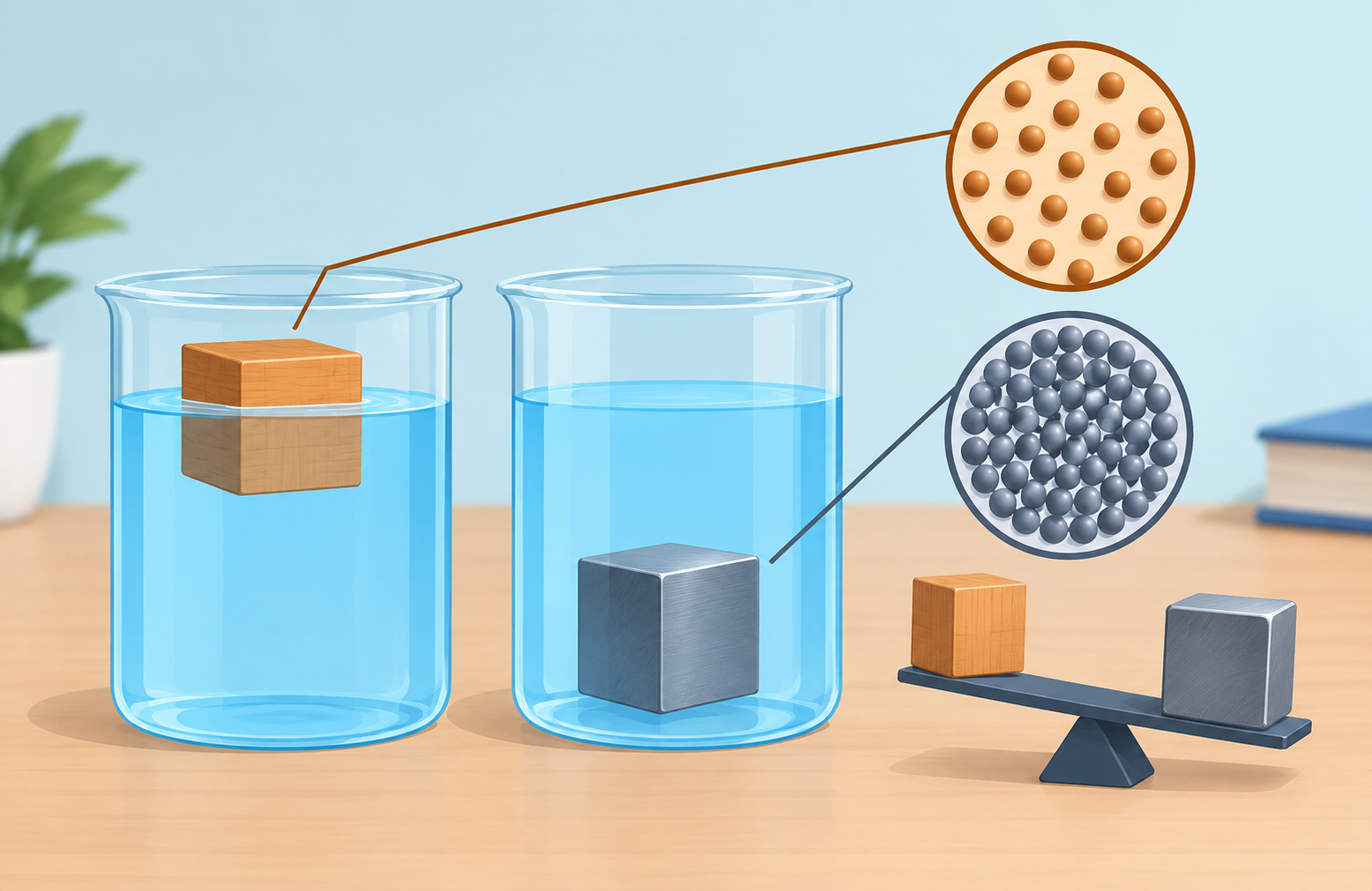
Pick up a small piece of lead and a large block of wood. The lead feels surprisingly heavy for its size — far heavier than you might expect. The wood, despite being much larger, feels noticeably lighter. Both objects have mass, but the lead packs far more mass into a much smaller space. That difference is what density describes.
What is density in physics? Density is the amount of mass contained in a unit volume of a substance. It tells you how tightly matter is packed together. Understanding density explains why ships float, why icebergs sit mostly below the surface, why hot air balloons rise, and why different materials feel so different when you hold them.
Key Takeaways
-
Density is defined as mass per unit volume: ρ = m/V.
-
The SI unit of density is kilogram per cubic metre (kg/m³).
-
Density is a property of the material — not of a particular object’s size or shape.
-
Objects float when their density is less than the fluid they are placed in; they sink when their density is greater.
-
Density is a scalar quantity — it has magnitude and a unit, but no direction.
-
Density generally decreases as temperature increases and increases as pressure increases.
-
Water has a density of exactly 1,000 kg/m³ at 4 °C — one of the most important reference values in physics.
What Is Density in Physics?
Density is the amount of mass packed into a unit volume of a substance. More precisely:
Density is the mass per unit volume of a material.
At the particle level, density describes how tightly the atoms or molecules of a substance are packed together. A dense material has many particles crammed into a small space. A less dense material has the same volume but fewer, lighter, or more widely spaced particles.
Crucially, density is a property of the material itself, not of a particular object. A small iron nail and a large iron girder have completely different masses and volumes — but they both have exactly the same density, because they are made of the same material.
A few examples to anchor the idea:
- A block of iron and a block of wood of the same size have very different densities. Iron has far more mass packed into the same volume — it feels much heavier.
- A tiny piece of gold is denser than a large piece of foam — even though the foam occupies far more space.
Density is a derived physical quantity — it is formed by combining two base quantities: mass and volume. It has magnitude and a unit, but no directional component. That makes density a scalar quantity. Unlike a vector quantity such as force or velocity (which require direction to describe fully), density needs only a number and a unit to be completely described. For a broader understanding of how quantities are classified in physics, see What Is a Physical Quantity?
The Density Formula
The formula for density is:
ρ = m/V
Where:
- ρ (the Greek letter rho) = density
- m = mass of the substance (kg)
- V = volume of the substance (m³)
What each variable means:
- Density (ρ): How much mass is packed into each unit of volume. A high density means a lot of mass in a small space.
- Mass (m): The total amount of matter in the object — measured in kilograms (kg).
- Volume (V): The total amount of three-dimensional space the object occupies — measured in cubic metres (m³).
Rearranging the formula:
You will often need to find mass or volume rather than density. Rearrange as follows:
- To find mass: m = ρ × V
- To find volume: V = m/ρ
A useful memory tool is the density triangle. Draw a triangle divided into three sections: place m at the top, and ρ and V side by side at the bottom. Cover the quantity you want to find — what remains shows you the calculation.
Units:
The SI unit of density is kg/m³. A commonly used non-SI unit is g/cm³ (grams per cubic centimetre).
Conversion: 1 g/cm³ = 1,000 kg/m³
For example, the density of water is 1 g/cm³ = 1,000 kg/m³.
SI Unit of Density
The SI unit of density is the kilogram per cubic metre (kg/m³).
This unit makes intuitive sense: it tells you exactly how many kilograms of mass are contained in one cubic metre of a substance.
In many chemistry and everyday contexts, the unit gram per cubic centimetre (g/cm³) is used instead. This is equivalent to gram per millilitre (g/mL) for liquids.
The conversion between the two units:
1 g/cm³ = 1,000 kg/m³
So if you know a material’s density in g/cm³, multiply by 1,000 to convert to kg/m³. If you know it in kg/m³, divide by 1,000 to convert to g/cm³.
For a complete reference to SI units and how they are defined and used, see What Are SI Units in Physics?
Densities of Common Materials
| Material | Density (kg/m³) | Density (g/cm³) | Notes |
|---|---|---|---|
| Hydrogen gas | ~0.09 | ~0.00009 | Lightest element; far less dense than air |
| Air (at sea level, 20 °C) | ~1.2 | ~0.0012 | Varies with temperature and altitude |
| Wood (pine) | ~500 | ~0.50 | Floats on water |
| Ice | ~917 | ~0.917 | Less dense than liquid water — floats |
| Water (at 4 °C) | 1,000 | 1.000 | Reference density; maximum density of water |
| Seawater | ~1,025 | ~1.025 | Saltier than fresh water — slightly denser |
| Concrete | ~2,400 | ~2.4 | Used in construction |
| Glass | ~2,500 | ~2.5 | Varies by type |
| Aluminium | ~2,700 | ~2.7 | Lightweight structural metal |
| Human bone | ~1,850–2,100 | ~1.85–2.1 | Varies with bone type and age |
| Iron / Steel | ~7,874 | ~7.874 | Common structural metal |
| Copper | ~8,960 | ~8.96 | Excellent electrical conductor |
| Lead | ~11,340 | ~11.34 | Very dense; used in radiation shielding |
| Mercury (liquid) | ~13,534 | ~13.534 | Densest common liquid at room temperature |
| Gold | ~19,300 | ~19.3 | One of the densest naturally occurring elements |
These values are approximate and can vary slightly with temperature, purity, and pressure.
Why Does Density Vary Between Materials?
The density of a material depends on two things at the atomic scale: how heavy its atoms are and how closely packed those atoms are.
Heavy atoms, tight packing → high density
Gold has very heavy atoms (atomic mass ~197) arranged in a tightly packed crystalline structure. This combination gives it an extremely high density of 19,300 kg/m³.
Light atoms, loose packing → low density
Aluminium has relatively light atoms (atomic mass ~27) and less compact packing — giving a density of 2,700 kg/m³. Wood contains mostly carbon, hydrogen, and oxygen atoms with a porous, open structure — making it far less dense.
Gases vs liquids vs solids
Gas particles are spread far apart with large spaces between them — which is why gases have extremely low densities compared to liquids and solids. Air is only about 1.2 kg/m³. The same water molecules in liquid form are roughly 830 times denser than in their gaseous state (steam).
How temperature affects density:
- Higher temperature → particles gain kinetic energy → they move further apart → volume increases → density decreases.
- Lower temperature → particles slow down → they pack more tightly → volume decreases → density increases.
How pressure affects density:
- Higher pressure → particles are forced closer together → volume decreases → density increases.
- This effect is especially significant for gases; liquids and solids are much harder to compress.
The important exception — water at 4 °C:
Most substances are densest in their solid state. Water is a notable exception. Water reaches its maximum density at exactly 4 °C (1,000 kg/m³). As water cools below 4 °C and forms ice, the hydrogen bonds between water molecules arrange into a hexagonal lattice structure that actually takes up more space than liquid water — making ice less dense (917 kg/m³) than the liquid it came from. This is why ice floats — and it has profound ecological consequences, as we will see shortly.
Floating and Sinking — Density and Buoyancy
The rule is elegantly simple:
- An object floats if its density is less than the density of the fluid it is placed in.
- An object sinks if its density is greater than the density of the fluid.
- An object is neutrally buoyant if its density equals the density of the fluid.
Why ice floats on water:
Ice has a density of approximately 917 kg/m³. Liquid water has a density of 1,000 kg/m³. Since ice is less dense, it floats — with approximately 91.7% of its volume submerged and about 8.3% above the surface.
Why steel ships float:
Steel has a density of roughly 7,874 kg/m³ — far greater than water. Yet a steel ship floats. The reason is that a ship is not solid steel. The hull is hollow and contains a large volume of air. The average density of the whole ship (steel + enclosed air + everything inside) is less than 1,000 kg/m³. It is this average density — not the density of the material alone — that determines whether the ship floats.
Why a stone sinks:
A typical stone has a density of 2,000–3,000 kg/m³ — well above the density of water. The buoyant force is insufficient to support the stone’s weight, and it sinks.
Density in Different States of Matter
| State of Matter | Particle Arrangement | Typical Density Range | Example |
|---|---|---|---|
| Solid | Tightly packed in regular or irregular lattice | 500–20,000 kg/m³ | Iron (7,874 kg/m³), Wood (500 kg/m³) |
| Liquid | Close together but able to flow | 700–14,000 kg/m³ | Water (1,000 kg/m³), Mercury (13,534 kg/m³) |
| Gas | Far apart, moving rapidly | 0.09–10 kg/m³ | Air (1.2 kg/m³), Hydrogen (0.09 kg/m³) |
In general, solids are denser than liquids, which are far denser than gases. This reflects the spacing of particles.
The water-ice exception and its ecological importance:
As mentioned earlier, ice (917 kg/m³) is less dense than liquid water (1,000 kg/m³). This means that when lakes and ponds freeze in winter, the ice forms a layer on the surface. This ice layer acts as an insulating blanket — it prevents the water below from losing heat to the cold atmosphere as quickly. Fish and other aquatic life can survive in the liquid water beneath the ice. If ice were denser than water, it would sink to the bottom, and water bodies could freeze solid from the bottom up — with devastating consequences for aquatic ecosystems.
Measuring Density
Regular Solids
- Measure the mass of the object using a digital balance (record in kg or g).
- Measure the dimensions (length, width, height) using a ruler or vernier calliper (in m or cm).
- Calculate volume: V = l × w × h
- Calculate density: ρ = m/V
Irregular Solids (Water Displacement Method)
For objects with irregular shapes, calculating volume from dimensions is impractical. The water displacement method solves this.
- Measure the mass of the object using a balance.
- Part-fill a measuring cylinder with water and record the initial volume (V₁).
- Carefully submerge the object in the water (it must be fully submerged and must not dissolve or absorb water).
- Record the new water level (V₂).
- Volume of object = V₂ − V₁
- Calculate density: ρ = m/V
This method is based on Archimedes’ principle: when an object is submerged in a fluid, it displaces a volume of fluid exactly equal to its own volume.
Liquids
- Measure the mass of an empty container using a balance (m₁).
- Pour a known volume of the liquid into the container using a measuring cylinder (record volume V).
- Measure the mass of the container + liquid (m₂).
- Mass of liquid = m₂ − m₁
- Calculate density: ρ = (m₂ − m₁)/V
Worked Examples
Example 1 — Calculate density from mass and volume
Question: A block has a mass of 540 g and a volume of 200 cm³. Calculate its density in g/cm³.
Given: m = 540 g, V = 200 cm³
Formula: ρ = m/V
Solution: ρ = 540 ÷ 200 = 2.7 g/cm³
Answer: 2.7 g/cm³
Explanation: Dividing mass by volume gives density. This value matches aluminium — which is what the block is likely made of.
Example 2 — Calculate mass from density and volume
Question: A piece of copper has a volume of 0.005 m³. Density of copper = 8,960 kg/m³. Find its mass.
Given: ρ = 8,960 kg/m³, V = 0.005 m³
Formula: m = ρ × V
Solution: m = 8,960 × 0.005 = 44.8 kg
Answer: 44.8 kg
Explanation: Rearranging ρ = m/V gives m = ρV. Substituting gives 44.8 kg — a substantial mass from a relatively small volume, which reflects copper’s high density.
Example 3 — Calculate volume from density and mass
Question: A gold bar has a mass of 12.56 kg. Density of gold = 19,300 kg/m³. Find its volume.
Given: m = 12.56 kg, ρ = 19,300 kg/m³
Formula: V = m/ρ
Solution: V = 12.56 ÷ 19,300 = 0.000651 m³ = 6.51 × 10⁻⁴ m³
Answer: 6.51 × 10⁻⁴ m³ (651 cm³)
Explanation: Even a 12.56 kg gold bar occupies less than a litre of space — illustrating just how dense gold is.
Example 4 — Density of a regular solid (rectangular block)
Question: A rectangular iron block measures 10 cm × 5 cm × 4 cm and has a mass of 1,574.8 g. Calculate its density.
Given: l = 10 cm, w = 5 cm, h = 4 cm, m = 1,574.8 g
Formula: V = l × w × h; ρ = m/V
Solution: V = 10 × 5 × 4 = 200 cm³. ρ = 1,574.8 ÷ 200 = 7.874 g/cm³
Answer: 7.874 g/cm³ (= 7,874 kg/m³)
Explanation: This matches the known density of iron — confirming the calculation is correct.
Example 5 — Density of an irregular solid (water displacement)
Question: A student submerges an irregularly shaped rock in a measuring cylinder. The water level rises from 40 cm³ to 65 cm³. The rock’s mass is 68.25 g. Find its density.
Given: V₁ = 40 cm³, V₂ = 65 cm³, m = 68.25 g
Formula: V = V₂ − V₁; ρ = m/V
Solution: V = 65 − 40 = 25 cm³. ρ = 68.25 ÷ 25 = 2.73 g/cm³
Answer: 2.73 g/cm³
Explanation: The water displacement method gives the volume of the rock directly. The density of approximately 2.73 g/cm³ is consistent with granite or similar rock.
Example 6 — Density of a liquid
Question: A measuring cylinder contains 50 cm³ of an unknown liquid. An empty beaker has mass 120 g. When the liquid is poured into the beaker, the total mass is 161 g. Find the density of the liquid.
Given: V = 50 cm³, m_beaker = 120 g, m_total = 161 g
Formula: m_liquid = m_total − m_beaker; ρ = m/V
Solution: m_liquid = 161 − 120 = 41 g. ρ = 41 ÷ 50 = 0.82 g/cm³
Answer: 0.82 g/cm³
Explanation: The density of 0.82 g/cm³ is consistent with vegetable oil — which floats on water, as expected.
Example 7 — Determine if an object will float or sink
Question: An object has a density of 1,200 kg/m³. Will it float or sink in water (density = 1,000 kg/m³)?
Given: ρ_object = 1,200 kg/m³, ρ_water = 1,000 kg/m³
Solution: Since 1,200 > 1,000, the object is denser than water.
Answer: The object sinks.
Explanation: Objects sink when their density exceeds the density of the fluid. The buoyant force is insufficient to support the object’s weight.
Example 8 — Compare densities of two objects
Question: Object A has mass 300 g and volume 100 cm³. Object B has mass 180 g and volume 90 cm³. Which is denser?
Given: A: m = 300 g, V = 100 cm³. B: m = 180 g, V = 90 cm³
Formula: ρ = m/V
Solution: ρ_A = 300 ÷ 100 = 3.0 g/cm³. ρ_B = 180 ÷ 90 = 2.0 g/cm³
Answer: Object A is denser (3.0 > 2.0 g/cm³).
Explanation: Object A has more mass per unit volume despite both objects being similar in overall mass.
Example 9 — Unit conversion (g/cm³ to kg/m³)
Question: The density of aluminium is 2.7 g/cm³. Convert this to kg/m³.
Given: ρ = 2.7 g/cm³
Formula: 1 g/cm³ = 1,000 kg/m³
Solution: ρ = 2.7 × 1,000 = 2,700 kg/m³
Answer: 2,700 kg/m³
Explanation: Simply multiply g/cm³ by 1,000 to obtain kg/m³. This is one of the most common unit conversions in density problems.
Example 10 — Real-world application (iceberg buoyancy)
Question: Ice has a density of 917 kg/m³ and water has a density of 1,000 kg/m³. What fraction of an iceberg is above the water surface?
Given: ρ_ice = 917 kg/m³, ρ_water = 1,000 kg/m³
Formula: Fraction submerged = ρ_ice ÷ ρ_water
Solution: Fraction submerged = 917 ÷ 1,000 = 0.917 (91.7%)
Fraction above surface = 1 − 0.917 = 0.083 = 8.3%
Answer: Approximately 8.3% of an iceberg is above the water surface.
Explanation: This is why icebergs are so hazardous to ships — the vast majority of their mass lies hidden below the surface.
Example 11 — Density and temperature (qualitative)
Question: A fixed mass of air is heated. Explain what happens to its density.
Solution: When air is heated, its particles gain kinetic energy and move further apart. The volume increases while the mass remains the same. Since ρ = m/V, an increase in V with constant m causes density to decrease.
Answer: Density of air decreases when it is heated.
Explanation: This principle explains why hot air rises — it is less dense than the cooler air surrounding it.
Example 12 — Finding the density of a gas
Question: A sealed container holds 0.096 g of hydrogen gas and has an internal volume of 1,000 cm³. Find the density of the hydrogen gas.
Given: m = 0.096 g, V = 1,000 cm³
Formula: ρ = m/V
Solution: ρ = 0.096 ÷ 1,000 = 0.000096 g/cm³ = 0.096 kg/m³
Answer: 0.096 kg/m³
Explanation: This is consistent with the known density of hydrogen gas at approximately room temperature and atmospheric pressure, confirming the calculation.
Example 13 — Mixed calculation
Question: A substance has a density of 2,500 kg/m³. What mass would a 0.004 m³ sample have?
Given: ρ = 2,500 kg/m³, V = 0.004 m³
Formula: m = ρ × V
Solution: m = 2,500 × 0.004 = 10 kg
Answer: 10 kg
Explanation: This is consistent with glass, which has a density of approximately 2,500 kg/m³.
Example 14 — Word problem
Question: A student wants to check whether a ring is made of pure gold. The ring has a mass of 19.3 g. When placed in a measuring cylinder, the water level rises from 50.0 cm³ to 51.0 cm³. Is the ring likely pure gold? (Density of gold = 19.3 g/cm³)
Given: m = 19.3 g, V = 51.0 − 50.0 = 1.0 cm³
Formula: ρ = m/V
Solution: ρ = 19.3 ÷ 1.0 = 19.3 g/cm³
Answer: The calculated density matches gold exactly — the ring is consistent with pure gold.
Explanation: Density measurements can be used to identify materials. If the density had been lower, it would suggest the ring was an alloy or an imitation.
Example 15 — Challenge problem
Question: A hollow steel sphere has an outer radius of 10 cm and an inner radius of 9 cm. The density of steel is 7,874 kg/m³. What is the average density of the sphere (including the hollow air-filled interior)?
Volume of solid steel shell:
V_outer = (4/3) × π × (0.10)³ = 4.189 × 10⁻³ m³
V_inner = (4/3) × π × (0.09)³ = 3.054 × 10⁻³ m³
V_steel = 4.189 × 10⁻³ − 3.054 × 10⁻³ = 1.135 × 10⁻³ m³
Mass of steel shell:
m = ρ_steel × V_steel = 7,874 × 1.135 × 10⁻³ = 8.937 kg
Total volume of sphere (including hollow interior):
V_total = 4.189 × 10⁻³ m³
Average density:
ρ_avg = m ÷ V_total = 8.937 ÷ 4.189 × 10⁻³ = 2,133 kg/m³
Answer: Average density ≈ 2,133 kg/m³
Explanation: The average density of the hollow sphere (2,133 kg/m³) is far less than solid steel (7,874 kg/m³). This illustrates how hollow construction dramatically reduces average density — the same principle that allows steel ships to float.
Practice Questions
12 Short Answer Questions
1. Define density in physics.
Answer: Density is the mass per unit volume of a substance. It measures how much mass is packed into each unit of volume. Formula: ρ = m/V.
2. What is the SI unit of density?
Answer: Kilogram per cubic metre (kg/m³).
3. A substance has a mass of 250 g and a volume of 50 cm³. Calculate its density in g/cm³.
Answer: ρ = 250 ÷ 50 = 5 g/cm³
4. Convert a density of 8.96 g/cm³ to kg/m³.
Answer: 8.96 × 1,000 = 8,960 kg/m³
5. An object has a density of 800 kg/m³. Will it float or sink in water (1,000 kg/m³)? Explain.
Answer: It will float — its density (800) is less than water (1,000), so the buoyant force exceeds its weight.
6. Explain why ice floats on water.
Answer: Ice has a density of approximately 917 kg/m³, which is less than liquid water (1,000 kg/m³). Because ice is less dense, it floats with about 8.3% of its volume above the surface.
7. State two factors that affect the density of a substance.
Answer: (1) Temperature — higher temperature decreases density. (2) Pressure — higher pressure increases density (especially in gases).
8. A block of lead has a density of 11,340 kg/m³ and a volume of 0.002 m³. Calculate its mass.
Answer: m = ρV = 11,340 × 0.002 = 22.68 kg
9. How would you measure the density of an irregularly shaped stone?
Answer: Measure its mass using a balance. Use the water displacement method to find its volume (submerge it in a measuring cylinder and record the rise in water level). Then calculate ρ = m/V.
10. A liquid has a density of 0.79 g/cm³. Express this in kg/m³ and state whether it floats or sinks in water.
Answer: 0.79 × 1,000 = 790 kg/m³. Since 790 < 1,000, this liquid (consistent with ethanol/alcohol) floats on water.
11. Explain why gases have much lower densities than solids.
Answer: In gases, particles are widely separated and move freely. In solids, particles are closely packed in a regular or irregular lattice. The much greater spacing between gas particles means far less mass per unit volume — giving gases very low densities.
12. A material has density 2,700 kg/m³ and mass 0.27 kg. What is its volume?
Answer: V = m/ρ = 0.27 ÷ 2,700 = 1 × 10⁻⁴ m³ = 100 cm³
10 Multiple Choice Questions
Question 1
What is the correct formula for density?
A. ρ = V/m
B. ρ = m × V
C. ρ = m/V
D. ρ = m + V
Correct Answer: C
Short Explanation: Density is defined as mass divided by volume (ρ = m/V). Dividing volume by mass (option A) would give the reciprocal of density, not density itself.
Question 2
The SI unit of density is:
A. kg/m
B. g/cm³
C. kg/m²
D. kg/m³
Correct Answer: D
Short Explanation: The SI unit of density is kilogram per cubic metre (kg/m³). While g/cm³ is commonly used, it is not an SI unit.
Question 3
What is the density of water at 4 °C?
A. 917 kg/m³
B. 1,025 kg/m³
C. 1,000 kg/m³
D. 100 kg/m³
Correct Answer: C
Short Explanation: Water reaches its maximum density of exactly 1,000 kg/m³ at 4 °C. This is one of the most important reference values in physics and chemistry.
Question 4
An object has a density of 1,500 kg/m³. When placed in water (density 1,000 kg/m³), it will:
A. Float
B. Sink
C. Remain suspended at mid-depth
D. Dissolve
Correct Answer: B
Short Explanation: Objects sink when their density is greater than the density of the fluid. Since 1,500 > 1,000, the object sinks.
Question 5
A block has mass 300 g and volume 120 cm³. What is its density?
A. 0.4 g/cm³
B. 2.0 g/cm³
C. 2.5 g/cm³
D. 36,000 g/cm³
Correct Answer: C
Short Explanation: ρ = m/V = 300 ÷ 120 = 2.5 g/cm³. This is consistent with the density of glass.
Question 6
Why does hot air rise in cool surroundings?
A. Hot air has greater mass than cool air.
B. Hot air has lower density than cool air.
C. Hot air has higher density than cool air.
D. Hot air has the same density as cool air.
Correct Answer: B
Short Explanation: Heating air causes its particles to move apart, increasing volume while mass stays constant. This decreases density. Less dense warm air is buoyant in denser cool air — so it rises.
Question 7
Which of the following materials has the highest density?
A. Aluminium
B. Lead
C. Water
D. Ice
Correct Answer: B
Short Explanation: Of the options listed, lead (11,340 kg/m³) is by far the densest. Aluminium is 2,700 kg/m³; water is 1,000 kg/m³; ice is 917 kg/m³.
Question 8
A student submerges an object in water in a measuring cylinder. The water level rises from 30 cm³ to 42 cm³. The object’s mass is 38.4 g. What is its density?
A. 1.0 g/cm³
B. 2.4 g/cm³
C. 3.2 g/cm³
D. 4.8 g/cm³
Correct Answer: C
Short Explanation: Volume of object = 42 − 30 = 12 cm³. ρ = 38.4 ÷ 12 = 3.2 g/cm³.
Question 9
Density is classified as which type of quantity?
A. Vector
B. Scalar
C. Base quantity
D. Dimensionless
Correct Answer: B
Short Explanation: Density is a scalar quantity — it has magnitude and a unit (kg/m³) but no direction. This distinguishes it from vector quantities such as force and velocity.
Question 10
Which conversion is correct?
A. 1 g/cm³ = 100 kg/m³
B. 1 g/cm³ = 0.001 kg/m³
C. 1 g/cm³ = 1,000 kg/m³
D. 1 g/cm³ = 10 kg/m³
Correct Answer: C
Short Explanation: 1 g/cm³ = 1,000 kg/m³. This follows from converting grams to kilograms (÷1,000) and cm³ to m³ (÷1,000,000): the net factor is × 1,000.
5 Challenge Questions
Challenge 1:
A student has two cubes. Cube A is made of copper (density = 8,960 kg/m³) with sides of 3 cm. Cube B is made of aluminium (density = 2,700 kg/m³) with sides of 5 cm. (a) Calculate the mass of each cube. (b) Which cube is heavier, and by how much?
Answer:
Volume of Cube A = 3³ = 27 cm³ = 27 × 10⁻⁶ m³
Mass of Cube A = ρ × V = 8,960 × 27 × 10⁻⁶ = 0.2419 kg (241.9 g)
Volume of Cube B = 5³ = 125 cm³ = 125 × 10⁻⁶ m³
Mass of Cube B = 2,700 × 125 × 10⁻⁶ = 0.3375 kg (337.5 g)
Cube B (aluminium) is heavier by 337.5 − 241.9 = 95.6 g.
Despite copper being more than three times as dense as aluminium, the much larger volume of Cube B means it has greater total mass.
Challenge 2:
An iceberg floats with 91.7% of its volume submerged in seawater (density = 1,025 kg/m³). A geologist estimates the total volume of the iceberg is 850 m³. (a) Calculate the submerged volume. (b) Calculate the mass of the iceberg. (c) Verify the density of ice using your answers.
Answer:
(a) Submerged volume = 0.917 × 850 = 779.45 m³
(b) The mass of ice = mass of seawater displaced (Archimedes’ principle)
m = ρ_seawater × V_submerged = 1,025 × 779.45 = 798,936 kg ≈ 799,000 kg
(c) Total volume of iceberg = 850 m³
ρ_ice = m ÷ V_total = 799,000 ÷ 850 ≈ 940 kg/m³
This is close to the accepted value of ~917 kg/m³ — any small discrepancy arises from rounding in the given percentage.
Challenge 3:
A submarine has a total volume of 5,000 m³. When surfaced, its ballast tanks are filled with air and the submarine’s mass is 4,800,000 kg. (a) Calculate the average density of the surfaced submarine. (b) To dive, the crew floods the ballast tanks with seawater (density 1,025 kg/m³). If the tanks have a total volume of 500 m³, what is the new mass of the submarine? (c) Calculate the new average density and determine whether the submarine will dive.
Answer:
(a) ρ_surfaced = m/V = 4,800,000 ÷ 5,000 = 960 kg/m³ (floats — less than 1,025 kg/m³)
(b) Mass of seawater flooding tanks = 1,025 × 500 = 512,500 kg
New total mass = 4,800,000 + 512,500 = 5,312,500 kg
(c) ρ_submerged = 5,312,500 ÷ 5,000 = 1,062.5 kg/m³
Since 1,062.5 > 1,025 kg/m³, the submarine’s average density now exceeds that of seawater — it will dive.
Challenge 4:
A student mixes 200 cm³ of oil (density = 0.82 g/cm³) with 300 cm³ of water (density = 1.00 g/cm³). Assuming the two liquids do not mix and the total volume is 500 cm³, calculate the average density of the combined liquid and explain what happens when the mixture settles.
Answer:
Mass of oil = 0.82 × 200 = 164 g
Mass of water = 1.00 × 300 = 300 g
Total mass = 164 + 300 = 464 g
Total volume = 500 cm³
Average density = 464 ÷ 500 = 0.928 g/cm³
When the mixture settles, the oil (0.82 g/cm³) floats on top of the water (1.00 g/cm³) because it is less dense. The two layers separate clearly. The average density (0.928 g/cm³) is between the two individual densities — but the layers do not blend; they remain distinct.
Challenge 5:
A crown is tested to determine whether it is made of pure gold (density = 19,300 kg/m³) or a gold-silver alloy. The crown has a mass of 772 g in air. When submerged in water, it appears to have a mass of 723.4 g (the apparent loss of mass equals the mass of water displaced). (a) Find the volume of the crown. (b) Calculate its density. (c) Is it pure gold?
Answer:
(a) Apparent mass loss = mass of water displaced = 772 − 723.4 = 48.6 g
Since water density = 1.0 g/cm³, volume of water displaced = volume of crown = 48.6 cm³
(b) ρ_crown = m/V = 772 ÷ 48.6 = 15.88 g/cm³ = 15,880 kg/m³
(c) Pure gold has a density of 19,300 kg/m³. The crown’s density (15,880 kg/m³) is significantly lower. The crown is not pure gold — it contains a less dense metal (likely silver, density ~10,490 kg/m³) mixed in.
This is essentially the original problem attributed to Archimedes — determining the purity of a gold crown by measuring its density through water displacement.
Density in Everyday Life
Ships are made hollow
The density principle at work: a solid steel ship would sink immediately. By making the hull hollow, a ship encloses a large volume of air inside its steel structure. The average density of the entire vessel (steel + air + everything aboard) is kept below 1,000 kg/m³ — allowing it to float.
Hot air balloons rise
When air inside the balloon envelope is heated by a burner, the air expands and some escapes through the open bottom. The mass of air inside decreases while the volume stays the same — reducing the average density. When this density falls below that of the surrounding cool air, the balloon rises.
Oil floats on water
Vegetable oil has a density of approximately 820–920 kg/m³ — less than water (1,000 kg/m³). When oil is poured onto water, it immediately rises to the surface and forms a separate layer. This is why oil slicks spread across water surfaces and why salad dressing separates if left to settle.
Icebergs float with most of their mass submerged
Ice density (~917 kg/m³) is close to but less than water. As a result, only about 8.3% of an iceberg protrudes above the surface — the remaining 91.7% is hidden below. This makes icebergs extremely hazardous to shipping.
Helium balloons rise in air
Helium has a density of approximately 0.164 kg/m³ at room temperature — far less than air (~1.2 kg/m³). A helium-filled balloon is surrounded by much denser air, so the buoyant force on it exceeds its weight and it rises.
Submarines control their buoyancy
Submarines have ballast tanks that can be filled with seawater (to increase average density and dive) or emptied using compressed air (to decrease average density and surface). By precisely controlling how much water is in the tanks, a submarine can achieve neutral buoyancy at any depth.
Cream rises to the top of milk
Cream has a lower density than skimmed milk because of its high fat content. Left to settle, cream naturally rises while the denser milk remains below. Industrial cream separators accelerate this process using centrifugal force.
Sediment settles to the bottom
Mud, silt, and other particles carried in water have densities much higher than water. When water flow slows, these dense particles can no longer be supported by the water’s upward currents and gradually settle to the bottom.
Hydrometers measure liquid density
A hydrometer is a float with a weighted bulb at the bottom and a graduated scale on a thin stem. It floats at different depths in different liquids depending on their density. Used in brewing (to measure sugar content), in battery acid testing, and in antifreeze checks.
Density vs Mass vs Volume
| Feature | Mass | Volume | Density |
|---|---|---|---|
| Definition | Amount of matter in an object | Amount of space an object occupies | Mass per unit volume |
| Formula | — (base quantity) | V = l × w × h (for rectangular shapes) | ρ = m/V |
| SI Unit | Kilogram (kg) | Cubic metre (m³) | Kilogram per cubic metre (kg/m³) |
| Type of quantity | Scalar | Scalar | Scalar |
| Changes with size? | Yes | Yes | No — it is a material property |
| Changes with location? | No (constant everywhere) | No | No (for the same material at same T and P) |
| Changes with temperature? | No | Yes (expands/contracts) | Yes (as volume changes) |
| Useful for identifying material? | No — two different materials can have the same mass | No — two different materials can have the same volume | Yes — density is characteristic of the material |
This last point is particularly important. Mass and volume alone cannot identify a material — a plastic block and an aluminium block could have the same mass, or the same volume, purely by coincidence. But density ties the two together in a ratio that is characteristic of the material. This is why density measurements are used to identify substances, test for impurities, and detect counterfeit goods.
Density and Archimedes’ Principle
Archimedes’ Principle states:
When an object is fully or partially submerged in a fluid, it experiences an upward buoyant force equal to the weight of the fluid it displaces.
In equation form:
F_buoyancy = ρ_fluid × V_submerged × g
Where ρ_fluid is the density of the fluid, V_submerged is the volume of fluid displaced, and g is gravitational acceleration (9.8 m/s²).
The connection between density and buoyancy follows directly:
- If the object is less dense than the fluid → the weight of displaced fluid (buoyant force) exceeds the object’s weight → the object floats.
- If the object is more dense than the fluid → the buoyant force is less than the object’s weight → the object sinks.
- If densities are equal → buoyant force exactly equals weight → neutral buoyancy (the object remains suspended at whatever depth it is placed).
Understanding mass correctly is essential here. For a full explanation of what mass means in physics and how it differs from weight, see What Is Mass in Physics?
Common Misconceptions About Density
| Misconception | Correct Explanation |
|---|---|
| “Heavier objects are always denser.” | A large foam block can be heavier than a small iron nail, but iron is far denser. Density = mass ÷ volume — size matters as much as mass. |
| “Density depends on the size of the object.” | Density is an intrinsic property of the material. Cut an iron block in half — each half has half the mass and half the volume, giving exactly the same density. |
| “Liquids all have the same density.” | Oil (~820 kg/m³), water (1,000 kg/m³), and mercury (13,534 kg/m³) have dramatically different densities. This is why they form separate layers when mixed. |
| “All metals are denser than water.” | Lithium (530 kg/m³), sodium (971 kg/m³), and potassium (890 kg/m³) are all less dense than water — they float (and may react violently with water). |
| “Ice and water have the same density.” | Ice (~917 kg/m³) is about 8.3% less dense than liquid water (1,000 kg/m³). This unique property of water — being denser as a liquid than as a solid — is why ice floats. |
Common Mistakes Students Make
| Incorrect Approach | Correct Approach |
|---|---|
| Using ρ = V/m (volume divided by mass) | Use ρ = m/V (mass divided by volume) |
| Leaving density in g/cm³ when calculation requires kg/m³ | Always convert to SI units (kg/m³) before substituting into physics equations |
| Forgetting to subtract the original water level in displacement measurements | Volume = final water level − initial water level |
| Confusing density with weight or heaviness | Density is mass per unit volume — a property of the material, not of how heavy a particular object feels |
| Assuming density is constant regardless of temperature | Density changes with temperature because volume changes while mass stays constant |
| Calculating volume of an irregular object from dimensions | Use the water displacement method for irregular shapes |
Density in Physics Topics
Fluid mechanics
Density is fundamental to understanding pressure in fluids (P = ρgh), buoyancy (Archimedes’ principle), and fluid flow. The relative densities of fluids determine stratification — why the ocean has distinct layers at different depths, and why weather systems form in the atmosphere.
Thermodynamics
Density is temperature-dependent, and this dependence drives convection currents — the mechanism by which heat is transferred through fluids. Understanding how density changes with temperature is essential in thermodynamics and climate science.
Astrophysics
The densities of astronomical objects span an extraordinary range. The Sun has an average density of about 1,408 kg/m³ — slightly denser than water. A neutron star can have a density of approximately 10¹⁷ kg/m³ — a teaspoon of neutron star material would weigh roughly a billion tonnes on Earth. Black holes represent regions where density effectively approaches infinity.
Material science
Engineers select materials partly based on density. Aluminium (2,700 kg/m³) is used in aircraft because it provides strength at low density — reducing fuel consumption. Titanium, carbon fibre composites, and advanced ceramics are chosen for similar reasons in high-performance applications.
Earth science
Earth’s interior is layered by density. The inner core (solid iron-nickel) has a density of approximately 12,000–13,000 kg/m³. The outer core (liquid iron-nickel) is around 10,000–12,000 kg/m³. The mantle is 3,300–5,600 kg/m³. The crust is 2,700–3,000 kg/m³. These density differences drive plate tectonics and the generation of Earth’s magnetic field.
Exam Tips
- Always check and convert units before calculating. If mass is given in grams, convert to kilograms. If volume is in cm³, convert to m³ (divide by 1,000,000) — or work consistently in g/cm³ throughout.
- Write the formula first: ρ = m/V. Then rearrange if needed before substituting numbers.
- For irregular solids: always describe the water displacement method — measuring initial and final water levels, finding the difference for volume.
- Know the density of water: 1,000 kg/m³ (or 1 g/cm³). This is the reference point for floating and sinking questions and appears in virtually every density-related exam question.
- State explicitly when comparing densities for floating/sinking. Do not just say “it floats” — say “the object’s density (x kg/m³) is less than the fluid’s density (y kg/m³), so it floats.”
- Density is a property of the material, not of a specific sample. A question about “the density of copper” has one answer regardless of how big the copper sample is.
- Show all working — even for straightforward substitutions. Examiners award marks for method as well as the final answer.
- Temperature changes density. If a question involves heating or cooling a substance, remember that density changes because volume changes while mass stays constant.
Quick Revision Notes
Definition: Density is the mass per unit volume of a substance — how much mass is packed into a given amount of space.
Formula: ρ = m/V
- Rearrangements: m = ρV and V = m/ρ
SI unit: kg/m³
Common unit: g/cm³
Conversion: 1 g/cm³ = 1,000 kg/m³
Density of water: 1,000 kg/m³ (at 4 °C) — the standard reference.
Floating and sinking:
- ρ_object < ρ_fluid → floats
- ρ_object > ρ_fluid → sinks
- ρ_object = ρ_fluid → neutral buoyancy
States of matter: Solids > Liquids > Gases (generally)
Exception: water is denser than ice — ice floats.
Measuring density:
- Regular solid: ρ = m/(l × w × h)
- Irregular solid: water displacement method (ρ = m/ΔV)
- Liquid: ρ = (m_total − m_container)/V
Temperature effect: Higher temperature → greater volume → lower density (for fixed mass).
Common misconceptions: Heavier ≠ denser; density does not depend on object size; not all metals sink in water.
Density Cheat Sheet
| Concept | Key Point | Example or Value |
|---|---|---|
| Definition | Mass per unit volume | ρ = m/V |
| SI unit | Kilogram per cubic metre | kg/m³ |
| Common unit | Gram per cubic centimetre | g/cm³ |
| Unit conversion | Multiply g/cm³ by 1,000 | 2.7 g/cm³ = 2,700 kg/m³ |
| Density of water | Reference value | 1,000 kg/m³ (at 4 °C) |
| Density of ice | Less than water | ~917 kg/m³ |
| Density of air | Very low | ~1.2 kg/m³ |
| Density of gold | Very high | ~19,300 kg/m³ |
| Float rule | Object density < fluid density | Wood (500) floats on water (1,000) |
| Sink rule | Object density > fluid density | Iron (7,874) sinks in water (1,000) |
| Temperature effect | Higher T → lower density | Hot air rises in cool surroundings |
| Scalar or vector | Scalar — magnitude and unit only | 2,700 kg/m³ — no direction |
| Archimedes’ Principle | Buoyant force = weight of displaced fluid | Used in water displacement method |
| Memory aid | Density triangle (ρ, m, V) | Cover the unknown to find the formula |
Frequently Asked Questions
1. What is density in physics?
Density is the amount of mass contained in a unit volume of a substance — described by the formula ρ = m/V. It measures how tightly packed the particles in a material are. Dense materials have a lot of mass in a small volume; less dense materials have less mass for the same volume.
2. What is the formula for density?
ρ = m/V, where ρ is density (kg/m³), m is mass (kg), and V is volume (m³). Rearranged: m = ρV to find mass, and V = m/ρ to find volume.
3. What is the SI unit of density?
Kilogram per cubic metre (kg/m³). The gram per cubic centimetre (g/cm³) is also widely used: 1 g/cm³ = 1,000 kg/m³.
4. What is the density of water?
Water has a density of exactly 1,000 kg/m³ (or 1 g/cm³) at 4 °C — the temperature at which water is most dense. This value is one of the most important reference points in physics.
5. Why does ice float on water?
Ice has a density of approximately 917 kg/m³ — less than liquid water (1,000 kg/m³). When water freezes, hydrogen bonds form an open hexagonal lattice that takes up more space than liquid water, making ice less dense and causing it to float.
6. What is the difference between density and mass?
Mass measures the total amount of matter in an object (kg). Density measures how much mass is packed into each unit of volume (kg/m³). A large object can have high mass but low density; a small object can have low mass but high density.
7. What is the difference between density and volume?
Volume is the amount of space an object occupies (m³). Density is mass divided by volume — it describes how much mass is present per unit of that volume. Volume tells you how big something is; density tells you how much matter is packed into that space.
8. How do you measure the density of an irregular solid?
Use the water displacement method: (1) measure the mass using a balance; (2) record the initial water volume in a measuring cylinder; (3) submerge the object fully and record the new water volume; (4) volume of object = change in water volume; (5) calculate ρ = m/V.
9. Does density change with temperature?
Yes. For most substances, increasing temperature causes particles to move further apart — volume increases while mass stays constant, so density decreases. Water is a notable exception, reaching its maximum density at 4 °C rather than at its freezing point.
10. What is the densest common material?
Among naturally occurring elements, osmium is the densest at approximately 22,590 kg/m³. Among common engineering materials, gold (~19,300 kg/m³) and lead (~11,340 kg/m³) are the densest widely encountered substances.
11. Why do ships float even though they are made of steel?
A ship is not solid steel — it is a hollow structure enclosing a large volume of air. The average density of the entire ship (steel hull, air, cargo, crew) is less than 1,000 kg/m³. Because this average density is less than water, the ship floats.
12. Is density a scalar or vector quantity?
Density is a scalar quantity — it has magnitude and a unit (kg/m³) but no direction. Unlike vector quantities such as force or velocity, density is fully described by a single number and its unit. For a clear explanation of scalar quantities, see What Is Scalar Quantity in Physics? In contrast, What Is Vector Quantity in Physics? explains why quantities like force require direction as well.
13. What is relative density?
Relative density (also called specific gravity) is the ratio of a substance’s density to the density of a reference substance — usually water. It is dimensionless. Relative density = ρ_substance ÷ ρ_water. A relative density greater than 1 means the substance is denser than water and will sink; less than 1 means it is less dense and will float.
14. How does density relate to buoyancy?
An object submerged in a fluid experiences a buoyant force equal to the weight of fluid displaced (Archimedes’ Principle). If the object’s density is less than the fluid’s, the buoyant force exceeds the object’s weight — it floats. If the object’s density is greater, it sinks. The densities directly determine the outcome.
15. What happens to density when a substance is compressed?
Compressing a substance forces its particles closer together — reducing volume while mass stays the same. Since ρ = m/V, a decrease in V with constant m means density increases. This effect is most dramatic in gases (which are very compressible); liquids and solids resist compression far more strongly.
Summary
Density tells you how much mass is packed into a unit volume of a material. The formula is:
ρ = m/V
where ρ is density (kg/m³), m is mass (kg), and V is volume (m³).
Density is a characteristic property of a material — not of a specific object. The density of copper is 8,960 kg/m³ whether you have a small copper coin or a large copper pipe. What changes with size is the mass and the volume — their ratio (density) stays the same.
Objects float when their density is less than the fluid they are in; they sink when their density is greater. Ice floats on water because ice (~917 kg/m³) is less dense than liquid water (1,000 kg/m³) — a unique property with profound consequences for life on Earth.
Density is affected by temperature and pressure: heating a substance generally decreases its density (volume increases with constant mass); compressing it generally increases its density (volume decreases). Water reaches its maximum density at 4 °C — below this temperature, it becomes less dense as it forms ice.
Density is a scalar quantity — it needs only a magnitude and a unit to be fully described, with no directional component.
Final Thoughts
Density is one of the most practical and universal concepts in all of physics. Once you understand it, an enormous range of everyday observations start to make sense — from why ships can sail, why ice covers lakes without freezing them solid, why the layers of the Earth are arranged the way they are, and why engineers spend considerable effort choosing materials by their density-to-strength ratio.
From the oceans to the atmosphere to the interiors of stars, density shapes how matter behaves and how the universe is structured. It is a concept that connects physics, chemistry, earth science, and engineering into a single, coherent idea: how much matter occupies how much space.
References
- Khan Academy — Density: https://www.khanacademy.org
- OpenStax University Physics — Density and Pressure: https://openstax.org
- Physics LibreTexts — Density: https://phys.libretexts.org
- Encyclopaedia Britannica — Density: https://www.britannica.com
- NIST — Reference on Constants, Units, and Uncertainty: https://www.nist.gov
Helpful Resources
Khan Academy — Density and Buoyancy
Students can watch video lessons and complete interactive exercises on density, the density formula, and how density determines floating and sinking — suitable for middle school through A-Level.
https://www.khanacademy.org
OpenStax University Physics — Fluid Mechanics
A free, peer-reviewed textbook with comprehensive coverage of density, pressure in fluids, buoyancy, and Archimedes’ Principle — with worked examples and practice problems.
https://openstax.org
Physics LibreTexts — Density and Archimedes’ Principle
Detailed, structured explanations of density, the water displacement method, and buoyancy — with diagrams and numerical examples for students at all levels.
https://phys.libretexts.org
NIST — Physical Reference Data
Official reference values for densities, constants, and material properties — useful for verifying data used in physics and chemistry problems.
https://www.nist.gov
Disclaimer:
This article is intended for educational and informational purposes only. While LearnMinto strives to provide accurate and up-to-date physics information, readers should verify important academic concepts through official textbooks, educational institutions, examination boards, or trusted educational resources before using this content for exams or academic purposes. LearnMinto is not affiliated with any specific school, university, research institution, or examination board.