
Introduction
Imagine a scientist in Japan and another in Brazil both measuring the length of the same metal rod. The Japanese scientist records 1.5 m. The Brazilian scientist records 150 cm. Are their answers different? No — but without a shared system, comparing results like this would be a constant source of confusion.
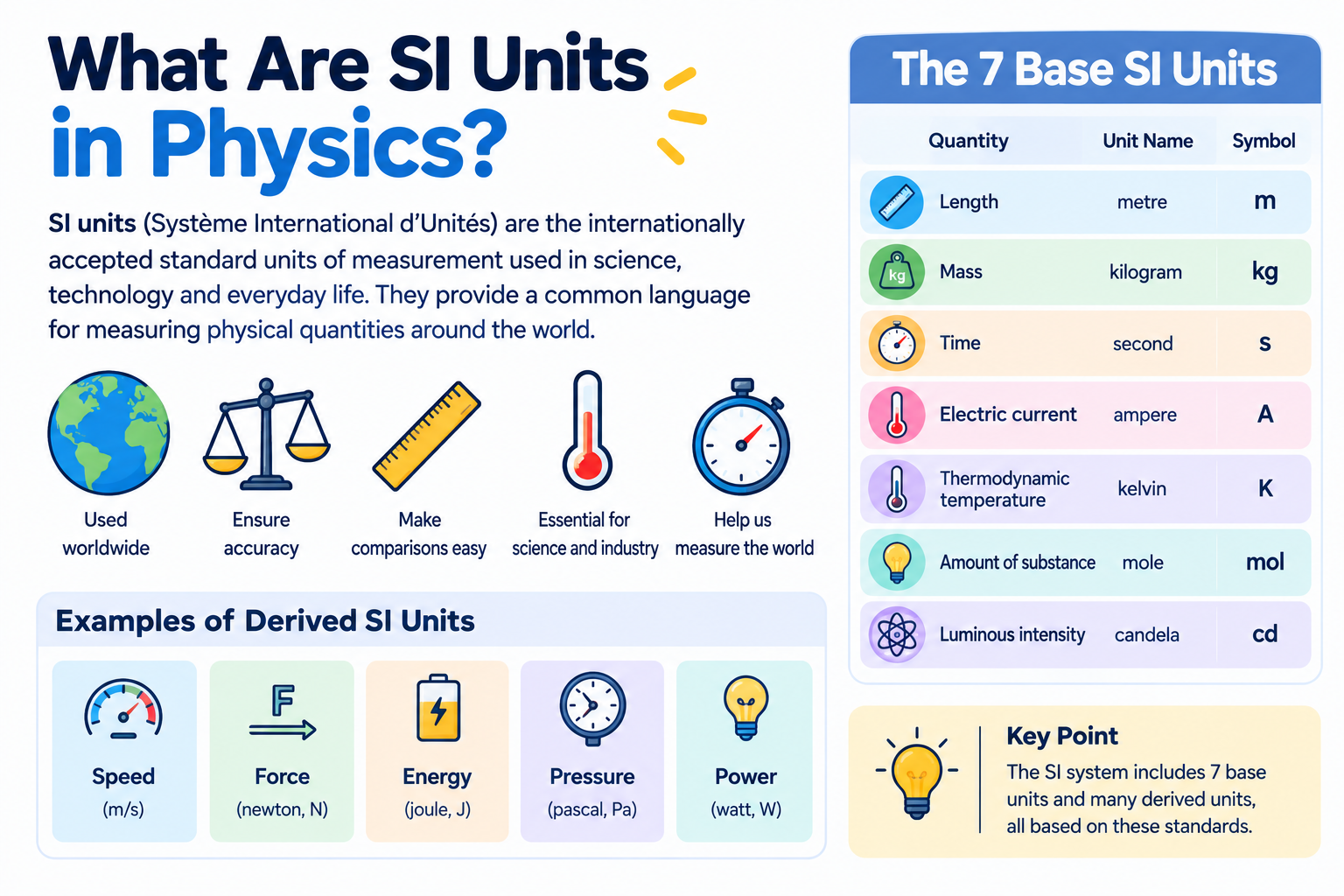
What are SI units in physics? SI units are the internationally agreed standard units of measurement used in science, engineering, medicine, and trade worldwide. SI stands for Système International d’Unités — French for the International System of Units. Every physical quantity you measure in physics — length, mass, time, force, energy — has a defined SI unit.
Without a shared system, scientific progress across borders would be far slower, and dangerous errors would be far more common.
Key Takeaways
-
SI stands for Système International d’Unités — the globally agreed system of measurement used in science and engineering.
-
The SI system is built on seven base units, each measuring a fundamental physical quantity independently.
-
All other units in physics are derived units — formed by combining base units through multiplication or division.
-
SI prefixes (such as kilo, milli, and nano) scale units up or down by powers of ten.
-
The SI system was formally established in 1960 and is maintained by the BIPM in France.
-
All seven base units were redefined in 2019 using fixed values of fundamental physical constants.
-
Using consistent SI units in calculations prevents errors and ensures results are globally comparable.
What Are SI Units in Physics?
The SI system (Système International d’Unités) is the modern international standard for measurement. It is the system of units used by scientists, engineers, doctors, and manufacturers in almost every country in the world.
Before SI existed, different countries used different — and often incompatible — systems. Britain used imperial units (feet, pounds, gallons). France used metric units. Other countries had their own variations. Converting between systems was tedious and error-prone, and scientific papers from different countries could not always be directly compared.
To solve this problem, the General Conference on Weights and Measures (CGPM) formally established the SI system in 1960. The system is governed and updated by the Bureau International des Poids et Mesures (BIPM), based in Sèvres, near Paris, France.
The SI system is built on seven base units. Every other unit used in physics, chemistry, and engineering is derived from these seven — which is why they are called derived units.
Every measurable property of the physical world — what physicists call a What Is a Physical Quantity? — has a corresponding SI unit to express it precisely.
Why Do We Need SI Units?
The need for a universal measurement system goes far beyond classroom physics. Here are five real and compelling reasons:
Scientific communication
Researchers in different countries must share data, reproduce experiments, and build on each other’s work. If a physicist in Germany uses metres and one in the United States uses feet, comparing results directly becomes cumbersome and error-prone. SI gives everyone the same language.
Avoiding catastrophic errors
Mismatched units have caused real disasters. In 1999, NASA lost the Mars Climate Orbiter — a spacecraft worth approximately $327 million — because one engineering team (Lockheed Martin) used imperial units (pound-force seconds) while NASA’s navigation system expected SI units (newton-seconds). The spacecraft entered the Martian atmosphere at the wrong angle and was destroyed. A simple unit mismatch caused a complete mission failure.
Engineering and manufacturing
A car assembled using parts made in Germany, Japan, and Mexico must have components that fit precisely together. This is only possible when every part is designed and measured using a common system.
Medicine
Drug dosages must be expressed in unambiguous units. An error of a factor of 1,000 — confusing milligrams and micrograms, for example — can be fatal. The SI system reduces this risk by providing clear, consistent units with defined prefixes.
Trade
International trade depends on fair and accurate measurement. Whether selling grain, fuel, or electronic components, agreed units ensure that what is measured in one country means exactly the same thing in another.
The Seven SI Base Units
The seven SI base units are the foundation of the entire system. They are defined independently of one another — no base unit is derived from or defined in terms of another base unit.
| Base Quantity | SI Base Unit | Unit Symbol | What It Measures |
|---|---|---|---|
| Length | metre | m | Distance, size, displacement |
| Mass | kilogram | kg | Amount of matter in an object |
| Time | second | s | Duration of events |
| Electric current | ampere | A | Rate of flow of electric charge |
| Thermodynamic temperature | kelvin | K | Absolute temperature |
| Amount of substance | mole | mol | Number of particles (atoms, molecules, etc.) |
| Luminous intensity | candela | cd | Intensity of visible light in a direction |
Each of these units has a precise scientific definition — most were redefined in 2019 to be based on fixed values of fundamental physical constants, making them more stable and reproducible than any physical artefact.
SI Derived Units
Most physical quantities you encounter in physics are not base quantities — they are derived quantities, measured using derived units formed by combining base units.
| Derived Quantity | Unit Name | Symbol | In Terms of Base Units | Everyday Example |
|---|---|---|---|---|
| Speed / Velocity | — | m/s | m·s⁻¹ | Car travelling at 30 m/s |
| Acceleration | — | m/s² | m·s⁻² | Free fall at 9.8 m/s² |
| Force | newton | N | kg·m·s⁻² | Pushing a 1 kg object |
| Energy / Work | joule | J | kg·m²·s⁻² | Energy in a stretched spring |
| Power | watt | W | kg·m²·s⁻³ | A 60 W light bulb |
| Pressure | pascal | Pa | kg·m⁻¹·s⁻² | Tyre pressure |
| Electric charge | coulomb | C | A·s | Charge stored in a capacitor |
| Voltage | volt | V | kg·m²·A⁻¹·s⁻³ | Battery voltage (1.5 V) |
| Resistance | ohm | Ω | kg·m²·A⁻²·s⁻³ | Resistor in a circuit |
| Frequency | hertz | Hz | s⁻¹ | Radio wave frequency (100 MHz) |
| Magnetic flux density | tesla | T | kg·A⁻¹·s⁻² | MRI scanner magnet strength |
| Capacitance | farad | F | A²·s⁴·kg⁻¹·m⁻² | Capacitor in an electronic circuit |
| Luminous flux | lumen | lm | cd·sr | Brightness of a torch |
| Illuminance | lux | lx | cd·sr·m⁻² | Light level in a room |
| Radioactivity | becquerel | Bq | s⁻¹ | Radioactive decay rate |
The newton — the SI unit of force — is one of the most important derived units in physics. For a complete explanation of what force means and how it is measured, see What Is Force in Physics?
SI Prefixes
SI prefixes are attached to unit names to express very large or very small values without writing out long strings of zeros. Each prefix represents a power of ten.
| Prefix | Symbol | Power of Ten | Multiplier | Example |
|---|---|---|---|---|
| Yotta | Y | 10²⁴ | 1,000,000,000,000,000,000,000,000 | 1 Ym |
| Zetta | Z | 10²¹ | 1,000,000,000,000,000,000,000 | 1 Zm |
| Exa | E | 10¹⁸ | 1,000,000,000,000,000,000 | 1 Em |
| Peta | P | 10¹⁵ | 1,000,000,000,000,000 | 1 Pm |
| Tera | T | 10¹² | 1,000,000,000,000 | 1 THz |
| Giga | G | 10⁹ | 1,000,000,000 | 1 GHz = 10⁹ Hz |
| Mega | M | 10⁶ | 1,000,000 | 1 MHz = 10⁶ Hz |
| Kilo | k | 10³ | 1,000 | 1 km = 1,000 m |
| Hecto | h | 10² | 100 | 1 hPa = 100 Pa |
| Deca | da | 10¹ | 10 | 1 dam = 10 m |
| (base unit) | — | 10⁰ | 1 | 1 m |
| Deci | d | 10⁻¹ | 0.1 | 1 dm = 0.1 m |
| Centi | c | 10⁻² | 0.01 | 1 cm = 0.01 m |
| Milli | m | 10⁻³ | 0.001 | 1 mm = 0.001 m |
| Micro | μ | 10⁻⁶ | 0.000001 | 1 μm = 10⁻⁶ m |
| Nano | n | 10⁻⁹ | 0.000000001 | 1 nm = 10⁻⁹ m |
| Pico | p | 10⁻¹² | 10⁻¹² | 1 pF = 10⁻¹² F |
| Femto | f | 10⁻¹⁵ | 10⁻¹⁵ | 1 fm (size of a nucleus) |
| Atto | a | 10⁻¹⁸ | 10⁻¹⁸ | 1 am |
| Zepto | z | 10⁻²¹ | 10⁻²¹ | 1 zm |
| Yocto | y | 10⁻²⁴ | 10⁻²⁴ | 1 ym |
Five prefix conversion examples:
- 3.5 km = 3.5 × 10³ m = 3,500 m
- 250 mg = 250 × 10⁻³ g = 0.250 g = 0.000250 kg
- 120 MHz = 120 × 10⁶ Hz = 1.2 × 10⁸ Hz
- 47 μA = 47 × 10⁻⁶ A = 0.000047 A
- 8.2 nm = 8.2 × 10⁻⁹ m = 0.0000000082 m
The Metre — SI Unit of Length
Symbol: m
The metre is the SI unit of length. It measures distance, height, depth, and displacement — any spatial extent in one dimension.
Current definition (post-2019): The metre is defined as the distance light travels in a vacuum in exactly 1/299,792,458 of a second. This definition links the metre to the speed of light — a universal physical constant — making it reproducible in any laboratory in the world.
Everyday uses: Your height (approximately 1.7 m), the length of a classroom (about 10 m), the distance between cities (expressed in kilometres).
Common multiples:
- 1 mm = 10⁻³ m (thickness of a coin)
- 1 cm = 10⁻² m (width of a fingernail)
- 1 km = 10³ m (distance you can walk in about 10 minutes)
The Kilogram — SI Unit of Mass
Symbol: kg
The kilogram is the SI unit of mass — the measure of how much matter an object contains.
Current definition (post-2019): The kilogram is defined by fixing the numerical value of Planck’s constant to exactly h = 6.62607015 × 10⁻³⁴ J·s. Before 2019, the kilogram was defined by a physical platinum-iridium cylinder kept in France — the only SI base unit still defined by a physical object. The 2019 redefinition replaced this with a definition based on a universal constant.
Mass is not weight. Mass measures the amount of matter in an object and does not change with location. Weight is the gravitational force on a mass, measured in newtons — it changes depending on gravitational field strength. For a detailed explanation, see What Is Mass in Physics?
Everyday uses: Your body mass (e.g., 65 kg), food portions (500 g of flour = 0.5 kg), material quantities in construction.
The Second — SI Unit of Time
Symbol: s
The second is the SI unit of time. It measures the duration of events, intervals, and periods.
Current definition: The second is defined as the duration of exactly 9,192,631,770 oscillations of the radiation corresponding to the transition between two hyperfine energy levels of the ground state of the caesium-133 atom. Atomic clocks based on this definition are accurate to better than one second in 300 million years.
Everyday uses: Timing a race, measuring the period of a pendulum, calculating speed (distance ÷ time).
Common multiples: millisecond (ms = 10⁻³ s), microsecond (μs = 10⁻⁶ s), nanosecond (ns = 10⁻⁹ s).
The Ampere — SI Unit of Electric Current
Symbol: A
The ampere is the SI unit of electric current — the rate of flow of electric charge through a conductor.
Current definition (post-2019): The ampere is defined by fixing the value of the elementary charge to exactly e = 1.602176634 × 10⁻¹⁹ C. One ampere corresponds to approximately 6.241 × 10¹⁸ elementary charges (electrons) flowing past a point per second.
Everyday uses: Household fuses are rated in amperes (e.g., 13 A). Phone chargers draw fractions of an ampere. Larger electric motors can draw tens or hundreds of amperes.
Common multiples: milliampere (mA = 10⁻³ A) — used in electronic circuits; microampere (μA = 10⁻⁶ A) — used in sensitive sensors.
The Kelvin — SI Unit of Temperature
Symbol: K
The kelvin is the SI unit of thermodynamic temperature — temperature measured on an absolute scale starting from the coldest possible point.
Current definition (post-2019): Defined by fixing the Boltzmann constant to exactly k = 1.380649 × 10⁻²³ J/K.
Kelvin and Celsius:
The relationship between kelvin and degrees Celsius is:
K = °C + 273.15
So 0 °C (the freezing point of water) = 273.15 K, and 100 °C (the boiling point of water) = 373.15 K.
Absolute zero is 0 K = −273.15 °C. This is the lowest possible temperature — the point at which particles have minimum thermal energy. It is theoretically impossible to cool anything below absolute zero.
Kelvin intervals are exactly the same size as Celsius intervals — a temperature change of 1 K is identical to a change of 1 °C. The only difference is where the scale starts.
Common use: Gas law calculations, thermodynamics equations, and astrophysics all use kelvin rather than Celsius, because many equations require an absolute temperature scale.
The Mole — SI Unit of Amount of Substance
Symbol: mol
The mole measures the amount of substance — specifically, the number of elementary entities (atoms, molecules, ions, electrons, or any specified particles) in a sample.
Current definition (post-2019): One mole is defined as exactly 6.02214076 × 10²³ elementary entities. This number is known as Avogadro’s number (or Avogadro’s constant), denoted N_A.
To give you a sense of scale: one mole of water molecules (18 grams of water) contains 6.02214076 × 10²³ individual H₂O molecules.
Common use: The mole is indispensable in chemistry for calculating the quantities of reactants and products in chemical reactions (stoichiometry). In physics, it appears in thermodynamics and statistical mechanics.
The Candela — SI Unit of Luminous Intensity
Symbol: cd
The candela measures luminous intensity — the power of visible light emitted in a particular direction per unit solid angle (measured in steradians).
Current definition (post-2019): Defined by fixing the luminous efficacy of monochromatic radiation at a frequency of 540 × 10¹² Hz (green light, near peak human visual sensitivity) to exactly 683 lm/W.
The candela is unique among SI base units because it is defined with respect to human visual perception. Not all light frequencies appear equally bright to the human eye — our eyes are most sensitive to green light and less sensitive to red and blue. The candela accounts for this by weighting light output according to human visual response.
Common use: Lighting design (how bright is a lamp?), photography, display screen brightness, and cinema projection.
Converting Between Units
Unit conversion is an essential skill in physics. Before substituting values into any equation, always check that all quantities are expressed in consistent SI units.
Eight worked conversion examples:
1. Convert 5 km to metres.
5 km = 5 × 10³ m = 5,000 m
(Kilo = 10³; multiply by 1,000.)
2. Convert 350 g to kilograms.
350 g = 350 ÷ 1,000 kg = 0.350 kg
(The SI unit of mass is kg; 1 kg = 1,000 g, so divide by 1,000.)
3. Convert 2.5 hours to seconds.
2.5 h × 60 min/h × 60 s/min = 2.5 × 3,600 = 9,000 s
(1 hour = 3,600 seconds.)
4. Convert 90 km/h to m/s.
90 km/h = 90 × 1,000 m ÷ 3,600 s = 90,000 ÷ 3,600 = 25 m/s
(Multiply by 1,000/3,600 = 1/3.6; or simply divide km/h by 3.6.)
5. Convert 500 mA to amperes.
500 mA = 500 × 10⁻³ A = 0.500 A
(Milli = 10⁻³; divide by 1,000.)
6. Convert 25 °C to kelvin.
K = °C + 273.15 = 25 + 273.15 = 298.15 K
(Always add 273.15 to convert Celsius to kelvin.)
7. Convert 4.5 × 10⁻³ m to millimetres.
4.5 × 10⁻³ m = 4.5 × 10⁻³ ÷ 10⁻³ mm = 4.5 mm
(1 mm = 10⁻³ m; divide metres by 10⁻³ to get mm, which is equivalent to multiplying by 10³.)
8. Convert 1.2 GHz to Hz.
1.2 GHz = 1.2 × 10⁹ Hz = 1,200,000,000 Hz
(Giga = 10⁹; multiply by 1,000,000,000.)
SI Units in Common Physics Equations
Physics equations must be dimensionally consistent — the units on the left-hand side must equal the units on the right-hand side. This is a powerful check for errors.
The SI unit of speed (m/s) appears throughout physics — for a clear explanation of what speed means and how it is calculated, see What Is Speed in Physics?
| Equation | Quantities and SI Units | Unit Result |
|---|---|---|
| v = d/t | d in m, t in s | m/s |
| F = ma | m in kg, a in m/s² | kg·m/s² = N |
| W = Fd | F in N, d in m | N·m = kg·m²/s² = J |
| P = W/t | W in J, t in s | J/s = kg·m²/s³ = W |
| ρ = m/V | m in kg, V in m³ | kg/m³ |
| Q = It | I in A, t in s | C (coulomb) |
| V = IR | I in A, R in Ω | A × kg·m²/(A²·s³) = kg·m²/(A·s³) = V |
| E = mc² | m in kg, c in m/s | kg·(m/s)² = kg·m²/s² = J |
The joule — the SI unit of energy — appears in many of these equations. For a thorough explanation of energy and its forms, see What Is Energy in Physics?
In every case, if you substitute the correct SI units into a correctly written equation, the units automatically work out to give the correct unit for the answer. If they do not balance, there is an error in the equation or the substitution.
Non-SI Units Still in Common Use
Not every unit encountered in daily life is a strict SI unit. Several non-SI units remain widely used and are officially accepted alongside the SI system by the BIPM.
| Non-SI Unit | Quantity | SI Equivalent |
|---|---|---|
| Minute (min) | Time | 1 min = 60 s |
| Hour (h) | Time | 1 h = 3,600 s |
| Day (d) | Time | 1 d = 86,400 s |
| Degree Celsius (°C) | Temperature | K = °C + 273.15 |
| Litre (L) | Volume | 1 L = 10⁻³ m³ |
| Electronvolt (eV) | Energy | 1 eV = 1.602176634 × 10⁻¹⁹ J |
| Kilometre per hour (km/h) | Speed | 1 km/h = 1/3.6 m/s |
| Tonne (t) | Mass | 1 t = 1,000 kg |
| Bar | Pressure | 1 bar = 10⁵ Pa |
These units are practical for everyday use. However, in physics calculations, always convert to SI units before substituting into equations — unless the question specifically permits otherwise.
Common Mistakes Students Make with SI Units
| Incorrect | Correct |
|---|---|
| Writing “Kg” for kilogram | Write kg (lowercase k and g — SI symbols are case-sensitive) |
| Writing “MPS” for metres per second | Write m/s (correct symbol format) |
| Using 25 °C directly in gas law equations | Convert to kelvin first: 25 °C = 298.15 K |
| Using km/h in F = ma calculations | Convert to m/s before substituting |
| Confusing milli (10⁻³) with micro (10⁻⁶) | Remember: milli = 10⁻³, micro = 10⁻⁶ (1,000 times smaller) |
| Omitting the unit from a numerical answer | Always include the unit — “25” is incomplete; “25 m/s” is correct |
| Treating mass and weight as the same | Mass is in kg (scalar); weight is in N (vector force) |
| Writing “sec” instead of “s” for second | The correct SI symbol for second is s |
Worked Examples
Example 1
Question: What is the SI unit of pressure? Express it in terms of base units.
Solution: The SI unit of pressure is the pascal (Pa). Pressure = Force ÷ Area. Force is in N = kg·m·s⁻². Area is in m². Therefore: Pa = N/m² = kg·m·s⁻² / m² = kg·m⁻¹·s⁻².
Explanation: Pressure is a derived unit — built from the base units kilogram, metre, and second.
Example 2
Question: Convert 7,500 m to kilometres.
Solution: 7,500 m ÷ 1,000 = 7.5 km
Explanation: Kilo means 10³. To convert metres to kilometres, divide by 1,000.
Example 3
Question: A student writes that a force is “50.” Is this correct?
Solution: No — it is incomplete. The unit is missing.
Explanation: A physical quantity requires both a numerical value and a unit. The correct answer is 50 N.
Example 4
Question: Convert 37 °C to kelvin.
Solution: K = 37 + 273.15 = 310.15 K
Explanation: The kelvin scale starts at absolute zero (−273.15 °C). Add 273.15 to any Celsius temperature to convert to kelvin.
Example 5
Question: Express the SI unit of energy (joule) in terms of base units.
Solution: Energy = Force × Distance = N × m = (kg·m·s⁻²) × m = kg·m²·s⁻²
Explanation: The joule is a derived unit. Breaking it down shows it is composed of three base units: kilogram, metre, and second.
Example 6
Question: Is it correct to use km/h in the equation v = d/t if distance is in metres and time is in seconds?
Solution: No.
Explanation: All quantities in an equation must use consistent SI units. If d is in metres (m) and t is in seconds (s), then v must be in m/s. Using km/h would give an incorrect result. Always convert to SI units first.
Example 7
Question: Convert 0.0045 kg to grams.
Solution: 0.0045 kg × 1,000 = 4.5 g
Explanation: 1 kg = 1,000 g. Multiply kilograms by 1,000 to convert to grams.
Example 8
Question: What is the SI unit of electric charge? Express it in terms of base units.
Solution: The SI unit is the coulomb (C). From Q = It: C = A × s = A·s.
Explanation: Electric charge is a derived quantity — it equals current (amperes) multiplied by time (seconds).
Example 9
Question: Convert 72 km/h to m/s.
Solution: 72 km/h = 72 × 1,000 ÷ 3,600 = 72,000 ÷ 3,600 = 20 m/s
Explanation: Multiply by 1,000 (km to m) and divide by 3,600 (h to s). Alternatively, divide km/h by 3.6 to get m/s.
Example 10
Question: Check whether the equation F = ma is dimensionally consistent.
Solution: Right-hand side: mass (kg) × acceleration (m/s²) = kg·m·s⁻². Left-hand side: force (N) = kg·m·s⁻². Both sides are equal — the equation is dimensionally consistent.
Explanation: Dimensional consistency is a necessary (though not sufficient) condition for a correct physics equation.
Example 11
Question: A student writes the symbol for kilogram as “KG.” What is wrong with this?
Solution: SI unit symbols are case-sensitive. The correct symbol is kg (lowercase k, lowercase g). Writing “KG” is incorrect.
Explanation: The SI system defines specific capitalisation rules. “K” alone means kelvin. “G” alone is the prefix giga (10⁹). Getting the case wrong changes the meaning entirely.
Example 12
Question: Express the SI unit of power (watt) in terms of base SI units.
Solution: Power = Energy ÷ Time = J ÷ s = kg·m²·s⁻² ÷ s = kg·m²·s⁻³
Explanation: The watt is a derived unit. One watt equals one joule per second, which in base units is kg·m²·s⁻³.
Practice Questions
12 Short Answer Questions
1. What does SI stand for, and where was the SI system established?
Answer: SI stands for Système International d’Unités (International System of Units). It was formally established in 1960 by the CGPM and is maintained by the BIPM in France.
2. List all seven SI base units with their symbols.
Answer: metre (m), kilogram (kg), second (s), ampere (A), kelvin (K), mole (mol), candela (cd).
3. What is the SI unit of force, and how is it expressed in base units?
Answer: The newton (N). In base units: N = kg·m·s⁻².
4. What is the difference between a base unit and a derived unit?
Answer: Base units are the seven fundamental units defined independently. Derived units are formed by combining base units through multiplication or division — for example, m/s (speed) or N = kg·m·s⁻² (force).
5. Convert 850 mA to amperes.
Answer: 850 mA = 850 × 10⁻³ A = 0.850 A
6. What is absolute zero, and what is its value in Celsius?
Answer: Absolute zero is the lowest possible temperature — 0 K = −273.15 °C — the point at which particles have minimum thermal energy.
7. Why is it important to convert to SI units before substituting into physics equations?
Answer: Physics equations are derived for consistent SI units. Using mixed units (e.g., km/h instead of m/s) produces incorrect numerical results.
8. Convert 0 °C and 100 °C to kelvin.
Answer: 0 °C = 273.15 K; 100 °C = 373.15 K
9. What is Avogadro’s number and what does it represent?
Answer: Avogadro’s number is 6.02214076 × 10²³. It represents the number of elementary entities (atoms, molecules, etc.) in one mole of a substance.
10. Express the SI unit of pressure in terms of base units.
Answer: Pascal (Pa) = kg·m⁻¹·s⁻²
11. A student records a mass as “75.” What is incorrect, and what should the correct entry be?
Answer: The unit is missing. The correct entry is 75 kg (or whichever unit is appropriate — the unit must always be stated).
12. What SI prefix represents 10⁻⁶, and give one example of its use?
Answer: Micro (μ). Example: 1 μm = 10⁻⁶ m (one micrometre — used to measure cell sizes in biology and physics).
10 Multiple Choice Questions
Question 1
What does SI stand for?
A. Standard International Units
B. Système International d’Unités
C. Scientific International Units
D. Standard Instruments of Units
Correct Answer: B
Short Explanation: SI is the abbreviation of Système International d’Unités — French for International System of Units. It was adopted in 1960 as the global standard for measurement.
Question 2
Which of the following is a SI base unit?
A. Newton (N)
B. Joule (J)
C. Ampere (A)
D. Pascal (Pa)
Correct Answer: C
Short Explanation: The ampere (A) is one of the seven SI base units, measuring electric current. Newton, joule, and pascal are all derived units.
Question 3
What is the SI unit of energy?
A. Watt (W)
B. Newton (N)
C. Pascal (Pa)
D. Joule (J)
Correct Answer: D
Short Explanation: The joule (J) is the SI unit of energy and work. 1 J = 1 kg·m²·s⁻². The watt is power; the newton is force; the pascal is pressure.
Question 4
Which SI prefix represents 10⁻⁹?
A. Micro (μ)
B. Nano (n)
C. Pico (p)
D. Milli (m)
Correct Answer: B
Short Explanation: Nano (n) = 10⁻⁹. Micro = 10⁻⁶, Pico = 10⁻¹², Milli = 10⁻³.
Question 5
Convert 120 km/h to m/s.
A. 33.3 m/s
B. 120 m/s
C. 0.033 m/s
D. 432 m/s
Correct Answer: A
Short Explanation: 120 km/h ÷ 3.6 = 33.3 m/s (or: 120 × 1,000 ÷ 3,600 = 33.3 m/s).
Question 6
Which of the following correctly expresses the newton in base SI units?
A. kg·m·s⁻¹
B. kg·m²·s⁻²
C. kg·m·s⁻²
D. kg·s⁻²
Correct Answer: C
Short Explanation: F = ma. Force = mass × acceleration = kg × m/s² = kg·m·s⁻². This is the definition of the newton in base units.
Question 7
What is 25 °C in kelvin?
A. 248.15 K
B. 298.15 K
C. 273.15 K
D. 25 K
Correct Answer: B
Short Explanation: K = °C + 273.15 = 25 + 273.15 = 298.15 K. Never use Celsius directly in thermodynamics equations — always convert to kelvin first.
Question 8
Which quantity does the candela measure?
A. Electric current
B. Luminous intensity
C. Amount of substance
D. Thermodynamic temperature
Correct Answer: B
Short Explanation: The candela (cd) measures luminous intensity — the power of visible light emitted in a given direction per unit solid angle. It is one of the seven SI base units.
Question 9
Which of the following unit symbols is written incorrectly?
A. kg
B. m/s
C. Kg
D. A
Correct Answer: C
Short Explanation: SI unit symbols are case-sensitive. The kilogram is written kg (lowercase k and g). Writing “Kg” is incorrect — capital K is the symbol for kelvin.
Question 10
How many elementary entities are in one mole of a substance?
A. 6.022 × 10²⁰
B. 6.022 × 10²³
C. 9.109 × 10⁻³¹
D. 1.602 × 10⁻¹⁹
Correct Answer: B
Short Explanation: One mole contains exactly 6.02214076 × 10²³ elementary entities — Avogadro’s number. The other values are the mass of an electron and the elementary charge.
5 Challenge Questions
Challenge 1:
In 1999, the Mars Climate Orbiter was lost due to a unit error. One team used pound-force seconds; the other expected newton-seconds. The force value sent was 4.45 times larger than expected (since 1 pound-force second ≈ 4.45 N·s). If the intended impulse was 20 N·s but the value received was interpreted as 20 lbf·s, what force in newtons was actually applied, and what was the percentage error?
Answer:
1 lbf·s = 4.44822 N·s
Actual impulse applied = 20 × 4.44822 = 88.96 N·s
Intended impulse = 20 N·s
Error = (88.96 − 20) / 20 × 100 = 344.8% error
This shows how a unit mismatch of a factor of approximately 4.45 produced an error of nearly 345% in the applied impulse — far more than enough to destroy the spacecraft’s trajectory.
Challenge 2:
A student measures a wire’s diameter as 0.45 mm using a micrometer. Express this measurement in (a) metres, (b) micrometres, and (c) nanometres. Show all working.
Answer:
(a) 0.45 mm = 0.45 × 10⁻³ m = 4.5 × 10⁻⁴ m
(b) 4.5 × 10⁻⁴ m ÷ 10⁻⁶ m/μm = 450 μm
(c) 4.5 × 10⁻⁴ m ÷ 10⁻⁹ m/nm = 450,000 nm = 4.5 × 10⁵ nm
Challenge 3:
Show that the equation for kinetic energy, E_k = ½mv², is dimensionally consistent. Use SI base units throughout.
Answer:
Right-hand side: ½ × mass × velocity²
= kg × (m/s)²
= kg × m²/s²
= kg·m²·s⁻²
Left-hand side: E_k is energy, measured in joules (J).
1 J = 1 kg·m²·s⁻² (from the definition of the joule).
Both sides: kg·m²·s⁻² ✓
The equation is dimensionally consistent — the units balance correctly.
Challenge 4:
A physics student needs to calculate pressure using P = F/A. The force is 500 N and the area is 25 cm². The student substitutes directly and gets P = 500/25 = 20 Pa. Explain the error and calculate the correct answer.
Answer:
The student used cm² instead of m² — a unit conversion error.
Correct conversion:
25 cm² = 25 × (10⁻²)² m² = 25 × 10⁻⁴ m² = 2.5 × 10⁻³ m²
Correct calculation:
P = F/A = 500 N ÷ 2.5 × 10⁻³ m² = 200,000 Pa = 2 × 10⁵ Pa
The student’s answer of 20 Pa was wrong by a factor of 10,000 — because 1 cm² = 10⁻⁴ m², not 10⁻² m². This is a common and important mistake: when converting areas, the conversion factor must be squared.
Challenge 5:
The speed of light in vacuum is exactly 299,792,458 m/s. (a) Express this in km/s. (b) Express it in km/h. (c) How far does light travel in one nanosecond? Give your answer in centimetres.
Answer:
(a) 299,792,458 m/s ÷ 1,000 = 299,792.458 km/s
(b) 299,792.458 km/s × 3,600 s/h = 1,079,252,848.8 km/h ≈ 1.079 × 10⁹ km/h
(c) Distance in 1 nanosecond:
1 ns = 1 × 10⁻⁹ s
d = v × t = 299,792,458 m/s × 10⁻⁹ s = 0.299792458 m ≈ 0.30 m = 30.0 cm
Light travels approximately 30 centimetres in one nanosecond — roughly the length of a ruler. This is a useful fact in electronics and computing, where nanosecond timescales are common.
SI Units Across Physics Topics
Mechanics
The most frequently used SI units in mechanics are the metre (m), kilogram (kg), second (s), and newton (N). Speed is in m/s, acceleration in m/s², force in N, energy in J, and momentum in kg·m/s. Getting these right is essential for applying Newton’s Laws and energy equations correctly.
Thermodynamics
Temperature in kelvin (K) is essential — gas laws and thermodynamic equations require an absolute temperature scale. Energy is in joules (J), pressure in pascals (Pa), and heat capacity in J/(kg·K).
Electricity and Magnetism
Electric current is in amperes (A), voltage in volts (V), resistance in ohms (Ω), charge in coulombs (C), and magnetic flux density in teslas (T). All are derived from base units involving the ampere, kilogram, metre, and second.
Waves and Optics
Frequency is in hertz (Hz = s⁻¹), wavelength in metres (m), and wave speed in m/s. Refractive index is dimensionless. Illuminance is in lux (lx) and luminous intensity in candela (cd).
Nuclear and Particle Physics
At this level, the electronvolt (eV) is commonly used for energy (1 eV = 1.602 × 10⁻¹⁹ J), and the becquerel (Bq = s⁻¹) measures radioactivity. Mass is sometimes expressed in unified atomic mass units (u), where 1 u = 1.66054 × 10⁻²⁷ kg.
Exam Tips
- Always include the unit in every numerical answer. A correct number without a unit will lose marks in most examinations.
- Convert all values to SI units before substituting into equations. This is the single most important habit to develop — it prevents the most common calculation errors.
- Know all seven base units and their correct symbols — including correct capitalisation. kg not Kg. A not a. K not k (k is kilo).
- Memorise the most common SI prefixes and their powers of ten. At minimum: nano (10⁻⁹), micro (10⁻⁶), milli (10⁻³), centi (10⁻²), kilo (10³), mega (10⁶), giga (10⁹).
- Be able to express derived units in terms of base units. Examiners regularly ask for the base unit expression of the newton, joule, pascal, or volt.
- Use kelvin — not Celsius — in thermodynamics equations. Forgetting to convert °C to K is a frequent and costly error.
- Do not confuse mass (kg) and weight (N). They are entirely different quantities — mass is a scalar; weight is a vector force.
- Check dimensional consistency in your answers. If the units do not balance on both sides of your equation, something is wrong.
Quick Revision Notes
SI = Système International d’Unités — the global standard for measurement in science and engineering, established 1960, maintained by BIPM.
Seven SI Base Units:
- Metre (m) — length
- Kilogram (kg) — mass
- Second (s) — time
- Ampere (A) — electric current
- Kelvin (K) — temperature
- Mole (mol) — amount of substance
- Candela (cd) — luminous intensity
Key Derived Units: N (force), J (energy), W (power), Pa (pressure), C (charge), V (voltage), Ω (resistance), Hz (frequency).
Key SI Prefixes: G (10⁹), M (10⁶), k (10³), c (10⁻²), m (10⁻³), μ (10⁻⁶), n (10⁻⁹), p (10⁻¹²).
Kelvin ↔ Celsius: K = °C + 273.15. Absolute zero = 0 K = −273.15 °C.
Conversion rules: Always convert to SI units before calculating. When converting areas or volumes, square or cube the linear conversion factor.
Common mistakes: Missing units, using °C in thermodynamics equations, using km/h instead of m/s, incorrect prefix powers, wrong capitalisation of unit symbols.
SI Units Cheat Sheet
| Concept | Key Point | Example |
|---|---|---|
| SI definition | International System of Units — global measurement standard | Established 1960 by CGPM |
| Base unit — length | Metre (m) | Height: 1.75 m |
| Base unit — mass | Kilogram (kg) | Body mass: 70 kg |
| Base unit — time | Second (s) | Race time: 9.58 s |
| Base unit — current | Ampere (A) | Circuit current: 2 A |
| Base unit — temperature | Kelvin (K) | Body temp: 310 K |
| Base unit — amount | Mole (mol) | 1 mol = 6.022 × 10²³ particles |
| Base unit — light | Candela (cd) | Lamp intensity: 800 cd |
| Derived unit — force | Newton (N) = kg·m·s⁻² | Weight: 700 N |
| Derived unit — energy | Joule (J) = kg·m²·s⁻² | Kinetic energy: 500 J |
| Derived unit — power | Watt (W) = kg·m²·s⁻³ | Light bulb: 60 W |
| Derived unit — pressure | Pascal (Pa) = kg·m⁻¹·s⁻² | Tyre pressure: 200,000 Pa |
| Prefix — kilo | 10³ | 1 km = 1,000 m |
| Prefix — milli | 10⁻³ | 1 mm = 0.001 m |
| Prefix — micro | 10⁻⁶ | 1 μA = 10⁻⁶ A |
| Prefix — nano | 10⁻⁹ | 1 nm = 10⁻⁹ m |
| Kelvin conversion | K = °C + 273.15 | 25 °C = 298.15 K |
| Absolute zero | 0 K = −273.15 °C | Minimum possible temperature |
Frequently Asked Questions
1. What are SI units in physics?
SI units are the internationally agreed standard units of measurement used in physics, science, engineering, and medicine. SI stands for Système International d’Unités. All physical quantities are measured and expressed using SI units or units derived from them.
2. What does SI stand for?
SI stands for Système International d’Unités — French for the International System of Units.
3. What are the 7 SI base units?
The seven SI base units are: metre (m), kilogram (kg), second (s), ampere (A), kelvin (K), mole (mol), and candela (cd).
4. What is the SI unit of force?
The SI unit of force is the newton (N). In base units: 1 N = 1 kg·m·s⁻².
5. What is the SI unit of energy?
The SI unit of energy is the joule (J). In base units: 1 J = 1 kg·m²·s⁻².
6. What is the difference between base units and derived units?
Base units are the seven independently defined fundamental units. Derived units are formed by combining base units through multiplication or division — for example, m/s (speed) or N = kg·m·s⁻² (force).
7. What are SI prefixes?
SI prefixes are multipliers attached to unit names to express very large or very small values conveniently. For example, kilo (k) = 10³, milli (m) = 10⁻³, nano (n) = 10⁻⁹.
8. What is the SI unit of temperature?
The SI unit of temperature is the kelvin (K). It measures absolute (thermodynamic) temperature, starting at absolute zero (0 K = −273.15 °C).
9. What is the difference between kelvin and Celsius?
Both use the same interval size (1 K = 1 °C difference), but different starting points. Celsius starts at the freezing point of water (0 °C). Kelvin starts at absolute zero. Conversion: K = °C + 273.15.
10. Why is the kilogram the SI unit of mass and not the gram?
When the SI system was formalised, the kilogram was chosen because it is a more practical size for everyday measurements. The gram is 1,000 times smaller and was less convenient as a base unit for scientific work. The kilogram remains the only SI base unit with a prefix in its name.
11. What is the SI unit of electric current?
The SI unit of electric current is the ampere (A). It measures the rate of flow of electric charge. The ampere is one of the seven SI base units.
12. What is absolute zero in kelvin?
Absolute zero is 0 K, equivalent to −273.15 °C. It is the lowest possible temperature — the point at which particles have their minimum possible thermal energy.
13. Why are SI units important?
SI units provide a universal, unambiguous language for measurement. They allow scientists and engineers worldwide to share results, reproduce experiments, and build technology without unit-related errors. As the Mars Climate Orbiter disaster showed, unit mismatches can have catastrophic consequences.
14. What is a mole in SI units?
A mole is the SI unit of amount of substance. One mole contains exactly 6.02214076 × 10²³ elementary entities (atoms, molecules, ions, etc.) — known as Avogadro’s number.
15. Are non-SI units allowed in physics?
Some non-SI units are officially accepted for use alongside the SI system by the BIPM — including the litre (L), minute (min), hour (h), electronvolt (eV), and degree Celsius (°C). However, in physics calculations, values should always be converted to SI units before substituting into equations.
Summary
SI units are the foundation of all measurement in physics and science. They provide a consistent, universal system that allows anyone, anywhere in the world, to measure and communicate physical quantities without ambiguity.
The system is built on seven base units — metre, kilogram, second, ampere, kelvin, mole, and candela — each independently defined using fundamental physical constants. From these seven, all other units in physics are derived.
SI prefixes extend the system to cover the enormous range of scales encountered in physics — from the nanometre scale of atoms to the gigametre scale of planetary distances.
Mastering SI units means knowing not just the names and symbols, but understanding why the system works the way it does — and applying it correctly in every measurement, every calculation, and every answer you write.
Final Thoughts
SI units are not just a list to memorise for an exam. They are the language of measurement — a carefully constructed, internationally agreed system that makes all of physics possible.
Every equation in physics is written in terms of SI units. Every experiment you perform produces results expressed in SI units. Every answer you give in a physics course must include the correct SI unit.
When you understand how base units combine to form derived units, how prefixes scale measurements up and down, and why consistent units matter in every calculation, physics becomes considerably more coherent. The numbers start to make sense not just mathematically, but physically.
Take the time to learn the seven base units, the key derived units, and the most important prefixes. That knowledge will serve you through every topic in physics — from mechanics and thermodynamics to electricity, waves, and beyond.
References
- BIPM — Bureau International des Poids et Mesures (SI Brochure, 9th Edition): https://www.bipm.org
- NIST — National Institute of Standards and Technology (SI Units): https://www.nist.gov
- Khan Academy — Units and Measurement: https://www.khanacademy.org
- OpenStax University Physics — Units and Measurement: https://openstax.org
- Physics LibreTexts — Physical Quantities and Units: https://phys.libretexts.org
Helpful Resources
BIPM — Bureau International des Poids et Mesures
The official international body responsible for the SI system. Students can access the full SI Brochure, which contains precise definitions of all seven base units and official SI prefix tables.
https://www.bipm.org
NIST — National Institute of Standards and Technology
NIST provides clear, authoritative explanations of SI units, prefixes, and constants — ideal for students who want to go beyond the basics and understand how units are defined and maintained.
https://www.nist.gov
Khan Academy — Physics: Units and Measurement
Offers video lessons and interactive practice exercises on SI units, unit conversion, scientific notation, and significant figures — suitable for GCSE through university level.
https://www.khanacademy.org
OpenStax University Physics
A free, peer-reviewed physics textbook with detailed coverage of physical quantities, SI units, unit conversion, and dimensional analysis — well-structured for self-study.
https://openstax.org
Disclaimer:
This article is intended for educational and informational purposes only. While LearnMinto strives to provide accurate and up-to-date physics information, readers should verify important academic concepts through official textbooks, educational institutions, examination boards, or trusted educational resources before using this content for exams or academic purposes. LearnMinto is not affiliated with any specific school, university, research institution, or examination board.
About the Author
Saad Qureshi is a Senior Education & Technology Editor at LearnMinto. He focuses on creating and reviewing clear, accessible educational content across mathematics, physics, chemistry, biology, computer science, technology, AI tools, and personal finance.