
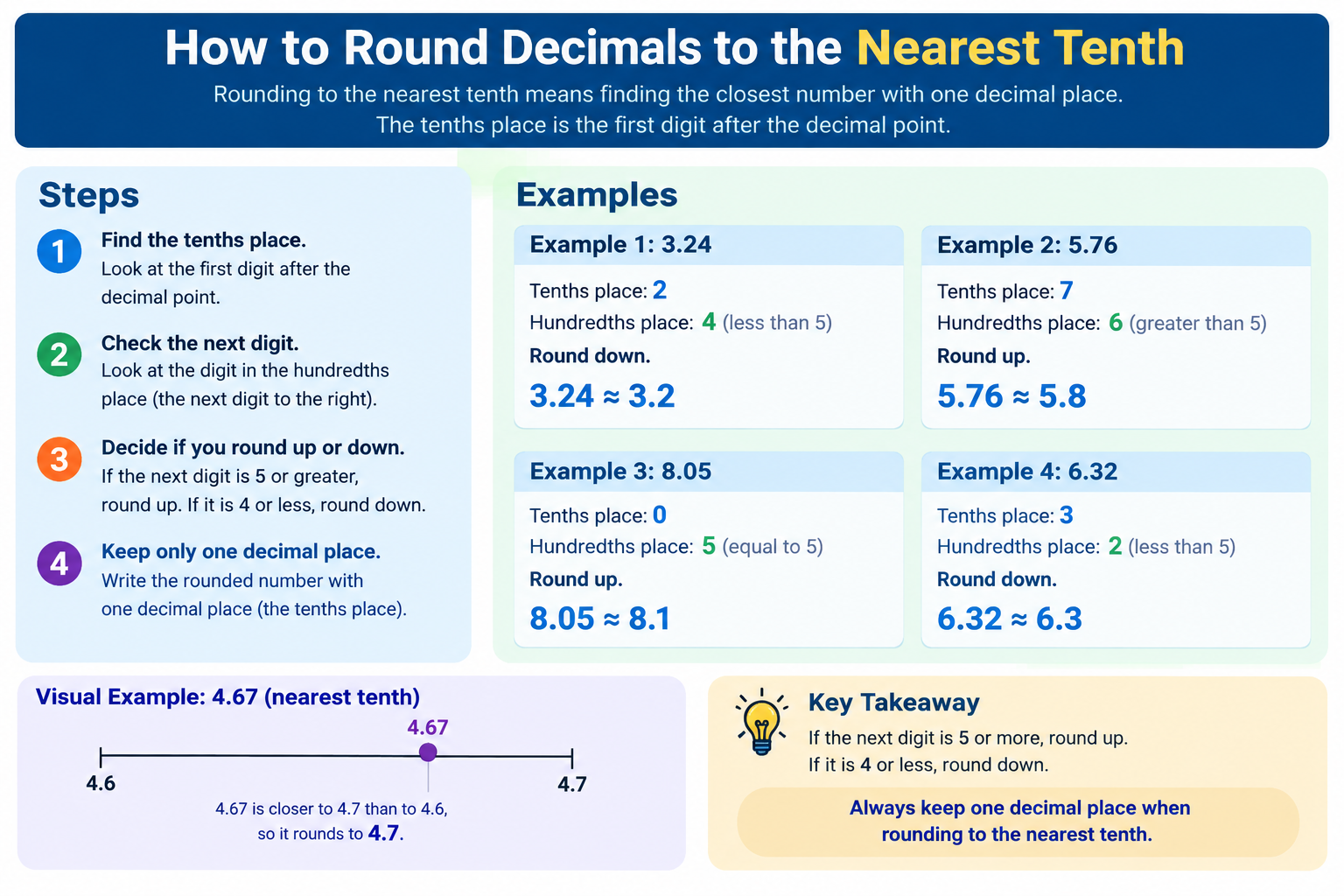
Introduction
Imagine you measure the length of a pencil and get 7.83 centimetres. That level of precision is sometimes more than you need. In many situations, saying the pencil is approximately 7.8 centimetres is perfectly accurate enough — and much easier to work with.
This is exactly what rounding is for. Rounding a decimal to the nearest tenth means keeping one digit after the decimal point and adjusting the value to the closest tenth.
It sounds simple, and it is — once you understand the rule and why it works. Whether you are a student encountering this for the first time, a parent helping with homework, or a teacher looking for a clear explanation to share, this guide walks through everything you need to know about how to round decimals to the nearest tenth.
Key Takeaways
-
Rounding means replacing a number with a simpler approximation that is close to the original value.
-
The tenths place is the first digit immediately to the right of the decimal point.
-
To round to the nearest tenth, look at the hundredths digit (the second digit after the decimal point).
-
If the hundredths digit is 5 or greater, round up the tenths digit by 1.
-
If the hundredths digit is 4 or less, keep the tenths digit the same.
-
Digits after the tenths place are dropped once rounding is complete.
-
Rounding is used in everyday life, science, finance, and measurement.
What Does Rounding Mean?
Rounding is the process of replacing a number with a nearby value that is simpler or easier to use, while keeping it as close to the original as possible.
When you round a number, you are essentially asking: “Which simple value is this number closest to?”
For example:
- 3.72 rounded to the nearest tenth is 3.7 (because 3.72 is closer to 3.7 than to 3.8)
- 3.76 rounded to the nearest tenth is 3.8 (because 3.76 is closer to 3.8 than to 3.7)
Rounding does not give you the exact value — it gives you a convenient approximation. This is useful in measurements, calculations, science, finance, and everyday communication.
What Is the Tenths Place?
In any decimal number, the position of each digit matters. The digit immediately to the right of the decimal point sits in the tenths place.
Look at the number 4.673:
| Ones | . | Tenths | Hundredths | Thousandths |
|---|---|---|---|---|
| 4 | . | 6 | 7 | 3 |
The digit 6 is in the tenths place. It represents six tenths, or 6/10.
When you round to the nearest tenth, your answer will always have exactly one digit after the decimal point.
Understanding Decimal Place Values
Before rounding, it helps to be confident with decimal place values. Every digit in a decimal number has a specific position and value.
Consider the number 25.8479:
| Tens | Ones | . | Tenths | Hundredths | Thousandths | Ten-Thousandths |
|---|---|---|---|---|---|---|
| 2 | 5 | . | 8 | 4 | 7 | 9 |
- Tenths place: 8 → value = 8/10 = 0.8
- Hundredths place: 4 → value = 4/100 = 0.04
- Thousandths place: 7 → value = 7/1000 = 0.007
- Ten-thousandths place: 9 → value = 9/10000 = 0.0009
When rounding to the nearest tenth, you only need to focus on the tenths digit and the hundredths digit. Everything else is secondary.
The Rounding Rule Explained
The standard rounding rule for rounding to the nearest tenth is:
- Find the digit in the tenths place (first digit after the decimal point).
- Look at the digit in the hundredths place (second digit after the decimal point). This is the decision digit.
- Apply the rule:
- If the hundredths digit is 5, 6, 7, 8, or 9 → round up (increase the tenths digit by 1).
- If the hundredths digit is 0, 1, 2, 3, or 4 → round down (keep the tenths digit the same).
- Drop all digits after the tenths place.
Why 5? The digit 5 represents the exact midpoint between two tenths. The convention in standard rounding (also called “round half up”) is to round up whenever the decision digit is 5 or more. This is the rule taught in most schools and used in most everyday contexts.
How to Round Decimals to the Nearest Tenth — Step by Step
Step 1: Identify the tenths digit
Look at the first digit after the decimal point. This is the digit you may change.
Step 2: Identify the hundredths digit
Look at the second digit after the decimal point. This is your decision digit — it tells you whether to round up or keep the tenths digit the same.
Step 3: Apply the rounding rule
- Hundredths digit ≥ 5 → add 1 to the tenths digit (round up)
- Hundredths digit ≤ 4 → leave the tenths digit unchanged (round down)
Step 4: Drop everything after the tenths place
Your answer should have exactly one digit after the decimal point.
Step 5: Check for carry-over
If the tenths digit was 9 and you round up, it becomes 10. In this case, write 0 in the tenths place and carry 1 to the ones place.
Worked Examples
Example 1: Round 3.72 to the nearest tenth.
- Tenths digit: 7
- Hundredths digit: 2 → less than 5, round down
- Keep the tenths digit as 7, drop the 2
Answer: 3.7
Example 2: Round 5.86 to the nearest tenth.
- Tenths digit: 8
- Hundredths digit: 6 → 5 or more, round up
- Increase tenths digit from 8 to 9, drop the 6
Answer: 5.9
Example 3: Round 12.35 to the nearest tenth.
- Tenths digit: 3
- Hundredths digit: 5 → round up
- Increase tenths digit from 3 to 4
Answer: 12.4
Example 4: Round 0.741 to the nearest tenth.
- Tenths digit: 7
- Hundredths digit: 4 → less than 5, round down
- Keep tenths digit as 7
Answer: 0.7
Example 5: Round 8.953 to the nearest tenth.
- Tenths digit: 9
- Hundredths digit: 5 → round up
- 9 + 1 = 10 → write 0 in tenths place, carry 1 to ones place
- 8 + 1 = 9
Answer: 9.0
Example 6: Round 100.049 to the nearest tenth.
- Tenths digit: 0
- Hundredths digit: 4 → less than 5, round down
- Keep tenths digit as 0
Answer: 100.0
Example 7: Round 6.999 to the nearest tenth.
- Tenths digit: 9
- Hundredths digit: 9 → round up
- 9 + 1 = 10 → write 0, carry 1 to ones: 6 + 1 = 7
Answer: 7.0
Example 8: Round 0.050 to the nearest tenth.
- Tenths digit: 0
- Hundredths digit: 5 → round up
- Increase tenths digit from 0 to 1
Answer: 0.1
Example 9: Round 47.321 to the nearest tenth.
- Tenths digit: 3
- Hundredths digit: 2 → less than 5, round down
Answer: 47.3
Example 10: Round 19.975 to the nearest tenth.
- Tenths digit: 9
- Hundredths digit: 7 → round up
- 9 + 1 = 10 → write 0, carry 1: 19 + 1 = 20
Answer: 20.0
Rounding on a Number Line
A number line is one of the clearest ways to understand what rounding actually means visually.
When rounding 3.72 to the nearest tenth, ask yourself: is 3.72 closer to 3.7 or to 3.8?
Draw a number line from 3.7 to 3.8, divided into ten equal parts:
3.70 — 3.71 — 3.72 — 3.73 — 3.74 — 3.75 — 3.76 — 3.77 — 3.78 — 3.79 — 3.80The midpoint between 3.7 and 3.8 is 3.75. Since 3.72 is to the left of 3.75, it is closer to 3.7.
Rounded answer: 3.7
Now consider 3.78. It sits to the right of the midpoint 3.75, so it is closer to 3.8.
Rounded answer: 3.8
This visual approach makes the rounding rule intuitive. Numbers below the midpoint go down; numbers at or above the midpoint go up.
Rounding Decimals With Many Decimal Places
When a decimal has three, four, or more digits after the decimal point, the process is exactly the same. You only ever need to look at the tenths and hundredths digits. Everything else can be ignored until the final step.
Example: Round 0.6283 to the nearest tenth.
- Tenths digit: 6
- Hundredths digit: 2 → round down
Answer: 0.6
Example: Round 3.14159 to the nearest tenth.
- Tenths digit: 1
- Hundredths digit: 4 → round down
Answer: 3.1
Example: Round 2.7182 to the nearest tenth.
- Tenths digit: 7
- Hundredths digit: 1 → round down
Answer: 2.7
Example: Round 9.8765 to the nearest tenth.
- Tenths digit: 8
- Hundredths digit: 7 → round up
Answer: 9.9
No matter how many digits follow, your decision is always based solely on the hundredths digit.
What Happens When the Hundredths Digit Is Exactly 5?
When the hundredths digit is exactly 5, the number sits precisely at the midpoint between two tenths. For example, 4.75 is exactly halfway between 4.7 and 4.8.
In standard rounding — the method taught in most schools — the rule is to round up when the digit is exactly 5.
So: 4.75 rounds up to 4.8
This convention is sometimes called “round half up” and it is the most widely used rule in everyday mathematics, finance, and most examination contexts.
You may encounter alternative rounding conventions in advanced statistics or computing, but for school-level mathematics, always round up when the hundredths digit is 5.
Rounding Decimals Greater Than 1
Rounding works in exactly the same way for larger decimal numbers. The whole-number part is unaffected unless a carry-over occurs.
Example: Round 134.67 to the nearest tenth.
- Tenths digit: 6
- Hundredths digit: 7 → round up
Answer: 134.7
Example: Round 999.95 to the nearest tenth.
- Tenths digit: 9
- Hundredths digit: 5 → round up
- 9 + 1 = 10 → write 0, carry: 999 + 1 = 1000
Answer: 1000.0
Large numbers follow the same straightforward rule. Just keep your focus on the tenths and hundredths digits.
Rounding Negative Decimals
Rounding negative decimals requires a small amount of extra care, because “rounding up” on a number line means moving towards zero for negative numbers.
In standard school mathematics, the most commonly taught approach is to apply the same rule mechanically:
- Look at the hundredths digit.
- If it is 5 or more, increase the tenths digit by 1 in absolute value (which actually moves the number closer to zero).
- If it is 4 or less, keep the tenths digit the same.
Example: Round −3.72 to the nearest tenth.
Ignoring the negative sign for now: 3.72 rounds to 3.7.
Answer: −3.7
Example: Round −5.86 to the nearest tenth.
5.86 rounds to 5.9.
Answer: −5.9
For standard school purposes, treat the digits as you normally would and then reapply the negative sign.
Common Mistakes When Rounding Decimals
1. Looking at the wrong digit
Some students look at the thousandths digit instead of the hundredths digit. Always check the second digit after the decimal point — that is your decision digit.
2. Rounding in stages
A common error is to round twice — for example, rounding 3.749 first to 3.75 and then to 3.8. This is incorrect. Look only at the hundredths digit of the original number. 3.749 rounds to 3.7, not 3.8.
3. Dropping digits instead of rounding
Simply removing digits without applying the rounding rule is called truncation, not rounding. 3.78 truncated to one decimal place is 3.7, but rounded to the nearest tenth it is 3.8.
4. Forgetting to carry over
When the tenths digit is 9 and you round up, the result is 10, which requires a carry. Forgetting this produces answers like 3.10 instead of the correct 4.0.
5. Writing extra digits in the answer
After rounding to the nearest tenth, the answer should have exactly one digit after the decimal point. Writing 3.70 instead of 3.7 is technically acceptable, but writing 3.700 suggests a different level of precision.
6. Confusing the tenths and hundredths places
The tenths place is first after the decimal; hundredths is second. Students sometimes reverse these, which leads to rounding using the wrong digit.
7. Rounding when an exact answer is required
In some problems, rounding is not appropriate. Always check whether the question asks for an exact answer or an approximation.
Rounding vs Truncating — What Is the Difference?
These two processes are often confused, but they are different.
Rounding considers the next digit and adjusts the kept digit up or down accordingly.
Truncating simply cuts off digits after a certain point, without any adjustment.
| Number | Rounded to Nearest Tenth | Truncated to One Decimal Place |
|---|---|---|
| 3.78 | 3.8 | 3.7 |
| 5.32 | 5.3 | 5.3 |
| 9.95 | 10.0 | 9.9 |
| 0.67 | 0.7 | 0.6 |
Notice that truncation always rounds towards zero, while standard rounding rounds to the nearest value. In most school mathematics, rounding is the expected method.
Real-Life Examples of Rounding to the Nearest Tenth
Measuring height: A student measures 163.47 cm tall. For most purposes, saying 163.5 cm is perfectly accurate.
Fuel prices: Petrol might cost 152.39 pence per litre. Rounded to the nearest tenth: 152.4 pence.
Temperature: A thermometer reads 36.82°C. Reported to the nearest tenth: 36.8°C.
Running times: A runner finishes in 9.87 seconds. To the nearest tenth: 9.9 seconds.
Shopping: A fruit weighs 0.347 kg. Rounded to the nearest tenth: 0.3 kg.
Science experiments: A measured volume is 12.63 ml. Recorded to the nearest tenth: 12.6 ml.
Currency conversion: An exchange rate gives £1 = $1.2748. Rounded to the nearest tenth: $1.3.
In each case, rounding makes the number easier to communicate and work with, while keeping it close to the true value.
Practice Questions
Try these on your own. Answers are provided below.
Round each decimal to the nearest tenth.
- 4.32
- 7.68
- 0.55
- 13.91
- 6.749
- 0.083
- 99.95
- 2.050
- 45.444
- 8.999
Fill in the blank.
- 3.72 rounded to the nearest tenth is ___.
- 0.461 rounded to the nearest tenth is ___.
- 15.35 rounded to the nearest tenth is ___.
- 7.901 rounded to the nearest tenth is ___.
- 100.08 rounded to the nearest tenth is ___.
True or False.
- 6.84 rounded to the nearest tenth is 6.9. (True / False)
- 3.749 rounded to the nearest tenth is 3.8. (True / False)
- 0.95 rounded to the nearest tenth is 1.0. (True / False)
- 12.52 rounded to the nearest tenth is 12.5. (True / False)
- 9.99 rounded to the nearest tenth is 10.0. (True / False)
Word problems.
- A plank of wood is 2.374 metres long. What is its length to the nearest tenth of a metre?
- A bag of rice weighs 1.862 kg. What is this to the nearest tenth of a kilogram?
- The temperature at noon was 23.47°C. What is this to the nearest tenth?
- A car travels 88.652 km. Round this to the nearest tenth of a kilometre.
- A student scores 76.85 marks out of 100. Round this to the nearest tenth.
Practice Question Answers:
- 4.3
- 7.7
- 0.6
- 13.9
- 6.7
- 0.1
- 100.0
- 2.1
- 45.4
- 9.0
- 3.7
- 0.5
- 15.4
- 7.9
- 100.1
- False — 6.84 rounds to 6.8 (hundredths digit is 4)
- False — 3.749 rounds to 3.7 (hundredths digit is 4)
- True — 0.95: tenths digit 9, hundredths digit 5, round up → 10/10 = 1.0
- True — 12.52: hundredths digit 2, round down → 12.5
- True — 9.99: hundredths digit 9, round up → 10.0
- 2.4 metres
- 1.9 kg
- 23.5°C
- 88.7 km
- 76.9
Multiple-Choice Questions
Question 1: What is 5.47 rounded to the nearest tenth?
A) 5.4
B) 5.5
C) 5.0
D) 6.0
Correct Answer: B — 5.5
Hundredths digit is 7 (≥ 5), so round up: 5.4 becomes 5.5.
Question 2: Which digit do you look at to round to the nearest tenth?
A) The ones digit
B) The tenths digit
C) The hundredths digit
D) The thousandths digit
Correct Answer: C — The hundredths digit
The hundredths digit is the decision digit when rounding to the nearest tenth.
Question 3: What is 0.349 rounded to the nearest tenth?
A) 0.4
B) 0.3
C) 0.35
D) 1.0
Correct Answer: B — 0.3
Hundredths digit is 4 (< 5), round down.
Question 4: A ribbon is 3.851 metres long. What is this to the nearest tenth?
A) 3.8
B) 4.0
C) 3.9
D) 3.85
Correct Answer: C — 3.9
Hundredths digit is 5, round up: 3.8 becomes 3.9.
Question 5: What is 9.999 rounded to the nearest tenth?
A) 9.9
B) 10.0
C) 9.99
D) 10.1
Correct Answer: B — 10.0
Hundredths digit 9 → round up tenths digit 9 → carry: 10.0.
Question 6: Which of these numbers rounds to 7.4 when rounded to the nearest tenth?
A) 7.46
B) 7.35
C) 7.44
D) 7.50
Correct Answer: C — 7.44
7.44: hundredths digit 4 → round down → 7.4. All others round to 7.5 or higher.
Question 7: True or false — 12.349 rounded to the nearest tenth is 12.4.
A) True
B) False
Correct Answer: B — False
Hundredths digit is 4 → round down → 12.3.
Question 8: What is 0.050 rounded to the nearest tenth?
A) 0.0
B) 0.05
C) 0.1
D) 1.0
Correct Answer: C — 0.1
Hundredths digit is 5 → round up → 0.1.
Question 9: A temperature of 37.652°C rounded to the nearest tenth is:
A) 37.6
B) 37.7
C) 38.0
D) 37.65
Correct Answer: B — 37.7
Hundredths digit is 5 → round up.
Question 10: Which number has been correctly rounded to the nearest tenth?
A) 4.35 → 4.3
B) 6.72 → 6.8
C) 8.54 → 8.5
D) 2.19 → 2.1
Correct Answer: D — 2.19 → 2.1
Hundredths digit is 9 → round up → 2.2. Wait — this means D is also wrong. Let us re-examine:
- A: 4.35 → hundredths 5 → round up → 4.4 ✗ (shown as 4.3)
- B: 6.72 → hundredths 2 → round down → 6.7 ✗ (shown as 6.8)
- C: 8.54 → hundredths 4 → round down → 8.5 ✓
- D: 2.19 → hundredths 9 → round up → 2.2 ✗ (shown as 2.1)
Correct Answer: C — 8.54 → 8.5
Challenge Questions
Challenge 1: A scientist records five measurements: 4.253, 4.248, 4.251, 4.255, and 4.249. Round each to the nearest tenth and state whether they all round to the same value.
- 4.253 → hundredths 5 → 4.3
- 4.248 → hundredths 4 → 4.2
- 4.251 → hundredths 5 → 4.3
- 4.255 → hundredths 5 → 4.3
- 4.249 → hundredths 4 → 4.2
They do not all round to the same value. Three round to 4.3 and two round to 4.2. This illustrates why rounding individual measurements can lead to slightly different results even when values are very close together.
Challenge 2: The number 8.X5 is rounded to the nearest tenth. What digit could X represent, and will the answer always be 8.Y where Y = X + 1?
X can be any digit from 0 to 9. Since the hundredths digit is 5, you always round up. So yes, the tenths digit increases by 1 in every case — provided the tenths digit is not 9. If X = 9, then 8.95 rounds to 9.0, not 8.10.
Challenge 3: Round 999.999 to the nearest tenth.
- Tenths digit: 9
- Hundredths digit: 9 → round up
- 9 + 1 = 10 → write 0, carry: 999.9 + 0.1 = 1000.0
Answer: 1000.0
Challenge 4: A student rounds 6.349 to the nearest tenth and gets 6.4. Identify and explain the error.
The student likely rounded in two stages: first rounding 6.349 to 6.35, and then rounding 6.35 to 6.4. This is a common but incorrect approach called cascading rounding or double rounding. The correct method is to look only at the original hundredths digit, which is 4. Since 4 < 5, the answer is 6.3.
Challenge 5: Without a calculator, explain how you know that 3.14159265 rounded to the nearest tenth is 3.1, without working through all the digits.
You only need to look at the tenths digit (1) and the hundredths digit (4). Since 4 < 5, you round down and keep the tenths digit as 1. All remaining digits — regardless of their values — are completely irrelevant to this decision.
Answer: 3.1
Quick Revision Notes
- The tenths place is the first digit to the right of the decimal point.
- The hundredths digit (second after the decimal) is your decision digit.
- Hundredths digit ≥ 5 → round the tenths digit up.
- Hundredths digit ≤ 4 → keep the tenths digit the same.
- Drop all digits after the tenths place in your final answer.
- If the tenths digit is 9 and you round up, carry 1 to the ones place.
- Never round in two stages — always use the original number.
- A rounded answer to the nearest tenth has exactly one digit after the decimal point.
Rounding Cheat Sheet
| Original Number | Tenths Digit | Hundredths Digit | Round Up or Down? | Rounded to Nearest Tenth |
|---|---|---|---|---|
| 3.72 | 7 | 2 | Down | 3.7 |
| 5.86 | 8 | 6 | Up | 5.9 |
| 0.55 | 5 | 5 | Up | 0.6 |
| 12.43 | 4 | 3 | Down | 12.4 |
| 9.95 | 9 | 5 | Up (carry) | 10.0 |
| 0.08 | 0 | 8 | Up | 0.1 |
| 47.32 | 3 | 2 | Down | 47.3 |
| 6.999 | 9 | 9 | Up (carry) | 7.0 |
| 100.04 | 0 | 4 | Down | 100.0 |
| 0.349 | 3 | 4 | Down | 0.3 |
Exam Tips
- Always identify the tenths and hundredths digits before doing anything else.
- Circle or underline the hundredths digit to remind yourself it is the decision digit.
- Never round step by step — use the original number each time.
- When rounding produces a carry, check whether the ones digit (or higher) also changes.
- Write your answer with exactly one digit after the decimal point.
- Re-read the question to confirm it asks for the nearest tenth and not the nearest whole number or hundredth.
- In word problems, include the correct unit in your rounded answer.
- Check your answer makes sense — a rounded number should be close to the original.
Frequently Asked Questions
1. What does rounding to the nearest tenth mean?
It means expressing a decimal number using only one digit after the decimal point, choosing the closest tenth to the original value.
2. Which digit do you look at when rounding to the nearest tenth?
You look at the hundredths digit — the second digit after the decimal point. This digit tells you whether to round up or keep the tenths digit the same.
3. What is the rule for rounding to the nearest tenth?
If the hundredths digit is 5 or more, increase the tenths digit by 1. If the hundredths digit is 4 or less, keep the tenths digit as it is. Then drop all digits after the tenths place.
4. What happens when the tenths digit is 9 and you need to round up?
The tenths digit becomes 10, so you write 0 in the tenths place and carry 1 to the ones digit. For example, 5.97 rounds to 6.0.
5. Does 3.749 round to 3.7 or 3.8?
It rounds to 3.7. The hundredths digit is 4, which is less than 5, so you round down. Many students make the error of rounding 3.749 in stages, but the correct approach is always to look at the original hundredths digit.
6. What if there is no hundredths digit?
If the number has only one decimal place, such as 4.7, it is already rounded to the nearest tenth. No further rounding is needed.
7. Is rounding to the nearest tenth the same as rounding to one decimal place?
Yes. “Rounding to the nearest tenth” and “rounding to one decimal place” mean exactly the same thing.
8. How do you round a negative decimal to the nearest tenth?
Apply the same rounding rule to the digits, then reattach the negative sign. For example, −3.76 rounded to the nearest tenth is −3.8.
9. Why do we round to the nearest tenth?
Rounding makes numbers simpler and easier to communicate, while keeping them close to the original value. It is widely used in measurement, science, finance, and daily life.
10. What is the difference between rounding and truncating?
Rounding adjusts the last kept digit based on the next digit. Truncating simply cuts off the remaining digits without any adjustment. For example, 3.78 rounded to one decimal place is 3.8, but truncated to one decimal place it is 3.7.
11. Can a number round to a whole number when rounding to the nearest tenth?
Yes. For example, 9.95 rounds to 10.0, which is equivalent to the whole number 10. The “.0” is typically included to show the level of precision.
12. What is 0.05 rounded to the nearest tenth?
The hundredths digit is 5, so you round up. The tenths digit 0 becomes 1. The answer is 0.1.
Summary
Rounding decimals to the nearest tenth is a skill built on one central idea: look at the hundredths digit and let it make the decision for you.
If the hundredths digit is 5 or more, the tenths digit goes up by one. If it is 4 or less, the tenths digit stays the same. Everything after the tenths place is dropped from the final answer.
The most important things to remember are:
- Always use the original number — never round in stages.
- The tenths place is the first digit after the decimal point.
- The hundredths place is the second digit, and it is the decision digit.
- A rounded answer to the nearest tenth always has exactly one digit after the decimal point.
- When rounding up produces a carry, let it flow naturally through the ones place (and beyond if needed).
This skill appears constantly in everyday life — in measurements, temperatures, prices, distances, and science. Developing a reliable, confident approach now will serve you well across many areas of mathematics.
Final Thoughts
Rounding to the nearest tenth is one of those skills that seems almost too simple once you understand it, but causes real confusion when the rule is not properly explained. The most important habit to build is checking the right digit every single time — the hundredths digit, not the thousandths, not the tenths itself.
Work through the practice questions in this guide at your own pace. Pay special attention to cases where a carry is involved, since those are the examples most likely to catch students off guard. Once you can handle 9.95 rounding to 10.0 without hesitation, you are genuinely confident with this topic.
From here, you might want to practise rounding to the nearest hundredth, rounding to the nearest whole number, or exploring how rounding connects to estimation and significant figures. Each of these builds naturally from the foundation you have established here.
For a broader understanding of how rounding works across different contexts in mathematics, the article What Is Rounding in Math? on LearnMinto is a useful next step.
Helpful Resources
- Khan Academy — Rounding Decimals
Clear video lessons and interactive practice on rounding decimals to various place values, including the nearest tenth.
https://www.khanacademy.org/math/arithmetic/arith-decimals - Mathematics LibreTexts — Decimals and Rounding
A thorough, open-access resource covering decimal place values, rounding rules, and worked examples at an introductory level.
https://math.libretexts.org - OpenStax Prealgebra — Decimals
A free, peer-reviewed prealgebra textbook with dedicated sections on decimal place value and rounding techniques.
https://openstax.org/books/prealgebra-2e/pages/1-introduction - National Council of Teachers of Mathematics (NCTM)
The leading body for mathematics education standards in the United States, with resources for understanding number sense and decimal concepts.
https://www.nctm.org
Disclaimer:
This article is intended for educational and informational purposes only. While LearnMinto strives to provide accurate and up-to-date mathematics information, readers should verify important academic concepts through official textbooks, educational institutions, examination boards, or trusted educational resources before using this content for exams or academic purposes. LearnMinto is not affiliated with any specific school, university, research institution, or examination board.
Author: Saad Qureshi
Author Role: Senior Education & Technology Editor at LearnMinto
Saad Qureshi is a Senior Education & Technology Editor at LearnMinto. He focuses on creating and reviewing clear, accessible educational content across mathematics, physics, chemistry, biology, computer science, technology, AI tools, and personal finance.