
Introduction
Look at this sequence of numbers:
5, 10, 15, 20, 25, 30…
Each number in that sequence is produced by multiplying 5 by a whole number. Multiply 5 by 1 and you get 5. Multiply 5 by 2 and you get 10. Multiply 5 by 3 and you get 15. The pattern continues without end.
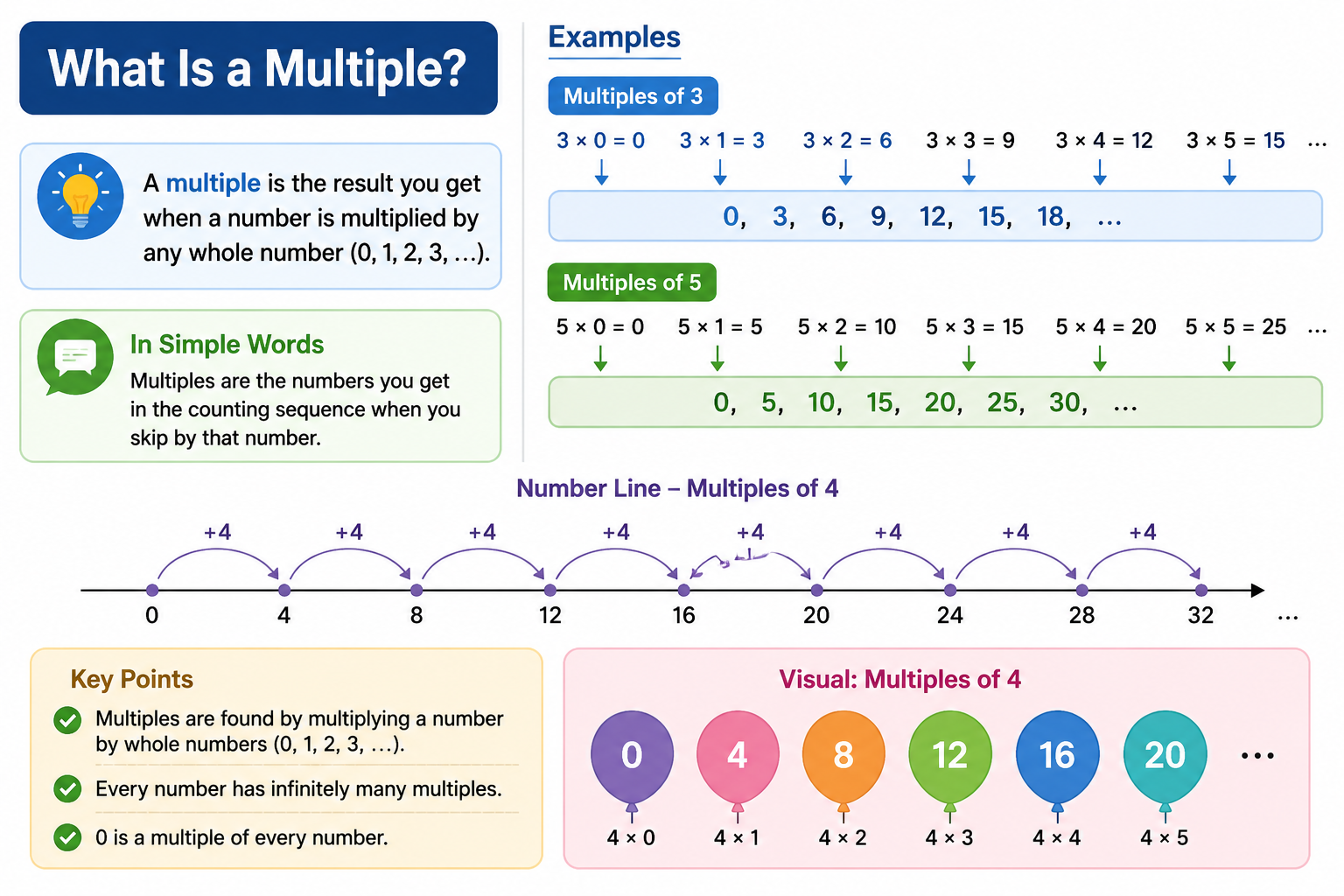
So, what is a multiple? A multiple is the result of multiplying a number by a whole number. Every number you produce this way — no matter how far you count — is a multiple of the original number.
Multiples are fundamental to mathematics. They connect directly to multiplication tables, divisibility, common denominators, the Least Common Multiple, fractions, and number patterns. Once you understand multiples clearly, a large part of school arithmetic and algebra becomes much more straightforward.
Key Takeaways
-
A multiple is the result of multiplying a number by a whole number.
-
Every number has infinitely many multiples because multiplication continues without end.
-
Every number is a multiple of itself, because n × 1 = n.
-
Zero is a multiple of every number, because n × 0 = 0.
-
Common multiples are numbers that appear in the multiples list of two or more numbers.
-
The Least Common Multiple (LCM) is the smallest positive number that is a common multiple of two or more numbers.
-
Multiples are the opposite direction to factors: multiples grow by multiplication, while factors are found by division.
What Is a Multiple?
A multiple of a number is the product you get when you multiply that number by any whole number.
Using 5 as an example:
5 × 1 = 5
5 × 2 = 10
5 × 3 = 15
5 × 4 = 20
5 × 5 = 25
Therefore, 5, 10, 15, 20, and 25 are all multiples of 5.
The sequence does not stop there. You can keep multiplying by 6, 7, 8, and so on, generating new multiples indefinitely. No matter how large a number gets, if it can be expressed as 5 multiplied by a whole number, it is a multiple of 5.
A few key points to keep in mind from the start:
- Multiples are produced by multiplying, not dividing.
- Every number in a multiplication table is a multiple of the number at the top of that table.
- Multiples continue without any upper limit.
Multiple Examples
Here are the first several multiples of some common numbers:
Multiples of 3:
3, 6, 9, 12, 15, 18, 21, 24, 27, 30…
Multiples of 4:
4, 8, 12, 16, 20, 24, 28, 32, 36, 40…
Multiples of 7:
7, 14, 21, 28, 35, 42, 49, 56, 63, 70…
The table below shows the first 10 positive multiples of six common numbers:
| Number | First 10 Positive Multiples |
|---|---|
| 2 | 2, 4, 6, 8, 10, 12, 14, 16, 18, 20 |
| 3 | 3, 6, 9, 12, 15, 18, 21, 24, 27, 30 |
| 4 | 4, 8, 12, 16, 20, 24, 28, 32, 36, 40 |
| 5 | 5, 10, 15, 20, 25, 30, 35, 40, 45, 50 |
| 6 | 6, 12, 18, 24, 30, 36, 42, 48, 54, 60 |
| 10 | 10, 20, 30, 40, 50, 60, 70, 80, 90, 100 |
Every row in that table comes directly from the corresponding multiplication table.
How Do Multiples Work?
Multiples work through the repeated process of multiplication. Each time you multiply the original number by the next whole number, you get the next multiple in the sequence.
Using 7 as an example:
7 × 1 = 7
7 × 2 = 14
7 × 3 = 21
7 × 4 = 28
7 × 5 = 35
So 7, 14, 21, 28, and 35 are all multiples of 7. They are all found in the 7 times table, which is exactly what a multiples list is.
There is an important two-way connection here. If 14 is a multiple of 7, then 7 is a factor of 14. The relationship between multiplication and division means that multiples and factors are always linked, just working in opposite directions.
How to Find Multiples of a Number
Finding multiples is one of the simplest processes in mathematics. Here is the method step by step:
- Choose your starting number.
- Multiply it by 1 to get the first multiple.
- Multiply it by 2 to get the second multiple.
- Multiply it by 3 to get the third multiple.
- Continue multiplying by 4, 5, 6, and so on for as many multiples as you need.
Example: Find the first 6 multiples of 8.
8 × 1 = 8
8 × 2 = 16
8 × 3 = 24
8 × 4 = 32
8 × 5 = 40
8 × 6 = 48
First 6 multiples of 8: 8, 16, 24, 32, 40, 48
Example: Find the first 5 multiples of 11.
11 × 1 = 11
11 × 2 = 22
11 × 3 = 33
11 × 4 = 44
11 × 5 = 55
First 5 multiples of 11: 11, 22, 33, 44, 55
First 10 Multiples
The table below shows the first 10 positive multiples of numbers 2 through 10. This is effectively a reference version of the standard multiplication tables.
| Number | First 10 Positive Multiples |
|---|---|
| 2 | 2, 4, 6, 8, 10, 12, 14, 16, 18, 20 |
| 3 | 3, 6, 9, 12, 15, 18, 21, 24, 27, 30 |
| 4 | 4, 8, 12, 16, 20, 24, 28, 32, 36, 40 |
| 5 | 5, 10, 15, 20, 25, 30, 35, 40, 45, 50 |
| 6 | 6, 12, 18, 24, 30, 36, 42, 48, 54, 60 |
| 7 | 7, 14, 21, 28, 35, 42, 49, 56, 63, 70 |
| 8 | 8, 16, 24, 32, 40, 48, 56, 64, 72, 80 |
| 9 | 9, 18, 27, 36, 45, 54, 63, 72, 81, 90 |
| 10 | 10, 20, 30, 40, 50, 60, 70, 80, 90, 100 |
Memorizing these multiples forms the backbone of mental arithmetic throughout secondary school.
Multiples of 2
The multiples of 2 are the even numbers. Every time you multiply 2 by a whole number, the result is even.
First 20 multiples of 2:
2, 4, 6, 8, 10, 12, 14, 16, 18, 20, 22, 24, 26, 28, 30, 32, 34, 36, 38, 40
Why is every multiple of 2 always even? Because multiplying any whole number by 2 always produces a number with 2 as a factor. By definition, a number with 2 as a factor is even. This means the multiples of 2 and the set of positive even numbers are exactly the same thing.
Multiples of 3
The multiples of 3 are:
3, 6, 9, 12, 15, 18, 21, 24, 27, 30, 33, 36…
An interesting property of multiples of 3 is that the sum of their digits is always divisible by 3. For example, take 27: 2 + 7 = 9, and 9 is divisible by 3. Take 123: 1 + 2 + 3 = 6, and 6 is divisible by 3. This is the standard divisibility rule for 3, and it works because of how our base-10 number system interacts with the factor 3.
Multiples of 3 alternate between odd and even values: 3 (odd), 6 (even), 9 (odd), 12 (even), and so on.
Multiples of 5
The multiples of 5 are:
5, 10, 15, 20, 25, 30, 35, 40, 45, 50, 55, 60…
Every positive multiple of 5 ends in either 0 or 5. This makes multiples of 5 among the easiest to identify by sight. If a number ends in 5 or 0, you can immediately confirm that 5 is a factor of that number and the number is a multiple of 5.
This pattern arises because 5 × even = a number ending in 0, and 5 × odd = a number ending in 5.
Multiples of 10
The multiples of 10 are:
10, 20, 30, 40, 50, 60, 70, 80, 90, 100, 110, 120…
Every multiple of 10 ends in zero. This is one of the most recognizable patterns in all of arithmetic. Because 10 = 2 × 5, any multiple of 10 must also be a multiple of both 2 and 5. Counting in tens is one of the first number patterns children learn, and it underpins our entire base-10 number system.
Common Multiples
When two or more numbers share a multiple, that shared value is called a common multiple.
Example: Find common multiples of 4 and 6.
Multiples of 4: 4, 8, 12, 16, 20, 24, 28, 32, 36, 40…
Multiples of 6: 6, 12, 18, 24, 30, 36, 42…
Numbers that appear in both lists: 12, 24, 36, 48…
These are common multiples of 4 and 6. Notice that common multiples continue indefinitely, just as individual multiples do. If 12 is a common multiple, then so are 24, 36, 48, and every subsequent value in the pattern.
Least Common Multiple
The Least Common Multiple (LCM) is the smallest positive number that is a common multiple of two or more numbers.
From the example above, the common multiples of 4 and 6 are 12, 24, 36… The smallest of these is 12, so:
LCM(4, 6) = 12
Method 1: Listing Multiples
List the multiples of each number and find the smallest one that appears in all lists.
LCM(3, 5):
Multiples of 3: 3, 6, 9, 12, 15, 18…
Multiples of 5: 5, 10, 15, 20…
LCM = 15
Method 2: Using Prime Factorization
Write each number as a product of prime factors. Take the highest power of each prime factor that appears. Multiply those together.
LCM(4, 6):
4 = 2²
6 = 2 × 3
LCM = 2² × 3 = 12
Both methods give the same answer. The listing method works well for smaller numbers, while prime factorization is more efficient for larger ones.
Multiples vs Factors
Multiples and factors are closely related, but they work in completely opposite directions. This is one of the most commonly confused pairs of concepts in school mathematics.
| Feature | Multiples | Factors |
|---|---|---|
| Definition | Results of multiplying a number by whole numbers | Whole numbers that divide a number exactly |
| How they are found | By multiplying | By dividing |
| Number of values | Infinite | Finite |
| Example (based on 6) | 6, 12, 18, 24, 30… | 1, 2, 3, 6 |
| Compared to original number | Always greater than or equal to the number | Always less than or equal to the number |
| Multiplication relationship | n × whole number = multiple | factor × factor = n |
| Division relationship | Multiple ÷ n = whole number | n ÷ factor = whole number |
A helpful way to think about it: if 6 is a factor of 12, then 12 is a multiple of 6. The relationship always works both ways, just from different starting points.
For a thorough explanation of factors and how to find them, see our article [What Is a Factor?]
Multiples vs Prime Numbers
A prime number is classified by how many factors it has — specifically, exactly two: 1 and itself. A multiple, on the other hand, is not a type of number at all. It is the result of a multiplication.
The distinction is important:
- 7 is a prime number because its only factors are 1 and 7.
- 7, 14, 21, 28, 35… are the multiples of 7.
- 14 is a multiple of 7, but 14 is not prime (it has factors 1, 2, 7, and 14).
Every prime number generates infinitely many multiples, and none of those multiples (other than the prime number itself) are prime. This is because every multiple beyond the first has the prime number as a factor, giving it at least three factors.
For a complete explanation of what makes a number prime, see our article [What Is a Prime Number?]
Multiples vs Rational Numbers
A rational number is any number that can be expressed as a fraction p/q, where p and q are integers and q is not zero. All whole numbers and all integers are rational numbers, which means every multiple of a whole number is automatically a rational number.
For example, the multiples of 3 — which are 3, 6, 9, 12, and so on — can each be written as a fraction (3/1, 6/1, 9/1, and so on), confirming that they are rational.
For a broader understanding of rational numbers and how they relate to fractions and integers, see our article [What Is a Rational Number?]
Multiples and Real Numbers
In everyday school mathematics, multiples are almost always discussed in the context of whole numbers and integers. However, it is worth knowing that whole numbers and integers are part of the much larger system known as the real numbers.
Real numbers include all rational numbers, all irrational numbers, and therefore all integers and whole numbers. Every multiple of a whole number sits within the real number system.
For a comprehensive look at the full number system and where integers and whole numbers fit, see our article [What Is a Real Number?]
Is 0 a Multiple?
This is a question that trips up many students, and the answer is yes — technically, 0 is a multiple of every nonzero number.
Here is the reasoning:
n × 0 = 0
Because 0 = n × 0 for any value of n, the number 0 satisfies the definition of a multiple.
However, there is an important practical point. In most elementary and secondary school contexts, when students are asked to list the multiples of a number, they start from the number itself (the result of multiplying by 1) rather than from 0. This is a matter of convention and context, not a mathematical error.
If your examination or textbook asks for “positive multiples,” then your list begins with the number itself, not with 0. Always read the question carefully.
Is Every Number a Multiple of Itself?
Yes. Every nonzero number is a multiple of itself because:
n × 1 = n
Examples:
- 5 × 1 = 5, so 5 is a multiple of 5.
- 13 × 1 = 13, so 13 is a multiple of 13.
- 100 × 1 = 100, so 100 is a multiple of 100.
This is why the first number in any multiples list is always the number itself when listing positive multiples starting from the multiplier 1.
Are Multiples Infinite?
Yes. For any nonzero number, the list of multiples never ends. You can always multiply by the next whole number to produce a new multiple.
For example, the multiples of 3 begin:
3, 6, 9, 12, 15, 18, 21, 24, 27, 30…
There is no final multiple of 3. No matter how large a multiple you find, you can always find the next one by adding 3 to it. This is fundamentally different from factors, which form a finite set for any given positive integer.
Multiples of Negative Numbers
The concept of multiples can extend to negative numbers. When you multiply a negative number by positive whole numbers, you get negative multiples.
Multiples of −3:
−3 × 1 = −3
−3 × 2 = −6
−3 × 3 = −9
−3 × 4 = −12
Sequence: −3, −6, −9, −12, −15…
In most elementary school contexts, multiples refer to positive values and the multiplier is a positive whole number. As you move into higher levels of mathematics, the definition broadens to include negative integers. Always check the context of the question you are working on.
Multiples of Fractions
The word “multiple” can technically apply beyond whole numbers. When you multiply a fraction by a whole number, the result is a multiple of that fraction.
Examples:
1/2 × 1 = 1/2
1/2 × 2 = 1
1/2 × 4 = 2
1/2 × 6 = 3
So 1/2, 1, 3/2, 2, 5/2, and 3 are all multiples of 1/2 in this broader sense.
In most school-level factor and multiple exercises, however, the focus remains on whole numbers and positive integers. Questions involving multiples at GCSE, IGCSE, and similar levels almost always involve whole numbers unless a question specifically states otherwise.
Multiples in Fractions
One of the most practical uses of common multiples in arithmetic is finding a common denominator when adding or subtracting fractions.
Example: Calculate 1/4 + 1/6.
To add these fractions, you need a common denominator — a number that is a multiple of both 4 and 6.
Multiples of 4: 4, 8, 12, 16…
Multiples of 6: 6, 12, 18…
The least common multiple of 4 and 6 is 12, so:
1/4 = 3/12
1/6 = 2/12
1/4 + 1/6 = 3/12 + 2/12 = 5/12
This connection between multiples and fractions is one reason why understanding multiples matters well beyond basic arithmetic. Fractions are themselves examples of rational numbers, a concept explored in detail in our article [What Is a Rational Number?]
Multiples and Divisibility
The concepts of multiples and divisibility are two ways of describing the same mathematical relationship.
If 24 is a multiple of 6, then 24 is also divisible by 6. These statements mean exactly the same thing, just phrased differently.
24 = 6 × 4, so 24 is a multiple of 6.
24 ÷ 6 = 4 exactly, so 24 is divisible by 6.
Conversely, if a number is not a multiple of another, it is not divisible by it.
25 ÷ 6 = 4 remainder 1, so 25 is not divisible by 6, and 25 is not a multiple of 6.
Divisibility rules help you quickly identify whether one number is a multiple of another without performing full long division.
Multiples and Even Numbers
Every multiple of an even number is itself even. This follows directly from the definition of even numbers.
For example:
- Multiples of 4: 4, 8, 12, 16, 20… — all even.
- Multiples of 6: 6, 12, 18, 24, 30… — all even.
What about odd numbers? Odd numbers produce a mix of odd and even multiples depending on the multiplier used.
Odd multiplier × odd number = odd result: 3 × 3 = 9 (odd)
Even multiplier × odd number = even result: 3 × 4 = 12 (even)
So the multiples of 3 alternate: 3 (odd), 6 (even), 9 (odd), 12 (even)…
Multiples and Odd Numbers
The multiples of an odd number follow a clear alternating pattern between odd and even values.
Multiples of 3: 3, 6, 9, 12, 15, 18, 21, 24…
Multiples of 5: 5, 10, 15, 20, 25, 30, 35, 40…
Multiples of 7: 7, 14, 21, 28, 35, 42, 49, 56…
In each case, odd times odd gives odd, and odd times even gives even. The result alternates perfectly throughout the multiples list.
This is worth remembering because it means an odd number is never exclusively odd or exclusively even in its multiples. Both types appear.
Multiples in Algebra
In algebra, multiplying a variable by a number is the same idea as listing multiples, just expressed with letters rather than specific values.
If x represents any number, then:
3x means 3 multiplied by x — a multiple of 3 (or a multiple of x).
5x means 5 multiplied by x.
7x means 7 multiplied by x.
When you substitute specific values for x, you generate specific multiples:
If x = 4:
3x = 12 (a multiple of 3)
5x = 20 (a multiple of 5)
Algebra simply extends the idea of multiples from fixed numbers to general expressions. Understanding multiples numerically makes algebraic manipulation considerably more intuitive.
Multiples in Everyday Life
You encounter multiples regularly in daily situations, even when you are not thinking about mathematics formally.
- Scheduling: A bus arrives every 15 minutes. The arrival times — 15, 30, 45, 60 minutes — are the multiples of 15.
- Repeated events: A machine completes a cycle every 8 seconds. After 40 seconds, it has completed 5 cycles, because 40 is a multiple of 8.
- Packaging: Items packed in boxes of 12 mean total quantities must be multiples of 12 to fill boxes exactly.
- Grouping: Arranging 30 chairs into equal rows requires the row size to divide 30. The possible row counts come from the multiples relationship.
- Timetables: Class periods of 50 minutes mean the schedule runs on multiples of 50.
- Measurements: Converting units often involves multiplying by fixed factors, producing multiples.
- Shopping quantities: Buying items in packs of 6 means your total count is always a multiple of 6.
Every time something repeats at regular intervals, multiples describe the resulting pattern.
Multiples in Physics
Repeated measurements and regular intervals appear throughout physics, and the mathematics behind them involves multiples directly.
Consider speed as a simple example. If a person walks at a steady speed of 5 kilometres per hour, the distances covered after whole numbers of hours are multiples of 5:
After 1 hour: 5 km
After 2 hours: 10 km
After 3 hours: 15 km
The distances form a multiples sequence because distance = speed × time, and time takes whole-number values. For a deeper understanding of how speed is defined and calculated in physics, see our article [What Is Speed in Physics?]
Recognizing that physical quantities often scale as multiples of a base value helps you calculate, estimate, and verify answers in physics problems quickly and confidently.
How Multiples Help With LCM
Listing multiples is the most straightforward method for finding the Least Common Multiple of two or more numbers.
Example 1: LCM of 6 and 9
Multiples of 6: 6, 12, 18, 24…
Multiples of 9: 9, 18, 27…
LCM = 18
Example 2: LCM of 4 and 10
Multiples of 4: 4, 8, 12, 16, 20, 24…
Multiples of 10: 10, 20, 30…
LCM = 20
Example 3: LCM of 3, 4, and 6
Multiples of 3: 3, 6, 9, 12, 15…
Multiples of 4: 4, 8, 12, 16…
Multiples of 6: 6, 12, 18…
LCM = 12
The listing method is reliable for small numbers and gives students a visual way to see why the LCM is the number it is.
How to Find Common Multiples Quickly
Here are practical strategies for identifying common multiples efficiently:
- List multiples systematically: Write out the multiples of each number in order. Scan both lists for the first number that appears in all of them.
- Compare sequences side by side: Writing both sequences on separate lines makes matches easier to spot visually.
- Use known multiplication facts: Familiarity with times tables up to 12 × 12 speeds up the listing process considerably.
- Use prime factorization for larger numbers: When numbers are large, listing becomes slow. Prime factorization gives the LCM directly by combining the highest powers of shared prime factors.
- Recognize familiar patterns: Multiples of 5 end in 0 or 5. Multiples of 10 end in 0. These patterns let you skip numbers quickly during comparison.
Multiples and Prime Factorization
Prime factorization provides an efficient route to finding the LCM without listing out long sequences.
Example: Find the LCM of 12 and 18.
Step 1: Find the prime factorization of each number.
12 = 2² × 3
18 = 2 × 3²
Step 2: Take the highest power of each prime factor that appears in either factorization.
Highest power of 2: 2²
Highest power of 3: 3²
Step 3: Multiply these together.
LCM = 2² × 3² = 4 × 9 = 36
Verify: Is 36 a multiple of 12? 12 × 3 = 36. Yes.
Is 36 a multiple of 18? 18 × 2 = 36. Yes.
Prime factorization is especially useful when working with larger numbers where listing multiples would take a long time.
Multiples of Numbers From 1 to 20
The table below shows the first 10 positive multiples of each number from 1 to 20. Use this as a reference when working on LCM problems, common multiples, or divisibility questions.
| Number | First 10 Positive Multiples |
|---|---|
| 1 | 1, 2, 3, 4, 5, 6, 7, 8, 9, 10 |
| 2 | 2, 4, 6, 8, 10, 12, 14, 16, 18, 20 |
| 3 | 3, 6, 9, 12, 15, 18, 21, 24, 27, 30 |
| 4 | 4, 8, 12, 16, 20, 24, 28, 32, 36, 40 |
| 5 | 5, 10, 15, 20, 25, 30, 35, 40, 45, 50 |
| 6 | 6, 12, 18, 24, 30, 36, 42, 48, 54, 60 |
| 7 | 7, 14, 21, 28, 35, 42, 49, 56, 63, 70 |
| 8 | 8, 16, 24, 32, 40, 48, 56, 64, 72, 80 |
| 9 | 9, 18, 27, 36, 45, 54, 63, 72, 81, 90 |
| 10 | 10, 20, 30, 40, 50, 60, 70, 80, 90, 100 |
| 11 | 11, 22, 33, 44, 55, 66, 77, 88, 99, 110 |
| 12 | 12, 24, 36, 48, 60, 72, 84, 96, 108, 120 |
| 13 | 13, 26, 39, 52, 65, 78, 91, 104, 117, 130 |
| 14 | 14, 28, 42, 56, 70, 84, 98, 112, 126, 140 |
| 15 | 15, 30, 45, 60, 75, 90, 105, 120, 135, 150 |
| 16 | 16, 32, 48, 64, 80, 96, 112, 128, 144, 160 |
| 17 | 17, 34, 51, 68, 85, 102, 119, 136, 153, 170 |
| 18 | 18, 36, 54, 72, 90, 108, 126, 144, 162, 180 |
| 19 | 19, 38, 57, 76, 95, 114, 133, 152, 171, 190 |
| 20 | 20, 40, 60, 80, 100, 120, 140, 160, 180, 200 |
Worked Examples: Finding Multiples
Example 1: Find the first 5 multiples of 4.
Given: The number 4
Method: Multiply 4 by 1, 2, 3, 4, and 5.
Calculation: 4, 8, 12, 16, 20
Answer: 4, 8, 12, 16, 20
Example 2: Find the first 10 multiples of 7.
Given: The number 7
Method: Multiply 7 by 1 through 10.
Calculation: 7, 14, 21, 28, 35, 42, 49, 56, 63, 70
Answer: 7, 14, 21, 28, 35, 42, 49, 56, 63, 70
Example 3: Find the first 5 multiples of 12.
Given: The number 12
Method: Multiply 12 by 1 through 5.
Calculation: 12, 24, 36, 48, 60
Answer: 12, 24, 36, 48, 60
Example 4: Find common multiples of 4 and 6.
Given: 4 and 6
Method: List multiples of each and identify common values.
Multiples of 4: 4, 8, 12, 16, 20, 24, 28, 32, 36…
Multiples of 6: 6, 12, 18, 24, 30, 36…
Answer: 12, 24, 36… (and continuing in this pattern)
Example 5: Find the LCM of 5 and 8.
Given: 5 and 8
Method: List multiples of each until a common value appears.
Multiples of 5: 5, 10, 15, 20, 25, 30, 35, 40…
Multiples of 8: 8, 16, 24, 32, 40…
Answer: LCM = 40
Example 6: Determine whether 36 is a multiple of 9.
Given: 36 and 9
Method: Divide 36 by 9.
Calculation: 36 ÷ 9 = 4 exactly (no remainder)
Answer: Yes, 36 is a multiple of 9 (9 × 4 = 36).
Example 7: Determine whether 45 is a multiple of 6.
Given: 45 and 6
Method: Divide 45 by 6.
Calculation: 45 ÷ 6 = 7 remainder 3
Answer: No, 45 is not a multiple of 6 because the division leaves a remainder.
Example 8: Find common multiples of 8 and 12.
Given: 8 and 12
Method: List multiples of each and identify common values.
Multiples of 8: 8, 16, 24, 32, 40, 48, 56, 64, 72…
Multiples of 12: 12, 24, 36, 48, 60, 72…
Answer: Common multiples include 24, 48, 72… LCM = 24.
Example 9: Find a common multiple of 3, 4, and 6.
Given: 3, 4, and 6
Method: List multiples of each.
Multiples of 3: 3, 6, 9, 12, 15…
Multiples of 4: 4, 8, 12, 16…
Multiples of 6: 6, 12, 18…
Answer: A common multiple is 12. (LCM of 3, 4, and 6 = 12)
Example 10: Real-life problem using multiples.
Given: Trains depart from a station every 8 minutes. A bus departs every 6 minutes. Both depart together at 9:00 am. When will they next depart together?
Method: Find the LCM of 8 and 6.
Multiples of 8: 8, 16, 24, 32…
Multiples of 6: 6, 12, 18, 24, 30…
LCM = 24 minutes.
Answer: They will next depart together at 9:24 am.
Common Mistakes About Multiples
Mistake 1: Factors and multiples are the same.
They are not. Factors divide the number. Multiples are produced by multiplying it. They work in opposite directions.
Mistake 2: Multiples stop after 10.
Multiples are infinite. There is no upper limit.
Mistake 3: 1 is a multiple of every number.
This reverses the correct relationship. Every number is a multiple of 1 (since n × 1 = n), but 1 is not a multiple of every number. For example, 1 is not a multiple of 7 because 7 × no whole number equals 1 (in positive whole numbers).
Mistake 4: Every number has only a few multiples.
Every nonzero number has infinitely many multiples.
Mistake 5: A multiple must always be larger than the original number.
This is almost always true for positive multiples (since multiplying by 1 gives the number itself, and multiplying by any larger whole number gives something bigger). However, if we include 0 as a multiplier, then 0 is a multiple of every number and is smaller.
Mistake 6: 0 cannot be a multiple.
Zero is a multiple of every number because n × 0 = 0 for any nonzero n.
Mistake 7: Every multiple of an odd number is odd.
This is false. Odd numbers produce both odd and even multiples depending on whether the multiplier is odd or even.
Mistake 8: Negative numbers cannot have multiples.
Negative numbers do have multiples. Multiplying a negative number by positive whole numbers produces a sequence of negative multiples.
Mistake 9: Multiples and divisors mean exactly the same thing.
These terms describe the same relationship from different perspectives. If 12 is a multiple of 4, then 4 is a divisor of 12. They are related, but a multiple is the larger result while a divisor is the smaller dividing number.
Multiples and Number Patterns
One of the most elegant things about multiples is the clear, predictable patterns they create. Recognizing these patterns makes mental arithmetic faster and more reliable.
Multiples of 2: 2, 4, 6, 8, 10, 12… (always even; increase by 2)
Multiples of 5: 5, 10, 15, 20, 25… (end in 0 or 5; increase by 5)
Multiples of 10: 10, 20, 30, 40… (always end in 0; increase by 10)
Multiples of 9: 9, 18, 27, 36, 45… (digit sums always add to 9; increase by 9)
These patterns make it easy to check your work. If you are listing multiples of 5 and you produce a number that does not end in 0 or 5, you have made an error somewhere.
Recognizing patterns in multiples also forms the basis for mental strategies in estimation, checking answers in examinations, and developing number sense more broadly.
Multiples Cheat Sheet
| Concept | Definition | Example |
|---|---|---|
| Multiple | The result of multiplying a number by a whole number | Multiples of 6: 6, 12, 18, 24… |
| Common multiple | A number that is a multiple of two or more numbers | 12 is a common multiple of 4 and 6 |
| Least common multiple (LCM) | The smallest positive common multiple | LCM(4, 6) = 12 |
| Factor | A whole number that divides another number exactly | 3 is a factor of 12 |
| Divisibility | A number is divisible by another if the division leaves no remainder | 24 is divisible by 6 |
| Prime number | A whole number greater than 1 with exactly two factors | 7 is prime |
Multiple Practice Questions
20 Multiple Choice Questions
Question 1: Which of the following is a multiple of 7?
A) 44 B) 49 C) 51 D) 57
Correct Answer: B
Explanation: 7 × 7 = 49. None of the others divide by 7 exactly.
Question 2: What is the 8th multiple of 6?
A) 42 B) 46 C) 48 D) 54
Correct Answer: C
Explanation: 6 × 8 = 48.
Question 3: Which number is a common multiple of 3 and 5?
A) 9 B) 10 C) 15 D) 20
Correct Answer: C
Explanation: 15 = 3 × 5 and 15 = 5 × 3. It appears in both multiples lists.
Question 4: What is the LCM of 4 and 10?
A) 14 B) 20 C) 40 D) 4
Correct Answer: B
Explanation: Multiples of 4: 4, 8, 12, 16, 20… Multiples of 10: 10, 20… LCM = 20.
Question 5: Is 45 a multiple of 6?
A) Yes B) No C) Only if 45 is even D) Cannot be determined
Correct Answer: B
Explanation: 45 ÷ 6 = 7 remainder 3, so 45 is not a multiple of 6.
Question 6: How many positive multiples does the number 8 have?
A) 8 B) 10 C) Infinitely many D) 80
Correct Answer: C
Explanation: Multiples continue indefinitely because multiplication never stops.
Question 7: Which of the following is NOT a multiple of 9?
A) 27 B) 36 C) 45 D) 50
Correct Answer: D
Explanation: 50 ÷ 9 = 5 remainder 5. So 50 is not a multiple of 9.
Question 8: What are the first three common multiples of 2 and 5?
A) 2, 5, 10 B) 10, 20, 30 C) 5, 10, 15 D) 4, 8, 10
Correct Answer: B
Explanation: Common multiples of 2 and 5: 10, 20, 30… (multiples of 10).
Question 9: What is the LCM of 3 and 7?
A) 10 B) 21 C) 42 D) 3
Correct Answer: B
Explanation: Since 3 and 7 share no common factors, LCM = 3 × 7 = 21.
Question 10: Which statement is correct?
A) Multiples are always smaller than the original number
B) A number has a finite number of multiples
C) Multiples are produced by multiplication
D) Factors and multiples are the same thing
Correct Answer: C
Explanation: Multiples are found by multiplying the number by whole numbers. The other statements are incorrect.
Question 11: Is 0 a multiple of 5?
A) No, because 0 is less than 5
B) Yes, because 5 × 0 = 0
C) Only if stated in the question
D) No, multiples must be positive
Correct Answer: B
Explanation: By definition, 0 = 5 × 0, so 0 is a multiple of 5. In most elementary contexts, however, positive multiples are listed starting from the number itself.
Question 12: What is the 12th multiple of 9?
A) 99 B) 108 C) 90 D) 117
Correct Answer: B
Explanation: 9 × 12 = 108.
Question 13: Which of these correctly lists the first 5 multiples of 11?
A) 1, 11, 22, 33, 44 B) 11, 22, 33, 44, 55 C) 11, 21, 31, 41, 51 D) 11, 22, 33, 44, 45
Correct Answer: B
Explanation: 11 × 1 = 11, × 2 = 22, × 3 = 33, × 4 = 44, × 5 = 55.
Question 14: The LCM of 6 and 8 is:
A) 16 B) 24 C) 48 D) 12
Correct Answer: B
Explanation: Multiples of 6: 6, 12, 18, 24… Multiples of 8: 8, 16, 24… LCM = 24.
Question 15: Which of these numbers is a multiple of both 4 and 7?
A) 14 B) 21 C) 28 D) 42
Correct Answer: C
Explanation: 28 = 4 × 7. It appears in both the multiples of 4 and multiples of 7.
Question 16: If a bus stops every 12 minutes and a train stops every 8 minutes, when do they next stop at the same time (starting from 0)?
A) After 16 minutes B) After 24 minutes C) After 20 minutes D) After 48 minutes
Correct Answer: B
Explanation: LCM(12, 8) = 24. Both stop together after 24 minutes.
Question 17: Which of the following is a multiple of 15?
A) 40 B) 45 C) 50 D) 55
Correct Answer: B
Explanation: 15 × 3 = 45. The others are not divisible by 15 exactly.
Question 18: Every multiple of 10 must also be a multiple of:
A) 7 B) 3 C) 5 D) 9
Correct Answer: C
Explanation: 10 = 2 × 5, so every multiple of 10 is also a multiple of 5 (and of 2).
Question 19: The number 36 is a multiple of which of the following?
A) 8 B) 7 C) 9 D) 11
Correct Answer: C
Explanation: 36 ÷ 9 = 4 exactly. So 36 is a multiple of 9.
Question 20: What is the LCM of 5, 6, and 10?
A) 30 B) 60 C) 15 D) 10
Correct Answer: A
Explanation: Multiples of 10: 10, 20, 30… Is 30 a multiple of 5? Yes (5 × 6 = 30). Is 30 a multiple of 6? Yes (6 × 5 = 30). LCM = 30.
10 Short Answer Questions
Q1: List the first 6 multiples of 9.
Answer: 9, 18, 27, 36, 45, 54
Q2: Is 72 a multiple of 8? Show your reasoning.
Answer: Yes. 72 ÷ 8 = 9 exactly. Alternatively, 8 × 9 = 72.
Q3: What is the LCM of 4 and 9?
Answer: Multiples of 4: 4, 8, 12, 16, 20, 24, 28, 32, 36… Multiples of 9: 9, 18, 27, 36… LCM = 36.
Q4: Find the first common multiple of 5 and 7.
Answer: LCM(5, 7) = 35. (Since 5 and 7 share no common factors, their LCM is their product.)
Q5: Write the first 4 multiples of 13.
Answer: 13, 26, 39, 52
Q6: Is every multiple of 6 also a multiple of 3? Explain.
Answer: Yes. Because 6 = 2 × 3, every multiple of 6 contains 3 as a factor, making it a multiple of 3.
Q7: What is the difference between multiples and factors?
Answer: Multiples are produced by multiplying a number. Factors divide a number exactly. Multiples are infinite; factors are finite.
Q8: Find the LCM of 8 and 12 using the listing method.
Answer: Multiples of 8: 8, 16, 24, 32… Multiples of 12: 12, 24, 36… LCM = 24.
Q9: Is 100 a multiple of 4?
Answer: Yes. 100 ÷ 4 = 25 exactly. Also, 4 × 25 = 100.
Q10: What is the 6th multiple of 15?
Answer: 15 × 6 = 90.
10 Multiple-Finding Questions
1. List the first 5 multiples of 3.
Answer: 3, 6, 9, 12, 15
2. List the first 5 multiples of 8.
Answer: 8, 16, 24, 32, 40
3. Is 56 a multiple of 7?
Answer: Yes. 7 × 8 = 56.
4. Is 50 a multiple of 8?
Answer: No. 50 ÷ 8 = 6 remainder 2.
5. List the first 5 multiples of 11.
Answer: 11, 22, 33, 44, 55
6. Is 81 a multiple of 9?
Answer: Yes. 9 × 9 = 81.
7. List the first 6 multiples of 7.
Answer: 7, 14, 21, 28, 35, 42
8. Is 78 a multiple of 6?
Answer: Yes. 6 × 13 = 78.
9. Is 95 a multiple of 4?
Answer: No. 95 ÷ 4 = 23 remainder 3.
10. List the first 5 multiples of 20.
Answer: 20, 40, 60, 80, 100
5 LCM Problems
Problem 1: Find the LCM of 6 and 10.
Step 1: List multiples.
Multiples of 6: 6, 12, 18, 24, 30, 36…
Multiples of 10: 10, 20, 30, 40…
Step 2: Identify the smallest common value.
LCM(6, 10) = 30
Problem 2: Find the LCM of 4, 6, and 12.
Step 1: List multiples.
Multiples of 4: 4, 8, 12, 16…
Multiples of 6: 6, 12, 18…
Multiples of 12: 12, 24…
Step 2: Smallest common value = 12.
LCM(4, 6, 12) = 12
Problem 3: Find the LCM of 9 and 12.
Step 1: Prime factorization method.
9 = 3²
12 = 2² × 3
Step 2: Highest powers: 2² and 3²
Step 3: LCM = 4 × 9 = 36
Verify: 36 ÷ 9 = 4 and 36 ÷ 12 = 3. Both exact. Correct.
Problem 4: Find the LCM of 5, 8, and 10.
Step 1: Prime factorization.
5 = 5
8 = 2³
10 = 2 × 5
Step 2: Highest powers: 2³ and 5
Step 3: LCM = 8 × 5 = 40
Verify: 40 ÷ 5 = 8, 40 ÷ 8 = 5, 40 ÷ 10 = 4. All exact. Correct.
Problem 5: Find the LCM of 7 and 11.
Step 1: Since 7 and 11 are both prime and share no common factors, their LCM is simply their product.
Step 2: LCM = 7 × 11 = 77
Verify: 77 ÷ 7 = 11 and 77 ÷ 11 = 7. Both exact. Correct.
Exam Tips
- Multiples come from multiplication. Whenever you see the word “multiple,” think of the times table for that number.
- Factors divide; multiples multiply. Keep this distinction clear in every question.
- Multiples continue indefinitely. If a question asks for “a” common multiple rather than “the” LCM, any correct value in the common list is acceptable.
- Every number is a multiple of itself. Do not forget to include the number itself when listing multiples.
- Use multiplication tables for speed. Knowing your times tables up to 12 × 12 makes finding multiples in exam conditions much faster.
- For LCM questions, list both multiples and scan for the first match. This avoids errors from trying to work it out mentally.
- 0 is a multiple of every number, but list positive multiples unless told otherwise. Read the question carefully.
Quick Revision Notes
- Definition: A multiple is the result of multiplying a number by a whole number.
- Examples: Multiples of 4 are 4, 8, 12, 16, 20…
- Common multiples: Numbers that appear in the multiples lists of two or more numbers.
- LCM: The smallest positive common multiple of two or more numbers.
- Multiples vs factors: Multiples grow by multiplication and are infinite; factors divide a number and are finite.
- Divisibility: A number is divisible by another if the second is a factor of the first — equivalently, the first is a multiple of the second.
- Number patterns: Multiples create regular, predictable sequences that help with mental arithmetic.
- Real-life applications: Scheduling, packaging, measuring, and counting in equal groups all rely on multiples.
Frequently Asked Questions
1. What is a multiple?
A multiple is the result of multiplying a number by a whole number. For example, the multiples of 3 are 3, 6, 9, 12, and so on.
2. What is the definition of a multiple in math?
In mathematics, a multiple of a number n is any number that can be expressed in the form n × k, where k is a whole number.
3. How do you find multiples of a number?
Multiply the number by 1, then by 2, then by 3, and continue for as many multiples as needed. The results are the multiples.
4. What are the first 10 multiples of 5?
5, 10, 15, 20, 25, 30, 35, 40, 45, 50.
5. What is the difference between factors and multiples?
Factors divide a number exactly and form a finite set. Multiples are produced by multiplying a number and continue indefinitely. They work in opposite directions.
6. What are common multiples?
Common multiples are numbers that appear in the multiples lists of two or more numbers. For example, 12 is a common multiple of 4 and 6.
7. What is the least common multiple?
The LCM is the smallest positive number that is a multiple of all the numbers in a given set. For example, LCM(4, 6) = 12.
8. Is 0 a multiple of every number?
Yes. Because n × 0 = 0 for any nonzero n, zero is technically a multiple of every number. In most school contexts, however, positive multiples are listed starting from the number itself.
9. Is every number a multiple of itself?
Yes. Because n × 1 = n, every number is a multiple of itself.
10. Are multiples infinite?
Yes. For any nonzero number, you can always multiply by a larger whole number to produce a new multiple. The list never ends.
11. Can negative numbers have multiples?
Yes. Multiplying a negative number by positive whole numbers produces negative multiples. For example, the multiples of −4 include −4, −8, −12, −16, and so on.
12. What are multiples of 10?
10, 20, 30, 40, 50, 60, 70, 80, 90, 100… Every multiple of 10 ends in zero.
13. How are multiples used to find LCM?
List the multiples of each number in order. The first value that appears in all lists is the LCM.
14. Is 1 a multiple of every number?
No. This is a common misconception. Every number is a multiple of 1 (since n × 1 = n), but 1 is a multiple only of itself.
15. Can fractions have multiples?
Yes, in a broader mathematical sense. Multiplying 1/2 by whole numbers gives 1/2, 1, 3/2, 2, and so on. In most school-level work, however, multiples questions focus on whole numbers.
Summary
A multiple is simply the result of multiplying a number by a whole number. Every number produces an infinite sequence of multiples, beginning with the number itself and continuing without limit. When two or more numbers share a multiple, that shared value is called a common multiple, and the smallest such value is the Least Common Multiple.
Understanding multiples helps you work efficiently with multiplication tables, divisibility, common denominators in fractions, and LCM calculations. Multiples and factors describe the same relationship from opposite directions — multiples grow outward through multiplication, while factors are found inward through division.
Final Thoughts
What is a multiple? It is the product of a number and a whole number — a sequence that begins with the number itself and extends indefinitely. That simple idea connects to almost every area of school mathematics, from the earliest multiplication tables through fractions, algebra, number theory, and beyond.
When you can list multiples quickly, identify common multiples confidently, and find the LCM efficiently, you gain tools that make dozens of different types of mathematical problems easier to solve. Multiples are not a standalone topic. They are woven into factors, divisibility, fractions, algebraic expressions, and real-life problem solving. Master them thoroughly, and you will find they serve you well throughout your entire mathematical education.
References
- Khan Academy — Factors and Multiples: https://www.khanacademy.org
- Wolfram MathWorld — Multiple: https://mathworld.wolfram.com/Multiple.html
- OpenStax — Prealgebra, Multiples and Least Common Multiples: https://openstax.org
- Mathematics LibreTexts — Multiples and the Least Common Multiple: https://math.libretexts.org
- Encyclopaedia Britannica — Least Common Multiple: https://www.britannica.com
Disclaimer:
This article is intended for educational and informational purposes only. While LearnMinto strives to provide accurate and up-to-date mathematics information, readers should verify important academic concepts through official textbooks, educational institutions, examination boards, or trusted educational resources before using this content for exams or academic purposes. LearnMinto is not affiliated with any specific school, university, research institution, or examination board.