
Introduction
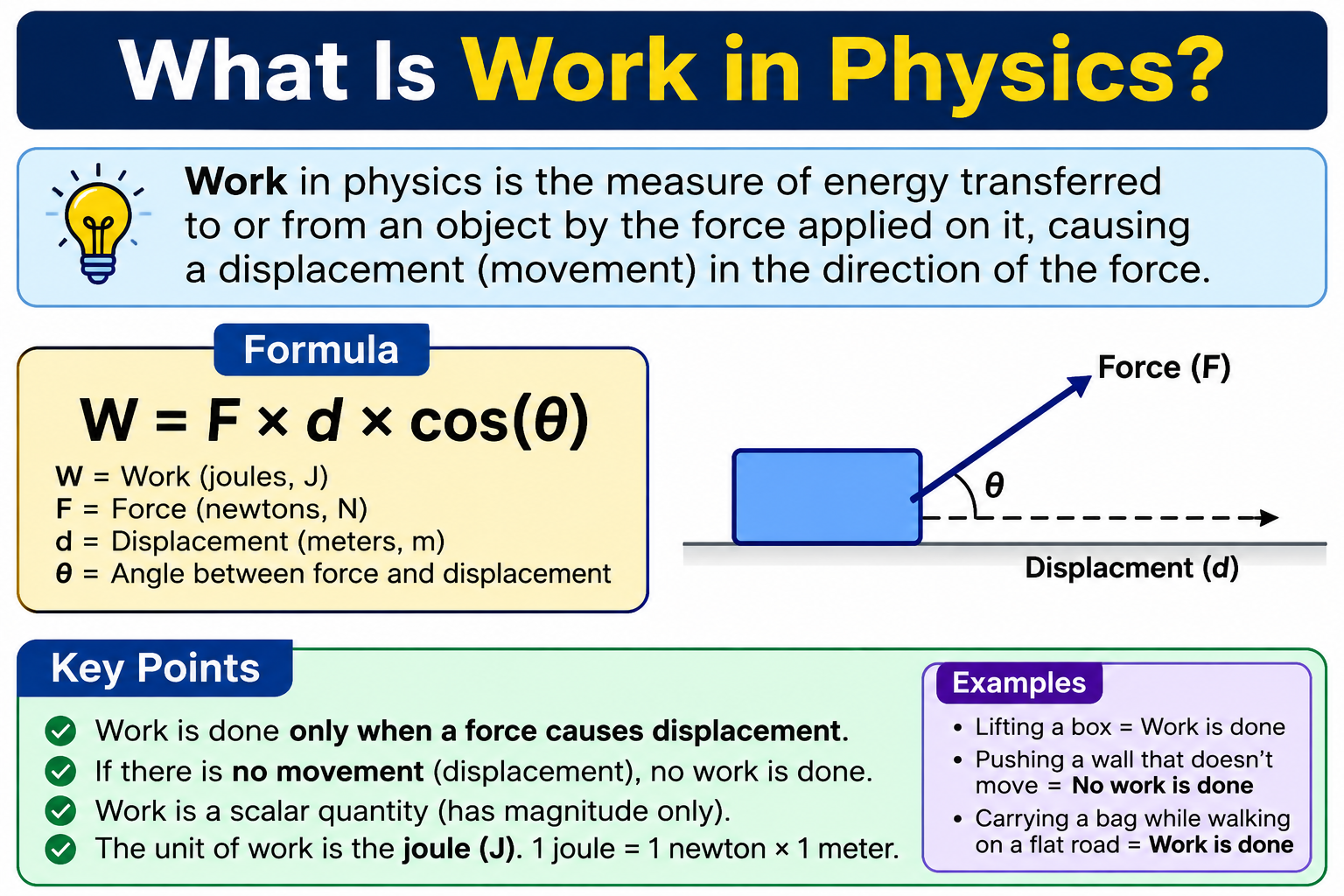
Imagine pushing a heavy box across a warehouse floor. Your muscles strain, the box slides forward, and after several metres it reaches its destination. In that situation, you have done work in the physics sense. Now imagine pushing that same box against a brick wall as hard as you can, and the wall does not move at all. In everyday language, you have worked very hard. In physics, however, you have done zero work on the wall. This distinction is one of the most important ideas in introductory mechanics. In physics, work is done when a force causes an object to move in the direction of the force.
The physics definition of work is precise and mathematical. It requires both a force and a displacement in the direction of that force. Without displacement, or when the force acts perpendicular to the displacement, no work is done regardless of how much effort is applied.
The formula for work is W = Fd cos θ, and its SI unit is the joule (J). In this article, you will find a complete, beginner-friendly guide to work in physics, covering its definition, formula, types, relationship with energy and power, real-life examples, worked calculations, practice questions, and much more.
Key Takeaways
-
Work in physics is done when a force causes an object to undergo displacement in the direction of the force.
-
The formula for work is W = Fd cos θ, where F is force, d is displacement, and θ is the angle between them.
-
The SI unit of work is the joule (J). One joule equals one newton-metre (1 J = 1 N·m).
-
Work is a scalar quantity. It has magnitude only and no direction.
-
Work can be positive (force and displacement in the same direction), negative (force opposes displacement), or zero (no displacement or force perpendicular to displacement).
-
The work-energy theorem states that the net work done on an object equals the change in its kinetic energy.
-
Work and energy share the same SI unit (joule), but they are not the same concept. Work is the process of energy transfer.
What Is Work in Physics?
In physics, work is the transfer of energy that occurs when a force causes an object to undergo displacement in the direction of that force. This is a very specific definition and it differs from the casual use of the word in everyday life.
Three conditions must be satisfied for work to be done in the physics sense:
- A force must be applied to the object.
- The object must undergo displacement (it must actually move).
- The displacement must have a component in the direction of the force. If the force and displacement are at right angles to each other, no work is done.
Key characteristics of work in physics:
- Work is the product of force and displacement in the direction of the force.
- Both force and displacement are required. Either alone is not sufficient.
- The direction of the force relative to the displacement is critical.
- Work is a scalar quantity. It has magnitude but no direction.
- Work can be positive, negative, or zero depending on the situation.
A clear example: when you lift a book from the floor onto a shelf, you apply an upward force and the book moves upward. The force and displacement are in the same direction, so you do positive work. When you hold the same book stationary at arm’s length, you apply an upward force but there is no displacement, so you do zero work on the book in the physics sense.
What Is the Formula for Work?
The general formula for work is:
W = Fd cos θ
Where:
- W = work done (joules, J)
- F = magnitude of the applied force (newtons, N)
- d = magnitude of the displacement (metres, m)
- θ = the angle between the direction of the force and the direction of the displacement
The cos θ factor accounts for the direction of the force relative to the displacement. It ensures that only the component of force acting in the direction of motion contributes to the work done.
What does cos θ mean at different angles?
- θ = 0°: Force and displacement are in exactly the same direction. cos 0° = 1. Maximum work is done: W = Fd
- θ = 90°: Force is perpendicular to displacement. cos 90° = 0. No work is done: W = 0
- θ = 180°: Force is in the opposite direction to displacement. cos 180° = −1. Negative work is done: W = −Fd
Example 1 (θ = 0°):
A person pushes a box with a force of 30 N along a horizontal floor for a distance of 5 m. The force is horizontal. Calculate the work done.
W = Fd cos θ
W = 30 × 5 × cos 0°
W = 30 × 5 × 1
W = 150 J
Example 2 (θ = 60°):
A person drags a suitcase with a force of 40 N at an angle of 60° above the horizontal over a displacement of 8 m horizontally. Calculate the work done.
W = Fd cos θ
W = 40 × 8 × cos 60°
W = 40 × 8 × 0.5
W = 160 J
What Is the SI Unit of Work?
The SI unit of work is the joule (J).
The joule can be understood directly from the work formula:
1 J = 1 N × 1 m = 1 N·m
In base SI units:
1 J = 1 kg·m²/s²
This follows from the unit analysis of W = Fd:
N × m = (kg·m/s²) × m = kg·m²/s²
One joule is the work done when a force of one newton moves an object one metre in the direction of the force.
For larger quantities of work, the kilojoule (kJ) is commonly used:
1 kJ = 1,000 J
For example, the work done by a crane lifting a large load might be expressed in kilojoules or megajoules (MJ). In physics calculations, always use joules as the standard unit unless instructed otherwise.
Is Work a Scalar or Vector Quantity?
Work is a scalar quantity. It has magnitude only and no direction.
This might seem surprising because force and displacement are both vector quantities. However, work is calculated as the dot product of force and displacement:
W = F · d = Fd cos θ
The dot product of two vectors always produces a scalar. The result is a single number (which can be positive, negative, or zero) but carries no directional information.
Important implications:
- A worker lifting a crate upward and a crate falling downward under gravity can both involve the same magnitude of work, even though the forces and displacements are in completely different directions.
- Work is added algebraically, not vectorially. Total work done by multiple forces is simply the arithmetic sum of the individual work values.
- Work can be positive, negative, or zero. A positive value means energy is transferred to the object. A negative value means energy is removed from the object.
Positive Work, Negative Work and Zero Work
Positive Work
Positive work is done when the force has a component in the same direction as the displacement. Energy is transferred to the object.
Examples of positive work:
- Lifting an object upward: the applied upward force and the upward displacement are in the same direction.
- Pushing a box in the direction it moves: force and displacement align.
- Gravity doing work on a falling object: gravity acts downward and the object moves downward. θ = 0°, so work is positive.
Negative Work
Negative work is done when the force has a component opposite to the direction of displacement. Energy is removed from the object.
Examples of negative work:
- Friction acting on a sliding box: friction acts backward (opposing motion) while the box moves forward. The angle between friction force and displacement is 180°.
- Braking a vehicle: the braking force acts backward while the vehicle moves forward.
- Carrying an object upward against gravity: gravity acts downward while the displacement is upward. Gravity does negative work on the rising object.
Zero Work
Zero work is done when there is no displacement, or when the force is perpendicular to the displacement.
Examples of zero work:
- A person holding a heavy bag stationary: force is applied but there is no displacement. W = F × 0 = 0 J.
- Carrying a bag horizontally at constant height: the force supporting the bag is vertical, but the displacement is horizontal. θ = 90°, cos 90° = 0, so W = 0 J on the bag in the vertical direction.
- A satellite in a circular orbit: gravity acts toward the centre (centripetal direction), while the satellite moves perpendicular to this. θ = 90°, so gravity does zero work on the satellite.
- Pushing against a stationary wall: no displacement occurs, so no work is done regardless of the force applied.
Types of Work
Work Done Against Gravity
When an object is lifted vertically upward, work is done against gravity. The applied force must equal or exceed the weight of the object, and the displacement is upward.
W = mgh
Where:
- m = mass (kg)
- g = gravitational acceleration (m/s²)
- h = vertical height lifted (m)
Example:
A 4 kg book is lifted 1.5 m vertically onto a shelf. g = 9.8 m/s². Calculate the work done against gravity.
W = mgh = 4 × 9.8 × 1.5
W = 58.8 J
This work equals the gain in gravitational potential energy of the book.
Work Done by Friction
When an object slides across a rough surface, friction does negative work on the object. It removes kinetic energy and converts it to thermal energy.
W_friction = −f × d
Where:
- f = frictional force (N)
- d = displacement (m)
The negative sign indicates that friction opposes the direction of motion.
Example:
A box slides 3 m across a floor against a friction force of 12 N. The work done by friction on the box is:
W_friction = −12 × 3 = −36 J
Friction removes 36 J of kinetic energy from the box.
Work Done by a Spring
When a spring is stretched or compressed, it exerts a force on the object attached to it. As the displacement changes, the spring force changes according to Hooke’s Law (F = kx). The work done by a spring as it extends from zero to extension x is:
W_spring = ½kx²
This is equal to the elastic potential energy stored in the spring. When the spring releases, this stored energy converts to kinetic energy of the object it propels. For a beginner-level treatment, the key idea is that the spring does positive work when it returns to its natural length, pushing the attached object.
Work and Energy
The work-energy theorem is one of the most important results in classical mechanics:
W_net = ΔKE = ½mv_f² − ½mv_i²
This states that the net work done on an object equals the change in its kinetic energy.
When a net force does positive work on an object, the object’s kinetic energy increases (it speeds up). When the net force does negative work, the kinetic energy decreases (it slows down).
Example:
A 5 kg object has an initial speed of 4 m/s. A net force does 90 J of work on it. Find its final speed.
W_net = ΔKE
90 = ½ × 5 × v_f² − ½ × 5 × 4²
90 = 2.5v_f² − 40
130 = 2.5v_f²
v_f² = 52
v_f = √52
v_f ≈ 7.2 m/s
The work-energy theorem connects the mechanical concept of force and displacement to the energy concept of kinetic energy. For a complete treatment of kinetic energy including its formula and types, the LearnMinto article on What Is Kinetic Energy? provides a thorough and student-friendly explanation.
Work and Potential Energy
Work done against gravity stores energy in the object as gravitational potential energy. The work done in lifting an object equals the gain in its gravitational PE:
W = ΔPE = mgh
Conversely, when gravity does work on a falling object, the gravitational PE decreases and kinetic energy increases by the same amount (in the absence of air resistance).
This connection between work and potential energy is central to understanding conservation of mechanical energy:
KE + PE = constant (no friction)
When you lift an object, you do work against gravity. That work is stored as gravitational PE. When the object falls, gravity does work on it, converting that stored PE back into KE. For a full exploration of potential energy including gravitational and elastic forms, the LearnMinto article on What Is Potential Energy? covers the topic in complete detail.
Work and Power
Work and power are closely related but describe different aspects of energy transfer.
Power is the rate at which work is done:
P = W / t
Where:
- P = power (watts, W)
- W = work done (joules, J)
- t = time taken (seconds, s)
Power tells you how quickly work is being done. Two workers who lift the same box to the same height do the same amount of work. However, the worker who does it in half the time exerts twice the power.
Example:
A crane lifts a 500 kg load 10 m in 20 seconds. g = 10 m/s². Calculate the power.
W = mgh = 500 × 10 × 10 = 50,000 J
P = W/t = 50,000/20
P = 2,500 W (2.5 kW)
The SI unit of power is the watt (W), where 1 W = 1 J/s. For a full explanation of power and how it is calculated, the LearnMinto article on What Is Power in Physics? provides comprehensive coverage.
Work and Force
Work depends directly on the force applied and on the angle between the force and the displacement.
Key relationships between work and force:
- At constant displacement and angle, doubling the force doubles the work done.
- If the force is zero, no work is done regardless of the displacement.
- The component of force in the direction of displacement determines the work done: F_effective = F cos θ.
- A larger force applied at a smaller angle to the displacement does more work than the same force at a larger angle.
For a deep understanding of force, including all its types and how it causes acceleration and motion, the LearnMinto article on What Is Force in Physics? is an essential companion.
Work and Displacement
Work also depends directly on the displacement of the object.
Key relationships between work and displacement:
- At constant force and angle, doubling the displacement doubles the work done.
- If displacement is zero, work is zero regardless of the force applied.
- The displacement used in the work formula is the component in the direction of the force, which equals d cos θ when the angle is measured from the force direction.
- Displacement is a vector: it represents the straight-line change in position, not the total distance travelled.
Work Done at an Angle
Many real situations involve forces applied at an angle to the direction of motion. The full formula W = Fd cos θ handles these cases precisely.
Detailed worked example:
A person pulls a trolley with a rope attached at an angle of 30° above the horizontal. The applied force is 50 N and the trolley moves 10 m horizontally. Calculate the work done.
Step 1: Identify the values.
F = 50 N, d = 10 m, θ = 30°
Step 2: Apply the formula.
W = Fd cos θ
W = 50 × 10 × cos 30°
W = 500 × 0.866
W = 433 J
The cos 30° factor (approximately 0.866) accounts for the fact that only the horizontal component of the 50 N force (50 × cos 30° ≈ 43.3 N) contributes to moving the trolley horizontally. The vertical component of the pulling force (50 × sin 30° = 25 N upward) partially lifts the trolley but does not contribute to horizontal displacement.
Physical meaning of cos θ:
The cos θ factor effectively extracts the component of force that acts in the direction of motion. The larger the angle, the smaller the component in the direction of motion, and the less work is done per unit of force and displacement.
Conservation of Energy and Work
The work-energy theorem connects directly to the law of conservation of energy. The total work done on an object by all forces equals the change in its kinetic energy:
W_total = ΔKE
When multiple forces act on an object, each does work:
- The applied force does positive work.
- Friction does negative work.
- Gravity may do positive or negative work depending on the direction of motion.
The net work (algebraic sum of all work contributions) determines whether KE increases or decreases.
Example:
A 10 kg box is pushed 5 m along the floor with a force of 80 N. Friction exerts 30 N opposing the motion. Calculate the net work and the change in kinetic energy.
Work by applied force: W_applied = 80 × 5 = 400 J
Work by friction: W_friction = −30 × 5 = −150 J
Net work = 400 + (−150) = 250 J
By the work-energy theorem: ΔKE = 250 J. The box gains 250 J of kinetic energy.
Work Done Against Friction
To move an object against friction, work must be done to overcome the frictional force. From the perspective of the person applying the driving force, this is positive work done against friction:
W_against friction = f × d
Where f is the frictional force and d is the distance moved.
Example:
A person slides a 15 kg crate 4 m across a rough floor. The kinetic coefficient of friction is 0.3. g = 10 m/s². How much work is done against friction?
Normal force: N = mg = 15 × 10 = 150 N
Frictional force: f = μ_k × N = 0.3 × 150 = 45 N
Work against friction: W = f × d = 45 × 4 = 180 J
This 180 J of work done against friction converts to thermal energy in the surfaces of the crate and floor. The energy is not destroyed; it simply changes form.
For a detailed treatment of friction and how it affects motion and energy, the LearnMinto article on What Is Friction? covers all the essential concepts.
Work Done by Gravity
Gravity is a constant force directed downward, and it does work whenever an object moves vertically.
W_gravity = mgh
Where h is the vertical displacement (positive downward if downward is chosen as the positive direction in this context, but the sign is naturally handled by the direction analysis below).
- Positive work by gravity: When an object falls, gravity and displacement are in the same direction (both downward). Gravity does positive work and the object gains kinetic energy.
- Negative work by gravity: When an object rises, gravity acts downward but displacement is upward. The angle between them is 180°. Gravity does negative work and the object loses kinetic energy (or requires an external force to continue rising).
Example:
A 2 kg ball falls 5 m. g = 10 m/s². What is the work done by gravity?
W_gravity = mgh = 2 × 10 × 5 = 100 J (positive)
The ball gains 100 J of kinetic energy as it falls (assuming no air resistance).
For a complete understanding of gravitational force and how it relates to work and energy, the LearnMinto article on What Is Gravity? is highly recommended.
Work Done by a Variable Force
In the situations discussed so far, the force has been constant throughout the displacement. In many real-world cases, however, the force changes as the object moves.
When force varies with displacement, the work done cannot be calculated simply as W = Fd. Instead, work is found from the area under the force-displacement graph.
- On a force-displacement graph, the horizontal axis represents displacement (m) and the vertical axis represents force (N).
- The area between the graph line and the displacement axis, between two positions, equals the work done.
- For a constant force, the graph is a horizontal line and the area is a rectangle: W = F × d.
- For a spring (where F = kx), the graph is a straight line through the origin and the area is a triangle: W = ½kx².
At school level, the key concept is that the area under a force-displacement graph always gives the work done, regardless of how the force varies.
Work in Everyday Life
Work in the physics sense appears in countless everyday situations. Here are some clear examples:
- Lifting a heavy shopping bag: You apply an upward force over an upward displacement. Work is done equal to mgh.
- Climbing stairs: Your legs do work against gravity with each step, equal to your weight multiplied by the total vertical height climbed.
- Pushing a car: Applying a horizontal force over a horizontal displacement. W = Fd if force and motion are in the same direction.
- Kicking a ball: The foot exerts a brief force on the ball over a small displacement during contact. This work transfers to kinetic energy of the ball.
- Pulling a rope: Tension in the rope does work on the object being pulled.
- Cycling: The rider’s legs do work on the pedals. This work is transferred through the drivetrain to the rear wheel, which does work against friction and air resistance.
- Carrying groceries horizontally: In the everyday sense, this feels like hard work. In physics, however, if you walk horizontally at constant height, the upward force you exert on the bags (to support their weight) is perpendicular to your horizontal displacement. The work done by you on the bags in the vertical direction is zero. Work is done on the bags in the horizontal direction only if you are accelerating them.
- Hammering a nail: The hammer exerts a downward force on the nail over a downward displacement. Significant work is done in a very short time.
Work in Machines and Engineering
Machines are devices that make work easier by changing the magnitude or direction of a force. However, a fundamental principle governs all ideal machines:
In an ideal machine (100% efficient), work input equals work output.
W_input = W_output
F_in × d_in = F_out × d_out
This means a machine can increase force by reducing displacement, or increase displacement by reducing force, but cannot increase both simultaneously.
Examples of machines and work:
- Lever: A small force applied over a large distance can lift a heavy load over a small distance. The work done on each side is equal in an ideal lever.
- Pulley system: A single movable pulley halves the required force but doubles the rope pulled. Total work remains the same.
- Crane: An engine does work against gravity to lift heavy loads. The rate of doing this work (power) determines how fast the crane can lift.
- Hydraulic systems: A small force applied over a large area in a hydraulic jack is amplified to a large force over a small area, allowing heavy loads to be lifted. Work in equals work out in an ideal system.
- Engines: Internal combustion engines convert chemical energy (from fuel) to work done on pistons, which is transmitted to the wheels.
Work and Newton’s Laws
Newton’s Second Law (F = ma) connects directly to the concept of work through the work-energy theorem.
Starting from Newton’s Second Law:
F_net = ma
If a constant net force F_net acts over displacement d:
W_net = F_net × d = mad
Using kinematics (v_f² = v_i² + 2ad):
ad = (v_f² − v_i²)/2
Therefore:
W_net = m × (v_f² − v_i²)/2 = ½mv_f² − ½mv_i² = ΔKE
This shows that the work-energy theorem is a direct consequence of Newton’s Second Law applied over a displacement.
Efficiency and Work
In real machines and physical systems, some of the input work is wasted as heat due to friction and other non-conservative forces. The efficiency of a machine describes what fraction of the input work is converted into useful output work.
Efficiency = (Useful work output / Total work input) × 100%
Efficiency is expressed as a percentage. An ideal (frictionless) machine has 100% efficiency. Real machines always have efficiency less than 100% because some energy is lost to heat, sound, or deformation.
Example:
A machine requires 500 J of work input to lift a box. The useful work done on the box (gain in gravitational PE) is 375 J. What is the efficiency?
Efficiency = (375 / 500) × 100%
Efficiency = 75%
The remaining 25% of input work (125 J) was converted to thermal energy by friction within the machine.
Mechanical Advantage and Work
Mechanical advantage (MA) is the ratio of the output force to the input force in a machine:
MA = Output force / Input force
A machine with MA > 1 multiplies force. However, the trade-off is that the input displacement must be greater than the output displacement by the same factor.
In an ideal machine:
F_in × d_in = F_out × d_out
So:
MA = F_out / F_in = d_in / d_out
A lever with MA = 4 allows you to lift a load four times heavier than your applied force. But you must push the input end four times farther than the load rises. The total work done is the same on both sides.
This principle explains why machines do not violate energy conservation. They redistribute force and displacement, but they cannot create work from nothing.
Work vs Energy
Work and energy are deeply connected but are not the same thing. Energy is the capacity to do work; work is the process of energy transfer.
| Feature | Work | Energy |
|---|---|---|
| Definition | Energy transferred by a force over a displacement | The capacity to do work |
| Formula | W = Fd cos θ | KE = ½mv²; PE = mgh |
| SI unit | Joule (J) | Joule (J) |
| Scalar or vector | Scalar | Scalar |
| Can it be negative? | Yes | KE: No; PE: Yes (gravitational) |
| What it describes | Process of energy transfer | State of an object or system |
| Example | Pushing a box 5 m | A moving ball; a raised object |
Work is a process. Energy is a state. When work is done on an object, energy is transferred to it. When work is done by an object (such as a falling weight), energy is transferred from it.
Work vs Power
Work and power are related but measure different things. Work measures the total energy transferred. Power measures how quickly that transfer occurs.
| Feature | Work | Power |
|---|---|---|
| Definition | Energy transferred by force over displacement | Rate of doing work |
| Formula | W = Fd cos θ | P = W/t |
| SI unit | Joule (J) | Watt (W) |
| Depends on time? | No | Yes |
| Scalar or vector | Scalar | Scalar |
| Example | Lifting a box 2 m | Lifting the same box in 2 seconds vs 4 seconds |
Two people doing the same amount of work in different times have different powers. The person who completes the work faster has greater power.
Work vs Force
Work and force are related but fundamentally different quantities.
| Feature | Work | Force |
|---|---|---|
| Definition | Energy transferred by force over displacement | A push or pull acting on an object |
| Formula | W = Fd cos θ | F = ma |
| SI unit | Joule (J) | Newton (N) |
| Scalar or vector | Scalar | Vector |
| Requires displacement? | Yes | No |
| Can it be zero with nonzero force? | Yes | No |
| Example | 50 J done pushing a box | 10 N applied to a box |
A large force can do zero work (if there is no displacement or if force is perpendicular to displacement). A small force can do a large amount of work if applied over a long displacement.
How to Calculate Work
Example 1: Basic work calculation (θ = 0°)
A person pushes a shopping trolley with a force of 25 N horizontally for 12 m. Calculate the work done.
W = Fd cos θ
W = 25 × 12 × cos 0°
W = 25 × 12 × 1
W = 300 J
Example 2: Work done at an angle
A person pulls a lawnmower handle with a force of 80 N at 40° to the horizontal over 15 m. Calculate the work done.
W = Fd cos θ
W = 80 × 15 × cos 40°
W = 1,200 × 0.766
W ≈ 919 J
Example 3: Work done against gravity (lifting)
A crane lifts a 200 kg steel beam 8 m vertically. g = 9.8 m/s². Calculate the work done against gravity.
W = mgh
W = 200 × 9.8 × 8
W = 15,680 J (15.68 kJ)
Example 4: Work done by friction (negative work)
A 10 kg box slides 6 m across a floor. The kinetic coefficient of friction is 0.4. g = 10 m/s². Calculate the work done by friction.
N = mg = 100 N
f_k = μ_k N = 0.4 × 100 = 40 N
W_friction = −f × d = −40 × 6
W_friction = −240 J
Friction removes 240 J from the box’s kinetic energy.
Example 5: Net work and kinetic energy change
A 4 kg object is pushed with an applied force of 60 N while friction exerts 20 N opposing the motion. The object moves 5 m. Calculate the net work and final speed if it started from rest.
Work by applied force: W_applied = 60 × 5 = 300 J
Work by friction: W_friction = −20 × 5 = −100 J
Net work: W_net = 300 − 100 = 200 J
By work-energy theorem:
W_net = ½mv_f² − 0
200 = ½ × 4 × v_f²
200 = 2v_f²
v_f² = 100
v_f = 10 m/s
Common Misconceptions About Work
Understanding what work is not helps avoid common exam errors:
- Thinking holding a heavy object constitutes work. You apply force, but there is no displacement. W = F × 0 = 0 J. Holding is not physics work.
- Thinking carrying a bag horizontally does physics work on the bag. If you carry a bag at constant height, the upward force you exert is perpendicular to your horizontal displacement. The work done by you on the bag in the vertical direction is zero.
- Thinking work requires subjective human effort. Physics work is purely mathematical. A machine can do enormous work with no human effort, and a person can exert tremendous effort while doing zero physics work.
- Confusing work with force. Force alone does not constitute work. Displacement is also required.
- Confusing work with power. Work is the total energy transferred. Power is the rate at which work is done.
- Forgetting that force must have a component in the direction of displacement. Always check the angle between force and displacement and include cos θ.
- Thinking work is always positive. Work can be negative (when force opposes displacement) or zero (perpendicular force or no displacement).
- Confusing work with energy. Work is a process of energy transfer. Energy is a property of an object or system.
How to Solve Work Problems
Use this structured approach to solve any work problem correctly:
- Identify the force applied. Find its magnitude in newtons. Is it constant or varying?
- Identify the displacement. Find how far the object moves in metres.
- Identify the angle between force and displacement. Is the force along the displacement (θ = 0°), at an angle, or perpendicular?
- Choose the correct formula. W = Fd cos θ for a constant force; area under graph for variable force; W = mgh for lifting.
- Convert units if necessary. Force in N, displacement in m for joules.
- Substitute the values. Insert all numbers carefully.
- Calculate the result. Work through the arithmetic step by step.
- Determine whether the work is positive, negative, or zero. Check the direction of the force relative to displacement.
- Include the correct unit. Always state joules (J) or kilojoules (kJ).
- Check whether the answer is reasonable. Lifting a book should give tens of joules. A crane lifting a car should give thousands.
Important Work Formulas
| Formula | Meaning | Variables | SI Unit | When to Use |
|---|---|---|---|---|
| W = Fd | Work done when force is parallel to displacement | F = force (N), d = displacement (m) | J | θ = 0°, simplest case |
| W = Fd cos θ | General work formula | F = force (N), d = displacement (m), θ = angle between F and d | J | Force at any angle to displacement |
| W = mgh | Work done lifting an object against gravity | m = mass (kg), g = gravitational acceleration (m/s²), h = height (m) | J | Lifting vertically |
| W_net = ΔKE | Work-energy theorem | W_net = net work (J), ΔKE = change in kinetic energy (J) | J | Finding speed change from net work |
| P = W / t | Power from work and time | P = power (W), t = time (s) | J (for W); W for P | Finding power or time from work |
| Efficiency = (W_out / W_in) × 100% | Efficiency of a machine | W_out = useful output work (J), W_in = total input work (J) | % | Machine efficiency problems |
Work Practice Questions
20 Multiple Choice Questions
Question 1: In physics, work is done when:
- A) A force is applied to an object
- B) A force causes an object to undergo displacement in the direction of the force
- C) An object is held stationary against gravity
- D) Energy is stored in an object
Correct Answer: B) A force causes an object to undergo displacement in the direction of the force
Explanation: Both force and displacement in the direction of force are required for work to be done.
Question 2: What is the SI unit of work?
- A) Newton
- B) Watt
- C) Joule
- D) Pascal
Correct Answer: C) Joule
Explanation: Work is measured in joules (J). 1 J = 1 N·m.
Question 3: A force of 20 N pushes a box 5 m in the direction of the force. What is the work done?
- A) 4 J
- B) 25 J
- C) 100 J
- D) 0 J
Correct Answer: C) 100 J
Explanation: W = Fd = 20 × 5 = 100 J. θ = 0°, so cos θ = 1.
Question 4: Is work a scalar or vector quantity?
- A) Vector
- B) Scalar
- C) Both
- D) Neither
Correct Answer: B) Scalar
Explanation: Work is a scalar quantity with magnitude only and no direction.
Question 5: A person carries a bag horizontally at constant height. What is the work done by the person on the bag in the vertical direction?
- A) Equal to the weight of the bag
- B) Equal to mgh
- C) Zero
- D) Negative
Correct Answer: C) Zero
Explanation: The supporting force is vertical; displacement is horizontal. θ = 90°, cos 90° = 0, so W = 0.
Question 6: Which formula correctly represents the general work equation?
- A) W = Fd
- B) W = Fd sin θ
- C) W = Fd cos θ
- D) W = F/d
Correct Answer: C) W = Fd cos θ
Explanation: The general formula for work includes the cosine of the angle between force and displacement.
Question 7: When is negative work done?
- A) When the force is in the same direction as displacement
- B) When the force is perpendicular to displacement
- C) When the force opposes the displacement
- D) When no force is applied
Correct Answer: C) When the force opposes the displacement
Explanation: If force and displacement are in opposite directions (θ = 180°), cos 180° = −1, giving negative work.
Question 8: A person lifts a 5 kg box 2 m vertically. g = 10 m/s². What work is done against gravity?
- A) 10 J
- B) 50 J
- C) 100 J
- D) 25 J
Correct Answer: C) 100 J
Explanation: W = mgh = 5 × 10 × 2 = 100 J.
Question 9: The work-energy theorem states:
- A) Work equals force times time
- B) Net work equals change in kinetic energy
- C) Work equals mass times acceleration
- D) Net work equals potential energy
Correct Answer: B) Net work equals change in kinetic energy
Explanation: W_net = ΔKE = ½mv_f² − ½mv_i².
Question 10: What is the work done by a force perpendicular to displacement?
- A) Maximum work
- B) Negative work
- C) Zero work
- D) Equal to Fd
Correct Answer: C) Zero work
Explanation: θ = 90°, cos 90° = 0, so W = Fd × 0 = 0 J.
Question 11: A force of 40 N acts at 60° to the direction of motion. The object moves 5 m. What is the work done?
- A) 200 J
- B) 100 J
- C) 173 J
- D) 80 J
Correct Answer: B) 100 J
Explanation: W = 40 × 5 × cos 60° = 200 × 0.5 = 100 J.
Question 12: A 3 kg object starts from rest and a net force does 54 J of work on it. What is its final speed?
- A) 6 m/s
- B) 9 m/s
- C) 3 m/s
- D) 18 m/s
Correct Answer: A) 6 m/s
Explanation: 54 = ½ × 3 × v². v² = 36. v = 6 m/s.
Question 13: Which of the following is an example of negative work?
- A) Lifting an object upward
- B) Pushing a box in the direction it moves
- C) Friction acting on a sliding object
- D) Gravity acting on a falling object
Correct Answer: C) Friction acting on a sliding object
Explanation: Friction opposes motion. Force and displacement are in opposite directions, giving negative work.
Question 14: What is 1 joule equivalent to?
- A) 1 kg·m/s
- B) 1 N·m
- C) 1 kg/m²
- D) 1 W·s²
Correct Answer: B) 1 N·m
Explanation: 1 J = 1 N·m = 1 kg·m²/s².
Question 15: A machine has work input of 400 J and useful work output of 300 J. What is the efficiency?
- A) 133%
- B) 75%
- C) 25%
- D) 100%
Correct Answer: B) 75%
Explanation: Efficiency = (300/400) × 100% = 75%.
Question 16: Power is related to work by:
- A) P = Wt
- B) P = W/t
- C) P = W²/t
- D) P = t/W
Correct Answer: B) P = W/t
Explanation: Power equals work done divided by time taken.
Question 17: A 2 kg ball falls 10 m freely. g = 10 m/s². What work does gravity do?
- A) 20 J
- B) 100 J
- C) 200 J
- D) 50 J
Correct Answer: C) 200 J
Explanation: W = mgh = 2 × 10 × 10 = 200 J. Gravity does positive work as the ball falls.
Question 18: What does the area under a force-displacement graph represent?
- A) Power
- B) Velocity
- C) Work done
- D) Momentum
Correct Answer: C) Work done
Explanation: The area under a force-displacement graph gives the work done by that force.
Question 19: Pushing a wall that does not move constitutes how much work done on the wall?
- A) Equal to the applied force
- B) Positive, since force is applied
- C) Zero, because displacement is zero
- D) Negative work
Correct Answer: C) Zero, because displacement is zero
Explanation: W = F × d = F × 0 = 0 J. No displacement means no work.
Question 20: In an ideal machine, the work output compared to work input is:
- A) Greater
- B) Less
- C) Equal
- D) Double
Correct Answer: C) Equal
Explanation: In an ideal (100% efficient) machine, work output equals work input. Real machines have output less than input due to friction.
10 Short Answer Questions
Q1: Define work in physics.
Work is done when a force causes an object to undergo displacement in the direction of the force. It is calculated as W = Fd cos θ and measured in joules (J).
Q2: What are the conditions necessary for work to be done?
Three conditions are required: (1) a force must be applied, (2) the object must undergo displacement, and (3) the displacement must have a component in the direction of the force.
Q3: A force of 15 N is applied at 0° to the direction of motion over 8 m. Calculate the work done.
W = Fd cos 0° = 15 × 8 × 1 = 120 J
Q4: State the work-energy theorem.
The net work done on an object equals the change in its kinetic energy: W_net = ΔKE = ½mv_f² − ½mv_i².
Q5: Explain why carrying a heavy bag horizontally constitutes zero physics work on the bag in the vertical direction.
The supporting force is vertical (upward), but the displacement is horizontal. The angle between force and displacement is 90°. cos 90° = 0, so W = Fd × 0 = 0 J.
Q6: A 6 kg object is lifted 3 m. g = 9.8 m/s². Calculate the work done against gravity.
W = mgh = 6 × 9.8 × 3 = 176.4 J
Q7: What is efficiency in physics? Give the formula.
Efficiency measures what fraction of input work is usefully converted to output work: Efficiency = (Useful work output / Total work input) × 100%.
Q8: A friction force of 25 N acts on a box sliding 4 m. Calculate the work done by friction.
W_friction = −f × d = −25 × 4 = −100 J
Q9: How does the work done by gravity change when an object rises rather than falls?
When an object rises, gravity acts downward but displacement is upward. The angle is 180°. cos 180° = −1. Gravity does negative work on a rising object.
Q10: A net force of 30 N acts on a 5 kg object over 6 m. Find the change in kinetic energy.
W_net = Fd = 30 × 6 = 180 J. By the work-energy theorem, ΔKE = 180 J.
5 Numerical Problems
Problem 1:
A 12 kg crate is pushed 8 m along a rough horizontal floor with an applied force of 70 N at 0° to the direction of motion. Friction exerts 30 N opposing the motion. g = 10 m/s². Calculate: (a) work done by applied force, (b) work done by friction, (c) net work, (d) final speed if the crate starts from rest.
Solution:
(a) W_applied = 70 × 8 = 560 J
(b) W_friction = −30 × 8 = −240 J
(c) W_net = 560 − 240 = 320 J
(d) W_net = ½mv_f²
320 = ½ × 12 × v_f²
320 = 6v_f²
v_f² = 53.3
v_f ≈ 7.3 m/s
Problem 2:
A person pulls a sled with a force of 100 N at an angle of 25° above the horizontal. The sled moves 20 m horizontally. Calculate the work done.
Solution:
W = Fd cos θ
W = 100 × 20 × cos 25°
W = 2,000 × 0.906
W ≈ 1,813 J
Problem 3:
A machine with 80% efficiency lifts a 500 kg load 4 m. g = 10 m/s². Calculate (a) useful work output, (b) total work input required.
Solution:
(a) Useful W_output = mgh = 500 × 10 × 4 = 20,000 J (20 kJ)
(b) Efficiency = W_output / W_input × 100%
80 = 20,000 / W_input × 100
W_input = 20,000 / 0.8
W_input = 25,000 J (25 kJ)
Problem 4:
A 3 kg ball is moving at 2 m/s. A net force then does 42 J of work on it. Find the final speed.
Solution:
KE_initial = ½ × 3 × 4 = 6 J
KE_final = KE_initial + W_net = 6 + 42 = 48 J
48 = ½ × 3 × v_f²
v_f² = 32
v_f = √32 ≈ 5.66 m/s
Problem 5:
A 20 kg box slides 10 m down a frictionless ramp inclined at 30° to the horizontal. g = 10 m/s². Calculate the work done by gravity and the speed at the bottom.
Solution:
Vertical height descended: h = 10 × sin 30° = 10 × 0.5 = 5 m
Work by gravity: W = mgh = 20 × 10 × 5 = 1,000 J
By work-energy theorem (starting from rest):
1,000 = ½ × 20 × v_f²
1,000 = 10v_f²
v_f² = 100
v_f = 10 m/s
5 Exam-Style Questions
Question 1:
A student pushes a 10 kg box along a horizontal floor with a constant force of 50 N at an angle of 20° below the horizontal. The box moves 6 m. The coefficient of kinetic friction is 0.3 and g = 10 m/s². Calculate (a) the work done by the applied force, (b) the normal force, (c) the work done by friction, and (d) the net work done on the box.
Answer:
(a) W_applied = Fd cos 20° = 50 × 6 × 0.940 = 282 J
(b) The vertical component of applied force pushes the box into the floor:
N = mg + F sin 20° = (10 × 10) + (50 × 0.342) = 100 + 17.1 = 117.1 N
(c) f_k = μ_k N = 0.3 × 117.1 = 35.1 N
W_friction = −35.1 × 6 = −210.6 J
(d) Net work = 282 + (−210.6) = 71.4 J
Question 2:
Explain, using the work-energy theorem, why a car requires more braking force to stop from 60 km/h than from 30 km/h in the same distance.
Answer: The work-energy theorem states that W_net = ΔKE. To stop a car, the braking force must do enough negative work to reduce the kinetic energy to zero: W_braking = −ΔKE = −½mv².
KE ∝ v². A car at 60 km/h has four times the kinetic energy of the same car at 30 km/h (since speed doubles and KE ∝ v²). To remove four times the kinetic energy over the same distance, the braking force must be four times larger. This is why speed has such a large effect on stopping distance and collision severity.
Question 3:
A 15 kg object is raised from the ground to a height of 6 m by a machine. The machine requires 1,200 J of electrical energy to complete the task. g = 9.8 m/s². Calculate (a) the work done against gravity, (b) the efficiency of the machine.
Answer:
(a) W_against gravity = mgh = 15 × 9.8 × 6 = 882 J
(b) Efficiency = (W_out / W_in) × 100% = (882 / 1,200) × 100%
Efficiency = 73.5%
The remaining 26.5% of electrical energy (318 J) was converted to heat by friction within the machine.
Question 4:
A person holds a 5 kg bag stationary at arm’s length for 2 minutes. Explain, using the physics definition of work, whether the person does any work on the bag. Also calculate the work done against gravity if the person then lifts the bag 0.8 m vertically. g = 9.8 m/s².
Answer: During the 2 minutes of holding the bag stationary, the person applies an upward force equal to the bag’s weight (5 × 9.8 = 49 N). However, the bag does not move. Displacement is zero. Since W = Fd cos θ and d = 0, the work done on the bag is zero J. Despite the physical strain on the person’s muscles, no work is done on the bag in the physics definition.
When the bag is lifted 0.8 m:
W = mgh = 5 × 9.8 × 0.8 = 39.2 J
The person does 39.2 J of work against gravity, which is stored as gravitational potential energy in the bag.
Question 5:
An ideal pulley system is designed so that an operator applies a force of 200 N over a rope distance of 3 m to lift a load. Calculate (a) the work done by the operator, (b) the weight of the load if the load rises 0.5 m.
Answer:
(a) W_input = F × d = 200 × 3 = 600 J
(b) In an ideal (100% efficient) pulley:
W_output = W_input = 600 J
W_output = Weight × height risen
600 = Weight × 0.5
Weight = 1,200 N
The pulley multiplies the force by a factor of 6 (1,200 N / 200 N = 6), but requires the rope to be pulled 6 times farther (3 m vs 0.5 m). Total work is equal on both sides.
Exam Tips
- Define work precisely: A force causes displacement in the direction of the force. Three components: force, displacement, and direction alignment. Do not say “effort applied.”
- Know the formula: W = Fd cos θ. Be ready to rearrange for F or d. Know that cos 0° = 1, cos 90° = 0, and cos 180° = −1.
- SI unit is joules (J). Never express work in newtons or watts.
- Work is scalar. Do not include direction in your answer.
- Positive, negative, zero: Know when each occurs and be able to explain with an example. Examiners frequently ask this.
- Work-energy theorem: W_net = ΔKE. Use this to find final speed when net work is given.
- Work at an angle: Always include the cos θ factor. Forgetting this is one of the most common errors in examinations.
- Work vs power: Work is total energy transferred. Power is rate of energy transfer (P = W/t). Do not confuse them.
- Efficiency: Always express as a percentage. Useful W_out divided by W_in, multiplied by 100%.
Quick Revision Notes
- Work = force × displacement × cos θ. Formula: W = Fd cos θ.
- SI unit: joule (J). 1 J = 1 N·m = 1 kg·m²/s².
- Scalar quantity: magnitude only, no direction.
- Positive work: force and displacement in same direction (θ < 90°).
- Negative work: force opposes displacement (θ = 180°).
- Zero work: no displacement, or force perpendicular to displacement (θ = 90°).
- Work-energy theorem: W_net = ΔKE = ½mv_f² − ½mv_i².
- Work against gravity: W = mgh.
- Work by friction: W_friction = −f × d (negative work on object).
- Power: P = W/t (watts).
- Efficiency: (useful W_out / W_in) × 100%.
- In ideal machines: W_input = W_output.
- Area under force-displacement graph = work done.
Work Cheat Sheet
| Concept | Definition | Formula | Unit | Example |
|---|---|---|---|---|
| Work | Energy transferred by force over displacement | W = Fd cos θ | J | Pushing a box 5 m |
| Work (θ = 0°) | Force parallel to displacement | W = Fd | J | Horizontal push |
| Work against gravity | Lifting object vertically | W = mgh | J | Lifting a 5 kg box 2 m |
| Work by friction | Friction removes KE | W = −fd | J | Sliding box on rough floor |
| Work-energy theorem | Net work = change in KE | W_net = ΔKE | J | Object accelerated by net force |
| Positive work | Force in direction of displacement | θ < 90°, W > 0 | J | Gravity on falling ball |
| Negative work | Force opposes displacement | θ = 180°, W < 0 | J | Friction on sliding object |
| Zero work | Force perpendicular to displacement | θ = 90°, W = 0 | J | Satellite in circular orbit |
| Power from work | Rate of doing work | P = W/t | W | Crane lifting load in 10 s |
| Efficiency | Useful output / input work | (W_out/W_in) × 100% | % | Machine lifting a load |
Frequently Asked Questions
1. What is work in physics?
Work in physics is done when a force causes an object to undergo displacement in the direction of the force. It is calculated as W = Fd cos θ and measured in joules (J).
2. What is the formula for work?
The general formula is W = Fd cos θ, where F is force (N), d is displacement (m), and θ is the angle between the force and displacement directions.
3. What is the SI unit of work?
The SI unit of work is the joule (J). 1 J = 1 N·m = 1 kg·m²/s².
4. Is work a scalar or vector quantity?
Work is a scalar quantity. It has magnitude only and no direction, even though it is calculated from two vector quantities.
5. When is work positive?
Work is positive when the force has a component in the same direction as the displacement (θ < 90°). The object gains energy.
6. When is work negative?
Work is negative when the force has a component opposite to the displacement (90° < θ ≤ 180°). The object loses energy.
7. When is work zero?
Work is zero when there is no displacement, or when the force is perpendicular to the displacement (θ = 90°).
8. What is the work-energy theorem?
The work-energy theorem states that the net work done on an object equals the change in its kinetic energy: W_net = ΔKE.
9. What is the difference between work and energy?
Energy is the capacity to do work. Work is the process of transferring energy. They share the same unit (joule) but describe different things.
10. What is the difference between work and power?
Work is the total energy transferred. Power is the rate at which work is done (P = W/t). They have different units: joules for work, watts for power.
11. What is the difference between work and force?
Force is a push or pull measured in newtons. Work is energy transferred by a force over a displacement, measured in joules. Work requires both force and displacement.
12. How do you calculate work done at an angle?
Use W = Fd cos θ, where θ is the angle between the force direction and the displacement direction.
13. Does carrying a heavy bag count as work in physics?
If you carry a bag horizontally at constant height, the upward supporting force is perpendicular to the horizontal displacement. The work done by you on the bag in the vertical direction is zero. This is a common exam topic.
14. How does friction relate to work?
Friction does negative work on a sliding object, removing kinetic energy and converting it to thermal energy. The work done by friction equals −f × d.
15. What is efficiency in physics?
Efficiency is the ratio of useful work output to total work input, expressed as a percentage: Efficiency = (W_out / W_in) × 100%.
Summary
Work in physics is defined as the transfer of energy that occurs when a force causes an object to undergo displacement in the direction of that force. The formula W = Fd cos θ captures this precisely, where the cos θ factor accounts for the angle between the force and displacement.
The SI unit of work is the joule (J). Work is a scalar quantity and can be positive (force in direction of motion), negative (force opposes motion), or zero (perpendicular force or no displacement).
The work-energy theorem (W_net = ΔKE) directly connects work to changes in kinetic energy and is one of the most powerful tools in classical mechanics. Work done against gravity increases potential energy (W = mgh). Friction does negative work on moving objects.
Work is related to power (P = W/t) and to efficiency in machines. Understanding these relationships is essential for analysing mechanical systems in engineering, transportation, and everyday life.
Final Thoughts
The physics definition of work is one of the first places where students discover that science uses familiar words in very precise and sometimes surprising ways. Holding a heavy object is not work. Carrying a bag across a room may not constitute work on the bag. Pushing a wall with all your strength does zero work on the wall.
Understanding what work is in physics means understanding energy transfer at its most fundamental level. Every time a force acts over a displacement, energy changes hands. That transfer is work. Mastering this concept gives you the tools to analyse everything from simple lifting tasks to complex machines, from falling objects to accelerating vehicles.
Work through the examples, practise applying W = Fd cos θ in different situations, and always check the direction of the force relative to the displacement. These habits will serve you throughout your study of energy, power, and mechanics.
References
- OpenStax. University Physics Volume 1 – Chapter 7: Work and Kinetic Energy. OpenStax, Rice University. Available at: https://openstax.org/books/university-physics-volume-1/pages/7-introduction
- Physics LibreTexts. Work. LibreTexts Physics. Available at: https://phys.libretexts.org/Bookshelves/University_Physics/Book%3A_University_Physics_(OpenStax)/Book%3A_University_Physics_I_-Mechanics_Sound_Oscillations_and_Waves(OpenStax)/07%3A_Work_and_Kinetic_Energy/7.01%3A_Work
- Khan Academy. Work and Energy. Khan Academy Physics. Available at: https://www.khanacademy.org/science/physics/work-and-energy/work-and-energy-tutorial/a/what-is-work
- Encyclopaedia Britannica. Work – Physics. Britannica. Available at: https://www.britannica.com/science/work-physics
- The Physics Classroom. Work, Energy and Power. The Physics Classroom. Available at: https://www.physicsclassroom.com/class/energy/Lesson-1/Definition-and-Mathematics-of-Work
- National Institute of Standards and Technology (NIST). SI Units – Joule. NIST. Available at: https://www.nist.gov/pml/owm/metric-si/si-units
Disclaimer
This article is intended for educational and informational purposes only. While LearnMinto strives to provide accurate and up-to-date information, readers should verify important academic concepts through official textbooks, educational institutions, examination boards, or trusted scientific resources before relying on this content for exams or academic purposes. LearnMinto is not affiliated with any specific school, university, research institution, or examination board.