
Introduction
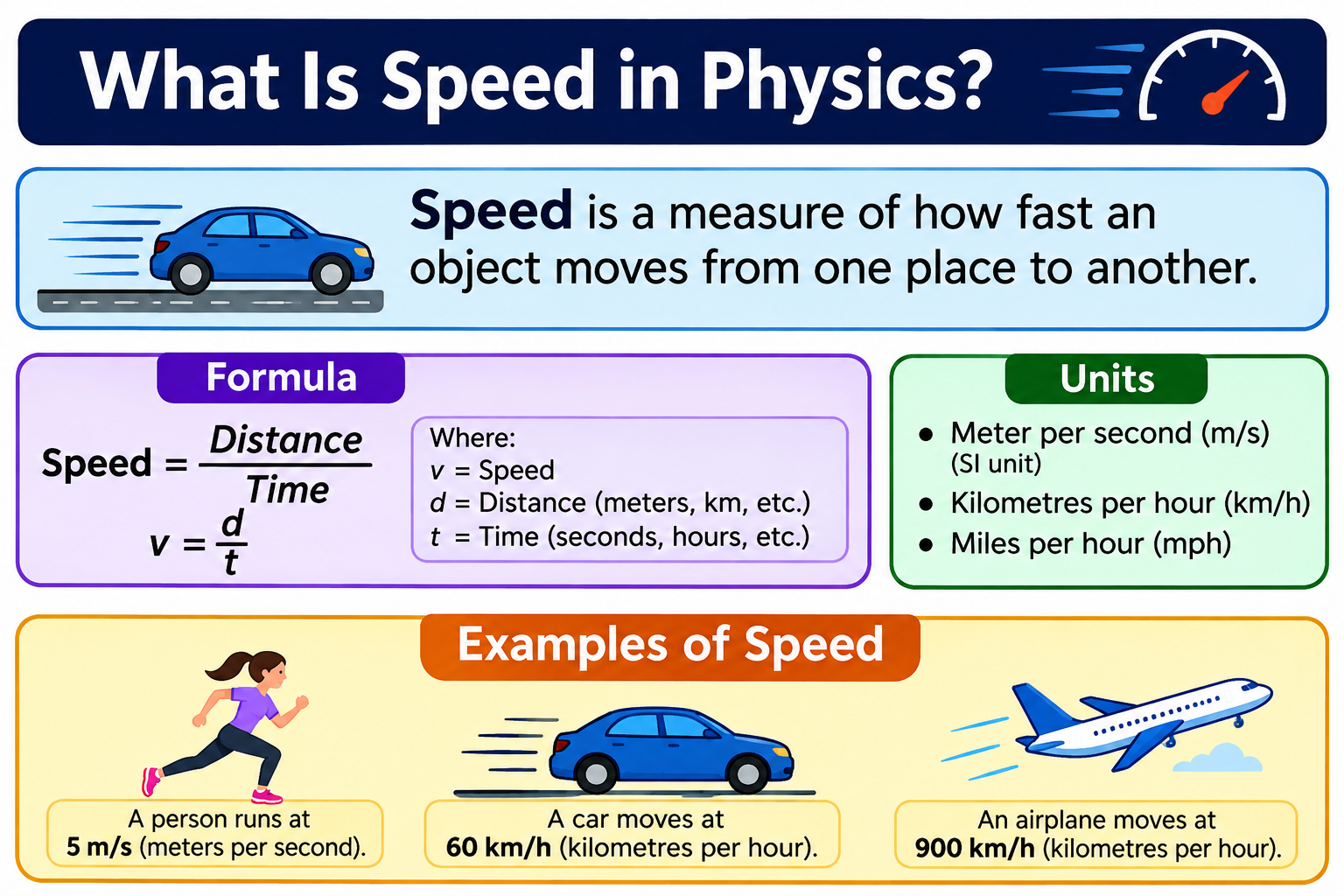
Speed is something we experience every single day, yet many students find it surprisingly tricky when it appears in a physics problem. So let us start with a clear, direct answer: speed is the rate at which an object covers distance. In other words, it tells you how quickly an object is moving from one place to another.
If a car travels 60 kilometres in one hour, its speed is 60 km/h. If a runner completes a 100-metre race in 10 seconds, their speed is 10 metres per second. Speed gives you a numerical value for how fast something is moving, but it does not tell you anything about the direction of that motion.
This is an important distinction. Speed is often confused with velocity, but velocity includes direction while speed does not. A car moving at 60 km/h north and a car moving at 60 km/h south have the same speed but completely different velocities.
In this article, you will find everything you need to understand speed in physics, including its definition, formula, types, unit conversions, distance-time graphs, worked examples, practice questions, and much more.
Key Takeaways
-
Speed is the rate at which an object covers distance, regardless of direction.
-
Speed is a scalar quantity, meaning it has magnitude only and no direction.
-
The formula for speed is v = d/t (speed = distance divided by time).
-
The SI unit of speed is metres per second (m/s).
-
There are four main types of speed: uniform, non-uniform, average, and instantaneous.
-
Average speed is calculated using total distance divided by total time.
-
Instantaneous speed is the speed of an object at a specific moment in time.
-
Speed and velocity are different: velocity includes direction, speed does not.
What Is Speed in Physics?
Speed is defined as the rate of change of distance with respect to time. More simply, it tells you how much distance an object covers in a given amount of time.
When you say a bicycle is moving at 5 m/s, you are saying that for every second of travel, the bicycle covers 5 metres of ground. Speed does not care about which direction the bicycle is heading. It only describes how fast the distance is being covered.
Here are some key points about speed:
- Speed measures how fast an object is moving.
- It is based on distance, not displacement.
- It does not indicate the direction of motion.
- Speed is always a positive value or zero. It cannot be negative.
- It is a scalar quantity, which means you only need a number and a unit to describe it fully.
Some everyday examples of speed:
- A person walking at approximately 1.4 m/s.
- A car on a motorway travelling at around 30 m/s (roughly 108 km/h).
- A commercial aeroplane cruising at about 250 m/s.
- Sound travelling through air at approximately 343 m/s at room temperature.
What Is the Formula for Speed?
The formula for speed is straightforward and forms the basis of almost all motion calculations at the introductory level:
v = d / t
Where:
- v = speed (measured in metres per second, m/s)
- d = distance travelled (measured in metres, m)
- t = time taken (measured in seconds, s)
This formula tells you that if an object covers a greater distance in the same amount of time, it is moving faster. Equally, if the same distance is covered in less time, the speed is higher.
The formula can be rearranged to find any of the three quantities if the other two are known:
- Speed: v = d / t
- Distance: d = v × t
- Time: t = d / v
Simple Example:
A cyclist covers 300 metres in 60 seconds. What is their speed?
v = d / t
v = 300 / 60
v = 5 m/s
Speed Formula Triangle
The speed formula triangle is a simple visual tool that makes it easy to remember all three rearrangements of the speed formula.
Imagine a triangle divided into three sections:
- d (distance) sits at the top.
- v (speed) sits at the bottom left.
- t (time) sits at the bottom right.
To use the triangle, cover the quantity you want to find:
- Cover d: you get v × t, so d = v × t
- Cover v: you get d / t, so v = d / t
- Cover t: you get d / v, so t = d / v
Example using d = v × t:
A train travels at 50 m/s for 120 seconds. How far does it travel?
d = v × t
d = 50 × 120
d = 6,000 m (or 6 km)
Example using t = d / v:
A car travels 180 km at a constant speed of 90 km/h. How long does the journey take?
t = d / v
t = 180 / 90
t = 2 hours
What Is the SI Unit of Speed?
The SI unit of speed is metres per second (m/s). This is the standard unit used in physics calculations worldwide.
Other commonly used units of speed include:
- km/h (kilometres per hour): commonly used for road vehicles and weather reports.
- mph (miles per hour): used in countries such as the United Kingdom and the United States for road speeds.
Converting between m/s and km/h:
To convert from km/h to m/s, divide by 3.6:
m/s = km/h ÷ 3.6
To convert from m/s to km/h, multiply by 3.6:
km/h = m/s × 3.6
Example 1: km/h to m/s
Convert 72 km/h to m/s.
72 ÷ 3.6 = 20 m/s
Example 2: m/s to km/h
Convert 25 m/s to km/h.
25 × 3.6 = 90 km/h
The factor of 3.6 comes from the fact that 1 km = 1,000 m and 1 hour = 3,600 seconds. So 1 km/h = 1,000/3,600 m/s = 1/3.6 m/s.
Is Speed a Scalar or Vector Quantity?
Speed is a scalar quantity. This means speed has magnitude only and does not include any information about direction.
To understand this, it helps to contrast speed with velocity.
- Scalar quantities are fully described by a number and a unit alone. Examples include speed, distance, mass, and temperature.
- Vector quantities require both a number and a direction to be fully described. Examples include velocity, displacement, force, and acceleration.
When a car travels at 80 km/h, that number alone tells you the speed. You do not need to know whether the car is heading north or south to state its speed. However, if someone asks for the car’s velocity, you would need to say “80 km/h north” or “80 km/h toward the city centre.”
This difference between speed and velocity becomes very important as you move into more advanced topics in mechanics. For a full comparison, see the section on Speed vs Velocity below.
Types of Speed
Speed does not always stay the same during a journey. Physicists recognise several types of speed to describe different situations.
Uniform Speed
An object has uniform speed when it covers equal distances in equal intervals of time. The speed does not change throughout the journey.
In practice, truly uniform speed is rarely maintained for long periods, but it is a useful idealization in physics problems.
Examples of uniform speed:
- A conveyor belt moving at a fixed rate in a factory.
- A satellite in a circular orbit (its speed stays approximately constant even though its direction changes continuously).
- A car using cruise control on a flat, straight motorway.
Non-Uniform Speed
An object has non-uniform speed when it covers unequal distances in equal intervals of time. The speed changes throughout the journey.
Most real-world motion is non-uniform because objects speed up, slow down, and respond to various forces.
Examples of non-uniform speed:
- A car in city traffic, constantly accelerating and braking.
- A ball rolling down a hill and gradually picking up speed.
- A person jogging who slows down toward the end of a run.
Average Speed
When an object travels at non-uniform speed, physicists use average speed to summarise the overall motion.
Average Speed = Total Distance / Total Time
Average speed gives a single value that represents the overall rate of travel across the entire journey.
Example:
A person drives 120 km in the first 2 hours and then 80 km in the next hour. What is their average speed?
Total distance = 120 + 80 = 200 km
Total time = 2 + 1 = 3 hours
Average speed = 200 / 3 = 66.7 km/h
Instantaneous Speed
Instantaneous speed is the speed of an object at a specific moment in time. It is what your car’s speedometer shows at any given instant.
Even if your average speed over a journey is 60 km/h, there will be moments where you are driving at 80 km/h and moments where you have slowed to 20 km/h. Each of those values is an instantaneous speed.
In mathematics, instantaneous speed is found by taking the derivative of distance with respect to time, but at the school level, it is most easily understood as the speed reading at a single precise moment.
Uniform Speed vs Non-Uniform Speed
| Feature | Uniform Speed | Non-Uniform Speed |
|---|---|---|
| Definition | Equal distance covered in equal time intervals | Unequal distance covered in equal time intervals |
| Motion pattern | Constant, unchanging | Varying, changing |
| Acceleration | Zero | Non-zero |
| Distance-time graph | Straight line | Curved line |
| Real-life example | Conveyor belt, cruise control on flat road | Car in traffic, ball rolling down a slope |
Average Speed vs Instantaneous Speed
| Feature | Average Speed | Instantaneous Speed |
|---|---|---|
| Definition | Total distance divided by total time | Speed at a specific moment in time |
| What it shows | Overall rate of travel for a journey | How fast the object is moving right now |
| Calculated from | Whole journey data | A single point in time |
| Practical example | Overall speed of a road trip | Car speedometer reading |
| Useful when | Journey has varying speed | You need speed at one precise moment |
Speed vs Velocity
Speed and velocity are closely related, but they are fundamentally different physical quantities. Many students confuse the two, so it is worth studying the comparison carefully.
| Feature | Speed | Velocity |
|---|---|---|
| Definition | Rate of change of distance | Rate of change of displacement |
| Scalar or vector | Scalar | Vector |
| Includes direction | No | Yes |
| Formula | v = d / t | v = s / t (where s = displacement) |
| SI unit | m/s | m/s |
| Can it be negative | No | Yes |
| Example | 60 km/h | 60 km/h north |
| Can it change while the other stays constant | Velocity can change while speed stays the same | Speed stays the same in uniform circular motion |
A very useful example of the difference: a car driving in a circle at a constant 40 km/h has a constant speed but a continuously changing velocity because its direction keeps changing.
To explore velocity in greater depth, the LearnMinto article on What Is Velocity? provides a detailed and student-friendly explanation.
Speed vs Distance
Speed and distance are often used together in calculations, but they describe very different things.
Distance is a measure of how much ground an object covers during its journey. It is a scalar quantity measured in metres (m) or kilometres (km). Distance does not depend on direction.
Speed describes how quickly that distance is being covered. It depends on both distance and time.
A simple way to think about it: distance answers “how far?” and speed answers “how fast?”
For example, if two cars both travel a distance of 100 km, but one takes 1 hour and the other takes 2 hours, they cover the same distance but travel at very different speeds.
Speed and Motion
Speed is one of the most direct ways to describe the motion of an object. Every moving object has a speed, and that speed can be zero, constant, or changing.
- An object at rest has zero speed.
- An object moving slowly has a low speed value.
- An object moving quickly has a high speed value.
- An object whose speed is changing is either accelerating or decelerating.
One important point that confuses many students: an object can move at a constant speed while its velocity changes. This happens when an object travels in a curve. A car navigating a roundabout at a steady 20 km/h has constant speed but changing velocity, because the direction of motion keeps changing.
Speed and Acceleration
Speed and acceleration are closely connected but describe different things.
Acceleration describes how quickly the velocity of an object changes over time. If an object speeds up, slows down, or changes direction, it is accelerating.
When a car increases its speed from 10 m/s to 30 m/s, it has accelerated. The speed has changed, and the change in speed over time is the acceleration.
However, it is possible for an object to accelerate even if its speed stays constant, provided its direction changes. This is the case in circular motion.
For a thorough explanation of acceleration and how it relates to both speed and velocity, the LearnMinto article on What Is Acceleration? provides clear definitions and worked examples.
Distance-Time Graphs and Speed
A distance-time graph plots the distance an object has travelled (vertical axis) against the time taken (horizontal axis). The shape of the line on this graph reveals information about the object’s speed.
- Horizontal line: The distance is not changing, so the object is stationary. Speed = 0.
- Straight line with a positive gradient: The object is moving at constant (uniform) speed. The steeper the line, the greater the speed.
- Steeper straight line: A steeper gradient means a greater speed, because more distance is covered in the same time.
- Curved line (curving upward): The gradient is increasing, which means the object is speeding up (accelerating).
- Curved line (curving and flattening): The gradient is decreasing, which means the object is slowing down.
The gradient (slope) of a distance-time graph gives the speed of the object for straightforward one-dimensional motion:
Speed = Change in distance / Change in time = Δd / Δt
Distance-time graphs are a standard topic in GCSE, IGCSE, and A-Level physics examinations, so understanding how to read and draw them is an important skill.
How to Calculate Speed
Example 1: Basic speed calculation
A dog runs 150 metres in 30 seconds. What is its speed?
v = d / t
v = 150 / 30
v = 5 m/s
Example 2: Speed in km/h
A train travels 240 km in 3 hours. What is its speed?
v = d / t
v = 240 / 3
v = 80 km/h
Example 3: Finding distance from speed and time
A car travels at 25 m/s for 40 seconds. How far does it travel?
d = v × t
d = 25 × 40
d = 1,000 m (or 1 km)
Example 4: Calculating average speed
A cyclist rides 10 km in 30 minutes, stops for 10 minutes, then rides another 5 km in 20 minutes. What is their average speed for the whole journey?
Total distance = 10 + 5 = 15 km
Total time = 30 + 10 + 20 = 60 minutes = 1 hour
Average speed = 15 / 1
Average speed = 15 km/h
Example 5: Mixed units requiring conversion
A car travels at 90 km/h for 30 minutes. How far does it travel in metres?
First, convert time: 30 minutes = 0.5 hours
d = v × t = 90 × 0.5 = 45 km
Convert to metres: 45 km = 45,000 m
Speed Conversion Examples
Converting between units of speed is a common requirement in physics problems. Here are the key conversions explained step by step.
From km/h to m/s (divide by 3.6):
Example: Convert 108 km/h to m/s.
108 ÷ 3.6 = 30 m/s
Example: Convert 54 km/h to m/s.
54 ÷ 3.6 = 15 m/s
From m/s to km/h (multiply by 3.6):
Example: Convert 20 m/s to km/h.
20 × 3.6 = 72 km/h
Example: Convert 12 m/s to km/h.
12 × 3.6 = 43.2 km/h
Why 3.6?
1 km/h means travelling 1,000 metres in 3,600 seconds.
So 1 km/h = 1,000 / 3,600 m/s = 1/3.6 m/s.
Therefore, to go from km/h to m/s, divide by 3.6, and to go from m/s to km/h, multiply by 3.6.
Real-Life Examples of Speed
Speed appears in countless real-world situations. Here are some scientifically reasonable reference values:
- Walking person: approximately 1.2 to 1.5 m/s (about 4 to 5 km/h).
- Cyclist: approximately 5 to 10 m/s (18 to 36 km/h) depending on terrain.
- Car on a motorway: approximately 28 to 33 m/s (100 to 120 km/h).
- Passenger train: approximately 55 to 80 m/s (200 to 290 km/h) for high-speed trains.
- Commercial aeroplane: approximately 230 to 260 m/s (around 850 to 950 km/h) at cruising altitude.
- Cheetah (fastest land animal): approximately 30 m/s (about 110 km/h) in short bursts.
- Speed of sound in air: approximately 343 m/s at 20°C.
- Speed of light in vacuum: approximately 3 × 10⁸ m/s, the fastest possible speed in the universe.
These examples help develop a sense of scale when you encounter speed values in physics problems.
What Is Average Speed?
Average speed is the total distance an object travels divided by the total time taken for the entire journey.
Average Speed = Total Distance / Total Time
Average speed is particularly useful when an object travels at different speeds during different parts of its journey, which is true of almost all real-world motion.
Important note: You cannot simply add two speeds and divide by two to find average speed, unless the object spends equal time at each speed. If the object spends different amounts of time at different speeds, you must use the total distance divided by the total time method.
Example showing why simple averaging is incorrect:
A car travels 60 km at 60 km/h, then another 60 km at 30 km/h.
Time for first 60 km: t = d/v = 60/60 = 1 hour
Time for second 60 km: t = d/v = 60/30 = 2 hours
Total distance = 120 km
Total time = 3 hours
Average speed = 120 / 3 = 40 km/h
If you had incorrectly averaged the two speeds: (60 + 30) / 2 = 45 km/h. This answer would be wrong because the car spent more time at the lower speed, which pulls the average down.
What Is Instantaneous Speed?
Instantaneous speed is the speed of an object at one specific moment in time. It answers the question: how fast is this object moving right now?
The most familiar example is your car’s speedometer. At any given instant, the speedometer displays your instantaneous speed. Even though your speed changes continuously during a drive, the speedometer always shows what your speed is at that precise moment.
Other examples:
- A cyclist speeding up on a downhill slope has a different instantaneous speed at every point along the slope.
- A roller coaster car has its highest instantaneous speed at the bottom of the steepest descent.
- A thrown ball has an instantaneous speed at every point during its flight, and this speed changes continuously under the influence of gravity and air resistance.
At a basic level, instantaneous speed can be estimated from a distance-time graph by finding the gradient of the line at that specific point (for a straight line) or the gradient of a tangent drawn at that point (for a curved line).
Common Mistakes Students Make About Speed
Even students who understand the concept of speed well can make avoidable errors. Here are the most common pitfalls to watch out for:
- Confusing speed with velocity. Speed has no direction. Velocity does. Never say “speed of 30 m/s north.” Instead, say “velocity of 30 m/s north” or “speed of 30 m/s.”
- Mixing up distance and displacement in the formula. The speed formula uses distance, not displacement. The velocity formula uses displacement.
- Forgetting to include units. In every exam answer, a numerical value without a unit is incomplete. Always state m/s, km/h, or whichever unit is appropriate.
- Mixing km/h and m/s without converting. If time is in seconds and distance is in kilometres, you must convert before substituting into v = d/t.
- Calculating average speed incorrectly. Simply averaging the individual speeds is wrong unless equal time is spent at each speed. Always use total distance divided by total time.
- Thinking speed can be negative. Speed is a scalar and is always zero or positive. Negative values indicate direction, which belongs to velocity.
- Confusing constant speed with constant velocity. An object can have constant speed while its velocity changes continuously (for example, circular motion at steady speed).
- Confusing speed with acceleration. Speed tells you how fast an object is moving. Acceleration tells you how quickly the speed or velocity is changing. A fast object is not necessarily accelerating.
How to Solve Speed Problems
Follow this structured approach to solve any speed problem accurately:
- Identify the distance. Read the problem carefully and find the distance value and its unit.
- Identify the time. Find the time value and its unit.
- Convert units if necessary. Make sure distance and time are in compatible units before calculating speed.
- Choose the correct formula. Decide whether you need v = d/t, d = v × t, or t = d/v.
- Substitute the values. Carefully insert the numbers into the formula.
- Calculate the result. Perform the arithmetic step by step.
- Add the correct unit. State the unit of your answer (m/s, km/h, etc.).
- Check whether the answer is reasonable. Does the speed make physical sense for the situation described?
Important Speed Formulas
| Formula | Meaning | Variables | Unit of Result |
|---|---|---|---|
| v = d / t | Speed equals distance divided by time | v = speed, d = distance, t = time | m/s or km/h |
| d = v × t | Distance equals speed multiplied by time | d = distance, v = speed, t = time | m or km |
| t = d / v | Time equals distance divided by speed | t = time, d = distance, v = speed | seconds or hours |
| Average speed = Total distance / Total time | Overall speed for a complete journey | Total d = sum of all distances, Total t = sum of all times | m/s or km/h |
Speed in Different Units
| Unit | Meaning | Common Use | Conversion |
|---|---|---|---|
| m/s | Metres per second | Standard SI unit used in physics calculations | Multiply by 3.6 to convert to km/h |
| km/h | Kilometres per hour | Road signs, vehicle speed, weather | Divide by 3.6 to convert to m/s |
| mph | Miles per hour | Road speeds in the UK and USA | 1 mph ≈ 0.447 m/s |
Speed and Safety
Speed plays a critical role in road safety. Higher speeds mean greater distances are needed to stop a vehicle safely. They also mean that in the event of a collision, the forces involved are much larger, leading to more serious consequences.
Stopping distance has two components in physics: the thinking distance (the distance covered during the driver’s reaction time) and the braking distance (the distance covered while the vehicle slows to a stop). Both of these increase with speed.
Understanding the physics of speed and stopping distances is one reason why speed limits exist and why they are set at the values they are. This is a practical application of the physics of motion that affects every driver and pedestrian.
Why Is Speed Important in Physics?
Speed is one of the most fundamental quantities in the study of motion. Here is why it matters across different areas:
- Mechanics: Speed is essential for describing and calculating the motion of all objects.
- Transportation: Engineers design vehicles, engines, and transport networks based on speed requirements.
- Sports science: Athletes and coaches use speed measurements to analyse and improve performance.
- Engineering: Machines, turbines, and manufacturing equipment are designed with speed specifications.
- Astronomy: The speeds of stars, galaxies, and spacecraft are crucial for understanding the universe.
- Everyday measurements: Speed cameras, GPS navigation, fitness trackers, and weather systems all rely on speed calculations.
- Motion analysis: Scientists studying animal behaviour, fluid dynamics, and particle physics all use speed as a key measurement.
Understanding speed also lays the foundation for studying velocity, acceleration, momentum, force, and energy. The LearnMinto article on What Is Force in Physics? shows clearly how speed and motion connect to the forces that cause changes in motion.
Speed Practice Questions
20 Multiple Choice Questions
Question 1: What is the SI unit of speed?
- A) km/h
- B) Joule
- C) Newton
- D) m/s
Correct Answer: D) m/s
Explanation: The SI unit of speed is metres per second (m/s).
Question 2: A car travels 200 m in 25 seconds. What is its speed?
- A) 5,000 m/s
- B) 8 m/s
- C) 0.125 m/s
- D) 225 m/s
Correct Answer: B) 8 m/s
Explanation: v = d/t = 200/25 = 8 m/s.
Question 3: Speed is which type of quantity?
- A) Vector
- B) Scalar
- C) Neither
- D) Both
Correct Answer: B) Scalar
Explanation: Speed has magnitude only and no direction, making it a scalar quantity.
Question 4: Which formula correctly expresses speed?
- A) v = t × a
- B) v = d × t
- C) v = d / t
- D) v = t / d
Correct Answer: C) v = d / t
Explanation: Speed equals distance divided by time.
Question 5: What does the slope of a distance-time graph represent?
- A) Acceleration
- B) Force
- C) Speed
- D) Time
Correct Answer: C) Speed
Explanation: The gradient of a distance-time graph gives the speed of the object.
Question 6: Convert 72 km/h to m/s.
- A) 25 m/s
- B) 20 m/s
- C) 18 m/s
- D) 72 m/s
Correct Answer: B) 20 m/s
Explanation: 72 ÷ 3.6 = 20 m/s.
Question 7: A horizontal line on a distance-time graph means the object is:
- A) Moving at constant speed
- B) Accelerating
- C) Stationary
- D) Decelerating
Correct Answer: C) Stationary
Explanation: A horizontal line means no change in distance over time, so the object is at rest.
Question 8: A train travels at 30 m/s for 5 minutes. What distance does it cover?
- A) 150 m
- B) 900 m
- C) 9,000 m
- D) 180 m
Correct Answer: C) 9,000 m
Explanation: d = v × t = 30 × 300 = 9,000 m (convert 5 minutes = 300 seconds first).
Question 9: What is instantaneous speed?
- A) The average speed over a whole journey
- B) The speed at a specific moment in time
- C) The maximum speed reached
- D) The minimum speed reached
Correct Answer: B) The speed at a specific moment in time
Explanation: Instantaneous speed is the speed of an object at one precise instant.
Question 10: Which of the following correctly describes non-uniform speed?
- A) Equal distances covered in equal time intervals
- B) Zero acceleration throughout
- C) Unequal distances covered in equal time intervals
- D) Constant gradient on a distance-time graph
Correct Answer: C) Unequal distances covered in equal time intervals
Explanation: Non-uniform speed means the rate of covering distance is changing.
Question 11: A runner completes 400 m in 50 seconds. What is their average speed?
- A) 450 m/s
- B) 8 m/s
- C) 350 m/s
- D) 0.125 m/s
Correct Answer: B) 8 m/s
Explanation: v = d/t = 400/50 = 8 m/s.
Question 12: What does a steeper line on a distance-time graph indicate?
- A) Slower speed
- B) Greater speed
- C) Zero speed
- D) Negative speed
Correct Answer: B) Greater speed
Explanation: A steeper gradient means more distance is covered per unit time, indicating greater speed.
Question 13: How do you convert m/s to km/h?
- A) Divide by 3.6
- B) Multiply by 1,000
- C) Multiply by 3.6
- D) Divide by 1,000
Correct Answer: C) Multiply by 3.6
Explanation: To convert from m/s to km/h, multiply by 3.6.
Question 14: Which of the following is the best example of uniform speed?
- A) A car braking at traffic lights
- B) A ball rolling down a slope
- C) A conveyor belt moving at a fixed rate
- D) A sprinter accelerating off the starting line
Correct Answer: C) A conveyor belt moving at a fixed rate
Explanation: A conveyor belt at a fixed rate covers equal distances in equal times, representing uniform speed.
Question 15: A car travels 90 km in 1.5 hours. What is its average speed?
- A) 135 km/h
- B) 60 km/h
- C) 45 km/h
- D) 91.5 km/h
Correct Answer: B) 60 km/h
Explanation: v = d/t = 90/1.5 = 60 km/h.
Question 16: Which of the following instruments measures instantaneous speed?
- A) Ruler
- B) Thermometer
- C) Speedometer
- D) Balance
Correct Answer: C) Speedometer
Explanation: A speedometer shows the speed of a vehicle at any given instant.
Question 17: Speed cannot be:
- A) Zero
- B) Positive
- C) Negative
- D) Measured in m/s
Correct Answer: C) Negative
Explanation: Speed is a scalar quantity and is always zero or positive. Negative values indicate direction, which belongs to velocity.
Question 18: A cyclist covers 30 km in 2 hours. What is their speed in m/s?
- A) 15 m/s
- B) 4.17 m/s
- C) 60 m/s
- D) 8.33 m/s
Correct Answer: B) 4.17 m/s
Explanation: Speed = 30/2 = 15 km/h. Convert: 15 ÷ 3.6 ≈ 4.17 m/s.
Question 19: An object moves at constant speed in a circle. Which statement is correct?
- A) Its velocity is also constant
- B) Its speed and velocity are both constant
- C) Its velocity changes but its speed remains constant
- D) Its speed changes but its velocity remains constant
Correct Answer: C) Its velocity changes but its speed remains constant
Explanation: In circular motion at constant speed, the direction changes continuously, so velocity changes while speed stays the same.
Question 20: A vehicle travels 500 m in 20 seconds. How long will it take to travel 2,000 m at the same speed?
- A) 40 seconds
- B) 60 seconds
- C) 80 seconds
- D) 100 seconds
Correct Answer: C) 80 seconds
Explanation: Speed = 500/20 = 25 m/s. t = d/v = 2,000/25 = 80 seconds.
10 Short Answer Questions
Q1: Define speed in physics.
Speed is the rate at which an object covers distance. It is a scalar quantity measured in metres per second (m/s), calculated using v = d/t.
Q2: What is the formula for speed? Define all variables.
v = d/t, where v is speed in m/s, d is distance in metres, and t is time in seconds.
Q3: What is the SI unit of speed?
The SI unit of speed is metres per second (m/s).
Q4: What is the difference between average speed and instantaneous speed?
Average speed is the total distance divided by the total time for an entire journey. Instantaneous speed is the speed of the object at one specific moment in time.
Q5: How do you convert 54 km/h to m/s?
Divide by 3.6: 54 ÷ 3.6 = 15 m/s.
Q6: A cyclist travels 600 m in 2 minutes. Calculate their speed in m/s.
Convert 2 minutes to 120 seconds. v = 600/120 = 5 m/s.
Q7: What does a horizontal line on a distance-time graph mean?
The object is stationary. Its distance is not changing, so its speed is zero.
Q8: Explain why speed is a scalar quantity.
Speed has only magnitude (a numerical value and a unit) and does not include direction. Since direction is not required to fully describe speed, it is a scalar.
Q9: A car travels at 20 m/s for 3 minutes. How far does it travel?
Convert 3 minutes = 180 seconds. d = v × t = 20 × 180 = 3,600 m.
Q10: Can two objects have the same speed but different velocities?
Yes. If two objects move at the same speed but in different directions, their speeds are equal but their velocities are different because velocity includes direction.
5 Numerical Problems
Problem 1:
A sprinter runs 100 m in 9.58 seconds. Calculate their average speed.
Solution:
v = d / t
v = 100 / 9.58
v ≈ 10.44 m/s
Problem 2:
A bus travels at a speed of 15 m/s for 12 minutes. How far does it travel?
Solution:
Convert time: 12 minutes = 720 seconds
d = v × t
d = 15 × 720
d = 10,800 m (10.8 km)
Problem 3:
A car travels 150 km at 75 km/h. How long does the journey take?
Solution:
t = d / v
t = 150 / 75
t = 2 hours
Problem 4:
A person walks 2 km in 25 minutes, rests for 5 minutes, then walks another 3 km in 35 minutes. Calculate the average speed in km/h.
Solution:
Total distance = 2 + 3 = 5 km
Total time = 25 + 5 + 35 = 65 minutes = 65/60 hours ≈ 1.083 hours
Average speed = 5 / 1.083
Average speed ≈ 4.62 km/h
Problem 5:
A train travels 480 km at 160 km/h. Convert the train’s speed to m/s and calculate the journey time in minutes.
Solution:
Speed in m/s: 160 ÷ 3.6 ≈ 44.4 m/s
Time: t = d/v = 480/160 = 3 hours = 180 minutes
5 Exam-Style Questions
Question 1:
Describe, using a distance-time graph, what happens to speed when the graph shows a curved line that becomes steeper over time.
Answer: A curved line on a distance-time graph that becomes progressively steeper shows that the gradient (slope) is increasing over time. Since gradient represents speed, an increasing gradient means the object is covering more distance in each successive time interval. This indicates that the object is speeding up, meaning it is accelerating.
Question 2:
A car travels 120 km at 80 km/h and then 80 km at 40 km/h. Calculate the average speed for the whole journey. Show your working clearly.
Answer:
Time for first section: t = 120/80 = 1.5 hours
Time for second section: t = 80/40 = 2 hours
Total distance = 120 + 80 = 200 km
Total time = 1.5 + 2 = 3.5 hours
Average speed = 200/3.5 ≈ 57.1 km/h
Question 3:
Explain the difference between scalar and vector quantities. State whether speed is scalar or vector and justify your answer.
Answer: A scalar quantity has magnitude only. A vector quantity has both magnitude and direction. Speed is a scalar quantity because it only tells us how fast an object is moving. It does not indicate any direction of motion. For example, a speed of 10 m/s gives no information about where the object is heading. In contrast, velocity is a vector because it specifies both the magnitude (10 m/s) and the direction (for example, north).
Question 4:
A motorcycle has an average speed of 72 km/h over a 1.5-hour journey. A car covers the same distance but takes 2 hours. Calculate the average speed of the car in m/s.
Answer:
Distance = v × t = 72 × 1.5 = 108 km
Car’s speed = 108 / 2 = 54 km/h
Convert to m/s: 54 ÷ 3.6 = 15 m/s
Question 5:
Explain why simply averaging two speed values does not always give the correct average speed for a journey.
Answer: Simply averaging two speed values (adding them and dividing by two) only gives the correct average when equal time is spent at each speed. When unequal time is spent at different speeds, the object spends more time at one speed than the other, which affects the overall average. The correct method is always to divide the total distance by the total time, which accounts for how long the object actually spent at each speed.
Exam Tips
- Remember the formula as a triangle: Cover what you want to find. Speed = d/t, Distance = v × t, Time = d/v.
- Always state the unit. An answer of “8” is incomplete. Write “8 m/s” or “8 km/h.”
- Know the conversion factor 3.6. Divide km/h by 3.6 to get m/s. Multiply m/s by 3.6 to get km/h.
- Speed is a scalar. Never include direction in a speed answer. If direction is required, the question is asking for velocity.
- Average speed uses total distance and total time. Do not simply average the two speed values unless specifically told that equal time was spent at each speed.
- Check your units before substituting. If distance is in kilometres and time is in seconds, the formula gives km/s, not m/s. Convert first.
- Instantaneous speed is what a speedometer shows. It is the speed at one moment, not across a journey.
- Distance-time graph gradient = speed. A steeper slope means greater speed. A horizontal line means zero speed.
Quick Revision Notes
- Speed is the rate at which distance is covered. Formula: v = d/t.
- SI unit of speed: metres per second (m/s).
- Speed is a scalar quantity (magnitude only, no direction).
- Speed cannot be negative.
- Types of speed: uniform, non-uniform, average, instantaneous.
- Uniform speed: equal distances in equal times. Non-uniform speed: unequal distances in equal times.
- Average speed = Total distance / Total time.
- Instantaneous speed: speed at one specific moment.
- Distance-time graph: gradient = speed. Horizontal line = stationary.
- Speed vs velocity: speed is scalar, velocity is vector (includes direction).
- Convert km/h to m/s: divide by 3.6. Convert m/s to km/h: multiply by 3.6.
- You can have constant speed with changing velocity (e.g. circular motion).
Speed Cheat Sheet
| Concept | Definition | Formula | Unit | Example |
|---|---|---|---|---|
| Speed | Rate of change of distance | v = d / t | m/s | Car at 20 m/s |
| Distance | Total ground covered | d = v × t | m or km | 100 m race |
| Time | Duration of travel | t = d / v | seconds or hours | 10 seconds |
| Average Speed | Total distance over total time | v_avg = total d / total t | m/s or km/h | Road trip speed |
| Instantaneous Speed | Speed at one specific moment | Read from speedometer or graph gradient | m/s | Car speedometer reading |
| Uniform Speed | Equal distances in equal times | v = d/t (constant) | m/s | Conveyor belt |
| Non-Uniform Speed | Unequal distances in equal times | v changes | m/s | City traffic |
| km/h to m/s | Unit conversion | Divide by 3.6 | m/s | 72 km/h = 20 m/s |
| m/s to km/h | Unit conversion | Multiply by 3.6 | km/h | 20 m/s = 72 km/h |
Frequently Asked Questions
1. What is speed in physics?
Speed is the rate at which an object covers distance. It is a scalar quantity calculated using v = d/t and measured in metres per second (m/s).
2. What is the formula for speed?
The formula for speed is v = d/t, where v is speed, d is distance, and t is time.
3. What is the SI unit of speed?
The SI unit of speed is metres per second (m/s).
4. Is speed a scalar or vector quantity?
Speed is a scalar quantity. It has magnitude only and does not include direction.
5. What are the types of speed?
The four main types are: uniform speed, non-uniform speed, average speed, and instantaneous speed.
6. What is average speed?
Average speed is the total distance covered divided by the total time taken for the entire journey.
7. What is instantaneous speed?
Instantaneous speed is the speed of an object at a specific moment in time. A car speedometer shows instantaneous speed.
8. What is the difference between speed and velocity?
Speed is a scalar that tells you how fast an object moves. Velocity is a vector that tells you how fast and in which direction the object moves.
9. How do you calculate speed?
Use v = d/t. Divide the distance travelled by the time taken. Make sure the units are compatible before calculating.
10. How do you convert km/h to m/s?
Divide by 3.6. For example, 108 km/h ÷ 3.6 = 30 m/s.
11. How do you convert m/s to km/h?
Multiply by 3.6. For example, 25 m/s × 3.6 = 90 km/h.
12. Can speed be zero?
Yes. When an object is at rest, its speed is zero.
13. Can an object have constant speed but changing velocity?
Yes. An object moving in a circle at constant speed has a continuously changing velocity because its direction changes at every point.
14. What is uniform speed?
Uniform speed means an object covers equal distances in equal time intervals. The speed does not change.
15. What is non-uniform speed?
Non-uniform speed means an object covers unequal distances in equal time intervals. The speed is changing.
Summary
Speed is the rate at which an object covers distance, and it is one of the most fundamental quantities in physics. Calculated using the simple formula v = d/t, speed is measured in metres per second (m/s) as its SI unit. As a scalar quantity, speed has magnitude but no direction, which distinguishes it from velocity.
There are four main types of speed: uniform (constant), non-uniform (changing), average (total distance over total time), and instantaneous (speed at one specific moment). Each type is useful in different physical situations.
Converting between units of speed is straightforward: divide km/h by 3.6 to get m/s, and multiply m/s by 3.6 to get km/h. Distance-time graphs provide a visual tool for analysing speed, where the gradient of the graph represents speed.
Understanding speed lays the groundwork for studying velocity, acceleration, force, momentum, and the physics of motion as a whole.
Final Thoughts
If there is one concept that bridges the gap between everyday experience and formal physics, it is speed. Everyone has an intuitive sense of fast and slow, but physics gives you the tools to measure, calculate, and reason about motion with precision.
Learning what speed is in physics means more than memorising v = d/t. It means understanding why direction matters, why average and instantaneous speed are different, and how to interpret graphs and solve problems with confidence. Once you are comfortable with speed, the next steps into velocity, acceleration, and forces become much more manageable.
Work through the practice problems, pay attention to units, and always check whether your answer makes physical sense. These habits will serve you well throughout your entire study of physics and beyond.
References
- OpenStax. University Physics Volume 1 – Chapter 3: Motion Along a Straight Line. OpenStax, Rice University. Available at: https://openstax.org/books/university-physics-volume-1/pages/3-introduction
- Physics LibreTexts. Speed and Velocity. LibreTexts Physics. Available at: https://phys.libretexts.org/Bookshelves/University_Physics/Book%3A_University_Physics_(OpenStax)/Book%3A_University_Physics_I_-Mechanics_Sound_Oscillations_and_Waves(OpenStax)/03%3A_Motion_Along_a_Straight_Line/3.02%3A_Instantaneous_Velocity_and_Speed
- Khan Academy. Speed and Velocity. Khan Academy Physics. Available at: https://www.khanacademy.org/science/physics/one-dimensional-motion/displacement-velocity-time/a/speed-and-velocity
- Encyclopaedia Britannica. Speed – Physics. Britannica. Available at: https://www.britannica.com/science/speed-physics
- The Physics Classroom. Speed and Velocity. The Physics Classroom. Available at: https://www.physicsclassroom.com/class/1DKin/Lesson-1/Speed-and-Velocity
- National Institute of Standards and Technology (NIST). SI Units. NIST. Available at: https://www.nist.gov/pml/owm/metric-si/si-units
Disclaimer
This article is intended for educational and informational purposes only. While LearnMinto strives to provide accurate and up-to-date information, readers should verify important academic concepts through official textbooks, educational institutions, examination boards, or trusted scientific resources before relying on this content for exams or academic purposes. LearnMinto is not affiliated with any specific school, university, research institution, or examination board.