
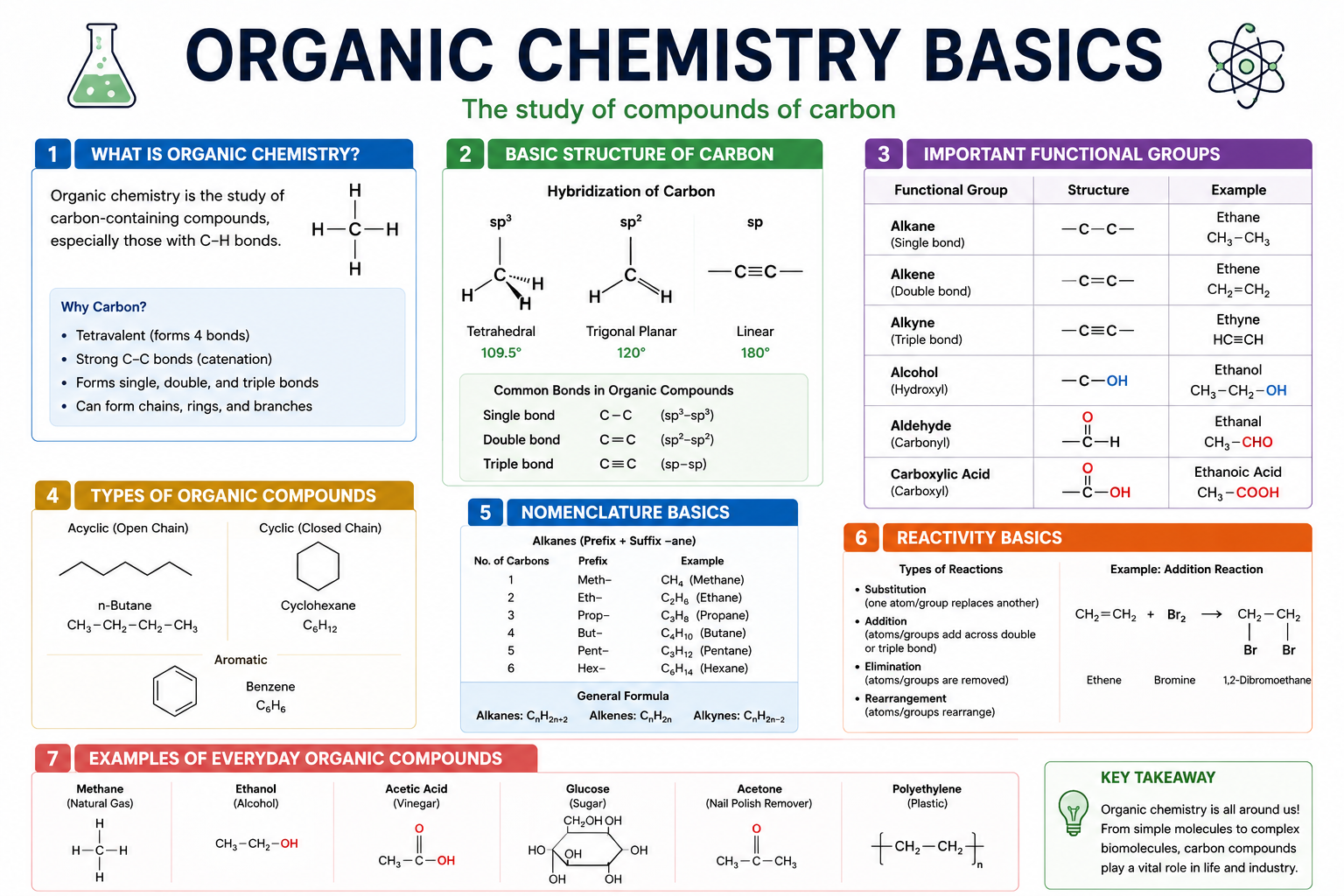
Introduction
Organic chemistry has a reputation for being one of the most challenging subjects in science education. Students often walk into their first organic chemistry class feeling nervous, and by the second week, many of them are convinced that it is an entirely different language. The truth, though, is that organic chemistry is not as intimidating as it looks once you understand the underlying logic. Everything flows from a single, remarkable element: carbon.
This organic chemistry basics study guide was written to give you one comprehensive resource that covers everything from the definition of organic chemistry all the way through functional groups, IUPAC nomenclature, isomerism, and organic reactions. Whether you are a high school student trying to pass your end-of-year exam, a pre-med student preparing for the MCAT, a pharmacy student reviewing foundational concepts, or simply someone who wants to understand what “organic” actually means in chemistry, this guide is for you.
We will start from the very beginning — the history of organic chemistry and why carbon is such an extraordinary element — and build steadily toward the more complex ideas. Along the way, you will find real-life examples that connect chemistry to the world you live in, comparison tables that organize key information clearly, and 55 practice questions to sharpen your exam preparation.
One thing worth saying upfront: organic chemistry rewards patience and practice. You cannot memorize your way through it the way you might with a list of facts. You need to understand patterns, recognize functional groups on sight, and develop an intuition for how carbon compounds behave. This guide is designed to help you build exactly that kind of understanding — one concept at a time.
Key Takeaways
- Organic chemistry is the study of carbon-containing compounds, which number in the tens of millions.
- Carbon is unique because of its tetravalency and ability to form chains, rings, and complex structures through catenation.
- Organic compounds are classified into aliphatic, alicyclic, aromatic, and heterocyclic categories.
- Hydrocarbons — the simplest organic compounds — are divided into alkanes, alkenes, alkynes, and aromatic hydrocarbons.
- Functional groups are specific arrangements of atoms that give organic molecules their characteristic chemical properties.
- IUPAC nomenclature provides a universal, systematic method for naming organic compounds.
- Isomerism explains why two compounds with the same molecular formula can have completely different structures and properties.
- Organic reactions follow recognizable patterns: addition, substitution, elimination, oxidation, reduction, and polymerization.
- Organic chemistry is central to medicine, fuels, food, plastics, cosmetics, and agriculture.
What Is Organic Chemistry?
At its simplest, organic chemistry is the branch of chemistry that deals with the study of carbon-containing compounds. That definition sounds narrow, but in practice, it covers an almost unimaginably large territory. Scientists have identified and characterized more than 20 million distinct organic compounds, with new ones being synthesized in laboratories every year.
The word “organic” historically referred to substances derived from living organisms — animals, plants, and microorganisms. Today we know that is not the defining characteristic. What makes a compound organic is the presence of carbon atoms, usually bonded to hydrogen and often to other elements like oxygen, nitrogen, sulfur, and halogens.
A few common exceptions to note: not all carbon-containing compounds are considered organic. Carbon dioxide (CO2), carbon monoxide (CO), carbonates (like CaCO3), and carbides are generally classified as inorganic compounds despite containing carbon. Organic chemistry, then, is really the chemistry of carbon chains and rings — the incredibly versatile frameworks that form the structural basis of all life and a huge proportion of modern industry.
Why Organic Chemistry Is Important
The importance of organic chemistry is difficult to overstate. Here is a short list of areas it directly touches:
- Medicine: Almost all pharmaceutical drugs are organic molecules. Aspirin, penicillin, morphine, and the antiviral drugs used to treat influenza are all products of organic chemistry.
- Food: Proteins, fats, carbohydrates, vitamins, and flavor compounds are all organic. Understanding food chemistry at a molecular level starts with organic chemistry.
- Materials: Plastics, rubber, nylon, Kevlar, and synthetic fibers are all organic polymers developed through organic chemistry research.
- Energy: Petroleum, natural gas, and coal are mixtures of organic compounds. The combustion reactions that power cars and generate electricity are organic reactions.
- Agriculture: Pesticides, herbicides, and fertilizers often involve organic compounds. Many agrochemicals are designed using principles of organic chemistry.
- Cosmetics: Soaps, perfumes, lotions, and hair products are formulated from organic compounds.
For students aiming at careers in medicine, pharmacy, chemical engineering, materials science, or environmental science, a strong foundation in organic chemistry is not optional — it is essential.
History of Organic Chemistry
Vital Force Theory
For most of human history, chemists believed that organic compounds — substances produced by living organisms — could only be created by life itself. This belief was known as Vitalism, or the Vital Force Theory. According to this idea, a mysterious “vital force” existed within living things that was responsible for producing organic molecules, and no laboratory process could ever replicate it.
This theory dominated chemistry for centuries. It explained why early chemists assumed that urea (a compound found in urine) or sucrose (table sugar) could never be made in a laboratory from simple inorganic starting materials.
Friedrich Wöhler’s Discovery
In 1828, a German chemist named Friedrich Wöhler performed an experiment that changed the history of chemistry forever. He was attempting to make ammonium cyanate (an inorganic compound) from silver cyanate and ammonium chloride. Instead, he accidentally synthesized urea — an organic compound — without any involvement of living organisms.
This was a landmark moment. It shattered the Vital Force Theory and demonstrated, for the first time, that organic compounds could be made from inorganic starting materials in a laboratory. Wöhler’s discovery opened the door to the entire field of synthetic organic chemistry.
Modern Organic Chemistry
Following Wöhler’s breakthrough, the field expanded rapidly. August Kekulé proposed the structure of benzene in the 1860s, laying the foundation for aromatic chemistry. Stanislao Cannizzaro clarified atomic weights. Louis Pasteur separated the first pair of enantiomers (mirror-image molecules), founding stereochemistry.
By the twentieth century, organic chemistry had evolved into a vast, sophisticated science capable of synthesizing extraordinarily complex molecules — including vitamins, hormones, antibiotics, and eventually entire drug molecules designed from scratch. Today, organic synthesis, computational chemistry, and green chemistry represent the cutting edge of this field.
Why Carbon Is Unique
Tetravalency of Carbon
Carbon occupies a very special position on the periodic table. It has an atomic number of 6 and an electron configuration of 2, 4 — meaning it has four electrons in its outermost shell. To achieve stability (a full outer shell of eight electrons), carbon needs to form exactly four covalent bonds. This property is called tetravalency.
Four bonds might sound simple, but it has profound consequences. Because carbon can form four bonds simultaneously, it can bond to four different atoms or groups of atoms at once. This flexibility allows carbon to create an enormous variety of structures.
Catenation
Catenation is the ability of carbon atoms to bond to other carbon atoms, forming long chains, branched chains, and rings. No other element does this as effectively as carbon. Silicon can catenate to a limited extent, but silicon-silicon bonds are much weaker and less stable than carbon-carbon bonds.
Because of catenation, carbon can form:
- Straight chains: Carbon atoms linked in a line, like in octane (a component of gasoline).
- Branched chains: Chains with side branches, like in isobutane.
- Rings: Carbon atoms bonded in a closed loop, like in cyclohexane or benzene.
- Double and triple bonds: Carbon can form single (C-C), double (C=C), and triple (C≡C) bonds with other carbon atoms.
Carbon Bonding
Carbon forms three types of bonds with other carbon atoms:
- Single bond (C-C): A sigma bond. The two carbons can rotate freely around this bond. Found in alkanes.
- Double bond (C=C): One sigma bond and one pi bond. Rotation is restricted, which is why geometric isomerism is possible in alkenes.
- Triple bond (C≡C): One sigma bond and two pi bonds. The molecule is linear around the triple bond. Found in alkynes.
Carbon also bonds readily with hydrogen (forming C-H bonds), oxygen (C-O and C=O bonds), nitrogen (C-N bonds), sulfur, and halogens. This versatility is the foundation of the entire diversity of organic chemistry.
Classification of Organic Compounds
Aliphatic Compounds
Aliphatic compounds are open-chain organic compounds — their carbon atoms are arranged in straight or branched chains rather than rings. They include alkanes, alkenes, and alkynes, as well as their functional group derivatives like alcohols, aldehydes, and carboxylic acids. The word “aliphatic” comes from the Greek word for fat, reflecting the historical observation that many fats are aliphatic compounds.
Alicyclic Compounds
Alicyclic compounds have carbon atoms arranged in a ring structure, but unlike aromatic compounds, they do not have the special delocalized electron system of benzene. Cyclohexane is a classic example — six carbon atoms arranged in a ring, each bonded to two hydrogen atoms. Alicyclic compounds share many properties with their aliphatic counterparts.
Aromatic Compounds
Aromatic compounds contain one or more benzene rings — six-membered carbon rings with alternating single and double bonds that are actually better described as delocalized electron systems. Benzene itself (C6H6) is the simplest example. Aromatic compounds have distinctive stability due to this delocalization. Toluene, naphthalene, and many pharmaceutical compounds are aromatic.
Heterocyclic Compounds
Heterocyclic compounds have ring structures that contain at least one atom other than carbon — most commonly nitrogen, oxygen, or sulfur. Pyridine (a nitrogen-containing ring), furan (oxygen-containing), and thiophene (sulfur-containing) are common examples. Many biologically important molecules, including nucleic acid bases (like adenine and guanine), are heterocyclic compounds.
Hydrocarbons Explained
Hydrocarbons are the simplest organic compounds — they contain only carbon and hydrogen. They form the backbone of organic chemistry and are the starting point for understanding more complex molecules.
Alkanes
Alkanes are saturated hydrocarbons, meaning every carbon-carbon bond is a single bond. Their general formula is CnH2n+2, where n is the number of carbon atoms.
The first four alkanes are:
- Methane (CH4) — natural gas, one carbon atom
- Ethane (C2H6) — two carbon atoms
- Propane (C3H8) — three carbon atoms, used in gas grills
- Butane (C4H10) — four carbon atoms, used in lighters
Alkanes are relatively unreactive because all bonds are single bonds. Their primary reaction is combustion — they burn in oxygen to produce carbon dioxide and water, releasing energy. This makes them excellent fuels.
Alkenes
Alkenes are unsaturated hydrocarbons that contain at least one carbon-carbon double bond. Their general formula is CnH2n. The double bond makes alkenes far more chemically reactive than alkanes.
Key examples:
- Ethene (C2H4) — the simplest alkene, used in the production of polyethylene plastic
- Propene (C3H6) — used in making polypropylene
- Butene (C4H8)
The carbon-carbon double bond in alkenes is the site of most chemical reactions. Addition reactions, where molecules add across the double bond, are characteristic of alkenes.
Alkynes
Alkynes contain at least one carbon-carbon triple bond. Their general formula is CnH2n-2. The triple bond makes them even more reactive than alkenes.
Key examples:
- Ethyne (C2H2) — also known as acetylene, used in welding torches because it burns at extremely high temperatures
- Propyne (C3H4)
Like alkenes, alkynes undergo addition reactions, but they can add two molecules across their triple bond.
Aromatic Hydrocarbons
Aromatic hydrocarbons, also called arenes, contain one or more benzene rings. Benzene (C6H6) is the parent compound. Despite having alternating double bonds in its structure, benzene does not behave like a typical unsaturated compound — it undergoes substitution reactions rather than addition reactions because adding to the ring would destroy the stable delocalized electron system.
Common aromatic hydrocarbons:
- Benzene — solvent, starting material in chemical synthesis
- Toluene (methylbenzene) — solvent, used in paint thinners
- Naphthalene — moth repellent, two fused benzene rings
- Styrene — monomer for polystyrene plastic
Saturated vs Unsaturated Hydrocarbons
| Property | Saturated Hydrocarbons (Alkanes) | Unsaturated Hydrocarbons (Alkenes/Alkynes) |
|---|---|---|
| Carbon-Carbon Bonds | Single bonds only | Double bonds (alkenes) or triple bonds (alkynes) |
| General Formula | CnH2n+2 (alkanes) | CnH2n (alkenes), CnH2n-2 (alkynes) |
| Reactivity | Relatively low | Higher — more reactive |
| Typical Reactions | Combustion, substitution | Addition reactions |
| Test with Bromine Water | No reaction (stays orange) | Decolorizes bromine water |
| Hydrogen Content | Maximum hydrogen per carbon | Less than maximum hydrogen |
| Physical State (small n) | Gas or liquid | Gas or liquid |
| Examples | Methane, butane, hexane | Ethene, propyne, acetylene |
Functional Groups Explained
A functional group is a specific arrangement of atoms within an organic molecule that is responsible for the molecule’s characteristic chemical behavior. Think of functional groups as the reactive “hot spots” of organic molecules. The rest of the molecule — the carbon chain — is relatively inert and mainly influences the physical properties. The functional group drives the chemistry.
Understanding functional groups is probably the single most important skill in introductory organic chemistry. Once you can identify a functional group, you can predict how a molecule will react.
Alcohols
Alcohols contain a hydroxyl group (-OH) attached to a carbon atom. The general formula is R-OH, where R represents any carbon chain.
- Primary alcohols: -OH on a carbon attached to one other carbon (e.g., ethanol, CH3CH2OH)
- Secondary alcohols: -OH on a carbon attached to two other carbons (e.g., propan-2-ol)
- Tertiary alcohols: -OH on a carbon attached to three other carbons (e.g., 2-methylpropan-2-ol)
Real-life examples: Ethanol is the alcohol in beverages. Methanol is used as a fuel and solvent. Glycerol (a triol with three -OH groups) is used in lotions and food products.
Aldehydes
Aldehydes contain a carbonyl group (C=O) at the end of a carbon chain — the carbonyl carbon has at least one hydrogen attached to it. General formula: RCHO.
- Methanal (formaldehyde, HCHO) — the simplest aldehyde, used as a preservative
- Ethanal (acetaldehyde, CH3CHO) — produced when ethanol is metabolized in the body
Aldehydes are easily oxidized to carboxylic acids and can be distinguished from ketones using Tollens’ reagent (silver mirror test) or Fehling’s solution.
Ketones
Ketones also contain a carbonyl group (C=O), but the carbonyl carbon is bonded to two other carbon atoms — never to a hydrogen. General formula: RCOR’.
- Propanone (acetone, CH3COCH3) — nail polish remover, common solvent
- Butanone (methyl ethyl ketone) — industrial solvent
Ketones are less reactive than aldehydes toward oxidation. They do not give a positive result with Tollens’ reagent under normal conditions.
Carboxylic Acids
Carboxylic acids contain the carboxyl group (-COOH), which combines a carbonyl (C=O) and a hydroxyl (-OH) on the same carbon. General formula: RCOOH.
- Methanoic acid (formic acid, HCOOH) — found in ant stings
- Ethanoic acid (acetic acid, CH3COOH) — the acid in vinegar
- Citric acid — found in citrus fruits
- Amino acids — the building blocks of proteins contain both -COOH and -NH2 groups
Carboxylic acids are weak acids. They donate a proton from the -COOH group in water.
Esters
Esters are formed when a carboxylic acid reacts with an alcohol in a condensation reaction (esterification), releasing water. General formula: RCOOR’.
- Ethyl ethanoate (ethyl acetate) — found in nail polish remover and some glues
- Many fruit flavors are esters — isoamyl acetate smells like banana, ethyl butyrate smells like pineapple
- Fats and oils are esters of glycerol and fatty acids (triglycerides)
Esters can be hydrolyzed (broken down by water) back into the acid and alcohol, especially in the presence of acid or base (saponification in base produces soaps).
Ethers
Ethers have two carbon groups bonded to an oxygen atom: R-O-R’. They are generally less reactive than most other functional groups.
- Diethyl ether (CH3CH2OCH3CH2) — historically used as an anesthetic
- Methoxymethane — simplest ether
Ethers are good solvents because they dissolve many organic compounds and are relatively unreactive under normal conditions.
Amines
Amines contain a nitrogen atom bonded to one, two, or three carbon groups. They are derivatives of ammonia (NH3) where one or more hydrogen atoms are replaced by carbon chains.
- Primary amine: RNH2 (e.g., methylamine)
- Secondary amine: R2NH
- Tertiary amine: R3N
Amines are bases because the nitrogen atom has a lone pair of electrons that can accept a proton. Many biologically important compounds — including neurotransmitters like dopamine and adrenaline — contain amine groups.
Amides
Amides contain a carbonyl group bonded to a nitrogen: RCONH2. They form when a carboxylic acid reacts with an amine.
- Ethanamide (acetamide, CH3CONH2) — simplest amide
- The peptide bond connecting amino acids in proteins is an amide bond
Amides are generally less reactive than carboxylic acids and are quite stable. Nylon is a synthetic polymer held together by amide bonds.
Haloalkanes
Haloalkanes (also called alkyl halides) are alkanes in which one or more hydrogen atoms have been replaced by halogen atoms (F, Cl, Br, or I). General formula: RX.
- Chloromethane (CH3Cl) — used as a refrigerant and solvent
- Bromomethane — fumigant
- Chloroform (trichloromethane, CHCl3) — was used as an anesthetic
- CFCs (chlorofluorocarbons) — once used in aerosols, now banned due to ozone depletion
Haloalkanes are important in organic synthesis because the halogen is a good leaving group, making these compounds reactive in substitution and elimination reactions.
Common Functional Groups Comparison Table
| Functional Group | Structure | Class of Compound | Example | Real-Life Application |
|---|---|---|---|---|
| Hydroxyl | -OH | Alcohol | Ethanol (C2H5OH) | Beverages, antiseptics |
| Carbonyl (end of chain) | -CHO | Aldehyde | Methanal (HCHO) | Preservative |
| Carbonyl (middle of chain) | -CO- | Ketone | Propanone (CH3COCH3) | Nail polish remover |
| Carboxyl | -COOH | Carboxylic Acid | Ethanoic acid (CH3COOH) | Vinegar |
| Ester linkage | -COO- | Ester | Ethyl ethanoate | Fragrances, solvents |
| Ether linkage | -O- | Ether | Diethyl ether | Solvent, anesthetic |
| Amino | -NH2 | Amine | Methylamine | Dyes, drugs |
| Amide | -CONH2 | Amide | Ethanamide | Nylon, proteins |
| Halo | -X (F, Cl, Br, I) | Haloalkane | Chloromethane | Refrigerants, synthesis |
IUPAC Nomenclature Basics
IUPAC stands for the International Union of Pure and Applied Chemistry. IUPAC nomenclature is the universally accepted systematic method for naming organic compounds. Before IUPAC names were standardized, the same compound might have dozens of different common names depending on where you were in the world. IUPAC naming solves that problem.
The basic rules follow a logical hierarchy. Here is how it works in practice.
Naming Alkanes
- Find the longest carbon chain — this is the parent chain, and it gives the compound its base name.
- 1 carbon: meth-
- 2 carbons: eth-
- 3 carbons: prop-
- 4 carbons: but-
- 5 carbons: pent-
- 6 carbons: hex-
- 7 carbons: hept-
- 8 carbons: oct-
- Add the suffix — for alkanes, the suffix is -ane. So: methane, ethane, propane, butane, pentane, hexane.
- Number the chain — start from the end that gives the substituents the lowest numbers.
- Name the substituents — alkyl groups have the suffix -yl (methyl, ethyl, propyl). List them alphabetically before the parent name with their position number.
Example: A 5-carbon chain with a methyl group on the second carbon is named 2-methylpentane.
Naming Alkenes
Follow the same rules as alkanes, but:
- Use the suffix -ene instead of -ane.
- Number the chain from the end closest to the double bond.
- Indicate the position of the double bond with a number before the parent name.
Example: A 4-carbon chain with a double bond starting at carbon 2 is but-2-ene (or 2-butene in older notation).
Naming Alkynes
Same rules as alkenes, but use the suffix -yne for the triple bond.
Example: A 4-carbon chain with a triple bond starting at carbon 1 is but-1-yne.
Naming Alcohols
- Use the suffix -ol for the hydroxyl group.
- Number the chain to give the -OH group the lowest possible number.
Example: CH3CH2OH is ethanol (2 carbons, -OH on carbon 1). CH3CHOHCH3 is propan-2-ol (3 carbons, -OH on carbon 2).
Exam Tip: When naming a compound with both a double bond and a hydroxyl group, the alcohol suffix (-ol) takes priority in numbering over the alkene (-en-).
Structural Formulas
Chemists use several different ways to represent the structure of organic molecules. Each has its uses depending on the context.
Molecular Formula
The molecular formula shows the exact number of each type of atom in a molecule, but gives no information about how they are connected.
Example: Ethanol has the molecular formula C2H6O. Dimethyl ether also has the molecular formula C2H6O. Same formula, completely different structures and properties — which is exactly why molecular formulas alone are insufficient.
Structural Formula
The structural formula shows all the atoms and all the bonds between them explicitly. It is the most detailed representation.
Example: Ethanol written as a structural formula shows every C-H bond, the C-C bond, the C-O bond, and the O-H bond.
Condensed Structural Formula
The condensed structural formula groups hydrogen atoms with the carbon they are attached to, writing them inline without drawing every bond.
Example: Ethanol is written as CH3CH2OH. Propane is written as CH3CH2CH3.
Condensed formulas are the most commonly used representation in written text because they are compact but still show the order of atoms.
Skeletal Formula
Skeletal formulas (also called line-angle formulas or bond-line structures) are the most commonly used in university-level organic chemistry. In a skeletal formula:
- Carbon atoms are represented by the vertices and ends of zigzag lines.
- Hydrogen atoms on carbon are not shown (they are implied).
- Only bonds between non-hydrogen atoms are drawn explicitly.
- Heteroatoms (O, N, Cl, etc.) and their attached hydrogens are shown.
Skeletal formulas look minimal but carry a lot of information once you are comfortable reading them. In professional chemistry research and pharmaceutical literature, skeletal formulas are the standard.
Isomerism Explained
Isomers are compounds that have the same molecular formula but different structural arrangements of atoms. This difference in structure means that isomers can have dramatically different physical and chemical properties. Isomerism is one of the most important and frequently tested concepts in organic chemistry.
Structural Isomerism
Structural isomers (also called constitutional isomers) differ in how their atoms are connected — that is, the actual bonding sequence is different.
Chain Isomerism
Chain isomers have the same molecular formula but different arrangements of the carbon skeleton — one might be a straight chain, and the other branched.
Example: Butane (C4H10) exists as two chain isomers:
- n-Butane: CH3CH2CH2CH3 (straight chain)
- Isobutane (2-methylpropane): (CH3)3CH (branched)
Both have the formula C4H10, but they have different boiling points and slightly different physical properties.
Position Isomerism
Position isomers have the same carbon skeleton and functional group, but the functional group is attached to a different position on the chain.
Example: Propan-1-ol (OH on carbon 1) and propan-2-ol (OH on carbon 2) are position isomers. Both have the formula C3H8O, but the -OH group is in different positions.
Functional Isomerism
Functional isomers have the same molecular formula but belong to different functional group classes entirely.
Example: Ethanol (C2H6O) is an alcohol. Dimethyl ether (CH3OCH3) is also C2H6O, but it is an ether. They are functional isomers with very different properties — ethanol is a liquid that mixes with water, while dimethyl ether is a gas at room temperature.
Stereoisomerism
Stereoisomers have the same molecular formula and the same connectivity of atoms, but their atoms are arranged differently in three-dimensional space.
Two main types:
Geometric (cis-trans) isomerism: Occurs in alkenes because the double bond restricts rotation. If each carbon of the double bond has two different groups, cis (same side) and trans (opposite side) arrangements are possible. For example, but-2-ene can exist as cis-but-2-ene and trans-but-2-ene.
Optical isomerism (Enantiomers): Occurs when a carbon atom has four different groups attached to it (called a chiral center or stereocenter). The two non-superimposable mirror-image forms are called enantiomers. They rotate plane-polarized light in opposite directions. Many drugs are chiral — one enantiomer may be therapeutic while the other is inactive or even harmful.
Types of Organic Reactions
Organic reactions follow recognizable patterns. Rather than memorizing every individual reaction, students who understand the reaction types can approach new reactions with far greater confidence.
Addition Reactions
Addition reactions occur when atoms or groups of atoms add across a double or triple bond. The bond order decreases — a double bond becomes a single bond, for example. Alkenes and alkynes are the most common substrates for addition reactions.
Types of addition reactions include:
- Hydrogenation: H2 adds across a double bond in the presence of a catalyst (Ni, Pt, or Pd). Converts alkenes to alkanes. Used industrially to harden vegetable oils into margarine.
- Halogenation: Br2 or Cl2 adds across the double bond. The decolorization of bromine water is a classic test for unsaturation.
- Hydrohalogenation: HX (HCl, HBr) adds across the double bond. Markovnikov’s Rule predicts the product — the hydrogen adds to the carbon that already has more hydrogens.
- Hydration: Water (H2O) adds across the double bond in the presence of an acid catalyst to form an alcohol.
Substitution Reactions
In substitution reactions, one atom or group replaces another. The overall number of bonds does not change.
- Free radical substitution in alkanes: When alkanes react with halogens under UV light, a hydrogen atom is replaced by a halogen atom. For example, methane + Cl2 under UV light gives chloromethane + HCl.
- Nucleophilic substitution in haloalkanes: A nucleophile (an electron-rich species) attacks the carbon bearing the halogen and displaces the halogen as a leaving group. There are two mechanisms — SN1 and SN2 — that differ in their kinetics and stereochemistry.
- Electrophilic aromatic substitution: The characteristic reaction of benzene. An electrophile substitutes a hydrogen atom on the benzene ring without destroying the aromatic system. Examples include nitration, halogenation, sulfonation, and Friedel-Crafts reactions.
Elimination Reactions
Elimination reactions involve the removal of atoms or groups from adjacent carbons, forming a double bond. They are essentially the reverse of addition reactions.
- Dehydration of alcohols: An alcohol reacts with concentrated H2SO4 at high temperature to eliminate water and form an alkene.
- Dehydrohalogenation: A haloalkane reacts with a base (like KOH in ethanol) to eliminate HX and form an alkene.
When both substitution and elimination are possible (as in reactions of haloalkanes with bases), the temperature and concentration determine which pathway dominates. Higher temperatures and stronger bases favor elimination.
Oxidation Reactions
Oxidation in organic chemistry generally involves the addition of oxygen or the removal of hydrogen.
- Primary alcohols can be oxidized to aldehydes (partial oxidation) and then to carboxylic acids (complete oxidation).
- Secondary alcohols can be oxidized to ketones.
- Tertiary alcohols resist oxidation under normal conditions.
- Aldehydes are easily oxidized to carboxylic acids.
- Combustion is a complete oxidation reaction where an organic compound reacts with oxygen to produce CO2 and H2O.
Common oxidizing agents: acidified potassium dichromate (K2Cr2O7/H2SO4), potassium permanganate (KMnO4).
Reduction Reactions
Reduction involves the addition of hydrogen or the removal of oxygen.
- Alkenes can be reduced to alkanes by addition of H2.
- Aldehydes and ketones can be reduced to primary and secondary alcohols, respectively, using NaBH4 (sodium borohydride) or LiAlH4 (lithium aluminum hydride).
- Carboxylic acids can be reduced to primary alcohols using LiAlH4.
Polymerization
Polymerization is the process of joining many small molecules (monomers) together into very large molecules (polymers).
Two main types:
- Addition polymerization: Monomers with double bonds add together repeatedly without losing any atoms. Polythene (polyethylene) is made from ethene monomers. Polypropylene comes from propene. PVC from chloroethene (vinyl chloride).
- Condensation polymerization: Monomers react and join together while losing small molecules (usually water) in the process. Nylon is made by condensation polymerization of a diamine and a dicarboxylic acid. Polyesters like PET are made similarly.
Organic Compounds in Everyday Life
Organic chemistry is not confined to laboratories and textbooks. Here are just a few ways it shows up in daily life:
- Cooking: Fats are esters. Sugars are carbohydrates (polyhydroxy aldehydes or ketones). The Maillard reaction that browns bread and meat involves complex organic reactions between amino acids and sugars.
- Cleaning: Soaps are sodium or potassium salts of fatty acids — they form when fats (esters) are hydrolyzed in base (saponification). Detergents are synthetic surfactants.
- Clothing: Most modern fabrics are organic polymers. Polyester, nylon, acrylic, and spandex are all synthetic organic materials. Even natural fibers like cotton (cellulose) and wool (protein) are organic.
- Medicines: Aspirin (acetylsalicylic acid), paracetamol, ibuprofen, and antibiotic drugs like amoxicillin are all organic molecules.
- Fuels: Gasoline is a mixture of organic hydrocarbons. Natural gas is mostly methane. Ethanol is added to gasoline in many countries as a bio-renewable fuel component.
Applications of Organic Chemistry
Medicines
Drug discovery is arguably the most impactful application of organic chemistry. Medicinal chemists design molecules that interact specifically with biological targets — enzymes, receptors, or pathogens — to treat disease. The development of antibiotics, antivirals, anti-cancer drugs, and analgesics all required sophisticated organic synthesis.
Plastics
Nearly all plastics are synthetic organic polymers. Polyethylene, polypropylene, polystyrene, PVC, nylon, Teflon, and polyester are all products of organic chemistry. Understanding the structure of these polymers helps chemists design materials with specific properties — rigidity, flexibility, heat resistance, or transparency.
Fuels
The global energy system runs largely on organic compounds. Crude oil is refined into fuels (gasoline, diesel, jet fuel, kerosene) and petrochemicals. Natural gas is methane. Coal contains complex aromatic hydrocarbons. Biofuels like bioethanol and biodiesel are renewable organic fuels.
Food Chemistry
Food science applies organic chemistry to understand flavor, nutrition, preservation, and safety. Flavor compounds are often esters or volatile organic molecules. Preservatives like ascorbic acid (vitamin C) and benzoic acid are organic compounds. The chemistry of fermentation, which produces bread, beer, wine, and yogurt, is entirely organic.
Cosmetics
Perfumes rely on volatile aromatic compounds and esters. Sunscreen contains organic UV-absorbing molecules. Skin care products contain organic emollients, surfactants, and antioxidants. Even the coloring agents in makeup are organic dyes.
Agriculture
Pesticides, herbicides, and fungicides are organic compounds designed to disrupt biological processes in target organisms without harming crops. Organophosphate pesticides inhibit a critical enzyme in insects. Glyphosate (a herbicide) disrupts a metabolic pathway in plants. Fertilizers often incorporate urea — the very compound whose synthesis launched the era of organic chemistry.
Common Organic Chemistry Terms Every Student Should Know
- Homologous series: A family of compounds with the same functional group and the same general formula, differing by a -CH2- unit.
- Monomer: A small molecule that is the building block of a polymer.
- Polymer: A large molecule made of many repeating monomer units.
- Nucleophile: An electron-rich species that donates electrons in reactions (e.g., OH-, CN-).
- Electrophile: An electron-deficient species that accepts electrons in reactions (e.g., H+, Br+).
- Carbocation: A carbon atom bearing a positive charge. An intermediate in many organic reactions.
- Free radical: A highly reactive species with an unpaired electron.
- Carbanion: A carbon atom bearing a negative charge.
- Leaving group: An atom or group that departs with a pair of electrons during a substitution or elimination reaction.
- Markovnikov’s Rule: In addition of HX to an unsymmetrical alkene, the hydrogen adds to the carbon with more hydrogens (the “richer gets richer” rule).
- Saponification: The base-catalyzed hydrolysis of an ester, especially a fat or oil, to produce soap and glycerol.
- Chirality: The property of a molecule being non-superimposable on its mirror image, like left and right hands.
- Delocalization: The spreading of electrons over more than two atoms, as seen in benzene.
- Esterification: The reaction of an alcohol with a carboxylic acid to form an ester and water.
Common Mistakes Students Make
Learning where students commonly go wrong is genuinely useful — it lets you avoid those same errors before an exam.
- Confusing aldehydes and ketones. Both have a carbonyl group (C=O). Remember: in aldehydes, the carbonyl is at the end of the chain (there is at least one H on the carbonyl carbon). In ketones, the carbonyl is in the middle (both neighbors are carbon groups).
- Forgetting to number the chain from the correct end. Always number from the end that gives substituents or functional groups the lowest possible numbers.
- Mixing up addition and substitution. Alkanes undergo substitution (one atom is replaced). Alkenes undergo addition (atoms add across the double bond). Benzene prefers substitution to preserve aromaticity.
- Confusing structural isomers and stereoisomers. Structural isomers have different connectivity. Stereoisomers have the same connectivity but different three-dimensional arrangements.
- Not recognizing functional groups by sight. This is a skill that only comes with practice. Spend time drawing and recognizing functional groups until it becomes automatic.
- Assuming all oxidation reactions produce carboxylic acids. Secondary alcohols oxidize to ketones, not carboxylic acids. Ketones are resistant to further oxidation under normal conditions.
- Ignoring Markovnikov’s Rule. When HX adds to an unsymmetrical alkene, students often write both products or pick the wrong major product. Practice applying Markovnikov’s Rule to various examples.
- Confusing cis and trans isomers. Cis means the two larger groups are on the same side of the double bond. Trans means they are on opposite sides.
Best Tips to Study Organic Chemistry
- Learn functional groups first. Before worrying about reactions, spend time memorizing and recognizing all major functional groups. This is your foundation.
- Practice IUPAC naming every day. Write out the names of compounds from structures and draw structures from names. Consistency matters more than marathon study sessions.
- Draw everything by hand. Do not just read — draw the structures, reactions, and mechanisms yourself. Drawing engages your spatial reasoning and locks in the information.
- Build a reaction map. Create a visual chart showing how different functional groups interconvert through reactions. Seeing these connections on one page helps enormously.
- Use molecular model kits or 3D software. Especially for stereochemistry. Seeing molecules in three dimensions makes cis-trans and optical isomerism much easier to grasp.
- Connect organic chemistry to real life. When you learn about esters, think about fruit flavors. When you study alcohols, think about ethanol fermentation. Contextual memory is powerful.
- Understand mechanisms, do not memorize them. Organic reaction mechanisms follow logical rules — electrons flow from nucleophiles to electrophiles. If you understand this principle, mechanisms make sense rather than being arbitrary sequences to memorize.
- Form a study group. Explaining concepts to other students is one of the most effective ways to identify gaps in your own understanding.
Organic Chemistry Basics Practice Questions
30 Multiple Choice Questions (MCQs) with Answers
- Which element is the defining element in organic compounds?
A) Hydrogen B) Oxygen C) Carbon D) Nitrogen
Answer: C - What is the general formula for alkanes?
A) CnH2n B) CnH2n+2 C) CnH2n-2 D) CnHn
Answer: B - Which scientist’s experiment disproved the Vital Force Theory?
A) Antoine Lavoisier B) John Dalton C) Friedrich Wöhler D) August Kekulé
Answer: C - What is the IUPAC name of CH3CH2OH?
A) Methanol B) Propanol C) Ethanol D) Butanol
Answer: C - Which functional group is present in carboxylic acids?
A) -OH B) -CHO C) -COOH D) -COO-
Answer: C - Alkenes are unsaturated hydrocarbons that contain:
A) Only single bonds B) At least one double bond C) At least one triple bond D) A benzene ring
Answer: B - What type of reaction occurs when bromine adds across a double bond?
A) Substitution B) Elimination C) Addition D) Polymerization
Answer: C - Which test is used to distinguish aldehydes from ketones?
A) Litmus test B) Bromine water test C) Tollens’ reagent D) Flame test
Answer: C - What is catenation?
A) The ability of carbon to form four bonds B) The ability of carbon to bond with oxygen C) The ability of carbon to bond with other carbon atoms D) The ionization of carbon
Answer: C - Which of the following is an aromatic hydrocarbon?
A) Methane B) Cyclohexane C) Benzene D) Ethene
Answer: C - What is the functional group in alcohols?
A) -COOH B) -CHO C) -OH D) -NH2
Answer: C - Propan-2-ol is an example of which type of alcohol?
A) Primary B) Secondary C) Tertiary D) Quaternary
Answer: B - Which type of isomerism involves the same molecular formula but different functional groups?
A) Chain isomerism B) Position isomerism C) Geometric isomerism D) Functional isomerism
Answer: D - What is the product when a primary alcohol is completely oxidized?
A) Aldehyde B) Ketone C) Carboxylic acid D) Ester
Answer: C - Which compound has the IUPAC name ethanoic acid?
A) HCOOH B) CH3COOH C) C2H5COOH D) CH3CHO
Answer: B - What type of polymerization produces nylon?
A) Addition polymerization B) Radical polymerization C) Condensation polymerization D) Chain-growth polymerization
Answer: C - Markovnikov’s Rule applies to which type of reaction?
A) Free radical substitution B) Electrophilic aromatic substitution C) Addition of HX to unsymmetrical alkenes D) Esterification
Answer: C - Which of the following is an ester?
A) CH3COOH B) CH3OCH3 C) CH3COOC2H5 D) CH3CHO
Answer: C - The ability of carbon to form four covalent bonds is known as:
A) Catenation B) Tetravalency C) Delocalization D) Chirality
Answer: B - Which compound is the simplest alkyne?
A) Methane B) Ethene C) Ethyne D) Propyne
Answer: C - What is the general formula for alkynes?
A) CnH2n+2 B) CnH2n C) CnH2n-2 D) CnH2n+1
Answer: C - Geometric (cis-trans) isomerism is possible in alkenes because:
A) The double bond allows free rotation B) The double bond restricts rotation C) The triple bond is present D) There is a benzene ring
Answer: B - Which reagent is commonly used to oxidize primary alcohols to aldehydes?
A) Dilute H2SO4 B) NaOH C) Acidified K2Cr2O7 D) NaBH4
Answer: C - What is produced when an alcohol reacts with a carboxylic acid?
A) Aldehyde B) Ester and water C) Amine D) Ketone
Answer: B - Benzene undergoes which type of reaction preferentially?
A) Addition B) Elimination C) Electrophilic aromatic substitution D) Radical addition
Answer: C - Which of the following is a heterocyclic compound?
A) Benzene B) Cyclohexane C) Pyridine D) Ethane
Answer: C - What does IUPAC stand for?
A) International Union of Pure and Applied Chemistry B) International University of Physical and Applied Chemistry C) Industrial Union of Pure Applied Chemistry D) International Union of Physical and Analytical Chemistry
Answer: A - A chiral carbon has:
A) Two identical groups B) A double bond C) Four different groups D) A triple bond
Answer: C - Which of the following is produced when ethene undergoes addition polymerization?
A) Nylon B) Polyester C) PVC D) Polyethylene
Answer: D - The decolorization of bromine water indicates:
A) Presence of an alkane B) Presence of an aromatic compound C) Presence of unsaturation (double or triple bond) D) Presence of a carboxylic acid
Answer: C
15 Short Answer Questions
- What is the difference between a saturated and an unsaturated hydrocarbon?
Answer: Saturated hydrocarbons (alkanes) contain only single carbon-carbon bonds and have the maximum possible number of hydrogen atoms. Unsaturated hydrocarbons (alkenes and alkynes) contain at least one double or triple carbon-carbon bond and have fewer hydrogen atoms than the maximum. Unsaturated hydrocarbons are more reactive than saturated ones.
- Explain what a functional group is and why it is important.
Answer: A functional group is a specific atom or group of atoms within an organic molecule that is responsible for the molecule’s characteristic chemical reactions. Functional groups are important because they determine the reactivity, polarity, and many physical properties of organic compounds. Knowing the functional group allows chemists to predict how a molecule will behave in reactions.
- What is Wöhler’s contribution to organic chemistry?
Answer: In 1828, Friedrich Wöhler synthesized urea — an organic compound — from ammonium cyanate, an inorganic starting material, without any biological organisms involved. This disproved the Vital Force Theory (which held that organic compounds could only be made by living things) and established that organic compounds could be synthesized artificially in the laboratory, founding modern organic chemistry.
- Describe catenation and explain why carbon is better at it than other elements.
Answer: Catenation is the ability of an element to form chains and rings by bonding to itself. Carbon is particularly effective at catenation because carbon-carbon bonds are strong and stable, and carbon’s tetravalency allows it to form chains, branches, and rings while still bonding to other atoms. Silicon can also catenate, but silicon-silicon bonds are weaker and less stable, limiting the length of silicon chains.
- What is the difference between an aldehyde and a ketone?
Answer: Both aldehydes and ketones contain a carbonyl group (C=O). In an aldehyde, the carbonyl carbon is at the end of the chain and is bonded to at least one hydrogen. In a ketone, the carbonyl carbon is bonded to two other carbon groups and is always in the middle of the chain. Aldehydes are more easily oxidized than ketones and give a positive result with Tollens’ reagent.
- What is Markovnikov’s Rule?
Answer: Markovnikov’s Rule states that when HX (a hydrogen halide) adds to an unsymmetrical alkene, the hydrogen atom adds to the carbon atom that already has more hydrogen atoms attached. In other words, the “rich get richer.” For example, when HBr adds to propene (CH3CH=CH2), the bromine attaches to carbon 2 (the one with fewer hydrogens) and the hydrogen goes to carbon 1, forming 2-bromopropane as the major product.
- What are enantiomers?
Answer: Enantiomers are a pair of molecules that are non-superimposable mirror images of each other. They occur when a carbon atom has four different groups attached to it (a chiral center). Enantiomers have identical physical properties (boiling points, melting points) except that they rotate plane-polarized light in opposite directions. In biological systems and pharmacology, enantiomers can behave very differently — one may be active and the other inactive or even toxic.
- Explain the difference between addition polymerization and condensation polymerization.
Answer: In addition polymerization, monomers containing double bonds join together repeatedly without losing any atoms. The polymer has the same empirical formula as the monomer. Polyethylene (from ethene) is an example. In condensation polymerization, monomers join together and release a small molecule (usually water) with each bond formed. The polymer has a different formula from the monomer. Nylon and polyester are examples.
- What is a homologous series?
Answer: A homologous series is a family of organic compounds that share the same functional group and the same general formula, with each member differing from the next by a -CH2- (methylene) unit. Members of a homologous series show a gradual change in physical properties (such as boiling point increasing with molecular mass) and similar chemical reactivity. The alkanes (methane, ethane, propane, butane…) form a homologous series.
- What is the difference between free radical substitution and nucleophilic substitution?
Answer: Free radical substitution involves highly reactive free radicals (species with unpaired electrons) and is typically initiated by UV light. It occurs in alkanes when halogens react under UV irradiation. Nucleophilic substitution involves a nucleophile (an electron-rich species) attacking a carbon and displacing a leaving group. It occurs in haloalkanes. The two mechanisms have different conditions, intermediates, and stereochemical outcomes.
- What are the conditions for the dehydration of an alcohol to form an alkene?
Answer: Dehydration of an alcohol requires concentrated sulfuric acid (H2SO4) or concentrated phosphoric acid (H3PO4) and high temperature (typically 170°C for ethanol with H2SO4). Under these conditions, water is eliminated from the alcohol molecule to form the corresponding alkene. For example, ethanol gives ethene under these conditions.
- Why does benzene preferentially undergo substitution rather than addition reactions?
Answer: Benzene has a highly stable delocalized pi electron system across all six carbons. Addition reactions would disrupt this aromatic system, destroying its special stability. Substitution reactions, on the other hand, allow a hydrogen to be replaced by another group while preserving the delocalized electron system and the aromatic ring. The stability gained by maintaining aromaticity strongly favors substitution.
- What is saponification?
Answer: Saponification is the alkaline hydrolysis of a fat or oil (an ester) to produce glycerol and the sodium or potassium salts of fatty acids (soaps). The reaction involves treating a fat with a strong base like NaOH or KOH. Soaps produced this way have a long non-polar hydrocarbon chain (which interacts with oil and grease) and a polar carboxylate head (which interacts with water), giving them their cleaning ability.
- Define stereoisomerism and give two examples.
Answer: Stereoisomerism occurs when compounds have the same molecular formula and the same sequence of bonded atoms, but differ in the three-dimensional arrangement of those atoms. Two examples are: (1) Geometric isomerism — cis-but-2-ene and trans-but-2-ene have the same connectivity but differ in the arrangement of groups around the double bond. (2) Optical isomerism — the two enantiomers of lactic acid have the same connectivity but are non-superimposable mirror images due to a chiral carbon.
- Describe two industrial applications of organic chemistry.
Answer: One major application is the production of plastics. Polyethylene is made by addition polymerization of ethene and is used in packaging, pipes, and bottles. A second application is pharmaceutical synthesis — organic chemistry is used to design and manufacture drugs. For example, aspirin (acetylsalicylic acid) is produced by esterification of salicylic acid with ethanoic anhydride, and this process requires careful control of organic reaction conditions to ensure purity and yield.
10 Long Answer Questions
- Explain in detail why carbon is uniquely suited to form the basis of organic chemistry. In your answer, discuss tetravalency, catenation, the types of bonds carbon forms, and how these properties lead to the enormous diversity of organic compounds.
- Describe the classification of organic compounds into aliphatic, alicyclic, aromatic, and heterocyclic categories. Give two examples of each category and explain the key structural features that distinguish them.
- Explain the concept of functional groups in organic chemistry. Describe the structure, key properties, and one real-life example of each of the following functional groups: alcohol, aldehyde, ketone, carboxylic acid, ester, and amine.
- Describe the IUPAC naming system for organic compounds. Using examples, explain how to name an alkane, alkene, alkyne, and alcohol. Apply these rules to name the following compounds: CH3CH2CH2CH3, CH3CH=CHCH3, CH3C≡CH, and CH3CH(OH)CH3.
- Explain all types of isomerism in organic chemistry — chain, position, functional group, geometric, and optical — with a clear example of each. Discuss why isomerism is important in pharmaceutical chemistry.
- Describe five types of organic reactions: addition, substitution, elimination, oxidation, and reduction. For each, give the typical reagents, conditions, and a specific example of the reaction.
- Explain the mechanism of addition reactions in alkenes. Include the concepts of electrophilic addition, Markovnikov’s Rule, and explain with examples how HBr, Br2, and water each add to propene.
- Discuss polymerization in detail. Compare and contrast addition polymerization and condensation polymerization with examples of each. Explain how the structure of a polymer determines its physical properties and applications.
- Describe how organic chemistry contributes to modern medicine and pharmacy. Discuss the concept of chiral drugs, give examples of important drug molecules and their functional groups, and explain why synthetic organic chemistry is essential for drug development.
- Describe the history of organic chemistry from the Vital Force Theory to modern organic synthesis. Explain the significance of Wöhler’s experiment, Kekulé’s proposal for the structure of benzene, and discuss how green chemistry represents the current direction of organic chemistry research.
Revision Checklist
Use this checklist to confirm your readiness before any exam:
- I can define organic chemistry and explain what makes a compound organic.
- I can describe why carbon is unique — tetravalency and catenation.
- I understand the Vital Force Theory and why Wöhler’s experiment disproved it.
- I can classify organic compounds as aliphatic, alicyclic, aromatic, or heterocyclic.
- I can name and describe alkanes, alkenes, alkynes, and aromatic hydrocarbons.
- I understand the difference between saturated and unsaturated hydrocarbons.
- I can recognize all major functional groups by their structural formula.
- I can describe the properties and give real-life examples of alcohols, aldehydes, ketones, carboxylic acids, esters, ethers, amines, amides, and haloalkanes.
- I can apply IUPAC rules to name alkanes, alkenes, alkynes, and alcohols.
- I can draw and interpret molecular, structural, condensed structural, and skeletal formulas.
- I can explain chain, position, functional, geometric, and optical isomerism with examples.
- I understand the five main types of organic reactions and can give examples of each.
- I can explain Markovnikov’s Rule and apply it to specific examples.
- I understand the difference between addition and condensation polymerization.
- I can describe at least three real-life applications of organic chemistry.
- I have completed all 55 practice questions and reviewed my answers.
- I am confident in my knowledge of all key vocabulary terms.
Best Books for Learning Organic Chemistry
- Organic Chemistry by Paula Yurkanis Bruice — Outstanding for beginners. Bruice writes with extraordinary clarity, uses biological context throughout, and provides excellent visual representations of mechanisms. Highly recommended for pre-med and pharmacy students.
- Organic Chemistry by David Klein — Very student-friendly, with a strong emphasis on skills and problem-solving strategies. The author anticipates common student misconceptions and addresses them directly.
- March’s Advanced Organic Chemistry by Michael Smith — The definitive reference work for advanced students and researchers. It covers virtually every class of organic reaction in depth. Best used once you have a solid foundation.
- Clayden’s Organic Chemistry — Widely considered the gold standard for university-level organic chemistry. Clayden explains mechanisms with remarkable clarity and connects structure to reactivity throughout.
- OpenStax Chemistry (Organic Chapters) — Free, peer-reviewed, and comprehensive. Ideal for students who want quality coverage without the cost of a textbook.
Free Online Organic Chemistry Resources
- OpenStax Chemistry (openstax.org) — Peer-reviewed, free chemistry textbooks with solid coverage of organic chemistry fundamentals, including functional groups, reactions, and nomenclature.
- Khan Academy Organic Chemistry (khanacademy.org) — Excellent video lessons and practice problems covering everything from basic carbon bonding through mechanisms and stereochemistry.
- Chemistry LibreTexts (chem.libretexts.org) — A comprehensive, freely accessible library with detailed articles on every organic chemistry topic, from IUPAC nomenclature to advanced reaction mechanisms.
- American Chemical Society (ACS) (acs.org) — Educational resources, career information, and access to a wide range of chemistry articles and resources from the world’s largest scientific society.
- Royal Society of Chemistry (RSC) (rsc.org) — High-quality educational materials, including interactive tools and resources tailored for high school and university chemistry students.
Frequently Asked Questions
1. What exactly is organic chemistry?
Organic chemistry is the branch of chemistry that studies carbon-containing compounds. It covers the structure, properties, reactions, and synthesis of molecules built around carbon chains and rings. It is distinct from inorganic chemistry, which deals with compounds that are generally not based on carbon chains.
2. Why is organic chemistry considered difficult?
Organic chemistry requires a different kind of thinking than many other scientific subjects. It is not primarily about memorizing facts — it is about recognizing patterns, understanding three-dimensional structures, and following the logic of electron movement in chemical reactions. Students who try to memorize everything without understanding the underlying principles often struggle. Students who focus on mechanisms and patterns tend to find it much more manageable.
3. What is the difference between alkanes, alkenes, and alkynes?
All three are hydrocarbons (containing only carbon and hydrogen). Alkanes have only single bonds (saturated, CnH2n+2). Alkenes have at least one double bond (CnH2n). Alkynes have at least one triple bond (CnH2n-2). As you go from alkanes to alkynes, reactivity generally increases.
4. How do I recognize functional groups quickly?
The best approach is practice. Draw each functional group repeatedly, write its name, and connect it to an example molecule. Flashcards work well for this. Over time, recognizing -COOH, -OH, -CHO, -C=O, and other groups by sight becomes automatic.
5. What is IUPAC nomenclature and why is it used?
IUPAC nomenclature is the international, systematic system for naming chemical compounds developed by the International Union of Pure and Applied Chemistry. It is used because it gives each compound a unique, unambiguous name that chemists anywhere in the world can understand, unlike common names which vary by country and tradition.
6. What are structural isomers?
Structural isomers (constitutional isomers) are compounds that have the same molecular formula but different structural arrangements — the atoms are connected in different sequences. Chain isomers, position isomers, and functional group isomers are all types of structural isomerism.
7. What is the difference between cis and trans isomers?
Cis-trans isomers (geometric isomers) occur in alkenes because the double bond restricts rotation. In a cis isomer, the two larger groups (or the two identical groups) are on the same side of the double bond. In a trans isomer, they are on opposite sides. This difference in arrangement leads to different physical properties, including different boiling points.
8. What is chirality in organic chemistry?
Chirality refers to the property of a molecule being non-superimposable on its mirror image. A chiral molecule typically has a carbon atom bonded to four different groups — this carbon is called a chiral center or stereocenter. Chiral molecules exist as pairs of enantiomers that are mirror images of each other. Chirality is critically important in pharmacology because the two enantiomers of a drug molecule can have very different biological effects.
9. What is the difference between addition and substitution reactions?
In an addition reaction, atoms or groups add across a double or triple bond, increasing the number of substituents on those carbons and reducing the bond order. In a substitution reaction, one atom or group replaces another without changing the number of bonds. Alkenes primarily undergo addition reactions; alkanes undergo substitution; benzene undergoes electrophilic aromatic substitution.
10. How is organic chemistry relevant to medicine and pharmacy?
Nearly all pharmaceutical drugs are organic molecules. Organic chemistry is used to design, synthesize, and modify drug molecules to improve their effectiveness, reduce side effects, and ensure they can be metabolized properly by the body. Understanding functional groups is essential because they determine how a drug interacts with biological targets. Concepts like chirality are critically important — many drugs are chiral, and only one enantiomer may be therapeutically active.
11. What is polymerization and what are some everyday examples?
Polymerization is the process by which small molecules (monomers) are joined together in large numbers to form a giant molecule (polymer). Common examples include: polyethylene (used in plastic bags, bottles, and pipes), polypropylene (food containers, ropes), PVC (pipes, flooring), nylon (clothing, ropes, toothbrush bristles), and polyester (clothing, bottles). Even natural polymers — proteins, DNA, cellulose — are formed by polymerization processes.
12. How is organic chemistry related to environmental science?
Organic chemistry is central to understanding environmental pollution and developing solutions. Many pollutants — including pesticides, oil spill components, plastics, and atmospheric chemicals — are organic compounds. Understanding their structure and reactivity helps scientists develop methods to detect, degrade, or neutralize them. Green chemistry is a growing field within organic chemistry focused on designing chemical processes that reduce waste, energy consumption, and the use of hazardous substances.
Summary
This organic chemistry basics study guide has covered the entire foundation of organic chemistry in one place. We started with the definition and history of the subject, showing how Wöhler’s 1828 experiment permanently changed the way chemists think about carbon compounds. We then explored why carbon is such a remarkable element — its tetravalency and ability to catenate make it the ideal scaffold for an almost infinite variety of molecular structures.
We moved through the classification of organic compounds, the properties and examples of alkanes, alkenes, alkynes, and aromatic hydrocarbons, and the critical comparison between saturated and unsaturated compounds. The section on functional groups covered every major class — alcohols, aldehydes, ketones, carboxylic acids, esters, ethers, amines, amides, and haloalkanes — with real-life examples connecting each to the world outside the lab.
IUPAC nomenclature gave us the language to name compounds systematically, and the section on structural formulas showed the different ways organic structures can be represented. Isomerism revealed how the same molecular formula can produce structurally and sterochemically distinct compounds with entirely different properties. The types of organic reactions — addition, substitution, elimination, oxidation, reduction, and polymerization — showed us that organic chemistry follows recognizable patterns rather than being a collection of unrelated facts.
Finally, we saw how organic chemistry connects to medicine, plastics, fuels, food science, cosmetics, and agriculture — making it arguably the most practically relevant branch of chemistry for everyday life and for most science careers.
Final Thoughts
Organic chemistry rewards students who are willing to think rather than just memorize. The patterns in functional groups, the logic of reaction mechanisms, the elegance of stereochemistry — all of these reveal a subject that is genuinely fascinating once you look past the initial complexity.
If you keep working at it consistently — drawing structures, practicing naming, applying mechanisms to new problems — you will find that organic chemistry starts to feel intuitive. That is the moment when studying stops feeling like a burden and starts feeling like solving puzzles.
To continue building your chemistry knowledge, explore these related guides on LearnMinto:
- Chemistry Study Guide
- Atomic Structure Study Guide
- Chemical Bonding Study Guide
- Mole Concept Study Guide
- Chemical Reactions Study Guide
- Acids and Bases Study Guide
Keep drawing, keep practicing, and keep asking why — that curiosity is what turns a passing grade into genuine mastery.
Disclaimer
This article is intended for educational and informational purposes only. While LearnMinto strives to provide accurate and up-to-date information, readers should verify important academic concepts through official textbooks, educational institutions, examination boards, or trusted scientific resources before relying on this content for exams or academic purposes. LearnMinto is not affiliated with any specific school, university, research institution, or examination board.