
Introduction
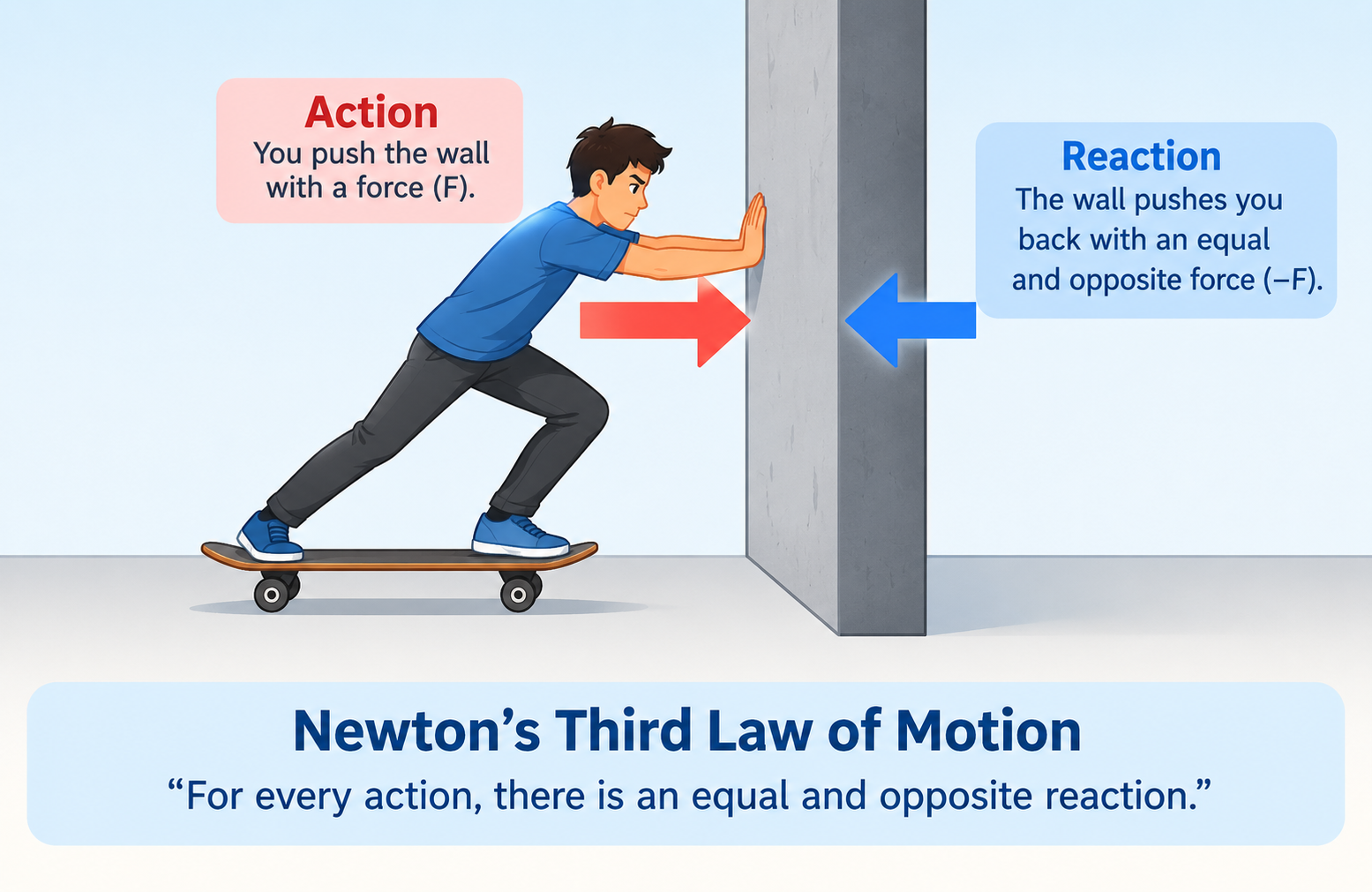
Press your hand firmly against a wall. You feel the wall pushing back. You are applying a force to the wall, and the wall is simultaneously applying an equal force back against your hand. You cannot push something without it pushing back.
What is Newton’s Third Law of Motion? It states that for every action, there is an equal and opposite reaction. More precisely, when one object exerts a force on a second object, the second object exerts a force on the first that is exactly equal in magnitude and opposite in direction — at the same time.
This law explains how rockets move through space, how you walk across a floor, how swimmers propel themselves through water, and why a gun recoils when fired. It is one of the most fundamental principles in all of physics.
Key Takeaways
-
Newton’s Third Law states that every action force has an equal and opposite reaction force.
-
The two forces in a pair always act on different objects — never on the same object.
-
Both forces in the pair are equal in magnitude and opposite in direction.
-
Both forces occur simultaneously — neither one comes before the other.
-
Action-reaction forces do not cancel each other out because they act on different objects.
-
The different masses of the two objects mean they may accelerate differently, even though the forces are equal.
-
Newton’s Third Law applies to both contact forces (pushing, pulling) and non-contact forces (gravity, magnetism).
What Is Newton’s Third Law of Motion?
Newton’s Third Law of Motion states:
“For every action, there is an equal and opposite reaction.”
The fuller, more precise statement is:
“When object A exerts a force on object B, object B simultaneously exerts a force on object A that is equal in magnitude and opposite in direction.”
Let us unpack each part of this carefully.
“Equal in magnitude”
The two forces are exactly the same size. If you push a wall with 30 N, the wall pushes you back with exactly 30 N — not 29 N, not 31 N. The magnitudes are always identical.
“Opposite in direction”
The two forces point in opposite directions. If the action force points to the right, the reaction force points to the left. If the action force points downward, the reaction force points upward.
“Simultaneously”
Both forces happen at exactly the same time. There is no delay between action and reaction. The word “action” and “reaction” do not imply a time sequence — they are just names for the two forces in the pair.
“Different objects”
This is the most critical part. The action force acts on object B. The reaction force acts on object A. They never both act on the same object. This is why they cannot cancel each other out.
Action and Reaction Forces — What Do They Mean?
The words “action” and “reaction” are informal labels. In reality, both forces are equally real, equally important, and equally physical.
There is no hierarchy — you could label either force in the pair as the “action” and the other as the “reaction.” The physics is the same either way.
Here is what you must always remember about action-reaction pairs:
- Both forces are real. Neither is more real or more powerful than the other.
- Both occur at the same time. The reaction does not wait for the action to finish.
- They act on different objects. This is non-negotiable — if both forces act on the same object, they are NOT a Newton’s Third Law pair.
- They are always equal in magnitude. No exceptions.
- They are always opposite in direction. Always.
The reason this confuses students is that it seems like equal and opposite forces should cancel. They would cancel — if they acted on the same object. But they do not. They act on two different objects, so each object experiences its own net force from its own set of forces.
Newton’s Third Law Force Pairs
A force pair (also called an action-reaction pair) consists of two forces that arise from the same interaction between two objects.
| Situation | Action Force | Reaction Force | Objects Involved |
|---|---|---|---|
| Walking | Foot pushes backward on ground | Ground pushes forward on foot | Foot and ground |
| Rocket in space | Engine pushes exhaust gases backward | Exhaust gases push rocket forward | Rocket and exhaust |
| Swimming | Swimmer pushes water backward | Water pushes swimmer forward | Swimmer and water |
| Book on table | Book pushes down on table | Table pushes up on book | Book and table |
| Jumping | Feet push down on Earth | Earth pushes feet upward | Feet and Earth |
| Gun firing bullet | Gun pushes bullet forward | Bullet pushes gun backward (recoil) | Gun and bullet |
| Bird flapping wings | Wing pushes air downward | Air pushes wing upward | Wing and air |
| Rowing a boat | Oar pushes water backward | Water pushes oar (and boat) forward | Oar and water |
In every single case: two different objects, forces equal in size, forces opposite in direction, both occurring simultaneously.
Why Don’t Action-Reaction Forces Cancel Out?
This is the question most students ask — and rightfully so. If the forces are equal and opposite, why don’t they cancel?
The answer: forces only cancel when they act on the same object.
When we calculate whether an object accelerates, we look at the net force on that one object. We add up every force acting on it. If the net force is zero, there is no acceleration.
Action-reaction forces act on different objects. They never both act on the same object. So they are never included in the same net force calculation.
Example — book on a table:
The book pushes down on the table (action force on the table).
The table pushes up on the book (reaction force on the book).
These two forces are a Newton’s Third Law pair. They are equal and opposite — but one acts on the table, the other on the book. They do not cancel.
Now consider the forces on the book specifically:
- Weight of the book (gravity pulling it downward)
- Normal force from the table (pushing it upward)
These two forces are equal and opposite and both act on the book. They cancel — giving zero net force on the book, so the book stays still.
But these two forces — weight and normal force on the book — are NOT a Newton’s Third Law pair. They happen to be equal because the book is in equilibrium, but they arise from different interactions entirely.
This distinction trips up almost every student who first encounters Newton’s Third Law. Take time to absorb it.
Newton’s Third Law in Everyday Life
Here are twelve real-world situations that demonstrate Newton’s Third Law clearly.
1. Walking
Action: Your foot pushes backward and downward on the ground.
Reaction: The ground pushes forward and upward on your foot — propelling you forward.
On a slippery surface, the reaction force is much weaker, which is why you cannot walk effectively.
2. Swimming
Action: The swimmer’s arms and legs push water backward.
Reaction: The water pushes the swimmer forward.
The harder the swimmer pushes, the greater the reaction force, and the faster they move.
3. Rocket propulsion
Action: The rocket engine expels exhaust gases at high speed in one direction (backward).
Reaction: The exhaust gases exert an equal and opposite force on the rocket (forward).
This works in the vacuum of space because the reaction does not depend on anything to push against.
4. Jumping
Action: Your legs push downward on the Earth.
Reaction: The Earth pushes upward on your legs — launching you into the air.
The Earth accelerates downward too, but its enormous mass means the acceleration is unmeasurably small.
5. A gun recoiling when fired
Action: The gun exerts a large force on the bullet, propelling it forward at high speed.
Reaction: The bullet exerts an equal force on the gun — pushing it backward (recoil).
The bullet is light (accelerates rapidly); the gun is heavy (accelerates little).
6. Rowing a boat
Action: The oar pushes water backward.
Reaction: The water pushes the oar (and attached boat) forward.
Rowing harder increases the reaction force and the boat’s speed.
7. A bird flying
Action: The bird’s wings push air downward.
Reaction: The air pushes the bird’s wings upward — providing lift.
Without air to push against, birds cannot fly — which is why they cannot operate in a vacuum.
8. A balloon deflating and moving
Action: Elastic forces in the balloon push air out through the nozzle.
Reaction: The escaping air pushes the balloon in the opposite direction.
This is the same principle as rocket propulsion on a small, accessible scale.
9. Kicking a football
Action: The foot exerts a force on the football.
Reaction: The football exerts an equal and opposite force on the foot.
This is why powerful kicks can hurt the kicker’s foot — the reaction force is felt.
10. A car’s wheels pushing on the road
Action: The rotating tyres push backward on the road surface.
Reaction: The road pushes forward on the tyres — this is what moves the car forward.
Without friction between tyre and road, this reaction force disappears — explaining why cars slip on ice.
11. A hammer hitting a nail
Action: The hammer exerts a downward force on the nail.
Reaction: The nail exerts an equal upward force on the hammer — which is why the hammer stops (or bounces back) on impact.
12. A person pushing a wall
Action: The person pushes the wall with force F.
Reaction: The wall pushes the person back with force F.
If the person is on wheels or a low-friction surface, they would roll backward — the reaction force is real and physical.
Newton’s Third Law and Rockets
Rocket propulsion is one of the most impressive demonstrations of Newton’s Third Law, and it works even in the complete vacuum of space.
Here is how it works:
The rocket engine burns fuel and expels the resulting exhaust gases at extremely high speed through nozzles at the back of the rocket. This expulsion is the action force — the rocket pushes the gases backward with enormous force.
By Newton’s Third Law, the exhaust gases push the rocket forward with an equal and opposite reaction force. This is the thrust that accelerates the rocket.
A common misunderstanding is that rockets need air or something to “push against.” They do not. The reaction force is between the rocket and its exhaust gases — not between the rocket and the surrounding medium. This is why rockets work perfectly in the vacuum of space where there is no air at all.
As the rocket burns fuel, its mass decreases. With the same thrust force but decreasing mass, the acceleration increases — consistent with What Is Newton’s Second Law of Motion? (a = F/m).
Newton’s Third Law and Walking
Walking depends entirely on Newton’s Third Law. Here is the step-by-step physics:
- Your calf muscles and leg push your foot backward and downward against the ground — this is the action force.
- The ground exerts a forward and upward reaction force on your foot — this is the friction force that propels you forward.
- Your body moves forward because of this reaction force from the ground.
On an icy or very slippery surface, the friction force between your foot and the ground is greatly reduced. The ground cannot provide a strong enough reaction force. Your foot slips backward without propelling you forward — and you fall.
This is why grip matters so much in footwear. The better the grip, the greater the reaction force the ground can provide.
Newton’s Third Law and Swimming
In water, swimmers use the same principle.
When a swimmer performs a front crawl stroke:
- Their arms sweep backward through the water — pushing water backward (action).
- The water resists this motion and pushes the swimmer’s arms (and body) forward (reaction).
The same happens with a kicking motion from the legs — backward kick, forward reaction. The combined reaction forces on the swimmer’s body propel them through the pool.
The more effectively a swimmer engages a large volume of water with each stroke, the greater the reaction force, and the faster they can swim.
Newton’s Third Law and Newton’s Second Law
Here is something that confuses many students: if the action and reaction forces are always equal in magnitude, why do objects accelerate differently?
A gun firing a bullet is the perfect example:
- The gun exerts a large force on the bullet (action).
- The bullet exerts an equal large force on the gun (reaction).
The forces are identical in magnitude. But the bullet (small mass) accelerates enormously — flying out of the barrel at high speed. The gun (large mass) recoils backward much more slowly.
The reason is Newton’s Second Law: a = F/m. The same force divided by a small mass gives large acceleration. The same force divided by a large mass gives small acceleration.
Two ice skaters of different masses pushing off each other demonstrate this beautifully. The lighter skater flies backward faster; the heavier skater moves more slowly. Same force pair, different accelerations because of different masses.
This also explains why the Earth barely moves when you jump off it — the gravitational force pair is equal, but Earth’s mass is so enormous that its acceleration is immeasurably tiny.
For a full explanation of how mass affects acceleration, see What Is Newton’s Second Law of Motion?
The tendency of a larger mass to resist acceleration more strongly is fundamentally a question of inertia — explored in detail in What Is Inertia in Physics?
Newton’s Third Law and Momentum
Newton’s Third Law is directly connected to one of the most important conservation laws in physics: the conservation of momentum.
When two objects interact:
- Object A pushes object B with force F for time t → Object B gains momentum Ft.
- Object B pushes object A with force −F for the same time t → Object A gains momentum −Ft.
The total change in momentum of the system = Ft + (−Ft) = zero.
This means the total momentum of the system is conserved — what one object gains in momentum, the other loses by exactly the same amount.
This is why when a stationary billiard ball is struck by a moving ball, the moving ball slows (loses momentum) and the stationary ball starts moving (gains momentum) — and if you add the momenta together, the total remains constant.
Newton’s Third Law guarantees that momentum is always conserved in any interaction between objects, as long as no external forces act on the system. For a full explanation of momentum and its conservation, see What Is Momentum?
Newton’s Third Law vs Newton’s First Law
| Feature | Newton’s First Law | Newton’s Third Law |
|---|---|---|
| What it describes | An object’s tendency to maintain its state of motion | The paired nature of all forces between objects |
| Condition | Net force = 0 → no change in velocity | Always — every force has a reaction |
| Key concept | Inertia | Action-reaction pairs |
| Number of objects | One object considered | Always two objects |
| Example | A car moving at constant speed | A foot pushing on ground; ground pushing foot forward |
Newton’s First Law describes what happens to a single object when net force is zero. For a thorough explanation, see What Is Newton’s First Law of Motion?
Newton’s Third Law describes the relationship between the forces two objects exert on each other. These are entirely different ideas, and mixing them up is a common source of confusion.
Newton’s Third Law vs Newton’s Second Law
| Feature | Newton’s Second Law | Newton’s Third Law |
|---|---|---|
| What it describes | How net force produces acceleration | The paired nature of forces between objects |
| Formula | F = ma | F_AB = −F_BA |
| Focus | One object | Two objects interacting |
| Key concept | Acceleration proportional to force | Every force has an equal and opposite reaction |
| Example | Car accelerating under engine force | Engine pushing exhaust back; exhaust pushing rocket forward |
Newton’s Second Law tells you what happens to an object given its net force and mass. Newton’s Third Law tells you that for every force there is always a paired force of equal magnitude acting in the opposite direction on the other object.
Identifying Newton’s Third Law Pairs — Step by Step
Use this method to identify action-reaction pairs in any situation:
Step 1: Identify the two objects interacting.
Step 2: State the force that object A exerts on object B (action): “A pushes/pulls B in [direction] with force F.”
Step 3: State the reaction force: “B pushes/pulls A in the opposite direction with the same force F.”
Step 4: Confirm both forces act on different objects.
Step 5: Confirm the forces are equal in magnitude and opposite in direction.
Worked Example 1: Person jumping
- Objects: Person’s feet and Earth.
- Action: Feet push downward on Earth.
- Reaction: Earth pushes upward on feet.
- Different objects: Yes (feet and Earth). ✓
- Equal and opposite: Yes. ✓
Worked Example 2: Balloon releasing air
- Objects: Balloon and air inside.
- Action: Balloon pushes air out through nozzle (backward).
- Reaction: Air pushes balloon forward.
- Different objects: Yes. ✓
- Equal and opposite: Yes. ✓
Worked Example 3: Book on a table
- Objects: Book and table.
- Action: Book pushes down on table surface.
- Reaction: Table pushes up on book (normal force on book).
- Different objects: Yes. ✓
- Equal and opposite: Yes. ✓
Worked Example 4: Swimmer pushing water
- Objects: Swimmer’s hand and water.
- Action: Hand pushes water backward.
- Reaction: Water pushes hand (and swimmer) forward.
- Different objects: Yes. ✓
- Equal and opposite: Yes. ✓
Worked Example 5: Earth-Moon gravitational attraction
- Objects: Earth and Moon.
- Action: Earth’s gravity pulls Moon toward Earth.
- Reaction: Moon’s gravity pulls Earth toward Moon.
- Different objects: Yes. ✓
- Equal and opposite: Yes. ✓
Common Misconceptions About Newton’s Third Law
| Misconception | Correct Explanation |
|---|---|
| “Action happens before reaction” | Both forces occur simultaneously — there is no time delay between action and reaction. |
| “The larger object exerts a greater force” | Forces in the pair are always equal regardless of the mass or size of either object. |
| “Action-reaction forces cancel each other out” | They cannot cancel because they act on different objects. Forces only cancel when they act on the same object. |
| “Newton’s Third Law only applies to contact forces” | It applies to all forces — including non-contact forces like gravity and magnetic forces. |
| “The reaction force is slightly weaker” | The reaction force is always exactly equal in magnitude. No exceptions. |
| “A heavier object produces a larger reaction force” | The reaction force equals the action force regardless of mass. Mass affects acceleration, not the magnitude of the force pair. |
Gravity and Newton’s Third Law
Gravity provides one of the most important — and most overlooked — examples of Newton’s Third Law.
When you stand on Earth:
- Action: Earth’s gravity pulls you downward with force W = mg.
- Reaction: You pull Earth upward with an equal gravitational force.
Both forces are equal. Earth pulls you with the same force that you pull Earth. The forces are a genuine Newton’s Third Law pair arising from gravitational attraction.
So why does Earth not move toward you?
Because Earth’s mass is approximately 6 × 10²⁴ kg. Using a = F/m, even a force of several hundred Newtons produces an acceleration of around 10⁻²³ m/s² for Earth — completely unmeasurable.
The same logic applies to the Earth-Moon system. Earth pulls the Moon with gravitational force (keeping it in orbit), and the Moon pulls Earth with an equal and opposite force (causing Earth’s tides and a tiny “wobble” in Earth’s position).
Common Mistakes Students Make
| Mistake | Correct Approach |
|---|---|
| Identifying forces on the same object as a Third Law pair | Newton’s Third Law pairs always involve two different objects. Check this first. |
| Confusing balanced forces (First Law) with action-reaction pairs (Third Law) | Balanced forces act on the same object and produce zero net force. Third Law pairs act on different objects. |
| Describing only one force in the pair | Always identify and state both forces — action on object B and reaction on object A. |
| Saying the reaction force is smaller or larger | The reaction force is always exactly equal in magnitude to the action force. |
| Forgetting that both forces occur simultaneously | Do not say the reaction “follows” the action — they happen at the same time. |
| Thinking Newton’s Third Law means objects cannot accelerate | Objects accelerate because of the forces acting on them individually. The Third Law does not prevent acceleration. |
Worked Examples
Example 1 — Walking
Situation: A person walks forward across a floor.
Action Force: Foot pushes backward on the floor.
Reaction Force: Floor pushes forward on the foot.
Objects Involved: Foot and floor (Earth).
Explanation: The reaction force from the floor is what propels the person forward. This is why you cannot walk on a frictionless surface — friction is needed to generate the reaction force.
Example 2 — Rocket in Space
Situation: A rocket engine fires, expelling hot gases.
Action Force: Rocket engine pushes exhaust gases backward at high speed.
Reaction Force: Exhaust gases push the rocket forward.
Objects Involved: Rocket and exhaust gases.
Explanation: No air or external surface is needed. The reaction is between rocket and its own exhaust. Works perfectly in vacuum.
Example 3 — Jumping from a Boat
Situation: A person jumps from a stationary boat onto a dock.
Action Force: Person’s legs push backward on the boat.
Reaction Force: Boat pushes person forward.
Objects Involved: Person and boat.
Explanation: The person moves forward onto the dock; the boat moves backward away from the dock — sometimes catching people off guard on a floating surface.
Example 4 — Ball Hitting a Wall
Situation: A ball is thrown against a wall.
Action Force: Ball exerts force on wall (pushing it).
Reaction Force: Wall exerts equal force on ball (pushing it back).
Objects Involved: Ball and wall.
Explanation: The wall pushes back with equal force, causing the ball to decelerate and potentially bounce back. The wall does not visibly move because its mass is enormous.
Example 5 — Gravitational Pair (Earth and Person)
Situation: A person stands on Earth.
Action Force: Earth pulls person downward (gravity, W = mg).
Reaction Force: Person pulls Earth upward with equal gravitational force.
Objects Involved: Person and Earth.
Explanation: Both forces are real and equal. Earth’s enormous mass means its acceleration is immeasurably tiny, but the force pair is genuine.
Example 6 — Gun and Bullet
Situation: A gun fires a bullet.
Action Force: Gun pushes bullet forward with large force.
Reaction Force: Bullet pushes gun backward with equal force (recoil).
Objects Involved: Gun and bullet.
Explanation: Same force magnitude on both. Bullet has tiny mass → accelerates enormously. Gun has large mass → accelerates little (small recoil velocity).
Example 7 — Swimming
Situation: A swimmer pulls their arms through water.
Action Force: Swimmer’s arms push water backward.
Reaction Force: Water pushes swimmer’s arms (and body) forward.
Objects Involved: Swimmer’s arms and water.
Explanation: The reaction from the water provides the thrust that moves the swimmer through the pool.
Example 8 — Two Ice Skaters Pushing Off
Situation: Two stationary ice skaters push each other.
Action Force: Skater A pushes Skater B with force F.
Reaction Force: Skater B pushes Skater A with force F (equal and opposite).
Objects Involved: Skater A and Skater B.
Explanation: Both experience the same force. The lighter skater accelerates more (a = F/m). They move apart in opposite directions — demonstrating both Newton’s Third Law and conservation of momentum.
Example 9 — Car Wheels and Road
Situation: A car accelerates forward.
Action Force: The rotating rear tyres push backward on the road surface.
Reaction Force: Road pushes forward on the tyres.
Objects Involved: Tyres and road.
Explanation: The forward reaction force from the road is what actually moves the car. Without sufficient friction (e.g., on ice), this reaction is too small, and the tyres spin without the car moving forward effectively.
Example 10 — Hammer Hitting a Nail
Situation: A hammer drives a nail into wood.
Action Force: Hammer exerts downward force on the nail.
Reaction Force: Nail exerts equal upward force on the hammer.
Objects Involved: Hammer and nail.
Explanation: The reaction force stops (or slows) the hammer on impact. The hammer “feels” the nail pushing back — which is why a heavy, hard surface is more difficult to hammer than a soft one.
Example 11 — Bird Flapping Wings
Situation: A bird flaps its wings downward.
Action Force: Wings push air downward.
Reaction Force: Air pushes wings (and bird) upward — providing lift.
Objects Involved: Wings and air.
Explanation: If there is no air (in a vacuum), no reaction force is available, and birds cannot fly.
Example 12 — Balloon Released
Situation: An inflated balloon is released.
Action Force: The balloon pushes air out through the opening.
Reaction Force: The air pushes the balloon in the opposite direction.
Objects Involved: Balloon and escaping air.
Explanation: This is a simple, visible demonstration of rocket-type propulsion — the balloon flies erratically as air rushes out.
Example 13 — Pulling a Rope (Tug of War)
Situation: Person A pulls one end of a rope; Person B holds the other end.
Action Force: Person A pulls rope (and Person B) toward them.
Reaction Force: Person B (via rope) pulls Person A toward them.
Objects Involved: Person A and Person B (via rope).
Explanation: Both experience equal and opposite forces. Who moves depends on friction with the ground and their individual masses — not on the force pair itself.
Example 14 — Bat Hitting a Ball
Situation: A cricket bat strikes a ball.
Action Force: Bat exerts force on ball (forward direction).
Reaction Force: Ball exerts equal force on bat (backward direction).
Objects Involved: Bat and ball.
Explanation: The ball accelerates rapidly (small mass). The bat decelerates slightly (large mass). The batsman feels the impact — that is the reaction force transmitted through the bat to their hands.
Example 15 — Earth and Moon Gravity
Situation: The Moon orbits Earth.
Action Force: Earth’s gravity pulls Moon toward Earth.
Reaction Force: Moon’s gravity pulls Earth toward Moon.
Objects Involved: Earth and Moon.
Explanation: The forces are equal and opposite. Earth’s massive size means it moves very little, but the Moon’s pull does cause Earth to slightly “wobble” — and it causes the ocean tides.
Practice Questions
12 Short Answer Questions
- State Newton’s Third Law of Motion in your own words.
- Why do action-reaction forces not cancel each other out?
- A swimmer pushes water backward. What is the reaction force?
- When a gun fires a bullet, both gun and bullet experience the same force. Why does the bullet accelerate much more than the gun?
- Give one example of Newton’s Third Law involving a non-contact force.
- A rocket engine fires exhaust gases backward. Explain how the rocket moves forward.
- You jump off a boat onto a dock. Describe the action and reaction forces.
- A book rests on a table. The book’s weight acts downward and the table’s normal force acts upward on the book. Is this a Newton’s Third Law pair? Explain.
- Two students stand on skateboards facing each other. Student A pushes Student B. What happens to Student A?
- Explain why you cannot walk effectively on a completely frictionless surface.
- When you press your hand on a wall, what is the reaction force?
- State one way Newton’s Third Law connects to the conservation of momentum.
Answers:
- For every action force that one object exerts on another, the second object exerts an equal and opposite reaction force on the first — simultaneously.
- Action-reaction forces act on different objects. Forces can only cancel when they act on the same object. Each object has its own net force calculated from its own forces alone.
- The water pushes the swimmer forward with an equal and opposite reaction force.
- Both experience the same magnitude of force. The bullet has a very small mass, so a = F/m gives very large acceleration. The gun has large mass, so the same force produces much smaller acceleration (recoil).
- Earth’s gravity pulls the Moon toward Earth (action); the Moon’s gravity pulls Earth toward the Moon (reaction). These are equal and opposite gravitational forces — a non-contact Third Law pair.
- The engine pushes exhaust gases backward (action). By Newton’s Third Law, the exhaust gases push the rocket forward with an equal and opposite force (reaction). No external surface is needed.
- Action: Your legs push backward on the boat. Reaction: The boat pushes you forward onto the dock. The boat moves backward; you move forward.
- No. The book’s weight is the gravitational force from Earth pulling the book down. The normal force is the table pushing the book up. These act on the same object (the book) and arise from different interactions. A Third Law pair requires forces on two different objects. The Third Law pair for the book’s weight is: Earth pulls book down; book pulls Earth up.
- Student A moves backward. When A pushes B (action on B), B pushes back on A (reaction on A) — propelling A in the opposite direction, even though A did the pushing.
- Without friction, the ground cannot exert a forward reaction force on your foot. Your foot would simply slip backward without propelling you forward. Friction is essential for the reaction force that enables walking.
- The wall exerts an equal force on your hand in the opposite direction — pushing back against your hand with the same magnitude as the force you applied.
- When object A exerts force F on object B, and B exerts −F on A for the same time, the momentum gained by B equals the momentum lost by A. The total momentum of the system remains constant — this is conservation of momentum, a direct consequence of Newton’s Third Law.
10 Multiple Choice Questions
Question 1
Which of the following is the correct statement of Newton’s Third Law?
A. An object at rest stays at rest unless a force acts on it.
B. Force equals mass times acceleration.
C. For every action, there is an equal and opposite reaction.
D. The net force on a stationary object is zero.
Correct Answer: C
Short Explanation: Option C is the correct statement of Newton’s Third Law. A is Newton’s First Law; B is Newton’s Second Law; D is a consequence of Newton’s First Law.
Question 2
A person pushes a wall with force 40 N. What is the force the wall exerts on the person?
A. 0 N
B. Less than 40 N
C. Greater than 40 N
D. 40 N in the opposite direction
Correct Answer: D
Short Explanation: Newton’s Third Law — the wall pushes back on the person with exactly 40 N in the opposite direction.
Question 3
Why do action-reaction forces NOT cancel each other out?
A. Because the reaction force is slightly smaller.
B. Because they act on different objects.
C. Because they act at different times.
D. Because one force is contact and the other is non-contact.
Correct Answer: B
Short Explanation: Action-reaction forces act on different objects. Forces only cancel when they act on the same object.
Question 4
A gun fires a bullet. Both gun and bullet experience equal and opposite forces. Why does the bullet accelerate much more?
A. The bullet experiences a larger force.
B. The gun experiences a larger force.
C. The bullet has much smaller mass, giving it greater acceleration.
D. The gun has less inertia.
Correct Answer: C
Short Explanation: From a = F/m, the same force applied to a much smaller mass produces much greater acceleration.
Question 5
Which of the following is a correct Newton’s Third Law force pair?
A. The weight of a book and the normal force on the same book.
B. The engine force on a car and friction on the same car.
C. Earth’s gravity pulling the Moon down and the Moon’s gravity pulling Earth up.
D. The tension in a rope at both ends of the same rope.
Correct Answer: C
Short Explanation: Option C involves two different objects (Earth and Moon) and equal and opposite gravitational forces — a genuine Third Law pair. Options A, B, and D involve forces on the same object or from the same interaction.
Question 6
How does a rocket move forward in space where there is nothing to push against?
A. The rocket pushes against space particles.
B. The rocket’s exhaust gases push on the surrounding air.
C. The rocket engine pushes exhaust gases backward; the gases push the rocket forward.
D. Gravity pulls the rocket in the direction of travel.
Correct Answer: C
Short Explanation: The reaction force is between the rocket and its own exhaust gases — no external medium is needed. This is Newton’s Third Law operating in vacuum.
Question 7
Two ice skaters of different masses push off each other from rest. Which skater moves faster?
A. The heavier skater.
B. The lighter skater.
C. They move at the same speed.
D. Neither moves.
Correct Answer: B
Short Explanation: Same force acts on both. From a = F/m, the lighter skater (smaller m) has greater acceleration and achieves higher speed.
Question 8
When you walk, what force directly propels you forward?
A. Your weight pushing you forward.
B. Air resistance behind you.
C. The reaction force of the ground pushing your foot forward.
D. Your muscles pulling you forward through the air.
Correct Answer: C
Short Explanation: Your foot pushes backward on the ground (action). The ground pushes your foot forward (reaction). This reaction force propels you forward.
Question 9
A book rests on a table. Which of the following is the Newton’s Third Law pair for the table’s normal force on the book?
A. The book’s weight (gravity downward on the book).
B. The book pushing down on the table.
C. The table’s weight pushing the floor down.
D. Gravity pulling the table down.
Correct Answer: B
Short Explanation: The table’s normal force pushes the book up (force on book). The Newton’s Third Law pair is the book pushing down on the table (force on table) — same magnitude, opposite direction, different objects.
Question 10
Does Newton’s Third Law apply to gravitational forces?
A. No — it only applies to contact forces.
B. Yes — Earth pulls an object down and the object pulls Earth up with equal force.
C. No — gravity is a special case that has no reaction.
D. Yes, but only on the Moon.
Correct Answer: B
Short Explanation: Newton’s Third Law applies to all forces, including gravity. Earth and any object near it exert equal and opposite gravitational forces on each other.
5 Challenge Questions
Challenge 1:
Two astronauts (Astronaut A: 60 kg, Astronaut B: 90 kg) are floating stationary in space. Astronaut A pushes Astronaut B with a force of 30 N. Find: (a) the acceleration of Astronaut B, (b) the acceleration of Astronaut A.
Solution:
(a) Astronaut B: a = F/m = 30/90 = 0.33 m/s² (away from A)
(b) Astronaut A: receives equal and opposite force of 30 N. a = 30/60 = 0.5 m/s² (away from B)
The forces are equal; the accelerations differ because the masses differ. Astronaut A (lighter) accelerates more. Total momentum of system remains zero — conservation of momentum holds.
Challenge 2:
A 0.05 kg bullet is fired from a 2.5 kg gun. The bullet leaves the barrel at 400 m/s. Find the recoil velocity of the gun. Use conservation of momentum (which follows from Newton’s Third Law).
Solution:
Total initial momentum = 0 (both at rest).
Momentum after firing: p_bullet + p_gun = 0
(0.05 × 400) + (2.5 × v_gun) = 0
20 + 2.5v_gun = 0
v_gun = −20/2.5 = −8 m/s
The gun recoils at 8 m/s in the opposite direction to the bullet. The negative sign indicates opposite direction.
Challenge 3:
A student claims: “The book rests on the table. The weight of the book (downward) and the normal force on the book (upward) are a Newton’s Third Law pair.” Explain clearly and fully why this student is incorrect, and identify the actual Newton’s Third Law pairs in this situation.
Solution:
The student is incorrect for two reasons:
- Both the weight and the normal force act on the same object (the book). Newton’s Third Law pairs must act on different objects.
- They arise from different interactions — weight comes from Earth’s gravitational interaction with the book; normal force comes from the contact interaction between table and book.
The actual Newton’s Third Law pairs are:
Pair 1 (gravitational):
- Earth pulls book downward (weight W on book).
- Book pulls Earth upward with equal force W.
Pair 2 (contact):
- Table pushes book upward (normal force on book).
- Book pushes table downward with equal force (normal force on table).
The weight and normal force on the book are equal only because the book is in equilibrium (net force = 0 on the book) — not because they form a Third Law pair.
Challenge 4:
Explain fully, using Newton’s Third Law, why a boat moves backward when a person jumps forward from it onto a dock. Include the effect of different masses.
Solution:
When the person crouches and jumps forward:
- Their legs push backward on the boat with force F (action on boat).
- The boat pushes the person forward with equal force F (reaction on person).
The person moves forward (onto the dock) because of the reaction force. The boat moves backward because of the action force the person exerted on it.
The person has smaller mass than the boat, so the person accelerates more (a = F/m). The boat has larger mass, so it accelerates less — it drifts backward more slowly than the person moves forward.
Total momentum is conserved: momentum gained forward by person = momentum gained backward by boat. If the boat is very heavy, it barely moves. If the boat is light (like a kayak), it moves back noticeably. This is why stepping from a small, unsecured boat can be dangerous.
Challenge 5:
A rocket with mass 3,000 kg (including fuel) fires its engines in space, producing a thrust of 60,000 N. (a) Calculate the initial acceleration. (b) After burning half the fuel, the mass is now 2,000 kg but thrust remains 60,000 N. Calculate the new acceleration. (c) Explain using Newton’s Third Law and Newton’s Second Law why the acceleration changes.
Solution:
(a) Initial: a = F/m = 60,000/3,000 = 20 m/s²
(b) After burning half fuel: a = 60,000/2,000 = 30 m/s²
(c) Newton’s Third Law: the rocket pushes exhaust gases backward; exhaust gases push rocket forward with equal force. The thrust force remains constant at 60,000 N throughout.
Newton’s Second Law (a = F/m): as fuel burns, mass decreases. With the same thrust force but smaller mass, the acceleration increases. This is why rockets accelerate more rapidly in the later stages of a burn — they are lighter but being pushed with the same force. The kinetic energy gained by the rocket increases rapidly as both speed and fuel-efficient acceleration grow — a topic explored further in What Is Kinetic Energy?
Newton’s Third Law in Space and Engineering
Newton’s Third Law is at the heart of some of the most important technologies ever developed.
Space travel: Every rocket — from the smallest satellite launcher to the most powerful space vehicle — operates entirely on Newton’s Third Law. Exhaust gases pushed backward; spacecraft pushed forward. No air, no problem. The reaction force requires nothing external.
Jet engines: Jet aircraft work on the same principle as rockets. The engine compresses air and burns fuel, then expels hot gas at high speed backward. The reaction force propels the aircraft forward. Unlike rockets, jets require atmospheric oxygen for combustion and cannot operate in space.
Firearms recoil: Gun designers must account for recoil — the reaction force on the weapon when a bullet is fired. Recoil mechanisms, stock design, and muzzle brakes are all engineering responses to Newton’s Third Law, managing the reaction force to reduce discomfort and improve accuracy.
Sports equipment: Tennis racquets, cricket bats, and golf clubs are all designed to manage the reaction force experienced when striking a ball. The materials, flex, and grip of equipment affect how the reaction force is transmitted to the player’s hands and arms. The What Is Kinetic Energy? of fast-moving balls and projectiles is directly related to how these Third Law interactions play out in sport.
Exam Tips
- Always identify the two objects involved. A Newton’s Third Law answer that mentions only one object is incomplete.
- State both forces explicitly. “Object A exerts force F on Object B; Object B exerts equal and opposite force F on Object A.”
- Confirm forces are equal in magnitude and opposite in direction. These two words — equal and opposite — must appear in your answer.
- Action-reaction pairs always act on different objects. If both forces are on the same object, you have identified the wrong pair.
- Do not confuse balanced forces with Newton’s Third Law pairs. Balanced forces are on the same object; Third Law pairs are on different objects.
- For calculation questions involving two objects, use F = ma on each object separately with their individual masses and the shared force magnitude.
- Gravity is a Third Law pair. Do not overlook gravitational interactions as examples of the Third Law.
- For rocket questions, always state what the rocket pushes (exhaust gases) and what pushes the rocket (exhaust gases pushing back).
Quick Revision Notes
- Newton’s Third Law: For every action, there is an equal and opposite reaction.
- Full statement: When A exerts force on B, B simultaneously exerts an equal and opposite force on A.
- Action-reaction pairs: Always involve two different objects. Forces equal in magnitude, opposite in direction, simultaneous.
- Why they do not cancel: They act on different objects. Forces only cancel when acting on the same object.
- Examples: Walking, swimming, rockets, jumping, gun recoil, balloon propulsion, bird flying.
- Connection to Newton’s Second Law: Same force, different masses → different accelerations. a = F/m for each object separately.
- Connection to momentum: Newton’s Third Law guarantees conservation of momentum — momentum gained by one object equals momentum lost by the other.
- Gravity as a Third Law pair: Earth pulls you down; you pull Earth up — equal and opposite gravitational forces.
- Common mistakes: Identifying forces on same object as a pair; saying reaction is smaller; thinking action comes first.
Newton’s Third Law Cheat Sheet
| Concept | Key Point | Example |
|---|---|---|
| Statement | Every action has an equal and opposite reaction | Hand pushes wall; wall pushes hand back |
| Force pair rule | Must involve two different objects | Foot (action on ground) and ground (reaction on foot) |
| Equal in magnitude | Forces are exactly the same size | 40 N push → 40 N reaction |
| Opposite in direction | Forces point in opposite directions | Push right → reaction pushes left |
| Simultaneous | Both forces occur at the same time | No delay between action and reaction |
| Why no cancellation | Act on different objects, not same object | Cannot combine into net force on one object |
| Different masses | Same force → different accelerations | Light bullet accelerates more than heavy gun |
| Gravity pair | Earth pulls you; you pull Earth | Equal gravitational forces, Earth barely accelerates |
| Rocket propulsion | Gases pushed back; rocket pushed forward | Works in space — no air needed |
| Conservation of momentum | Direct consequence of Newton’s Third Law | Total momentum of system conserved in all interactions |
Frequently Asked Questions
1. What is Newton’s Third Law of Motion?
Newton’s Third Law states that for every action, there is an equal and opposite reaction. When one object exerts a force on a second object, the second object exerts an equal force in the opposite direction on the first — simultaneously.
2. What does “equal and opposite” mean?
“Equal” means the two forces have exactly the same magnitude (size). “Opposite” means they point in exactly opposite directions. Together, these properties define every action-reaction pair.
3. Do action and reaction forces cancel out?
No. They act on different objects and are never combined in the same net force calculation. Forces only cancel when they act on the same object.
4. Why don’t action-reaction forces cancel?
Because they act on two different objects. Each object has its own net force, calculated from forces acting on that object alone. The action acts on object B; the reaction acts on object A. They are never on the same object.
5. What is an example of Newton’s Third Law?
When you walk, your foot pushes backward on the ground (action) and the ground pushes your foot forward (reaction) — propelling you forward.
6. How does Newton’s Third Law explain rocket propulsion?
The rocket engine pushes exhaust gases backward at high speed (action). The exhaust gases push the rocket forward with equal force (reaction). No air or external surface is needed — the interaction is between the rocket and its exhaust.
7. How does Newton’s Third Law explain walking?
Your foot pushes backward on the ground (action). The ground pushes your foot forward (reaction). This forward reaction force from the ground is what actually propels you forward.
8. How does Newton’s Third Law relate to Newton’s Second Law?
Both laws work together. Newton’s Third Law tells you that force pairs are always equal and opposite. Newton’s Second Law (a = F/m) explains why two objects with different masses accelerate differently despite experiencing the same magnitude of force.
9. Does Newton’s Third Law apply to gravity?
Yes. Earth’s gravity pulls you downward (action on you). You pull Earth upward with an equal gravitational force (reaction on Earth). The forces are equal — Earth just barely accelerates because its mass is enormous.
10. What is an action-reaction pair?
A pair of forces arising from the same interaction between two objects. Force A acts on object B (action); force B acts on object A (reaction). Equal in magnitude, opposite in direction, simultaneous.
11. Why does a gun recoil when fired?
The gun exerts a force on the bullet, accelerating it forward (action). The bullet exerts an equal force on the gun backward (reaction) — causing the gun to recoil. The gun’s larger mass means smaller recoil acceleration.
12. Can Newton’s Third Law apply to non-contact forces?
Yes. Gravitational and magnetic forces all follow Newton’s Third Law. Earth pulls the Moon and the Moon pulls Earth with equal and opposite gravitational forces — a classic non-contact Third Law pair.
13. How do swimmers use Newton’s Third Law?
Swimmers push water backward with their arms and legs (action). The water pushes the swimmer forward with equal force (reaction). The harder and more effectively they push the water, the faster they move.
14. What is the difference between Newton’s Third Law and balanced forces?
Balanced forces act on the same object and produce zero net force (Newton’s First Law). Newton’s Third Law pairs act on different objects — they never both act on the same object.
15. How do you identify an action-reaction pair?
Identify the two interacting objects. State the force object A exerts on object B (action). State the equal and opposite force object B exerts on object A (reaction). Confirm: different objects, equal magnitude, opposite direction, simultaneous occurrence.
Summary
Newton’s Third Law of Motion tells us something profound and universal: no force ever exists alone. Every force is one half of a pair. When object A pushes or pulls object B, object B always pushes or pulls object A back — with exactly the same strength, at exactly the same time, in exactly the opposite direction.
The two forces in the pair always act on different objects — which is precisely why they do not cancel. Each object is subject to its own set of forces, and the net force on each object determines its own acceleration.
When the two objects have different masses, Newton’s Second Law explains why they respond differently to the same force pair — a heavier object accelerates less, a lighter object more. This explains why a bullet flies far and a gun merely recoils, why a swimmer moves forward while the water moves backward, and why a rocket accelerates through space with no air to push against.
Every interaction in physics — contact or non-contact, large or small — follows this law without exception. It is one of the deepest and most elegant truths in classical mechanics.
Final Thoughts
Newton’s Third Law is not just a rule to memorise for an exam — it is a description of how every interaction in the physical universe works. There are no one-sided forces. Every push has a push back. Every pull has a pull back. Always equal, always opposite, always simultaneous.
Understanding this law deeply — not just repeating “equal and opposite reaction” — means being able to identify force pairs in any situation, explain why rockets work in space, understand how you are able to walk, and appreciate why conservation of momentum is not just a convenient rule but an inevitable consequence of how forces work between objects.
Take the time to work through the examples in this article, practice identifying force pairs in everyday situations, and make sure you can clearly explain why action-reaction forces do not cancel. That understanding will serve you well across all of physics — from mechanics to electromagnetism to astrophysics.
References
- Khan Academy — Newton’s Laws of Motion: https://www.khanacademy.org
- OpenStax University Physics — Newton’s Third Law: https://openstax.org
- Physics LibreTexts — Newton’s Third Law of Motion: https://phys.libretexts.org
- Encyclopaedia Britannica — Newton’s Laws of Motion: https://www.britannica.com
- NASA — Newton’s Third Law Applied to Rocket Propulsion: https://www.nasa.gov
Helpful Resources
Khan Academy — Newton’s Laws and Forces
Students can watch video lessons and complete interactive practice exercises covering Newton’s Third Law, action-reaction pairs, rocket propulsion, and momentum conservation.
https://www.khanacademy.org
OpenStax University Physics
A free, peer-reviewed textbook with detailed chapters on Newton’s Laws, force pairs, momentum, and applications — suitable for high school through early university level.
https://openstax.org
Physics LibreTexts — Classical Mechanics
Provides structured, accessible explanations of Newton’s Third Law, force pair identification, gravity as a Third Law example, and rocket propulsion.
https://phys.libretexts.org
NASA Education — Rockets and Newton’s Laws
NASA’s education pages apply Newton’s Third Law directly to real rocket science and space exploration, giving students compelling real-world context.
https://www.nasa.gov
Disclaimer:
This article is intended for educational and informational purposes only. While LearnMinto strives to provide accurate and up-to-date physics information, readers should verify important academic concepts through official textbooks, educational institutions, examination boards, or trusted educational resources before using this content for exams or academic purposes. LearnMinto is not affiliated with any specific school, university, research institution, or examination board.
About the Author
Saad Qureshi is a Senior Education & Technology Editor at LearnMinto. He focuses on creating and reviewing clear, accessible educational content across mathematics, physics, chemistry, biology, computer science, technology, AI tools, and personal finance.