
Introduction
Imagine you are sitting on a bus that suddenly brakes hard. Even though the bus stops, your body keeps moving forward — you lurch toward the seat in front of you. Nobody pushed you. Nothing pulled you forward. Your body simply did not want to stop.
That experience is inertia.
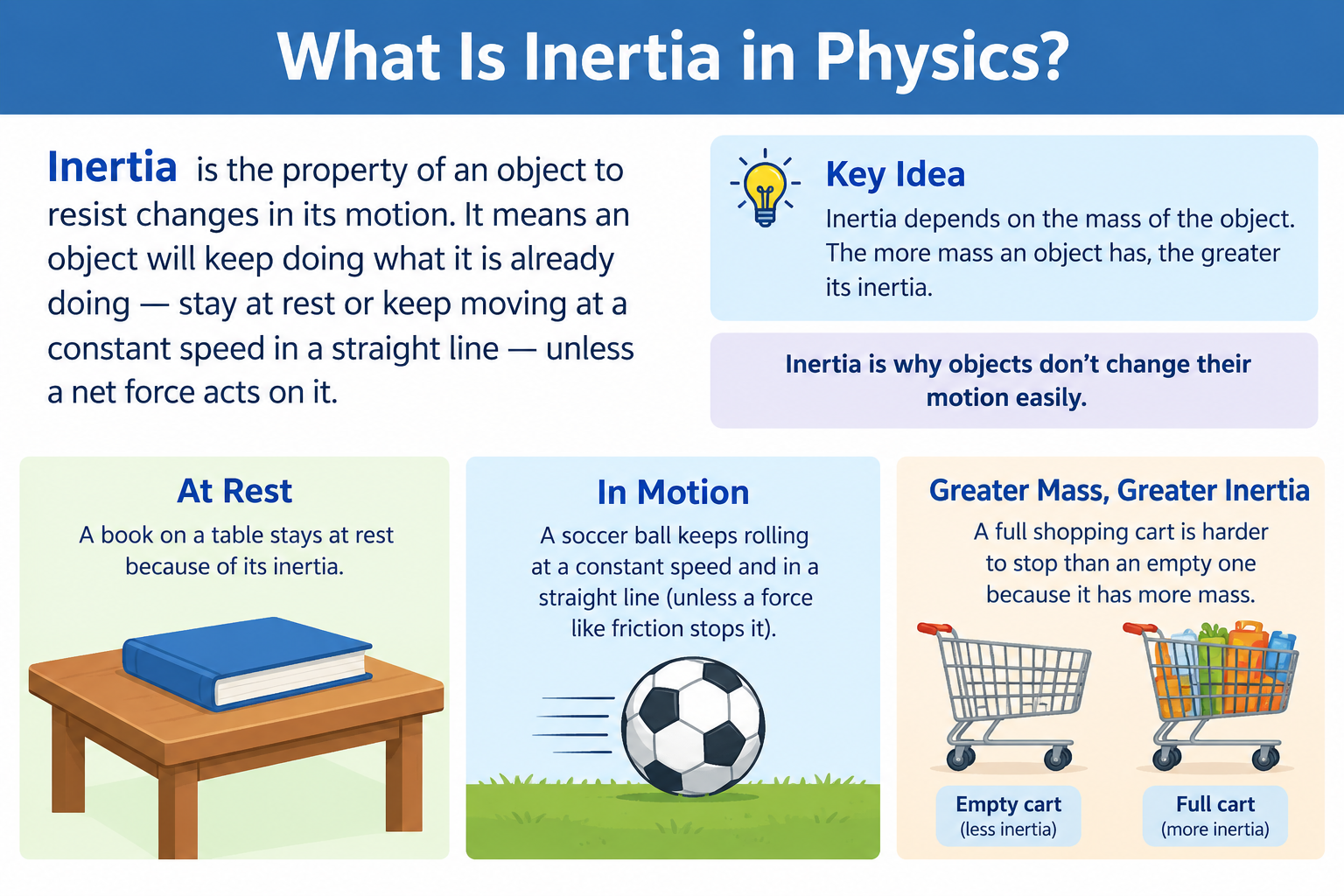
What is inertia in physics? Inertia is the tendency of an object to resist any change in its state of motion. An object at rest tends to stay at rest. An object moving tends to keep moving in the same direction at the same speed — unless an external force acts on it.
Inertia is not a mysterious force. It is a fundamental property of all matter, and understanding it is the starting point for understanding how forces, motion, and Newton’s Laws of Motion all connect.
Key Takeaways
-
Inertia is the resistance of an object to changes in its state of motion — whether that means starting to move, stopping, or changing direction.
-
Inertia is directly described by Newton’s First Law of Motion, which is why it is also called the Law of Inertia.
-
The amount of inertia an object has depends entirely on its mass — the greater the mass, the greater the inertia.
-
There are three types of inertia: inertia of rest, inertia of motion, and inertia of direction.
-
Inertia is a property of matter, not a force. It does not cause objects to move — it causes them to resist changes in motion.
-
In the absence of friction and other forces (such as in space), inertia is demonstrated in its purest form.
-
Understanding inertia is essential for understanding Newton’s Laws, momentum, forces, and motion in physics.
What Is Inertia in Physics?
Inertia is the property of an object that causes it to resist any change in its state of motion.
There are two sides to this:
- An object at rest will stay at rest unless a force acts on it.
- An object in motion will continue moving in the same direction at the same speed unless a force acts on it.
Think of it this way: objects are “lazy” in a physical sense. They do not change what they are doing unless something forces them to.
The concept was formalised by Sir Isaac Newton in the 17th century and forms the foundation of his First Law of Motion. The word inertia itself comes from the Latin word meaning idleness or inactivity — which is a fitting description for a property that resists change.
A football sitting on a pitch will not roll by itself. A football rolling across the pitch will not stop by itself (ignoring friction for a moment). Both situations demonstrate inertia.
Inertia and Newton’s First Law of Motion
Newton’s First Law of Motion states:
“An object at rest stays at rest, and an object in motion stays in motion with the same speed and in the same direction, unless acted upon by an unbalanced external force.”
This law is sometimes called the Law of Inertia — because it is, in essence, a formal statement of what inertia means.
The critical phrase is unbalanced external force. This means a force from outside the object that is not cancelled out by an equal opposing force. When forces are balanced — like a book sitting still on a table with gravity and the table’s normal reaction force equal and opposite — the object’s state of motion does not change.
When the forces become unbalanced — a push, a pull, friction, gravity — then the state of motion changes. Until that happens, inertia keeps everything exactly as it is.
What Determines the Amount of Inertia?
The amount of inertia an object possesses depends directly on its mass.
Mass is the measure of how much matter an object contains. The more mass an object has, the more it resists changes in its motion. There is no formula needed here — the relationship is a direct one: more mass equals more inertia.
Consider these comparisons:
- A bowling ball versus a tennis ball: the bowling ball is much harder to set rolling and much harder to stop — it has greater inertia.
- A loaded lorry versus a bicycle: the lorry requires a far greater force to accelerate from rest and a far greater braking force to stop — it has far greater inertia.
- A boulder versus a pebble: you can throw a pebble easily but could barely budge a boulder — the boulder’s greater mass gives it much greater inertia.
This is precisely why large vehicles have powerful engines and powerful braking systems. Their mass demands it.
Types of Inertia
Physicists commonly recognise three types of inertia, each corresponding to a different kind of change that an object resists.
Inertia of Rest
Definition: The tendency of an object at rest to remain at rest unless acted upon by an external force.
An object that is stationary does not spontaneously begin moving. It resists being set into motion.
Examples:
- A book on a table: The book stays exactly where it is until someone picks it up or pushes it. No internal tendency causes it to slide.
- The tablecloth trick: If you pull a tablecloth quickly from under a set of dishes, the dishes remain roughly in place for a moment. Their inertia of rest resists the sudden motion transmitted by the tablecloth. The force is brief, and friction is low enough that the dishes barely move.
- Dust on a carpet: When you beat a carpet, the carpet moves suddenly but the dust particles, due to their inertia of rest, tend to stay behind — separating from the carpet fibres and falling away.
Why it happens: The object has no tendency to change its state. Only an external, unbalanced force can break that rest.
Inertia of Motion
Definition: The tendency of a moving object to continue moving at the same speed in the same direction unless acted upon by an external force.
Once something is moving, it wants to keep moving. Slowing it down or stopping it requires a force to oppose that motion.
Examples:
- A passenger in a braking car: When the car brakes suddenly, the passenger’s body continues forward. The car decelerates but the passenger’s body, due to inertia of motion, keeps moving at the original speed — until the seatbelt or seat applies a stopping force.
- A rolling ball: A football kicked along a smooth floor continues rolling well beyond the point where it was kicked. Only friction gradually brings it to rest.
- An athlete after crossing the finish line: A sprinter does not stop the instant they cross the finish line. Their body continues forward because of inertia of motion. They must actively apply muscular force to decelerate.
Why it happens: A moving object has kinetic energy and momentum. Without an opposing force, there is no reason for it to slow down or stop.
Inertia of Direction
Definition: The tendency of a moving object to resist any change in the direction of its motion.
Objects in motion want to travel in a straight line. Changing that direction requires a force to act.
Examples:
- A car turning sharply: When a car turns a corner quickly, the passengers feel pushed toward the outer side of the turn. Their bodies want to continue in a straight line — it is their inertia of direction resisting the change in direction caused by the turning car.
- Water on a spinning wheel: Water droplets on a rotating bicycle tyre fly off in a straight line (tangentially) when they leave the tyre. They do not curve — they travel in the straight line their inertia of direction dictates the moment they are no longer held by the surface.
- A stone on a string: When you swing a stone in a circle on a string and then release it, the stone flies off in a straight line, not continuing in a circle. Inertia of direction causes it to travel straight once the centripetal force (the string) is removed.
Why it happens: Changing direction requires a centripetal force directed toward the centre of the curve. Without that force, the object continues in a straight line.
Inertia and Mass
The direct relationship between inertia and mass is one of the most important ideas in introductory physics. Mass is the measure of inertia.
| Object | Approximate Mass | Inertia Level |
|---|---|---|
| Light feather | Extremely low | Extremely low |
| Tennis ball | ~58 g | Very low |
| Football | ~430 g | Low |
| Adult person | ~70 kg | Medium |
| Small car | ~1,200 kg | High |
| Lorry (loaded) | ~20,000 kg | Very high |
A more massive object does not just feel heavier — it genuinely resists acceleration and deceleration more strongly. This is exactly why the same engine produces very different performance in a lightweight sports car versus a heavy lorry.
Inertia and mass also directly influence an object’s momentum — its quantity of motion. A more massive object moving at the same speed carries more momentum and requires a greater force to stop.
For a detailed explanation of this, see What Is Momentum?
Real-World Examples of Inertia
Here are twelve everyday situations that clearly demonstrate inertia.
1. Passengers lurching in a vehicle (Inertia of Motion)
When a bus brakes suddenly, passengers continue forward because their bodies resist the deceleration. The bus stops; the passengers, without the bus continuing to carry them, keep moving until the seat or seatbelt applies a force.
2. The coin and card trick (Inertia of Rest)
Place a card on a glass and a coin on the card. Flick the card away quickly — the coin drops into the glass. The coin’s inertia of rest keeps it in place while the card slides away beneath it.
3. Athletes running past the finish line (Inertia of Motion)
Sprinters cannot stop the instant the race ends. Their mass in motion resists the change — they need several metres to decelerate completely.
4. A ball rolling along a surface (Inertia of Motion)
A ball kicked along a floor continues rolling. It only stops because friction gradually exerts an opposing force. On a frictionless surface, it would roll indefinitely.
5. Dust falling from a beaten carpet (Inertia of Rest)
The carpet moves suddenly when beaten, but the dust particles resist this sudden motion and separate from the fibres.
6. Seatbelts in cars (Inertia of Motion)
Seatbelts exist precisely because of inertia. In a collision, the car stops suddenly but the occupant’s body continues forward at the pre-collision speed. The seatbelt applies the stopping force gradually to protect the occupant.
7. A hammer head tightening on the handle (Inertia of Rest)
When a carpenter strikes a hammer handle sharply on a surface, the handle decelerates suddenly. The heavier hammer head, due to its inertia of rest relative to the moving handle, continues moving — driving itself more firmly onto the handle.
8. Wet clothes in a spin dryer (Inertia of Direction)
The drum forces the clothes to move in a circle. Water droplets inside the wet clothes resist this change in direction — their inertia of direction causes them to move outward through the drum holes, removing the water from the clothes.
9. A stone thrown horizontally (Inertia of Motion)
A stone thrown horizontally tends to continue moving horizontally. It is gravity (a vertical force) that curves its path downward. Its horizontal inertia of motion keeps it moving forward.
10. A cyclist after stopping pedalling (Inertia of Motion)
A cyclist who stops pedalling does not stop immediately. Inertia of motion keeps them rolling forward. Friction and air resistance gradually slow them down.
11. A spacecraft in deep space (Inertia of Motion)
A spacecraft far from any significant gravitational influence continues moving at constant speed and in a constant direction without any engine power. There is virtually no friction, so its inertia is demonstrated without interruption.
12. A passenger in a turning car (Inertia of Direction)
When a car turns left, the passenger feels pushed toward the right side. The car turns, but the passenger’s body wants to continue in the original straight direction — inertia of direction at work.
Inertia in Everyday Life
Inertia has real and significant implications beyond classroom physics.
Road safety: Seatbelts and headrests are engineering responses to inertia. A headrest prevents whiplash — when a car is struck from behind, the car seat pushes the occupant’s body forward but the head, due to inertia, lags momentarily behind. The headrest limits that relative motion.
Stopping distances on roads are directly related to inertia. A heavier vehicle at the same speed has greater inertia and needs a greater braking force applied over a longer distance to stop. This is why lorries have much longer stopping distances than cars.
Sports: A bowler in cricket, a pitcher in baseball, and a goalkeeper saving a penalty all deal with inertia constantly. The moving ball resists being stopped; the heavier ball resists more. Understanding this helps athletes develop better technique.
Engineering: Braking systems, suspension, and engine design all account for the inertia of the vehicle and its load. The energy of a moving vehicle — discussed in What Is Kinetic Energy? — is directly tied to its mass and velocity, both of which determine how much inertia the vehicle has.
Inertia vs Force
Inertia and force are related but completely different things.
Inertia is a property of matter — it describes resistance to change.
Force is an interaction — a push or pull that can change an object’s state of motion.
Inertia does not cause movement. It resists change. A force is what produces change.
| Concept | What It Is | What It Does |
|---|---|---|
| Inertia | A property of matter | Resists changes in motion |
| Force | An interaction (push/pull) | Causes changes in motion |
To move a stationary car, you must apply a force large enough to overcome its inertia. To catch a fast cricket ball, your hands must apply a stopping force against the ball’s inertia of motion. To stop a rolling trolley, friction or a push provides the force that inertia alone cannot produce.
Without a net force, inertia wins — and the object continues doing exactly what it was already doing.
Inertia and Friction
In real life, inertia of motion seems to “run out” — moving objects eventually stop. Students often think this means inertia gradually decreases. It does not.
What actually happens is that friction — the force between two surfaces in contact — acts continuously against the motion, decelerating the object. It is friction overcoming inertia, not inertia fading.
A box sliding across a rough floor slows because friction opposes its motion. The same box sliding across a perfectly smooth surface would not slow at all.
In situations with no friction — like an object moving through empty space — inertia keeps the object moving at constant velocity indefinitely. This is consistent with the idea that, in the absence of unbalanced forces, objects maintain What Is Uniform Motion? — constant speed in a straight line — exactly as Newton’s First Law describes.
Inertia and Momentum
Inertia and momentum are closely connected but they are not the same thing.
- Inertia is a property — a measure of how much an object resists changes in motion. It depends only on mass.
- Momentum is a quantity — the product of an object’s mass and its velocity (p = mv).
A larger mass means greater inertia and, at the same speed, greater momentum. This is why a lorry travelling at 30 km/h is far harder to stop than a bicycle at the same speed — the lorry has more inertia and far more momentum.
To change momentum — to accelerate, decelerate, or change direction — a net force must overcome the object’s inertia. The greater the inertia (mass), the greater the force required to produce the same change in momentum.
For a full explanation of how momentum works, see What Is Momentum?
Inertia in Space
Space provides the clearest possible demonstration of inertia because there is virtually no friction and very little air resistance.
A spacecraft launched from Earth and then left without engine thrust continues travelling at the same speed and in the same direction for enormous distances. The engines are off — no force is being applied — but the spacecraft keeps moving because nothing is opposing its motion. Inertia keeps it going.
This is also why space travel requires careful trajectory planning. Once a spacecraft is given a velocity, it maintains that velocity until a gravitational field or a thruster changes it. The spacecraft does not “run out” of motion. It simply keeps going.
When motion changes — due to a planet’s gravity, for example — that constitutes What Is Non-Uniform Motion?, where the speed or direction of an object changes over time. In space, gravity provides the unbalanced force that produces this non-uniform motion, curving the spacecraft’s path.
Common Misconceptions About Inertia
| Misconception | Correct Explanation |
|---|---|
| Inertia is a force | Inertia is a property of matter, not a force. It does not push or pull anything. |
| Inertia causes objects to move | Inertia resists changes in motion. It does not initiate movement. |
| Objects slow down because of inertia | Objects slow down because of friction or air resistance — forces that oppose motion. Inertia would keep them moving. |
| Heavier objects always move more slowly | Heavier objects have more inertia but can move at any speed. They simply require more force to accelerate or decelerate. |
| Inertia only applies to stationary objects | Inertia applies to all objects — at rest and in motion. Inertia of motion and inertia of direction both apply to moving objects. |
| Mass and weight are the same when discussing inertia | Mass measures the amount of matter (and therefore inertia). Weight is the gravitational force on that mass. They are different quantities. |
Inertia — Key Formula Connection
Newton’s Second Law of Motion provides the mathematical link between inertia (mass) and force:
F = ma
Where:
- F = net force (in Newtons, N)
- m = mass (in kilograms, kg)
- a = acceleration (in metres per second squared, m/s²)
This equation tells you directly that for the same acceleration, a more massive object requires a proportionally greater force. A truck with ten times the mass of a car needs ten times the force to achieve the same acceleration.
Overcoming inertia means applying a net force to produce a change in velocity — acceleration. When that force is applied over a distance, it involves doing work on the object — a concept explored in What Is Work in Physics?
For a beginner, the key takeaway from F = ma in the context of inertia is simple: more mass = more resistance to acceleration = more inertia.
Worked Examples
Example 1
Situation: A book is resting on a table. No one touches it.
Type of Inertia: Inertia of rest.
Explanation: The book has no tendency to change its state. No unbalanced force acts on it, so it remains stationary.
What would change without inertia? Without inertia, the book could spontaneously begin moving for no reason — which does not happen in reality.
Example 2
Situation: A footballer kicks a ball. The ball rolls across the pitch and gradually slows to a stop.
Type of Inertia: Inertia of motion.
Explanation: After the kick, the ball’s inertia keeps it moving. Friction from the grass gradually applies an opposing force, slowing it down. The inertia itself did not wear out — friction overcame it.
What would change without inertia? The ball would stop the instant the kick ended, which would make sports impossible.
Example 3
Situation: A car turns a sharp corner. The passenger feels pressed against the outer door.
Type of Inertia: Inertia of direction.
Explanation: The car changes direction, but the passenger’s body wants to continue in the original straight-line direction. The car door pushes against the passenger to force them to turn with the car.
What would change without inertia? Passengers would change direction instantly with the car without any sensation — which is not how matter behaves.
Example 4
Situation: Compare the difficulty of pushing a pram (pushchair) versus pushing a loaded shopping trolley.
Type of Inertia: Inertia of rest and inertia of motion.
Explanation: The loaded trolley has greater mass and therefore greater inertia. More force is needed to start it moving (inertia of rest) and more force is needed to stop it (inertia of motion).
What would change without inertia? Both would respond identically regardless of mass, which contradicts all observed physics.
Example 5
Situation: A spacecraft is launched, its engines are then switched off, and it continues travelling through deep space.
Type of Inertia: Inertia of motion.
Explanation: In the absence of friction or air resistance, no force opposes the spacecraft’s motion. Inertia keeps it moving indefinitely at constant velocity.
What would change without inertia? The spacecraft would stop as soon as the engines cut — but this is never observed in frictionless environments.
Example 6
Situation: Water droplets fly off a spinning car tyre in a straight line rather than following the circular path of the tyre.
Type of Inertia: Inertia of direction.
Explanation: The water droplets are being forced to travel in a circle by the surface of the tyre. When they detach, there is no longer a centripetal force directing them inward. Their inertia of direction causes them to travel in a straight line tangent to the circle.
Example 7
Situation: A heavier ball and a lighter ball are both given the same push. Which one accelerates more?
Explanation: The lighter ball accelerates more. Using F = ma: if F is the same but m is smaller, a must be larger. The lighter ball has less inertia and resists the force less. The heavier ball has more inertia and requires more force for the same acceleration.
Example 8
Situation: A carpet is shaken vigorously. Dust particles fall off.
Type of Inertia: Inertia of rest.
Explanation: The carpet accelerates suddenly when shaken. The dust particles, due to their inertia of rest, resist this acceleration and tend to remain in their original position — separating from the carpet.
Example 9
Situation: A passenger on a bus reads a book. The bus accelerates forward suddenly. The passenger feels pushed back into their seat.
Type of Inertia: Inertia of rest.
Explanation: The passenger’s body was at rest (relative to the ground). The bus accelerates forward. The seat pushes the passenger forward, but the passenger’s body resists this acceleration — appearing to be pushed backward into the seat.
Example 10
Situation: A lorry and a car are both travelling at 60 km/h. The lorry takes much longer to stop after braking.
Type of Inertia: Inertia of motion.
Explanation: The lorry has far greater mass. At the same speed, its inertia of motion is much greater. Even with the same braking force applied per unit area, the lorry’s greater mass means it requires both more force and more distance to stop.
Practice Questions
10 Short Answer Questions
- Define inertia in physics.
- State Newton’s First Law of Motion.
- What property of an object determines its inertia?
- Name the three types of inertia.
- A ball is rolling along a frictionless surface. What will it eventually do and why?
- Why do passengers lurch forward when a car brakes suddenly?
- Explain why it is harder to stop a lorry than a bicycle moving at the same speed.
- Is inertia a force? Explain your answer.
- Give one real-world example of inertia of direction.
- Why do objects in space continue moving without any engine thrust?
Answers:
- Inertia is the tendency of an object to resist any change in its state of motion — whether that is remaining at rest, continuing to move, or maintaining direction.
- An object at rest stays at rest, and an object in motion stays in motion with the same speed and in the same direction, unless acted upon by an unbalanced external force.
- Mass determines inertia. Greater mass means greater inertia.
- Inertia of rest, inertia of motion, and inertia of direction.
- On a frictionless surface, the ball will continue moving at the same speed in the same direction indefinitely. Without friction, no force opposes its motion.
- When the car brakes, the car decelerates. The passengers’ bodies, due to inertia of motion, continue moving forward at the original speed until the seatbelt or seat applies a stopping force.
- The lorry has much greater mass, giving it far greater inertia of motion. At the same speed, more force is required over a greater distance to overcome its larger inertia and bring it to rest.
- No. Inertia is not a force — it is a property of matter. It describes resistance to changes in motion but does not push, pull, or act on anything.
- When a car turns sharply, passengers feel pressed against the outer door. Their inertia of direction causes their bodies to want to continue in a straight line while the car changes direction.
- In space, there is virtually no friction or air resistance. With no force opposing the spacecraft’s motion, its inertia of motion keeps it moving at constant velocity indefinitely.
10 Multiple Choice Questions
Question 1
Inertia is best described as:
A. A force that keeps objects moving
B. A property of matter that resists changes in motion
C. The weight of an object
D. The acceleration of an object under gravity
Correct Answer: B
Short Explanation: Inertia is a property of matter — not a force. It describes the resistance of an object to changes in its state of motion.
Question 2
Which of the following has the greatest inertia?
A. A tennis ball
B. A football
C. A person
D. A loaded lorry
Correct Answer: D
Short Explanation: Inertia depends on mass. A loaded lorry has the greatest mass among these options and therefore the greatest inertia.
Question 3
A passenger lurches forward when a car brakes suddenly. This is an example of:
A. Inertia of rest
B. Inertia of direction
C. Inertia of motion
D. Gravitational force
Correct Answer: C
Short Explanation: The passenger’s body was in motion and continues moving forward when the car decelerates — inertia of motion.
Question 4
Newton’s First Law of Motion is also known as:
A. The Law of Acceleration
B. The Law of Gravity
C. The Law of Inertia
D. The Law of Momentum
Correct Answer: C
Short Explanation: Newton’s First Law describes inertia — the tendency of objects to maintain their state of motion — and is therefore called the Law of Inertia.
Question 5
A spacecraft with its engines switched off continues moving through deep space at constant velocity. This demonstrates:
A. Inertia of direction
B. Inertia of rest
C. The force of thrust
D. Inertia of motion
Correct Answer: D
Short Explanation: In the absence of friction and opposing forces, the spacecraft’s inertia of motion keeps it moving at the same speed in the same direction.
Question 6
When a tablecloth is pulled quickly from a set of dishes, the dishes remain in place. This is an example of:
A. Inertia of motion
B. Inertia of direction
C. Inertia of rest
D. Gravitational inertia
Correct Answer: C
Short Explanation: The dishes are at rest and resist being set into motion by the brief, low-friction contact with the moving tablecloth — inertia of rest.
Question 7
Which of the following statements about inertia is correct?
A. Inertia causes objects to slow down over time.
B. Inertia is a type of friction.
C. Greater mass means less inertia.
D. Greater mass means greater inertia.
Correct Answer: D
Short Explanation: Inertia is directly proportional to mass. Greater mass always means greater resistance to changes in motion.
Question 8
Water flies off a spinning bicycle tyre in a straight line when it leaves the surface. This is an example of:
A. Inertia of rest
B. Inertia of motion
C. Inertia of direction
D. Centripetal inertia
Correct Answer: C
Short Explanation: The water’s inertia of direction causes it to travel in a straight line (tangentially) when it is no longer held to the circular path by the tyre surface.
Question 9
Which force most commonly overcomes inertia of motion in everyday situations?
A. Gravity
B. Friction
C. Magnetism
D. Tension
Correct Answer: B
Short Explanation: Friction is the force most commonly responsible for slowing and stopping moving objects in everyday life, thereby overcoming inertia of motion.
Question 10
Using F = ma, if the mass of an object doubles and the same force is applied, what happens to the acceleration?
A. It doubles.
B. It stays the same.
C. It halves.
D. It becomes zero.
Correct Answer: C
Short Explanation: From F = ma: a = F/m. If m doubles and F stays the same, a is halved. Greater inertia (mass) means less acceleration for the same force.
5 Challenge Questions
Challenge 1: A 500 kg racing car and a 5,000 kg bus are both moving at 100 km/h. Compare their inertia and explain which requires more force to stop in the same time.
Answer:
The bus has ten times the mass of the racing car, giving it ten times the inertia of motion. Using F = ma (or the impulse-momentum relationship F × t = m × Δv), to stop both in the same time with the same velocity change, the bus requires ten times the braking force. This is why buses and lorries have large, powerful braking systems.
Challenge 2: An astronaut in deep space throws a spanner away from them. Describe what happens to both the astronaut and the spanner, and explain the role of inertia.
Answer:
When the astronaut throws the spanner, they exert a force on it, giving the spanner velocity in one direction. By Newton’s Third Law, the spanner exerts an equal and opposite force on the astronaut, giving the astronaut a velocity in the opposite direction. In the absence of friction and air resistance, both the astronaut and the spanner continue moving at their respective constant velocities indefinitely — their inertia of motion keeps each one moving without any additional force required.
Challenge 3: Explain why a head restraint (headrest) in a car seat reduces whiplash injuries in rear-end collisions. Use the concept of inertia in your answer.
Answer:
In a rear-end collision, the car is struck from behind and accelerates forward suddenly. The car seat pushes the occupant’s body forward. However, due to inertia of rest, the head — not yet in contact with the headrest — tends to stay behind momentarily, causing the neck to bend backward sharply (whiplash). The headrest limits how far the head can move backward relative to the body, reducing the severity of the neck injury by applying a forward force to the head earlier in the collision sequence.
Challenge 4: A ball is placed on the roof of a car. The car accelerates forward. Describe what appears to happen to the ball from the perspective of an observer standing on the road, and explain using inertia.
Answer:
From the road observer’s perspective, the ball stays roughly in place — it does not accelerate forward with the car. The car accelerates beneath it. Since the ball has inertia of rest (relative to the ground) and there is insufficient friction between the roof and the ball to accelerate it forward as fast as the car accelerates, the ball appears to roll backward relative to the car. Relative to the ground, the ball has barely moved — the car has moved forward under it.
Challenge 5: On a smooth horizontal surface, a person pushes two boxes — one of 2 kg and one of 20 kg — with the same force for the same time. Which moves further and why?
Answer:
The 2 kg box moves further. Using F = ma: with the same force F and a mass of 2 kg, the acceleration is a = F/2. For the 20 kg box, a = F/20 — ten times less. With greater acceleration and the same time, the lighter box reaches a higher velocity and travels further. The heavier box has ten times the inertia, so the same force produces ten times less acceleration. This demonstrates directly that greater mass means greater resistance to changes in motion.
Common Mistakes Students Make
| Mistake | Correct Understanding |
|---|---|
| Saying inertia is a force | Inertia is a property of matter, not a force. Forces cause changes in motion; inertia resists them. |
| Saying inertia causes objects to move | Inertia does not cause motion. It resists changes in motion — including the start of motion. |
| Saying friction proves inertia fades | Friction is an external force that opposes motion. Inertia does not decrease — friction overcomes it. |
| Confusing mass with weight | Mass is the measure of matter (and inertia), measured in kg. Weight is the gravitational force on that mass, measured in N. |
| Thinking inertia only applies to still objects | Inertia applies to all objects — inertia of motion and inertia of direction both apply to moving objects. |
Quick Revision Notes
- Inertia: The resistance of an object to any change in its state of motion.
- Newton’s First Law (Law of Inertia): An object at rest stays at rest; an object in motion stays in motion unless acted on by an unbalanced external force.
- Types of inertia:
- Inertia of rest — resists starting to move.
- Inertia of motion — resists slowing down or stopping.
- Inertia of direction — resists changing direction.
- Inertia and mass: Greater mass = greater inertia. Mass is the measure of inertia.
- Inertia vs force: Inertia is a property; force is an interaction. A net force is needed to overcome inertia.
- Common examples: Passengers in braking vehicles, spinning dryers, dust on beaten carpets, spacecraft in deep space, athletes running past finish lines.
- Key misconceptions: Inertia is not a force; it does not cause motion; friction is what slows objects down, not the absence of inertia.
Inertia Cheat Sheet
| Concept | Key Point | Example |
|---|---|---|
| Definition | Resistance to change in state of motion | Passenger lurching in braking bus |
| Newton’s First Law | Object maintains its state unless force acts | Ball rolling on frictionless surface |
| Inertia of rest | Stationary objects resist being moved | Dishes remaining when tablecloth pulled |
| Inertia of motion | Moving objects resist being stopped | Athlete running past finish line |
| Inertia of direction | Moving objects resist direction change | Passengers pushed outward in turning car |
| Inertia and mass | Greater mass = greater inertia | Lorry harder to stop than bicycle |
| Inertia in space | No friction = pure inertia demonstration | Spacecraft continuing without engine |
| Inertia vs force | Inertia is a property; force is an interaction | Force overcomes inertia to change motion |
Frequently Asked Questions
1. What is inertia in physics?
Inertia is the tendency of an object to resist any change in its state of motion. An object at rest stays at rest, and a moving object continues moving at the same speed and in the same direction unless an external unbalanced force acts on it.
2. What is Newton’s First Law of inertia?
Newton’s First Law states that an object at rest stays at rest, and an object in motion stays in motion with the same speed and direction, unless acted upon by an unbalanced external force. It is called the Law of Inertia.
3. What are the types of inertia?
There are three types: inertia of rest (resisting being moved from rest), inertia of motion (resisting being stopped or slowed), and inertia of direction (resisting a change in the direction of motion).
4. What is inertia of rest?
Inertia of rest is the tendency of a stationary object to remain stationary. It takes an external force to overcome this resistance and set the object in motion.
5. What is inertia of motion?
Inertia of motion is the tendency of a moving object to continue moving at the same speed in the same direction. A force must act to slow it down, stop it, or change its speed.
6. What is inertia of direction?
Inertia of direction is the tendency of a moving object to continue moving in a straight line. A force must act to change the direction of motion.
7. How does mass affect inertia?
Mass is the direct measure of inertia. Greater mass means greater resistance to changes in motion. A heavier object requires more force to accelerate, decelerate, or change direction.
8. What are examples of inertia in everyday life?
Passengers lurching in vehicles, athletes running past finish lines, seatbelts protecting occupants in crashes, dust falling from beaten carpets, and water flying off a spinning tyre are all everyday examples.
9. Is inertia a force?
No. Inertia is a property of matter, not a force. Forces cause changes in motion. Inertia is the resistance to those changes.
10. Why do passengers lurch forward when a car brakes?
The car decelerates due to braking, but the passengers’ bodies resist this deceleration due to inertia of motion. Their bodies continue moving forward at the original speed until the seatbelt or seat applies a stopping force.
11. Why do objects in space keep moving?
In space, there is virtually no friction or air resistance. Without any opposing force, an object’s inertia of motion keeps it moving at constant velocity indefinitely — exactly as Newton’s First Law predicts.
12. What is the difference between inertia and momentum?
Inertia is a property (resistance to change) that depends only on mass. Momentum is a quantity (p = mv) that depends on both mass and velocity. A more massive object has more inertia and, at the same speed, more momentum.
13. Why does a heavier object have more inertia?
Because inertia is directly proportional to mass. More mass means more matter resisting the change — more force is needed to produce the same acceleration.
14. How does inertia relate to road safety?
Inertia explains why seatbelts, headrests, and stopping distances are essential. Vehicles and passengers resist deceleration during a crash due to inertia, and safety systems are designed to apply stopping forces gradually and safely.
15. What would happen if there were no inertia?
Without inertia, objects would change their state of motion instantaneously in response to any force, no matter how tiny. Motion would be entirely unpredictable, and the physical world as we know it would not function. Sports, engineering, and everyday physics all rely on inertia behaving consistently.
Summary
Inertia is one of the most fundamental properties of matter in physics. Every object — regardless of its size, shape, or composition — resists changes to its state of motion. An object at rest stays at rest. An object in motion stays in motion in the same direction and at the same speed. Only an unbalanced external force can change this.
The three types of inertia — rest, motion, and direction — cover every aspect of how objects resist change. And the single most important factor determining how much inertia an object has is its mass. More mass means more inertia, which means more force is needed to produce any given change in motion.
Inertia is not a force — it is a property. It does not cause motion. It resists change. Understanding this distinction is the key to understanding Newton’s First Law and everything that follows from it.
Final Thoughts
Inertia might seem like a simple concept at first glance, but it runs through almost everything in physics. Newton’s First Law, the second law (F = ma), momentum, forces, circular motion, and even satellite orbits all connect back to this one fundamental idea: matter resists changes in its state of motion.
Once you have a clear picture of inertia — what it is, what it is not, and how the three types apply to real situations — you will find that much of introductory physics starts to make intuitive sense. Why do seatbelts save lives? Inertia. Why do larger vehicles need more powerful brakes? Inertia. Why does a spacecraft not need its engines once it is moving through deep space? Inertia.
Practise identifying which type of inertia applies in different situations, work through the examples in this article, and revisit the connection to Newton’s Laws. That foundation will serve you well across all of mechanics and beyond.
References
- Khan Academy — Newton’s Laws of Motion and Inertia: https://www.khanacademy.org
- OpenStax University Physics — Newton’s First Law: https://openstax.org
- Physics LibreTexts — Inertia and Newton’s First Law: https://phys.libretexts.org
- Encyclopaedia Britannica — Inertia: https://www.britannica.com
- NASA — Newton’s Laws of Motion (Space Education): https://www.nasa.gov
Helpful Resources
Khan Academy — Forces and Newton’s Laws
Students can watch video lessons and complete interactive exercises covering inertia, Newton’s First and Second Laws, friction, and forces in everyday contexts.
https://www.khanacademy.org
OpenStax University Physics
A free, peer-reviewed textbook with comprehensive chapters on Newton’s Laws, inertia, mass, force, and motion — suitable for high school and early university students.
https://openstax.org
Physics LibreTexts
Provides well-structured, accessible explanations of inertia, Newton’s Laws, forces, and motion with worked examples and practice problems.
https://phys.libretexts.org
NASA Education — Newton’s Laws
NASA’s education resources explain Newton’s Laws in the context of space exploration, offering engaging real-world applications of inertia and motion.
https://www.nasa.gov
Disclaimer:
This article is intended for educational and informational purposes only. While LearnMinto strives to provide accurate and up-to-date physics information, readers should verify important academic concepts through official textbooks, educational institutions, examination boards, or trusted educational resources before using this content for exams or academic purposes. LearnMinto is not affiliated with any specific school, university, research institution, or examination board.
About the Author
Saad Qureshi is a Senior Education & Technology Editor at LearnMinto. He focuses on creating and reviewing clear, accessible educational content across mathematics, physics, chemistry, biology, computer science, technology, AI tools, and personal finance.