
Introduction
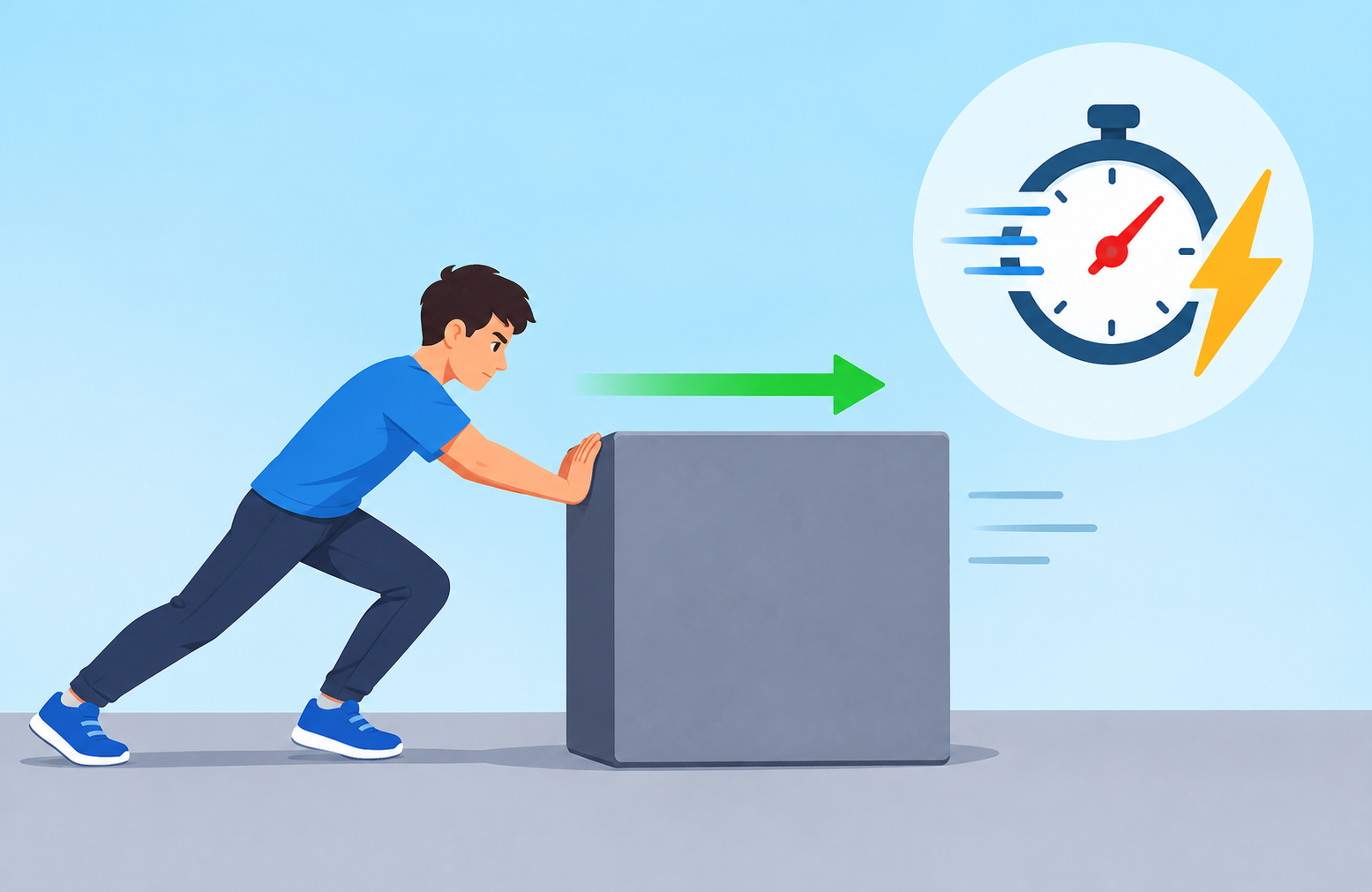
Imagine two people are asked to carry the same heavy box up a flight of stairs. Both carry the same box, cover the same distance, and do exactly the same amount of work. The only difference is that one person does it in 10 seconds and the other takes 30 seconds.
In everyday speech, we might say the faster person is more powerful — and in physics, we would be completely correct.
Power describes not just how much work is done, but how quickly it is done. Two systems can transfer the same amount of energy and yet have completely different power outputs, simply because one does it in less time.
This is one of the most useful and practical ideas in all of physics. Understanding what power is in physics helps explain why a sports car accelerates faster than a family saloon, why a kettle boils water quicker than a candle can, and why engineers carefully calculate the power requirements of lifts, motors, and turbines.
Key Takeaways
-
Power is the rate at which work is done or energy is transferred.
-
The formula for power is P = W/t.
-
The SI unit of power is the watt (W), equal to one joule per second.
-
Power can also be calculated using P = Fv when a constant force acts in the direction of motion.
-
Power is a scalar quantity — it has magnitude but no direction.
-
A higher power output means energy is transferred more quickly, not that more total energy is stored.
What Is Power in Physics?
Power is the rate at which work is done or energy is transferred.
More precisely:
Power tells you how much energy is being transferred — or how much work is being done — per unit of time.
To understand this properly, it helps to be clear about three related but distinct concepts:
| Term | What It Describes |
|---|---|
| Work | The energy transferred when a force moves an object through a distance |
| Energy | The capacity to do work — stored or in motion |
| Power | How quickly work is done or energy is transferred |
A common point of confusion is thinking that a more powerful machine does more work. That is not necessarily true. A more powerful machine does the same work in less time — or more work in the same time. Power is always about the rate, not just the quantity.
Power is a scalar quantity — it has magnitude (measured in watts) but no direction.
The Formula for Power
The standard formula for power is:
P = W/t
Where:
- P = power (measured in watts, W)
- W = work done (measured in joules, J)
- t = time taken (measured in seconds, s)
This formula makes intuitive sense. If you do a large amount of work in a short time, you have high power. If the same work takes much longer, the power is lower.
Units:
1 watt = 1 joule per second
1 W = 1 J/s
This means that a device with a power of 1 watt transfers 1 joule of energy every second. A device rated at 1,000 watts transfers 1,000 joules every second.
Note on symbols: In this article, W in the formula P = W/t represents work done (in joules). The italic W should not be confused with the unit symbol W (watt), which represents power. Context always makes the distinction clear in physics problems.
How to Calculate Power
Follow this straightforward method:
- Identify the work done (or energy transferred) — this should be in joules.
- Identify the time taken — this must be in seconds.
- Write the formula: P = W/t
- Substitute the values into the formula.
- Calculate the result.
- State the unit — watts (W).
If the time is given in minutes, multiply by 60 to convert to seconds before substituting.
Worked Examples
Example 1 — A Person Doing Work
Given:
A person does 600 J of work in 10 seconds.
Formula: P = W/t
Substitution: P = 600 ÷ 10
Answer: P = 60 W
The person has a power output of 60 watts.
Example 2 — A Machine Lifting a Load
Given:
An electric motor lifts a 200 N load through a vertical distance of 5 m in 4 seconds.
First, calculate the work done:
W = F × d = 200 × 5 = 1,000 J
Formula: P = W/t
Substitution: P = 1,000 ÷ 4
Answer: P = 250 W
Example 3 — Comparing Two People
Given:
Person A lifts a 50 kg box by 3 m in 5 seconds.
Person B lifts the same box the same distance but takes 15 seconds.
Use g = 9.8 m/s².
Work done by each person:
W = mgh = 50 × 9.8 × 3 = 1,470 J
Person A: P = 1,470 ÷ 5 = 294 W
Person B: P = 1,470 ÷ 15 = 98 W
Both people do the same work (1,470 J). Person A has three times the power output because they complete the task in one third of the time.
Example 4 — A Car Engine
Given:
A car engine does 500,000 J of work in 25 seconds.
Formula: P = W/t
Substitution: P = 500,000 ÷ 25
Answer: P = 20,000 W = 20 kW
Power Formula Using Force and Velocity
When a constant force acts on an object moving at a constant velocity, power can be calculated directly without needing to know work and time separately:
P = Fv
Where:
- P = power (watts, W)
- F = force applied (newtons, N)
- v = velocity of the object (metres per second, m/s)
This formula applies when the force and velocity are in the same direction — for example, a car engine producing a driving force in the direction of motion.
Worked Example:
A car’s engine produces a driving force of 2,000 N and the car travels at a constant speed of 25 m/s.
P = Fv = 2,000 × 25
P = 50,000 W = 50 kW
This formula is particularly useful in mechanics and engineering, where you often know the force being applied and the speed at which the object is moving, rather than the total work done over a period of time.
For a thorough understanding of how force and motion connect in physics, see What Is Force in Physics?
Power and Work
Power and work are closely related — but they measure different things.
Work answers the question: how much energy was transferred?
Power answers the question: how quickly was that energy transferred?
Using the formula P = W/t, you can see:
- If work increases while time stays the same → power increases.
- If time increases while work stays the same → power decreases.
- If you know power and time, you can find work: W = P × t
For a complete explanation of work, including how it is calculated from force and displacement, see What Is Work in Physics?
Power and Energy
Since work is a measure of energy transferred, power is also equal to the rate of energy transfer:
P = Energy transferred ÷ time
This applies to any form of energy — mechanical, electrical, thermal, or otherwise.
A few practical illustrations:
- A 100 W light bulb transfers 100 joules of energy every second (mostly as light and heat).
- A 3,000 W electric shower transfers 3,000 joules every second to heat the water.
- A 1,500 W microwave oven delivers 1,500 joules of energy per second to the food inside it.
The key point: a higher-power device transfers energy more quickly. It does not necessarily store more energy — it processes it faster.
This relationship also means you can rearrange the formula to find the total energy transferred:
Energy = Power × Time
E = P × t
For example, a 2,000 W heater running for 60 seconds transfers:
E = 2,000 × 60 = 120,000 J = 120 kJ
SI Unit of Power
The SI unit of power is the watt, symbol W.
1 watt = 1 joule per second (1 J/s)
For larger values, standard SI prefixes apply:
| Unit | Symbol | Value |
|---|---|---|
| Watt | W | 1 J/s |
| Kilowatt | kW | 1,000 W |
| Megawatt | MW | 1,000,000 W |
| Gigawatt | GW | 1,000,000,000 W |
Practical examples:
- A human walking up stairs: approximately 100–200 W
- A car engine: typically 50–200 kW
- A large power station: approximately 1–3 GW
The watt is named after James Watt (1736–1819), the Scottish engineer whose improvements to the steam engine helped drive the Industrial Revolution. The unit was adopted in his honour.
You may also encounter horsepower (hp) in engineering contexts:
1 hp ≈ 746 W
This is not an SI unit but is still used widely in the automotive industry.
Mechanical Power
Mechanical power refers to the rate at which mechanical work is done — typically in systems involving forces, motion, machines, and engines.
Whenever a machine exerts a force to move something — a crane lifting a steel beam, a motor driving a conveyor belt, an engine propelling a vehicle — mechanical power is involved.
The most useful formula here is:
P = Fv
Example:
A crane lifts a 500 kg steel beam at a constant speed of 0.8 m/s. Use g = 9.8 m/s².
Force needed to lift the beam at constant speed:
F = mg = 500 × 9.8 = 4,900 N
Power = Fv = 4,900 × 0.8 = 3,920 W ≈ 3.92 kW
This tells the engineer what motor power is needed to achieve that lifting speed for that load.
If you are studying AP Physics or need a handy formula reference, the AP Physics 1 Equation Sheet includes key power and energy relationships.
Electrical Power
While this article focuses primarily on mechanical power, it is worth briefly introducing electrical power since it appears frequently in everyday contexts.
The basic formula for electrical power is:
P = IV
Where:
- P = electrical power (watts, W)
- I = electric current (amperes, A)
- V = voltage/potential difference (volts, V)
Two related formulas derived using Ohm’s Law (V = IR):
P = I²R
P = V²/R
Where R = resistance (ohms, Ω).
These formulas are used to calculate the power consumed by resistors, appliances, and circuits. A 13 A fuse in a 230 V plug socket, for example, can handle:
P = IV = 13 × 230 = 2,990 W ≈ 3 kW
This is why high-powered appliances like kettles and electric showers require their own dedicated circuits with appropriately rated fuses.
Power vs Work vs Energy
| Concept | What It Describes | Common Formula | SI Unit |
|---|---|---|---|
| Work | Energy transferred by a force acting over a distance | W = F × d | Joule (J) |
| Energy | The capacity to do work (stored or in transfer) | KE = ½mv², PE = mgh | Joule (J) |
| Power | The rate at which work is done or energy is transferred | P = W/t | Watt (W) |
The critical distinction: work and energy are both measured in joules. Power is measured in watts. Joules measure how much — watts measure how fast.
Confusing these three is one of the most common errors in introductory physics.
Real-Life Examples of Power
Car engines
A car engine’s power rating (in kilowatts or horsepower) determines how quickly it can accelerate the vehicle. A 150 kW engine can transfer energy to the drivetrain far faster than a 75 kW engine — which is why more powerful cars tend to accelerate more quickly.
Electric light bulbs
A 100 W bulb transfers twice as much energy per second as a 50 W bulb. LED technology achieves similar brightness using far less power — a 10 W LED typically produces as much visible light as a 60 W incandescent bulb.
Lifts and elevators
An elevator motor must have sufficient power to lift the weight of the lift car and passengers at an acceptable speed. Engineers calculate the required mechanical power using P = Fv, based on the maximum load and desired lift speed.
Cranes
Construction cranes are rated by their power output. A more powerful crane can lift heavier loads or lift the same load more quickly.
Household appliances
Appliances are labelled with their power consumption — typically in watts or kilowatts. A washing machine at 2,000 W uses energy twice as fast as a dishwasher at 1,000 W.
Athletes
A professional cyclist in a sprint can produce approximately 1,000–1,500 W for short periods. A recreational cyclist sustains roughly 100–200 W over a longer ride. This is why short sprint events and long-distance events suit very different physical profiles.
Turbines and power stations
A large wind turbine generates approximately 2–3 MW of electrical power. A nuclear power station might generate 1–3 GW — enough to supply electricity to millions of homes simultaneously.
Common Mistakes When Calculating Power
1. Confusing work with power
Work (joules) and power (watts) are different quantities. Doing a lot of work does not mean high power — time matters.
2. Forgetting to divide by time
The most common arithmetic error. Always check: have you divided the work or energy by the time?
3. Using minutes instead of seconds
The SI unit of time is the second. If time is given in minutes, multiply by 60 before substituting into P = W/t.
Example: 5 minutes = 5 × 60 = 300 seconds.
4. Giving the wrong unit
Power is always in watts (W), not joules. If your answer comes out in joules, you have calculated work, not power.
5. Confusing watts with joules
Watts and joules sound similar to beginners but measure completely different things. Joules = energy or work. Watts = rate of energy transfer.
6. Misusing P = Fv
This formula applies when force and velocity are in the same direction. If the force is perpendicular to motion (as with centripetal force), it does no work and contributes nothing to power.
7. Using the wrong value of g
When calculating work done against gravity (W = mgh), use g = 9.8 m/s² unless stated otherwise. Using g = 10 m/s² gives an approximation — always state which value you are using.
8. Confusing mass and weight
Mass is in kilograms (kg). Weight is a force in newtons (N = kg × g). Use mass with mgh; use force in newtons with W = Fd.
Practice Questions
Question 1
A student does 1,800 J of work in 30 seconds. Calculate the student’s power output.
Question 2
An electric motor has a power output of 500 W. How much work does it do in 2 minutes?
Question 3
A car engine exerts a force of 3,500 N and the car moves at 20 m/s. Calculate the power output of the engine.
Question 4
Person A climbs a flight of stairs doing 4,000 J of work in 8 seconds. Person B does the same work in 20 seconds. Calculate the power output of each person and explain the difference.
Question 5
A crane lifts a 1,200 N load through 8 m in 16 seconds. Calculate (a) the work done and (b) the power of the crane.
Question 6
A 60 W light bulb runs for 10 minutes. How much energy does it transfer in this time?
Question 7
Which has greater power — a machine that does 10,000 J of work in 50 seconds, or one that does 6,000 J in 20 seconds?
Question 8 (Conceptual)
Two cars have the same top speed. Car A has a 100 kW engine; Car B has a 150 kW engine. Explain why Car B accelerates faster to its top speed, even though both cars eventually reach the same maximum velocity.
Answers and Explanations
Answer 1:
P = W/t = 1,800 ÷ 30 = 60 W
Answer 2:
Convert time: 2 minutes = 120 seconds.
W = P × t = 500 × 120 = 60,000 J (60 kJ)
Answer 3:
P = Fv = 3,500 × 20 = 70,000 W = 70 kW
Answer 4:
Person A: P = 4,000 ÷ 8 = 500 W
Person B: P = 4,000 ÷ 20 = 200 W
Both do the same work but Person A completes it in less time, giving a higher power output. Power depends on the rate of doing work, not just the total work done.
Answer 5:
(a) W = F × d = 1,200 × 8 = 9,600 J
(b) P = W/t = 9,600 ÷ 16 = 600 W
Answer 6:
Convert time: 10 minutes = 600 seconds.
E = P × t = 60 × 600 = 36,000 J = 36 kJ
Answer 7:
Machine 1: P = 10,000 ÷ 50 = 200 W
Machine 2: P = 6,000 ÷ 20 = 300 W
Machine 2 has greater power despite doing less total work, because it completes the task in much less time.
Answer 8:
At any given speed below the maximum, the more powerful engine (Car B) can exert greater force or sustain higher acceleration. Even if both cars share the same drag-limited top speed, Car B reaches it more quickly because it transfers energy to the drivetrain at a higher rate — 150,000 joules per second compared to 100,000 joules per second. Power determines how fast acceleration occurs, not the final speed alone.
Frequently Asked Questions
What is power in physics?
Power is the rate at which work is done or energy is transferred. It tells you not how much energy is involved, but how quickly that energy is being transferred. The formula is P = W/t, and it is measured in watts.
What is the formula for power?
The primary formula is P = W/t (power equals work divided by time). When a force acts along the direction of motion, you can also use P = Fv (power equals force multiplied by velocity).
What is the SI unit of power?
The watt (W). One watt equals one joule per second (1 W = 1 J/s). Larger units include kilowatt (kW = 1,000 W) and megawatt (MW = 1,000,000 W).
Is power the same as energy?
No. Energy (measured in joules) is the capacity to do work. Power (measured in watts) is how quickly energy is transferred. A 100 W bulb and a 50 W bulb can both transfer the same total energy over time — the 100 W bulb just does it twice as fast.
How is power related to work?
Power is work divided by time: P = W/t. Alternatively, W = P × t — multiply power by time to find the total work done. Power describes the rate of doing work; work describes the total energy transferred.
What is the difference between power and force?
Force (newtons) causes or changes motion. Power (watts) measures how quickly work is done. A large force does not automatically mean high power — it depends on how fast the object moves and how much work is done per unit of time.
What does 1 watt mean?
One watt means that 1 joule of energy is being transferred every second. A 1 W source transfers 60 joules in a minute, 3,600 joules in an hour.
How do you calculate power from work and time?
Divide the work done (in joules) by the time taken (in seconds). P = W/t. Make sure the time is in seconds — convert minutes to seconds by multiplying by 60.
What is P = Fv?
P = Fv is an alternative power formula. It applies when a constant force acts in the direction of motion at a constant velocity. Power equals force (in newtons) multiplied by speed (in m/s). The result is in watts.
Can power be calculated from energy and time?
Yes. Since work is a measure of energy transferred, you can use P = E/t where E is the energy transferred in joules and t is the time in seconds. This gives the same result as P = W/t.
Summary
Power is one of the most practical concepts in physics — it tells you not just what is happening, but how quickly it is happening.
The central idea is simple:
P = W/t — power equals work done divided by time taken.
The SI unit is the watt (W), equal to one joule per second. When force and velocity are aligned, you can also use P = Fv.
Power is a scalar quantity — it has no direction, only magnitude.
The relationship between force, work, energy, and power forms one of the most important conceptual chains in physics:
Force acts over a distance → Work is done → Energy is transferred → Power measures how quickly this happens
Understanding this chain helps make sense of everything from car engines and electric motors to climbing stairs and powering a household. A device with higher power does not necessarily do more work overall — it does work at a faster rate.
Helpful Resources
OpenStax University Physics — Work, Power, and Energy
A peer-reviewed, freely available university physics text with complete coverage of power, work, and energy with worked examples.
https://openstax.org
Khan Academy — Power
Video lessons and practice exercises on the concept of power, the watt, and real-world applications — suitable for high school through introductory college level.
https://www.khanacademy.org
Encyclopaedia Britannica — Power (Physics)
A reliable reference entry covering the definition, units, and basic applications of power in physics.
https://www.britannica.com
Disclaimer:
This article is provided for educational and informational purposes. Physics formulas and examples are simplified for learning and should be checked against your course materials, textbook, or instructor when used for academic work.