
Introduction
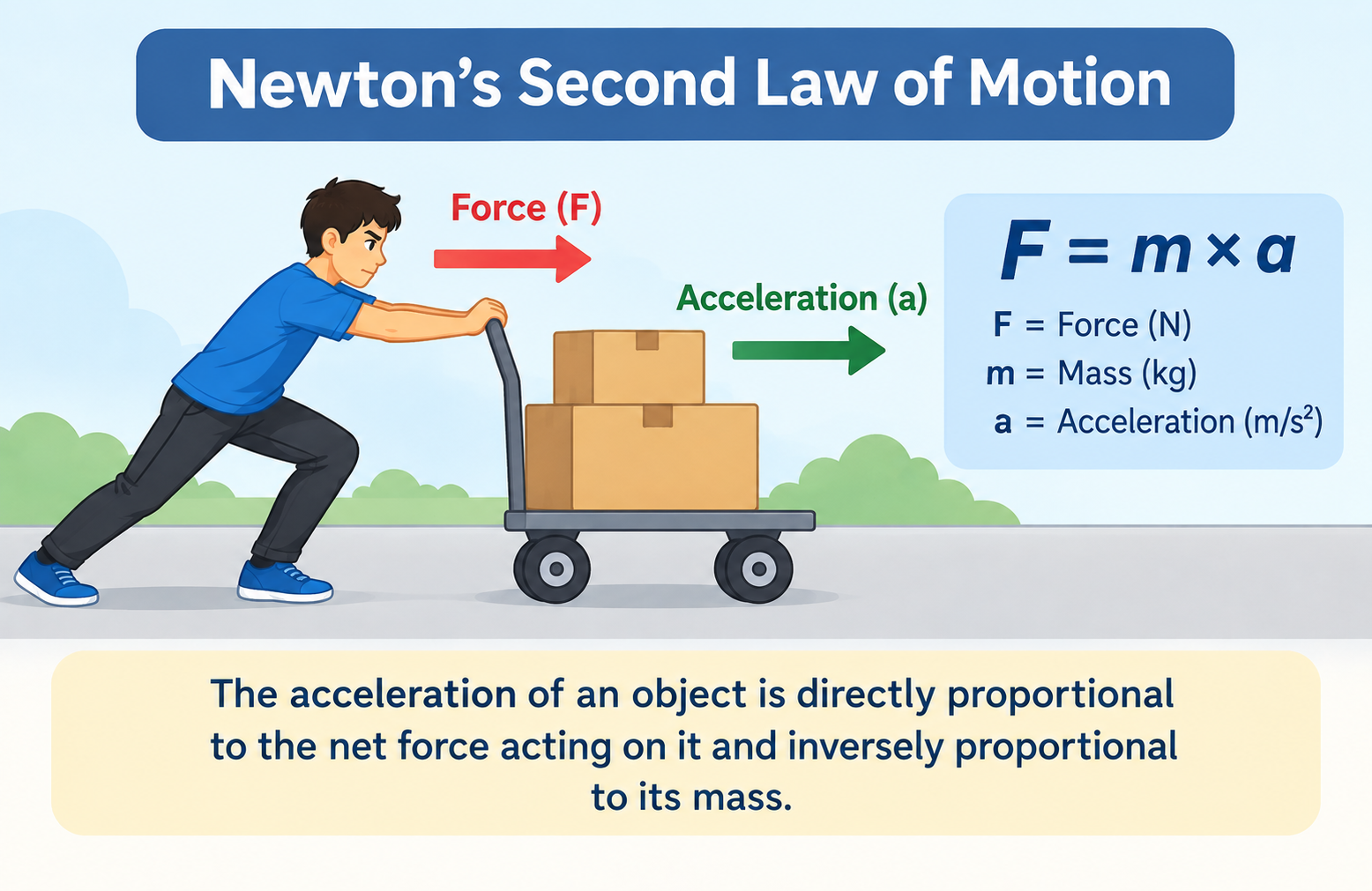
Think about pushing a shopping trolley around a supermarket. When it is empty, a gentle push sends it moving quickly — it accelerates easily. Fill it with heavy shopping and suddenly the same push barely moves it. Push harder and it picks up speed faster. These three observations — all experienced in a single shopping trip — are a perfect everyday description of Newton’s Second Law.
What is Newton’s Second Law of Motion? It states that the acceleration of an object depends on the net force acting on it and the object’s mass. A greater force produces greater acceleration; a greater mass produces less acceleration for the same force. The relationship is captured in one of the most important equations in physics: F = ma.
This law connects force, mass, and acceleration in a precise, measurable way — making it indispensable in physics, engineering, sport, and virtually every situation involving movement.
Key Takeaways
-
Newton’s Second Law states that acceleration is directly proportional to net force and inversely proportional to mass.
-
The formula is F = ma, where F is net force (N), m is mass (kg), and a is acceleration (m/s²).
-
The formula can be rearranged to find any one of the three quantities: a = F/m and m = F/a.
-
F in the formula always refers to the net force — the overall combined force after all forces (including friction) are accounted for.
-
Weight is a force calculated by W = mg, where g ≈ 9.8 m/s² on Earth.
-
Increasing the force on an object (with constant mass) increases its acceleration proportionally.
-
Increasing the mass of an object (with constant force) decreases its acceleration proportionally.
What Is Newton’s Second Law of Motion?
Newton’s Second Law of Motion states:
“The acceleration of an object is directly proportional to the net force acting on it and inversely proportional to its mass.”
Let us unpack both parts of this statement.
“Directly proportional to the net force” means that if you double the force applied to an object (keeping its mass constant), its acceleration doubles. If you triple the force, the acceleration triples. Force and acceleration change in the same direction and by the same factor.
“Inversely proportional to its mass” means that if you double the mass of an object (keeping the force constant), its acceleration halves. A heavier object is harder to accelerate. Mass and acceleration change in opposite directions — when one goes up, the other goes down.
Put simply: push harder, and the object accelerates faster. Make it heavier, and it accelerates less for the same push.
These principles explain why a lorry needs a much more powerful engine than a bicycle to achieve the same acceleration, and why a tennis ball accelerates far more than a shot put when struck with the same force.
The Formula: F = ma
The mathematical expression of Newton’s Second Law is:
F = ma
Where:
| Symbol | Quantity | SI Unit | Unit Symbol |
|---|---|---|---|
| F | Net force | Newton | N |
| m | Mass | Kilogram | kg |
| a | Acceleration | Metre per second squared | m/s² |
What is a Newton?
One Newton is the force required to accelerate a mass of 1 kilogram at 1 metre per second squared.
1 N = 1 kg × 1 m/s²
Rearranging the formula:
The formula F = ma can be rearranged to find any of the three quantities:
- To find force: F = ma
- To find acceleration: a = F/m
- To find mass: m = F/a
Quick examples of each rearrangement:
Finding acceleration:
A net force of 30 N acts on a 6 kg object.
a = F/m = 30/6 = 5 m/s²
Finding mass:
A force of 40 N produces an acceleration of 8 m/s².
m = F/a = 40/8 = 5 kg
Finding force:
A 10 kg object accelerates at 3 m/s².
F = ma = 10 × 3 = 30 N
Understanding the Relationships in F = ma
Force and Acceleration
When the mass of an object stays constant, force and acceleration are directly proportional. Increasing the force increases the acceleration by the same factor.
Example:
A 5 kg trolley:
- Force = 10 N → a = 10/5 = 2 m/s²
- Force = 20 N → a = 20/5 = 4 m/s²
- Force = 30 N → a = 30/5 = 6 m/s²
Double the force → double the acceleration. Triple the force → triple the acceleration. The relationship is linear.
Mass and Acceleration
When the force stays constant, mass and acceleration are inversely proportional. Increasing the mass decreases the acceleration.
Example:
Force = 24 N:
- Mass = 4 kg → a = 24/4 = 6 m/s²
- Mass = 8 kg → a = 24/8 = 3 m/s²
- Mass = 12 kg → a = 24/12 = 2 m/s²
Double the mass → half the acceleration. Triple the mass → one-third the acceleration.
This is also why mass is often described as a measure of an object’s resistance to acceleration — which connects directly to the concept of inertia. For a detailed explanation, see What Is Inertia in Physics?
Force, Mass, and Acceleration Together
Example:
A 3 kg object is pushed with a net force of 12 N.
a = F/m = 12/3 = 4 m/s²
Now the mass doubles to 6 kg and the force also doubles to 24 N:
a = F/m = 24/6 = 4 m/s²
When both force and mass double simultaneously, acceleration stays the same. This shows that acceleration depends on the ratio of force to mass — not on either quantity alone.
SI Units in Newton’s Second Law
Using consistent SI units is essential for correct calculations.
| Quantity | Symbol | SI Unit | Unit Symbol |
|---|---|---|---|
| Force | F | Newton | N |
| Mass | m | Kilogram | kg |
| Acceleration | a | Metre per second squared | m/s² |
Why this matters:
If you use grams instead of kilograms, or centimetres per second squared instead of m/s², your answer will be wrong by a large factor. Always convert to SI units before substituting into F = ma.
Check: 1 N = 1 kg·m/s²
If you calculate F = 2 kg × 3 m/s² = 6 N — the units check out. If the units do not produce Newtons, something in the setup is wrong.
Newton’s Second Law Step-by-Step Calculation Method
Use this method for any Newton’s Second Law problem:
Step 1: Write down what you know — identify F, m, and a from the question.
Step 2: Identify what you need to find.
Step 3: Choose the correct rearrangement of F = ma:
- Finding F: F = ma
- Finding a: a = F/m
- Finding m: m = F/a
Step 4: Substitute the known values with their units.
Step 5: Calculate the numerical answer.
Step 6: Write the final answer with the correct unit and direction where appropriate.
Example using this method: A 4 kg object accelerates at 5 m/s². Find the net force.
- Step 1: m = 4 kg, a = 5 m/s²
- Step 2: Find F
- Step 3: F = ma
- Step 4: F = 4 kg × 5 m/s²
- Step 5: F = 20
- Step 6: F = 20 N
Easy Worked Examples
Example 1 — Finding Force
Given: m = 8 kg, a = 3 m/s²
Find: F
Formula: F = ma
Working: F = 8 × 3
Answer: F = 24 N
Example 2 — Finding Acceleration
Given: F = 50 N, m = 10 kg
Find: a
Formula: a = F/m
Working: a = 50/10
Answer: a = 5 m/s²
Example 3 — Finding Mass
Given: F = 72 N, a = 9 m/s²
Find: m
Formula: m = F/a
Working: m = 72/9
Answer: m = 8 kg
Example 4 — Car Accelerating
Given: A 1,200 kg car accelerates at 2.5 m/s²
Find: Net force required
Formula: F = ma
Working: F = 1,200 × 2.5
Answer: F = 3,000 N
Example 5 — Football Being Kicked
Given: A force of 80 N acts on a 0.4 kg football
Find: Acceleration
Formula: a = F/m
Working: a = 80/0.4
Answer: a = 200 m/s²
Example 6 — Finding Mass from Rocket Data
Given: A rocket engine produces 500,000 N of thrust and gives the rocket an acceleration of 25 m/s²
Find: Mass of the rocket
Formula: m = F/a
Working: m = 500,000/25
Answer: m = 20,000 kg
Example 7 — Small Object
Given: m = 0.5 kg, a = 12 m/s²
Find: F
Formula: F = ma
Working: F = 0.5 × 12
Answer: F = 6 N
Example 8 — Finding Acceleration for a Bicycle
Given: A cyclist and bicycle have a combined mass of 80 kg. Net force = 160 N.
Find: Acceleration
Formula: a = F/m
Working: a = 160/80
Answer: a = 2 m/s²
Example 9 — Large Force, Large Mass
Given: F = 15,000 N, m = 3,000 kg
Find: a
Formula: a = F/m
Working: a = 15,000/3,000
Answer: a = 5 m/s²
Example 10 — Finding Force on a Ball
Given: A 0.15 kg cricket ball accelerates at 800 m/s²
Find: Force applied by bat
Formula: F = ma
Working: F = 0.15 × 800
Answer: F = 120 N
Example 11 — Finding Mass
Given: F = 30 N, a = 6 m/s²
Find: m
Formula: m = F/a
Working: m = 30/6
Answer: m = 5 kg
Example 12 — Person Pushing a Box
Given: A person applies 45 N to a 9 kg box on a frictionless surface
Find: Acceleration
Formula: a = F/m
Working: a = 45/9
Answer: a = 5 m/s²
Newton’s Second Law and Net Force
The F in F = ma is not just any force — it is the net force: the vector sum of all forces acting on the object.
When multiple forces act on an object, you must find the net force first before applying F = ma.
Forces in the same direction — add them:
A 5 kg box is pushed by two people: Person A applies 30 N and Person B applies 20 N, both in the same direction. No friction.
Net force = 30 + 20 = 50 N
a = F/m = 50/5 = 10 m/s²
Forces in opposite directions — subtract them:
A 10 kg box is pushed with 60 N to the right. Friction acts with 20 N to the left.
Net force = 60 − 20 = 40 N (to the right)
a = F/m = 40/10 = 4 m/s² (to the right)
When net force is zero:
If a 1,500 kg car travels at constant velocity, the engine force equals air resistance and friction exactly.
Net force = 0 N
a = 0/1,500 = 0 m/s² — no acceleration, consistent with What Is Newton’s First Law of Motion?
Newton’s Second Law in Everyday Life
Newton’s Second Law is not just a classroom equation — it explains behaviour you observe every single day.
1. Pushing a shopping trolley
An empty trolley (low mass) accelerates easily with a small force. A full trolley (high mass) requires a much larger force to achieve the same acceleration. F = ma in direct action.
2. A car accelerating from rest
A car engine provides a forward force. The car’s mass resists this force. The resulting acceleration depends on the ratio F/m. A sports car with a powerful engine and low mass accelerates far more quickly than a heavy lorry with the same engine.
3. Braking a vehicle
Brakes apply a backward force. Using F = ma: the deceleration (negative acceleration) depends on braking force and vehicle mass. A heavier vehicle with the same braking force decelerates more slowly — which is why lorries need longer stopping distances.
4. Kicking a football
The footballer’s boot applies a force to the ball for a very short time. Because the ball’s mass is small, the acceleration is very large — the ball travels quickly. A heavier object kicked with the same force would accelerate far less.
5. Rocket launch
Rocket engines produce enormous thrust forces to accelerate the large mass of the rocket and its fuel. As fuel burns and mass decreases, the same engine force produces greater acceleration — perfectly consistent with a = F/m.
6. Cycling uphill
Gravity acts as a backward force opposing forward motion. The cyclist must apply a greater force to achieve the same acceleration uphill compared to level ground, because the net force is reduced by the gravitational component along the slope.
7. A cricket ball being bowled
A fast bowler applies a large force to a relatively light ball over a short delivery stride. The large force relative to small mass produces a very high acceleration, allowing the ball to reach high speeds.
8. Safety features in vehicles — crumple zones and airbags
These features work by increasing the time over which deceleration occurs during a crash. A longer stopping time means lower deceleration, which means a smaller force on the occupants — directly applying F = ma to protect lives. This also connects to What Is Momentum? — reducing the rate of momentum change reduces the force experienced.
Newton’s Second Law and Weight
Weight is a direct application of Newton’s Second Law. On Earth, gravity accelerates all objects downward at approximately g = 9.8 m/s² (sometimes rounded to 10 m/s² in school physics).
The weight of an object is the gravitational force acting on it:
W = mg
Where:
- W = weight (Newtons, N)
- m = mass (kilograms, kg)
- g = gravitational field strength (≈ 9.8 m/s² on Earth)
Key distinction — mass vs weight:
| Property | Mass | Weight |
|---|---|---|
| What it measures | Amount of matter | Gravitational force on an object |
| Unit | kg | N |
| Changes with location? | No | Yes (g varies on Moon, Mars, etc.) |
| Formula | — | W = mg |
Worked examples:
Find the weight of a 60 kg person on Earth:
W = 60 × 9.8 = 588 N
Find the weight of a 5 kg bag:
W = 5 × 9.8 = 49 N
Find the mass of an object that weighs 196 N on Earth:
m = W/g = 196/9.8 = 20 kg
Newton’s Second Law and Friction
Friction is one of the most important forces to account for when applying Newton’s Second Law in real-world situations. It always acts opposite to the direction of motion and reduces the net force.
Finding net force with friction:
Applied force − Friction force = Net force
Then: a = Net force / mass
Example 1:
A force of 50 N is applied to a 5 kg box. Friction = 20 N.
Net force = 50 − 20 = 30 N
a = 30/5 = 6 m/s²
Example 2:
A 10 kg object is pushed with 80 N. Friction = 30 N.
Net force = 80 − 30 = 50 N
a = 50/10 = 5 m/s²
Example 3:
A 20 kg crate is pulled with 100 N. Friction = 40 N.
Net force = 100 − 40 = 60 N
a = 60/20 = 3 m/s²
When friction equals the applied force, net force = 0, and the object moves at constant velocity (no acceleration) — consistent with Newton’s First Law.
Newton’s Second Law vs Newton’s First Law
These two laws work together. Understanding how they differ — and how they connect — is important for exam success.
| Feature | Newton’s First Law | Newton’s Second Law |
|---|---|---|
| Condition | Net force = 0 | Net force ≠ 0 |
| Result | No change in velocity (stays at rest or constant velocity) | Object accelerates |
| Formula | Net F = 0 → a = 0 | F = ma |
| What it describes | Inertia — resistance to change | How force produces acceleration |
| Example | Car at steady 60 km/h | Car speeding up from rest |
Newton’s First Law is a special case: when net force is zero, Newton’s Second Law gives a = F/m = 0/m = 0 — no acceleration. So the First Law is logically contained within the Second.
Newton’s Second Law vs Newton’s Third Law
Newton’s Third Law states that for every action, there is an equal and opposite reaction. This is a separate law describing force pairs between two objects.
Newton’s Second Law describes what happens to one object when a net force acts on it.
Newton’s Third Law describes the mutual forces between two objects in an interaction.
For example: when a rocket engine pushes exhaust gases backward (action), the gases push the rocket forward (reaction) — Newton’s Third Law. The rocket then accelerates because of the net forward force on it — Newton’s Second Law (F = ma).
Both laws are needed to fully describe most real-world situations, but they address different aspects of the physics.
Graphs and Newton’s Second Law
1. Force vs Acceleration (constant mass)
If mass is constant and force increases, acceleration increases proportionally. The graph of Force (y-axis) vs Acceleration (x-axis) is a straight line through the origin.
The gradient of this graph equals the mass:
gradient = F/a = m
This is a common exam question — if you are given a Force vs Acceleration graph and asked for the mass, calculate the gradient.
2. Acceleration vs Mass (constant force)
If force is constant and mass increases, acceleration decreases. The relationship is inverse. The graph of Acceleration (y-axis) vs Mass (x-axis) is a curve (hyperbola), not a straight line.
If you plot Acceleration vs 1/Mass instead, the graph becomes a straight line — confirming the inverse relationship.
3. Force vs Mass (constant acceleration)
If acceleration is constant and mass increases, more force is required. The graph of Force (y-axis) vs Mass (x-axis) is a straight line through the origin.
The gradient of this graph equals the acceleration:
gradient = F/m = a
Common Misconceptions About Newton’s Second Law
| Misconception | Correct Explanation |
|---|---|
| F = ma means force causes motion | Force causes a change in motion (acceleration), not motion itself. An object can move without a net force if already in motion. |
| Greater mass always means the object moves more slowly | Greater mass means less acceleration for the same force. With a proportionally greater force, it can accelerate just as fast. |
| The formula only applies to large objects | F = ma applies universally — to electrons, balls, cars, and planets alike. |
| Weight and mass are the same thing | Weight is a force measured in Newtons (W = mg). Mass is the amount of matter, measured in kilograms. |
| Applied force equals net force | Net force = applied force − opposing forces (such as friction). Always subtract resistive forces first. |
| A larger force always causes faster motion | Force causes acceleration — a change in velocity. An object could already be moving fast and a large force simply accelerates it further. |
Common Mistakes Students Make
| Mistake | Correct Approach |
|---|---|
| Using weight (N) as mass in F = ma | Convert weight to mass first: m = W/g, then use m in F = ma |
| Not calculating net force before using F = ma | Always subtract friction and other opposing forces from the applied force to find net force |
| Forgetting to include units in the answer | Always state the unit: N for force, m/s² for acceleration, kg for mass |
| Using grams instead of kilograms | Convert grams to kilograms (divide by 1,000) before substituting |
| Confusing the direction of acceleration | Acceleration acts in the direction of the net force — always identify the direction of the net force first |
| Dividing incorrectly when rearranging | Write out the rearranged formula clearly before substituting values |
Worked Examples — Extended
Example 1 — Net Force with Friction
Given: A 15 kg box is pushed with 90 N. Friction = 30 N.
Find: Acceleration
Formula: Net F = 90 − 30 = 60 N; a = F/m
Working: a = 60/15
Answer: a = 4 m/s²
Example 2 — Weight Calculation
Given: m = 45 kg, g = 9.8 m/s²
Find: Weight
Formula: W = mg
Working: W = 45 × 9.8
Answer: W = 441 N
Example 3 — Finding Mass from Weight
Given: Weight = 294 N on Earth (g = 9.8 m/s²)
Find: Mass
Formula: m = W/g
Working: m = 294/9.8
Answer: m = 30 kg
Example 4 — Two Forces Same Direction
Given: A 6 kg object is pushed by Force 1 = 18 N and Force 2 = 12 N in the same direction. No friction.
Find: Acceleration
Formula: Net F = 18 + 12 = 30 N; a = F/m
Working: a = 30/6
Answer: a = 5 m/s²
Example 5 — Finding Acceleration with Friction
Given: A 20 kg trolley. Applied force = 120 N. Friction = 20 N.
Find: Acceleration
Working: Net F = 120 − 20 = 100 N; a = 100/20
Answer: a = 5 m/s²
Example 6 — Finding Force on a Car
Given: A 1,500 kg car decelerates at 4 m/s² (braking).
Find: Braking force (net force causing deceleration)
Formula: F = ma
Working: F = 1,500 × 4
Answer: F = 6,000 N (directed backward, opposing motion)
Example 7 — Finding Mass
Given: Net force = 45 N produces an acceleration of 9 m/s²
Find: Mass
Formula: m = F/a
Working: m = 45/9
Answer: m = 5 kg
Example 8 — Rocket Problem
Given: A 2,000 kg rocket. Thrust = 40,000 N upward. Weight = 2,000 × 9.8 = 19,600 N downward.
Find: Acceleration upward
Working: Net F = 40,000 − 19,600 = 20,400 N upward; a = 20,400/2,000
Answer: a = 10.2 m/s² upward
Example 9 — Person in a Lift
Given: A 70 kg person stands in a lift accelerating upward at 2 m/s².
Find: Normal force (apparent weight)
Working: Net F = ma = 70 × 2 = 140 N (upward net force needed)
Weight = 70 × 9.8 = 686 N downward
Normal force − 686 = 140 → Normal force = 686 + 140
Answer: Normal force = 826 N
Example 10 — Deceleration Problem
Given: A 900 kg car brakes with a net force of 4,500 N.
Find: Deceleration
Formula: a = F/m
Working: a = 4,500/900
Answer: a = 5 m/s² (deceleration)
Practice Questions
15 Practice Questions
- Find the force needed to accelerate a 5 kg mass at 4 m/s².
- A net force of 60 N acts on a 12 kg object. Find the acceleration.
- A force of 35 N produces an acceleration of 7 m/s². Find the mass.
- Calculate the weight of a 25 kg object on Earth (g = 9.8 m/s²).
- A 3 kg ball accelerates at 10 m/s². What force acts on it?
- A 50 N force acts on an object with mass 25 kg. Find the acceleration.
- Find the mass of an object that weighs 490 N on Earth.
- A 10 kg box is pushed with 80 N. Friction = 30 N. Find the acceleration.
- A car of mass 1,000 kg accelerates at 3 m/s². What is the net force?
- Two forces of 25 N and 15 N act in the same direction on a 5 kg object. Find the acceleration (no friction).
- A 2 kg object is accelerated from rest. After 4 seconds its velocity is 20 m/s. Find the net force.
- A 500 kg rocket produces 15,000 N of thrust. Its weight is 4,900 N. Find the upward acceleration.
- A force of 120 N acts on a 40 kg object with a friction force of 40 N opposing motion. Find the acceleration.
- Find the weight of a 70 kg person on the Moon where g = 1.6 m/s².
- A 8 kg object decelerates from 20 m/s to 4 m/s in 4 seconds. Find the net braking force.
Answers:
- F = 5 × 4 = 20 N
- a = 60/12 = 5 m/s²
- m = 35/7 = 5 kg
- W = 25 × 9.8 = 245 N
- F = 3 × 10 = 30 N
- a = 50/25 = 2 m/s²
- m = 490/9.8 = 50 kg
- Net F = 80 − 30 = 50 N; a = 50/10 = 5 m/s²
- F = 1,000 × 3 = 3,000 N
- Net F = 25 + 15 = 40 N; a = 40/5 = 8 m/s²
- a = (20 − 0)/4 = 5 m/s²; F = 2 × 5 = 10 N
- Net F = 15,000 − 4,900 = 10,100 N; a = 10,100/500 = 20.2 m/s²
- Net F = 120 − 40 = 80 N; a = 80/40 = 2 m/s²
- W = 70 × 1.6 = 112 N
- a = (4 − 20)/4 = −4 m/s² (deceleration); F = 8 × 4 = 32 N
10 Multiple Choice Questions
Question 1
A 4 kg object accelerates at 6 m/s². What is the net force?
A. 1.5 N
B. 10 N
C. 24 N
D. 48 N
Correct Answer: C
Short Explanation: F = ma = 4 × 6 = 24 N.
Question 2
A net force of 100 N acts on a 20 kg object. What is the acceleration?
A. 2,000 m/s²
B. 0.2 m/s²
C. 5 m/s²
D. 120 m/s²
Correct Answer: C
Short Explanation: a = F/m = 100/20 = 5 m/s².
Question 3
The mass of an object is doubled while the force on it remains constant. What happens to the acceleration?
A. It doubles.
B. It stays the same.
C. It quadruples.
D. It halves.
Correct Answer: D
Short Explanation: a = F/m. If m doubles and F stays the same, a halves — inversely proportional relationship.
Question 4
Which of the following is the correct SI unit for force?
A. kg
B. m/s²
C. N (Newton)
D. J (Joule)
Correct Answer: C
Short Explanation: Force is measured in Newtons (N). 1 N = 1 kg·m/s².
Question 5
A 10 kg box is pushed with 70 N. A friction force of 20 N opposes motion. What is the acceleration?
A. 7 m/s²
B. 5 m/s²
C. 2 m/s²
D. 9 m/s²
Correct Answer: B
Short Explanation: Net F = 70 − 20 = 50 N. a = 50/10 = 5 m/s².
Question 6
What is the weight of a 12 kg object on Earth (g = 9.8 m/s²)?
A. 12 N
B. 117.6 N
C. 1.22 N
D. 9.8 N
Correct Answer: B
Short Explanation: W = mg = 12 × 9.8 = 117.6 N.
Question 7
A force of 60 N produces an acceleration of 12 m/s². What is the mass?
A. 720 kg
B. 0.2 kg
C. 5 kg
D. 48 kg
Correct Answer: C
Short Explanation: m = F/a = 60/12 = 5 kg.
Question 8
An object moves at constant velocity. What is the net force?
A. Equal to its weight
B. Greater than friction
C. Zero
D. Equal to the applied force
Correct Answer: C
Short Explanation: Constant velocity means zero acceleration. From F = ma: if a = 0, net F = m × 0 = 0.
Question 9
The force on a football is tripled while its mass stays the same. What happens to its acceleration?
A. It stays the same.
B. It triples.
C. It halves.
D. It quadruples.
Correct Answer: B
Short Explanation: a = F/m. If F triples and m stays constant, a triples — directly proportional.
Question 10
A student calculates acceleration as F × m instead of F/m. What type of error is this?
A. Unit error
B. Direction error
C. Formula rearrangement error
D. Net force error
Correct Answer: C
Short Explanation: The correct rearrangement is a = F/m, not F × m. The student has multiplied instead of divided — a formula rearrangement error.
5 Challenge Questions
Challenge 1:
A 1,200 kg car accelerates from rest to 24 m/s in 8 seconds. Friction and air resistance total 1,500 N. What force does the engine produce?
Solution:
Acceleration: a = (24 − 0)/8 = 3 m/s²
Net force required: F_net = ma = 1,200 × 3 = 3,600 N
Engine force = Net force + Friction = 3,600 + 1,500 = 5,100 N
Challenge 2:
A 500 kg rocket has a thrust of 12,000 N. The weight of the rocket is 500 × 9.8 = 4,900 N. Calculate the upward acceleration. Then explain what happens to acceleration as fuel burns and mass decreases.
Solution:
Net upward force = 12,000 − 4,900 = 7,100 N
a = 7,100/500 = 14.2 m/s² upward
As fuel burns, mass decreases. With the same thrust (F constant) and decreasing m, a = F/m increases — the rocket accelerates faster as it burns fuel. This is why rockets accelerate more rapidly in later stages of launch.
Challenge 3:
A 70 kg person stands in a lift. The lift accelerates downward at 3 m/s². What is the normal force on the person?
Solution:
Weight = 70 × 9.8 = 686 N downward
Net downward force = ma = 70 × 3 = 210 N (downward)
Taking downward as positive: Weight − Normal force = 210
686 − N = 210
N = 686 − 210 = 476 N
The person feels lighter because the normal force (apparent weight) is less than their actual weight.
Challenge 4:
A 25 kg box is on a rough surface. A 200 N force is applied at an angle — only 160 N acts horizontally. Friction = 60 N. Find the horizontal acceleration.
Solution:
Horizontal net force = 160 − 60 = 100 N
a = 100/25 = 4 m/s²
Only the horizontal component of the applied force contributes to horizontal motion. The vertical component affects the normal force but not the horizontal acceleration directly.
Challenge 5:
Two objects, A (mass 3 kg) and B (mass 7 kg), are connected by a string on a frictionless surface. A force of 50 N pulls object A. Find: (a) the acceleration of the system, (b) the tension in the string between them.
Solution:
(a) Total mass = 3 + 7 = 10 kg
a = F/m = 50/10 = 5 m/s²
(b) The tension in the string only needs to accelerate object B:
T = m_B × a = 7 × 5 = 35 N
Check: Force on A minus tension = net force on A alone: 50 − 35 = 15 N = 3 × 5 ✓
Exam Tips
- Always find net force first. Before substituting into F = ma, subtract all opposing forces (friction, air resistance, weight components) from the applied force.
- Remember all three rearrangements. Know F = ma, a = F/m, and m = F/a — exam questions test all three.
- Units matter. Force must be in N, mass in kg, and acceleration in m/s². If given grams or cm/s², convert first.
- Do not confuse mass and weight. Mass is in kg; weight is in N. If a question gives weight, find mass first using m = W/g.
- Show every step of working. Even if your final answer is wrong, clear working earns method marks.
- State the direction of acceleration. Acceleration is a vector — it has direction. State “upward,” “forward,” or “to the right” as appropriate.
- For weight questions, use g = 9.8 m/s² unless the question specifies a different value or asks you to use 10 m/s².
- Check whether net force is zero. If the question describes constant velocity, net force = 0 — do not calculate a non-zero acceleration.
- For graph questions: gradient of Force vs Acceleration = mass; gradient of Force vs Mass = acceleration.
Quick Revision Notes
- Newton’s Second Law: The acceleration of an object is directly proportional to the net force and inversely proportional to the mass.
- Formula: F = ma
- Rearrangements: a = F/m; m = F/a
- SI units: F in Newtons (N), m in kilograms (kg), a in m/s²
- 1 Newton: The force required to accelerate 1 kg at 1 m/s²
- Net force: Total combined force = applied force − opposing forces
- Weight: W = mg (g = 9.8 m/s² on Earth)
- Mass vs weight: Mass (kg) = constant; Weight (N) = depends on gravitational field
- Friction: Opposing force that reduces net force and therefore acceleration
- Force-acceleration (constant mass): Direct proportion — double F → double a
- Mass-acceleration (constant force): Inverse proportion — double m → halve a
- Common mistake: Using weight as mass without converting
Newton’s Second Law Cheat Sheet
| Concept | Formula | Notes |
|---|---|---|
| Newton’s Second Law | F = ma | F = net force in N |
| Find acceleration | a = F/m | Divide net force by mass |
| Find mass | m = F/a | Divide net force by acceleration |
| Net force | F_net = F_applied − F_friction | Always subtract opposing forces |
| Weight | W = mg | g = 9.8 m/s² on Earth |
| Find mass from weight | m = W/g | Used when weight is given instead of mass |
| 1 Newton equals | 1 kg·m/s² | Fundamental unit check |
| Force-acceleration graph | Gradient = mass | Straight line through origin |
| Force-mass graph | Gradient = acceleration | Straight line through origin |
Frequently Asked Questions
1. What is Newton’s Second Law of Motion?
Newton’s Second Law states that the acceleration of an object is directly proportional to the net force acting on it and inversely proportional to its mass. It is expressed as F = ma.
2. What is the formula for Newton’s Second Law?
The formula is F = ma, where F is net force (N), m is mass (kg), and a is acceleration (m/s²). It can be rearranged as a = F/m or m = F/a.
3. What does F = ma mean?
It means that the net force on an object equals the product of its mass and its acceleration. Greater force produces greater acceleration; greater mass produces less acceleration for the same force.
4. What is a Newton (unit)?
One Newton (1 N) is the force required to accelerate a mass of 1 kilogram at 1 metre per second squared. 1 N = 1 kg·m/s².
5. How do you calculate force?
Multiply mass by acceleration: F = ma. For example, a 5 kg object accelerating at 3 m/s² has a net force of 15 N.
6. How do you calculate acceleration using Newton’s Second Law?
Rearrange: a = F/m. Divide the net force (in N) by the mass (in kg) to get acceleration in m/s².
7. How do you calculate mass using Newton’s Second Law?
Rearrange: m = F/a. Divide the net force (in N) by the acceleration (in m/s²) to get mass in kg.
8. What is net force?
Net force is the overall combined force acting on an object — the sum of all forces considering their directions. In F = ma, F always refers to the net force.
9. How does mass affect acceleration?
Mass and acceleration are inversely proportional when force is constant. Doubling the mass halves the acceleration. A heavier object is harder to accelerate.
10. How does force affect acceleration?
Force and acceleration are directly proportional when mass is constant. Doubling the force doubles the acceleration.
11. What is the difference between mass and weight?
Mass is the amount of matter in an object, measured in kilograms — it does not change with location. Weight is the gravitational force on an object, measured in Newtons, calculated as W = mg.
12. How is Newton’s Second Law used in everyday life?
It explains car acceleration and braking, rocket launches, sporting impacts, vehicle safety design, and much more. Whenever a net force changes an object’s motion, Newton’s Second Law is at work.
13. What is the difference between Newton’s First and Second Laws?
The First Law describes what happens when net force is zero — no change in motion. The Second Law describes what happens when net force is non-zero — the object accelerates according to F = ma.
14. How does friction affect Newton’s Second Law calculations?
Friction acts as an opposing force that reduces the net force. Before using F = ma, subtract friction from the applied force to find the actual net force.
15. What units are used in Newton’s Second Law?
Force in Newtons (N), mass in kilograms (kg), and acceleration in metres per second squared (m/s²). Using consistent SI units is essential for correct answers.
Summary
Newton’s Second Law of Motion is one of the most powerful and practical equations in all of physics. At its heart, it tells you three things:
- Apply a greater force to an object, and it accelerates more.
- Increase the mass of an object, and it accelerates less for the same force.
- These relationships are captured precisely in F = ma.
The F in the equation is always the net force — accounting for every force acting on the object, including friction and weight. Mass and weight are different quantities — mass is in kilograms, weight is in Newtons.
Whether you are calculating the braking force of a car, the thrust needed to launch a rocket, or the acceleration of a kicked football, the same formula applies every time. Knowing how to use F = ma, rearrange it, and correctly calculate net force before applying it gives you a tool that works across an enormous range of physical situations.
As objects accelerate, they gain kinetic energy — a concept explored further in What Is Kinetic Energy?. And when a force acts over a distance to produce that acceleration, work is done — as explained in What Is Work in Physics? These ideas connect directly to Newton’s Second Law, showing how force, motion, and energy are all part of the same coherent framework.
Final Thoughts
Newton’s Second Law — F = ma — is arguably the most used equation in classical physics. It is simple in form but extraordinarily powerful in application. It explains the motion of objects from a rolling ball to a spacecraft, from a braking car to a falling raindrop.
For students, the most important habits when working with this law are: always find the net force first, always use SI units, and always be clear about whether a quantity is mass or weight. Get those three things right, and the formula does the rest.
Understanding Newton’s Second Law also builds the bridge to more advanced topics — momentum, energy, circular motion, and mechanics — making it one of the most important investments of time in any physics course. Take the time to practise with varied problems, including those involving friction and weight, and the ideas will become second nature.
References
- Khan Academy — Newton’s Second Law: https://www.khanacademy.org
- OpenStax University Physics — Newton’s Laws of Motion: https://openstax.org
- Physics LibreTexts — Newton’s Second Law: https://phys.libretexts.org
- Encyclopaedia Britannica — Newton’s Laws of Motion: https://www.britannica.com
- NASA — Newton’s Laws Applied to Space Travel: https://www.nasa.gov
Helpful Resources
Khan Academy — Forces and Newton’s Laws
Students can watch video lessons and complete interactive exercises covering F = ma, net force, weight, friction, and real-world applications of Newton’s Second Law.
https://www.khanacademy.org
OpenStax University Physics
A free, peer-reviewed textbook with detailed chapters on Newton’s Laws, force, mass, acceleration, and worked examples at multiple difficulty levels.
https://openstax.org
Physics LibreTexts — Classical Mechanics
Provides clear, structured explanations of Newton’s Second Law, net force calculations, and SI units, with examples suitable for GCSE through university level.
https://phys.libretexts.org
NASA Education — Forces and Motion
NASA’s education pages apply Newton’s Laws to real spacecraft and rocket science, giving students engaging real-world context for F = ma.
https://www.nasa.gov
Disclaimer:
This article is intended for educational and informational purposes only. While LearnMinto strives to provide accurate and up-to-date physics information, readers should verify important academic concepts through official textbooks, educational institutions, examination boards, or trusted educational resources before using this content for exams or academic purposes. LearnMinto is not affiliated with any specific school, university, research institution, or examination board.
About the Author
Saad Qureshi is a Senior Education & Technology Editor at LearnMinto. He focuses on creating and reviewing clear, accessible educational content across mathematics, physics, chemistry, biology, computer science, technology, AI tools, and personal finance.