
Introduction
Think about the last time you travelled in a car through a busy town. The car accelerated away from traffic lights, slowed down around a bend, came to a stop behind a bus, then sped up again on a clear stretch of road. At no point was the car moving at a steady, unchanging speed throughout the entire journey.
This is the reality of almost all motion in the world around us. Objects rarely move at a perfectly constant speed in a perfectly straight line. They speed up, slow down, change direction, and respond to changing forces acting on them. In physics, this kind of motion — where speed or direction changes over time — is called non-uniform motion.
Understanding non-uniform motion is essential for making sense of how the physical world actually behaves. It connects to some of the most important ideas in physics, including acceleration, force, energy, and Newton’s laws. This guide explains what non-uniform motion is, why it happens, how to recognise it, how to analyse it, and where it appears in everyday life — clearly and step by step.
Key Takeaways
-
Non-uniform motion occurs when an object’s speed, direction, or both change over time.
-
In non-uniform motion, the object covers unequal distances in equal intervals of time.
-
Non-uniform motion is caused by a net (unbalanced) force acting on the object.
-
A distance-time graph of non-uniform motion produces a curve, not a straight line.
-
A velocity-time graph of non-uniform motion produces a line that is not horizontal — it slopes, curves, or changes.
-
Acceleration is the defining feature of non-uniform motion — it is always non-zero.
-
Almost all real-world motion is non-uniform to some degree.
-
Non-uniform motion includes uniformly accelerated motion (constant acceleration) and non-uniformly accelerated motion (changing acceleration).
What Is Non-Uniform Motion?
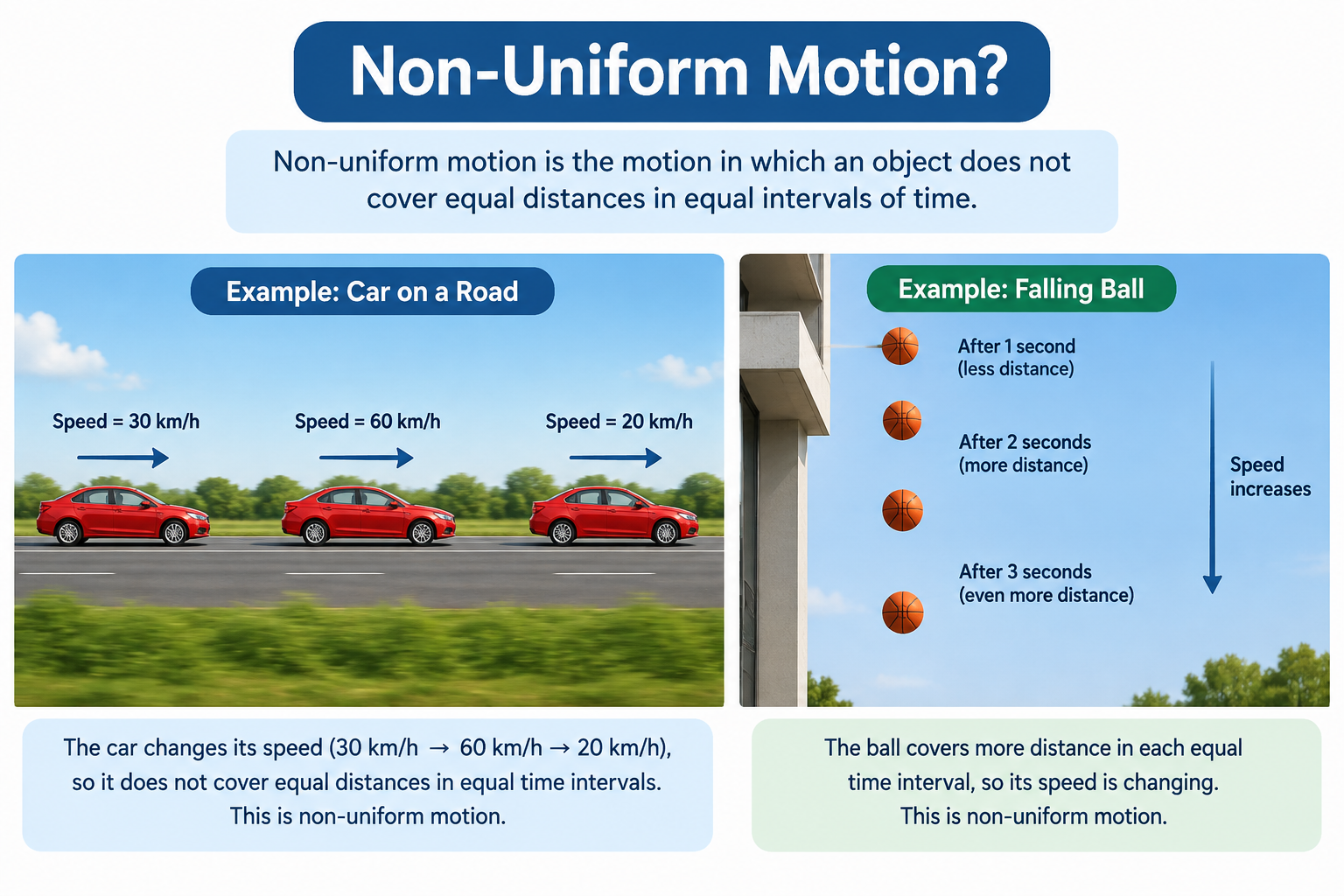
In physics, non-uniform motion is defined as motion in which an object does not cover equal distances in equal intervals of time.
Put more simply: if you watch an object moving and its speed changes — even slightly — at any point during that motion, it is in non-uniform motion.
A direct comparison:
- In uniform motion, an object covers the same distance every second. A car moving at a perfectly steady 20 m/s covers exactly 20 metres in each and every second.
- In non-uniform motion, the distance covered each second varies. A car accelerating from traffic lights might cover 2 metres in the first second, 5 metres in the second, 9 metres in the third, and so on.
Non-uniform motion is not a special or unusual case. It is, in fact, the default state of almost all objects in the real world. Perfectly uniform motion requires zero net force — a condition that is almost never achieved in practice, because forces such as gravity, friction, and air resistance are almost always present.
Definition and Key Characteristics
Formal definition:
Non-uniform motion is motion in which the velocity of an object changes with time — either in magnitude (speed), direction, or both.
Key characteristics of non-uniform motion:
- The object covers unequal distances in equal time intervals.
- The velocity is not constant — it changes over time.
- The object has a non-zero acceleration at some or all points during the motion.
- The net force acting on the object is not zero.
- The distance-time graph is a curve (not a straight line).
- The velocity-time graph is not a horizontal line.
Any one of these characteristics is sufficient to identify non-uniform motion. If an object’s speed is changing, it is in non-uniform motion. If its direction is changing (even at constant speed), it is also in non-uniform motion.
Non-Uniform Motion vs Uniform Motion
Understanding non-uniform motion becomes clearer when contrasted directly with uniform motion.
| Feature | Uniform Motion | Non-Uniform Motion |
|---|---|---|
| Speed | Constant throughout | Changes over time |
| Direction | Straight line | May change |
| Velocity | Constant | Changes in magnitude, direction, or both |
| Acceleration | Zero | Non-zero (at least at some points) |
| Net force | Zero | Non-zero |
| Distance per time interval | Equal | Unequal |
| Distance-time graph | Straight line | Curved line |
| Velocity-time graph | Horizontal line | Sloping or curved line |
| Example | A ball rolling on a frictionless surface | A car braking; a ball thrown upward |
The most important distinction is this: uniform motion requires zero net force, while non-uniform motion requires a non-zero net force.
This is a direct consequence of Newton’s first law of motion — an object continues in uniform motion (constant velocity) unless acted upon by an unbalanced force. The moment any unbalanced force acts on an object, its motion becomes non-uniform.
What Causes Non-Uniform Motion?
Non-uniform motion is caused by a net (unbalanced) force acting on an object. According to Newton’s second law:
F = ma
Where F is the net force, m is the mass, and a is the acceleration. If F is non-zero, then acceleration is non-zero, and the object’s velocity changes — producing non-uniform motion.
The forces that commonly cause non-uniform motion include:
Gravity:
When an object falls freely under gravity, it accelerates downward at approximately 9.8 m/s². Each second, its speed increases. This is non-uniform motion. For a complete understanding of how force drives this, see What Is Force in Physics?
Friction:
Friction opposes the motion of an object. When a ball rolls along a rough surface, friction gradually slows it down, producing non-uniform (decelerating) motion.
Air resistance:
A car travelling at high speed experiences significant air resistance. If the driving force from the engine changes, or air resistance changes with speed, the net force changes and the motion becomes non-uniform.
Applied forces:
Any externally applied force — a push, a pull, a kick — that is not perfectly balanced by opposing forces will produce a change in velocity and therefore non-uniform motion.
Tension and normal forces:
In more complex systems, tension in ropes, normal reaction forces from surfaces, and other contact forces can produce non-uniform motion when they are unbalanced.
Types of Non-Uniform Motion
Non-uniform motion can be broadly divided into two categories based on whether the acceleration itself is constant or changing.
1. Uniformly Accelerated Motion
In uniformly accelerated motion, the object’s speed changes at a constant rate. The acceleration is constant throughout the motion.
- The velocity increases (or decreases) by the same amount every second.
- The velocity-time graph is a straight line with a non-zero gradient.
- The distance-time graph is a parabola (a specific type of curve).
- The SUVAT equations of motion apply directly.
Examples:
- A ball dropped from rest under gravity (acceleration = 9.8 m/s² downward)
- A car braking uniformly from 30 m/s to rest
- An object pushed by a constant force on a frictionless surface
2. Non-Uniformly Accelerated Motion
In non-uniformly accelerated motion, the acceleration itself changes over time. The rate of change of speed is not constant.
- The velocity-time graph is curved (not a straight line).
- The distance-time graph has a more complex curve.
- The SUVAT equations do not apply directly.
Examples:
- A car accelerating in real traffic (engine force varies, air resistance increases with speed)
- A skydiver falling through air (drag increases as speed increases, so acceleration decreases over time)
- A pendulum swinging (the restoring force and therefore the acceleration change continuously with position)
Uniformly Accelerated Motion
Uniformly accelerated motion is the most studied and most mathematically tractable form of non-uniform motion. Because the acceleration is constant, a set of four equations — the SUVAT equations — can be used to analyse the motion completely.
SUVAT equations:
- v = u + at
- s = ut + ½at²
- v² = u² + 2as
- s = ½(u + v)t
Where:
- s = displacement (m)
- u = initial velocity (m/s)
- v = final velocity (m/s)
- a = acceleration (m/s²)
- t = time (s)
These equations apply only when acceleration is constant. They are among the most useful tools in introductory physics and form the basis of most calculation questions involving non-uniform motion at school and early university level.
Example: Free fall
A ball is dropped from rest. Using g = 9.8 m/s²:
After 1 s: v = 0 + 9.8 × 1 = 9.8 m/s; s = ½ × 9.8 × 1 = 4.9 m
After 2 s: v = 0 + 9.8 × 2 = 19.6 m/s; s = ½ × 9.8 × 4 = 19.6 m
After 3 s: v = 0 + 9.8 × 3 = 29.4 m/s; s = ½ × 9.8 × 9 = 44.1 m
The speed increases by 9.8 m/s every second (constant acceleration), but the distance covered each second increases — demonstrating that the motion is non-uniform.
Non-Uniformly Accelerated Motion
When the acceleration itself changes over time, the analysis becomes more complex. The SUVAT equations no longer apply, and more advanced mathematical tools (such as calculus) or graphical methods are needed.
The skydiver — a classic example:
When a skydiver jumps from a plane:
- Initially, the only significant force is gravity (weight). Acceleration is approximately 9.8 m/s² downward.
- As the skydiver speeds up, air resistance increases (it depends on speed).
- The net downward force decreases as air resistance grows.
- Acceleration decreases (the skydiver still speeds up, but more slowly).
- Eventually, air resistance equals weight. Net force = 0. Acceleration = 0.
- The skydiver reaches terminal speed — a form of uniform motion within a non-uniform motion scenario.
This progression — from high acceleration to zero acceleration as terminal speed is reached — is a perfect example of non-uniformly accelerated motion. It directly connects to the concept of What Is Momentum? because the changing acceleration means momentum is changing at a non-constant rate until terminal speed is reached.
Distance-Time Graphs for Non-Uniform Motion
The shape of a distance-time graph reveals the nature of an object’s motion. For non-uniform motion, the graph is always curved — not a straight line.
What curves mean:
- A curve that gets steeper (concave up) means the object is speeding up — the distance covered each second is increasing.
- A curve that gets shallower (concave down) means the object is slowing down — the distance covered each second is decreasing.
- A complex curve with changing curvature means the acceleration itself is changing.
Comparing with uniform motion:
| Motion Type | Distance-Time Graph Shape |
|---|---|
| Stationary | Horizontal straight line |
| Uniform motion | Straight line (constant gradient) |
| Uniform acceleration (speeding up) | Upward curve getting steeper |
| Uniform deceleration (slowing down) | Upward curve getting shallower |
| Non-uniform acceleration | Complex or irregular curve |
Reading instantaneous speed from a distance-time graph:
For a curved distance-time graph, the instantaneous speed at any point is found by drawing a tangent to the curve at that point and calculating the gradient of the tangent.
Instantaneous speed = gradient of tangent = Δd/Δt at that point
This is the only correct method — drawing a chord between two points on the curve gives average speed over that interval, not instantaneous speed.
Velocity-Time Graphs for Non-Uniform Motion
A velocity-time graph is often even more informative than a distance-time graph when analysing non-uniform motion.
Key features:
| Feature | Meaning |
|---|---|
| Horizontal line | Constant velocity (uniform motion) |
| Straight line sloping upward | Uniform acceleration (constant positive acceleration) |
| Straight line sloping downward | Uniform deceleration (constant negative acceleration) |
| Curved line | Non-uniform acceleration (acceleration changing) |
| Line crossing the time axis | Object changes direction |
| Area under the graph | Displacement of the object |
| Gradient of the graph | Acceleration of the object |
For uniformly accelerated motion:
The velocity-time graph is a straight line. The gradient of this line gives the acceleration:
a = Δv / Δt = gradient of velocity-time graph
For non-uniformly accelerated motion:
The velocity-time graph is curved. The instantaneous acceleration at any point is the gradient of the tangent to the curve at that point.
Finding displacement:
The area under a velocity-time graph (between the graph line and the time axis) gives the displacement of the object during that time interval. This is true for both uniform and non-uniform motion.
Acceleration in Non-Uniform Motion
Acceleration is the rate of change of velocity. It is what distinguishes non-uniform motion from uniform motion.
Formula:
a = (v − u) / t = Δv / t
Where:
- a = acceleration (m/s²)
- v = final velocity (m/s)
- u = initial velocity (m/s)
- t = time (s)
In non-uniform motion:
- If an object speeds up in the positive direction: positive acceleration
- If an object slows down in the positive direction: negative acceleration (deceleration)
- If speed is increasing at a constant rate: uniform acceleration
- If the acceleration itself changes: non-uniform acceleration
Important note:
An object moving in a circle at constant speed is also undergoing non-uniform motion because its direction (and therefore its velocity) is constantly changing. The acceleration in this case is called centripetal acceleration and is directed towards the centre of the circle.
Newton’s Laws and Non-Uniform Motion
Non-uniform motion is inseparable from Newton’s laws of motion, which describe exactly when and why objects accelerate.
Newton’s First Law (Law of Inertia):
An object remains in uniform motion (or at rest) unless acted upon by a net external force. This law tells us that non-uniform motion requires an unbalanced force. Without a net force, the motion remains uniform.
Newton’s Second Law:
F = ma
The net force on an object equals its mass times its acceleration. This is the quantitative description of non-uniform motion: if there is a net force, there is acceleration, and the motion is non-uniform.
Larger net force → greater acceleration → more rapidly non-uniform motion.
Larger mass → smaller acceleration for the same force → less rapidly changing motion.
Newton’s Third Law:
For every action, there is an equal and opposite reaction. In many non-uniform motion scenarios, the reaction forces (such as the normal reaction force from a surface) play a role in determining the net force and therefore the acceleration.
Understanding force in depth makes Newton’s laws much clearer — the article What Is Force in Physics? explores the concept thoroughly.
Non-Uniform Motion and Friction
Friction is one of the most common causes of non-uniform motion in everyday life. It is a contact force that opposes the relative motion between two surfaces.
How friction causes non-uniform motion:
When an object slides along a surface, the frictional force acts opposite to its direction of motion. This produces a deceleration — the object slows down, covering less distance each second. This is non-uniform motion.
Example:
A book pushed across a table. When the push is released, friction decelerates the book until it stops. The motion after the push is released is non-uniform — the book covers less and less distance each second until its speed reaches zero.
Static vs kinetic friction:
- Static friction prevents a stationary object from moving when a force is applied.
- Kinetic (sliding) friction acts on a moving object and opposes its motion.
Both forms of friction are relevant to non-uniform motion. When applied force exceeds static friction, the object begins to move — and kinetic friction then produces non-uniform (decelerating) motion.
The energy dissipated by friction is converted to heat — a connection to the concept explored in What Is Heat Energy?
Non-Uniform Motion and Gravity
Gravity is the most fundamental cause of non-uniform motion in nature. Every object with mass exerts a gravitational pull on every other object with mass.
Free fall:
When an object falls freely under gravity (ignoring air resistance), it undergoes uniform acceleration at g ≈ 9.8 m/s² directed downward. This is non-uniform motion — the object covers increasing distances each second.
Falling with air resistance:
In real situations, air resistance opposes the downward motion. As the object speeds up, air resistance increases. The net downward force decreases, so the acceleration decreases — producing non-uniformly accelerated motion. Eventually, terminal speed is reached and the motion becomes uniform again.
Projectile motion:
An object launched at an angle undergoes non-uniform motion. The vertical component of its velocity changes continuously (due to gravity), while the horizontal component remains constant (ignoring air resistance). The combination produces a curved trajectory — the parabolic path characteristic of projectile motion.
Gravity and mass:
The gravitational force on an object depends on its mass: F = mg. Heavier objects experience a larger gravitational force, but they also have greater inertia (resistance to acceleration). The result is that all objects fall at the same rate in a vacuum — a classic result confirmed by Galileo. This relationship between mass, force, and motion is explored in detail in What Is Mass in Physics?
Non-Uniform Motion in Circular Paths
An object moving in a circle at constant speed is a special and important case of non-uniform motion.
Although the speed (magnitude of velocity) remains constant, the direction of velocity changes continuously. Since velocity is a vector, a change in direction means a change in velocity — and therefore acceleration.
This acceleration is called centripetal acceleration and is always directed toward the centre of the circular path.
Formula:
a = v²/r
Where:
- a = centripetal acceleration (m/s²)
- v = speed (m/s)
- r = radius of the circular path (m)
The force producing this centripetal acceleration is called the centripetal force:
F = mv²/r
Examples:
- A car turning a corner: friction between the tyres and the road provides the centripetal force.
- A satellite orbiting Earth: gravity provides the centripetal force.
- A ball on a string swung in a circle: tension in the string provides the centripetal force.
In all cases, the object moves at constant speed but its direction continuously changes — making the motion non-uniform.
Non-Uniform Motion and Kinetic Energy
Because non-uniform motion involves changing speed, the kinetic energy of an object in non-uniform motion also changes over time.
Kinetic energy formula:
KE = ½mv²
When an object speeds up, its kinetic energy increases. When it slows down, its kinetic energy decreases. This change in kinetic energy is directly related to the work done by the net force on the object, through the work-energy theorem:
Net work done = Change in kinetic energy
W_net = ΔKE = ½mv² − ½mu²
This means that when a net force acts on an object over a displacement (causing non-uniform motion), it transfers energy to or from the object. Understanding What Is Kinetic Energy? fully supports this analysis.
Example:
A car of mass 1,000 kg accelerates from 10 m/s to 30 m/s.
Initial KE = ½ × 1,000 × 100 = 50,000 J
Final KE = ½ × 1,000 × 900 = 450,000 J
Change in KE = 450,000 − 50,000 = 400,000 J
This 400,000 J of kinetic energy was provided by the work done by the engine (minus any energy lost to friction and air resistance).
Non-Uniform Motion and Momentum
Momentum is the product of mass and velocity:
p = mv
In non-uniform motion, velocity changes — so momentum changes. The rate of change of momentum is directly related to the net force on the object, by Newton’s second law in its momentum form:
F = Δp / Δt
This means the greater the net force and the longer it acts, the greater the change in momentum.
The quantity impulse (F × t) equals the change in momentum — a concept that is central to understanding collisions, braking, and many other non-uniform motion scenarios. The article What Is Momentum? covers this topic in thorough detail.
Example:
A ball of mass 0.4 kg changes velocity from 5 m/s to 15 m/s in 2 seconds.
Change in momentum = m × Δv = 0.4 × (15 − 5) = 4 kg m/s
Net force = Δp/Δt = 4/2 = 2 N
Real-Life Examples of Non-Uniform Motion
Non-uniform motion is the dominant form of motion in the real world. Here are clear, concrete examples across different contexts.
Vehicles in traffic:
A bus travelling through a city accelerates from bus stops, decelerates approaching traffic lights, and varies its speed constantly. Every change in speed is non-uniform motion.
A thrown ball:
When you throw a ball upward, gravity decelerates it as it rises (the ball covers less distance each second), brings it momentarily to rest at the top, then accelerates it downward. Throughout, the speed is changing — this is non-uniform motion.
A swinging pendulum:
A pendulum swings fastest at the bottom of its arc and slowest at the turning points at each side. Its speed changes continuously — a clear example of non-uniform motion.
A falling raindrop:
A raindrop starts from rest and accelerates under gravity. As it speeds up, air resistance increases. The deceleration due to air resistance grows until the raindrop reaches terminal speed — at which point it transitions to uniform motion. Most of the journey involves non-uniform motion.
A braking car:
When a car brakes, the braking force decelerates it from its travelling speed to zero. It covers less and less distance each second — non-uniform motion.
A rollercoaster:
A rollercoaster speeds up going downhill, slows down going uphill, and changes direction around bends. Every section of the ride involves non-uniform motion.
Planets orbiting the Sun:
Planets move in elliptical orbits. Their speed varies — they move fastest when closest to the Sun and slowest when furthest away. This is non-uniform motion.
A sprinter at the start of a race:
A sprinter accelerates rapidly from the starting blocks, building speed throughout the first half of the race before reaching near-maximum speed. The acceleration phase is textbook non-uniform motion.
Flowing rivers:
Water in a river flows at different speeds in different sections — faster in narrower channels and around bends, slower in wider, calmer stretches. The water is in non-uniform motion throughout.
Common Mistakes When Understanding Non-Uniform Motion
1. Thinking only speeding up counts as non-uniform motion
Non-uniform motion includes any change in velocity — speeding up, slowing down, or changing direction. A car decelerating is just as much in non-uniform motion as one accelerating.
2. Confusing non-uniform motion with non-uniform acceleration
Non-uniform motion means velocity is changing. Non-uniform acceleration means the acceleration itself is changing. Both are types of non-uniform motion, but they are not the same thing.
3. Assuming a straight distance-time graph means constant acceleration
A straight distance-time graph means constant speed (uniform motion), not constant acceleration. Constant acceleration produces a curved distance-time graph.
4. Using SUVAT equations when acceleration is not constant
The SUVAT equations only apply when acceleration is uniform (constant). Applying them to situations where acceleration changes over time produces incorrect results.
5. Thinking zero acceleration means no motion
Zero acceleration means constant velocity — which could mean the object is moving at a steady speed. It does not mean the object is stationary.
6. Misreading velocity-time graphs
A horizontal line on a velocity-time graph means constant velocity (zero acceleration — uniform motion). A sloping line means constant acceleration (non-uniform motion). A curved line means non-uniform acceleration.
7. Forgetting that circular motion at constant speed is still non-uniform
Many students assume that if speed is constant, motion is uniform. But uniform motion requires constant velocity — both constant speed and constant direction. Circular motion at constant speed involves continuously changing direction, making it non-uniform.
8. Confusing instantaneous speed with average speed on curved graphs
On a curved distance-time graph, the gradient at a single point (found by drawing a tangent) gives instantaneous speed. The gradient of a chord between two points gives average speed. These are different values.
How Non-Uniform Motion Connects to Other Physics Topics
Non-uniform motion sits at the heart of classical mechanics and connects to a wide range of physical concepts.
Force and Newton’s Laws: Non-uniform motion is caused by unbalanced forces. Newton’s second law quantifies this relationship directly. Every non-uniform motion problem can be approached by identifying the forces involved.
Work and energy: When a net force causes non-uniform motion over a displacement, work is done and kinetic energy changes. The work-energy theorem connects these ideas. A deeper look at What Is Work in Physics? reinforces this connection.
Momentum and impulse: Changing velocity means changing momentum. The net force equals the rate of change of momentum — making momentum analysis central to non-uniform motion.
Displacement and velocity: Non-uniform motion is fundamentally about changing displacement over time. The displacement-time and velocity-time relationships are the primary tools for analysing non-uniform motion mathematically.
Heat energy: In almost all real non-uniform motion scenarios, energy is lost to heat through friction and air resistance. Understanding What Is Heat Energy? provides context for where this energy goes.
Waves: Sound waves, water waves, and seismic waves all involve non-uniform motion of particles as the wave passes through them. Each particle oscillates — speeding up and slowing down — as the wave energy passes.
Worked Examples
Example 1: Identifying non-uniform motion
A car covers 10 m in the first second, 15 m in the second second, and 20 m in the third second. Is this non-uniform motion?
The distances covered in equal time intervals are different (10, 15, 20 m).
Yes — this is non-uniform motion.
Example 2: Calculating acceleration during non-uniform motion
A train accelerates from 5 m/s to 25 m/s in 10 seconds. What is its acceleration?
a = (v − u)/t = (25 − 5)/10 = 20/10 = 2 m/s²
The non-zero acceleration confirms non-uniform motion.
Example 3: Using a SUVAT equation
A ball is dropped from rest and falls for 4 seconds under gravity (g = 9.8 m/s², ignoring air resistance). What is its speed after 4 seconds? What distance has it fallen?
v = u + at = 0 + 9.8 × 4 = 39.2 m/s
s = ut + ½at² = 0 + ½ × 9.8 × 16 = 78.4 m
Example 4: Distance from a velocity-time graph
A velocity-time graph shows velocity increasing uniformly from 0 to 20 m/s over 5 seconds. What is the displacement?
Displacement = area under graph = ½ × base × height = ½ × 5 × 20 = 50 m
Example 5: Deceleration to rest
A car travelling at 30 m/s brakes uniformly and stops in 6 seconds. What is the deceleration?
a = (v − u)/t = (0 − 30)/6 = −30/6 = −5 m/s² (deceleration of 5 m/s²)
Example 6: Braking distance
Using the above example, what distance does the car cover while braking?
s = ½(u + v)t = ½ × (30 + 0) × 6 = ½ × 30 × 6 = 90 m
Example 7: Instantaneous speed from a distance-time graph
A tangent drawn to a curved distance-time graph at t = 3 s passes through the points (1 s, 4 m) and (5 s, 28 m).
Instantaneous speed = gradient of tangent = (28 − 4)/(5 − 1) = 24/4 = 6 m/s
Example 8: Kinetic energy change during non-uniform motion
A car of mass 900 kg accelerates from 10 m/s to 20 m/s.
Initial KE = ½ × 900 × 100 = 45,000 J
Final KE = ½ × 900 × 400 = 180,000 J
Change in KE = 180,000 − 45,000 = 135,000 J
Example 9: Momentum change
A ball of mass 0.3 kg accelerates from 4 m/s to 16 m/s in 3 seconds.
Δp = m × Δv = 0.3 × (16 − 4) = 0.3 × 12 = 3.6 kg m/s
Force = Δp/Δt = 3.6/3 = 1.2 N
Example 10: Projectile — vertical non-uniform motion
A ball is thrown upward at 19.6 m/s. How long does it take to reach maximum height? What is the maximum height? (g = 9.8 m/s²)
At maximum height, v = 0.
t = (v − u)/a = (0 − 19.6)/(−9.8) = 2 seconds
s = ut + ½at² = 19.6 × 2 + ½ × (−9.8) × 4 = 39.2 − 19.6 = 19.6 m
Example 11: Centripetal acceleration
A car moves around a circular bend of radius 50 m at 15 m/s. What is the centripetal acceleration?
a = v²/r = 225/50 = 4.5 m/s²
Example 12: Non-uniform motion — average speed
A car covers 60 m in the first 4 seconds and 100 m in the next 4 seconds.
Total distance = 60 + 100 = 160 m; Total time = 8 s
Average speed = 160/8 = 20 m/s
(The different distances in equal time intervals confirm non-uniform motion.)
Example 13: Finding displacement using SUVAT
A motorbike starts from rest and accelerates at 3 m/s² for 8 seconds. What is the displacement?
s = ut + ½at² = 0 + ½ × 3 × 64 = 96 m
Example 14: Velocity after displacement
An object starts at 4 m/s and accelerates at 2 m/s² over a displacement of 20 m. What is the final velocity?
v² = u² + 2as = 16 + 2 × 2 × 20 = 16 + 80 = 96
v = √96 ≈ 9.8 m/s
Example 15: Work done during non-uniform motion
A net force of 500 N acts on a car over a displacement of 200 m. How much work is done?
W = F × d = 500 × 200 = 100,000 J (100 kJ)
Practice Questions
Work through each question independently. Answers are provided below.
Identifying non-uniform motion.
- A car covers 25 m in each second for 5 seconds. Is this uniform or non-uniform motion?
- A ball covers 5 m in the first second, 10 m in the second, and 15 m in the third. What type of motion is this?
- A satellite orbits Earth at 7,700 m/s in a circular orbit. Is this uniform or non-uniform motion? Explain.
Acceleration calculations.
- A car accelerates from 0 to 24 m/s in 8 seconds. What is the acceleration?
- A ball decelerates from 15 m/s to 0 in 5 seconds. What is the deceleration?
- An object increases its velocity from 6 m/s to 18 m/s in 4 seconds. Find the acceleration.
SUVAT calculations.
- A motorbike starts from rest and accelerates at 4 m/s² for 6 seconds. What is its final speed?
- A car travelling at 20 m/s brakes with a deceleration of 5 m/s². How long does it take to stop?
- A ball is dropped from rest. How far does it fall in 3 seconds? (g = 9.8 m/s²)
- An object starts at 5 m/s and accelerates at 3 m/s² for 4 seconds. What distance does it cover?
- A car brakes from 25 m/s to rest. The braking distance is 62.5 m. What is the deceleration?
- Find the final velocity of an object starting at 8 m/s, accelerating at 2 m/s² over 18 m.
Velocity-time graphs.
- A velocity-time graph shows a straight line from (0 s, 0 m/s) to (5 s, 30 m/s). What is the acceleration? What is the displacement?
- A velocity-time graph shows 10 m/s constant for 4 seconds, then decreases to 0 in 2 seconds. Find the total displacement.
Energy and momentum.
- A car (mass 1,200 kg) accelerates from 0 to 25 m/s. What is the change in kinetic energy?
- A ball (mass 0.5 kg) accelerates from 2 m/s to 10 m/s in 4 seconds. What net force acts on it?
- A 60 kg cyclist accelerates from 5 m/s to 15 m/s. What is the change in momentum?
Word problems.
- A stone is thrown downward from a cliff at 5 m/s. After 3 seconds, what is its speed? (g = 9.8 m/s²)
- A car is travelling at 30 m/s when the driver spots a hazard. After a reaction time of 0.5 s, the driver brakes with a deceleration of 6 m/s². What total distance does the car travel before stopping?
- A ball is kicked upward at 14.7 m/s. Taking g = 9.8 m/s², how long is it in the air before returning to the ground?
Answers:
- Uniform motion — equal distances in equal time intervals.
- Non-uniform motion — unequal distances in equal time intervals; the object is accelerating.
- Non-uniform motion — the direction changes continuously, so velocity changes even though speed is constant.
- a = (24−0)/8 = 3 m/s²
- a = (0−15)/5 = −3 m/s² (deceleration of 3 m/s²)
- a = (18−6)/4 = 3 m/s²
- v = 0 + 4 × 6 = 24 m/s
- t = (0−20)/(−5) = 4 seconds
- s = ½ × 9.8 × 9 = 44.1 m
- s = 5×4 + ½×3×16 = 20 + 24 = 44 m
- v² = u² + 2as → 0 = 625 + 2a × 62.5 → 125a = −625 → a = −5 m/s²
- v² = 64 + 2×2×18 = 64+72 = 136 → v = √136 ≈ 11.7 m/s
- a = 30/5 = 6 m/s²; Displacement = ½ × 5 × 30 = 75 m
- Displacement = (10×4) + (½×10×2) = 40+10 = 50 m
- ΔKE = ½×1200×625 − 0 = 375,000 J
- F = ma = 0.5 × (10−2)/4 = 0.5 × 2 = 1 N
- Δp = 60 × (15−5) = 60 × 10 = 600 kg m/s
- v = 5 + 9.8×3 = 5 + 29.4 = 34.4 m/s
- Reaction distance = 30 × 0.5 = 15 m; Braking: v² = u² + 2as → 0 = 900 − 12s → s = 75 m; Total = 15+75 = 90 m
- Time to reach top: v = u + at → 0 = 14.7 − 9.8t → t = 1.5 s; Total time in air = 2 × 1.5 = 3 seconds
Multiple-Choice Questions
Question 1: Which of the following best describes non-uniform motion?
A) Motion in which the object moves in a straight line
B) Motion in which the speed remains constant throughout
C) Motion in which the velocity changes over time
D) Motion in which no force acts on the object
Correct Answer: C — Motion in which the velocity changes over time
Non-uniform motion is defined by changing velocity — either in magnitude (speed), direction, or both.
Question 2: Which graph shape indicates non-uniform motion on a distance-time graph?
A) A horizontal straight line
B) A diagonal straight line with constant gradient
C) A curved line
D) A vertical straight line
Correct Answer: C — A curved line
A curved distance-time graph shows that the gradient (speed) is changing — indicating non-uniform motion.
Question 3: What is the acceleration of a car that goes from 10 m/s to 40 m/s in 6 seconds?
A) 4 m/s²
B) 5 m/s²
C) 6 m/s²
D) 8 m/s²
Correct Answer: B — 5 m/s²
a = (40−10)/6 = 30/6 = 5 m/s².
Question 4: A ball is dropped from rest and falls freely under gravity (g = 9.8 m/s²). What is its speed after 5 seconds?
A) 9.8 m/s
B) 24.5 m/s
C) 49 m/s
D) 122.5 m/s
Correct Answer: C — 49 m/s
v = u + at = 0 + 9.8 × 5 = 49 m/s.
Question 5: Which of the following is an example of non-uniform motion?
A) A light ray travelling through a vacuum
B) A car moving at exactly 60 km/h on a straight motorway
C) A pendulum swinging back and forth
D) A train moving at constant speed on a straight track
Correct Answer: C — A pendulum swinging back and forth
A pendulum’s speed changes continuously — it speeds up toward the bottom and slows at the extremes. This is non-uniform motion.
Question 6: What does the gradient of a velocity-time graph represent?
A) Distance
B) Speed
C) Displacement
D) Acceleration
Correct Answer: D — Acceleration
The gradient of a velocity-time graph = change in velocity / change in time = acceleration.
Question 7: An object moves in a circle at constant speed. Which statement is true?
A) It is in uniform motion because its speed is constant.
B) It is in non-uniform motion because its direction — and therefore velocity — continuously changes.
C) It has zero acceleration.
D) No force acts on it.
Correct Answer: B — It is in non-uniform motion because its direction — and therefore velocity — continuously changes.
Uniform motion requires constant velocity — both constant speed and direction. Circular motion changes direction continuously.
Question 8: A car of mass 800 kg decelerates from 20 m/s to rest in 5 seconds. What is the braking force?
A) 1,600 N
B) 3,200 N
C) 4,000 N
D) 800 N
Correct Answer: B — 3,200 N
a = (0−20)/5 = −4 m/s²; F = ma = 800 × 4 = 3,200 N.
Question 9: Which equation is used to find displacement when initial velocity, acceleration, and time are known?
A) v = u + at
B) v² = u² + 2as
C) s = ut + ½at²
D) s = ½(u + v)t
Correct Answer: C — s = ut + ½at²
This SUVAT equation directly links displacement (s) to initial velocity (u), acceleration (a), and time (t).
Question 10: A skydiver reaches terminal speed. Which of the following correctly describes this situation?
A) The skydiver is still accelerating downward.
B) The net force on the skydiver is zero and the speed is constant.
C) The drag force is less than the weight.
D) The skydiver has stopped moving.
Correct Answer: B — The net force on the skydiver is zero and the speed is constant.
At terminal speed, drag equals weight. Net force = 0, acceleration = 0, speed is constant — the skydiver is in uniform motion at this point.
Challenge Questions
Challenge 1: A car accelerates from rest at 2 m/s² for 10 seconds, then moves at constant speed for 20 seconds, then decelerates at 4 m/s² until it stops.
(a) What is the maximum speed reached?
(b) How long does the deceleration phase last?
(c) What is the total distance covered?
(a) v = u + at = 0 + 2 × 10 = 20 m/s
(b) t = v/a = 20/4 = 5 seconds
(c)
- Phase 1 (acceleration): s = ½at² = ½ × 2 × 100 = 100 m
- Phase 2 (constant speed): s = 20 × 20 = 400 m
- Phase 3 (deceleration): s = v²/(2a) = 400/8 = 50 m
- Total = 100 + 400 + 50 = 550 m
Challenge 2: A ball is thrown vertically upward at 24.5 m/s from the edge of a cliff that is 49 m high. Taking g = 9.8 m/s² and upward as positive:
(a) What is the maximum height above the cliff top?
(b) What is the total time before the ball hits the ground below?
(c) What is the ball’s speed when it hits the ground?
(a) v² = u² + 2as → 0 = (24.5)² − 2×9.8×s → s = 600.25/19.6 = 30.625 m
(b) Taking downward as negative from cliff top, final displacement = −49 m:
−49 = 24.5t − ½×9.8×t²
4.9t² − 24.5t − 49 = 0
Divide by 4.9: t² − 5t − 10 = 0
t = (5 + √(25 + 40))/2 = (5 + √65)/2 = (5 + 8.062)/2 ≈ 6.53 seconds
(c) v = u + at = 24.5 − 9.8 × 6.53 = 24.5 − 63.99 ≈ −39.5 m/s
Speed when hitting ground ≈ 39.5 m/s downward
Challenge 3: A velocity-time graph shows the following for a car:
- 0 to 4 s: velocity increases from 0 to 16 m/s (straight line)
- 4 to 10 s: constant velocity of 16 m/s
- 10 to 14 s: velocity decreases from 16 m/s to 0 (straight line)
(a) Calculate the acceleration in each phase.
(b) Calculate the total displacement.
(c) Calculate the average speed for the whole journey.
(a)
- Phase 1: a = 16/4 = 4 m/s²
- Phase 2: a = 0 m/s² (constant velocity)
- Phase 3: a = (0−16)/4 = −4 m/s²
(b)
- Phase 1: s = ½ × 4 × 16 = 32 m
- Phase 2: s = 16 × 6 = 96 m
- Phase 3: s = ½ × (16+0) × 4 = 32 m
- Total displacement = 32 + 96 + 32 = 160 m
(c) Total time = 14 s
Average speed = 160/14 ≈ 11.4 m/s
Challenge 4: A 1,500 kg car travelling at 30 m/s applies brakes with a constant braking force of 9,000 N. Simultaneously, a 500 N air resistance force also acts against the motion.
(a) What is the total decelerating force?
(b) What is the deceleration?
(c) How far does the car travel before stopping?
(d) How much kinetic energy is dissipated as heat?
(a) Total force = 9,000 + 500 = 9,500 N
(b) a = F/m = 9,500/1,500 = 6.33 m/s²
(c) v² = u² − 2as → 0 = 900 − 2×6.33×s → s = 900/12.67 ≈ 71.0 m
(d) Initial KE = ½×1,500×900 = 675,000 J — all dissipated as heat (final KE = 0)
Challenge 5: Two objects, A (mass 3 kg) and B (mass 5 kg), are both in non-uniform motion. Object A accelerates from 2 m/s to 8 m/s in 3 seconds. Object B decelerates from 10 m/s to 4 m/s in 4 seconds.
(a) Find the net force on each object.
(b) Find the change in momentum of each object.
(c) Which object experiences the greater change in kinetic energy?
(a)
Force on A: a = (8−2)/3 = 2 m/s²; F = 3×2 = 6 N
Force on B: a = (4−10)/4 = −1.5 m/s²; F = 5×1.5 = 7.5 N
(b)
Δp_A = 3 × (8−2) = 18 kg m/s
Δp_B = 5 × (4−10) = −30 kg m/s (magnitude 30 kg m/s)
(c)
ΔKE_A = ½×3×(64−4) = ½×3×60 = 90 J
ΔKE_B = ½×5×(16−100) = ½×5×(−84) = −210 J (magnitude 210 J)
Object B experiences a greater change in kinetic energy (210 J) compared to Object A (90 J).
Quick Revision Notes
- Non-uniform motion = velocity changes over time (speed, direction, or both).
- Object covers unequal distances in equal time intervals.
- Caused by a non-zero net force acting on the object.
- Acceleration is non-zero in non-uniform motion.
- Distance-time graph: curved line (not straight).
- Velocity-time graph: sloping or curved line (not horizontal).
- Gradient of velocity-time graph = acceleration.
- Area under velocity-time graph = displacement.
- SUVAT equations apply only when acceleration is constant.
- Instantaneous speed = gradient of tangent on a distance-time curve.
- Uniform acceleration: constant rate of speed change (straight v-t line).
- Non-uniform acceleration: changing rate of speed change (curved v-t line).
- Circular motion at constant speed is non-uniform (direction changes).
- Terminal speed is reached when drag = weight (net force = 0).
- KE changes during non-uniform motion: ΔKE = ½mv² − ½mu².
- Momentum changes: Δp = mΔv = F × t.
Non-Uniform Motion Cheat Sheet
| Concept | Formula | Notes |
|---|---|---|
| Acceleration | a = (v−u)/t | Rate of change of velocity |
| SUVAT 1 | v = u + at | Final velocity |
| SUVAT 2 | s = ut + ½at² | Displacement |
| SUVAT 3 | v² = u² + 2as | No time needed |
| SUVAT 4 | s = ½(u+v)t | Average velocity × time |
| Newton’s second law | F = ma | Net force causes acceleration |
| Centripetal acceleration | a = v²/r | Circular motion |
| Kinetic energy | KE = ½mv² | Changes with speed |
| Change in KE | ΔKE = ½mv² − ½mu² | Work-energy theorem |
| Momentum | p = mv | Changes during non-uniform motion |
| Impulse | F×t = Δp | Force × time = change in momentum |
| Work done | W = F×d | Net work = ΔKE |
| V-T graph gradient | a = Δv/Δt | Acceleration |
| V-T graph area | Area = displacement | Above axis = positive |
| D-T graph gradient | Gradient = speed | Use tangent for instantaneous speed |
| Terminal speed condition | Drag = Weight | Net force = 0, acceleration = 0 |
Exam Tips
- Always read the question carefully to determine whether acceleration is uniform or non-uniform. Only apply the SUVAT equations when the question explicitly states or implies constant acceleration.
- On distance-time graph questions involving curves, draw a tangent at the specified point and calculate its gradient to find instantaneous speed. Do not connect two points on the curve with a straight line and call it instantaneous speed.
- When using velocity-time graphs, remember: gradient = acceleration and area = displacement. Practice calculating both for straight-line and triangular sections.
- For questions involving a skydiver or falling object with air resistance, think in stages: initial acceleration (high), decreasing acceleration as drag increases, and finally terminal speed (constant — uniform motion).
- In deceleration questions, be careful with signs. Deceleration is negative acceleration. If the question asks for “deceleration,” give a positive value with the word “deceleration,” or clearly indicate the sign if asked for acceleration.
- In circular motion questions, remember that constant speed does not mean uniform motion if direction is changing. Always check whether velocity (not just speed) is constant.
- For SUVAT problems, list u, v, a, s, t at the start — filling in what you know and identifying what you need to find. Then select the equation that contains the required unknown and the known quantities.
- State units with every answer in exam responses. An acceleration without m/s² or a force without N will typically lose marks.
Frequently Asked Questions
1. What is non-uniform motion in simple terms?
Non-uniform motion is motion in which an object does not travel at a steady, constant speed. Its velocity changes over time — either it speeds up, slows down, or changes direction. In everyday terms, almost all motion you observe is non-uniform.
2. What is the main difference between uniform and non-uniform motion?
In uniform motion, an object covers equal distances in equal time intervals and has zero acceleration. In non-uniform motion, the distances covered in equal time intervals are unequal, and the object has a non-zero acceleration caused by a net force.
3. What causes non-uniform motion?
Non-uniform motion is caused by a net (unbalanced) force acting on an object. This force produces acceleration, which changes the object’s velocity. Common causes include gravity, friction, air resistance, and applied forces.
4. Is circular motion at constant speed an example of non-uniform motion?
Yes. Although the speed remains constant, the direction of motion changes continuously in circular motion. Since velocity is a vector (magnitude and direction), a change in direction means a change in velocity — and therefore acceleration. This makes circular motion at constant speed a form of non-uniform motion.
5. What does the distance-time graph look like for non-uniform motion?
The distance-time graph for non-uniform motion is a curve, not a straight line. A curve getting steeper indicates speeding up. A curve getting shallower indicates slowing down. The gradient of the tangent at any point gives the instantaneous speed.
6. What do the SUVAT equations represent?
The SUVAT equations are four equations of motion that apply to objects undergoing uniform (constant) acceleration. They relate displacement (s), initial velocity (u), final velocity (v), acceleration (a), and time (t). They cannot be applied when acceleration is not constant.
7. What is uniformly accelerated motion?
Uniformly accelerated motion is a type of non-uniform motion in which the acceleration is constant throughout. The speed changes at a steady rate — for example, a ball in free fall under gravity (ignoring air resistance) accelerates at a constant 9.8 m/s² downward.
8. What is terminal speed and how does it relate to non-uniform motion?
Terminal speed is the constant speed reached by a falling object when the drag force equals its weight, making the net force zero. Before reaching terminal speed, the object undergoes non-uniform (decelerating in terms of acceleration) motion. At terminal speed, the motion becomes uniform.
9. Can an object have non-uniform motion if only its direction changes?
Yes. Velocity is a vector quantity with both magnitude and direction. If only the direction changes (even while speed remains constant), the velocity still changes — and that constitutes non-uniform motion with a corresponding acceleration.
10. How is acceleration calculated during non-uniform motion?
Acceleration is calculated as a = (v − u)/t, where v is final velocity, u is initial velocity, and t is time. On a velocity-time graph, acceleration equals the gradient. For non-uniform acceleration, the instantaneous acceleration at any point equals the gradient of the tangent to the velocity-time curve at that point.
11. How does friction contribute to non-uniform motion?
Friction is a force that opposes motion. When an object moves across a surface, friction decelerates it — reducing its speed over time. This produces non-uniform motion where the object covers less distance each second. The energy dissipated by friction becomes heat energy in the surfaces.
12. What is the relationship between non-uniform motion and kinetic energy?
Since kinetic energy depends on speed (KE = ½mv²), and non-uniform motion involves changing speed, kinetic energy changes during non-uniform motion. When an object accelerates, kinetic energy increases. When it decelerates, kinetic energy decreases. The change equals the net work done on the object.
13. How is non-uniform motion different from non-uniform acceleration?
Non-uniform motion simply means the velocity is changing (any type of acceleration). Non-uniform acceleration specifically means the acceleration itself is changing over time. All motion with non-uniform acceleration is non-uniform motion, but not all non-uniform motion has non-uniform acceleration — for example, uniformly accelerated motion is non-uniform motion with constant (uniform) acceleration.
14. What are three real-life examples of non-uniform motion?
A car braking to a stop (decelerating — speed decreases each second), a ball thrown upward (speed decreases as it rises, reaches zero, then increases as it falls), and a swinging pendulum (speed changes continuously through each swing). All three involve changing velocity and are therefore non-uniform motion.
15. Why is almost all real-world motion non-uniform?
Perfectly uniform motion requires exactly zero net force throughout the motion. In reality, forces such as gravity, friction, and air resistance almost always act on moving objects. These forces are rarely perfectly balanced, meaning the velocity of real objects almost always changes over time — making non-uniform motion the rule, not the exception.
Summary
Non-uniform motion is one of the most important and universal concepts in physics. It describes what happens when an object’s velocity changes over time — when it speeds up, slows down, or changes direction under the influence of an unbalanced force.
The key ideas to remember:
- Non-uniform motion = changing velocity = unequal distances in equal time intervals.
- It is caused by a net force acting on the object (Newton’s second law).
- Acceleration is always non-zero during non-uniform motion.
- Distance-time graphs: curved lines for non-uniform motion; steeper curve = speeding up.
- Velocity-time graphs: sloping or curved lines; gradient = acceleration; area = displacement.
- SUVAT equations apply only for constant (uniform) acceleration.
- Uniformly accelerated motion has constant acceleration — a special, important case.
- Non-uniformly accelerated motion has changing acceleration — more complex but more realistic.
- Circular motion at constant speed is non-uniform because direction changes continuously.
- Terminal speed marks the end of non-uniform motion when drag balances weight.
- Kinetic energy and momentum both change during non-uniform motion.
Almost everything that moves in the real world is in some form of non-uniform motion. Mastering this concept unlocks the door to understanding acceleration, force, energy transfer, and the rich, dynamic behaviour of objects throughout physics.
Final Thoughts
Non-uniform motion is not a complication — it is reality. The world around us is full of objects speeding up, slowing down, and changing direction under the influence of gravity, friction, air resistance, and applied forces. Physics gives us the tools to analyse and predict all of this with precision.
If you are comfortable with the definitions, the graphs, the SUVAT equations, and the connections to force, energy, and momentum covered in this guide, you have built a genuinely strong foundation in classical mechanics. These ideas reappear constantly throughout physics — in waves, in circular motion, in thermodynamics, and far beyond.
Take time to practise the worked examples and tackle the practice questions independently. Work especially on reading and interpreting velocity-time graphs — this is the skill that students most often find challenging, and the one that brings the greatest rewards once it becomes fluent. With consistent practice, non-uniform motion will feel not like a difficult topic, but like a natural way of understanding the world.
Helpful Resources
- Khan Academy — Acceleration and Non-Uniform Motion
Clear video lessons and interactive exercises covering acceleration, velocity-time graphs, and equations of motion for students at all levels.
https://www.khanacademy.org/science/physics/one-dimensional-motion - OpenStax Physics — Kinematics and Motion
A free, peer-reviewed physics textbook with comprehensive coverage of uniform and non-uniform motion, acceleration, and graphical analysis.
https://openstax.org/books/physics/pages/1-introduction - The Physics Classroom — Kinematics
A thorough and well-regarded free resource covering distance-time graphs, velocity-time graphs, acceleration, and equations of motion with interactive elements.
https://www.physicsclassroom.com/class/1DKin - BBC Bitesize — Motion and Acceleration
A student-friendly UK resource explaining uniform and non-uniform motion, speed-time graphs, and acceleration with practice questions aligned to school examinations.
https://www.bbc.co.uk/bitesize/topics/zq6svcw - HyperPhysics — Kinematics
A concise and authoritative reference from Georgia State University covering the equations of motion, acceleration, and graphical analysis of non-uniform motion.
http://hyperphysics.phy-astr.gsu.edu/hbase/mot.html
Disclaimer:
This article is intended for educational and informational purposes only. While LearnMinto strives to provide accurate and up-to-date physics information, readers should verify important academic concepts through official textbooks, educational institutions, examination boards, or trusted educational resources before using this content for exams or academic purposes. LearnMinto is not affiliated with any specific school, university, research institution, or examination board.