
Introduction
Imagine you leave your home in the morning, walk three kilometres through winding streets, stop at a coffee shop, take a detour through the park, and eventually arrive at your school — which happens to be just one kilometre in a straight line from your house. You have walked three kilometres, but you have only moved one kilometre away from where you started.
In physics, these two measurements have different names and different meanings. The three kilometres you actually walked is the distance. The one kilometre in a straight line from your starting point to your finishing point — including the direction — is the displacement.
Displacement is one of the foundational concepts in physics. It describes not just how far an object has moved, but where it has ended up relative to where it began. This guide explains what displacement means, how it works, how to calculate it, and how it connects to the broader world of physics — clearly and step by step.
Key Takeaways
-
Displacement is the straight-line distance from an object’s starting position to its final position, measured in a specific direction.
-
Displacement is a vector quantity — it has both magnitude and direction.
-
Displacement can be positive, negative, or zero.
-
Displacement is different from distance: distance measures total path length; displacement measures net change in position.
-
The SI unit of displacement is the metre (m).
-
If an object returns to its starting point, its displacement is zero — regardless of how far it has travelled.
-
Displacement is used to calculate velocity, acceleration, and work done in many physics problems.
What Is Displacement in Physics?
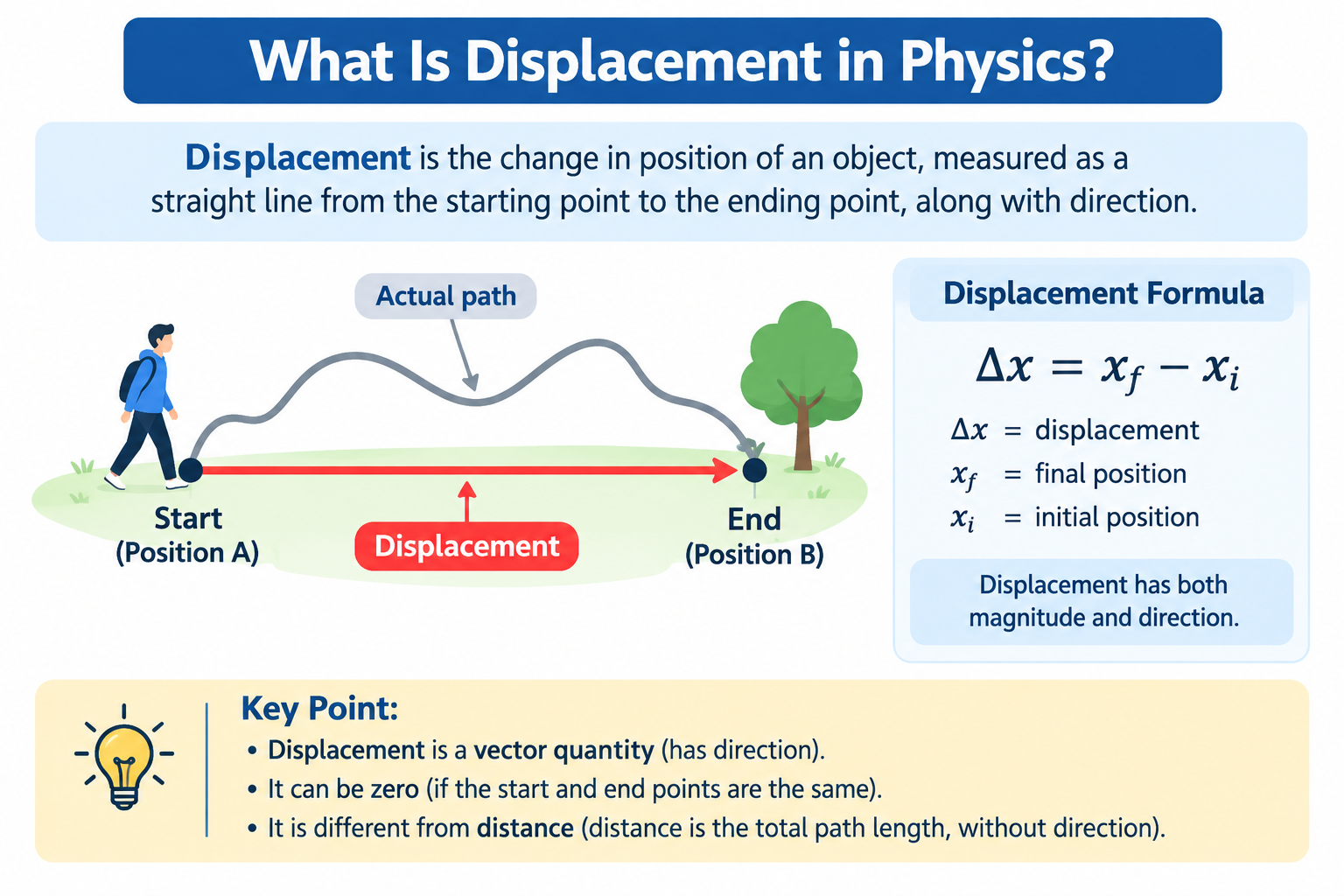
In physics, displacement is defined as the change in position of an object. More precisely, it is the straight-line distance from the object’s initial position to its final position, measured in a specific direction.
Formal definition:
Displacement = Final position − Initial position
It does not matter what path the object took to get from start to finish. Displacement only cares about two things: where the object started and where it ended up.
A simple example:
A ball rolls from point A to point B along a curved track. The ball covers a total path length (distance) along the curve. But the displacement is simply the straight-line arrow drawn directly from A to B — the shortest possible route between the two points, with a direction attached.
If the ball then rolls back from B to A, it has covered additional distance. But its displacement from the original starting point A is now zero, because it is back where it began.
This is what makes displacement genuinely different from distance, and what makes it such a useful quantity in physics.
Displacement as a Vector Quantity
One of the most important things to understand about displacement is that it is a vector quantity.
In physics, quantities are classified as:
- Scalar: Has magnitude (size) only. Examples: distance, speed, mass, temperature.
- Vector: Has both magnitude and direction. Examples: displacement, velocity, force, acceleration.
Displacement is a vector because it requires both:
- A magnitude — how far the final position is from the initial position.
- A direction — which way from the initial position to the final position.
Example:
Saying “an object has a displacement of 5 metres” is incomplete. You must say “5 metres north” or “5 metres to the right” or “5 metres at 30° above the horizontal” to fully describe the displacement.
This directional information is what distinguishes displacement from distance. When you say a car has travelled 50 km, that is a distance — a scalar. When you say the car is now 30 km north-east of where it started, that is a displacement — a vector.
The concept of vectors and scalars runs throughout physics. Force, for example, is also a vector — both its magnitude and direction determine its effect on an object, as discussed in the LearnMinto article What Is Force in Physics?
Displacement vs Distance — Key Differences
Students consistently find this distinction challenging, so it is worth exploring clearly and carefully.
| Feature | Distance | Displacement |
|---|---|---|
| Definition | Total path length travelled | Straight-line change in position from start to end |
| Type | Scalar | Vector |
| Direction | No direction | Has direction |
| Can it be negative? | No — always ≥ 0 | Yes — depends on chosen positive direction |
| Can it be zero? | Only if no movement | Yes — if object returns to start |
| Symbol | d or s | s, x, or Δx (or Δr in 2D) |
| SI unit | Metre (m) | Metre (m) |
| Path dependent? | Yes — depends on the path taken | No — only depends on start and end positions |
Concrete example to make the difference clear:
A swimmer completes one length of a 50-metre pool, turns, and swims back.
- Distance = 50 + 50 = 100 metres
- Displacement = 0 metres (back at the starting wall)
Another example:
A person walks 8 m east, then 6 m north.
- Distance = 8 + 6 = 14 metres
- Displacement = √(8² + 6²) = √(64 + 36) = √100 = 10 metres north-east
The displacement (10 m) is less than the distance (14 m), and it includes a direction.
The Symbol and Formula for Displacement
Displacement is commonly represented by the symbol s, x, d, or Δx (delta x), depending on the textbook and context. In two or three dimensions, it may be written as Δr.
The most fundamental formula for displacement is:
Δx = x_f − x_i
Where:
- Δx = displacement
- x_f = final position
- x_i = initial position
This formula applies directly in one-dimensional motion along a straight line.
In two dimensions:
When motion occurs in two dimensions (such as moving both horizontally and vertically), the total displacement is found using the Pythagorean theorem:
|Δr| = √(Δx² + Δy²)
And the direction is found using:
θ = arctan(Δy / Δx)
Where Δx is the horizontal component and Δy is the vertical component.
The SI Unit of Displacement
The SI unit of displacement is the metre (m), the same as the unit for distance and length.
This makes sense because displacement is still a measure of how far apart two points are — it is just specified as a straight-line measurement with direction attached.
Common units of displacement:
| Unit | Symbol | Use |
|---|---|---|
| Metre | m | Standard SI unit — most physics problems |
| Kilometre | km | Larger displacements (journeys, geography) |
| Centimetre | cm | Smaller laboratory measurements |
| Millimetre | mm | Precision engineering, small displacements |
As with distance, always convert all units to the same system before performing calculations.
Positive, Negative, and Zero Displacement
Unlike distance, displacement can take three different types of values.
Positive displacement:
When an object moves in the chosen positive direction, its displacement is positive.
Example: If rightward is defined as positive, an object that moves 5 m to the right has a displacement of +5 m.
Negative displacement:
When an object moves in the opposite direction to the chosen positive direction, its displacement is negative.
Example: If rightward is positive, an object that moves 5 m to the left has a displacement of −5 m.
Zero displacement:
When an object returns to its starting position — no matter how far it has travelled — its displacement is zero.
Example: A car drives 10 km from home to the supermarket, then drives 10 km back home. The distance covered is 20 km, but the displacement is 0 km.
The sign of displacement tells you which side of the starting position the object ended up on. This is a crucial concept in problems involving oscillation, circular motion, and return journeys.
How to Calculate Displacement
Method 1: Straight-Line Motion (One Dimension)
For motion in a straight line, subtract the initial position from the final position.
Δx = x_f − x_i
Example:
An object starts at position 3 m and moves to position 11 m.
Δx = 11 − 3 = +8 m
The positive sign indicates movement in the positive direction.
Example with negative displacement:
An object starts at 10 m and moves to 4 m.
Δx = 4 − 10 = −6 m
The negative sign indicates movement in the negative direction (backward).
Method 2: Two-Dimensional Motion
When motion involves components in two perpendicular directions, use the Pythagorean theorem to find the magnitude and trigonometry to find the direction.
Step 1: Identify the horizontal displacement component (Δx) and vertical displacement component (Δy).
Step 2: Find the magnitude: |Δr| = √(Δx² + Δy²)
Step 3: Find the direction: θ = arctan(Δy / Δx)
Example:
A person walks 9 m east then 12 m north.
Δx = 9 m (east), Δy = 12 m (north)
|Δr| = √(9² + 12²) = √(81 + 144) = √225 = 15 m
θ = arctan(12/9) = arctan(1.333) ≈ 53.1° north of east
Displacement = 15 m at 53.1° north of east
Method 3: Using a Velocity-Time Graph
The area under a velocity-time graph gives the displacement of the object.
- Area above the time axis = positive displacement
- Area below the time axis = negative displacement
- Net displacement = total area above minus total area below
Displacement in One Dimension
One-dimensional displacement is the simplest case. The object moves along a single straight line, and the positive direction is chosen by convention (usually rightward or upward).
Example 1:
A train starts at station A (position = 0 km) and travels to station B (position = 80 km).
Displacement = 80 − 0 = 80 km (in the positive direction)
Example 2:
A ball is thrown upward from the ground (position = 0 m) and reaches a maximum height of 15 m, then falls back down 5 m to a ledge.
Final position = 15 − 5 = 10 m above the ground
Displacement = 10 − 0 = 10 m upward
Distance = 15 + 5 = 20 m
Example 3:
A particle moves from x = −3 m to x = 7 m.
Displacement = 7 − (−3) = 10 m in the positive direction
Displacement in Two Dimensions
Most real-world motion occurs in two or three dimensions, making it necessary to work with displacement as a vector with components.
Example 1:
A ship sails 30 km east and then 40 km north. What is its displacement from the starting port?
|Δr| = √(30² + 40²) = √(900 + 1600) = √2500 = 50 km
Direction = arctan(40/30) ≈ arctan(1.333) ≈ 53.1° north of east
Displacement = 50 km at 53.1° north of east
Example 2:
A hiker walks 5 km south and then 12 km west. What is the displacement?
|Δr| = √(5² + 12²) = √(25 + 144) = √169 = 13 km
Direction = arctan(12/5) ≈ arctan(2.4) ≈ 67.4° west of south
Displacement = 13 km at 67.4° west of south
Example 3:
An aircraft flies 200 km north, then 150 km east, then 100 km south.
Net north-south: 200 − 100 = 100 km north
Net east-west: 150 km east
|Δr| = √(100² + 150²) = √(10000 + 22500) = √32500 ≈ 180.3 km
Direction = arctan(150/100) = arctan(1.5) ≈ 56.3° east of north
Displacement on a Number Line
A number line is one of the clearest ways to visualise displacement in one dimension. The number line stretches from negative values on the left to positive values on the right, with zero at the centre.
← −5 −4 −3 −2 −1 0 1 2 3 4 5 →Example 1:
An object moves from position −2 to position +4.
Displacement = 4 − (−2) = +6 (six units to the right)
Example 2:
An object moves from position +5 to position +1.
Displacement = 1 − 5 = −4 (four units to the left)
Example 3:
An object moves from +3 to −3.
Displacement = −3 − 3 = −6 (six units to the left)
The number line makes it visually clear that displacement has both size (how many units) and direction (left or right). This connects naturally to the broader concept of how vectors work in one dimension.
Displacement-Time Graphs
A displacement-time graph plots displacement on the vertical axis and time on the horizontal axis. It is a powerful tool for understanding motion.
Key features:
| Feature on Graph | Meaning |
|---|---|
| Straight line sloping upward | Constant velocity in positive direction |
| Straight line sloping downward | Constant velocity in negative direction |
| Horizontal line | Object is stationary (displacement not changing) |
| Steeper slope | Greater velocity (faster movement) |
| Line returning to zero | Object has returned to starting position |
| Curved line | Changing velocity (acceleration) |
Reading the gradient:
The gradient (slope) of a displacement-time graph gives the velocity of the object.
Velocity = Δdisplacement / Δtime = gradient of the graph
This is a key difference from a distance-time graph, where the gradient gives speed. Here, the gradient gives velocity — a vector quantity that can be positive or negative.
Example:
A displacement-time graph shows a straight line from (0 s, 0 m) to (5 s, 20 m).
Gradient = 20/5 = 4 m/s (velocity in positive direction)
If the graph then shows a line from (5 s, 20 m) to (10 s, 0 m):
Gradient = (0 − 20)/(10 − 5) = −20/5 = −4 m/s (velocity in negative direction — returning to start)
Displacement and Velocity
Velocity is directly defined using displacement:
Velocity = Displacement / Time
v = Δx / t
Because displacement is a vector, velocity is also a vector. The direction of velocity is always the same as the direction of displacement during that interval.
Example 1:
A car travels 150 m north in 10 seconds.
v = 150/10 = 15 m/s north
Example 2:
A ball rolls from position +8 m to position +2 m in 3 seconds.
Δx = 2 − 8 = −6 m
v = −6/3 = −2 m/s (moving in the negative direction)
Comparison: speed vs velocity
- Speed = total distance / total time (scalar)
- Velocity = displacement / time (vector)
An object that makes a round trip has zero displacement, therefore zero average velocity — even though its average speed is non-zero. This is one of the most commonly tested distinctions in introductory physics.
Displacement and Acceleration
Acceleration is the rate of change of velocity. Since velocity involves displacement, acceleration is also linked to displacement through the equations of motion.
Equations of motion (SUVAT equations):
For constant acceleration along a straight line:
- v = u + at
- s = ut + ½at²
- v² = u² + 2as
- s = ½(u + v)t
Where:
- s = displacement (m)
- u = initial velocity (m/s)
- v = final velocity (m/s)
- a = acceleration (m/s²)
- t = time (s)
These equations allow displacement to be calculated even when velocity is changing, as long as the acceleration is constant.
Example:
A car starts from rest (u = 0) and accelerates at 3 m/s² for 6 seconds. What is its displacement?
s = ut + ½at²
s = (0)(6) + ½(3)(6²)
s = 0 + ½ × 3 × 36
s = 54 m
Displacement in Work and Energy
In the formula for work done:
W = F × d
The “d” in this formula is technically the displacement in the direction of the applied force — not simply the distance. This distinction matters when the force and motion are not perfectly aligned.
More precisely:
W = F × s × cos θ
Where:
- F = magnitude of the applied force (N)
- s = magnitude of displacement (m)
- θ = angle between the force and the displacement
When the force and displacement are in the same direction (θ = 0°), cos θ = 1, and the formula simplifies to W = F × s.
When they are perpendicular (θ = 90°), cos θ = 0, and no work is done — even if significant displacement occurs.
For a full exploration of how work is defined and calculated in physics, the article What Is Work in Physics? provides a thorough guide. The energy released or transferred through work connects directly to kinetic and potential energy — and understanding What Is Kinetic Energy? deepens this picture further.
Displacement in Projectile Motion
In projectile motion, an object moves in two dimensions simultaneously — horizontally and vertically. Displacement must be calculated separately for each component.
Horizontal displacement:
x = u_x × t
Where u_x is the horizontal component of initial velocity.
Vertical displacement:
y = u_y × t − ½gt²
Where u_y is the vertical component of initial velocity and g is gravitational acceleration (≈ 9.8 m/s²).
Total displacement:
|Δr| = √(x² + y²)
Example:
A ball is kicked horizontally at 10 m/s from a platform. After 2 seconds:
Horizontal displacement: x = 10 × 2 = 20 m
Vertical displacement: y = 0 × 2 − ½ × 9.8 × 4 = −19.6 m (downward)
Total displacement: |Δr| = √(20² + 19.6²) = √(400 + 384.16) = √784.16 ≈ 28.0 m
Direction: θ = arctan(19.6/20) ≈ 44.4° below the horizontal
Displacement in Circular Motion
When an object moves in a circle, its displacement continuously changes direction, even if its speed remains constant.
Key points:
- After a half revolution, the displacement equals the diameter of the circle (2r), pointing from the starting point directly across to the opposite side.
- After a full revolution, the displacement is zero — the object is back at its starting point.
- This means that in uniform circular motion, the average velocity over one complete revolution is zero, even though the object is constantly moving.
Example:
A car drives around a circular roundabout of radius 20 m and completes a half circle.
Displacement = diameter = 2 × 20 = 40 m (pointing directly across the circle)
Distance = half circumference = π × 20 ≈ 62.8 m
The displacement (40 m) is significantly less than the distance (62.8 m).
Real-Life Examples of Displacement
Commuting to work:
You leave home and arrive at your office. Your displacement is the straight-line distance from home to office, with direction. Your distance is the total length of the route you actually took.
A bouncing ball:
A ball dropped from a height of 2 m hits the floor and bounces back up 1.5 m. After the bounce, its displacement from the original drop point is 2 − 1.5 = 0.5 m downward. Its distance is 2 + 1.5 = 3.5 m.
A pendulum:
A pendulum swings from left to right and back to centre. When it is at the centre (rest position), its displacement from the centre is zero. At its rightmost point, its displacement from the centre is the amplitude. This is directly related to the energy of oscillation — a concept explored in What Is Heat Energy? when thermal motion is considered at the molecular level.
Space missions:
Mission controllers track both the total distance a spacecraft has travelled (relevant for fuel consumption and time calculations) and its displacement from Earth (relevant for communication signal timing and gravitational calculations).
Running track:
An athlete runs 400 m around a standard athletics track and finishes exactly where they started. Distance = 400 m. Displacement = 0 m.
Elevator:
A lift starts on the ground floor (position = 0 m), rises to the 5th floor (position = +15 m), then descends to the 2nd floor (position = +6 m). Displacement from the ground floor = +6 m upward. Distance = 15 + 9 = 24 m.
Momentum and collisions:
In collision problems, the displacement of objects before and after impact is used alongside momentum to analyse how forces acted over time and distance.
Common Mistakes When Understanding Displacement
1. Confusing displacement with distance
The most common error. Always remember: distance is total path length (scalar); displacement is straight-line change in position with direction (vector). If the object changes direction, they will differ.
2. Forgetting direction
Writing displacement as “5 metres” without specifying direction gives an incomplete answer in physics. Displacement must include both magnitude and direction: “5 metres north” or “+5 metres.”
3. Assuming displacement is always positive
Displacement can be positive, negative, or zero. Negative displacement means the final position is on the opposite side of the starting point relative to the chosen positive direction.
4. Thinking zero displacement means no movement
An object can travel a very large distance and still have zero displacement if it returns to its starting point. Do not confuse zero displacement with zero motion.
5. Using the wrong equation for velocity
Speed = distance/time; velocity = displacement/time. Using distance when the question requires velocity gives a scalar answer instead of a vector — incorrect in vector problems.
6. Ignoring the angle in two-dimensional displacement
In two-dimensional problems, the magnitude of displacement is found using the Pythagorean theorem. Forgetting to calculate the direction means the answer is incomplete.
7. Adding displacement components without using vector addition
In two dimensions, you cannot simply add displacement values that point in different directions. Horizontal and vertical components must be calculated separately and then combined using the Pythagorean theorem.
8. Misreading displacement-time graphs
The gradient of a displacement-time graph gives velocity, not speed. A negative gradient means the object is moving in the negative direction — not that it is decelerating.
How Displacement Connects to Other Physics Topics
Displacement is not an isolated concept. It connects to virtually every major topic in mechanics and beyond.
Velocity: Defined as displacement per unit time. Without displacement, velocity cannot be properly defined as a vector quantity.
Acceleration: The SUVAT equations link displacement to initial velocity, final velocity, acceleration, and time. Displacement is the key output of motion equations.
Work and energy: Work done by a force depends on the displacement in the direction of that force — not simply the distance.
Understanding What Is Work in Physics? in full requires a clear grip on displacement.
Momentum: Impulse — the change in momentum — is related to force applied over time. The displacement of the object during that time determines the work done and the energy transferred.
The article What Is Momentum? explains momentum in detail and its connection to motion quantities.
Waves: In wave physics, displacement refers to how far a point on the wave medium has moved from its equilibrium position. This is a different use of the same word — wave displacement is the instantaneous movement of a particle from rest, which varies with time and position along the wave.
Mass and inertia: A larger mass requires more force to achieve the same displacement in the same time, illustrating how mass, force, and displacement are interrelated through Newton’s second law.
Worked Examples
Example 1: Simple one-dimensional displacement
A cyclist starts at position 0 m and travels to position 45 m.
Δx = 45 − 0 = 45 m in the positive direction
Example 2: Negative displacement
A particle moves from x = 15 m to x = 3 m.
Δx = 3 − 15 = −12 m (moves in the negative direction)
Example 3: Zero displacement
A runner completes a 5 km circular loop and finishes at the starting line.
Δx = final position − initial position = 0 − 0 = 0 m
Distance = 5 km; Displacement = 0 m
Example 4: Two-dimensional displacement
A hiker walks 5 m east and 12 m north.
|Δr| = √(5² + 12²) = √(25 + 144) = √169 = 13 m
Direction = arctan(12/5) ≈ 67.4° north of east
Example 5: Displacement with direction change
A ball moves 8 m to the right, then 3 m to the left.
Displacement = 8 − 3 = +5 m (to the right)
Distance = 8 + 3 = 11 m
Example 6: Displacement using SUVAT
A car starts from rest and accelerates at 2 m/s² for 8 seconds. What is the displacement?
s = ut + ½at² = 0 × 8 + ½ × 2 × 64 = 64 m
Example 7: Velocity from displacement
A train moves from position 20 m to position 140 m in 6 seconds.
v = Δx/t = (140 − 20)/6 = 120/6 = 20 m/s
Example 8: Work using displacement
A force of 30 N acts on an object over a displacement of 5 m in the direction of the force.
W = F × s = 30 × 5 = 150 J
Example 9: Displacement-time graph gradient
A displacement-time graph shows a line from (2 s, 6 m) to (8 s, 30 m).
Gradient = (30 − 6)/(8 − 2) = 24/6 = 4 m/s (velocity)
Example 10: Projectile displacement
A ball is launched horizontally at 12 m/s. After 3 seconds:
Horizontal displacement = 12 × 3 = 36 m
Vertical displacement = ½ × 9.8 × 3² = ½ × 9.8 × 9 = 44.1 m downward
|Δr| = √(36² + 44.1²) = √(1296 + 1944.81) = √3240.81 ≈ 56.9 m
Example 11: Half-circle displacement
An object travels a half-circle of radius 10 m.
Distance = π × 10 ≈ 31.4 m
Displacement = diameter = 2 × 10 = 20 m (pointing directly across)
Example 12: Displacement from velocity-time graph area
A velocity-time graph shows a constant velocity of 6 m/s for 5 seconds, then −3 m/s for 4 seconds.
Displacement in first part = 6 × 5 = +30 m
Displacement in second part = −3 × 4 = −12 m
Net displacement = 30 + (−12) = +18 m
Total distance = 30 + 12 = 42 m
Example 13: Displacement in an oscillating object
A mass on a spring oscillates between −8 cm and +8 cm from the rest position. Starting from +8 cm, after half a period, it reaches −8 cm.
Displacement = −8 − 8 = −16 cm (from initial position)
Distance = 16 cm (same magnitude, since it moved directly from one extreme to the other)
Example 14: Finding displacement from acceleration and velocity
A ball decelerates uniformly from 20 m/s to 0 m/s with a deceleration of 4 m/s².
Using v² = u² + 2as:
0 = 400 + 2(−4)s
8s = 400
s = 50 m
Example 15: Multi-stage displacement
A person walks: 10 m north, 10 m east, 10 m south, 5 m west.
North-south: 10 − 10 = 0 m
East-west: 10 − 5 = 5 m east
Total displacement = 5 m east
Total distance = 10 + 10 + 10 + 5 = 35 m
Practice Questions
Try each question independently. Answers are provided below.
One-dimensional displacement.
- An object moves from position 4 m to position 19 m. What is the displacement?
- A particle moves from x = 12 m to x = 5 m. What is the displacement?
- A ball moves 7 m right, then 3 m left. What is the displacement? What is the distance?
- A runner starts at position 0 m, runs to 100 m, and then runs back to 40 m. What is the displacement? What is the distance?
- An object starts at −5 m and moves to +8 m. What is the displacement?
Two-dimensional displacement.
- A person walks 6 m east and 8 m north. What is the magnitude of displacement?
- A ship travels 24 km south then 7 km east. What is the magnitude of displacement?
- A plane flies 300 km north, then 400 km east. What is the displacement (magnitude and direction)?
Displacement and velocity.
- An object moves with a displacement of 60 m in 12 seconds. What is its velocity?
- A car has a velocity of 25 m/s and travels for 8 seconds. What is the displacement?
SUVAT — displacement with acceleration.
- A car accelerates from rest at 5 m/s² for 4 seconds. What is the displacement?
- A ball decelerates from 15 m/s to 0 at 3 m/s². What is the displacement?
- An object with initial velocity 10 m/s accelerates at 2 m/s² for 5 seconds. What is the displacement?
Displacement-time graphs.
- A displacement-time graph has a line from (0 s, 0 m) to (10 s, 80 m). What is the velocity?
- A graph shows a line from (3 s, 20 m) to (9 s, −4 m). What is the velocity?
Word problems.
- A lift goes from the ground floor (0 m) to the 8th floor (+24 m), then back down to the 3rd floor (+9 m). What is the displacement from the start? What is the distance?
- A swimmer swims 3 lengths of a 50 m pool. What is the distance? What is the displacement from the starting wall?
- A person walks 12 m north, 5 m east, 12 m south. What is the displacement?
- A car drives 80 km east, then 60 km north, then 80 km west. What is the displacement?
- A ball is thrown upward at 20 m/s. Taking upward as positive and g = 10 m/s², what is the displacement after 3 seconds?
Answers:
- Δx = 19 − 4 = +15 m
- Δx = 5 − 12 = −7 m
- Displacement = 7 − 3 = +4 m (right); Distance = 10 m
- Displacement = 40 − 0 = +40 m; Distance = 100 + (100 − 40) = 160 m
- Δx = 8 − (−5) = +13 m
- |Δr| = √(6² + 8²) = √(36+64) = √100 = 10 m
- |Δr| = √(24² + 7²) = √(576+49) = √625 = 25 km
- |Δr| = √(300² + 400²) = √(90000+160000) = √250000 = 500 km; Direction = arctan(400/300) ≈ 53.1° east of north
- v = 60/12 = 5 m/s
- s = v × t = 25 × 8 = 200 m
- s = 0 + ½ × 5 × 16 = 40 m
- v² = u² + 2as → 0 = 225 − 6s → s = 37.5 m
- s = 10 × 5 + ½ × 2 × 25 = 50 + 25 = 75 m
- v = 80/10 = 8 m/s
- v = (−4 − 20)/(9 − 3) = −24/6 = −4 m/s
- Displacement = +9 − 0 = +9 m upward; Distance = 24 + (24−9) = 39 m
- Distance = 3 × 50 = 150 m; Displacement = 50 m (3 lengths: goes, comes back, goes — ends at far wall)
- North-south cancel; East-west: 5 m east; Displacement = 5 m east
- East-west: 80 − 80 = 0; North-south: 60 m north; Displacement = 60 km north
- s = ut + ½at² = 20(3) + ½(−10)(9) = 60 − 45 = +15 m (above starting point)
Multiple-Choice Questions
Question 1: Which of the following best defines displacement?
A) The total path length travelled by an object
B) The speed of an object at any given instant
C) The straight-line change in position from start to end, with direction
D) The rate of change of distance with time
Correct Answer: C — The straight-line change in position from start to end, with direction
Displacement is a vector defined as the change in position, measured as a straight line from initial to final position, with direction included.
Question 2: A student walks 5 m north, then 5 m south. What is the displacement?
A) 10 m
B) 5 m south
C) 0 m
D) 5 m north
Correct Answer: C — 0 m
The student returns to the starting point. Final position = initial position. Displacement = 0.
Question 3: Displacement is classified as which type of quantity?
A) Scalar
B) Vector
C) Fundamental
D) Derived scalar
Correct Answer: B — Vector
Displacement has both magnitude and direction, making it a vector quantity.
Question 4: An object moves from x = 3 m to x = −5 m. What is the displacement?
A) +8 m
B) −2 m
C) −8 m
D) +2 m
Correct Answer: C — −8 m
Δx = −5 − 3 = −8 m. The negative sign indicates movement in the negative direction.
Question 5: A person walks 3 m east and 4 m north. What is the magnitude of displacement?
A) 7 m
B) 1 m
C) 5 m
D) 12 m
Correct Answer: C — 5 m
|Δr| = √(3² + 4²) = √(9 + 16) = √25 = 5 m.
Question 6: What does the gradient of a displacement-time graph represent?
A) Acceleration
B) Distance
C) Speed
D) Velocity
Correct Answer: D — Velocity
Gradient = change in displacement / change in time = velocity. This is different from a distance-time graph where gradient gives speed.
Question 7: Which of the following statements about displacement is correct?
A) Displacement is always equal to distance.
B) Displacement can never be zero unless no movement occurred.
C) Displacement is always greater than distance.
D) Displacement can be positive, negative, or zero.
Correct Answer: D — Displacement can be positive, negative, or zero.
Displacement reflects net change in position and can be negative (opposite direction) or zero (return to start).
Question 8: A car starts from rest and accelerates uniformly at 4 m/s² for 5 seconds. What is the displacement?
A) 20 m
B) 25 m
C) 50 m
D) 100 m
Correct Answer: C — 50 m
s = ut + ½at² = 0 + ½ × 4 × 25 = 50 m.
Question 9: An athlete completes two full laps of a 400 m circular track. What is the displacement?
A) 800 m
B) 400 m
C) 200 m
D) 0 m
Correct Answer: D — 0 m
After two complete laps, the athlete is back at the starting point. Displacement = 0.
Question 10: A velocity-time graph shows a constant velocity of 8 m/s for 6 seconds. What is the displacement?
A) 14 m
B) 1.33 m
C) 48 m
D) 96 m
Correct Answer: C — 48 m
Displacement = area under the velocity-time graph = 8 × 6 = 48 m.
Challenge Questions
Challenge 1: A particle moves along a straight line. It travels 20 m to the right, then 35 m to the left, then 15 m to the right. Taking rightward as positive:
(a) What is the total distance?
(b) What is the final displacement from the starting point?
(c) How far is the particle from its starting point?
(a) Distance = 20 + 35 + 15 = 70 m
(b) Displacement = +20 − 35 + 15 = 0 m
(c) The particle is 0 m from its starting point — it has returned exactly to where it began.
Challenge 2: A boat travels 40 km north-east (at 45° to east). Calculate the northward and eastward components of displacement.
North-east at 45° means equal north and east components.
East component = 40 × cos 45° = 40 × 0.7071 ≈ 28.3 km east
North component = 40 × sin 45° = 40 × 0.7071 ≈ 28.3 km north
Displacement components: 28.3 km east and 28.3 km north
Challenge 3: An object starts from rest and undergoes the following motion in a straight line:
- Accelerates at 3 m/s² for 4 seconds
- Moves at constant velocity for 5 seconds
- Decelerates at 2 m/s² until it stops
Calculate the total displacement.
Phase 1 (acceleration):
v = u + at = 0 + 3 × 4 = 12 m/s
s₁ = ½at² = ½ × 3 × 16 = 24 m
Phase 2 (constant velocity = 12 m/s for 5 s):
s₂ = 12 × 5 = 60 m
Phase 3 (deceleration from 12 m/s to 0 at 2 m/s²):
v² = u² + 2as → 0 = 144 − 4s → s₃ = 36 m
Total displacement = 24 + 60 + 36 = 120 m
Challenge 4: A drone starts at position (0, 0) and makes the following movements:
- 10 m in the positive x-direction
- 6 m in the positive y-direction
- 4 m in the negative x-direction
- 2 m in the negative y-direction
(a) What is the final position of the drone?
(b) What is the magnitude and direction of the displacement from start to finish?
(a) x-coordinate: 10 − 4 = 6 m; y-coordinate: 6 − 2 = 4 m
Final position: (6, 4)
(b) |Δr| = √(6² + 4²) = √(36 + 16) = √52 ≈ 7.21 m
Direction = arctan(4/6) = arctan(0.667) ≈ 33.7° above the positive x-axis
Challenge 5: A football is kicked from the ground at an angle of 30° above the horizontal with an initial speed of 20 m/s. Taking g = 10 m/s² and ignoring air resistance:
(a) What are the horizontal and vertical components of initial velocity?
(b) What is the time of flight?
(c) What is the horizontal displacement (range)?
(d) What is the vertical displacement at the highest point?
(a) u_x = 20 cos 30° = 20 × 0.866 ≈ 17.3 m/s
u_y = 20 sin 30° = 20 × 0.5 = 10 m/s
(b) At maximum height, v_y = 0: t_up = u_y/g = 10/10 = 1 s
Total time of flight = 2 × 1 = 2 s
(c) Horizontal displacement = u_x × t = 17.3 × 2 ≈ 34.6 m
(d) At highest point (t = 1 s):
s_y = u_y × t − ½gt² = 10 × 1 − ½ × 10 × 1 = 10 − 5 = 5 m upward
Quick Revision Notes
- Displacement = final position − initial position. It is the straight-line change in position.
- Displacement is a vector — it has both magnitude and direction.
- Displacement can be positive, negative, or zero.
- Distance = total path length (scalar, always positive).
- Δx = x_f − x_i for one-dimensional motion.
- In two dimensions: |Δr| = √(Δx² + Δy²).
- Velocity = displacement / time (vector); Speed = distance / time (scalar).
- The gradient of a displacement-time graph = velocity.
- The area under a velocity-time graph = displacement.
- SUVAT equation: s = ut + ½at² links displacement to acceleration and time.
- After a complete revolution, displacement = 0 but distance = circumference.
- In work: W = F × s × cos θ — displacement matters, not just distance.
Displacement Cheat Sheet
| Concept | Formula | Notes |
|---|---|---|
| One-dimensional displacement | Δx = x_f − x_i | Can be positive, negative, or zero |
| Two-dimensional displacement (magnitude) | |Δr| = √(Δx² + Δy²) | Pythagorean theorem |
| Direction of displacement | θ = arctan(Δy/Δx) | Angle from reference direction |
| Velocity from displacement | v = Δx / t | Vector quantity |
| Displacement from velocity | s = v × t | Constant velocity only |
| Displacement with acceleration | s = ut + ½at² | SUVAT equation |
| Displacement (no time) | v² = u² + 2as | SUVAT — use when t unknown |
| Work and displacement | W = F × s × cos θ | θ = angle between force and displacement |
| Gradient of displacement-time graph | gradient = velocity | Sign indicates direction |
| Area under velocity-time graph | area = displacement | Above axis = positive; below = negative |
| Circular — full revolution | Displacement = 0 | Distance = 2πr |
| Circular — half revolution | Displacement = 2r | Distance = πr |
Exam Tips
- Always state the direction when giving a displacement answer. Writing “8 m” instead of “8 m north” or “+8 m” will typically lose marks in vector questions.
- For two-dimensional displacement problems, break the motion into perpendicular components first, then combine using the Pythagorean theorem. Never add vectors pointing in different directions arithmetically.
- When a question gives a velocity-time graph and asks for displacement, calculate the area under the graph. Areas below the time axis represent negative displacement.
- Use the SUVAT equations for uniformly accelerated motion. Always write down the values of u, v, a, s, and t from the question before selecting the appropriate equation.
- In circular motion problems, remember that one complete revolution always gives zero displacement, even if the question tries to confuse you with the distance covered.
- Read carefully whether a question asks for distance, displacement, speed, or velocity. These are four distinct quantities and require different calculations and different answers.
- When calculating the angle of a two-dimensional displacement, check which direction the angle is measured from (north, east, horizontal) and state your answer accordingly.
- For projectile questions, treat horizontal and vertical motion independently. Write separate displacement equations for each direction.
Frequently Asked Questions
1. What is displacement in physics?
Displacement is the straight-line change in position of an object from its initial position to its final position, measured in a specific direction. It is a vector quantity with SI unit metres (m), and it can be positive, negative, or zero.
2. What is the difference between distance and displacement?
Distance is the total path length travelled by an object — a scalar with no direction. Displacement is the straight-line change in position with direction — a vector. They are equal only when an object moves in a perfectly straight line without changing direction.
3. Can displacement be zero even if an object has moved?
Yes. If an object travels and returns to its starting position, its displacement is zero regardless of how far it has travelled. A runner completing a full lap of a circular track has zero displacement but non-zero distance.
4. Can displacement be negative?
Yes. Displacement is negative when the object ends up on the opposite side of the starting point relative to the defined positive direction. For example, if rightward is positive, moving leftward produces negative displacement.
5. What is the formula for displacement?
The basic formula is Δx = x_f − x_i (final position minus initial position) for one-dimensional motion. In two dimensions, the magnitude is |Δr| = √(Δx² + Δy²), and the direction is found using trigonometry.
6. What is the SI unit of displacement?
The SI unit of displacement is the metre (m), the same as for distance.
7. How is displacement related to velocity?
Velocity is defined as displacement divided by time: v = Δx/t. Because displacement is a vector, velocity is also a vector — it has both magnitude and direction.
8. How do you find displacement from a velocity-time graph?
Calculate the area under the velocity-time graph. Areas above the time axis represent positive displacement; areas below represent negative displacement. The net displacement is the algebraic sum of all areas.
9. How do you find displacement with acceleration?
Use the SUVAT equation: s = ut + ½at², where u is initial velocity, a is acceleration, and t is time. Other SUVAT equations can also be used depending on which quantities are known.
10. What is displacement in projectile motion?
In projectile motion, displacement has two components. The horizontal displacement is x = u_x × t. The vertical displacement is y = u_y × t − ½gt². The total displacement is the vector combination of these two components.
11. What does displacement mean in wave physics?
In wave physics, displacement refers to the distance a particle of the medium has moved from its equilibrium (rest) position at a given instant. It varies with time as the wave passes through the medium.
12. Is displacement always less than distance?
Displacement is always less than or equal to the distance. It equals the distance only when the object moves in a perfectly straight line without reversing direction. In all other cases, displacement is strictly less than distance.
13. How is displacement different from position?
Position describes where an object is relative to a reference point (origin). Displacement describes how much and in what direction the position has changed. Displacement = final position − initial position.
14. What happens to displacement in circular motion?
In circular motion at constant speed, the displacement changes continuously in direction. After a half revolution, displacement equals the diameter. After a full revolution, displacement returns to zero, even though the object has been moving throughout.
15. Why is displacement important in physics?
Displacement is fundamental to defining velocity and acceleration as vector quantities. It is essential in the SUVAT equations of motion, in calculating work done by forces, in analysing projectile and circular motion, and in understanding wave behaviour. A correct understanding of displacement underpins almost every area of classical mechanics.
Summary
Displacement is one of the most fundamental and precisely defined quantities in physics. It is the straight-line change in an object’s position from start to finish, measured with both magnitude and direction.
The key ideas to carry forward are:
- Displacement is a vector. It requires both magnitude and direction. Always include direction in your answer.
- Displacement differs from distance. Distance counts every metre of path; displacement only cares about start and end.
- Displacement can be positive, negative, or zero. Its sign depends on direction relative to the chosen positive axis.
- Zero displacement does not mean zero motion. An object can travel a large distance and return to its starting point, giving zero displacement.
- Displacement connects to velocity, acceleration, work, and energy through formulas and graphs used throughout classical mechanics.
- In two dimensions, displacement is found using the Pythagorean theorem for magnitude and trigonometry for direction.
Mastering displacement means understanding not just a definition, but a way of thinking about position and change in position — a perspective that runs through all of mechanics and much of the rest of physics.
Final Thoughts
Displacement seems like a simple concept at first glance, but the more you work with it, the more you appreciate its precision and power. It is the quantity that forces you to think carefully about direction — not just how far something has moved, but where it has ended up relative to where it began.
Many of the most important equations in physics — the SUVAT equations, the definition of velocity, the work-energy theorem — are built on displacement rather than distance. Understanding displacement clearly is not a preliminary step before “real” physics begins. It is real physics. It is the foundation on which mechanics is built.
Take the time to practise identifying whether a situation calls for distance or displacement, to calculate two-dimensional displacements correctly, and to interpret displacement-time graphs fluently. These skills repay the investment many times over throughout your study of physics.
Helpful Resources
- Khan Academy — Displacement, Velocity, and Time
Clear video lessons and interactive exercises on displacement, velocity, and the distinction from distance and speed, suitable for beginners and intermediate learners.
https://www.khanacademy.org/science/physics/one-dimensional-motion - OpenStax Physics — Kinematics in One Dimension
A free, peer-reviewed physics textbook covering displacement, velocity, acceleration, and the SUVAT equations with worked examples and practice questions.
https://openstax.org/books/physics/pages/1-introduction - The Physics Classroom — Vectors and Scalars
A comprehensive free resource explaining the distinction between scalars and vectors, with detailed coverage of displacement, velocity, and their applications.
https://www.physicsclassroom.com/class/1DKin - BBC Bitesize — Speed, Distance, and Displacement
A student-friendly UK resource explaining displacement, distance, speed, and velocity with diagrams and practice questions aligned to school examinations.
https://www.bbc.co.uk/bitesize/topics/zq6svcw - HyperPhysics — Kinematics
A concise reference resource from Georgia State University covering displacement, velocity, acceleration, and equations of motion in clear, precise language.
http://hyperphysics.phy-astr.gsu.edu/hbase/mot.html
Disclaimer:
This article is intended for educational and informational purposes only. While LearnMinto strives to provide accurate and up-to-date physics information, readers should verify important academic concepts through official textbooks, educational institutions, examination boards, or trusted educational resources before using this content for exams or academic purposes. LearnMinto is not affiliated with any specific school, university, research institution, or examination board.