
Introduction
Picture a train travelling along a perfectly straight track at exactly 80 kilometres per hour, never speeding up, never slowing down, not turning left or right. Every minute, it covers the same distance. Every hour, it covers the same distance. The motion is completely steady, completely predictable, and completely consistent.
This is what physicists call uniform motion — and while it might seem like a simple idea, it is one of the most foundational concepts in the entire study of physics. Uniform motion is the starting point for understanding how objects move, how forces affect motion, and why the laws Newton wrote nearly four centuries ago still describe the world so accurately today.
In this guide, you will learn exactly what uniform motion means, what conditions are required for it to occur, how to recognise it on graphs, how to calculate with it, and where it appears in the real world. Every concept is explained clearly, step by step, with worked examples to reinforce understanding.
Key Takeaways
-
Uniform motion is motion in which an object travels equal distances in equal intervals of time.
-
In uniform motion, the speed of the object remains constant throughout.
-
Uniform motion occurs in a straight line — the direction does not change.
-
The velocity of an object in uniform motion is constant — both magnitude and direction remain the same.
-
Zero acceleration is a defining feature of uniform motion.
-
For uniform motion to occur, the net force acting on the object must be zero.
-
A distance-time graph of uniform motion produces a straight line with a constant gradient.
-
A velocity-time graph of uniform motion produces a horizontal straight line.
-
Uniform motion is an idealised condition — rarely achieved perfectly in the real world, but closely approximated in many situations.
What Is Uniform Motion?
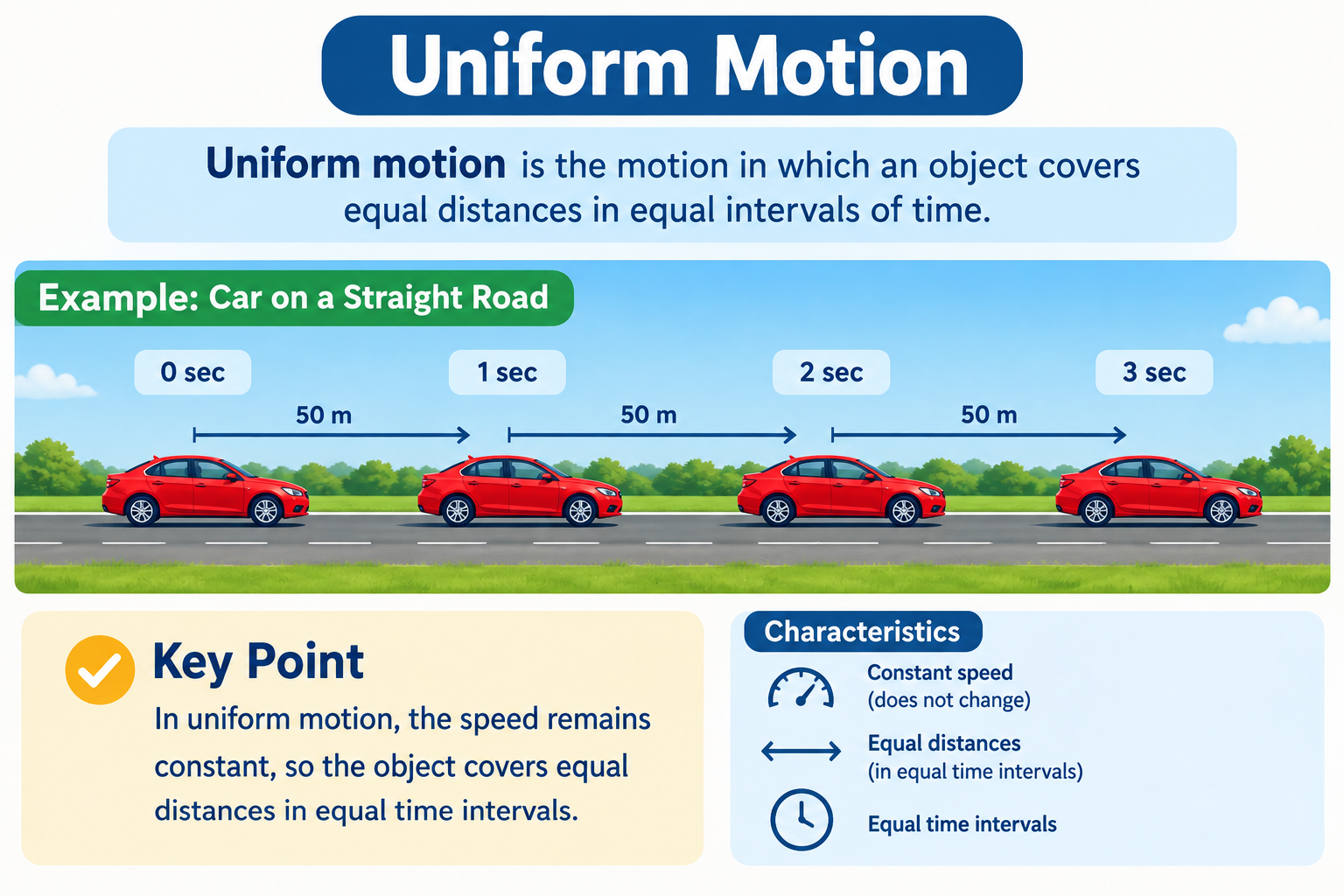
In physics, uniform motion is defined as motion in which an object moves in a straight line and covers equal distances in equal intervals of time.
The two essential conditions are:
- Constant speed — the object covers the same distance every second (or every minute, or every hour — whatever the chosen time interval).
- Straight-line path — the direction of motion does not change.
Together, these two conditions mean that the velocity of the object is completely constant — both in magnitude (speed) and in direction. Nothing about the motion changes over time.
A simple example:
A car moving at exactly 20 m/s in a straight line covers 20 metres in every second — the first second, the fifth second, the tenth second. There is no speeding up, no slowing down, no turning. This is uniform motion.
Another example:
A marble rolling along a perfectly smooth, perfectly straight groove at 3 m/s. Every second, it covers exactly 3 metres. Its direction never changes. Its speed never changes. It is in uniform motion.
The key word throughout is constant. Constant speed, constant direction, constant velocity. The moment any of these changes, the motion becomes non-uniform.
Formal Definition and Key Characteristics
Formal definition:
Uniform motion is motion in which an object travels in a straight line with a constant velocity — covering equal distances in equal time intervals — with zero acceleration.
Key characteristics:
- Equal distances in equal time intervals: If you measure the position of the object every second, the gap between consecutive positions is always the same.
- Constant speed: The magnitude of velocity does not change.
- Constant direction: The object moves along a straight line throughout.
- Constant velocity: Both speed and direction are constant — velocity as a whole does not change.
- Zero acceleration: Since velocity is constant, there is no change in velocity over time, so acceleration is zero.
- Zero net force: By Newton’s first law, zero acceleration means zero net force on the object.
- Straight-line distance-time graph: The graph of distance against time is a straight line with a constant, non-zero gradient.
- Horizontal velocity-time graph: The graph of velocity against time is a horizontal straight line.
Every one of these characteristics follows logically from the others. They are all different ways of describing the same fundamental situation: an object moving without changing its motion in any way.
Conditions Required for Uniform Motion
For an object to undergo true uniform motion, two fundamental conditions must be satisfied simultaneously.
Condition 1: Zero Net Force
According to Newton’s first law of motion, an object will continue in uniform motion only if the net force acting on it is zero. This means all forces acting on the object must be perfectly balanced — they must cancel each other out entirely.
If even the slightest unbalanced force acts on the object, it will accelerate (or decelerate), and the motion will become non-uniform.
In practice, achieving a net force of exactly zero is extremely difficult because forces like gravity, friction, and air resistance are almost always present and rarely perfectly balanced. This is why truly perfect uniform motion is an idealised concept.
Condition 2: No Change in Direction
The object must move in a straight line. If the direction changes at all — even while the speed stays the same — the velocity changes, and the motion is no longer uniform.
This is why circular motion at constant speed is not classified as uniform motion: the direction changes continuously, even if the speed does not.
Both conditions — zero net force and straight-line motion — must hold simultaneously and continuously for the motion to remain uniform.
Uniform Motion vs Non-Uniform Motion
The contrast between uniform and non-uniform motion is one of the most fundamental distinctions in physics.
| Feature | Uniform Motion | Non-Uniform Motion |
|---|---|---|
| Speed | Constant throughout | Changes over time |
| Direction | Constant — straight line | May change |
| Velocity | Constant (magnitude and direction) | Changes at some or all points |
| Acceleration | Zero | Non-zero (at least at some points) |
| Net force | Zero | Non-zero |
| Distance per time interval | Equal | Unequal |
| Distance-time graph | Straight line with constant gradient | Curved line |
| Velocity-time graph | Horizontal straight line | Sloping or curved line |
| Real-world prevalence | Rare — idealised | The norm in everyday experience |
The most important difference is this: uniform motion requires zero net force and produces zero acceleration, while non-uniform motion requires a non-zero net force and produces non-zero acceleration.
For a comprehensive exploration of non-uniform motion and how it differs in graphs and calculations, the LearnMinto article What Is Non-Uniform Motion? covers every aspect in detail.
Uniform Motion and Newton’s First Law
Uniform motion is the direct physical expression of Newton’s First Law of Motion, which states:
“An object at rest remains at rest, and an object in motion remains in motion with the same speed and in the same direction, unless acted upon by an unbalanced external force.”
This law — sometimes called the Law of Inertia — tells us that uniform motion is the natural state of objects. An object does not need a force to keep moving at constant velocity. It only needs a force to change its velocity.
This was a revolutionary idea when Newton proposed it. Before Newton, many people assumed that a constant force was needed to maintain constant motion. Newton showed that this is wrong — constant motion requires zero net force, not constant force.
Inertia is the property of matter that causes it to resist changes in motion. An object with large mass has large inertia — it is harder to accelerate and harder to stop. But once in uniform motion, all objects (regardless of mass) will continue in that motion indefinitely, provided no net force acts on them.
Understanding how force connects to the maintenance of uniform motion is explored thoroughly in What Is Force in Physics?
Speed and Velocity in Uniform Motion
In uniform motion, it is important to be precise about the quantities involved.
Speed:
Speed is a scalar quantity — it has magnitude only. In uniform motion, speed is constant throughout. The object covers the same distance per unit time, always.
Velocity:
Velocity is a vector quantity — it has both magnitude and direction. In uniform motion, velocity is completely constant. This means both the speed (magnitude) and the direction of motion are unchanged.
This distinction matters because it defines the boundary between uniform and non-uniform motion:
- If speed changes but direction stays the same → non-uniform motion
- If direction changes but speed stays the same → still non-uniform motion (velocity has changed)
- If both speed and direction remain constant → uniform motion
Example:
A ball rolling east at 5 m/s has a velocity of 5 m/s east. If it continues rolling east at exactly 5 m/s, it is in uniform motion. If it turns north while maintaining 5 m/s, it is now in non-uniform motion — velocity has changed even though speed has not.
The Formula for Uniform Motion
Because speed is constant in uniform motion, the formula relating distance, speed, and time is straightforward:
s = d / t
Or equivalently:
d = s × t
Where:
- d = distance covered (metres, m)
- s = speed (metres per second, m/s)
- t = time elapsed (seconds, s)
This formula applies perfectly in uniform motion because the speed never changes — you can use any time interval and the result will always be the same.
Example 1:
A car moves at a constant 30 m/s. How far does it travel in 12 seconds?
d = s × t = 30 × 12 = 360 m
Example 2:
A train covers 450 km at a constant speed of 150 km/h. How long does the journey take?
t = d/s = 450/150 = 3 hours
Example 3:
A cyclist takes 40 seconds to cover 280 m at constant speed. What is their speed?
s = d/t = 280/40 = 7 m/s
Because speed is constant, there is no need for average speed calculations or SUVAT equations. A single, simple formula handles every uniform motion calculation.
Distance-Time Graphs for Uniform Motion
The distance-time graph is one of the most important tools for visualising and analysing motion. For uniform motion, the graph has a distinctive and easily recognisable shape.
Shape:
A distance-time graph for uniform motion is a straight line with a constant, positive gradient.
The line starts at the initial position of the object and rises steadily — covering equal additional distance for every equal step in time.
What the gradient tells you:
The gradient (slope) of the distance-time graph equals the speed of the object.
Gradient = speed = Δd / Δt = rise / run
A steeper gradient means greater speed. A shallower gradient means smaller speed. A horizontal line (zero gradient) means the object is stationary — a special case where speed is zero.
Reading different sections:
| Section of Graph | Meaning |
|---|---|
| Straight line with positive gradient | Uniform motion — constant speed |
| Horizontal straight line | Stationary — speed is zero |
| Straight line with steeper gradient | Faster uniform motion |
| Straight line with shallower gradient | Slower uniform motion |
| Curved line | Non-uniform motion — speed is changing |
Example:
A distance-time graph shows a straight line passing through (0 s, 0 m) and (10 s, 80 m).
Gradient = speed = (80 − 0) / (10 − 0) = 80/10 = 8 m/s
The object is moving at a constant speed of 8 m/s — uniform motion.
Velocity-Time Graphs for Uniform Motion
A velocity-time graph plots velocity on the vertical axis against time on the horizontal axis.
Shape for uniform motion:
A velocity-time graph for uniform motion is a horizontal straight line at a constant, non-zero value.
The line never goes up (no acceleration) and never goes down (no deceleration). It sits at a constant height equal to the speed of the object.
What the graph tells you:
- Gradient of the velocity-time graph = acceleration. In uniform motion, the gradient is zero (horizontal line), confirming zero acceleration.
- Area under the velocity-time graph = displacement. For a horizontal line over time t at velocity v, the area is a rectangle: displacement = v × t.
Comparing different scenarios:
| Velocity-Time Graph Feature | Meaning |
|---|---|
| Horizontal line at constant value | Uniform motion — constant velocity |
| Horizontal line at zero | Object is stationary |
| Line sloping upward | Uniform acceleration (non-uniform motion) |
| Line sloping downward | Uniform deceleration (non-uniform motion) |
| Curved line | Non-uniform acceleration (non-uniform motion) |
Example:
A velocity-time graph shows a horizontal line at v = 15 m/s from t = 0 to t = 8 s.
Acceleration = gradient = 0 m/s² (horizontal line confirms zero acceleration)
Displacement = area = 15 × 8 = 120 m
Acceleration in Uniform Motion
Acceleration is defined as the rate of change of velocity:
a = Δv / t = (v − u) / t
In uniform motion, velocity does not change. Therefore:
Δv = v − u = 0
a = 0 / t = 0 m/s²
Acceleration is always zero in uniform motion.
This is not a coincidence — it is a defining feature. If there were any acceleration (positive or negative), the velocity would be changing, and the motion would not be uniform.
This zero acceleration also means:
- No net force acts on the object (F = ma = m × 0 = 0 N).
- The distance-time graph is straight, not curved.
- The velocity-time graph is horizontal, not sloping.
- The SUVAT equations reduce to simple forms: with a = 0, s = ut + ½at² becomes s = ut (distance = speed × time).
Uniform Motion in a Straight Line
The phrase “uniform motion in a straight line” is used frequently in physics because it captures the complete definition concisely. Both conditions — constant speed and straight-line direction — must be met simultaneously.
Why must it be a straight line?
If an object moves in a curve, its direction changes continuously. A change in direction means a change in velocity (since velocity is a vector). A change in velocity means acceleration is present. Acceleration means non-zero net force. Therefore, curved motion cannot be uniform motion.
The only possible path for truly uniform motion is a straight line — in one consistent direction, at constant speed, forever (or until a net force acts to change it).
Uniform rectilinear motion:
In more advanced physics, uniform motion in a straight line is sometimes called uniform rectilinear motion (from the Latin rectus, meaning straight). This term emphasises both the constant velocity and the straight-line path.
Is Circular Motion at Constant Speed Uniform Motion?
This is one of the most commonly tested conceptual questions in introductory physics, and the answer is clear:
No. Circular motion at constant speed is NOT uniform motion.
Here is the reasoning:
- In circular motion, the object’s speed remains constant (the speedometer reading never changes).
- However, the direction of motion changes continuously — at every point on the circle, the object is moving in a different direction.
- Since velocity is a vector (magnitude AND direction), a change in direction means a change in velocity.
- A change in velocity means there is acceleration — specifically, centripetal acceleration directed towards the centre of the circle.
- Acceleration requires a net force — in circular motion, this is the centripetal force.
- Because there is a non-zero net force and non-zero acceleration, the motion is non-uniform.
Summary:
| Quantity | In Circular Motion at Constant Speed |
|---|---|
| Speed | Constant |
| Direction | Continuously changing |
| Velocity | Continuously changing |
| Acceleration | Non-zero (centripetal) |
| Net force | Non-zero (centripetal force) |
| Classification | Non-uniform motion |
A satellite orbiting Earth at constant speed, a car going around a roundabout at steady speed, a ball on a string swung in a circle — all of these are non-uniform motion, despite constant speed.
Uniform Motion and Force
The relationship between uniform motion and force is direct and fundamental.
Newton’s Second Law: F = ma
In uniform motion, a = 0, therefore:
F_net = m × 0 = 0 N
The net force on an object in uniform motion is always zero. This does not mean no forces act on the object — it means all forces perfectly cancel each other out.
Examples of balanced forces in uniform motion:
A book on a table (stationary — special case of uniform motion at zero speed):
- Weight of the book acts downward.
- Normal reaction force from the table acts upward.
- Net force = 0.
A car moving at constant speed on a straight road:
- Driving force from the engine acts forward.
- Air resistance and friction act backward.
- If driving force = air resistance + friction, net force = 0, and the car is in uniform motion.
A parachutist at terminal speed (moving down at constant speed):
- Weight acts downward.
- Drag force from air resistance acts upward.
- When drag = weight, net force = 0 → uniform motion (constant terminal speed).
In all these cases, forces are present — but they balance perfectly. The result is zero net force and uniform motion.
The concept of how forces balance to produce uniform motion is explored in depth in What Is Force in Physics?
Uniform Motion and Friction
Friction is one of the primary forces that prevents uniform motion in everyday situations. It acts opposite to the direction of motion and tends to decelerate objects — making their motion non-uniform.
How friction disrupts uniform motion:
A ball rolling along a rough floor slows down because friction converts kinetic energy into heat. The ball’s speed decreases over time — non-uniform motion.
How friction can enable uniform motion:
Paradoxically, friction can also maintain uniform motion. A car moving at constant speed on a straight road requires a driving force from the engine. This driving force overcomes friction and air resistance exactly. If the driving force equals the total resistive forces, the net force is zero — uniform motion is maintained.
Friction and surfaces:
On a perfectly frictionless surface (an idealisation that does not exist in the real world), an object given an initial push would continue in uniform motion indefinitely. This is the scenario Newton described in his first law. The energy lost through friction in real situations is converted to heat — a concept connected to What Is Heat Energy?
Key point:
Friction is not the enemy of all motion — it is the enemy of effortless uniform motion. Overcoming it requires an equal and opposite applied force to maintain the balance that uniform motion demands.
Uniform Motion and Energy
An object in uniform motion has a constant speed, which means it has a constant kinetic energy throughout its motion.
Kinetic energy formula:
KE = ½mv²
Since both m (mass) and v (speed) are constant during uniform motion, KE remains unchanged. The object neither gains nor loses kinetic energy.
This also means:
- No net work is being done on the object (by Newton’s work-energy theorem: net work = change in KE = 0).
- If applied forces do positive work (like a car engine), the resistive forces do equal negative work (like friction and air resistance), so the net work is zero.
- The total mechanical energy of the object (kinetic + potential, in the absence of height change) remains constant.
Potential energy:
If the object moves horizontally at constant speed, its height does not change and its gravitational potential energy (GPE = mgh) remains constant as well. Total mechanical energy is fully conserved.
If the object moves on a slope at constant speed (for example, a car driving up a hill at constant speed), it gains gravitational potential energy — meaning the engine must do extra work against both friction and gravity to maintain uniform motion.
The connection between energy, work, and motion is explored further in What Is Kinetic Energy? and What Is Work in Physics?
Uniform Motion at Different Scales
Uniform motion appears (or is closely approximated) across a wide range of physical scales.
Human scale:
A person walking at a steady pace along a straight path approximates uniform motion over short time intervals.
Vehicle scale:
A car on cruise control on a straight motorway, or a train between stations on a straight track, closely approximates uniform motion.
Planetary scale:
The planets of the solar system move in approximately elliptical orbits. Over short sections of these orbits, their motion approximates uniform motion — but it is never truly uniform because the direction continuously changes (elliptical path) and speed varies slightly.
Cosmic scale:
Light travels through a vacuum at a constant speed of approximately 3 × 10⁸ m/s in a straight line. This is one of the closest physical approximations to true uniform motion — constant speed, constant direction, for enormous distances.
Atomic scale:
In certain quantum mechanical models, electrons in an atom can be described as having constant energy states — an analogy (though imperfect) to the stability of uniform motion.
The universal principle is the same at every scale: where forces are balanced or absent, motion tends toward uniformity.
Real-Life Examples of Uniform Motion
True uniform motion is an idealisation — but many real situations approximate it closely enough to be usefully described as uniform motion.
A train on a straight, level track at constant speed:
Between two stations on a flat, straight section of track, a modern train can maintain a very nearly constant speed for extended periods. Cruise control systems, engine management, and straight tracks all contribute to this approximation of uniform motion.
Light travelling through a vacuum:
Electromagnetic radiation — including visible light, radio waves, and X-rays — travels through a vacuum at exactly c ≈ 3 × 10⁸ m/s in a straight line. This is one of the most precise examples of uniform motion known to physics. No force acts on light in a vacuum to change its speed or direction.
A satellite in a circular orbit (approximately):
A satellite orbiting Earth at constant altitude moves at approximately constant speed. However, as discussed earlier, because its direction continuously changes, this is technically non-uniform motion — but the speed component is constant and the orbit is a useful approximation in many contexts.
A hockey puck on ice:
A puck sliding across a very smooth ice surface after being struck experiences minimal friction and air resistance. For a short period, it moves in a nearly straight line at nearly constant speed — a close approximation to uniform motion.
A ball rolling in a frictionless tube:
In an idealised physics problem, a ball rolling through a frictionless straight tube with no air resistance would continue indefinitely at constant speed — perfect uniform motion.
A parachutist at terminal speed:
Once a parachutist’s drag force equals their weight, they fall at a constant terminal speed in a straight (vertical) line. This is uniform motion — but only at that exact moment of balance. Any change in posture or altitude (and therefore air density) would shift the balance and make the motion non-uniform again.
A car on cruise control on a flat, straight motorway:
Modern cruise control systems adjust the throttle continuously to maintain a set speed. On a flat, straight road with minimal wind, this closely approximates uniform motion.
Sound waves in a uniform medium:
Sound travels through a uniform medium (such as still air at constant temperature) at a constant speed — approximately 343 m/s in air at 20°C. Along a straight path, this is uniform motion. The connection between wave speed, distance, and time follows directly from the uniform motion formula.
Approximate Uniform Motion in Practice
Because perfect uniform motion requires conditions (zero net force, perfectly straight path) that are almost impossible to achieve in the real world, physicists often work with approximate uniform motion — situations where the departures from perfect uniformity are small enough to be ignored without significantly affecting the accuracy of calculations.
When is the approximation valid?
- When friction and air resistance are small compared to other forces (for example, a heavy train on a straight track).
- Over short time intervals during which speed and direction changes are negligible.
- When the path is nearly straight (a long straight road approximates a straight line even though Earth’s surface is slightly curved).
- When the speed variation is small relative to the average speed (a runner maintaining “constant” pace still varies slightly, but the approximation of uniform motion gives useful results).
Why use the approximation?
Treating motion as uniform simplifies calculations enormously. If the approximation is valid within the precision required, it is far more efficient to use s = d/t than to apply complex equations for varying acceleration.
This pragmatic use of idealised models is central to how physics works. Understanding when an approximation is justified — and when it is not — is an important scientific skill.
Common Mistakes When Understanding Uniform Motion
1. Thinking that uniform motion means the object is moving fast
Uniform motion has nothing to do with how fast an object is moving. An object moving at 0.001 m/s in a straight line at constant speed is in uniform motion. An object moving at 100 m/s in a curve is not.
2. Assuming zero acceleration means zero velocity
Zero acceleration means zero change in velocity — the velocity is constant. The velocity could be zero (object is stationary) or any non-zero constant value. A stationary object is actually a special case of uniform motion where v = 0.
3. Thinking circular motion at constant speed is uniform motion
Speed and velocity are different. Constant speed in circular motion does not mean constant velocity, because the direction continuously changes. Without constant velocity, the motion is not uniform.
4. Confusing “no net force” with “no force”
In uniform motion, the net force is zero — but individual forces may still be present and acting on the object. A car driving at constant speed has engine force forward and friction/air resistance backward. These balance — the net force is zero — and the motion is uniform.
5. Misreading a flat section on a distance-time graph
A horizontal (flat) line on a distance-time graph means the object is stationary — it has zero velocity. This is not the same as uniform motion with constant non-zero velocity. Uniform motion shows as a straight line with a positive (non-zero) gradient.
6. Misreading the velocity-time graph
Some students confuse a horizontal line on a velocity-time graph (uniform motion — constant velocity, zero acceleration) with a horizontal line on a distance-time graph (stationary). These two graphs tell you different things with the same shape.
7. Applying SUVAT equations with a non-zero acceleration to uniform motion
In uniform motion, a = 0. The SUVAT equations all reduce to s = vt (distance = speed × time). Using SUVAT with any non-zero acceleration for a uniform motion problem produces incorrect results.
8. Assuming that uniform motion is the common state of objects in the real world
In reality, uniform motion is rare because forces such as gravity, friction, and air resistance are almost always present and almost never perfectly balanced. Non-uniform motion is far more common in practice.
How Uniform Motion Connects to Other Physics Topics
Uniform motion is not an isolated concept. It connects fundamentally to almost every major area of classical physics.
Newton’s Laws: Uniform motion is the direct expression of Newton’s first law. Newton’s second law (F = ma) confirms that zero net force produces zero acceleration — the condition for uniform motion.
Speed and distance: The formula d = s × t, the most basic formula in kinematics, applies perfectly and simply in uniform motion. Understanding What Is Speed in Physics? provides the foundation for applying this formula correctly.
Displacement and velocity: In uniform motion, displacement and distance are equal in magnitude (since the path is straight), and speed equals the magnitude of velocity. Understanding What Is Displacement in Physics? helps clarify these vector-scalar relationships.
Momentum: An object in uniform motion has constant momentum (p = mv, both m and v constant). By Newton’s second law in momentum form (F = Δp/Δt), zero net force means zero rate of change of momentum — consistent with constant momentum in uniform motion. See What Is Momentum? for a full treatment.
Energy: Constant speed means constant kinetic energy. No net work is done on the object. Energy is conserved without transformation.
Waves: Waves propagating through a uniform medium travel at constant speed — uniform motion for the wave pattern itself.
Non-uniform motion: Understanding uniform motion makes non-uniform motion far easier to understand by contrast. The differences in graphs, acceleration, and force requirements define each concept against the other.
Worked Examples
Example 1: Basic uniform motion calculation
A cyclist rides at a constant speed of 12 m/s in a straight line. How far do they travel in 25 seconds?
d = s × t = 12 × 25 = 300 m
Example 2: Finding time
A train travels at a constant 90 km/h. How long does it take to cover 360 km?
t = d/s = 360/90 = 4 hours
Example 3: Finding speed
A ball rolls in a straight line and covers 135 m in 15 seconds at constant speed. What is its speed?
s = d/t = 135/15 = 9 m/s
Example 4: Identifying uniform motion from data
An object’s position is recorded every second: 0 m, 8 m, 16 m, 24 m, 32 m.
Equal distances of 8 m are covered each second. Direction is constant (increasing position).
This is uniform motion at 8 m/s.
Example 5: Distance-time graph gradient
A distance-time graph shows a straight line from (0 s, 0 m) to (12 s, 96 m).
Gradient = speed = (96 − 0)/(12 − 0) = 96/12 = 8 m/s
The constant gradient confirms uniform motion.
Example 6: Velocity-time graph — finding displacement
A velocity-time graph shows a horizontal line at 20 m/s from t = 0 to t = 15 s.
Acceleration = gradient = 0 (horizontal line confirms uniform motion)
Displacement = area = 20 × 15 = 300 m
Example 7: Net force in uniform motion
A car of mass 1,200 kg moves at a constant 30 m/s on a straight road. A friction force of 400 N acts backward. What is the driving force from the engine?
Since motion is uniform, a = 0 and net force = 0.
Driving force = friction force = 400 N (forward, to balance friction)
Example 8: Kinetic energy in uniform motion
A van of mass 2,000 kg moves at constant 15 m/s. What is its kinetic energy throughout the journey?
KE = ½mv² = ½ × 2,000 × 225 = 225,000 J
This value remains constant throughout (constant speed → constant KE).
Example 9: Converting units for uniform motion calculation
A car travels at a constant 108 km/h. Convert to m/s and find the distance covered in 5 minutes.
Speed: 108 ÷ 3.6 = 30 m/s
Time: 5 minutes = 300 seconds
Distance: d = 30 × 300 = 9,000 m (9 km)
Example 10: Checking whether motion is uniform from a table
| Time (s) | Distance (m) |
|---|---|
| 0 | 0 |
| 2 | 14 |
| 4 | 28 |
| 6 | 42 |
| 8 | 56 |
Distance increases by 14 m every 2 seconds — equal distances in equal time intervals.
Speed = 14/2 = 7 m/s. This is uniform motion.
Example 11: Two objects in uniform motion
Car A travels at 20 m/s and Car B at 30 m/s, both in straight lines. They start from the same point at the same time. How far apart are they after 1 minute?
Distance by A = 20 × 60 = 1,200 m
Distance by B = 30 × 60 = 1,800 m
Separation = 1,800 − 1,200 = 600 m
Example 12: Light travelling in uniform motion
Light travels at 3 × 10⁸ m/s. How long does it take light to travel from the Moon to Earth (distance ≈ 3.84 × 10⁸ m)?
t = d/s = (3.84 × 10⁸)/(3 × 10⁸) = 1.28 seconds
Example 13: Uniform motion and momentum
A ball of mass 0.5 kg moves at a constant 6 m/s. What is its momentum? Does the momentum change during uniform motion?
p = mv = 0.5 × 6 = 3 kg m/s
Since velocity is constant during uniform motion, momentum remains constant at 3 kg m/s throughout.
Example 14: Force balance in uniform motion
A boat moves at constant speed along a straight canal. The engine provides a forward force of 800 N. Water resistance acts backward. What is the water resistance?
Net force = 0 (uniform motion) → Water resistance = 800 N
Example 15: Reading uniform motion from a distance-time graph
A distance-time graph shows two straight-line sections: from (0 s, 0 m) to (5 s, 40 m), then from (5 s, 40 m) to (10 s, 40 m).
Section 1: Gradient = 40/5 = 8 m/s — uniform motion at 8 m/s.
Section 2: Gradient = 0/5 = 0 m/s — the object is stationary. This is technically uniform motion at v = 0, i.e., at rest.
Practice Questions
Work through each question independently. Answers are provided below.
Basic calculations.
- An object moves at constant 5 m/s in a straight line. How far does it travel in 30 seconds?
- A car travels 240 km at a constant speed of 80 km/h. How long does the journey take?
- A ball rolls 72 m in 9 seconds at constant speed. What is the speed?
- A plane flies at constant 250 m/s. How far does it travel in 2 minutes?
- How long does light take to travel 1.5 × 10¹¹ m at 3 × 10⁸ m/s?
Identifying uniform motion.
- An object covers 12 m, 12 m, 12 m, and 12 m in consecutive seconds. Is this uniform motion?
- An object covers 5 m, 8 m, 11 m, 14 m in consecutive seconds. Is this uniform motion?
- A car moves around a circular track at constant 40 km/h. Is this uniform motion? Explain.
Graphs.
- A distance-time graph shows a straight line from (0 s, 0 m) to (8 s, 64 m). What is the speed?
- A distance-time graph shows a horizontal line at 30 m from t = 4 s to t = 9 s. What is the speed in this section?
- A velocity-time graph shows a horizontal line at 12 m/s from t = 0 to t = 10 s. What is the displacement? What is the acceleration?
Forces in uniform motion.
- A car moves at constant speed. The engine force is 1,200 N forward. Air resistance is 700 N. What must the friction force be?
- A boat moves at constant speed. Water resistance is 600 N. What is the engine thrust?
- An object in uniform motion has mass 5 kg. What is the net force?
Energy and momentum.
- A car (mass 1,500 kg) moves at constant 20 m/s. What is its kinetic energy?
- Does a car in uniform motion gain or lose kinetic energy? Explain.
- A ball (mass 0.3 kg) moves at constant 10 m/s. What is its momentum?
Unit conversions.
- Convert 54 km/h to m/s.
- Convert 25 m/s to km/h.
- A car moves at constant 72 km/h. How far does it travel in 15 minutes? Give your answer in metres.
Word problems.
- A train travels between two cities 480 km apart at a constant 120 km/h. What is the journey time?
- Sound travels at 340 m/s through still air. How long does it take for sound to travel 5,100 m?
- A satellite in circular orbit travels at 7,700 m/s. Its orbital circumference is 4.4 × 10⁷ m. How long does one orbit take?
- Two runners start at the same point and run in the same straight direction. Runner A runs at 4 m/s and Runner B at 6 m/s. How far apart are they after 5 minutes?
- A car in uniform motion has a driving force of 900 N. Friction is 350 N. What is the air resistance?
Answers:
- d = 5 × 30 = 150 m
- t = 240/80 = 3 hours
- s = 72/9 = 8 m/s
- t = 2 × 60 = 120 s; d = 250 × 120 = 30,000 m (30 km)
- t = (1.5 × 10¹¹)/(3 × 10⁸) = 500 seconds (about 8 minutes 20 seconds)
- Yes — uniform motion. Equal distances (12 m) in equal time intervals (1 s each).
- No — non-uniform motion. The distances increase by 3 m each second — unequal distances.
- No — not uniform motion. Speed is constant but direction continuously changes → velocity changes → non-uniform motion.
- Speed = gradient = 64/8 = 8 m/s
- Speed = gradient = 0/5 = 0 m/s (object is stationary)
- Displacement = area = 12 × 10 = 120 m; Acceleration = gradient = 0 m/s²
- Net force = 0 → Friction + Air resistance = Engine force → Friction = 1,200 − 700 = 500 N
- Engine thrust = Water resistance = 600 N (net force = 0)
- Net force = m × a = 5 × 0 = 0 N
- KE = ½ × 1,500 × 400 = 300,000 J
- Neither — kinetic energy remains constant because speed is constant (KE = ½mv², both m and v unchanged).
- p = mv = 0.3 × 10 = 3 kg m/s
- 54 ÷ 3.6 = 15 m/s
- 25 × 3.6 = 90 km/h
- 72 km/h = 20 m/s; t = 15 × 60 = 900 s; d = 20 × 900 = 18,000 m
- t = 480/120 = 4 hours
- t = 5,100/340 = 15 seconds
- t = d/s = (4.4 × 10⁷)/7,700 ≈ 5,714 seconds ≈ 95.2 minutes
- In 5 min = 300 s: A covers 4 × 300 = 1,200 m; B covers 6 × 300 = 1,800 m; Separation = 600 m
- Net force = 0 → Air resistance = 900 − 350 = 550 N
Multiple-Choice Questions
Question 1: Which of the following best defines uniform motion?
A) Motion in which speed increases steadily over time
B) Motion in which an object moves in a straight line with constant velocity
C) Motion in which an object moves in any direction at constant speed
D) Motion in which no forces act on the object
Correct Answer: B — Motion in which an object moves in a straight line with constant velocity
Uniform motion requires both constant speed (magnitude of velocity) and constant direction (straight line). Both conditions must be met.
Question 2: What is the acceleration of an object in uniform motion?
A) Positive and constant
B) Negative and constant
C) Zero
D) Changing over time
Correct Answer: C — Zero
In uniform motion, velocity is constant — no change in velocity means zero acceleration.
Question 3: Which graph shape represents uniform motion on a distance-time graph?
A) A curved line getting steeper
B) A horizontal flat line
C) A straight line with a constant positive gradient
D) A curved line getting shallower
Correct Answer: C — A straight line with a constant positive gradient
Uniform motion produces a straight line on a distance-time graph. The constant gradient equals the constant speed. A flat line means stationary, not uniform motion.
Question 4: A car moves at constant 25 m/s in a straight line. What distance does it cover in 40 seconds?
A) 625 m
B) 65 m
C) 1,000 m
D) 0.625 m
Correct Answer: C — 1,000 m
d = s × t = 25 × 40 = 1,000 m.
Question 5: For uniform motion to be maintained, what must be true about the net force?
A) It must be large and constant
B) It must be in the direction of motion
C) It must be zero
D) It must equal the weight of the object
Correct Answer: C — It must be zero
Newton’s first law: an object continues in uniform motion only when the net force is zero. Any non-zero net force produces acceleration and therefore non-uniform motion.
Question 6: A velocity-time graph shows a horizontal line at 18 m/s for 6 seconds. What does this represent?
A) Uniform acceleration
B) Non-uniform motion
C) Uniform motion with zero acceleration
D) Deceleration
Correct Answer: C — Uniform motion with zero acceleration
A horizontal velocity-time graph means constant velocity and zero gradient — zero acceleration. This is uniform motion.
Question 7: A car engine provides 1,000 N forward. Air resistance is 600 N and friction is 400 N. Is the car in uniform motion?
A) Yes — the net force is zero
B) No — the engine force exceeds the resistive forces
C) Yes — because the car is moving
D) No — friction always prevents uniform motion
Correct Answer: A — Yes — the net force is zero
Total resistive forces = 600 + 400 = 1,000 N. Engine force = 1,000 N. Net force = 1,000 − 1,000 = 0 N → uniform motion.
Question 8: Which of the following is the closest real-world approximation of uniform motion?
A) A ball rolling down a hill
B) A car braking at traffic lights
C) Light travelling through a vacuum
D) A swinging pendulum
Correct Answer: C — Light travelling through a vacuum
Light travels at a constant speed of 3 × 10⁸ m/s in a straight line through a vacuum — one of the best physical approximations of true uniform motion.
Question 9: An object covers 15 m, 20 m, 25 m, and 30 m in consecutive seconds. Is this uniform motion?
A) Yes — the distances are increasing steadily
B) No — the distances are not equal in consecutive seconds
C) Yes — the speed is positive throughout
D) No — the object is decelerating
Correct Answer: B — No — the distances are not equal in consecutive seconds
In uniform motion, equal distances must be covered in equal time intervals. Here, the distances increase by 5 m each second — this is uniformly accelerated non-uniform motion.
Question 10: A ball of mass 2 kg moves at constant 8 m/s. What is its kinetic energy, and does it change during uniform motion?
A) KE = 64 J; it increases over time
B) KE = 32 J; it remains constant
C) KE = 64 J; it remains constant
D) KE = 16 J; it decreases over time
Correct Answer: C — KE = 64 J; it remains constant
KE = ½ × 2 × 64 = 64 J. Since speed is constant in uniform motion, KE = ½mv² remains constant throughout.
Challenge Questions
Challenge 1: A car travels along a straight motorway. Between two speed cameras 1,200 m apart, the car takes 48 seconds to pass. A second car covers the same distance in 40 seconds.
(a) What is the average speed of each car?
(b) Are either or both cars in uniform motion? What assumption must be made?
(c) If the speed limit is 31 m/s, which car (if either) is likely speeding?
(a)
Car A: s = 1,200/48 = 25 m/s
Car B: s = 1,200/40 = 30 m/s
(b) The speed cameras give average speed over the 1,200 m section. We cannot confirm uniform motion from this data alone — we can only confirm the average speed. To treat either car as being in uniform motion requires the assumption that their speed was constant throughout the measured section.
(c) Car A (25 m/s) is below the 31 m/s limit. Car B (30 m/s) is also below the limit. Neither car is conclusively speeding based on average speed alone. However, if Car B’s instantaneous speed at any point exceeded 31 m/s, it could still have been speeding.
Challenge 2: Two trains start from opposite ends of a 300 km straight track at the same time. Train A moves at 80 km/h and Train B moves at 70 km/h towards each other. Both are in uniform motion.
(a) When do they meet?
(b) How far has each train travelled when they meet?
(c) What is the speed of Train A relative to Train B?
(a) Combined speed = 80 + 70 = 150 km/h
Time = 300/150 = 2 hours
(b)
Train A: d = 80 × 2 = 160 km
Train B: d = 70 × 2 = 140 km
Check: 160 + 140 = 300 km ✓
(c) Relative speed = 80 + 70 = 150 km/h (they are moving towards each other, so speeds add)
Challenge 3: A car in uniform motion has a driving force of 1,500 N. The coefficient of friction between the tyres and the road is such that friction = 900 N. What is the air resistance force? If the car’s speed is 30 m/s, what power is the engine producing?
Net force = 0 (uniform motion)
Air resistance = 1,500 − 900 = 600 N
Power = Force × Speed = 1,500 × 30 = 45,000 W (45 kW)
Challenge 4: An object moves along a straight line. Its position x at time t is given by the equation:
x = 5t + 3
(where x is in metres and t is in seconds)
(a) What is the velocity of the object?
(b) Is this uniform motion? How do you know?
(c) What is the object’s position at t = 0? What does this represent?
(d) What is the acceleration?
(a) The equation x = 5t + 3 is linear in t. The rate of change of position (velocity) = the coefficient of t = 5 m/s
(b) Yes — this is uniform motion. The velocity is constant at 5 m/s (the gradient of x with respect to t is constant at 5). Equal distances are covered in equal time intervals.
(c) At t = 0: x = 5(0) + 3 = 3 m. This represents the initial position of the object — it started 3 metres from the reference point (origin), not at the origin.
(d) Since velocity is constant, acceleration = 0 m/s².
Challenge 5: A spaceship far from any significant gravitational field is moving at 2,000 m/s in a straight line. The engines are switched off. An astronaut of mass 70 kg is inside.
(a) What happens to the spaceship’s motion after the engines are switched off?
(b) What is the net force on the spaceship?
(c) What is the momentum of the astronaut inside the spaceship? (Assume the spaceship is also moving at 2,000 m/s.)
(d) If the spaceship fires a brief thruster burst that increases its speed to 2,500 m/s, what was the impulse applied to the astronaut?
(a) The spaceship continues in uniform motion at 2,000 m/s in a straight line. Far from any gravitational field, there are no significant forces acting on it. By Newton’s first law, it maintains constant velocity indefinitely.
(b) Net force = 0 N (uniform motion confirmed — no forces acting)
(c) p = mv = 70 × 2,000 = 140,000 kg m/s (1.4 × 10⁵ kg m/s)
(d) Impulse = change in momentum = m × Δv = 70 × (2,500 − 2,000) = 70 × 500 = 35,000 N s (3.5 × 10⁴ N s)
Quick Revision Notes
- Uniform motion = constant velocity = constant speed in a straight line.
- Object covers equal distances in equal time intervals.
- Acceleration = 0 in uniform motion.
- Net force = 0 in uniform motion (Newton’s first law).
- Forces may be present — they just perfectly balance each other.
- Formula: d = s × t (constant speed throughout).
- Distance-time graph: straight line with constant gradient = speed.
- Velocity-time graph: horizontal straight line at constant v; gradient = 0; area = displacement.
- Kinetic energy is constant in uniform motion (constant speed).
- Momentum is constant in uniform motion (constant velocity).
- Circular motion at constant speed is NOT uniform motion — direction changes.
- A stationary object is a special case of uniform motion (v = 0, a = 0, F_net = 0).
- Uniform motion is an idealisation — approximated but rarely achieved perfectly in reality.
- Light in a vacuum is the best physical example of uniform motion.
Uniform Motion Cheat Sheet
| Concept | Formula / Rule | Notes |
|---|---|---|
| Definition | Equal distances in equal time intervals | Straight-line path required |
| Velocity | Constant (magnitude and direction) | Both speed and direction unchanged |
| Acceleration | a = 0 m/s² | No change in velocity |
| Net force | F_net = 0 N | Forces may exist but are balanced |
| Distance | d = s × t | Use constant speed directly |
| Speed from d-t graph | s = gradient = Δd/Δt | Straight line → constant gradient |
| Acceleration from v-t graph | a = gradient = 0 | Horizontal line confirms uniform motion |
| Displacement from v-t graph | Area = v × t | Rectangle under horizontal line |
| Kinetic energy | KE = ½mv² = constant | Constant speed → constant KE |
| Momentum | p = mv = constant | Constant velocity → constant momentum |
| Net work done | W_net = 0 J | No change in KE |
| Circular motion check | Not uniform — direction changes | Speed constant, velocity not |
| Stationery object | v = 0, a = 0, F_net = 0 | Special case of uniform motion |
| Unit conversion | m/s × 3.6 = km/h | Always convert before calculating |
Exam Tips
- When a question asks whether motion is uniform, check for both conditions: constant speed AND straight-line direction. Do not accept constant speed alone if direction changes.
- On distance-time graph questions, calculate the gradient using two clearly identified points on the straight line. State the gradient as the speed with the correct unit (m/s, km/h, etc.).
- On velocity-time graph questions, confirm uniform motion by noting the horizontal line and stating that the gradient is zero (zero acceleration). Calculate displacement using area = v × t.
- For force questions in uniform motion: always start with net force = 0. Then write the force balance equation and solve for the unknown force.
- When checking whether an object is in uniform motion from a data table, subtract consecutive distance values. If all differences are equal, the motion is uniform.
- Do not confuse a horizontal line on a distance-time graph (stationary) with a horizontal line on a velocity-time graph (uniform motion at constant velocity). They look the same but mean different things.
- In exam questions about circular motion: state clearly that constant speed does not mean constant velocity, because direction changes — so circular motion is non-uniform.
- Always include units in your final answer. Speed without a unit loses marks.
- In questions asking about force during uniform motion on a slope, remember that the component of gravity along the slope must also be included in the force balance.
Frequently Asked Questions
1. What is uniform motion in simple terms?
Uniform motion is when an object moves at a constant speed in a straight line. It covers the same distance every second, never speeds up, never slows down, and never changes direction. The velocity is completely constant throughout.
2. What are the conditions for uniform motion?
Two conditions must both be satisfied: the speed must remain constant throughout (no acceleration or deceleration), and the direction of motion must remain constant (straight-line path). Together, these ensure that velocity is constant.
3. What is the acceleration in uniform motion?
The acceleration is exactly zero. Since velocity does not change in uniform motion, there is no rate of change of velocity — and therefore no acceleration.
4. What force is required to maintain uniform motion?
The net force must be zero. This does not mean no forces act — it means all forces acting on the object must perfectly balance each other. A car at constant speed has engine force exactly balanced by friction and air resistance.
5. What does a distance-time graph look like for uniform motion?
The graph is a straight line with a constant, positive gradient. The gradient of the line equals the speed of the object. A steeper line means greater speed. A horizontal line means the object is stationary (not uniform motion with non-zero speed).
6. What does a velocity-time graph look like for uniform motion?
The graph is a horizontal straight line at a constant, non-zero value. The gradient is zero (confirming zero acceleration), and the area under the line gives the displacement (displacement = speed × time).
7. Is circular motion at constant speed an example of uniform motion?
No. Although the speed is constant, the direction changes continuously in circular motion. Since velocity is a vector, a change in direction means a change in velocity — and therefore acceleration (centripetal acceleration). Uniform motion requires constant velocity, not just constant speed.
8. What is the best real-world example of uniform motion?
Light travelling through a vacuum is the closest physical approximation. It travels at a constant 3 × 10⁸ m/s in a straight line, with no forces acting to change its speed or direction. Other approximations include a train on a straight, level track at cruise control speed, or a puck sliding on nearly frictionless ice.
9. What happens to kinetic energy during uniform motion?
Kinetic energy remains constant throughout uniform motion. Since KE = ½mv² and both mass and speed are constant, kinetic energy does not change. No net work is done on the object.
10. What is the difference between uniform motion and rest?
Both involve zero acceleration and zero net force — but in uniform motion, the object moves at a constant non-zero velocity, while at rest the velocity is zero. A stationary object is technically a special case of uniform motion where v = 0.
11. Can uniform motion occur on a curved path?
No. Uniform motion requires a straight-line path. On any curved path, the direction changes, which means the velocity changes, which means acceleration is present — contradicting the definition of uniform motion.
12. Why is uniform motion considered an idealisation?
In the real world, forces like gravity, friction, and air resistance are almost always present and almost never perfectly balanced. Achieving a net force of exactly zero over any significant distance or time is practically impossible. Uniform motion is therefore a theoretical ideal that is closely approximated but never perfectly achieved.
13. What is the formula used for uniform motion?
The primary formula is d = s × t (distance = speed × time). Because speed is constant, this simple formula applies without needing the more complex SUVAT equations. All uniform motion calculations reduce to this one relationship.
14. How does Newton’s first law relate to uniform motion?
Newton’s first law states that an object continues in uniform motion (or at rest) unless acted upon by a net external force. This law tells us that uniform motion is the natural state of objects — no force is needed to maintain it, only to change it. Any deviation from uniform motion requires a net force.
15. How does uniform motion differ from uniformly accelerated motion?
In uniform motion, velocity is constant and acceleration is zero. In uniformly accelerated motion, velocity changes at a constant rate — the acceleration is constant but non-zero. Both are special, idealised cases, but they are fundamentally different: one involves no change in velocity, the other involves steady change.
Summary
Uniform motion is one of the most elegant and fundamental concepts in physics. It describes the natural state of undisturbed motion — an object moving at constant speed in a straight line, covering equal distances in equal time intervals, with zero acceleration and zero net force.
The key principles to carry forward:
- Equal distances in equal time intervals — the defining test of uniform motion.
- Zero acceleration — velocity does not change in magnitude or direction.
- Zero net force — all forces balance perfectly (Newton’s first law).
- Straight-line path — direction is constant throughout.
- Distance-time graph: straight line with constant gradient equal to speed.
- Velocity-time graph: horizontal line; gradient = 0; area = displacement.
- Kinetic energy and momentum are constant — nothing changes during uniform motion.
- Circular motion at constant speed is NOT uniform — direction (and therefore velocity) changes.
- Uniform motion is an idealisation — closely approximated in many real situations but never perfectly achieved.
Uniform motion is the baseline from which all other motion is understood. Non-uniform motion is defined by its departure from this baseline. Newton’s laws describe when and why that departure occurs. And nearly every topic in mechanics — from speed calculations to energy conservation to the behaviour of forces — connects back to this simple, powerful concept.
Final Thoughts
There is a certain beauty in the concept of uniform motion. It represents the simplest possible state of moving things — no acceleration, no changing forces, no complicated interactions. Just steady, consistent, predictable motion through space and time.
Newton recognised that this simplicity is not an unusual condition requiring special explanation. It is, in fact, the default state of matter. Objects do not need forces to keep moving — they need forces only to change their motion. This insight was revolutionary in Newton’s time and remains one of the most important ideas in all of physics.
As you continue studying physics, you will find that uniform motion serves as the reference point for understanding everything else. Non-uniform motion is defined by its difference from uniform motion. Acceleration is defined as the rate at which uniform motion is disrupted. Forces are identified by the non-uniform motion they produce.
Master the concept of uniform motion thoroughly — understand its definition, its conditions, its graphs, and its relationship to force and energy — and the rest of classical mechanics will become significantly more accessible.
Helpful Resources
- Khan Academy — Uniform Motion and Newton’s First Law
Clear video lessons and interactive exercises on uniform motion, velocity, and Newton’s laws, suitable for beginners and intermediate physics students.
https://www.khanacademy.org/science/physics/one-dimensional-motion - OpenStax Physics — Kinematics and Newton’s Laws
A free, peer-reviewed physics textbook covering uniform motion, velocity, acceleration, and the conditions for constant velocity with worked examples.
https://openstax.org/books/physics/pages/1-introduction - The Physics Classroom — Newton’s First Law
A thorough and well-regarded free resource covering uniform motion, Newton’s first law, inertia, and the conditions for constant velocity with diagrams and interactive elements.
https://www.physicsclassroom.com/class/newtlaws - BBC Bitesize — Speed, Distance, and Motion Graphs
A student-friendly UK resource explaining uniform motion, distance-time graphs, velocity-time graphs, and speed calculations with practice questions aligned to school examinations.
https://www.bbc.co.uk/bitesize/topics/zq6svcw - HyperPhysics — Newton’s Laws and Kinematics
A concise and authoritative reference from Georgia State University covering uniform motion, Newton’s laws, and motion graphs with clear, precise explanations.
http://hyperphysics.phy-astr.gsu.edu/hbase/mot.html
Disclaimer:
This article is intended for educational and informational purposes only. While LearnMinto strives to provide accurate and up-to-date physics information, readers should verify important academic concepts through official textbooks, educational institutions, examination boards, or trusted educational resources before using this content for exams or academic purposes. LearnMinto is not affiliated with any specific school, university, research institution, or examination board.