
Introduction
Imagine you go for a morning walk. You leave your house, walk three blocks to the left, then two blocks forward, then turn right and walk one more block before arriving at a park. By the time you get there, you have covered a certain total length of ground — and that total length is what physicists call distance.
Distance is one of the most fundamental concepts in physics. It sounds deceptively simple — and in many ways it is — but understanding it properly, distinguishing it from related ideas like displacement, and knowing how to calculate it correctly forms the foundation for understanding motion, speed, velocity, energy, and much more.
Whether you are just beginning your journey in physics or revisiting the basics to strengthen your understanding, this guide gives you a complete, clear picture of what distance means in physics, how it is measured, where it appears in calculations, and why it matters in the real world.
Key Takeaways
-
Distance is the total length of the path travelled by an object, regardless of direction.
-
Distance is a scalar quantity — it has magnitude only, not direction.
-
The SI unit of distance is the metre (m).
-
Distance is always positive or zero — it can never be negative.
-
Distance is different from displacement, which is the straight-line separation between start and end points and includes direction.
-
Distance is related to speed and time through the formula: distance = speed × time.
-
Distance appears in calculations involving speed, velocity, work, energy, and many other physical quantities.
What Is Distance in Physics?
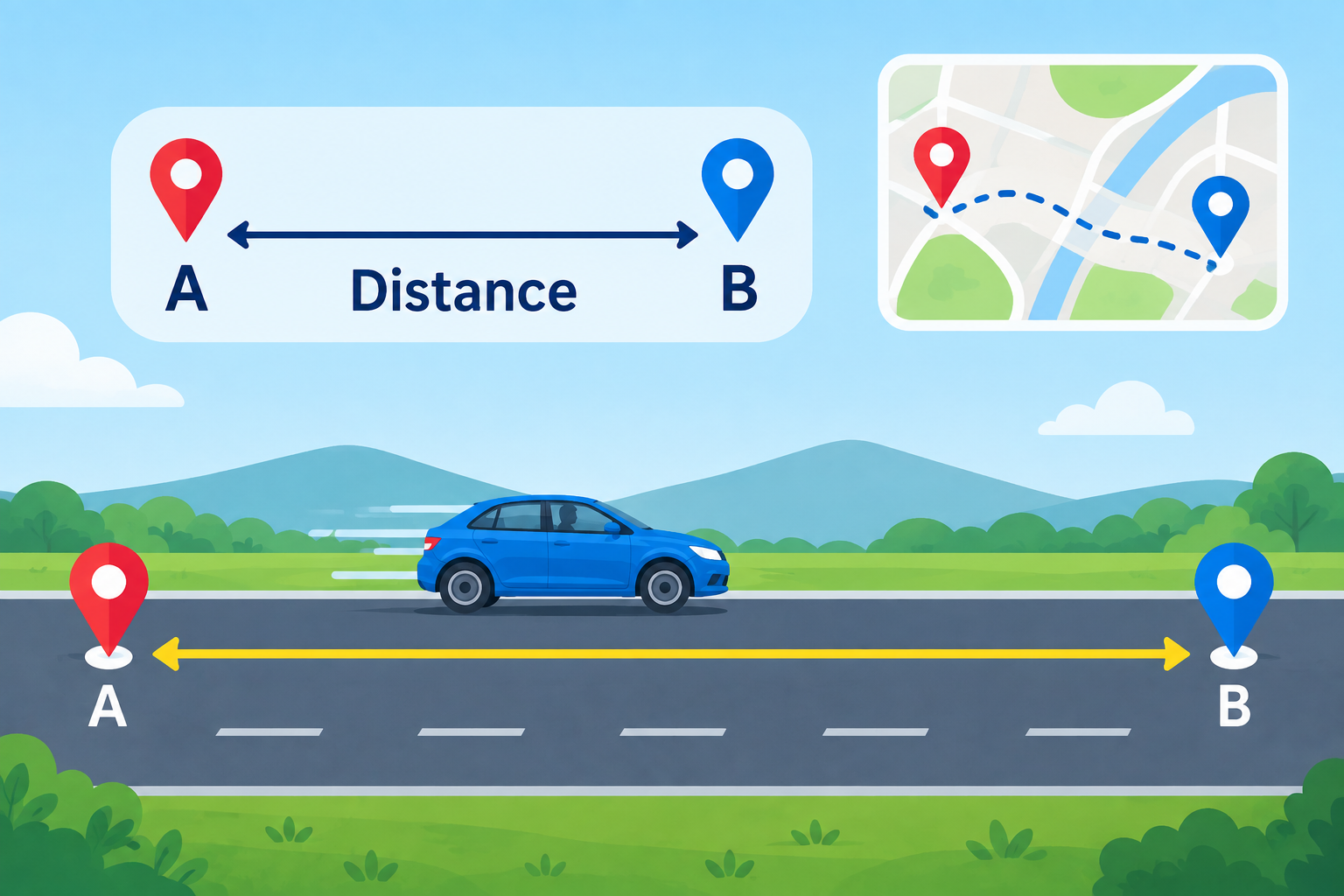
In physics, distance is defined as the total length of the path travelled by an object as it moves from one point to another. It does not matter what direction the object travels or whether it changes direction along the way — distance simply counts up the total ground covered.
Formal definition:
Distance is the total path length traversed by an object during its motion.
Consider a ball rolling from point A to point B along a curved track. The distance is the total length of that curved track — not the straight-line measurement between A and B. If the ball then rolls back from B halfway towards A, the distance increases further, even though the ball is now closer to its starting point.
This is one of the key features of distance: it accumulates. Every metre you travel adds to the distance, no matter which direction you are heading.
Distance as a Scalar Quantity
In physics, quantities are classified as either scalars or vectors.
- A scalar quantity has magnitude (size) only.
- A vector quantity has both magnitude and direction.
Distance is a scalar quantity. It tells you how much ground has been covered, but it carries no information about direction whatsoever.
This is an important distinction. When you say an object has travelled 50 metres, that statement says nothing about which direction it went. It could have gone north, south, around a curve, or back and forth — the distance is still 50 metres as long as the total path length is 50 metres.
Because distance is a scalar:
- It is always positive or zero. You cannot travel a negative distance.
- It is added arithmetically — 10 m + 20 m = 30 m, with no direction involved.
- It does not cancel out when you change direction, unlike displacement.
Compare this with a vector quantity such as force, which requires both a magnitude and a direction to be fully described. Distance requires only a magnitude.
Distance vs Displacement — What Is the Difference?
This is one of the most important distinctions in introductory physics, and it is one that students frequently confuse.
| Feature | Distance | Displacement |
|---|---|---|
| Definition | Total path length travelled | Straight-line separation from start to end point |
| Type | Scalar | Vector |
| Direction | No direction | Has direction |
| Can it be negative? | No — always ≥ 0 | Yes — depends on direction |
| Can it be zero? | Only if no movement | Yes — if you return to start |
| Symbol | d or s | s or Δx (depending on context) |
Example to illustrate the difference:
A student walks 400 metres around a circular track and returns exactly to the starting point.
- Distance = 400 metres (the student covered 400 metres of ground)
- Displacement = 0 metres (the student is back where they started, so there is no net change in position)
Another example:
A person walks 3 km east, then turns and walks 4 km north.
- Distance = 3 + 4 = 7 km (total path length)
- Displacement = √(3² + 4²) = √(9 + 16) = √25 = 5 km north-east (straight-line distance from start to end, with direction)
The two values are different. Distance is always greater than or equal to displacement in magnitude.
The SI Unit of Distance
The standard international unit of distance is the metre (m), defined by the International System of Units (SI).
One metre was originally defined as one ten-millionth of the distance from the equator to the North Pole. Today, it is defined using the speed of light: one metre is the distance light travels in a vacuum in 1/299,792,458 of a second.
Common metric units of distance and their relationships:
| Unit | Symbol | Equivalent |
|---|---|---|
| Kilometre | km | 1 km = 1,000 m |
| Metre | m | Base unit |
| Centimetre | cm | 1 cm = 0.01 m |
| Millimetre | mm | 1 mm = 0.001 m |
| Micrometre | μm | 1 μm = 0.000001 m |
| Nanometre | nm | 1 nm = 0.000000001 m |
For everyday physics problems, metres and kilometres are the most commonly used units. In atomic and subatomic physics, nanometres and picometres become relevant.
Other Units of Distance
Beyond the SI system, several other units of distance are used in specific contexts.
Imperial units:
| Unit | Approximate SI Equivalent |
|---|---|
| Inch (in) | 0.0254 m |
| Foot (ft) | 0.3048 m |
| Yard (yd) | 0.9144 m |
| Mile (mi) | 1,609.34 m |
Astronomical units:
| Unit | Symbol | Used For | Value |
|---|---|---|---|
| Astronomical unit | AU | Distances within our solar system | ≈ 1.496 × 10¹¹ m |
| Light-year | ly | Distances between stars | ≈ 9.461 × 10¹⁵ m |
| Parsec | pc | Distances in astronomy | ≈ 3.086 × 10¹⁶ m |
The astronomical unit (AU) is defined as the average distance from Earth to the Sun — approximately 150 million kilometres. The light-year is the distance light travels in one year, roughly 9.46 trillion kilometres.
These enormous units exist because the distances involved in astronomy are so vast that measuring them in metres would require impractically large numbers — which is precisely why standard form is used in science. For a refresher on expressing such numbers efficiently, the concept of standard form is explained in a dedicated LearnMinto guide.
How to Measure Distance
Distance is measured using a variety of methods and instruments depending on the scale and precision required.
Direct measurement:
For short distances, physical measuring tools such as rulers, metre sticks, and measuring tapes are used. These give direct readings in centimetres or metres.
Indirect measurement:
For larger distances — such as the width of a room, the length of a field, or the distance between cities — indirect methods are often used:
- Odometers measure distance travelled in vehicles.
- Rangefinders use laser or ultrasonic pulses to calculate distances.
- GPS systems calculate distances using satellite signals and timing data.
- Radar measures large distances using reflected radio waves — a technique related to the behaviour of waves described in What Is Reflection of Waves?
In laboratory physics:
Practical experiments use rulers, callipers, micrometres, and motion sensors depending on the precision required.
The Distance Formula in Physics
The most fundamental formula relating distance to other physical quantities is:
d = s × t
Where:
- d = distance (in metres, m)
- s = speed (in metres per second, m/s)
- t = time (in seconds, s)
This formula can be rearranged to find any one of the three quantities:
- d = s × t (find distance)
- s = d / t (find speed)
- t = d / s (find time)
A useful memory aid is the DST triangle:
     [ d ]
    -------
  [s]   [t]
Cover the quantity you want to find. The remaining two show the operation: side by side means multiply; one on top of the other means divide.
Distance, Speed, and Time
Speed is defined as the rate at which distance is covered over time. Because distance is a scalar and time is a scalar, speed is also a scalar quantity.
Formula:
Speed = Distance / Time
s = d / t
Example 1:
A cyclist covers 60 km in 2 hours. What is their speed?
s = 60 / 2 = 30 km/h
Example 2:
A car travels at 90 km/h for 3 hours. What distance does it cover?
d = s × t = 90 × 3 = 270 km
Example 3:
A runner covers 400 m at a speed of 8 m/s. How long does the run take?
t = d / s = 400 / 8 = 50 seconds
Note: speed tells you how quickly distance is being covered, but says nothing about direction. When direction is included, the quantity becomes velocity — and the corresponding concept is displacement rather than distance.
Distance and Velocity
While speed relates to distance, velocity relates to displacement. Both involve how quickly an object is moving, but:
- Speed = distance / time (scalar)
- Velocity = displacement / time (vector)
In many real-world situations, when an object moves in a straight line without changing direction, the magnitudes of speed and velocity are equal, and the distance and displacement are also equal. The distinction becomes meaningful when the object changes direction.
Example:
A dog runs 30 m north and then 30 m south in 20 seconds.
- Total distance = 60 m
- Total displacement = 0 m
- Average speed = 60/20 = 3 m/s
- Average velocity = 0/20 = 0 m/s
The dog is running at a speed of 3 m/s but has zero average velocity, because it ends up where it started.
Distance on a Distance-Time Graph
A distance-time graph plots distance (on the vertical axis) against time (on the horizontal axis). It is one of the most useful tools for visualising and analysing motion.
Key features to interpret:
| Feature on Graph | Meaning |
|---|---|
| Straight line sloping upward | Constant speed — distance increases steadily with time |
| Steeper slope | Greater speed |
| Shallower slope | Smaller speed |
| Horizontal line (flat) | Object is stationary — distance is not changing |
| Curved line | Changing speed (acceleration or deceleration) |
Reading the gradient:
The gradient (slope) of a distance-time graph equals the speed of the object.
Gradient = rise / run = change in distance / change in time = speed
Example:
A distance-time graph shows a straight line rising from (0, 0) to (10, 50). The gradient = 50/10 = 5 m/s. The object is moving at a constant speed of 5 m/s.
Distance in Work and Energy Calculations
Distance plays a central role in the physics of work and energy. Work is done when a force causes an object to move through a distance.
Formula:
W = F × d
Where:
- W = work done (in joules, J)
- F = force applied (in newtons, N)
- d = distance moved in the direction of the force (in metres, m)
This formula shows that for the same applied force, a greater distance means more work is done. Equally, if no distance is covered — if the object does not move — no work is done regardless of how large the force is.
A deeper understanding of work and its relationship to distance is available in the article What Is Work in Physics? on LearnMinto.
Connection to kinetic energy:
When work is done on an object and it begins to move, it gains kinetic energy. The relationship between force, distance, and energy is fundamental to understanding how objects speed up or slow down.
For a thorough introduction to kinetic energy, see What Is Kinetic Energy?
Distance in Projectile Motion
When an object is launched into the air at an angle, it follows a curved path called a trajectory. The horizontal distance covered during the flight is called the range.
For a projectile launched with initial speed u at angle θ to the horizontal (ignoring air resistance):
Horizontal distance (range):
R = (u² × sin 2θ) / g
Where g is the acceleration due to gravity (≈ 9.8 m/s²).
Key points:
- The horizontal distance increases with initial speed.
- The maximum range is achieved at 45° launch angle.
- Horizontal and vertical motions are independent of each other.
Example:
A ball is kicked at 20 m/s at an angle of 30° to the ground. The horizontal component of velocity is 20 × cos 30° ≈ 17.3 m/s, and the vertical component is 20 × sin 30° = 10 m/s.
Time of flight = 2 × (vertical component / g) = 2 × 10 / 9.8 ≈ 2.04 s
Horizontal distance = 17.3 × 2.04 ≈ 35.3 m
Distance in Circular Motion
When an object moves in a circle, the distance it travels in one complete revolution is the circumference of the circle.
Formula:
d = 2πr
Where:
- r = radius of the circle
- π ≈ 3.14159
Example:
A car travels around a circular roundabout with a radius of 15 metres. What distance does it cover in one complete circuit?
d = 2 × π × 15 = 2 × 3.14159 × 15 ≈ 94.25 metres
Note: In circular motion, if the object completes a full revolution and returns to its starting point, the displacement is zero — but the distance is the full circumference. This is a clear illustration of why distance and displacement are genuinely different quantities.
Distance in Waves and Optics
Distance is a key concept in the study of waves. Several important wave measurements are defined in terms of distance.
Wavelength (λ): The distance between two successive points on a wave that are in phase — for example, crest to crest or trough to trough. Wavelength is measured in metres.
Amplitude: The distance from the equilibrium (rest) position to the maximum displacement of the wave. This is related to the energy carried by the wave — a concept linked to What Is Heat Energy? when waves carry thermal radiation.
Wave speed formula:
v = f × λ
Where:
- v = wave speed (m/s)
- f = frequency (Hz)
- λ = wavelength (m) — a distance measurement
In optics:
The concept of distance appears in the mirror and lens equations. The distance from an object to a mirror, and the distance from the mirror to the image formed, are central to understanding how optical systems work.
Distance at Different Scales
One of the remarkable aspects of distance as a physical quantity is the extraordinary range of scales over which it is relevant.
| Scale | Example | Approximate Distance |
|---|---|---|
| Subatomic | Diameter of a proton | 1.7 × 10⁻¹⁵ m |
| Atomic | Diameter of a hydrogen atom | 1.06 × 10⁻¹⁰ m |
| Everyday | Height of a person | 1.7 m |
| City | Distance across London | ≈ 50 km |
| Country | Length of Great Britain | ≈ 900 km |
| Planetary | Earth’s diameter | ≈ 1.27 × 10⁷ m |
| Solar system | Earth to Sun (1 AU) | ≈ 1.5 × 10¹¹ m |
| Galactic | Diameter of Milky Way | ≈ 9 × 10²⁰ m |
| Universe | Observable universe radius | ≈ 4.4 × 10²⁶ m |
This enormous range — spanning over 40 orders of magnitude — illustrates why consistent units and scientific notation are essential in physics.
Instruments Used to Measure Distance
Different contexts require different measurement tools. Here is an overview of the most common instruments used in physics to measure distance.
| Instrument | Range | Precision | Typical Use |
|---|---|---|---|
| Ruler | 0–30 cm | 1 mm | Basic lab measurements |
| Metre stick | 0–100 cm | 1 mm | Larger lab measurements |
| Measuring tape | 0–50 m | 1 mm | Field measurements |
| Vernier calliper | 0–20 cm | 0.1 mm | Precise diameter measurements |
| Micrometer screw gauge | 0–25 mm | 0.01 mm | Very precise small measurements |
| Ultrasonic rangefinder | 0.3–10 m | ~1 cm | Motion experiments |
| Laser rangefinder | 1–hundreds of m | ~1 mm | Surveying, construction |
| GPS | Global | ~1–5 m | Navigation, mapping |
| Radar | Hundreds of km | Varies | Aviation, weather, astronomy |
Choosing the right instrument depends on the scale of the distance being measured and the precision required.
Common Mistakes When Understanding Distance
1. Confusing distance with displacement
This is the most frequent error in introductory physics. Distance is the total path length; displacement is the straight-line distance from start to finish with direction. A student who walks in a circle and returns to their starting point has travelled a non-zero distance but has zero displacement.
2. Assuming distance can be negative
Distance is always positive or zero. It accumulates with every step taken, regardless of direction. Only displacement can be negative (when the final position is on the opposite side of the starting point relative to the chosen positive direction).
3. Treating distance and displacement as equal when direction changes
Distance and displacement are only equal in magnitude when an object moves in a perfectly straight line without changing direction. Any change in direction causes them to differ.
4. Ignoring units or using inconsistent units
Mixing metres with kilometres without conversion leads to incorrect results. Always check that all quantities are in consistent units before substituting into a formula.
5. Misreading a distance-time graph
A flat line on a distance-time graph means the object is stationary, not that it has zero speed. A steeper line means greater speed, not greater distance.
6. Confusing the formula d = s × t with d = v × t
When working with displacement, the formula uses velocity (v). When working with distance, it uses speed (s). These are different quantities, and using the wrong one gives an incorrect physical interpretation even if the numbers match.
7. Thinking distance includes direction
Students occasionally try to assign direction to distance statements — “the object travelled 50 metres northwards” — but the 50 metres in that sentence is technically the displacement if direction is included. Distance alone is just 50 metres with no directional qualifier.
Real-Life Examples of Distance in Physics
Athletics: A 100-metre sprint measures the distance between the starting blocks and the finish line. The athlete’s distance and displacement are equal here, because they run in a straight line.
Road trips: A car journey from one city to another follows winding roads. The distance shown on the odometer reflects the total path length, which is greater than the straight-line (displacement) distance between the two cities.
Space exploration: NASA calculates the distance a spacecraft travels over its entire trajectory to plan fuel requirements. The distance can be many times greater than the straight-line separation between Earth and the destination.
Pendulum: A swinging pendulum travels a distance equal to the arc length with each swing. When it returns to the centre, it has zero displacement from equilibrium but has covered a real distance.
Sound waves: The distance a sound wave travels determines how long it takes to reach a listener. This is used in echo detection and sonar systems.
Rolling a ball: When a ball is pushed across a floor and slows down due to friction, the distance it covers before stopping depends on its initial speed and the frictional force — connecting distance directly to energy and momentum.
Measuring mass through distance: In some experimental setups, distance measurements are used indirectly to calculate other quantities. For example, the extension of a spring under a known mass is measured as a distance to determine the spring constant.
Worked Examples
Example 1: Basic distance calculation
A train travels at a constant speed of 120 km/h for 2.5 hours. What distance does it cover?
d = s × t = 120 × 2.5 = 300 km
Example 2: Finding speed from distance and time
A swimmer covers 1,500 m in 25 minutes. What is their average speed in m/s?
Convert time: 25 minutes = 25 × 60 = 1,500 seconds
s = d / t = 1,500 / 1,500 = 1 m/s
Example 3: Finding time from distance and speed
A sound wave travels at 340 m/s. How long does it take to cover 1,700 m?
t = d / s = 1,700 / 340 = 5 seconds
Example 4: Distance vs displacement
A student walks 6 m east, then 8 m north. What is the total distance? What is the displacement?
Distance = 6 + 8 = 14 m
Displacement = √(6² + 8²) = √(36 + 64) = √100 = 10 m north-east
Example 5: Circular track
An athlete runs 5 complete laps of a circular track with radius 40 m. What total distance does the athlete cover?
Circumference = 2πr = 2 × 3.14159 × 40 ≈ 251.3 m
Total distance = 5 × 251.3 ≈ 1,256.6 m
Displacement = 0 m (athlete returns to start after each lap, and after 5 full laps)
Example 6: Distance-time graph
A distance-time graph shows a straight line from (0 s, 0 m) to (8 s, 40 m). What is the speed of the object?
Speed = gradient = change in distance / change in time = 40 / 8 = 5 m/s
Example 7: Work and distance
A force of 50 N pushes a box along a horizontal floor for 6 metres. How much work is done?
W = F × d = 50 × 6 = 300 J
Example 8: Wave distance
A wave has a frequency of 200 Hz and a speed of 340 m/s. What is its wavelength (a distance)?
λ = v / f = 340 / 200 = 1.7 m
Example 9: Projectile horizontal distance
A ball is thrown horizontally at 15 m/s from a height of 20 m. How far horizontally does it travel before hitting the ground? (g = 9.8 m/s²)
Time to fall: 20 = 1/2 × 9.8 × t² → t² = 40/9.8 ≈ 4.08 → t ≈ 2.02 s
Horizontal distance = 15 × 2.02 ≈ 30.3 m
Example 10: Stopping distance
A car travelling at 30 m/s takes 4.5 seconds to stop. What is the stopping distance?
Using average speed (from 30 to 0, average = 15 m/s):
d = 15 × 4.5 = 67.5 m
Example 11: Conversion of units
Express 3.5 km in metres.
3.5 km = 3.5 × 1,000 = 3,500 m
Example 12: Astronomical distance
The nearest star (Proxima Centauri) is approximately 4.24 light-years away. Express this in metres.
1 light-year ≈ 9.461 × 10¹⁵ m
4.24 × 9.461 × 10¹⁵ ≈ 4.01 × 10¹⁶ m
Example 13: Echo calculation
A person shouts near a cliff. The echo returns after 2.4 seconds. Speed of sound = 340 m/s. How far away is the cliff?
Total distance = 340 × 2.4 = 816 m
But the sound travels to the cliff and back, so:
Distance to cliff = 816 / 2 = 408 m
Example 14: Multi-stage journey
A bus travels 15 km north, then 20 km east, then 15 km south.
Total distance = 15 + 20 + 15 = 50 km
Net displacement: the north and south cancel, leaving 20 km east.
Displacement = 20 km east
Example 15: Speed with unit conversion
A car covers 150 miles in 2 hours and 30 minutes. Find its average speed in miles per hour.
Time = 2.5 hours
Speed = 150 / 2.5 = 60 mph
Practice Questions
Work through each question independently. Answers are provided below.
Basic distance calculations.
- A cyclist rides at 15 m/s for 40 seconds. What distance do they cover?
- A runner covers 800 m in 4 minutes. What is their average speed in m/s?
- A car travels at 60 km/h. How long does it take to cover 210 km?
- A boat travels 45 km in 3 hours. What is its speed?
- A train covers 480 km in 4 hours. What is its average speed?
Distance vs displacement.
- A person walks 5 m east and then 5 m west. What is the distance? What is the displacement?
- A dog runs 12 m north, 5 m east. What is the total distance? What is the magnitude of displacement?
- An athlete runs one complete lap of a 400 m track. What is the distance? What is the displacement?
Distance-time graphs.
- A graph shows a straight line from (0, 0) to (5 s, 25 m). What is the speed?
- A graph shows a horizontal line at 30 m between t = 3 s and t = 7 s. What is the speed in this section?
Work and distance.
- A force of 40 N acts on an object over 8 m. How much work is done?
- 300 J of work is done by a 60 N force. What distance was covered?
Waves and distance.
- A wave travels at 300 m/s with a frequency of 150 Hz. What is the wavelength?
- A sound wave takes 3 seconds to travel from a speaker to a wall. Speed of sound = 340 m/s. What is the distance to the wall?
Conversions.
- Convert 4.2 km to metres.
- Convert 850 cm to metres.
- Convert 0.0035 m to millimetres.
Word problems.
- A plane flies at 900 km/h. How far does it travel in 3.5 hours?
- An echo returns after 1.6 seconds. Speed of sound = 340 m/s. How far away is the reflecting surface?
- A circular track has a diameter of 100 m. What distance does an athlete cover in 3 laps?
Answers:
- d = 15 × 40 = 600 m
- t = 4 × 60 = 240 s; s = 800/240 = 3.33 m/s
- t = 210/60 = 3.5 hours
- s = 45/3 = 15 km/h
- s = 480/4 = 120 km/h
- Distance = 10 m; Displacement = 0 m
- Distance = 17 m; Displacement = √(12² + 5²) = √(144+25) = √169 = 13 m
- Distance = 400 m; Displacement = 0 m
- Speed = 25/5 = 5 m/s
- Speed = 0 m/s (horizontal line means stationary)
- W = 40 × 8 = 320 J
- d = W/F = 300/60 = 5 m
- λ = 300/150 = 2 m
- d = 340 × 3 = 1,020 m
- 4,200 m
- 8.5 m
- 3.5 mm
- d = 900 × 3.5 = 3,150 km
- Total = 340 × 1.6 = 544 m; Distance to surface = 544/2 = 272 m
- Circumference = π × 100 ≈ 314.16 m; 3 laps = 3 × 314.16 ≈ 942.5 m
Multiple-Choice Questions
Question 1: Which of the following best defines distance in physics?
A) The straight-line separation between two points
B) The total path length travelled by an object
C) The rate of change of position with time
D) The displacement of an object in a given direction
Correct Answer: B — The total path length travelled by an object
Distance is always the total length of the path followed, regardless of direction or changes in direction along the way.
Question 2: Distance is classified as which type of physical quantity?
A) Vector
B) Tensor
C) Scalar
D) Derived vector
Correct Answer: C — Scalar
Distance has magnitude only and no direction, making it a scalar quantity.
Question 3: A person walks 4 m east and 3 m north. What is the total distance walked?
A) 1 m
B) 5 m
C) 7 m
D) 25 m
Correct Answer: C — 7 m
Distance = 4 + 3 = 7 m. (Note: the displacement would be 5 m, but the distance is the total path length.)
Question 4: What is the SI unit of distance?
A) Kilometre
B) Centimetre
C) Foot
D) Metre
Correct Answer: D — Metre
The metre (m) is the SI base unit for all length and distance measurements in physics.
Question 5: A car completes one full lap of a circular track of radius 50 m. What is the displacement?
A) 314 m
B) 100 m
C) 0 m
D) 50 m
Correct Answer: C — 0 m
After one full lap, the car returns to its starting point. Displacement (start to finish, straight line) = 0. Distance = 2π × 50 ≈ 314 m.
Question 6: Which formula correctly relates distance, speed, and time?
A) d = s + t
B) d = s / t
C) d = s × t
D) d = t / s
Correct Answer: C — d = s × t
Distance = Speed × Time is the fundamental relationship between these three scalar quantities.
Question 7: On a distance-time graph, what does a horizontal flat line indicate?
A) Constant speed
B) The object is accelerating
C) The object is stationary
D) The object is decelerating
Correct Answer: C — The object is stationary
A flat line means distance is not changing with time. The object is not moving.
Question 8: A force of 25 N moves an object a distance of 4 m. How much work is done?
A) 6.25 J
B) 29 J
C) 100 J
D) 21 J
Correct Answer: C — 100 J
W = F × d = 25 × 4 = 100 J.
Question 9: Which of the following can have a negative value?
A) Distance
B) Speed
C) Displacement
D) Path length
Correct Answer: C — Displacement
Displacement is a vector and can be negative depending on direction. Distance is always positive or zero.
Question 10: A sound pulse is emitted and returns as an echo after 0.6 seconds. The speed of sound is 340 m/s. What is the distance to the reflecting surface?
A) 204 m
B) 408 m
C) 102 m
D) 340 m
Correct Answer: C — 102 m
Total distance = 340 × 0.6 = 204 m. The sound travels to the surface and back, so the distance to the surface = 204/2 = 102 m.
Challenge Questions
Challenge 1: A person jogs around a rectangular park. The park is 120 m long and 80 m wide. They complete 4 full laps, then stop halfway along one of the long sides. What is the total distance covered? What is their displacement from the starting point?
Perimeter = 2 × (120 + 80) = 400 m
4 full laps = 4 × 400 = 1,600 m
Extra half of long side = 120/2 = 60 m
Total distance = 1,600 + 60 = 1,660 m
After 4 full laps, the person is back at the start. After walking 60 m along the long side:
Displacement = 60 m (along the long side from the starting corner)
Challenge 2: A ball is thrown horizontally from the top of a 45 m tall building at a speed of 20 m/s. (g = 9.8 m/s²)
(a) How long does it take to hit the ground?
(b) What horizontal distance does it travel?
(c) What is the total path length? (Hint: use the Pythagorean theorem as an approximation.)
(a) 45 = 1/2 × 9.8 × t² → t² = 90/9.8 ≈ 9.18 → t ≈ 3.03 s
(b) Horizontal distance = 20 × 3.03 ≈ 60.6 m
(c) Vertical distance fallen = 45 m; Horizontal = 60.6 m
Approximate path length ≈ √(45² + 60.6²) = √(2025 + 3672.4) = √5697.4 ≈ 75.5 m
(Note: The actual path is curved, so this is a straight-line approximation. The true arc length would be slightly longer.)
Challenge 3: Two cars start from the same point. Car A travels north at 60 km/h for 2 hours. Car B travels east at 80 km/h for 2 hours. After 2 hours:
(a) What distance has each car covered?
(b) What is the straight-line distance between the two cars?
(a) Car A: d = 60 × 2 = 120 km north
Car B: d = 80 × 2 = 160 km east
(b) Straight-line separation = √(120² + 160²) = √(14400 + 25600) = √40000 = 200 km
Challenge 4: A wave machine in a physics lab produces waves with a frequency of 5 Hz. The wavelength is measured as 0.4 m. A student standing 6 m away from the source receives the wave. How many complete wavelengths fit between the source and the student? How long does the wave take to travel that distance?
Wave speed = f × λ = 5 × 0.4 = 2 m/s
Number of wavelengths = distance / wavelength = 6 / 0.4 = 15 complete wavelengths
Time = d / v = 6 / 2 = 3 seconds
Challenge 5: A delivery driver makes the following journey from the depot: 8 km east, 6 km north, 8 km west, then 2 km south, then delivers a package and returns directly to the depot.
(a) What is the total distance of the outward journey (before returning)?
(b) What is the displacement from the depot at the point of delivery?
(c) What total distance does the driver cover for the entire round trip?
(a) Outward distance = 8 + 6 + 8 + 2 = 24 km
(b) East-west: 8 km east − 8 km west = 0 km east-west
North-south: 6 km north − 2 km south = 4 km north
Displacement = 4 km north
(c) Return trip = 4 km (straight back to depot, along displacement)
Total distance = 24 + 4 = 28 km
Quick Revision Notes
- Distance = total path length travelled by an object.
- Distance is a scalar — magnitude only, no direction.
- Distance is always positive or zero — never negative.
- SI unit: metre (m).
- Distance ≠ Displacement: distance is total path; displacement is straight-line change in position with direction.
- Formula: d = s × t (distance = speed × time).
- Distance-time graph: gradient = speed; flat line = stationary; steep line = fast.
- Work formula: W = F × d (work = force × distance).
- Wave formula: v = f × λ (speed = frequency × wavelength, where λ is a distance).
- Circular distance: d = 2πr for one full revolution.
- Distance and displacement are equal only when motion is in a straight line without direction change.
Distance Cheat Sheet
| Concept | Formula | Units | Notes |
|---|---|---|---|
| Distance from speed and time | d = s × t | m | Scalar — no direction |
| Speed from distance and time | s = d / t | m/s | Scalar |
| Time from distance and speed | t = d / s | s | — |
| Work done | W = F × d | J | d is in direction of force |
| Wave speed | v = f × λ | m/s | λ (wavelength) is a distance |
| Circular distance | d = 2πr | m | One full revolution |
| Circumference | C = πD | m | D = diameter |
| Distance-time gradient | Gradient = speed | m/s | Rise over run on the graph |
| Echo distance | d = (v × t) / 2 | m | Divide by 2 (return journey) |
| Unit conversion | 1 km = 1,000 m | — | Always convert before calculating |
Exam Tips
- Always distinguish between distance and displacement in your answers. If a question asks for distance, give the total path length. If it asks for displacement, give the straight-line separation with direction.
- Check whether all quantities are in consistent SI units before substituting into any formula. Converting km to m and hours to seconds at the start of a problem prevents errors later.
- When reading a distance-time graph, remember the gradient gives speed. Practise calculating gradients from graph coordinates.
- For echo and sonar questions, remember that the measured time is for the return journey — always divide the total time by 2 to find the one-way distance.
- In circular motion problems, distance around the track is the circumference (2πr), not the diameter or the radius.
- When calculating work done, remember that d must be the distance moved in the direction of the force. If the force and motion are perpendicular, the work done is zero.
- For projectile problems, treat horizontal and vertical motion completely independently. Horizontal distance uses horizontal speed and time of flight.
- State the unit with every answer. A numerical answer without units in a physics exam is incomplete and may not receive full marks.
Frequently Asked Questions
1. What is distance in physics?
Distance is the total length of the path travelled by an object from one point to another, regardless of direction. It is a scalar quantity with SI unit metres (m). Every metre of ground covered adds to the distance, no matter which direction the object is moving.
2. What is the difference between distance and displacement?
Distance is the total path length — a scalar with no direction. Displacement is the straight-line separation from the starting point to the ending point — a vector that includes direction. Distance is always greater than or equal to the magnitude of displacement.
3. Can distance ever be negative?
No. Distance is always positive or zero. Because it measures total path length, every movement adds to the value. Only displacement can be negative, because it involves direction.
4. What is the SI unit of distance?
The SI unit of distance is the metre (m). Other commonly used units include kilometres (km), centimetres (cm), and millimetres (mm). In astronomy, light-years and astronomical units are used for very large distances.
5. What is the formula for distance?
The most commonly used formula is d = s × t, where d is distance, s is speed, and t is time. Distance also appears in the work formula W = F × d, and in the wave formula v = f × λ.
6. Is distance a scalar or a vector?
Distance is a scalar quantity. It has magnitude (size) only and no direction. This distinguishes it from displacement, which is a vector with both magnitude and direction.
7. What does the gradient of a distance-time graph represent?
The gradient (slope) of a distance-time graph represents the speed of the object. A steeper gradient indicates greater speed. A horizontal line (zero gradient) means the object is stationary.
8. How is distance related to work in physics?
Work is defined as the force applied to an object multiplied by the distance it moves in the direction of that force: W = F × d. Without distance — if no movement occurs — no work is done regardless of the force applied.
9. How do you calculate distance using an echo?
Measure the time between emitting a pulse and receiving the echo. Multiply this time by the wave speed to get the total distance travelled (there and back). Divide by 2 to get the one-way distance to the reflecting surface.
10. What is the distance covered in one revolution of a circle?
The distance covered in one complete revolution of a circular path is the circumference: d = 2πr, where r is the radius of the circle.
11. How does distance relate to kinetic energy?
Distance is not directly in the kinetic energy formula (KE = 1/2 mv²), but it is indirectly connected through work. When a force acts over a distance, it does work that changes the kinetic energy of an object. Larger distances mean more work done for the same force.
12. What is the difference between distance and length?
In everyday language, both terms are used interchangeably. In physics, “distance” often refers specifically to the separation between two points or the total path length during motion, while “length” typically refers to the size of a stationary object. Both are measured in metres.
13. How is distance measured in astronomy?
Astronomers use astronomical units (AU) for distances within the solar system, light-years for distances between stars, and parsecs for larger cosmic scales. One light-year is the distance light travels in one year, approximately 9.461 × 10¹⁵ metres.
14. Can two objects have the same distance but different displacements?
Yes — and this is a very common scenario. Two cars that each drive 10 km but in different directions will have the same distance (10 km) but different displacements, because displacement includes direction. Similarly, an object that travels 10 km and returns to its start has a distance of 10 km but a displacement of zero.
15. Why is understanding distance important in physics?
Distance is one of the most fundamental measurements in all of physics. It underpins calculations of speed, velocity, acceleration, work, energy, wave properties, and gravitational interactions. Without a clear understanding of distance, almost every other area of physics becomes harder to navigate accurately.
Summary
Distance is the total length of the path an object travels. It is a scalar quantity — it has magnitude but no direction. It is always positive or zero, and it accumulates with every movement regardless of the direction taken.
The key concepts to remember are:
- Distance ≠ Displacement: distance is total path length; displacement includes direction and can be zero even when significant distance has been covered.
- SI unit: the metre (m).
- Core formula: d = s × t.
- Distance-time graph: the gradient equals speed; a flat line means stationary.
- Work formula: W = F × d — distance in the direction of the applied force.
- Wave formula: v = f × λ — wavelength is a distance measurement.
Distance appears in virtually every area of physics — from the simplest speed calculation to the grandest questions about the scale of the universe. Building a solid, precise understanding of this fundamental quantity makes every other topic in physics clearer and more manageable.
Final Thoughts
Distance is such a basic concept that it is tempting to treat it as self-evident and move on quickly. But the distinction between distance and displacement, the importance of direction (or the deliberate absence of it), and the way distance connects to speed, work, waves, and energy are all ideas that deserve careful attention.
Students who invest time in truly understanding distance — rather than just applying the formula — find that the rest of their physics studies becomes significantly easier. The habits of checking units, distinguishing scalar from vector quantities, and reading graphs accurately all start here.
Physics, at every level, is built on precise measurement and clear definitions. Distance is where that precision begins.
Helpful Resources
- Khan Academy — Distance and Displacement
Clear video lessons and interactive exercises on distance, displacement, speed, and velocity for beginner and intermediate physics students.
https://www.khanacademy.org/science/physics/one-dimensional-motion - OpenStax Physics — Kinematics
A free, peer-reviewed physics textbook covering distance, displacement, speed, velocity, and acceleration with worked examples and practice problems.
https://openstax.org/books/physics/pages/1-introduction - BBC Bitesize — Distance and Speed
A student-friendly resource explaining distance, speed, displacement, and related concepts with diagrams, examples, and quizzes aligned to the UK curriculum.
https://www.bbc.co.uk/bitesize/topics/zq6svcw - The Physics Classroom — Describing Motion
A comprehensive, well-regarded free resource explaining scalar and vector quantities, distance, displacement, and motion graphs with interactive activities.
https://www.physicsclassroom.com/class/1DKin - NIST — SI Units Reference
The National Institute of Standards and Technology’s authoritative reference for SI units, including the formal definition of the metre.
https://www.nist.gov/pml/owm/metric-si/si-units
Disclaimer:
This article is intended for educational and informational purposes only. While LearnMinto strives to provide accurate and up-to-date physics information, readers should verify important academic concepts through official textbooks, educational institutions, examination boards, or trusted educational resources before using this content for exams or academic purposes. LearnMinto is not affiliated with any specific school, university, research institution, or examination board.