
Introduction
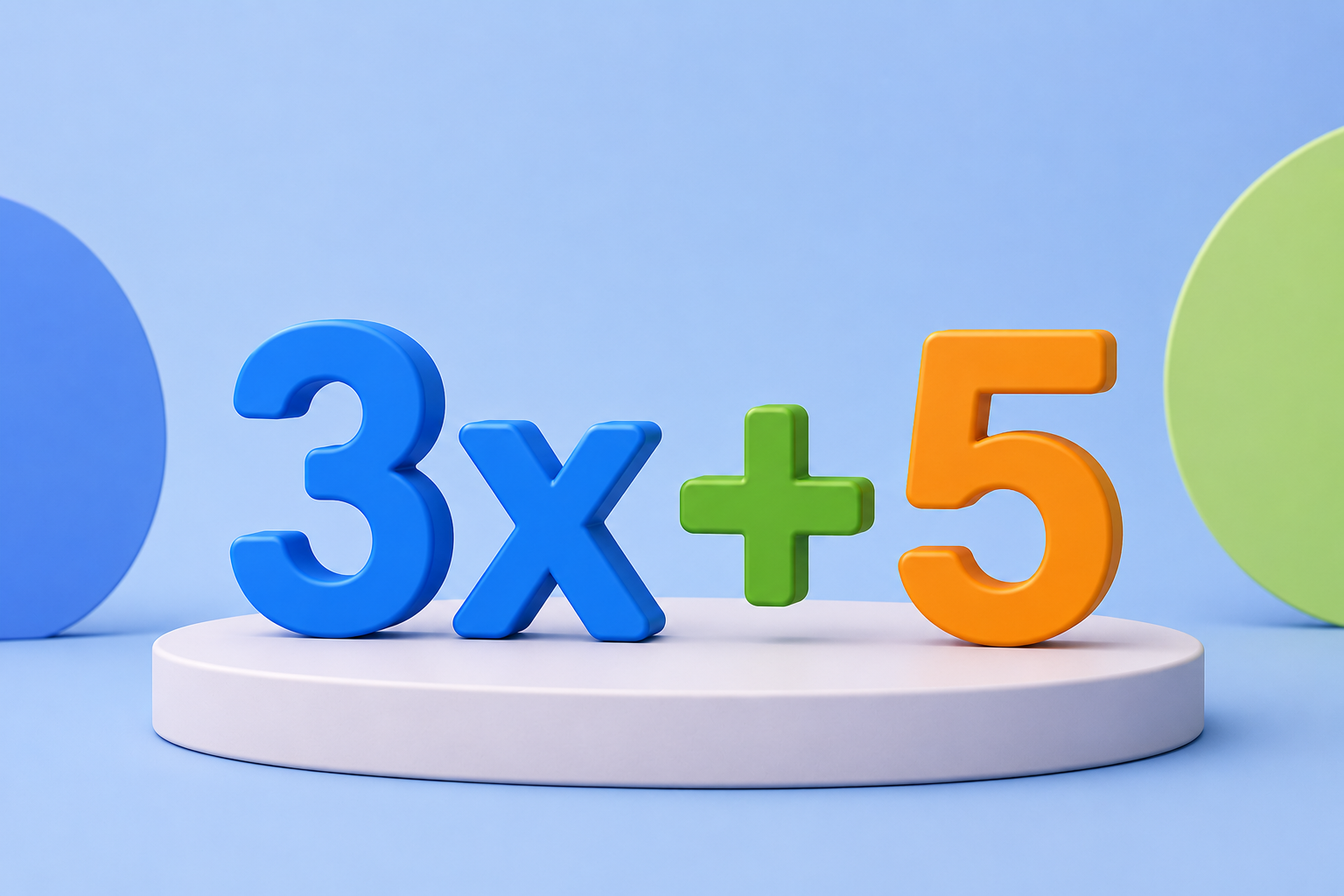
Consider the expression x + 5. This is a binomial because it contains exactly two terms: x and 5. A binomial is an algebraic expression made up of two terms joined by addition or subtraction. Each term may contain numbers, variables, and non-negative integer exponents.
Binomials are used when simplifying expressions, expanding brackets, factoring, solving equations, and representing real-world situations. They are also important in geometry, physics, and higher mathematics. Understanding binomials gives students a strong foundation for working with polynomials and algebraic equations.
Key Takeaways
-
A binomial has exactly two terms.
-
Its terms are joined by addition or subtraction.
-
A binomial is a type of polynomial.
-
Binomials may contain one or more variables.
-
The degree of a binomial is the highest exponent of its variable.
-
FOIL is a useful method for multiplying two binomials.
-
A one-term expression is a monomial, while a three-term expression is a trinomial.
What Is a Binomial?
The word binomial comes from two parts:
- Bi means two.
- Nomial refers to terms or expressions.
Therefore, a binomial is an algebraic expression with exactly two terms.
Common forms include:
- a + b
- a – b
- axⁿ + bxᵐ
- axⁿ – bxᵐ
In the expression axⁿ + bxᵐ:
- a and b are coefficients.
- x is the variable.
- n and m are non-negative integer exponents.
- The two terms are joined by addition or subtraction.
Examples include:
- x + 3
- 4x – 7
- 3x² + 5x
- 2x³ – 9
- 5xy + 2y²
Let us examine them:
- x + 3 has the terms x and 3.
- 4x – 7 has the terms 4x and -7.
- 3x² + 5x has the terms 3x² and 5x.
- 2x³ – 9 has the terms 2x³ and -9.
- 5xy + 2y² has two terms involving two variables.
Subtraction can also be written as addition of a negative number:
4x – 7 = 4x + (-7)
The expression still has two terms.
What Makes an Expression a Binomial?
An expression is a binomial when:
- It has exactly two terms.
- The terms are separated by addition or subtraction.
- Each term is an algebraic term.
- For polynomial binomials, variable exponents are non-negative integers.
Compare the following:
- 5x has one term, so it is a monomial.
- 5x + 2 has two terms, so it is a binomial.
- 5x² + 3x + 1 has three terms, so it is a trinomial.
A binomial does not require its two terms to have the same degree. For example, x³ + 2 is a binomial even though its terms have degrees 3 and 0.
Parts of a Binomial
Terms
A term is a number, variable, or product of numbers and variables.
In 3x² – 8:
- The first term is 3x².
- The second term is -8.
The negative sign belongs to the second term. This is important when adding, subtracting, or comparing expressions.
Coefficients
A coefficient is the numerical factor of a term.
In 5x + 7:
- The coefficient of x is 5.
- 7 is a constant term.
In x – 4:
- The coefficient of x is 1.
- The coefficient of the constant term is -4.
Variables
A variable is a letter representing an unknown or changing value.
In 3xy + 2y², the variables are x and y.
Exponents
An exponent tells us how many times a variable is multiplied by itself.
In 4x³ + 2x:
- The exponent in 4x³ is 3.
- The exponent in 2x is 1.
Constants
A constant is a term without a variable.
In 7x – 9, the constant is -9.
Leading Term and Leading Coefficient
The leading term is the term with the highest degree when the binomial is written in standard form.
In 5x³ – 2x:
- Leading term: 5x³
- Leading coefficient: 5
Binomial vs Monomial vs Trinomial
For a broader explanation of one-term expressions, see What Is a Monomial? A discussion of the larger family of polynomial expressions can be found in What Is a Polynomial in Math?
| Type | Number of Terms | Example |
|---|---|---|
| Monomial | 1 | 5x² |
| Binomial | 2 | 3x + 4 |
| Trinomial | 3 | x² + 5x + 6 |
| Polynomial | One or more | 2x³ + x² – x + 7 |
Monomials, binomials, and trinomials are all types of polynomials.
Degree of a Binomial
The degree of a binomial is the highest exponent of its variable.
| Binomial | Degree | Type by Degree |
|---|---|---|
| x + 2 | 1 | Linear binomial |
| x² + 4 | 2 | Quadratic binomial |
| 3x³ – x | 3 | Cubic binomial |
| 5x⁴ + 2x | 4 | Quartic binomial |
| x⁵ – 6 | 5 | Quintic binomial |
Examples:
- x + 4 has degree 1.
- x² + 3 has degree 2.
- 4x³ – 2x has degree 3.
- 5x⁴ + x² has degree 4.
- 2x⁵ – 7 has degree 5.
The number of terms and the degree describe different features. For example, x³ + 2 is a binomial because it has two terms and a cubic polynomial because its degree is 3.
For more information about quadratic expressions and equations, read What Is a Quadratic Equation?
Types of Binomials Based on Degree
Linear Binomial
A linear binomial has degree 1.
Examples:
- x + 5
- 3x – 2
- 7x + 1
Quadratic Binomial
A quadratic binomial has degree 2.
Examples:
- x² + 4
- 3x² – 5x
- 2x² + 7
Cubic Binomial
A cubic binomial has degree 3.
Examples:
- x³ + 2
- 4x³ – x
- 2x³ + 5x²
Quartic Binomial
A quartic binomial has degree 4.
Examples:
- x⁴ – 9
- 2x⁴ + x²
- 5x⁴ – 3x
Higher-Degree Binomials
Binomials may also have degree 5 or higher.
Examples:
- x⁵ + 1
- 3x⁶ – 2x²
- 4x⁷ + 9
What Is Not a Binomial?
The following expressions are not binomials:
- Expressions with one term, such as 5x².
- Expressions with three terms, such as x² + 3x + 2.
- Expressions with four or more terms.
- Expressions that simplify to one term.
- Expressions with invalid polynomial exponents, such as x⁻¹ + 3.
| Expression | Is It a Binomial? | Reason |
|---|---|---|
| 3x + 5 | Yes | Exactly two terms |
| 7x² | No | One term; it is a monomial |
| x² + 4x + 1 | No | Three terms; it is a trinomial |
| x⁻¹ + 2 | No as a polynomial binomial | Negative exponent |
| √x + 3 | No as a polynomial binomial | Fractional exponent |
| 4x³ – 7 | Yes | Exactly two valid terms |
| 5x + 2x | No after simplification | It becomes 7x, one term |
Always simplify an expression when necessary before classifying it.
Standard Form of a Binomial
A binomial is in standard form when its terms are arranged from the highest degree to the lowest degree.
Examples:
Non-standard: 4 + 3x²
Standard form: 3x² + 4
Non-standard: 5x – x³
Standard form: -x³ + 5x
Non-standard: 2 + 7x⁴ – 3x²
Standard form: 7x⁴ – 3x² + 2
Standard form makes it easier to identify:
- The degree.
- The leading term.
- The leading coefficient.
- The type of binomial.
Simplifying Binomials
Some binomials contain like terms and simplify to monomials.
For example:
3x + 5x = 8x
The original expression has two terms, but the simplified answer has one term.
However, unlike terms cannot be combined:
- 3x + 5 cannot be simplified.
- 4x² + 2x cannot be simplified.
- 6xy + 3xy = 9xy.
Terms are like terms only when their variables and exponents match. For further explanation, read What Are Like Terms in Algebra? and What Are Unlike Terms in Algebra?
Adding Binomials
To add binomials:
- Remove the brackets.
- Group like terms.
- Add the coefficients.
- Write the answer in standard form.
Example 1
(3x+4)+(2x+7)=3x+2x+4+7=5x+11
Example 2
(4×2+3)+(x2−5)=4×2+x2+3−5=5×2−2
Example 3
(2×2+3x)+(5×2−x)=2×2+5×2+3x−x=7×2+2x
Example 4
(x3+2x)+(3×3−5x)=x3+3×3+2x−5x=4×3−3x
Example 5
(12x+3)+(14x−2)=(12+14)x+1=34x+1
Subtracting Binomials
When subtracting binomials, distribute the negative sign to both terms in the second bracket.
Example 1
(5x+7)−(2x+3)=5x+7−2x−3=3x+4
Example 2
(4×2−1)−(x2+5)=4×2−1−x2−5=3×2−6
Example 3
(3×2+2x)−(x2−4x)=3×2+2x−x2+4x=2×2+6x
Example 4
(x3−2)−(3×3+5)=x3−2−3×3−5=−2×3−7
Example 5
(34x+2)−(12x−1)=34x+2−12x+1=14x+3
Multiplying Binomials
To multiply two binomials, multiply every term in the first binomial by every term in the second. The FOIL method is a useful shortcut for two binomials.
FOIL means:
- First
- Outer
- Inner
- Last
Example 1
(x+5)(x+2)=x2+2x+5x+10=x2+7x+10
Example 2
(x−4)(x+3)=x2+3x−4x−12=x2−x−12
Example 3
(2x+1)(x+6)=2×2+12x+x+6=2×2+13x+6
Example 4
(3x−2)(2x−5)=6×2−15x−4x+10=6×2−19x+10
Example 5: Difference of Squares
(x+7)(x−7)=x2−7x+7x−49=x2−49
The middle terms cancel. This follows the identity:
(a+b)(a−b)=a2−b2
Example 6: Squaring a Binomial
(x+4)2=(x+4)(x+4)=x2+4x+4x+16=x2+8x+16
The identity is:
(a+b)2=a2+2ab+b2
Example 7
(2x−3)(x2+4)=2x(x2+4)−3(x2+4)=2×3+8x−3×2−12=2×3−3×2+8x−12
Example 8: Rational Coefficients
(12x+1)(2x−3)=x2−32x+2x−3=x2+12x−3
Dividing Binomials by Monomials
Divide each term of the binomial by the monomial.
Example 1
6×2+9x3x=6x23x+9x3x=2x+3
Example 2
12×3−8x24x2=3x−2
Example 3
10x2y+15xy25xy=2x+3y
Example 4
3×2+6x3x=x+2
The divisor must not equal zero. For example, in expressions divided by x, we require x ≠ 0.
Factoring Binomials
Factoring means expressing a binomial as a product of simpler expressions.
Factoring Out a Common Monomial
6×2+9x
The greatest common factor is 3x:
6×2+9x=3x(2x+3)
The concept of common factors is explained in What Is a Factor?
Difference of Squares
Use:
a2−b2=(a−b)(a+b)
Examples:
x2−25=(x−5)(x+5)4×2−9=(2x−3)(2x+3)9×2−16=(3x−4)(3x+4)
This method works only when the expression is a subtraction of two perfect squares.
Evaluating Binomials
To evaluate a binomial, substitute the given value for the variable and calculate.
Example 1
Evaluate 3x + 5 when x = 4.
3(4)+5=12+5=17
Example 2
Evaluate x² – 7 when x = -3.
(−3)2−7=9−7=2
Example 3
Evaluate 2x³ – x when x = 2.
2(23)−2=2(8)−2=14
Example 4
Evaluate 1/2x + 3 when x = 6.
12(6)+3=3+3=6
Example 5
Evaluate 4x² – 3x when x = 1/2.
4(12)2−3(12)=4(14)−32=1−32=−12
Binomials can be evaluated for any real-number value. See What Is a Real Number? for a review of real numbers.
Binomials With Multiple Variables
A binomial may contain two or more variables.
Examples:
- 3x²y + 4xy²
- 5ab – 2b²
- 7pq³ + 9p²q
For each term, add the exponents to find its degree.
Example 1
3x2y+4xy2
- 3x²y has degree 2 + 1 = 3.
- 4xy² has degree 1 + 2 = 3.
The binomial has degree 3.
Example 2
5a3b2−2ab
- 5a³b² has degree 3 + 2 = 5.
- -2ab has degree 1 + 1 = 2.
The binomial has degree 5.
Example 3
7p2q+9q3
- 7p²q has degree 2 + 1 = 3.
- 9q³ has degree 3.
The binomial has degree 3.
Binomial Identities
Square of a Sum
(a+b)2=a2+2ab+b2
Example:
(x+3)2=x2+6x+9
Square of a Difference
(a−b)2=a2−2ab+b2
Example:
(x−4)2=x2−8x+16
Difference of Squares
(a+b)(a−b)=a2−b2
Example:
(x+5)(x−5)=x2−25
A common mistake is to write:
(a+b)2=a2+b2
This is incorrect because the middle term 2ab is missing.
Binomials in Geometry and Real Life
Rectangle Area
A rectangle has length x + 4 centimetres and width x centimetres.
A=x(x+4)A=x2+4x cm2
Cost Calculation
Suppose an item costs x dollars and delivery costs 5 dollars.
Total cost=x+5
This is a linear binomial.
Consecutive Numbers
If one number is x, the next number is x + 1.
Their sum is:
x+(x+1)=2x+1
Binomials are also useful in physics. For example, if distance is represented by d = 3t + 5, then when t = 4:
d=3(4)+5=17
This represents a distance of 17 units. For a related physics topic, see What Is Force in Physics?
Binomial Summary Table
| Binomial | Terms | Degree | Type | Leading Term | Leading Coefficient |
|---|---|---|---|---|---|
| x + 3 | 2 | 1 | Linear | x | 1 |
| 3x² – 5 | 2 | 2 | Quadratic | 3x² | 3 |
| 4x³ + 2x | 2 | 3 | Cubic | 4x³ | 4 |
| -x⁴ + 7 | 2 | 4 | Quartic | -x⁴ | -1 |
| 2x⁵ – 9x² | 2 | 5 | Quintic | 2x⁵ | 2 |
Common Mistakes Students Make
| Incorrect Idea | Correct Understanding |
|---|---|
| x + 3 is a monomial | x + 3 is a binomial |
| x² + x + 1 is a binomial | It has three terms, so it is a trinomial |
| Degree means number of terms | Degree means highest exponent |
| (4x + 2) – (x – 3) = 3x – 1 | Correct result is 3x + 5 |
| (a + b)² = a² + b² | Correct result is a² + 2ab + b² |
| (x + 3)(x – 3) = x² + 9 | Correct result is x² – 9 |
| 5x + 2x remains a binomial | It simplifies to 7x, a monomial |
| Terms with different powers can be combined | Only like terms can be combined |
Binomials Cheat Sheet
| Concept | Rule | Example |
|---|---|---|
| Definition | Exactly two terms | 3x + 5 |
| Linear binomial | Degree 1 | 2x – 7 |
| Quadratic binomial | Degree 2 | x² + 4 |
| Standard form | Highest degree first | 3x² + 2 |
| Addition | Combine like terms | 2x + 1 + 3x + 4 = 5x + 5 |
| Subtraction | Distribute the negative | (4x + 2) – (x – 3) = 3x + 5 |
| FOIL | First, Outer, Inner, Last | (x + 2)(x + 3) = x² + 5x + 6 |
| Square of a sum | (a + b)² = a² + 2ab + b² | (x + 2)² = x² + 4x + 4 |
| Square of a difference | (a – b)² = a² – 2ab + b² | (x – 2)² = x² – 4x + 4 |
| Difference of squares | (a + b)(a – b) = a² – b² | (x + 3)(x – 3) = x² – 9 |
| Not a binomial | One, three, or more terms | 5x; x² + x + 1 |
Worked Examples
- Identify: 4x + 9 is a binomial because it has two terms.
- Terms: In 7x² – 3, the terms are 7x² and -3.
- Coefficients: In 5x – 8, the coefficients are 5 and -8.
- Constant: In 3x + 11, the constant is 11.
- Degree: 2x⁴ – x has degree 4.
- Leading term: In 4 + 6x³, the leading term is 6x³.
- Leading coefficient: In -2x⁵ + 7, it is -2.
- Classification: x² + 4 is a quadratic binomial.
- Not a binomial: x² + x + 1 is a trinomial.
- Standard form: 3 – x⁴ becomes -x⁴ + 3.
- Simplify: 4x + 3x = 7x.
- Add: (x² + 2) + (3x² – 1) = 4x² + 1.
- Add three: (x + 1) + (2x + 3) + (3x – 2) = 6x + 2.
- Subtract: (5x² + 1) – (2x² – 3) = 3x² + 4.
- Careful subtraction: (x³ + 2x) – (3x³ – x) = -2x³ + 3x.
- FOIL: (x + 2)(x + 5) = x² + 7x + 10.
- Square: (x – 3)² = x² – 6x + 9.
- Difference of squares: x² – 36 = (x – 6)(x + 6).
- Divide: (8x² + 12x) ÷ 4x = 2x + 3.
- Evaluate: 2x + 7 when x = 5 gives 17.
- Factor: 10x² + 15x = 5x(2x + 3).
- Rational coefficients: (1/2x + 1/3) + (1/4x – 1/3) = 3/4x.
- Multiple variables: 2x²y + 3xy² has degree 3.
- Real-world: If a rectangle has dimensions x and x + 6, its area is x² + 6x.
Practice Questions
Multiple Choice Questions
1. Which expression is a binomial?
A. 4x
B. x + 3
C. x² + x + 1
D. 5
Answer: B. It has exactly two terms.
2. What is the degree of 3x⁴ – 2?
A. 2
B. 3
C. 4
D. 5
Answer: C. The highest exponent is 4.
3. Which expression is a trinomial?
A. x + 1
B. 5x²
C. x² + 3x + 2
D. 7
Answer: C. It has three terms.
4. Expand (x + 4)(x + 2).
A. x² + 6x + 8
B. x² + 8x + 6
C. x² + 2x + 8
D. x² + 4x + 8
Answer: A.
5. Simplify (3x + 2) + (x + 5).
A. 4x + 7
B. 3x + 7
C. 4x + 3
D. 2x + 7
Answer: A.
6. Simplify (5x – 1) – (2x + 3).
A. 3x + 2
B. 3x – 4
C. 7x + 2
D. 7x – 4
Answer: B.
7. What is the leading coefficient of -4x³ + 2?
A. 2
B. 3
C. 4
D. -4
Answer: D.
8. Which identity is correct?
A. (a + b)² = a² + b²
B. (a + b)² = a² + 2ab + b²
C. (a + b)² = a² – 2ab + b²
D. (a + b)² = 2a² + 2b²
Answer: B.
9. Factor x² – 25.
A. (x – 5)²
B. (x + 5)²
C. (x – 5)(x + 5)
D. x(x – 25)
Answer: C.
10. Evaluate 2x + 3 when x = 4.
A. 8
B. 9
C. 11
D. 14
Answer: C.
11. Which is not a polynomial binomial?
A. x + 2
B. x² – 1
C. x⁻¹ + 3
D. 4x³ – 7
Answer: C. It contains a negative exponent.
12. Simplify 6x + 2x.
A. 8x
B. 8x²
C. 12x
D. 4x
Answer: A.
13. What is the degree of 3x²y + 4xy²?
A. 2
B. 3
C. 4
D. 6
Answer: B.
14. Expand (x + 7)(x – 7).
A. x² + 49
B. x² – 49
C. x² + 14x – 49
D. x² – 14x + 49
Answer: B.
15. Divide (12x² + 6x) by 6x.
A. 2x + 1
B. 2x + 6
C. 6x + 1
D. 2x² + 1
Answer: A.
16. What is the standard form of 3 – x²?
A. 3 – x²
B. x² + 3
C. -x² + 3
D. -3x²
Answer: C.
17. Which expression is linear?
A. x² + 1
B. x³ + 2
C. 4x – 5
D. x⁴ – 1
Answer: C.
18. Simplify (2x + 1)(x + 3).
A. 2x² + 4x + 3
B. 2x² + 7x + 3
C. 2x² + 6x + 1
D. 2x² + 3x + 1
Answer: B.
19. What is the constant in 7x – 12?
A. 7
B. x
C. -12
D. 12x
Answer: C.
20. Which expression simplifies to a monomial?
A. x + 4
B. 3x + 5x
C. x² + x + 1
D. x – 2
Answer: B. It simplifies to 8x.
Identify and Classify Problems
For each expression, state whether it is a binomial. If it is, identify its degree and type.
- 3x + 8 — Yes; degree 1; linear binomial.
- x² – 4 — Yes; degree 2; quadratic binomial.
- 2x³ + x — Yes; degree 3; cubic binomial.
- 5x⁴ – 1 — Yes; degree 4; quartic binomial.
- x⁵ + 6 — Yes; degree 5; quintic binomial.
- 7x — No; monomial.
- x² + x + 1 — No; trinomial.
- x⁻¹ + 2 — No as a polynomial binomial.
- 4xy + 3y² — Yes; degree 2.
- 2x²y + 5xy² — Yes; degree 3.
- 6 — No; constant monomial.
- x + 2x — No after simplifying; it becomes 3x.
- √x + 1 — No as a polynomial binomial.
- 3a²b + 4ab³ — Yes; degree 4.
- 9x⁶ – 2x² — Yes; degree 6.
Operations Problems
- (2x+3)+(4x−1)=6x+2
- (7x−5)−(3x+2)=4x−7
- (x+6)(x+2)=x2+8x+12
- (2x−1)(x+4)=2×2+7x−4
- (x−5)2=x2−10x+25
- x2−64=(x−8)(x+8)
- (9×2+6x)÷3x=3x+2
- 8×2+12x=4x(2x+3)
- 3x+7, when x = 2: 6+7=13
- (x+1)(x−3)=x2−2x−3
Challenge Problems
1. Expand:
(2x+3)(x2−x+4)=2×3−2×2+8x+3×2−3x+122×3+x2+5x+12
2. Simplify:
(23x+1)−(16x−4)=23x−16x+512x+5
3. Factor:
12×2−27
First take out 3:
3(4×2−9)
Then use difference of squares:
3(2x−3)(2x+3)
4. Find the degree:
4x2y3+7xy4
Both terms have degree 5:
- 2 + 3 = 5
- 1 + 4 = 5
Therefore, the binomial has degree 5.
5. A rectangle has length 2x+5 metres and width x metres. Find its area when x=3.
A=x(2x+5)=2×2+5x
When x = 3:
A=2(3)2+5(3)=18+15=33 m2
Exam Tips
- Count the terms before classifying an expression.
- Remember that the sign belongs to the following term.
- Write the binomial in standard form before finding its degree.
- Do not confuse the number of terms with the degree.
- Combine only like terms.
- Distribute a negative sign to every term inside brackets.
- Use all four FOIL products when multiplying binomials.
- Do not forget the middle term when squaring a binomial.
- Use difference of squares only for subtraction of two perfect squares.
- Use brackets when substituting negative numbers.
- Check whether simplification changes a binomial into a monomial.
Quick Revision Notes
- A binomial has exactly two terms.
- Terms are separated by addition or subtraction.
- A binomial is a type of polynomial.
- The degree is the highest exponent.
- Standard form lists terms from highest to lowest degree.
- Add binomials by combining like terms.
- Subtract binomials by distributing the negative sign first.
- Multiply binomials using distribution or FOIL.
- Divide each term by a monomial.
- Factor by taking out common factors or using difference of squares.
- Evaluate by substituting the given value.
- Binomials are used in geometry, physics, finance, and algebraic modelling.
Frequently Asked Questions
1. What is a binomial in math?
A binomial is an algebraic expression with exactly two terms joined by addition or subtraction.
2. How many terms does a binomial have?
A binomial always has two terms.
3. What are examples of binomials?
Examples include x + 5, 3x – 7, x² + 4, and 2xy – 3y².
4. What is the difference between a monomial and a binomial?
A monomial has one term, while a binomial has two terms.
5. What is the difference between a binomial and a trinomial?
A binomial has two terms. A trinomial has three terms.
6. Can a binomial have two variables?
Yes. For example, 3x²y + 4xy² is a binomial with two variables.
7. What is the degree of a binomial?
It is the highest exponent of the variable. For multiple variables, find the degree of each term by adding its exponents.
8. Is x + 5 a binomial?
Yes. It has the two terms x and 5.
9. Is 5x + 2x still a binomial after simplifying?
No. It simplifies to 7x, which is a monomial.
10. How do you add binomials?
Remove brackets, collect like terms, and add their coefficients.
11. How do you subtract binomials?
Distribute the negative sign to every term in the second bracket, then combine like terms.
12. How do you multiply binomials?
Multiply each term in the first binomial by each term in the second. FOIL is useful for two binomials.
13. What is the FOIL method?
FOIL means First, Outer, Inner, and Last. It helps organise the four products when multiplying two binomials.
14. What is the difference-of-squares formula?
The formula is:
a2−b2=(a−b)(a+b)
15. How are binomials used in real life?
They can represent costs, dimensions, areas, distances, and relationships between physical quantities.
Summary
A binomial is an algebraic expression with exactly two terms. These terms are usually joined by addition or subtraction, such as 3x + 4 or x² – 9.
Binomials can be classified by degree as linear, quadratic, cubic, quartic, or higher-degree expressions. They can be written in standard form, evaluated by substitution, added and subtracted by combining like terms, multiplied using distribution or FOIL, divided by monomials, and factored using common factors or special identities.
The most important identities are:
(a+b)2=a2+2ab+b2(a−b)2=a2−2ab+b2(a+b)(a−b)=a2−b2
Final Thoughts
Understanding what is a binomial is an important step in learning algebra. Binomials appear in polynomial expressions, equations, geometry, physics, and mathematical modelling.
Once you can identify their terms, find their degree, simplify them, and perform operations accurately, you will be better prepared for factoring, quadratic equations, functions, and higher mathematics. Practise carefully, pay attention to signs, and always check your answer in standard form.
References
- OpenStax — College Algebra
- Khan Academy — Algebra
- Mathematics LibreTexts
- Encyclopaedia Britannica — Polynomial
- Wolfram MathWorld — Binomial
Disclaimer:
This article is intended for educational and informational purposes only. While LearnMinto strives to provide accurate and up-to-date mathematics information, readers should verify important academic concepts through official textbooks, educational institutions, examination boards, or trusted educational resources before using this content for exams or academic purposes. LearnMinto is not affiliated with any specific school, university, research institution, or examination board.