
Introduction
Every time you strike a match, cook an egg, breathe, digest your lunch, or watch iron rust on an old bicycle frame, you’re witnessing a chemical reaction. These transformations are happening everywhere, all the time — inside your body, in the atmosphere, in the soil, and in every industrial plant on the planet. Understanding chemical reactions is not just an academic exercise. It’s understanding how the material world changes and why.
A chemical reaction is a process in which substances (reactants) are transformed into new substances (products) with different chemical properties. Atoms don’t appear or disappear — they’re rearranged. Bonds break and new ones form. Energy is released or absorbed. And the identity of the matter changes in ways that cannot be undone by simple physical means.
This Chemical Reactions Study Guide is designed to give you a complete, exam-ready understanding of chemical reactions — from recognizing that a reaction is occurring, to writing and balancing chemical equations, to understanding the different reaction types and the factors that control how fast reactions proceed. Whether you’re preparing for GCSE, A-Level, AP Chemistry, IB Chemistry, NEET, or another major chemistry qualification, this guide covers every concept you’ll encounter.
We’ll work through all eight major reaction types with balanced equation examples, tackle balancing equations step by step, explore the energetics of exothermic and endothermic reactions, explain collision theory and activation energy, and connect reaction chemistry to everyday life. A full set of practice questions — including MCQs, short answers, long-form questions, and equation-balancing exercises — rounds out the guide.
The goal is simple: by the end of this guide, you should be able to approach any chemical reaction question on an exam with genuine confidence, not guesswork.
Key Takeaways
Before You Dive In — Key Takeaways
- A chemical reaction involves the breaking and forming of chemical bonds, transforming reactants into products with different properties.
- The law of conservation of mass requires that balanced chemical equations have the same number of each type of atom on both sides.
- The eight major reaction types are: combination (synthesis), decomposition, single displacement, double displacement, combustion, neutralization, redox, and precipitation.
- Exothermic reactions release energy; endothermic reactions absorb it.
- Reaction rate is affected by temperature, concentration, pressure, surface area, and catalysts.
- Collision theory states that reactions occur when particles collide with sufficient energy (activation energy) and correct orientation.
- Activation energy is the minimum energy required for a reaction to proceed; catalysts lower activation energy without being consumed.
- State symbols (s), (l), (g), and (aq) in equations describe the physical state of each substance.
What Are Chemical Reactions?
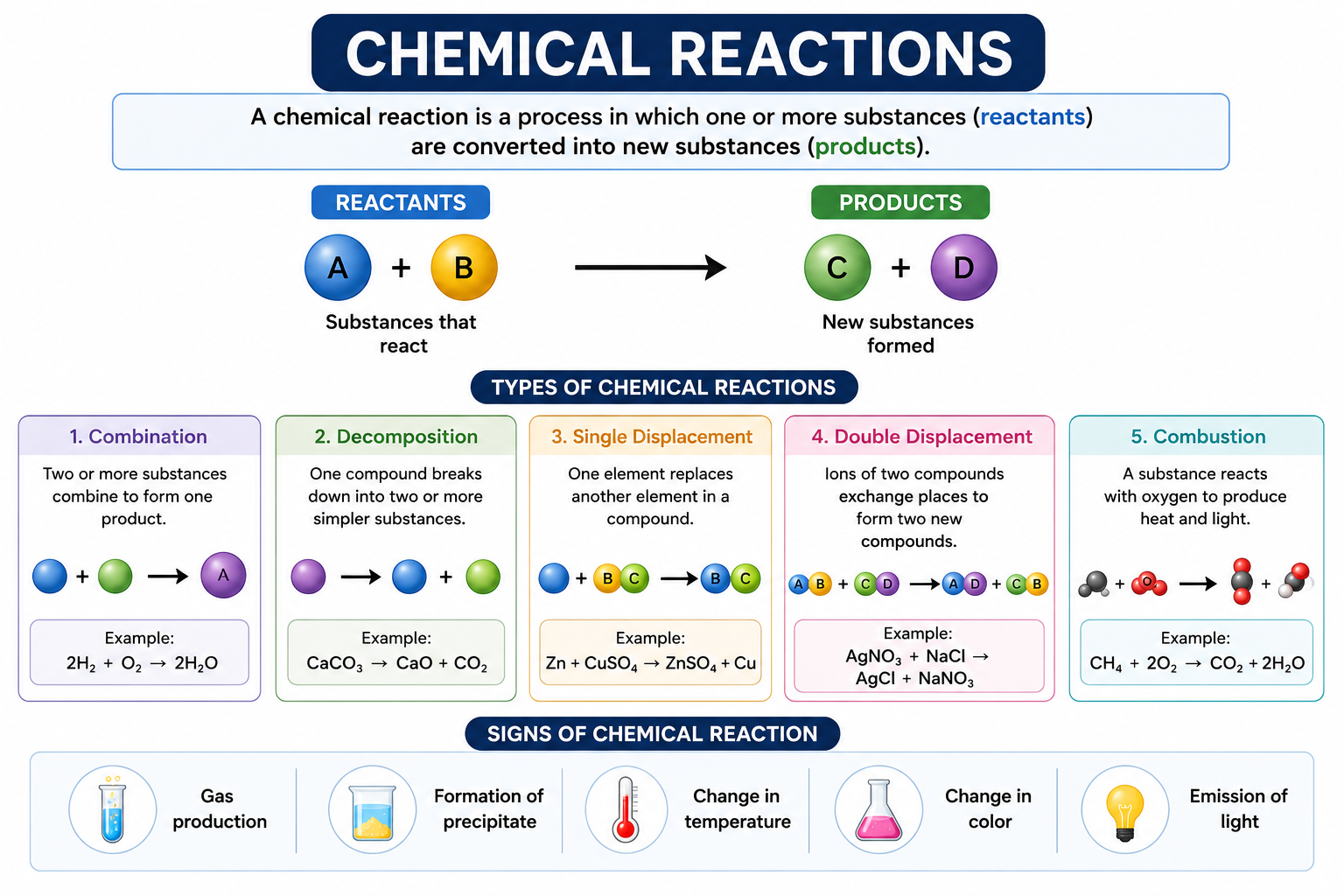
A chemical reaction is a process in which one or more substances (the reactants) are converted into one or more different substances (the products) through the breaking and forming of chemical bonds. The atoms present in the reactants are reorganized into new arrangements in the products, but no atoms are created or destroyed in the process.
This last point — the conservation of atoms — is what makes balancing equations both possible and necessary.
It’s important to distinguish chemical changes from physical changes. When ice melts to liquid water, its chemical identity doesn’t change — both are H₂O. But when hydrogen and oxygen gases combust to form water, new bonds are formed and the identities of the substances change completely. That’s a chemical reaction.
The energy associated with breaking and forming bonds is what drives every chemical reaction. When the energy released from forming new bonds exceeds the energy required to break existing bonds, the reaction releases energy (exothermic). When more energy must be supplied to break bonds than is released in forming new ones, the reaction absorbs energy (endothermic).
Why Chemical Reactions Are Important
Chemical reactions are the engine of the natural world and the foundation of all chemistry. Here’s why they matter:
- Life depends on them. Photosynthesis, cellular respiration, protein synthesis, enzyme catalysis, immune responses — every biological process is a chemical reaction or a series of them.
- Industry requires them. Steel production, pharmaceutical manufacturing, food processing, fuel combustion, water treatment, semiconductor fabrication — all driven by chemical reactions.
- Environmental changes result from them. Acid rain, ozone depletion, combustion emissions, and the nitrogen cycle are all reaction-driven phenomena.
- Medical treatments use them. Drugs work by participating in or inhibiting specific chemical reactions in the body. Surgery uses controlled combustion (lasers, electrocautery). Diagnostic tests detect the products of biological reactions.
- They’re everywhere in daily life. Cooking, cleaning, digestion, rusting, fermentation — ordinary life is filled with chemical reactions operating at various rates and scales.
Signs of a Chemical Reaction
How do you know a chemical reaction has occurred? While the definitive test is whether new substances with different properties have formed, there are several observable signs:
Color Change
A permanent change in color — not due to mixing two colors, but due to formation of a new substance — indicates a chemical reaction. Copper turning green (forming copper carbonate from exposure to CO₂ and moisture), silver tarnishing (forming silver sulfide), or potassium permanganate solution turning colorless when it reacts with a reducing agent are all examples.
Gas Formation
Visible bubbles in a solution often indicate gas production. Vinegar and baking soda producing CO₂ bubbles, zinc reacting with hydrochloric acid to produce hydrogen gas, or hydrogen peroxide decomposing to release oxygen are classic examples.
Temperature Change
If a mixture noticeably gets hotter (exothermic) or colder (endothermic) without any external heat source or refrigeration, a chemical reaction is occurring. Dissolving ammonium nitrate in water (cold packs) and burning magnesium (extremely hot) are opposite examples.
Formation of a Precipitate
When two clear solutions are mixed and an insoluble solid (precipitate) forms, a chemical reaction has occurred. Mixing silver nitrate solution with sodium chloride solution produces a white precipitate of silver chloride.
Light or Sound Production
Light emission (chemiluminescence, as in glow sticks or firefly bioluminescence), flame, or an explosive sound all indicate energy release from a chemical reaction.
Important Fact: Not all of these signs are exclusive to chemical reactions. For example, a phase change (like boiling water) also involves a temperature change and gas formation. The definitive test is whether new chemical substances with different properties have formed — that’s the true criterion for a chemical reaction.
Reactants and Products Explained
In every chemical equation:
- Reactants are the starting substances that enter the reaction. They appear on the left side of the equation.
- Products are the new substances formed. They appear on the right side of the equation.
An arrow (→) separates reactants from products and indicates the direction of the reaction.
Reactants vs Products Table
| Feature | Reactants | Products |
|---|---|---|
| Position in equation | Left side of the arrow | Right side of the arrow |
| Role | Starting materials; consumed | New substances formed |
| Chemical identity | Present before reaction | Different from reactants |
| Bond status | Bonds breaking | New bonds forming |
| Example (combustion of methane) | CH₄ and O₂ | CO₂ and H₂O |
| Example (photosynthesis) | CO₂ and H₂O | C₆H₁₂O₆ and O₂ |
Chemical Equations Explained
A chemical equation is a symbolic representation of a chemical reaction using chemical formulas and symbols. It communicates:
- Which substances are reacting (reactants)
- Which substances are produced (products)
- The relative amounts (moles) of each substance involved
- The physical states of each substance (using state symbols)
State symbols:
- (s) = solid
- (l) = liquid
- (g) = gas
- (aq) = aqueous (dissolved in water)
Example of a complete chemical equation:
2H₂(g) + O₂(g) → 2H₂O(l)
This tells us: 2 moles of hydrogen gas react with 1 mole of oxygen gas to produce 2 moles of liquid water.
Conditions symbols above the arrow indicate required conditions:
- A Greek delta symbol (Δ) above the arrow indicates heat is applied
- “hv” indicates light energy
- Catalyst names (e.g., MnO₂, Fe) written above or below the arrow indicate a catalyst is used
How to Write Chemical Equations
Writing a chemical equation requires:
- Identify the reactants and products. Determine what substances react and what new substances form.
- Write correct chemical formulas. Use the correct chemical formula for each substance — not the name, but the formula. Water is H₂O, not just “water.”
- Write the unbalanced equation. Place reactants on the left, products on the right, separated by an arrow.
- Include state symbols where required.
- Balance the equation (see next section).
Common formula errors to avoid:
- Writing H₂0 instead of H₂O (zero versus letter O)
- Writing NaCl₂ instead of NaCl (correct formula from charge balance)
- Using a formula that doesn’t reflect the actual chemical identity
How to Balance Chemical Equations
Law of Conservation of Mass
The law of conservation of mass (Lavoisier, 1789) states that matter cannot be created or destroyed in a chemical reaction. The total mass of the reactants must equal the total mass of the products. Since mass comes from atoms, this means the number of each type of atom must be the same on both sides of the equation.
A balanced equation satisfies this law by adjusting the coefficients (numbers in front of formulas) — never by changing the subscripts (numbers within formulas, which define the compound itself).
Step-by-Step Method for Balancing Equations
Systematic approach:
- Write the unbalanced equation with correct formulas
- Count atoms of each element on each side
- Balance one element at a time, starting with elements that appear in only one compound on each side
- Balance metals first, then nonmetals, leave hydrogen and oxygen for last
- Use fractions if needed initially, then multiply through to get whole-number coefficients
- Verify: recount all atoms on each side
Example 1: Balancing a simple equation
Unbalanced: Fe + O₂ → Fe₂O₃
Step 1: Count atoms: Left: 1 Fe, 2 O. Right: 2 Fe, 3 O.
Step 2: Balance Fe: Need 2 Fe on left → 2Fe + O₂ → Fe₂O₃
Step 3: Count O: Left: 2. Right: 3. Need to balance O.
Step 4: Use fraction: 2Fe + 3/2 O₂ → Fe₂O₃ (oxygen now 3 on each side)
Step 5: Multiply all by 2 to eliminate fraction: 4Fe + 3O₂ → 2Fe₂O₃
Verify: Left: 4 Fe, 6 O. Right: 4 Fe (2×2), 6 O (2×3). Balanced.
Example 2: Balancing a combustion equation
Unbalanced: C₃H₈ + O₂ → CO₂ + H₂O
Step 1: Left: 3 C, 8 H, 2 O. Right: 1 C, 2 H, 3 O.
Step 2: Balance C first: put 3 in front of CO₂ → C₃H₈ + O₂ → 3CO₂ + H₂O
Step 3: Balance H: 8 H on left, so put 4 in front of H₂O → C₃H₈ + O₂ → 3CO₂ + 4H₂O
Step 4: Count O on right: 3(2) + 4(1) = 6 + 4 = 10 O. Need 10 O on left from O₂: put 5 in front.
Balanced: C₃H₈ + 5O₂ → 3CO₂ + 4H₂O
Verify: Left: 3 C, 8 H, 10 O. Right: 3 C, 8 H, 10 O. Correct.
Example 3: Balancing an equation with polyatomic ions
Unbalanced: Ca(OH)₂ + H₃PO₄ → Ca₃(PO₄)₂ + H₂O
Balance Ca: 3Ca(OH)₂ + 2H₃PO₄ → Ca₃(PO₄)₂ + H₂O (balancing Ca and PO₄)
Count H: Left: 3(2) + 2(3) = 6 + 6 = 12 H. Need 12 H in water: 6H₂O.
Count O: Left: 3(2) + 2(4) = 6 + 8 = 14 O. Right: 2(4) + 6(1) = 8 + 6 = 14 O.
Balanced: 3Ca(OH)₂ + 2H₃PO₄ → Ca₃(PO₄)₂ + 6H₂O
Common Mistakes When Balancing Equations
- Changing subscripts (changing H₂O to H₃O to add more hydrogen) — this creates a different chemical entirely
- Forgetting to count all atoms, including those inside brackets: Ca₃(PO₄)₂ has 8 oxygen atoms (4 × 2), not 4
- Balancing oxygen before everything else (oxygen usually goes last because it appears in most compounds)
- Not checking the final balance — always recount every atom on both sides at the end
Types of Chemical Reactions
Types of Chemical Reactions Comparison Table
| Reaction Type | General Pattern | Key Features | Example |
|---|---|---|---|
| Combination (Synthesis) | A + B → AB | Two or more substances form one product | 2Na + Cl₂ → 2NaCl |
| Decomposition | AB → A + B | One substance breaks into two or more | 2H₂O₂ → 2H₂O + O₂ |
| Single Displacement | A + BC → AC + B | One element replaces another in a compound | Zn + CuSO₄ → ZnSO₄ + Cu |
| Double Displacement | AB + CD → AD + CB | Ions switch partners | AgNO₃ + NaCl → AgCl + NaNO₃ |
| Combustion | Fuel + O₂ → CO₂ + H₂O | Rapid reaction with oxygen, produces heat/light | CH₄ + 2O₂ → CO₂ + 2H₂O |
| Neutralization | Acid + Base → Salt + H₂O | Acid and base cancel each other | HCl + NaOH → NaCl + H₂O |
| Redox | Transfer of electrons | Oxidation and reduction occur simultaneously | Zn + CuSO₄ → ZnSO₄ + Cu |
| Precipitation | Two solutions → insoluble solid | An insoluble product forms | BaCl₂ + Na₂SO₄ → BaSO₄↓ + 2NaCl |
Combination (Synthesis) Reaction
In a combination reaction (also called a synthesis reaction), two or more reactants combine to form a single product.
General form: A + B → AB
Examples:
- 2Na(s) + Cl₂(g) → 2NaCl(s) — Sodium burns in chlorine to form sodium chloride (table salt)
- CaO(s) + H₂O(l) → Ca(OH)₂(aq) — Quicklime reacts with water to form slaked lime
- 2H₂(g) + O₂(g) → 2H₂O(l) — Hydrogen and oxygen combine to form water
- N₂(g) + 3H₂(g) → 2NH₃(g) — The Haber process for ammonia synthesis
Synthesis reactions often release energy and can be difficult to reverse. They’re particularly important in industrial chemistry — the synthesis of ammonia feeds roughly half the world’s population through nitrogen fertilizers.
Decomposition Reaction
In a decomposition reaction, a single compound breaks down into two or more simpler substances when supplied with energy (heat, light, electricity, or a catalyst).
General form: AB → A + B
Examples:
- 2H₂O₂(aq) → 2H₂O(l) + O₂(g) — Hydrogen peroxide decomposes to water and oxygen (this is the bubbling you see when hydrogen peroxide is poured on a wound; MnO₂ acts as a catalyst)
- CaCO₃(s) → CaO(s) + CO₂(g) — Thermal decomposition of limestone (important in cement manufacturing)
- 2H₂O(l) → 2H₂(g) + O₂(g) — Electrolysis of water
- 2KClO₃(s) → 2KCl(s) + 3O₂(g) — Laboratory production of oxygen gas
Single Displacement Reaction
In a single displacement reaction (also called single replacement), one element replaces another element within a compound. This occurs when the displacing element is more reactive than the element it replaces — a concept governed by the activity series (also called the reactivity series).
General form: A + BC → AC + B
Examples:
- Zn(s) + CuSO₄(aq) → ZnSO₄(aq) + Cu(s) — Zinc displaces copper from copper sulfate solution; zinc is more reactive than copper
- Fe(s) + 2HCl(aq) → FeCl₂(aq) + H₂(g) — Iron displaces hydrogen from hydrochloric acid
- 2Na(s) + 2H₂O(l) → 2NaOH(aq) + H₂(g) — Sodium displaces hydrogen from water
- Cl₂(g) + 2NaBr(aq) → 2NaCl(aq) + Br₂(aq) — Chlorine (more reactive halogen) displaces bromine
The activity series lists metals and some nonmetals in order of decreasing reactivity. A metal can displace any metal below it in the series from a compound — but not one above it.
Double Displacement Reaction
In a double displacement reaction (also called metathesis), the cations and anions of two ionic compounds switch partners, producing two new compounds.
General form: AB + CD → AD + CB
Examples:
- AgNO₃(aq) + NaCl(aq) → AgCl(s)↓ + NaNO₃(aq) — Silver chloride precipitates out
- BaCl₂(aq) + Na₂SO₄(aq) → BaSO₄(s)↓ + 2NaCl(aq) — Barium sulfate precipitate (used in medical barium meals)
- HCl(aq) + NaOH(aq) → NaCl(aq) + H₂O(l) — Acid-base neutralization (also a type of double displacement)
Double displacement reactions often produce precipitates, gases, or water — one of these driving forces is usually required for the reaction to proceed.
Combustion Reaction
Combustion is the rapid reaction of a substance (usually a hydrocarbon or organic compound) with oxygen, producing heat and light. Complete combustion produces carbon dioxide and water; incomplete combustion (insufficient oxygen) produces carbon monoxide, soot (carbon), and water.
General form: Hydrocarbon + O₂ → CO₂ + H₂O (complete combustion)
Examples:
- CH₄(g) + 2O₂(g) → CO₂(g) + 2H₂O(g) — Methane (natural gas) burning
- C₃H₈(g) + 5O₂(g) → 3CO₂(g) + 4H₂O(g) — Propane (LPG) burning
- 2C₈H₁₈(l) + 25O₂(g) → 16CO₂(g) + 18H₂O(g) — Octane (gasoline) burning
- C(s) + O₂(g) → CO₂(g) — Carbon burning (complete)
- 2C(s) + O₂(g) → 2CO(g) — Carbon burning (incomplete)
Combustion is always highly exothermic. The energy released is what makes fuels useful. However, CO₂ emissions from combustion are the primary driver of anthropogenic climate change, making the chemistry of combustion one of the most practically significant areas of chemical research today.
Neutralization Reaction
Neutralization is the reaction between an acid and a base to produce a salt and water. It is a specific subtype of double displacement reaction and is always exothermic.
General form: Acid + Base → Salt + Water
Examples:
- HCl(aq) + NaOH(aq) → NaCl(aq) + H₂O(l)
- H₂SO₄(aq) + 2KOH(aq) → K₂SO₄(aq) + 2H₂O(l)
- 2HNO₃(aq) + Ca(OH)₂(aq) → Ca(NO₃)₂(aq) + 2H₂O(l)
- HCl(aq) + NH₃(aq) → NH₄Cl(aq) (no free water because NH₃ is a weak base)
At the ionic level, every strong acid/strong base neutralization reduces to the net ionic equation:
H⁺(aq) + OH⁻(aq) → H₂O(l)
Redox (Oxidation-Reduction) Reaction
A redox reaction involves the simultaneous transfer of electrons between species. Oxidation is the loss of electrons; reduction is the gain of electrons (memory device: OIL RIG — Oxidation Is Loss, Reduction Is Gain).
The species that loses electrons is oxidized and acts as the reducing agent. The species that gains electrons is reduced and acts as the oxidizing agent.
Examples:
- Zn(s) + Cu²⁺(aq) → Zn²⁺(aq) + Cu(s) — Zinc is oxidized (loses 2e⁻), copper ion is reduced (gains 2e⁻)
- 4Fe(s) + 3O₂(g) → 2Fe₂O₃(s) — Rusting: iron is oxidized, oxygen is reduced
- 2Na(s) + Cl₂(g) → 2NaCl(s) — Sodium is oxidized (loses e⁻), chlorine is reduced (gains e⁻)
Redox reactions underpin batteries (electrochemical cells), corrosion, combustion, photosynthesis, and cellular respiration.
Precipitation Reaction
A precipitation reaction occurs when two soluble ionic compounds in solution react to form an insoluble solid product — the precipitate — which settles out of solution.
The arrow with a downward-pointing symbol (↓) after a formula indicates a precipitate.
Examples:
- Pb(NO₃)₂(aq) + 2KI(aq) → PbI₂(s)↓ + 2KNO₃(aq) — Bright yellow lead(II) iodide precipitate
- CaCl₂(aq) + Na₂CO₃(aq) → CaCO₃(s)↓ + 2NaCl(aq) — White calcium carbonate precipitate
- FeCl₃(aq) + 3NaOH(aq) → Fe(OH)₃(s)↓ + 3NaCl(aq) — Rust-colored iron(III) hydroxide precipitate
Precipitation reactions are used in water treatment (removing heavy metal ions), qualitative chemical analysis (identifying ions by their characteristic precipitate colors), and chemical manufacturing.
Exothermic vs Endothermic Reactions (Comparison Table)
| Feature | Exothermic Reaction | Endothermic Reaction |
|---|---|---|
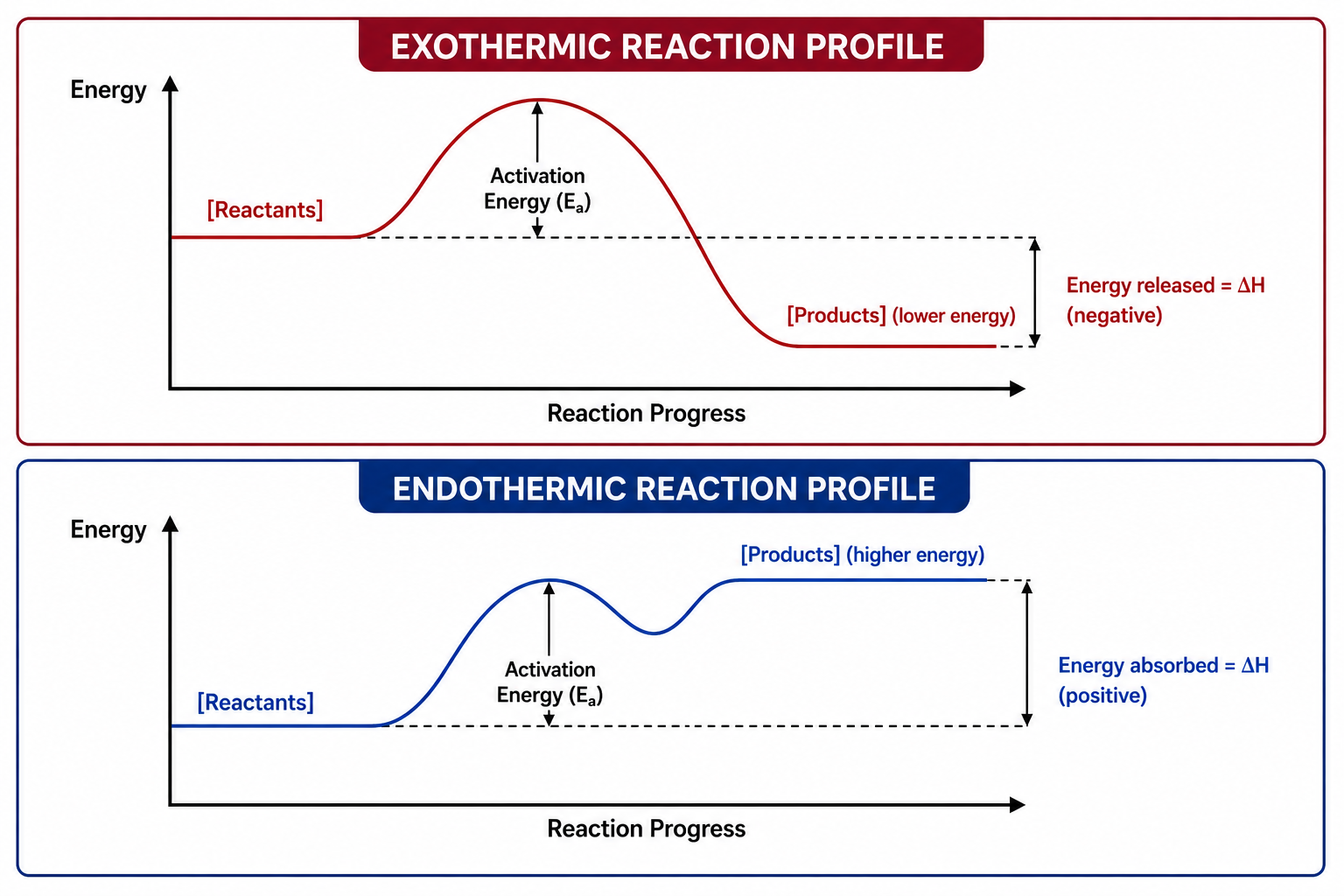
| Energy flow | Releases energy to surroundings | Absorbs energy from surroundings |
| Temperature effect | Surroundings get warmer | Surroundings get cooler |
| Sign of ΔH (enthalpy change) | Negative (ΔH < 0) | Positive (ΔH > 0) |
| Energy of products vs reactants | Products have lower energy | Products have higher energy |
| Energy diagram | Products are lower on the diagram | Products are higher on the diagram |
| Spontaneity tendency | Often spontaneous | Often requires continuous energy input |
| Examples | Combustion, neutralization, respiration, rusting | Photosynthesis, thermal decomposition, dissolving NH₄NO₃ |
| Everyday example | Hand warmers, burning wood | Cold packs, cooking (baking) |
Energy diagram description:
Reversible vs Irreversible Reactions (Comparison Table)
| Feature | Reversible Reaction | Irreversible Reaction |
|---|---|---|
| Direction | Proceeds in both forward and reverse directions | Proceeds in one direction only |
| Symbol | Double arrow (⇌) | Single arrow (→) |
| Products | Can reform reactants | Cannot significantly reform reactants |
| Equilibrium | Reaches dynamic equilibrium | No equilibrium; goes to completion |
| Extent of reaction | Never 100% complete | Essentially 100% complete |
| Examples | N₂ + 3H₂ ⇌ 2NH₃; H₂O ⇌ H⁺ + OH⁻ | Combustion; neutralization; precipitation |
| Le Chatelier’s Principle | Applies — system responds to disturbances | Does not apply |
Factors Affecting Chemical Reactions
The rate of a chemical reaction — how fast reactants convert to products — is affected by several factors, all of which can be explained through collision theory.
Temperature
Increasing temperature increases reaction rate significantly. Higher temperature means molecules have more kinetic energy — they move faster, collide more frequently, and a greater proportion of those collisions have energy exceeding the activation energy. As a rough guide, for every 10°C rise in temperature, many reactions approximately double in rate (though this varies considerably).
Practical example: Refrigerating food slows the chemical reactions (enzymatic and microbial) that cause spoilage. Cooking food at high temperature speeds up the Maillard browning reaction (which is why bread crust browns faster in a hotter oven).
Concentration
Higher concentration means more particles in a given volume, leading to more frequent collisions and a faster reaction rate. For gases, increasing partial pressure has the same effect as increasing concentration.
Practical example: Pure oxygen makes fires burn more intensely and rapidly than air (which is only 21% oxygen). Hospitals restrict oxygen use in certain areas precisely because fires burn so vigorously in oxygen-enriched environments.
Pressure
For reactions involving gases, increasing pressure compresses the gas into a smaller volume, increasing the concentration of gas molecules. This leads to more frequent collisions and faster reaction rates.
Practical example: The Haber process for ammonia synthesis operates at 150–300 atm pressure to drive a faster rate of reaction between nitrogen and hydrogen.
Surface Area
Increasing the surface area of solid reactants exposes more particles to the other reactant, increasing the frequency of collisions at the surface.
Practical example: Powdered iron rusts far faster than iron rods because the powder has enormously more surface area. In industrial settings, explosions can be caused by airborne dust of normally safe materials (flour, coal, sugar) because fine particles have massive surface area and react very rapidly with atmospheric oxygen.
Catalysts
A catalyst is a substance that increases the rate of a chemical reaction without being permanently consumed in the process. Catalysts work by providing an alternative reaction pathway with a lower activation energy, meaning more collisions have sufficient energy to result in a reaction.
Heterogeneous catalysts are in a different physical state from the reactants (e.g., solid platinum catalyst with gaseous reactants in catalytic converters).
Homogeneous catalysts are in the same phase as the reactants.
Practical examples:
- MnO₂ catalyzes the decomposition of hydrogen peroxide
- Iron catalyzes the Haber process (N₂ + 3H₂ → 2NH₃)
- Platinum and palladium catalyze the conversion of toxic CO and NOₓ to CO₂ and N₂ in vehicle catalytic converters
- Enzymes are biological catalysts — proteins that catalyze specific biochemical reactions in living organisms with extraordinary specificity
Factors Affecting Reaction Rate Summary Table
| Factor | Effect on Rate | Mechanism |
|---|---|---|
| Temperature increase | Increases rate | More kinetic energy; more frequent and more energetic collisions |
| Concentration increase | Increases rate | More particles; more frequent collisions |
| Pressure increase (gases) | Increases rate | Same as increased concentration for gases |
| Surface area increase | Increases rate | More reactive surface exposed; more collision opportunities |
| Catalyst added | Increases rate | Lower activation energy pathway provided |
| Inhibitor added | Decreases rate | Blocks active sites or interferes with reaction mechanism |
Collision Theory Explained
Collision theory is the model that explains why and how chemical reactions occur and why reaction rates vary. It states that:
- For a chemical reaction to occur, reactant particles must collide with each other.
- Not all collisions lead to a reaction — only effective collisions do.
- An effective collision requires two conditions to be met simultaneously:
- The colliding particles must have sufficient kinetic energy (at least equal to the activation energy)
- The particles must collide with the correct orientation (the reactive parts of the molecules must make contact)
This model elegantly explains all the factors that affect reaction rate:
- Temperature: Higher temperature → more kinetic energy → higher fraction of collisions exceeding activation energy
- Concentration/Pressure: More particles → more frequent collisions overall → more effective collisions per second
- Surface area: More exposed surface → more opportunities for collision
- Catalysts: Lower activation energy → higher fraction of collisions (even at the same temperature) that are effective
Orientation effect: Two hydrogen iodide molecules colliding head-on (H·I approaching I·H) can react. But if both iodine atoms or both hydrogen atoms collide first, the geometry is wrong and no reaction occurs. This is why even with very high collision frequency, only a fraction of collisions are productive.
Activation Energy Explained
Activation energy (Ea) is the minimum amount of energy that colliding particles must possess for a chemical reaction to occur. It represents the energy required to break the bonds in the reactants so that new bonds can form in the products.
Even in exothermic reactions (which overall release energy), an initial energy input is required to get the reaction started. Think of it like pushing a boulder over a hill — even if it will roll downhill on its own once it’s over the top, you still need to provide energy to get it over the hill first.
Key points about activation energy:
- Every reaction has a characteristic activation energy
- Higher activation energy = slower reaction at a given temperature (fewer particles have sufficient energy)
- Lower activation energy = faster reaction (more particles can react)
- Catalysts lower activation energy without changing the overall energy change of the reaction (ΔH stays the same)
- The Maxwell-Boltzmann distribution describes the spread of energies among molecules at a given temperature; increasing temperature shifts this distribution so that more molecules have energies exceeding Ea
Catalyst effect on Ea: A catalyst provides an alternative reaction pathway — a different mechanism that achieves the same overall transformation but through a sequence of steps each requiring less energy than the uncatalyzed pathway. The overall enthalpy change (ΔH) is unchanged; only the energy hill (Ea) is lower.
Chemical Reactions in Everyday Life
Respiration
Cellular respiration is the oxidation of glucose to release usable energy:
C₆H₁₂O₆ + 6O₂ → 6CO₂ + 6H₂O + energy (ATP)
This exothermic reaction occurs continuously in every living cell. The energy released is captured as ATP (adenosine triphosphate), the universal energy currency of biology. Without this reaction, no cellular work — movement, synthesis, active transport — could occur.
Photosynthesis
Photosynthesis is essentially the reverse of respiration, driven by light energy:
6CO₂ + 6H₂O + light energy → C₆H₁₂O₆ + 6O₂
This endothermic reaction occurs in plant chloroplasts, converting solar energy into chemical energy stored in glucose. It is responsible for virtually all oxygen in Earth’s atmosphere and for the base of every food chain.
Digestion
Digestion involves multiple hydrolysis reactions in which complex food molecules are broken down into simpler ones:
- Starch → glucose (hydrolysis by amylase)
- Proteins → amino acids (hydrolysis by proteases)
- Fats → fatty acids and glycerol (hydrolysis by lipases)
All of these reactions are catalyzed by specific digestive enzymes at optimal pH values.
Rusting
Rusting of iron is an electrochemical redox reaction:
4Fe(s) + 3O₂(g) + 6H₂O(l) → 4Fe(OH)₃(s) → 2Fe₂O₃·3H₂O(s)
Iron is oxidized; oxygen is reduced. Water acts as an electrolyte medium. The process is accelerated by salt (which increases conductivity) and acid (which lowers pH and increases reactivity). Rust costs economies worldwide hundreds of billions of dollars annually in structural damage and replacement.
Cooking
Cooking involves numerous chemical reactions: the Maillard reaction (amino acids and sugars browning at high temperatures), caramelization (sugar dehydration), protein denaturation, gluten network formation in bread, and the thermal decomposition of baking soda (NaHCO₃ → Na₂CO₃ + H₂O + CO₂) that makes cakes rise.
Burning Fuels
The combustion of fossil fuels (coal, oil, natural gas) is the reaction responsible for electricity generation, heating, and transportation:
- Natural gas: CH₄ + 2O₂ → CO₂ + 2H₂O (ΔH = −890 kJ/mol)
- Coal (simplified): C + O₂ → CO₂
These reactions are highly exothermic but also the primary source of anthropogenic CO₂ emissions.
Applications of Chemical Reactions
The deliberate use of chemical reactions is responsible for most of modern civilization:
- Pharmaceuticals: Drug synthesis involves carefully sequenced chemical reactions to build complex molecular structures from simpler starting materials.
- Fertilizer production: The Haber process (N₂ + 3H₂ → 2NH₃) and subsequent conversion of ammonia to ammonium nitrate and other fertilizers feed roughly half the global population.
- Steel production: Iron ore is reduced by carbon in a blast furnace: Fe₂O₃ + 3CO → 2Fe + 3CO₂
- Electrochemistry: Batteries (controlled redox reactions), electroplating (deposition of metals by electrolysis), and fuel cells all exploit chemical reactions for energy conversion.
- Polymer manufacturing: Addition polymerization (of ethene to polyethene) and condensation polymerization (of amino acids to proteins, or diols and diacids to polyesters) create materials with specific properties for specific applications.
- Water treatment: Chlorination (Cl₂ + H₂O → HCl + HOCl; HOCl kills bacteria), precipitation of heavy metals, and pH adjustment all use controlled chemical reactions to make water safe.
Common Chemical Reaction Terms Every Student Should Know
| Term | Definition |
|---|---|
| Reactant | Starting material in a chemical reaction; appears on the left of the equation |
| Product | New substance formed in a reaction; appears on the right |
| Chemical equation | Symbolic representation of a chemical reaction using formulas |
| Coefficient | Number in front of a formula in a balanced equation; indicates molar ratio |
| Subscript | Number within a chemical formula indicating number of atoms of that element |
| State symbol | Symbol in brackets indicating physical state: (s), (l), (g), (aq) |
| Balanced equation | Equation with equal numbers of each type of atom on both sides |
| Exothermic | Reaction that releases energy to surroundings; ΔH is negative |
| Endothermic | Reaction that absorbs energy from surroundings; ΔH is positive |
| Activation energy | Minimum energy required for a reaction to occur |
| Catalyst | Substance that speeds up a reaction without being consumed |
| Inhibitor | Substance that slows a chemical reaction |
| Collision theory | Model explaining reactions occur through effective particle collisions |
| Combustion | Reaction of a substance with oxygen, producing heat and light |
| Decomposition | Reaction in which one compound breaks into simpler substances |
| Synthesis | Reaction in which two or more substances combine to form one product |
| Displacement | Reaction in which one element replaces another in a compound |
| Precipitation | Formation of an insoluble solid from a reaction between two solutions |
| Redox reaction | Reaction involving simultaneous oxidation and reduction |
| Oxidation | Loss of electrons (increase in oxidation state) |
| Reduction | Gain of electrons (decrease in oxidation state) |
| Enthalpy (ΔH) | Heat energy change in a reaction at constant pressure |
| Reversible reaction | Reaction that can proceed in both forward and reverse directions |
| Equilibrium | State where forward and reverse reaction rates are equal |
| Activity series | List of metals in order of decreasing reactivity |
Common Mistakes Students Make
These are the most frequently occurring errors in chemical reaction questions:
- Changing subscripts to balance equations. Changing H₂O to H₃O changes the compound entirely. Only change coefficients (the numbers in front of formulas) when balancing.
- Writing incorrect chemical formulas. NaCl₂ doesn’t exist — the formula should be NaCl. Always determine the correct formula from charges before writing the equation.
- Misidentifying reaction types. A + B → AB is synthesis; AB → A + B is decomposition. Students sometimes confuse these because they look similar. Identify whether there is one product or one reactant to distinguish them.
- Forgetting state symbols. Many examinations require state symbols (s), (l), (g), (aq) for full marks. Including them is not optional when specified.
- Confusing oxidizing agent and reducing agent. The oxidizing agent gets reduced (it gains electrons). The reducing agent gets oxidized (it loses electrons). These seem backwards at first — the agent causes the opposite reaction to what happens to it.
- Thinking catalysts are consumed. Catalysts participate in the reaction mechanism but are regenerated by the end — they are not consumed. This is what makes them economically valuable: a small amount catalyzes a very large quantity of reaction.
- Assuming higher temperature always speeds up all reactions. Temperature increases do increase most reaction rates. However, for enzyme-catalyzed reactions in biology, temperatures above the optimum denature the enzyme and dramatically reduce the rate.
- Confusing the sign of ΔH. Exothermic reactions have negative ΔH (energy is released, so the energy content of the products is lower than the reactants). Endothermic reactions have positive ΔH. Students frequently reverse these.
- Assuming a precipitate always forms in a double displacement reaction. Double displacement reactions produce a precipitate only if one of the products is insoluble. If both products are soluble in water, no precipitate forms and no visible reaction appears to occur.
- Forgetting to balance equations before using them in stoichiometry calculations. Every calculation involving mole ratios from equations requires a correctly balanced equation first. An unbalanced equation gives wrong ratios and wrong answers.
Best Tips to Study Chemical Reactions
Exam Tips Box
- Practice balancing equations daily until it’s completely automatic. The systematic approach (balance metals, then nonmetals, then H and O last) handles 90% of equations efficiently. Practice with 10 equations each session until you can balance any equation correctly within two minutes.
- Memorize the eight reaction type patterns with one example each. When you encounter an unfamiliar equation, identifying its type helps you predict the products even without knowing the specific reaction.
- For combustion equations specifically, remember: balance C from CO₂, then H from H₂O, then O from O₂ (always last). This sequence always works for hydrocarbon combustion.
- Learn the activity/reactivity series for metals. Knowing the order (K, Na, Ca, Mg, Al, Zn, Fe, Ni, Sn, Pb, H, Cu, Ag, Au) allows you to predict whether displacement reactions will occur.
- For exothermic/endothermic questions, remember that ΔH negative = exothermic = energy released = products at lower energy level. Draw the energy profile diagram — visualizing it makes the sign convention intuitive.
- Connect collision theory to every rate factor. If a question asks why concentration affects rate, don’t just say “more collisions” — say “more particles per unit volume means more frequent collisions, increasing the proportion that are effective.”
- Combustion of hydrocarbons always produces CO₂ and H₂O in complete combustion. Recognize this pattern so you can write the products without having to reason through it each time.
Chemical Reactions Practice Questions
30 Multiple Choice Questions (MCQs) with Answers
1. Which of the following is NOT a sign of a chemical reaction?
- A) Formation of a precipitate
- B) Production of a gas
- C) Change in physical shape of a substance ✓
- D) Change in color
2. What type of reaction is: 2H₂O₂ → 2H₂O + O₂?
- A) Synthesis
- B) Decomposition ✓
- C) Combustion
- D) Single displacement
3. In the equation: Zn + CuSO₄ → ZnSO₄ + Cu, what type of reaction is this?
- A) Double displacement
- B) Decomposition
- C) Single displacement ✓
- D) Combination
4. What is the balanced equation for the combustion of methane?
- A) CH₄ + O₂ → CO₂ + H₂O
- B) CH₄ + 2O₂ → CO₂ + 2H₂O ✓
- C) 2CH₄ + O₂ → CO₂ + 2H₂O
- D) CH₄ + 2O₂ → CO₂ + H₂O
5. Which of the following represents an endothermic reaction?
- A) CH₄ + 2O₂ → CO₂ + 2H₂O
- B) H⁺ + OH⁻ → H₂O
- C) 6CO₂ + 6H₂O → C₆H₁₂O₆ + 6O₂ ✓
- D) 4Fe + 3O₂ → 2Fe₂O₃
6. A catalyst increases reaction rate by:
- A) Increasing the temperature
- B) Increasing the concentration of reactants
- C) Lowering the activation energy ✓
- D) Increasing the surface area
7. OIL RIG in redox chemistry stands for:
- A) Oxygen In Liquid; Reduction In Gas
- B) Oxidation Is Loss (of electrons); Reduction Is Gain (of electrons) ✓
- C) Oxidation Involves Liquid; Reactions Involve Gases
- D) Oxygen Is Lost; Reduced In Gain
8. In the reaction 2Na + Cl₂ → 2NaCl, what type of reaction is this?
- A) Synthesis (combination) ✓
- B) Decomposition
- C) Single displacement
- D) Combustion
9. Which factor does NOT increase the rate of a chemical reaction?
- A) Increasing temperature
- B) Adding a catalyst
- C) Increasing concentration
- D) Removing a catalyst ✓
10. The law of conservation of mass requires that in a chemical equation:
- A) The number of molecules is equal on both sides
- B) The subscripts are equal on both sides
- C) The number of atoms of each element is equal on both sides ✓
- D) The products have greater mass than reactants
11. What does the symbol (aq) indicate in a chemical equation?
- A) The substance is a gas
- B) The substance is a solid
- C) The substance is dissolved in water ✓
- D) The substance is liquid
12. What type of reaction produces a precipitate?
- A) Combustion
- B) Decomposition
- C) Precipitation (double displacement) ✓
- D) Synthesis
13. Which of these is a reversible reaction?
- A) Combustion of natural gas
- B) Rusting of iron
- C) N₂ + 3H₂ ⇌ 2NH₃ ✓
- D) Neutralization of HCl with NaOH
14. In an exothermic reaction, ΔH is:
- A) Negative ✓
- B) Positive
- C) Zero
- D) Undefined
15. Which sequence is correct for balancing hydrocarbon combustion equations?
- A) H, C, O
- B) O, C, H
- C) C, H, O ✓
- D) O, H, C
16. Increasing the surface area of a solid reactant:
- A) Changes the products formed
- B) Increases the rate of reaction ✓
- C) Decreases the activation energy
- D) Decreases the temperature
17. Which of the following is an oxidizing agent?
- A) Zn in Zn + CuSO₄ → ZnSO₄ + Cu
- B) Fe in 4Fe + 3O₂ → 2Fe₂O₃
- C) O₂ in 4Fe + 3O₂ → 2Fe₂O₃ ✓
- D) Na in 2Na + Cl₂ → 2NaCl
18. The downward arrow (↓) in a chemical equation indicates:
- A) A decrease in temperature
- B) A gas is produced
- C) A precipitate is formed ✓
- D) The reaction is endothermic
19. What is produced in complete combustion of a hydrocarbon?
- A) CO and H₂O
- B) C and H₂O
- C) CO₂ and H₂O ✓
- D) CO₂ and H₂
20. Collision theory states that a reaction occurs when:
- A) Particles are in the same container
- B) Particles have any amount of energy
- C) Particles collide with sufficient energy and correct orientation ✓
- D) Temperature is above 100°C
21. The neutralization of HCl with NaOH produces:
- A) HClO and NaH
- B) NaCl and H₂O ✓
- C) NaH and ClOH
- D) Na₂Cl and H₂O
22. Which type of reaction has the general form A + BC → AC + B?
- A) Double displacement
- B) Decomposition
- C) Single displacement ✓
- D) Synthesis
23. Rusting of iron is an example of:
- A) Decomposition
- B) Combustion
- C) Oxidation-reduction ✓
- D) Synthesis
24. When balancing equations, what should you NEVER change?
- A) Coefficients
- B) State symbols
- C) Subscripts ✓
- D) Reaction conditions
25. Which of the following increases the rate of a gaseous reaction?
- A) Decreasing pressure
- B) Increasing pressure ✓
- C) Using larger containers
- D) Removing the catalyst
26. The energy required to start a chemical reaction is called:
- A) Enthalpy
- B) Activation energy ✓
- C) Kinetic energy
- D) Bond energy
27. In cellular respiration, glucose is:
- A) Synthesized from CO₂ and H₂O
- B) Oxidized to produce CO₂, H₂O, and ATP ✓
- C) Decomposed into carbon and water
- D) Reduced to form ethanol
28. Which is an example of a combination reaction?
- A) 2H₂O₂ → 2H₂O + O₂
- B) CaO + H₂O → Ca(OH)₂ ✓
- C) Zn + CuSO₄ → ZnSO₄ + Cu
- D) CH₄ + 2O₂ → CO₂ + 2H₂O
29. What type of reaction is: AgNO₃ + NaCl → AgCl↓ + NaNO₃?
- A) Single displacement
- B) Precipitation (double displacement) ✓
- C) Combustion
- D) Decomposition
30. A reaction with positive ΔH is:
- A) Exothermic and releases energy
- B) Endothermic and absorbs energy ✓
- C) Exothermic and absorbs energy
- D) Neither exothermic nor endothermic
15 Short Answer Questions
- State the law of conservation of mass and explain what it requires when writing a balanced chemical equation.
- Describe five observable signs that a chemical reaction has occurred. For each, give a specific real-world example.
- What is the difference between an exothermic and an endothermic reaction? Define each in terms of energy flow and the sign of ΔH, and give two examples of each.
- Explain collision theory. What two conditions must be met for a collision to be an effective collision that results in a reaction?
- What is activation energy? How do catalysts affect activation energy, and how does this explain their ability to speed up reactions?
- Describe how temperature affects the rate of a chemical reaction, explaining the mechanism through collision theory and the distribution of molecular energies.
- Distinguish between a reversible and an irreversible reaction, giving one example of each with the correct arrow notation.
- Explain what a catalyst is, how it works at the molecular level, and give two specific examples of industrially or biologically important catalysts.
- Write balanced equations for: (a) the combustion of propane (C₃H₈), (b) the decomposition of calcium carbonate, (c) the reaction of iron with hydrochloric acid.
- Identify the type of reaction for each of the following and explain your reasoning:
(a) 2SO₂ + O₂ → 2SO₃
(b) H₂SO₄ + 2NaOH → Na₂SO₄ + 2H₂O
(c) Cl₂ + 2KBr → 2KCl + Br₂ - Explain why increasing the surface area of a solid reactant increases the reaction rate. Use coal dust and coal lumps as an example.
- In OIL RIG, explain what each letter pair means in the context of redox reactions. Identify the oxidizing and reducing agents in: Mg + 2HCl → MgCl₂ + H₂.
- Write the balanced ionic equation for the neutralization of sulfuric acid with sodium hydroxide. What is the net ionic equation?
- Explain the difference between a combination reaction and a decomposition reaction. Could the same pair of substances theoretically undergo both? Explain with an example.
- Explain why rusting is considered a chemical reaction rather than a physical change. Write the overall balanced equation for the rusting of iron.
10 Long Answer Questions
- Describe all eight major types of chemical reactions (synthesis, decomposition, single displacement, double displacement, combustion, neutralization, redox, and precipitation) in detail. For each type, state the general pattern, explain the mechanism, give two balanced equation examples, and describe one real-world occurrence or application.
- Explain how to balance a chemical equation, including why it must be done, what the law of conservation of mass requires, and the systematic step-by-step approach. Demonstrate the method by balancing five equations of varying difficulty, showing all working steps.
- Compare and contrast exothermic and endothermic reactions comprehensively: definition, enthalpy change (ΔH), energy diagram shape, spontaneity, common examples, and practical applications. Include a discussion of how the concepts relate to bond breaking and bond forming energies.
- Explain in detail how each of the five main factors (temperature, concentration, pressure, surface area, catalysts) affects the rate of a chemical reaction. For each factor, explain the mechanism using collision theory, state the direction of the effect on rate, and give a specific practical example.
- Describe collision theory fully, including the conditions for an effective collision, the role of molecular orientation, the significance of the Maxwell-Boltzmann energy distribution, and how the theory explains why reaction rates change with temperature, concentration, surface area, and catalysts.
- Explain redox reactions in full: the definitions of oxidation and reduction in terms of electron transfer, the identification of oxidizing and reducing agents, the assignment of oxidation states, and why oxidation and reduction must always occur together. Give five balanced redox equations from different contexts (industrial, biological, everyday).
- Write a comprehensive discussion of chemical reactions in everyday life. Choose six different scenarios (from respiration, photosynthesis, digestion, rusting, cooking, and fuel combustion), describe the chemical reactions involved for each, write balanced equations where possible, and explain why each reaction is significant.
- Describe the concept of activation energy in detail, including its role in determining reaction rate, how it appears in energy profile diagrams for both exothermic and endothermic reactions, what happens when a catalyst is added (for both types), and how the Maxwell-Boltzmann distribution explains why a small temperature increase can dramatically increase the fraction of molecules with energy exceeding Ea.
- Explain reversible reactions and chemical equilibrium in full. Define a reversible reaction, explain what dynamic equilibrium means, describe how Le Chatelier’s principle predicts the system’s response to changes in concentration, temperature, and pressure, and use the Haber process (N₂ + 3H₂ ⇌ 2NH₃) as an extended example throughout.
- Write a comprehensive comparison of the eight reaction types, organized around two axes: whether they involve electron transfer (redox or not) and whether they involve bond formation, bond breaking, or both. Discuss how some reactions can be classified under multiple types simultaneously (e.g., combustion is both a redox reaction and an exothermic reaction).
10 Equation Balancing Practice Problems with Solutions
Problem 1: Balance: Al + O₂ → Al₂O₃
Solution:
Count: Al: 1 left, 2 right. O: 2 left, 3 right.
Balance Al: 2Al + O₂ → Al₂O₃
Balance O: 2Al + 3/2 O₂ → Al₂O₃ → multiply by 2:
4Al + 3O₂ → 2Al₂O₃
Check: Left: 4 Al, 6 O. Right: 4 Al (2×2), 6 O (2×3). Balanced.
Problem 2: Balance: Na + H₂O → NaOH + H₂
Solution:
Count: Na:1/1, H:2/(1+2=3), O:1/1
Balance H: 2Na + 2H₂O → 2NaOH + H₂
2Na + 2H₂O → 2NaOH + H₂
Check: Left: 2 Na, 4 H, 2 O. Right: 2 Na, 4 H (2+2), 2 O. Balanced.
Problem 3: Balance: Fe₂O₃ + CO → Fe + CO₂
Solution:
Count: Fe: 2 left, 1 right. C: 1 left, 1 right. O: 3+1=4 left, 2 right.
Balance Fe: Fe₂O₃ + CO → 2Fe + CO₂
Balance C and O: Fe₂O₃ + 3CO → 2Fe + 3CO₂
Fe₂O₃ + 3CO → 2Fe + 3CO₂
Check: Left: 2 Fe, 3+3=6 O (wait: 3O + 3×1O = 3+3=6 O left), Right: 3×2O=6 O. Balanced.
Problem 4: Balance: C₂H₆ + O₂ → CO₂ + H₂O
Solution:
Balance C: 2CO₂; Balance H: 3H₂O.
C₂H₆ + O₂ → 2CO₂ + 3H₂O
Count O right: 4+3=7. Need 7/2 O₂. Multiply through by 2:
2C₂H₆ + 7O₂ → 4CO₂ + 6H₂O
Check: Left: 4 C, 12 H, 14 O. Right: 4 C, 12 H, 8+6=14 O. Balanced.
Problem 5: Balance: KMnO₄ + HCl → KCl + MnCl₂ + H₂O + Cl₂
Solution: (Inspection/trial method)
Try: 2KMnO₄ + 16HCl → 2KCl + 2MnCl₂ + 8H₂O + 5Cl₂
Check K: 2/2 ✓. Mn: 2/2 ✓. H: 16/(16) ✓. O: 8/(8) ✓. Cl: 16/(2+4+10=16) ✓
2KMnO₄ + 16HCl → 2KCl + 2MnCl₂ + 8H₂O + 5Cl₂
Problem 6: Balance: Ca₃(PO₄)₂ + H₂SO₄ → CaSO₄ + H₃PO₄
Solution:
Ca: 3 left, 1 right; PO₄: 2 left, 1 right; SO₄: 1 left, 1 right.
Balance Ca and PO₄: Ca₃(PO₄)₂ + H₂SO₄ → 3CaSO₄ + 2H₃PO₄
Balance H₂SO₄ for SO₄: need 3 SO₄ on right, so 3H₂SO₄.
Check H: 3×2=6 left. Right: 2×3=6 H. ✓
Ca₃(PO₄)₂ + 3H₂SO₄ → 3CaSO₄ + 2H₃PO₄
Problem 7: Balance: NH₃ + O₂ → NO + H₂O
Solution:
4NH₃ + 5O₂ → 4NO + 6H₂O
Check: N: 4/4 ✓; H: 12/(12) ✓; O: 10/(4+6=10) ✓
4NH₃ + 5O₂ → 4NO + 6H₂O
Problem 8: Balance: HNO₃ + Cu → Cu(NO₃)₂ + NO + H₂O
Solution: (dilute HNO₃)
8HNO₃ + 3Cu → 3Cu(NO₃)₂ + 2NO + 4H₂O
Check: H:8/8 ✓; N:8/(6+2=8) ✓; O:24/(18+2+4=24) ✓; Cu:3/3 ✓
8HNO₃ + 3Cu → 3Cu(NO₃)₂ + 2NO + 4H₂O
Problem 9: Balance: Al + H₂SO₄ → Al₂(SO₄)₃ + H₂
Solution:
Balance Al: 2Al; Balance SO₄: 3H₂SO₄; Balance H: 3H₂
2Al + 3H₂SO₄ → Al₂(SO₄)₃ + 3H₂
Check: Al:2/2 ✓; H:6/6 ✓; S:3/3 ✓; O:12/12 ✓
Problem 10: Balance: C₆H₁₂O₆ + O₂ → CO₂ + H₂O (cellular respiration)
Solution:
Balance C: 6CO₂. Balance H: 6H₂O.
C₆H₁₂O₆ + O₂ → 6CO₂ + 6H₂O
Count O right: 12 + 6 = 18. Left already has 6 from glucose, so need 12 more from O₂ = 6O₂.
C₆H₁₂O₆ + 6O₂ → 6CO₂ + 6H₂O
Check: Left: 6 C, 12 H, 6+12=18 O. Right: 6 C, 12 H, 12+6=18 O. Balanced.
Revision Checklist
Use this before any chemical reactions examination:
- I can identify the signs of a chemical reaction and distinguish them from physical changes
- I understand the law of conservation of mass and why equations must be balanced
- I can write correct chemical formulas for common substances
- I can balance chemical equations using the step-by-step systematic method
- I never change subscripts when balancing equations (only coefficients)
- I know all eight reaction types with their general patterns and at least one example each
- I can write balanced equations for combustion of simple hydrocarbons
- I understand exothermic vs endothermic reactions including the sign of ΔH for each
- I can draw and interpret energy profile diagrams for exothermic and endothermic reactions
- I understand reversible reactions and the concept of dynamic equilibrium
- I can explain how temperature, concentration, pressure, surface area, and catalysts affect reaction rate
- I can explain collision theory and define activation energy
- I understand what catalysts do and how they lower activation energy
- I can apply OIL RIG to identify oxidation and reduction in redox reactions
- I can identify oxidizing agents and reducing agents in a given reaction
- I include state symbols (s), (l), (g), (aq) where required
- I have completed all 30 MCQs and reviewed any errors
- I have balanced all 10 practice equations and verified each one by recounting atoms
Best Books for Learning Chemical Reactions
These textbooks are consistently recommended by chemistry educators:
- “Chemistry: The Central Science” by Brown, LeMay, Bursten, Murphy, and Woodward — The most widely used university general chemistry text; its chapters on chemical reactions, reaction types, reaction rates (kinetics), and thermochemistry are comprehensive, clearly written, and packed with worked examples.
- “Chemistry” by Zumdahl and Zumdahl — Particularly strong on explaining the conceptual basis of reaction types and rate factors, with an exceptional treatment of reaction kinetics accessible to students at all levels.
- “GCSE Chemistry” by Nigel Saunders (Oxford Revision Guides) — For students at GCSE level; clearly organized around the types of reactions and balancing equations, with exam-focused practice.
- “Chemical Kinetics and Reaction Dynamics” by Paul Houston — For advanced students wanting to go deeper into reaction rates, collision theory, transition state theory, and molecular reaction dynamics.
- “Organic Chemistry” by Clayden, Greeves, and Warren — For students moving into organic reactions; exceptional coverage of reaction mechanisms, electron pushing, and how to predict products from reagent and substrate structure.
Free Online Chemistry Resources
- OpenStax Chemistry — Free, peer-reviewed university chemistry textbooks covering all reaction types, balancing equations, kinetics, and thermochemistry with worked examples and practice problems.
- Khan Academy Chemistry — Free video lessons and exercises on balancing equations, reaction types, reaction rates, collision theory, and activation energy. Excellent for visual learners.
- Chemistry LibreTexts — Comprehensive open-access chemistry library with academic-level content on all aspects of chemical reactions, from introductory through advanced university level.
- American Chemical Society (ACS) — Educational materials from the world’s largest chemistry organization, including interactive simulations of chemical reactions and curriculum resources.
- Royal Society of Chemistry (RSC) — Curriculum-aligned resources from the UK’s leading chemistry organization, including reaction type explanations, equation balancing practice, and interactive rate factor demonstrations.
Related Articles on LearnMinto
These connected guides will help you build on chemical reaction concepts across the full chemistry curriculum:
- Chemistry Study Guide — Comprehensive overview of all major chemistry topics for exam success
- Atomic Structure Study Guide — Understanding electron configuration as the basis of chemical reactivity
- Periodic Table Study Guide — Reactivity trends and activity series explained through periodic properties
- Chemical Bonding Study Guide — Understanding bond breaking and forming as the molecular basis of all chemical reactions
- Mole Concept Study Guide — Stoichiometric calculations from balanced equations
Frequently Asked Questions
Q1: What is a chemical reaction?
A chemical reaction is a process in which one or more reactants are converted into one or more products through the breaking and forming of chemical bonds. The atoms present in the reactants are rearranged into new configurations in the products. No atoms are created or destroyed — they’re just reorganized, which is why balanced equations must have the same number of each atom on both sides.
Q2: How do you balance a chemical equation?
Balance chemical equations by adjusting coefficients (the numbers in front of formulas) — never by changing subscripts within formulas. Work systematically: balance metals first, then nonmetals, and leave hydrogen and oxygen for last. Count atoms of each element on both sides at the end to verify. The law of conservation of mass requires that atom counts match on both sides.
Q3: What are the main types of chemical reactions?
The eight major types are: synthesis (combination), decomposition, single displacement, double displacement, combustion, neutralization, redox (oxidation-reduction), and precipitation. Each has a characteristic pattern: synthesis builds one product from multiple reactants; decomposition breaks one compound into multiple products; combustion reacts with oxygen to produce CO₂ and H₂O; neutralization reacts acid with base to produce salt and water.
Q4: What is the difference between exothermic and endothermic reactions?
Exothermic reactions release energy (heat) to the surroundings — the system gets warmer and ΔH is negative (products have lower energy than reactants). Endothermic reactions absorb energy from the surroundings — the system gets cooler and ΔH is positive (products have higher energy than reactants). Combustion and neutralization are exothermic; photosynthesis and thermal decomposition are endothermic.
Q5: What factors affect the rate of a chemical reaction?
Five main factors affect reaction rate: temperature (higher temperature increases rate), concentration (higher concentration increases rate), pressure (higher pressure increases rate for gases), surface area (greater surface area increases rate for solids), and catalysts (lower activation energy, increasing rate). All are explained by collision theory: factors that increase collision frequency or the proportion of collisions with sufficient energy increase the reaction rate.
Q6: What is collision theory?
Collision theory states that chemical reactions occur when reactant particles collide with (1) sufficient kinetic energy — at least equal to the activation energy — and (2) the correct molecular orientation. Not all collisions lead to reactions; only effective collisions do. This model explains why reaction rate increases with temperature, concentration, surface area, and the use of catalysts.
Q7: What is activation energy?
Activation energy is the minimum energy that colliding particles must possess for a chemical reaction to occur. Even in exothermic reactions (which release energy overall), this initial energy input is required to break bonds in the reactants. Catalysts provide alternative reaction pathways with lower activation energy, allowing more collisions to be effective without changing the overall energy change (ΔH) of the reaction.
Q8: What is a catalyst and is it consumed in the reaction?
A catalyst increases the rate of a chemical reaction by providing an alternative reaction pathway with lower activation energy. Crucially, catalysts are not consumed in the reaction — they participate in the mechanism but are regenerated by the end, allowing each catalyst molecule to facilitate a very large number of reaction cycles. Examples include MnO₂ in hydrogen peroxide decomposition, iron in the Haber process, and enzymes in biological systems.
Q9: What is the difference between single and double displacement reactions?
In single displacement (A + BC → AC + B), one element replaces another in a compound. In double displacement (AB + CD → AD + CB), the cations and anions of two ionic compounds switch partners. Single displacement occurs when the displacing element is more reactive (higher in the activity series). Double displacement often produces a precipitate, gas, or water as a driving force.
Q10: What does OIL RIG mean?
OIL RIG is a memory device for redox reactions: Oxidation Is Loss (of electrons), Reduction Is Gain (of electrons). The species that loses electrons is oxidized and acts as the reducing agent; the species that gains electrons is reduced and acts as the oxidizing agent. Note the apparent paradox: the reducing agent causes reduction in the other species (while being oxidized itself), and the oxidizing agent causes oxidation in the other species (while being reduced itself).
Q11: How do you identify the type of a chemical reaction?
Identify by the pattern of reactants and products: if two or more reactants produce one product, it’s synthesis. If one reactant produces two or more products, it’s decomposition. If one element replaces another in a compound (A + BC → AC + B), it’s single displacement. If two ionic compounds swap ions (AB + CD → AD + CB), it’s double displacement. If there’s reaction with oxygen producing CO₂ and H₂O, it’s combustion. If an acid reacts with a base to produce salt and water, it’s neutralization. If an insoluble solid forms from two solutions, it’s precipitation.
Q12: Why is rusting considered a chemical reaction?
Rusting is a chemical reaction because it produces new substances (iron oxides and hydroxides) with chemical properties entirely different from metallic iron. The iron is permanently changed — it cannot be physically separated back into iron and oxygen. The reaction involves electron transfer (iron is oxidized, oxygen is reduced), making it a redox reaction. The overall reaction produces Fe₂O₃·H₂O (hydrated iron oxide), which is the reddish-brown flaking material we call rust.
Summary
Chemical reactions are at the heart of all chemistry and of the natural world. Understanding them means understanding how matter transforms, how energy is stored and released, and how every living and non-living process ultimately operates at the molecular level.
This guide has covered the complete landscape of the topic: recognizing reactions through observable signs; writing and balancing chemical equations; understanding the eight major reaction types (synthesis, decomposition, single displacement, double displacement, combustion, neutralization, redox, and precipitation); distinguishing exothermic from endothermic reactions; understanding reversible and irreversible processes; and explaining how temperature, concentration, pressure, surface area, and catalysts all affect reaction rate through the framework of collision theory and activation energy.
Chemical reactions in everyday life — respiration, photosynthesis, digestion, rusting, cooking, and fuel combustion — demonstrate that this is not purely academic knowledge. It explains the world you live in.
Final Thoughts
Chemical reactions are one of those topics where the more you study, the more connections you see. Once you recognize the pattern of a combustion reaction, you see it everywhere — in car engines, in rocket propulsion, in forest fires, and in the mitochondria of every cell in your body. Once you understand why increasing temperature speeds up reactions, you understand refrigerators, enzyme biology, and industrial process design simultaneously.
This Chemical Reactions Study Guide has aimed to give you both the theoretical understanding and the practical skill — particularly equation balancing and reaction type identification — needed to perform confidently on any chemistry examination. Work through the balancing problems systematically, practice identifying reaction types from equations until it’s automatic, and use the revision checklist to identify any remaining gaps.
Chemistry is ultimately the study of change — and chemical reactions are how that change happens.
Disclaimer
This article is intended for educational and informational purposes only. While LearnMinto strives to provide accurate and up-to-date information, readers should verify important academic concepts through official textbooks, educational institutions, examination boards, or trusted scientific resources before relying on this content for exams or academic purposes. LearnMinto is not affiliated with any specific school, university, research institution, or examination board.