
Introduction
If you’ve ever stared at a biology textbook wondering how a fish could possibly be related to a human, or why bacteria seem to get stronger every time we throw antibiotics at them—you’re already thinking about evolution. And honestly, that curiosity is exactly where great science begins.
This evolution study guide is designed to be the only resource you’ll need to understand, revise, and prepare for any exam or class discussion involving evolutionary biology. Whether you’re a high school student preparing for AP Biology, a college student revisiting key concepts, or just someone who finds the history of life on Earth genuinely fascinating, this guide has you covered.
Evolution is not just an abstract theory from the 1800s. It’s a living, breathing field of science that explains why antibiotic-resistant bacteria are a global health crisis, why dogs look so different from wolves, why your arm and a bat’s wing share the same bones, and why some animals that live on separate continents look startlingly similar.
Over the years of teaching biology, one thing I’ve noticed again and again is that students don’t struggle with evolution because it’s complicated—they struggle because it gets taught in disconnected pieces. Natural selection here. Fossil records there. Speciation somewhere else. Nobody ties it all together into a coherent story.
That’s exactly what this guide does. We’ll walk through everything from the foundational ideas of Darwin to how evolution plays out in your daily life, complete with practical examples, comparison tables, common misconceptions, and practice questions you can use right now.
Let’s get into it.
Key Takeaways
Before you dive in, here’s what you’ll walk away understanding:
- Evolution is the gradual change in inherited traits of populations over generations—not individuals
- Charles Darwin and Alfred Russel Wallace independently developed the theory of natural selection
- Five major categories of evidence support evolution: fossils, comparative anatomy, embryology, molecular biology, and biogeography
- Natural selection works through variation, overproduction, competition, and differential survival
- Speciation can happen through geographic separation (allopatric) or without it (sympatric)
- Evolution is directly observable today in antibiotic resistance, dog breeding, and crop development
- Human evolution is supported by fossil, genetic, and anatomical evidence tracing back millions of years
- Common misconceptions—like “survival of the fittest means the strongest survive”—can seriously trip you up on exams
What Is Evolution?
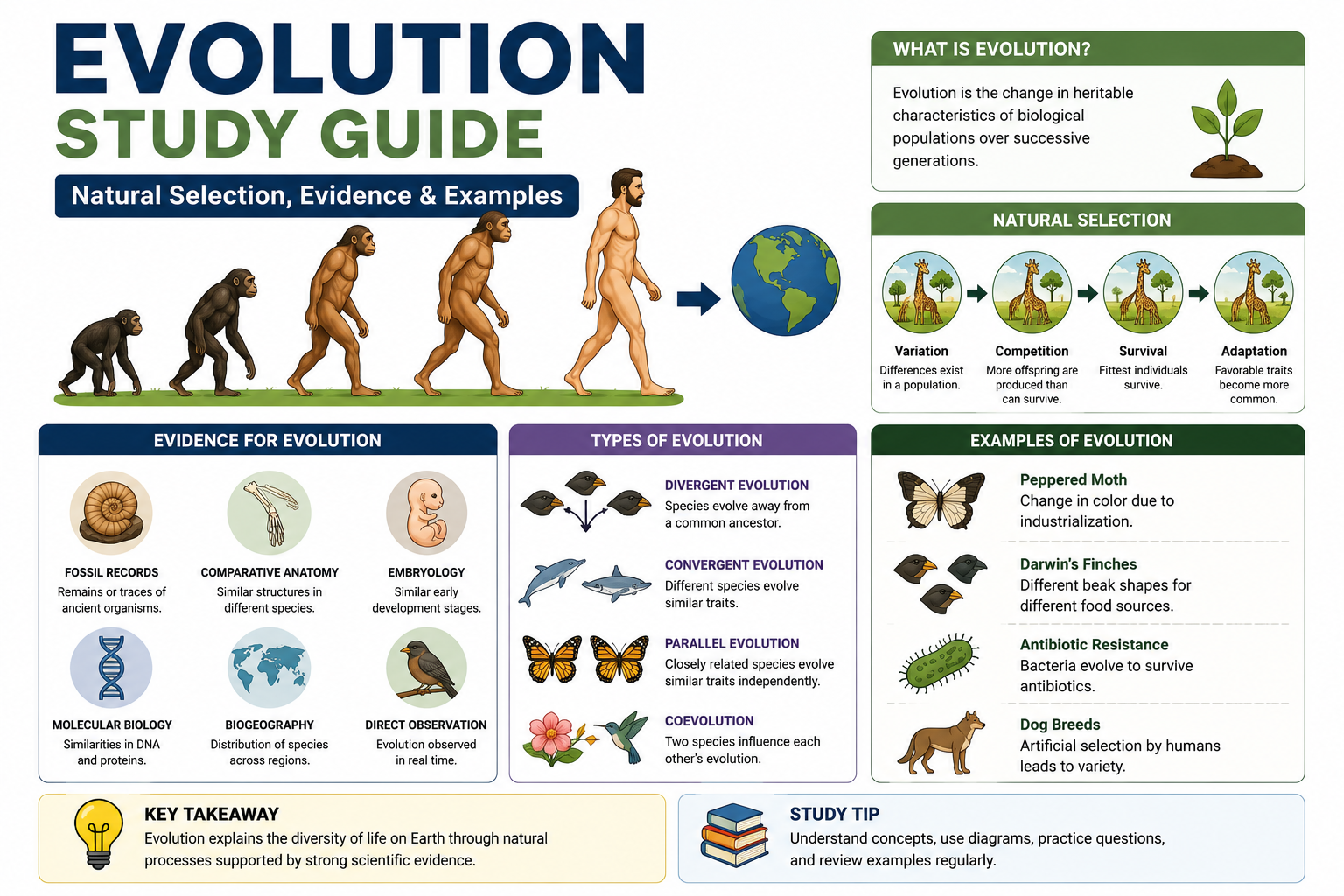
At its simplest, evolution is change over time. More specifically in biology, evolution refers to the gradual change in the inherited characteristics of populations across successive generations. It’s not about one organism changing during its lifetime—that’s development. Evolution is about populations changing over time.
Here’s an analogy that helps. Imagine a school where students wear a certain style of backpack because it’s popular. Over twenty years, the most practical backpack style becomes the default because students who used it were more efficient. The “population” of backpacks in that school evolved—not because any single backpack changed, but because which type got passed down changed.
In biology, the “backpacks” are genes. Traits that improve survival and reproduction get passed on more frequently. Over generations, the population starts to look different from its ancestors.
Biologists define evolution more precisely in two ways:
- Microevolution – Small-scale changes within a species over relatively short periods (e.g., changes in beak size in birds)
- Macroevolution – Large-scale changes that lead to the emergence of new species or higher taxonomic groups over long periods
Evolution doesn’t have a direction or a goal. It doesn’t “try” to make organisms better. It simply describes what happens when heritable variation meets environmental pressure over time. That’s it. And somehow, that simple process has produced every living thing on Earth.
Why Is Evolution Important?
This is the question every student should ask, and very few textbooks answer properly. Evolution isn’t just a topic for biology class—it’s the foundation that makes all of biology make sense.
The famous geneticist Theodosius Dobzhansky once wrote, “Nothing in biology makes sense except in the light of evolution.” That sentence has aged remarkably well.
Here’s why evolution matters beyond the classroom:
Medicine: Understanding how pathogens evolve helps doctors and researchers stay ahead of disease. Antibiotic resistance, viral mutations, and cancer progression are all evolutionary processes. Without evolutionary thinking, medicine would be blind.
Agriculture: Modern crops are the result of thousands of years of artificial selection—a human-guided form of evolution. Understanding how traits are inherited and selected allows us to develop disease-resistant, high-yield crops that feed billions.
Conservation: When you know how species adapt to their environments, you can make smarter decisions about how to protect them. Conservation biologists use evolutionary principles to manage endangered species and restore ecosystems.
Biotechnology: Gene editing tools like CRISPR were developed with a deep understanding of how genetic material changes and functions—knowledge rooted in evolutionary biology.
Understanding ourselves: Human anatomy, behavior, psychology, and even some social patterns have evolutionary roots. Knowing where we came from helps explain who we are.
In short, evolution is not optional knowledge. It’s the operating system that runs biology.
History of Evolutionary Theory
The idea that life changes over time didn’t start with Darwin. Philosophers in ancient Greece, including Anaximander, speculated that humans might have descended from fish-like creatures. But these were philosophical musings, not scientific theories.
Let’s trace the actual scientific development:
Pre-Darwin Thinkers
- Carolus Linnaeus (1700s): Developed the classification system for organisms and noticed distinct patterns in their organization, planting seeds for evolutionary thinking
- Georges Buffon (1700s): Suggested species could change over time due to environmental influences—a radical idea for his era
- Erasmus Darwin (late 1700s): Charles Darwin’s grandfather actually wrote poems and essays suggesting that all life descended from a common ancestor
- Jean-Baptiste Lamarck (early 1800s): Proposed one of the first formal evolutionary theories—that organisms pass on traits they acquire during their lifetime. This is now known to be incorrect (a giraffe stretching its neck doesn’t give its offspring a longer neck), but Lamarck deserves credit for pushing the conversation forward
The Geological Revolution
Charles Lyell’s work in geology showed that Earth was far older than previously believed. This was critical—Darwin’s theory required enormous amounts of time to work. Without deep time, evolution couldn’t function.
Thomas Malthus
Malthus’s work on population growth, showing that populations always outgrow their resources, directly influenced Darwin’s thinking about competition and survival.
By the time Darwin published On the Origin of Species in 1859, he wasn’t working in isolation. He was synthesizing decades of scientific ideas into a coherent, evidence-backed theory.
Charles Darwin and the Theory of Evolution
Charles Darwin is arguably the most influential scientist in the history of biology. But what made his contribution special wasn’t just his intelligence—it was his remarkable ability to observe, question, and synthesize.
Darwin was born in England in 1809. As a young man, he secured a spot on HMS Beagle, a British naval ship that spent five years (1831–1836) surveying coastlines around the world. That journey changed everything.
The Galapagos Insight
During the Beagle’s stop at the Galapagos Islands off the coast of South America, Darwin observed something peculiar. The islands had finches—small birds—but each island’s finches had beaks shaped differently. Some had stout, crushing beaks ideal for eating seeds. Others had long, thin beaks for probing flowers or catching insects.
Darwin initially didn’t think much of it. But back in England, when ornithologist John Gould confirmed these were all separate species descended from a common South American ancestor, the implication hit Darwin like a thunderbolt: species could change over time, branching from a common origin.
Natural Selection—The Mechanism Darwin Found
Darwin realized that populations produce more offspring than can survive. Resources are limited. So there’s constant competition. Individuals with favorable traits survive longer and reproduce more. Their traits get passed on. Over generations, favorable traits become more common in the population.
He called this process natural selection.
Darwin spent over 20 years gathering evidence before publishing. Part of what finally pushed him to publish was a letter from Alfred Russel Wallace, who had independently arrived at the same theory while working in Southeast Asia. The two men jointly presented their findings to the Linnean Society in 1858. Darwin published On the Origin of Species in 1859, and biology has never been the same since.
Neo-Darwinian Synthesis
Darwin didn’t know about genetics—Gregor Mendel’s work on inheritance wasn’t incorporated into evolutionary theory until the early 20th century. The modern synthesis merged Darwin’s natural selection with Mendelian genetics, giving evolution its full mechanistic foundation.
Natural Selection Explained
Natural selection is the engine of evolution. It’s the process through which certain inherited traits become more or less common in a population based on how they affect survival and reproduction. Think of it as nature’s way of editing a population—slowly, over generations.
To understand how it works, you need to understand its four core components.
Variation
No two individuals in a population are exactly alike. Even among siblings, there are differences—in height, disease resistance, coloration, speed, and countless other traits. This variation exists because of mutations, genetic recombination during sexual reproduction, and other processes.
Without variation, natural selection has nothing to work with. If everyone were identical, there’d be no differential survival—everyone would have the same advantages and disadvantages. Variation is the raw material of evolution.
Example: In a population of beetles, some might be brown and others green. That color difference is a variation.
Overproduction
Almost every organism produces more offspring than can possibly survive to reproduce. A single oak tree drops thousands of acorns per year. A female frog may lay thousands of eggs in a single season. Bacteria can divide every 20 minutes. This excess is intentional from an evolutionary standpoint—it provides a large pool of variants from which selection can act.
Example: If only a tiny fraction of those acorns grow into adult trees, the ones that do survive must have had some advantage—maybe they fell in a spot with better soil or less competition.
Competition
Because resources—food, water, shelter, mates—are limited, individuals within a population compete for them. This competition isn’t always dramatic. It doesn’t have to mean actual fighting. It could simply mean one plant’s roots reaching water slightly faster than another’s.
The key is that not everyone gets enough resources to survive and reproduce. Competition creates the pressure that makes natural selection work.
Survival of the Fittest
This phrase is perhaps the most misunderstood in all of science. “Fittest” does NOT mean strongest, fastest, or most aggressive. In evolutionary biology, fitness refers to an organism’s ability to survive and reproduce in its specific environment.
A cave fish that loses its eyes over generations isn’t weaker—it’s actually better adapted to an environment where eyes cost energy to develop and maintain but provide no benefit.
Fitness is always relative to the environment. A trait that’s advantageous in one environment may be deadly in another.
Adaptation
Over many generations, as individuals with favorable traits survive and reproduce more successfully, those traits become increasingly common in the population. The population becomes better suited—more adapted—to its environment.
Adaptation is both the process and the result. The webbed feet of a duck, the thick fur of a polar bear, the camouflage of a stick insect—all of these are adaptations that arose through natural selection acting on variation over time.
Evidence for Evolution
Evolution is one of the most well-supported theories in all of science. Here’s the evidence that builds the case.
Fossil Records
Fossils are the preserved remains or traces of ancient organisms found in rock layers. They give us a direct window into the past. The fossil record shows:
- Life on Earth has changed dramatically over time
- Older rock layers contain simpler, more primitive organisms
- There are transitional fossils that show intermediate forms between major groups
Famous example: Tiktaalik, a 375-million-year-old fossil that shows features of both fish and land vertebrates—a transitional form between aquatic and terrestrial life.
Comparative Anatomy
When you compare the skeletons of different vertebrates, something striking emerges—they share the same basic bone structure. A human arm, a whale flipper, a bat wing, and a cat’s front leg all have the same bones arranged in the same basic pattern: one bone near the body, two bones below, then small bones, then digits.
These are called homologous structures—same basic structure, different function—and they point to a common ancestor.
Embryology
The embryos of very different vertebrates look remarkably similar in their early stages. Fish, frogs, chickens, pigs, and humans all have gill slits and tails as embryos. As development proceeds, these structures either change function or disappear entirely.
This similarity in embryonic development suggests shared evolutionary ancestry. Organisms that share a common ancestor often share developmental pathways, even if the adult forms look completely different.
Molecular Biology
Perhaps the most powerful modern evidence for evolution comes from DNA. Every living organism uses the same genetic code—the same four nucleotide bases, the same codons, the same basic machinery for protein synthesis.
More telling: we can directly compare DNA sequences between species. Humans share approximately 98–99% of their DNA with chimpanzees, about 85% with mice, and even a surprising 60% with fruit flies. The closer two species are evolutionarily, the more similar their DNA sequences.
Biogeography
Biogeography is the study of where organisms live around the world. Evolution predicts that related species should be found near each other—and near where their common ancestor lived.
The Galapagos finches are a classic example. So are the marsupials of Australia—isolated from the rest of the world for millions of years, they evolved independently to fill ecological roles that placental mammals fill elsewhere. Yet the same ecological niches produced strikingly convergent forms.
Direct Observation
Evolution has been directly observed in real time. Industrial melanism in peppered moths is a textbook case: before industrialization in England, white moths were more common (better camouflaged on light-colored trees). After industrialization blackened tree trunks with soot, dark moths became dominant.
Antibiotic-resistant bacteria, beak changes in Galapagos finches during drought years, and the evolution of Trinidadian guppies in different predator environments have all been directly documented by scientists.
Types of Evolution
Divergent Evolution
Divergent evolution occurs when two or more populations of the same species gradually become more different over time, often leading to the formation of new species. This typically happens when populations become geographically or ecologically separated.
Example: Darwin’s finches on the Galapagos Islands—all descended from one South American ancestor, they diverged into multiple species with different beak shapes suited to different food sources.
Convergent Evolution
Here’s one of nature’s most fascinating phenomena. Convergent evolution happens when unrelated species independently evolve similar traits because they face similar environmental challenges.
Example: Dolphins (mammals) and sharks (fish) have very similar streamlined body shapes. They share no recent common ancestor, but both evolved these features because water imposes the same hydrodynamic demands on any large swimming animal.
Parallel Evolution
Parallel evolution is similar to convergent evolution, but occurs in closely related species that independently develop similar traits in similar environments.
Example: The independent evolution of color patterns in certain butterfly species that share similar predator pressures. Because the species started from similar genetic foundations, they evolved similar solutions.
Coevolution
Coevolution occurs when two or more species exert selective pressure on each other, causing both to evolve in response. This is biology’s version of an arms race.
Example: Flowering plants and their pollinators. Some orchids have evolved flowers shaped perfectly for a specific moth species, while that moth’s anatomy fits perfectly for accessing the orchid’s nectar. Each species shaped the evolution of the other.
Predator-prey relationships also drive coevolution—faster cheetahs select for faster gazelles, which in turn select for even faster cheetahs.
Adaptation and Natural Selection
Every adaptation you can name—the long neck of a giraffe, the thick blubber of a seal, the mimicry of a stick insect—is the result of natural selection acting on heritable variation over many generations.
It’s important to understand that adaptations don’t arise because an organism “needs” them. A giraffe didn’t grow a long neck because it wanted to reach leaves. Rather, ancestral giraffes with slightly longer necks could access more food, survived better, and reproduced more. Their offspring inherited those slightly longer necks. This process repeated over thousands of generations.
Adaptations can be:
- Structural: Physical features like fur thickness, beak shape, or limb length
- Physiological: Internal processes like the ability to tolerate high salt concentrations or metabolize specific toxins
- Behavioral: Actions like migration patterns, mating rituals, or tool use
One concept students often miss is that adaptations are trade-offs. A peacock’s enormous tail is beautiful and attracts mates, but it also makes the bird more visible to predators and harder to fly. The trait persists because its reproductive benefit outweighs its survival cost—at least in the peacock’s environment.
Speciation Explained
Speciation is the process by which new species form. This is where evolution goes from changing populations to creating entirely new lineages.
The biological species concept defines a species as a group of organisms that can interbreed and produce fertile offspring. When populations can no longer do this, they’ve become separate species.
Allopatric Speciation
This is the most common and well-understood form of speciation. “Allopatric” means “different places.” When a population gets physically separated—by a mountain range, river, ocean, or glacier—the two groups can no longer interbreed. They experience different selective pressures, accumulate different mutations, and eventually become so different that even if they were reunited, they couldn’t successfully reproduce together.
Example: The Grand Canyon split populations of squirrels on its northern and southern rims. The two populations have diverged so significantly over thousands of years that they’re now classified as separate species.
Sympatric Speciation
“Sympatric” means “same place.” This form of speciation happens without geographic separation—within the same territory. It’s less common and more controversial, but it does occur.
Polyploidy (having extra sets of chromosomes) is a common mechanism in plants. If a plant accidentally doubles its chromosome number, it can no longer reproduce with the original population—instant speciation.
Example: Many of our crop plants, including wheat, arose through polyploidy—naturally or through human-assisted hybridization.
Evolution vs Natural Selection
Students often use these terms interchangeably, but they mean different things. Here’s a clear comparison:
| Feature | Evolution | Natural Selection |
|---|---|---|
| Definition | Change in allele frequencies in a population over time | The mechanism by which beneficial traits increase in frequency |
| Scope | Broad process; includes multiple mechanisms | One specific mechanism driving evolution |
| Timescale | Observable over generations; dramatic over millions of years | Acts generation by generation |
| Requires variation? | Yes | Yes |
| The only mechanism? | No — also includes genetic drift, gene flow, mutation | No — it’s one of several evolutionary mechanisms |
| Example | Bacteria becoming resistant to antibiotics over decades | Bacteria with resistance genes surviving and reproducing more |
The short version: Natural selection is one of the main drivers of evolution. Evolution is the result. Think of evolution as the journey and natural selection as one of the engines powering it.
Other mechanisms of evolution include genetic drift (random changes in allele frequencies, especially in small populations), gene flow (the movement of alleles between populations), and mutation (the ultimate source of new genetic variation).
Homologous vs Analogous Structures
This comparison trips up students on nearly every major biology exam. Make sure you know the difference cold.
| Feature | Homologous Structures | Analogous Structures |
|---|---|---|
| Definition | Same underlying structure, different function | Different underlying structure, similar function |
| Origin | Common ancestor | Convergent evolution (different ancestors) |
| What they show | Shared evolutionary history | Similar environmental pressures |
| Example | Human arm, whale flipper, bat wing | Bird wing and insect wing |
| Bone structure | Same bones, rearranged | Completely different internal structure |
Why this matters: Homologous structures are evidence of common descent. Analogous structures are evidence of convergent evolution—they tell us about environmental pressures, not shared ancestry.
A classic trick question: bird wings and bat wings look similar and do the same thing, but they’re actually analogous (convergent evolution), not homologous in their specialized form—though both share the underlying vertebrate forelimb structure inherited from a common ancestor.
Vestigial Organs and Their Importance
Vestigial organs are structures that have lost most or all of their original function through evolution but persist in an organism because they haven’t yet been eliminated by selection.
They’re one of the most compelling pieces of evidence for evolution because they reveal evolutionary history directly in an organism’s anatomy.
Human vestigial structures include:
- Coccyx (tailbone): The remnant of a tail present in our primate ancestors. It still serves as an attachment point for some muscles, but the original tail function is gone
- Wisdom teeth: Our ancestors needed these large molars to grind tough plant material. Modern humans have smaller jaws and softer diets, making these teeth more of a liability
- Arrector pili muscles: These cause goosebumps when you’re cold or scared. In our hairy ancestors, raising body hair provided insulation and made them look larger to predators. Now it just gives us goosebumps
- Plantaris muscle: A small muscle in the leg that’s absent in about 10% of people—it was useful for grasping with feet in primate ancestors
- Plica semilunaris: The small fold of tissue in the inner corner of your eye—a remnant of the nictitating membrane (third eyelid) present in many other animals
Vestigial doesn’t mean completely useless—it means significantly reduced in function compared to ancestral forms. They’re evolutionary footnotes, remnants of what worked in a different time and environment.
Human Evolution Overview
Human evolution is both one of the most fascinating and most misunderstood topics in biology. Let’s lay out the actual science clearly.
Modern humans (Homo sapiens) belong to the family Hominidae—the great apes. We are most closely related to chimpanzees, sharing approximately 98–99% of our DNA. Critically, this does NOT mean humans descended from modern chimpanzees. We share a common ancestor with them—a species that lived approximately 6–7 million years ago.
Key milestones in human evolutionary history:
| Time Period | Species/Event | Key Development |
|---|---|---|
| ~7 million years ago | Sahelanthropus tchadensis | One of the earliest known hominins |
| ~4 million years ago | Australopithecus afarensis | Bipedalism (walking upright); “Lucy” belongs here |
| ~2.5 million years ago | Homo habilis | First stone tool use |
| ~1.9 million years ago | Homo erectus | Fire use; first hominin to leave Africa |
| ~300,000 years ago | Homo sapiens (archaic) | Modern humans begin to emerge |
| ~70,000 years ago | Migration out of Africa | Modern humans spread globally |
| ~30,000 years ago | Neanderthals extinct | But we interbred—non-African humans carry ~1–4% Neanderthal DNA |
Evidence for human evolution comes from:
- Fossil record showing a gradual progression of hominin forms
- Comparative genetics showing our relationship to living great apes
- Archaeological evidence of tool use, fire, and art
- Anatomical comparisons like our shared skeletal structure with other primates
Human evolution is an ongoing process, by the way. We haven’t “stopped” evolving—we’ve just changed the selective pressures acting on our population.
Evolution in Plants and Animals
Evolution isn’t just something that happened to ancient fish transitioning to land. It’s ongoing, and it plays out across the entire living world.
In plants:
- Flowering plants (angiosperms) are thought to have evolved from gymnosperm ancestors around 130 million years ago. Their flowers coevolved with pollinators, creating one of the most successful ecological partnerships in life’s history
- Carnivorous plants like the Venus flytrap evolved in nutrient-poor soils—natural selection favored plants that could supplement their nutrition by digesting insects
- C4 photosynthesis evolved independently in multiple plant lineages as an adaptation to hot, dry environments—a remarkable example of convergent evolution at the molecular level
In animals:
- Whales evolved from land-dwelling mammals. Fossil intermediates like Pakicetus and Ambulocetus show the gradual transition from four-legged land animals to fully aquatic whales—complete with vestigial hind limbs still present in some modern whales
- Eyes appear to have evolved independently in different animal lineages over 40 times—each time as a response to the same environmental pressure: the advantage of detecting light
- Insect wings provide a fascinating evolutionary puzzle—they may have evolved from gill-like structures in aquatic insect ancestors, or from extensions of thoracic segments used for thermoregulation
The diversity of life on Earth is evolution’s greatest proof of concept.
Evolution in Everyday Life
This is the section that tends to change how students think about biology—because evolution isn’t just ancient history. It’s happening right now, and it affects your life directly.
Antibiotic Resistance
This is evolution in action at the most critical scale. When you take antibiotics, the drug kills most bacteria causing your infection. But if even a handful of bacteria carry a mutation that helps them survive the antibiotic, those bacteria reproduce and pass on that resistance gene.
The more antibiotics we use—especially when courses aren’t completed—the stronger the selective pressure for resistance. The World Health Organization identifies antibiotic resistance as one of the greatest threats to global health. Understanding it requires understanding evolution.
The lesson: Never stop antibiotics early. And recognize that the bacteria you can’t see are evolving in real time.
Vaccine Development
Viruses evolve rapidly. The influenza virus mutates so quickly that a new flu vaccine is needed every year, tailored to that year’s most likely strains. HIV has proven extraordinarily difficult to vaccinate against partly because it evolves so fast within a single patient’s body.
COVID-19 provided a vivid lesson in viral evolution, as variants arose with different transmission rates and immune escape abilities. Evolutionary thinking is central to how virologists track and respond to these changes.
Agriculture
Every food crop you eat is the result of evolution—either natural or human-directed. Wheat, corn, rice, and tomatoes all look dramatically different from their wild ancestors because thousands of years of selective breeding (artificial selection) chose for traits humans wanted: larger fruits, higher yield, better flavor.
Modern biotechnology extends this further, but the underlying principle—selecting for heritable traits—is pure Darwin.
Pest resistance is also an evolutionary challenge. Insects and weeds evolve resistance to pesticides and herbicides. Farmers and scientists who understand evolutionary biology design management strategies to slow down resistance development.
Conservation Biology
When a species is reduced to very small populations, it loses genetic diversity—a phenomenon called a genetic bottleneck. With less variation, the population has fewer evolutionary options when facing new diseases or environmental changes.
Conservation geneticists use evolutionary principles to manage breeding programs, restore genetic diversity, and assess which populations are most at risk. The Florida panther recovery program, for example, used strategic crossbreeding with Texas pumas to restore lost genetic diversity and reduce inbreeding effects.
Common Evolution Terms Every Student Should Know
| Term | Definition |
|---|---|
| Allele | A variant form of a gene |
| Gene pool | All alleles present in a breeding population |
| Genetic drift | Random changes in allele frequencies, especially in small populations |
| Gene flow | Movement of alleles between populations through migration |
| Fitness | Reproductive success relative to other individuals in the population |
| Selective pressure | Environmental factors that affect which individuals survive and reproduce |
| Phylogeny | Evolutionary history and relationships among organisms |
| Clade | A group of organisms that includes a common ancestor and all its descendants |
| Hardy-Weinberg equilibrium | A null model showing that allele frequencies stay constant in the absence of evolutionary forces |
| Sexual selection | A form of natural selection where traits increase mating success rather than survival |
| Allopatry | Geographic separation of populations |
| Reproductive isolation | Inability of two populations to interbreed and produce fertile offspring |
| Sympatry | Populations occupying the same geographic area |
| Transitional fossil | A fossil showing intermediate characteristics between ancestral and descendant groups |
| Endemic species | Species found only in a specific geographic location |
Common Misconceptions About Evolution
Let’s clear these up directly—these are the ideas that cost students points on exams and create public confusion about science.
Misconception 1: “Evolution is just a theory”
In everyday speech, “theory” means a guess. In science, a theory is a well-tested, well-supported explanation backed by substantial evidence. Gravity is also “just a theory.” Evolution meets the same rigorous standard.
Misconception 2: “Humans evolved from monkeys”
This one is repeated constantly and is completely wrong. Humans and modern apes share a common ancestor. We are evolutionary cousins, not descendants of any living primate.
Misconception 3: “Survival of the fittest means the strongest survive”
Fitness means reproductive success in a specific environment. A bacterium that lives two days and produces a thousand offspring is more “fit” than a lion that lives twenty years but raises only three cubs.
Misconception 4: “Individual organisms evolve”
Individuals don’t evolve—populations do. Your body doesn’t change genetically in response to your environment. Over generations, populations with advantageous traits become more common.
Misconception 5: “Evolution has a direction or goal”
Evolution has no foresight, no destination, no plan. It doesn’t work toward perfection. It simply describes what happens when heritable variation meets differential reproductive success.
Misconception 6: “Evolution and religion are always in conflict”
This is a social and philosophical question, not a scientific one. Many deeply religious scientists accept evolution as the explanation for the biological diversity of life. The two frameworks address fundamentally different questions.
Common Mistakes Students Make in Evolution
After years of grading biology exams, here are the most consistent errors I see:
- Confusing evolution with individual change. Always specify that populations evolve, not individuals. Writing “the giraffe evolved a longer neck” will cost you marks—”giraffe populations evolved longer average neck lengths” is accurate.
- Using teleological language. Don’t write “giraffes grew longer necks to reach leaves.” Evolution has no purpose. Say “giraffes with longer necks had higher reproductive success, so neck length increased in the population.”
- Confusing homologous and analogous structures. Review the comparison table in this guide and practice with specific examples.
- Misidentifying speciation types. Allopatric requires geographic separation. Sympatric does not. Know specific examples for each.
- Forgetting Lamarck on history questions. He gets mentioned often in exam contexts—know why his theory was wrong (inheritance of acquired characteristics) and what he got right (species do change over time).
- Conflating natural selection with artificial selection. Natural selection operates through environmental pressures without human intervention. Artificial selection is human-directed breeding for desired traits.
Best Tips to Study Evolution
1. Build a timeline first. Before diving into details, sketch out the major events in evolutionary history—from the origin of life through the Cambrian explosion to human evolution. Having a timeline in your head gives you a scaffold for everything else.
2. Learn mechanisms, not just facts. Don’t just memorize that antibiotic resistance is an example of evolution. Understand why it happens—variation, selection pressure, differential reproduction. The mechanism is what exam questions test.
3. Use diagrams constantly. Draw natural selection, draw phylogenetic trees, draw the difference between allopatric and sympatric speciation. Visual memory is powerful for biology concepts.
4. Connect evidence types. Practice explaining how different evidence types (fossils, DNA, anatomy) collectively support evolution. Exam questions often ask you to evaluate evidence—knowing all the types and how they fit together is essential.
5. Practice with past exam questions. Evolution questions have predictable patterns. Find past AP Biology, A-Level, or IB exam questions on evolution and practice writing full responses.
6. Teach it to someone else. Explaining concepts out loud—even to an imaginary student—forces you to identify gaps in your understanding faster than any other method.
7. Don’t skip the misconceptions. Knowing what evolution is NOT will help you avoid losing marks to careless wording.
Evolution Practice Questions
20 Multiple Choice Questions with Answers
- What is the primary mechanism of evolution according to Darwin?
- A) Genetic drift
- B) Natural selection ✓
- C) Gene flow
- D) Mutation
- Which of the following is NOT a requirement for natural selection to occur?
- A) Heritable variation
- B) Overproduction of offspring
- C) A specific direction or goal ✓
- D) Differential survival and reproduction
- Homologous structures indicate:
- A) Convergent evolution
- B) Similar environmental pressures
- C) Common ancestry ✓
- D) Analogous function
- The coccyx in humans is best described as:
- A) An analogous structure
- B) A vestigial structure ✓
- C) A homologous structure to fish scales
- D) A derived character unique to humans
- Allopatric speciation requires:
- A) Polyploidy
- B) Geographic isolation ✓
- C) Sympatric populations
- D) Horizontal gene transfer
- Antibiotic resistance in bacteria is an example of:
- A) Lamarckian inheritance
- B) Convergent evolution
- C) Natural selection acting in real time ✓
- D) Genetic drift
- Which type of evolution explains why dolphins and sharks have similar body shapes?
- A) Divergent evolution
- B) Parallel evolution
- C) Convergent evolution ✓
- D) Coevolution
- Alfred Russel Wallace is significant because he:
- A) Discovered the fossil record
- B) Independently developed the theory of natural selection ✓
- C) Proposed the inheritance of acquired characteristics
- D) Developed the classification system
- In evolutionary biology, “fitness” refers to:
- A) Physical strength and endurance
- B) Speed relative to predators
- C) Reproductive success in a specific environment ✓
- D) Body size relative to competitors
- Lamarck’s evolutionary theory was incorrect because:
- A) Species don’t change over time
- B) Acquired characteristics are not inherited ✓
- C) There is no competition in nature
- D) Organisms don’t overproduce offspring
- Genetic drift has the greatest effect in:
- A) Large, diverse populations
- B) Small, isolated populations ✓
- C) Populations with high gene flow
- D) Populations with high mutation rates
- The fossil Tiktaalik is significant because:
- A) It’s the oldest known fossil
- B) It shows features of both fish and land vertebrates ✓
- C) It proves Lamarck’s theory
- D) It’s the earliest known primate
- Which of the following provides the strongest molecular evidence for evolution?
- A) Biogeography
- B) Embryology
- C) DNA sequence comparison ✓
- D) Vestigial organs
- Coevolution is best described as:
- A) Two unrelated species evolving similar traits
- B) Two species exerting mutual selective pressures on each other ✓
- C) A population splitting into two species
- D) Random changes in allele frequencies
- Which hominid is associated with the first stone tool use?
- A) Homo sapiens
- B) Australopithecus afarensis
- C) Homo habilis ✓
- D) Homo erectus
- What percentage of DNA do humans share with chimpanzees?
- A) 50–60%
- B) 75–80%
- C) 90–95%
- D) 98–99% ✓
- Which of the following is an example of an analogous structure?
- A) Human arm and whale flipper
- B) Bird wing and insect wing ✓
- C) Human tailbone and monkey tail
- D) Dog leg and horse leg
- Sympatric speciation most commonly occurs through:
- A) Geographic barriers
- B) Behavioral differences only
- C) Polyploidy ✓
- D) Climate change
- The Hardy-Weinberg equilibrium describes a population where:
- A) Evolution is occurring rapidly
- B) Natural selection is the only force acting
- C) Allele frequencies remain constant in the absence of evolutionary forces ✓
- D) Genetic drift dominates
- Which of the following is NOT a category of evidence for evolution?
- A) Fossil records
- B) Biogeography
- C) Astrology ✓
- D) Molecular biology
10 Short Answer Questions
- Explain the four components of natural selection with one example for each.
- Describe the difference between homologous and analogous structures. Give two examples of each.
- What is the difference between microevolution and macroevolution? Provide an example of each.
- Why did Darwin wait more than 20 years before publishing On the Origin of Species? What finally prompted publication?
- Explain why antibiotic resistance is a product of natural selection rather than Lamarckian inheritance.
- What is the biological species concept? What are its limitations?
- Compare allopatric and sympatric speciation. Under what conditions does each typically occur?
- List five vestigial structures in humans and explain what function they may have served in our ancestors.
- Explain how biogeography provides evidence for evolution using the Galapagos finches as an example.
- What is the Hardy-Weinberg equilibrium, and why is it useful as a null model for evolutionary studies?
5 Long Answer Questions
- Describe the theory of natural selection in detail, including all four of its core mechanisms. Explain how this process leads to adaptation and ultimately speciation over geological time. Use at least two specific examples throughout your answer.
- Discuss the five major categories of evidence for evolution. For each category, describe what the evidence is, how it is collected or studied, and what specific example best illustrates the evidence for common descent.
- Compare and contrast Lamarck’s and Darwin’s theories of evolution. What did Lamarck get right? Where did his theory fail, and what evidence demonstrated its failure? How does modern genetics support Darwin’s theory?
- Trace the major milestones in human evolution from our earliest hominin ancestors to Homo sapiens. Include key species, time periods, and the anatomical or behavioral innovations associated with each. Discuss at least three types of evidence used to study human evolution.
- Explain how evolutionary biology is relevant to modern human society. Choose three specific fields (e.g., medicine, agriculture, conservation) and explain in detail how evolutionary principles are applied in each. Include specific examples for each field.
Evolution Revision Checklist
Use this checklist before any exam. If you can’t check a box confidently, review that section.
- I can define evolution in both simple and technical terms
- I can explain all four components of natural selection with examples
- I can distinguish between microevolution and macroevolution
- I can describe at least five types of evidence for evolution
- I can explain the difference between homologous and analogous structures
- I can name five vestigial structures in humans and explain their evolutionary significance
- I can compare divergent, convergent, parallel, and coevolution with examples
- I can explain both allopatric and sympatric speciation with examples
- I can construct a timeline of human evolution with key species and dates
- I can apply evolutionary principles to antibiotic resistance and vaccine development
- I know the difference between evolution and natural selection
- I can identify and correct the six most common misconceptions about evolution
- I understand the contributions of Darwin, Wallace, Lamarck, Lyell, and Mendel
- I can define key terms: genetic drift, gene flow, fitness, selective pressure, gene pool
- I have practiced at least 20 multiple choice and 5 long answer questions
Best Books for Learning Evolution
- “On the Origin of Species” by Charles Darwin — The original text is remarkably readable and gives you direct insight into Darwin’s thinking. Even reading excerpts is worthwhile.
- “The Selfish Gene” by Richard Dawkins — A brilliant exploration of evolution from the gene’s perspective. Engaging, accessible, and transformative in how you’ll see natural selection.
- “Why Evolution Is True” by Jerry Coyne — Possibly the best single-book summary of the evidence for evolution written for a general audience. Highly recommended for students who want clear, compelling explanations.
- “Your Inner Fish” by Neil Shubin — Shubin led the team that discovered Tiktaalik and writes beautifully about what anatomy reveals about our evolutionary history.
- “The Third Chimpanzee” by Jared Diamond — Examines human evolution in the context of our closest relatives. Eye-opening and accessible.
- Campbell Biology (any recent edition) — The standard reference for comprehensive, exam-ready biology content, including detailed evolution chapters.
Free Online Evolution Resources
- Khan Academy – Evolution Unit — Free video lessons and practice questions covering all major evolution topics, perfectly aligned with AP Biology standards.
- HHMI BioInteractive — Outstanding, research-based educational resources including videos, interactive simulations, and lesson plans on evolution from the Howard Hughes Medical Institute.
- OpenStax Biology – Chapter on Evolution — A fully free, peer-reviewed college biology textbook with comprehensive evolution chapters available online.
- Biology LibreTexts – Evolutionary Biology — Open-access academic content on evolutionary biology, suitable for college-level study.
- Smithsonian National Museum of Natural History – Human Origins — The definitive online resource for human evolution, with fossil databases, interactive timelines, and educational resources backed by Smithsonian researchers.
Frequently Asked Questions
1. What is the simplest definition of evolution?
Evolution is the change in inherited traits of populations over successive generations. At its most basic: populations change over time through processes like natural selection, genetic drift, and gene flow.
2. Did humans evolve from chimpanzees?
No. Humans and chimpanzees share a common ancestor that lived approximately 6–7 million years ago. We are evolutionary relatives, not descendants of modern chimps or any living primate.
3. What is the difference between natural selection and evolution?
Natural selection is one mechanism that drives evolution. Evolution is the broader result—the change in allele frequencies in a population over time. Other mechanisms include genetic drift, gene flow, and mutation.
4. How long does evolution take?
It depends entirely on the organism and the selective pressure. Bacteria can show observable evolutionary change within days. In multicellular organisms, significant changes might take thousands to millions of years. But measurable evolution (like beak size changes in birds) can be documented within human lifetimes.
5. What is the strongest evidence for evolution?
All evidence types collectively make the strongest case, but molecular biology—particularly DNA sequence comparisons—provides perhaps the most precise, quantifiable evidence. It allows scientists to measure genetic relationships between species and construct evolutionary trees with remarkable accuracy.
6. What was Lamarck’s theory, and why was it wrong?
Lamarck proposed that organisms could pass on traits they acquired during their lifetimes—like muscles developed through use. This was disproved because only germline genetic material (DNA in eggs and sperm) is inherited, not changes acquired by body cells during an organism’s life.
7. What is genetic drift?
Genetic drift is the random change in allele frequencies in a population. Unlike natural selection, it’s not driven by fitness—it’s chance. It has the most dramatic effects in small populations, where random events can eliminate alleles entirely.
8. Can evolution be observed directly?
Absolutely. Antibiotic resistance in bacteria, the peppered moth’s color shift during industrialization, beak size changes in Galapagos finches during droughts, and guppy adaptation to different predator environments have all been directly documented by scientists.
9. What is speciation?
Speciation is the evolutionary process through which new species form. It typically occurs when populations become reproductively isolated—either through geographic separation (allopatric) or other barriers (sympatric)—and diverge genetically until they can no longer interbreed.
10. What is adaptive radiation?
Adaptive radiation occurs when a single ancestral species rapidly diversifies into many new forms to fill available ecological niches. Darwin’s finches are a classic example—one ancestor gave rise to 15 distinct species adapted to different food sources on the Galapagos Islands.
11. How does sexual selection differ from natural selection?
Natural selection favors traits that improve survival. Sexual selection favors traits that improve mating success, even if they reduce survival (like the peacock’s tail). Both are mechanisms of evolution, and both can operate simultaneously.
12. Is evolution still happening in humans?
Yes. Recent studies have shown ongoing natural selection in human populations—for traits like later age at first birth, lower cholesterol levels, and resistance to certain diseases. Evolution never stops as long as there is variation and differential reproductive success.
Summary
This evolution study guide has covered everything you need to confidently understand, explain, and apply evolutionary biology. Let’s pull together the essential threads.
Evolution is the gradual change in inherited traits of populations over generations, driven by mechanisms including natural selection, genetic drift, gene flow, and mutation. Charles Darwin and Alfred Russel Wallace established natural selection as the primary mechanism: variation exists, populations overproduce, competition filters individuals, and those with favorable traits leave more offspring. Over generations, those traits spread.
The evidence for evolution is robust and multi-layered—fossil records reveal life’s history in stone, comparative anatomy shows shared ancestry in structural patterns, embryology highlights common developmental origins, molecular biology provides genetic fingerprints of relationship, biogeography explains the geographic distribution of species, and direct observation confirms evolution happening in real time.
Evolution takes different forms—divergent, convergent, parallel, and coevolution—each revealing different aspects of how life responds to environmental pressures. Speciation, whether allopatric or sympatric, is evolution’s mechanism for generating biodiversity.
Evolution isn’t ancient history. It explains antibiotic resistance, shapes vaccine development, underpins modern agriculture, and guides conservation decisions. Understanding evolution means understanding the living world around you.
For exam preparation: master the mechanisms, not just the examples. Know the evidence categories and what each demonstrates. Practice using precise scientific language. And revisit the revision checklist before every major test.
Final Thoughts
Evolution is one of those rare ideas that changes how you see everything. Once you truly understand it—not just as a set of facts to memorize but as a genuine mechanism for how life works—you start seeing it everywhere.
You see it in the bacteria your doctor prescribes antibiotics for. You see it in the dog breeds your neighbors own. You see it in your own skeleton, in the coccyx you can feel at the base of your spine, in the wisdom teeth causing problems in your jaw, in the goosebumps that race up your arm when you’re frightened.
Life has been evolving for approximately 3.8 billion years. In that time, it has produced extraordinary diversity from simple beginnings. The fact that we can understand the mechanism behind all of that—through observation, evidence, and scientific reasoning—is genuinely one of the most remarkable achievements of human thought.
If this guide has done its job, you’re leaving with not just facts but understanding. You can explain natural selection in your own words. You know why antibiotic resistance is an evolutionary problem. You understand what it actually means to share a common ancestor with a chimpanzee.
Use the practice questions. Work through the revision checklist. Come back to the comparison tables before your exam. And most importantly, stay curious—because evolution is a story that’s still being written, and every living thing on this planet, including you, is part of it.
Good luck with your studies
References
- OpenStax Biology 2e – openstax.org
- Khan Academy – AP Biology: Natural Selection – khanacademy.org
- HHMI BioInteractive – Evolution Resources – biointeractive.org
- Biology LibreTexts – Evolutionary Biology – bio.libretexts.org
- Smithsonian Human Origins Program – humanorigins.si.edu
Disclaimer:
This article is intended for educational and informational purposes only. While LearnMinto strives to provide accurate, well-researched, and up-to-date information, evolution is a scientific field that continues to advance through ongoing research and discovery. The content presented here is based on widely accepted scientific principles and is designed to support learning and exam preparation. Readers should verify important academic information through official textbooks, educational institutions, examination boards, or trusted scientific resources before relying on this content for academic purposes. LearnMinto is not affiliated with any specific school, university, or examination board, and this article should not be interpreted as professional scientific, medical, or educational advice.