
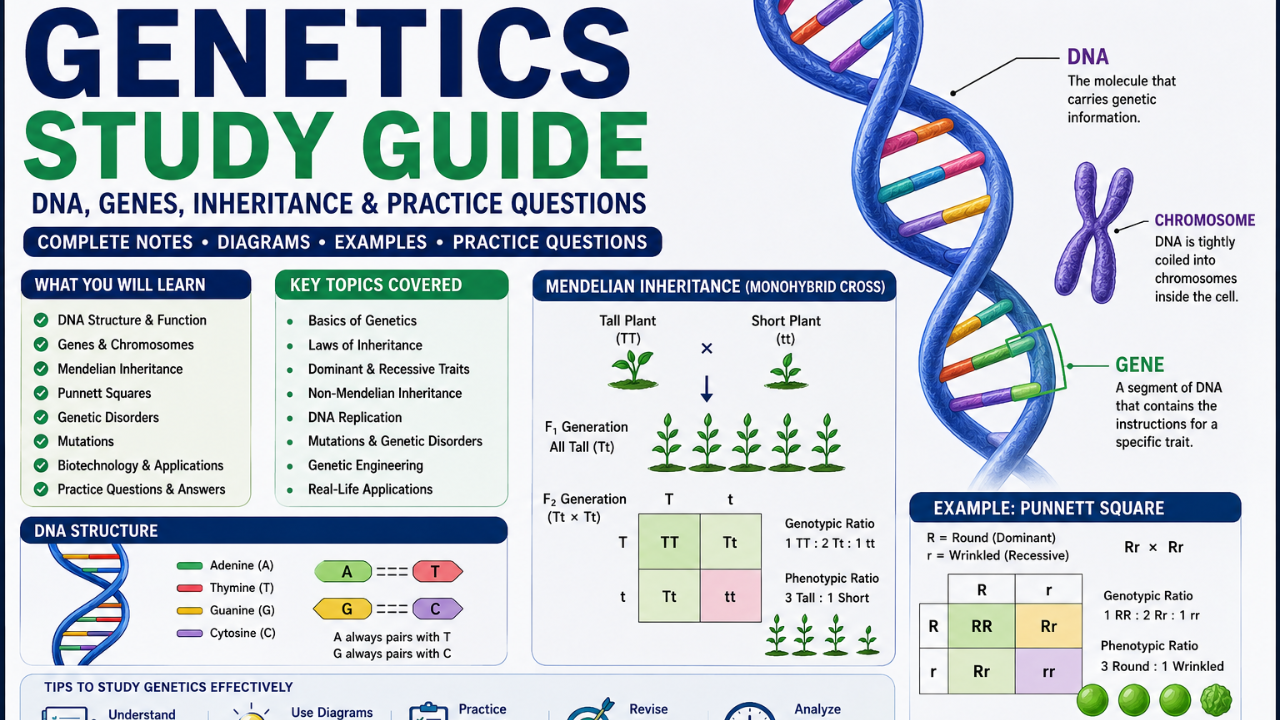
Genetics is one of those subjects that starts feeling personal pretty quickly. Why do you have your mother’s eyes but your father’s height? Why do some diseases run in families while others seem to appear out of nowhere? Why do identical twins share the same DNA but still develop slightly different personalities and health histories?
These aren’t just interesting questions. They’re genetics questions. And the answers sit in something so small you can’t see it with the naked eye—your DNA.
This genetics study guide is built to take you from the very basics all the way through to complex inheritance patterns, mutations, genetic disorders, and biotechnology. Whether you’re preparing for AP Biology, IB Biology, GCSE, SAT Subject Tests, or a college-level genetics exam, everything you need is organized right here.
No scattered notes. No confusing jargon without explanation. Just clear, connected, thorough genetics content that actually helps you understand—and perform.
Let’s start from the ground up.
Key Takeaways
- Genetics is the study of heredity—how traits are passed from parents to offspring through genes and DNA.
- DNA is organized into genes, which are carried on chromosomes inside the nucleus of every cell.
- Mendelian genetics follows predictable patterns of inheritance using dominant and recessive alleles.
- Non-Mendelian inheritance includes incomplete dominance, codominance, multiple alleles, and polygenic traits.
- Punnett squares are tools for predicting the probability of offspring inheriting specific genotypes and phenotypes.
- Mutations are changes in DNA that can be harmful, neutral, or beneficial depending on their nature and location.
- Genetic engineering and biotechnology are transforming medicine, agriculture, and scientific research.
- This guide includes 35 practice questions at three levels for complete exam preparation.
What Is Genetics?
Genetics is the branch of biology that studies heredity and variation—how traits and characteristics are passed from one generation to the next, and why individuals within a species differ from one another.
At the most fundamental level, genetics is the science of information. Biological information encoded in DNA molecules gets copied, expressed, and transmitted. Every time a cell divides, that information is duplicated and passed on. Every time an organism reproduces, a version of that information is shared with the next generation.
Genetics operates at several levels simultaneously:
- Molecular genetics — studies DNA, RNA, and protein synthesis at the molecular level
- Classical (Mendelian) genetics — studies patterns of inheritance through generations
- Population genetics — studies how allele frequencies change across populations over time
- Genomics — studies entire genomes rather than individual genes
- Epigenetics — studies heritable changes in gene expression that don’t involve changes to the DNA sequence itself
For most high school and introductory college courses, you’ll primarily work with classical genetics and molecular genetics. But understanding where these fit within the broader discipline helps you see the bigger picture.
Why Is Genetics Important?
The honest answer is that genetics touches almost everything in modern life.
In medicine, genetics explains why certain diseases run in families, why some people respond differently to medications, and how cancers develop at the molecular level. Genetic testing can now identify disease risk before symptoms appear. Gene therapy is being used to treat conditions like sickle cell disease and certain inherited blindness disorders.
In agriculture, understanding plant genetics has led to crops with higher yields, better drought resistance, longer shelf life, and improved nutritional profiles. The development of disease-resistant wheat and pest-resistant cotton are both genetically informed achievements.
In forensic science, DNA profiling can identify individuals from a single hair or drop of blood. It has exonerated innocent people and convicted criminals with an accuracy that no other forensic technique matches.
In evolutionary biology, genetics provides the mechanism behind evolution. Understanding how mutations arise and spread through populations explains biodiversity, species divergence, and adaptation.
In your daily life, genetics influences your risk for dozens of conditions, your physical characteristics, and even some behavioral tendencies. Understanding the basics helps you interpret genetic test results, understand medical diagnoses, and make informed health decisions.
For students, genetics is also one of the most heavily tested topics in biology. Mastering it thoroughly pays dividends across every subsequent biology course.
History of Genetics
Genetics as a formal science is surprisingly recent, but observations about heredity stretch back thousands of years.
| Year | Scientist / Event | Contribution |
|---|---|---|
| Ancient times | Farmers and breeders | Noticed that offspring resemble parents; selective breeding practiced |
| 1665 | Robert Hooke | Discovered cells, laying the foundation for understanding heredity’s physical basis |
| 1859 | Charles Darwin | Published On the Origin of Species; proposed natural selection but didn’t know the mechanism of heredity |
| 1865 | Gregor Mendel | Published experiments on pea plant inheritance; established the laws of segregation and independent assortment |
| 1869 | Friedrich Miescher | Isolated nucleic acid (DNA) from cell nuclei for the first time |
| 1900 | de Vries, Correns, von Tschermak | Independently rediscovered Mendel’s work, launching modern genetics |
| 1902 | Walter Sutton & Theodor Boveri | Chromosome theory of inheritance — genes are on chromosomes |
| 1910 | Thomas Hunt Morgan | Discovered sex-linked inheritance using Drosophila (fruit flies) |
| 1928 | Frederick Griffith | Transformation experiment demonstrated that genetic material can be transferred between bacteria |
| 1944 | Avery, MacLeod & McCarty | Demonstrated that DNA, not protein, is the genetic material |
| 1952 | Hershey & Chase | Confirmed DNA as the genetic material using bacteriophages |
| 1953 | James Watson & Francis Crick | Described the double-helix structure of DNA (with crucial contributions from Rosalind Franklin) |
| 1961 | Jacob & Monod | Proposed the operon model of gene regulation |
| 1977 | Frederick Sanger | Developed DNA sequencing techniques |
| 1990–2003 | Human Genome Project | Sequenced all ~3 billion base pairs of the human genome |
| 2012 | Jennifer Doudna & Emmanuelle Charpentier | Developed CRISPR-Cas9 as a precise gene-editing tool |
This timeline matters because it shows genetics isn’t static. Our understanding continues to evolve, and breakthroughs like CRISPR are still reshaping what’s possible.
Basic Genetics Terms Every Student Should Know
Before diving into mechanisms and inheritance patterns, you need a working vocabulary. These are the terms that appear in virtually every genetics question.
| Term | Definition |
|---|---|
| Gene | A segment of DNA that codes for a specific protein or functional RNA molecule |
| Allele | One of two or more versions of a gene |
| Locus (plural: loci) | The specific location of a gene on a chromosome |
| Genome | The complete set of genetic information in an organism |
| Chromosome | A thread-like structure of DNA and proteins carrying genetic information |
| Genotype | The genetic makeup of an organism (e.g., Bb, BB, bb) |
| Phenotype | The observable physical or biochemical characteristics of an organism |
| Dominant allele | An allele whose effect is expressed when one or two copies are present |
| Recessive allele | An allele whose effect is only expressed when two copies are present |
| Homozygous | Having two identical alleles for a trait (e.g., BB or bb) |
| Heterozygous | Having two different alleles for a trait (e.g., Bb) |
| Diploid (2n) | Having two complete sets of chromosomes (one from each parent) |
| Haploid (n) | Having one complete set of chromosomes (as in gametes) |
| Gamete | A sex cell — sperm or egg — that is haploid |
| Zygote | A fertilized egg cell formed by the fusion of two gametes |
| Mutation | A permanent change in the DNA sequence |
| Heredity | The passing of traits from parents to offspring |
| Trait | A specific characteristic of an organism |
| Punnett square | A diagram used to predict the genotypes and phenotypes of offspring |
| Test cross | Crossing an organism with a homozygous recessive individual to determine the organism’s genotype |
DNA Structure and Function
DNA—deoxyribonucleic acid—is the molecule that carries the genetic instructions for the development, functioning, growth, and reproduction of all known living organisms.
Physical Structure
DNA is a double helix—imagine a twisted ladder. This structure was described by James Watson and Francis Crick in 1953, building on X-ray crystallography data produced by Rosalind Franklin.
The building blocks of DNA are nucleotides. Each nucleotide has three components:
- A deoxyribose sugar (five-carbon sugar)
- A phosphate group
- A nitrogenous base
The four nitrogenous bases:
- Adenine (A)
- Thymine (T)
- Cytosine (C)
- Guanine (G)
Complementary base pairing rules:
- Adenine always pairs with Thymine: A — T
- Cytosine always pairs with Guanine: C — G
This pairing is held together by hydrogen bonds. A-T pairs form two hydrogen bonds; C-G pairs form three. This is why DNA with more C-G pairs is slightly more stable.
The two strands of DNA run in opposite directions—they’re antiparallel. One strand runs 5′ to 3′, and the complementary strand runs 3′ to 5′.
How DNA Is Organized
In eukaryotic cells, DNA doesn’t float loose in the nucleus. It’s tightly wound around proteins called histones to form structures called nucleosomes. These coil further to form chromatin, which condenses into visible chromosomes during cell division.
In the human body:
- Each cell nucleus contains approximately 3 billion base pairs of DNA
- If stretched out, the DNA in a single human cell would be about 2 meters long
- It’s packaged so efficiently that it fits inside a nucleus just a few micrometers across
Function of DNA
DNA has three primary functions:
- Store genetic information — the sequence of bases encodes instructions for building proteins
- Replicate — copy itself faithfully before cell division so each daughter cell gets a complete genome
- Direct protein synthesis — through transcription and translation, DNA directs the production of every protein in the organism
Genes and Chromosomes Explained
What Is a Gene?
A gene is a specific sequence of DNA nucleotides that codes for a functional product—usually a protein, but sometimes a functional RNA molecule. Genes are the basic units of heredity.
Humans have approximately 20,000–25,000 protein-coding genes, yet these make up only about 1–2% of the total genome. The rest of the DNA was once dismissed as “junk DNA,” but research has shown much of it has regulatory or structural roles.
What Are Chromosomes?
Chromosomes are organized structures of DNA and proteins found in the nucleus of eukaryotic cells. Each chromosome contains one long, continuous DNA molecule along with associated histone proteins.
Human chromosome facts:
- Humans have 46 chromosomes (23 pairs) in every somatic (body) cell
- 22 pairs are autosomes — non-sex chromosomes
- 1 pair is sex chromosomes: XX in females, XY in males
- Gametes (sperm and eggs) contain only 23 chromosomes (haploid)
- When sperm and egg fuse, the resulting zygote has 46 chromosomes (diploid)
Homologous chromosomes are matching pairs—one inherited from the mother and one from the father. They carry the same genes at the same loci, but may carry different alleles.
Sister chromatids are identical copies of a chromosome produced during DNA replication, joined at the centromere. They separate during cell division.
Karyotype
A karyotype is a visual display of an organism’s chromosomes, arranged by size and shape. It’s produced using cells frozen in metaphase (when chromosomes are most condensed and visible). Karyotyping is used to detect chromosomal abnormalities like Down syndrome (trisomy 21) or Turner syndrome (45, XO).
Relationship Between DNA, Genes, and Chromosomes
Students often learn these three terms in isolation. Here’s how they connect:
DNA → Gene → Chromosome → Genome
Think of it this way:
- DNA is the material — the actual molecule storing information
- A gene is a specific segment of DNA with a specific function — like one sentence in a long book
- A chromosome is a packaged, organized structure containing many genes — like a chapter in that book
- The genome is the complete collection of all DNA — the entire book
Practical analogy:
- DNA = the alphabet and language
- Gene = a specific word or sentence with meaning
- Chromosome = a chapter containing many words and sentences
- Genome = the complete encyclopedia
This hierarchy matters for understanding how genetic information is organized, replicated, and expressed.
Types of Genetic Traits
Not all traits are inherited the same way. Understanding the different patterns is essential for solving genetics problems correctly.
1. Simple (Mendelian) traits
Controlled by a single gene with clear dominant and recessive alleles. Example: widow’s peak hairline (dominant), attached earlobes (recessive).
2. Sex-linked traits
Carried on sex chromosomes (usually the X chromosome). Because males have only one X chromosome, they’re more likely to express X-linked recessive traits. Example: red-green color blindness, hemophilia.
3. Polygenic traits
Controlled by two or more genes. Produce a continuous range of phenotypes rather than distinct categories. Example: skin color, height, eye color.
4. Multifactorial traits
Influenced by multiple genes AND environmental factors. Example: cardiovascular disease risk, type 2 diabetes, intelligence.
5. Autosomal traits
Carried on autosomes (non-sex chromosomes). Can be dominant or recessive. Both males and females are equally likely to be affected.
6. Epigenetic traits
Not encoded in the DNA sequence itself, but in how genes are expressed. These changes can sometimes be inherited. Example: methylation patterns affecting gene activity.
Mendelian Genetics
Gregor Mendel’s Experiments
Gregor Mendel (1822–1884) was an Austrian monk who conducted careful, quantitative experiments with pea plants (Pisum sativum) in his monastery garden between 1856 and 1863.
Why pea plants?
- Short generation time (one growing season)
- Large number of offspring for statistical analysis
- Clear, distinct traits with two obvious forms
- Easy to control pollination (self-fertilization or cross-fertilization)
- Many varieties already available with known characteristics
The seven traits Mendel studied:
| Trait | Dominant Form | Recessive Form |
|---|---|---|
| Seed shape | Round | Wrinkled |
| Seed color | Yellow | Green |
| Pod shape | Inflated | Constricted |
| Pod color | Green | Yellow |
| Flower color | Purple | White |
| Flower position | Axial | Terminal |
| Plant height | Tall | Short |
Key cross types:
- Monohybrid cross — studies one trait at a time (e.g., seed color)
- Dihybrid cross — studies two traits simultaneously (e.g., seed color AND seed shape)
- P generation — the original parent generation (true-breeding)
- F1 generation — first filial generation (first offspring)
- F2 generation — second filial generation (offspring of F1 crosses)
Mendel’s key observation:
When Mendel crossed true-breeding purple-flowered plants with true-breeding white-flowered plants:
- F1 generation: ALL plants had purple flowers
- F2 generation: ¾ purple : ¼ white (approximately 3:1 ratio)
This told Mendel that the white trait didn’t disappear—it was hidden in F1 and reappeared in F2. He concluded there must be discrete “factors” (now called alleles) controlling each trait.
Laws of Inheritance
Mendel’s work established two fundamental laws:
Law of Segregation (First Law):
Each organism carries two alleles for each trait. These alleles separate during gamete formation so that each gamete receives only one allele. When fertilization occurs, the offspring receives one allele from each parent.
In simple terms: alleles segregate (separate) during meiosis, so each gamete carries only one version of each gene.
Law of Independent Assortment (Second Law):
Genes for different traits are inherited independently of one another (as long as they’re on different chromosomes). The inheritance of one trait doesn’t influence the inheritance of another.
In simple terms: during meiosis, the separation of alleles for one gene is independent of the separation of alleles for another gene—they assort randomly into gametes.
Important exception: The law of independent assortment applies only to genes located on different chromosomes or very far apart on the same chromosome. Genes close together on the same chromosome are linked and tend to be inherited together—this is called genetic linkage, which Mendel’s pea plant genes happened to avoid.
Dominant and Recessive Traits
Dominant alleles are expressed whenever they’re present—in either one copy (heterozygous) or two copies (homozygous dominant). They’re written with capital letters (e.g., B).
Recessive alleles are only expressed when two copies are present (homozygous recessive). A single recessive allele is “hidden” by the dominant allele in a heterozygous individual. Written with lowercase letters (e.g., b).
Important nuance: “Dominant” doesn’t mean “common” or “better.” The allele for Huntington’s disease is dominant, yet it causes a fatal neurological condition. Dominance simply refers to which allele’s effect is expressed in the phenotype.
| Genotype | Description | Phenotype (if B = brown eyes, b = blue) |
|---|---|---|
| BB | Homozygous dominant | Brown eyes |
| Bb | Heterozygous | Brown eyes (B is expressed) |
| bb | Homozygous recessive | Blue eyes |
Non-Mendelian Inheritance
Mendel’s laws explain many inheritance patterns, but not all traits follow simple dominant-recessive rules. Several other patterns exist.
Incomplete Dominance
In incomplete dominance, neither allele is completely dominant. The heterozygous phenotype is a blend of the two homozygous phenotypes.
Classic example — Snapdragon flower color:
- RR = Red flowers
- WW = White flowers
- RW = Pink flowers (a blend, not red or white)
Key point: The alleles themselves haven’t blended—the genotype RW still produces both R and W alleles, which can be separated in future generations. The phenotype appears blended.
If two pink snapdragons (RW × RW) are crossed:
- ¼ RR = Red
- ½ RW = Pink
- ¼ WW = White
- Ratio: 1:2:1 (phenotype and genotype ratios are the same)
Codominance
In codominance, both alleles are fully expressed simultaneously in the heterozygote. Neither is dominant over the other. The phenotype shows both traits at the same time—not a blend.
Classic example — ABO blood type (partially):
- In individuals with genotype I^A I^B, both A and B antigens are expressed on red blood cells → Blood type AB
Another example — Roan cattle:
- Red (R^R R^R) × White (R^W R^W) → Roan cattle (R^R R^W) — individual hairs are either red or white; the coat appears reddish-brown due to the mixture of colored hairs
The key distinction from incomplete dominance:
- Incomplete dominance = blended phenotype (pink flower)
- Codominance = both phenotypes visible simultaneously (individual red AND white hairs)
Multiple Alleles
Most genes have more than two possible alleles in a population, even though each individual can only carry two of those alleles (one on each homologous chromosome).
Classic example — ABO blood type:
The ABO blood type system is controlled by one gene with three alleles: I^A, I^B, and i.
| Genotype | Blood Type | Antigens on RBCs | Antibodies in Plasma |
|---|---|---|---|
| I^A I^A or I^A i | A | A antigen | Anti-B |
| I^B I^B or I^B i | B | B antigen | Anti-A |
| I^A I^B | AB | A and B antigens | Neither |
| ii | O | Neither | Anti-A and Anti-B |
Why this matters clinically: Blood type compatibility is critical for blood transfusions. Incompatible blood types trigger immune reactions that can be fatal.
Polygenic Inheritance
Polygenic traits are controlled by two or more genes, each contributing to the phenotype. Rather than producing distinct categories, polygenic traits produce a continuous range of variation that typically forms a bell curve in a population.
Examples of polygenic traits:
- Human height
- Skin pigmentation
- Eye color
- Weight
- Intelligence
Why polygenic traits are tricky:
- Many gene combinations are possible
- Environmental factors often interact with the genetic component
- You can’t predict outcomes with a simple Punnett square
Skin color example:
If controlled by three genes (A, B, C), each contributing one “unit” of pigment:
- Someone with aabbcc has the least pigment (lightest)
- Someone with AABBCC has the most pigment (darkest)
- Most people fall somewhere in between, creating continuous variation
This explains why children can have skin tones that appear different from either parent.
Punnett Squares Explained with Examples
A Punnett square is a simple diagram used to predict the probable genotype and phenotype ratios in offspring from a genetic cross.
How to Set Up a Punnett Square
Step 1: Determine the genotypes of both parents.
Step 2: Write the possible gametes each parent can produce along the top and side of the square.
Step 3: Fill in each box by combining the gametes from the top and side.
Step 4: Determine the genotype and phenotype ratios from your results.
Example 1: Monohybrid Cross
Cross: Bb × Bb (both parents heterozygous for brown eyes, where B = brown, b = blue)
Parent gametes: Each Bb parent can produce B or b gametes.
        B        b
   ┌─────────┬─────────┐
B  │   BB    │   Bb    │
   ├─────────┼─────────┤
b  │   Bb    │   bb    │
   └─────────┴─────────┘
Results:
- Genotype ratio: 1 BB : 2 Bb : 1 bb
- Phenotype ratio: 3 Brown : 1 Blue (3:1)
Example 2: Dihybrid Cross
Cross: BbRr × BbRr
(B = brown eyes dominant over b = blue; R = round seed dominant over r = wrinkled)
Parent gametes: BbRr can produce four gamete types: BR, Br, bR, br
The resulting 4×4 Punnett square produces 16 boxes and the classic 9:3:3:1 phenotype ratio:
- 9 Brown eyes, Round seeds
- 3 Brown eyes, Wrinkled seeds
- 3 Blue eyes, Round seeds
- 1 Blue eyes, Wrinkled seeds
Example 3: Test Cross
Scenario: A tall plant (T_) has an unknown genotype. To find out if it’s TT or Tt, cross it with a homozygous recessive tall plant (tt).
- If all offspring are tall → parent was TT
- If offspring are 50% tall and 50% short → parent was Tt
Test crosses are a practical tool geneticists use to determine an organism’s genotype from its phenotype alone.
Genotype vs. Phenotype (Comparison Table)
| Feature | Genotype | Phenotype |
|---|---|---|
| Definition | The genetic makeup of an organism | The observable physical or biochemical traits |
| Visibility | Cannot be seen directly | Can be observed, measured, or tested |
| Changes | Does not change during lifetime (mostly) | Can be influenced by environment |
| Representation | Written as allele combinations (e.g., Bb) | Described as observable characteristics |
| Determined by | DNA sequence | Genotype + environment |
| Examples | BB, Bb, bb | Brown eyes, blue eyes |
| Always matches? | No — same phenotype can come from different genotypes | One phenotype can result from multiple genotypes |
Important insight: Two individuals can have the same phenotype (brown eyes) but different genotypes (BB or Bb). This is why phenotype alone doesn’t tell you the complete genetic story—which is exactly why test crosses exist.
Homozygous vs. Heterozygous (Comparison Table)
| Feature | Homozygous | Heterozygous |
|---|---|---|
| Definition | Two identical alleles for a trait | Two different alleles for a trait |
| Examples | BB (homozygous dominant), bb (homozygous recessive) | Bb |
| Also called | True-breeding (for that trait) | Hybrid |
| Gametes produced | Only one type (all B or all b) | Two types (B and b) |
| Phenotype | Expresses either dominant or recessive trait | Usually expresses dominant trait |
| Carrier status | Cannot be a carrier of recessive disease (if homozygous dominant) | Can be a carrier of a recessive allele |
Carrier: In genetics, a carrier is an individual who is heterozygous for a recessive disease allele. They don’t express the disease (because the dominant allele masks it) but can pass the recessive allele to their children. Carrier status is especially important in understanding the inheritance of recessive genetic disorders.
DNA Replication Explained
Before a cell divides, it must copy all of its DNA so each daughter cell receives a complete genome. This process is called DNA replication, and it occurs during the S phase of the cell cycle.
Key Principle: Semi-Conservative Replication
DNA replication is semi-conservative — each new DNA molecule consists of one original (template) strand and one newly synthesized strand. This was demonstrated by Meselson and Stahl in 1958.
Steps of DNA Replication
1. Initiation
- Replication begins at specific sequences called origins of replication
- In prokaryotes: typically one origin; in eukaryotes: thousands of origins (for speed)
- Helicase unwinds and separates the double helix by breaking hydrogen bonds between base pairs
- The area where the strands separate is called the replication fork
2. Priming
- Primase synthesizes a short RNA primer complementary to the template strand
- The primer provides a starting point for DNA polymerase, which can only add nucleotides to an existing strand—never start from scratch
3. Elongation
- DNA polymerase III (in prokaryotes) or DNA polymerase δ/ε (in eukaryotes) adds new nucleotides to the 3′ end of the growing strand, following complementary base-pairing rules
- The leading strand is synthesized continuously toward the replication fork
- The lagging strand is synthesized in short fragments (Okazaki fragments) moving away from the fork
- DNA ligase joins Okazaki fragments together
4. Termination
- Replication continues until the entire chromosome is copied or two replication forks meet
- RNA primers are replaced with DNA
- The new strands are checked for errors
Proofreading and Error Correction
DNA polymerase has a proofreading function—it checks each newly added nucleotide and removes incorrect ones. Additional repair enzymes scan for remaining errors after replication. Overall error rate: approximately 1 mistake per billion base pairs copied. Without proofreading, the rate would be about 1 in 100,000—catastrophically high.
Mutations
A mutation is a permanent change in the nucleotide sequence of DNA. Mutations are the source of all genetic variation—without them, evolution couldn’t occur. But mutations can also disrupt normal gene function and cause disease.
Types of Mutations
At the DNA (molecular) level:
| Mutation Type | Description | Example |
|---|---|---|
| Substitution (point mutation) | One base is replaced by another | CAT → CAG |
| Insertion | One or more bases are added | CAT → CAAT |
| Deletion | One or more bases are removed | CAT → CT |
| Frameshift | Insertion or deletion shifts the reading frame | Alters all downstream codons |
| Silent mutation | Base change doesn’t alter amino acid | Due to redundancy in genetic code |
| Missense mutation | Base change alters one amino acid | Sickle cell disease (one amino acid change) |
| Nonsense mutation | Base change creates a premature stop codon | Shortened, usually nonfunctional protein |
At the chromosome level:
| Mutation Type | Description |
|---|---|
| Deletion | A segment of a chromosome is lost |
| Duplication | A segment is copied twice |
| Inversion | A segment is reversed within the chromosome |
| Translocation | A segment moves from one chromosome to another |
| Nondisjunction | Chromosomes fail to separate during meiosis, producing cells with wrong chromosome numbers |
Causes of Mutations
Mutations arise from two main sources:
1. Spontaneous mutations:
- Errors in DNA replication that escape proofreading
- Spontaneous chemical changes (e.g., deamination of cytosine)
- Occur at a low but constant rate
2. Induced mutations (caused by mutagens):
- Chemical mutagens: Nitrous acid, benzene, aflatoxins (can alter or intercalate between bases)
- Physical mutagens: UV radiation (causes thymine dimers), X-rays and gamma rays (break DNA strands)
- Biological mutagens: Some viruses can insert their DNA into the host genome
Effects of Mutations
Mutations are not always harmful. Their effects fall into three categories:
Harmful mutations:
- Disrupt normal gene function
- Can cause genetic disorders or cancer
- If in germline cells (sperm/eggs), can be passed to offspring
- Example: BRCA1 mutation increases breast cancer risk significantly
Neutral mutations:
- Silent mutations that don’t change protein function
- Mutations in non-coding DNA regions
- Have no impact on the organism’s fitness
- Most mutations fall into this category
Beneficial mutations:
- Rare, but critically important for evolution
- Provide an advantage in a particular environment
- Can spread through a population by natural selection
- Example: CCR5-delta32 mutation provides resistance to HIV infection in homozygous individuals
Genetic Disorders
Genetic disorders result from mutations in genes or chromosomal abnormalities. They can be inherited or arise spontaneously. Understanding common genetic disorders is required knowledge for most biology courses.
Down Syndrome
Also called: Trisomy 21
Cause: Nondisjunction during meiosis results in a gamete with two copies of chromosome 21 instead of one. When this gamete is fertilized, the resulting individual has three copies of chromosome 21 (47 chromosomes total).
Characteristics:
- Intellectual disability (mild to moderate in most cases)
- Characteristic facial features (epicanthal folds, flat nasal bridge)
- Short stature
- Increased risk of heart defects, leukemia, and early-onset Alzheimer’s disease
Inheritance: Not typically inherited—usually arises as a new mutation. Risk increases significantly with maternal age (particularly over 35).
Detection: Prenatal testing via amniocentesis or chorionic villus sampling; non-invasive prenatal testing (NIPT) using cell-free fetal DNA.
Cystic Fibrosis
Cause: Autosomal recessive disorder. Mutations in the CFTR gene (cystic fibrosis transmembrane conductance regulator) on chromosome 7. The most common mutation is a deletion of three base pairs (ΔF508), causing loss of the amino acid phenylalanine.
What goes wrong: CFTR encodes a chloride ion channel. When it malfunctions, chloride ions can’t exit cells properly, causing abnormally thick, sticky mucus to build up in the lungs, pancreas, and digestive tract.
Effects:
- Chronic lung infections (major cause of morbidity)
- Pancreatic insufficiency (difficulty digesting food)
- Infertility in males (blocked vas deferens)
- Salty-tasting skin (classic diagnostic indicator)
Inheritance: Must inherit two defective CFTR alleles (one from each parent). Parents who are carriers (Cf) have a 25% chance with each pregnancy of having an affected child.
Treatment: Symptom management (physiotherapy, antibiotics, enzyme supplements); newer drugs like ivacaftor and elexacaftor-tezacaftor target the defective CFTR protein directly.
Sickle Cell Disease
Cause: Autosomal recessive disorder caused by a single missense mutation in the HBB gene (beta-globin gene on chromosome 11). A single base substitution (adenine → thymine) changes the sixth amino acid from glutamic acid to valine.
What goes wrong: The abnormal hemoglobin (HbS) polymerizes when deoxygenated, distorting red blood cells into a rigid, sickle (crescent) shape.
Effects:
- Sickle-shaped cells clog blood vessels → intense pain episodes (vaso-occlusive crises)
- Shortened red blood cell lifespan (10–20 days vs. 120 days) → chronic anemia
- Increased infection risk (splenic dysfunction)
- Organ damage over time
Sickle cell trait (carriers): Individuals with one normal and one sickle allele (HbA/HbS) are generally healthy but carry the trait. Importantly, they have a degree of resistance to malaria—which explains the high frequency of the HbS allele in populations from malaria-endemic regions (an example of heterozygote advantage).
Treatment: Hydroxyurea (increases fetal hemoglobin), bone marrow transplant, and increasingly, gene therapy.
Hemophilia
Cause: X-linked recessive disorder affecting blood clotting factors.
- Hemophilia A: Deficiency of clotting factor VIII (most common; affects ~1 in 5,000 males)
- Hemophilia B: Deficiency of clotting factor IX
What goes wrong: Without sufficient clotting factors, the blood coagulation cascade is disrupted, and wounds bleed for much longer than normal.
Inheritance pattern:
- Gene is on the X chromosome
- Males (XY) need only one affected X allele to have hemophilia
- Females (XX) need two affected X alleles to have hemophilia (rare); females with one affected allele are carriers
- An affected father cannot pass hemophilia to his sons (he gives them Y)
- A carrier mother has a 50% chance of passing it to each son
Historical significance: Hemophilia was prevalent in European royal families in the 19th and early 20th centuries due to intermarriage—often called the “royal disease.”
Treatment: Regular infusions of the missing clotting factor; gene therapy trials showing promising results.
Genetic Engineering and Biotechnology
Genetic engineering involves deliberately modifying an organism’s genome using laboratory techniques. It’s one of the most rapidly advancing and consequential fields in modern science.
Key Techniques
Recombinant DNA Technology:
Combines DNA from two different sources. A gene of interest is cut from one organism’s DNA using restriction enzymes and inserted into a vector (often a plasmid) that carries it into a host cell. The host cell then expresses the foreign gene.
Classic application: Human insulin production. Before 1982, diabetics relied on insulin extracted from pigs and cows. Now, the human insulin gene is inserted into bacteria, which produce identical human insulin at industrial scale.
Polymerase Chain Reaction (PCR):
Amplifies a specific DNA sequence millions of times from a tiny sample. Essential for forensics (analyzing crime scene DNA), disease diagnosis, ancestry testing, and research.
Steps of PCR:
- Denaturation — Heat separates DNA strands (94–98°C)
- Annealing — Primers bind to target sequences (~50–65°C)
- Extension — DNA polymerase (Taq polymerase) synthesizes new strands (~72°C)
- Repeated for 25–35 cycles, doubling the target DNA each cycle
Gel Electrophoresis:
Separates DNA fragments by size using an electric current through an agarose gel. Smaller fragments move farther; larger fragments move less. Creates a pattern of bands used to compare DNA samples (DNA fingerprinting) or confirm the size of PCR products.
DNA Sequencing:
Determines the exact order of nucleotide bases in a DNA molecule. Modern next-generation sequencing can sequence an entire human genome in hours.
CRISPR-Cas9:
The most precise and versatile gene-editing tool currently available. CRISPR (Clustered Regularly Interspaced Short Palindromic Repeats) was originally a bacterial immune system. Scientists repurposed it to:
- Cut DNA at specific target sequences using guide RNA to direct the Cas9 protein (molecular scissors)
- Allow deletion, correction, or insertion of genetic sequences with unprecedented precision
Applications: Correcting sickle cell disease and beta-thalassemia, developing cancer immunotherapies, creating disease-resistant crops, and basic research.
Cloning:
- Reproductive cloning: Produces a genetically identical organism (e.g., Dolly the sheep, 1996)
- Therapeutic cloning: Produces cloned embryos to harvest stem cells for medical research and potential therapies
Transgenic Organisms:
Organisms that have had genes from another species inserted into their genome. Examples:
- GloFish — zebrafish with fluorescent protein genes from jellyfish
- Golden Rice — rice engineered to produce beta-carotene (vitamin A precursor)
- Bt crops — crops expressing bacterial genes that produce natural insecticides
Applications of Genetics in Medicine and Agriculture
Medicine
| Application | Description |
|---|---|
| Genetic testing | Identifies disease risk alleles before symptoms appear |
| Prenatal diagnosis | Amniocentesis, CVS, and NIPT detect chromosomal abnormalities |
| Pharmacogenomics | Tailors drug treatment based on an individual’s genetic profile |
| Gene therapy | Introduces correct copies of defective genes to treat disease |
| Cancer genomics | Identifies specific mutations driving a patient’s cancer for targeted therapy |
| Stem cell therapy | Uses genetically modified stem cells to replace damaged tissue |
| Vaccine development | mRNA vaccines use genetic information to train the immune system |
Agriculture
| Application | Description |
|---|---|
| Selective breeding | Traditional use of genetics to improve crop yield and livestock |
| GM crops | Herbicide-resistant, pest-resistant, or nutritionally enhanced crops |
| Disease-resistant varieties | Plants engineered to resist fungal, bacterial, or viral diseases |
| Drought and salt tolerance | Crops engineered to grow in harsh environmental conditions |
| Animal cloning | Preserving genetics of high-value livestock |
| Biofuels | Algae and bacteria engineered to produce fuel more efficiently |
Common Genetics Terms for Exams
| Term | Exam-Ready Definition |
|---|---|
| Carrier | A heterozygous individual who carries a recessive allele without expressing its phenotype |
| Test cross | A cross between an organism with an unknown genotype and a homozygous recessive individual |
| Linked genes | Genes located on the same chromosome that tend to be inherited together |
| Crossing over | Exchange of genetic material between homologous chromosomes during meiosis I |
| Recombination | Shuffling of genetic material through crossing over; creates new allele combinations |
| Sex-linked | A gene located on a sex chromosome (usually X) |
| Pedigree | A chart showing inheritance patterns of a trait through generations of a family |
| Nondisjunction | Failure of homologous chromosomes or sister chromatids to separate properly during cell division |
| Aneuploidy | A condition with an abnormal number of chromosomes (e.g., trisomy, monosomy) |
| Trisomy | Having three copies of a particular chromosome (2n + 1) |
| Monosomy | Having only one copy of a particular chromosome (2n – 1) |
| Epistasis | A gene at one locus affects the expression of a gene at another locus |
| Pleiotropy | One gene affects multiple, seemingly unrelated phenotypic traits |
| Hardy-Weinberg equilibrium | A principle stating allele frequencies in a population remain constant in the absence of evolutionary forces |
| Gene pool | The complete set of alleles in a population |
Common Mistakes Students Make in Genetics
Mistake 1: Confusing genotype and phenotype
Genotype is the genetic code; phenotype is what you can observe. Two individuals can look identical (same phenotype) but have different genotypes (BB vs. Bb). This confusion leads to errors in Punnett square interpretation.
Mistake 2: Thinking dominant means more common
Dominant alleles are expressed when present, but they’re not necessarily common in a population. Huntington’s disease allele is dominant but rare. Polydactyly (extra fingers) is caused by a dominant allele but is uncommon.
Mistake 3: Forgetting carriers in autosomal recessive crosses
Students often forget that two phenotypically normal parents can produce an affected child if both are carriers. Always consider carrier status when analyzing pedigrees for recessive traits.
Mistake 4: Applying Mendel’s laws where they don’t fit
Mendel’s laws of segregation and independent assortment don’t apply to linked genes, polygenic traits, or sex-linked inheritance. Recognize which inheritance pattern applies before solving a problem.
Mistake 5: Mixing up incomplete dominance and codominance
Incomplete dominance produces a blended phenotype (pink). Codominance produces both phenotypes simultaneously (red AND white patches). This distinction costs marks regularly in exams.
Mistake 6: Setting up Punnett squares incorrectly
The most common errors are putting parental genotypes (not gametes) inside the boxes, forgetting to separate alleles into individual gametes, and misreading ratios. Always write gametes along the outside before filling in the boxes.
Mistake 7: Misreading pedigrees for sex-linked traits
If a trait is X-linked recessive: more males affected than females; affected males have carrier mothers; affected fathers cannot pass it to sons (only daughters). Missing any of these clues leads to wrong conclusions.
Mistake 8: Confusing DNA replication and transcription
DNA replication copies the entire genome for cell division. Transcription copies specific gene sequences into mRNA for protein production. Both use template strands and complementary base pairing, but they’re completely different processes with different purposes, enzymes, and products.
Best Tips to Study Genetics Faster
1. Master the vocabulary first
Genetics is terminology-heavy. Before you can solve problems, you need to know what words like heterozygous, locus, and allele actually mean—not as definitions to recite, but as concepts you can apply. Make flashcards and test yourself both ways.
2. Practice Punnett squares daily
This is genuinely a skill that improves with repetition. Start with monohybrid crosses, move to dihybrid, then try sex-linked and incomplete dominance problems. Do at least five crosses per study session until they feel automatic.
3. Learn to read pedigrees systematically
When analyzing a pedigree:
- First determine: is it autosomal or sex-linked?
- Then determine: is it dominant or recessive?
- Use clues: Are more males affected? Does it skip generations? Can two unaffected parents produce an affected child?
4. Use visual timelines for the history of genetics
A visual timeline of discoveries—Mendel to Watson-Crick to CRISPR—helps you understand why we know what we know and answers historical questions on exams.
5. Connect molecular genetics to classical genetics
Don’t study DNA structure in isolation from inheritance. The connection is clear: alleles are different DNA sequences → different DNA sequences produce different proteins → different proteins produce different phenotypes. This chain of reasoning answers a huge range of exam questions.
6. Attempt past paper genetics problems immediately
After studying each inheritance type, find 5–10 exam questions on that specific pattern and attempt them immediately. Genetics problems require practice far more than re-reading.
7. Draw, don’t just read
Sketch DNA replication, draw chromosome segregation during meiosis, map out pedigrees by hand. Visual and kinesthetic engagement with genetics material improves retention significantly.
8. Understand why, not just what
Don’t memorize “the Law of Segregation says alleles separate.” Understand why—because during meiosis, homologous chromosomes (each carrying one allele) separate into different gametes. When you understand the mechanism, the rules make sense on their own.
Genetics Practice Questions
20 Multiple Choice Questions (MCQs)
Cover the answers and attempt each question honestly.
1. What is the term for the specific location of a gene on a chromosome?
- A) Allele B) Genome C) Locus D) Codon
2. In Mendel’s monohybrid crosses, what phenotype ratio appeared in the F2 generation?
- A) 1:1 B) 1:2:1 C) 3:1 D) 9:3:3:1
3. A person with genotype Bb is best described as:
- A) Homozygous dominant B) Heterozygous C) Homozygous recessive D) Haploid
4. Which of the following represents a genotype?
- A) Brown eyes B) Tall height C) Bb D) Blue eyes
5. Mendel’s Law of Independent Assortment states that:
- A) Alleles for one gene affect other genes B) Genes on different chromosomes are inherited independently C) All offspring inherit dominant traits D) Gametes contain two alleles
6. In incomplete dominance, crossing red (RR) with white (WW) flowers produces:
- A) All red B) All pink C) Half red, half white D) All white
7. A carrier of a recessive genetic disease is best described as:
- A) Homozygous dominant B) Heterozygous C) Homozygous recessive D) Affected by the disease
8. What technique amplifies specific DNA sequences millions of times?
- A) Gel electrophoresis B) DNA sequencing C) PCR D) CRISPR
9. Sickle cell disease is caused by:
- A) A chromosomal deletion B) A frameshift mutation C) A single missense mutation in the HBB gene D) A nonsense mutation
10. Which blood type results from codominance in the ABO system?
- A) A B) B C) AB D) O
11. Down syndrome is caused by:
- A) A deletion on chromosome 21 B) Trisomy 21 (nondisjunction) C) A point mutation D) X-linked inheritance
12. What is the phenotype ratio from a dihybrid cross (BbRr × BbRr)?
- A) 3:1 B) 1:2:1 C) 9:3:3:1 D) 1:1:1:1
13. A mutation that creates a premature stop codon is called:
- A) Silent B) Missense C) Nonsense D) Frameshift
14. Which enzyme joins Okazaki fragments during DNA replication?
- A) Helicase B) DNA polymerase C) Primase D) DNA ligase
15. Hemophilia is best described as:
- A) X-linked recessive B) Autosomal dominant C) X-linked dominant D) Autosomal recessive
16. In a test cross, the unknown organism is crossed with:
- A) A heterozygous organism B) A homozygous recessive organism C) A homozygous dominant organism D) Another unknown organism
17. Which feature of DNA replication is described as “semi-conservative”?
- A) Only half the DNA is copied B) Each new molecule has one old and one new strand C) Replication happens in only one direction D) Only one chromosome is copied at a time
18. What does CRISPR-Cas9 use to direct it to a specific DNA sequence?
- A) A restriction enzyme B) A primer C) A guide RNA D) DNA ligase
19. Which of the following is a polygenic trait?
- A) ABO blood type B) Cystic fibrosis C) Human height D) Hemophilia
20. An individual with genotype X^H X^h (where h = hemophilia) would be described as:
- A) Affected male B) Affected female C) Carrier female D) Normal female with no hemophilia allele
10 Short Answer Questions
Write complete, precise answers using appropriate biological terminology.
- Explain Mendel’s Law of Segregation using the example of a monohybrid cross between two heterozygous tall pea plants (Tt × Tt). Include the expected genotype and phenotype ratios in offspring.
- A red-flowered snapdragon (RR) is crossed with a white-flowered snapdragon (WW). What will be the phenotype of the F1 offspring? If two F1 plants are crossed, what are the expected genotype and phenotype ratios in F2? Identify the inheritance pattern.
- Explain the difference between autosomal dominant and autosomal recessive inheritance. Give one example of a disorder caused by each type and explain why it follows that inheritance pattern.
- Describe the process of DNA replication. Include the roles of helicase, primase, DNA polymerase, and ligase. Explain what is meant by semi-conservative replication.
- Explain how a single missense mutation in the HBB gene causes sickle cell disease. Include what changes at the DNA, protein, and cellular levels.
- A woman with normal color vision but a carrier father has a son. What is the probability that her son is color blind? Show your reasoning using a Punnett square. (Assume color blindness is X-linked recessive.)
- Compare and contrast incomplete dominance and codominance. Use a specific example of each to illustrate how the heterozygous phenotype differs between the two patterns.
- Explain what nondisjunction is, when it occurs, and give one specific chromosomal disorder that results from it. Include whether the disorder results from nondisjunction in meiosis I or meiosis II.
- Describe the CRISPR-Cas9 system. What is the role of the guide RNA? How does the Cas9 protein work? Give one current or potential medical application.
- Explain the concept of heterozygote advantage using sickle cell disease and malaria as your example. Why does the sickle cell allele persist at high frequency in certain populations despite causing serious disease in homozygotes?
5 Long Answer Questions
Designed for AP Biology, IB Biology, and college-level exam preparation.
1. Explain the molecular structure of DNA and describe how this structure enables DNA to carry genetic information, replicate accurately, and direct protein synthesis. In your answer, include the structure of a nucleotide, complementary base pairing, the antiparallel nature of the double helix, the process of replication (including key enzymes), and how the genetic code is read during protein synthesis. (15 marks)
2. A genetics researcher is studying a population in which cystic fibrosis occurs at a rate of 1 in 2,500 individuals. Using Hardy-Weinberg equations (p² + 2pq + q² = 1), calculate the frequency of the disease allele (q), the carrier frequency (2pq), and the frequency of homozygous dominant individuals (p²). Explain the assumptions that must hold for the Hardy-Weinberg equilibrium to apply and discuss what could cause allele frequencies to change in a real population. (15 marks)
3. Describe the inheritance of sex-linked traits using hemophilia as your primary example. Explain why males are more frequently affected than females, how a carrier female can be identified, and what the expected offspring ratios are from a cross between a carrier female and an unaffected male. Extend your discussion to explain why daughters of an affected father cannot be unaffected non-carriers. (12 marks)
4. Evaluate the applications and ethical implications of genetic engineering. Discuss at least three specific technologies (e.g., recombinant DNA, PCR, CRISPR-Cas9), explain their mechanisms and applications in medicine and agriculture, and address the ethical concerns raised by their use, including germline editing, GMO labeling, and genetic privacy. (15 marks)
5. Compare and contrast Mendelian and non-Mendelian inheritance. For each of the following patterns—simple dominance, incomplete dominance, codominance, multiple alleles, and polygenic inheritance—describe the mechanism, expected phenotype ratios, and a specific biological example. Explain why Mendel did not observe non-Mendelian patterns in his original pea plant experiments. (15 marks)
Genetics Revision Checklist
Work through each item systematically. Only check it off when you can explain or demonstrate it—not just when you’ve read it.
Foundations
- Define genetics and explain why it’s important
- Name key scientists in the history of genetics and their contributions
- Define all 20 basic genetics vocabulary terms from memory
- Explain the relationship between DNA, genes, chromosomes, and the genome
DNA Structure and Replication
- Draw and label the structure of a DNA nucleotide
- Explain complementary base pairing rules
- Describe the double helix structure and antiparallel strands
- Explain semi-conservative replication
- Name and describe the role of each enzyme in DNA replication
- Explain what Okazaki fragments are and why they form
- Describe DNA proofreading and explain why it’s important
Mendelian Genetics
- State Mendel’s Law of Segregation with explanation
- State Mendel’s Law of Independent Assortment with explanation
- Distinguish dominant from recessive alleles
- Complete monohybrid Punnett squares correctly
- Complete dihybrid Punnett squares and state the 9:3:3:1 ratio
- Set up and interpret a test cross
- Read and interpret a pedigree chart for autosomal dominant and recessive traits
Non-Mendelian Genetics
- Explain and distinguish incomplete dominance from codominance
- Explain multiple alleles using ABO blood types
- Describe polygenic inheritance and give an example
- Explain sex-linked inheritance and work through X-linked problems
- Read pedigrees for X-linked recessive traits
Mutations
- Name and describe all types of point mutations
- Explain what a frameshift mutation is and why it’s often more serious
- Describe chromosomal mutations (deletion, duplication, inversion, translocation)
- Explain nondisjunction and give an example of a resulting disorder
- Classify mutation effects as harmful, neutral, or beneficial with examples
Genetic Disorders
- Explain the cause and effects of Down syndrome
- Describe the molecular basis of cystic fibrosis
- Explain how a single missense mutation causes sickle cell disease
- Describe the inheritance pattern of hemophilia and why males are more affected
Biotechnology
- Describe recombinant DNA technology with an example
- Explain the steps of PCR
- Describe how gel electrophoresis works and what it shows
- Explain CRISPR-Cas9 mechanism and one application
- Discuss at least two medical applications of genetic engineering
- Discuss at least two agricultural applications of genetic engineering
Best Books for Learning Genetics
| Book | Best For | Level |
|---|---|---|
| Genetics: From Genes to Genomes – Hartwell et al. | Comprehensive college-level genetics | University |
| Campbell Biology – Urry et al. | Solid genetics chapters within broader biology text | AP / College |
| Molecular Biology of the Gene – Watson et al. | Molecular genetics in depth | University / Advanced |
| Introduction to Genetic Analysis – Griffiths et al. | Classic, problem-oriented genetics textbook | University |
| The Gene: An Intimate History – Siddhartha Mukherjee | Engaging narrative history of genetics | General / Advanced |
| Cracking the AP Biology Exam – Princeton Review | AP exam-focused genetics review | AP |
| Oxford IB Biology Course Companion | IB genetics content and exam prep | IB |
| CGP GCSE Biology | UK GCSE genetics content | GCSE |
| The Double Helix – James Watson | Historical account of DNA structure discovery | General Reading |
Free Online Genetics Resources
1. Khan Academy — Genetics Unit
khanacademy.org — Free videos and practice exercises on Mendelian genetics, DNA replication, protein synthesis, non-Mendelian inheritance, and genetic disorders. Ideal for visual learners and self-paced review.
2. Learn.Genetics — University of Utah
learn.genetics.utah.edu — Outstanding genetics learning resource with interactive modules on DNA structure, inheritance patterns, epigenetics, and genetic testing. Peer-reviewed and widely used in schools.
3. HHMI BioInteractive — Genetics Resources
biointeractive.org — Professional-quality animations and case studies on genetics, including CRISPR, sickle cell disease, and population genetics. Used extensively by AP Biology teachers.
4. National Human Genome Research Institute (NHGRI)
genome.gov — Authoritative information on genetics topics from the US government’s genomics research institute. Excellent for genetic disorders, biotechnology, and the Human Genome Project.
5. Bozeman Science — Genetics Playlist
YouTube.com/BozemanScience — Paul Andersen’s AP Biology-aligned video explanations of genetics topics are among the clearest available anywhere, with a focus on conceptual understanding and exam application.
Frequently Asked Questions
1. What is the difference between a gene and an allele?
A gene is a specific segment of DNA that codes for a particular protein or functional RNA. An allele is a specific version of that gene. For example, the gene for eye color exists at a specific locus; the alleles are the specific versions—one coding for brown pigmentation, another for blue. Every individual has two alleles for each gene (one per homologous chromosome), which may be the same or different.
2. What is the difference between genotype and phenotype?
Genotype refers to the actual genetic code an organism carries—the specific allele combination (e.g., Bb). Phenotype is the observable result of that genotype—what you can actually see or measure (e.g., brown eyes). The same phenotype can result from different genotypes (BB and Bb both produce brown eyes), and the environment can influence phenotype expression without changing the genotype.
3. How do dominant and recessive alleles work?
A dominant allele produces its associated phenotype whenever it’s present—in one copy or two. A recessive allele only produces its phenotype when two copies are present. In a heterozygous individual (one dominant, one recessive allele), the dominant allele’s product masks the effect of the recessive allele. “Dominance” refers to the relationship between alleles in terms of phenotypic expression—it doesn’t imply any value or superiority.
4. What is a Punnett square and how do you use it?
A Punnett square is a grid used to predict the possible genotypes and phenotypes of offspring from a genetic cross. You write the gametes of each parent along the top and side of the grid, then fill in each box by combining those gametes. The filled grid shows all possible offspring genotypes and their probabilities. It works best for monohybrid and dihybrid Mendelian crosses.
5. What is the difference between mitosis and meiosis in the context of genetics?
Mitosis produces two genetically identical diploid daughter cells and is used for growth and repair. From a genetics perspective, it copies and distributes the genome without changing it. Meiosis produces four genetically unique haploid cells (gametes) through two rounds of division, including crossing over and independent assortment. Meiosis is where genetic variation is generated and where Mendel’s laws of segregation and independent assortment operate.
6. What causes genetic mutations?
Mutations can arise spontaneously (errors during DNA replication that escape proofreading) or can be induced by mutagens—chemical agents like benzene and nitrous acid, physical agents like UV radiation and X-rays, or biological agents like certain viruses. Not all mutations are harmful—many are silent, and rare beneficial mutations are the raw material for evolution.
7. How is Down syndrome caused?
Down syndrome is caused by trisomy 21—the presence of three copies of chromosome 21 instead of two. This results from nondisjunction during meiosis, where chromosome 21 pairs fail to separate correctly, producing a gamete with two copies of chromosome 21. When this gamete is fertilized by a normal gamete, the resulting zygote has 47 chromosomes.
8. Why are males more frequently affected by X-linked recessive conditions than females?
Males have only one X chromosome (XY genotype). If that X chromosome carries a recessive disease allele, they have no second X chromosome to mask its effects—they’ll express the condition. Females have two X chromosomes (XX), so a second X can carry the dominant normal allele, masking the recessive one. Females need two copies of the defective allele to be affected, which is much less likely.
9. What is CRISPR-Cas9 and why is it important?
CRISPR-Cas9 is a precise gene-editing tool adapted from a bacterial immune system. A guide RNA directs the Cas9 protein (which acts as molecular scissors) to a specific DNA sequence, where it makes a precise cut. Scientists can then delete, correct, or insert genetic sequences at that location. It’s important because it’s faster, cheaper, and more accurate than previous gene-editing techniques, and it has enormous potential for treating genetic diseases, developing new medicines, and creating improved crops.
10. What is the Hardy-Weinberg equilibrium?
The Hardy-Weinberg equilibrium is a mathematical model describing the conditions under which allele frequencies in a population remain constant from generation to generation. It requires: a large population, random mating, no mutation, no migration, and no natural selection. When these conditions hold, p² + 2pq + q² = 1 (where p and q are allele frequencies). It serves as a null hypothesis for detecting evolutionary change in real populations.
11. What is epigenetics?
Epigenetics refers to heritable changes in gene expression that don’t involve changes to the underlying DNA sequence. Examples include DNA methylation (adding methyl groups to DNA reduces gene expression) and histone modification (changing how tightly DNA is wound affects gene accessibility). Epigenetic changes can be influenced by environment, diet, stress, and aging—and some can be passed to offspring.
12. What is genetic linkage and how does it affect inheritance?
Genetic linkage occurs when two genes are located close together on the same chromosome. Because they’re physically connected, they tend to be inherited together rather than independently—this violates Mendel’s Law of Independent Assortment. The closer two genes are, the more tightly linked they are. However, crossing over during meiosis can separate linked genes, which is why even linked genes show some recombination.
Summary
Genetics is the science of biological information—how it’s stored in DNA, expressed through protein synthesis, and transmitted through generations.
This guide has covered every essential concept for exam success and genuine understanding:
- DNA is a double helix of nucleotides following specific base-pairing rules (A-T, C-G), organized into genes on chromosomes.
- Genes and chromosomes carry the hereditary information organized hierarchically within the genome.
- Mendelian genetics explains dominant-recessive inheritance through the Laws of Segregation and Independent Assortment.
- Non-Mendelian patterns—incomplete dominance, codominance, multiple alleles, and polygenic inheritance—explain traits that don’t follow simple rules.
- Punnett squares predict offspring genotype and phenotype ratios with mathematical precision.
- DNA replication is semi-conservative and enzyme-driven, ensuring each daughter cell receives a complete, accurate genome.
- Mutations are changes in DNA sequence—potentially harmful, neutral, or beneficial, and the source of all genetic variation.
- Genetic disorders like cystic fibrosis, sickle cell disease, and hemophilia illustrate how single gene changes produce cascading effects on health.
- Genetic engineering and biotechnology—including PCR, recombinant DNA, and CRISPR—are transforming medicine, agriculture, and research.
- 35 practice questions across three difficulty levels give you the exam practice needed to convert knowledge into marks.
Final Thoughts
Genetics rewards students who take the time to truly understand connections rather than memorize isolated facts. When you understand that an allele is just a DNA sequence, that different sequences produce different proteins, and that different proteins produce different phenotypes, suddenly all the inheritance patterns, disorders, and biotechnology applications make logical sense rather than feeling like disconnected information to memorize.
Use this genetics study guide as your primary reference throughout your course. Return to it when a concept doesn’t click. Work through the practice questions under exam conditions. Build your Punnett square skills until they feel automatic. Review your revision checklist honestly.
Genetics is genuinely one of the most fascinating areas in all of science. Understanding it doesn’t just help you pass exams—it helps you understand yourself, your family, your health, and the living world around you at its most fundamental level.
Article Disclaimer
This article is intended for educational and informational purposes only. While LearnMinto strives to provide accurate, well-researched, and up-to-date information, genetics is a continuously evolving field of science. Readers should verify important academic concepts through official textbooks, educational institutions, examination boards, or trusted scientific resources before relying on this content for exams or academic purposes. LearnMinto is not affiliated with any specific school, university, or examination board.