
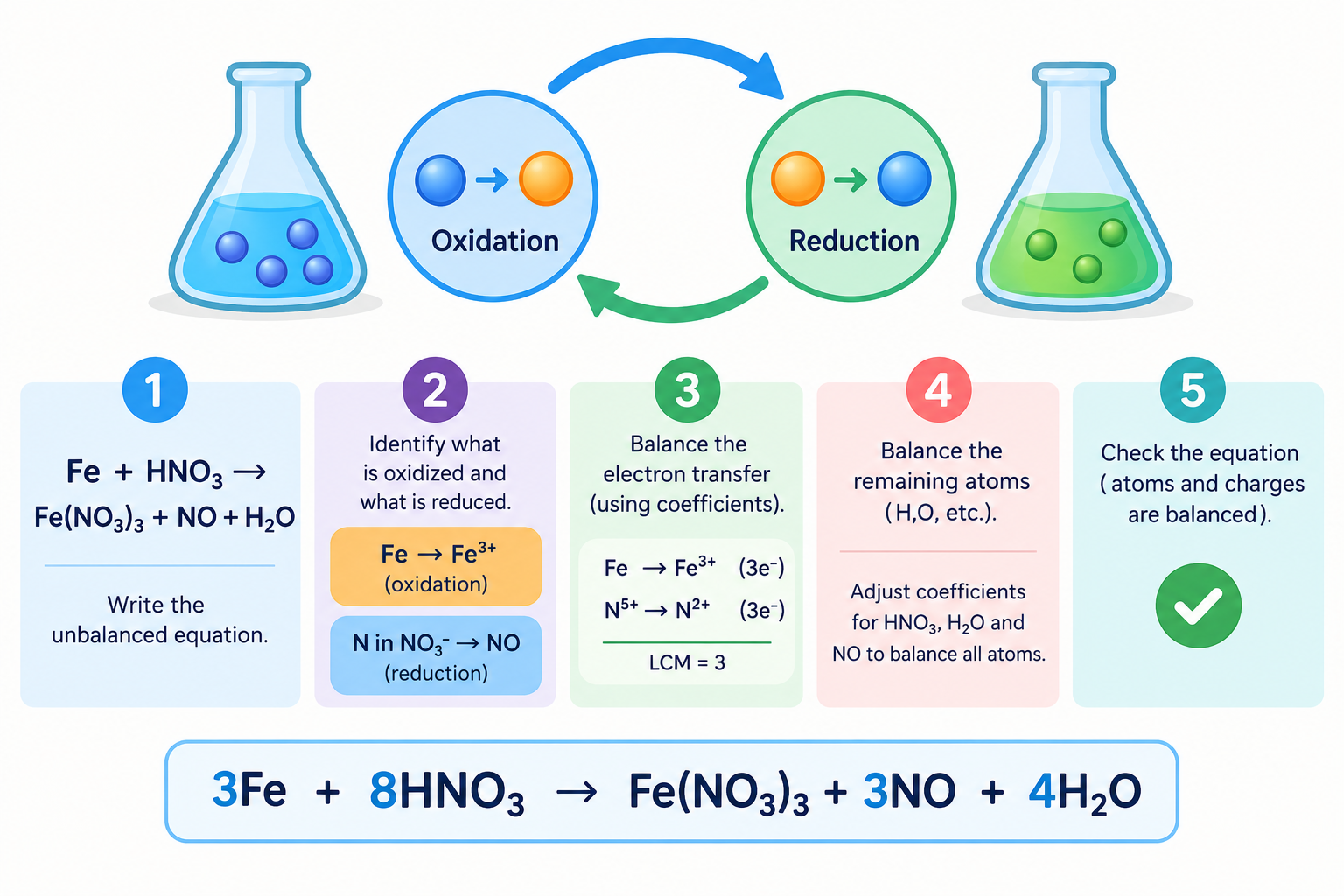
What Is a Redox Reaction?
Redox is short for reduction-oxidation. Electrons move from one species to another. That’s all it is.
Think about a rusting bike chain. Iron atoms lose electrons to oxygen in the air. The iron turns into rust. Now think about the battery in your phone. A metal gives up electrons at one end, and those electrons travel through a circuit to do work. Same idea, different payoff.
Two terms to lock in:
-
Oxidation is the loss of electrons. The oxidation number goes up.
-
Reduction is the gain of electrons. The oxidation number goes down.
Memory trick: OIL RIG. Oxidation Is Loss, Reduction Is Gain.
Here’s the problem. Redox equations often fail the usual “count the atoms” approach. You have to balance atoms and charge at the same time. The half-reaction method makes that manageable.
The Foundation: Why the Half-Reaction Method Works
The half-reaction method (also called the ion-electron method) splits one messy equation into two simple ones:
- One half-reaction shows oxidation (electrons on the product side).
- One half-reaction shows reduction (electrons on the reactant side).
You balance each half on its own. Then you join them so the electrons cancel.
Most redox reactions you’ll see in class happen in water. That means the solution’s setup matters. If you’re solid on concentration and moles, redox titrations get much easier. Need a refresher? Read What Is Molarity in Chemistry first. You’ll use it in the quick check later in this guide.
What you need before you start:
- A reliable way to assign oxidation numbers
- The ability to count atoms and total charge
- Knowledge of whether the solution is acidic or basic
Practice assigning oxidation numbers with the Khan Academy redox exercises. Short, daily drills beat one long cram session.
Part 1: Balancing Redox Reactions in Acidic Medium
In acid, the solution is full of H⁺ and H₂O. You’ll use both to balance.
The 7 Steps
- Write the skeleton equation. Include only the species that change.
- Assign oxidation numbers and identify what’s oxidized and what’s reduced.
- Split into two half-reactions.
- Balance each half-reaction in this exact order:
- Atoms other than O and H
- O by adding H₂O
- H by adding H⁺
- Charge by adding e⁻
- Multiply the half-reactions so the electrons match.
- Add the half-reactions and cancel anything that appears on both sides.
- Check atoms and charge.
Solved Example: Dichromate and Iron(II) in Acid
Unbalanced equation:
Cr₂O₇²⁻ + Fe²⁺ → Cr³⁺ + Fe³⁺
Step 1: Skeleton. Already done above.
Step 2: Oxidation numbers.
- Cr in Cr₂O₇²⁻: +6 → Cr³⁺: +3. Chromium is reduced.
- Fe²⁺: +2 → Fe³⁺: +3. Iron is oxidized.
Step 3: Split.
- Reduction: Cr₂O₇²⁻ → Cr³⁺
- Oxidation: Fe²⁺ → Fe³⁺
Step 4: Balance the reduction half.
- Balance Cr (not O or H): Cr₂O₇²⁻ → 2Cr³⁺
- Balance O with H₂O. Seven O on the left, so add 7 H₂O to the right: Cr₂O₇²⁻ → 2Cr³⁺ + 7H₂O
- Balance H with H⁺. Fourteen H on the right, so add 14 H⁺ to the left: 14H⁺ + Cr₂O₇²⁻ → 2Cr³⁺ + 7H₂O
- Balance charge with e⁻. Left side: +14 + (−2) = +12. Right side: +6. Add 6 e⁻ to the left:
14H⁺ + Cr₂O₇²⁻ + 6e⁻ → 2Cr³⁺ + 7H₂O
Step 4 (continued): Balance the oxidation half.
Atoms already match. Charge: left is +2, right is +3. Add 1 e⁻ to the right:
Fe²⁺ → Fe³⁺ + e⁻
Step 5: Match the electrons. The reduction half has 6 e⁻. The oxidation half has 1 e⁻. Multiply the oxidation half by 6:
6Fe²⁺ → 6Fe³⁺ + 6e⁻
Step 6: Add and cancel. The 6 e⁻ appear on both sides and cancel.
Cr₂O₇²⁻ + 6Fe²⁺ + 14H⁺ → 2Cr³⁺ + 6Fe³⁺ + 7H₂O
Step 7: Check.
| Left | Right | |
|---|---|---|
| Cr | 2 | 2 |
| Fe | 6 | 6 |
| O | 7 | 7 |
| H | 14 | 14 |
| Charge | (−2) + (+12) + (+14) = +24 | (+6) + (+18) = +24 |
Everything matches. The equation is balanced.
Quick Molarity Check
Redox equations earn their keep in titrations. Take a similar reaction in acid:
MnO₄⁻ + 5Fe²⁺ + 8H⁺ → Mn²⁺ + 5Fe³⁺ + 4H₂O
A student uses 25.0 mL of 0.0200 M KMnO₄ to reach the endpoint. How many moles of Fe²⁺ were in the sample?
- Moles MnO₄⁻ = 0.0200 mol/L × 0.0250 L = 5.00 × 10⁻⁴ mol
- Mole ratio from the balanced equation: 1 MnO₄⁻ reacts with 5 Fe²⁺
- Moles Fe²⁺ = 5.00 × 10⁻⁴ × 5 = 2.50 × 10⁻³ mol
See why balancing matters? Without the coefficient of 5, this answer is wrong by a factor of five.
Part 2: Balancing Redox Reactions in Basic Medium
In a basic solution, there’s almost no free H⁺. The solution has OH⁻ and H₂O instead. So you can’t just toss H⁺ into your equation.
The trick: balance as if the solution were acidic, then convert.
The 9 Steps
- Write the skeleton equation.
- Assign oxidation numbers.
- Split into half-reactions.
- Balance each half as if in acid (atoms, then O with H₂O, then H with H⁺, then charge with e⁻).
- Neutralize the H⁺. For every H⁺ in a half-reaction, add one OH⁻ to both sides.
- Combine each H⁺ and OH⁻ on the same side into H₂O.
- Cancel any H₂O that now appears on both sides.
- Match the electrons, then add the half-reactions and cancel.
- Check atoms and charge.
Solved Example: Permanganate and Iodide in Base
Unbalanced equation:
MnO₄⁻ + I⁻ → MnO₂ + I₂
Step 2: Oxidation numbers.
- Mn in MnO₄⁻: +7 → MnO₂: +4. Manganese is reduced.
- I⁻: −1 → I₂: 0. Iodide is oxidized.
Step 3: Split.
- Reduction: MnO₄⁻ → MnO₂
- Oxidation: I⁻ → I₂
Step 4: Balance the reduction half as if in acid.
- Mn already balances.
- Balance O: MnO₄⁻ → MnO₂ + 2H₂O
- Balance H: 4H⁺ + MnO₄⁻ → MnO₂ + 2H₂O
- Balance charge. Left: +4 − 1 = +3. Right: 0. Add 3 e⁻ to the left:
4H⁺ + MnO₄⁻ + 3e⁻ → MnO₂ + 2H₂O
Step 5: Neutralize the H⁺. There are 4 H⁺, so add 4 OH⁻ to both sides:
4H⁺ + 4OH⁻ + MnO₄⁻ + 3e⁻ → MnO₂ + 2H₂O + 4OH⁻
Step 6: Form water. 4H⁺ + 4OH⁻ becomes 4H₂O:
4H₂O + MnO₄⁻ + 3e⁻ → MnO₂ + 2H₂O + 4OH⁻
Step 7: Cancel extra water. Subtract 2 H₂O from both sides:
MnO₄⁻ + 2H₂O + 3e⁻ → MnO₂ + 4OH⁻
Charge check: left is −1 − 3 = −4. Right is −4. ✓
Balance the oxidation half.
Balance I first: 2I⁻ → I₂. Charge: left is −2, right is 0. Add 2 e⁻ to the right:
2I⁻ → I₂ + 2e⁻
No H or O is involved, so no neutralizing step is needed.
Step 8: Match the electrons. The least common multiple of 3 and 2 is 6.
- Multiply the reduction half by 2: 2MnO₄⁻ + 4H₂O + 6e⁻ → 2MnO₂ + 8OH⁻
- Multiply the oxidation half by 3: 6I⁻ → 3I₂ + 6e⁻
Add them. The 6 e⁻ cancel:
2MnO₄⁻ + 6I⁻ + 4H₂O → 2MnO₂ + 3I₂ + 8OH⁻
Step 9: Check.
| Left | Right | |
|---|---|---|
| Mn | 2 | 2 |
| I | 6 | 6 |
| O | 8 + 4 = 12 | 4 + 8 = 12 |
| H | 8 | 8 |
| Charge | (−2) + (−6) = −8 | −8 |
Balanced. Notice that OH⁻ ends up on the product side. That’s normal for a reaction in base, and it’s a good sign.
Five Mistakes That Cost Students Points
- Skipping the charge check. Atoms can balance while charge is off. Always check both.
- Balancing in the wrong order. Do atoms other than O and H first. Then O, then H, then charge.
- Forgetting to add OH⁻ to both sides. Whatever you add to one side, you add to the other.
- Leaving electrons in the final equation. If e⁻ remain, you didn’t match them correctly.
- Putting H⁺ in a basic-solution answer. The final basic equation should contain OH⁻ and H₂O, not H⁺.
Quick Checklist: Acidic vs. Basic Medium
| Step | Acidic Medium | Basic Medium |
|---|---|---|
| 1. Split | Write oxidation and reduction half-reactions | Same |
| 2. Atoms (not O, H) | Balance first | Same |
| 3. Oxygen | Add H₂O | Add H₂O |
| 4. Hydrogen | Add H⁺ | Add H⁺ (temporarily) |
| 5. Neutralize | Not needed | Add OH⁻ to both sides for each H⁺, then combine into H₂O |
| 6. Charge | Add e⁻ | Add e⁻ (before neutralizing) |
| 7. Electrons | Multiply so electrons match | Same |
| 8. Combine | Add halves, cancel common species | Same, then cancel extra H₂O |
| 9. Final check | Atoms and charge | Atoms and charge, and no H⁺ left |
| Typical sign | H⁺ on the reactant side | OH⁻ on the product side |
Screenshot this table. It’s your exam-day cheat sheet.
Keep Practicing
Balancing redox reactions is a skill. Skill comes from reps.
- Do five problems a day for a week. Alternate acidic and basic.
- Run through the Khan Academy redox exercises for more problems with instant feedback.
- Watch electron transfer happen with PhET interactive chemistry simulations. Seeing it helps the half-reaction idea click.
- Strengthen your foundations with AP Chemistry Unit 1 Practice Questions. Moles and electron configurations make redox far easier.
Your Practice Challenge
Try this one on your own. Then check your answer below.
Balance in acidic solution:
Cu + NO₃⁻ → Cu²⁺ + NO
Hints:
- Copper goes from 0 to +2. Nitrogen goes from +5 to +2.
- The reduction half needs 4H⁺ and gains 3 e⁻.
- The oxidation half loses 2 e⁻. The least common multiple is 6.
Answer: 3Cu + 2NO₃⁻ + 8H⁺ → 3Cu²⁺ + 2NO + 4H₂O
Charge check: (−2) + (+8) = +6 on the left. +6 on the right. ✓
Got it right? Try the same reaction in basic solution next. That one will test whether the neutralizing step has stuck.
Disclaimer:
This study guide is an independent educational resource intended solely for academic support and self-study purposes.