
Introduction
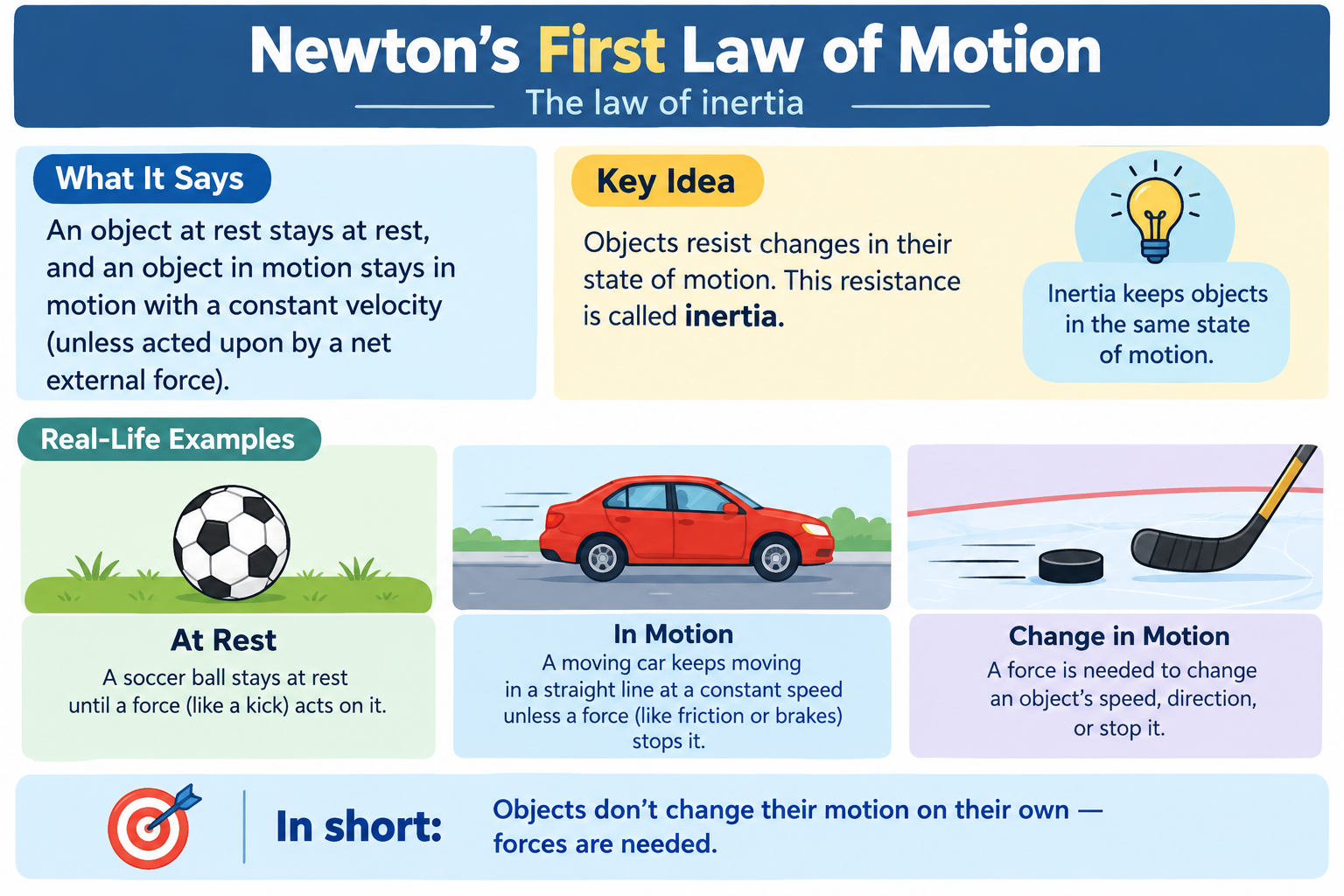
A football sitting on a pitch stays exactly where it is. Nobody needs to hold it there — it simply does not move on its own. Now kick that ball across a smooth surface. Unless something stops it — friction, a wall, another player — it keeps rolling. Both of these observations are describing the same physical principle.
What is Newton’s First Law of Motion? It states that an object at rest stays at rest, and an object in motion stays in motion at the same speed and in the same direction, unless acted upon by an unbalanced external force.
This single statement explains an enormous range of behaviour — from why seatbelts save lives to why spacecraft keep travelling through deep space without any engine power. It is the starting point for understanding all of classical mechanics, and once it makes sense, much of physics begins to click into place.
Key Takeaways
-
Newton’s First Law states that objects do not change their state of motion unless a net external force acts on them.
-
It applies equally to objects at rest and objects moving at constant velocity.
-
Newton’s First Law is also called the Law of Inertia because inertia is the property that makes this law hold.
-
A net force of zero means no change in motion — not necessarily that no forces are present.
-
Balanced forces produce no change in motion; unbalanced forces cause acceleration, deceleration, or a change in direction.
-
In everyday life, friction and air resistance are the forces that most commonly interrupt the behaviour described by Newton’s First Law.
-
In space, where friction is absent, Newton’s First Law is demonstrated in its purest form.
What Is Newton’s First Law of Motion?
Newton’s First Law of Motion states:
“An object at rest stays at rest, and an object in motion stays in motion with the same speed and in the same direction, unless acted upon by an unbalanced external force.”
Let us break this down piece by piece, because each part matters.
“An object at rest stays at rest”
A stationary object will not start moving by itself. A book on a desk, a parked car, a ball on a pitch — none of these move unless something acts on them. There is no tendency for a resting object to spontaneously begin moving.
“An object in motion stays in motion”
A moving object does not naturally slow down and stop. In reality, it appears to — but that is because friction and air resistance are forces acting on it. Without those forces, it would keep moving indefinitely.
“Same speed and direction”
A moving object maintains not just its speed but its direction. Changing either one requires a force. This is why changing direction — turning a corner, for example — requires a force to act on the object.
“Unless acted upon by an unbalanced external force”
This is the condition that changes everything. An “external” force comes from outside the object. An “unbalanced” force is one that is not cancelled out by an equal and opposite force. When a net force acts, the state of motion changes.
Newton’s First Law and Inertia
Newton’s First Law is so closely tied to inertia that it is often called the Law of Inertia.
Inertia is the property of matter that causes objects to resist changes in their state of motion. An object at rest resists being set in motion. An object in motion resists being stopped, slowed, or redirected. The more mass an object has, the greater its inertia.
Newton’s First Law is essentially a formal statement of what inertia means physically. Because all matter has inertia, all objects resist changes to their motion — and this is exactly what the First Law describes.
For a thorough explanation of inertia, its three types, and how it connects to mass, see What Is Inertia in Physics? on LearnMinto.
What Is an Unbalanced Force?
To apply Newton’s First Law correctly, you need to understand the difference between balanced and unbalanced forces.
Balanced forces occur when all the forces acting on an object cancel each other out. The net force — the overall combined force — is zero. When forces are balanced, there is no change in the object’s motion.
Unbalanced forces occur when the forces acting on an object do not cancel out. The net force is not zero. When forces are unbalanced, the object accelerates — it speeds up, slows down, or changes direction.
| Situation | Forces Acting | Net Force | Result |
|---|---|---|---|
| Book resting on a table | Weight downward, normal force upward | 0 | Stays at rest |
| Car moving at constant speed | Engine force forward, friction/air resistance backward (equal) | 0 | Constant velocity |
| Kicked football in flight | Gravity downward, air resistance backward | Not zero | Decelerates and falls |
| Pushed box on rough floor | Applied force forward, friction backward (unequal) | Not zero | Accelerates |
| Spacecraft with engines off in space | No significant forces | 0 | Continues at constant velocity |
The key insight: zero net force does not mean no forces are present. It means the forces present are exactly balanced. A book on a table has two forces acting on it — gravity pulling it down and the table’s normal force pushing it up. They are equal and opposite, so the net force is zero and the book stays still.
Newton’s First Law in Everyday Life
Newton’s First Law shows up constantly in daily experience, even if we do not always recognise it.
1. A passenger lurching in a braking car
When a car brakes suddenly, the car decelerates. The passenger’s body was moving at the car’s speed and continues moving forward because of inertia. The seatbelt applies the stopping force. In motion part of the law.
2. A ball rolling on a smooth surface
A ball rolled along a nearly frictionless surface (like a bowling alley) keeps rolling for a long time. The small amount of friction present gradually slows it. Without any friction, it would not stop. In motion part of the law.
3. A book resting on a desk
The book sits motionless. Gravity acts downward, the desk pushes upward with an equal normal force. Net force is zero — no motion results. At rest part of the law.
4. Seatbelts and road safety
In a collision, the car stops suddenly. Passengers, due to inertia, continue moving forward at the original speed. The seatbelt applies a force to decelerate the passenger safely. Without it, the passenger continues forward unimpeded — directly demonstrating the in-motion part of the law.
5. A spacecraft moving through space
A spacecraft with its engines off continues at constant velocity through deep space. No friction, no air resistance — nothing opposes its motion. Newton’s First Law in its purest form. In motion part of the law.
6. Athletes continuing to run after the finish line
A sprinter cannot stop the instant they cross the finish line. Their body continues forward because of inertia of motion. They must actively decelerate by applying muscular force. In motion part of the law.
7. The coin and card trick
Place a card on a glass and a coin on the card. Flick the card away sharply — the coin drops straight down into the glass. The coin’s inertia of rest keeps it in place while the card slides away. At rest part of the law.
8. The tablecloth trick
Pull a tablecloth quickly from under dishes — the dishes remain roughly in place because their inertia resists the brief motion. At rest part of the law.
9. Wet clothes in a washing machine drum
The spinning drum pushes clothes in a circular path. Water inside the clothes tries to continue in a straight line (inertia of direction) and is forced outward through the drum perforations, removing the water. In motion/direction part of the law.
10. A hockey puck sliding on ice
Ice offers very little friction. A puck struck across the ice travels a very long distance before stopping because almost no force opposes its motion. This approximates the frictionless condition of Newton’s First Law remarkably well. In motion part of the law.
Balanced and Unbalanced Forces
Understanding the distinction between balanced and unbalanced forces is essential for applying Newton’s First Law correctly.
When all forces acting on an object are balanced — every force cancelled by an equal and opposite force — the net force is zero. According to Newton’s First Law, zero net force means no change in velocity. The object either remains at rest or continues moving at constant velocity.
When forces are unbalanced — one direction has a greater force than the opposite — the net force is not zero. The object’s velocity changes. It may speed up, slow down, or change direction. This is the domain of Newton’s Second Law.
An important point: velocity is a vector quantity. It has both magnitude (speed) and direction. Changing either the speed or the direction counts as a change in velocity. This means that even an object moving at constant speed around a curve is experiencing an unbalanced force — the one changing its direction.
A net force not only changes velocity but also changes an object’s momentum. The relationship between net force, mass, and the change in momentum is one of the most important ideas in mechanics.
For a full explanation, see What Is Momentum?
Newton’s First Law and Constant Velocity
A common misunderstanding is that Newton’s First Law only applies to objects at rest. It applies equally to objects moving at constant velocity.
Constant velocity means the object moves at the same speed in the same direction without changing. This is a state of zero net force — exactly like being at rest — just with a non-zero speed.
| State | Velocity | Net Force | Example |
|---|---|---|---|
| At rest | 0 | 0 | Book on desk |
| Constant velocity | Any constant value | 0 | Car on motorway at steady speed |
| Accelerating | Changing | Not zero | Car speeding up |
| Decelerating | Changing | Not zero | Car braking |
A car on a motorway at constant 70 mph: The engine provides a forward force. Air resistance and friction provide a backward force. If these are equal, the net force is zero and the car maintains exactly 70 mph — no change in velocity.
A skydiver at terminal velocity: The skydiver accelerates after jumping but eventually reaches a speed where air resistance equals gravitational force. At this point, net force is zero and the skydiver falls at constant velocity — terminal velocity.
Both situations represent What Is Uniform Motion? — constant speed in a straight line — which is precisely what Newton’s First Law predicts when no net force acts.
Newton’s First Law and Friction
On Earth, moving objects almost always slow down and stop. Students often conclude that “things naturally stop moving.” This is not correct — things stop because friction and air resistance act on them.
Friction is a contact force that opposes the relative motion of surfaces in contact. Air resistance is a force that opposes the motion of an object through air. Both are unbalanced forces that cause deceleration.
A rubber ball bouncing along a concrete pavement stops much faster than a hockey puck sliding across ice — not because the ball has “less motion” but because concrete produces far more friction than ice. In both cases, inertia keeps the objects moving; friction overcomes that inertia.
If friction and air resistance could be entirely eliminated, every moving object would continue at constant velocity forever — exactly as Newton’s First Law states.
In the real world, friction is nearly always present. When it is, objects experience What Is Non-Uniform Motion? — their speed changes over time. This is not a violation of Newton’s First Law; it is the First Law working correctly, because a real unbalanced force (friction) is now acting.
Newton’s First Law vs Newton’s Second Law
Newton published three laws of motion, and the first two are closely linked. Understanding how they differ is important.
| Feature | Newton’s First Law | Newton’s Second Law |
|---|---|---|
| Condition | Net force = 0 | Net force ≠ 0 |
| Result | No change in velocity | Object accelerates (F = ma) |
| What it describes | Inertia — resistance to change | How force produces acceleration |
| Example | Car at constant speed | Car speeding up |
| Mathematical form | Net F = 0 → a = 0 | F = ma |
Newton’s First Law tells you what happens when there is no net force: nothing changes.
Newton’s Second Law tells you what happens when there is a net force: the object accelerates in proportion to the force and inversely proportional to its mass.
In a sense, the First Law is a special case of the Second Law — when F = 0, then a = 0, which means no change in velocity. But historically and conceptually, the First Law stands alone because it challenges the intuitive but incorrect idea that a force is needed to maintain motion.
Newton’s First Law in Space
Space provides the closest real-world environment to the idealised conditions in Newton’s First Law. There is virtually no air, so air resistance is negligible. The gravitational fields far from any planet or star are extremely weak.
A spacecraft that has used its engines to reach a certain velocity and then switched them off will continue at that velocity — same speed, same direction — for enormous distances. No engine is running. No force is acting. Inertia maintains the motion.
This is not just a theoretical prediction — it is observed in every space mission. Voyager 1, launched in 1977, continues travelling through interstellar space decades later with its engines long exhausted. Newton’s First Law, operating in conditions where friction is essentially zero, keeps it moving.
On Earth, this effect is hidden by friction and gravity — which is precisely why it took careful scientific thinking to realise that constant motion, not rest, is the natural state of an undisturbed object.
Historical Context — Who Was Newton?
Sir Isaac Newton published his three laws of motion in his landmark work Philosophiæ Naturalis Principia Mathematica (commonly called the Principia) in 1687. This work transformed physics and mathematics and is one of the most influential scientific texts ever written.
The idea behind Newton’s First Law, however, was not entirely new. Galileo Galilei had challenged the ancient Aristotelian view in the early 17th century. Aristotle had taught that objects naturally came to rest and that a continuous force was required to maintain motion. Galileo’s experiments with balls rolling on inclined planes led him to recognise that without friction, a rolling ball would continue moving indefinitely. Newton formalised this insight into the precise law we use today.
Newton’s genius was in recognising that the same principle — resistance to change in motion — applies both to objects at rest and objects in motion, and in connecting it mathematically to his other laws.
Common Misconceptions About Newton’s First Law
| Misconception | Correct Explanation |
|---|---|
| Objects naturally slow down and stop | Objects slow down because of friction and air resistance — external forces. Without them, objects continue indefinitely. |
| A force is needed to keep something moving | A force is needed only to change motion. Maintaining constant velocity requires zero net force. |
| Newton’s First Law only applies to stationary objects | It applies equally to objects at constant velocity — any state with zero net force. |
| Balanced forces mean no forces are present | Balanced forces means forces are present but cancel out, giving a net force of zero. |
| A heavier object needs more force to stay at rest | If forces are balanced, any mass stays at rest regardless of weight. The normal force automatically adjusts to balance gravity. |
| Inertia is a force that keeps things moving | Inertia is a property of matter — not a force. It describes resistance to change, not a push or pull. |
Worked Examples
Example 1
Situation: A book lies on a table. It does not move.
Applying Newton’s First Law: The book is at rest. Gravity acts downward; the normal force from the table acts upward. These are equal and opposite — net force = 0.
Explanation: With zero net force, the book stays at rest. Newton’s First Law predicts exactly this.
Conclusion: The book remains stationary — consistent with the “object at rest stays at rest” part of the law.
Example 2
Situation: A hockey puck is struck and slides across smooth ice.
Applying Newton’s First Law: The puck is in motion. Very little friction acts. The net force is close to zero.
Explanation: The puck continues at nearly constant velocity because there is almost no force to oppose it.
Conclusion: The puck travels a long distance before tiny friction forces gradually stop it — closely approximating Newton’s First Law.
Example 3
Situation: A car travels at constant 60 km/h on a straight, level road.
Applying Newton’s First Law: Velocity is constant. Therefore, net force = 0. Engine force forward exactly balances friction and air resistance backward.
Explanation: The driver maintains the accelerator at just the right level to ensure the driving force matches resistive forces exactly.
Conclusion: Constant velocity → zero net force → Newton’s First Law applies.
Example 4
Situation: A passenger in a car is thrown forward when the car brakes suddenly.
Applying Newton’s First Law: The passenger was moving at the car’s speed. When the car decelerates, the passenger’s inertia keeps their body moving forward.
Explanation: No force has yet acted on the passenger’s body to decelerate it — so it continues forward until the seatbelt or dashboard applies a force.
Conclusion: Inertia of motion — the “in motion stays in motion” part of the law.
Example 5
Situation: A spacecraft with engines off travels through deep space.
Applying Newton’s First Law: No friction, no air resistance, negligible gravity. Net force ≈ 0.
Explanation: The spacecraft maintains its velocity indefinitely. No engine is needed to maintain motion — only to change it.
Conclusion: Pure demonstration of Newton’s First Law — constant velocity in the absence of net force.
Example 6
Situation: A ball is kicked horizontally. Ignoring air resistance, what keeps it moving horizontally?
Applying Newton’s First Law: No horizontal force acts after the kick (ignoring air resistance). Net horizontal force = 0.
Explanation: Inertia of motion keeps the ball moving horizontally at the same speed. Gravity acts vertically — changing only the vertical component of velocity.
Conclusion: Newton’s First Law governs the horizontal motion; gravity governs the vertical motion separately.
Example 7
Situation: A rubber ball is rolled across a rough carpet. It quickly slows and stops.
Applying Newton’s First Law: The ball has inertia of motion. Friction from the carpet is an unbalanced backward force.
Explanation: The net force is not zero — friction is greater than zero. This causes deceleration. The ball stops due to friction, not because “motion runs out.”
Conclusion: Newton’s First Law still holds — a net force (friction) changes the ball’s velocity.
Example 8
Situation: A skydiver reaches terminal velocity.
Applying Newton’s First Law: At terminal velocity, air resistance equals the gravitational force. Net force = 0.
Explanation: The skydiver is moving but at constant velocity — exactly as Newton’s First Law predicts for zero net force.
Conclusion: Terminal velocity is a constant-velocity state consistent with Newton’s First Law.
Example 9
Situation: A car turns a corner at constant speed. Is Newton’s First Law being obeyed?
Applying Newton’s First Law: Speed is constant but direction is changing. Velocity is changing.
Explanation: A changing direction means a changing velocity. Therefore, the net force is not zero — a centripetal force (from friction or the road) acts inward. Newton’s First Law is not being violated — an unbalanced force is present.
Conclusion: Constant speed around a corner is not constant velocity. Newton’s First Law correctly predicts that a force must act.
Example 10
Situation: A heavy box sits on a warehouse floor. Two workers push it from opposite sides with equal force. The box does not move.
Applying Newton’s First Law: Forces from left and right are equal and opposite. Net force = 0.
Explanation: Balanced forces → no change in motion. The box stays at rest exactly as Newton’s First Law predicts.
Conclusion: Balanced forces produce no change in motion, regardless of the individual force magnitudes.
Example 11
Situation: A coin is placed on a card sitting on top of a glass. The card is flicked away sharply. The coin drops into the glass.
Applying Newton’s First Law: The coin is at rest. The card is pulled away rapidly. The brief, low-friction contact between coin and card does not give the coin significant horizontal velocity.
Explanation: Inertia of rest keeps the coin in place horizontally. Gravity then pulls it straight down into the glass.
Conclusion: “Object at rest stays at rest” — inertia of rest demonstrated cleanly.
Example 12
Situation: A train moving at constant velocity on a level track has its engine providing a forward force of 50,000 N. What is the friction and air resistance force?
Applying Newton’s First Law: Constant velocity → net force = 0.
Explanation: If the engine provides 50,000 N forward and the net force is zero, then friction and air resistance must also total 50,000 N backward.
Conclusion: The resistive forces equal the engine force exactly — balanced, giving zero net force and constant velocity.
Example 13
Situation: An astronaut floating in a space station gently pushes a wrench away from them. Describe the wrench’s subsequent motion.
Applying Newton’s First Law: Once released, no force acts on the wrench (negligible gravity, no friction, no air).
Explanation: The wrench continues at constant velocity in the direction it was pushed — indefinitely, until it contacts a wall.
Conclusion: Newton’s First Law governs the wrench’s motion completely.
Example 14
Situation: A cyclist stops pedalling on a flat road. What happens next and why?
Applying Newton’s First Law: The cyclist was moving at constant velocity while pedalling kept driving force equal to friction. When pedalling stops, the driving force drops to zero but friction continues.
Explanation: Net force is now backward (friction only). The cyclist decelerates — an unbalanced force is acting.
Conclusion: The change in motion (deceleration) is caused by the now-unbalanced friction force — Newton’s First Law operating correctly.
Example 15
Situation: Two identical balls are placed on the same surface. One is made of aluminium, the other of lead. Both are given the same push. Which keeps moving longer?
Applying Newton’s First Law: The lead ball has greater mass and therefore greater inertia. The same friction force acts on both. Using F = ma: greater mass → less deceleration for the same friction force.
Explanation: The lead ball decelerates more slowly and therefore travels further before stopping.
Conclusion: Greater mass (greater inertia) means the same friction force produces less deceleration — directly related to What Is Kinetic Energy?, since a heavier ball at the same speed carries more kinetic energy that must be removed by friction before it stops.
Practice Questions
12 Short Answer Questions
- State Newton’s First Law of Motion in your own words.
- Why is Newton’s First Law also called the Law of Inertia?
- What is the net force on an object moving at constant velocity?
- A ball is rolling along a surface and gradually slows down. Is this a violation of Newton’s First Law? Explain.
- What forces act on a book resting on a table? What is the net force?
- Why do passengers lurch forward when a car brakes suddenly?
- A spacecraft with engines off continues moving through space. Which part of Newton’s First Law explains this?
- What is the difference between balanced and unbalanced forces?
- Does a skydiver at terminal velocity have a net force acting on them? Explain.
- Why is Newton’s First Law difficult to observe perfectly on Earth?
- A car moves at constant 50 km/h. What can you conclude about the forces acting on it?
- Explain why seatbelts are a safety feature based on Newton’s First Law.
Answers:
- An object at rest stays at rest, and an object in motion continues moving at the same speed and direction, unless a net external force acts on it.
- Because inertia — the property of matter that resists changes in motion — is the physical property that makes Newton’s First Law hold. The law is a formal description of what inertia means.
- Zero. Constant velocity means no change in motion, which requires a net force of zero.
- No. The ball slows because friction is an external unbalanced force acting on it. Newton’s First Law is not violated — it correctly predicts that an external force (friction) changes the motion.
- Gravity acts downward; the table’s normal force acts upward. They are equal and opposite. Net force = 0.
- The car decelerates. The passenger’s body was moving at the car’s speed and continues forward due to inertia of motion — Newton’s First Law — until the seatbelt applies a stopping force.
- The “object in motion stays in motion” part. In the absence of friction and significant gravity, the spacecraft’s inertia maintains constant velocity indefinitely.
- Balanced forces cancel out, giving a net force of zero and no change in motion. Unbalanced forces do not cancel, giving a non-zero net force that changes the object’s motion.
- No. At terminal velocity, gravity equals air resistance — the net force is zero. The skydiver moves at constant velocity, consistent with Newton’s First Law.
- Because friction and air resistance are almost always present, making it impossible to observe perfectly constant motion. These forces continuously act as unbalanced forces to change the motion of objects.
- The net force on the car is zero. The engine’s driving force equals the total friction and air resistance. Balanced forces → constant velocity.
- In a collision, the car stops suddenly. Passengers continue moving forward at the original speed due to inertia — Newton’s First Law. The seatbelt provides the stopping force, decelerating the passenger safely rather than allowing them to continue forward and strike the windscreen or dashboard.
10 Multiple Choice Questions
Question 1
Which of the following is the correct statement of Newton’s First Law?
A. An object always moves in the direction of the applied force.
B. Force equals mass times acceleration.
C. An object at rest stays at rest, and a moving object continues at the same velocity, unless acted on by a net force.
D. Every action has an equal and opposite reaction.
Correct Answer: C
Short Explanation: Option C is the correct statement of Newton’s First Law. A is a consequence of Newton’s Second Law; B is Newton’s Second Law; D is Newton’s Third Law.
Question 2
A car moves at constant velocity on a level road. What is the net force on the car?
A. Equal to the engine force
B. Equal to friction
C. Zero
D. Greater than friction
Correct Answer: C
Short Explanation: Constant velocity means no change in motion, which requires net force = 0. The engine force and friction are equal and opposite.
Question 3
Why do passengers in a bus lurch forward when the bus brakes suddenly?
A. The brakes push the passengers forward.
B. The passengers’ inertia keeps them moving forward.
C. The seats push the passengers forward.
D. Friction between the seat and passengers increases.
Correct Answer: B
Short Explanation: The passengers were in motion and their inertia keeps them moving forward when the bus decelerates — Newton’s First Law in action.
Question 4
A book sits on a table. Which statement correctly describes the forces?
A. No forces act on the book.
B. Only gravity acts on the book.
C. Gravity and the normal force are balanced; net force is zero.
D. The normal force is greater than gravity.
Correct Answer: C
Short Explanation: Gravity pulls the book downward and the table’s normal force pushes it upward with equal magnitude — balanced forces, net force = 0.
Question 5
An object moving at constant velocity has:
A. A net force in the direction of motion
B. No forces acting on it
C. Balanced forces and zero net force
D. An increasing speed
Correct Answer: C
Short Explanation: Constant velocity requires zero net force. Forces may be present, but they are balanced — they cancel each other out.
Question 6
Newton’s First Law is also known as:
A. The Law of Acceleration
B. The Law of Inertia
C. The Law of Gravity
D. The Law of Reaction
Correct Answer: B
Short Explanation: Newton’s First Law describes inertia — the tendency of objects to resist changes in their motion — and is therefore called the Law of Inertia.
Question 7
A ball rolls along a frictionless surface. What happens to it?
A. It gradually slows and stops.
B. It speeds up over time.
C. It continues at the same velocity indefinitely.
D. It changes direction randomly.
Correct Answer: C
Short Explanation: On a frictionless surface, no unbalanced force acts. Newton’s First Law predicts that the ball continues at constant velocity indefinitely.
Question 8
A spacecraft far from any planet has its engines switched off. What happens?
A. It slows down and eventually stops.
B. It continues at constant velocity in a straight line.
C. It reverses direction.
D. It accelerates due to inertia.
Correct Answer: B
Short Explanation: In space, with no friction or significant gravitational force, the spacecraft’s inertia maintains its velocity. Newton’s First Law applies in its purest form.
Question 9
Which of the following correctly describes an unbalanced force?
A. Two forces of equal magnitude acting in opposite directions
B. A force with no direction
C. A situation where forces do not cancel, giving a non-zero net force
D. Any force acting on an object at rest
Correct Answer: C
Short Explanation: An unbalanced force means the forces acting do not cancel — the net force is non-zero, causing a change in motion.
Question 10
A car engine produces a force of 4,000 N forward. Friction and air resistance total 4,000 N backward. What happens to the car?
A. It accelerates.
B. It decelerates.
C. It maintains constant velocity.
D. It stops immediately.
Correct Answer: C
Short Explanation: 4,000 N forward and 4,000 N backward — net force = 0. Newton’s First Law predicts constant velocity.
5 Challenge Questions
Challenge 1: A 1,200 kg car travelling at 90 km/h on a motorway suddenly has its engine cut off. Air resistance and friction together provide a backward force of 600 N. Describe the car’s subsequent motion and explain why.
Answer:
With the engine off, the driving force drops to zero. The only horizontal force is the backward friction and air resistance of 600 N. This is now an unbalanced force. Using F = ma: a = 600/1,200 = 0.5 m/s² — the car decelerates at 0.5 m/s². The car does not stop immediately because its inertia of motion resists the change. It gradually slows because the 600 N backward force is an unbalanced net force. Newton’s First Law explains why it does not stop instantly — it takes the continued action of this unbalanced force over time to bring the car to rest.
Challenge 2: Explain why a person standing on a bus feels pushed backward when the bus accelerates forward, using Newton’s First Law.
Answer:
When the bus accelerates forward, the bus (and the floor under the person’s feet) moves forward. The person’s body, due to inertia of rest (relative to the ground), tends to remain in its original position. The bus seat or floor pushes the person forward, but the upper body lags behind momentarily — creating the sensation of being pushed backward. In reality, the person is not being pushed backward — their body is simply resisting the forward acceleration. Newton’s First Law: the body tends to stay where it was until a force (from the seat or floor) accelerates it forward with the bus.
Challenge 3: A hockey puck slides across ice and gradually comes to rest. A student says: “This proves Newton’s First Law is wrong — moving objects do stop.” Write a clear response to this student.
Answer:
Newton’s First Law is not wrong — it is being misapplied. The law states that an object continues at constant velocity unless acted upon by an unbalanced external force. In this case, friction from the ice surface is acting as that unbalanced force, continuously opposing the puck’s motion and decelerating it. The puck stops because of friction, not because “motion naturally runs out.” On a perfectly frictionless surface, the puck would never stop. The First Law is entirely consistent with this observation — an external force (friction) changed the puck’s motion, exactly as the law predicts.
Challenge 4: An astronaut in a space station releases a stationary ball in front of them. What does Newton’s First Law predict for the ball’s subsequent motion, and why would this look unusual to an observer outside the station?
Answer:
The ball is released from rest. No significant force acts on it inside the station (microgravity conditions mean gravitational effects are negligible in the short term and the ball and station are in the same orbit). Newton’s First Law predicts the ball stays at rest relative to the astronaut — it does not drift away and does not fall. This appears unusual from an Earth-based perspective because on Earth, releasing an object causes it to fall. In the station, the apparent weightlessness means no net force distinguishes the ball from its surroundings, and it simply floats in place — perfectly consistent with Newton’s First Law.
Challenge 5: A car engine provides a constant forward force. Initially the car accelerates. Eventually it reaches a constant maximum speed and stops accelerating. Use Newton’s First and Second Laws to explain why.
Answer:
Initially, the engine force exceeds friction and air resistance. The net force is forward and non-zero — Newton’s Second Law (F = ma) predicts acceleration. As speed increases, air resistance increases (air resistance increases with speed). Eventually, air resistance and friction together grow large enough to exactly equal the engine force. At this point, the net force = 0 — Newton’s First Law now applies. With zero net force, there is no further acceleration, and the car maintains this maximum constant velocity. The transition from acceleration to constant velocity is the transition from Newton’s Second Law conditions (net force ≠ 0) to Newton’s First Law conditions (net force = 0).
Common Mistakes Students Make
| Mistake | Correct Understanding |
|---|---|
| Confusing zero velocity with zero force | Zero velocity means the object is at rest. Zero net force means no change in motion — which could be at rest OR at constant velocity. |
| Thinking constant velocity means no forces act | Constant velocity means net force = 0. Forces can be present and still balanced. |
| Confusing balanced forces with no forces | Balanced forces cancel out, giving zero net force. Forces are present — they simply add to zero. |
| Ignoring friction in real examples | In real life, friction and air resistance are unbalanced forces causing deceleration. They must be identified and accounted for. |
| Thinking Newton’s First Law only applies to rest | The law applies equally to constant velocity — any state with zero net force. |
| Saying “inertia pushes the passenger forward” | Inertia is not a force. The passenger continues forward because no force has yet stopped them — not because inertia pushed them. |
Exam Tips
- Always identify the net force first. Before answering any question about motion, determine whether the net force is zero or non-zero.
- Net force = 0 means no change in motion. The object stays at rest or continues at constant velocity — not necessarily that it stops.
- Do not confuse balanced forces with no forces. A car at constant speed has forces acting — they just cancel out.
- Friction and air resistance are the most common decelerating forces. When an object slows down in everyday life, these forces are responsible — not a natural tendency to stop.
- Newton’s First Law applies to constant velocity, not just rest. This is one of the most commonly tested points in exams.
- When a question asks “why does it keep moving?” — the answer is inertia and Newton’s First Law. State the law explicitly if asked.
- For extended-response questions, always identify: (1) the forces present, (2) whether they are balanced or unbalanced, (3) what Newton’s First Law therefore predicts.
- State the law precisely. Examiners often award marks for the exact wording — “same speed and same direction” and “unbalanced external force” are important phrases.
Quick Revision Notes
- Newton’s First Law: An object at rest stays at rest; an object in motion stays in motion at the same speed and direction — unless a net external force acts.
- Law of Inertia: Another name for Newton’s First Law, because inertia is the property that makes it hold.
- Inertia: The resistance of an object to changes in its state of motion. Greater mass = greater inertia.
- Balanced forces: Forces that cancel out. Net force = 0. No change in motion.
- Unbalanced forces: Forces that do not cancel. Net force ≠ 0. Motion changes.
- Net force: The overall combined force on an object. If zero, Newton’s First Law applies.
- Constant velocity: Constant speed and direction. Net force = 0. Consistent with Newton’s First Law.
- Friction and air resistance: The most common forces that cause deceleration in everyday situations.
- Space: The closest real environment to the idealised conditions of Newton’s First Law — no friction, negligible air resistance.
- Misconception to avoid: Objects do not naturally stop — they stop because forces act on them.
Newton’s First Law Cheat Sheet
| Concept | Key Point | Example |
|---|---|---|
| Statement of the law | Object keeps its state of motion unless net force acts | Ball rolling on frictionless surface continues indefinitely |
| At rest case | Net force = 0 → stays at rest | Book on a table |
| Constant velocity case | Net force = 0 → continues at same speed and direction | Car at steady motorway speed |
| Unbalanced force | Net force ≠ 0 → motion changes | Braking car decelerates |
| Inertia | Property causing resistance to change in motion | Passenger lurching forward when car brakes |
| Balanced forces | Forces cancel; net force = 0; no change in motion | Equal push from both sides on a stationary box |
| Friction | Common unbalanced force causing deceleration | Ball slowing on carpet |
| In space | No friction → pure demonstration of First Law | Spacecraft continuing without engines |
| Law of Inertia | Alternative name for Newton’s First Law | Coin staying in place when card is flicked away |
Frequently Asked Questions
1. What is Newton’s First Law of Motion?
Newton’s First Law states that an object at rest stays at rest, and an object in motion continues moving at the same speed and in the same direction, unless acted upon by an unbalanced external force.
2. What is the simple explanation of Newton’s First Law?
Objects do not change what they are doing unless something forces them to. A stationary object stays still; a moving object keeps moving — unless a net force acts.
3. What is the Law of Inertia?
The Law of Inertia is another name for Newton’s First Law. Inertia is the property of matter that resists changes in motion, and Newton’s First Law formally describes this behaviour.
4. What does “unbalanced force” mean?
An unbalanced force is a situation where the forces acting on an object do not cancel out — there is a non-zero net force. This causes the object’s motion to change.
5. Does Newton’s First Law apply to moving objects?
Yes — it applies equally to objects at rest and objects moving at constant velocity. Both states share the condition of zero net force.
6. Why does a rolling ball eventually stop?
Because friction and air resistance — external unbalanced forces — act against its motion and gradually decelerate it. Without these forces, it would not stop.
7. Why do passengers lurch forward in a braking car?
The car decelerates, but the passengers’ bodies continue moving at the original speed due to inertia of motion. No force has yet acted on the passenger’s body to slow it — until the seatbelt applies one.
8. Does an object moving at constant velocity have a net force?
No. Constant velocity means no change in motion, which requires zero net force. Forces may be present and balanced, but the net force is zero.
9. What is the difference between Newton’s First and Second Laws?
The First Law describes what happens when net force is zero — no change in motion. The Second Law describes what happens when net force is not zero — the object accelerates according to F = ma.
10. Why is Newton’s First Law hard to observe on Earth?
Because friction and air resistance are almost always present, acting as unbalanced forces that constantly change the motion of objects. These forces make it appear that objects “naturally” slow down, when in reality they are being decelerated by external forces.
11. How does Newton’s First Law apply to space travel?
In space, friction and air resistance are negligible. A spacecraft with engines off continues at constant velocity indefinitely — a direct demonstration of Newton’s First Law in conditions very close to the ideal.
12. What did Galileo contribute to Newton’s First Law?
Galileo challenged the Aristotelian view that objects naturally come to rest and that force is needed to maintain motion. His experiments showed that without friction, a rolling ball continues indefinitely — the insight that Newton later formalised into the First Law.
13. What is balanced force?
Balanced forces occur when two or more forces acting on an object cancel each other out, giving a net force of zero. A book on a table with gravity balanced by the normal force is a classic example.
14. What is net force?
Net force is the overall combined force on an object — the vector sum of all forces acting. If forces in opposite directions are equal, net force is zero. If not, net force is non-zero and motion changes.
15. Why is Newton’s First Law important?
It is the foundation of classical mechanics. It defines what “natural” motion is — constant velocity, not rest — and establishes that forces are needed only to change motion, not to maintain it. Every other concept in mechanics builds on this foundation.
Summary
Newton’s First Law of Motion rests on two clear ideas:
- An object at rest stays at rest — it will not move unless a net external force acts on it.
- An object in motion stays in motion at the same speed and in the same direction — it will not stop, slow down, or change direction unless a net external force acts.
The condition in both cases is the same: zero net force means no change in motion. This applies whether the object is stationary or moving at constant velocity.
In everyday life, friction and air resistance are the forces that most visibly overcome inertia and change motion. In their absence — as in space — Newton’s First Law operates without interruption, and objects maintain their motion indefinitely.
The law is not just a rule to memorise. It represents a genuine insight into how the universe works: objects do not need a reason to keep doing what they are doing. They need a reason — a net force — to change.
Final Thoughts
Newton’s First Law of Motion is where the study of classical mechanics begins, and it is worth taking time to genuinely understand it rather than simply memorising the words. The key shift in thinking it requires — from “objects naturally stop” to “objects naturally continue” — is one of the most important conceptual steps in physics.
Once that shift is made, everything else in mechanics becomes more logical. Forces cause changes. Inertia resists changes. Mass determines how much inertia an object has. Balanced forces mean no change. Unbalanced forces mean acceleration. These ideas all flow directly from Newton’s First Law.
Work through the examples in this article, practise identifying balanced and unbalanced forces in different situations, and test yourself with the practice questions. Building a solid understanding here will make Newton’s Second and Third Laws, momentum, energy, and every other topic in mechanics significantly easier to grasp.
References
- Khan Academy — Newton’s Laws of Motion: https://www.khanacademy.org
- OpenStax University Physics — Newton’s First Law: https://openstax.org
- Physics LibreTexts — Newton’s First Law of Motion: https://phys.libretexts.org
- Encyclopaedia Britannica — Newton’s Laws of Motion: https://www.britannica.com
- NASA — Newton’s Laws of Motion (Space Education): https://www.nasa.gov
Helpful Resources
Khan Academy — Forces and Newton’s Laws
Students can watch video lessons and complete interactive exercises on Newton’s Laws, balanced and unbalanced forces, inertia, and motion.
https://www.khanacademy.org
OpenStax University Physics
A free, peer-reviewed textbook with thorough chapters on Newton’s Laws, net force, inertia, and applications of classical mechanics.
https://openstax.org
Physics LibreTexts — Classical Mechanics
Provides well-structured explanations of Newton’s First Law, balanced forces, constant velocity, and motion in everyday and space contexts.
https://phys.libretexts.org
NASA Education — Newton’s Laws
NASA’s education resources explain Newton’s Laws in the context of real space missions, giving students engaging real-world applications.
https://www.nasa.gov
Disclaimer:
This article is intended for educational and informational purposes only. While LearnMinto strives to provide accurate and up-to-date physics information, readers should verify important academic concepts through official textbooks, educational institutions, examination boards, or trusted educational resources before using this content for exams or academic purposes. LearnMinto is not affiliated with any specific school, university, research institution, or examination board.
About the Author
Saad Qureshi is a Senior Education & Technology Editor at LearnMinto. He focuses on creating and reviewing clear, accessible educational content across mathematics, physics, chemistry, biology, computer science, technology, AI tools, and personal finance.