
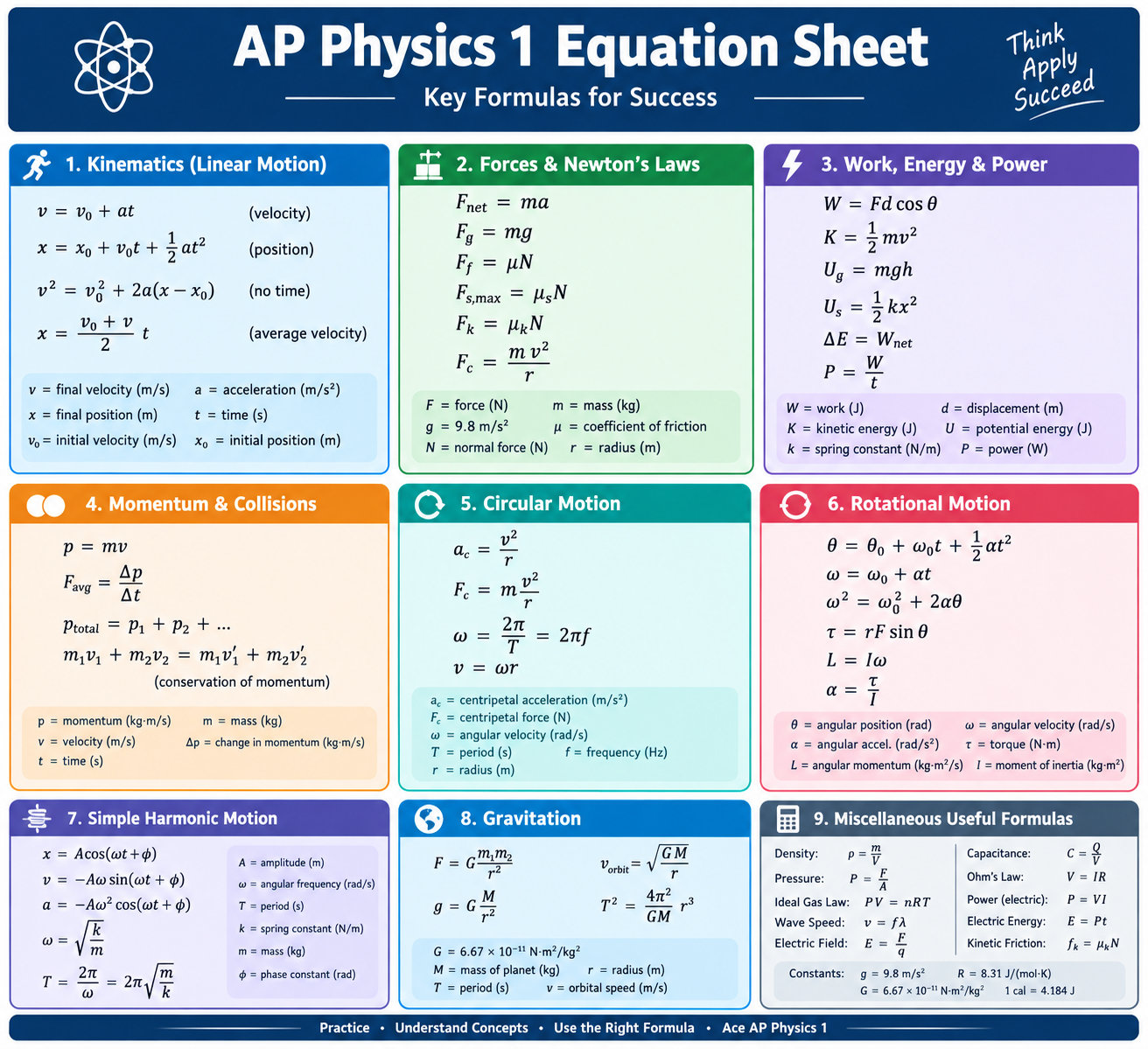
Introduction
Walking into the AP Physics 1 exam with the equation sheet in front of you should feel like an advantage — but for many students, it creates more confusion than confidence. The formulas are there, but knowing which one to use, when to use it, and how to apply it under exam pressure is a different skill entirely.
The AP Physics 1 equation sheet is not a cheat sheet you can rely on without preparation. It is a reference tool that rewards students who already understand the physics behind every formula. A student who has memorised equations without understanding them will struggle to use the sheet effectively. A student who understands the physics will find the sheet makes the exam significantly more manageable.
This guide walks through every major formula on the AP Physics 1 equation sheet in plain language. For each equation, you will find a clear explanation of what it means, what each symbol represents, what units are involved, when to use it, and a worked example showing how it applies in a real problem. Whether you are approaching the exam for the first time or revising in the final weeks before test day, this guide gives you what you need to use the equation sheet with genuine confidence.
Key Takeaways
-
The AP Physics 1 equation sheet is provided during the exam — but understanding the physics behind each formula is essential for using it correctly.
-
Equations are tools for solving problems, not substitutes for conceptual understanding.
-
Every symbol in every equation has a specific physical meaning and a specific unit.
-
Many AP Physics 1 problems require combining two or more equations — knowing when to do this is a critical skill.
-
The most common exam mistakes involve substituting values before identifying the correct equation, using inconsistent units, and misidentifying variables.
-
Practising worked examples with each formula builds the fluency needed to apply equations quickly under exam conditions.
-
Conceptual questions on AP Physics 1 test understanding of what equations mean — not just numerical calculation.
About the AP Physics 1 Equation Sheet
The College Board provides an official equation sheet to every student during the AP Physics 1 exam. This sheet is included in both the multiple-choice and free-response sections of the examination.
What the equation sheet contains:
- Kinematic equations for constant acceleration
- Newton’s second law and related force equations
- Work, energy, and power formulas
- Momentum and impulse equations
- Rotational motion equations
- Equations for simple harmonic motion
- Universal gravitation formula
- Wave equations
- Ohm’s law and basic circuit equations
- A table of common symbols and units
What the equation sheet does NOT contain:
- Explanations of when to use each formula
- Definitions of variables in context
- Guidance on which equation applies to a given problem
- Trigonometric identities (though basic trig is expected knowledge)
- Explanations of concepts
The equation sheet is a reference, not a guide. Students who understand the physics use it efficiently. Students who do not understand the physics will find the sheet has limited value under timed exam conditions.
How to Use the Equation Sheet Effectively
Before diving into the equations themselves, it is worth establishing the right approach to using the equation sheet during the exam.
Step 1: Read the problem fully before looking at the sheet
Understand what the problem is asking and what physical situation it describes. Identify the knowns and unknowns.
Step 2: Identify the physical topic
Is this a kinematics problem? A momentum problem? A circuit problem? Narrowing down the topic immediately limits which section of the equation sheet is relevant.
Step 3: Select the appropriate equation
From the relevant section, identify which equation contains the variable you want to find and the variables you already know.
Step 4: Check units before substituting
Convert all values to SI units before substituting. Mixed units (km/h and m/s, for example) produce incorrect results.
Step 5: Solve algebraically before substituting numbers
Rearrange the equation for the unknown variable first. Substituting numbers into an unrearranged equation dramatically increases the risk of arithmetic errors.
Step 6: Check that the answer is physically reasonable
Does the magnitude make sense? Does the unit match what you expected?
Kinematics Equations
Kinematics describes the motion of objects without reference to the forces causing the motion. The AP Physics 1 equation sheet provides four equations for uniformly accelerated motion — the SUVAT equations.
These equations apply only when acceleration is constant.
The Four Kinematic Equations
Equation 1:
v = v₀ + at
- v = final velocity (m/s)
- v₀ = initial velocity (m/s)
- a = acceleration (m/s²)
- t = time (s)
When to use: When you know initial velocity, acceleration, and time, and need to find final velocity. No displacement involved.
Equation 2:
x = x₀ + v₀t + ½at²
- x = final position (m)
- x₀ = initial position (m)
- v₀ = initial velocity (m/s)
- a = acceleration (m/s²)
- t = time (s)
When to use: When you need displacement and know initial velocity, acceleration, and time.
Equation 3:
v² = v₀² + 2a(x − x₀)
- All variables as above, with (x − x₀) representing displacement.
When to use: When time is not known or not needed. Connects final velocity to displacement.
Equation 4:
x = x₀ + ½(v₀ + v)t
- All variables as above.
When to use: When acceleration is not directly known, but initial and final velocities and time are known.
Key Points About Kinematic Equations
- Define a positive direction at the start of every problem. Objects moving in that direction have positive velocity; objects moving against it have negative velocity.
- Deceleration is negative acceleration — substitute a negative value for a when the object is slowing down in the positive direction.
- For free-fall problems, a = −g ≈ −9.8 m/s² (taking upward as positive).
Worked Example:
A car starts from rest and accelerates uniformly at 3 m/s² for 8 seconds. Find the final velocity and distance covered.
Step 1: Identify knowns: v₀ = 0, a = 3 m/s², t = 8 s
Step 2: Find final velocity using Equation 1:
v = 0 + (3)(8) = 24 m/s
Step 3: Find distance using Equation 2:
x = 0 + 0(8) + ½(3)(8²) = 0 + 0 + ½(3)(64) = 96 m
Newton’s Laws and Force Equations
Newton’s laws of motion are central to AP Physics 1. The equation sheet provides the key mathematical expressions of these laws.
Newton’s Second Law
ΣF = ma
- ΣF = net force (sum of all forces) (N)
- m = mass (kg)
- a = acceleration (m/s²)
When to use: Whenever you need to relate force, mass, and acceleration. This is the most frequently used equation in AP Physics 1.
Important: ΣF means the vector sum of all forces. Always draw a free-body diagram first. Forces in the direction of acceleration are positive; forces opposing acceleration are negative.
Worked Example:
A 5 kg box is pushed with 30 N horizontally on a surface with 10 N of friction. What is the acceleration?
ΣF = 30 − 10 = 20 N
a = ΣF/m = 20/5 = 4 m/s²
Weight
W = mg
- W = weight (N)
- m = mass (kg)
- g = gravitational field strength ≈ 9.8 m/s² (near Earth’s surface)
When to use: To find the gravitational force on an object near Earth’s surface.
Important distinction: Mass (kg) is a scalar measure of the amount of matter. Weight (N) is the gravitational force on that mass. They are often confused but are fundamentally different quantities.
The LearnMinto article What Is Mass in Physics? explores this distinction clearly.
Friction Force
f = μN
- f = friction force (N)
- μ = coefficient of friction (dimensionless)
- N = normal force (N)
When to use: To calculate the frictional force between two surfaces. Use μₛ (static) when the object is not moving, and μₖ (kinetic) when sliding occurs.
Worked Example:
A 10 kg block sits on a surface with μₖ = 0.3. Find the kinetic friction force.
N = mg = 10 × 9.8 = 98 N
f = μN = 0.3 × 98 = 29.4 N
Centripetal Acceleration and Force
a_c = v²/r
F_c = mv²/r
- a_c = centripetal acceleration (m/s²)
- v = speed (m/s)
- r = radius of circular path (m)
- F_c = centripetal force (N)
- m = mass (kg)
When to use: For any object moving in a circular path at constant speed. The centripetal force is always directed toward the centre of the circle.
Important: Centripetal force is not a new type of force — it is always provided by an existing force (gravity, tension, friction, normal force) directed toward the centre.
Worked Example:
A 2 kg ball swings in a horizontal circle of radius 0.5 m at 4 m/s. What is the centripetal force?
F_c = mv²/r = (2)(16)/(0.5) = 64 N
Work, Energy, and Power Equations
Energy and work form one of the most concept-rich sections of AP Physics 1. The equation sheet provides the essential formulas.
Work Done by a Constant Force
W = Fd cos θ
- W = work done (J)
- F = magnitude of the applied force (N)
- d = displacement (m)
- θ = angle between the force and the displacement
When to use: Whenever a force acts on an object and the object moves. If force and displacement are in the same direction, θ = 0° and cos θ = 1, simplifying to W = Fd.
Key concept: No displacement → no work done, regardless of force. Force perpendicular to displacement → zero work done (cos 90° = 0).
A thorough treatment of this concept is available in What Is Work in Physics?
Kinetic Energy
KE = ½mv²
- KE = kinetic energy (J)
- m = mass (kg)
- v = speed (m/s)
When to use: To find the energy an object has due to its motion. Also used in the work-energy theorem.
Work-Energy Theorem
W_net = ΔKE = ½mv² − ½mv₀²
When to use: When net work done equals the change in kinetic energy. This is one of the most powerful relationships in mechanics — it connects force (through work) directly to the change in an object’s motion.
For a full explanation of kinetic energy and its connections, see What Is Kinetic Energy?
Gravitational Potential Energy
PE_g = mgh
- PE_g = gravitational potential energy (J)
- m = mass (kg)
- g ≈ 9.8 m/s²
- h = height above the reference level (m)
When to use: For objects near Earth’s surface at height h above a chosen reference point. The reference level is arbitrary — choose it to simplify the problem (usually the lowest point).
Conservation of Energy
E_total = KE + PE = constant (in the absence of non-conservative forces)
Or expressed as:
KE₁ + PE₁ = KE₂ + PE₂
When to use: When no friction or other non-conservative forces act, total mechanical energy is conserved. Set initial total energy equal to final total energy.
Worked Example:
A 3 kg ball rolls off a 5 m high ledge. What is its speed at the bottom?
Using conservation of energy:
mgh = ½mv²
(9.8)(5) = ½v²
v² = 98
v = 9.9 m/s
Power
P = W/t = Fv
- P = power (W — watts)
- W = work done (J)
- t = time (s)
- F = force (N)
- v = speed (m/s)
When to use: To find the rate of doing work. P = Fv is useful when an object moves at constant speed under an applied force.
Elastic Potential Energy (Spring)
PE_s = ½kx²
- PE_s = elastic potential energy (J)
- k = spring constant (N/m)
- x = compression or extension from natural length (m)
Spring Force (Hooke’s Law)
F_s = kx
- F_s = spring force (N)
- k = spring constant (N/m)
- x = displacement from equilibrium (m)
When to use: For any problem involving a spring. The force is always directed back toward the equilibrium position (restoring force).
Momentum and Impulse Equations
Momentum is one of the most important conserved quantities in physics.
Linear Momentum
p = mv
- p = momentum (kg m/s)
- m = mass (kg)
- v = velocity (m/s)
When to use: To find the momentum of any moving object. Momentum is a vector — direction matters. For a complete exploration of momentum, see What Is Momentum?
Impulse-Momentum Theorem
J = FΔt = Δp = m(v − v₀)
- J = impulse (N s or kg m/s)
- F = average net force (N)
- Δt = time interval (s)
- Δp = change in momentum (kg m/s)
When to use: When a force acts over a time interval and changes an object’s momentum. Key in collision and impact problems.
Conceptual insight: A larger time interval for the same impulse means a smaller average force. This is why airbags and crumple zones reduce injury — they extend the collision time.
Conservation of Momentum
Σp_before = Σp_after
m₁v₁ + m₂v₂ = m₁v₁’ + m₂v₂’
When to use: In any collision or explosion problem when no external forces act on the system. This is one of the most tested concepts in AP Physics 1.
Types of collisions:
| Type | Momentum | Kinetic Energy |
|---|---|---|
| Elastic | Conserved | Conserved |
| Inelastic | Conserved | Not conserved |
| Perfectly inelastic | Conserved | Not conserved — objects stick together |
Worked Example:
A 3 kg ball moving at 5 m/s collides with a stationary 2 kg ball. They stick together. What is the final velocity?
m₁v₁ + m₂v₂ = (m₁ + m₂)v’
(3)(5) + (2)(0) = (3 + 2)v’
15 = 5v’
v’ = 3 m/s
Rotational Motion Equations
AP Physics 1 introduces rotational motion, and the equation sheet provides rotational analogues of the linear motion equations.
Rotational Kinematics
θ = ω₀t + ½αt²
ω = ω₀ + αt
ω² = ω₀² + 2αθ
- θ = angular displacement (rad)
- ω = angular velocity (rad/s)
- ω₀ = initial angular velocity (rad/s)
- α = angular acceleration (rad/s²)
- t = time (s)
These equations mirror the linear SUVAT equations exactly. Every linear quantity has a rotational analogue:
| Linear | Rotational | Relationship |
|---|---|---|
| x (displacement) | θ (angular displacement) | x = rθ |
| v (velocity) | ω (angular velocity) | v = rω |
| a (acceleration) | α (angular acceleration) | a = rα |
| F (force) | τ (torque) | — |
| m (mass) | I (moment of inertia) | — |
Torque
τ = rF sin θ
- τ = torque (N m)
- r = distance from pivot to point of force application (m)
- F = force (N)
- θ = angle between the force and the lever arm
When to use: Whenever a force causes (or tends to cause) rotation. Torque is the rotational equivalent of force.
Key concept: Maximum torque occurs when the force is perpendicular to the lever arm (sin 90° = 1). Zero torque occurs when the force is parallel to the lever arm (sin 0° = 0).
Newton’s Second Law for Rotation
Στ = Iα
- Στ = net torque (N m)
- I = moment of inertia (kg m²)
- α = angular acceleration (rad/s²)
This is the rotational equivalent of F = ma. Moment of inertia (I) plays the same role as mass in linear motion — it is the rotational inertia of the object.
Moment of Inertia — Common Cases
The equation sheet provides formulas for common shapes:
| Object | Moment of Inertia |
|---|---|
| Point mass at radius r | I = mr² |
| Solid disk or cylinder | I = ½mr² |
| Hollow cylinder (ring) | I = mr² |
| Solid sphere | I = 2/5 mr² |
| Rod about centre | I = 1/12 mL² |
| Rod about end | I = 1/3 mL² |
Rotational Kinetic Energy
KE_rot = ½Iω²
When to use: For any rotating object. When an object both translates and rotates (like a rolling ball), the total kinetic energy is:
KE_total = ½mv² + ½Iω²
Angular Momentum
L = Iω
When to use: Rotational equivalent of linear momentum. Angular momentum is conserved when net torque is zero.
Conservation of angular momentum:
L₁ = L₂ → I₁ω₁ = I₂ω₂
Classic example: A spinning figure skater pulls in their arms, reducing I, which increases ω — they spin faster. Total angular momentum is conserved.
Simple Harmonic Motion Equations
Simple harmonic motion (SHM) occurs when a restoring force is proportional to displacement.
Period of a Mass-Spring System
T = 2π√(m/k)
- T = period (s)
- m = mass (kg)
- k = spring constant (N/m)
When to use: For any object oscillating on a spring. Note that the period does not depend on amplitude — only on mass and spring constant.
Period of a Simple Pendulum
T = 2π√(L/g)
- T = period (s)
- L = length of the pendulum (m)
- g ≈ 9.8 m/s²
When to use: For a simple pendulum (point mass on a massless string) undergoing small-angle oscillations. The period depends only on length and gravitational field strength — not on mass or amplitude (for small amplitudes).
Key conceptual points:
- Increasing the mass of a pendulum does NOT change its period.
- Increasing the amplitude (for small angles) does NOT change its period.
- Taking a pendulum to the Moon (where g is smaller) INCREASES the period — it swings more slowly.
- Increasing the length of a pendulum INCREASES the period.
SHM Relationships
In SHM, the following relationships apply:
- Maximum speed occurs at the equilibrium position (maximum KE, zero PE).
- Maximum force and acceleration occur at the extremes of displacement (maximum PE, zero KE).
- Total energy in SHM: E = ½kA² (where A is amplitude)
Gravity Equations
Universal Law of Gravitation
F_g = Gm₁m₂/r²
- F_g = gravitational force between two masses (N)
- G = universal gravitational constant = 6.674 × 10⁻¹¹ N m²/kg²
- m₁, m₂ = the two masses (kg)
- r = distance between centres of the masses (m)
When to use: For gravitational force between any two masses, particularly when not near Earth’s surface (where g varies).
Key relationships:
- If distance r doubles, force decreases by a factor of 4 (inverse square law).
- If one mass doubles, force doubles.
- Gravitational force is always attractive.
Worked Example:
Find the gravitational force between Earth (M = 5.97 × 10²⁴ kg) and a 70 kg person at Earth’s surface (r = 6.37 × 10⁶ m).
F_g = (6.674 × 10⁻¹¹ × 5.97 × 10²⁴ × 70) / (6.37 × 10⁶)²
F_g ≈ 686 N
(This equals mg = 70 × 9.8 = 686 N — a useful check.)
Gravitational Field Strength
g = GM/r²
When to use: To find the gravitational field strength at a distance r from the centre of a planet of mass M.
Wave Equations
Waves are a significant part of AP Physics 1, and several key equations appear on the sheet.
Wave Speed
v = fλ
- v = wave speed (m/s)
- f = frequency (Hz)
- λ = wavelength (m)
When to use: For any wave — mechanical or electromagnetic. The speed of a wave is determined by the medium, not by the frequency.
Worked Example:
A wave has a frequency of 200 Hz and wavelength 1.7 m. What is its speed?
v = fλ = 200 × 1.7 = 340 m/s (the speed of sound in air at approximately 20°C)
Period and Frequency
T = 1/f
- T = period (s) — time for one complete oscillation
- f = frequency (Hz) — number of oscillations per second
When to use: To convert between period and frequency. These are always reciprocals of each other.
Standing Waves
For a string fixed at both ends or a pipe open at both ends:
f_n = n(v/2L) where n = 1, 2, 3…
For a pipe closed at one end:
f_n = n(v/4L) where n = 1, 3, 5… (odd harmonics only)
- L = length of string or pipe (m)
- n = harmonic number
Conceptual understanding:
- Standing waves form when two identical waves travel in opposite directions and interfere.
- Nodes are points of zero displacement (destructive interference).
- Antinodes are points of maximum displacement (constructive interference).
- The fundamental frequency (n = 1) is the lowest frequency that produces a standing wave.
Sound Waves
The Decibel Scale
The AP Physics 1 course covers sound intensity qualitatively. Key conceptual points:
- Intensity decreases with distance from the source (inverse square law).
- The human ear perceives sound intensity logarithmically.
- Doubling the distance from a point source reduces intensity by a factor of 4.
Doppler Effect (Conceptual)
The Doppler effect describes how the perceived frequency of a wave changes when the source or observer is moving.
- Source moving toward observer → observed frequency is higher than emitted frequency.
- Source moving away from observer → observed frequency is lower than emitted frequency.
- Same principle applies when the observer moves toward or away from the source.
AP Physics 1 primarily tests the Doppler effect conceptually rather than with calculation.
Electric Charge and Coulomb’s Law
Coulomb’s Law
F_E = kq₁q₂/r²
- F_E = electrostatic force (N)
- k = Coulomb’s constant = 8.99 × 10⁹ N m²/C²
- q₁, q₂ = electric charges (C — coulombs)
- r = distance between charges (m)
When to use: To find the electrostatic force between two point charges.
Key relationships:
- Like charges (both positive or both negative) → repulsive force.
- Unlike charges (one positive, one negative) → attractive force.
- If r doubles, force decreases by a factor of 4 (inverse square law — same form as gravity).
- If one charge doubles, force doubles.
Comparison with gravity:
Both Coulomb’s law and Newton’s law of gravitation follow an inverse square relationship (1/r²). However, electrostatic forces can be either attractive or repulsive, while gravitational forces are always attractive.
DC Circuits Equations
Ohm’s Law
V = IR
- V = voltage (potential difference) (V — volts)
- I = current (A — amperes)
- R = resistance (Ω — ohms)
When to use: For any resistor in a circuit. This is the fundamental relationship between voltage, current, and resistance.
Rearrangements:
- I = V/R (find current)
- R = V/I (find resistance)
Power in Circuits
P = IV = I²R = V²/R
- P = power dissipated (W)
- I = current (A)
- V = voltage (V)
- R = resistance (Ω)
When to use: To find the power dissipated (as heat) in a resistor or the power delivered by a source.
Resistors in Series
R_total = R₁ + R₂ + R₃ + …
- Total resistance increases when resistors are added in series.
- The same current flows through all resistors in series.
- Voltage is shared between resistors.
Resistors in Parallel
1/R_total = 1/R₁ + 1/R₂ + 1/R₃ + …
- Total resistance decreases when resistors are added in parallel.
- The same voltage appears across all resistors in parallel.
- Current is shared between branches.
Two resistors in parallel:
R_total = (R₁ × R₂) / (R₁ + R₂)
Kirchhoff’s Laws (Conceptual)
Junction rule (current law): The total current entering a junction equals the total current leaving it. (Conservation of charge.)
Loop rule (voltage law): The sum of potential differences around any closed loop in a circuit equals zero. (Conservation of energy.)
These laws are primarily tested conceptually in AP Physics 1 rather than through complex multi-loop calculations.
Worked Example:
A 12 V battery powers a circuit with two resistors in series: R₁ = 4 Ω and R₂ = 8 Ω.
Total resistance: R = 4 + 8 = 12 Ω
Current: I = V/R = 12/12 = 1 A
Voltage across R₁: V₁ = IR₁ = 1 × 4 = 4 V
Voltage across R₂: V₂ = IR₂ = 1 × 8 = 8 V
Check: 4 + 8 = 12 V ✓
Power in R₂: P = I²R = 1² × 8 = 8 W
Understanding Symbols and Units
One of the most important skills for using the equation sheet is knowing what every symbol means and what unit it carries.
| Symbol | Quantity | SI Unit |
|---|---|---|
| m | Mass | kg |
| v, v₀ | Velocity | m/s |
| a | Acceleration | m/s² |
| t | Time | s |
| x, x₀ | Position/displacement | m |
| F | Force | N (= kg m/s²) |
| W | Work | J (= N m) |
| P | Power | W (= J/s) |
| KE | Kinetic energy | J |
| PE | Potential energy | J |
| p | Momentum | kg m/s |
| J | Impulse | N s (= kg m/s) |
| τ | Torque | N m |
| I | Moment of inertia | kg m² |
| ω | Angular velocity | rad/s |
| α | Angular acceleration | rad/s² |
| θ | Angular displacement | rad |
| L | Angular momentum | kg m²/s |
| T | Period | s |
| f | Frequency | Hz (= 1/s) |
| λ | Wavelength | m |
| g | Gravitational field | m/s² |
| G | Gravitational constant | N m²/kg² |
| k (spring) | Spring constant | N/m |
| k (Coulomb) | Coulomb’s constant | N m²/C² |
| q | Electric charge | C |
| V | Voltage | V (= J/C) |
| I (circuit) | Current | A (= C/s) |
| R | Resistance | Ω (= V/A) |
| μ | Coefficient of friction | Dimensionless |
| g | 9.8 m/s² | Near Earth surface |
Common Mistakes Using the Equation Sheet
1. Using kinematic equations when acceleration is not constant
The SUVAT equations apply only for constant acceleration. Using them in situations where acceleration changes — such as a mass on a spring or a skydiver reaching terminal velocity — produces incorrect results.
2. Forgetting to take the vector nature of quantities into account
Velocity, force, momentum, and acceleration are all vectors. When working in one dimension, assign positive and negative signs carefully and consistently. Ignoring signs leads to incorrect answers.
3. Not converting units before substituting
Speed in km/h, mass in grams, distance in cm — all must be converted to SI units (m/s, kg, m) before use in any equation. Unit errors are one of the most common sources of lost marks.
4. Confusing mass and weight
Mass is in kg. Weight is in N. W = mg converts between them. Using mass where weight is required (or vice versa) produces answers that are off by a factor of 9.8.
5. Using the wrong collision equation
In perfectly inelastic collisions, objects stick together (use momentum conservation). In elastic collisions, both momentum AND kinetic energy are conserved. Do not assume all collisions are elastic.
6. Confusing period and frequency
T = 1/f. A longer period means a lower frequency. A shorter period means a higher frequency. Substituting period where frequency is required (or vice versa) produces a result that is off by a factor of T² or f².
7. Not drawing a free-body diagram before applying Newton’s second law
Trying to apply ΣF = ma without a complete free-body diagram almost always leads to missing a force or assigning the wrong sign.
8. Applying the parallel resistor formula incorrectly
The formula for resistors in parallel gives the reciprocal of the total resistance — not the total resistance itself. Students often forget the final step of taking the reciprocal.
9. Confusing the direction of the centripetal force
Centripetal force always points toward the centre of the circular path — not in the direction of motion. It is a net inward force, not a separate force that acts outward.
10. Using F = kx without checking the sign
The spring force is a restoring force — it opposes displacement. When writing equations involving springs, the force on the mass is in the opposite direction to the displacement from equilibrium.
How to Identify Which Equation to Use
Choosing the correct equation is the most important skill for succeeding on AP Physics 1. Here is a systematic approach.
Step 1: Identify the physical topic
Read the problem and ask:
- Is this about motion (kinematics)?
- Is this about forces (Newton’s laws)?
- Is this about energy?
- Is this about momentum or collisions?
- Is this about rotation?
- Is this about waves?
- Is this about circuits?
Step 2: List knowns and unknowns
Write out every quantity given in the problem with its value and unit. Identify clearly what you need to find.
Step 3: Look for the equation that connects known variables to the unknown
From the relevant section of the equation sheet, identify the equation containing the unknown and all (or most) of the known quantities.
Step 4: Check whether you need more than one equation
Some problems require two steps:
- Find an intermediate quantity using one equation.
- Use the intermediate quantity in a second equation to find the answer.
Step 5: Check dimensions
After selecting an equation, verify that the units on both sides match. This is a powerful error-checking tool.
Quick reference — by situation:
| Situation | Primary Equation |
|---|---|
| Object moving with constant acceleration | Kinematic equations |
| Forces acting on an object | ΣF = ma |
| Object moving in a circle | F_c = mv²/r |
| Energy conservation (no friction) | KE₁ + PE₁ = KE₂ + PE₂ |
| Collision or explosion | Conservation of momentum |
| Spring system | F = kx; PE_s = ½kx² |
| Pendulum or spring period | T = 2π√(L/g) or T = 2π√(m/k) |
| Gravity between any two masses | F_g = Gm₁m₂/r² |
| Wave properties | v = fλ; T = 1/f |
| Circuit analysis | V = IR; series/parallel rules |
Multi-Equation Problems
Many AP Physics 1 problems — especially free-response questions — require combining two or more equations. Here are the most common multi-equation scenarios.
Projectile Motion
Horizontal and vertical motions are independent. Solve them separately.
Horizontal: x = v_x × t (constant velocity — no horizontal acceleration)
Vertical: y = v₀yt + ½gt² (constant downward acceleration)
The two equations are linked by the time of flight t.
Example: A ball launched horizontally at 15 m/s from a 20 m cliff.
Time to fall: 20 = ½(9.8)t² → t = 2.02 s
Horizontal distance: x = 15 × 2.02 = 30.3 m
Energy + Kinematics
Use conservation of energy to find speed, then use kinematics to find time or distance.
Example: A ball rolls off a 10 m high ramp. Find its speed at the bottom (energy), then find how long it travels horizontally before hitting the ground at the base of the ramp (kinematics).
Newton’s Second Law + Friction + Kinematics
Find net force, calculate acceleration using F = ma, then use kinematics to find final velocity or distance.
Circular Motion + Gravity
For an object in circular orbit, gravity provides the centripetal force:
F_g = F_c
Gm₁m₂/r² = mv²/r
This combination determines orbital speed: v = √(GM/r)
Momentum + Energy (Elastic Collision)
For elastic collisions, both momentum and kinetic energy are conserved. Solving both equations simultaneously gives the final velocities of both objects.
Worked Examples by Topic
Kinematics Example 1:
A ball is thrown upward at 20 m/s. How high does it go?
v² = v₀² + 2a(x − x₀)
0 = 400 + 2(−9.8)(h)
h = 400/19.6 = 20.4 m
Kinematics Example 2:
A car decelerates from 30 m/s to rest over 9 seconds. What is the deceleration and stopping distance?
a = (0 − 30)/9 = −3.33 m/s²
x = ½(v₀ + v)t = ½(30)(9) = 135 m
Forces Example:
A 4 kg block on a 30° frictionless incline. Find the acceleration.
F_net = mg sin 30° = 4 × 9.8 × 0.5 = 19.6 N
a = F/m = 19.6/4 = 4.9 m/s²
Energy Example:
A 2 kg pendulum bob swings from a height of 0.8 m. What is the maximum speed at the bottom?
mgh = ½mv²
v = √(2gh) = √(2 × 9.8 × 0.8) = √15.68 ≈ 3.96 m/s
Momentum Example:
A 0.5 kg ball moving at 6 m/s hits a wall and rebounds at 4 m/s. What is the change in momentum?
Δp = m(v_f − v_i) = 0.5(−4 − 6) = 0.5(−10) = −5 kg m/s (magnitude 5 N s)
Rotation Example:
A disk (I = ½mr² = ½ × 2 × 0.09 = 0.09 kg m²) accelerates from 0 to 12 rad/s in 4 seconds. What torque was applied?
α = (12 − 0)/4 = 3 rad/s²
τ = Iα = 0.09 × 3 = 0.27 N m
SHM Example:
A 0.5 kg mass on a spring (k = 200 N/m). What is the period?
T = 2π√(m/k) = 2π√(0.5/200) = 2π√(0.0025) = 2π × 0.05 ≈ 0.314 s
Wave Example:
A wave travels at 300 m/s with period 0.01 s. What is the wavelength?
f = 1/T = 1/0.01 = 100 Hz
λ = v/f = 300/100 = 3 m
Circuit Example:
Three resistors (6 Ω, 3 Ω, 2 Ω) in parallel. Find the total resistance.
1/R = 1/6 + 1/3 + 1/2 = 1/6 + 2/6 + 3/6 = 6/6 = 1
R_total = 1 Ω
Gravity Example:
A planet has twice Earth’s mass and twice Earth’s radius. What is the surface gravitational field?
g = GM/r²
New g = G(2M)/(2r)² = 2GM/4r² = GM/(2r²) = g_Earth/2 ≈ 4.9 m/s²
Practice Questions
Work through each question. Answers are provided below.
Kinematics
- A car accelerates from 0 to 30 m/s in 10 s. What is the acceleration and distance covered?
- A ball is dropped from 45 m. How long does it take to hit the ground? (g = 10 m/s²)
- A projectile is launched horizontally at 20 m/s from a 80 m cliff. What is the horizontal range?
Forces
- A 10 kg box is pulled across a floor with 60 N. Friction is 20 N. What is the acceleration?
- A 5 kg object moves in a circle of radius 2 m at 4 m/s. What is the centripetal force?
- What is the weight of a 70 kg person on a planet where g = 4 m/s²?
Energy
- A 3 kg object falls from 10 m. What is its speed just before hitting the ground?
- A spring with k = 500 N/m is compressed 0.2 m. What is the stored elastic PE?
- A 1,000 kg car moves at 20 m/s. What is its kinetic energy?
Momentum
- A 4 kg ball moves at 5 m/s east and collides with a stationary 6 kg ball. They stick together. Find the final velocity.
- A 0.3 kg ball hits a wall at 10 m/s and bounces back at 10 m/s. What is the impulse?
- A force of 200 N acts for 0.05 s. What is the impulse?
Rotation
- A disk (I = 0.4 kg m²) has an angular velocity of 8 rad/s. What is its angular momentum?
- A net torque of 6 N m acts on a wheel with I = 2 kg m². What is the angular acceleration?
Waves and SHM
- A wave has f = 440 Hz and v = 343 m/s. What is the wavelength?
- A pendulum has length 1 m on Earth (g = 9.8 m/s²). What is its period?
- A 0.2 kg mass on a spring with k = 80 N/m. What is the period?
Circuits
- A 24 V battery powers a 8 Ω resistor. What is the current?
- Two resistors (4 Ω and 12 Ω) are in parallel. What is the total resistance?
- A 3 Ω resistor carries 2 A. What power does it dissipate?
Answers:
- a = 3 m/s²; d = ½at² = ½ × 3 × 100 = 150 m
- 45 = ½ × 10 × t² → t² = 9 → t = 3 s
- t = √(2×80/10) = 4 s; x = 20 × 4 = 80 m
- a = (60−20)/10 = 4 m/s²
- F_c = mv²/r = 5 × 16/2 = 40 N
- W = mg = 70 × 4 = 280 N
- v = √(2gh) = √(2×10×10) = 14.1 m/s (using g = 10)
- PE_s = ½ × 500 × 0.04 = 10 J
- KE = ½ × 1000 × 400 = 200,000 J
- (4×5) + 0 = (4+6)v’ → v’ = 2 m/s east
- J = mΔv = 0.3 × (−10−10) = −6 N s (magnitude 6 N s)
- J = FΔt = 200 × 0.05 = 10 N s
- L = Iω = 0.4 × 8 = 3.2 kg m²/s
- α = τ/I = 6/2 = 3 rad/s²
- λ = v/f = 343/440 ≈ 0.780 m
- T = 2π√(1/9.8) ≈ 2π × 0.319 ≈ 2.0 s
- T = 2π√(0.2/80) = 2π√(0.0025) ≈ 0.314 s
- I = V/R = 24/8 = 3 A
- R = (4×12)/(4+12) = 48/16 = 3 Ω
- P = I²R = 4 × 3 = 12 W
Multiple-Choice Questions
Question 1: A car brakes from 24 m/s to rest over 6 seconds. What distance does it travel?
A) 144 m
B) 72 m
C) 48 m
D) 96 m
Correct Answer: B — 72 m
x = ½(v₀ + v)t = ½(24 + 0)(6) = 72 m.
Question 2: Which of the following does NOT affect the period of a simple pendulum?
A) Length of the pendulum
B) Local gravitational field strength
C) Mass of the bob
D) Location on the Moon vs Earth
Correct Answer: C — Mass of the bob
T = 2π√(L/g). Period depends on L and g but not on the mass of the bob.
Question 3: A 2 kg object moving at 6 m/s collides with and sticks to a 4 kg object at rest. What is the final velocity?
A) 6 m/s
B) 3 m/s
C) 2 m/s
D) 4 m/s
Correct Answer: C — 2 m/s
(2)(6) = (2+4)v’ → 12 = 6v’ → v’ = 2 m/s.
Question 4: If the distance between two charged particles is tripled, by what factor does the electrostatic force change?
A) Decreases by a factor of 3
B) Increases by a factor of 9
C) Decreases by a factor of 9
D) Increases by a factor of 3
Correct Answer: C — Decreases by a factor of 9
Coulomb’s law is F ∝ 1/r². Tripling r multiplies force by 1/9.
Question 5: A spring with k = 400 N/m is compressed 0.1 m. What is the maximum speed of a 2 kg mass attached to it when released?
A) 1 m/s
B) 2 m/s
C) 4 m/s
D) 0.5 m/s
Correct Answer: A — 1 m/s
½kx² = ½mv² → ½(400)(0.01) = ½(2)v² → 2 = v² → v = 1 m/s.
Question 6: Two resistors (R₁ = 6 Ω and R₂ = 3 Ω) are connected in parallel. What is the equivalent resistance?
A) 9 Ω
B) 2 Ω
C) 4.5 Ω
D) 3 Ω
Correct Answer: B — 2 Ω
R = (6 × 3)/(6 + 3) = 18/9 = 2 Ω.
Question 7: A satellite orbits Earth in a circular orbit. Which force provides the centripetal force?
A) Air resistance
B) The normal force
C) Gravity
D) The applied engine thrust
Correct Answer: C — Gravity
For an orbiting satellite, gravity provides the centripetal force directed toward Earth’s centre.
Question 8: A disk initially at rest accelerates to 20 rad/s in 5 seconds. What is its angular acceleration?
A) 100 rad/s²
B) 25 rad/s²
C) 4 rad/s²
D) 15 rad/s²
Correct Answer: C — 4 rad/s²
α = Δω/t = 20/5 = 4 rad/s².
Question 9: An object’s kinetic energy is 200 J and its mass is 4 kg. What is its speed?
A) 5 m/s
B) 10 m/s
C) 50 m/s
D) 100 m/s
Correct Answer: B — 10 m/s
KE = ½mv² → 200 = ½(4)v² → v² = 100 → v = 10 m/s.
Question 10: In a perfectly inelastic collision between two objects, which quantity is conserved?
A) Kinetic energy only
B) Momentum only
C) Both kinetic energy and momentum
D) Neither kinetic energy nor momentum
Correct Answer: B — Momentum only
In perfectly inelastic collisions, momentum is conserved but kinetic energy is not — some is converted to heat and deformation.
Challenge Questions
Challenge 1: A 5 kg block is released from rest at the top of a 4 m frictionless incline at 30°. At the bottom, it slides onto a rough horizontal surface (μₖ = 0.25) and comes to rest.
(a) Find the speed at the bottom of the incline.
(b) Find the distance the block slides on the rough surface.
(a) Height of incline: h = 4 × sin 30° = 2 m
Conservation of energy:
mgh = ½mv²
v = √(2 × 9.8 × 2) = √39.2 ≈ 6.26 m/s
(b) On horizontal surface: friction force = μmg = 0.25 × 5 × 9.8 = 12.25 N
Using work-energy theorem: −f × d = ΔKE
−12.25 × d = 0 − ½(5)(39.2)
12.25d = 98
d = 8 m
Challenge 2: A ball of mass 0.5 kg is attached to a string of length 0.8 m and swings in a vertical circle. At the top of the circle, the minimum speed for maintaining contact is required.
(a) Find the minimum speed at the top.
(b) If this minimum speed is maintained at the top, find the speed at the bottom.
(a) At the top, minimum speed occurs when tension = 0 and gravity alone provides centripetal force:
mg = mv²/r → v = √(gr) = √(9.8 × 0.8) = √7.84 ≈ 2.8 m/s
(b) Conservation of energy from top to bottom (height difference = 2r = 1.6 m):
½mv_top² + mg(2r) = ½mv_bottom²
½(7.84) + 9.8(1.6) = ½v²
3.92 + 15.68 = ½v²
v² = 39.2
v ≈ 6.26 m/s
Challenge 3: Two carts on a frictionless track: Cart A (2 kg) moves at 8 m/s east; Cart B (3 kg) moves at 2 m/s west. They undergo a perfectly elastic collision.
(a) Find the total momentum before collision.
(b) Find the total kinetic energy before collision.
(c) If after collision Cart B moves at 4.4 m/s east, find Cart A’s final velocity.
(a) Take east as positive:
p_total = (2)(8) + (3)(−2) = 16 − 6 = 10 kg m/s east
(b) KE_total = ½(2)(64) + ½(3)(4) = 64 + 6 = 70 J
(c) Conservation of momentum:
10 = (2)v_A’ + (3)(4.4)
10 = 2v_A’ + 13.2
2v_A’ = −3.2
v_A’ = −1.6 m/s (1.6 m/s west)
Check KE: ½(2)(2.56) + ½(3)(19.36) = 2.56 + 29.04 = 31.6 J ≠ 70 J
Note: The given final velocity for Cart B is not consistent with an elastic collision in this scenario — a truly elastic collision would require solving a system of two equations simultaneously.
Challenge 4: A solid cylinder (I = ½mr² = ½ × 3 × 0.04 = 0.06 kg m²) rolls without slipping down a 5 m incline of height 2 m from rest.
(a) Find the speed at the bottom using energy conservation.
(b) Compare this with a point mass sliding down the same frictionless incline.
(a) Energy conservation (rotational + translational KE):
mgh = ½mv² + ½Iω²
Since v = rω → ω = v/r:
mgh = ½mv² + ½(½mr²)(v/r)²
mgh = ½mv² + ¼mv²
mgh = ¾mv²
v = √(4gh/3) = √(4 × 9.8 × 2/3) = √(26.13) ≈ 5.11 m/s
(b) Point mass (sliding, no rotation):
v = √(2gh) = √(2 × 9.8 × 2) = √39.2 ≈ 6.26 m/s
The rolling cylinder is slower because some energy goes into rotational KE.
Challenge 5: A circuit has a 12 V battery, internal resistance 1 Ω, connected to an external circuit with R₁ = 3 Ω and R₂ = 6 Ω in parallel.
(a) Find the equivalent external resistance.
(b) Find the total current from the battery.
(c) Find the terminal voltage of the battery.
(d) Find the current through R₂.
(a) R_external = (3 × 6)/(3 + 6) = 18/9 = 2 Ω
(b) Total resistance = 1 + 2 = 3 Ω
I_total = V/R_total = 12/3 = 4 A
(c) Terminal voltage = EMF − I × r_internal = 12 − 4 × 1 = 8 V
(d) Voltage across parallel combination = 8 V
I through R₂ = V/R₂ = 8/6 ≈ 1.33 A
Quick Revision Notes
Kinematics: SUVAT equations apply only for constant acceleration. Choose the equation that contains your unknown and your knowns. For free fall, a = −9.8 m/s².
Forces: Always draw a free-body diagram. ΣF = ma — net force produces acceleration. W = mg near Earth’s surface.
Energy: KE = ½mv². PE_g = mgh. PE_s = ½kx². Energy is conserved when no non-conservative forces act.
Momentum: p = mv. Impulse = FΔt = Δp. Momentum is always conserved in collisions (no external forces).
Rotation: Mirror of linear equations. τ = Iα (not F = ma). Rolling objects need both translational and rotational KE.
SHM: Period of spring T = 2π√(m/k). Period of pendulum T = 2π√(L/g). Neither depends on amplitude.
Gravity: F_g = Gm₁m₂/r². Inverse square law — double distance, force quarters.
Waves: v = fλ. T = 1/f. Standing waves — nodes are zero displacement, antinodes are maximum.
Circuits: V = IR. Series adds R. Parallel reduces R. Power = IV = I²R.
Equation Reference Table
| Topic | Equation | Use When |
|---|---|---|
| Velocity (kinematics) | v = v₀ + at | Know u, a, t; find v |
| Displacement (kinematics) | x = x₀ + v₀t + ½at² | Know u, a, t; find x |
| Velocity-displacement | v² = v₀² + 2a(x−x₀) | No time involved |
| Newton’s 2nd | ΣF = ma | Force-acceleration relationship |
| Weight | W = mg | Force due to gravity near Earth |
| Friction | f = μN | Friction force on sliding object |
| Centripetal force | F_c = mv²/r | Circular motion |
| Work | W = Fd cos θ | Force at angle to displacement |
| Kinetic energy | KE = ½mv² | Energy of moving object |
| Gravitational PE | PE = mgh | Height above reference |
| Elastic PE | PE_s = ½kx² | Compressed/extended spring |
| Power | P = W/t = Fv | Rate of doing work |
| Momentum | p = mv | Quantity of motion |
| Impulse | J = FΔt = Δp | Force over time |
| Torque | τ = rF sin θ | Rotational force |
| Rotational 2nd law | Στ = Iα | Net torque → angular acceleration |
| Angular momentum | L = Iω | Conserved when no net torque |
| Period (spring) | T = 2π√(m/k) | Spring-mass oscillation |
| Period (pendulum) | T = 2π√(L/g) | Simple pendulum |
| Gravitation | F_g = Gm₁m₂/r² | Force between any two masses |
| Wave speed | v = fλ | All wave types |
| Period-frequency | T = 1/f | Convert between T and f |
| Coulomb’s law | F_E = kq₁q₂/r² | Force between charges |
| Ohm’s law | V = IR | Voltage-current-resistance |
| Circuit power | P = IV = I²R | Power in resistor |
| Series resistance | R = R₁ + R₂ + … | Resistors in series |
| Parallel resistance | 1/R = 1/R₁ + 1/R₂ + … | Resistors in parallel |
Exam Tips
- Read every problem twice before selecting an equation. Many students lose marks by misidentifying what is being asked.
- Draw a free-body diagram for every forces problem — no exceptions. Missing a force or getting a sign wrong without a diagram is extremely common.
- Assign a positive direction at the start of every kinematics or forces problem and stick to it consistently throughout.
- Use conservation laws first in energy and momentum problems. They are usually the most direct path to the answer.
- Check units at every step. If the unit of your answer does not match the unit of the quantity asked for, find the error before moving on.
- For free-response questions, show all working clearly — even if the final numerical answer is incorrect, method marks are awarded for correct reasoning and equations.
- For conceptual multiple-choice questions, eliminate obviously wrong answers first, then reason carefully from physical principles.
- Do not skip small problems to save time for large ones — short problems on AP Physics 1 often carry disproportionate marks relative to time required.
- Practise identifying equation type quickly — the ability to look at a problem and immediately know whether it requires conservation of energy, Newton’s second law, or kinematics is the most valuable skill you can build before the exam.
- For rotation problems, write the linear analogue first, then replace each linear quantity with its rotational counterpart. This systematic approach dramatically reduces errors.
Frequently Asked Questions
1. Is the equation sheet provided during the AP Physics 1 exam?
Yes. The College Board provides the official AP Physics 1 equation sheet during both the multiple-choice and free-response sections of the exam. You do not need to memorise the formulas, but you must understand what they mean and when to use them.
2. Should I memorise the equations even though the sheet is provided?
Understanding the equations thoroughly — what each variable represents, what units to use, and when each equation applies — is essential. Students who rely on the sheet without genuine understanding struggle to use it efficiently under timed conditions. Familiarity with the equations through practice is the most effective preparation.
3. What are the most important equations on the AP Physics 1 sheet?
ΣF = ma (Newton’s second law), the four kinematic equations, conservation of momentum, conservation of energy (KE + PE = constant), and V = IR (Ohm’s law) are among the most frequently tested. However, every equation on the sheet appears in some form across the exam.
4. What equations are NOT on the AP Physics 1 sheet?
Trigonometric identities (sin, cos, tan), the quadratic formula, and some specific formulas used in derivations are not explicitly listed. Students are expected to know basic trigonometry and algebra independently.
5. How do I decide which kinematic equation to use?
List your known variables (u, v, a, s, t) and your unknown. Select the equation that contains your unknown and all your known variables. If time is not involved, use v² = v₀² + 2as.
6. Can I use conservation of energy instead of kinematics?
Often yes — and sometimes it is the more efficient approach. Conservation of energy avoids working with acceleration and time, making it the preferred method in many falling object and spring problems.
7. How does the AP Physics 1 equation sheet differ from AP Physics C?
AP Physics C (Mechanics and Electricity & Magnetism) includes calculus-based equations and additional topics such as Gauss’s law, RC circuits, and more detailed electromagnetic theory. AP Physics 1 focuses on algebra-based physics with a narrower set of equations.
8. What is the most common mistake students make when using the equation sheet?
Choosing the wrong equation — often because the student did not clearly identify all knowns and unknowns before searching the sheet. The second most common mistake is unit inconsistency. Drawing a free-body diagram and listing variables before searching for an equation prevents most errors.
9. How should I practise using the equation sheet?
Do full timed practice problems from past AP Physics 1 exams without pre-selecting equations. Start each problem by identifying the topic, listing knowns and unknowns, and then consulting the relevant section of the sheet. This mimics exact exam conditions.
10. What is the difference between elastic and inelastic collisions on the equation sheet?
Both types conserve momentum. Elastic collisions also conserve kinetic energy. Perfectly inelastic collisions (objects stick together) conserve momentum but not kinetic energy. The equation sheet provides momentum equations — kinetic energy equations are applied additionally for elastic collisions.
Summary
The AP Physics 1 equation sheet is a powerful resource — but only for students who truly understand the physics it represents. Each formula is a precise mathematical description of a physical relationship. Knowing which formula to use, what each symbol means, which units to apply, and how to combine equations in multi-step problems is what distinguishes students who perform well on the exam from those who struggle despite having the formulas in front of them.
The major topics and their key equations:
- Kinematics: Four SUVAT equations for constant acceleration.
- Forces: ΣF = ma, W = mg, f = μN, F_c = mv²/r.
- Energy: KE = ½mv², PE = mgh, PE_s = ½kx², P = W/t.
- Momentum: p = mv, J = FΔt = Δp, conservation of momentum.
- Rotation: Rotational analogues of all linear equations; τ = Iα, L = Iω.
- SHM: T = 2π√(m/k), T = 2π√(L/g).
- Gravity: F_g = Gm₁m₂/r².
- Waves: v = fλ, T = 1/f.
- Circuits: V = IR, P = IV, series and parallel resistance rules.
Build your understanding of each equation through worked examples and practice problems. Learn to recognise physical situations quickly and match them to the correct equations. Develop the habit of checking units, drawing diagrams, and verifying that answers are physically reasonable. With this preparation, the equation sheet becomes what it is designed to be — a genuine advantage on exam day.
Final Thoughts
Physics equations are not just formulas to substitute numbers into. They are compressed descriptions of how the physical world behaves. Every equation on the AP Physics 1 sheet captures a relationship that physicists discovered by observing nature, testing hypotheses, and refining understanding over centuries.
The students who do best on AP Physics 1 are not those who have memorised every formula — they are those who understand what each formula is describing. They can look at a ball rolling down a ramp and immediately recognise an energy conservation problem. They can read a collision scenario and know that momentum is conserved. They can see a circular motion problem and identify which force is providing the centripetal acceleration.
That level of understanding does not come from reading the equation sheet. It comes from working through problems, making mistakes, correcting them, and gradually building the physical intuition that makes exam success feel natural rather than accidental.
Use this guide as a reference, but invest your preparation time in practising with real problems from past AP exams. Every problem you work through builds the familiarity and confidence that the exam demands.
Helpful Resources
- College Board — AP Physics 1 Official Equation Sheet
The official AP Physics 1 equation sheet and course description, provided directly by the College Board — the definitive reference for exam preparation.
https://apcentral.collegeboard.org/courses/ap-physics-1 - Khan Academy — AP Physics 1
A comprehensive free resource aligned specifically to AP Physics 1, with video lessons, worked examples, and practice questions covering every topic on the exam.
https://www.khanacademy.org/science/ap-physics-1 - The Physics Classroom — AP Physics 1 Topics
A thorough, well-respected free resource covering mechanics, waves, energy, momentum, and circuits with diagrams, worked examples, and interactive exercises.
https://www.physicsclassroom.com - OpenStax University Physics Volume 1
A free, peer-reviewed university-level physics textbook covering all AP Physics 1 topics in rigorous but accessible detail, with worked examples and problem sets.
https://openstax.org/books/university-physics-volume-1/pages/1-introduction - Flipping Physics — AP Physics 1
A popular YouTube-based resource with concise, exam-focused video lessons on every AP Physics 1 topic, created by an experienced physics teacher.
https://www.flippingphysics.com/ap-physics-1.html
Disclaimer:
This article is intended for educational and informational purposes only. While LearnMinto strives to provide accurate and up-to-date physics information, readers should verify important academic concepts through official College Board materials, textbooks, educational institutions, and trusted educational resources before using this content for examination preparation. LearnMinto is not affiliated with the College Board, any school, university, research institution, or examination board.