
Introduction
Imagine you are travelling from Lahore to Karachi, a journey of roughly 1,200 kilometres. For part of the trip you drive at 100 km/h on a motorway, then slow to 40 km/h through a busy city, and stop for thirty minutes at a rest area. At the end of the journey, what single number best describes how fast you travelled overall? That number is your average speed.
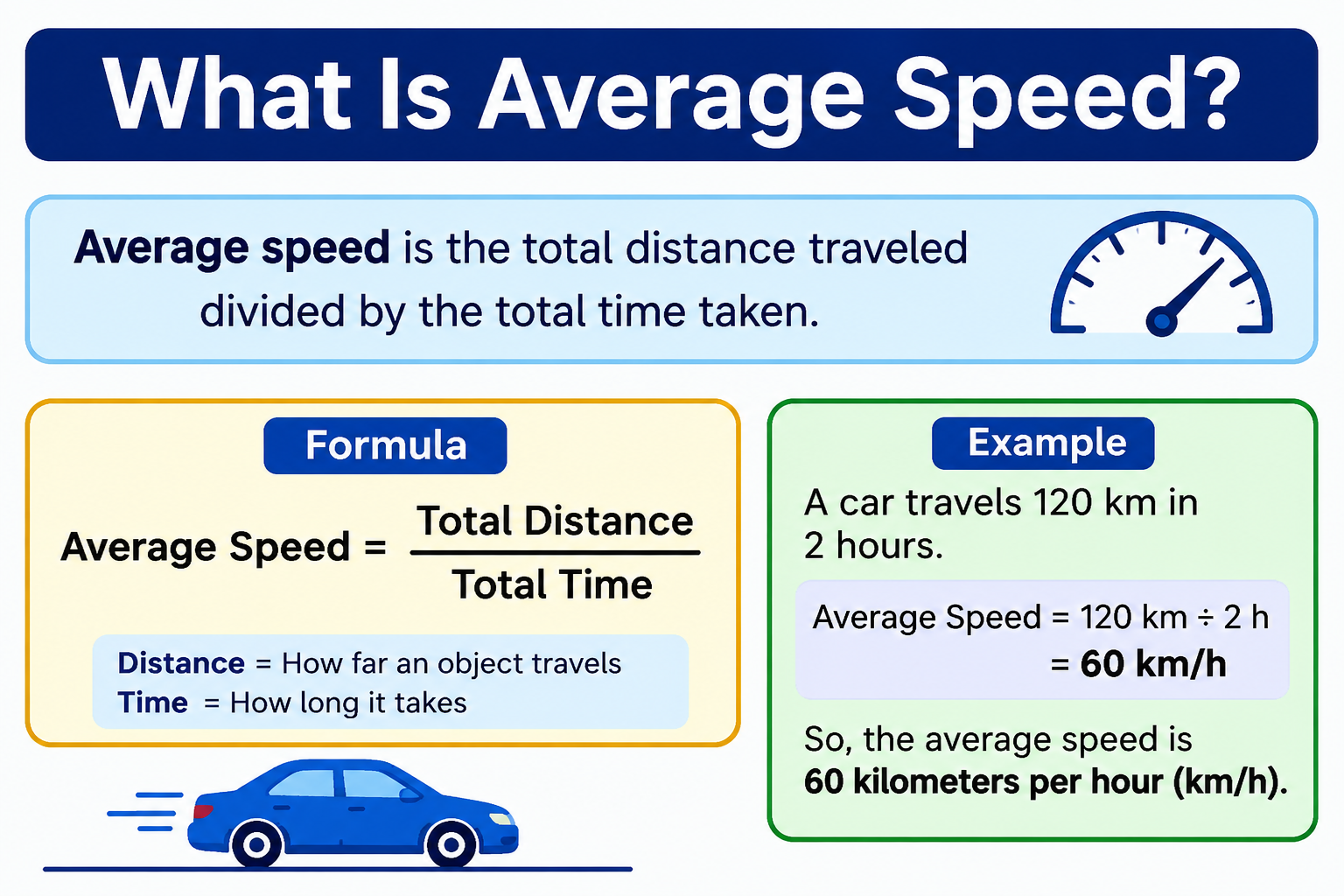
Average speed is the total distance travelled divided by the total time taken. It does not tell you how fast you were moving at any particular moment. Instead, it gives you one value that summarises your overall rate of motion for the entire journey. The formula is simple, the SI unit is metres per second (m/s), and the concept applies everywhere from school physics problems to real-world navigation.
This article explains exactly what average speed is, how to calculate it correctly, how it differs from instantaneous speed and average velocity, and how to handle the most common exam questions on the topic.
Key Takeaways
-
Average speed is the total distance travelled divided by the total time taken: Average Speed = Total Distance ÷ Total Time
-
The SI unit of average speed is metres per second (m/s)
-
Average speed is a scalar quantity — it has magnitude only, no direction
-
Average speed uses total distance, not displacement
-
Average speed is not the same as average velocity, which uses displacement
-
Simply averaging two speed values is only valid when the time intervals are equal
-
Average speed can never be negative and is zero only when no distance is covered
What Is Average Speed?
Average speed is the total distance an object travels divided by the total time it takes to travel that distance.
It is important to understand what the word “average” means here. During a real journey, an object rarely moves at exactly the same speed throughout. A car speeds up, slows down, stops at traffic lights, and accelerates again. Average speed captures the overall picture by asking one simple question: if the object had been moving at a perfectly constant speed the whole time, what speed would have covered the same distance in the same total time?
That is average speed.
A few things to keep clearly in mind:
- Average speed describes an entire journey, not a single moment.
- It always uses total distance, which is the full length of the path actually travelled.
- It does not use displacement, which is the straight-line distance between start and finish.
- Average speed is always zero or positive. It can never be negative.
- A stationary object has an average speed of zero.
Average speed is a scalar quantity, meaning it has magnitude only. There is no direction associated with it.
Average Speed Formula
The formula for average speed is:
Average Speed = Total Distance ÷ Total Time
Written using symbols:
v_av = d / t
Where:
| Symbol | Quantity | SI Unit |
|---|---|---|
| v_av | Average speed | m/s |
| d | Total distance travelled | m |
| t | Total time taken | s |
Total distance is the complete length of the path an object has travelled, measured in metres (m). If a person walks 300 m forward and then 100 m back, the total distance is 400 m, not 200 m.
Total time is the complete time taken for the journey, including any stops or pauses, measured in seconds (s).
Average speed is measured in metres per second (m/s) in the SI system.
Other common units include:
- Kilometres per hour (km/h) — used for road travel
- Miles per hour (mph) — used in the United Kingdom and United States for road speeds
Simple Worked Example:
A cyclist travels 600 m in 120 seconds. What is the average speed?
v_av = d / t
v_av = 600 / 120
v_av = 5 m/s
How to Calculate Average Speed
Follow these steps every time you calculate average speed:
- Identify all the distances travelled during the journey. List each segment separately if needed.
- Add all the distances to find the total distance.
- Identify all the time intervals, including any stops.
- Add all the time intervals to find the total time.
- Convert units if necessary so that distance and time are in compatible units.
- Divide total distance by total time using the formula v_av = d / t.
- Write the correct unit with your answer (m/s, km/h, or mph as appropriate).
- Check whether the answer is reasonable by comparing it to the given speeds in the problem.
Worked Example 1:
A runner completes a 400 m track in 50 seconds.
Total distance = 400 m
Total time = 50 s
v_av = 400 / 50 = 8 m/s
Worked Example 2:
A student walks 1,200 m to school in 20 minutes. What is the average speed in m/s?
Convert time: 20 minutes = 20 × 60 = 1,200 s
v_av = 1,200 / 1,200 = 1 m/s
Worked Example 3:
A car travels 90 km in 1.5 hours. What is the average speed in km/h?
v_av = 90 / 1.5 = 60 km/h
Average Speed Examples
Example 1 — A Car Trip:
A car travels 150 km in the first 2 hours and then 90 km in the next 1.5 hours.
Total distance = 150 + 90 = 240 km
Total time = 2 + 1.5 = 3.5 hours
v_av = 240 / 3.5 = 68.57 km/h
Example 2 — A Cyclist:
A cyclist rides 10 km at 20 km/h and then 10 km at 10 km/h.
Time for first segment = 10 / 20 = 0.5 hours
Time for second segment = 10 / 10 = 1 hour
Total distance = 10 + 10 = 20 km
Total time = 0.5 + 1 = 1.5 hours
v_av = 20 / 1.5 = 13.33 km/h
Notice that this is not 15 km/h, which you would get by simply averaging 20 and 10. The correct method always uses total distance and total time.
Example 3 — A Runner:
A runner completes two laps of a 200 m track. The first lap takes 25 seconds and the second lap takes 35 seconds.
Total distance = 200 + 200 = 400 m
Total time = 25 + 35 = 60 s
v_av = 400 / 60 = 6.67 m/s
Example 4 — A Train:
A train travels 300 km in 2 hours, stops for 30 minutes at a station, then travels a further 200 km in 1.5 hours.
Total distance = 300 + 200 = 500 km
Total time = 2 + 0.5 + 1.5 = 4 hours
v_av = 500 / 4 = 125 km/h
Example 5 — A Person Walking with a Stop:
A person walks 600 m in 10 minutes, rests for 5 minutes, then walks a further 400 m in 8 minutes.
Total distance = 600 + 400 = 1,000 m
Total time = 10 + 5 + 8 = 23 minutes = 23 × 60 = 1,380 s
v_av = 1,000 / 1,380 = 0.72 m/s
Example 6 — A Road Trip:
A family drives 200 km at 100 km/h, stops for 1 hour for lunch, then drives 150 km at 75 km/h.
Time for first segment = 200 / 100 = 2 hours
Time for second segment = 150 / 75 = 2 hours
Total distance = 200 + 150 = 350 km
Total time = 2 + 1 + 2 = 5 hours
v_av = 350 / 5 = 70 km/h
Average Speed vs Instantaneous Speed
Average speed and instantaneous speed are closely related but describe very different things.
| Feature | Average Speed | Instantaneous Speed |
|---|---|---|
| Definition | Total distance divided by total time | Speed at one specific moment |
| Time interval | Covers the entire journey | Measured at a single instant |
| Example | 60 km/h over a 3-hour trip | 80 km/h shown on a speedometer |
| Calculation | v_av = d / t | Rate of change of distance at that instant |
| Use | Describing overall journey rate | Checking speed at a particular point |
| Can it change? | Single value for the journey | Changes constantly during the journey |
The speedometer in a car shows instantaneous speed — it tells you how fast the car is moving right now, not over the whole journey. Average speed, by contrast, summarises the entire trip with one value.
Average Speed vs Speed
Speed is a general term that describes how fast an object moves. Average speed is a specific version of speed calculated over a complete time interval using total distance.
When someone says a car “travels at 60 km/h,” they often mean its average speed over a journey. When a speedometer reads 60 km/h, that is instantaneous speed.
For a thorough explanation of speed and how it is defined in physics, visit our article on [What Is Speed in Physics?].
Average Speed vs Average Velocity
This distinction is one of the most commonly tested topics in physics examinations. Many students confuse the two, but they are fundamentally different.
Average speed uses total distance:
v_av = Total Distance / Total Time
Average velocity uses total displacement:
v_av(velocity) = Total Displacement / Total Time
Displacement is the straight-line distance from the starting point to the ending point, including direction. Distance is the full length of the path actually walked or driven.
| Feature | Average Speed | Average Velocity |
|---|---|---|
| Formula | Total distance / total time | Total displacement / total time |
| Uses distance or displacement? | Distance | Displacement |
| Scalar or vector? | Scalar | Vector |
| Has direction? | No | Yes |
| Can it be zero? | Only if no distance covered | Yes — after a round trip |
| Can it be negative? | No | Yes |
| Example | 10 m/s over a 5 km route | 5 m/s northward |
Key example:
A person runs 400 m around a circular track and returns exactly to their starting point.
Average speed = 400 / t (some positive value, since 400 m was covered)
Average velocity = 0 / t = 0 m/s (because displacement is zero — they ended where they started)
This example perfectly illustrates why these two quantities can give completely different results for the same journey.
For a full explanation of velocity and how it differs from speed, visit our article on [What Is Velocity?].
Distance and Average Speed
When calculating average speed, it is essential to use total distance rather than displacement.
Distance is the total length of the path an object actually follows. It is always zero or positive and keeps increasing as the object moves, regardless of direction.
Here is why this matters for average speed calculations:
- If a person walks 500 m east and then 300 m west, the total distance is 800 m, not 200 m.
- Average speed = 800 / total time, giving a meaningful positive value.
- Using displacement (200 m) would underestimate how much movement actually occurred.
This is particularly important in problems involving journeys with detours, zigzag routes, or any return toward the starting point.
Average Speed for a Round Trip
A round trip is one where an object travels from point A to point B and then returns from B to A.
The total distance for a round trip is always twice the one-way distance.
Example:
A person drives 60 km from home to work and then 60 km back. The first leg takes 1 hour and the return leg takes 1.5 hours.
Total distance = 60 + 60 = 120 km
Total time = 1 + 1.5 = 2.5 hours
v_av = 120 / 2.5 = 48 km/h
Note that the average velocity for this round trip is zero because the displacement is zero — the person ends up back where they started.
Average Speed When Speeds Are Different
A very common mistake in physics is to simply add two speeds together and divide by two to find the average speed. This only works in one specific situation: when the time intervals are equal.
If the distances are different or the time intervals are different, you must always use:
Average Speed = Total Distance ÷ Total Time
Example showing why simple averaging fails:
A car travels 100 km at 50 km/h and then 100 km at 100 km/h.
If you simply average: (50 + 100) / 2 = 75 km/h — this is incorrect.
Correct method:
Time for first leg = 100 / 50 = 2 hours
Time for second leg = 100 / 100 = 1 hour
Total distance = 200 km
Total time = 3 hours
v_av = 200 / 3 = 66.67 km/h
The car spent more time travelling at the slower speed, so the average is pulled below 75 km/h. Always calculate total distance and total time separately.
Average Speed for Equal Distances
When an object travels the same distance at two different speeds, there is a specific formula that gives the correct average speed directly. This is known as the harmonic mean of the two speeds.
Formula:
Average Speed = 2v₁v₂ / (v₁ + v₂)
Where:
- v₁ = speed for the first equal distance
- v₂ = speed for the second equal distance
This formula is only valid when the two distances are equal. It cannot be used when the distances differ.
Example:
A cyclist rides from town A to town B at 20 km/h and returns at 30 km/h.
Using the formula:
Average Speed = 2 × 20 × 30 / (20 + 30)
= 1,200 / 50
= 24 km/h
You can verify this with the full method. Let the distance each way be 60 km.
Time A to B = 60 / 20 = 3 hours
Time B to A = 60 / 30 = 2 hours
Total distance = 120 km
Total time = 5 hours
v_av = 120 / 5 = 24 km/h — confirmed.
Note that 24 km/h is less than the simple average of 25 km/h. The harmonic mean is always less than or equal to the arithmetic mean when the two speeds differ.
Average Speed for Equal Time Intervals
When an object travels at two different speeds for equal amounts of time, the correct average speed is the simple arithmetic mean of the two speeds.
Formula:
Average Speed = (v₁ + v₂) / 2
This is only valid when the time intervals are equal.
Example:
A train travels at 80 km/h for 2 hours and then at 120 km/h for the next 2 hours.
Average Speed = (80 + 120) / 2 = 100 km/h
Verification:
Distance in first 2 hours = 80 × 2 = 160 km
Distance in next 2 hours = 120 × 2 = 240 km
Total distance = 400 km
Total time = 4 hours
v_av = 400 / 4 = 100 km/h — confirmed.
This is the only case where you can safely average the speeds directly.
Can Average Speed Be Zero?
Average speed is zero only when the total distance travelled is zero.
In practice, this means the object did not move at all during the time period in question. If any distance is covered, the average speed will be greater than zero.
This is an important contrast with average velocity. After a round trip, the average velocity is zero because the displacement is zero. But the average speed after a round trip is always greater than zero because the object covered a real distance.
Summary:
- Average speed = 0 only if the object did not move (total distance = 0)
- Average velocity = 0 if the object returns to its starting point (displacement = 0)
- These can be very different for the same journey
Can Average Speed Be Greater Than Instantaneous Speed?
No. The average speed over any time interval cannot exceed the maximum instantaneous speed reached during that interval.
Think of it this way: average speed is a kind of “middle ground” value. If you never drove faster than 120 km/h during a journey, your average speed for that journey cannot be 130 km/h. The average is always somewhere between the minimum and maximum instantaneous speeds during the journey.
This is a straightforward logical point, not a derived result, and it helps you check whether calculated answers are physically reasonable.
Average Speed and Acceleration
When an object accelerates, its instantaneous speed changes from moment to moment. A car pulling away from a traffic light gradually increases its speed. A ball rolling down a slope speeds up continuously.
Despite this variation in instantaneous speed, the object still has one average speed for the entire journey. The average speed simply reflects the overall outcome — how much distance was covered in how much time — regardless of whether the speed was changing throughout.
Understanding how acceleration affects the rate of change of speed is explored in our article on [What Is Acceleration?].
Average Speed and Velocity
Speed and velocity are related but distinct quantities in physics.
Speed is a scalar — it has magnitude only. It tells you how fast an object is moving without specifying any direction.
Velocity is a vector — it has both magnitude and direction. It tells you how fast and in what direction an object is moving.
Average speed and average velocity share this same scalar-vector distinction. Average speed summarises the overall rate of motion using distance. Average velocity summarises the overall change in position using displacement and includes a direction.
For a round trip or any journey that loops back toward the start, average speed will be positive while average velocity will be less than average speed, and may be zero.
Average Speed in Real Life
Average speed is one of the most practically useful measurements in everyday life.
- Driving: A motorist who covers 200 km in 2.5 hours has an average speed of 80 km/h, even though the actual speed varied throughout the journey.
- Cycling: A cyclist who completes a 40 km race in 1 hour 20 minutes has an average speed of 30 km/h.
- Running: A marathon runner who covers 42.195 km in 3 hours 30 minutes has an average speed of approximately 12.06 km/h.
- Train journeys: Rail operators publish average speeds for routes to help passengers estimate journey times.
- Air travel: A flight covering 5,500 km in 7 hours has an average speed of approximately 786 km/h.
- Walking: A person who walks 4 km in 1 hour has an average speed of 4 km/h, which is a typical walking pace.
- Sports: In cricket, the speed of a delivery is quoted as an average over the distance from the bowler’s hand to the batsman.
Average Speed in Transportation
In real transportation, achieving a stated average speed depends on far more than simply pressing the accelerator.
Factors that reduce average speed include:
- Traffic congestion slowing vehicles below their intended speed
- Mandatory stops at traffic lights, toll booths, or stations
- Road conditions such as narrow roads, sharp bends, or poor surfaces
- Route length and detours that increase total distance
- Scheduled station stops on train routes
- Delays due to weather, accidents, or mechanical issues
All of these reduce average speed because they either reduce the distance covered in a given time or increase the time taken to cover a given distance.
Average Speed and Travel Time
When you know the average speed and the total distance, you can estimate travel time using a rearrangement of the average speed formula.
Time = Distance ÷ Average Speed
t = d / v_av
Example:
A train travels at an average speed of 150 km/h. How long does it take to cover 450 km?
t = 450 / 150 = 3 hours
This calculation gives a reliable estimate when the stated average speed genuinely applies to the full journey.
Average Speed and Distance
You can also use average speed and time to calculate the distance covered.
Distance = Average Speed × Time
d = v_av × t
Example:
A cyclist maintains an average speed of 15 km/h for 2.5 hours. How far do they travel?
d = 15 × 2.5 = 37.5 km
Average Speed Unit Conversions
Converting m/s to km/h
Multiply by 3.6:
km/h = m/s × 3.6
Example: 20 m/s × 3.6 = 72 km/h
Converting km/h to m/s
Divide by 3.6:
m/s = km/h ÷ 3.6
Example: 90 km/h ÷ 3.6 = 25 m/s
Converting mph to km/h
Multiply by 1.60934:
km/h = mph × 1.60934
Example: 60 mph × 1.60934 = 96.56 km/h
Converting km/h to mph
Divide by 1.60934:
mph = km/h ÷ 1.60934
Example: 100 km/h ÷ 1.60934 = 62.14 mph
Conversion summary table:
| From | To | Multiply by |
|---|---|---|
| m/s | km/h | 3.6 |
| km/h | m/s | 0.2778 (÷ 3.6) |
| mph | km/h | 1.60934 |
| km/h | mph | 0.62137 |
Average Speed Problems
Problem 1 — Basic average speed:
A ball rolls 80 m in 10 seconds. Find the average speed.
Given: d = 80 m, t = 10 s
Formula: v_av = d / t
v_av = 80 / 10
v_av = 8 m/s
Problem 2 — Different speeds over different distances:
A car travels 120 km at 60 km/h and then 80 km at 40 km/h. Find the average speed for the whole journey.
Time 1 = 120 / 60 = 2 hours
Time 2 = 80 / 40 = 2 hours
Total distance = 120 + 80 = 200 km
Total time = 2 + 2 = 4 hours
v_av = 200 / 4
v_av = 50 km/h
Problem 3 — Different distances:
A person walks 3 km in 45 minutes and then jogs 5 km in 35 minutes.
Total distance = 3 + 5 = 8 km
Total time = 45 + 35 = 80 minutes = 80/60 hours = 1.333 hours
v_av = 8 / 1.333
v_av = 6 km/h
Problem 4 — Round trip:
A driver goes from city A to city B (200 km) at 80 km/h and returns at 100 km/h.
Time A to B = 200 / 80 = 2.5 hours
Time B to A = 200 / 100 = 2 hours
Total distance = 400 km
Total time = 4.5 hours
v_av = 400 / 4.5
v_av = 88.89 km/h
Problem 5 — Journey with a stop:
A bus travels 90 km in 1 hour, stops for 15 minutes, then travels 60 km in 45 minutes.
Total distance = 90 + 60 = 150 km
Total time = 1 hour + 0.25 hours + 0.75 hours = 2 hours
v_av = 150 / 2
v_av = 75 km/h
Problem 6 — Unit conversion:
A train travels at 25 m/s for 2 hours. Find the total distance in km and the average speed in km/h.
Convert speed: 25 × 3.6 = 90 km/h
Distance = 90 × 2 = 180 km
Average speed = 90 km/h
Problem 7 — Equal-distance problem:
A cyclist travels 30 km at 15 km/h and returns 30 km at 10 km/h.
Using formula: Average Speed = 2v₁v₂ / (v₁ + v₂)
= 2 × 15 × 10 / (15 + 10)
= 300 / 25
= 12 km/h
Problem 8 — Equal-time problem:
A vehicle travels at 60 km/h for 3 hours and then at 90 km/h for 3 hours.
Average Speed = (60 + 90) / 2
= 75 km/h
Verification: Distance 1 = 180 km, Distance 2 = 270 km, Total = 450 km, Total time = 6 hours
v_av = 450 / 6 = 75 km/h — confirmed.
Common Mistakes When Calculating Average Speed
Mistake 1: Adding speeds and dividing by two without checking conditions.
This only works when time intervals are equal. If the distances are equal or the times are unequal, this method gives the wrong answer.
Mistake 2: Using displacement instead of distance.
Average speed always uses total distance. Using displacement will give a different and incorrect result whenever the path is not a straight line from start to finish.
Mistake 3: Forgetting to calculate total time.
Students sometimes use only the travelling time and forget to add any stops or pauses. All time counts — including rest breaks, traffic stops, and station waits.
Mistake 4: Ignoring stops.
A ten-minute stop at a petrol station increases total time and therefore reduces average speed. Never leave out pauses when adding up the total time.
Mistake 5: Mixing units.
Using kilometres for distance and seconds for time will give a speed in km/s, which is rarely what is needed. Always ensure distance and time are in compatible units before dividing.
Mistake 6: Forgetting to include the unit.
An answer of “8” is incomplete. The correct answer is “8 m/s” or “8 km/h.” Always state the unit.
Mistake 7: Confusing average speed with average velocity.
These are not the same. Average velocity uses displacement; average speed uses distance. After a round trip, average speed is positive but average velocity is zero.
Mistake 8: Using the harmonic mean formula when the distances are not equal.
The formula Average Speed = 2v₁v₂ / (v₁ + v₂) only applies when the two distances are exactly equal. If they differ, use the full method with total distance and total time.
How to Solve Average Speed Questions
Use this method every time you face an average speed problem in an exam:
- Read the problem carefully and identify every distance and every time mentioned.
- List all distances for each stage of the journey.
- Add the distances to find total distance.
- List all time intervals, including any stops.
- Add the time intervals to find total time.
- Convert units so that distance is in metres (or km) and time is in seconds (or hours) consistently.
- Apply the formula: v_av = Total Distance / Total Time
- Calculate the result step by step.
- Write the correct unit with your answer.
- Check whether the answer is reasonable. If a car was travelling between 40 km/h and 100 km/h throughout a journey, an average speed of 200 km/h would immediately signal an error.
Average Speed and Graphs
Distance-Time Graphs
On a distance-time graph:
- The horizontal axis represents time.
- The vertical axis represents distance from the starting point.
- A straight line with a positive slope represents constant speed.
- A steeper slope represents a greater speed.
- A horizontal line represents the object being stationary (no distance being covered).
- A curved line represents changing speed (acceleration or deceleration).
The average speed over an interval can be read from a distance-time graph by dividing the total distance covered (change in the vertical axis) by the total time taken (change in the horizontal axis).
Speed-Time Graphs
On a speed-time graph:
- The horizontal axis represents time.
- The vertical axis represents instantaneous speed.
- The area under the graph gives the total distance travelled.
- A horizontal line represents constant speed.
- A rising line represents acceleration.
- A falling line represents deceleration.
Average speed can be found from a speed-time graph by dividing the total area under the graph (total distance) by the total time.
Average Speed and Distance-Time Graphs
On a distance-time graph, the average speed for an entire journey is the gradient of the straight line connecting the starting point to the ending point, regardless of how the graph curves in between.
This is a useful shortcut: draw a straight line from the beginning of the journey to the end. The slope of that line equals the average speed.
For example, if a journey starts at d = 0 m at t = 0 s and ends at d = 500 m at t = 100 s, the average speed is:
v_av = 500 / 100 = 5 m/s
This is true even if the object sped up, slowed down, or stopped during the journey.
Important Average Speed Formulas
| Formula | Meaning | When to Use |
|---|---|---|
| v_av = d / t | Average speed = total distance ÷ total time | Any average speed problem — always the starting formula |
| d = v_av × t | Distance = average speed × time | When speed and time are known and distance is needed |
| t = d / v_av | Time = distance ÷ average speed | When speed and distance are known and time is needed |
| v_av = 2v₁v₂ / (v₁ + v₂) | Harmonic mean for equal distances | Only when two equal distances are covered at different speeds |
| v_av = (v₁ + v₂) / 2 | Arithmetic mean for equal time intervals | Only when two equal time intervals occur at different speeds |
Always default to v_av = d / t. The special formulas are shortcuts that only work under specific conditions.
Average Speed Practice Questions
20 Multiple Choice Questions
Question 1: What is the correct formula for average speed?
A. Total displacement ÷ total time
B. Total distance ÷ total time
C. Total force ÷ total mass
D. Change in velocity ÷ time
Correct Answer: B
Average speed = total distance ÷ total time. Displacement is used for average velocity, not average speed.
Question 2: A car travels 300 km in 5 hours. What is its average speed?
A. 50 km/h
B. 60 km/h
C. 65 km/h
D. 75 km/h
Correct Answer: B
v_av = 300 / 5 = 60 km/h.
Question 3: The SI unit of average speed is:
A. km/h
B. mph
C. m/s
D. cm/s
Correct Answer: C
The SI unit of speed and average speed is metres per second (m/s).
Question 4: Is average speed a scalar or vector quantity?
A. Vector
B. Scalar
C. Neither
D. Both
Correct Answer: B
Average speed has magnitude only, no direction. It is a scalar quantity.
Question 5: A runner completes a 10 km race in 50 minutes. What is the average speed in km/h?
A. 10 km/h
B. 12 km/h
C. 15 km/h
D. 20 km/h
Correct Answer: B
50 minutes = 50/60 hours = 0.833 hours. v_av = 10 / 0.833 = 12 km/h.
Question 6: A person walks 500 m east and 500 m west in 200 seconds. What is the average speed?
A. 0 m/s
B. 2.5 m/s
C. 5 m/s
D. 10 m/s
Correct Answer: C
Total distance = 1,000 m. v_av = 1,000 / 200 = 5 m/s. (Average velocity would be 0 m/s.)
Question 7: Which of the following equals average velocity but not necessarily average speed?
A. Total distance ÷ total time
B. Total displacement ÷ total time
C. Total force ÷ total mass
D. Total distance ÷ total displacement
Correct Answer: B
Average velocity uses displacement; average speed uses distance.
Question 8: A car travels 60 km at 60 km/h and then 60 km at 30 km/h. What is the average speed?
A. 45 km/h
B. 40 km/h
C. 35 km/h
D. 50 km/h
Correct Answer: B
Time 1 = 1 hour, Time 2 = 2 hours. Total distance = 120 km, Total time = 3 hours. v_av = 120/3 = 40 km/h.
Question 9: A train travels at 50 m/s. What is this speed in km/h?
A. 150 km/h
B. 180 km/h
C. 200 km/h
D. 250 km/h
Correct Answer: B
50 × 3.6 = 180 km/h.
Question 10: Average speed can be zero only if:
A. Displacement is zero
B. Velocity is zero
C. Total distance is zero
D. Acceleration is zero
Correct Answer: C
Average speed = distance / time. It is zero only when total distance = 0.
Question 11: A vehicle travels at 80 km/h for 2 hours and 40 km/h for 2 hours. The average speed is:
A. 50 km/h
B. 55 km/h
C. 60 km/h
D. 70 km/h
Correct Answer: C
Equal time intervals, so arithmetic mean applies: (80 + 40) / 2 = 60 km/h.
Question 12: Which formula applies when two equal distances are covered at different speeds v₁ and v₂?
A. (v₁ + v₂) / 2
B. v₁ × v₂ / (v₁ + v₂)
C. 2v₁v₂ / (v₁ + v₂)
D. (v₁ × v₂) / 2
Correct Answer: C
The harmonic mean formula 2v₁v₂ / (v₁ + v₂) applies for equal distances.
Question 13: A cyclist travels 40 km in 2 hours with a 30-minute break during the journey. What is the average speed including the break?
A. 16 km/h
B. 20 km/h
C. 25 km/h
D. 28 km/h
Correct Answer: A
Total time = 2 hours + 0.5 hours = 2.5 hours. v_av = 40 / 2.5 = 16 km/h.
Question 14: The speedometer of a car shows:
A. Average speed
B. Average velocity
C. Instantaneous speed
D. Instantaneous velocity
Correct Answer: C
A speedometer displays instantaneous speed — the speed at that exact moment.
Question 15: A body travels 100 m in the first 10 s and 200 m in the next 20 s. What is the average speed?
A. 8 m/s
B. 10 m/s
C. 12 m/s
D. 15 m/s
Correct Answer: B
Total distance = 300 m, Total time = 30 s. v_av = 300 / 30 = 10 m/s.
Question 16: How do you convert 72 km/h to m/s?
A. Multiply by 3.6
B. Divide by 3.6
C. Multiply by 60
D. Divide by 60
Correct Answer: B
72 ÷ 3.6 = 20 m/s.
Question 17: A person completes a round trip of 20 km in 2 hours. What is their average speed?
A. 0 km/h
B. 5 km/h
C. 10 km/h
D. 20 km/h
Correct Answer: C
Total distance = 20 km (not 0), Total time = 2 hours. v_av = 20 / 2 = 10 km/h.
Question 18: For which of the following can average speed and average velocity have the same magnitude?
A. A round trip
B. A circular path returning to start
C. A straight-line journey with no return
D. A zigzag route
Correct Answer: C
On a straight-line one-way journey, distance equals displacement, so average speed and average velocity magnitudes are equal.
Question 19: A plane covers 1,500 km in 3 hours. What is the average speed?
A. 400 km/h
B. 450 km/h
C. 500 km/h
D. 550 km/h
Correct Answer: C
v_av = 1,500 / 3 = 500 km/h.
Question 20: An object moves 60 m in the first minute and 120 m in the next 2 minutes. What is the average speed?
A. 1 m/s
B. 1.5 m/s
C. 2 m/s
D. 2.5 m/s
Correct Answer: A
Total distance = 180 m, Total time = 3 minutes = 180 s. v_av = 180 / 180 = 1 m/s.
10 Short Answer Questions
Q1: Define average speed.
Average speed is the total distance travelled by an object divided by the total time taken for that journey.
Q2: What is the SI unit of average speed?
The SI unit of average speed is metres per second (m/s).
Q3: Why does average speed use distance rather than displacement?
Distance measures the full length of the path actually travelled, while displacement measures only the straight-line distance from start to finish. Average speed describes the overall rate of motion along the real path, so distance is the appropriate quantity.
Q4: Can average speed be zero for a moving object?
No. If an object moves at all, it covers some distance, and average speed will be greater than zero. Average speed is zero only if the object does not move at all.
Q5: A car travels 150 km in 2 hours. What is its average speed?
v_av = 150 / 2 = 75 km/h
Q6: What is the difference between average speed and average velocity?
Average speed = total distance ÷ total time (scalar). Average velocity = total displacement ÷ total time (vector). After a round trip, average speed is positive but average velocity is zero.
Q7: Convert 54 km/h to m/s.
54 ÷ 3.6 = 15 m/s
Q8: When can you average two speeds by simply taking their arithmetic mean?
Only when the two speeds are maintained for equal amounts of time.
Q9: A train stops for 15 minutes at a station during a journey. Should this stop be included in the total time when calculating average speed?
Yes. Total time includes all time elapsed, including stops. Leaving out the stop would give an overestimate of average speed.
Q10: A cyclist travels from A to B at 24 km/h and from B to A at 16 km/h. Find the average speed for the round trip.
Average Speed = 2 × 24 × 16 / (24 + 16) = 768 / 40 = 19.2 km/h
5 Numerical Problems
Problem 1:
A student walks 2 km to school in 25 minutes and jogs 2 km back in 15 minutes. Find the average speed for the whole journey in m/s.
Total distance = 2 + 2 = 4 km = 4,000 m
Total time = 25 + 15 = 40 minutes = 2,400 s
v_av = 4,000 / 2,400 = 1.67 m/s
Problem 2:
A car travels from city X to city Y (360 km) at 90 km/h, stops for 30 minutes, then travels from Y to Z (180 km) at 60 km/h. Find the average speed for the entire trip.
Time X to Y = 360 / 90 = 4 hours
Stop = 0.5 hours
Time Y to Z = 180 / 60 = 3 hours
Total distance = 360 + 180 = 540 km
Total time = 4 + 0.5 + 3 = 7.5 hours
v_av = 540 / 7.5 = 72 km/h
Problem 3:
A sprinter runs the first 50 m in 6 seconds and the remaining 50 m in 5 seconds. Find the average speed for the 100 m race.
Total distance = 100 m
Total time = 6 + 5 = 11 s
v_av = 100 / 11 = 9.09 m/s
Problem 4:
A bus travels at 40 km/h for 1.5 hours, then at 60 km/h for 2.5 hours. Find the average speed.
Distance 1 = 40 × 1.5 = 60 km
Distance 2 = 60 × 2.5 = 150 km
Total distance = 60 + 150 = 210 km
Total time = 1.5 + 2.5 = 4 hours
v_av = 210 / 4 = 52.5 km/h
Problem 5:
A car completes a 500 km journey. For the first 200 km it travels at 100 km/h, for the next 200 km at 80 km/h, and for the final 100 km at 50 km/h. Find the average speed.
Time 1 = 200 / 100 = 2 hours
Time 2 = 200 / 80 = 2.5 hours
Time 3 = 100 / 50 = 2 hours
Total distance = 500 km
Total time = 2 + 2.5 + 2 = 6.5 hours
v_av = 500 / 6.5 = 76.92 km/h
5 Exam-Style Questions
Q1: A car travels along a motorway at 120 km/h for 2 hours, then enters a town and travels 30 km at 30 km/h. Calculate the average speed for the whole journey. [3 marks]
Distance on motorway = 120 × 2 = 240 km
Time in town = 30 / 30 = 1 hour
Total distance = 240 + 30 = 270 km
Total time = 2 + 1 = 3 hours
v_av = 270 / 3 = 90 km/h
Q2: Explain why the average speed of a round trip is not zero, even though the average velocity is zero. [3 marks]
Average speed uses total distance, which counts every metre of path travelled. In a round trip, the object covers real distance in both directions, so total distance is positive and average speed is positive. Average velocity uses displacement — the straight-line distance from start to finish. After a round trip, the object is back at the start, so displacement is zero, making average velocity zero. These two quantities use different measures of “how far,” which is why they give different results.
Q3: A cyclist completes a 60 km circuit in 2 hours and 30 minutes. (a) Calculate the average speed in km/h. (b) State the average velocity and explain your answer. [4 marks]
(a) Total distance = 60 km
Total time = 2.5 hours
v_av = 60 / 2.5 = 24 km/h
(b) Average velocity = 0 km/h
Because the circuit returns the cyclist to the starting point, the displacement is zero. Average velocity = 0 / 2.5 = 0 km/h.
Q4: A car travels from point A to point B at 80 km/h and returns from B to A at 120 km/h. Show that the average speed is not 100 km/h and calculate the correct average speed. [4 marks]
Let the distance A to B = d km.
Time A to B = d / 80
Time B to A = d / 120
Total distance = 2d
Total time = d/80 + d/120 = 3d/240 + 2d/240 = 5d/240 = d/48
v_av = 2d ÷ (d/48) = 2d × 48/d = 96 km/h
This is not 100 km/h because more time is spent at the lower speed of 80 km/h, pulling the average below the arithmetic mean of 100 km/h.
Q5: A student claims that to find average speed, you simply add all the speeds given in a problem and divide by the number of speeds. Identify the error in this reasoning and explain the correct method. [3 marks]
The student’s method is incorrect. Adding speeds and dividing only gives the correct average speed when each speed is maintained for exactly the same time interval. If the time intervals differ, this method overestimates the contribution of higher speeds and underestimates lower speeds. The correct method is always to calculate total distance (by adding all distances for each segment) and divide by total time (by adding all time intervals). The formula v_av = total distance / total time is universally correct regardless of how many segments the journey has.
Exam Tips
Keep these strategies in mind for any average speed examination question:
- Always write the formula first: v_av = Total Distance / Total Time. This shows the examiner your method even if you make an arithmetic error.
- List distances and times separately before adding them. This reduces mistakes and makes your working easy to follow.
- Include every stop and pause in the total time. Stops are the most commonly forgotten component.
- Check your units before substituting into the formula. Distance and time must be compatible.
- Speed vs velocity: Remember that average speed uses distance (scalar) and average velocity uses displacement (vector). Never mix them up.
- Distance vs displacement: If an object returns toward its starting point, total distance still accumulates. Displacement may be much smaller.
- Equal-distance problems: Use 2v₁v₂ / (v₁ + v₂) only when you are told the distances are equal. Otherwise, calculate total time for each segment individually.
- Equal-time problems: Use (v₁ + v₂) / 2 only when you are told the time intervals are equal.
- Unit conversions: Memorise that m/s × 3.6 = km/h and km/h ÷ 3.6 = m/s. These appear frequently.
- Check your answer: Is the average speed between the lowest and highest speeds given in the problem? If not, recheck your working.
Quick Revision Notes
- Average speed = Total Distance ÷ Total Time
- SI unit: m/s (also km/h and mph in everyday use)
- Scalar quantity — no direction
- Always uses total distance, never displacement
- Average speed ≠ average velocity (unless the journey is a straight line with no return)
- Average speed = 0 only when total distance = 0
- Average velocity = 0 after a complete round trip (displacement = 0)
- Simple averaging of two speeds is only valid for equal time intervals
- Harmonic mean formula (2v₁v₂ / (v₁ + v₂)) is only valid for equal distances
- Include all stops and waiting time in the total time
- To convert km/h to m/s: divide by 3.6
- To convert m/s to km/h: multiply by 3.6
- Distance from speed and time: d = v_av × t
- Time from speed and distance: t = d / v_av
Average Speed Cheat Sheet
| Concept | Definition | Formula | Unit | Example |
|---|---|---|---|---|
| Average Speed | Total distance divided by total time | v_av = d / t | m/s | 300 m in 60 s → 5 m/s |
| Finding Distance | Speed multiplied by time | d = v_av × t | m | 10 m/s for 30 s → 300 m |
| Finding Time | Distance divided by speed | t = d / v_av | s | 500 m at 25 m/s → 20 s |
| Equal-Distance Case | Harmonic mean of two speeds | v_av = 2v₁v₂ / (v₁ + v₂) | m/s or km/h | 20 km/h and 30 km/h → 24 km/h |
| Equal-Time Case | Arithmetic mean of two speeds | v_av = (v₁ + v₂) / 2 | m/s or km/h | 40 km/h and 60 km/h → 50 km/h |
| m/s to km/h | Multiply by 3.6 | km/h = m/s × 3.6 | km/h | 20 m/s → 72 km/h |
| km/h to m/s | Divide by 3.6 | m/s = km/h ÷ 3.6 | m/s | 90 km/h → 25 m/s |
Frequently Asked Questions
1. What is average speed?
Average speed is the total distance travelled by an object divided by the total time taken for the journey. It describes the overall rate of motion rather than the speed at any single moment.
2. What is the formula for average speed?
The formula is: Average Speed = Total Distance ÷ Total Time, or v_av = d / t.
3. What is the SI unit of average speed?
The SI unit of average speed is metres per second (m/s). Other common units include km/h and mph.
4. How do you calculate average speed?
Add up all the distances for each part of the journey to get total distance. Add up all the time intervals, including any stops, to get total time. Divide total distance by total time.
5. What is the difference between average speed and speed?
Speed is a general term describing how fast something moves. Average speed specifically refers to the total distance divided by the total time over a complete journey. Instantaneous speed is the speed at one specific moment.
6. What is the difference between average speed and average velocity?
Average speed uses total distance and is a scalar. Average velocity uses total displacement and is a vector. After a round trip, average speed is positive but average velocity is zero.
7. Can average speed be zero?
Only if the object did not move — that is, only if the total distance is zero. If any distance is covered, average speed is greater than zero.
8. How do you calculate average speed for a round trip?
Add the distance in each direction to get total distance. Add the time for each direction (and any stops) to get total time. Then divide total distance by total time.
9. Can you average two speeds by adding them and dividing by two?
Only when the two speeds are maintained for equal time intervals. For equal-distance segments at different speeds, use the harmonic mean formula: 2v₁v₂ / (v₁ + v₂).
10. What is average speed for equal distances?
When two equal distances are covered at different speeds v₁ and v₂, the average speed is 2v₁v₂ / (v₁ + v₂). This is always less than the simple average (v₁ + v₂) / 2 when the speeds differ.
11. What is average speed for equal time intervals?
When two equal time intervals are spent at speeds v₁ and v₂, the average speed is simply (v₁ + v₂) / 2.
12. How do you convert km/h to m/s?
Divide the speed in km/h by 3.6. For example: 72 km/h ÷ 3.6 = 20 m/s.
13. How does acceleration affect average speed?
Acceleration causes instantaneous speed to change throughout the journey. Average speed still summarises the whole journey as one value, but the variation in speed caused by acceleration means the instantaneous speed will differ from the average speed at almost every moment.
14. Why is total distance used instead of displacement?
Average speed describes the total rate of motion along the actual path taken. Displacement only measures the straight-line change in position, which ignores detours, zigzags, and returns. Total distance captures all the real movement.
15. What is the difference between average speed and instantaneous speed?
Average speed covers the entire journey and is calculated using total distance and total time. Instantaneous speed is the speed at one specific moment, such as what a speedometer reads.
Summary
Average speed is one of the most straightforward and practically useful concepts in physics. It is defined as the total distance an object travels divided by the total time it takes to travel that distance, expressed by the formula v_av = d / t.
The SI unit is metres per second (m/s), though kilometres per hour (km/h) is widely used in everyday contexts.
Average speed is a scalar quantity. It always uses total distance, never displacement. This distinguishes it from average velocity, which uses total displacement and is a vector.
The simple averaging of two speeds only produces the correct result when the time intervals are equal. For equal-distance problems, the harmonic mean formula (2v₁v₂ / (v₁ + v₂)) must be used. When in doubt, always return to total distance divided by total time — this formula never fails.
Average speed cannot be negative and is zero only when no distance is covered. After a round trip, average speed is always positive, even though average velocity is zero.
Final Thoughts
Understanding what average speed is and how to calculate it correctly is a fundamental skill in physics and in everyday life. Whether you are estimating how long a road journey will take, analysing the performance of an athlete, or solving an examination question involving multiple stages of a journey, average speed gives you a single reliable number that summarises the overall rate of motion.
The key principle to remember is that average speed always comes from total distance divided by total time. No shortcut replaces this calculation unless the specific conditions for the harmonic or arithmetic mean formulas are clearly met.
Mastering average speed also builds the foundation for understanding related topics such as velocity, acceleration, distance-time graphs, and the equations of motion — all of which build on the same core ideas explored here.
References
- OpenStax University Physics — Motion Along a Straight Line
https://openstax.org/books/university-physics-volume-1/pages/3-introduction - Physics LibreTexts — Speed and Velocity
https://phys.libretexts.org/Bookshelves/University_Physics/Book%3A_University_Physics_(OpenStax)/Map%3A_University_Physics_I_-Mechanics_Sound_Oscillations_and_Waves(OpenStax)/03%3A_Motion_Along_a_Straight_Line - Khan Academy Physics — Displacement, Velocity, and Time
https://www.khanacademy.org/science/physics/one-dimensional-motion - Encyclopaedia Britannica — Speed and Velocity
https://www.britannica.com/science/speed-physics - The Physics Classroom — Speed and Velocity
https://www.physicsclassroom.com/class/1DKin/Lesson-1/Speed-and-Velocity - National Institute of Standards and Technology (NIST) — SI Units
https://www.nist.gov/pml/owm/metric-si/si-units
Disclaimer
This article is intended for educational and informational purposes only. While LearnMinto strives to provide accurate and up-to-date information, readers should verify important academic concepts through official textbooks, educational institutions, examination boards, or trusted scientific resources before relying on this content for exams or academic purposes. LearnMinto is not affiliated with any specific school, university, research institution, or examination board.