
Introduction
Think about a large truck and a bicycle both moving at the same speed. Which one would be harder to stop? The truck, without question. Now think about why. It is not just because the truck is heavier. It is because the truck has far greater momentum.
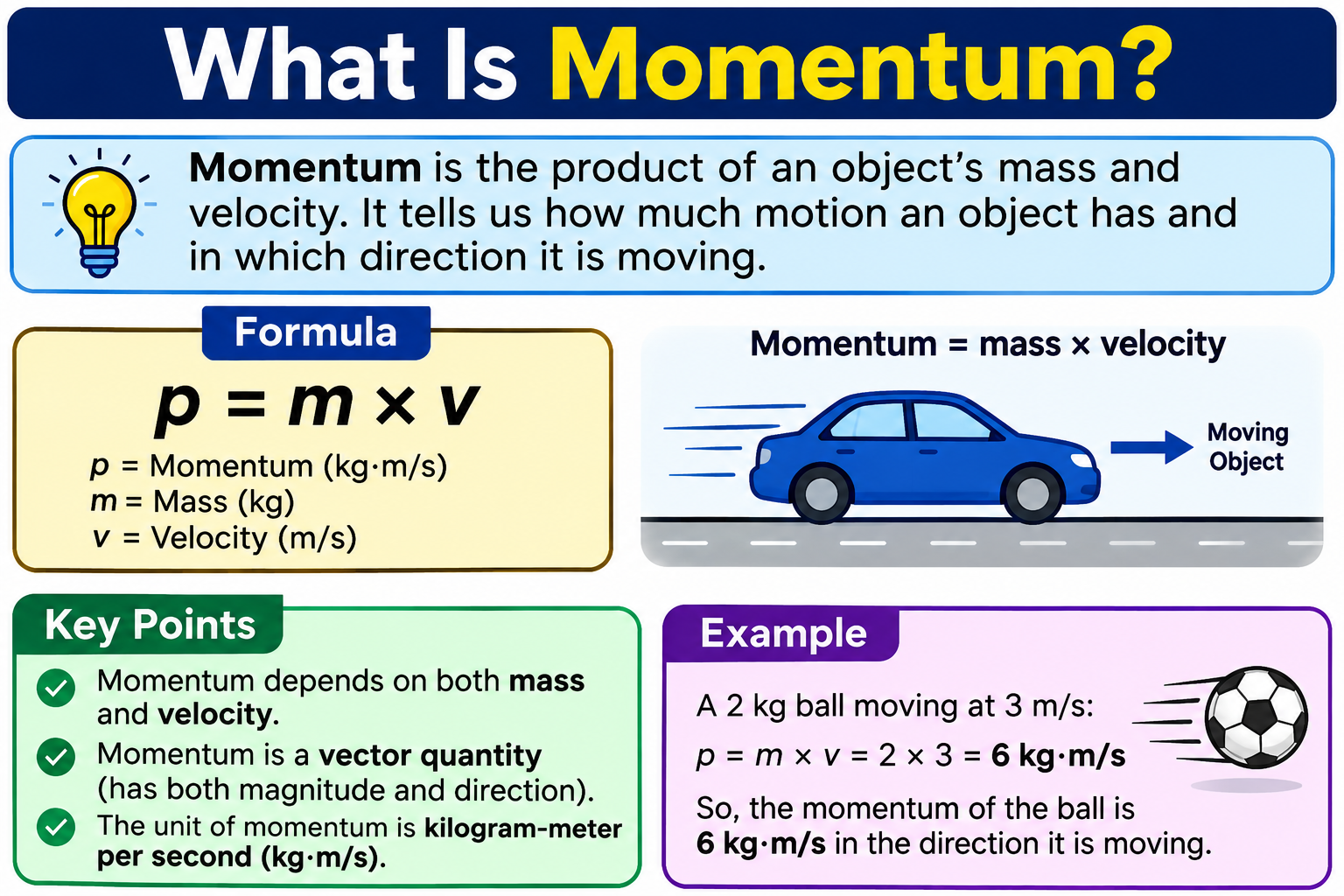
In physics, momentum is the product of an object’s mass and its velocity. It tells you how much motion an object has and how difficult it is to bring that object to a stop. The greater the mass or the greater the velocity, the greater the momentum.
In everyday conversation, people use the word “momentum” loosely, often meaning that something is gaining speed or strength. In physics, the meaning is far more precise. Momentum is a measurable quantity with a specific formula, a defined SI unit, and a direction.
The formula for momentum is:
p = mv
The SI unit of momentum is the kilogram metre per second (kg·m/s).
In this article, you will learn exactly what momentum means in physics, how to calculate it, why it is a vector quantity, how it is conserved in collisions and explosions, and how it connects to Newton’s laws, impulse, kinetic energy, and real-world situations. Whether you are studying for GCSE, A-Level, NEET, MDCAT, or ECAT, this guide covers everything you need.
Key Takeaways
-
Momentum is the product of an object’s mass and its velocity: p = mv
-
The SI unit of momentum is kg·m/s, which is equivalent to N·s
-
Momentum is a vector quantity — it has both magnitude and direction
-
A stationary object has zero momentum because its velocity is zero
-
The law of conservation of momentum states that the total momentum of a closed system remains constant when no external force acts on it
-
In an elastic collision, both momentum and kinetic energy are conserved; in an inelastic collision, only momentum is conserved
-
The impulse-momentum theorem states that the impulse applied to an object equals its change in momentum: FΔt = Δp
What Is Momentum in Physics?
Momentum is a fundamental concept in physics that describes the quantity of motion an object possesses. Formally defined, momentum is the product of an object’s mass and its velocity.
An object has momentum when it is moving. The more massive the object and the faster it moves, the greater its momentum. A stationary object has zero momentum because its velocity is zero, regardless of how massive it is.
Here is what makes momentum important to understand:
- Both mass and velocity are required. You cannot calculate momentum without knowing both. A very massive object sitting still has no momentum. A tiny object moving at high speed can have significant momentum.
- The direction of velocity matters. Because velocity has a direction, momentum also has a direction. If two objects move in opposite directions, their momenta have opposite signs.
- Momentum is a vector quantity. This means it has both magnitude and direction. You must always specify the direction when describing momentum precisely.
- A stationary object has zero momentum. Since velocity is zero, the product mv equals zero.
- A more massive or faster object has greater momentum. Doubling the mass doubles the momentum. Doubling the speed doubles the momentum.
Understanding momentum is the gateway to understanding collisions, Newton’s laws, impulse, and the conservation laws that govern the physical world.
What Is the Formula for Momentum?
The formula for momentum is straightforward:
p = mv
Each variable in this formula has a specific meaning:
| Symbol | Quantity | SI Unit |
|---|---|---|
| p | Momentum | kg·m/s |
| m | Mass | kg |
| v | Velocity | m/s |
p represents momentum. It is measured in kilogram metres per second (kg·m/s).
m represents the mass of the object. Mass is measured in kilograms (kg).
v represents the velocity of the object. Velocity is measured in metres per second (m/s). Remember that velocity includes direction.
What this formula tells you physically:
- A heavy slow object can have the same momentum as a light fast object. A 10 kg object moving at 5 m/s has the same momentum as a 5 kg object moving at 10 m/s — both have p = 50 kg·m/s.
- Doubling the mass while keeping velocity constant doubles the momentum.
- Doubling the velocity while keeping mass constant doubles the momentum.
Numerical Example 1:
A car of mass 1,200 kg is moving at a velocity of 15 m/s. Calculate its momentum.
p = mv
p = 1,200 × 15
p = 18,000 kg·m/s
The car has a momentum of 18,000 kg·m/s in the direction of motion.
Numerical Example 2:
A football of mass 0.45 kg is kicked and moves at a velocity of 20 m/s. Calculate its momentum.
p = mv
p = 0.45 × 20
p = 9 kg·m/s
The ball has a momentum of 9 kg·m/s in the direction it was kicked.
What Is the SI Unit of Momentum?
The SI unit of momentum is the kilogram metre per second (kg·m/s).
This unit comes directly from the formula p = mv:
- Mass is measured in kilograms (kg)
- Velocity is measured in metres per second (m/s)
- Therefore, momentum = kg × m/s = kg·m/s
There is an equivalent unit for momentum: the newton-second (N·s). These two units are identical in value.
To see why, recall from Newton’s Second Law that:
1 N = 1 kg·m/s²
So:
1 N·s = 1 kg·m/s² × s = 1 kg·m/s
This confirms that 1 kg·m/s = 1 N·s.
The newton-second is particularly useful when dealing with impulse, because impulse is also measured in N·s and equals the change in momentum.
Is Momentum a Scalar or Vector Quantity?
Momentum is a vector quantity.
This means it has both magnitude (how much) and direction (which way).
Here is why this matters:
- The direction of momentum is always the same as the direction of the object’s velocity.
- If a ball moves to the right, its momentum points to the right. If the same ball moves to the left, its momentum points to the left.
- When an object changes direction, its momentum changes — even if its speed stays the same. This is because velocity has changed.
- In calculations, momentum can be positive or negative depending on the reference direction you choose. For example, if you define rightward as positive, then an object moving to the left has negative momentum.
This vector nature is essential when applying the law of conservation of momentum, especially in collision problems where objects move in opposite directions.
Types of Momentum
Linear Momentum
Linear momentum is the momentum of an object moving along a straight line. It is the most commonly studied type of momentum at the high school and introductory college level.
The formula is:
p = mv
Examples of linear momentum:
- A car moving along a straight motorway
- A ball rolling across the floor
- A bullet fired from a gun in a straight line
In all these cases, the object travels in a definite direction, and its momentum points in that same direction.
Angular Momentum
Angular momentum is the momentum of a rotating or spinning object. While linear momentum describes motion in a straight line, angular momentum describes rotational motion.
The formula for angular momentum is:
L = Iω
Where:
- L = angular momentum, measured in kg·m²/s
- I = moment of inertia (a measure of how mass is distributed around the axis of rotation), measured in kg·m²
- ω = angular velocity (how fast the object is rotating), measured in radians per second (rad/s)
You do not need to derive this formula at the introductory level. What matters is understanding that angular momentum works in a similar way to linear momentum: if no external torque acts on a rotating system, its angular momentum is conserved.
Examples of angular momentum:
- A spinning top maintaining its spin
- Earth rotating on its own axis
- A figure skater pulling their arms inward to spin faster — their moment of inertia decreases, so their angular velocity increases to conserve angular momentum
Angular momentum is a fascinating area of physics that becomes especially important in advanced mechanics and astrophysics.
Conservation of Momentum
The law of conservation of momentum is one of the most powerful and useful principles in all of physics.
Statement:
The total momentum of a closed system remains constant as long as no external force acts on it.
A closed system is one where no external forces influence the objects inside. In practice, this means we consider systems where external forces such as friction or air resistance are either absent or negligible.
Why is momentum conserved?
From Newton’s Third Law, when two objects interact, they exert equal and opposite forces on each other. These internal forces produce equal and opposite changes in momentum that cancel out. The total momentum of the system therefore stays the same.
The mathematical statement:
p_before = p_after
For two objects:
m₁v₁ + m₂v₂ = m₁v₁’ + m₂v₂’
Where:
- m₁ and m₂ are the masses of the two objects
- v₁ and v₂ are their velocities before the collision
- v₁’ and v₂’ are their velocities after the collision
Example 1: Two trolleys colliding
Trolley A (mass 2 kg) moves at 3 m/s to the right. Trolley B (mass 3 kg) is at rest. They collide and trolley B moves at 1.2 m/s to the right after the collision. Find the velocity of trolley A after the collision.
Total momentum before = m₁v₁ + m₂v₂
= (2 × 3) + (3 × 0)
= 6 + 0
= 6 kg·m/s
Total momentum after = m₁v₁’ + m₂v₂’
6 = (2 × v₁’) + (3 × 1.2)
6 = 2v₁’ + 3.6
2v₁’ = 6 − 3.6
2v₁’ = 2.4
v₁’ = 1.2 m/s to the right
Example 2: Gun recoiling after firing
When a gun fires a bullet, the system (gun + bullet) starts at rest with zero total momentum. After firing, the bullet moves forward at high speed and the gun recoils backward. The total momentum remains zero because the forward momentum of the bullet equals the backward momentum of the gun.
This is a direct and elegant demonstration of momentum conservation.
Types of Collisions
Elastic Collision
In an elastic collision, both momentum and kinetic energy are conserved.
Conditions:
- No energy is lost to heat, sound, or permanent deformation
- Kinetic energy before the collision equals kinetic energy after
- Objects bounce off each other
Examples:
- Billiard balls colliding on a pool table
- Collisions between gas molecules (treated as approximately elastic)
In reality, perfectly elastic collisions are rare in everyday life but are a useful idealisation for calculations.
Inelastic Collision
In an inelastic collision, momentum is conserved but kinetic energy is not.
Conditions:
- Some kinetic energy is converted into heat, sound, or deformation
- The total kinetic energy after the collision is less than before
- The objects do not necessarily stick together
Examples:
- A car crash where the cars crumple but do not join
- A rubber ball bouncing off a floor but not returning to its original height
Most real-world collisions are inelastic to some degree.
Perfectly Inelastic Collision
A perfectly inelastic collision is the extreme case where the two objects stick together after the collision and move as one combined object.
The formula becomes:
m₁v₁ + m₂v₂ = (m₁ + m₂)v’
Where v’ is the common velocity of the combined object after the collision.
Numerical Example:
A 4 kg ball moving at 6 m/s to the right collides with a stationary 2 kg ball. They stick together. Find their common velocity after the collision.
m₁v₁ + m₂v₂ = (m₁ + m₂)v’
(4 × 6) + (2 × 0) = (4 + 2) × v’
24 = 6v’
v’ = 4 m/s to the right
The combined mass moves at 4 m/s to the right after the collision.
Kinetic energy before = ½ × 4 × 6² = 72 J
Kinetic energy after = ½ × 6 × 4² = 48 J
Energy lost = 72 − 48 = 24 J (converted to heat, sound, and deformation)
Momentum and Newton’s Second Law
Newton’s Second Law is most commonly written as F = ma, but its deeper and more general form is expressed in terms of momentum.
Since acceleration is the rate of change of velocity:
F = ma = m(Δv/Δt) = Δp/Δt
This tells us:
The net force acting on an object equals the rate of change of its momentum.
This is actually the original form in which Newton stated his Second Law.
What this means physically:
- If a large force acts on an object, its momentum changes rapidly.
- If a small force acts, its momentum changes slowly.
- If no net force acts, momentum does not change — which connects directly to the law of conservation of momentum.
Impulse and Momentum
Impulse is a concept that bridges force and the change in momentum of an object.
Definition:
Impulse is the product of force and the time for which it acts.
Impulse = FΔt
The impulse-momentum theorem states:
FΔt = Δp = m(v_f − v_i)
Where:
- F = applied force (N)
- Δt = time interval over which the force acts (s)
- Δp = change in momentum (kg·m/s)
- v_f = final velocity (m/s)
- v_i = initial velocity (m/s)
What this means physically:
A large force applied for a short time and a small force applied for a long time can produce exactly the same change in momentum. What matters is the product of force and time, not either one alone.
Real-Life Example 1 — Cricket bat hitting a ball:
When a batsman strikes a cricket ball, a very large force acts on the ball for an extremely short time. The impulse (FΔt) is large enough to reverse the ball’s direction and send it to the boundary.
Real-Life Example 2 — Airbags in a car:
During a car crash, the driver’s momentum must be reduced to zero rapidly. Without an airbag, the steering wheel exerts a very large force for a very short time — this can cause serious injury. An airbag increases the time over which the force acts, reducing the peak force on the driver while delivering the same impulse (same change in momentum). This is why airbags save lives.
Numerical Example:
A 0.5 kg ball moving at 10 m/s is brought to rest by a wall in 0.02 seconds. Calculate the force exerted by the wall on the ball.
Δp = m(v_f − v_i) = 0.5 × (0 − 10) = −5 kg·m/s
F = Δp / Δt = −5 / 0.02 = −250 N
The negative sign indicates the force acts opposite to the ball’s initial direction. The magnitude of the force is 250 N.
Momentum and Velocity
Momentum and velocity are closely connected, but they are not the same thing.
Velocity is simply how fast an object moves in a specific direction. Momentum takes velocity one step further by also accounting for the object’s mass.
How momentum depends on velocity:
- Greater velocity → greater momentum, assuming mass stays the same.
- If velocity is zero, momentum is zero regardless of mass.
- The direction of velocity determines the direction of momentum.
- If an object changes direction — even at constant speed — its velocity changes, and therefore its momentum changes.
This last point is important. A ball swinging in a circle at constant speed is constantly changing direction, meaning its velocity and momentum are constantly changing, even though the speed does not.
Momentum and Mass
Mass is the other key factor that determines momentum.
How momentum depends on mass:
- Greater mass → greater momentum, assuming velocity stays the same.
- A more massive object is harder to stop because it has more momentum to lose before coming to rest.
- A less massive object moving at very high speed can have the same momentum as a heavier object moving slowly.
Consider a 0.01 kg bullet moving at 900 m/s. Its momentum is 9 kg·m/s. A 9 kg object moving at 1 m/s also has a momentum of 9 kg·m/s. Despite the enormous difference in mass, their momenta are identical.
This shows why mass alone does not determine how difficult something is to stop — velocity plays an equally important role.
For more on mass and how it differs from weight, see our article on [What Is Mass in Physics?].
Momentum and Force
Force and momentum are connected through Newton’s Second Law in its most fundamental form:
F = Δp / Δt
This means:
- Applying a larger force changes momentum more quickly.
- Applying a force for a longer time changes momentum by a greater amount.
- The direction of the force determines the direction of the change in momentum.
If you push an object in the direction it is already moving, you increase its momentum. If you push it in the opposite direction, you decrease its momentum (or reverse it if the force is large enough and acts long enough).
This relationship explains why a steady push over a long time, even if the force is modest, can build up significant momentum in an object.
To understand force in greater depth, visit our article on [What Is Force in Physics?].
Momentum and Kinetic Energy
Momentum and kinetic energy both depend on mass and velocity, but they are fundamentally different quantities.
The connection between them is expressed by:
KE = p² / 2m
This formula shows that for a given mass, a larger momentum corresponds to greater kinetic energy. However, the relationship is not directly proportional — kinetic energy increases with the square of velocity (and therefore the square of momentum), while momentum increases linearly with velocity.
Key distinctions:
- Momentum is a vector quantity; kinetic energy is a scalar.
- In an elastic collision, both momentum and kinetic energy are conserved.
- In an inelastic collision, momentum is conserved but kinetic energy is not.
- A change in momentum does not always mean a proportional change in kinetic energy.
For a thorough explanation of kinetic energy and the work-energy theorem, visit our article on [What Is Kinetic Energy?].
Momentum in Everyday Life
Momentum appears in countless situations in daily life, often without us realising it.
- A moving truck vs a bicycle: At the same speed, the truck has far greater momentum due to its much larger mass. This is why trucks take much longer to stop than bicycles.
- A cricket ball hitting a bat: The bat exerts a large impulse on the ball, rapidly changing its momentum and reversing its direction.
- A footballer kicking a ball: The boot applies an impulse to the ball, giving it momentum in the direction of the kick.
- A bowling ball knocking down pins: The large momentum of the bowling ball is transferred to the pins through collisions.
- A rocket launching: Hot gases are expelled backward at high speed. By conservation of momentum, the rocket moves forward.
- Car crashes and airbags: Airbags increase the time of impact, reducing the peak force on passengers while bringing their momentum to zero safely.
- A swimmer pushing off a pool wall: The swimmer exerts a force on the wall; the wall exerts an equal and opposite force on the swimmer, giving them momentum.
- A gun recoiling when fired: The bullet gains forward momentum; by conservation of momentum, the gun gains equal and opposite backward momentum.
Momentum in Machines and Engineering
Engineers use the principles of momentum in the design and operation of many machines and safety systems.
- Rocket propulsion: Rockets work entirely on the principle of conservation of momentum. Ejecting gas backward at high speed gives the rocket forward momentum.
- Vehicle safety systems: Airbags and crumple zones are both designed using impulse principles. Crumple zones increase the time of a collision, spreading the change in momentum over a longer period and reducing the peak force on passengers.
- Pile drivers: A pile driver drops a heavy mass from a height. By the time it strikes the pile, the mass has large momentum, which is transferred to the pile to drive it into the ground.
- Sports equipment design: The design of cricket bats, golf clubs, tennis rackets, and helmets all takes impulse and momentum into account to maximise performance and protect athletes.
Momentum and Newton’s Laws
All three of Newton’s Laws connect directly to momentum.
Newton’s First Law:
An object in motion continues moving with the same velocity — and therefore the same momentum — unless acted upon by an external force. An object at rest (zero momentum) stays at rest. This law is essentially a statement about the conservation of momentum in the absence of external forces.
Newton’s Second Law:
The net force acting on an object equals the rate of change of its momentum:
F = Δp / Δt
This is the most fundamental statement of the Second Law. It tells us that force causes a change in momentum, not just acceleration.
Newton’s Third Law:
When two objects collide, they exert equal and opposite forces on each other for the same duration. This means they experience equal and opposite changes in momentum. The total momentum of the system therefore does not change.
Conservation of Momentum and Explosions
The law of conservation of momentum applies not just to collisions but also to explosions.
In an explosion, a system that is initially at rest breaks apart into two or more pieces. Since the total momentum before the explosion is zero, the total momentum after the explosion must also be zero.
Mathematical statement:
0 = m₁v₁ + m₂v₂
This means:
m₁v₁ = −m₂v₂
The two pieces move in opposite directions, and their momenta are equal in magnitude and opposite in direction.
Example 1: A gun firing a bullet
Before firing: gun and bullet at rest, total momentum = 0
After firing: bullet moves forward at high speed, gun recoils backward.
m_bullet × v_bullet = −m_gun × v_gun
Numerical Example:
A gun of mass 2 kg fires a bullet of mass 0.01 kg at a velocity of 400 m/s forward. Find the recoil velocity of the gun.
Total momentum before = 0
m_bullet × v_bullet + m_gun × v_gun = 0
(0.01 × 400) + (2 × v_gun) = 0
4 + 2v_gun = 0
v_gun = −2 m/s
The negative sign confirms the gun moves in the opposite direction to the bullet. The gun recoils at 2 m/s backward.
Example 2: Two ice skaters pushing off
Two ice skaters stand still facing each other. One skater (mass 60 kg) pushes the other (mass 50 kg) and moves backward at 1 m/s. Find the velocity of the second skater.
Total momentum before = 0
(60 × −1) + (50 × v₂) = 0
−60 + 50v₂ = 0
v₂ = 1.2 m/s forward
Momentum vs Velocity
| Feature | Momentum | Velocity |
|---|---|---|
| Definition | Product of mass and velocity | Rate of change of displacement |
| Formula | p = mv | v = Δs / Δt |
| SI Unit | kg·m/s | m/s |
| Depends on mass? | Yes | No |
| Scalar or vector? | Vector | Vector |
| Can be zero? | Yes (if v = 0 or m = 0) | Yes (if at rest) |
Velocity tells you how fast and in what direction an object moves. Momentum tells you how much “motion” it carries, taking its mass into account. An object can have a large velocity but small momentum (if it has very little mass), or a small velocity but large momentum (if it is very massive)
Momentum vs Force
| Feature | Momentum | Force |
|---|---|---|
| Definition | Product of mass and velocity | Push or pull acting on an object |
| Formula | p = mv | F = ma or F = Δp/Δt |
| SI Unit | kg·m/s | Newton (N) |
| Scalar or vector? | Vector | Vector |
| Depends on time? | Not directly | Yes (through impulse) |
| Causes change? | Changed by force | Causes change in momentum |
Force causes a change in momentum. Momentum is the result of force acting on an object over time. They are related but are fundamentally different quantities.
For a complete explanation of force, visit our article on [What Is Force in Physics?].
Momentum vs Kinetic Energy
| Feature | Momentum | Kinetic Energy |
|---|---|---|
| Definition | Product of mass and velocity | Energy of motion = ½mv² |
| Formula | p = mv | KE = ½mv² |
| SI Unit | kg·m/s | Joule (J) |
| Scalar or vector? | Vector | Scalar |
| Conserved in all collisions? | Yes | Only in elastic collisions |
| Depends on direction? | Yes | No |
The key difference is that momentum is conserved in every collision, while kinetic energy is only conserved in elastic collisions. In real-world collisions, some kinetic energy is always lost, but momentum is always conserved.
For more on kinetic energy, visit our article on [What Is Kinetic Energy?].
Momentum vs Impulse
| Feature | Momentum | Impulse |
|---|---|---|
| Definition | Product of mass and velocity | Product of force and time |
| Formula | p = mv | J = FΔt |
| SI Unit | kg·m/s | N·s (= kg·m/s) |
| Nature | A property of a moving object | An action applied to an object |
| Relationship | Impulse equals change in momentum | FΔt = Δp |
Impulse is not a property of an object — it is something that happens to an object. When an impulse is applied, it changes the object’s momentum. Momentum is the result; impulse is the cause of the change.
How to Calculate Momentum
Example 1: Basic momentum calculation
A 5 kg object moves at 8 m/s. Find its momentum.
p = mv = 5 × 8 = 40 kg·m/s
Example 2: Momentum of two objects at different speeds
Object A: mass 10 kg, velocity 3 m/s → p_A = 10 × 3 = 30 kg·m/s
Object B: mass 2 kg, velocity 15 m/s → p_B = 2 × 15 = 30 kg·m/s
Both objects have identical momentum despite very different masses and speeds.
Example 3: Conservation of momentum in a collision
Object A (3 kg) moves at 4 m/s to the right. Object B (5 kg) moves at 2 m/s to the left (velocity = −2 m/s). They collide and object B moves at 1 m/s to the right after the collision. Find the final velocity of object A.
Before: p_total = (3 × 4) + (5 × −2) = 12 − 10 = 2 kg·m/s
After: 2 = (3 × v_A’) + (5 × 1)
2 = 3v_A’ + 5
3v_A’ = −3
v_A’ = −1 m/s (1 m/s to the left)
Example 4: Perfectly inelastic collision
A 6 kg trolley moving at 5 m/s collides with a stationary 4 kg trolley. They stick together. Find their common velocity.
m₁v₁ + m₂v₂ = (m₁ + m₂)v’
(6 × 5) + (4 × 0) = (6 + 4)v’
30 = 10v’
v’ = 3 m/s
Example 5: Impulse and change in momentum
A 70 kg person running at 6 m/s is stopped by a net force over 0.5 seconds. Find the force.
Δp = m(v_f − v_i) = 70 × (0 − 6) = −420 kg·m/s
F = Δp / Δt = −420 / 0.5 = −840 N
The force is 840 N in the direction opposing motion.
Common Misconceptions About Momentum
Misconception 1: A heavier object always has more momentum.
Not true. A lighter object moving at much higher speed can have greater momentum than a heavier stationary or slow-moving object. Momentum depends on both mass and velocity.
Misconception 2: Momentum and force are the same.
Force causes a change in momentum. They are related but not identical. Force is measured in newtons; momentum is measured in kg·m/s.
Misconception 3: Momentum and kinetic energy are the same.
They are different quantities with different formulas, different units, and different conservation properties. Momentum is always conserved in collisions; kinetic energy is not.
Misconception 4: A stationary object can have momentum.
If an object is not moving, its velocity is zero, so its momentum is also zero — regardless of how massive it is.
Misconception 5: Momentum is a scalar.
Momentum is a vector. Direction matters. Two objects moving in opposite directions at the same speed have momenta that partially or fully cancel each other.
Misconception 6: Kinetic energy is always conserved in a collision.
Kinetic energy is only conserved in elastic collisions. In inelastic collisions, some kinetic energy is always converted to other forms such as heat and sound.
Misconception 7: Impulse and momentum are the same thing.
Impulse is the change in momentum, not momentum itself. Momentum is a property of a moving object. Impulse is an action applied to an object that changes its momentum.
Misconception 8: You do not need to consider direction when calculating momentum.
Direction is essential. Forgetting to assign correct signs to velocities in opposite directions leads to incorrect answers in conservation of momentum problems.
How to Solve Momentum Problems
Follow these steps every time you solve a momentum problem:
- Identify all objects in the system. List everything that is moving or will be affected.
- Identify the mass of each object. Write down the values in kilograms.
- Identify the velocity of each object, including direction. Assign a positive direction (e.g., rightward or upward) and use negative values for objects moving the other way.
- Choose the correct formula. Use p = mv for basic momentum, the conservation equation for collisions, or the impulse formula if force and time are involved.
- Convert units if necessary. Make sure all masses are in kg and velocities in m/s before substituting.
- Apply conservation of momentum if required. Set total momentum before equal to total momentum after.
- Substitute the values. Plug numbers carefully into the formula.
- Calculate the result. Work through the arithmetic step by step.
- Determine the direction of momentum. A positive answer means the object moves in your chosen positive direction; negative means it moves the other way.
- Include the correct unit. Always write kg·m/s (or N·s).
- Check whether the answer is reasonable. Does the speed seem physically plausible? Does the direction make sense?
Important Momentum Formulas
| Formula | Meaning | Variables | SI Unit | When to Use |
|---|---|---|---|---|
| p = mv | Linear momentum | p = momentum, m = mass, v = velocity | kg·m/s | Finding the momentum of any moving object |
| FΔt = Δp = m(v_f − v_i) | Impulse-momentum theorem | F = force, Δt = time, v_f and v_i = final and initial velocities | N·s = kg·m/s | When force acts for a given time to change momentum |
| m₁v₁ + m₂v₂ = m₁v₁’ + m₂v₂’ | Conservation of momentum | m = masses, v = velocities before and after | kg·m/s | Any collision or interaction with no external forces |
| m₁v₁ + m₂v₂ = (m₁ + m₂)v’ | Perfectly inelastic collision | v’ = common velocity after collision | kg·m/s | When two objects collide and stick together |
| F = Δp / Δt | Force equals rate of change of momentum | F = net force, Δp = change in momentum, Δt = time | N | Newton’s Second Law in momentum form |
| KE = p² / 2m | Kinetic energy in terms of momentum | KE = kinetic energy, p = momentum, m = mass | J | Connecting momentum and energy |
Momentum Practice Questions
20 Multiple Choice Questions
Question 1: What is the SI unit of momentum?
A. Newton (N)
B. Joule (J)
C. Kilogram metre per second (kg·m/s)
D. Watt (W)
Correct Answer: C
Momentum = mass × velocity = kg × m/s = kg·m/s.
Question 2: A 3 kg object moves at 4 m/s. What is its momentum?
A. 7 kg·m/s
B. 1.33 kg·m/s
C. 12 kg·m/s
D. 0.75 kg·m/s
Correct Answer: C
p = mv = 3 × 4 = 12 kg·m/s.
Question 3: Is momentum a scalar or vector quantity?
A. Scalar
B. Vector
C. Neither
D. It depends on the situation
Correct Answer: B
Momentum has both magnitude and direction, making it a vector quantity.
Question 4: A stationary object of mass 10 kg has momentum of:
A. 10 kg·m/s
B. 100 kg·m/s
C. 0 kg·m/s
D. Depends on its weight
Correct Answer: C
If v = 0, then p = mv = m × 0 = 0.
Question 5: In a perfectly inelastic collision:
A. Both momentum and kinetic energy are conserved
B. Neither momentum nor kinetic energy is conserved
C. Only kinetic energy is conserved
D. Only momentum is conserved
Correct Answer: D
In inelastic collisions, momentum is conserved but kinetic energy is lost.
Question 6: Which of the following correctly states the law of conservation of momentum?
A. Momentum is always increasing
B. Total momentum of a closed system is constant when no external force acts
C. Momentum equals force times displacement
D. Momentum is conserved only in elastic collisions
Correct Answer: B
The law applies to closed systems free from external forces.
Question 7: A 2 kg ball moves right at 5 m/s and a 2 kg ball moves left at 5 m/s. What is the total momentum of the system?
A. 20 kg·m/s
B. 10 kg·m/s
C. 0 kg·m/s
D. 5 kg·m/s
Correct Answer: C
p_total = (2 × 5) + (2 × −5) = 10 − 10 = 0 kg·m/s.
Question 8: What does impulse equal?
A. Force divided by time
B. Mass times acceleration
C. Force multiplied by time
D. Mass times displacement
Correct Answer: C
Impulse = FΔt.
Question 9: In which type of collision is kinetic energy conserved?
A. Perfectly inelastic
B. Inelastic
C. Elastic
D. All collisions
Correct Answer: C
Only elastic collisions conserve both momentum and kinetic energy.
Question 10: A 5 kg object has a momentum of 25 kg·m/s. What is its velocity?
A. 125 m/s
B. 5 m/s
C. 20 m/s
D. 0.2 m/s
Correct Answer: B
v = p/m = 25/5 = 5 m/s.
Question 11: Newton’s Second Law in terms of momentum states that:
A. F = mv
B. F = Δp / Δt
C. F = p / m
D. F = mv²
Correct Answer: B
The net force equals the rate of change of momentum.
Question 12: A gun recoils after firing a bullet. This is an example of:
A. Newton’s First Law
B. Conservation of energy
C. Conservation of momentum
D. Newton’s Second Law only
Correct Answer: C
The total momentum before and after firing remains zero.
Question 13: If the velocity of an object doubles while its mass stays the same, its momentum:
A. Stays the same
B. Doubles
C. Quadruples
D. Halves
Correct Answer: B
p = mv; doubling v doubles p.
Question 14: The unit N·s is equivalent to:
A. kg·m²/s
B. kg·m/s
C. kg·m/s²
D. J/m
Correct Answer: B
1 N·s = 1 kg·m/s² × s = 1 kg·m/s.
Question 15: Which quantity is conserved in ALL types of collisions?
A. Kinetic energy
B. Speed
C. Momentum
D. Potential energy
Correct Answer: C
Momentum is conserved in all collisions where no external force acts.
Question 16: An airbag in a car works by:
A. Increasing the force during impact
B. Reducing the mass of the driver
C. Increasing the time of impact to reduce peak force
D. Eliminating the change in momentum
Correct Answer: C
A longer collision time reduces peak force while the same impulse (change in momentum) is applied.
Question 17: Angular momentum is associated with:
A. Objects moving in a straight line
B. Objects at rest
C. Rotating or spinning objects
D. Objects with zero velocity
Correct Answer: C
Angular momentum L = Iω applies to rotational motion.
Question 18: A 10 kg object moving at 3 m/s collides with a stationary 5 kg object and they stick together. What is their combined velocity?
A. 2 m/s
B. 1.5 m/s
C. 3 m/s
D. 6 m/s
Correct Answer: A
(10 × 3) + (5 × 0) = (10 + 5)v’ → 30 = 15v’ → v’ = 2 m/s.
Question 19: Which of the following has the greatest momentum?
A. A 1 kg ball moving at 50 m/s
B. A 5 kg ball moving at 8 m/s
C. A 10 kg ball moving at 4 m/s
D. A 50 kg object moving at 0.5 m/s
Correct Answer: C
A: 50 kg·m/s, B: 40 kg·m/s, C: 40 kg·m/s — wait, let me recalculate. A = 50, B = 40, C = 40, D = 25. Correct Answer: A with 50 kg·m/s.
Question 20: If no external force acts on a system, what happens to its total momentum?
A. It increases
B. It decreases
C. It becomes zero
D. It remains constant
Correct Answer: D
This is the law of conservation of momentum.
10 Short Answer Questions
Q1: Define momentum in physics.
Momentum is the product of an object’s mass and its velocity. It is a vector quantity measured in kg·m/s.
Q2: State the law of conservation of momentum.
The total momentum of a closed system remains constant as long as no external force acts on it.
Q3: What is the difference between elastic and inelastic collisions?
In an elastic collision, both momentum and kinetic energy are conserved. In an inelastic collision, momentum is conserved but kinetic energy is not — some energy is lost as heat, sound, or deformation.
Q4: Why is momentum a vector quantity?
Momentum has both magnitude and direction. Its direction is the same as the direction of the object’s velocity. A change in direction means a change in momentum, even at constant speed.
Q5: What is impulse and how does it relate to momentum?
Impulse is the product of force and the time for which it acts (FΔt). It equals the change in momentum of an object: FΔt = Δp.
Q6: A 2 kg object is moving at 10 m/s. Calculate its momentum.
p = mv = 2 × 10 = 20 kg·m/s.
Q7: Why does a gun recoil when it fires a bullet?
Before firing, the total momentum of the system (gun + bullet) is zero. After firing, to conserve momentum, the bullet moves forward and the gun moves backward with equal and opposite momentum.
Q8: What happens to kinetic energy in a perfectly inelastic collision?
Some kinetic energy is lost, converted into heat, sound, and permanent deformation of the objects.
Q9: How do airbags protect passengers using the principle of impulse?
Airbags increase the time over which the passenger’s momentum is brought to zero. Since FΔt = Δp is constant, a longer time means a smaller peak force on the passenger, reducing injury.
Q10: State the impulse-momentum theorem.
The impulse applied to an object equals the change in its momentum: FΔt = m(v_f − v_i).
5 Numerical Problems
Problem 1:
A 1,500 kg car is moving at 20 m/s. Calculate its momentum.
p = mv = 1,500 × 20 = 30,000 kg·m/s
Problem 2:
A 0.15 kg ball moving at 30 m/s is brought to rest in 0.03 seconds by a wall. Calculate the average force exerted by the wall.
Δp = m(v_f − v_i) = 0.15 × (0 − 30) = −4.5 kg·m/s
F = Δp / Δt = −4.5 / 0.03 = −150 N
The wall exerts a force of 150 N opposing the ball’s motion.
Problem 3:
Trolley A (mass 4 kg) moves at 6 m/s to the right. Trolley B (mass 4 kg) is at rest. After the collision, trolley A stops. Find the velocity of trolley B after the collision.
Total momentum before = 4 × 6 + 4 × 0 = 24 kg·m/s
After: 24 = 4 × 0 + 4 × v_B’
v_B’ = 24 / 4 = 6 m/s to the right
Problem 4:
A gun of mass 3 kg fires a 0.015 kg bullet at 500 m/s. Find the recoil velocity of the gun.
Total momentum before = 0
(0.015 × 500) + (3 × v_gun) = 0
7.5 + 3v_gun = 0
v_gun = −2.5 m/s
The gun recoils at 2.5 m/s in the opposite direction to the bullet.
Problem 5:
A 60 kg skater moving at 4 m/s collides with and holds onto a stationary 40 kg skater. Find their combined velocity after the collision.
m₁v₁ + m₂v₂ = (m₁ + m₂)v’
(60 × 4) + (40 × 0) = (60 + 40)v’
240 = 100v’
v’ = 2.4 m/s
5 Exam-Style Questions
Q1: A 0.5 kg ball moving at 12 m/s hits a wall and rebounds at 8 m/s in the opposite direction. Calculate (a) the change in momentum, and (b) the impulse applied by the wall.
(a) Take forward as positive:
Δp = m(v_f − v_i) = 0.5 × (−8 − 12) = 0.5 × (−20) = −10 kg·m/s
The magnitude of the change in momentum is 10 kg·m/s, directed away from the wall.
(b) Impulse = Δp = −10 N·s (10 N·s directed away from the wall)
Q2: Explain, using the concept of momentum, why it takes longer for a fully loaded lorry to stop compared to an empty one moving at the same speed.
A fully loaded lorry has greater mass. Since p = mv and both lorries have the same velocity, the loaded lorry has greater momentum. To bring an object to rest, you must remove all its momentum. With greater momentum, the braking force must act for a longer time (or a much larger force must be applied), which is why it takes longer to stop.
Q3: A 5 kg trolley moving right at 3 m/s collides with a 3 kg trolley moving left at 2 m/s. They stick together. Calculate their final velocity and state the direction.
Taking rightward as positive:
Total momentum before = (5 × 3) + (3 × −2) = 15 − 6 = 9 kg·m/s
(5 + 3)v’ = 9
v’ = 9/8 = 1.125 m/s to the right
Q4: Define impulse. Explain why, in terms of impulse, a longer collision time reduces injury in a car crash.
Impulse = FΔt = Δp. In a car crash, the passenger’s momentum must be reduced to zero, so Δp is fixed. If Δt increases (longer collision time due to airbag or crumple zone), then F must decrease to maintain the same Δp. A smaller force on the body causes less injury.
Q5: State the difference between elastic and inelastic collisions. A 2 kg ball moving at 5 m/s collides elastically with a stationary 2 kg ball. What are the velocities of both balls after the collision?
In an elastic collision, both momentum and kinetic energy are conserved. When two identical masses collide elastically and one is at rest, the moving object stops and the stationary one moves forward at the original speed.
Ball 1 final velocity = 0 m/s
Ball 2 final velocity = 5 m/s in the original direction of motion.
This can be verified by checking both momentum and kinetic energy conservation.
Exam Tips
Keep these points in mind when answering momentum questions in any examination:
- Definition: Always state that momentum is the product of mass and velocity. Never leave out velocity — mass alone is not enough.
- Formula: Write p = mv clearly. In collision problems, always write the full conservation equation before substituting values.
- SI unit: The SI unit is kg·m/s. You can also write N·s — both are accepted. Never write joules for momentum.
- Vector nature: Always assign a positive direction and stick to it throughout the problem. Use negative signs for objects moving in the opposite direction.
- Conservation of momentum: Remember this applies only when no external force acts on the system. State this assumption in exam answers.
- Impulse-momentum theorem: Link FΔt = Δp clearly. Explain that a longer time reduces peak force — this is a common four or six mark question.
- Types of collisions: Know that elastic conserves both momentum and kinetic energy; inelastic conserves only momentum. In perfectly inelastic, the objects stick together.
- Momentum vs kinetic energy: Do not confuse p = mv with KE = ½mv². They are different quantities with different units and different conservation rules.
- Momentum vs force: Force causes a change in momentum. They are not the same thing.
Quick Revision Notes
- Momentum: p = mv, SI unit: kg·m/s, vector quantity
- Momentum depends on both mass and velocity
- A stationary object has zero momentum
- Momentum is conserved in all collisions (in closed systems)
- Elastic collision: momentum and kinetic energy both conserved
- Inelastic collision: momentum conserved, kinetic energy not conserved
- Perfectly inelastic: objects stick together, p = (m₁ + m₂)v’
- Impulse = FΔt = Δp (impulse-momentum theorem)
- Newton’s Second Law: F = Δp / Δt
- Newton’s Third Law explains why momentum is conserved in collisions
- Angular momentum: L = Iω (for rotating objects)
- In explosions: total momentum before = 0 = total momentum after
- KE in terms of momentum: KE = p² / 2m
Momentum Cheat Sheet
| Concept | Definition | Formula | Unit | Example |
|---|---|---|---|---|
| Linear Momentum | Product of mass and velocity | p = mv | kg·m/s | A 5 kg ball at 4 m/s has p = 20 kg·m/s |
| Impulse | Product of force and time | J = FΔt | N·s | A bat applies 100 N for 0.01 s: impulse = 1 N·s |
| Conservation of Momentum | Total momentum constant in closed system | m₁v₁ + m₂v₂ = m₁v₁’ + m₂v₂’ | kg·m/s | Two trolleys colliding on a frictionless surface |
| Perfectly Inelastic Collision | Objects stick together | (m₁ + m₂)v’ = m₁v₁ + m₂v₂ | kg·m/s | Clay ball sticking to a wall |
| Newton’s Second Law (momentum form) | Force equals rate of change of momentum | F = Δp / Δt | N | Braking force stopping a car |
| Angular Momentum | Momentum of a rotating object | L = Iω | kg·m²/s | Figure skater spinning |
| KE from momentum | Kinetic energy expressed using momentum | KE = p² / 2m | J | Comparing energy of objects with same momentum |
Frequently Asked Questions
1. What is momentum in physics?
Momentum is the product of an object’s mass and its velocity. It measures how much motion an object has and how difficult it is to stop. The formula is p = mv, and the SI unit is kg·m/s.
2. What is the formula for momentum?
The formula for momentum is p = mv, where p is momentum in kg·m/s, m is mass in kg, and v is velocity in m/s.
3. What is the SI unit of momentum?
The SI unit of momentum is the kilogram metre per second (kg·m/s), which is equivalent to the newton-second (N·s).
4. Is momentum a scalar or vector quantity?
Momentum is a vector quantity. It has both magnitude and direction, with its direction being the same as the direction of the object’s velocity.
5. What is the law of conservation of momentum?
The total momentum of a closed system remains constant as long as no external force acts on it. Mathematically: p_before = p_after.
6. What is the difference between elastic and inelastic collisions?
In an elastic collision, both momentum and kinetic energy are conserved. In an inelastic collision, momentum is conserved but some kinetic energy is lost to heat, sound, or deformation.
7. What is impulse in physics?
Impulse is the product of force and the time for which it acts: Impulse = FΔt. It equals the change in momentum of an object.
8. What is the impulse-momentum theorem?
The impulse-momentum theorem states that the impulse applied to an object equals its change in momentum: FΔt = m(v_f − v_i).
9. What is the difference between momentum and kinetic energy?
Momentum (p = mv) is a vector and is conserved in all collisions. Kinetic energy (KE = ½mv²) is a scalar and is only conserved in elastic collisions. They are related by KE = p² / 2m.
10. What is the difference between momentum and force?
Force causes a change in momentum. Force is measured in newtons, while momentum is measured in kg·m/s. The relationship is F = Δp / Δt.
11. What is the difference between momentum and velocity?
Velocity describes how fast an object moves and in what direction. Momentum also accounts for the mass of the object. Two objects can have the same velocity but different momenta if their masses differ.
12. What is angular momentum?
Angular momentum (L = Iω) is the momentum of a rotating or spinning object. It depends on the moment of inertia and the angular velocity. Like linear momentum, it is conserved in the absence of external torques.
13. How does a gun recoil relate to momentum?
Before firing, the total momentum of the gun and bullet system is zero. When the bullet is fired forward, the gun recoils backward to conserve the total momentum of the system, which must remain zero.
14. How do airbags use the concept of impulse?
Airbags increase the time over which a passenger’s momentum is reduced to zero during a crash. Since FΔt = Δp is fixed, a longer time means a smaller force on the body, significantly reducing the risk of serious injury.
15. What is a perfectly inelastic collision?
A perfectly inelastic collision is one in which the two colliding objects stick together and move as one combined object after the collision. Momentum is conserved, but the maximum possible kinetic energy is lost.
Summary
Momentum is one of the most fundamental and widely applicable concepts in physics. It is defined as the product of mass and velocity, expressed by the formula p = mv, and measured in kg·m/s. As a vector quantity, it always has both magnitude and direction.
The law of conservation of momentum is a cornerstone principle: in any closed system free from external forces, the total momentum before an event equals the total momentum after it. This applies to collisions of all types and to explosions.
Collisions are classified as elastic (both momentum and kinetic energy conserved), inelastic (only momentum conserved), or perfectly inelastic (objects stick together). Understanding the differences between these types is essential for solving examination problems correctly.
The impulse-momentum theorem (FΔt = Δp) explains how force and time together change the momentum of an object. It is the physics behind airbags, crumple zones, sports equipment design, and rocket propulsion.
Momentum connects directly to all three of Newton’s laws, to kinetic energy, and to the concept of force. Mastering momentum gives you the tools to analyse almost any dynamic situation in classical mechanics.
Final Thoughts
Understanding what momentum is in physics opens up a remarkably wide range of physical phenomena. From the collision of billiard balls to the launch of a rocket, from the recoil of a gun to the way airbags protect lives, momentum and its conservation are at work everywhere.
The physics definition of momentum is precise, mathematically powerful, and very different from how we use the word in everyday conversation. In physics, momentum is not about “gaining steam” — it is a measurable, directional quantity that obeys strict conservation laws.
If you build a strong understanding of momentum, you will find that topics such as Newton’s laws, kinetic energy, impulse, collisions, and the behaviour of objects in motion all become much clearer and more connected. Momentum is not just one concept — it is the thread that runs through much of classical mechanics.
References
- OpenStax University Physics — Linear Momentum and Collisions
https://openstax.org/books/university-physics-volume-1/pages/9-introduction - Physics LibreTexts — Linear Momentum
https://phys.libretexts.org/Bookshelves/University_Physics/Book%3A_University_Physics_(OpenStax)/Map%3A_University_Physics_I_-Mechanics_Sound_Oscillations_and_Waves(OpenStax)/09%3A_Linear_Momentum_and_Collisions - Khan Academy Physics — Momentum and Impulse
https://www.khanacademy.org/science/physics/linear-momentum - Encyclopaedia Britannica — Momentum
https://www.britannica.com/science/momentum - The Physics Classroom — Momentum and Its Conservation
https://www.physicsclassroom.com/class/momentum - National Institute of Standards and Technology (NIST) — SI Units
https://www.nist.gov/pml/owm/metric-si/si-units
Disclaimer
This article is intended for educational and informational purposes only. While LearnMinto strives to provide accurate and up-to-date information, readers should verify important academic concepts through official textbooks, educational institutions, examination boards, or trusted scientific resources before relying on this content for exams or academic purposes. LearnMinto is not affiliated with any specific school, university, research institution, or examination board.