
Have you ever looked at the periodic table and wondered why some atoms and ions seem to behave in remarkably similar ways, even though they are completely different elements? That is one of those moments where chemistry starts to feel genuinely exciting. The answer often comes down to electrons — specifically, how many electrons a particle has.
When two or more species, whether they are atoms, molecules, or ions, contain the same number of electrons, they are called isoelectronic species. This concept sits right at the heart of atomic structure, and once you understand it, a whole range of chemistry problems become much easier to work through. You start to see patterns where everything seemed random before.
This topic comes up repeatedly in high school chemistry, A-Level, GCSE, NEET, MDCAT, and ECAT syllabuses. Students often struggle with it not because it is complicated, but because it is not explained clearly enough. Most textbooks give you the definition and a quick list of examples, then move on. That is not enough if you really want to understand the concept and apply it under exam conditions.
In this guide, I am going to walk you through everything — the definition, the history behind the idea, how to identify isoelectronic species step by step, electron configurations, ionic radius trends, comparison with isotopes, isobars, and isotones, worked examples, practice questions, and much more. Whether you are just starting out or revising for a competitive exam, this article has something useful for you.
Let us get into it.
Key Takeaways
-
Isoelectronic species are atoms, ions, or molecules that have the same number of electrons.
-
They do not need to have the same number of protons or the same atomic number.
-
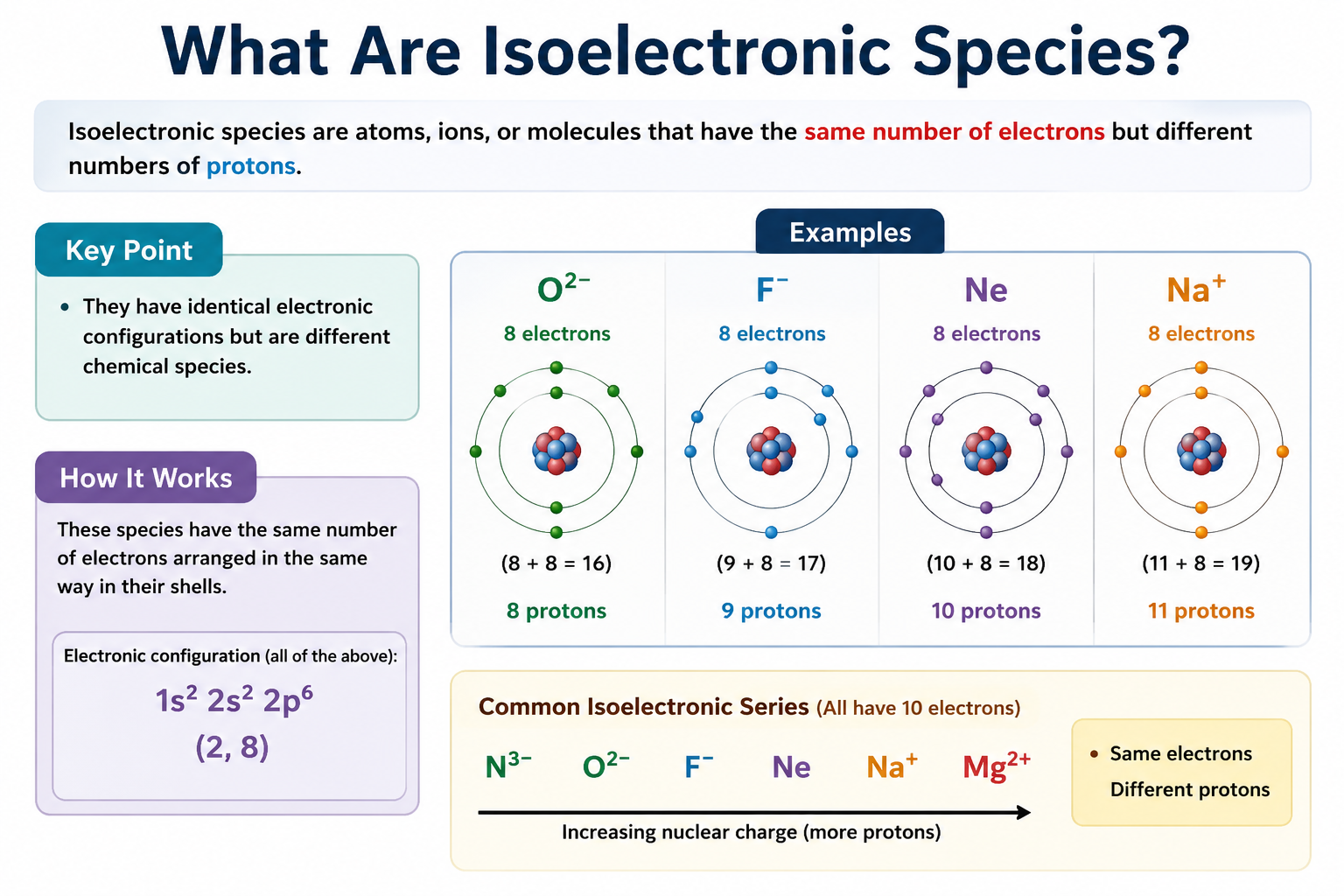
A classic example is the set N³⁻, O²⁻, F⁻, Ne, Na⁺, Mg²⁺, and Al³⁺ — all of which have 10 electrons.
-
Within an isoelectronic series, ionic size decreases as the nuclear charge increases.
-
Isoelectronic species share the same electron configuration but differ in the number of protons, which affects their properties.
-
This concept is fundamental for understanding periodic trends, chemical bonding, and atomic structure.
-
Isoelectronic species are different from isotopes, isobars, and isotones — do not confuse them.
What Are Isoelectronic Species?
Definition
Isoelectronic species are atoms, ions, or molecules that contain exactly the same number of electrons. The word “isoelectronic” comes from Greek: “iso” meaning equal, and “electronic” referring to electrons. Two or more species are classified as isoelectronic when their total electron count is identical, regardless of the number of protons or neutrons they contain.
Simple Explanation
Think about it this way. A neutral neon atom has 10 protons and 10 electrons. A fluoride ion, F⁻, has 9 protons but has gained one extra electron, so it also has 10 electrons. A sodium ion, Na⁺, has 11 protons but lost one electron, leaving it with 10 electrons as well. All three — Ne, F⁻, and Na⁺ — have 10 electrons. That makes them isoelectronic.
The key point here is that it is the electron count that matters, not the proton count. Two species from completely different elements can be isoelectronic simply because their electron numbers work out to be the same.
Why Are Isoelectronic Species Important?
This is a fair question, and the honest answer is that understanding isoelectronic species helps you make sense of a lot of chemistry that would otherwise seem arbitrary.
First, isoelectronic species have the same electron configuration. This means they arrange their electrons in exactly the same way around the nucleus, which gives them similar chemical and physical behaviors. Knowing that two species are isoelectronic allows chemists to predict properties without running experiments every single time.
Second, the concept is directly linked to trends in ionic radius. When you compare a series of isoelectronic ions, the one with the most protons will be the smallest, because a higher nuclear charge pulls the same number of electrons closer to the nucleus. This is a key periodic trend that appears in nearly every exam.
Third, this concept shows up constantly in discussions about chemical bonding, molecular geometry, and reactivity. Isoelectronic molecules often have similar bond angles and shapes. Carbon dioxide (CO₂) and nitrous oxide (N₂O) are both linear molecules partly because of their isoelectronic nature.
Finally, for competitive exam preparation — NEET, MDCAT, ECAT, A-Level, GCSE — isoelectronic species questions appear with high frequency. Getting this concept right gives you guaranteed marks.
History and Development of the Concept
The idea of isoelectronic species has been around since the early 20th century, closely tied to the development of atomic theory and quantum mechanics. In 1919, Irving Langmuir, an American chemist and physicist, formally developed the concept as part of his broader work on the octet rule and electronic structures of atoms and molecules.
Langmuir noticed that certain molecules and ions with the same number of electrons tended to have similar structural properties. He observed, for instance, that N₂ and CO are isoelectronic and have very similar bond lengths and energies. This observation was more than just a curiosity — it pointed toward a deep connection between electron count and molecular behavior.
His work built on earlier contributions from Gilbert N. Lewis, who had introduced the idea of electron pairs and the octet rule in 1916. Together, their ideas laid the groundwork for modern chemical bonding theory, and the isoelectronic principle became a useful tool for predicting and comparing molecular properties.
Over the decades, the concept has been refined and expanded. Today it is applied not just to simple atoms and monoatomic ions but also to polyatomic ions and molecules, making it one of the most versatile ideas in general chemistry.
Characteristics of Isoelectronic Species
Here are the defining characteristics that all isoelectronic species share:
- They have the same total number of electrons.
- They have the same electron configuration.
- They belong to different elements or have different ionic charges.
- They may have different numbers of protons, neutrons, and therefore different atomic numbers and mass numbers.
- Their physical properties, such as size and effective nuclear charge, differ because the number of protons varies.
- Within an isoelectronic series, chemical reactivity and charge density vary with the number of protons.
One thing worth emphasizing: isoelectronic species are not chemically identical. Having the same number of electrons makes them structurally similar, but the differences in nuclear charge mean their actual behavior in reactions can be quite different.
How to Identify Isoelectronic Species
This is where students often get stuck. The good news is that identifying isoelectronic species is a straightforward process once you know the steps.
Count Total Electrons
The most direct method is to count the total number of electrons in each species.
For a neutral atom, the number of electrons equals the atomic number.
For a cation (positive ion), subtract the charge from the atomic number. A Na⁺ ion has an atomic number of 11 and a charge of +1, so it has 11 – 1 = 10 electrons.
For an anion (negative ion), add the charge to the atomic number. An O²⁻ ion has an atomic number of 8 and a charge of -2, so it has 8 + 2 = 10 electrons.
If two or more species give you the same number, they are isoelectronic.
Compare Electron Configurations
Once you have determined the electron count, write out the electron configurations and compare them. Isoelectronic species will have identical configurations because the arrangement of electrons follows the same rules regardless of which element you started with.
For the 10-electron series: 1s² 2s² 2p⁶
Every species in the N³⁻, O²⁻, F⁻, Ne, Na⁺, Mg²⁺, Al³⁺ set has this exact configuration.
Identify Ions and Atoms
Pay close attention to the charge on each ion. A simple trick for exam questions: look for neutral atoms of noble gases, then ask which ions of nearby elements would have the same electron count.
Elements to the right of a noble gas form cations to reach that noble gas configuration. Elements to the left form anions. All of these become isoelectronic with that noble gas.
Electron Configuration and Isoelectronic Species
Understanding electron configuration is essential for this topic. Let us look at the 10-electron series in detail.
Neon (Ne) has atomic number 10. Its electron configuration is:
1s² 2s² 2p⁶
Total electrons: 2 + 2 + 6 = 10
Now, nitrogen has atomic number 7. A neutral nitrogen atom has 7 electrons. If nitrogen gains 3 electrons to form N³⁻, it now has 10 electrons. Its configuration becomes 1s² 2s² 2p⁶ — exactly like neon.
Oxygen has atomic number 8. Gaining 2 electrons gives O²⁻ with 10 electrons and the configuration 1s² 2s² 2p⁶.
Fluorine has atomic number 9. Gaining 1 electron gives F⁻ with 10 electrons and the configuration 1s² 2s² 2p⁶.
Sodium has atomic number 11. Losing 1 electron gives Na⁺ with 10 electrons and the configuration 1s² 2s² 2p⁶.
Magnesium has atomic number 12. Losing 2 electrons gives Mg²⁺ with 10 electrons and the configuration 1s² 2s² 2p⁶.
Aluminum has atomic number 13. Losing 3 electrons gives Al³⁺ with 10 electrons and the configuration 1s² 2s² 2p⁶.
All seven species share the same electron arrangement. This is the clearest possible example of isoelectronic species in action.
Common Examples of Isoelectronic Species
Nitrogen Ion (N³⁻)
Nitrogen is a non-metal with atomic number 7. In its ionic form N³⁻, it has gained three electrons, bringing the total to 10. The electron configuration is 1s² 2s² 2p⁶. This ion is relatively large because it has only 7 protons holding 10 electrons — the nuclear attraction per electron is weaker.
Oxygen Ion (O²⁻)
Oxygen has atomic number 8. The oxide ion O²⁻ has 8 + 2 = 10 electrons. Configuration: 1s² 2s² 2p⁶. It is smaller than N³⁻ because 8 protons pull 10 electrons more effectively than 7 protons do.
Fluorine Ion (F⁻)
Fluorine has atomic number 9. The fluoride ion F⁻ has 9 + 1 = 10 electrons. Configuration: 1s² 2s² 2p⁶. Smaller still, because the nuclear charge is higher.
Neon (Ne)
Neon is the reference point for this series. As a noble gas, it already has 10 electrons in its neutral state. Configuration: 1s² 2s² 2p⁶. It sits right in the middle of the isoelectronic series in terms of size and is the only neutral atom in this group.
Sodium Ion (Na⁺)
Sodium has atomic number 11. When it forms Na⁺, it loses 1 electron, leaving 10. Configuration: 1s² 2s² 2p⁶. With 11 protons for 10 electrons, the ionic radius is smaller than neon’s atomic radius.
Magnesium Ion (Mg²⁺)
Magnesium has atomic number 12. Losing 2 electrons gives 10 total. Configuration: 1s² 2s² 2p⁶. Smaller than Na⁺ because 12 protons attract 10 electrons more tightly.
Aluminum Ion (Al³⁺)
Aluminum has atomic number 13. Losing 3 electrons gives 10 total. Configuration: 1s² 2s² 2p⁶. The smallest ion in this series because 13 protons exert the strongest pull on the same 10 electrons.
Isoelectronic Series Table
| Species | Atomic Number | Protons | Electrons | Electron Configuration | Relative Size |
|---|---|---|---|---|---|
| N³⁻ | 7 | 7 | 10 | 1s² 2s² 2p⁶ | Largest |
| O²⁻ | 8 | 8 | 10 | 1s² 2s² 2p⁶ | Very Large |
| F⁻ | 9 | 9 | 10 | 1s² 2s² 2p⁶ | Large |
| Ne | 10 | 10 | 10 | 1s² 2s² 2p⁶ | Medium |
| Na⁺ | 11 | 11 | 10 | 1s² 2s² 2p⁶ | Small |
| Mg²⁺ | 12 | 12 | 10 | 1s² 2s² 2p⁶ | Very Small |
| Al³⁺ | 13 | 13 | 10 | 1s² 2s² 2p⁶ | Smallest |
As the atomic number increases across this table, the number of protons increases while the number of electrons stays constant at 10. The result is a steady decrease in ionic radius, which is one of the most tested trends in competitive chemistry exams.
Isoelectronic Species and Ionic Radius
Trend in Ionic Size
The ionic radius trend within an isoelectronic series is one of the most important things you need to know for your exams. The rule is simple:
As the nuclear charge increases within an isoelectronic series, the ionic radius decreases.
In the 10-electron series, Al³⁺ is the smallest and N³⁻ is the largest, even though they all have exactly the same number of electrons.
Why Ionic Size Changes
The explanation for this trend comes down to effective nuclear charge. When you add more protons to a nucleus while keeping the number of electrons fixed, the positive charge of the nucleus increases. This stronger positive pull drags the electron cloud inward, making the ion smaller.
Think of it like this: imagine 10 people being held together by ropes connected to a central point. If you increase the strength of that central anchor, those 10 people get pulled closer together. More protons mean a stronger anchor, and the ion shrinks.
N³⁻ has only 7 protons for 10 electrons. The pull is relatively weak, so the electrons spread out more and the ion is large. Al³⁺ has 13 protons for 10 electrons. The pull is much stronger, the electrons are held tightly, and the ion is compact.
This principle is sometimes called the nuclear charge effect on ionic radius, and it applies not just to this 10-electron series but to any isoelectronic group you encounter.
Isoelectronic Species vs Isotopes
| Feature | Isoelectronic Species | Isotopes |
|---|---|---|
| Same number of | Electrons | Protons (same element) |
| Differ in | Protons and neutrons | Neutrons |
| Same atomic number? | No | Yes |
| Same element? | No | Yes |
| Example | Ne and Na⁺ | Carbon-12 and Carbon-14 |
| Chemical behavior | Similar in some ways | Nearly identical |
| Focus | Electron count | Mass number |
Isoelectronic Species vs Isobars
| Feature | Isoelectronic Species | Isobars |
|---|---|---|
| Same number of | Electrons | Nucleons (protons + neutrons) |
| Same mass number? | Not necessarily | Yes |
| Same atomic number? | No | No |
| Same element? | No | No |
| Example | F⁻ and Ne | Argon-40 and Calcium-40 |
| Shared property | Electron configuration | Mass number |
Isoelectronic Species vs Isotones
| Feature | Isoelectronic Species | Isotones |
|---|---|---|
| Same number of | Electrons | Neutrons |
| Same atomic number? | No | No |
| Same element? | No | No |
| Example | O²⁻ and Ne | Carbon-14 and Nitrogen-15 |
| Key defining factor | Equal electron count | Equal neutron count |
Isoelectronic Species vs Ions
| Feature | Isoelectronic Species | Regular Ions |
|---|---|---|
| Must be ions? | Not necessarily (can include neutral atoms) | Yes, by definition |
| Same number of electrons? | Yes | Not necessarily |
| Defined by | Electron count across multiple species | Charge on a single atom or molecule |
| Example | Ne, Na⁺, Mg²⁺ are all isoelectronic | Na⁺ alone is simply a cation |
| Comparison needed? | Yes, across two or more species | No, described individually |
How to Solve Isoelectronic Questions
Example 1
Question: Which of the following is isoelectronic with Ne?
Options: Li⁺, Na⁺, K⁺, H⁻
Solution:
Ne has 10 electrons.
- Li has atomic number 3. Li⁺ has 3 – 1 = 2 electrons. Not isoelectronic.
- Na has atomic number 11. Na⁺ has 11 – 1 = 10 electrons. Isoelectronic with Ne.
- K has atomic number 19. K⁺ has 19 – 1 = 18 electrons. Not isoelectronic.
- H has atomic number 1. H⁻ has 1 + 1 = 2 electrons. Not isoelectronic.
Answer: Na⁺
Example 2
Question: Arrange in order of decreasing ionic radius: Na⁺, Mg²⁺, Al³⁺
Solution:
All three are isoelectronic with 10 electrons.
- Na⁺: 11 protons, 10 electrons
- Mg²⁺: 12 protons, 10 electrons
- Al³⁺: 13 protons, 10 electrons
More protons means smaller size. So the order of decreasing ionic radius is:
Na⁺ > Mg²⁺ > Al³⁺
Example 3
Question: How many electrons does S²⁻ have? Is it isoelectronic with Ar?
Solution:
Sulfur has atomic number 16. S²⁻ has gained 2 electrons.
Electrons in S²⁻ = 16 + 2 = 18
Argon has atomic number 18. Neutral Ar has 18 electrons.
Both have 18 electrons. Their electron configuration is 1s² 2s² 2p⁶ 3s² 3p⁶.
Yes, S²⁻ is isoelectronic with Ar.
Electron Configuration Practice
Here are a few species from the 18-electron isoelectronic series for you to verify on your own. Confirm that each one has 18 electrons and write out the configuration:
- S²⁻ (atomic number 16, gains 2 electrons)
- Cl⁻ (atomic number 17, gains 1 electron)
- Ar (atomic number 18, neutral)
- K⁺ (atomic number 19, loses 1 electron)
- Ca²⁺ (atomic number 20, loses 2 electrons)
- Sc³⁺ (atomic number 21, loses 3 electrons)
All of these have the configuration 1s² 2s² 2p⁶ 3s² 3p⁶, which is the argon configuration.
Real-Life Applications
Chemistry
Isoelectronic principles help chemists predict the shapes and bonding behavior of molecules. For example, CO₂ (carbon dioxide) and N₂O (nitrous oxide) are isoelectronic molecules. Both are linear. Knowing this helps chemists design new molecules with predictable shapes for pharmaceuticals, materials, and industrial applications.
The isoelectronic principle also helps in explaining why certain catalysts work the way they do. Ions with identical electron configurations but different charges interact differently with surfaces and substrates, which affects catalytic efficiency.
Material Science
In semiconductor technology, materials are often “doped” — meaning small amounts of impurities are added to change electrical properties. Understanding the electronic structure of these dopants, and recognizing which species are isoelectronic, helps engineers design better electronic components.
Isoelectronic substitution is a real technique used in crystal engineering, where atoms are swapped for isoelectronic equivalents to modify the properties of solid materials without completely changing the structure.
Atomic Research
Physicists studying the spectra of ions often work with isoelectronic sequences. When you look at ions from different elements that have the same number of electrons — for instance, the 10-electron series across the periodic table — the spectral lines follow predictable patterns. This allows researchers to test quantum mechanical models and refine our understanding of atomic structure.
Education and Examinations
In academic settings, isoelectronic species serve as a bridge concept that connects atomic structure, electron configuration, ionic radius, and periodic trends. Teachers use this concept to show students how multiple ideas connect, and examination boards test it frequently because it requires genuine conceptual understanding rather than simple memorization.
Common Mistakes Students Make
Let me be straightforward about the errors I see most often, because avoiding these will genuinely improve your exam scores.
- Confusing isoelectronic with isobaric: Isoelectronic means same number of electrons. Isobaric means same mass number. These are completely different things.
- Forgetting to account for ionic charge: A surprisingly common error. Students calculate electrons for the neutral atom and forget to add or subtract for the charge. Always check the charge first.
- Assuming isoelectronic species have the same size: They do not. Size decreases with increasing nuclear charge in an isoelectronic series.
- Thinking isoelectronic species have identical properties: Having the same electron configuration creates similarities, but proton number still controls many properties. Do not overstate the similarity.
- Mixing up anion and cation rules: For anions, add the charge to the atomic number to get electrons. For cations, subtract. Students sometimes do this backward under exam pressure.
- Assuming all noble gases are isoelectronic with each other: Neon has 10 electrons and argon has 18. They are not isoelectronic — they are both noble gases, but different ones.
Best Tips to Study Isoelectronic Species
- Always start by writing down the atomic number of each element involved.
- Determine whether the species is a cation or anion, then calculate the total electrons.
- Write out the electron configuration for each species and compare.
- Practice with both the 10-electron and 18-electron isoelectronic series first, as these appear most often in exams.
- Use the periodic table as a visual aid — mark noble gas positions and work outward in both directions.
- Create your own isoelectronic series for different noble gases to deepen your understanding.
- When studying ionic radius, always ask yourself: same electrons, but which species has more protons?
- Connect this concept to periodic trends — it makes the whole chapter easier to understand.
- Do at least 20 to 30 practice questions across different formats before your exam.
- Review comparison tables regularly to keep the distinctions between isoelectronic, isotopic, and isobaric species clear in your mind.
Common Terms Every Student Should Know
- Isoelectronic: Having the same number of electrons.
- Electron configuration: The arrangement of electrons in an atom or ion across different energy levels and subshells.
- Atomic number: The number of protons in the nucleus of an atom.
- Cation: A positively charged ion formed when an atom loses electrons.
- Anion: A negatively charged ion formed when an atom gains electrons.
- Ionic radius: The effective size of an ion in a crystal or molecule.
- Nuclear charge: The total positive charge of the nucleus, equal to the number of protons.
- Effective nuclear charge: The net positive charge experienced by an electron, accounting for shielding by other electrons.
- Isoelectronic series: A group of atoms and ions that all have the same number of electrons.
- Noble gas configuration: The electron arrangement of a noble gas, which is particularly stable.
- Isotopes: Atoms of the same element with different numbers of neutrons.
- Isobars: Atoms of different elements with the same mass number.
- Isotones: Atoms of different elements with the same number of neutrons.
Isoelectronic Species Practice Questions
30 Multiple Choice Questions (MCQs) with Answers
- How many electrons does Mg²⁺ have?
a) 12 b) 10 c) 14 d) 8
Answer: b) 10 - Which species is isoelectronic with Ne?
a) Li⁺ b) Na⁺ c) K⁺ d) Be²⁺
Answer: b) Na⁺ - The electron configuration of N³⁻ is:
a) 1s² 2s² 2p³ b) 1s² 2s² 2p⁶ c) 1s² 2s² 2p⁵ d) 1s² 2s² 2p⁴
Answer: b) 1s² 2s² 2p⁶ - Which of the following pairs is isoelectronic?
a) Na and Mg b) Cl⁻ and Ar c) N and O d) H and He
Answer: b) Cl⁻ and Ar - In the isoelectronic series Na⁺, Mg²⁺, Al³⁺, which is smallest?
a) Na⁺ b) Mg²⁺ c) Al³⁺ d) All same size
Answer: c) Al³⁺ - S²⁻ is isoelectronic with which noble gas?
a) Ne b) Kr c) Ar d) He
Answer: c) Ar - How many electrons does F⁻ have?
a) 9 b) 8 c) 10 d) 11
Answer: c) 10 - Which species has the largest ionic radius in the 10-electron series?
a) Na⁺ b) F⁻ c) N³⁻ d) Mg²⁺
Answer: c) N³⁻ - Which of these is NOT isoelectronic with Ar?
a) K⁺ b) Ca²⁺ c) Cl⁻ d) Na⁺
Answer: d) Na⁺ - What is the total electron count of Al³⁺?
a) 13 b) 16 c) 10 d) 11
Answer: c) 10 - Isoelectronic species must have the same:
a) Mass number b) Atomic number c) Number of electrons d) Number of neutrons
Answer: c) Number of electrons - Which of the following molecules are isoelectronic?
a) CO₂ and SO₂ b) N₂ and CO c) H₂O and CO₂ d) HCl and NaCl
Answer: b) N₂ and CO - How many electrons does Ca²⁺ have?
a) 20 b) 22 c) 18 d) 16
Answer: c) 18 - Which isoelectronic species has the highest nuclear charge in the 10-electron series?
a) Ne b) Na⁺ c) Mg²⁺ d) Al³⁺
Answer: d) Al³⁺ - O²⁻ has the same electron configuration as:
a) O b) F c) Ne d) N
Answer: c) Ne - In an isoelectronic series, as atomic number increases, ionic radius:
a) Increases b) Stays the same c) Decreases d) First increases then decreases
Answer: c) Decreases - Which ion has the same electron configuration as Kr?
a) Rb⁺ b) Na⁺ c) Cl⁻ d) Ca²⁺
Answer: a) Rb⁺ - How many protons does O²⁻ have?
a) 10 b) 8 c) 6 d) 12
Answer: b) 8 - The species N₂ and CO are isoelectronic because they both have:
a) 14 protons b) 14 electrons c) Same bond type d) Same molecular mass
Answer: b) 14 electrons - Which of the following groups contains all isoelectronic species?
a) Na⁺, Mg²⁺, Al³⁺ b) Na, Mg, Al c) K⁺, Ca, Cl d) Li⁺, Be²⁺, H⁻
Answer: a) Na⁺, Mg²⁺, Al³⁺ - Li⁺ is isoelectronic with:
a) He b) Ne c) H d) Be
Answer: a) He - How many electrons are in Be²⁺?
a) 4 b) 6 c) 2 d) 8
Answer: c) 2 - Which species is isoelectronic with He?
a) Li⁺ b) Na⁺ c) H⁻ d) Both a and c
Answer: d) Both a and c - What is common between isoelectronic species?
a) Number of protons b) Atomic mass c) Electron configuration d) Neutron count
Answer: c) Electron configuration - P³⁻ has how many electrons?
a) 15 b) 16 c) 18 d) 12
Answer: c) 18 - Which pair is NOT isoelectronic?
a) Ne and Na⁺ b) Ar and Cl⁻ c) He and Li⁺ d) Kr and Na⁺
Answer: d) Kr and Na⁺ - The effective nuclear charge in an isoelectronic series increases when:
a) Electrons are added b) Protons increase c) Neutrons increase d) Mass number increases
Answer: b) Protons increase - How many electrons are in K⁺?
a) 19 b) 20 c) 18 d) 17
Answer: c) 18 - Which noble gas serves as reference for the 18-electron isoelectronic series?
a) Ne b) He c) Kr d) Ar
Answer: d) Ar - CO₂ and which molecule are isoelectronic?
a) H₂O b) N₂O c) SO₃ d) CH₄
Answer: b) N₂O
15 Short Answer Questions
- Define isoelectronic species in your own words.
- Why does ionic radius decrease with increasing atomic number in an isoelectronic series?
- Name four species that are isoelectronic with neon.
- What is the electron configuration of O²⁻?
- Are CO and N₂ isoelectronic? Explain.
- Differentiate between isoelectronic species and isotopes.
- List the members of the 18-electron isoelectronic series.
- Why is N³⁻ larger than Na⁺ even though both have 10 electrons?
- What does effective nuclear charge mean in the context of isoelectronic species?
- Name two molecular examples of isoelectronic species.
- Can two neutral atoms ever be isoelectronic? Explain with an example.
- What is the charge on an ion that has the same electron configuration as Ar and belongs to an element with atomic number 16?
- Why do isoelectronic species have similar electron configurations?
- Explain why Al³⁺ is the smallest in its isoelectronic series.
- Is the concept of isoelectronic species applicable to molecules as well as ions? Give an example.
10 Numerical Problems with Step-by-Step Solutions
Problem 1: How many electrons are in Cl⁻?
Step 1: Atomic number of Cl = 17
Step 2: Cl⁻ has gained 1 electron
Step 3: Electrons = 17 + 1 = 18
Answer: 18 electrons
Problem 2: Is Sc³⁺ isoelectronic with Ar?
Step 1: Atomic number of Sc = 21
Step 2: Sc³⁺ loses 3 electrons
Step 3: Electrons = 21 – 3 = 18
Step 4: Ar has 18 electrons
Answer: Yes, they are isoelectronic
Problem 3: How many electrons does the phosphide ion (P³⁻) have?
Step 1: Atomic number of P = 15
Step 2: P³⁻ gains 3 electrons
Step 3: Electrons = 15 + 3 = 18
Answer: 18 electrons
Problem 4: Arrange Na⁺, F⁻, and O²⁻ in order of increasing ionic radius.
Step 1: All have 10 electrons
Step 2: Na has 11 protons, F has 9, O has 8
Step 3: More protons means smaller radius
Step 4: O²⁻ (8p) > F⁻ (9p) > Na⁺ (11p) in terms of radius
Answer: Na⁺ < F⁻ < O²⁻
Problem 5: Calculate the number of electrons in Ti⁴⁺ and determine which noble gas it is isoelectronic with.
Step 1: Atomic number of Ti = 22
Step 2: Ti⁴⁺ loses 4 electrons
Step 3: Electrons = 22 – 4 = 18
Step 4: Ar has 18 electrons
Answer: Ti⁴⁺ has 18 electrons and is isoelectronic with Ar
Problem 6: Confirm that CO and N₂ are isoelectronic.
Step 1: CO has 6 (C) + 8 (O) = 14 electrons
Step 2: N₂ has 7 (N) + 7 (N) = 14 electrons
Answer: Both have 14 electrons, confirmed isoelectronic
Problem 7: How many electrons are in Be²⁺?
Step 1: Atomic number of Be = 4
Step 2: Be²⁺ loses 2 electrons
Step 3: Electrons = 4 – 2 = 2
Answer: 2 electrons (isoelectronic with He)
Problem 8: Which ion of silicon would be isoelectronic with Ne?
Step 1: Ne has 10 electrons
Step 2: Si has atomic number 14
Step 3: We need to remove 4 electrons from Si to get 10
Step 4: Si would need a 4+ charge
Answer: Si⁴⁺ is isoelectronic with Ne
Problem 9: Verify that S²⁻ and Ca²⁺ are both in the 18-electron isoelectronic series.
Step 1: S has atomic number 16. S²⁻: 16 + 2 = 18 electrons
Step 2: Ca has atomic number 20. Ca²⁺: 20 – 2 = 18 electrons
Answer: Both have 18 electrons and are isoelectronic with Ar
Problem 10: An ion has 18 electrons and a charge of 3+. Identify the element.
Step 1: Ion has charge 3+ and 18 electrons
Step 2: Electrons = Protons – 3
Step 3: 18 = Protons – 3
Step 4: Protons = 21
Step 5: Element with atomic number 21 is Scandium (Sc)
Answer: The element is Scandium, forming Sc³⁺
Revision Checklist
Use this checklist before any exam to make sure you have covered all the key ideas:
- I can define isoelectronic species accurately.
- I know how to calculate the number of electrons in cations and anions.
- I can write electron configurations for common isoelectronic species.
- I understand the 10-electron and 18-electron isoelectronic series completely.
- I can explain the ionic radius trend within an isoelectronic series.
- I know the difference between isoelectronic species, isotopes, isobars, and isotones.
- I can identify isoelectronic pairs of molecules such as CO and N₂.
- I have practiced at least 20 MCQs and can solve numerical problems confidently.
- I can explain why Al³⁺ is smaller than Na⁺ despite having the same number of electrons.
- I have reviewed common mistakes and know how to avoid them.
Best Books for Learning Atomic Structure
If you want to go deeper into this topic, these resources are genuinely excellent:
- NCERT Chemistry (Class 11 and 12): Clear explanations suited for NEET and MDCAT preparation, especially for atomic structure chapters.
- Chemistry: The Central Science by Brown, LeMay, and Bursten: A comprehensive university-level text with excellent periodic trend discussions.
- Atkins’ Physical Chemistry: For advanced students who want to understand the quantum mechanical basis of electron configurations.
- Morrison and Boyd Organic Chemistry: Useful for understanding how isoelectronic principles apply to organic structures and functional groups.
- Concise Inorganic Chemistry by J.D. Lee: Ideal for A-Level and undergraduate students with detailed coverage of ionic radius trends and periodic properties.
Free Online Chemistry Resources
For additional study materials and interactive practice, these are among the best freely available resources:
- OpenStax Chemistry (openstax.org): Free peer-reviewed university chemistry textbooks with clear explanations of atomic structure and electron configuration.
- Khan Academy (khanacademy.org): Video lessons and practice exercises on electron configuration, ionic radii, and periodic trends — excellent for visual learners.
- Chemistry LibreTexts (chem.libretexts.org): An extensive open-access chemistry library covering isoelectronic species and related topics in depth.
- American Chemical Society (acs.org): Resources for chemistry education, including materials aligned with exam standards.
- Royal Society of Chemistry (rsc.org): High-quality educational content including topics on atomic structure and chemical periodicity.
Frequently Asked Questions
1. What are isoelectronic species?
Isoelectronic species are atoms, ions, or molecules that have exactly the same number of electrons. They may belong to different elements and have different numbers of protons, but their total electron count is identical.
2. Can two neutral atoms be isoelectronic?
Yes, but only if they happen to have the same atomic number — which would make them the same element. Among different elements, isoelectronic relationships typically involve ions. However, noble gases can serve as neutral reference points within isoelectronic series.
3. Are isoelectronic species the same size?
No. Within an isoelectronic series, size varies depending on the number of protons. More protons mean a stronger nuclear pull on the same number of electrons, resulting in a smaller radius.
4. What is the difference between isoelectronic species and isotopes?
Isotopes are atoms of the same element with different numbers of neutrons. Isoelectronic species are different elements (or differently charged species) that have the same number of electrons. These are completely different concepts.
5. Is Ne isoelectronic with Na⁺?
Yes. Neon has 10 electrons in its neutral state. Na⁺ has 11 protons but lost 1 electron, leaving 10. Both have the configuration 1s² 2s² 2p⁶, so they are isoelectronic.
6. How do I find the number of electrons in an ion?
For cations: subtract the positive charge from the atomic number.
For anions: add the negative charge (as a number) to the atomic number.
7. What is an isoelectronic series?
An isoelectronic series is a group of atoms and ions that all have the same number of electrons. The 10-electron series (N³⁻, O²⁻, F⁻, Ne, Na⁺, Mg²⁺, Al³⁺) is the most commonly studied example.
8. Are CO and N₂ isoelectronic?
Yes. CO has 6 + 8 = 14 electrons, and N₂ has 7 + 7 = 14 electrons. They are both isoelectronic and share similar bonding characteristics, including triple bonds.
9. Why is Al³⁺ the smallest in its isoelectronic series?
Al³⁺ has 13 protons and 10 electrons. The highest nuclear charge in the 10-electron series means the electrons are pulled most tightly toward the nucleus, making Al³⁺ the smallest.
10. What is the electron configuration shared by the 10-electron isoelectronic series?
All members of the 10-electron series share the configuration 1s² 2s² 2p⁶.
11. Is isoelectronic the same as isobaric?
No. Isoelectronic means same number of electrons. Isobaric means same mass number. These are different concepts entirely.
12. Can molecules be isoelectronic?
Yes. Molecules can be isoelectronic if they have the same total number of electrons. CO₂ and N₂O are a commonly cited example. Both have 22 electrons and both are linear molecules.
Summary
Let us pull everything together. Isoelectronic species are atoms, ions, or molecules with the same total number of electrons. The most classic and commonly tested example is the 10-electron series: N³⁻, O²⁻, F⁻, Ne, Na⁺, Mg²⁺, and Al³⁺. All of these have the electron configuration 1s² 2s² 2p⁶.
Within any isoelectronic series, ionic radius decreases as atomic number increases, because more protons exert a stronger pull on the same electron cloud. This is a key trend that connects isoelectronic species to the broader topic of periodic properties.
Isoelectronic species are distinct from isotopes (same element, different neutrons), isobars (same mass number), and isotones (same neutron count). Keeping these distinctions clear is essential for exam success.
The concept extends beyond simple monoatomic ions. Molecules like CO and N₂, or CO₂ and N₂O, are also isoelectronic, and this relationship helps explain similarities in their bond properties and molecular geometry.
For exams at any level — whether GCSE, A-Level, NEET, MDCAT, or ECAT — understanding what isoelectronic species are, how to identify them, and how they relate to ionic radius trends will give you a reliable advantage.
Final Thoughts
Chemistry, at its best, is about seeing the patterns that connect what initially looks like an overwhelming collection of facts. The concept of isoelectronic species is a perfect example. Once you grasp that electrons are the defining feature, you start to see why certain ions behave similarly, why ionic sizes follow predictable patterns, and why molecular shapes can mirror each other across different elements.
Take the time to work through the practice questions in this guide, review the comparison tables, and use the revision checklist before your next exam. If you build a solid understanding of this concept now, it will support you through more advanced topics like molecular orbital theory, coordination chemistry, and quantum mechanics later on.
For further reading, explore the related LearnMinto articles on
These articles build directly on the ideas covered here and will strengthen your overall understanding of atomic chemistry.
Keep asking questions, keep practicing, and do not let the details overwhelm you. Chemistry is learnable — every single part of it.
Disclaimer
This article is intended for educational and informational purposes only. While LearnMinto strives to provide accurate and up-to-date information, readers should verify important academic concepts through official textbooks, educational institutions, examination boards, or trusted scientific resources before relying on this content for exams or academic purposes. LearnMinto is not affiliated with any specific school, university, research institution, or examination board.