
Introduction
Stand at the base of a large cliff and shout. A few seconds later, your voice returns to you. That returning sound is an echo — one of the most familiar and naturally occurring examples of wave reflection in everyday life. Look into a still pond and you see the trees and sky mirrored on the surface. Hold a mirror in front of a torch and the light bounces straight back. All of these experiences share the same underlying physics.
Wave reflection occurs when a wave reaches a boundary or obstacle and is redirected back into the original medium or region. The wave does not pass through the boundary and is not simply absorbed — instead, it reverses direction and travels back the way it came, though at a different angle depending on how it arrived.
Reflection is not limited to light. It applies equally to sound waves, water waves, radio waves, microwaves, and all other types of waves. The same fundamental rules govern reflection in every case.
This article explains what wave reflection is, the laws that govern it, the types of reflection, how it applies to different waves, and where it is used in real-world applications — from radar and sonar to concert hall design and medical imaging.
Key Takeaways
-
Wave reflection occurs when a wave reaches a boundary and is redirected back into the original medium
-
The law of reflection states: angle of incidence = angle of reflection (i = r), both measured from the normal
-
Regular reflection occurs from smooth surfaces and produces organised, predictable reflected waves
-
Diffuse reflection occurs from rough surfaces and scatters reflected waves in many directions — but the law of reflection still applies at each point
-
Reflection can occur with any type of wave: light, sound, water waves, radio waves, and electromagnetic waves
-
During reflection in the same medium, frequency, speed, and wavelength of the wave remain unchanged
-
Reflection has important practical applications including radar, sonar, ultrasound imaging, mirrors, and communication systems
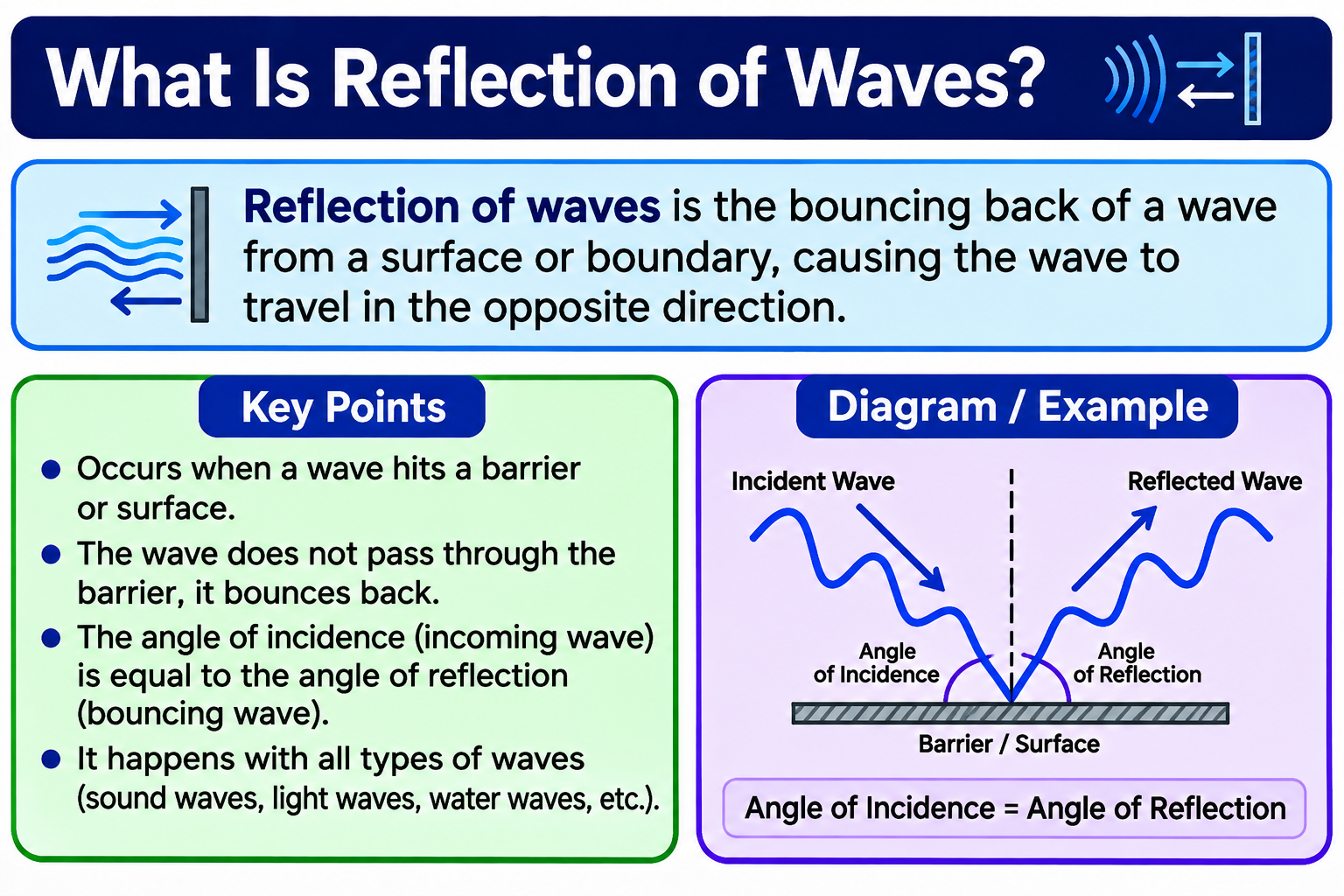
What Is Reflection of Waves?
Reflection of waves is the process by which a wave travelling through one medium strikes a boundary and is redirected back into the same medium or region, rather than passing through or being completely absorbed.
Every wave carries energy. When that wave encounters a surface or boundary — whether a mirror, a wall, the seabed, or the upper layers of the atmosphere — some or all of that energy is turned around and sent back in a new direction. The wave that arrives is called the incident wave, and the wave that bounces back is the reflected wave.
Key points to understand from the start:
- The incident wave is the original wave travelling toward the reflecting surface
- The reflecting surface or boundary is the obstacle or boundary the wave encounters
- The reflected wave is the wave that travels away from the surface after reflection
- Reflection does not mean the wave is stopped or absorbed — it is redirected
- The wave continues to carry energy after reflection, though some energy may be lost to absorption at real surfaces
Reflection can occur with any type of wave. Whether you are dealing with light striking a mirror, sound bouncing off a wall, or radio waves returning from an aircraft, the physics of reflection is governed by the same fundamental laws.
How Does Wave Reflection Occur?
The process of wave reflection follows a consistent sequence:
- A wave (the incident wave) travels through a medium toward a boundary or surface.
- The wave reaches the boundary — this is the point of incidence.
- At the boundary, the wave interacts with the surface. The surface cannot allow the wave to continue through it (or only allows partial transmission), so the energy is redirected.
- The wave is reflected — it changes its direction of travel and moves back into the original medium.
- The reflected wave travels away from the surface, obeying the law of reflection.
The reflected wave originates from the same point on the surface where the incident wave arrived. If the surface is smooth and flat, all parts of an incoming wave reflect in the same organised way. If the surface is rough, different parts of the incoming wave strike the surface at slightly different angles, reflecting in different directions.
Important Terms in Wave Reflection
Incident Wave
The incident wave is the wave travelling toward the reflecting boundary before reflection occurs. It carries the original energy from the source and arrives at the surface at a particular angle.
Reflected Wave
The reflected wave is the wave that has bounced off the reflecting surface and is now travelling away from it. It carries most or all of the energy that was in the incident wave (some may be absorbed), but travels in a new direction.
Normal
The normal is an imaginary line drawn perpendicular (at right angles) to the reflecting surface at the exact point where the incident wave meets the surface (the point of incidence). All angles in reflection are measured relative to the normal, not relative to the surface itself.
Angle of Incidence
The angle of incidence (symbol: i) is the angle between the incident wave (or ray) and the normal at the point of incidence. It is always measured from the normal.
Angle of Reflection
The angle of reflection (symbol: r) is the angle between the reflected wave (or ray) and the normal at the point of incidence. It is always measured from the normal.
Point of Incidence
The point of incidence is the specific location on the reflecting surface where the incident wave strikes. It is the point from which the normal is drawn and where the reflected wave originates.
Laws of Reflection
There are two fundamental laws of reflection that apply to all types of waves on smooth surfaces.
First Law of Reflection
The angle of incidence is equal to the angle of reflection.
Expressed mathematically:
i = r
Where:
- i = angle of incidence (measured from the normal to the incident ray)
- r = angle of reflection (measured from the normal to the reflected ray)
This means that if a ray of light strikes a mirror at 30° to the normal, it will be reflected at 30° to the normal on the other side. If it strikes at 45°, it reflects at 45°. This relationship holds true for all smooth surfaces and all types of waves.
Second Law of Reflection
The incident ray, the reflected ray, and the normal at the point of incidence all lie in the same plane.
In simple terms, this means everything happens in a single flat surface — the wave does not bounce sideways or out of the plane of the diagram. If you draw the incident ray, the normal, and the reflected ray on a flat piece of paper, all three lines will lie flat on that same piece of paper.
This second law confirms that reflection is a two-dimensional process at any given point of incidence. For three-dimensional surfaces, the plane shifts depending on where the wave strikes, but at each specific point, the second law always holds.
Both laws together fully describe the geometry of reflection for smooth surfaces. They are among the oldest established laws in physics, confirmed by experimentation across centuries.
Diagram of Reflection
A standard reflection diagram contains the following elements, arranged clearly for educational purposes:
Reflecting surface: A horizontal straight line representing the smooth mirror or boundary.
Normal: A vertical dashed line drawn perpendicular to the reflecting surface at the point of incidence, extending both above and below the surface.
Incident ray: A line approaching the point of incidence from the upper left, drawn as a solid arrow pointing toward the surface. The angle between this line and the normal (measured on the left side of the normal) is the angle of incidence (i).
Reflected ray: A line leaving the point of incidence toward the upper right, drawn as a solid arrow pointing away from the surface. The angle between this line and the normal (measured on the right side of the normal) is the angle of reflection (r).
Angle labels: Both angles i and r are marked clearly, confirming i = r.
When reading or drawing this diagram in an examination:
- Always draw the normal as a dashed line
- Measure angles from the normal, not from the surface
- Label both angles clearly with their symbols
Types of Reflection
Not all reflecting surfaces behave in the same way. The type of reflection that occurs depends primarily on the smoothness of the surface relative to the wavelength of the incoming wave.
Regular Reflection
Regular reflection (also called specular reflection) occurs when a wave reflects from a smooth, flat surface in a single, well-defined direction.
When parallel rays of the incident wave hit a smooth surface, they all strike at the same angle and are all reflected at the same angle. The reflected rays emerge parallel to each other, organised and predictable.
This organised reflection is what allows a clear image to be formed.
Examples of surfaces that produce regular reflection:
- A plane mirror (glass with a silvered backing)
- The surface of a calm lake or still water
- A polished metal surface
- A smooth glass pane
Because all reflected rays travel in the same direction from a smooth surface, your eye receives rays that appear to come from a single consistent location — which is why you see a clear, accurate image of yourself in a mirror.
Diffuse Reflection
Diffuse reflection occurs when a wave reflects from a rough or uneven surface. Because the surface has many tiny irregularities at the microscopic level, different parts of the incident wave strike the surface at slightly different angles — even if the overall direction of incidence appears the same.
Each tiny section of the rough surface obeys the law of reflection perfectly. But because each section is tilted at a slightly different angle, the reflected rays scatter in many different directions.
Examples of surfaces that produce diffuse reflection:
- A sheet of white paper
- A painted wall
- An unpolished piece of wood
- A rough concrete floor
- Most natural surfaces
Because the reflected rays scatter in all directions, diffuse reflection does not form a clear image. However, it is diffuse reflection that allows you to see objects that are not themselves light sources — the rough surface scatters reflected light in all directions, including toward your eyes, making the object visible from any angle.
Regular vs Diffuse Reflection
| Feature | Regular Reflection | Diffuse Reflection |
|---|---|---|
| Surface type | Smooth, flat | Rough, uneven |
| Direction of reflected rays | All parallel — single direction | Scattered in many directions |
| Image formation | Clear image formed | No clear image formed |
| Examples | Mirror, calm water, polished metal | Paper, wall, rough wood |
| Appearance | Shiny, reflective | Matte, dull |
| Obeys law of reflection? | Yes, at the surface level | Yes, at each tiny point |
The critical point to understand is that diffuse reflection does not violate the law of reflection. At each microscopic point on the rough surface, the angle of incidence equals the angle of reflection. It is simply that each point is oriented slightly differently, so the reflected rays go in different directions overall.
Reflection of Light
Light reflection is the most familiar and widely studied type of wave reflection. When light strikes a surface, three things can happen simultaneously — some light is reflected, some is absorbed, and some may pass through (transmission). The proportions depend on the surface material and the wavelength of the light.
For reflection of light, the same two laws apply:
- Angle of incidence = angle of reflection
- The incident ray, reflected ray, and normal lie in the same plane
Reflection of light occurs from:
- Plane mirrors: flat, smooth reflective surfaces that produce regular reflection and clear virtual images
- Concave mirrors: curved inward — can focus reflected light to a point and form real or virtual images
- Convex mirrors: curved outward — produce diverging reflected rays and smaller, upright virtual images
Understanding light reflection is fundamental to the study of optics. It explains how mirrors work, how telescopes are built, how periscopes function, and how retro-reflective road markings are visible to drivers at night.
Reflection from a Plane Mirror
A plane mirror is a flat, smooth reflective surface. When an object is placed in front of a plane mirror, the reflected rays appear to come from a point behind the mirror — and a virtual image is formed.
Characteristics of an image formed by a plane mirror:
- Virtual: the image cannot be projected onto a screen — it appears to exist behind the mirror
- Upright: the image is the same way up as the object
- Same size as the object: the image dimensions equal the object dimensions
- Laterally inverted: left and right are swapped — the image is a mirror image of the object (text appears reversed)
- Same distance behind the mirror as the object is in front: if an object is 30 cm in front of the mirror, the image appears 30 cm behind it
These properties all follow directly from applying the law of reflection to every ray of light leaving the object and striking the mirror.
Reflection of Sound
Sound waves are longitudinal mechanical waves — they require a medium to travel through. When sound encounters a hard, solid surface, much of the sound energy is reflected rather than absorbed or transmitted.
The laws of reflection apply to sound in the same way as they apply to light. The angle of incidence equals the angle of reflection, measured from the normal to the reflecting surface.
Sound reflection is strongest from:
- Hard, dense surfaces (concrete, brick, stone, glass)
- Large, flat surfaces (walls, cliffs, buildings)
- Smooth surfaces (which produce regular reflection)
Sound reflection is weaker from:
- Soft, porous materials (foam, carpets, curtains)
- Rough or irregular surfaces (which produce diffuse sound reflection)
Applications of sound reflection:
- Echoes — hearing a reflected sound after a time delay
- Reverberation — multiple reflections in an enclosed space
- Acoustic design — shaping rooms for concerts or speech clarity
- Sonar — using reflected sound pulses to detect underwater objects
For a deeper understanding of sound as a wave, see our article on [What Is a Wave in Physics?].
Echo and Reflection of Sound
An echo is a reflected sound that is heard as a distinct, separate repetition of the original sound. It is produced when sound reflects off a hard surface that is far enough away for the reflected wave to arrive at the listener noticeably after the original sound.
For the human ear and brain to distinguish an echo as a separate sound, the time delay must be at least approximately 0.1 seconds. Since sound travels at approximately 340 m/s in air at room temperature, this means the reflecting surface must be at least:
Distance = (speed × time) / 2 = (340 × 0.1) / 2 = 17 metres
The division by 2 accounts for the fact that the sound must travel to the surface and back — the total distance covered is twice the distance to the wall.
Reverberation is different from an echo. In reverberation, the reflected sounds arrive so quickly (because reflecting surfaces are close) that they blend with the original sound rather than being heard as separate repetitions. This is common in small rooms with hard walls.
Worked example:
A person shouts toward a cliff. The echo is heard 2 seconds later. The speed of sound in air is 340 m/s. How far away is the cliff?
Distance = (speed × time) / 2 = (340 × 2) / 2 = 340 m
The cliff is 340 metres away.
Reflection of Water Waves
Water waves reflect when they reach a solid boundary such as a harbour wall, a straight shoreline, or a submerged obstacle. The reflected wave moves away from the boundary according to the same law of reflection — angle of incidence equals angle of reflection.
In a ripple tank experiment (a shallow tray of water used in laboratory demonstrations):
- Plane (straight) waves striking a flat barrier reflect as plane waves at an equal angle on the other side of the normal
- Circular waves reflecting from a flat barrier appear to originate from a point behind the barrier (the same principle as a plane mirror)
Water wave reflection is visible at beaches and harbour walls, where waves can be seen bouncing back and interacting with incoming waves to form complex interference patterns.
Reflection of Radio Waves
Radio waves are electromagnetic waves with relatively long wavelengths. They can be reflected by several types of surfaces and atmospheric layers.
Key examples of radio wave reflection:
- Ground reflection: radio waves can reflect off flat terrain, buildings, and large structures
- Ionospheric reflection: certain layers of Earth’s ionosphere (the uppermost part of the atmosphere, ionised by solar radiation) can reflect radio waves of particular frequencies back toward Earth’s surface. This was historically crucial for long-distance radio communication before satellites.
- Radar: radio waves transmitted from a radar station reflect off aircraft, ships, or weather systems and return to the receiver. The time taken for the round trip is used to calculate the distance to the object.
The ability to reflect radio waves off distant objects or atmospheric layers has shaped the development of global communication and navigation systems.
Reflection of Electromagnetic Waves
All electromagnetic waves can undergo reflection, following the same laws as light. The reflective properties depend on the wavelength of the radiation and the nature of the surface.
Examples across the electromagnetic spectrum:
- Visible light: reflects from mirrors, water, and most solid surfaces
- Radio waves: reflect from ionosphere, aircraft, and large structures (used in radar and broadcasting)
- Microwaves: reflect from metal surfaces (used in microwave communications and radar)
- Infrared radiation: reflects from shiny metal surfaces (used in thermal imaging and infrared reflectors)
Understanding that all electromagnetic waves undergo reflection is important for explaining why satellites use large reflective dish antennas, why some buildings have reflective glass facades, and why certain materials are effective at blocking specific types of radiation.
Reflection vs Refraction
| Feature | Reflection | Refraction |
|---|---|---|
| What happens | Wave bounces back from boundary | Wave passes through boundary and changes speed |
| Direction change | Wave returns to original medium | Wave continues into new medium, changing direction |
| Boundary | Wave does not cross it | Wave crosses into a new medium |
| Medium | Wave stays in original medium | Wave enters a second medium |
| Frequency | Unchanged | Unchanged |
| Speed | Unchanged (same medium) | Changes in new medium |
| Wavelength | Unchanged | Changes in new medium |
| Example | Mirror reflection, echo | Light bending through glass, sound bending in air layers |
Both reflection and refraction can occur simultaneously when a wave meets a boundary. The relative proportions depend on the angle of incidence and the properties of the two media.
For a full explanation of refraction and how it differs from reflection, our article on [What Is a Wave in Physics?] covers both topics in the context of wave behaviour.
Reflection vs Absorption
When a wave reaches a surface, the incident energy is distributed between three processes:
- Reflection: energy is redirected back into the original medium
- Absorption: energy is transferred to the surface material and converted to thermal energy
- Transmission: energy passes through the material into the medium beyond
Every real surface involves some combination of all three. A mirror reflects most of the incident light but absorbs a small fraction. Black paper absorbs most of the incident light and reflects very little. A window pane transmits most of the incident light but reflects and absorbs small proportions.
The difference between reflection and absorption is important in practical applications:
- Dark, dull surfaces absorb more radiation and reflect less — useful for solar panels and heating applications
- Light, shiny surfaces reflect more radiation and absorb less — useful for keeping buildings cool and reducing heat absorption
Reflection vs Transmission
At any boundary, a wave can be reflected, transmitted, or absorbed. Reflection and transmission are essentially competing processes:
- High reflection, low transmission: most energy bounces back — typical of a metal mirror or a solid wall for sound
- Low reflection, high transmission: most energy passes through — typical of a window for light or a thin sheet of cardboard for sound
- Partial reflection and partial transmission: some energy goes each way — typical of a glass surface for light or a wall for sound
In physics, the proportion of energy reflected is called the reflectance (or reflectivity), and the proportion transmitted is called the transmittance. These values depend on the materials involved and the angle of incidence.
Does Reflection Change Wave Speed?
When a wave reflects from a stationary boundary and remains in the same medium, its speed is determined by the properties of that medium — not by the reflection itself. The speed of the reflected wave in the original medium is the same as the speed of the incident wave.
For example:
- A sound wave in air reflects from a concrete wall. The reflected sound travels back through air at the same speed — approximately 340 m/s.
- A light wave reflects from a mirror. The reflected light travels back through air at the same speed — approximately 3 × 10⁸ m/s.
Speed does not change during reflection because the medium has not changed.
Does Reflection Change Frequency?
For reflection from a stationary boundary, the frequency of the reflected wave equals the frequency of the incident wave. The reflecting surface simply redirects the wave — it does not alter the rate at which wave cycles are produced, which is determined by the original source.
There is one notable exception: if the reflecting surface is moving relative to the source (or observer), the reflected wave can have a different frequency due to the Doppler effect. For example, a radar gun measures the speed of a moving car by detecting the frequency shift in radio waves reflected from the moving vehicle. However, for stationary boundaries — which are the standard case in introductory physics — frequency is unchanged.
Does Reflection Change Wavelength?
Since both wave speed (v) and frequency (f) remain the same after reflection from a stationary boundary in the same medium, the wavelength (λ) also remains unchanged.
This follows directly from the wave equation:
v = fλ
Where:
- v = wave speed (m/s)
- f = frequency (Hz)
- λ = wavelength (m)
If v and f are both constant, λ must also remain constant.
So after reflection:
- Speed: unchanged
- Frequency: unchanged
- Wavelength: unchanged
- Direction: changed (according to the law of reflection)
The only thing that changes when a wave reflects from a smooth, stationary surface is the direction of travel.
Reflection and Energy
During reflection, the reflected wave carries most — but not always all — of the energy of the incident wave.
In practice, real surfaces are not perfect reflectors:
- Some energy is absorbed by the surface material and converted to thermal energy
- Some energy may be transmitted through the surface if it is not completely opaque
- The remainder is reflected
For a perfect, ideal reflector (which does not exist in practice), 100% of the incident energy would be reflected. Real mirrors reflect approximately 85–95% of incident light, absorbing the rest. Sound hitting a carpet may reflect only 10–20% of the incident energy, absorbing most of the rest.
The energy of a reflected wave also depends on the angle of incidence — waves striking at very shallow angles (grazing incidence) are often reflected more efficiently than those striking perpendicularly.
Reflection of Waves in Everyday Life
Wave reflection is not confined to textbooks — it is happening all around you, all the time:
- Mirrors: regular reflection of light from a smooth silvered surface forms clear images used in homes, cars, and scientific instruments
- Echoes: sound reflecting off cliffs, large buildings, or mountains returns to the source as a delayed repetition
- Radar: reflected radio waves reveal the position and speed of aircraft, ships, and weather systems
- Sonar: reflected sound waves map the seabed, detect submarines, and help ships navigate safely
- Mobile communication: microwave signals reflect between relay towers and atmospheric layers to extend communication range
- Water wave reflection: waves in a harbour reflect off walls and breakwaters, creating wave patterns that sailors must navigate
- Optical instruments: telescopes, microscopes, and cameras use reflection from mirrors and curved surfaces to gather and focus light
- Soundproofing: understanding reflection (and absorption) allows engineers to design rooms that redirect sound or prevent it from escaping
- Satellite communication: large parabolic dish antennas use reflection to focus weak signals from satellites into the antenna’s receiver
Applications of Wave Reflection
Radar
Radar (Radio Detection And Ranging) works by transmitting pulses of radio waves from an antenna. When these waves encounter an object — an aircraft, a ship, a storm cell — they reflect back toward the receiver.
By measuring the time taken for the reflected pulse to return and knowing the speed of radio waves (3 × 10⁸ m/s), the distance to the object can be calculated:
Distance = (speed × time) / 2
The division by 2 accounts for the wave travelling to the object and back. Radar is used in aviation, weather forecasting, maritime navigation, and speed enforcement on roads.
Sonar
Sonar (Sound Navigation and Ranging) uses reflected sound waves — typically ultrasound (above 20,000 Hz) — to detect and locate objects underwater.
A sonar system transmits a pulse of sound into the water. When the pulse reaches the seabed, a submarine, or a shoal of fish, it reflects and returns to the receiver. The time delay gives the distance, using:
Distance = (speed of sound in water × time) / 2
Sonar is used by ships for navigation, by submarines for detection, and by fishermen for locating fish.
Medical Imaging
Ultrasound imaging uses reflected sound waves at very high frequencies (typically 1–20 MHz) to produce images of structures inside the body without using ionising radiation.
A probe emits ultrasound pulses that travel through body tissues. At boundaries between tissues of different density, some of the wave is reflected. The reflected pulses are detected by the probe and processed to create a real-time image on a screen.
Ultrasound is used to image unborn babies during pregnancy, examine organs such as the liver and kidneys, and guide medical procedures. The physics of reflection is entirely responsible for its operation.
Optical Devices
Reflection from curved mirrors forms the basis of many optical instruments:
- Reflecting telescopes use large concave mirrors to gather and focus light from distant stars and galaxies
- Periscopes use two plane mirrors to allow observation over or around obstacles
- Driving mirrors use convex mirrors to provide wide-angle views behind vehicles
- Searchlights and torches use concave mirrors to reflect and focus light into a parallel beam
Communication
Reflection plays a role in extending the range of radio and microwave communications:
- Long-wave and medium-wave radio signals can reflect off the ionosphere, allowing broadcasts to reach beyond the horizon
- Microwave dish antennas focus transmitted and received signals using parabolic reflectors, improving signal efficiency
Reflection and Echoes in Buildings
Sound reflection inside buildings is an important consideration for architects and acoustic engineers.
Concert halls and theatres: need carefully designed surfaces that distribute reflected sound evenly throughout the audience, ensuring every seat receives clear, balanced sound. Curved surfaces can focus or diffuse reflected sound, and the shape of the ceiling and walls is engineered deliberately for this purpose.
Classrooms: need moderate reverberation. Too many hard reflective surfaces create a confusing overlap of sounds. Soft furnishings, carpets, and acoustic ceiling tiles absorb some reflected sound to improve speech clarity.
Recording studios: require minimal reflection and reverberation to capture clean recordings. Walls are lined with acoustic foam and irregular surfaces that produce maximum diffuse reflection and absorption.
Auditoriums: use angled reflective panels above the stage to project sound outward toward the audience rather than upward into the roof space.
Reflection and Multiple Reflections
Waves can reflect more than once, bouncing between multiple surfaces before their energy is eventually absorbed.
Examples of multiple reflections:
- Parallel mirrors: a light ray placed between two parallel facing mirrors bounces back and forth, producing an apparently infinite series of images
- Echoes between buildings: sound reflecting between two parallel building facades can produce a series of diminishing echoes, each slightly quieter than the last as energy is absorbed at each reflection
- Sound in rooms: the complex pattern of multiple reflections from walls, ceiling, and floor creates the characteristic acoustic quality of any enclosed space
- Optical fibres: light reflects repeatedly off the inner walls of a glass fibre, travelling long distances through the fibre with minimal loss — this is total internal reflection, an important application of the reflection principle
Reflection from Curved Surfaces
Reflection does not only occur from flat surfaces. Curved surfaces also reflect waves, but because different parts of the surface face in different directions, the reflected rays travel in different directions — producing focusing or diverging effects.
Concave surfaces (curving inward, like the inside of a bowl) reflect parallel rays toward a central focal point. This concentrating effect is used in reflecting telescopes, satellite dish antennas, searchlights, and solar concentrators.
Convex surfaces (curving outward, like the outside of a sphere) reflect parallel rays so they spread outward, as if coming from a virtual point behind the surface. This diverging effect gives convex mirrors a wide field of view, which is why they are used as driving mirrors and security mirrors in shops.
In both cases, the law of reflection (i = r) applies at every individual point on the curved surface. It is the varying orientation of the surface at different points that produces the focusing or diverging effect.
Common Misconceptions About Wave Reflection
Misconception 1: Reflection only happens with light.
Reflection occurs with all types of waves — sound, water waves, radio waves, microwaves, seismic waves, and all forms of electromagnetic radiation.
Misconception 2: A reflected wave always travels in exactly the opposite direction.
A reflected wave only travels in the exact reverse direction if the incident wave strikes the surface at 90° (perpendicularly). At any other angle of incidence, the reflected wave travels in a different direction according to the law of reflection.
Misconception 3: Reflection means the wave is completely stopped.
Reflection redirects the wave — it does not stop it. The reflected wave continues to travel and carry energy after reflection.
Misconception 4: Rough surfaces do not reflect waves.
Rough surfaces do reflect waves — they produce diffuse reflection, where rays scatter in many directions. The law of reflection still applies at each microscopic point on the surface.
Misconception 5: Diffuse reflection does not obey the law of reflection.
Diffuse reflection obeys the law of reflection perfectly at every individual point. It is the irregular orientation of the many tiny surface patches that causes the rays to scatter overall.
Misconception 6: Reflection always changes the wave’s frequency.
For reflection from a stationary boundary, frequency is unchanged. Only reflections from moving boundaries (Doppler effect) change the observed frequency.
Misconception 7: Reflection always changes the wave’s speed.
Reflection in the same medium does not change wave speed. Speed depends on the medium, not on reflection itself.
Misconception 8: All surfaces reflect the same amount of energy.
Different surfaces reflect different proportions of incident energy depending on their material, texture, and the wavelength of the wave. A mirror reflects most light; black paper reflects very little.
Misconception 9: Echo and reverberation are exactly the same.
An echo is a distinct, separate repetition of a sound heard after a noticeable time delay. Reverberation is the persistence of sound caused by many rapid reflections that blend together, not distinguishable as separate repetitions.
How to Solve Reflection Problems
Use this reliable method for any reflection problem:
- Identify the incident ray or wave — determine its direction of travel and the surface it will strike.
- Draw (or identify) the reflecting surface — note whether it is flat, concave, or convex.
- Draw the normal — a line perpendicular to the surface at the point of incidence. Remember the normal is perpendicular to the surface, not parallel to it.
- Identify the angle of incidence — measure from the normal to the incident ray.
- Apply the law of reflection — the angle of reflection equals the angle of incidence.
- Determine the angle of reflection — mark it on the opposite side of the normal.
- Draw the reflected ray — from the point of incidence, at the angle of reflection from the normal.
- Check your angles — confirm both angles are measured from the normal, not from the surface.
- For echo problems — use Distance = (speed × time) / 2, remembering the factor of 2 for the round trip.
Reflection Numerical Problems
Problem 1: Finding angle of reflection
A ray of light strikes a plane mirror at an angle of 35° to the normal. What is the angle of reflection?
Given: Angle of incidence i = 35°
Law of reflection: i = r
Answer: r = 35°
The reflected ray makes an angle of 35° with the normal.
Problem 2: Finding angle of incidence
A reflected ray makes an angle of 52° with the reflecting surface. What is the angle of incidence?
The angle with the surface = 52°
Angle with the normal = 90° − 52° = 38°
Since angle of reflection = 38°, and i = r:
Answer: Angle of incidence = 38°
Problem 3: Echo distance calculation
A ship uses sonar to measure the depth of the ocean. An ultrasound pulse is sent downward and the echo returns after 0.6 seconds. The speed of sound in seawater is 1,500 m/s. Find the depth.
Given: v = 1,500 m/s, t = 0.6 s
Distance = (v × t) / 2 = (1,500 × 0.6) / 2 = 900 / 2 = 450 m
The seabed is 450 metres below the ship.
Problem 4: Wave speed and wavelength
A sound wave with frequency 400 Hz reflects from a wall. Before and after reflection, the wave speed is 340 m/s. What is the wavelength of the reflected wave?
Given: v = 340 m/s, f = 400 Hz
λ = v / f = 340 / 400 = 0.85 m
The wavelength remains 0.85 m — unchanged by reflection.
Problem 5: Radar distance calculation
A radar system transmits radio waves and receives the reflected signal after 0.0002 seconds. The speed of radio waves is 3 × 10⁸ m/s. How far away is the aircraft?
Given: v = 3 × 10⁸ m/s, t = 0.0002 s
Distance = (v × t) / 2 = (3 × 10⁸ × 0.0002) / 2 = 60,000 / 2 = 30,000 m = 30 km
The aircraft is 30 kilometres away.
Important Wave Reflection Formulas
| Formula | Meaning | Variables | When to Use |
|---|---|---|---|
| i = r | Law of reflection: angle of incidence equals angle of reflection | i = angle of incidence, r = angle of reflection (both from normal) | All reflection problems involving angle calculations |
| v = fλ | Wave equation: speed equals frequency times wavelength | v = wave speed (m/s), f = frequency (Hz), λ = wavelength (m) | Finding wave speed, frequency, or wavelength before or after reflection |
| Distance = (v × t) / 2 | Echo/sonar/radar distance formula | v = wave speed, t = total travel time (s), Distance = distance to reflecting surface | Finding distance to reflecting surface using echo, sonar, or radar time measurements |
The division by 2 in the distance formula is essential — the wave travels to the surface and back, so the total distance travelled is twice the distance to the surface.
Wave Reflection Practice Questions
20 Multiple Choice Questions
Question 1: What is wave reflection?
A. The wave passing through a boundary into a new medium
B. The wave being completely absorbed by a surface
C. The wave being redirected back into the original medium after reaching a boundary
D. The wave changing speed as it enters a new medium
Correct Answer: C
Reflection is the process by which a wave returns to its original medium after striking a boundary, without passing through it.
Question 2: The angle of incidence is measured between:
A. The incident ray and the reflecting surface
B. The reflected ray and the reflecting surface
C. The incident ray and the normal
D. The reflected ray and the incident ray
Correct Answer: C
The angle of incidence is always measured from the normal (the line perpendicular to the surface), not from the surface itself.
Question 3: A ray strikes a mirror at 40° to the normal. What is the angle of reflection?
A. 50°
B. 80°
C. 40°
D. 20°
Correct Answer: C
By the first law of reflection, angle of reflection = angle of incidence = 40°.
Question 4: Which type of reflection produces a clear image?
A. Diffuse reflection
B. Regular reflection
C. Both produce clear images
D. Neither produces images
Correct Answer: B
Regular (specular) reflection from smooth surfaces produces organised reflected rays that form clear images.
Question 5: Diffuse reflection occurs because:
A. The surface absorbs all the energy
B. The surface has many microscopic irregularities that reflect rays in different directions
C. The wave frequency changes on hitting the surface
D. The law of reflection does not apply to rough surfaces
Correct Answer: B
On rough surfaces, different points are oriented differently, so each reflects light at a slightly different angle, scattering the reflected rays.
Question 6: Which of the following is an example of regular (specular) reflection?
A. Reflection from white paper
B. Reflection from a painted wall
C. Reflection from the surface of a calm lake
D. Reflection from rough concrete
Correct Answer: C
A calm lake surface is smooth enough to produce regular (specular) reflection, forming clear mirror-like images.
Question 7: An echo is heard 3 seconds after a sound is made. The speed of sound is 340 m/s. How far away is the reflecting surface?
A. 1,020 m
B. 510 m
C. 340 m
D. 680 m
Correct Answer: B
Distance = (340 × 3) / 2 = 1,020 / 2 = 510 m.
Question 8: What happens to the frequency of a wave after it reflects from a stationary surface?
A. It increases
B. It decreases
C. It remains the same
D. It doubles
Correct Answer: C
Reflection from a stationary boundary does not change the frequency of the wave.
Question 9: The second law of reflection states that:
A. The angle of incidence equals the angle of reflection
B. Reflection always reduces the wave’s energy
C. The incident ray, reflected ray, and normal lie in the same plane
D. Reflection only applies to light waves
Correct Answer: C
The second law of reflection states that the incident ray, reflected ray, and normal at the point of incidence all lie in the same plane.
Question 10: In a radar system, a signal returns after 0.001 seconds. The speed of radio waves is 3 × 10⁸ m/s. How far away is the object?
A. 150,000 m
B. 300,000 m
C. 3,000 m
D. 1,500 m
Correct Answer: A
Distance = (3 × 10⁸ × 0.001) / 2 = 300,000 / 2 = 150,000 m.
Question 11: Which of the following cannot be reflected?
A. Sound waves
B. Water waves
C. Radio waves
D. None of the above — all waves can be reflected
Correct Answer: D
All types of waves can be reflected when they encounter an appropriate boundary.
Question 12: What is the difference between an echo and reverberation?
A. An echo occurs only with light; reverberation only with sound
B. An echo is a distinct delayed repetition; reverberation is the blending of many rapid reflections
C. They are exactly the same phenomenon
D. Reverberation occurs outdoors; echoes occur indoors
Correct Answer: B
An echo is heard as a separate, delayed sound. Reverberation is the prolonged sound caused by many rapid reflections blending together.
Question 13: A light ray strikes a surface at 90° to the surface (not to the normal). What is the angle of reflection?
A. 90°
B. 0°
C. 45°
D. 180°
Correct Answer: B
If the ray strikes at 90° to the surface, it is parallel to the normal — meaning the angle of incidence is 0°. Therefore, the angle of reflection is also 0° (the ray reflects straight back).
Question 14: Sonar uses which type of wave?
A. Light waves
B. Radio waves
C. Sound waves (ultrasound)
D. Microwaves
Correct Answer: C
Sonar uses reflected sound waves — typically ultrasound — to detect and locate underwater objects.
Question 15: What is the image formed by a plane mirror?
A. Real, inverted, same size
B. Virtual, upright, same size, laterally inverted
C. Real, upright, smaller
D. Virtual, inverted, larger
Correct Answer: B
A plane mirror forms a virtual, upright, same-size image that is laterally inverted (left-right reversed) and located as far behind the mirror as the object is in front.
Question 16: A wave has a speed of 340 m/s and a frequency of 680 Hz. After reflecting from a wall, what is its wavelength?
A. 2 m
B. 1 m
C. 0.5 m
D. 0.25 m
Correct Answer: C
λ = v / f = 340 / 680 = 0.5 m. Reflection does not change speed or frequency, so wavelength is unchanged.
Question 17: Which surface will produce the most regular reflection?
A. Rough concrete
B. Crumpled aluminium foil
C. White paper
D. Polished flat mirror
Correct Answer: D
A polished flat mirror is the smoothest surface and produces the most organised regular (specular) reflection.
Question 18: Reflection of radio waves off the ionosphere allows:
A. Radio waves to be absorbed by the Earth
B. Radio signals to reach beyond the horizon
C. Radio waves to travel faster
D. Radio frequencies to increase
Correct Answer: B
Ionospheric reflection redirects radio waves back toward Earth’s surface, allowing signals to travel beyond the geometric horizon and reach distant locations.
Question 19: In which application is wave reflection NOT primarily used?
A. Radar
B. Sonar
C. Refraction-based lenses in spectacles
D. Ultrasound imaging
Correct Answer: C
Spectacle lenses work primarily by refraction — bending light as it passes through the lens — not by reflection.
Question 20: Does diffuse reflection obey the law of reflection?
A. No — diffuse reflection is random and follows no law
B. Yes — the law of reflection applies at each individual point on the rough surface
C. Only partially
D. Only for light, not for sound
Correct Answer: B
Diffuse reflection fully obeys the law of reflection at each microscopic point on the surface. It appears random overall only because the surface has many differently oriented points.
10 Short Answer Questions
Q1: State the two laws of reflection.
First law: The angle of incidence equals the angle of reflection (i = r), both measured from the normal.
Second law: The incident ray, the reflected ray, and the normal at the point of incidence all lie in the same plane.
Q2: What is the difference between regular and diffuse reflection?
Regular reflection occurs from smooth surfaces and produces organised reflected rays that can form clear images. Diffuse reflection occurs from rough surfaces and scatters reflected rays in many directions, producing no clear image.
Q3: A ray of light strikes a plane mirror at 65° to the surface. What is the angle of reflection?
Angle to surface = 65°
Angle of incidence (from normal) = 90° − 65° = 25°
Angle of reflection = 25°
Q4: Explain why metals feel colder than wood — without using the word “heat” — using the concept of reflection and absorption.
Metal surfaces are shiny and reflect a higher proportion of infrared radiation. However, the feeling of coldness relates to thermal conductivity rather than reflection directly. This question is best addressed separately in heat transfer context.
Q5: What is an echo and how is it different from reverberation?
An echo is a distinct, separate repetition of a sound heard after a time delay, produced by reflection from a distant surface. Reverberation is the prolonging of sound by many rapid reflections arriving so quickly they blend with the original, creating a wash of sound rather than a distinct repetition.
Q6: An ultrasound pulse is sent into a patient’s body and a reflected signal returns after 0.00004 seconds. If sound travels at 1,540 m/s in tissue, how deep is the reflecting surface?
Distance = (v × t) / 2 = (1,540 × 0.00004) / 2 = 0.0616 / 2 = 0.0308 m = 3.08 cm
Q7: Does reflection change the wavelength of a sound wave reflected from a stationary wall? Explain.
No. Reflection from a stationary surface does not change frequency or speed, so the wavelength (λ = v/f) remains unchanged.
Q8: List three practical applications of wave reflection.
Radar (reflected radio waves detect aircraft), sonar (reflected sound detects underwater objects), and ultrasound imaging (reflected sound waves produce medical images of internal body structures).
Q9: Why does a rough surface produce diffuse reflection rather than regular reflection?
A rough surface has many tiny areas, each oriented at a slightly different angle. Each tiny area obeys the law of reflection, but because their orientations differ, the reflected rays from different areas travel in different directions, scattering the light.
Q10: A radar signal returns after 0.0004 seconds. Speed of radio waves = 3 × 10⁸ m/s. Find the distance to the target.
Distance = (3 × 10⁸ × 0.0004) / 2 = 120,000 / 2 = 60,000 m = 60 km
5 Numerical Problems
Problem 1:
A ray of light strikes a flat mirror at 55° to the reflecting surface. Find the angle of incidence and the angle of reflection.
Angle to surface = 55°
Angle of incidence = 90° − 55° = 35°
Angle of reflection = 35° (by law of reflection)
Problem 2:
A ship emits a sonar pulse that returns after 1.2 seconds. The speed of sound in seawater is 1,500 m/s. Calculate the depth of the seabed.
Distance = (1,500 × 1.2) / 2 = 1,800 / 2 = 900 m
Problem 3:
A sound wave of frequency 512 Hz travels at 340 m/s and reflects from a wall. Find the wavelength of the reflected wave.
λ = v / f = 340 / 512 = 0.664 m
(Reflection does not change frequency or speed, so wavelength is unchanged.)
Problem 4:
A radar system detects an aircraft. The radio pulse returns after 0.00006 seconds. Speed of radio waves = 3 × 10⁸ m/s. Calculate the distance to the aircraft.
Distance = (3 × 10⁸ × 0.00006) / 2 = 18,000 / 2 = 9,000 m = 9 km
Problem 5:
A student stands 85 m from a wall and claps. How long does it take for the echo to return? (Speed of sound = 340 m/s)
Total distance = 2 × 85 = 170 m
Time = Distance / speed = 170 / 340 = 0.5 seconds
5 Exam-Style Questions
Q1: Explain, using the law of reflection, why a plane mirror produces a clear image while a rough wooden surface does not. [4 marks]
A plane mirror has an extremely smooth surface. All rays from the incident wave strike the surface at the same angle and are reflected according to the law of reflection (i = r) in the same, organised direction. The reflected rays remain parallel, forming a clear, predictable image.
A rough wooden surface has microscopic irregularities. Each small portion of the surface is oriented at a slightly different angle. The law of reflection (i = r) still applies at each tiny portion, but because the angles of the surface vary, the reflected rays travel in many different directions. This diffuse reflection scatters the light, preventing image formation.
Q2: A ship uses sonar to map the ocean floor. A pulse is sent and the echo returns after 2.4 seconds. (a) Calculate the depth of the ocean floor if the speed of sound in seawater is 1,500 m/s. (b) Explain why the time is divided by 2 in the calculation. [4 marks]
(a) Distance = (v × t) / 2 = (1,500 × 2.4) / 2 = 3,600 / 2 = 1,800 m
(b) The sonar pulse must travel from the ship to the ocean floor and then back to the ship. The total distance covered by the pulse is therefore twice the depth. Dividing by 2 gives the one-way distance — the actual depth of the water.
Q3: State and explain the two laws of reflection. [4 marks]
First law: The angle of incidence equals the angle of reflection (i = r). This means that whatever angle a wave arrives at (measured from the normal), it leaves at exactly the same angle on the other side of the normal. This applies to all types of waves on smooth surfaces.
Second law: The incident ray, the reflected ray, and the normal at the point of incidence all lie in the same plane. This means the reflection process is flat — the geometry of reflection can always be described in a single two-dimensional plane containing all three lines. The wave does not deflect out of this plane during reflection.
Q4: Explain the difference between an echo and reverberation, giving one example of each. [4 marks]
An echo is a distinct, separately heard repetition of a sound, produced when the reflected sound arrives at least 0.1 seconds after the original. This delay occurs because the reflecting surface is far enough away for the time lag to be perceptible. Example: shouting toward a distant cliff and hearing your voice return clearly after a pause of 1–2 seconds.
Reverberation occurs when many reflected sounds arrive so rapidly that the listener cannot distinguish them as separate events — they merge with the original sound, extending and prolonging it. Example: the lingering quality of music or voice in a large empty room with hard stone walls, where the sound seems to “ring” for a moment after the source stops.
Q5: A student investigates reflection of light using a ray box and plane mirror. When the angle of incidence is 0°, describe what happens to the reflected ray. When the angle of incidence is 90°, describe what happens. Explain both answers using the law of reflection. [4 marks]
When angle of incidence = 0°: The incident ray strikes the mirror along the direction of the normal — perpendicular to the surface. By the law of reflection, the angle of reflection = angle of incidence = 0°. The reflected ray therefore travels back along the same path as the incident ray — directly back toward the source.
When angle of incidence = 90°: An angle of incidence of 90° from the normal means the ray travels parallel to the mirror surface (grazing incidence). By the law of reflection, the reflected ray would also make an angle of 90° with the normal — meaning it too would be parallel to the surface, travelling in the opposite direction along the surface. In practice, this is a limiting case and the reflected intensity approaches zero for most surfaces at grazing incidence.
Exam Tips
Keep these points in mind for any examination question on wave reflection:
- Always measure angles from the normal, not from the surface. This is the single most common mistake. If a question gives an angle to the surface, subtract it from 90° to get the angle to the normal before applying the law.
- State the law of reflection clearly: i = r, both measured from the normal. Always state this formula before applying it.
- Regular vs diffuse reflection: connect the type of reflection to the surface smoothness. Regular = smooth surface = clear image. Diffuse = rough surface = no image.
- Diffuse reflection still obeys the law: always state this explicitly in exam answers. Many students lose marks by implying diffuse reflection is random.
- Echo problems always divide by 2: the sound travels to the surface and back. Total distance = 2 × depth. Depth = (speed × time) / 2.
- Reflection does not change frequency, speed, or wavelength for a stationary boundary in the same medium. Only direction changes.
- Second law of reflection: coplanar means all three (incident ray, reflected ray, normal) lie in the same flat plane. Draw a diagram if needed.
- Practical applications: know at least three applications — mirror, radar, sonar — and be able to explain each using the physics of reflection.
- Image in a plane mirror: virtual, upright, same size, laterally inverted, same distance behind as object is in front. Memorise all five properties.
Quick Revision Notes
- Wave reflection = wave redirected back into original medium at a boundary
- i = r (angle of incidence = angle of reflection, both from the normal)
- Second law: incident ray, reflected ray, and normal are coplanar
- Regular (specular) reflection: smooth surface → organised rays → clear image
- Diffuse reflection: rough surface → scattered rays → no clear image; law of reflection still applies at each point
- Reflection does not change wave speed, frequency, or wavelength (stationary boundary)
- Plane mirror image: virtual, upright, same size, laterally inverted, same distance behind mirror as object in front
- Echo formula: Distance = (v × t) / 2
- Divide by 2 because sound travels to surface AND back
- Radar: reflected radio waves detect aircraft/objects, measure distance
- Sonar: reflected ultrasound maps seabed, detects submarines
- Ultrasound imaging: reflected sound creates medical images
- Concave mirrors focus reflected rays; convex mirrors diverge them
- Not all incident energy is reflected — some is absorbed, some transmitted
- Reverberation ≠ echo: reverberation is rapid multiple reflections blending; echo is distinct delayed repetition
Wave Reflection Cheat Sheet
| Concept | Definition | Formula | Example |
|---|---|---|---|
| Wave reflection | Wave redirected back into original medium at a boundary | — | Mirror reflecting light, echo of sound |
| Angle of incidence (i) | Angle between incident ray and normal | — | Ray at 30° to normal: i = 30° |
| Angle of reflection (r) | Angle between reflected ray and normal | i = r | Same ray: r = 30° |
| First law of reflection | Angle of incidence = angle of reflection | i = r | Light strikes mirror at 45°; reflects at 45° |
| Second law of reflection | Incident ray, reflected ray, and normal are coplanar | — | All three in the same flat plane |
| Regular reflection | Smooth surface → organised reflected rays | i = r at surface | Plane mirror, calm water |
| Diffuse reflection | Rough surface → scattered reflected rays | i = r at each point | Paper, painted wall |
| Echo distance | Distance to reflecting surface using sound/radar | d = (v × t) / 2 | Sound returns in 2 s at 340 m/s → d = 340 m |
| Wave equation | Speed = frequency × wavelength | v = fλ | 340 = 400 × 0.85 |
| Plane mirror image | Virtual, upright, same size, laterally inverted | — | Your reflection in a bathroom mirror |
Frequently Asked Questions
1. What is reflection of waves?
Wave reflection is the process by which a wave travelling through a medium strikes a boundary or surface and is redirected back into the original medium, rather than passing through or being absorbed.
2. What is the law of reflection?
There are two laws. First: the angle of incidence equals the angle of reflection (i = r), both measured from the normal. Second: the incident ray, reflected ray, and normal at the point of incidence all lie in the same plane.
3. What is the angle of incidence?
The angle of incidence is the angle between the incoming (incident) wave or ray and the normal — the imaginary line perpendicular to the reflecting surface at the point of incidence.
4. What is the angle of reflection?
The angle of reflection is the angle between the reflected wave or ray and the normal at the point of incidence.
5. What is regular reflection?
Regular reflection (also called specular reflection) occurs when waves reflect from a smooth, flat surface. The reflected rays are organised and parallel, allowing clear images to be formed.
6. What is diffuse reflection?
Diffuse reflection occurs when waves reflect from a rough surface. The surface irregularities cause reflected rays to scatter in many different directions. No clear image is formed, but the law of reflection still applies at each individual point.
7. What is the difference between reflection and refraction?
Reflection involves a wave bouncing back from a boundary into the original medium. Refraction involves a wave passing through a boundary into a new medium and changing speed (and direction). Both can occur simultaneously at the same boundary.
8. Can sound waves be reflected?
Yes. Sound waves reflect from hard, solid surfaces. Echoes are produced by reflection of sound from distant surfaces. Sonar uses reflected sound to detect objects underwater.
9. Can water waves be reflected?
Yes. Water waves reflect from solid barriers, walls, and shorelines. This is observable in ripple tank experiments and at harbours and beaches.
10. Does reflection change frequency?
For reflection from a stationary boundary, frequency is unchanged. A moving boundary (Doppler effect) can change the observed frequency of reflected waves.
11. Does reflection change wavelength?
No. Since speed and frequency remain unchanged after reflection in the same medium, the wavelength (λ = v/f) also remains the same.
12. What is an echo?
An echo is a reflected sound wave that is heard as a distinct, separate repetition of the original sound after a noticeable time delay. It requires the reflecting surface to be far enough away (at least about 17 m) for the delay to be perceptible.
13. How is reflection used in radar?
Radar transmits pulses of radio waves. When these reflect from an object such as an aircraft, the reflected pulse returns to the receiver. The time taken for the round trip is used to calculate the object’s distance using Distance = (v × t) / 2.
14. What is the difference between reflection and absorption?
Reflection redirects the wave back into the original medium. Absorption converts the wave’s energy into thermal energy within the surface material. Real surfaces perform both to varying degrees.
15. Where is wave reflection used in everyday life?
Reflection is used in mirrors, echoes, radar, sonar, ultrasound medical imaging, optical instruments (telescopes, periscopes), satellite dishes, radio communication, and architectural acoustic design.
Summary
Wave reflection occurs when a wave reaches a boundary and is redirected back into the original medium. It is governed by two fundamental laws: the angle of incidence equals the angle of reflection (i = r), and the incident ray, reflected ray, and normal are all in the same plane.
There are two main types of reflection. Regular (specular) reflection occurs from smooth surfaces and produces organised reflected rays capable of forming clear images. Diffuse reflection occurs from rough surfaces and scatters rays in many directions — but the law of reflection still applies at each individual point.
Reflection applies to all types of waves: light, sound, water waves, radio waves, and all forms of electromagnetic radiation. During reflection from a stationary boundary in the same medium, the wave’s speed, frequency, and wavelength all remain unchanged — only the direction of travel changes.
The echo formula — Distance = (v × t) / 2 — applies whenever a wave must travel to a surface and back, whether in sonar, radar, or acoustic problems.
Reflection has vital practical applications including radar detection, sonar navigation, ultrasound medical imaging, optical instruments, mirrors, and acoustic design of buildings.
Final Thoughts
Wave reflection is one of the most fundamental and universally applicable behaviours in all of physics. It explains why you see your face in a mirror, why you hear an echo in a canyon, why radar can detect an aircraft hundreds of kilometres away, and why a sonar system can map the ocean floor.
Understanding what wave reflection is — the laws that govern it, the types of surfaces that produce it, the waves to which it applies, and the calculations it enables — equips you to explain a remarkably wide range of physical phenomena. From the simplest plane mirror to the most sophisticated radar installation, the same elegant principle applies: the wave arrives, the boundary redirects it, and it departs at an equal angle on the other side of the normal.
This principle, simple as it sounds, is one of the foundational ideas upon which optics, acoustics, telecommunications, medical imaging, and navigation technology are all built.
References
- OpenStax University Physics — The Nature of Light: Reflection
https://openstax.org/books/university-physics-volume-3/pages/1-introduction - Physics LibreTexts — Reflection of Waves
https://phys.libretexts.org/Bookshelves/University_Physics/Book%3A_University_Physics_(OpenStax)/Map%3A_University_Physics_II_-Thermodynamics_Electricity_and_Magnetism(OpenStax)/16%3A_Waves - Khan Academy Physics — Reflection and Refraction
https://www.khanacademy.org/science/physics/geometric-optics - The Physics Classroom — Reflection and the Ray Model of Light
https://www.physicsclassroom.com/class/refln - Encyclopaedia Britannica — Reflection of Light
https://www.britannica.com/science/reflection-physics - National Institute of Standards and Technology (NIST) — SI Units
https://www.nist.gov/pml/owm/metric-si/si-units
Disclaimer
This article is intended for educational and informational purposes only. While LearnMinto strives to provide accurate and up-to-date physics information, readers should verify important academic concepts through official textbooks, educational institutions, examination boards, or trusted scientific resources before using this content for exams or academic purposes. LearnMinto is not affiliated with any specific school, university, research institution, or examination board.