
Introduction
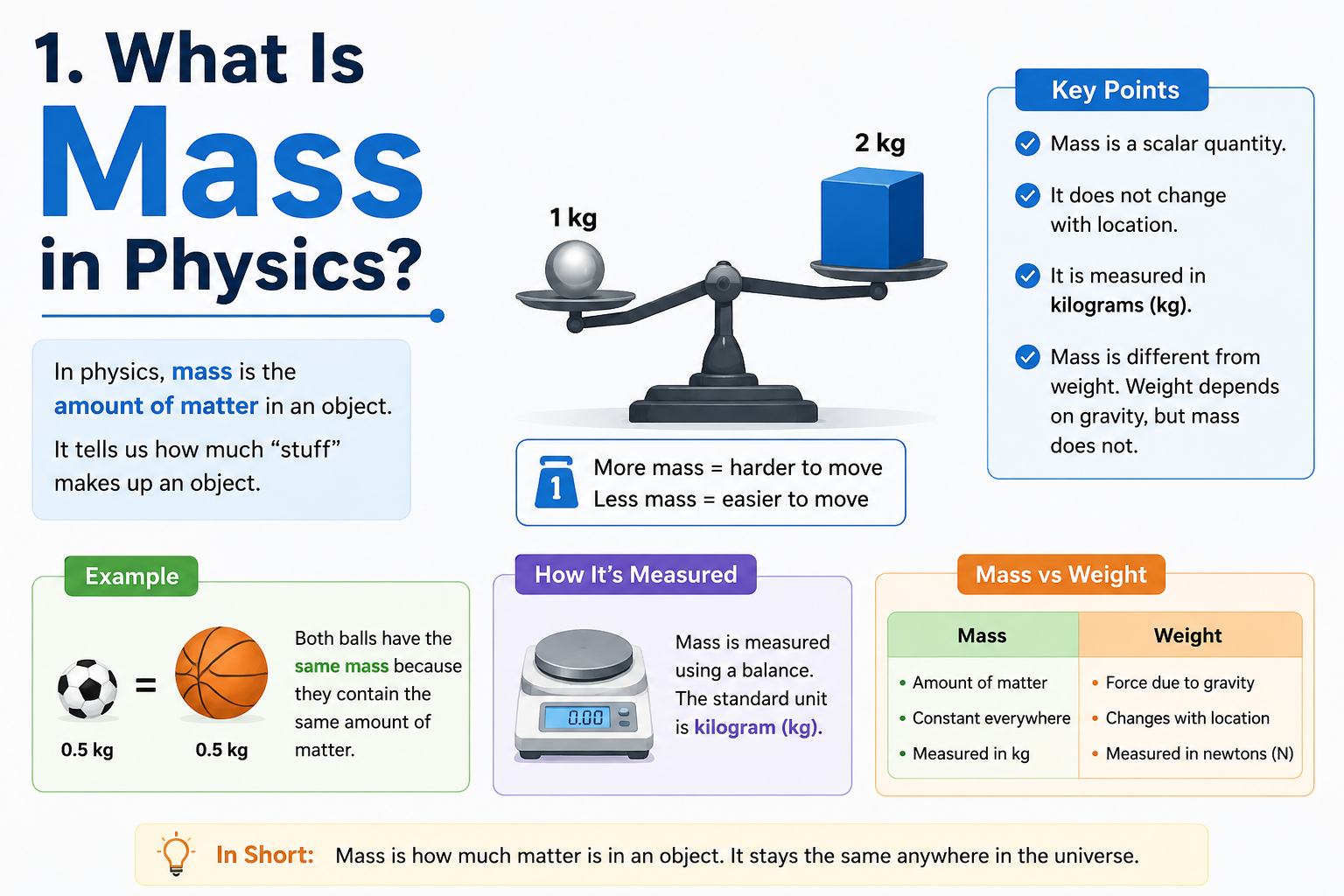
Pick up a tennis ball in one hand and a bowling ball in the other. The difference you feel immediately is not just size. It is the effort required to lift, move, and accelerate each one. The bowling ball resists your push far more than the tennis ball does. That resistance comes from mass. So what is mass in physics? Mass is the measure of the amount of matter contained in an object. It is also a measure of how strongly an object resists changes to its state of motion, a property known as inertia.
Mass is one of the most fundamental quantities in all of physics. It is not the same as weight, even though people often use the two words interchangeably in everyday conversation. Weight is the gravitational force acting on an object and changes depending on where you are in the universe. Mass stays the same whether you are standing on Earth, floating in space, or standing on the Moon.
In this article, you will find a thorough, beginner-friendly guide to mass in physics, covering its definition, SI unit, formula, types, relationship with weight, gravity, energy, and momentum, along with worked examples, practice questions, and much more.
Key Takeaways
-
Mass is the measure of the amount of matter in an object and its resistance to changes in motion (inertia).
-
The SI unit of mass is the kilogram (kg).
-
Mass is a scalar quantity. It has magnitude only and no direction.
-
Mass does not change with location. Weight changes; mass does not.
-
There are two concepts of mass: inertial mass (resistance to acceleration) and gravitational mass (interaction with gravity). These are observed to be equal to a very high degree of precision.
-
Key formula from Newton’s Second Law: m = F / a.
-
Mass connects directly to weight, momentum, kinetic energy, potential energy, and Einstein’s famous equation E = mc².
What Is Mass in Physics?
Mass is defined as the measure of the total amount of matter contained in an object. Every physical object, from a grain of sand to a planet, has mass. The more matter an object contains, the greater its mass.
Mass also has a second, equally important meaning in physics: it is a measure of inertia, which is the resistance of an object to any change in its state of motion. An object at rest tends to stay at rest, and a moving object tends to keep moving, and the strength of that tendency depends directly on its mass.
Here are the key characteristics of mass:
- Mass measures matter: A larger object made of the same material as a smaller one will have greater mass because it contains more matter.
- Mass measures inertia: The more mass an object has, the harder it is to accelerate it from rest, change its speed, or bring it to a stop.
- Mass does not change with location: A 5 kg object on Earth has the same mass of 5 kg on the Moon, in space, or anywhere else in the universe.
- Mass is a scalar quantity: It has only magnitude, not direction. You describe mass with a number and a unit alone.
- Mass is fundamental: Almost every major equation in classical physics involves mass. It appears in Newton’s laws, the equations for momentum, kinetic energy, potential energy, and even Einstein’s most famous equation.
What Is the SI Unit of Mass?
The SI unit of mass is the kilogram (kg). It is one of the seven SI base units from which all other units in the International System of Units are derived.
Since 2019, the kilogram has been defined in terms of the Planck constant, a fixed physical constant, rather than a physical prototype. This makes the definition stable and universally reproducible.
Other commonly used units of mass and their relationships to the kilogram:
- Gram (g): 1 g = 0.001 kg, or equivalently, 1 kg = 1,000 g. Used for small objects such as ingredients in cooking.
- Milligram (mg): 1 mg = 0.000001 kg, or 1 kg = 1,000,000 mg. Used in medicine and for very small quantities.
- Tonne (t): 1 t = 1,000 kg. Used for large objects such as vehicles and bulk goods.
A quick reference for unit conversions:
| Unit | Equivalent in kg |
|---|---|
| 1 milligram (mg) | 0.000001 kg |
| 1 gram (g) | 0.001 kg |
| 1 kilogram (kg) | 1 kg |
| 1 tonne (t) | 1,000 kg |
In everyday life, you encounter mass measured in grams when buying food, kilograms when describing body mass, and tonnes when describing the mass of vehicles or large quantities of materials.
What Is the Formula for Mass?
Mass does not have a single defining formula on its own. Instead, it appears in several fundamental physics equations. The two most commonly used formulas to calculate mass are:
From Newton’s Second Law:
F = ma, rearranged as m = F / a
Where:
- F = net force (newtons, N)
- m = mass (kilograms, kg)
- a = acceleration (m/s²)
Example 1:
A force of 30 N causes an object to accelerate at 6 m/s². What is the mass of the object?
m = F / a
m = 30 / 6
m = 5 kg
From the weight equation:
W = mg, rearranged as m = W / g
Where:
- W = weight (newtons, N)
- m = mass (kilograms, kg)
- g = gravitational acceleration (approximately 9.8 m/s² near Earth’s surface)
Example 2:
An object weighs 196 N on Earth. What is its mass? (g = 9.8 m/s²)
m = W / g
m = 196 / 9.8
m = 20 kg
Both formulas are standard in introductory physics and appear frequently in GCSE, A-Level, and NEET examination questions.
Is Mass a Scalar or Vector Quantity?
Mass is a scalar quantity. This means it has magnitude only and no direction.
To describe the mass of an object, you only need a number and a unit. For example, a bag of rice has a mass of 5 kg. No direction is needed or meaningful.
This contrasts with vector quantities, which require both magnitude and direction. For example:
- Force is a vector: 10 N to the right.
- Velocity is a vector: 15 m/s north.
- Acceleration is a vector: 3 m/s² downward.
Mass, like distance, temperature, and speed, is described completely by its magnitude alone.
This distinction matters in calculations. When you add masses together, you simply add the numbers. There is no need to consider direction, as you would with forces or velocities.
Types of Mass
Physicists distinguish between two conceptually important types of mass. At the level of everyday physics and school examinations, they are numerically equal, but understanding the distinction enriches your understanding of how mass behaves.
Inertial Mass
Inertial mass is the measure of an object’s resistance to acceleration when a force is applied. It comes directly from Newton’s Second Law:
F = ma
The greater the inertial mass, the greater the force required to produce a given acceleration. If you push a light bicycle and a heavy lorry with the same force, the bicycle accelerates far more quickly. The lorry has much greater inertial mass.
Inertial mass is essentially the answer to the question: “How hard is it to change this object’s motion?”
Gravitational Mass
Gravitational mass is a measure of how strongly an object interacts with a gravitational field. It determines how much gravitational force acts on the object:
W = mg
The greater the gravitational mass, the greater the gravitational force acting on the object in a given gravitational field. This is why heavier objects (with more gravitational mass) feel a stronger gravitational pull.
The Equivalence Principle:
One of the most remarkable facts in physics is that inertial mass and gravitational mass are equal to an extraordinarily high degree of precision. This equivalence is not an obvious requirement from either definition, yet experiment after experiment confirms it. Albert Einstein elevated this observation into a cornerstone of his general theory of relativity: the equivalence principle states that the effects of gravity and the effects of acceleration are locally indistinguishable.
For school-level physics, you can treat inertial mass and gravitational mass as the same quantity, because to the precision of all practical measurements, they are.
Mass vs Weight
The confusion between mass and weight is one of the most common errors in introductory physics. They are fundamentally different quantities, even though they are related.
| Feature | Mass | Weight |
|---|---|---|
| Definition | Amount of matter in an object; measure of inertia | Gravitational force acting on an object |
| Scalar or Vector | Scalar | Vector |
| SI Unit | Kilogram (kg) | Newton (N) |
| Formula | m = F/a or m = W/g | W = mg |
| Changes with location | No | Yes |
| Value on Moon vs Earth | Same (e.g., 10 kg on both) | About one-sixth on the Moon compared to Earth |
| Instrument to measure | Beam balance or electronic balance | Spring balance (calibrated in newtons) |
| Example | A person has a mass of 60 kg everywhere | That person weighs 588 N on Earth, about 98 N on the Moon |
Mass is constant. Weight is not. An astronaut with a mass of 80 kg on Earth still has a mass of 80 kg on the Moon. However, their weight on Earth is approximately 784 N (using g = 9.8 m/s²), while on the Moon, where g ≈ 1.62 m/s², their weight is approximately 130 N.
Mass vs Force
Mass and force are related through Newton’s Second Law but are fundamentally different physical quantities.
| Feature | Mass | Force |
|---|---|---|
| Definition | Amount of matter; resistance to acceleration | A push or pull acting on an object |
| Scalar or Vector | Scalar | Vector |
| SI Unit | Kilogram (kg) | Newton (N) |
| Formula | m = F/a | F = ma |
| Can it be zero? | Not for physical objects | Yes (zero net force) |
| Direction | None | Yes, must be specified |
| Example | A 10 kg box | A 50 N push on the box |
Force causes acceleration. Mass resists it. The two quantities are inseparable in Newton’s Second Law, but they are not the same thing.
For a complete guide to force and all its types, the LearnMinto article on What Is Force in Physics? is an ideal resource to read alongside this one.
Mass and Inertia
Inertia is the tendency of an object to resist changes in its state of motion. It is directly related to mass: the greater the mass, the greater the inertia.
Newton’s First Law states that an object at rest stays at rest and an object in motion continues moving at constant velocity unless acted upon by a net external force. The reason objects behave this way is inertia. And the amount of inertia an object has is determined by its mass.
Real-life examples of mass and inertia:
- Bowling ball vs tennis ball: Throw both with the same force. The tennis ball (small mass, low inertia) accelerates far more and reaches a much higher speed. The bowling ball (large mass, high inertia) moves much more slowly.
- Truck vs bicycle: It takes much longer to stop a moving lorry than a moving bicycle, even if both are travelling at the same speed, because the lorry has far greater inertia.
- Heavy box vs light box: A light box on the floor is easy to slide across the room. A heavy box with the same coefficient of friction resists your push much more strongly.
An important clarification: inertia is not a force. It is a property of matter. Forces cause changes in motion. Inertia describes the resistance to those changes.
Mass and Newton’s Second Law
Newton’s Second Law establishes the direct mathematical relationship between mass, force, and acceleration:
F = ma
Rearranged to find mass:
m = F / a
This equation tells you that for a given net force, increasing the mass reduces the acceleration, and reducing the mass increases the acceleration.
Example 1:
A net force of 20 N acts on a 4 kg object. What is the acceleration?
a = F / m = 20 / 4 = 5 m/s²
Example 2:
The same force of 20 N now acts on an 8 kg object.
a = F / m = 20 / 8 = 2.5 m/s²
Doubling the mass halved the acceleration. This inverse relationship between mass and acceleration is one of the most tested ideas in school physics.
Mass and Gravity
Mass and gravity are deeply connected. The gravitational force acting on an object depends on its mass:
W = mg
Where:
- W = weight in newtons (N)
- m = mass in kilograms (kg)
- g = gravitational acceleration (approximately 9.8 m/s² near Earth’s surface)
The greater the mass, the greater the gravitational force. This is why heavier objects feel heavier on a scale.
Example:
A person has a mass of 70 kg. Calculate their weight on Earth and on the Moon.
On Earth (g = 9.8 m/s²):
W = mg = 70 × 9.8 = 686 N
On the Moon (g ≈ 1.62 m/s²):
W = mg = 70 × 1.62 = 113.4 N
The person’s mass is 70 kg in both locations. Their weight is very different because the gravitational acceleration is different.
This distinction is one of the most practically important in physics. Spacecraft designers must account for the difference between mass and weight when planning missions to different planets or moons.
For a thorough understanding of gravitational force and how it works, the LearnMinto article on What Is Gravity? covers the topic in full.
Mass and Density
Density is the amount of mass per unit volume of a material. The relationship is:
ρ = m / V
Where:
- ρ = density (kg/m³)
- m = mass (kg)
- V = volume (m³)
Rearranging to find mass:
m = ρ × V
Example:
A block of aluminium has a density of 2,700 kg/m³ and a volume of 0.002 m³. What is its mass?
m = ρ × V
m = 2,700 × 0.002
m = 5.4 kg
Density and mass are related but not the same. A large balloon filled with air and a small block of lead can have the same mass, but the lead has a far greater density because its mass is packed into a much smaller volume.
Mass and Momentum
Momentum is the product of mass and velocity. The more mass an object has, or the faster it moves, the greater its momentum:
p = mv
Where:
- p = momentum (kg·m/s)
- m = mass (kg)
- v = velocity (m/s)
Example:
A 1,200 kg car moves at 15 m/s. What is its momentum?
p = mv = 1,200 × 15
p = 18,000 kg·m/s
A heavier object moving at the same speed has greater momentum and is therefore harder to stop. This is why large vehicles require significantly longer stopping distances than lighter ones.
Mass and Kinetic Energy
Kinetic energy is the energy an object possesses due to its motion. It depends on both mass and velocity:
KE = ½ mv²
Where:
- KE = kinetic energy (joules, J)
- m = mass (kg)
- v = velocity (m/s)
Example:
A 2 kg ball moves at 10 m/s. What is its kinetic energy?
KE = ½ × 2 × 10²
KE = ½ × 2 × 100
KE = 100 J
Doubling the mass doubles the kinetic energy. Doubling the speed quadruples the kinetic energy, because velocity is squared. This is why speed has such a large effect on the energy of moving vehicles.
Mass and Potential Energy
Gravitational potential energy is the energy stored in an object due to its height above a reference point. It depends directly on mass:
PE = mgh
Where:
- PE = gravitational potential energy (joules, J)
- m = mass (kg)
- g = gravitational acceleration (m/s²)
- h = height above the reference point (m)
Example:
A 5 kg object is lifted to a height of 3 m. g = 9.8 m/s². What is its gravitational potential energy?
PE = mgh
PE = 5 × 9.8 × 3
PE = 147 J
Greater mass at the same height stores more gravitational potential energy. This is why a heavy boulder released from a height delivers far more energy than a small stone dropped from the same height.
Mass and Pressure
Pressure is force per unit area. Since weight is a force that depends on mass, mass indirectly affects pressure.
P = F / A = W / A = mg / A
Where:
- P = pressure (pascals, Pa)
- F = force (newtons, N)
- A = area (m²)
A heavier object (greater mass) exerts greater weight, which increases the pressure on the surface beneath it, assuming the contact area is the same. This is why a heavy person exerts more pressure on the floor than a light person standing on the same area.
For a full treatment of pressure and how it relates to force and area, the LearnMinto article on What Is Pressure in Physics? provides clear explanations and practical examples.
How Is Mass Measured?
Mass is measured using balances rather than scales that rely on gravity. There are three main instruments used in practice:
Beam balance:
A beam balance compares the unknown mass on one side against known reference masses on the other side. Because both sides experience the same gravitational acceleration, the comparison is valid regardless of location. A beam balance on the Moon gives the same reading as on Earth. This is the most direct measurement of mass.
Electronic balance:
A modern electronic balance uses load cells to measure the force exerted by the object and converts this to a mass reading using the local gravitational acceleration. These are calibrated for Earth’s gravity and are very accurate in laboratory settings.
Spring balance:
A spring balance actually measures weight (force), not mass. It extends by an amount proportional to the force (weight) acting on it. The scale is then converted to a mass reading using the assumption that g = 9.8 m/s². If you used a spring balance calibrated on Earth to measure an object on the Moon, it would give an incorrect mass reading because the gravitational acceleration is different. A beam balance would still give the correct result.
This distinction between measuring mass and measuring weight is tested in many physics examinations.
Mass in Different Contexts
Mass in Everyday Life
Mass is encountered constantly in daily life, often without explicit recognition:
- Cooking: Recipes specify ingredients in grams. A cake recipe might call for 200 g of flour, 150 g of sugar, and 100 g of butter.
- Buying goods: Supermarket items are sold by mass in kilograms. You buy 1 kg of apples or 500 g of cheese.
- Vehicles: A standard car has a mass of approximately 1,200 to 1,800 kg. A lorry might have a mass of 20,000 kg or more.
- Sports: In athletics, implements such as the shot put, hammer, and discus have specified masses for competition.
Mass in Science and Engineering
Mass plays a central role in professional and scientific contexts:
- Engineering design: Structural engineers calculate the mass of materials used in buildings and bridges to ensure loads are safely supported.
- Space science: Every kilogram of mass launched into orbit requires enormous amounts of fuel. Mass budget is a critical constraint in spacecraft design.
- Medicine: Body mass index (BMI) uses mass in kilograms and height in metres to provide a simple measure of body composition.
- Chemistry: Molar mass relates the mass of a substance to the number of moles of atoms or molecules it contains, which is fundamental to stoichiometry and chemical calculations.
- Physics calculations: Mass appears in virtually every fundamental equation of classical mechanics, thermodynamics, and modern physics.
Conservation of Mass
The law of conservation of mass states that in a closed system, the total mass remains constant over time. Matter is neither created nor destroyed during physical or chemical processes in classical physics.
For example, if you burn wood, the mass of the wood appears to disappear, but the ash, gases, and water vapour produced together have the same total mass as the original wood plus the oxygen consumed in the reaction.
In classical physics, conservation of mass is a reliable principle for everyday calculations. At the level of special relativity and nuclear physics, mass and energy are interconvertible, as described by E = mc². The more complete statement is the conservation of mass-energy rather than mass alone. However, for all everyday physical and chemical processes, the classical conservation of mass provides an excellent and highly accurate model.
Mass and Einstein’s Mass-Energy Equivalence
One of the most famous equations in all of science is:
E = mc²
Where:
- E = energy (joules, J)
- m = mass (kg)
- c = speed of light in a vacuum (approximately 3 × 10⁸ m/s)
This equation, derived by Albert Einstein as part of his special theory of relativity, states that mass and energy are equivalent and interconvertible. A small amount of mass corresponds to an enormous amount of energy because c² is an astronomically large number (approximately 9 × 10¹⁶ m²/s²).
The equation tells us that mass is a form of stored energy. Conversely, energy has an associated mass. At everyday speeds and energy scales, this equivalence is imperceptibly small and has no practical effect on classical mechanics calculations.
E = mc² becomes significant in the context of nuclear physics and particle physics, where measurable amounts of mass convert to energy or vice versa. However, a beginner-friendly takeaway is simply this: mass and energy are two aspects of the same fundamental quantity, and mass carries an extraordinary amount of latent energy.
Common Misconceptions About Mass
Understanding what mass is not helps solidify what it is:
- Confusing mass with weight. Mass is the amount of matter (kg). Weight is the gravitational force on that mass (N). They are related but not the same.
- Thinking mass changes with location. Mass is constant everywhere. Only weight changes with location because it depends on the local gravitational acceleration.
- Thinking heavier objects fall faster. In an ideal vacuum, all objects fall with the same gravitational acceleration (g ≈ 9.8 m/s²) regardless of their mass. Air resistance causes differences in real-world falling, but that is a separate effect.
- Confusing mass with size or volume. A large balloon has great volume but very little mass. A small lead weight has small volume but significant mass. Mass and size are completely different.
- Confusing mass with density. Density is mass per unit volume. Two objects with the same mass can have very different densities if their volumes differ.
- Thinking mass has direction. Mass is a scalar with no direction. You never say “5 kg upward.” Mass simply is 5 kg.
- Treating inertial and gravitational mass as if they behave differently in everyday problems. At school level and for all everyday calculations, they are equal. Use them as a single quantity.
How to Calculate Mass
Example 1: Using m = F / a
A net force of 45 N accelerates an object at 9 m/s². Find the mass.
m = F / a
m = 45 / 9
m = 5 kg
Example 2: Using m = W / g
An object weighs 294 N on Earth. g = 9.8 m/s². Find the mass.
m = W / g
m = 294 / 9.8
m = 30 kg
Example 3: Using m = ρ × V
A block of iron has a density of 7,874 kg/m³ and a volume of 0.001 m³. Find the mass.
m = ρ × V
m = 7,874 × 0.001
m = 7.874 kg
Example 4: Using m = p / v
An object has a momentum of 120 kg·m/s and moves at 6 m/s. Find the mass.
m = p / v
m = 120 / 6
m = 20 kg
Example 5: Using KE = ½ mv², rearranged for mass
An object has kinetic energy of 200 J and moves at 10 m/s. Find the mass.
KE = ½ mv²
200 = ½ × m × 10²
200 = ½ × m × 100
200 = 50m
m = 200 / 50
m = 4 kg
Important Mass Formulas
| Formula | Meaning | Variables | SI Unit of Result |
|---|---|---|---|
| m = F / a | Mass from Newton’s Second Law | F = force (N), a = acceleration (m/s²) | kg |
| m = W / g | Mass from weight and gravity | W = weight (N), g = gravitational acceleration (m/s²) | kg |
| m = ρ × V | Mass from density and volume | ρ = density (kg/m³), V = volume (m³) | kg |
| p = mv | Momentum (rearrange for m = p/v) | p = momentum (kg·m/s), v = velocity (m/s) | kg |
| KE = ½ mv² | Kinetic energy (rearrange for m) | KE = kinetic energy (J), v = velocity (m/s) | kg |
| PE = mgh | Gravitational potential energy | g = gravitational acceleration (m/s²), h = height (m) | kg (when rearranged) |
| E = mc² | Mass-energy equivalence | E = energy (J), c = speed of light (m/s) | kg (when rearranged) |
Mass Practice Questions
20 Multiple Choice Questions
Question 1: What is the SI unit of mass?
- A) Newton
- B) Joule
- C) Kilogram
- D) Pascal
Correct Answer: C) Kilogram
Explanation: The kilogram (kg) is the SI base unit of mass.
Question 2: Which of the following correctly describes mass?
- A) The gravitational force on an object
- B) The amount of matter in an object
- C) The volume of an object
- D) The speed of an object
Correct Answer: B) The amount of matter in an object
Explanation: Mass measures the quantity of matter contained in an object.
Question 3: A force of 60 N causes an object to accelerate at 3 m/s². What is the mass of the object?
- A) 180 kg
- B) 63 kg
- C) 57 kg
- D) 20 kg
Correct Answer: D) 20 kg
Explanation: m = F/a = 60/3 = 20 kg.
Question 4: Is mass a scalar or vector quantity?
- A) Vector
- B) Scalar
- C) Both
- D) Neither
Correct Answer: B) Scalar
Explanation: Mass has magnitude only and no direction. It is a scalar quantity.
Question 5: What is the weight of a 10 kg object on Earth? (g = 9.8 m/s²)
- A) 1.02 N
- B) 10 N
- C) 98 N
- D) 9.8 kg
Correct Answer: C) 98 N
Explanation: W = mg = 10 × 9.8 = 98 N.
Question 6: An astronaut has a mass of 75 kg on Earth. What is their mass on the Moon?
- A) 75 kg
- B) 12.5 kg
- C) 450 kg
- D) 735 N
Correct Answer: A) 75 kg
Explanation: Mass does not change with location. The astronaut’s mass remains 75 kg on the Moon.
Question 7: Which instrument directly measures mass regardless of gravitational field?
- A) Spring balance
- B) Thermometer
- C) Beam balance
- D) Barometer
Correct Answer: C) Beam balance
Explanation: A beam balance compares masses and gives a correct reading regardless of the local gravitational field.
Question 8: What is the formula for momentum?
- A) p = ma
- B) p = mv
- C) p = mg
- D) p = F/a
Correct Answer: B) p = mv
Explanation: Momentum equals mass multiplied by velocity.
Question 9: A 5 kg object moves at 4 m/s. What is its kinetic energy?
- A) 20 J
- B) 80 J
- C) 40 J
- D) 10 J
Correct Answer: C) 40 J
Explanation: KE = ½ mv² = ½ × 5 × 16 = 40 J.
Question 10: Which type of mass measures resistance to acceleration?
- A) Gravitational mass
- B) Atomic mass
- C) Inertial mass
- D) Molar mass
Correct Answer: C) Inertial mass
Explanation: Inertial mass is defined by how much an object resists changes in its motion.
Question 11: An object has a weight of 490 N on Earth. g = 9.8 m/s². What is its mass?
- A) 490 kg
- B) 4,802 kg
- C) 50 kg
- D) 5 kg
Correct Answer: C) 50 kg
Explanation: m = W/g = 490/9.8 = 50 kg.
Question 12: What is the relationship between mass and acceleration at constant force?
- A) Directly proportional
- B) Inversely proportional
- C) No relationship
- D) Exponential
Correct Answer: B) Inversely proportional
Explanation: From F = ma, at constant F, acceleration decreases as mass increases.
Question 13: A block has a density of 3,000 kg/m³ and a volume of 0.002 m³. What is its mass?
- A) 1,500 kg
- B) 6 kg
- C) 3,002 kg
- D) 0.6 kg
Correct Answer: B) 6 kg
Explanation: m = ρ × V = 3,000 × 0.002 = 6 kg.
Question 14: Which equation represents mass-energy equivalence?
- A) F = ma
- B) W = mg
- C) E = mc²
- D) p = mv
Correct Answer: C) E = mc²
Explanation: Einstein’s mass-energy equivalence is expressed as E = mc².
Question 15: What is the gravitational potential energy of a 4 kg object at a height of 5 m? (g = 10 m/s²)
- A) 20 J
- B) 200 J
- C) 40 J
- D) 2 J
Correct Answer: B) 200 J
Explanation: PE = mgh = 4 × 10 × 5 = 200 J.
Question 16: Which of the following changes when you move from Earth to the Moon?
- A) Mass
- B) Weight
- C) Amount of matter
- D) Inertia
Correct Answer: B) Weight
Explanation: Weight depends on the local gravitational field, so it changes with location. Mass stays the same.
Question 17: An object has KE = 500 J and moves at 10 m/s. What is its mass?
- A) 50 kg
- B) 5 kg
- C) 10 kg
- D) 100 kg
Correct Answer: C) 10 kg
Explanation: KE = ½mv², so 500 = ½ × m × 100, giving m = 1000/100 = 10 kg.
Question 18: Why is it harder to stop a moving lorry than a moving bicycle at the same speed?
- A) The lorry has more volume
- B) The lorry has greater inertia due to greater mass
- C) The lorry has more air resistance
- D) The bicycle has greater weight
Correct Answer: B) The lorry has greater inertia due to greater mass
Explanation: Greater mass means greater inertia, which is greater resistance to changes in motion.
Question 19: What is 1 tonne equal to in kilograms?
- A) 100 kg
- B) 10 kg
- C) 10,000 kg
- D) 1,000 kg
Correct Answer: D) 1,000 kg
Explanation: 1 tonne = 1,000 kg.
Question 20: An object has momentum of 60 kg·m/s and velocity of 5 m/s. What is its mass?
- A) 300 kg
- B) 55 kg
- C) 12 kg
- D) 65 kg
Correct Answer: C) 12 kg
Explanation: m = p/v = 60/5 = 12 kg.
10 Short Answer Questions
Q1: Define mass in physics.
Mass is the measure of the amount of matter in an object. It is also a measure of an object’s inertia, or resistance to changes in its state of motion. It is measured in kilograms (kg) and is a scalar quantity.
Q2: What is the difference between mass and weight?
Mass is the amount of matter in an object, measured in kilograms, and does not change with location. Weight is the gravitational force on that mass, measured in newtons, and changes depending on the local gravitational acceleration.
Q3: A net force of 36 N accelerates an object at 4 m/s². Calculate the mass.
m = F/a = 36/4 = 9 kg
Q4: Why does mass not change with location?
Mass measures the amount of matter in an object, which is a fixed quantity. It does not depend on gravity, location, or any external conditions.
Q5: What is inertial mass?
Inertial mass is the measure of an object’s resistance to acceleration. It is defined by Newton’s Second Law: F = ma. A larger inertial mass requires a greater force to produce the same acceleration.
Q6: An object has a density of 1,000 kg/m³ and volume of 0.05 m³. Calculate its mass.
m = ρ × V = 1,000 × 0.05 = 50 kg
Q7: How does mass relate to kinetic energy?
KE = ½mv². Kinetic energy is directly proportional to mass. Doubling the mass doubles the kinetic energy at the same speed.
Q8: What does E = mc² tell us about mass?
It tells us that mass and energy are interrelated. A small amount of mass corresponds to an enormous amount of energy because c² (speed of light squared) is a very large number.
Q9: A 20 kg object is lifted 4 m high on Earth. g = 9.8 m/s². Calculate its gravitational potential energy.
PE = mgh = 20 × 9.8 × 4 = 784 J
Q10: Why does a beam balance measure mass correctly on the Moon while a spring balance calibrated on Earth does not?
A beam balance compares two masses experiencing the same gravitational field. The comparison is valid regardless of the value of g. A spring balance measures force (weight) and converts it to mass using Earth’s g value. On the Moon, where g is different, this conversion gives an incorrect mass reading.
5 Numerical Problems
Problem 1:
A 15 kg trolley is pushed with a force of 90 N. Calculate the acceleration.
Solution:
a = F/m = 90/15
a = 6 m/s²
Problem 2:
An object weighs 637 N on Earth. g = 9.8 m/s². Calculate the mass and then find its weight on the Moon. (g_Moon = 1.62 m/s²)
Solution:
m = W/g = 637/9.8 = 65 kg
Weight on Moon = mg = 65 × 1.62 = 105.3 N
Problem 3:
A copper block has a density of 8,960 kg/m³ and a volume of 0.003 m³. Calculate the mass and weight. (g = 9.8 m/s²)
Solution:
m = ρ × V = 8,960 × 0.003 = 26.88 kg
W = mg = 26.88 × 9.8 = 263.4 N
Problem 4:
An object of mass 8 kg moves at 6 m/s. Calculate its momentum and kinetic energy.
Solution:
p = mv = 8 × 6 = 48 kg·m/s
KE = ½mv² = ½ × 8 × 36 = 144 J
Problem 5:
An object has kinetic energy of 360 J and moves at 12 m/s. Find its mass.
Solution:
KE = ½mv²
360 = ½ × m × 144
360 = 72m
m = 360/72
m = 5 kg
5 Exam-Style Questions
Question 1:
Explain why an astronaut has the same mass on the Moon as on Earth but a different weight.
Answer: Mass measures the amount of matter in the astronaut’s body. This quantity does not change regardless of location because the number of atoms in the astronaut’s body remains the same. Weight, however, is the gravitational force acting on that mass: W = mg. On the Moon, the gravitational acceleration (g ≈ 1.62 m/s²) is much smaller than on Earth (g ≈ 9.8 m/s²). Since weight depends on g, and g is different on the Moon, the astronaut’s weight is approximately one-sixth of their Earth weight, even though their mass is unchanged.
Question 2:
A car of mass 1,500 kg accelerates from 0 to 30 m/s in 10 seconds. Calculate the net force required.
Answer:
Acceleration: a = Δv/Δt = (30 − 0)/10 = 3 m/s²
Net force: F = ma = 1,500 × 3 = 4,500 N
Question 3:
Explain the difference between inertial mass and gravitational mass, and state their observed relationship.
Answer: Inertial mass is the measure of an object’s resistance to acceleration when a force is applied, defined through Newton’s Second Law (F = ma). Gravitational mass is the measure of how strongly an object interacts with a gravitational field, appearing in the weight equation (W = mg). Although they are defined differently, experiments to very high precision have shown that inertial mass and gravitational mass are equal for any given object. This equivalence is a foundational principle in Einstein’s general theory of relativity.
Question 4:
A student claims: “Because a feather has less mass than a rock, the rock will always fall faster.” Evaluate this claim.
Answer: This claim is incorrect in the context of ideal free fall. In a vacuum with no air resistance, all objects fall with the same gravitational acceleration (g ≈ 9.8 m/s²), regardless of their mass. A feather and a rock dropped simultaneously in a vacuum would reach the ground at the same time. The student is likely observing the effect of air resistance, which disproportionately slows down a light, large-surface-area object like a feather compared to a dense, compact rock. Air resistance is a separate effect and is not a consequence of mass alone.
Question 5:
A 3 kg object is placed on a shelf 5 m above the ground. g = 9.8 m/s². Calculate its gravitational potential energy. If it then falls to the ground, calculate its speed just before impact, assuming no air resistance.
Answer:
PE = mgh = 3 × 9.8 × 5 = 147 J
At the ground, all PE converts to KE:
KE = 147 J
½mv² = 147
½ × 3 × v² = 147
1.5v² = 147
v² = 98
v = √98
v ≈ 9.9 m/s
Exam Tips
- Define mass clearly: It is the amount of matter in an object and a measure of inertia. Avoid confusing it with weight.
- Know the SI unit: Kilogram (kg). Never write mass in newtons.
- Mass vs weight is a guaranteed exam question: Mass is constant (kg, scalar). Weight changes with location (N, vector, W = mg).
- Mass is scalar: Never include direction in a mass answer.
- Inertial vs gravitational mass: At school level, treat them as equal. Know what each one means conceptually.
- Memorise the key formulas: m = F/a, m = W/g, m = ρV, p = mv, KE = ½mv², PE = mgh.
- In calculations, always identify which formula is relevant before substituting. A common error is using the wrong formula for the situation.
- E = mc² is for modern physics context: At school level, understand what it means conceptually. Do not use it in classical mechanics calculations.
- Beam balance vs spring balance: Know which measures mass directly and which measures weight.
Quick Revision Notes
- Mass = amount of matter in an object = measure of inertia.
- SI unit: kilogram (kg). Other units: gram (g), milligram (mg), tonne (t).
- Mass is a scalar: magnitude only, no direction.
- Mass does not change with location. Weight does.
- Two types: inertial mass (resistance to acceleration) and gravitational mass (interaction with gravity). They are equal in practice.
- Weight = mg (newtons). Mass = W/g or F/a (kilograms).
- Mass and inertia: greater mass = greater resistance to motion change.
- Newton’s Second Law: F = ma → m = F/a.
- Density: ρ = m/V → m = ρV.
- Momentum: p = mv → m = p/v.
- Kinetic energy: KE = ½mv².
- Potential energy: PE = mgh.
- E = mc²: mass and energy are interconvertible.
- Conservation of mass: in classical physics, mass is conserved in closed systems.
- Beam balance measures mass. Spring balance measures weight.
Mass Cheat Sheet
| Concept | Definition | Formula | Unit | Example |
|---|---|---|---|---|
| Mass | Amount of matter; measure of inertia | m = F/a or m = W/g | kg | A 5 kg box |
| Weight | Gravitational force on a mass | W = mg | N | 5 kg box weighs 49 N on Earth |
| Inertial Mass | Resistance to acceleration | m = F/a | kg | Heavy lorry hard to accelerate |
| Gravitational Mass | Interaction with gravity | m = W/g | kg | Object pulled toward Earth |
| Density and Mass | Mass per unit volume | m = ρV | kg | Iron block calculation |
| Momentum and Mass | Product of mass and velocity | p = mv | kg·m/s | Moving car momentum |
| Kinetic Energy | Energy due to motion | KE = ½mv² | J | Ball rolling down slope |
| Potential Energy | Stored energy due to height | PE = mgh | J | Object on a shelf |
| Mass-Energy | Equivalence of mass and energy | E = mc² | J | Nuclear context |
Frequently Asked Questions
1. What is mass in physics?
Mass is the measure of the amount of matter in an object. It is also a measure of inertia, the resistance to changes in motion. It is measured in kilograms and is a scalar quantity.
2. What is the SI unit of mass?
The SI unit of mass is the kilogram (kg).
3. Is mass a scalar or vector quantity?
Mass is a scalar quantity. It has magnitude only and no direction.
4. What is the difference between mass and weight?
Mass is the amount of matter (kg, constant everywhere). Weight is the gravitational force on that mass (N, changes with location). W = mg.
5. Does mass change with location?
No. Mass is constant regardless of where an object is in the universe. Weight changes because it depends on the local gravitational acceleration.
6. What is inertial mass?
Inertial mass is the measure of an object’s resistance to acceleration. It is defined through F = ma. Greater inertial mass means a greater force is needed to produce the same acceleration.
7. What is gravitational mass?
Gravitational mass determines how strongly an object interacts with a gravitational field. It appears in W = mg. Greater gravitational mass means a greater gravitational force.
8. What is the formula for mass?
The most common formulas are m = F/a (from Newton’s Second Law) and m = W/g (from the weight equation). Others include m = ρV, m = p/v, and rearrangements of KE = ½mv².
9. How is mass measured?
Mass is most accurately measured with a beam balance, which compares masses and works correctly regardless of location. Electronic balances are also used but are calibrated for Earth’s gravity.
10. What is the difference between mass and density?
Mass is the total amount of matter in an object (kg). Density is how much mass is packed into a given volume (kg/m³). They are related by ρ = m/V.
11. What is the difference between mass and volume?
Mass measures how much matter an object contains. Volume measures how much space it occupies. A balloon has large volume but small mass. A lead block has small volume but large mass.
12. How does mass relate to force and acceleration?
From Newton’s Second Law, F = ma. For a given force, greater mass produces smaller acceleration. For a given mass, greater force produces greater acceleration.
13. How does mass affect kinetic energy?
KE = ½mv². Kinetic energy is directly proportional to mass. At the same speed, doubling the mass doubles the kinetic energy.
14. What is E = mc²?
It is Einstein’s mass-energy equivalence equation. It states that mass and energy are interconvertible, with c being the speed of light. A small amount of mass corresponds to an enormous amount of energy.
15. Can mass be zero?
In classical physics, no ordinary physical object has zero mass. In particle physics, photons (particles of light) have zero rest mass, but this is a concept beyond the scope of introductory school physics.
Summary
Mass is one of the most fundamental quantities in physics. It is the measure of the amount of matter in an object and also a measure of inertia, the resistance to changes in motion. The SI unit of mass is the kilogram (kg), and mass is a scalar quantity with no direction.
Mass remains constant regardless of location, unlike weight, which depends on the local gravitational acceleration (W = mg). The two main types of mass, inertial mass and gravitational mass, are equal to a very high degree of precision.
Mass connects directly to force through Newton’s Second Law (F = ma), to momentum (p = mv), to kinetic energy (KE = ½mv²), to potential energy (PE = mgh), and to Einstein’s mass-energy equivalence (E = mc²). Understanding mass is therefore essential for understanding almost every major topic in classical and modern physics.
Final Thoughts
Mass is not just a number on a scale. It is a fundamental property of matter that connects force, motion, energy, and gravity in a single coherent framework. When you understand what mass is in physics, you understand why some objects are harder to move than others, why your weight would change on the Moon while your mass would not, why a moving lorry is so difficult to stop, and why the universe behaves the way it does at every scale from atoms to galaxies.
Take the time to distinguish mass from weight, understand its role in every major formula it appears in, and practise calculating it from different starting points. These skills will serve you throughout your study of physics and provide a solid foundation for everything from simple mechanics to the most advanced ideas in modern science.
References
- OpenStax. University Physics Volume 1 – Chapter 5: Newton’s Laws of Motion. OpenStax, Rice University. Available at: https://openstax.org/books/university-physics-volume-1/pages/5-introduction
- Physics LibreTexts. Mass and Weight. LibreTexts Physics. Available at: https://phys.libretexts.org/Bookshelves/University_Physics/Book%3A_University_Physics_(OpenStax)/Book%3A_University_Physics_I_-Mechanics_Sound_Oscillations_and_Waves(OpenStax)/05%3A_Newton’s_Laws_of_Motion/5.04%3A_Mass_and_Weight
- Khan Academy. Mass, Weight and Gravity. Khan Academy Physics. Available at: https://www.khanacademy.org/science/physics/forces-newtons-laws/normal-contact-force/a/what-is-weight
- Encyclopaedia Britannica. Mass – Physics. Britannica. Available at: https://www.britannica.com/science/mass-physics
- The Physics Classroom. Mass and Weight. The Physics Classroom. Available at: https://www.physicsclassroom.com/class/newtlaws/Lesson-2/Mass-and-Weight
- National Institute of Standards and Technology (NIST). SI Base Units – Kilogram. NIST. Available at: https://www.nist.gov/pml/owm/metric-si/si-units
Disclaimer
This article is intended for educational and informational purposes only. While LearnMinto strives to provide accurate and up-to-date information, readers should verify important academic concepts through official textbooks, educational institutions, examination boards, or trusted scientific resources before relying on this content for exams or academic purposes. LearnMinto is not affiliated with any specific school, university, research institution, or examination board.