
Introduction
If you have ever watched an ice cube melt into water and then seen steam rise from a boiling pot, you have already witnessed three states of matter right there in your kitchen. Matter is everything around us — every object you can touch, every liquid you can pour, and every gas you breathe. Understanding how matter behaves in its different forms is one of the most fundamental things you will ever learn in chemistry, and honestly, it connects to nearly every other topic in the subject.
This states of matter study guide was written with one goal in mind: to give you everything you need in one place. Whether you are a high school student preparing for your end-of-year exam, a pre-med student reviewing physical chemistry, or simply someone who wants to understand the world a little better, this guide has you covered. We will walk through the particle model of matter, kinetic molecular theory, properties of all four states — solid, liquid, gas, and plasma — and then go deep into phase changes, heating curves, cooling curves, and phase diagrams.
By the time you reach the end of this guide, you should feel genuinely confident about these concepts. There are comparison tables to organize your thinking, diagrams described in plain language, and 55 practice questions so you can test yourself before any exam. We have also included a revision checklist, a glossary of key terms, and practical real-life examples because chemistry is not just something that happens in a lab — it is happening everywhere, all the time.
Let us start from the very beginning and build a solid understanding together.
Key Takeaways
- Matter exists in four main states: solid, liquid, gas, and plasma.
- The state of a substance depends on how its particles are arranged and how much energy they possess.
- Kinetic Molecular Theory explains the behavior of particles in each state using the concept of energy and motion.
- Changes between states — such as melting, boiling, sublimation, and condensation — involve energy transfer without a change in temperature during the transition.
- Plasma is the most common state of matter in the universe, even though it is rarely encountered in everyday life on Earth.
- Phase diagrams map out the conditions of temperature and pressure under which a substance exists as a solid, liquid, or gas.
- Understanding states of matter is essential for chemistry, physics, biology, engineering, and environmental science.
What Are the States of Matter?
Matter is anything that has mass and takes up space. From the air you breathe to the chair you are sitting on right now, everything is made of matter. The state of matter refers to the physical form that matter takes — and it is determined primarily by the arrangement of particles and the energy those particles possess.
Traditionally, chemistry courses introduce three states of matter: solid, liquid, and gas. These are the three that you will encounter most often in your everyday life. However, there is a fourth state — plasma — which is actually the most abundant form of matter in the entire universe. Stars, including our own sun, are made almost entirely of plasma. We rarely interact with plasma in daily life, but it is absolutely worth understanding.
The state that any substance adopts at a given moment depends on two main factors: temperature and pressure. Change the temperature, and a solid can become a liquid. Change the pressure, and a gas can be forced into a liquid state. This flexibility is what makes states of matter such a rich and interesting topic.
Why States of Matter Are Important
You might be wondering why this topic deserves such attention in chemistry. The answer is simple — it underpins almost every other concept you will study.
Here is why states of matter matter:
- Industrial processes like distillation, crystallization, and gas compression rely on understanding how substances behave in different states.
- Medical applications such as the use of liquid oxygen in hospitals or the behavior of gases in the lungs depend on this knowledge.
- Environmental science topics like the water cycle, cloud formation, and the behavior of greenhouse gases are all rooted in state changes.
- Engineering relies heavily on understanding thermal expansion, phase transitions, and the behavior of materials under pressure.
- Cooking involves constant phase changes — boiling, steaming, melting chocolate, and freezing ice cream are all practical demonstrations.
If you understand states of matter deeply, you will find that many other chemistry topics start to click much more naturally.
Kinetic Molecular Theory Explained
Kinetic Molecular Theory, often abbreviated as KMT, is the framework that explains why matter behaves the way it does in each of its states. The word “kinetic” comes from the Greek word meaning motion, and that is precisely what this theory is about — the motion of particles.
Here are the core ideas behind KMT:
- All matter is made of particles — atoms, molecules, or ions — that are in constant motion.
- The energy of these particles determines the state of the substance. More energy means more motion.
- Particles in a gas move fast and randomly, traveling in straight lines until they collide with something.
- Particles in a liquid move around each other, but they are still in close proximity and attract one another.
- Particles in a solid vibrate in fixed positions — they move, but they do not travel from place to place.
- Temperature is a measure of the average kinetic energy of particles. A higher temperature means particles are moving faster on average.
- In an ideal gas, there are no intermolecular forces between particles, and the particles themselves occupy no volume. Real gases deviate from this ideal behavior, especially at high pressures and low temperatures.
KMT is elegant because it connects the invisible world of particles to the visible, measurable properties we observe in the lab — things like pressure, volume, temperature, and diffusion rates.
Particle Model of Matter
The particle model of matter is a simplified version of KMT designed for students who are just beginning to explore chemistry. It uses these core assumptions:
- All matter is made up of tiny particles.
- These particles are always moving.
- There are forces of attraction between particles.
- Particles have spaces between them.
- The amount of space and the degree of movement depend on the state of the substance.
Particle Arrangement by State:
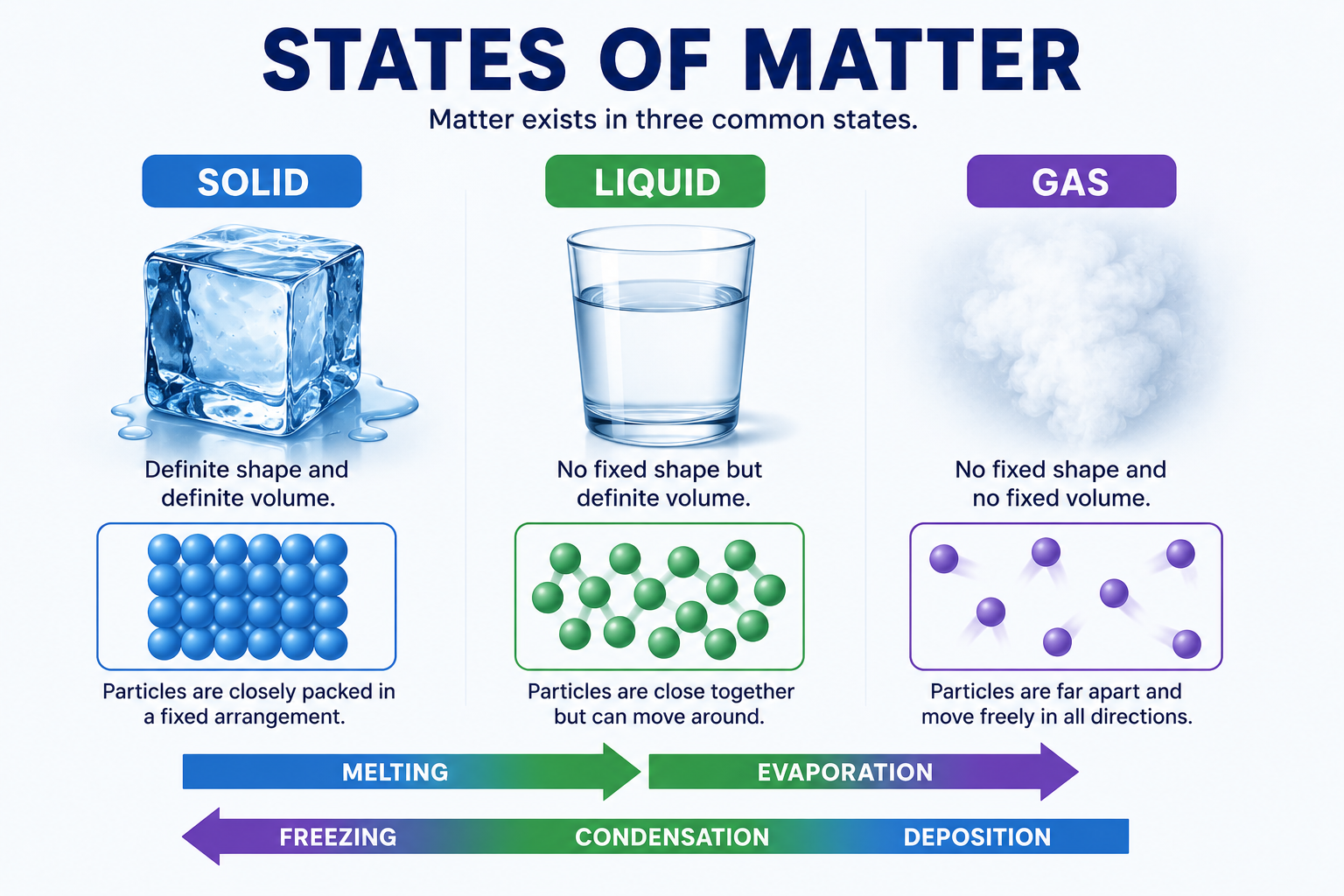
In a solid, particles are packed tightly together in a regular, ordered arrangement. They vibrate in place but do not move past each other. The forces between them are very strong.
In a liquid, particles are still close together, but they are not in a fixed arrangement. They can slide past one another, which is why liquids flow. The forces between them are weaker than in solids.
In a gas, particles are spread far apart and move rapidly and randomly in all directions. The forces between them are negligible, and they fill any container they are placed in.
In plasma, particles have so much energy that electrons are stripped from atoms, creating a mixture of free electrons and positively charged ions. Plasma does not follow the same rules as the other three states.
The Four Main States of Matter
Solids
Properties of Solids
Solids are the state of matter that most people understand intuitively because they are all around us — books, tables, rocks, and metal are all solids. Here is what makes a solid different from everything else:
- Definite shape: Solids hold their shape without a container. A rock stays rock-shaped whether it is on the ground or in your hand.
- Definite volume: The volume of a solid does not change with the shape of its container.
- High density: Particles are packed closely together, so solids tend to be dense compared to liquids and gases.
- Very low compressibility: You cannot squish a solid — the particles are already as close as they can get.
- Very low ability to flow: Solids do not flow under normal conditions because particles cannot move past each other.
- Thermal expansion: Solids expand slightly when heated because particles vibrate more energetically, taking up a little more space.
Types of Solids
Not all solids are the same. There are two main structural types: crystalline solids and amorphous solids.
Crystalline Solids
Crystalline solids have particles arranged in a highly ordered, repeating three-dimensional pattern called a crystal lattice. This ordered structure gives crystalline solids specific, well-defined properties.
Types of crystalline solids include:
- Ionic crystals — like sodium chloride (table salt), where positive and negative ions alternate in a lattice. These tend to have high melting points and conduct electricity when dissolved in water.
- Molecular crystals — like ice or iodine crystals, where molecules are held together by intermolecular forces. They generally have lower melting points.
- Covalent network solids — like diamond or quartz, where atoms are connected by covalent bonds throughout the entire structure. These have extremely high melting points and are very hard.
- Metallic crystals — like copper or iron, where metal ions are surrounded by a “sea” of delocalized electrons. This structure is why metals conduct heat and electricity so well.
Amorphous Solids
Amorphous solids look like solids and behave like solids, but their particles do not have a long-range ordered arrangement. Glass is the classic example. Rubber, plastic, and gel are others. Because there is no defined crystal structure, amorphous solids do not have a sharp melting point — they gradually soften over a range of temperatures.
Examples of Solids
- Ice (water below 0°C)
- Table salt (sodium chloride)
- Diamond
- Iron
- Wood
- Wax
- Chalk
Liquids
Properties of Liquids
Liquids occupy the middle ground between solids and gases. They have enough energy to flow but not enough to break free from intermolecular attractions completely.
- Definite volume but no definite shape: A liquid takes the shape of its container but keeps a constant volume. Pour water into a round glass — it becomes round. Pour it into a square container — it becomes square. The volume stays the same.
- Moderate density: Liquids are generally less dense than solids (with water being a famous exception to this when compared to ice, because ice is less dense than liquid water — which is why ice floats).
- Very low compressibility: Like solids, liquids resist compression. This is why hydraulic systems in car brakes work — liquid transmits pressure without being compressed.
- Ability to flow: Particles can slide past each other, allowing liquids to flow.
- No fixed particle arrangement: Particles are close but mobile, moving in a less organized way than solid particles.
Surface Tension
Surface tension is a fascinating property of liquids that results from intermolecular forces. At the surface of a liquid, molecules are only attracted by other molecules below and beside them — not from above — because there is no liquid above. This creates a net inward force that makes the surface behave like a tight, elastic film.
Surface tension is why:
- A needle can float on water if placed carefully.
- Water droplets form a spherical shape rather than spreading flat.
- Some insects, like water striders, can walk on water.
Water has a particularly high surface tension due to hydrogen bonding between water molecules. Soap reduces surface tension by disrupting these forces, which is why soapy water spreads and cleans more effectively.
Viscosity
Viscosity is the measure of a liquid’s resistance to flow. Think of it as the “thickness” of a liquid. Honey has a high viscosity — it flows very slowly. Water has a low viscosity — it flows easily.
Viscosity depends on:
- Temperature: Higher temperature reduces viscosity because particles have more energy to overcome intermolecular attractions.
- Intermolecular forces: Stronger forces between molecules mean higher viscosity.
- Molecular size: Larger, more complex molecules tend to tangle together, increasing viscosity.
Examples of Liquids
- Water (H2O at room temperature)
- Mercury (liquid metal used in thermometers)
- Ethanol (the alcohol in beverages)
- Olive oil
- Blood
- Liquid nitrogen (at very low temperatures)
- Honey
Gases
Properties of Gases
Gases are the most energetic of the three familiar states. Their particles have so much kinetic energy that they break free from intermolecular attractions and spread out to fill any space available.
- No definite shape or volume: A gas fills whatever container it occupies completely. Release carbon dioxide into a room and it will spread throughout the entire space.
- Very low density: Particles are so far apart that gases are much less dense than liquids or solids.
- Highly compressible: This is one of the defining characteristics of gases. Because there is so much empty space between particles, gases can be squeezed into a much smaller volume. This is how gas cylinders work.
- Rapid, random motion of particles: Gas molecules move at very high speeds (hundreds of meters per second for some gases at room temperature) in all directions.
- No significant intermolecular forces: Gas particles interact very little with each other under normal conditions.
Gas Pressure
Gas pressure results from the constant collisions of gas molecules with the walls of a container. Each individual collision exerts a tiny force, but with billions of particles colliding every second, the cumulative effect is measurable pressure.
- Increasing temperature increases pressure because particles move faster and hit the walls more forcefully and more often.
- Decreasing volume (compressing the gas) increases pressure because particles collide with the walls more frequently.
- This is described mathematically by the gas laws, including Boyle’s Law, Charles’s Law, and the Ideal Gas Law.
Gas Diffusion
Diffusion is the movement of particles from an area of high concentration to an area of low concentration. In gases, this process happens relatively quickly because gas particles are so mobile.
If you spray perfume in one corner of a room, after a few minutes you can smell it across the room. That is diffusion in action. The rate of diffusion depends on:
- Molecular mass: Lighter gas molecules diffuse faster than heavier ones at the same temperature. This is described by Graham’s Law of Diffusion.
- Temperature: Higher temperatures mean faster diffusion.
- Concentration gradient: A steeper gradient leads to faster diffusion.
Gas Compression
Because gases have so much empty space between particles, they can be compressed significantly. This property has enormous practical value — compressed natural gas in vehicles, oxygen cylinders for divers and hospitals, and pressurized canisters for aerosols all rely on the compressibility of gases.
When a gas is compressed, its pressure increases (assuming temperature stays constant), which follows Boyle’s Law: pressure and volume are inversely proportional.
Examples of Gases
- Oxygen (O2) — essential for respiration
- Carbon dioxide (CO2) — produced in combustion and respiration
- Nitrogen (N2) — makes up about 78% of Earth’s atmosphere
- Hydrogen (H2)
- Steam (water vapor above 100°C at standard pressure)
- Helium — used in balloons
- Chlorine — a greenish-yellow toxic gas used in water treatment
Plasma
Properties of Plasma
Plasma is often called the fourth state of matter, and it is genuinely different from the other three. When a gas is heated to extremely high temperatures or exposed to a strong electromagnetic field, electrons are torn away from atoms. The result is an ionized gas — a mixture of free electrons and positive ions — called plasma.
Key properties of plasma include:
- No definite shape or volume (like a gas)
- Electrically conductive: Because plasma contains charged particles, it conducts electricity far better than ordinary gases.
- Affected by magnetic fields: Unlike neutral gases, plasma responds strongly to electric and magnetic fields.
- Extremely high energy: Plasma forms only at very high temperatures — thousands to millions of degrees Celsius.
- Luminous: Plasma typically emits light, which is why flames (partially ionized) and lightning (briefly ionized air) glow.
Examples of Plasma
- The sun and other stars
- Lightning bolts
- The aurora borealis (Northern Lights)
- Neon and fluorescent lights
- Plasma TVs (older technology)
- Flames (partially plasmatic)
- Nuclear fusion reactors
Comparison of Solids, Liquids, Gases, and Plasma
| Property | Solid | Liquid | Gas | Plasma |
|---|---|---|---|---|
| Shape | Definite | No definite shape | No definite shape | No definite shape |
| Volume | Definite | Definite | No definite volume | No definite volume |
| Particle Arrangement | Ordered, tightly packed | Close but disordered | Far apart, random | Completely ionized, no structure |
| Particle Motion | Vibrate in place | Flow past each other | Move rapidly and randomly | Move extremely fast |
| Compressibility | Very low | Very low | Very high | Very high |
| Density | High | Moderate | Very low | Very low |
| Intermolecular Forces | Very strong | Moderate | Negligible | None (ionized) |
| Energy Level | Low | Moderate | High | Extremely high |
| Electrical Conductivity | Generally low | Varies (ionic liquids conduct) | Very low | Very high |
| Common Examples | Ice, salt, iron | Water, oil, mercury | Oxygen, steam, CO2 | Sun, lightning, neon lights |
Changes in States of Matter
When matter changes from one state to another, we call it a phase change or a change of state. These transitions happen when energy is added to or removed from a substance. Importantly, the temperature of a pure substance does not change while a phase change is happening — all the energy goes into changing the arrangement of particles rather than speeding them up or slowing them down.
Melting
Melting occurs when a solid is heated to its melting point and transitions into a liquid. During melting, energy is absorbed (endothermic process) and used to break the bonds or intermolecular forces holding particles in their fixed positions. The temperature stays constant at the melting point until all the solid has melted.
- Example: Ice melting at 0°C
- Technical term: The energy absorbed during melting is called the latent heat of fusion.
Freezing
Freezing is the reverse of melting. A liquid cools to its freezing point, and particles slow down enough that intermolecular forces pull them into a fixed arrangement. Energy is released during freezing (exothermic process).
- Example: Water freezing at 0°C to form ice
- The melting point and freezing point of a substance are the same temperature — just approached from opposite directions.
Evaporation
Evaporation is the process by which liquid molecules at the surface gain enough energy to escape into the gas phase. It can happen at any temperature — not just at the boiling point — because at any given temperature, some molecules in a liquid have more energy than the average.
- Example: Puddles disappearing on a warm day, sweat evaporating from your skin
- Evaporation causes cooling because the molecules that escape are the most energetic ones, leaving behind a cooler liquid.
Boiling
Boiling is different from evaporation in an important way: boiling occurs throughout the entire liquid at a specific temperature — the boiling point. At this point, vapor bubbles form throughout the liquid, not just at the surface.
- Example: Water boiling at 100°C at standard atmospheric pressure
- The energy absorbed during boiling is called the latent heat of vaporization.
- The boiling point changes with pressure. At higher altitudes, where pressure is lower, water boils at temperatures below 100°C.
Condensation
Condensation is the reverse of evaporation and boiling. Gas particles lose energy, slow down, and are drawn together by intermolecular forces, becoming a liquid. This process releases energy (exothermic).
- Example: Water vapor condensing on a cold glass, morning dew on grass, fog forming in cool air
- Condensation is a crucial step in the water cycle.
Sublimation
Sublimation is a direct transition from solid to gas without passing through the liquid state. It occurs when the intermolecular forces in a solid are weak enough that, at a particular temperature and pressure, particles can escape directly into the gas phase.
- Example: Dry ice (solid carbon dioxide) sublimes at room temperature, which is why it produces that dramatic foggy effect. Iodine also sublimes when gently heated.
- Moth balls (naphthalene) gradually shrink by sublimation.
- Freeze-drying food is a commercial application of sublimation.
Deposition
Deposition is the reverse of sublimation — gas converting directly into solid without going through the liquid phase.
- Example: Frost forming on windows on a cold night. Water vapor in the air deposits directly as ice crystals on the cold glass.
- Snow crystals also form by deposition in clouds.
Heating Curve of Water Explained
A heating curve shows how the temperature of a substance changes as heat is added over time. The curve for water is a perfect example because it clearly shows the melting and boiling plateaus.
Here is what happens as ice is heated from, say, minus 20°C to 120°C:
Segment 1 — Ice Heating (below 0°C):
The temperature of ice rises steadily. The energy added increases the kinetic energy of the ice particles (they vibrate faster). The curve slopes upward.
Segment 2 — Melting Plateau (at 0°C):
The temperature stays at 0°C even though heat continues to be added. All the energy goes into breaking the hydrogen bonds in the ice crystal structure to convert it to liquid water. This is the latent heat of fusion. The curve is flat.
Segment 3 — Liquid Water Heating (0°C to 100°C):
The temperature of liquid water rises steadily again. Particles gain kinetic energy and move faster. The slope of this segment is different from segment 1 because liquid water has a different specific heat capacity than ice.
Segment 4 — Boiling Plateau (at 100°C):
The temperature stays at 100°C while all the liquid water converts to steam. The energy overcomes the intermolecular forces holding water molecules together in the liquid phase. This is the latent heat of vaporization, which is much larger than the latent heat of fusion. The curve is flat again.
Segment 5 — Steam Heating (above 100°C):
The temperature of the steam rises as energy continues to be added. The curve slopes upward again.
The two flat sections of the heating curve are the most important parts to understand for exams.
Cooling Curve Explained
A cooling curve is simply the heating curve in reverse — it shows what happens as a substance loses heat and cools down. For water, starting from steam at 120°C and cooling to ice at minus 20°C:
- Steam cools from 120°C to 100°C (curve slopes downward)
- Water vapor condenses at 100°C (flat plateau — latent heat released)
- Liquid water cools from 100°C to 0°C (curve slopes downward)
- Water freezes at 0°C (flat plateau — latent heat of fusion released)
- Ice cools below 0°C (curve slopes downward)
The key point: during the phase transitions (the flat parts), energy is being released by the substance into the surroundings, but the temperature does not drop until the phase change is complete.
Phase Changes and Energy Transfer
Every phase change involves energy. Here is a quick summary:
| Phase Change | Direction | Energy Change | Type |
|---|---|---|---|
| Melting | Solid to Liquid | Energy absorbed | Endothermic |
| Boiling/Evaporation | Liquid to Gas | Energy absorbed | Endothermic |
| Sublimation | Solid to Gas | Energy absorbed | Endothermic |
| Freezing | Liquid to Solid | Energy released | Exothermic |
| Condensation | Gas to Liquid | Energy released | Exothermic |
| Deposition | Gas to Solid | Energy released | Exothermic |
A useful way to remember this: when you go from a more ordered state to a less ordered state (solid to liquid, liquid to gas), you need to add energy. When you go the other way, energy is released.
Phase Diagram Explained
A phase diagram is a graph that shows which state of matter a substance exists in at different combinations of temperature and pressure. The x-axis represents temperature and the y-axis represents pressure. Three regions on the diagram correspond to solid, liquid, and gas.
The three regions are separated by boundary lines, and these lines represent conditions where two phases coexist in equilibrium:
- Solid-liquid boundary (fusion curve): Crossing this line corresponds to melting or freezing.
- Liquid-gas boundary (vapor pressure curve): This shows the boiling point of the liquid at different pressures. It ends at the critical point.
- Solid-gas boundary (sublimation curve): Below this line, the substance exists as a gas; above it (at low pressure), as a solid.
Three special points on a phase diagram:
- Triple Point: The unique combination of temperature and pressure at which all three states — solid, liquid, and gas — coexist simultaneously. For water, this is 0.01°C and 611.7 Pa.
- Critical Point: At temperatures and pressures above this point, the distinction between liquid and gas disappears. The substance becomes a supercritical fluid, which has properties of both states. For water, the critical point is 374°C and 218 atmospheres of pressure.
- Normal Boiling Point and Normal Melting Point: These are the temperatures at which boiling and melting occur under standard atmospheric pressure (1 atm or 101,325 Pa).
One important note about water: the solid-liquid boundary line of water has a negative slope — meaning ice melts under increased pressure. This is unusual. Most substances have a positive slope, meaning their melting point increases with pressure.
Factors Affecting State Changes
Temperature
Temperature is the most obvious factor. Increasing temperature gives particles more kinetic energy. When particles have enough energy to overcome the intermolecular forces holding them in a given state, a phase change occurs. This is why ice melts when you warm it and why water boils when heated to its boiling point.
Pressure
Pressure affects phase changes in ways that are sometimes surprising. For example:
- Increasing pressure raises the boiling point of a liquid. This is the principle behind a pressure cooker — at higher pressure, water boils above 100°C, cooking food faster.
- Decreasing pressure lowers the boiling point. At the top of a tall mountain, where atmospheric pressure is lower, water boils at around 90°C instead of 100°C.
- For most substances, increasing pressure raises the melting point. For water, increasing pressure lowers the melting point, which is part of why ice skating works — the pressure of the blade on the ice can slightly lower the melting point.
States of Matter in Everyday Life
Chemistry does not stay in the lab. Here are some examples of states of matter in your everyday experience:
- Cooking: Boiling water, melting butter, steam rising from a pot, and the way bread hardens when baked all involve phase changes.
- Weather: Rain, snow, and sleet are all forms of water in different states. Clouds form by condensation, and snowflakes form by deposition.
- The human body: Your body uses water as a liquid solvent for all biochemical reactions. The air you breathe is a mixture of gases. Bones and teeth are partially crystalline solids.
- Technology: Refrigerators work by cycling a refrigerant through evaporation and condensation cycles. Air conditioning uses the same principle.
- Medicine: Liquid oxygen is stored and used in hospitals. Anesthetic gases are administered in the gas phase.
Applications of States of Matter
- Distillation: Exploits differences in boiling points to separate liquid mixtures.
- Freeze-drying: Uses sublimation to remove water from food or medicine without damaging it.
- Metallurgy: Involves melting and solidifying metals to create alloys and shape components.
- Refrigeration and air conditioning: Relies on the evaporation of refrigerant fluids to absorb heat.
- Plasma cutting and welding: Uses high-energy plasma to cut through metal or join it.
- Nuclear fusion research: Plasma is the medium in which nuclear fusion reactions occur, potentially providing limitless clean energy.
- Cryogenics: The study and use of materials at extremely low temperatures, where unusual properties emerge.
Common States of Matter Terms Every Student Should Know
- Latent Heat: The energy absorbed or released during a phase change at constant temperature.
- Latent Heat of Fusion: Energy required to melt a solid at its melting point.
- Latent Heat of Vaporization: Energy required to convert a liquid to gas at its boiling point.
- Vapor Pressure: The pressure exerted by the vapor of a liquid at equilibrium above the liquid’s surface.
- Boiling Point: Temperature at which vapor pressure equals external pressure.
- Melting Point: Temperature at which a solid turns to liquid at standard pressure.
- Triple Point: Conditions where solid, liquid, and gas coexist.
- Critical Point: The temperature and pressure above which liquid and gas are indistinguishable.
- Sublimation: Solid to gas without passing through liquid.
- Deposition: Gas to solid without passing through liquid.
- Viscosity: Resistance of a liquid to flow.
- Surface Tension: The elastic property of a liquid surface due to intermolecular forces.
- Diffusion: Movement of particles from high to low concentration.
- Plasma: Ionized gas consisting of free electrons and positive ions.
- Specific Heat Capacity: The amount of energy needed to raise 1 gram of a substance by 1°C.
Common Mistakes Students Make
Knowing where other students go wrong can help you avoid the same traps. Here are the most frequent errors:
- Thinking temperature changes during a phase change. It does not. The flat parts of the heating/cooling curve trip up a lot of students.
- Confusing evaporation and boiling. Evaporation happens at the surface at any temperature. Boiling happens throughout the liquid at the boiling point.
- Forgetting that plasma is a state of matter. Many students know only three states. Plasma comes up in multiple choice questions and short answer sections.
- Misreading phase diagrams. Particularly confusing are the slopes of the boundary lines and the direction of melting under pressure for water versus other substances.
- Thinking all solids have a sharp melting point. Crystalline solids do. Amorphous solids (like glass) do not — they soften gradually.
- Assuming liquids are always less dense than solids. Water is less dense as a solid (ice) than as a liquid, which is why ice floats. Students often forget that this is unusual.
- Confusing sublimation and deposition. Remember: sublimation is solid to gas, deposition is gas to solid.
Best Tips to Study States of Matter
- Draw your own diagrams of particle arrangements. Hand-drawing something forces your brain to process it more deeply than just reading it.
- Use the water cycle as your mental framework — it naturally covers evaporation, condensation, freezing, and melting.
- Create flashcards for phase change terms and their energy relationships.
- Practice reading phase diagrams using labeled examples before you try interpreting new ones.
- Test yourself with the practice questions at the end of this guide before your exam.
- Link new concepts to things you already know — if you understand why sweat cools you down, you already understand the basics of evaporation.
- Summarize each state in three words: Solid = rigid, ordered, dense. Liquid = flowing, close, moderate. Gas = fast, spread, compressible. Plasma = ionized, conductive, energetic.
States of Matter Practice Questions
30 Multiple Choice Questions (MCQs) with Answers
- Which state of matter has a definite shape and definite volume?
A) Gas B) Liquid C) Solid D) Plasma
Answer: C - Which state of matter is the most abundant in the universe?
A) Solid B) Liquid C) Gas D) Plasma
Answer: D - During which phase change does a substance absorb energy?
A) Condensation B) Freezing C) Deposition D) Melting
Answer: D - What is the term for the direct conversion of a solid into a gas?
A) Evaporation B) Condensation C) Sublimation D) Deposition
Answer: C - According to Kinetic Molecular Theory, temperature is a measure of the:
A) Average potential energy B) Average kinetic energy C) Pressure D) Volume
Answer: B - Which property of liquids describes their resistance to flow?
A) Surface tension B) Viscosity C) Vapor pressure D) Diffusion
Answer: B - What happens to the boiling point of water at high altitudes?
A) Increases B) Decreases C) Stays the same D) Reaches 100°C exactly
Answer: B - What is the unique point on a phase diagram where all three states coexist?
A) Critical point B) Boiling point C) Triple point D) Melting point
Answer: C - Which of the following is an example of deposition?
A) Ice melting B) Water evaporating C) Frost forming on a window D) Dry ice producing fog
Answer: C - Which type of solid lacks a long-range ordered particle arrangement?
A) Ionic crystal B) Metallic crystal C) Molecular crystal D) Amorphous solid
Answer: D - Which law states that the pressure and volume of a gas are inversely proportional at constant temperature?
A) Charles’s Law B) Boyle’s Law C) Graham’s Law D) Gay-Lussac’s Law
Answer: B - Which change of state is exothermic?
A) Melting B) Boiling C) Sublimation D) Condensation
Answer: D - What is the latent heat of vaporization?
A) Energy to melt a solid B) Energy to freeze a liquid C) Energy to convert a liquid to gas at its boiling point D) Energy to convert gas to solid
Answer: C - Ice is less dense than liquid water because:
A) Water molecules are lighter in ice B) Ice molecules move faster C) Ice has an open crystal lattice structure D) Ice contains more hydrogen bonds per molecule
Answer: C - What causes gas pressure?
A) Gravity pulling particles down B) Intermolecular forces C) Collisions of gas particles with container walls D) Evaporation of liquid
Answer: C - Surface tension in water is primarily caused by:
A) Covalent bonding B) Hydrogen bonding C) Ionic interactions D) Dispersion forces
Answer: B - Which of the following gases diffuses fastest at the same temperature?
A) Carbon dioxide (44 g/mol) B) Oxygen (32 g/mol) C) Nitrogen (28 g/mol) D) Hydrogen (2 g/mol)
Answer: D - During melting, the temperature of a pure solid:
A) Increases steadily B) Decreases C) Remains constant D) Fluctuates
Answer: C - A pressure cooker allows food to cook faster because:
A) It increases pressure, raising the boiling point of water B) It decreases pressure C) It conducts heat better D) It contains more water
Answer: A - Which state of matter is characterized by ionized particles?
A) Solid B) Liquid C) Gas D) Plasma
Answer: D - The critical point on a phase diagram represents:
A) The triple point B) The conditions above which liquid and gas are indistinguishable C) The normal boiling point D) The sublimation point
Answer: B - Diamond is an example of which type of crystalline solid?
A) Ionic B) Molecular C) Covalent network D) Metallic
Answer: C - Which of the following is NOT a property of gases?
A) Definite volume B) High compressibility C) Rapid random motion D) Low density
Answer: A - Which process occurs when sweat evaporates from your skin?
A) Heat is released B) Heat is absorbed from the skin C) Temperature of skin increases D) Crystallization occurs
Answer: B - The slope of the solid-liquid boundary for water on a phase diagram is:
A) Positive B) Zero C) Negative D) Undefined
Answer: C - Graham’s Law of Diffusion relates to:
A) Pressure and volume B) Temperature and volume C) Molecular mass and diffusion rate D) Density and viscosity
Answer: C - Which of the following is an endothermic process?
A) Freezing B) Deposition C) Sublimation D) Condensation
Answer: C - Metallic solids conduct electricity because:
A) They have ionic bonds B) They have delocalized electrons C) They are amorphous D) They have covalent bonds
Answer: B - Plasma is formed when:
A) A gas is cooled to very low temperatures B) A gas is ionized by extreme heat or electromagnetic fields C) A liquid evaporates rapidly D) A solid sublimes
Answer: B - Which state of matter fills the exact shape of its container but maintains constant volume?
A) Solid B) Gas C) Liquid D) Plasma
Answer: C
15 Short Answer Questions
- Explain why the temperature of water does not change during boiling even though heat is being added.
Answer: The energy added during boiling (latent heat of vaporization) is used to overcome intermolecular forces between water molecules and convert them to steam. No energy goes toward increasing particle speed, so temperature remains constant until all the liquid has vaporized.
- Describe the difference between evaporation and boiling.
Answer: Evaporation occurs at the surface of a liquid at any temperature when surface molecules gain enough energy to escape to the gas phase. Boiling occurs throughout the entire liquid at a specific temperature (the boiling point) when vapor pressure equals external pressure.
- Why does water have unusually high surface tension compared to most liquids?
Answer: Water molecules form strong hydrogen bonds with each other. At the surface, molecules are only attracted inward and sideways, creating a strong net inward force that gives water high surface tension.
- What is the triple point of a substance?
Answer: The triple point is the unique combination of temperature and pressure at which the solid, liquid, and gas phases of a substance coexist in thermodynamic equilibrium. For water, this occurs at 0.01°C and 611.7 Pa.
- How does increasing pressure affect the boiling point of a liquid?
Answer: Increasing pressure raises the boiling point of a liquid. At higher pressure, more energy (higher temperature) is needed for the vapor pressure to equal the external pressure, so the liquid boils at a higher temperature.
- Differentiate between crystalline and amorphous solids.
Answer: Crystalline solids have a regular, repeating three-dimensional arrangement of particles and a sharp melting point. Amorphous solids lack long-range order in particle arrangement and soften over a temperature range rather than having a distinct melting point.
- What is latent heat and why is it called “latent”?
Answer: Latent heat is the energy absorbed or released during a phase change at constant temperature. It is called latent (meaning hidden) because this energy does not cause a temperature change — it is hidden in the structure of the matter as it transitions between states.
- Explain why dry ice produces a white fog when exposed to warm air.
Answer: Dry ice (solid CO2) sublimes directly from solid to gas at room temperature. The extremely cold CO2 gas then rapidly cools the water vapor in the surrounding air, causing it to condense into tiny water droplets that form the visible white fog.
- Define viscosity and give one factor that affects it.
Answer: Viscosity is the resistance of a liquid to flow. Temperature affects viscosity — as temperature increases, viscosity decreases because particles gain more energy to overcome intermolecular attractions, allowing the liquid to flow more easily.
- Describe what happens at the particle level during condensation.
Answer: During condensation, gas particles lose kinetic energy, slow down, and come close enough together for intermolecular forces to take effect. Particles are drawn together and form a liquid. Energy is released into the surroundings during this process.
- What is diffusion and how does molecular mass affect it?
Answer: Diffusion is the net movement of particles from an area of high concentration to low concentration. Molecular mass affects diffusion rate — lighter molecules diffuse faster than heavier ones at the same temperature, as described by Graham’s Law.
- Why is plasma electrically conductive?
Answer: Plasma consists of free electrons and positively charged ions, both of which can move freely and carry electric charge. This free movement of charged particles makes plasma an excellent conductor of electricity.
- Explain the significance of the critical point on a phase diagram.
Answer: Above the critical point (critical temperature and critical pressure), the distinct liquid and gas phases no longer exist separately. The substance becomes a supercritical fluid with properties intermediate between liquid and gas. No phase boundary can be crossed above the critical point.
- Why does ice float on water?
Answer: Ice has a lower density than liquid water because the hydrogen-bonded crystal structure of ice creates an open lattice with more space between molecules than liquid water. Since ice is less dense, it floats on the denser liquid water.
- Describe two real-life applications of sublimation.
Answer: Freeze-drying is one application — water is removed from food or medicine by sublimation at low pressure, preserving the product without heat damage. The second is the use of dry ice in food transport and theatrical fog effects, where it sublimes at room temperature without leaving any liquid residue.
10 Long Answer Questions
- Compare and contrast the four states of matter — solid, liquid, gas, and plasma — with respect to particle arrangement, energy, properties, and real-life examples. Include a discussion of how temperature and pressure influence which state a substance adopts.
- Explain the kinetic molecular theory in detail and describe how it accounts for the observed properties of gases, including pressure, diffusion, and compressibility.
- Draw and explain a complete heating curve for water, from ice at -20°C to steam at 120°C. Identify all phase changes, explain what is happening at the particle level in each segment, and relate the flat sections to latent heat.
- Describe the structure and properties of the four types of crystalline solids (ionic, molecular, covalent network, and metallic) with one example of each. Explain how the type of bonding in each affects its physical properties.
- Explain what a phase diagram is and describe all its key features, including the solid, liquid, and gas regions, the boundary lines, the triple point, and the critical point. Why does the solid-liquid boundary for water slope in an unusual direction?
- Describe seven changes of state — melting, freezing, evaporation, boiling, condensation, sublimation, and deposition — with a real-life example of each. Identify whether each process is endothermic or exothermic and explain why.
- Explain the concept of surface tension and viscosity in liquids. How do intermolecular forces contribute to both properties? Discuss how temperature affects each one.
- Discuss the industrial and scientific applications of the states of matter. Include examples from at least five different fields such as medicine, engineering, food science, environmental science, and energy production.
- Explain how a pressure cooker works and why food cooks faster in it. Connect your answer to the relationship between pressure and boiling point. Also explain why food takes longer to cook at high altitudes.
- Describe the formation and properties of plasma. Explain why plasma is considered the most common state of matter in the universe even though humans rarely encounter it in daily life. Give at least five examples of plasma occurring naturally or in technology.
Revision Checklist
Use this checklist before your exam to make sure you are fully prepared:
- I can name and describe all four states of matter.
- I can explain the particle arrangement in solids, liquids, gases, and plasma.
- I can define and explain kinetic molecular theory.
- I can describe the properties of solids, liquids, gases, and plasma separately.
- I can distinguish between crystalline and amorphous solids.
- I can explain surface tension and viscosity with real examples.
- I can name and explain all seven phase changes.
- I can identify which phase changes are endothermic and which are exothermic.
- I can draw and interpret a heating curve for water.
- I can draw and interpret a cooling curve.
- I can explain what latent heat is and why temperature stays constant during phase changes.
- I can read and interpret a phase diagram.
- I can identify the triple point and critical point on a phase diagram.
- I can explain how temperature and pressure affect phase changes.
- I understand why ice floats on water.
- I can explain gas pressure using kinetic molecular theory.
- I can describe diffusion and relate diffusion rate to molecular mass.
- I can give real-life examples of each state of matter and each phase change.
- I have practiced multiple choice, short answer, and long answer questions.
- I have reviewed all key vocabulary terms.
Best Books for Learning States of Matter
- Chemistry: The Central Science by Brown, LeMay, Bursten, Murphy, Woodward, and Stoltzfus — One of the most widely used general chemistry textbooks. Covers states of matter, KMT, phase diagrams, and phase changes in exceptional detail.
- Zumdahl’s Chemistry — Excellent for students who want a more applied perspective. The chapters on states of matter and thermochemistry are particularly well written.
- OpenStax Chemistry: Atoms First — A free, peer-reviewed textbook that covers all the fundamentals clearly. Ideal for students on a budget.
- Physical Chemistry by Atkins and de Paula — For advanced students who want to go deeper into thermodynamics, phase equilibria, and the mathematical treatment of states of matter.
- Chemistry: A Molecular Approach by Nivaldo Tro — Excellent visual explanations of particle behavior and phase changes. Highly recommended for visual learners.
Free Online Chemistry Resources
- OpenStax Chemistry (openstax.org) — Free, peer-reviewed textbooks covering all major chemistry topics including states of matter, kinetic theory, and phase diagrams.
- Khan Academy Chemistry (khanacademy.org) — Video lessons, practice exercises, and detailed explanations of states of matter and phase changes. Great for self-paced learners.
- Chemistry LibreTexts (chem.libretexts.org) — A comprehensive, freely accessible chemistry library with in-depth articles on every aspect of states of matter, KMT, and thermodynamics.
- American Chemical Society (ACS) (acs.org) — Educational resources, articles, and videos from one of the world’s leading chemistry organizations.
- Royal Society of Chemistry (RSC) (rsc.org) — High-quality educational materials, including resources specifically designed for high school and undergraduate students.
Frequently Asked Questions
1. What are the four states of matter?
The four states of matter are solid, liquid, gas, and plasma. Each is defined by the arrangement, energy, and behavior of its constituent particles.
2. Why is plasma considered a state of matter if we rarely see it on Earth?
Plasma qualifies as a state of matter because it has distinct physical properties different from gas, liquid, and solid. Even though we rarely encounter it in everyday life, it makes up an estimated 99% of all visible matter in the universe — stars are made of plasma.
3. What is the difference between melting point and boiling point?
The melting point is the temperature at which a solid converts to a liquid at standard pressure. The boiling point is the temperature at which a liquid converts to a gas (its vapor pressure equals external pressure). Both are fixed for pure crystalline substances at a given pressure.
4. Why does water boil at a lower temperature on a mountain?
At higher altitudes, atmospheric pressure is lower. Since a liquid boils when its vapor pressure equals external pressure, less energy (lower temperature) is needed to reach that point. Water boils at around 90°C on a high mountain rather than 100°C.
5. What is sublimation, and can all substances sublime?
Sublimation is the direct conversion of a solid to a gas without passing through the liquid state. Not all substances sublime under normal conditions — it requires relatively weak intermolecular forces or specific pressure conditions. Carbon dioxide sublimes at room temperature and atmospheric pressure. Water can sublime under low pressure (which is how freeze-drying works).
6. What is the difference between evaporation and boiling?
Evaporation happens at the surface of a liquid at any temperature when surface molecules have enough energy to escape into the gas phase. Boiling occurs throughout the liquid at a fixed temperature (the boiling point), when vapor pressure equals external pressure and bubbles form throughout.
7. What is latent heat and why is it important?
Latent heat is the energy absorbed or released during a phase change at constant temperature. It is important because it explains why phase changes happen at constant temperature, appears on heating and cooling curves as flat sections, and has practical implications in everything from cooking to weather systems.
8. How does a phase diagram work?
A phase diagram plots the state of a substance at different combinations of temperature and pressure. Regions on the graph represent solid, liquid, or gas. The boundary lines represent conditions where two phases coexist. Special points include the triple point (all three phases coexist) and the critical point (liquid-gas boundary ends).
9. What is kinetic molecular theory?
Kinetic Molecular Theory is the scientific framework that explains the behavior of matter in terms of the motion and energy of particles. It describes how temperature relates to kinetic energy, explains gas pressure through particle collisions, and accounts for differences in the properties of solids, liquids, gases, and plasma.
10. Why is ice less dense than liquid water?
Water molecules in the solid state form a hexagonal crystal lattice held together by hydrogen bonds. This lattice is more open and spacious than the arrangement of molecules in liquid water, giving ice a lower density. This is why ice floats on water — an unusual property that is crucial for aquatic life in cold climates.
11. What are the types of crystalline solids?
There are four main types: ionic crystals (like NaCl), molecular crystals (like ice), covalent network solids (like diamond), and metallic crystals (like copper). Each has distinct properties related to the type of bonding and intermolecular forces present.
12. How is the states of matter topic relevant to medical entrance exams?
This topic appears in NEET, MCAT, and other medical entrance exams because it underlies physiology (gas exchange in lungs, osmosis, diffusion), pharmacology (drug delivery in different states), and biochemistry (protein folding, cellular membranes). Understanding KMT, phase changes, and gas behavior is essential for understanding how the body works at a molecular level.
Summary
This states of matter study guide has covered everything from the basics of the particle model to the complexity of phase diagrams. Let us bring the key ideas together.
Matter exists in four states — solid, liquid, gas, and plasma — and the state any substance adopts depends on the energy of its particles and the conditions of temperature and pressure. Kinetic Molecular Theory gives us the particle-level framework to understand all of this: temperature reflects average kinetic energy, and the arrangement and interactions of particles explain every macroscopic property we observe.
Solids are rigid, dense, and ordered. Liquids flow freely but maintain a definite volume. Gases expand to fill any container and are highly compressible. Plasma is the ionized, most energetic state that makes up the stars.
Changes between these states — melting, freezing, evaporation, boiling, condensation, sublimation, and deposition — all involve energy transfer. Endothermic processes absorb energy, while exothermic processes release it. During a phase change, the temperature of a pure substance stays constant because all the energy goes into reorganizing particle arrangements, not increasing speed.
Heating curves and cooling curves show these changes visually. Phase diagrams map out the conditions under which each state exists. The triple point and critical point are unique landmarks on any phase diagram.
From cooking to medicine, from refrigeration to nuclear fusion, the states of matter underpin an enormous range of technologies and natural phenomena. Understanding these concepts well is not just important for chemistry exams — it is foundational knowledge for any science career.
Final Thoughts
Chemistry rewards curious minds. The states of matter might seem like basic stuff at first, but the more you dig into it — the more you look at why ice floats, why plasma conducts electricity, why a pressure cooker speeds up cooking — the more remarkable it becomes. Every concept here connects to deeper physics, to everyday life, and to some of the most exciting frontiers of modern science, including nuclear fusion research.
If you want to keep building on this knowledge, check out our related guides on LearnMinto:
- Chemistry Study Guide
- Atomic Structure Study Guide
- Periodic Table Study Guide
- Chemical Bonding Study Guide
- Mole Concept Study Guide
- Chemical Reactions Study Guide
Study smart, practice regularly, and keep asking why. That curiosity is what turns a good student into a great one.
Disclaimer
This article is intended for educational and informational purposes only. While LearnMinto strives to provide accurate and up-to-date information, readers should verify important academic concepts through official textbooks, educational institutions, examination boards, or trusted scientific resources before relying on this content for exams or academic purposes. LearnMinto is not affiliated with any specific school, university, research institution, or examination board.